
San Diego ADU Permit Timeline 2026: How Long It Really Takes, Stage by Stage
Bottom line. The San Diego ADU permit timeline for a typical custom ADU in 2026 runs roughly 3 to 5 months from initial submittal to permit in hand — about 2 to 4 weeks in intake and pre-screen, 30 days for first plan check, 2 to 4 weeks per round of corrections (most projects run one to three rounds), then 15 to 20 days to pay fees and reach issuance. If your plan qualifies under California’s pre-approved plan program (AB 1332, Gov. Code §65852.27), the City must approve or deny a complete detached-ADU application within 30 days. In the Coastal Overlay Zone, AB 462 establishes a 60-day Coastal Development Permit clock that runs concurrently with standard ADU review where applicable.
Two clocks cause most of the confusion. The 15-business-day completeness rule (Gov. Code §66317(a)(2)) requires the City to tell you whether your application is complete within 15 business days. The 60-day approve-or-deny rule (§66317(a)(3)) then runs from the date the application is deemed complete, not from the date you uploaded drawings.
Your fastest next step: See What You Can Build → Get Your Free ADU Report. Enter your address and get your jurisdiction, zoning, overlays, and applicable permit path — no commitment.
| If you’re filing… | Legal clock | Editorial planning range (2026) | What can extend the calendar |
|---|---|---|---|
| Detached ADU with a qualifying pre-approved plan | 30 days from complete app (Gov Code §65852.27 / AB 1332) | 30–60 days from complete app | Site-specific corrections, utility upgrades, plan modifications that disqualify the pre-approved path |
| Custom detached or attached ADU | 60 days from complete app (Gov Code §66317(a)(3)) | 90–150 days from initial submittal to issuance | Multiple correction cycles, complex sites, applicant response time |
| Coastal Overlay Zone ADU | 60-day CDP clock (AB 462), concurrent with ADU review | Coastal premium varies; verify with DSD before committing | LCP appealability, pending ordinances, site constraints |
| ADU Home Density Bonus | 60-day base clock + Bonus agreement steps | Editorial range: 4–7 months [NEEDS PERMIT-RECORD VALIDATION] | Affordable-ADU agreement, deed restriction, Community Enhancement Fee |
| AB 2533 legalization (pre-2020 ADU) | 60-day decision clock | 60–90 days editorial range | Substandard checklist response; Coastal Act areas excluded per IB 242 |
Sources: Cal. Gov. Code §66317; AB 1332 (Carrillo, codified at §65852.27); AB 462; AB 2533; City of San Diego Information Bulletins 400 and 242; San Diego Municipal Code §§141.0302, 129.0218. Last verified May 11, 2026.
By The Dwelling Index Editorial Team · Methodology · Editorial standards · Corrections
Last updated: May 11, 2026 · Last verified: May 11, 2026 · Next scheduled review: August 11, 2026
Affiliate disclosure: The Dwelling Index is reader-supported. Some links on this page are affiliate links. If you click one and take a qualifying action, we may earn a commission at no extra cost to you. Affiliate relationships do not influence our editorial rankings or conclusions. Read our full disclosure.
What we verified — Last checked May 11, 2026
- California ADU applications must receive a completeness determination within 15 business days under Gov. Code §66317(a)(2), and a complete application must be approved or denied within 60 days under §66317(a)(3). Verified against the HCD ADU Handbook (March 2026 update).
- California’s pre-approved detached ADU plan framework requires a 30-day approve-or-deny window for qualifying complete applications under Gov. Code §65852.27 (AB 1332, effective January 1, 2024; pre-approval programs required by January 1, 2025).
- AB 462 was chaptered October 10, 2025 as an urgency statute. It creates a 60-day approve-or-deny clock for Coastal Development Permit applications for ADUs and requires concurrent CDP review where applicable.
- As of DSD’s Permit Processing Timeline data current May 8, 2026, standard Building Permit issuance is 2 business days, Rapid Review issuance is 2 business days, and Hybrid Process is 1 business day. Re-verify before relying on these figures for project planning.
- City of San Diego Information Bulletin 400 governs ADU/JADU submittals including Coastal Overlay Zone CDP rules.
- City Information Bulletins 117 (permit expiration), 242 (legalization pathway; excludes Coastal Act areas), and 153 (Ready to Issue requirements) verified May 11, 2026.
- City of San Diego opted into AB 1033 (separate ADU sale) via Ordinance O-21989. HCD issued an October 6, 2025 compliance letter identifying state-law concerns with portions of O-21989; verify current City implementation before relying on specific provisions.
- SnapADU is an approved Dwelling Index partner serving Greater San Diego (CSLB License #1075582). Operational claims attributed to SnapADU are sourced from SnapADU’s public site and reported timeline data.
Items labeled “editorial planning range” are our synthesis of public city workflows, the statutory clock, and timelines reported by Greater San Diego builders. Items marked [NEEDS VERIFICATION] have not been confirmed against a named municipal source as of May 11, 2026.
Jurisdiction warning: “San Diego” does not always mean “City of San Diego.” If your address is in Bonsall, Lakeside, Alpine, Ramona, Fallbrook, Spring Valley, Valley Center, Julian, or any other unincorporated community, you’re under the County of San Diego Planning & Development Services (PDS) with different rules. Use ZAPP to confirm definitively.
How long does a San Diego ADU permit actually take?
A complete California ADU application is subject to two state-law clocks — a 15-business-day completeness review and a 60-day approve-or-deny window — while qualifying detached ADUs using pre-approved plans get a 30-day window under AB 1332. None of those clocks measure the full path from “I uploaded drawings” to “I have a permit in hand.”
Three numbers in the wild get confused:
30 days. This is the AB 1332 clock for a detached ADU using a plan that’s been pre-approved by the local agency (or by another local agency the City accepts) within the current triennial California Building Standards Code cycle. The City of San Diego currently accepts pre-approved plans from the San Diego County PDS ADU Plans library, the City of Chula Vista PRADU program, and the City of Encinitas PRADU program. The 30-day window starts when the application is deemed complete — not the day the drawings hit the upload portal.
60 days. This is the headline number from California Government Code §66317(a)(3). It applies to any complete ADU application on a lot with an existing single-family or multifamily dwelling. If the City doesn’t approve or deny inside 60 days from the completeness date, the application is deemed approved by operation of law. But the clock does not automatically pause every time DSD issues plan-check corrections. Applicant response time during cycle issues reports extends the practical calendar.
3 to 5 months. This is the editorial planning range for a typical custom ADU in the City of San Diego in 2026, based on public DSD stage definitions and timelines reported by Greater San Diego builders. SnapADU and Better Place Design & Build — two of the most active San Diego ADU design-build firms — both publish 3-to-5-month planning ranges in their 2026 client guidance. We label this as an editorial planning range, not a verified median, until permit-record data confirms it.
The historic ceiling for context: in 2022 and early 2023, when DSD was operating with roughly 150 vacancies, CBS 8 reported the average San Diego ADU permit took 217 days — about seven months. Since then, DSD has hired into vacancies, moved 100% of permit intake online, and rebuilt its public dashboard. As of DSD’s data current May 8, 2026, the final permit-issuance step for a standard Building Permit is averaging 2 business days — a substantial improvement from the multi-week issuance queues of 2022. The reason the total still runs 3 to 5 months is that most of the calendar lives upstream in intake, plan check, and the back-and-forth on corrections.
When does the 60-day ADU permit clock actually start?
“Submitted” is not the same as “complete”
When you upload your drawings through DSD’s online portal, the application enters intake. DSD assigns a PRJ project number, generates a fee invoice, and queues it for an initial completeness screen. That screen triggers the 15-business-day completeness review. The City is checking whether you submitted the minimum required documents — site plan, floor plans, elevations, sections, Title 24 energy compliance package, structural calculations where applicable, the General Application form, Water Meter Data Card, Storm Water Applicability Checklist, Assessor Building Record for buildings over 45 years old, and the rest of the package specified in Information Bulletin 400 and the DSD Project Submittal Manual.
If the package is complete, the City issues a “complete” determination and the 60-day review clock starts. If it’s incomplete, the City issues a list of missing items and the 60-day decision clock doesn’t run until you cure those items and the City accepts the resubmittal.
First-screen incompleteness is common enough to plan for. What matters is that you get the completeness determination back inside 15 business days. If you’re past 15 business days from submittal and haven’t heard, book a Virtual Appointment with DSD and ask for the completeness status in writing.
Intake vs review vs issuance
DSD’s public Permit Processing Timeline page separates three stages:
- Intake — queue time from upload to pre-screen complete. ADU applications typically sit in intake for 2 to 4 weeks during a normal-volume period (editorial planning range based on builder-reported timelines).
- Review — time from “deemed complete” to final approval recommendation. This is where the §66317(a)(3) 60-day clock applies. First reviews typically run approximately 30 days; resubmittal reviews run roughly the same per round.
- Issuance — time after review completes and all final requirements are verified (fees paid, contractor info on file). As of DSD’s data current May 8, 2026, the standard Building Permit issuance queue is averaging 2 business days.
The 60-day clock applies to the review stage only. It does not run during intake, and it doesn’t apply to issuance (which is administrative, not a discretionary decision).
What can extend or affect the 60-day clock
Three things have explicit statutory effect under §66317:
- Incomplete application. If the application is found incomplete under §66317(a)(2), the 60-day decision clock does not start until completeness is cured.
- Applicant-requested delay. §66317 explicitly provides for tolling when the applicant requests a delay.
- Concurrent primary-dwelling application. Where an ADU application is filed alongside a new primary dwelling, the City may delay action on the ADU until the primary dwelling is decided.
In practice, the most common reason San Diego ADU timelines exceed 60 days is applicant response time on cycle issues reports. When DSD issues plan-check corrections, your team needs time to revise and consolidate a response across all disciplines. That response time is on you and your designer.
Note for stuck applications: If the City misses the 60-day deadline on a complete application without a tolling event, §66317(d) provides that the application is deemed approved. Under SB 543, incompleteness determinations and denials must reach a final written determination within 60 business days through the City’s appeal process. Both provisions are worth knowing, but neither should be invoked without legal counsel.
Stage by stage: what each phase of a San Diego ADU permit actually takes
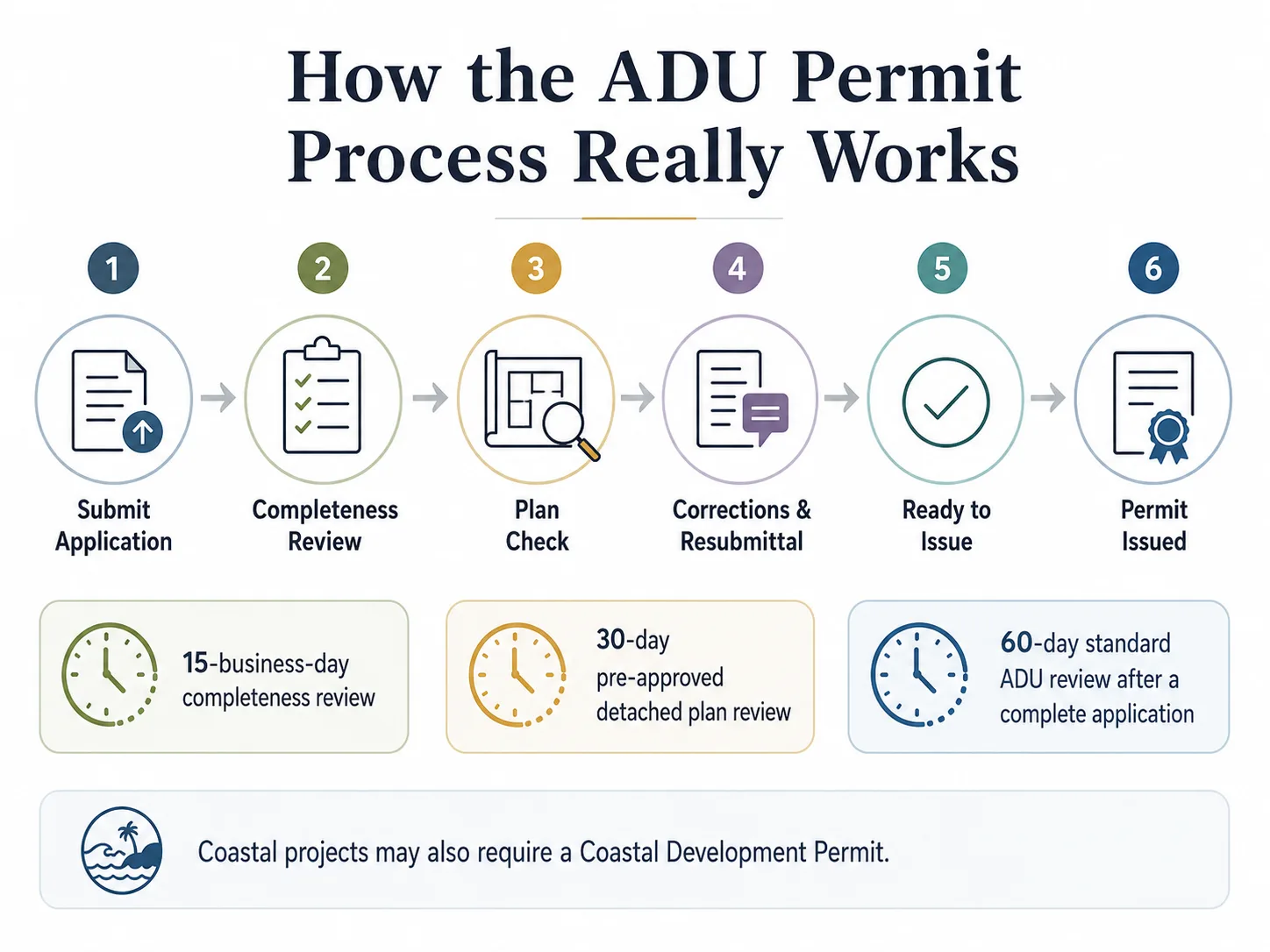
A San Diego ADU permit moves through five phases inside DSD: (1) intake and pre-screen for an editorial 2 to 4 weeks; (2) first plan check across all disciplines for approximately 30 days once deemed complete; (3) recheck rounds for approximately 30 days each, with most projects running 1 to 3 rounds; (4) Ready to Issue for 15 to 20 days; (5) permit issuance, currently 2 business days per DSD dashboard data current May 8, 2026.
Phase 1 — Intake and pre-screen (2 to 4 weeks, editorial range)
Intake begins the moment you upload your application through DSD’s online portal. DSD pulls the package into the pre-screen queue, where staff verify the minimum required documents are present. This is not a content review — staff are checking whether structural calcs were submitted at all, not whether they’re correct. The pre-screen triggers the 15-business-day completeness determination required by §66317(a)(2).
The four moves that compress intake:
- Submit a package that follows DSD’s Requirements for Digital Plans & Documents. Files in the wrong format, missing title blocks, missing PDF bookmarks, or wrong sheet sizes get flagged immediately.
- Include the General Application, Water Meter Data Card, Storm Water Applicability Checklist, and Assessor Building Record for any building over 45 years old. These four items account for a large share of intake corrections.
- Use the current Project Submittal Manual. The Manual updates a few times a year; following an outdated checklist is a common reason a clean-looking submittal gets bounced.
- Book a Virtual Appointment after receiving your PRJ number. DSD offers virtual appointments for project setup and process questions after a PRJ number is assigned — useful for resolving fees, routing, and submittal requirements.
Phase 2 — First plan check (≈30 days)
Once deemed complete and setup fees are paid, the project enters first review. DSD assigns the application to all relevant discipline reviewers concurrently — structural, fire, planning, mechanical, electrical, plumbing, building, accessibility, and any coastal or grading reviewers depending on your project. They each contribute findings to the shared cycle issues report.
The §66317(a)(3) 60-day review clock begins here. A critical workflow rule: even if one discipline completes its review on day 12, you cannot upload responses until every discipline has finished and the consolidated cycle issues report has been issued. The single-response file rule is non-negotiable — address every discipline’s comments in one consolidated resubmittal, not piecemeal.
Phase 3 — Recheck rounds (≈30 days each)
Most San Diego ADU projects run 1 to 3 recheck rounds, according to SnapADU’s published guidance and consistent reporting from other Greater San Diego ADU design-builders. SnapADU notes that even an exceptionally clean submittal will typically trigger a second-round review, because reviewers can ask for additional clarification and code interpretations can vary between reviewers.
Each recheck round runs approximately 30 days from your consolidated response upload to DSD’s next cycle issues report (or approval). Add 1 to 2 weeks for your team to prepare the consolidated response — you’re responding to potentially dozens of comments from multiple disciplines.
Practical math: a project with two recheck rounds takes roughly 2 to 3 months in plan check alone once deemed complete. Three rounds: 3 to 4 months. This is the single biggest variable in the San Diego ADU permit timeline — clean plans clear in two rounds; messy plans take five.
Phase 4 — Ready to Issue (15 to 20 days)
When all disciplines sign off, the project enters Ready to Issue status. DSD has approved the plans and is waiting for final administrative items: payment of permit issuance fees, school fees (for ADUs over 500 sq ft where applicable), water and sewer capacity fees, contractor information, and verification that outstanding holds are cleared.
A project can sit in Ready to Issue for weeks or even months while fees and contractor information are finalized. If site conditions change (zoning update, code-cycle update) during a long Ready to Issue period, DSD may require re-review.
Phase 5 — Permit issuance (2 business days as of May 8, 2026)
The actual issuance step — DSD generating and releasing the permit once fees are paid and verification is complete — currently takes 2 business days for a standard Building Permit per DSD dashboard data current May 8, 2026. Building Permit Rapid Review issuance is also averaging 2 business days, and the Building Permit & Construction Change Hybrid Process is averaging 1 business day. These figures update weekly on the DSD timeline page; re-verify before relying on them.
See What You Can Build → Get Your Free ADU Report
Free starting check, no commitment.
Check My PropertyDo pre-approved ADU plans really make San Diego permits faster?
Yes, but only in the narrow way the rule actually works. Under AB 1332 (codified at California Government Code §65852.27), a qualifying detached ADU using a current-code-cycle pre-approved plan triggers a 30-day approve-or-deny window instead of the standard 60-day window. The catch: the 30-day window applies to the review of the application, not the entire workflow — site-specific items, utility upgrades, grading, coastal review, and any deviations from the pre-approved plan can still extend the real calendar.
What AB 1332 actually requires
AB 1332 (Carrillo, 2023) took effect January 1, 2024. The statute required every local agency in California to establish a pre-approval program by January 1, 2025. The program must: accept ADU plan submissions for pre-approval; post pre-approved plans on the City’s website; and apply a 30-day approve-or-deny window for detached ADU permit applications that use a pre-approved plan from the current triennial Building Standards Code cycle (or an identical plan previously approved by the local agency in the current cycle).
Which pre-approved plans the City of San Diego accepts
As of May 11, 2026, the City of San Diego accepts three pre-approved plan libraries:
- San Diego County PDS ADU Plans. The County operates a free pre-approved ADU plan library through Planning & Development Services. Plans are detached, in a range of sizes from roughly 400 to 1,200 square feet.
- City of Chula Vista PRADU. Chula Vista’s Permit-Ready ADU library was developed under a competitive bid process. The City of San Diego accepts these plans for the 30-day review path.
- City of Encinitas PRADU. Encinitas operates a Permit-Ready ADU program with pre-approved designs. The City of San Diego accepts these plans for the 30-day review.
The City also accepts plans pre-approved through its own master plan production process, governed by Information Bulletin 114a. Any ADU provider can submit plans for City pre-approval. Once approved, the plans are posted on the DSD website alongside the applicant’s contact information. For more detail on the full plan library across San Diego County, see our San Diego Pre-Approved ADU Plans (2026): 26 Options guide.
Why “pre-approved plan” doesn’t mean “no review”
A pre-approved plan is a complete building plan — architecture, structure, energy compliance, mechanical, electrical, plumbing. What it is not is a site-specific plan. DSD’s first review of a pre-approved-plan application focuses on:
- Site-specific compliance (setbacks, dimensions, drainage, easements)
- Utility connections (water, sewer, electric panel capacity, gas)
- Foundation and grading for your specific lot conditions
- Fire access if in a Wildland-Urban Interface zone
- Tree protection if any trees are within the dripline of the proposed construction
- Coastal review if in the Coastal Overlay Zone
The 30-day window applies to that site-specific review. If review surfaces issues, your team responds, and the next round runs. Most pre-approved-plan applications still clear faster than custom — but “30 days” is the floor on review, not the ceiling on time-to-permit-in-hand.
When a pre-approved plan is the wrong choice
Pre-approved plans can be the wrong choice when your lot’s dimensions, slope, or specific constraints don’t fit the standardized plan. Site-specific modifications and added engineering can erase the time saved. If your lot has unusual shape, significant slope, fire-access challenges, or a septic system, a semi-custom plan can be faster end-to-end because it’s designed for your lot from the start. We cover this in depth in our San Diego Pre-Approved ADU Plans guide.
Affiliate disclosure: The Dwelling Index is reader-supported. Some links on this page are affiliate links. If you click one and take a qualifying action, we may earn a commission at no extra cost to you. Affiliate relationships do not influence our editorial rankings or conclusions. Read our full disclosure.
Want a design-build firm to manage the entire permit path?
For homeowners who want a single team to handle design, pre-approved or custom plan selection, permitting, and construction, SnapADU is one of the most active ADU design-builders in Greater San Diego. SnapADU’s public site reports it has completed 100+ ADUs in the region since 2020 and manages design and permitting in-house. SnapADU also publishes that permitting can take up to 6 additional weeks when using a third-party permitting agency, because each handoff adds days to the process — this is SnapADU’s reported figure based on their project records.
Best fit: detached new-construction ADUs in Greater San Diego — San Diego, Oceanside, Carlsbad, Encinitas, Del Mar, Solana Beach, Poway, San Marcos, Escondido, La Mesa, El Cajon, Vista, Chula Vista, Rancho Santa Fe, Santee, Lemon Grove, Imperial Beach, National City, Bonsall, Cardiff by the Sea, La Costa, and unincorporated San Diego County.
Not a fit if: you’re planning a small interior JADU, a simple garage conversion outside their service area, or a property outside Greater San Diego. In those cases, start with the free ADU feasibility report instead.
See also: SnapADU Review 2026
Coastal Overlay Zone ADUs: AB 462 and the second permit clock
If your San Diego ADU is in the Coastal Overlay Zone, you may need a Coastal Development Permit (CDP) in addition to your building permit. AB 462 — chaptered October 10, 2025 as an urgency statute — creates a 60-day approve-or-deny clock for ADU CDP applications and requires CDP review to run concurrently with ADU review where applicable. The City of San Diego’s Coastal Overlay Zone covers parts of La Jolla, Pacific Beach, Mission Beach, Ocean Beach, Sunset Cliffs, and portions of Point Loma. Information Bulletin 400 specifies that a CDP is required for ADUs and JADUs in the Coastal Overlay Zone unless the unit is completely contained within an existing primary structure, does not involve an increase in habitable area, and does not convert non-habitable space to habitable space.
Why coastal ADUs are different
The California Coastal Act requires development in the Coastal Zone to comply with both state coastal policies and the locally adopted Local Coastal Program (LCP). Most ADU construction triggers Coastal Act review because it’s “development” under the Act’s definition. On September 7, 2022, the California Coastal Commission certified the City of San Diego’s amendments to its LCP (action W15), which moved most City ADU coastal reviews to a Process One ministerial path handled by DSD staff — a change that shaved months off coastal ADU timelines in San Diego.
On September 12, 2024, the Coastal Commission certified ADU regulations associated with Housing Action Package 1.0 (Ordinance O-21439). Several additional City ordinances affecting Coastal Overlay Zone ADUs are still pending Coastal Commission certification — Ordinance Numbers O-21618, O-21758, O-21836, and O-21989. Until those ordinances are certified, the older rules apply within the Coastal Overlay Zone.
What AB 462 changed in 2026
- 60-day CDP clock. Local agencies with certified LCPs must approve or deny CDP applications for ADUs within 60 days of a complete application.
- Concurrent review. CDP review must run concurrently with the underlying ADU review under §66317 where applicable — not stacked sequentially after it.
- Disaster-area treatment. AB 462 allows certificate of occupancy for an ADU on a disaster-affected lot under specified conditions.
Our 4-to-10-week coastal premium is an editorial planning range that needs to be validated against City permit records before being presented as a typical add-on — re-verify with DSD before committing to a coastal timeline.
How to know if you’re in the Coastal Overlay Zone
Use the City’s Zoning and Parcel Information Portal (ZAPP) and look up your parcel. The portal shows your Base Zone, applicable overlay zones, and any Planned District designations. If your parcel falls inside the Coastal Overlay Zone, the property card will say so.
If you’re unsure, the safest move is to assume coastal review applies and confirm with DSD before committing to a timeline. The penalty for building a coastal ADU without a required CDP — stop-work orders, demolition orders, Coastal Commission enforcement — is far worse than the time cost of the CDP itself.
Greater San Diego cities substantially in the Coastal Zone
- Coronado — almost entirely within the Coastal Overlay Zone
- Del Mar — substantially within the Coastal Overlay Zone
- Solana Beach — substantially within the Coastal Overlay Zone
- Encinitas (including Cardiff by the Sea) — coastal areas within the Coastal Overlay Zone
- Carlsbad — coastal areas within the Coastal Overlay Zone
- Oceanside — coastal areas within the Coastal Overlay Zone
- Imperial Beach — coastal areas within the Coastal Overlay Zone
- City of San Diego coastal communities — La Jolla, Pacific Beach, Mission Beach, Ocean Beach, Point Loma, Sunset Cliffs
For city-specific coastal ADU guidance, see our city builder pages — each covers the local coastal process where it applies.
What adds weeks or months to a San Diego ADU permit?
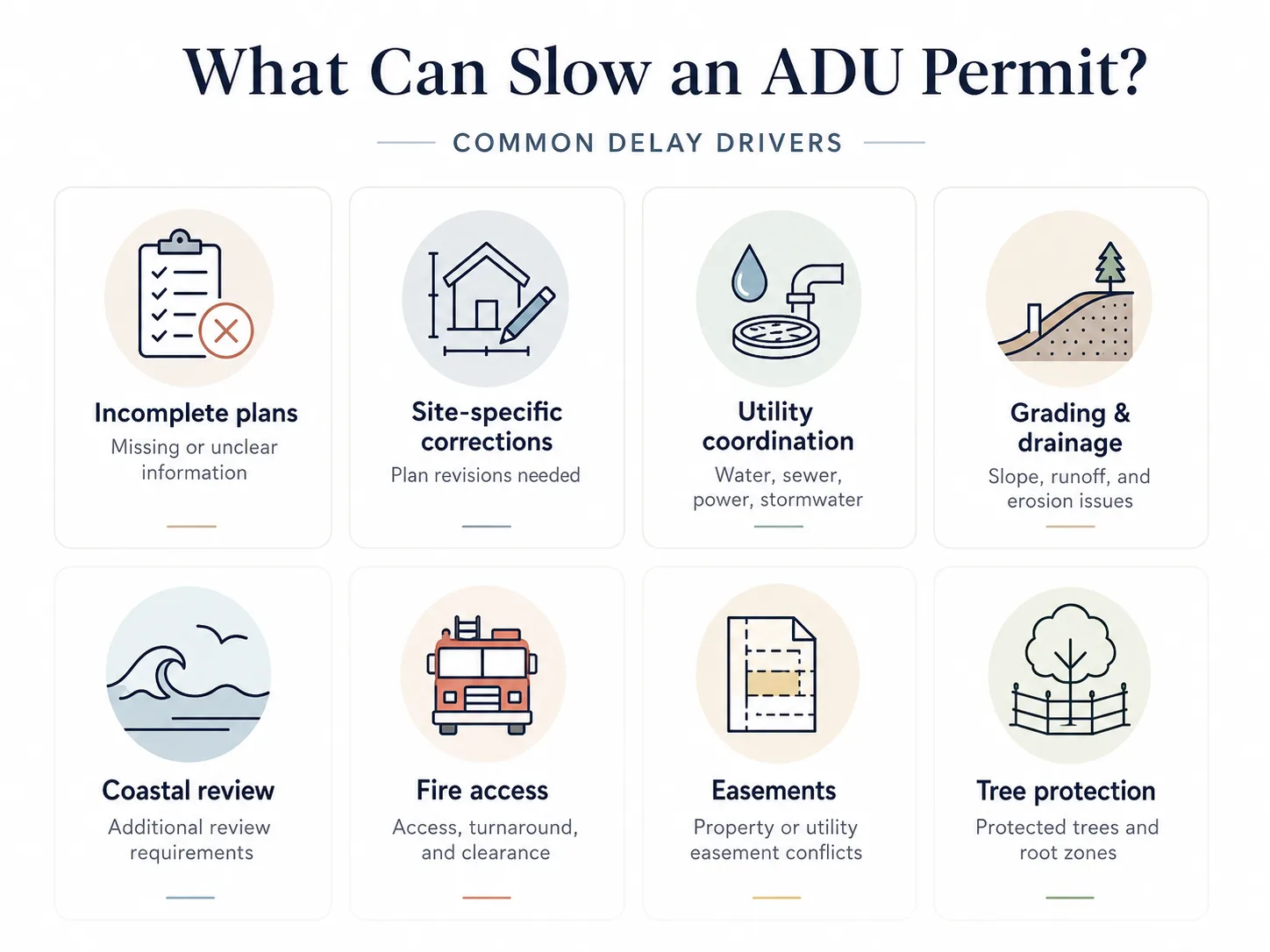
Most San Diego ADU permits stretch past the 60-day legal clock because of a small set of repeatable causes — incomplete submittal packages, missing discipline responses on resubmittals, coastal review, grading and slope issues, septic and unincorporated County conditions, fire access requirements, utility upgrades, older-building documentation, and HOA review. The fastest timelines come from finding these issues before submittal.
The delay-risk table
| Delay risk | Warning sign on your property | What to do before submittal | Why it costs weeks |
|---|---|---|---|
| Coastal review | Property in Coastal Overlay Zone and ADU not fully inside existing primary structure | Confirm CDP requirement under IB 400; check pending Coastal Commission certifications | CDP runs concurrently under AB 462 but adds noticing and additional review |
| Incomplete response package | Multiple disciplines issued corrections | Wait for all disciplines to complete cycle reports; respond to every discipline in one consolidated file | DSD treats piecemeal resubmittals as incomplete |
| Grading or slope | Sloped lot, geological special-study overlay, or retaining walls needed | Ask whether a grading permit or slope-analysis report is required upfront | Adds a separate Grading review track |
| Utility upgrades | New detached ADU, electric appliances, sewer tie-in question, or undersized water meter | Have your designer produce a utility plan and panel-load calculation before submittal | Triggers right-of-way work and utility-provider coordination |
| Older building (45+ years) | Existing primary residence built before 1981 | Prepare Assessor Building Record and photographic survey at submittal | DSD requires these documents; missing them stalls intake |
| Septic system | Property uses septic (common in unincorporated County and parts of North County) | Run septic capacity analysis and percolation test before submittal | Adds environmental health review |
| Fire access | Property in a Very High Fire Hazard Severity Zone | Confirm hose-pull distance, defensible space, and ignition-resistant construction standards | Adds Fire Department review |
| Tree protection | Trees within the proposed footprint or dripline | Get an arborist report and include tree-protection notes on the site plan | Triggers Planning review |
| HOA review | Property governed by CC&Rs | Submit construction documents to HOA in parallel with City | HOA review can run weeks; doesn’t pause the City clock but can block construction |
| Third-party permit-handoff drag | Designer and permit consultant are separate firms | Use a single team or a tight communication protocol; reduce handoffs | SnapADU reports up to 6 additional weeks per handoff in their published data |
The recheck-killer checklist
These are the specific submittal items that frequently appear in cycle issues reports. Audit your plans against this list before submittal. Items marked [NEEDS CODE SOURCE] should be confirmed by your design team against the relevant code or bulletin.
Site and civil (5 items)
- Incomplete site plan dimensions. Every setback, lot line, easement, and structure-to-structure distance must be dimensioned and labeled. Source: DSD Project Submittal Manual, site plan requirements.
- Missing drainage path. The site plan must show how storm water flows from your roof and any new impervious surfaces to an approved discharge point. Source: City Storm Water Applicability Checklist requirements.
- Misplaced setback dimensions on a corner lot. Corner lots have two front yards as a typical zoning treatment, and the side-to-front setback transition is a frequent source of corrections. Source: San Diego Municipal Code zoning provisions; confirm specific yard treatment with DSD for your zone.
- Missing tree-protection notes. If any trees are within the dripline of proposed construction, the site plan typically must include tree-protection notes and protection fencing details. [NEEDS CODE SOURCE — confirm specific tree-protection provisions applicable to your parcel with DSD Planning.]
- Missing fire-zone designation. Properties in a Wildland-Urban Interface or Very High Fire Hazard Severity Zone typically must declare the designation on the site plan. Source: California Residential Code Chapter R337 and applicable City fire zone overlay regulations.
Building and structural (5 items)
- Missing Title 24 energy compliance documentation. California Title 24 requires a specific compliance package — energy compliance forms (CF1R, CF2R, CF3R), envelope calculations, and HVAC sizing. ADUs are not exempt.
- Missing structural calcs for tall walls. Tall walls and lateral systems require structural analysis per the California Residential Code and California Building Code. [NEEDS CODE SOURCE — your design engineer should confirm the specific threshold and analysis applicable to your project.]
- Solar panel requirement. Per City of San Diego ADU information, newly constructed non-manufactured detached ADUs are subject to the California Energy Code solar-panel requirement; panels may be installed on the ADU itself or on the primary dwelling. JADUs are not required to have solar panels.
- Missing accessibility provisions for any Bonus Accessible ADU. If building under the ADU Home Density Bonus Program and claiming an accessible unit, ADA-equivalent accessibility provisions must appear on the plans.
- Missing fire-rated assembly details near property lines. Exterior walls near property lines typically require fire-rated assembly details per the California Residential Code. [NEEDS CODE SOURCE — confirm the exact distance threshold and assembly requirements with your design engineer.]
Submittal-package level (4 items)
- Assessor Building Record missing for buildings over 45 years old. If the existing primary residence is older than 45 years, the Assessor Building Record and a photographic survey must be included. Source: DSD Permit Processing Timeline guidance.
- Uploaded files don’t follow DSD’s digital plan requirements. PDF sheet sizes, bookmarks, title blocks, and electronic signature placement all have specific rules. Source: DSD Requirements for Digital Plans & Documents.
- Corrections from multiple disciplines not consolidated. Each resubmittal must respond to every discipline’s comments in a single consolidated response file. Source: DSD Permit Processing Timeline page workflow rules.
- Contractor information missing at Ready to Issue. Missing license numbers, missing workers’ comp documentation, or wrong contractor classification will hold your issuance. Source: DSD Information Bulletin 153.
Get the Free San Diego ADU Permit Comment Tracker
Spreadsheet template for logging city comments, discipline names, response dates, resubmittal dates, and who owns each fix. Free download.
Download Free Comment TrackerGreater San Diego permit window: how 19 jurisdictions compare
The City of San Diego is the largest jurisdiction in San Diego County but not the slowest. Coastal-Zone-heavy cities like Coronado, Del Mar, and Solana Beach tend to run longer because the CDP adds a parallel review. Below is our compiled comparison across 19 jurisdictions. Hard timeline windows in this table are editorial planning ranges based on builder-reported data and official municipal program structure — not verified permit-record medians.
| Jurisdiction | Editorial typical permit window | Pre-approved plan path | Coastal Zone | Submittal mode | Basis |
|---|---|---|---|---|---|
| City of San Diego | 3–5 months | Yes — accepts County PDS, Chula Vista, Encinitas plans; 30-day review under §65852.27 | Coastal Overlay covers parts of La Jolla, Pacific Beach, Mission Beach, OB, Point Loma, Sunset Cliffs | Digital (100% online) | DSD timeline page; IB 400; SnapADU/Better Place reported data |
| San Diego County (unincorporated) | 4–10 weeks | Yes — County PDS ADU Plans library | Coastal-adjacent in some communities | In-person at County Operations Center | County PDS ADU page; SnapADU reported data |
| Chula Vista | ~3 months | Yes — Chula Vista PRADU program | No | Hybrid | City of Chula Vista ADU page; SnapADU reported data |
| Carlsbad | 3–5 months | Limited [NEEDS VERIFICATION] | Yes — Carlsbad LCP governs coastal areas | In-person | Carlsbad ADU page; provider-reported |
| Encinitas (incl. Cardiff) | 2–4 months | Yes — Encinitas PRADU; 30-day path | Yes — substantially in Coastal Zone | Digital | City of Encinitas ADU page; provider-reported |
| Oceanside | 3–4 months | Limited [NEEDS VERIFICATION] | Yes — coastal areas | Hybrid [NEEDS VERIFICATION] | City of Oceanside ADU page (60-day review clock; stops on plan check comments, restarts on resubmittal) |
| La Mesa | 2–3 months | Yes — La Mesa PADU library | No | Digital | City of La Mesa ADU page |
| El Cajon | 2–3 months | Limited [NEEDS VERIFICATION] | No | Digital | El Cajon ADU page; provider-reported |
| Escondido | 3–4 months | Yes — Escondido PAADU program | No | In-person [NEEDS VERIFICATION] | City of Escondido PAADU page |
| San Marcos | 2–3 months | Yes — San Marcos PRADU program | No | Digital [NEEDS VERIFICATION] | City of San Marcos PRADU page |
| Poway | 3–4 months | Limited [NEEDS VERIFICATION] | No | Hybrid [NEEDS VERIFICATION] | Provider-reported |
| Coronado | 4–6 months | No [NEEDS VERIFICATION] | Yes — substantially within Coastal Zone | Hybrid [NEEDS VERIFICATION] | Provider-reported |
| Del Mar | 4–6 months | Yes — Del Mar PAADU | Yes — substantially Coastal | Hybrid [NEEDS VERIFICATION] | City of Del Mar ADU page; provider-reported |
| Solana Beach | 3–5 months | Limited [NEEDS VERIFICATION] | Yes — substantially Coastal | Hybrid [NEEDS VERIFICATION] | Provider-reported |
| Imperial Beach | 2–3 months | Yes — Imperial Beach pre-approved plans | Yes — coastal areas | Hybrid [NEEDS VERIFICATION] | City of Imperial Beach ADU page |
| National City | 2–3 months | Limited [NEEDS VERIFICATION] | No | Digital [NEEDS VERIFICATION] | Provider-reported |
| Santee | 2–3 months | Limited [NEEDS VERIFICATION] | No | Digital [NEEDS VERIFICATION] | Provider-reported |
| Vista | 3–4 months | Limited [NEEDS VERIFICATION] | No | Hybrid [NEEDS VERIFICATION] | Provider-reported |
| Lemon Grove | 2–3 months | Limited [NEEDS VERIFICATION] | No | Hybrid [NEEDS VERIFICATION] | Provider-reported |
Editorial synthesis of official municipal ADU program pages and Greater San Diego builder-reported timeline data. Items marked [NEEDS VERIFICATION] have not been directly confirmed against the named jurisdiction’s current public source as of May 11, 2026.
The spread between fastest editorial range (~2 months) and slowest (~6 months) is heavily driven by submittal completeness, correction-cycle count, and Coastal Zone status rather than which city you’re in. Two homeowners in the same jurisdiction can have permit timelines 3 months apart based on whether their submittal clears in one round or four.
The City of San Diego processes more ADU permits than any other jurisdiction in the region — roughly 1,909 ADUs were among 10,000 homes approved in a single recent year per DSD program staff cited by CBS 8. Despite that volume, the City’s published workflow has compressed substantially since 2022 because DSD has hired into vacancies, intake moved 100% online, and the AB 1332 pre-approved-plan path has diverted simpler projects to a 30-day track.
How do I check current San Diego ADU permit wait times?
The City of San Diego publishes a public Permit Processing Timeline that updates weekly. The page separates intake, review, and issuance stages and shows current citywide averages. It reflects all building permits, not an ADU-specific median — useful as context for typical stage timing, but not as a per-project guarantee.
Three resources, in order of usefulness
- DSD Permit Processing Timeline (sandiego.gov/development-services/permits/timeline). Weekly snapshot of intake, review, and issuance averages across all permit types. Use the figures as citywide context, not ADU-specific medians.
- DSD Permit Center Dashboard (linked from the timeline page). An interactive dashboard with deeper breakdowns by permit type and review stage.
- DSD Accela account (login required). Your specific project’s current status, current discipline assignments, and cycle issues report history.
What “intake,” “review,” and “issuance” mean on the DSD dashboard
- Intake numbers measure the queue from “upload” to “pre-screen complete.” If your project is past pre-screen but hasn’t received a completeness determination, you’re still in intake.
- Review numbers measure the time from “deemed complete” to “all disciplines signed off.” If you’ve received a cycle issues report and are preparing a response, you’re in review but waiting on your response.
- Issuance numbers measure the time from “all disciplines signed off and Ready to Issue” to “permit physically issued.” This is the 2-business-day number; it does not measure the full ADU permit timeline.
How to read your workflow status
DSD publishes a Workflow Status Mapping and Definitions PDF that maps status names in Accela to plain-English meanings. Common statuses for an active ADU permit:
- Application Setup — DSD is generating your fee invoice. Action: pay the setup fee.
- In Intake — Pre-screen in progress.
- Intake Complete / Routed for Review — Application deemed complete; 60-day clock running.
- Cycle Issues Report Issued — You have corrections. Action: prepare consolidated response across all disciplines.
- In Plan Check / Review — Active review by one or more disciplines.
- Ready to Issue — All disciplines signed off; awaiting fee payment, contractor info, or final verification.
- Permit Issued — Done. Construction can begin (subject to inspection sequencing).
When to book a DSD virtual appointment
DSD offers virtual appointments for project setup and specific status/process questions after a PRJ number is assigned. They’re particularly useful at two points:
- Right after receiving your PRJ number, before pre-screen completes. Helps confirm fees, routing, and submittal requirements.
- Mid-project, if you’re past day 30 of review with no comments. A status appointment can surface whether your project is genuinely stuck or simply queued.
To schedule, visit sandiego.gov/development-services/virtual-appointments.
How long do San Diego ADU permits last after they’re issued?
In the City of San Diego, a building permit becomes void if not utilized within one year of issuance. Once utilized, work cannot be suspended or abandoned for 180 calendar days at a time. For one- and two-family residential dwellings and accessory structures (which includes most ADUs), the underlying permit expires three years after issuance if final inspection isn’t reached. The City allows utilization extensions of up to 180 days when a request is filed on the required form no later than one month before the end of the utilization period (Information Bulletin 117).
In unincorporated San Diego County, work must start within 2 years of issuance, progress with valid inspections at least every 180 days, and reach completion within 3 years.
City of San Diego permit expiration (SDMC §129.0218 and IB 117)
- One-year utilization rule. The permit becomes void if not utilized within one year of issuance. “Utilized” generally means construction work has commenced and at least one inspection has been called and passed.
- 180-day abandonment rule. Once utilized, work cannot be suspended or abandoned for 180 calendar days. If work stops longer, the permit becomes void.
- Three-year final-inspection rule. For one- and two-family dwellings and accessory structures, the permit expires three years after issuance if final inspection isn’t reached.
- 180-day extensions. Extensions are not automatic. The extension request must be filed on the required form no later than one month before the end of the utilization period, and the Building Official must determine the criteria are met.
When permit expiration matters most
Four common situations where permit expiration becomes a real risk:
- Family-planning ADUs where the move-in date is uncertain. The owner gets the permit ready and then waits for the family member.
- Investment ADUs being financed during the build. Construction loan or HELOC timing pushes the actual start back.
- Properties on a sale path. Owner permits the ADU to add resale value, then sells before construction.
- DIY or owner-builder projects. Construction proceeds slowly between weekend work.
In all cases: don’t let the permit go void. File the IB 117 extension request well before the one-year mark, document the reason for delay, and keep a record of any inspections called.
What documents should I prepare before submittal?
A faster San Diego ADU permit starts before submission. City of San Diego ADU/JADU submittals require a complete drawing package plus City forms including the General Application, Water Meter Data Card, and Storm Water Applicability Checklist. Older buildings (45+ years) require an Assessor Building Record and photographic survey. The complete checklist lives in Information Bulletin 400 and the DSD Project Submittal Manual.
Minimum drawing package
- Cover sheet with project information, code summary, and sheet index
- Site plan showing all property lines with dimensions, all existing and proposed structures, setbacks, easements, utilities, drainage flow, parking, and access
- Vicinity map
- Floor plans for each level of the proposed ADU
- Roof plan
- Exterior elevations (typically all four sides)
- Building sections showing wall assemblies, floor and roof assemblies
- Structural plans and calculations for foundations, framing, lateral systems
- Title 24 energy compliance package (CF1R, CF2R, CF3R forms, envelope and HVAC calculations)
- Mechanical, electrical, and plumbing plans
- Fire-rated assembly details where required based on property-line distance and construction type
City forms and checklists
- General Application form
- Water Meter Data Card (routed through City Public Utilities Department: Water)
- Storm Water Applicability Checklist
- Coastal Determination form if your property is in or near the Coastal Overlay Zone
- Grading Determination if any significant cut, fill, or retaining wall is proposed
For older buildings (45+ years)
- Assessor Building Record — accessible through the San Diego County Assessor’s Office
- Photographic survey documenting the existing structure’s exterior condition
Utility considerations before submittal
- Water meter sizing. Confirm meter and service details through the City of San Diego Public Utilities Department / DSD process — the Water Meter Data Card is the City’s primary intake document for this.
- Sewer connection. Confirm sewer-lateral capacity, slope, and connection point. Septic properties add a separate environmental health review track.
- Electric panel capacity. Most older San Diego homes have 100A or 125A panels. ADU loads often require a panel upgrade.
- Gas service. Confirm whether the ADU will be all-electric or include gas. All-electric ADUs avoid gas-service permitting issues.
Practical pre-submittal checklist
Before your designer hits “upload,” ask them to confirm each of these:
- ☐Complete drawing set per Information Bulletin 400
- ☐Site plan with all setbacks, dimensions, and drainage path
- ☐Structural calculations stamped by a licensed engineer
- ☐Title 24 energy compliance package complete
- ☐Water Meter Data Card complete (and routed through City Public Utilities)
- ☐Storm Water Applicability Checklist complete
- ☐Coastal determination if applicable
- ☐Grading determination if applicable
- ☐Plan-check response owner identified (single point of contact)
- ☐Expected resubmittal turnaround time committed to in writing
If your designer hesitates on any of these, that hesitation is one of the most predictive indicators of a slower permit timeline.
What should I do if my San Diego ADU permit is delayed?
Don’t ask “any update?” — that question consistently produces the least useful answers. Ask specifically: which stage is the project in, has the application been deemed complete, are all setup fees paid, which disciplines have issued comments, who owns each response, and is the 30-day or 60-day clock currently running, paused, or no longer the relevant gate because comments have been issued.
The 7 questions to ask your designer or permit coordinator
- Has the application been deemed complete by DSD? If yes, on what date.
- Are all setup and plan-check fees paid?
- Which disciplines have completed review and which are still pending?
- Were any cycle issues reports issued? If yes, when and by which disciplines.
- Who owns the response to each correction? Designer, structural engineer, mechanical engineer, civil engineer, etc.
- What is the target resubmittal date?
- Is the 30-day or 60-day review clock currently running, paused under §66317, or already satisfied by the City’s action?
The permit-status script you can copy and send
Subject: ADU permit status and plan-check clock confirmation
Hi [Name],
I’d like to confirm the current permit stage for project number [PRJ-XXXXXX]. Could you confirm the following:
- Has the application been deemed complete? If yes, on what date?
- Are all setup or plan-check fees paid?
- Which disciplines have completed review, and which are still in progress?
- Were any correction comments issued? If yes, when and by which disciplines?
- Who owns the response for each correction?
- What is the target resubmittal date?
- Is the 30-day or 60-day review clock currently running, paused under §66317, or already satisfied?
If a virtual appointment with the assigned reviewer would help resolve any of the above, I’d appreciate a recommendation on how to set one up.
Thank you,
[Your name]
When the delay is normal vs a red flag
Normal delays
- Pre-screen taking 2 to 3 weeks during a high-volume period
- First review taking the full 30 days
- A second cycle issues report
- 2 to 3 weeks to consolidate a response to multiple disciplines
Red flag delays
- 4+ weeks in pre-screen with no completeness determination
- 30+ days in active review with no comments issued and no reviewer assigned
- Designer can’t tell you which disciplines have completed review
- Same “any day now” answer week after week without specifics
When to escalate
If your project is past day 50 of active review with no comments issued, send a written status request and book a DSD virtual appointment. If the City misses the 60-day deadline on a complete application without a tolling event, §66317(d) provides for deemed approval — don’t invoke that without legal counsel, but use the awareness to drive a status conversation. If your designer is the bottleneck, ask for specifics in writing. Note that adding a third-party permit expediter itself can add weeks, per SnapADU’s published data on handoff costs.
Track your permit stage week-by-week
Get the Free ADU Permit Comment Tracker — a spreadsheet template for logging city comments, discipline names, response dates, and who owns each fix.
Download Free Comment TrackerWhich San Diego ADU path should I choose if timing matters?
If timing is your top priority, the lowest-risk permit path is usually a clean inland detached ADU using a qualifying pre-approved plan and a complete site-specific package. The highest-risk paths involve coastal review, sloped or septic sites, fire-zone constraints, heavily modified pre-approved plans, or third-party permit handoffs.
The path-selection table
| Your situation | Lowest-timeline-risk path | Key prep before submittal |
|---|---|---|
| “I want the fastest path and I have a simple inland lot.” | Pre-approved detached plan + complete site-specific package + single design-build team | Confirm pre-approved plan fits your lot dimensions and setbacks |
| “I’m in the Coastal Overlay Zone.” | Determine if CDP applies under IB 400 before choosing a plan; budget for the 60-day CDP clock under AB 462 (concurrent with ADU review) | Pull your parcel’s Coastal Overlay status from ZAPP |
| “I’m converting a garage.” | Garage conversion ADU using existing footprint; confirm fire separation and structural | Confirm structure can accept conversion; address older-building documentation |
| “I’m in unincorporated County.” | County PDS pre-approved plans + budget for septic, fire, and grading reviews | Pull septic capacity and fire zone designation first |
| “I need rental income by a specific date.” | Pre-approved detached plan + design-build team that handles permitting in-house | Plan for 30-day pre-approved review + 6 to 10 month construction. Note: City ADUs/JADUs may not be rented for less than 31 consecutive days. |
| “I’m building for a family member moving in.” | Same as rental — speed favors pre-approved + single team | Coordinate move-in date with permit + construction timeline |
| “I want someone to manage the whole thing for me.” | Design-build firm covering Greater San Diego | Verify service area, CSLB license, and that permitting is in-house |
| “I have a complex site (slope, septic, fire zone, irregular lot).” | Semi-custom plan + experienced local design-build firm | Plan for longer permit timeline and possible additional environmental review |
| “I’m legalizing a pre-2020 ADU.” | AB 2533 legalization pathway + substandard checklist response | IB 242 excludes legalization-bulletin use in Coastal Act areas; Coastal Commission approval required there |
| “I want to sell the ADU separately.” | City of San Diego opted into AB 1033 via Ordinance O-21989 — but ADUs developed through the City’s ADU Home Density Bonus Program are not eligible for separate sale | Plan for condominium creation under Davis-Stirling Act, Subdivision Map Act compliance, safety inspection, lienholder consent, and utility-provider notice |
When custom design is the right choice anyway
Pre-approved plans are fastest on average, but they’re not always the right answer. Three scenarios push toward custom even when timing matters:
- Lot dimensions don’t fit any pre-approved plan footprint. Modifying a pre-approved plan to fit a constrained lot can require enough engineering changes to erase the time savings.
- Significant slope or unusual topography. Pre-approved plans assume flat or near-flat lots. Sloped lots need custom foundation and grading design.
- Strong aesthetic or programmatic requirements. If the ADU is intended for long-term family housing or as a primary income generator, design quality often justifies the time premium.
The “house aging parent” path
This is one of the most common reasons we see for an ADU project. The timeline math is critical because the family member’s situation can shift while the permit and construction are pending:
- Start with a pre-approved plan unless the lot really requires custom design.
- Choose a single team that handles design, permitting, and construction. The handoff penalty between separate firms can be 6+ weeks per handoff per SnapADU’s published reporting.
- Budget around 10 to 14 months from “first call” to “move-in ready” — design refinement + 3 to 5 months permit + 6 to 10 months construction.
- If the family member’s situation is urgent (next 6 months), the timeline math doesn’t work for new construction. Consider an interior JADU or manufactured ADU on a quicker timeline.
See What You Can Build → Get Your Free ADU Report
Free starting check, no commitment.
Check My PropertyMethodology: how we built this San Diego ADU permit timeline
This page was built by separating three things that other resources tend to blur together: California’s official legal clocks, the City of San Diego’s published workflow stages, and the practical planning ranges that reflect what San Diego homeowners actually experience. Legal claims come from primary sources — California Government Code, AB 1332, AB 462, AB 976, AB 1033, AB 1154, AB 2533, the HCD ADU Handbook, the San Diego Municipal Code, and DSD Information Bulletins. Practical planning ranges are explicitly labeled as editorial synthesis of public city workflows, the statutory clocks, and timelines reported by Greater San Diego ADU builders. We do not represent any practical planning range as a verified permit-record median.
Primary legal and regulatory sources
- California Government Code §66317 (15-business-day completeness, 60-day approve-or-deny, tolling, deemed approval, appeal process per SB 543)
- California Government Code §65852.27 (AB 1332 pre-approved plan program; 30-day clock)
- AB 1332 (Carrillo, chaptered 2023; effective January 1, 2024; programs required by January 1, 2025)
- AB 462 (chaptered October 10, 2025; urgency statute; coastal CDP 60-day concurrent clock)
- AB 976 (effective January 1, 2024; permanently removed ADU owner-occupancy sunset)
- AB 1033 (effective 2024; separate sale of ADUs)
- AB 1154 (2025; narrows JADU owner-occupancy rule based on bathroom configuration)
- AB 2533 (effective 2025; pre-2020 ADU legalization pathway)
- SB 13 (2019; impact-fee waiver for ADUs under 750 square feet)
- SB 477 (2024; renumbered the bulk of ADU statutes to §§66314–66342)
- HCD ADU Handbook (March 2026 update)
- California Coastal Commission certification action W15 (September 7, 2022) and Housing Action Package 1.0 certification (September 12, 2024)
- HCD letter dated October 6, 2025 identifying state-law compliance concerns with portions of City of San Diego Ordinance O-21989
City of San Diego sources
- DSD Permit Processing Timeline page (data current May 8, 2026)
- DSD Workflow Status Mapping and Definitions PDF
- Information Bulletin 400 (Accessory Dwelling Unit/Junior Accessory Dwelling Unit)
- Information Bulletin 117 (Building Permit Extension & Expiration)
- Information Bulletin 153 (Ready to Issue Requirements)
- Information Bulletin 242 (How to Obtain a Permit to Legalize Unpermitted ADUs; excludes Coastal Act areas)
- Information Bulletin 501 (Fee Schedule for Construction Permits)
- Information Bulletin 114a (Master Plan Production Process)
- San Diego Municipal Code §141.0302 (ADU regulations, ADU Home Density Bonus Program)
- San Diego Municipal Code §129.0218 (Permit expiration)
- City of San Diego Ordinances O-21989, O-21439, and pending Coastal Commission certifications for O-21618, O-21758, O-21836
Industry / practitioner sources
- SnapADU published permit-timeline data and project records (2020–2026)
- Better Place Design & Build San Diego ADU permit content
- ADU Geeks San Diego ADU process documentation
- CBS 8 coverage of DSD permitting (2022–2024)
- City of Encinitas, Chula Vista, Del Mar, La Mesa, Imperial Beach, and other Greater San Diego city ADU program pages
For Dwelling Index’s full editorial standards and corrections policy, see /editorial-standards/ and /corrections/. We are not affiliated with DSD, County PDS, or HCD. We do not provide legal advice; for project-specific legal questions, consult a California land-use attorney.
San Diego ADU permit timeline FAQ
Is the San Diego ADU permit timeline 30 days or 60 days?
Neither, in isolation. The 60-day rule under Government Code §66317(a)(3) applies to the review of a complete ADU application — meaning after the City has deemed the application complete. The 30-day rule under AB 1332 (§65852.27) applies to qualifying detached ADUs using a pre-approved plan from the current code cycle. Both are review clocks, not permit-in-hand timelines. The full editorial planning range from initial submittal to issuance typically runs 3 to 5 months for custom ADUs and 30 to 60 days for pre-approved-plan ADUs in the City of San Diego in 2026.
When does the 60-day ADU clock start in San Diego?
The 60-day clock starts the day your application is deemed complete, not the day you upload drawings. Gov. Code §66317(a)(2) requires the City to issue a completeness determination within 15 business days of submittal. If the application is incomplete, the City lists what’s missing and the 60-day clock doesn’t run until you cure those items and the City accepts the resubmittal. DSD also separates its workflow into intake, review, and issuance — the 60-day clock measures the review stage only.
Do pre-approved ADU plans guarantee a 30-day permit in San Diego?
No. Pre-approved plans qualify for a 30-day review window for detached ADUs under §65852.27, but the 30-day clock applies only after the application is deemed complete. Site-specific items — setbacks, drainage, utilities, foundation, fire access, coastal status — still require review. Most pre-approved-plan applications clear in 30 to 60 days based on builder-reported data, but the 30 days is the floor on review, not the time to permit-in-hand.
What can extend the ADU permit calendar past 60 days?
Three things have explicit statutory effect: an incomplete application (the 60-day clock doesn’t start), an applicant-requested delay (clock tolled), and a concurrent primary-dwelling decision (City may delay action on the ADU). In practice, the biggest practical extender is applicant response time on cycle issues reports — time spent revising and consolidating responses across disciplines is on you, not on the City.
How long does a garage conversion ADU permit take in San Diego?
Garage conversion ADUs typically permit faster than new-construction detached ADUs because the building footprint already exists. Editorial planning range: 2 to 4 months from initial submittal to issuance. The most common timeline-killers are older-building documentation (Assessor Building Record + photographic survey if the original structure is over 45 years old), fire separation between the converted garage and the primary residence, and utility upgrades.
Do coastal ADUs in San Diego need extra review?
Many do. IB 400 specifies that a Coastal Development Permit (CDP) is required for ADUs and JADUs in the Coastal Overlay Zone unless the unit is completely contained within an existing primary structure, does not involve an increase in habitable area, and does not convert non-habitable space to habitable space. AB 462 (effective October 10, 2025) creates a 60-day approve-or-deny clock for ADU CDP applications and requires CDP review to run concurrently where applicable.
How do I check my San Diego ADU permit status?
Log into your DSD Accela account using your PRJ project number. For city-wide average times, check the DSD Permit Processing Timeline page (sandiego.gov/development-services/permits/timeline) which updates weekly. For a status conversation with the assigned reviewer, book a DSD virtual appointment at sandiego.gov/development-services/virtual-appointments.
Can I start building before my ADU permit is issued?
No. California Government Code and the San Diego Municipal Code both require a building permit before construction begins. AB 2533 (effective 2025) creates a legalization pathway for ADUs built before January 1, 2020 — but it does not authorize starting unpermitted construction now, and IB 242 specifies that the City’s legalization process is not allowed for unpermitted work in Coastal Act areas.
How long is a San Diego ADU permit valid after issuance?
Under SDMC §129.0218 and IB 117, building permits must be utilized within one year of issuance and once utilized cannot be suspended or abandoned for 180 days at a time. For one- and two-family dwellings and accessory structures (which includes most ADUs), the permit expires three years after issuance if final inspection isn’t reached.
Why did my builder say permitting could take 6 months if state law says 60 days?
Because the legal review clock and the practical project calendar are different things. The state’s 60-day clock runs only during active review of a complete application. It does not run during intake, during applicant response time on cycle issues reports, during Ready to Issue, or during issuance. A project with one cycle of corrections typically takes 3 to 4 months total from initial submittal even though the City’s active review stays inside the 60-day window.
Can I sell my ADU separately from my house in San Diego?
Yes, in principle. The City of San Diego opted into AB 1033 via Ordinance O-21989. The pathway requires condominium creation under the Davis-Stirling Act, Subdivision Map Act compliance, a safety inspection, lienholder consent, and utility-provider notice. ADUs developed through the City’s ADU Home Density Bonus Program are not eligible for separate sale. HCD’s October 6, 2025 letter identified state-law compliance concerns with portions of O-21989; verify the latest City and HCD posture before relying on a specific local provision.
Can I short-term rent my ADU after the permit is issued?
No. City of San Diego ADUs and JADUs may not be rented for less than 31 consecutive days. The minimum 31-day rental term applies to all ADUs and JADUs regardless of permit path.
Does using a design-build firm speed up the permit timeline?
In most cases, yes. The largest single source of preventable delay is the handoff between a separate designer and a separate permit consultant. SnapADU’s published guidance notes that permitting can take up to 6 additional weeks when third-party permit handoffs are involved. A single design-build firm that handles design, permitting, and construction in-house typically clears the permit faster on average — although the firm’s actual track record matters more than the structure.
A note on what this guide doesn’t cover
This page is the permit-timeline answer. It doesn’t go deep on permit fees, because that’s a different question covered in San Diego Detached ADU Cost 2026: Real Prices + Fee Math. It doesn’t list every pre-approved plan available in the city — that’s covered in San Diego Pre-Approved ADU Plans (2026): 26 Options. It doesn’t rank builders — that’s covered in our Best ADU Builders San Diego County guide.
What this page does is answer the one question that drives the most homeowner anxiety: how long is this going to take, and what can I do this week to make it faster?
See What You Can Build at Your Address → Get Your Free ADU Report
Free starting check, no commitment.
Check My Property