
Encinitas Pre-Approved ADU Plans: All 8 PRADU Options, Real Costs & Permit Steps
Encinitas currently offers eight City-pre-approved ADU plans — the “PRADU” program — designed by two local architecture firms, Design Path Studio and DZN Partners. Plans range from a 224 sq ft DZN studio to a 1,199 sq ft DZN three-bedroom, and they cost $0 to download. The City waives PRADU plan check and inspection fees, though required state/regional fees, school and water/sewer district fees, Coastal Development Permit noticing postage, and recorder fees still apply. Most homeowners building a PRADU spend between $155,000 and $830,000 all-in depending on plan size and site conditions.
Your real plan-selection decision is rarely about square footage. It’s about whether you stay under 500 sq ft (the geotechnical-letter trigger) or under 750 sq ft of interior livable space (the state impact-fee ceiling under Gov. Code §66311.5). Below, we compare every plan, decode the fee thresholds, walk the permit process step by step, and tell you when PRADU is the wrong answer.
By The Dwelling Index Editorial Team · · Last verified: May 11, 2026 · Next scheduled review: November 2026
What We Verified — May 11, 2026
- 8 PRADU plans active: City of Encinitas PRADU page — Design Path Studio (350, 555, 745, 938 sq ft) and DZN Partners (224, 499, 990, 1,199 sq ft)
- PRADU fee waiver: City waives plan check and inspection fees; state, school, water/sewer district, CDP postage, and recorder fees still apply
- 500 sq ft geotech trigger: Encinitas Applications & Information — geotechnical letter required for structures over 500 sq ft unless waived by Building Official
- 750 sq ft impact-fee shelter: Gov. Code §66311.5 prohibits local agencies from charging impact fees on ADUs at or under 750 sq ft of interior livable space
- AB 1332 30-day clock: Applies to Encinitas PRADU permits (plans are current-code-cycle compliant, effective January 1, 2026)
- Short-term rentals prohibited: City STR Permits page — ADU STRs prohibited except narrow grandfathered permits
Pick your starting plan by goal
| If your priority is… | Start with… | Why |
|---|---|---|
| Smallest possible detached unit | DZN Partners Studio (224 sq ft) | Lowest footprint; least site disruption; below both fee thresholds |
| Small backyard, livable studio | Design Path Studio (350 sq ft) | Compact, modular base plan you can expand later |
| True 1-bedroom that stays below the over-500 sq ft geotech-letter trigger | DZN Partners 1BR (499 sq ft) | The most under-discussed plan-selection move in Encinitas |
| Roomier 1-bedroom for aging parent or adult child | Design Path Studio 1BR (555 sq ft) | More livable; expect a geotechnical letter |
| Two bedrooms that sit at the state impact-fee shelter | Design Path Studio 2BR (745 sq ft) | At or under 750 sq ft of interior livable space = local impact fees prohibited under Gov. Code §66311.5 (verify interior livable space on the current PDF) |
| Maximum bedrooms under 1,000 sq ft | Design Path Studio 3BR (938 sq ft) | Three bedrooms (3-bath per City listing), L-shape, hits the upper limit of compact plans |
| Larger 2-bedroom with accessibility features | DZN Partners 2BR (990 sq ft) | Wider doors, seated-height appliances, larger rooms |
| Largest allowed 3-bedroom | DZN Partners 3BR (1,199 sq ft) | Near Encinitas’s 1,200 sq ft detached cap; two en-suites, bi-fold doors |
| You want to change the layout | Don’t pursue PRADU | Any modification disqualifies the plan from the PRADU path |
See What You Can Build → Get Your Free Encinitas ADU Report (60 seconds)
We’ll cross-reference your address against Encinitas’s zoning, coastal status, lot coverage, and setbacks and surface which PRADU plans your lot can accommodate. Free, no card.
Get Your Free Encinitas ADU Report →What Encinitas pre-approved ADU plans are available right now?
The Encinitas PRADU program — short for Permit-Ready Accessory Dwelling Unit — launched in 2019 under the City’s “Housing for Generations” initiative. The City paid each of two local Encinitas architecture firms $16,000 to design a coordinated set of detached ADU plans that meet local zoning, building, and energy code. The intent was to remove design friction for homeowners who otherwise had to pay $8,000–$14,000 in custom architectural fees just to start the permit conversation.
Both firms still appear on the City’s PRADU page, and the City states the plans have been updated regularly to current building code requirements. Encinitas Municipal Code Chapter 23.12 now adopts the 2025 California Building Standards Code, effective January 1, 2026, so any PRADU permit pulled now uses the current code cycle.
Source hierarchy note: The City of Encinitas PRADU page controls each plan’s size, bed/bath count, and current status. The plan preparer pages (Design Path Studio and DZN Partners) control design intent and exterior options. SnapADU’s individual plan pages are used here only for layout walkthroughs and dimensional commentary. Where third-party sources disagree with the City, the City list controls for production decisions.
The complete Encinitas PRADU plan inventory
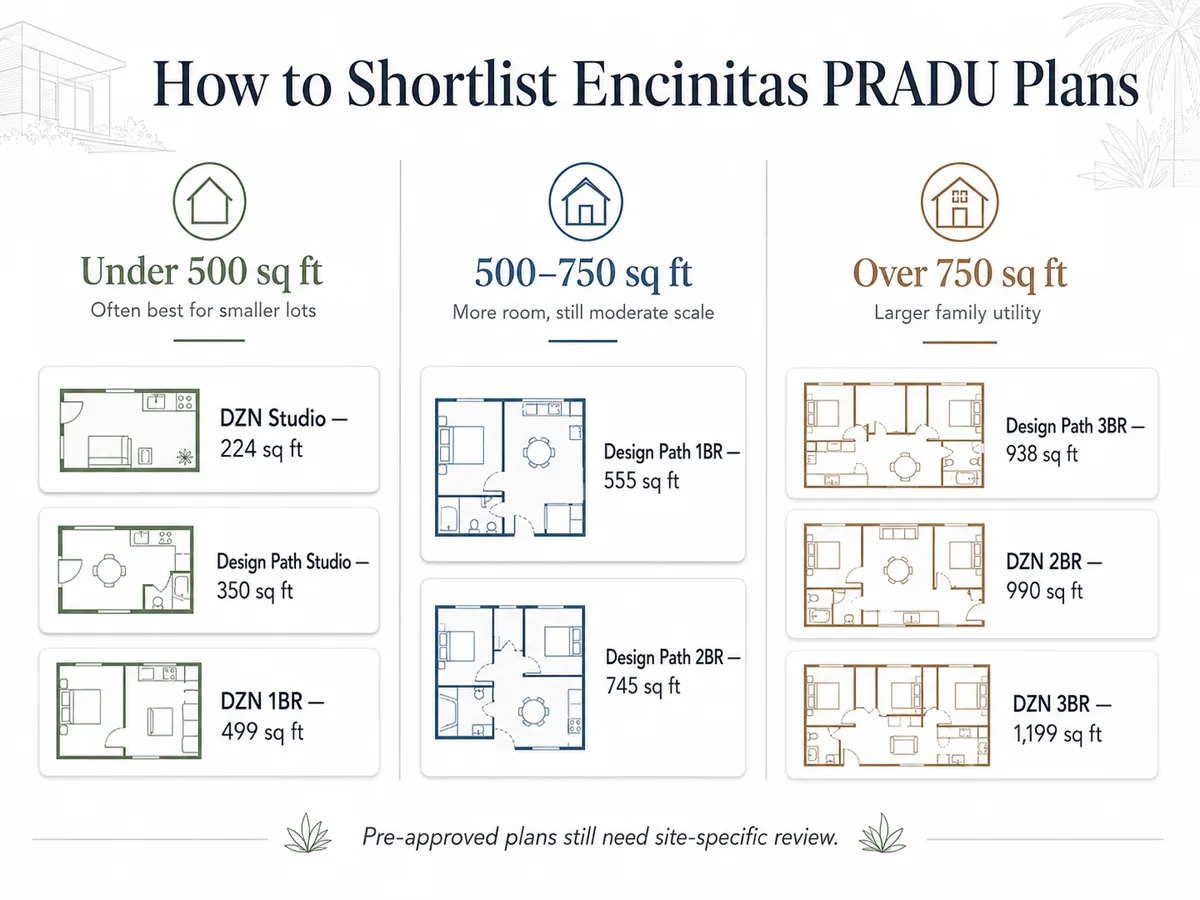
We assembled this matrix from the City’s PRADU page, Design Path Studio’s project page, DZN Partners’ project page, and SnapADU’s published plan walkthroughs.
| # | Plan | Architect | Bed / Bath | Listed size | Approx. footprint | Layout characteristic |
|---|---|---|---|---|---|---|
| 1 | DZN Studio | DZN Partners | Studio / 1 bath | 224 sq ft | 16′ × 14′ | Single great room, linear front-wall kitchen, full bath, optional loft over bath/closet/entry |
| 2 | Design Path Studio | Design Path Studio | Studio / 1 bath | 350 sq ft | Modular base | Full bath, linear kitchen, closet, open great room — designed as a “base plan” you can expand into 1BR/2BR/3BR later with minimal plumbing changes |
| 3 | DZN 1-Bed | DZN Partners | 1 bed / 1 bath | 499 sq ft | 14′ wide narrow | Living room one end, bedroom the other, galley kitchen with breakfast nook, dual-access central bath, in-bath laundry |
| 4 | Design Path 1-Bed | Design Path Studio | 1 bed / 1 bath | 555 sq ft | Expanded base | Bedroom addition to the studio base; same plumbing core |
| 5 | Design Path 2-Bed | Design Path Studio | 2 bed / 2 bath | 745 sq ft | Side-by-side | Open kitchen + living one side; two bedrooms (one en-suite) the other side |
| 6 | Design Path 3-Bed | Design Path Studio | 3 bed / 3 bath | 938 sq ft | L-shape | Three bedrooms, three bathrooms per City PRADU list, open living and kitchen, in-unit laundry. Discrepancy: SnapADU shows 935 sq ft / 2 bath; City shows 938 sq ft / 3 bath. Pull the current City PDF before designing. |
| 7 | DZN 2-Bed | DZN Partners | 2 bed / 2 bath | 990 sq ft | 30′ × 33′ | Open great room with island kitchen, two bedrooms (primary en-suite), hallway bath, laundry closet; designed for semi-abled or disabled occupants with wider doors and seated-height appliances |
| 8 | DZN 3-Bed | DZN Partners | 3 bed / 3+ bath | 1,199 sq ft | Near Encinitas detached cap | Bi-fold doors at great room, kitchen island, primary suite with walk-in, two more bedrooms with en-suite baths plus a hall bath, laundry closet |
Patterns worth knowing before you scroll past the table
The DZN Partners set spans both extremes. DZN designed the smallest plan in the program (224 sq ft) and the largest (1,199 sq ft) — useful if you’re at either edge of the size spectrum.
The Design Path Studio set is built around expansion. The studio is laid out as a “base plan” with all plumbing, utilities, structural openings, and core living components in place. You can start at 350 sq ft and add bedrooms over time without redoing the plumbing or major structure.
DZN offers three exterior style families per plan. Each DZN plan ships with three pre-approved exterior options: Traditional (cement plaster siding, single fascia, tile roofing), Modern Southwest (stone-and-stucco mix, low-slope and shingle roofing), Coastal Craftsmen (lap wood siding, double fascia, asphalt shingle), with a Barn Modern alternate (board-and-batten siding, exposed rafter tails, standing-seam metal roof) on some plans. You can swap materials to match your primary residence without triggering a custom review, as long as you stay within the pre-approved menu.
Get Your Free Encinitas ADU Report
Two minutes. We’ll surface which of these eight plans can physically fit on your lot given your setbacks, coastal status, and lot coverage.
Check My Lot →Are Encinitas PRADU plans actually pre-approved — or just pre-designed?
This is the single most-misunderstood detail in the program. The word “permit-ready” is doing more work than it should. Encinitas’s own PRADU page is direct about the limit: “A site-specific plan that shows the location of the preapproved ADU must be prepared and submitted, which the ADU builder/contractor should be able to prepare.”
SnapADU, a local design-build firm with multiple completed Encinitas PRADUs, describes the plans as roughly 85% complete — the remaining 15% is the site-specific work.
| Already pre-reviewed in the PRADU plan | Still site-specific (you handle this) |
|---|---|
| Architectural drawings | Site plan showing setbacks, property lines, easements |
| Structural drawings and calculations | Soils/geotechnical letter report (over 500 sq ft, unless waived) |
| Standardized plan notes and details | Title 24 Part 6 energy compliance documents |
| Code-compliant base design | Stormwater intake form / SWQMP (>500 sq ft impervious) |
| Pre-approved exterior style options | Coastal Development Permit packet (if in coastal overlay) |
| — | SDG&E coordination |
| — | Water and sewer agency sign-offs |
| — | School district fee certification |
| — | Building permit submittal package |
The AB 1332 30-day approve-or-deny window — and what kills it
SnapADU tracks an actual end-to-end timeline of 4 to 5 months from submission to permit issuance for standard and coastal projects. The 30-day window applies to the building permit decision; concurrent reviews (Coastal Development Permit notice cycles, water and sewer agency sign-offs, school district fee certification, and San Diego County Recorder covenant recording) have their own timelines.
Things that kill your 30-day expectation
- An incomplete application. SB 543 (effective January 1, 2026) requires cities to issue completeness determinations within 15 business days. Submit a complete package and the clock starts.
- Any plan modification. The moment you redraw a wall, resize a room, swap a window outside the pre-approved fenestration menu, or add a bedroom, you’re no longer using a pre-approved plan.
- An outdated code-cycle plan. AB 1332 applies to plans approved during the current triennial California Building Standards Code cycle. Encinitas’s plans are kept current; verify the date on the PDF you download.
- Parcel-specific issues. Slope analysis, coastal review, fire mitigation, special-study overlays, or septic permits can run concurrently but don’t shorten the City’s overall timeline.
- Missing site plan. The most common single delay. A PRADU plan without a site plan is not a complete application.
AB 130’s code freeze — the quiet companion benefit
Assembly Bill 130, signed in mid-2025, restricts state and local building-standard changes affecting residential units from October 1, 2025 through June 1, 2031. For PRADU planning, this means a permit pulled in 2026 uses the 2025 California Building Standards Code, and the code requirements aren’t expected to shift mid-project. Stacked on top of AB 1332’s 30-day decision clock, it creates a real window of regulatory predictability that wasn’t there a year ago.
Which Encinitas PRADU plan should you shortlist first?
The two fee thresholds, decoded in plain English
Threshold 1 — 500 square feet (geotechnical letter). Encinitas’s PRADU application checklist requires a geotechnical letter report for any new structure over 500 sq ft, unless waived by the Building Official. Common waiver scenarios: the ADU is on a certified pad, there’s a compaction report on file, the City has a soils report on file for the lot, or the Building Official determines a letter isn’t needed.
Practical impact: PRADU plans under 500 sq ft (DZN Studio at 224, Design Path Studio at 350, DZN 1BR at 499) often skip this entirely. Plans over 500 sq ft typically pay $1,500–$5,000 for the geotech letter unless they qualify for a waiver. The DZN 499 sq ft 1-bedroom sits one square foot below the over-500 sq ft trigger — a real plan-selection advantage few homeowners hear about.
Threshold 2 — 750 square feet (state impact-fee shelter). California Government Code §66311.5 prohibits local agencies, special districts, and water corporations from imposing impact fees on ADUs at or under 750 sq ft of interior livable space. Note: §66311.5 explicitly excludes utility connection and capacity charges from its definition of “impact fee.” So a sub-750 sq ft ADU is sheltered from park, traffic, RTCIP, and similar fees — but utility connection/capacity charges and other non-impact-fee costs still apply.
School fees are a separate threshold. Per the California HCD March 2026 ADU Handbook, school districts can charge school impact fees on ADUs larger than 500 sq ft of interior livable space, regardless of the 750 sq ft impact-fee rule. A 555 sq ft 1-bedroom can face school fees that a 499 sq ft 1-bedroom does not. Verify the applicable school district and current fee certification for the parcel.
The plan-fit scoring card
Methodology: scores reflect editorial judgment based on (1) footprint and small-lot suitability, (2) exposure to the 500/750 sq ft fee thresholds, (3) modification flexibility within the PRADU path, (4) likely rental demand, (5) typical family-use functionality, (6) construction-cost exposure on a $375–$600+/sq ft turnkey basis, (7) likely permit and site-review timeline, and (8) plan flexibility. Scores run 1 (weak fit) to 5 (strong fit). Score weights matter to your specific situation — there’s no universal “best plan.”
| Plan | Small-lot fit | Modification risk | Fee threshold | Rental utility | Family utility | Build-cost exposure | Constr. speed | Plan flexibility |
|---|---|---|---|---|---|---|---|---|
| DZN Studio (224) | 5 | 5 | 5 (below both) | 2 | 1 | 1 (lowest) | 5 | 1 |
| Design Path Studio (350) | 5 | 5 | 5 (below both) | 2 | 2 | 1 | 5 | 4 (expandable) |
| DZN 1BR (499) | 4 | 5 | 5 (under 500) | 3 | 2 | 2 | 4 | 1 |
| Design Path 1BR (555) | 4 | 5 | 4 (over 500, under 750) | 3 | 3 | 2 | 4 | 4 |
| Design Path 2BR (745) | 3 | 5 | 5 (at impact-fee shelter) | 4 | 4 | 3 | 3 | 3 |
| Design Path 3BR (938) | 2 | 5 | 2 (over 750) | 4 | 5 | 4 | 3 | 3 |
| DZN 2BR (990) | 2 | 5 | 2 (over 750) | 4 | 4 | 4 | 3 | 1 |
| DZN 3BR (1,199) | 1 | 5 | 2 (over 750) | 5 | 5 | 5 (highest) | 2 | 1 |
Choose by use case
Aging parent, in-law, or caregiver setup. Compare the DZN 499 sq ft 1BR (under-500 geotech advantage), the Design Path 555 sq ft 1BR (slightly more livable), and the DZN 990 sq ft 2BR (accessibility-friendly layout with wider doors and seated-height appliances). The 990 sq ft plan was explicitly designed for semi-abled or disabled occupants.
Adult child or young-professional rental. Compare the DZN 499 sq ft 1BR and the Design Path 555 sq ft 1BR. The published zip-level 1-bedroom rent medians (sourced to Rentometer, March 2026) are $2,245 in Cardiff (92007) and $2,410 in Leucadia (92024). The smaller plan’s geotech-letter savings often outweigh the modest livability gain.
Long-term family rental. Compare the Design Path 745 sq ft 2BR (verify interior livable space; if confirmed at or under 750, it sits inside the state impact-fee shelter) against the DZN 990 sq ft 2BR (more livable but loses fee protection). A 2-bedroom in Encinitas rents in the $3,990–$4,030/month range. Using SnapADU’s $375–$600+/sq ft cost range, the extra ~245 sq ft costs roughly $92,000–$147,000+ in construction before separate fee and sitework differences.
Phased expansion strategy. Start with the Design Path Studio (350 sq ft) as a base plan and add bedrooms later. The plumbing core stays in place. This is the only PRADU plan series explicitly designed for phased expansion.
Maximum bedrooms. The DZN 1,199 sq ft 3BR is the largest plan in the program and sits near Encinitas’s 1,200 sq ft detached cap. Walk-in closet, two en-suite baths, bi-fold doors. Build cost typically lands in the $471,000–$830,000 range all-in.
Small backyard, narrow side yard. The DZN 224 sq ft studio (16′ × 14′) and the DZN 1BR (just 14 feet wide) are purpose-built for tight setbacks and narrow placements.
Check Your Address Before You Pick a PRADU Plan → Get My Free Encinitas ADU Report
We’ll run your lot against Encinitas’s setback, coastal, and lot-coverage rules and return a shortlist of plans that physically fit.
Run the Free Address Check →What does PRADU save — and what still costs money?
What PRADU actually saves
- Plan design fees: The City’s 2019 launch estimate was $8,000–$14,000 in custom architectural fees avoided. Adjusting for 2026 design rates, the range is closer to $10,000–$20,000.
- City permit fees: Encinitas waives PRADU/ADU plan check and inspection fees. State-required fees, school district fees (over 500 sq ft), water and sewer district fees, CDP noticing postage, and San Diego County Recorder covenant fees still apply.
- Some review friction: Pre-approved structural and architectural drawings move faster through plan check. Typically 2–6 weeks of review time saved, not months.
- Risk reduction: Custom plans sometimes come back from City review requiring redrawing. PRADU plans have already cleared that review.
What PRADU does not save
- Construction cost: A PRADU plan doesn’t reduce labor or materials. SnapADU’s 2026 cost guide pegs detached ADU construction in San Diego at $375–$600+ per square foot turnkey.
- Site work: Foundation, grading, drainage, retaining walls if needed — identical to custom plans.
- Soils and geotech: Required over 500 sq ft regardless of plan source (unless waived).
- Stormwater mitigation: Required for ADUs with over 500 sq ft of impervious surface. SnapADU reports a typical solution runs around $5,000.
- Utility hookups: Water, sewer, electrical service, SDG&E coordination, and panel upgrades if needed.
- State-required fees above 750 sq ft of interior livable space.
- School district fees for ADUs over 500 sq ft of interior livable space.
The realistic total build cost by plan, 2026
Methodology note: these are Dwelling Index planning ranges, not quotes. Construction column from SnapADU’s published $375–$600+/sq ft turnkey range. Site-specific drafting, soils, stormwater, and utility ranges reflect typical Encinitas project costs; line items vary by lot. Use these to budget early; replace with two real local bids before signing anything.
| Plan | Size | Construction ($375–$600+/sf) | Site drafting | Soils/geotech | Stormwater | Utility hookups | Fee notes | All-in range |
|---|---|---|---|---|---|---|---|---|
| DZN Studio | 224 | $84K–$134K | $4.5K–$7.5K | $0–$2.5K | $3.5K–$7K | $3K–$10K | City fees waived; no school fee | ~$95K–$161K |
| Design Path Studio | 350 | $131K–$210K | $5K–$8.5K | $0–$3K | $4K–$7.5K | $3.5K–$11K | City fees waived; no school fee | ~$144K–$240K |
| DZN 1BR | 499 | $187K–$299K | $5.5K–$9K | $0–$3.5K | $4.5K–$8K | $4K–$12K | City fees waived; below 500 = no school fee | ~$201K–$332K |
| Design Path 1BR | 555 | $208K–$333K | $6K–$10K | $1.5K–$4K | $5K–$8.5K | $4K–$13K | City fees waived; school fees apply | ~$225K–$369K |
| Design Path 2BR | 745 | $279K–$447K | $6.5K–$12K | $2K–$4.5K | $5K–$10K | $5K–$15K | City fees waived; school fees apply; at/under 750 = §66311.5 shelter | ~$298K–$489K |
| Design Path 3BR | 938 | $352K–$563K | $7K–$14K | $2.5K–$5K | $5K–$12K | $6K–$17K | City fees waived; school + proportional impact fees apply | ~$373K–$611K |
| DZN 2BR | 990 | $371K–$594K | $7.5K–$14.5K | $2.5K–$5K | $5K–$12K | $6K–$17K | City fees waived; school + proportional impact fees apply | ~$392K–$642K |
| DZN 3BR | 1,199 | $450K–$719K | $7.5K–$15K | $2.5K–$5K | $5K–$12K | $6K–$18K | City fees waived; school + proportional impact fees apply | ~$471K–$769K |
Need to plan the budget? Compare ADU financing paths → — HELOCs, cash-out refis, construction loans, and renovation-specific products explained without lender rankings.
What an Encinitas ADU rents for — and the simple ROI math
We pulled comparable rent data from SnapADU’s regularly-updated Encinitas page (sourced to Rentometer, March 2026):
| Zip code | Neighborhood | Median 1BR | Median 2BR | Median 3BR |
|---|---|---|---|---|
| 92007 | Cardiff | $2,245 | $3,990 | $5,300 |
| 92024 | Leucadia / Encinitas | $2,410 | $4,030 | $5,100 |
Disclaimer: These are illustrative comparable rents from third-party data, not guarantees of returns. Actual results depend on local market conditions, construction costs, financing terms, and regulatory approvals. Run street-level comps before underwriting your project.
Worked example: Design Path 2BR (745 sq ft)
- All-in build (mid-range from cost table): ~$450,000
- Gross rent at $4,000/month: $48,000/year
- Gross yield: ~10.7% before expenses
- After typical 25–30% deduction for vacancy, property taxes, insurance, repairs, management, and capital reserves: net yield typically 7.5–8.0% before financing
These are illustrative examples, not guarantees of returns. People build ADUs in coastal Encinitas for income plus property appreciation plus housing flexibility, not for pure yield-chasing returns.
The PRADU permit process, step by step
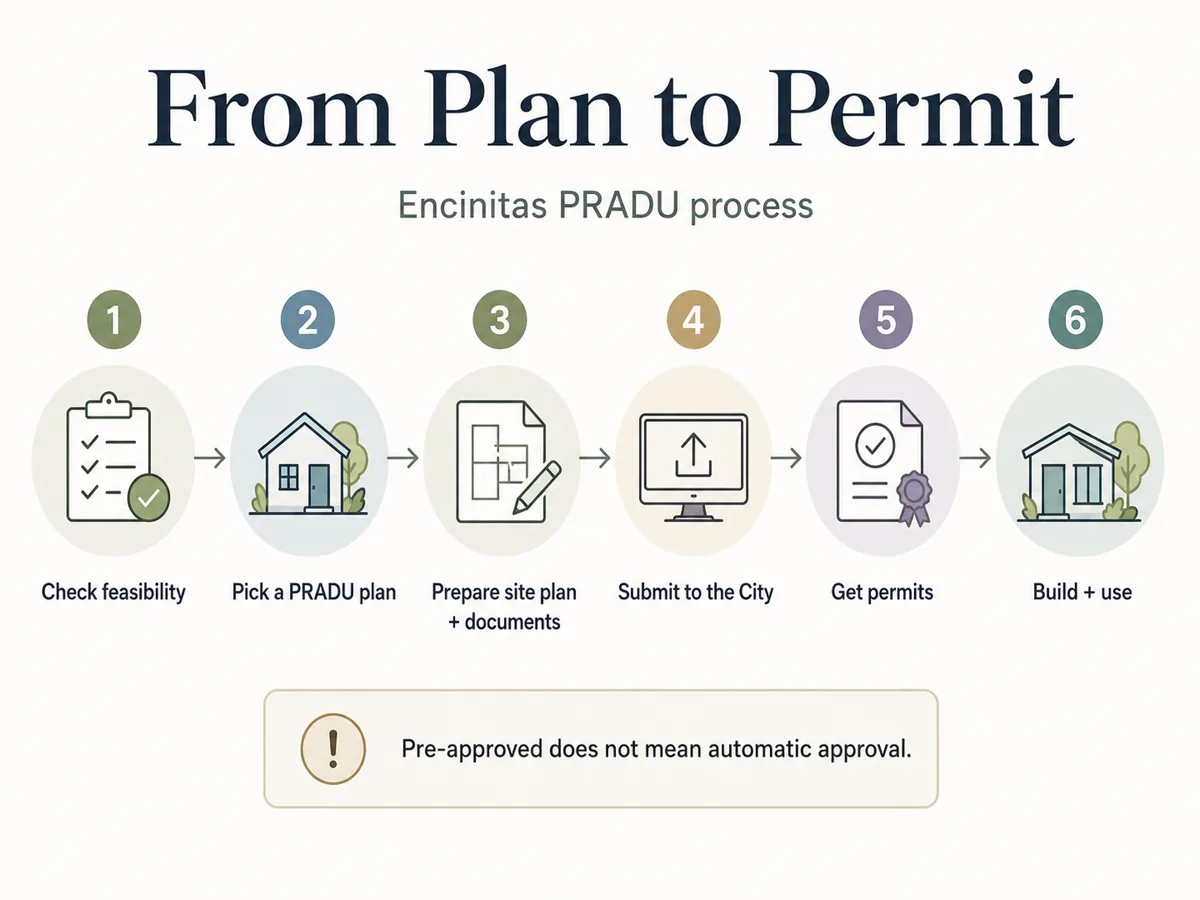
Step 1 — Consult with City staff (free)
Before you spend money on drawings or reports, email or call City staff:
- Building Division: building@encinitasca.gov / 760-633-2710
- Engineering: developmenteng@encinitasca.gov / 760-633-2706
- Planning: planning@encinitasca.gov
Ask about grading triggers, coastal review, slope analysis, fire requirements, and whether the geotech letter can be waived for your lot. This conversation is free and routinely saves projects from expensive re-submittals.
Step 2 — Download your chosen PRADU plan set
The current PDFs live on the City of Encinitas’s Accessory Dwelling Units page under “Housing for Generations.” Download the plan you’ve shortlisted. Pre-approved exterior options ship with the plan.
Step 3 — Hire a designer or contractor for site-specific work
A civil engineer, architect, or experienced ADU contractor prepares the site-specific package:
Required items (per City application checklist):
| Item | Why it matters |
|---|---|
| Grant deed | Ownership documentation |
| Supplemental application | Permit completeness |
| Boundary certification (if any structure ends up within 5 ft of a property line) | Setback verification |
| CAP checklist | Climate Action Plan compliance |
| Construction and demolition debris management plan | Waste compliance |
| Stormwater intake form / SWQMP | Drainage review |
| Title 24 Part 6 energy documentation | State energy compliance |
| Housing Development Tracking Form (Single Family/ADU) | New unit tracking |
| Owner authorization affidavit | Authorization |
| Building plans (PRADU set + site-specific) | Core submittal |
| Geotechnical letter report if over 500 sq ft | Soils/foundation review (unless waived by Building Official) |
Additional items that may be required:
| Item | When it applies |
|---|---|
| Electrical service load calculations | All new ADUs; panel upgrade may be required |
| Height certification | When ADU height needs surveyor verification |
| Landscape letter | When required by Planning |
| School fee certification | All ADUs over 500 sq ft of interior livable space |
| Water and sewer agency certification | All new ADUs |
| County Health approval | Septic systems or health-flagged scenarios |
| Solar PV plans | New detached ADUs (deferred submittal permitted) |
| Owner-builder form or contractor information | At permit issuance |
Step 4 — Submit through the CSS portal
All Encinitas permit applications are submitted electronically through the Customer Self-Service portal. Paper submittals are no longer accepted. Upload the PRADU plan set, all site-specific documents, supplemental application, owner authorization affidavit, grant deed, and Housing Development Tracking Form. The portal triggers automated routing to Building, Land Development, Engineering, Fire, and Planning.
Step 5 — Multi-department review
- Building Division — code compliance review (the part covered by the AB 1332 30-day clock for pre-approved plans)
- Land Development & Building (Planning) — setbacks, zoning, lot coverage, height
- Land Development Engineering — grading, drainage, stormwater, public improvements
- Fire Prevention — fire access, defensible space, sprinkler requirements
- Coastal review — concurrent if in coastal overlay (10-day public notice window for CDPNF)
You’ll receive water, sewer, and school fee forms by email. Walk these to the relevant agencies, get signatures, pay applicable fees, and upload final forms back through CSS.
Step 6 — Address corrections and record covenants
Most projects receive at least one round of corrections. Address them precisely and resubmit. During this phase, the Land Development & Building reviewer will email you an ADU covenant. You sign and notarize it. The original wet-signed document goes back to the City. The City then invoices San Diego County Recorder fees, which you pay through the CSS portal. Coastal projects also sign and notarize a Hold Harmless agreement.
Step 7 — Permit issuance, construction, inspections, and occupancy
Once all sign-offs and forms are complete, the building technician issues the permit. Construction follows the standard inspection schedule. Final inspection results in your Certificate of Occupancy.
What slows projects down most often
- Incomplete soils reports (no waiver pre-confirmed; report doesn’t reach the right depth)
- Missing SDG&E coordination letter
- Coastal noticing during slow periods
- School district fee form not signed in time
- Site plan revisions after planning review
- Plan changes that should have been raised in Step 1
What can disqualify or slow down an Encinitas PRADU application?
| Blocker | What it actually means | What to do before you commit |
|---|---|---|
| Plan modification | Any deviation from the City-approved plan (wall moves, room resizing, layout changes, fenestration outside the pre-approved menu) disqualifies the plan from PRADU treatment | Verify your selected plan can be built as-is on your lot; if not, switch plans or go custom |
| Hillside / Inland Bluff Overlay (HIBO) | Slope analysis may be required; certain accessory structures may face additional review | Pull your parcel’s overlay status from the City’s GIS before choosing a plan |
| Special Study Overlay | Geologic / seismic / archaeological reports may be triggered | Check parcel status with Planning before commissioning the geotech |
| Coastal Overlay Zone | Adds the Coastal Development Permit No Fee process: 10-day public notice window, ~$200 postage cost; building permit cannot issue until CDP is issued; appeal jurisdiction parcels add a Notice of Final Action and 10-business-day appeal period | Confirm coastal status; budget for the extra review timing |
| Coastal Bluff Overlay Zone | Encinitas Municipal Code §30.34.020 prohibits accessory structures within 40 feet of the top of a coastal bluff, with limited exceptions | If your lot is within 40 ft of a bluff edge, PRADU is likely not viable in that placement |
| Fire Department requirements | Fire access, defensible space, and material requirements may still apply. Fire sprinklers cannot be required for an ADU unless required for the primary residence | Pull fire zone status; confirm sprinkler status with the primary residence |
| Utility upgrades | Sewer lateral tie-in, electrical service load calculations, panel upgrade if existing service can’t handle the load, SDG&E coordination | Have a contractor review your panel and laterals before bidding the project |
| Solar PV requirement | New detached ADUs require a Solar Photovoltaic system (deferred permit allowed); HCD confirms this is subject to state solar requirement with statutory exceptions | Pursue exceptions if applicable; otherwise budget for a small PV system |
| All-electric appliance rule | New detached ADUs must have all appliances powered by electricity as the sole power source | No gas range / gas water heater on new detached PRADUs |
| Over 500 sq ft | Geotechnical letter report required unless waived by the Building Official | Budget $1,500–$5,000 for the letter, or pursue a waiver |
| Over 750 sq ft (interior livable space) | Loses the state’s §66311.5 impact-fee shelter; proportional school and other impact fees may apply | Compare against staying at or under 745 sq ft (verify interior livable space) |
| Septic system | San Diego County Health Department approval required | Pull septic record; check capacity |
| Stormwater (>500 sq ft impervious) | Drainage / stormwater mitigation plan required | Add to budget early |
Find the PRADU Plans That Fit Your Lot → Run the Free Encinitas Address Check
We’ll surface the overlays, fire zones, and bluff distances that show up on the City’s own GIS.
Run the Free Address Check →Can you modify an Encinitas pre-approved ADU plan?
| Change type | Allowed inside PRADU? | Notes |
|---|---|---|
| Pre-approved exterior style swap (Traditional / Modern Southwest / Coastal Craftsmen / Barn Modern) | Yes | DZN plans ship with three exterior schemes; Design Path plans similarly include style options |
| Roof material from the approved menu | Yes | Tile, asphalt shingle, standing-seam metal, low-slope — within plan-specific options |
| Siding swap from the approved menu | Yes | Cement plaster, lap wood, board-and-batt, stone-and-stucco mix — within plan-specific options |
| Doors/windows from the approved fenestration options | Yes | Each plan ships with multiple approved configurations |
| Interior finishes (cabinets, counters, flooring, fixtures) | Yes | Not part of the structural/architectural plan check |
| Moving an interior wall | No | Disqualifies PRADU |
| Resizing a room | No | Disqualifies PRADU |
| Adding or removing a bedroom | No | Unless using Design Path’s pre-designed expansion concept |
| Changing the exterior footprint | No | Disqualifies PRADU |
| Site placement (where the ADU sits on your lot) | Required | This is the site-specific part of the submittal |
The practical takeaway: if you find yourself wanting to “just move that wall a little,” you’ve probably outgrown the PRADU path. That’s not a failure — it’s information. Go semi-custom.
Can you use Encinitas PRADU plans outside Encinitas?
| Destination jurisdiction | Accepts Encinitas PRADU plans? | Source |
|---|---|---|
| City of San Diego | Yes — explicitly accepts City of Encinitas Permit-Ready ADU Plans | City of San Diego Development Services |
| County of San Diego (unincorporated) | Operates its own separate pre-approved plans program; check the County’s current list | County of San Diego Planning & Development Services |
| La Mesa | SnapADU reports certain DZN Partners plans are pre-approved in La Mesa through La Mesa’s own PRADU program; verify with La Mesa Building Division before relying on it (provider-reported, not officially verified) | SnapADU plan pages |
| Carlsbad, Chula Vista, Coronado, Del Mar, El Cajon, Escondido, Imperial Beach, Lemon Grove, National City, Oceanside, Poway, San Marcos, Santee, Solana Beach, Vista | Each runs its own ADU program; verify before submitting Encinitas plans | Individual city Building Departments |
See also: San Diego County pre-approved ADU plans — how cross-acceptance works across all cities.
PRADU vs custom vs prefab — an honest comparison
| Factor | Encinitas PRADU | Custom-designed | Prefab / modular |
|---|---|---|---|
| Plan cost | $0 | $8,000–$20,000 | Bundled into unit price |
| Build cost in Encinitas (1BR, all-in) | $200K–$400K | $260K–$450K | $200K–$400K (varies by manufacturer) |
| Permit decision timeline | 30 days approve-or-deny under AB 1332 for complete submittals | 3–5 months typical | 2–4 months; factory build runs concurrent |
| Design flexibility | Low — fixed layout, menu of exteriors | High | Low–medium |
| Aesthetic match to existing home | Good (multiple exterior styles) | Excellent | Variable |
| Best for | Standard lot, want predictability | Hillside / odd lot / unique layout | Tight schedule, level lot, comfortable with manufactured-home aesthetics |
| Resale impact | Strong (site-built; looks indistinguishable from custom) | Strongest | Variable; HUD-coded units may not appraise like site-built |
When PRADU is the right answer
- Standard rectangular lot with sewer access
- No coastal-bluff complications
- Single-story plan fits the setbacks (or two-story under 16 ft)
- You want a 1BR rental, an aging-in-place studio, or a multigenerational 2–3BR
- You prioritize timeline and cost predictability over uniqueness
When PRADU is the wrong answer
- Hillside lot needing custom foundation
- Coastal-bluff parcel within 40 ft of bluff top
- Very narrow side yard where none of the eight footprints physically fit
- You want a layout not on the eight-plan menu
- You want a guest house under 640 sq ft without a kitchen (different program — Encinitas’s guest-quarters rules)
- Your HOA, coastal overlay, or specific plan area drives design choices the PRADU exteriors can’t match
Want a local builder to sanity-check your PRADU fit?
SnapADU’s service-area page lists Encinitas within Greater San Diego, and the firm reports having built more than 100 ADUs in the region including multiple Encinitas PRADUs. They publish their own assessment of when pre-approved plans actually pencil out.
Compare your Encinitas lot with SnapADU →Looking for the right local builder regardless of plan type? Compare the best ADU builders in Encinitas — vetted for CSLB license, Encinitas PRADU experience, and published pricing.
Edge cases Encinitas homeowners run into
These situations don’t fit cleanly into the main decision flow but trip up enough projects that you should know about them.
Maximum ADU size in Encinitas
Encinitas Municipal Code says the maximum living area of an attached or detached ADU cannot exceed 1,200 sq ft or the total living area of the primary dwelling, whichever is less. California state law separately requires local standards to allow at least 850 sq ft for a one-bedroom ADU and 1,000 sq ft for an ADU with more than one bedroom. The state minimum protects your ability to build a small or mid-size ADU regardless of primary dwelling size; it does not make a 1,199 sq ft PRADU viable on every parcel.
Two-story PRADU under the 4-foot setback
ADUs that take advantage of the reduced 4-foot side and rear setbacks are limited to 16 feet in height. Above 16 feet, the underlying zone’s setbacks apply. State law allows a height limit of 18 feet for detached ADUs within a half mile of a major transit stop or high-quality transit corridor, with an additional 2 feet permitted if the ADU’s roof pitch matches the primary dwelling. None of the eight current PRADU plans are designed as two-story by default, but loft variants are available on certain plans.
The coastal-bluff 40-foot rule
Encinitas Municipal Code §30.34.020 (Coastal Bluff Overlay Zone) prohibits accessory structures within 40 feet of the top of a coastal bluff, with limited exceptions. If your lot edges a bluff, this rule effectively determines whether a PRADU can go where you want it to go. Pull the City’s coastal overlay GIS layer before designing.
Septic vs sewer
If your parcel is on a septic system, you’ll need San Diego County Health Department approval before the City finalizes your permit. The PRADU plans themselves don’t preclude septic, but the County Health review adds time and may require capacity analysis or system upgrades.
HOA and CC&R restrictions
AB 130 (signed mid-2025) prohibits homeowners associations from imposing fees or other financial requirements on ADU projects in common interest development communities. HOAs can still impose reasonable design restrictions that don’t unreasonably increase cost or effectively prohibit the ADU — but they can’t charge you a fee for review.
Solar PV requirement
The Encinitas application checklist notes that a Solar Photovoltaic System may be required for new detached PRADUs, with exceptions. A deferred building permit for solar is allowed alongside the main PRADU permit. HCD’s March 2026 ADU Handbook confirms that newly constructed detached ADUs are subject to the state’s solar requirement with statutory exceptions.
Fire sprinklers
Per Encinitas Municipal Code, fire sprinklers cannot be required for an ADU unless they are required for the primary residence. Fire access, defensible space, and material requirements within 10 feet of property lines may still apply.
Owner occupancy on ADUs and JADUs
AB 976 permanently eliminated owner-occupancy requirements for ADUs in California — meaning you don’t have to live on the property to rent your PRADU. For Junior ADUs (JADUs), AB 1154 (effective 2026) ties owner occupancy to whether the JADU shares sanitation facilities with the primary residence: shared sanitation triggers owner occupancy; separate sanitation does not.
Short-term rentals (Airbnb / Vrbo)
If your PRADU pro forma depends on short-term rental income, this is a dealbreaker, not an edge case. Build the underwriting on long-term rental income from day one.
AB 1033 condo separation
AB 1033 allows local agencies to permit the separate sale of ADUs from the primary residence as condominium units, but local opt-in is required and varies by jurisdiction. Verify the City of Encinitas’s current position before underwriting any plan that depends on separately selling the PRADU.
Plan changes mid-construction
If you change the plan mid-build — even something modest — you lose PRADU status for the affected portion and trigger standard ADU review. Time loss is typically 6–12 weeks. Make all your decisions before you submit.
Cross-jurisdictional plan reuse
If you sell your Encinitas property and buy a different lot in a city that accepts Encinitas PRADU plans (currently the City of San Diego, per City of San Diego Development Services), you can sometimes carry a PRADU plan with you. The plan is the architect’s intellectual property — you’d need the plan preparer’s authorization. AB 1332 requires the plan applicant’s contact info to be posted with the pre-approved plan, which is how the authorization conversation starts.
How much PRADU plans actually saved Encinitas homeowners — the original launch numbers
The City’s 2019 launch presentation projected the program would save homeowners:
- 3–6 months of planning and design time
- $8,000–$14,000 in design fees, depending on plan size
- $2,000–$4,000 in waived ADU fees (in place since February 2018)
- Combined $10,000–$18,000 in upfront savings per project
Adjusting for 2026 architectural rates, those ranges are still roughly correct on the design-fee line (closer to $10,000–$20,000 now). The 3–6 month time savings, in practice, is closer to 2–3 months saved on the design phase. The AB 1332 30-day approve-or-deny clock is what delivers the bigger acceleration on permit decisions today.
What we verified for this guide
We separate verified primary-source facts from provider-reported facts. Verification date: May 11, 2026.
Verified against official City of Encinitas, California state code, or California HCD sources
| Verified item | Source | Verified |
|---|---|---|
| Encinitas lists 8 City pre-approved PRADU plans designed by Design Path Studio and DZN Partners | City of Encinitas PRADU page | May 11, 2026 |
| Plan sizes: DZN Studio 224, Design Path Studio 350, DZN 1BR 499, Design Path 1BR 555, Design Path 2BR 745, Design Path 3BR 938 (3 bed/3 bath), DZN 2BR 990, DZN 3BR 1,199 | City of Encinitas PRADU page | May 11, 2026 |
| Modifications disqualify a plan from the PRADU path | City of Encinitas PRADU page | May 11, 2026 |
| PRADU/ADU City fees waived except state/regional, school, water/sewer district, CDP postage, and recorder fees | City of Encinitas PRADU page & Process Guide | May 11, 2026 |
| Geotechnical letter report required for buildings over 500 sq ft unless waived by Building Official | City Applications & Information page | May 11, 2026 |
| AB 1332 30-day approve-or-deny clock for complete detached ADU applications using current-cycle pre-approved plans | California Gov. Code §65852.27 | May 11, 2026 |
| Gov. Code §66311.5: local agencies cannot impose impact fees on ADUs at or under 750 sq ft of interior livable space; connection and capacity charges excluded from “impact fee” definition | California Government Code §66311.5 | May 11, 2026 |
| AB 130 restricts state and local building-standard changes affecting residential units from October 1, 2025 through June 1, 2031 | California Assembly Bill 130 (2025) | May 11, 2026 |
| AB 976 permanently eliminated ADU owner-occupancy requirements; AB 1154 (2026) makes JADU owner occupancy contingent on shared sanitation facilities | California HCD March 2026 ADU Handbook | May 11, 2026 |
| SB 543 — 15 business days completeness determination for ADU applications, effective January 1, 2026; school impact fees may apply to ADUs over 500 sq ft | California HCD March 2026 ADU Handbook | May 11, 2026 |
| Encinitas detached ADU max size: 1,200 sq ft or total primary dwelling living area, whichever is less; fire sprinklers cannot be required for ADUs unless required for the primary residence | Encinitas Municipal Code Chapter 30.48 | May 11, 2026 |
| Coastal Bluff Overlay 40-foot accessory-structure exclusion | Encinitas Municipal Code §30.34.020 | May 11, 2026 |
| ADU short-term rentals prohibited in Encinitas except grandfathered permits; rental terms must be longer than 30 days | City of Encinitas STR Permits page | May 11, 2026 |
| Encinitas adopted the 2025 California Building Standards Code, effective January 1, 2026 | Encinitas Municipal Code Chapter 23.12 | May 11, 2026 |
| City of San Diego accepts Encinitas Permit-Ready ADU Plans | City of San Diego Development Services | May 11, 2026 |
Provider-reported / third-party data (verified but secondary)
| Item | Source |
|---|---|
| PRADU plans described as approximately 85% complete | SnapADU |
| Permit timeline of 4–5 months typical for Encinitas | SnapADU |
| ADU construction cost $375–$600+ per sq ft turnkey in San Diego | SnapADU 2026 cost guide |
| Stormwater mitigation typically ~$5,000; 100+ ADUs built in San Diego County including multiple Encinitas PRADUs | SnapADU |
| Rent comparables, Cardiff (92007) and Leucadia (92024) | SnapADU citing Rentometer, March 2026 |
| La Mesa cross-acceptance of certain DZN plans | SnapADU plan pages (provider-reported, not officially verified) |
| Encinitas PRADU launch design-fee savings of $8,000–$14,000 + $2,000–$4,000 in fee waivers | The Coast News, January 2019 launch coverage |
Items flagged for re-verification before action
- Current City PRADU plan PDFs for exact dimensions and interior livable space treatment
- Design Path 3BR specifications — City list shows 938 sq ft / 3 bath; SnapADU shows 935 sq ft / 2 bath; verify against current City PDF
- Current school district fee per square foot for your parcel (San Dieguito Union HSD, Encinitas Union School District, or Cardiff School District depending on location)
- Current water and sewer agency fees / deposits for your parcel
- Current Encinitas short-term rental ordinance status and any grandfathered permit availability
- Encinitas’s current position on AB 1033 condo-separation opt-in
- La Mesa cross-acceptance status (currently provider-reported, not officially verified)
Our methodology
The Dwelling Index is an independent research resource covering ADU financing, costs, and regulations. We built this guide by cross-referencing the City of Encinitas’s official PRADU and ADU pages, the City’s PRADU Submittal Guide and Process Guide, the City’s Applications & Information checklist, California Government Code sections cited throughout, the California Department of Housing and Community Development March 2026 ADU Handbook, plan preparer pages from Design Path Studio and DZN Partners, SnapADU’s regularly-updated Encinitas regulations and individual plan pages, and the City’s adopted municipal code.
We use the City of Encinitas, California statute, and HCD as the controlling sources for legal, permit, and code claims. We use Design Path Studio and DZN Partners as the controlling sources for plan design intent. We use SnapADU and other local builder data as provider-reported sources for typical project cost, timing, and rental comparables. We don’t accept payment for inclusion in our guides.
Frequently asked questions
Does Encinitas have pre-approved ADU plans?
Yes. Encinitas operates the PRADU (Permit-Ready Accessory Dwelling Unit) program and currently lists eight City pre-approved plans designed by Design Path Studio and DZN Partners. Sizes range from a 224 sq ft studio to a 1,199 sq ft 3-bedroom. The program launched in 2019 and was expanded in January 2025 to accept privately submitted plans under AB 1332.
Are Encinitas PRADU plans free?
The eight official plans are free to download from the City of Encinitas. Encinitas also waives PRADU/ADU plan check and inspection fees. State-required fees, school district fees (over 500 sq ft of interior livable space), water and sewer district fees, Coastal Development Permit noticing postage (~$200), and San Diego County Recorder covenant fees still apply. The plans themselves cost zero dollars; the project still costs $155,000–$830,000+ all-in depending on size and site conditions.
How many pre-approved ADU plans does Encinitas have?
Eight as of May 2026: four by Design Path Studio (350, 555, 745, and 938 sq ft) and four by DZN Partners (224, 499, 990, and 1,199 sq ft). Under AB 1332, the City now also accepts plans from private architects, so this list may grow over time.
How long does the PRADU permit process take?
Under AB 1332, Encinitas must approve or deny a complete building permit application that uses a pre-approved plan within 30 days. The full end-to-end timeline including utility sign-offs, school district fee certification, and recorded covenants typically runs 4 to 5 months for both standard and coastal-zone projects, per SnapADU’s tracked San Diego County project history.
Can I modify an Encinitas pre-approved ADU plan?
You can swap exteriors, materials, doors, and windows from the pre-approved menu that ships with each plan. You cannot change the layout, move walls, resize rooms, add or remove bedrooms, or alter the structural design without losing PRADU status. Any modification beyond the pre-approved menu disqualifies the plan from the PRADU path.
What is the maximum ADU size in Encinitas?
1,200 sq ft or the total living area of the primary dwelling, whichever is less, per Encinitas Municipal Code. California state law separately guarantees the ability to build at least 850 sq ft for a 1-bedroom and 1,000 sq ft for an ADU with more than one bedroom, regardless of primary dwelling size.
Do I need a coastal permit for an Encinitas ADU?
If your lot is in the Coastal Overlay Zone, your PRADU requires a Coastal Development Permit No Fee (CDPNF). The process adds a 10-day public notice window and runs concurrently with the building permit review, but the building permit cannot be issued until the CDP is issued. If the property is within the Coastal Commission appeal jurisdiction, the permit also routes through a Notice of Final Action and a 10-business-day appeal period. The Coastal Bluff Overlay Zone separately prohibits accessory structures within 40 feet of the bluff top.
Do I need a geotechnical report?
Yes, for any new ADU over 500 sq ft, unless the Encinitas Building Official waives it. Common waiver scenarios: the ADU sits on a certified pad, the lot has a recent compaction report on file, or the City has a soils report for the parcel. PRADU plans under 500 sq ft (DZN Studio at 224 sq ft, Design Path Studio at 350 sq ft, DZN 1BR at 499 sq ft) typically avoid this requirement entirely.
Are Encinitas PRADU plans accepted in San Diego or other cities?
The City of San Diego currently accepts Encinitas Permit-Ready ADU plan sets per its Development Services Department. SnapADU reports that certain DZN Partners plans are pre-approved in La Mesa through La Mesa’s own PRADU program; verify with La Mesa Building Division before relying on it. Other San Diego County jurisdictions vary — cross-acceptance is a jurisdiction-by-jurisdiction decision, not a statewide automatic.
Should I use a PRADU plan or a custom plan?
Use a PRADU plan when one of the eight City plans fits your lot as-is and you want predictable permitting and design costs. Use a custom plan when your lot is irregular, you need a layout not on the menu, your HOA or coastal context drives design, or you’d need enough modifications to disqualify the PRADU path anyway. The PRADU plan saves $10,000–$20,000 in design fees and 2–3 months in design time; custom plans cost more but adapt to any lot.
What is PRADU short for?
PRADU stands for Permit-Ready Accessory Dwelling Unit. It’s the brand name for Encinitas’s pre-approved ADU plan program, launched in 2019 under the City’s “Housing for Generations” initiative.
Do owners have to live on the property to build a PRADU?
No. AB 976 permanently eliminated owner-occupancy requirements for ADUs statewide, including PRADUs. For Junior ADUs (JADUs — under 500 sq ft, built within the existing primary residence), AB 1154 (effective 2026) ties owner occupancy to whether the JADU shares sanitation facilities with the primary residence.
Can I use an Encinitas PRADU as an Airbnb or short-term rental?
No, not for new ADUs. Per the City of Encinitas’s Short-Term Rental Permits page, short-term rentals are prohibited in ADUs in Encinitas, with a narrow grandfathered exception. Encinitas Municipal Code separately allows ADUs to be rented only for terms longer than 30 days. If your pro forma depends on STR income, PRADU is not the path.
How much can I rent an Encinitas PRADU for?
Per SnapADU’s regularly-updated Encinitas rent table (sourced to Rentometer, March 2026), comparable median rents in 2026 are: 1-bedroom $2,245–$2,410/month, 2-bedroom $3,990–$4,030/month, and 3-bedroom $5,100–$5,300/month. These are illustrative comparables, not guarantees of returns.
What is the AB 1332 30-day rule?
AB 1332 added California Government Code §65852.27, effective January 1, 2025. It requires every California city to operate a program that pre-approves ADU plans, and it requires the city to ministerially approve or deny a complete building permit application that uses a pre-approved plan within 30 days of receiving the completed application. The clock applies only to detached ADUs, only to complete applications, and only to plans in the current building code cycle. The statute does not guarantee approval — only a timely decision.
Download the Free ADU Starter Kit →
Get the Encinitas PRADU plan inventory matrix, the total-build cost worksheet, the eligibility checklist, and the printable permit-submission checklist — emailed in 60 seconds.
Download the Free ADU Starter Kit →Not sure where to start?
See what’s possible at your address — get your free ADU report in 60 seconds.
Get My Free Encinitas ADU Report →
See What You Can Build → Get Your Free ADU Report
Related guides
- Best ADU Builders in Encinitas — compare the right local builder before choosing a plan
- San Diego County Pre-Approved ADU Plans — see how Encinitas fits the county-wide picture
- Carlsbad Pre-Approved ADU Plans — 4 sizes, 2026 status, and the 750 sq ft fee cliff
- How Much Does an ADU Cost? — national ADU cost ranges and what drives them
- ADU Cost Per Square Foot — detailed per-square-foot cost data
- ADU Financing Options — HELOCs, cash-out refis, construction loans explained