
ADU Financing Options in 2026: 8 Paths Compared (Real Rates, Free Path Finder)
By The Dwelling Index Editorial Team · Last updated September 16, 2026 · 35 min read
The bottom line on how to finance an ADU
How to finance an ADU depends on four things: how much usable equity you have today, whether your current first-mortgage rate is worth protecting, whether you need the lender to consider your home’s future value, and whether ADU rental income can help you qualify. For most homeowners with strong equity and a low pandemic-era first mortgage, a HELOC (home equity line of credit) or home equity loan is the first path to test — it preserves the rate on your existing mortgage. If your current equity isn’t enough to cover an ADU build, a construction-to-permanent loan, a Fannie Mae HomeStyle Renovation loan, a Freddie Mac CHOICERenovation loan, or an FHA 203(k) can underwrite based on what your home will be worth after the ADU is built. Grants and local programs help at the margins, but most are paused, fully allocated, or restrictive — California’s CalHFA ADU Grant has been fully allocated since December 28, 2023. The next step is to confirm what you can actually build on your lot, then match it to the financing lane that fits your equity, rate, and credit profile.
What we verified for this guide
- Fannie Mae ADU loan rules and the Desktop Underwriter (DU) 12.1 release that went live the weekend of March 21, 2026 automating ADU rental-income qualification — verified against Selling Guide B3-3.8-01, Announcement SEL-2025-08, and Pennymac Announcement 26-29.
- Freddie Mac ADU and CHOICERenovation guidance, including the limitation effective for applications received on or after May 4, 2026 that bars use of rental income from a unit funded by CHOICERenovation proceeds for qualifying.
- FHA / HUD Mortgagee Letter 2023-17, which updated rental-income, property eligibility, and appraisal protocols for ADUs and expanded eligible improvements under the Standard 203(k) program.
- CFPB and FTC consumer-risk guidance on HELOCs, home equity loans, cash-out refinances, home equity contracts, and reverse mortgages.
- Benchmark rate data as of May 17, 2026: national HELOC average 7.21% and home equity loan average 7.36% per Curinos; Wall Street Journal prime rate 6.75%.
- Current status of CalHFA, MassHousing, Boston Home Center, SDHC, NYC Plus One, Colorado CHFA, Portland SDC waiver, Salt Lake City Backyard Keys, Summit County, Orlando, and Charlotte ADU assistance programs — verified against each program’s official page as of May 17, 2026.
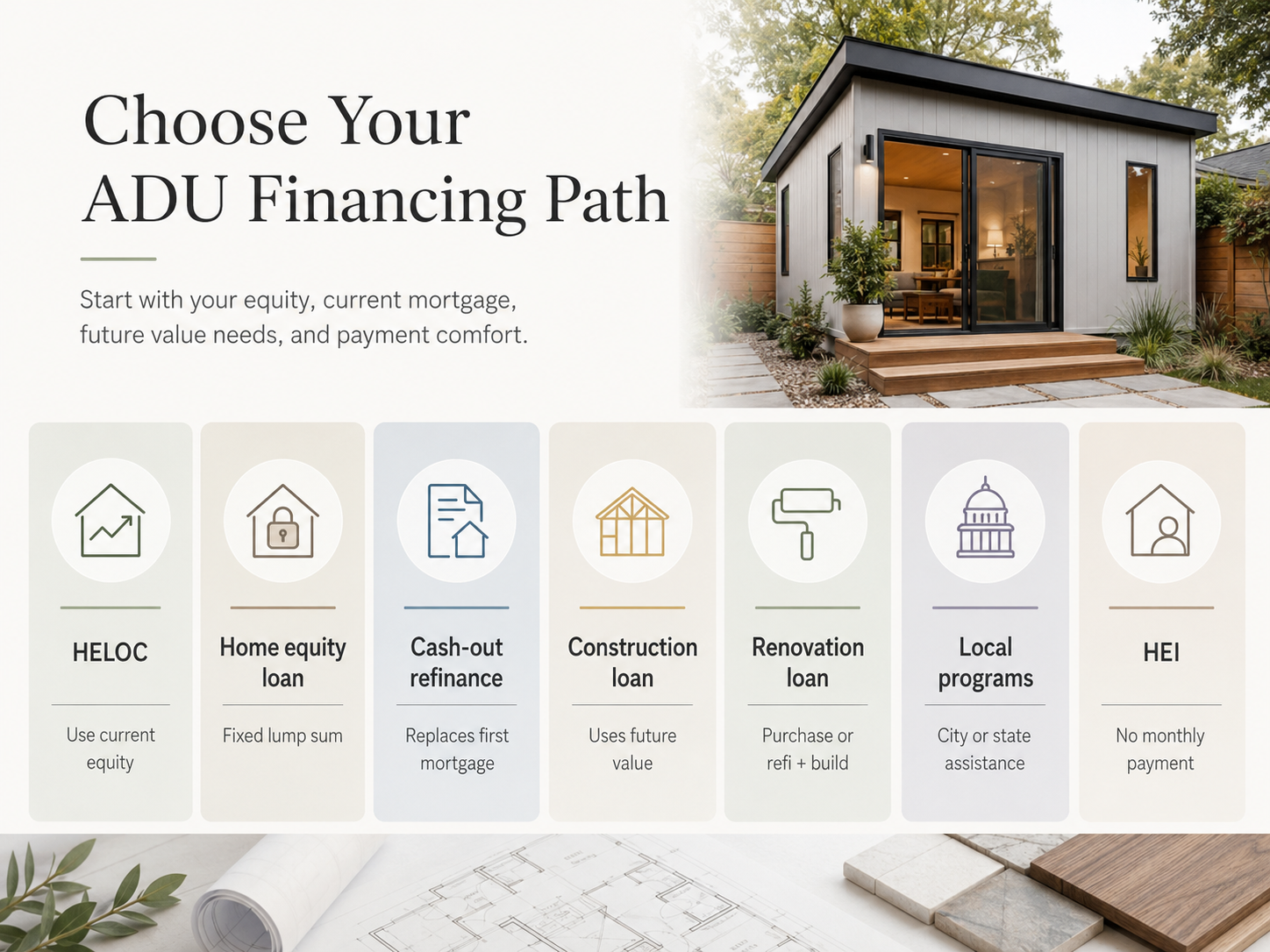
ADU financing paths at a glance
| Path | Best when… | Keeps first mortgage? | Underwrites against | Rate (May 17, 2026) | Biggest watchout |
|---|---|---|---|---|---|
| HELOC | You have equity, want flexibility, and a low first-mortgage rate | ✅ Yes | Current value | ~7.21% national avg (Curinos) | Variable rate; payment can rise |
| Home equity loan | You have equity and want a fixed payment | ✅ Yes | Current value | ~7.36% national avg (Curinos) | Lump sum — less flexible for phased builds |
| Cash-out refinance | Your current rate is already at or above market | ❌ Replaces it | Current value | ~6.8–7.1% range | Lose your existing rate |
| Construction / C-to-perm loan | Low current equity, strong income, ground-up build | Depends on structure | Future (as-completed) value | ~7–9% range | Complex draws, inspections, potential refi |
| Renovation loan (HomeStyle / CHOICERenovation / 203(k)) | Buying + building, or low-equity refi+build | ❌ Replaces it | Future (as-completed) value | ~6.8–7.5% range | Strict timelines, contractor approvals |
| Local program or grant | Income-qualified in a participating city/state | Varies | Varies | Often below market | Most are paused, waitlisted, or rent-restricted |
| Home equity investment (HEI) | Can't carry another monthly payment; accept appreciation-sharing | ✅ Yes | Current value | No required monthly payment | State-limited; balloon settlement at 10–30 years |
Benchmark rates are national averages from Curinos via Yahoo Finance, verified May 17, 2026. Rates are not loan offers, are not guaranteed, may not reflect APR with all fees, and vary by lender, credit, LTV, lien position, property, and state.
See what you can build before you call a lender
Confirm your lot is buildable first. Setbacks, lot coverage, height limits, fire-zone rules, and owner-occupancy requirements can change which financing path works — or whether you should be borrowing at all.
See What You Can Build → Get Your Free ADU ReportFind your ADU financing path in 60 seconds
Most ADU financing guides give you ten options and tell you “it depends.” Use our free path finder — it asks for your equity position, current first-mortgage rate, ADU type, credit profile, and whether you plan to rent — and returns the single financing lane to test first, the documents the lender will ask for, and the disqualifiers to watch.
Calculates your usable equity, flags state-specific program availability, and tells you the disqualifiers that could block your build.
What is the best way to finance an ADU?
The best way to finance an ADU is the path that matches your equity, protects your current mortgage when it’s worth protecting, gives you enough borrowing room without depending on assumptions a lender won’t honor, and respects your real monthly-payment capacity. There is no single “best ADU loan.” There are eight realistic paths, and the right one is determined by a five-question fork that takes less than a minute to walk through.
The five-question financing fork
- Do I have enough usable current equity? Take your home’s current market value, multiply by 80%, subtract your existing first-mortgage balance. If that number covers your ADU budget, current-value products are on the table. If not, you’ll need future-value products.
- Is my current first mortgage worth protecting? If you locked a rate below today’s market — common for anyone who refinanced or bought in 2020 to 2022 — you almost never want to replace it with a cash-out refinance. The math on losing that rate over a 30-year balance can exceed the cost of the ADU itself.
- Does the ADU budget exceed my current-equity borrowing room? If yes, you need a lender who will underwrite against the property’s as-completed value — a construction loan, construction-to-permanent loan, or a renovation loan like Fannie Mae HomeStyle, Freddie Mac CHOICERenovation, or FHA 203(k).
- Will the ADU rent help me qualify? Since the Desktop Underwriter 12.1 release the weekend of March 21, 2026, Fannie Mae automates rental-income qualification for one-unit primary residences with an existing ADU on eligible transactions, capped at 30% of total qualifying income after the standard 75%-of-gross-rent calculation.
- Can I carry another monthly payment? If the answer is no, you’re in HEI (home equity investment) or HECM (Home Equity Conversion Mortgage) territory — products that can avoid required monthly payments in some cases, but carry their own complexity and risk.
What are the 8 main ways to finance an ADU?
1. HELOC for an ADU
A HELOC (home equity line of credit) is a revolving credit line secured by your home’s available equity. Lenders typically allow combined loan-to-value (CLTV) up to 80–85% of current appraised value, minus your existing first-mortgage balance. As of May 17, 2026, the Curinos national average HELOC rate is 7.21%, near the 2026 low of 7.19% first observed in mid-March.
- Best fit: You have meaningful equity, you want to draw funds as construction invoices come due, and you want to preserve a favorable rate on your existing mortgage.
- Bad fit: You bought recently with less than 20% equity; you’re uncomfortable with variable-rate risk; or you can’t tolerate a payment that could rise if prime rate moves.
- How it works: A HELOC has two phases. During the draw period (typically 10 years), you borrow up to your credit limit, paying interest only on what’s drawn. After the draw period, the loan converts to a repayment period (typically 20 years) of fully amortizing principal-plus-interest payments. HELOCs are usually variable-rate, indexed to the Wall Street Journal prime rate (6.75% as of May 17, 2026) plus a lender margin.
- Biggest upside: Flexibility. You only pay interest on what you’ve drawn. Your first mortgage stays untouched.
- Biggest downside: Rate risk. If prime rises during your draw period, your payment rises.
- The detail most guides miss: Credit unions and regional banks often beat the big banks on HELOC pricing. As of mid-May 2026, FourLeaf Credit Union was advertising an introductory APR of 5.99% for the first 12 months on lines up to $500,000. Always run the math past the intro period.
2. Home equity loan for an ADU
A home equity loan gives you a fixed lump sum at a fixed rate, repaid over a set term. It sits on top of your first mortgage as a second lien and uses current home value to determine borrowing power. As of May 17, 2026, the Curinos national average home equity loan rate is 7.36%, matching the 2026 low first observed in mid-March.
- Best fit: You have a defined ADU budget, you want rate certainty, and you want one predictable monthly payment.
- Bad fit: You’re doing a phased build where costs hit over months, or you anticipate paying off chunks early and re-borrowing.
- How it works: The lender disburses a single lump sum at closing. You repay it on a fixed amortization schedule, usually 10 to 30 years. Your first mortgage stays intact.
- Biggest upside: Rate certainty. Your payment never changes.
- Biggest downside: You borrow the full amount upfront, even if construction hasn’t started. Interest accrues on the entire balance from day one.
- The detail most guides miss: Home equity loans and HELOCs can be stacked. Some homeowners use a small HELOC for early soft costs (design, plans, permits) and a larger home equity loan for the construction draw.
3. Cash-out refinance for an ADU
A cash-out refinance replaces your entire existing first mortgage with a larger one, and you take the difference as cash. Most cash-out refis cap total borrowing at 80% of current home value. This path can work when your existing rate is at or above current market levels — but it rarely works when you locked a sub-5% rate in 2020 to 2022.
- Best fit: Your existing mortgage rate is similar to or higher than today’s rates, you owe relatively little on your home, or you want to consolidate everything into a single payment.
- Bad fit: You have a low first-mortgage rate. The CFPB has flagged that cash-out refinancing converts home equity into mortgage debt and can increase foreclosure risk if repayment fails.
The dollar math on why this decision is so expensive
Illustration: a $200,000 ADU financed alongside a $400,000 existing mortgage, with each compared loan amortized over 30 years. The rates below are historical May 2026 inputs, not current offers. This comparison excludes closing costs and future HELOC rate changes; lender eligibility and loan-to-value limits must be checked separately.
| Current first-mortgage rate | Cash-out refi (6.85% on $600K) | HELOC at 7.21% + existing mortgage preserved |
|---|---|---|
| 3.25% | Approximately $815,000 | Approximately $516,000 |
| 5.00% | Approximately $815,000 | Approximately $662,000 |
| 7.00% | Approximately $815,000 | Approximately $847,000 |
Illustrative only. Numbers are rounded. Assumes a fixed 7.21% HELOC rate for comparability — actual HELOC payments vary with prime rate. Excludes closing costs. Not a loan offer.
Calculation: monthly payment = P × r / [1 − (1 + r)−n]; total interest = monthly payment × n − P; r = annual rate ÷ 12; n = 360. The preserved-mortgage column adds the first-mortgage and HELOC interest amounts without counting principal as interest.
At a 3.25% existing first-mortgage rate, the modeled cash-out refinance costs about $299,000 more in interest. At 7.00%, the modeled cash-out refinance costs about $32,000 less, before closing costs and other differences.
4. Construction loan / construction-to-permanent loan for an ADU
A construction loan funds the ADU project in staged draws as your contractor hits milestones, with lender-ordered inspections verifying progress before each draw. A construction loan can underwrite against your home’s projected as-completed value — so you can borrow against equity that doesn’t exist yet. A construction-to-permanent loan converts automatically to a permanent first mortgage when construction is done, while a construction-only loan requires a separate refinance at completion.
- Best fit: You don’t have enough current equity for HELOC or home equity loan products, but you have strong income, good credit, plans in hand, contractor bids, and a permitted (or permit-eligible) project.
- Bad fit: You want simplicity. Construction loans require approved plans, a licensed insured GC, a detailed draw schedule, periodic inspections, and lender oversight. Owner-builders typically struggle to find lenders.
- Biggest upside: Lets you borrow against what your home will be worth. A homeowner with a $500,000 current value and $475,000 mortgage has effectively zero usable equity today — but the same home with a completed ADU might appraise at $625,000, opening meaningful borrowing room. Illustrative only.
- Biggest downside: More complex than every other path. Higher closing costs, longer timelines (often 60–90 days from application to closing), and stricter contractor requirements.
- The detail most guides miss: Construction loans typically require permitted plans to close. In California, qualifying detached ADU applications using a preapproved plan under AB 1332 must be approved or denied within 30 days. Start the lender conversation before you submit for permit, not after.
How ADU construction draws actually work
Construction loans release funds in stages as your contractor hits documented milestones. The lender does not hand you the full loan amount on day one. A typical detached ADU build has four to six draws: foundation, framing, rough-in (plumbing, electrical, HVAC), drywall and finishes, and final inspection. A lender-appointed inspector verifies progress before each draw is released.
- Pre-funded draws: The lender releases funds at the start of each phase; the contractor uses those funds during the phase.
- Reimbursement draws: The contractor pays vendors and labor out of pocket, then submits invoices for reimbursement after the inspector signs off.
- Hybrid: Pre-funding for materials (with proof of order), reimbursement for labor. Ask your lender exactly which model applies.
5. Renovation loans for ADUs (FHA 203(k), Fannie Mae HomeStyle, Freddie Mac CHOICERenovation)
Renovation loans combine purchase or refinance with renovation funding in a single loan, underwriting against the property’s projected after-completion value. The three main programs — FHA Standard 203(k), Fannie Mae HomeStyle Renovation, and Freddie Mac CHOICERenovation — each cover ADU work, but their scope, rules, and rental-income treatment differ in ways that matter.
FHA Standard 203(k)
- Best fit: Buying a property and adding or renovating an ADU; lower credit (FHA accepts as low as 580 with 3.5% down); conversion-heavy scope (garage, basement, attached addition).
- Bad fit: Building a brand-new standalone detached ADU from the ground up. HUD ML 2023-17 orients Standard 203(k) ADU provisions toward conversions and additions.
- How it works: A single FHA loan funds the home purchase or refinance plus the ADU work. Under HUD Mortgagee Letter 2023-17 (effective October 16, 2023), the Standard 203(k) program was expanded to include eligible ADU conversions and additions.
Fannie Mae HomeStyle Renovation
- Best fit: Buying or refinancing and adding an ADU; detached, modular, or HUD-code manufactured ADU.
- Bad fit: You have a low first-mortgage rate you’d lose by refinancing.
- Key rule: Renovation must be completed within 15 months of closing. Per Fannie Mae Selling Guide B2-3-04, eligible ADU types include detached, attached, modular, and HUD-code manufactured ADUs (with permanent foundation and real-property classification).
Freddie Mac CHOICERenovation
- Best fit: Purchase or refinance plus renovation, ADU-eligible, underwrites against future value.
- Critical restriction effective May 4, 2026: For CHOICERenovation applications received on or after May 4, 2026, rental income from a unit funded with renovation proceeds cannot be used to qualify the borrower. If you’re planning to use future ADU rent for qualifying, Fannie Mae HomeStyle is now more flexible for that specific use case.
The biggest renovation-loan upside across all three programs: You borrow against what the home will be worth, not what it’s worth today. The biggest downside: They replace your first mortgage, have strict timelines, require stricter contractor approvals than a HELOC, and involve more paperwork.
6. Home equity investments (HEIs) for an ADU
A home equity investment (HEI), sometimes called a home equity agreement (HEA), gives you a lump sum of cash in exchange for a percentage of your home’s future value. There are no required monthly payments. You settle the contract — typically at 10 to 30 years, or earlier if you sell or refinance — by buying back the company’s share, which can include the investor’s share of appreciation, contract caps, valuation adjustments, and fees. The CFPB has flagged home equity contracts as a complex, evolving category of home-secured financing that consumers should evaluate carefully against traditional debt products.
- Best fit: You can’t carry another monthly payment, your credit profile keeps you from qualifying for a HELOC, you have a clear short-to-medium-term exit strategy, and your home is in a state where HEI companies operate.
- Bad fit: You plan to hold the property for 20+ years and the home will appreciate strongly. The total cost of sharing appreciation over a long hold can substantially exceed the cost of interest on a traditional loan, per CFPB analysis.
- The detail most guides miss: HEIs often discount your home’s appraised value at the outset — frequently by 15–25% — affecting both your initial payout and the settlement math. Always ask for the net payout after all fees, the discount applied to your starting valuation, and the effective appreciation share rate.
HEI provider summary (verify current availability before applying)
| Provider | States served (verify at provider site) | Term | Notable feature |
|---|---|---|---|
| Hometap | AZ, CA, FL, IN, MI, MN, MO, NV, NJ, NY, OH, OR, PA, SC, UT, VA | 10 years | Established brand; fully online estimate process |
| Point | Select states; check point.com | Up to 30 years | Longest available term |
| Unlock | Select states; check unlock.com | 10 years | Allows partial buyouts during term |
| Unison | Select states; check unison.com | Up to 30 years | Broadest historical state availability |
| Splitero | CA, CO, OR, WA | 30 years | Safety-cap repayment protections |
| EquiFi | California only | Open-ended | No fixed repayment deadline |
State availability changes frequently. Always confirm current state list, maximum funding, term length, credit requirements, and contract structure directly with the provider before applying. Consider consulting a financial advisor or real estate attorney before signing a long-dated home equity contract.
7. Local ADU financing programs, grants, and waivers
Some real, currently funded ADU assistance programs exist — but they’re local, limited, and often more restrictive than they sound. California’s CalHFA ADU Grant has been fully allocated since December 28, 2023. Treat local programs as a bonus that can lower your total cost, not as the foundation of your ADU budget.
Every row below is current as of May 17, 2026, with the program’s official source linked — but ADU assistance programs open and close based on funding cycles, so confirm directly with the administering agency before relying on any in your plan.
Verified ADU assistance program watchlist
| Geography | Program | What it offers | Key restrictions | Verified |
|---|---|---|---|---|
| California (statewide) | CalHFA ADU Grant | Previously up to $40,000 for pre-development costs | Fully allocated since Dec 28, 2023. No relaunch date. Beware of scammers. | May 17, 2026 |
| Massachusetts (statewide) | MassHousing ADU Loan | Fixed-rate 2nd mortgage up to $250K (detached) / $150K (attached) | Owner-occupied SFR primary; income limits; designs and permits required | May 17, 2026 |
| Boston, MA | Boston Home Center ADU Assistance | Technical assistance grant up to $7,500 + ADU loan gap funding up to $50,000 at 0% interest | Income-qualified 1–3 unit owner-occupants; workshop required | May 17, 2026 |
| San Diego, CA | SDHC ADU Finance Program | C-to-perm loan up to $250,000; 1% during construction, 4% permanent; 75% max LTV; free technical assistance | City of San Diego only; 680 min FICO; $2,500 fee; affordable-rent restriction up to 7 years | May 17, 2026 |
| New York City | Plus One ADU / ADU for You | Up to $395,000 combined financing through NYC HPD + NYS HCR; pre-approved designs and feasibility tools | Closed to new interest submissions; intake ended June 12, 2026. | May 17, 2026 |
| Colorado | CHFA ADU Finance Programs | Loans, credit enhancements, and interest-rate buydowns through eligible lenders | Borrower or tenant must be low/moderate-income; ADU-Supportive Jurisdiction required | May 17, 2026 |
| Portland, OR | ADU SDC Waiver | Waives System Development Charges on eligible ADUs | 10-year covenant required; short-term rentals prohibited | May 17, 2026 |
| Salt Lake City, UT | Backyard Keys (via CDCU) | Up to $200,000 at 3% fixed; 5-year term with 5-year extension; 30-year amortization | Owner-occupied, west of I-15; Good Landlord certification; income/rent rules | May 17, 2026 |
| Summit County, CO | ADU Assistance Program | Reimburses 25% of ADU construction cost | Unincorporated Summit County; workforce-housing covenant; rent capped at 110% AMI | May 17, 2026 |
| Orlando, FL | ADU Incentive Program | Build-out rebate up to $10,000 + 100% rebate of eligible transportation, sewer, park impact, and permit fees | City limits only; rent to ≤120% AMI households for 12 of first 24 months after CO | May 17, 2026 |
| Charlotte, NC | Queen City ADU Program | Up to $80,000 OR 50% of total project costs (whichever is less); forgivable financing | Initial round closed Oct 31, 2025; income-restricted tenants; 8-year affordability period | May 17, 2026 |
Before you rely on a local program, verify these eight things
- Is funding currently open or fully allocated?
- Is it city-specific, county-specific, or state-specific?
- Is there an income cap that excludes you?
- Does it require rent restrictions, and for how many years?
- Does it prohibit short-term rentals?
- Does it require owner-occupancy?
- Is funding upfront, reimbursement-based, or staged?
- Does the program timeline conflict with your lender’s timeline?
Don’t let a closed grant block your project
Most homeowners who actually build ADUs do it with mainstream financing — not grants. If a local program fits, stack it on top. But don’t wait twelve months for a grant that may not reopen.
See What You Can Build → Get Your Free ADU ReportShould you keep your current mortgage or replace it?
Whether to preserve your existing first mortgage is the single most expensive question in ADU financing — and most guides bury it. If you locked a rate during the 2020–2022 low-rate environment, replacing that rate to fund an ADU can cost more in additional interest over 30 years than the ADU itself costs to build. The general rule: if your existing rate is more than ~1.5 percentage points below current market, use a second-lien product (HELOC or home equity loan) so only the ADU money gets the higher rate.
- When a HELOC or home equity loan almost always wins: If your current first-mortgage rate is meaningfully below today’s market (roughly 5.5% or below), your default should be a HELOC or home equity loan. You pay the higher second-lien rate only on the ADU money. Your $400,000 first mortgage at 3.25% stays at 3.25%.
- When a cash-out refinance can still make sense: If your existing rate is already at or above current market, a cash-out refi can consolidate everything into one payment and potentially improve your overall rate. The trigger: if your existing mortgage is at 7%+, the math may favor a single 6.85% cash-out refi over a 3.25% first mortgage plus a 7.21% HELOC. Run total interest paid over the full life of both options before deciding.
- When future-value financing is your only option: If your usable current equity isn’t enough to cover the ADU budget, no current-value product works. You’re in renovation or construction loan territory.
- The math nobody runs for you: Most lenders will quote you a monthly payment. Few will compute total interest over the loan’s life. Always ask. The number that determines whether the deal is good or terrible is total dollars out the door — not whether the monthly looks tidy.
How much equity do you actually need to finance an ADU?
The minimum equity required depends entirely on which financing path you pursue. Current-value products (HELOC, home equity loan, cash-out refinance) require enough equity that your project budget fits within (home value × 80%) − existing mortgage balance. Future-value products (construction loans, renovation loans) require far less current equity because they underwrite against the home’s projected as-completed value.
The current-value equity formula
(Home value × CLTV cap) − Existing mortgage balance = Available borrowing room
| Home value | Existing mortgage | 80% CLTV cap | Available borrowing room |
|---|---|---|---|
| $500,000 | $300,000 | $400,000 | $100,000 |
| $600,000 | $350,000 | $480,000 | $130,000 |
| $700,000 | $400,000 | $560,000 | $160,000 |
| $800,000 | $500,000 | $640,000 | $140,000 |
| $1,000,000 | $550,000 | $800,000 | $250,000 |
Illustrative only. Actual borrowing power depends on lender underwriting, credit profile, income, DTI, property value, and lien position. Not a loan offer.
The future-value math (and why it changes everything)
That same $700,000 home, with a permitted, well-documented detached ADU plan, might appraise as-completed at $900,000. At 80% CLTV against the after-completion value:
($900,000 × 0.80) − $400,000 = $320,000 of borrowing room
The available borrowing room doubles compared to the current-value path. This is exactly the equity gap the Terner Center for Housing Innovation has identified as the primary friction point for ADU financing. Illustrative only. Actual as-completed values vary by appraiser, comparable sales, plan quality, and market.
You’ve done the equity math. Test it against your actual property.
Use the ADU Financing Path Finder →Can ADU rental income help you qualify? (The Fannie Mae DU 12.1 update)
Yes — and the rules just got significantly easier on the Fannie Mae side. As of the Desktop Underwriter 12.1 release the weekend of March 21, 2026, Fannie Mae’s automated underwriting evaluates rental income from an existing ADU on a one-unit principal residence for purchase and limited cash-out refinance transactions. The general calculation: 75% of gross monthly rent, then capped at 30% of total qualifying income, with additional limits for borrowers without 12 months of property-management experience.
Fannie Mae’s ADU rental-income rules (post-DU 12.1)
- Subject property must be a one-unit principal residence with an existing ADU.
- Transaction type must be a purchase or limited cash-out refinance. Standard cash-out refis and investment-property transactions remain ineligible.
- Rental income may be derived from only one ADU, even if the property has multiple ADUs.
- Rental-income calculation: 75% of gross monthly rent, supported by a signed lease or Form 1007.
- The amount of rental income used for qualifying cannot exceed 30% of the borrower’s total qualifying income.
- Borrowers with fewer than 12 months of property management experience face an additional limit: qualifying rental income cannot exceed the borrower’s housing payment (PITIA).
Worked example: how the 75%-then-30%-cap rule works in dollars
Borrower with $6,000/month W-2 qualifying income. ADU renting for $2,500/month gross:
- Step 1 — 75% calc: $2,500 × 0.75 = $1,875
- Step 2 — 30% cap on total income: max $2,571
- Step 3 — Smaller wins: $1,875 is usable
- New total qualifying income = $7,875
Same borrower with ADU renting at $4,000/month gross:
- 75% calc: $4,000 × 0.75 = $3,000
- 30% cap: $2,571 (cap is lower)
- Only $2,571 is usable
- New total qualifying income = $8,571
Illustrative only. Not a guarantee of qualification. Actual underwriting depends on lender overlays, documentation, the specific transaction, and DU findings.
Freddie Mac’s ADU rental-income rules (the May 4, 2026 limitation)
- Permitted on purchase and no-cash-out refinance transactions for one-unit primary residences with an ADU.
- Total qualifying rental income is capped at 30% of total income used to qualify.
- Critical CHOICERenovation limitation (May 4, 2026): For CHOICERenovation applications received on or after May 4, 2026, rental income from a unit funded with renovation proceeds cannot be used to qualify the borrower.
FHA’s ADU rental-income rules (HUD Mortgagee Letter 2023-17)
- One-unit FHA property with ADU: FHA may use 75% of the lesser of fair market rent or lease amount.
- Standard 203(k) prospective ADU (no prior rental history): 50% of the lesser of fair market rent or lease amount.
- FHA does NOT allow ADU rental income on cash-out refinance transactions.
- Borrower must have two months of full PITI in reserves after closing when using ADU rental income.
If you’re financing an ADU partly on the strength of future rent, you’ll need to actually rent it once it’s built. Property management platforms like Buildium handle rent collection, tenant screening, expense tracking, and tax-ready documentation.
Explore property management options → (via Buildium — affiliate disclosure applies.)How do you finance an ADU with little or no equity?
If you don’t have enough current equity for a HELOC or home equity loan, your realistic paths are: (1) a construction or construction-to-permanent loan that underwrites against as-completed value, (2) a renovation loan like Fannie Mae HomeStyle or FHA 203(k) that does the same, (3) a home equity investment in eligible states, (4) a local assistance program where available, or (5) phasing the project down to fit current borrowing room.
The future-value path, step by step
- Get approved ADU plans drawn. You don’t need a permit yet, but you need plans the appraiser can use.
- Get two detailed contractor bids from licensed, insured GCs with ADU experience.
- Apply with a future-value-trained lender — usually a regional bank, credit union, or specialty renovation/construction lender. Screen for ADU loan volume.
- The appraiser delivers an as-completed value based on your plans, contractor bid, and comparable sales of homes with completed ADUs.
- The lender underwrites against that as-completed value, not your current value.
- At closing, funds flow into a holding account and are released to your contractor in draws as construction milestones are inspected.
- At completion, the loan either converts automatically to permanent (construction-to-permanent) or you refinance into a permanent mortgage.
What lenders want from a low-equity ADU borrower
- Credit score ideally 700+ (some products allow lower)
- DTI below 43%, often below 38% for tighter LTV scenarios
- Documented income stability — two-year employment history
- Six months of housing payments in reserves for many construction loans
- A licensed, insured general contractor with no liens or major complaints
- Detailed plans, bids, and a draw schedule
Can you finance an ADU without monthly payments?
Possibly — but “no monthly payments” doesn’t mean free. The two main paths are HEIs (home equity investments) and HECMs (FHA-insured reverse mortgages for borrowers 62+). Both can avoid required monthly mortgage payments, but both carry meaningful repayment complexity, cost structures that can exceed traditional interest over long holds, and real foreclosure risk if loan obligations (taxes, insurance, maintenance) aren’t met.
- HECM best fit: Owner age 62+, significant home equity, planning to age in place.
- HECM critical obligation: HECM borrowers must continue paying property taxes, homeowners insurance, and HOA fees, and maintain the home in good condition. The CFPB explicitly warns that failure to meet these obligations can lead to default and foreclosure even though no monthly mortgage payment is required.
What ADU costs can my financing cover?
Financing-eligible cost categories vary by product. HELOCs and home equity loans are the most flexible — funds can be used for anything from plans and permits through appliances and landscaping. Construction loans and renovation loans are tied to documented construction line items. Local programs often restrict use to design and pre-development costs, hard construction, or both.
| Cost category | HELOC / HE loan | Cash-out refi | Construction loan | HomeStyle / CHOICERenovation | FHA 203(k) | Local program |
|---|---|---|---|---|---|---|
| Architectural plans / design | ✅ | ✅ | Often if itemized | ✅ | ✅ | Varies |
| Engineering, structural, geotech | ✅ | ✅ | ✅ | ✅ | ✅ | Varies |
| Permit fees | ✅ | ✅ | ✅ | ✅ | ✅ | Sometimes |
| Hard construction (labor + materials) | ✅ | ✅ | ✅ | ✅ | ✅ | Usually |
| Site work / grading | ✅ | ✅ | ✅ | ✅ | ✅ | Varies |
| Utility upgrades (sewer, water, electrical) | ✅ | ✅ | ✅ | ✅ | ✅ | Sometimes |
| Appliances and fixtures | ✅ | ✅ | If in budget | ✅ | ✅ | Sometimes |
| Landscaping (limited) | ✅ | ✅ | Limited | Limited | Limited | Rarely |
| Furnishings (post-construction) | ✅ | ✅ | ❌ | ❌ | ❌ | ❌ |
| Contingency reserve | ✅ | ✅ | ✅ (required) | ✅ (required) | ✅ (required) | Sometimes |
Treat this as a general framework. Specific program rules vary by lender, agency overlay, and local-program covenant. Confirm each line with your lender or program administrator before assuming coverage.
Financing prefab, modular, manufactured, and conversion ADUs
Your ADU type changes which financing products work smoothly. Detached site-built ADUs are the most flexible. Garage conversions and basement ADUs are typically the most affordable type, and equity-based products usually cover the full budget. Modular ADUs built to state or local building code are treated like site-built structures by most lenders. HUD-code manufactured ADUs require permanent foundation and real-property classification to qualify for conventional financing.
| ADU type | Best fit | Second-best path | Key watchout |
|---|---|---|---|
| Detached new-build | Construction loan or HELOC (if equity exists) | HomeStyle / CHOICERenovation | Appraisal comps may be limited |
| Garage conversion | HELOC or home equity loan | FHA 203(k) | Scope creep — get a detailed bid first |
| Basement / internal / JADU | HELOC or home equity loan | FHA 203(k) | Egress, ceiling height, code requirements |
| Attached addition | HELOC or construction loan | 203(k) or HomeStyle | Structural engineering often underestimated |
| Prefab / modular (state-code) | HELOC or construction loan | HomeStyle / CHOICERenovation | Confirm lender treats modular like site-built |
| Manufactured (HUD-code) | HomeStyle (permanent foundation + real property) | Specialized credit union lender | Real property classification + HUD documentation |
| Owner-builder | Limited lender options | HELOC (if equity exists) | Many lenders won't finance owner-builder projects |
Fannie Mae HomeStyle explicitly includes modular ADUs as eligible. Some prefab and modular companies offer in-house financing or have lender partnerships.
Compare modular ADU pricing → (via Modular Home Direct — affiliate disclosure applies.)
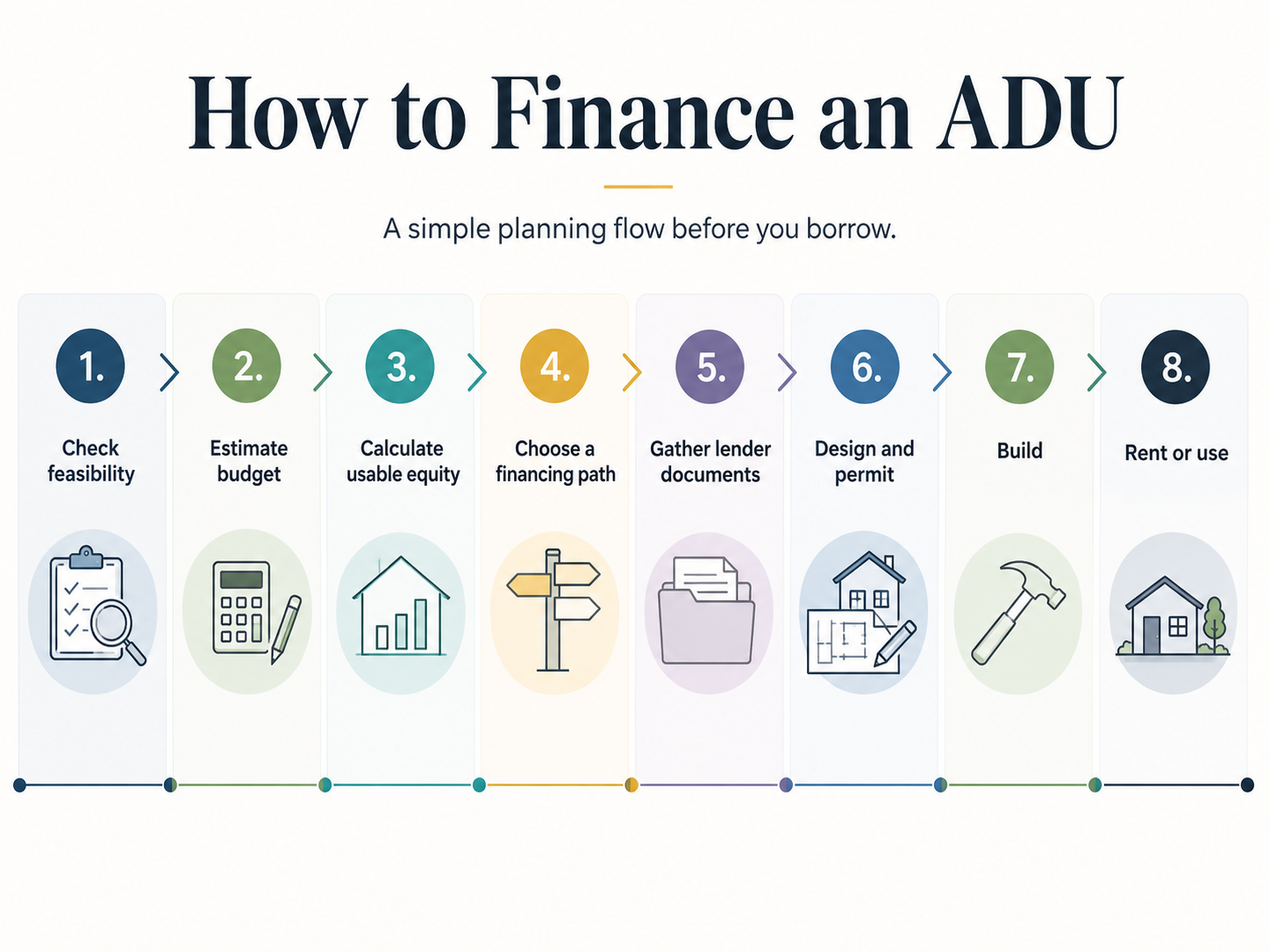
What does the ADU financing process look like, week by week?
As a planning estimate: 4–6 weeks for a HELOC, 6–8 weeks for a cash-out refinance, 8–12 weeks for a construction loan, and 10–14 weeks for an FHA 203(k). The longest single step in every product is the appraisal — especially for future-value products, where the appraiser needs your plans and contractor bid before issuing a value.
Week 1: Define your project and rough budget
Before talking to any lender, know what you're building. Confirm your lot is buildable. Use ADU cost guides or get two contractor bids to establish a range.
Week 2: Choose your financing family
Based on equity, current rate, ADU type, and timeline, narrow to one or two paths. Don't let a lender choose for you based on what they sell most.
Weeks 2–3: Get documents in order
Pull your last two pay stubs, two years of W-2s or tax returns, recent bank statements, current mortgage statement, and any existing home equity documents.
Weeks 3–4: Apply to two or three lenders simultaneously
Apply to 2–3 lenders with verifiable ADU experience. Ask explicitly about their ADU loan volume in the last 12 months.
Weeks 4–8: Appraisal, underwriting, conditions
The lender orders the appraisal. For construction or renovation loans, the appraiser uses your plans and contractor bid to issue an as-completed value.
Weeks 8–10: Closing
You sign the final loan documents. For construction loans, the funds typically move into a controlled disbursement account.
Weeks 10+: Draws and construction
Your contractor hits milestones. A lender-ordered inspector verifies progress before each draw is released.
Twelve questions to ask every ADU lender
- What’s your ADU loan volume in the last 12 months?
- Is this loan based on current value or as-completed value?
- Can ADU rental income count toward my qualifying income, and if so, what’s the cap?
- What’s the draw schedule for construction (if applicable)?
- Who orders the appraisal, and how long does it typically take?
- What happens if the appraisal comes in below the budget?
- Are there prepayment penalties?
- What are all the closing costs, itemized?
- Will the rate change between application and closing?
- Do you finance modular and manufactured ADUs the same way?
- What contractor qualifications do you require?
- What’s the earliest date you can close?
If a loan officer can’t answer most of these without checking with someone else, find a different lender.
Document checklist by financing path
| Document | HELOC / HE loan | Cash-out refi | Construction loan | HomeStyle / 203(k) | HEI |
|---|---|---|---|---|---|
| Pay stubs / W-2s / tax returns | ✅ | ✅ | ✅ | ✅ | Often required |
| Bank statements | ✅ | ✅ | ✅ | ✅ | ✅ |
| Current mortgage statement | ✅ | ✅ | ✅ | ✅ | ✅ |
| Property insurance declaration | ✅ | ✅ | ✅ | ✅ | ✅ |
| Approved ADU plans | Often optional | Often optional | ✅ | ✅ | Not usually required |
| Permit status / eligibility | Often optional | Often optional | ✅ | ✅ | Not usually required |
| Two contractor bids | Recommended | Recommended | ✅ | ✅ | Not required |
| Detailed draw schedule | Not required | Not required | ✅ | ✅ | Not required |
| Signed lease / Form 1007 (if rental income used) | If applicable | If applicable | If applicable | If applicable | N/A |
Get the Loan Officer Interview Script — plus financing checklists and state program directory
Download the Free 2026 ADU Starter Kit →No spam. Free to download.
What does it actually cost to borrow? Three worked scenarios
The headline rate rarely tells you which option costs the least over the time you’ll hold the debt. These three scenarios work the math at May 2026 market context.
Methodology
We compare total interest across the full debt stack — existing first mortgage plus any new ADU financing — over the remaining term, not just the ADU money alone. Year-1 monthly payments are principal + interest only (excluding taxes, insurance, HOA, and PMI). Construction-loan payments are interest-only during the build. Rates reflect Curinos and Bankrate national averages for HELOCs and home equity loans (May 2026), Freddie Mac PMMS for 30-year first mortgages (6.36% on May 14, 2026), and roughly 25–75 basis points higher for cash-out tiers. Your actual rate, fees, APR, and approval depend on credit, income, equity, lender, and product. These are illustrative comparisons, not offers or guarantees.
Scenario 1: $150,000 garage conversion
Borrower profile: Owner since 2018; home value $700,000; existing mortgage balance $300,000 at 3.5% with ~25 years remaining; FICO 750.
| Option | Rate context | Approx. monthly (yr 1, P&I) | Approx. total interest, full stack | Net assessment |
|---|---|---|---|---|
| Keep first mortgage + $150K HELOC | First $300K @ 3.5%; HELOC $150K @ ~7.25% variable | ~$1,505 (first) + ~$906 interest-only HELOC during draw | ~$281K–$351K | Protects the 3.5% rate; wins on blended cost. |
| Keep first mortgage + $150K fixed HEL, 20 yrs | First $300K @ 3.5%; HEL $150K @ ~7.50% fixed | ~$1,505 (first) + ~$1,209 (HEL) | ~$291K | Predictable payment; keeps the 3.5% rate. |
| Cash-out refinance to $450K, 30 yrs | Replacement loan $450K @ ~6.50% | ~$2,844 | ~$574K | Replaces a 3.5% rate; debt-stack cost materially higher. |
Verdict: For a garage conversion at this profile, a fixed home equity loan or HELOC wins by a wide margin over a cash-out refi.
Scenario 2: $250,000 mid-size detached ADU
Borrower profile: Owner since 2020; home value $800,000; existing mortgage balance $400,000 at 3.25% with ~25 years remaining; FICO 740.
| Option | Rate context | Approx. monthly (yr 1, P&I) | Approx. total interest, full stack | Net assessment |
|---|---|---|---|---|
| Keep first mortgage + $250K HELOC | First $400K @ 3.25%; HELOC $250K @ ~7.25% variable | ~$1,948 (first) + ~$1,510 interest-only HELOC during draw | ~$420K–$530K | Protects the 3.25% first mortgage; stress-test the variable rate. |
| Keep first mortgage + $250K fixed HEL, 30 yrs | First $400K @ 3.25%; HEL $250K @ ~7.50% fixed | ~$1,948 (first) + ~$1,749 (HEL) | ~$570K | Predictable; higher total due to longer HEL term. |
| HomeStyle Renovation refi to $650K, 30 yrs | Replacement loan $650K @ ~6.50% | ~$4,109 | ~$830K | Replaces the 3.25%; debt-stack cost materially higher. |
| Construction-to-permanent, $250K vs. future value | ~7.75% during build; ~6.50% after conversion | Varies by draw and conversion structure | Comparable to HomeStyle if first mortgage isn’t replaced | Works for owners with insufficient current equity. |
Verdict: With adequate equity and a sub-4% first mortgage, the HELOC wins over 30 years. With insufficient current equity, construction-to-perm or HomeStyle is the path.
Scenario 3: $400,000 full custom detached ADU on a recent purchase
Borrower profile: Owner since 2024; purchase price $900,000; current mortgage balance $700,000 at 7.0%; FICO 720.
| Option | Rate context | Approx. monthly (yr 1, P&I) | Approx. total interest, full stack | Net assessment |
|---|---|---|---|---|
| Standalone HELOC | Insufficient current equity for second-lien underwriting | N/A | N/A | Most lenders will decline at this LTV. |
| HomeStyle Renovation refi to $1.1M | Replacement loan $1.1M @ ~6.50% | ~$6,953 | ~$1.4M | Replaces 7.0% with 6.50%. Note: $1.1M exceeds the standard 2026 one-unit conforming limit of $832,750 — requires a high-cost county or non-conforming product. |
| FHA 203(k) Standard | ~$1.0–$1.1M @ ~7.50%; subject to FHA county limits | ~$7,690 | ~$1.6M | Higher rate; lower down payment. Less flexible for new-build detached. |
| Construction-to-permanent loan | ~7.75% during build; ~6.75% conversion | Varies by structure | Comparable | Common path for low-equity construction. |
Verdict: For a 2024 buyer already at 7%, replacing the first mortgage with HomeStyle Renovation can actually improve the rate while funding the ADU — but only if the property qualifies under conforming or high-cost limits. The blended math reverses entirely versus Scenarios 1 and 2.
The takeaway across all three: the right financing path is borrower-specific. A path that wins for one homeowner can be the worst choice for another. Run your own math. Rate context: Curinos/Bankrate HELOC and home equity loan averages (May 2026); Freddie Mac PMMS 30-year fixed 6.36% (May 14, 2026); FHFA 2026 conforming loan limit $832,750.
What can go wrong with ADU financing?
The biggest ADU financing mistakes happen before the first lender call: borrowing before checking local zoning, assuming all projected rent will count toward qualifying, underestimating utility and site costs, repricing a low-rate first mortgage when it’s not necessary, treating “no monthly payment” products as free, or banking on a grant that’s closed. None are unfixable, but each can add months and tens of thousands of dollars.
Risk 1: Borrowing before confirming local feasibility
Lenders won't fund an ADU that can't legally be built. Confirm zoning, setbacks, lot coverage, height limits, and any local ADU ordinances before spending money on plans or applying for financing.
Risk 2: Assuming all projected ADU rent will help you qualify
The 75% calculation, the 30% caps in Fannie Mae and Freddie Mac, the agency-specific exclusions on cash-out refinances, the FHA 50% rule for prospective rent — they all matter. Ask your specific lender, in writing, what percentage of projected ADU rent will count under the program you're using.
Risk 3: Repricing a low mortgage you didn't need to replace
The worked dollar math above tells you what happens if you do this. Always compare total interest paid over the full life of both options — not just monthly payments.
Risk 4: Underestimating utility, site, and soft costs
ADU construction quotes often exclude utility lateral upgrades, sewer connections, electrical panel upgrades, site grading, geotechnical reports, design fees, permit fees, and impact fees. Build a 10% contingency on top of whatever your detailed scope shows.
Risk 5: Treating 'no monthly payment' products as free
HEIs and HECMs can avoid required monthly payments — but the cost shows up at the back end. Model the total cost over your expected hold period and compare it to traditional debt.
Risk 6: Banking on a grant that's closed or restrictive
CalHFA's $40,000 ADU Grant has been fully allocated since December 28, 2023. Plan around mainstream financing as your primary path, and treat any grant as a bonus — not the foundation.
Risk 7: Appraisal coming in below your number
ADU appraisals are still a difficult area. Comparable sales may be limited, which can cause conservative valuations. Build a 5–10% contingency for an appraisal that lands below your number.
Don’t borrow before you know what you can build
See What You Can Build → Get Your Free ADU ReportADU financing FAQs
What is the best way to finance an ADU?
The best path depends on your equity, your current mortgage rate, the ADU type you're building, and whether rental income can help you qualify. For most homeowners with a low pandemic-era first mortgage and enough equity, a HELOC or home equity loan is the first option to test — it preserves the favorable first-mortgage rate. For low-equity homeowners, a construction loan or renovation loan that underwrites against future value is usually the right path.
Is there a specific ADU loan?
No nationwide universal ADU loan exists. Lenders finance ADUs through standard products: HELOCs, home equity loans, cash-out refinances, construction loans, construction-to-permanent loans, and renovation loans (Fannie Mae HomeStyle, Freddie Mac CHOICERenovation, FHA 203(k)). Some local programs offer ADU-specific loans, but those are geographically narrow.
Can I use a HELOC to build an ADU?
Yes, and it's one of the most common financing paths for homeowners with sufficient equity. A HELOC's flexibility — draw funds as construction invoices come due, pay interest only on what's drawn — matches the cash-flow pattern of a construction project well. The trade-offs are variable-rate risk during the draw period and the fact that your home secures the loan.
Should I use a HELOC or a cash-out refinance for an ADU?
If your current first-mortgage rate is meaningfully below today's market, almost always a HELOC. The HELOC keeps your favorable rate intact and applies the higher second-lien rate only to the ADU money. A cash-out refi makes more sense when your existing rate is already at or above market.
How much equity do I need to build an ADU?
For current-value products (HELOC, home equity loan, cash-out refi), the rough formula is (home value × 80%) minus existing mortgage balance. If that covers your ADU budget, you have enough equity. If not, future-value products (construction loans, renovation loans) can underwrite against your home's as-completed value, often unlocking significantly more borrowing power.
Can I use FHA 203(k) for an ADU?
Yes, with important scope considerations. HUD Mortgagee Letter 2023-17 expanded Standard 203(k) eligibility for ADU work, including conversions and additions. The 203(k) program is best for conversion-heavy work, not standalone new-build detached ADUs.
Can ADU rental income help me qualify?
Sometimes. Fannie Mae allows ADU rental income for eligible transactions (purchase and limited cash-out refis) on one-unit primary residences — 75% of gross rent, capped at 30% of total qualifying income, automated in DU 12.1 as of March 21, 2026. Freddie Mac has similar rules with the CHOICERenovation restriction effective May 4, 2026. FHA allows rental income under HUD ML 2023-17 but not on cash-out refis.
Did Fannie Mae change the rules for ADU rental income?
Yes. Fannie Mae Announcement SEL-2025-08 (October 2025) updated rental-income policy to allow ADU rental income for qualifying. Desktop Underwriter 12.1, released March 21, 2026, automates the rule — including the 30% qualifying-income cap and single-ADU limitation.
Can I finance an ADU with no equity?
Often yes — but not through a HELOC, home equity loan, or standard cash-out refi. The realistic paths are future-value financing (construction loans, construction-to-permanent loans, Fannie Mae HomeStyle, Freddie Mac CHOICERenovation, FHA 203(k)), home equity investments in eligible states, local assistance programs, and phased scope.
Can I finance a prefab or modular ADU?
Yes. Modular ADUs built to state or local building codes are generally treated like site-built structures by most lenders. Fannie Mae HomeStyle explicitly allows modular ADUs. HUD-code manufactured ADUs require permanent foundation and real-property classification for conventional financing.
Are there ADU grants in California in 2026?
The CalHFA ADU Grant of up to $40,000 has been fully allocated since December 28, 2023 and is not accepting new applications. CalHFA warns that anyone claiming to help access this grant is running a scam. Some city-level programs remain active, notably the SDHC ADU Finance Program.
Can I finance an ADU on a rental or investment property?
Eligibility depends on the product, agency, and occupancy. Most ADU-specific rental-income rules apply to one-unit primary residences. For investment properties, options narrow: DSCR loans, portfolio-loan products from regional banks and credit unions, and certain construction loans. Expect higher rates and larger down payments than owner-occupied options.
Can I finance an unpermitted or nonconforming ADU?
Generally no, not through conventional mortgage products. Lenders and appraisers require the ADU to be legally permitted under local zoning. California's AB 2533 (effective January 1, 2025) created a pathway for legalizing certain unpermitted ADUs constructed before 2020.
Will building an ADU affect my property taxes, homeowners insurance, or escrow?
In most cases, yes. Property taxes typically increase as the ADU's value is added to assessed value. Homeowners insurance premiums usually rise; you may need a landlord rider or umbrella if you rent the ADU. Escrow accounts will recalibrate upward. Confirm with your county assessor, insurer, and lender before finalizing financial projections.
What if the appraisal comes in below my ADU budget?
Your borrowing power drops. Options include bringing more cash to close, reducing project scope, providing additional comparable data to support a revised appraisal, or applying with a different lender. Building a 5–10% contingency up front protects against this risk.
Does an owner-builder approach make ADU financing harder?
Yes, significantly. Most construction loans and renovation loans require a licensed, insured general contractor. If you plan to act as your own GC, start the lender conversation early — options are more limited and terms are often stricter.
What credit score do I need for an ADU loan?
It depends on the product. Conventional construction loans typically require 680+ FICO. FHA 203(k) accepts down to 580 with 3.5% down. HELOCs and home equity loans usually want 680+ for the best rates but accept down to about 620 with overlays. HEI minimums vary by provider and state.
Does an ADU usually add value to the property?
FHFA data shows that California properties with ADUs experienced stronger median appraised-value growth than comparable properties without ADUs over 2013–2023. This is historical California data, not a nationwide guarantee. Results vary by market, ADU quality, and unit type.
Which ADU financing option actually costs the least over time?
It depends on your existing mortgage rate and how long you hold the debt — the headline rate rarely decides it. In our worked scenarios at May 2026 rates, a borrower with a sub-4% first mortgage almost always pays less over 25–30 years by keeping that mortgage and layering a HELOC or fixed home equity loan on top, rather than doing a cash-out refinance that reprices the whole balance. But for a recent buyer already at 7%, a HomeStyle Renovation refinance can lower the blended rate while funding the ADU. Compare total interest across the full debt stack — first mortgage plus new financing — not just the monthly payment on the ADU money.
What happens if my permits are delayed after I close on ADU financing?
Most construction and renovation loans have time limits on construction duration. Fannie Mae HomeStyle requires renovation completion within 15 months of closing. Construction loans typically allow a 12-month window with extension options. If permits are delayed, communicate with your lender early — extension fees or a forced refinance may result.
How The Dwelling Index researches and evaluates ADU financing paths
We are an independent research resource covering ADU financing, costs, and regulations. We do not originate loans, act as a broker, or sort financing options by compensation.
- Source hierarchy: Primary agency documents (Fannie Mae Selling Guide, Freddie Mac Guide, HUD Mortgagee Letters) for regulatory facts. Consumer-protection authorities (CFPB, FTC) for risk disclosure. Verified program pages from administering agencies for grant and program status. Rate benchmarks from Curinos and Bankrate with publication dates.
- Evaluation criteria for each path: Property fit, geographic availability, current-value versus future-value treatment, ability to preserve an existing first mortgage, rental-income treatment under each agency, draw structure, contractor and owner-builder constraints, and program eligibility verified with a date.
- What we never do: Rank lenders by compensation. Quote specific rates or APRs as guarantees. Promote any specific lender as “best.” Use fake reviews or testimonials. Publish schema for content that isn’t visible on the page.
- Verification cadence: Agency rules quarterly; local program status monthly; benchmark rates monthly or after any major Fed/FOMC action; partner availability and affiliate status monthly.
See our methodology, editorial standards, and affiliate disclosure.
Sources cited in this guide
- Fannie Mae Selling Guide B3-3.8-01: Rental Income — selling-guide.fanniemae.com
- Fannie Mae Selling Guide B2-3-04: Special Property Eligibility Considerations — selling-guide.fanniemae.com
- Fannie Mae Announcement SEL-2025-08 — singlefamily.fanniemae.com
- Pennymac Announcement 26-29 (DU 12.1 effective March 21, 2026) — corr.pennymac.com
- Freddie Mac Single-Family ADU page — sf.freddiemac.com
- Freddie Mac Guide Section 5601.2 — guide.freddiemac.com
- HUD Mortgagee Letter 2023-17 — hud.gov
- CFPB — Home Equity Contracts Market Overview — consumerfinance.gov
- California HCD ADU Handbook (2026) — hcd.ca.gov
- Curinos HELOC/HEL rates via Yahoo Finance (May 17, 2026) — finance.yahoo.com
- Terner Center / Urban Institute — ADU Construction Financing (2022) — ternercenter.berkeley.edu
- FHFA — Trends in Median Appraised Value for Properties with ADUs in California — fhfa.gov
- Freddie Mac Primary Mortgage Market Survey (PMMS) — 30-year fixed 6.36%, May 14, 2026 — freddiemac.com/pmms
- Bankrate — Current HELOC and home equity loan rates, May 2026 (HELOC 7.26%, HEL 8.03% on May 6, 2026) — bankrate.com
- FHFA — 2026 Conforming Loan Limits ($832,750 standard one-unit; $1,249,125 high-cost) — fhfa.gov
- HUD — FHA 2026 Loan Limits ($541,287 floor; $1,249,125 ceiling) — hud.gov
- HUD Mortgagee Letter 2024-13 — FHA 203(k) modernization, effective November 4, 2024 — hud.gov
- Fannie Mae SEL-2025-10 (December 10, 2025) — UAD 3.6 ADU property eligibility (effective March 31, 2026) and HomeStyle Renovation upfront disbursements up to 50% of renovation costs — singlefamily.fanniemae.com
- Freddie Mac Bulletin 2025-15 (November 5, 2025; effective February 9, 2026) — manufactured-home ADUs — guide.freddiemac.com
- Freddie Mac Bulletin 2026-1 (February 4, 2026) — CHOICERenovation rental-income rule, effective May 4, 2026 — guide.freddiemac.com
- Fannie Mae Selling Guide B5-3.2-01 — HomeStyle Renovation 75% as-completed value cap and 15-month completion requirement — selling-guide.fanniemae.com
- California State Board of Equalization — New Construction Assessment (ADU additions generally assessable as new construction) — boe.ca.gov
Not sure where to start? See what’s possible at your address — get your free ADU report in 60 seconds.
See What You Can Build → Get Your Free ADU ReportThe Dwelling Index is an independent research resource covering ADU financing, costs, and regulations. We are not a lender, broker, or builder. This page is educational and does not constitute legal, tax, mortgage, or financial advice. Financing availability, underwriting, rates, fees, and eligibility vary by lender, borrower, property, and location. Always confirm terms with a licensed lender and verify ADU rules with your local planning and building department.