
Best Prefab ADU Companies in 2026: Real Prices, Best Fits & Red Flags
The best prefab ADU companies are the ones that actually serve your state, fit your lot, and give you a written quote that covers the full installed project — not just the unit. After reviewing more than a dozen prefab ADU companies on installed costs, service areas, build types, and completed projects, our top picks are Abodu for turnkey California projects with fixed pricing, Villa Homes for larger layouts in California and Colorado, Studio Shed for nationwide panelized delivery, and Samara for design-forward net-zero builds in California.
But here’s what most comparison pages don’t tell you: website prices across this category are not apples-to-apples. Some companies quote all-in pricing that includes foundation, utilities, and installation. Others quote unit-only prices where site work, permits, and delivery are entirely separate. The difference can be six figures. The comparison below sorts it all out — who’s real, who serves where, what’s actually included in each price, and what questions to ask before you commit a dollar.
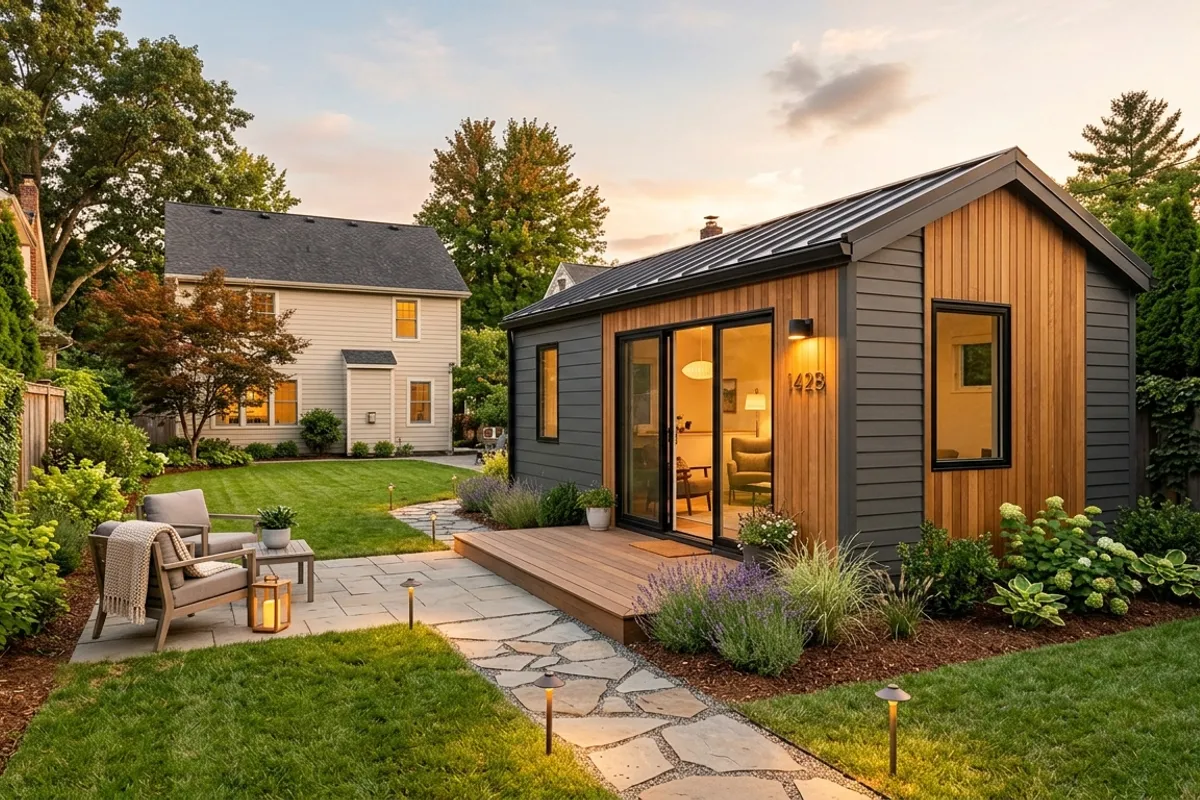
Which Prefab ADU Companies Are the Best Options Right Now?
These are the companies we’d tell a friend to start with. The right pick depends on your state, lot, budget, and how much of the process you want to manage yourself.
Prices sourced from company websites as of April 2026. Scope and inclusions vary significantly by company — always confirm in writing what your quote covers before signing. See our methodology →
| Company | Best For | States Served | Build Type | Base Price Range | What’s Included in Base? | Crane? |
|---|---|---|---|---|---|---|
| Abodu | Fixed-price turnkey (CA) | California | Modular, HCD-approved | $234,800 home / $298,800 installed start – $328,800 home / $424,800 installed start | Home price includes design, permits/plan check and delivery; typical installation includes foundation, standard site work, utility connections/trenching up to 50 ft and crane allowance up to 100 ft | Yes |
| Villa Homes | Larger layouts, 2–3 BR | California, Colorado | Offsite/prefab construction | Varies by model — request quote | Turnkey: design, permits, site work, install, utilities | Varies |
| Studio Shed | Nationwide, hybrid support | All 50 states | Panelized | ~$40K+ (product + plans); ~$250/sqft with ProAssembly + site work | Kit + plans; ProAssembly and full service available | No |
| Samara | Design-forward, California | California | Modular (steel frame) | Starting at $152,000 plus installation | Unit cost; installation priced separately | Yes |
| Boxabl | Multiple sizes, expanding nationally | Expanding — verify your area | Foldable modular | Monthly financing from ~$895/mo | "We handle everything" — verify scope for your area | Yes |
| Deltec Homes | Storm resistance, eco | Nationwide (all 50 states) | Panelized | Varies by design | Structure + panels; local GC handles site work | No |
The Dwelling Index is reader-supported. This table may include companies with affiliate partnerships. Our rankings are never influenced by compensation.
What Does a Prefab ADU Actually Cost Installed?
This is where most buyers get blindsided — and it’s the most important thing to understand before you contact any company.
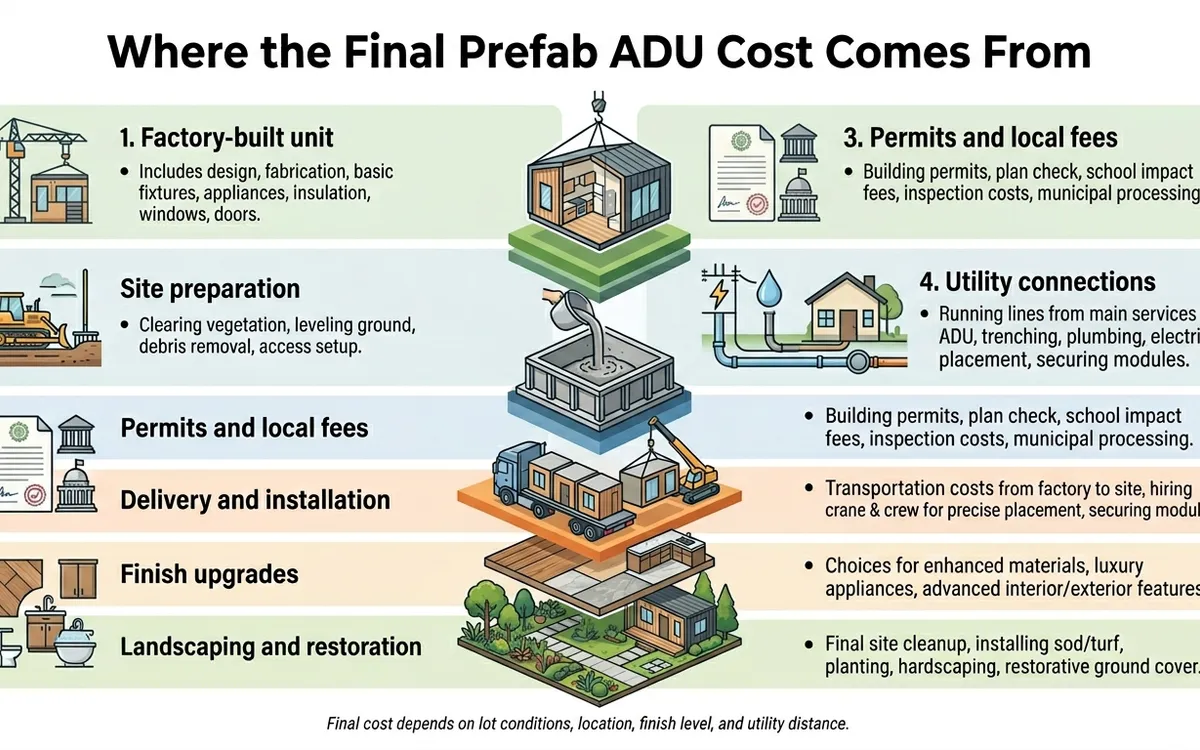
Every prefab ADU company prices differently. Some, like Abodu, publish all-in pricing that covers the unit, foundation, standard utility connections, delivery, and installation. Others, like Studio Shed, price the kit and plans separately from assembly, site work, and permits — which you handle locally. And some companies quote a unit price that looks compelling until you realize foundation, utilities, crane, permits, and finish work are all separate line items.
The cost components that may or may not be included in your quote:
- Foundation: $15,000–$50,000
- Every prefab ADU needs one. Sloped lots push toward the high end. (Source: BuildX cost analysis, SnapADU project data, March 2026.)
- Site preparation: $5,000–$30,000
- Clearing, grading, access creation. Flat and clear? Low end. Sloped with trees? Budget up. (Source: GreatBuildz hidden cost breakdown, industry reporting.)
- Utility connections: $10,000–$25,000
- Water, sewer/septic, electrical, gas trenching from your main home or street to the ADU pad. Abodu includes standard connections and trenching up to 50 feet; separately quoted items may still apply. (Source: Abodu fixed-pricing page; confirm property-specific scope.)
- Delivery and crane: $5,000–$15,000
- Full modular units need a crane. Overhead wires, narrow streets, or tight access increase cost. Panelized companies like Studio Shed and Deltec avoid this entirely. (Source: Industry reporting, vendor specifications.)
- Permits and engineering: Varies by jurisdiction and scope
- Even with pre-approved plans, local inspections, utility or capacity charges and separately quoted site items may add cost. Abodu’s current fixed-pricing page places design, permits and plan check in the home price; confirm the itemized scope. (Source: Abodu fixed-pricing page; confirm property-specific scope.)
- Finish work and upgrades: $0–$50,000+
- Turnkey companies include finishes, while kit companies often do not. Compare the written scope rather than carrying forward an average-upgrade estimate. (Source: Abodu fixed-pricing page; confirm property-specific scope.)
The Math in Practice
Turnkey provider on a straightforward California lot (Abodu example):
Abodu One (500 sq ft): home from $260,800 + typical installation $64,000 = $324,800 home-plus-installation starting total, before separately quoted items and tax.
Source: Abodu.com/pricing, April 2026.
Panelized kit on a nationwide lot (Studio Shed example):
Product + plans: ~$40,000+ + ProAssembly: varies + Local GC for foundation, utilities, permits: varies by market = $150,000–$350,000+ total depending on size, location, and scope
Source: Studio-shed.com, editorial estimate based on published ~$250/sqft guidance for 400 sqft units.
Budget path with owner involvement (prefabADU example):
Kit materials: starting ~$30,000 + Owner-managed foundation, utilities, permits, assembly = $100,000–$250,000+ total
Source: prefabADU.com, editorial estimate.
These are editorial estimates based on published pricing and industry data, not guaranteed quotes. Actual costs depend on your specific lot, location, and project scope.
How to Protect Yourself
Before you sign anything or put down a deposit, get answers to these questions in writing:
- What is included in your quoted price? Get a line-item breakdown.
- What is explicitly excluded — foundation, site prep, utilities, permits, crane, landscaping?
- Who handles excluded scope — you or the company? If you, what’s the estimated cost?
- What are the deposit terms, and what happens to your deposit if the project is delayed or cancelled?
- What is the realistic timeline from contract signing to certificate of occupancy?
- Can I visit a completed, occupied installation — not a showroom or render?
- What warranty covers the unit, and what covers the site work?
Any company that can’t answer these clearly is telling you something important.
Not sure if your lot qualifies?
Get your free ADU feasibility report — local size limits, setback rules, and estimated costs in about 60 seconds.
Check My Property →Which Prefab ADU Companies Are Actually Worth Shortlisting?
We evaluated each company against the same criteria: published pricing and what’s included, service area, build type and code path, lot-fit requirements, timeline, and evidence of completed installations. Here’s what we found.
Abodu
Best Turnkey in CaliforniaCalifornia · Modular · HCD-Approved · Home from $234,800; installed start from $298,800
Our take: The most transparent turnkey option in California, with genuinely fixed pricing and a streamlined permitting pathway.
- Best for
- California homeowners who want a modern ADU with predictable costs and minimal project management on their end. Strong for homeowners with good crane access.
- Who should skip
- Homeowners outside California. Anyone who needs heavy customization or wants to match a specific architectural style. Properties where crane access is impossible.
- States served
- California. (Source: Abodu.com, April 2026.)
- Build type
- Factory-built modular, HCD state-approved plans. HCD approval means a streamlined permitting pathway — California law generally gives local agencies 60 days to act on ADU applications, and for detached ADUs submitted with a pre-approved plan, the timeline can be as short as 30 days. (Source: California HCD ADU Handbook; California Government Code §65852.2.)
- Models & pricing
- Abodu Studio: 385 sq ft — home from $234,800; home + typical installation from $298,800
- Abodu One: 500 sq ft, 1BR/1BA — home from $260,800; home + typical installation from $324,800
- Abodu Two: 625 sq ft, 2BR/1BA — home from $293,800; home + typical installation from $358,800
- Abodu Two+: 800 sq ft, 2BR/2BA — home from $328,800; home + typical installation from $424,800
- Dwell House: current quote required. Confirm current availability and specifications directly.
Abodu publishes home and typical-installation prices separately. Confirm a property-specific quote; separately quoted items and tax may add cost.
- What's included
- Dedicated project manager, complete unit with finishes and appliances, permit services, pre-approved plans, unit delivery and installation, foundation, and standard utility connections.
- NOT included
- Separately quoted items include a $6,000 survey/staking/certification package, work beyond standard allowances, demolition, tree removal, unusual site engineering and sales tax. Confirm the full property-specific scope.
- Timeline
- About 6 months for most projects. Manufacturing takes approximately 4 months, with site work running in parallel.
- Evidence
- Hundreds of completed installations across California. Real photography, not just renders. Showrooms available for visits. (Source: Abodu.com.)
Villa Homes
Best for Larger LayoutsCalifornia, Colorado · Offsite/Prefab · 15+ Floor Plans
Our take: The widest floor plan selection among California turnkey providers, with genuine expansion beyond the state.
- Best for
- Homeowners who want turnkey service with 15+ floor plans including 2 and 3-bedroom layouts. Good for larger ADU projects and anyone wanting accessible design options.
- Who should skip
- Budget-focused buyers looking for the lowest possible path. Homeowners outside California and Colorado.
- States served
- California and Colorado. Villa describes having experts across the country for design and contracting support — verify current installation availability for your location. (Source: VillaHomes.com, April 2026.)
- Build type
- Offsite/prefab construction. Villa describes itself as a leader in offsite construction with turnkey services covering design, permitting, construction, delivery, site work, installation, and utility hookups.
- Pricing
- Villa offers an instant quote tool on their website. Published per-square-foot pricing varies by model and configuration — request a quote directly for current numbers. The company emphasizes transparent pricing with no hidden costs. (Source: VillaHomes.com, April 2026.)
- What's included
- Design, permitting, construction, site work, installation, and utility hookups — positioned as full turnkey service. Energy Star appliances standard.
- Timeline
- Varies by project scope and jurisdiction. Industry-standard for turnkey California ADUs is 6–12 months from design to move-in.
- Evidence
- Villa describes itself as the largest ADU builder in California. Real project documentation on their website. (Source: VillaHomes.com.)
Studio Shed
Best Nationwide OptionAll 50 States · Panelized · No Crane Required · Since 2008
Our take: The strongest option for homeowners outside California, with a proven 17-year track record and flexible service levels from DIY kits to professional assembly.
- Best for
- Nationwide reach. Homeowners who want control over the process, or who want to work with Studio Shed’s ProAssembly teams and local partners. No crane required — panelized delivery fits through standard gates.
- Who should skip
- Anyone who wants a completely hands-off turnkey experience with zero project coordination.
- States served
- All 50 states. Factory in Louisville, Colorado. (Source: Studio-shed.com, April 2026.)
- Build type
- Panelized. Factory-built wall and roof panels shipped to your property for on-site assembly. No crane required.
- Models & pricing
- The Summit Series is their premier ADU line. Product and permit plans start around $40,000. Full ADU product plus ProAssembly plus site work and permits runs approximately $250/sq ft for a 400 sq ft unit. Studio Shed also offers a 3D Design Center for online customization. (Source: Studio-shed.com/adu/cost-financing, April 2026.)
- What's included
- Prefabricated wall and roof panels, electrical and appliance package, kitchen and bath package (on ADU models), engineered permit-ready plans. Two-by-six wall construction.
- Service model
- Multiple tiers — from kit-only (you arrange assembly and site work locally) to ProAssembly (their teams handle assembly) to more comprehensive support with local partners. This is a hybrid model, not purely DIY. (Source: Studio-shed.com FAQ, April 2026.)
- Timeline
- Kit delivery in weeks. Total project timeline depends on local permitting, contractor availability, and site prep — typically 3–8 months.
- Evidence
- Operating since 2008 — one of the longest track records in the prefab ADU space. Online 3D Design Center. Multiple product lines with real project documentation.
Samara
Best Design-Forward OptionCalifornia · Modular Steel Frame · 100% Electric · From $152,000 + Install
Our take: The design and build-quality leader in California, backed by serious founders and institutional capital.
- Best for
- Design-conscious California homeowners who want a beautifully crafted ADU. Strong for homeowners who care about build quality, fire resistance, and long-term value.
- Who should skip
- Budget-focused buyers. Anyone outside California.
- States served
- California only. (Source: Samara.com, April 2026.)
- Build type
- Factory-built modular with precision-engineered steel frames. 100% electric. Fire-resistant by design. Solar-ready — net-zero capability may vary for sites with significant shading. (Source: Samara.com, April 2026.)
- Models & pricing
- Studio: 420 sq ft — starting at $152,000 plus installation
- One Bedroom: 540 sq ft — plus installation
- Two Bedroom: 690 sq ft — plus installation
- XL 8: 800 sq ft — plus installation
- XL 10: 950 sq ft (new) — plus installation
Installation costs are site-specific and quoted separately. Source: Samara.com/backyard/models, April 2026.
- What's included
- Samara manages the full process from product design and manufacturing to permitting, delivery, installation, and financing. The base model price covers the unit; installation is priced based on your site assessment.
- Timeline
- As few as 30 days of on-site labor, with full projects completing in approximately seven months including permitting. (Source: Samara.com.)
- Evidence
- Co-founded by Airbnb co-founder Joe Gebbia and former Flex CEO Mike McNamara. $41M Series A led by Thrive Capital. Real installations documented. Showrooms available. Manufacturing facility in Mexicali, MX. (Source: Samara.com/news.)
Boxabl
Expanding NationallyExpanding Availability · Foldable Modular · Studio, 1BR & 2BR
Our take: Significant innovation in foldable modular housing, now offering multiple models and expanding service nationally. Verify current availability and scope for your specific area.
- Best for
- Buyers interested in factory-finished modular units with an expanding national presence. Boxabl now offers studio, one-bedroom, and two-bedroom configurations.
- Who should skip
- Anyone who needs a unit immediately without confirming delivery timeline for their area. Verify scope and availability before committing.
- States served
- Expanding nationally — availability varies by region. Confirm directly with Boxabl for your location. (Source: Boxabl.com, April 2026.)
- Build type
- Foldable modular. Units fold down for efficient shipping and unfold on-site.
- Models
- Casita Studio: 361 sq ft (19’×19’)
- Casita One Bedroom: 722 sq ft (19’×38’)
- Casita Two Bedroom: 722 sq ft (19’×38’)
Monthly financing from approximately $895/month (studio). (Source: Boxabl.com/casita, April 2026.)
- Important
- Boxabl’s service model has evolved — their current website describes a more comprehensive offering. Confirm exactly what’s included for your specific project — foundation, permits, utilities, site prep, installation scope — before committing. Crane or telehandler equipment is required for installation.
- Evidence
- Significant media coverage and consumer interest. Factory operations in Nevada. Real units delivered and installed.
More Companies Worth Knowing About
Deltec Homes
Asheville, NC. Founded in 1968 and certified as a B Corp. Known for circular, hurricane-resistant designs engineered for extreme weather. Net-zero capable. Ships panelized to all 50 states. Not an ADU specialist, but their smaller models work well as ADUs. Strong for storm-prone areas and eco-conscious buyers. (Source: DeltecHomes.com, April 2026.)
Plant Prefab
Rialto, CA. Focuses on sustainability with LEED-certified and Net Zero Energy homes. Collaborates with architects for custom modular construction. California presence. (Source: PlantPrefab.com.)
prefabADU
Bay Area, CA. A long-established company with over 170 completed units. Positions itself as the most affordable path through DIY kits with owner-builder guidance. Micro, Suite, and Villa unit categories from 150–1,200 sq ft. Best for hands-on homeowners comfortable doing significant work themselves. (Source: prefabADU.com.)
Dvele
Modular home company offering smart home technology integration and premium finishes. Broader product line beyond ADUs. California market. (Source: Dvele.com.)
Dwellito
Not a manufacturer but a marketplace that connects buyers with prefab ADU companies. Useful for comparing options and accessing financing — think of it as a comparison shopping platform for the category.
See what you can build at your address — get your free ADU feasibility report
Local size limits, setback rules, and estimated costs in 60 seconds. No sales call. No commitment.
Get Your Free ADU Property Report →Should You Choose Modular, Panelized, Kit, or Manufactured?
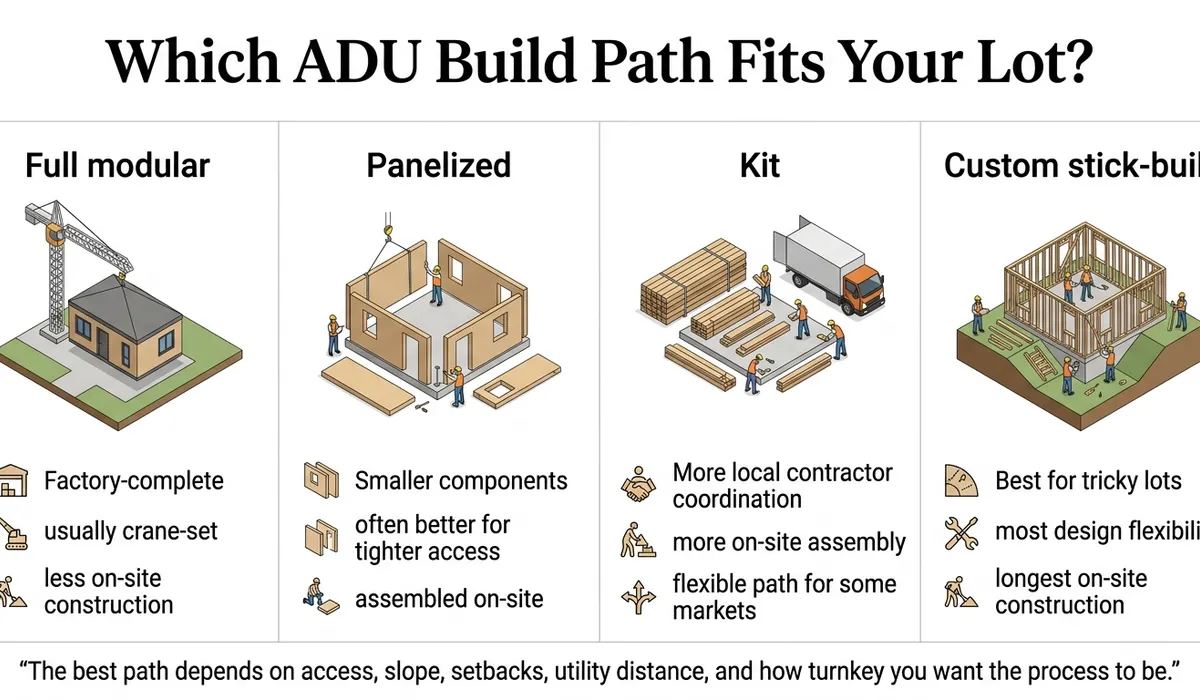
These aren’t marketing labels — they change your permitting pathway, financing options, delivery method, and how your ADU gets appraised.
| Factor | Modular | Panelized | Kit | Manufactured (HUD Code) |
|---|---|---|---|---|
| How it arrives | Complete unit on a truck | Wall/roof panels on a truck | Materials + plans shipped | Complete unit on a chassis |
| Crane required? | Yes | No | No | Usually no |
| Code path | State/local building code (IRC) or HCD-approved | State/local building code (IRC) | State/local building code (IRC) | Federal HUD Code (24 CFR Part 3280) |
| Financing | Standard home equity/construction loans | Standard home equity/construction loans | Standard home equity/construction loans | May face restrictions — verify with lender |
| Appraisal | Typically treated like site-built | Typically treated like site-built | Typically treated like site-built | May be treated differently — verify |
| Best for | Easy lots with crane access | Tight access, mid-budget | Budget-conscious, hands-on buyers | Specific use cases |
Why This Matters for Your Wallet
Fannie Mae and most conventional lenders treat modular and panelized ADUs built to IRC (International Residential Code) standards the same as site-built construction for financing and appraisal purposes. Manufactured housing built to federal HUD Code (24 CFR Part 3280) follows a separate regulatory and financial pathway. (Source: Fannie Mae Selling Guide; HUD regulations.)
Will a Prefab ADU Actually Work on Your Lot?
You can fall in love with a model online, but if it doesn’t physically, legally, and practically work on your specific property, none of the rest matters. Here’s the quick screening checklist.
- Access width
- Can a flatbed truck reach your property? If modular, is there overhead clearance for a crane? If your backyard access is through a narrow side gate, panelized or kit options (Studio Shed, Deltec, prefabADU) work where modular can't.
- Slope and grading
- Flat is cheapest. Significant slope means additional foundation engineering, potential retaining walls, and higher site prep costs.
- Overhead wires
- Power lines crossing your backyard or the crane path can prevent modular installation. Temporary relocation is sometimes possible but adds cost and time.
- Setbacks and easements
- Every jurisdiction has minimum distances from property lines and existing structures. Most ADU regulations require 4-foot rear and side setbacks, but check your local code.
- Utility distance
- How far is the ADU pad from your sewer connection, water line, electrical panel, and gas? Every additional foot of trenching adds cost. Abodu includes up to 50 feet of standard utility connections; beyond that adds to the price.
- Trees
- Mature trees in the build zone usually need removal. Some jurisdictions have tree preservation ordinances.
When Prefab Isn’t the Right Move
We’d point you toward stick-built construction if your lot has extreme access constraints, you need the ADU to precisely match a historic or highly specific architectural style, your lot has severe slope or irregular shape requiring a fully custom foundation, or your local market has competitive contractors who can meet or beat prefab on total project cost. Stick-built isn’t better or worse — it’s a different tool for different situations.
Not sure if your lot qualifies?
Get your free ADU feasibility report — local size limits, setback rules, and estimated costs in about 60 seconds.
Check My Property →How Do You Avoid Getting Burned by a Prefab ADU Company?
The prefab ADU industry is young, growing fast, and not every company making promises today will be around to deliver. We track this so you don’t have to learn the hard way.
A Real Cautionary Tale
Connect Homes liquidation — January 2025
Connect Homes filed for liquidation in January 2025 after accumulating debt and supply-chain problems. As reported by Dwell, one Northern California family paid more than $400,000 for an ADU that was never delivered, and the company went silent. Internal issues included dozens of projects where plans weren’t submitted for permits on time — a fact hidden from customers.
Source: Dwell, “Buying a Prefab ADU Was Supposed to Be Easier Than This,” May 2025.
Connect Homes had advertised with major design publications and appeared credible. That’s exactly why due diligence matters.
The Red Flag Checklist
Before any deposit, verify:
Render-only portfolio. This is the single biggest filter. Renders are cheap. Finished units on real lots are proof of execution. Real photos of completed, occupied installations — not just renders.
Years in business and completed project count. Companies under 2–3 years old with no verified completions carry higher risk.
Deposit and payment terms. Understand exactly when money is due and what happens if the project is delayed or cancelled. Abodu, for example, uses a milestone-based payment structure tied to manufacturing progress and site work completion.
Recent customer references. Not hand-picked — homeowners who completed the process in the last 6–12 months.
State contractor licensing. Verify through your state's licensing board.
Clear scope documentation. Vagueness about what's included is a bigger red flag than high pricing.
The good news: the companies that survive and grow in this industry are getting more transparent. Abodu’s fixed pricing, Villa’s instant quote tool, Samara’s turnkey model with no surprise fees, and Studio Shed’s online 3D design center all represent the industry moving in the right direction. But the burden of verification still falls on you.
Free 2026 ADU Starter Kit
Quote comparison worksheet, vendor vetting checklist, lot-fit screening guide, and a financing paths explainer — everything you need before you talk to a single company.
Download the Free ADU Starter Kit →How Long Does a Prefab ADU Take from Contract to Move-In?
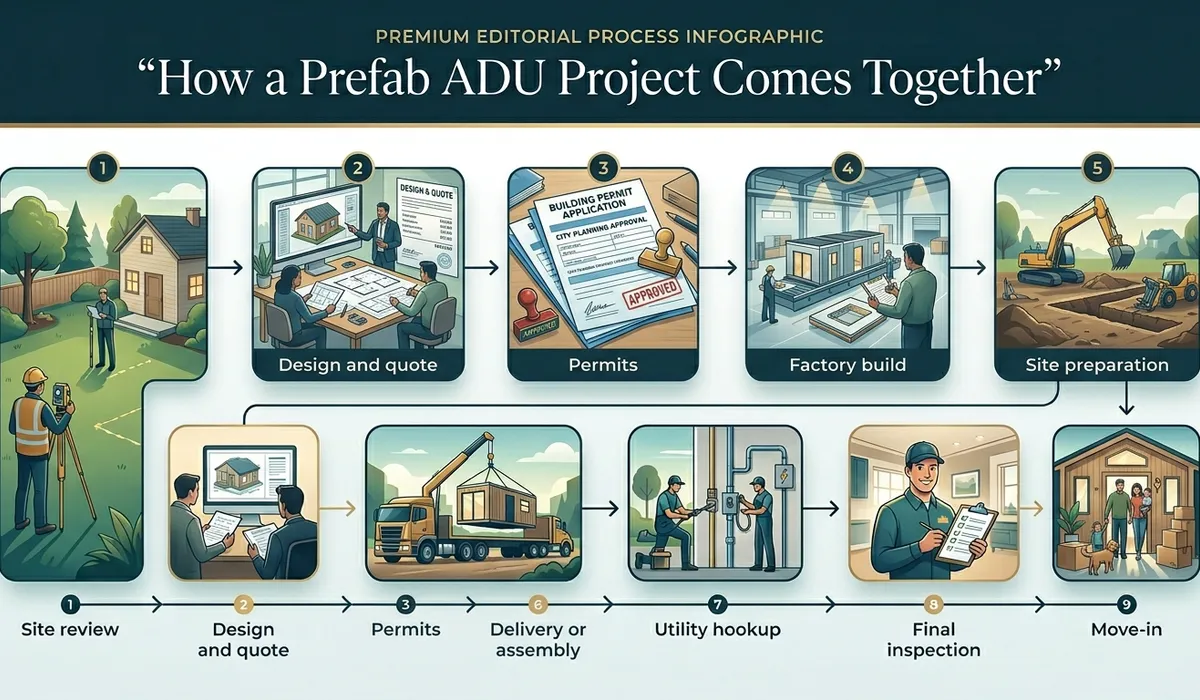
Every company will tell you their process is fast. The factory build often is. But “factory time” is not “project timeline.”
| Phase | Typical Duration | Where Delays Live |
|---|---|---|
| Design and selection | 2–4 weeks | Decision paralysis, site assessment scheduling |
| Permitting | 2–12 weeks | Varies by jurisdiction. California law generally gives local agencies 60 days to act on ADU applications. For detached ADUs using a pre-approved plan, the window is 30 days. Other states vary widely. |
| Factory build | 4–12 weeks | Supply chain, production backlog |
| Site preparation | 2–4 weeks (can run parallel to factory) | Excavation, weather, contractor scheduling |
| Delivery and installation | 1 day to 4 weeks | Modular: crane scheduling, weather. Panelized: assembly time. |
| Utility connections + finish | 1–4 weeks | Utility company scheduling, inspection waits |
| Final inspections and CO | 1–4 weeks | Inspector availability, corrections |
| Realistic total | 4–8 months | Permitting drives the timeline more than construction |
Source: California Government Code §65852.2 for permitting timelines; company-reported timelines; industry reporting.
How Do Homeowners Pay for a Prefab ADU?
Most homeowners don’t write a six-figure check. They finance the project through one of several paths, and the right choice depends on your equity, credit, and how the ADU is classified.
Home Equity Line of Credit (HELOC)
Draw against existing home equity. Works well for homeowners with significant equity built up. You pay interest only on what you draw.
Cash-Out Refinance
Replace your current mortgage with a larger one and use the difference for the ADU. Can work if current terms are favorable relative to your existing mortgage.
Construction Loan
Purpose-built for building projects. Funds released in stages as work progresses. Converts to permanent financing upon completion.
ADU-Specific Products
A growing number of lenders now offer products designed for ADU construction. Samara and Abodu both offer financing partnerships directly through their platforms. Terms and availability vary.
This is educational information about financing paths, not lending advice. The Dwelling Index is not a lender, broker, or financial advisor. Financing terms and qualification vary by lender and circumstance. Consult directly with lenders about your specific situation.
For a deeper look, see our ADU Financing Guide →
Do Prefab ADUs Increase Property Value?
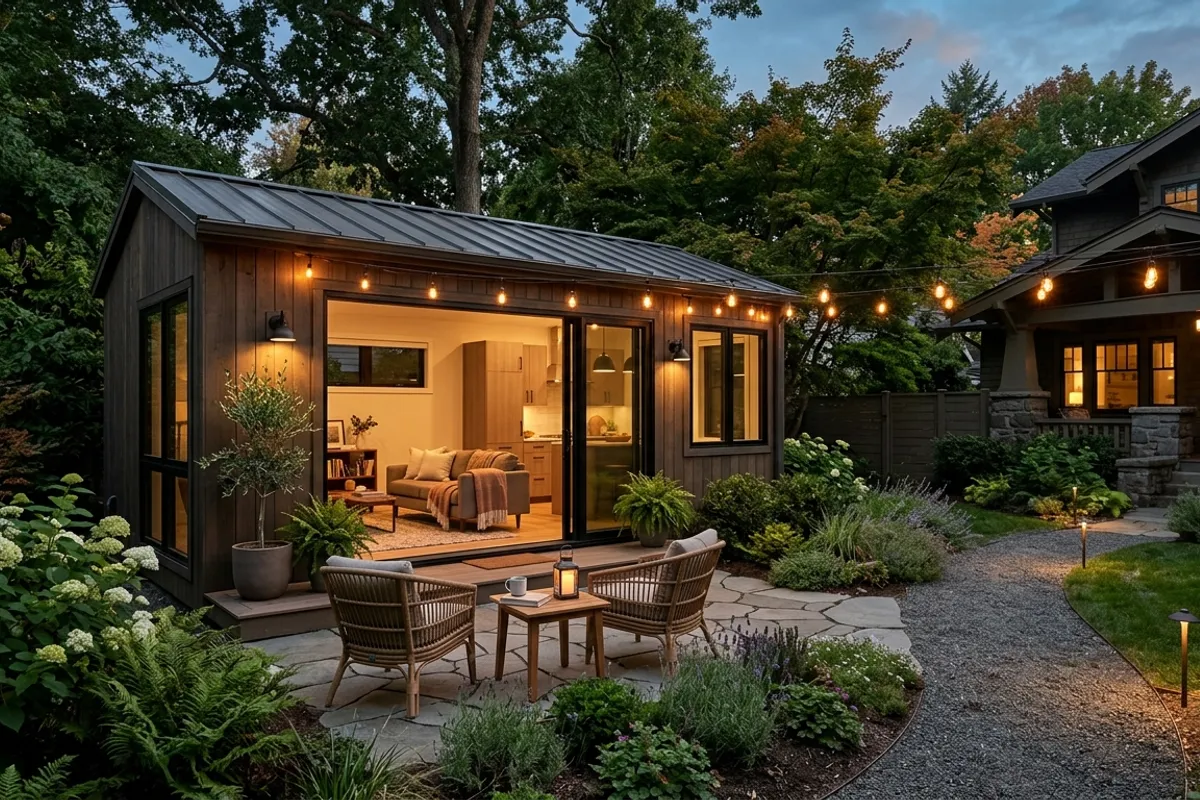
A properly permitted ADU — prefab or stick-built — adds real value to your property. How much depends on your local market, the unit’s size and quality, and how it’s classified for appraisal.
The value shows up in two ways. First, the property itself appraises higher because it now has a legal, permitted secondary dwelling. Second, a rental ADU generates monthly income that strengthens your financial position whether you rent long-term or short-term (where local regulations allow). Many homeowners find that the rental income alone covers their ADU financing payments within the first year.
Important factors that affect the value equation: permitted units add meaningfully more value than unpermitted ones (and unpermitted ADUs create legal liability at resale). Modular and panelized ADUs built to IRC standards are generally appraised comparably to stick-built — but confirm with a local appraiser in your market. And local rental demand determines how much income the unit can realistically generate.
Property value impact and rental income potential vary significantly by market, unit size, quality, and local conditions. These are not guarantees of returns. Consult with a local real estate professional and appraiser for your specific situation.
See more: ADU Rental Income: Real Rent, ROI & Mortgage Rules (2026) →
Prefab vs. Stick-Built: The Honest Comparison
| Factor | Prefab (Modular/Panelized) | Stick-Built (Custom) |
|---|---|---|
| Cost predictability | Higher — fixed or published pricing | Lower — more variable |
| Total cost | Comparable once site work is included | Comparable — depends on local labor market |
| Timeline | Shorter on-site time; parallel factory/site work | Longer on-site; sequential process |
| Backyard disruption | Less — most work happens off-site | More — full construction site for months |
| Customization | Limited to available models | Fully custom |
| Lot flexibility | Requires crane access (modular) or panel delivery | Adapts to any lot |
| Quality | Consistent — factory-controlled | Variable — depends on your contractor |
Prefab wins when your lot has good access, you value speed and cost predictability, and your design preferences align with available models. Stick-built wins when you need a custom design, have a challenging lot, or want the ADU to seamlessly match your home’s architecture.
Panelized construction (Studio Shed, Deltec) is the middle ground that’s often overlooked — factory-built panels assembled on-site without a crane. Speed advantages of prefab, access flexibility of stick-built.
Which States Allow Prefab ADUs Right Now?
Prefab ADUs aren’t approved because they’re prefab. They’re approved when your state and local jurisdiction allow the ADU type and code path you’re proposing. State law can expand access and streamline permitting, but city and county zoning, setbacks, utilities, and plan review still control your specific approval.
California — most developed framework
State law generally gives local agencies 60 days to act on ADU applications. For detached ADUs submitted with a pre-approved plan, the approval-or-denial window is 30 days. AB 976 permanently removed owner-occupancy requirements. AB 1033 authorizes local agencies to opt in to allowing separate ADU sales in condominium form — this is a local opt-in, not a blanket statewide right. (Source: California Government Code §65852.2; AB 976; AB 1033.)
Beyond California
ADU-enabling legislation is spreading. Oregon, Washington, Colorado, Texas (particularly Austin), Florida, Massachusetts, and others have passed or are advancing ADU frameworks — but implementation varies dramatically by municipality.
For state-specific rules, see our State ADU Law Guides →
Frequently Asked Questions About Prefab ADU Companies
What is the best prefab ADU company in California?+
What is the best prefab ADU company outside California?+
Is a prefab ADU cheaper than stick-built?+
What does a prefab ADU cost installed?+
Do prefab ADUs need permits?+
Can you finance a prefab ADU?+
What if my gate is too narrow for a crane?+
What's the difference between modular and manufactured ADUs?+
How long does a prefab ADU take from contract to move-in?+
What happens if a prefab ADU company goes out of business?+
Can I use a prefab ADU as a rental?+
Which prefab ADU companies offer 2-bedroom units?+
How Did We Rank These Prefab ADU Companies?
What we verified
Service areas, published pricing and inclusions (from company websites and pricing pages), build type and code path, models offered, completed-installation evidence, and years in business. Every company-specific claim is sourced to the company's own current website or named third-party reporting.
What we estimated editorially
All-in installed costs where companies don't publish total project pricing. These are clearly labeled as editorial estimates, not quotes.
What disqualified a company from our top picks
Insufficient verified completions. Render-only portfolios. Pricing that appeared misleading. Unclear service area claims.
How we handle affiliate relationships
Some companies on this page have affiliate partnerships with The Dwelling Index. We earn a commission when you use our links — at no extra cost to you. Rankings and editorial recommendations are based on independent research and are never influenced by compensation.
Updates
We review and update pricing, service areas, and company status at least quarterly. Last full review: April 2026.
Corrections
If you have firsthand experience with any company listed here, or notice outdated information, contact editorial@dwellingindex.com.
Read our full editorial methodology →
Glossary
- ADU (Accessory Dwelling Unit)
- A secondary housing unit on a single-family residential lot. Also called granny flat, in-law unit, backyard cottage, or DADU.
- Modular ADU
- Factory-built to state/local building codes (IRC/IBC). Delivered as a complete unit. Craned into place.
- Panelized ADU
- Factory-built panels shipped and assembled on-site. No crane required.
- Kit ADU
- Materials, plans, and pre-cut components shipped for on-site assembly.
- Manufactured Home
- Built to federal HUD Code (24 CFR Part 3280) on a permanent chassis.
- HCD
- California Housing and Community Development — the state agency that approves prefab ADU plans for streamlined permitting.
- IRC
- International Residential Code — the model building code for residential construction, including most modular ADUs.
- Turnkey
- The company handles everything from design through certificate of occupancy.
- Certificate of Occupancy (CO)
- Official approval from your local building department that the ADU is legal to inhabit.
Related Guides
See what you can build at your address
Lot size, setbacks, zoning, and estimated costs — all in about 60 seconds. No sales call. No commitment.
Free. Takes 60 seconds. No commitment required.
The Dwelling Index is an independent educational resource for homeowners exploring ADU projects. We are not a builder, lender, or broker. Content on this page is for informational purposes and does not constitute professional construction, legal, or financial advice. Cost estimates are based on publicly available data and editorial analysis — actual project costs depend on your specific property, location, and project scope. Consult qualified local professionals for your specific situation.