
Best 2 Bedroom Prefab ADU: Real Costs, Models, and Lot Fit
By The Dwelling Index Editorial Team · Last updated: May 27, 2026 · Last verified: May 27, 2026
Published May 27, 2026
There is no single best 2 bedroom prefab ADU for every property — the right one comes down to your state, your lot access, your budget, and your building-code path. For California homeowners who want a turnkey, hands-off build, the shortlist is Abodu Two+, Samara Backyard XL 8, and Villa's 800 sq ft models. For homeowners anywhere in the U.S. who want the widest availability and a panelized kit that ships flat, Studio Home's Summit 800 and Summit 1000 are the stronger starting points. For the lowest advertised base prices, manufactured-home catalogs like Homes Direct list 2-bedroom units from roughly $77,850 to $108,570 — but those are factory base prices, not installed projects, and they follow a different building code.
The one number to anchor on: published “starting at” prices run from about $71,750 for a DIY kit to $426,800 for a premium turnkey unit, and your real installed total almost always lands well above the unit price once foundation, delivery, utilities, permits, taxes, and site work are added.
Your next step: confirm whether a 2-bedroom unit can physically and legally fit on your lot before you request a quote — that single check prevents the most expensive mistake homeowners make.
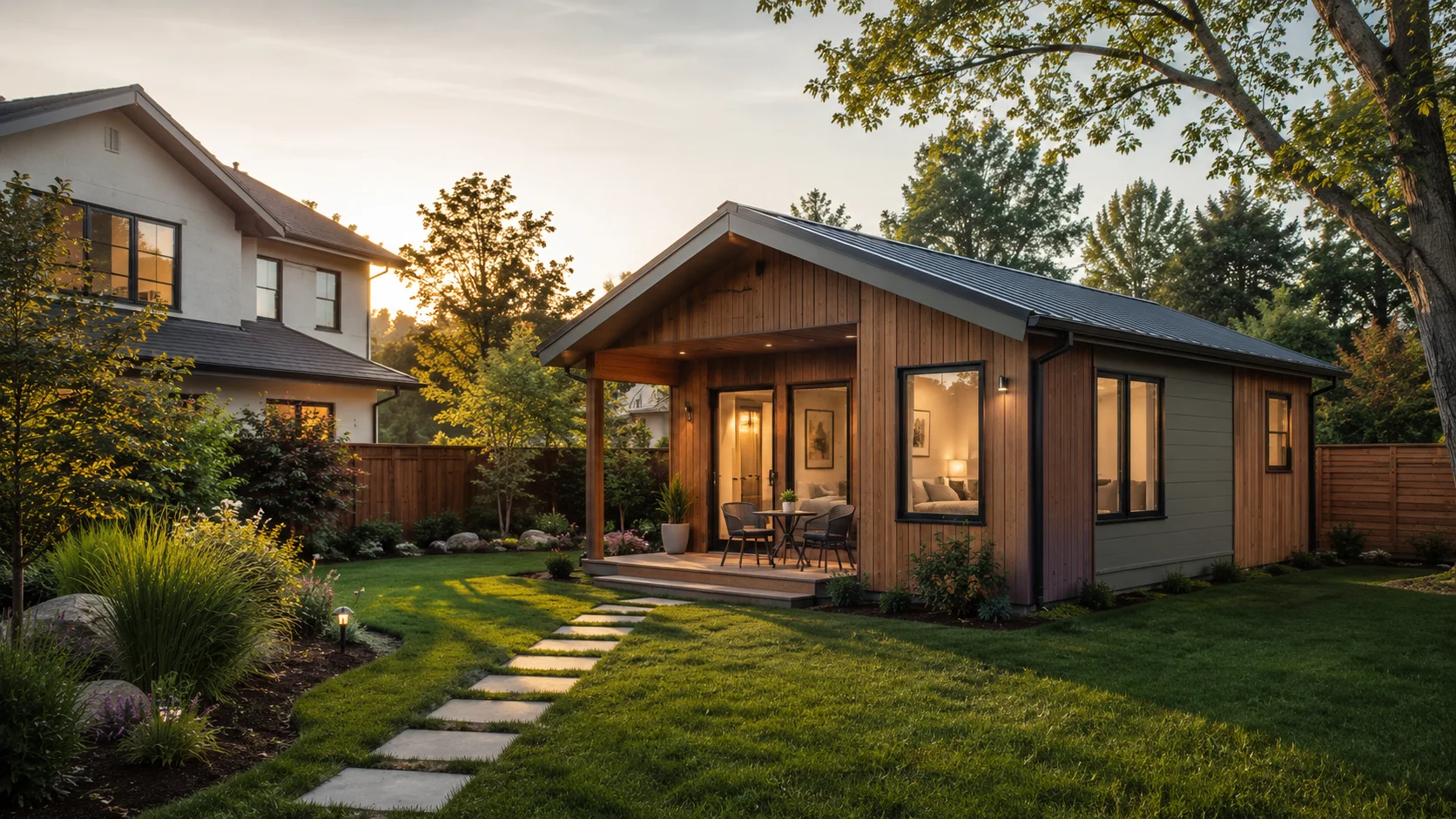
Best 2 bedroom prefab ADU by situation (start here)
Here's the fast answer, sorted by who you are — not by who pays us. (See exactly how we ranked these.)
| Your situation | Best starting shortlist | Why it fits | Watch out for |
|---|---|---|---|
| California, premium, want it handled for you | Abodu Two+ / Samara Backyard XL 8 | Published 2BR/2BA models, fixed-price turnkey positioning | Highest total price; California-focused service areas |
| Anywhere in the U.S., want the widest reach | Studio Home Summit 800 / Summit 1000 | Panelized flat-pack kit, ships nationwide, DIY or pro-assembly | Kit price is not the installed price; local site work varies |
| Design-forward, California, want size options | Samara Backyard Two Bedroom / XL 8 / XL 10 | Three 2BR sizes from 690–950 sq ft; optional solar; WUI fire-rated | Price is "plus installation" — not the project total |
| Lowest advertised base price | Homes Direct / Modular Home Direct catalogs | 2BR base prices from ~$77,850; broad national availability | Manufactured/HUD-code path; price excludes delivery, setup, tax, site work |
| Compact / foldable curiosity | BOXABL 2 Bedroom Casita | 722 sq ft 2BR layout, compact footprint | Verify local approval and total package price by address first |
Whatever your situation, the smartest first move costs nothing and takes a minute: find out what your specific lot can actually support before you fall for a single floor plan.
See what's possible at your address → Get your free ADU report in 60 seconds.
See What You Can Build → Get Your Free ADU ReportFree, no email required.
Why you can trust this comparison (and the one thing prefab marketing won't tell you)
The Dwelling Index is an independent research resource covering ADU financing, costs, and regulations. We built the tables on this page from published manufacturer model pages, primary-source California statute, federal lending and appraisal guidance, and real homeowner discussions. Every price carries a source and a date. Where a provider's own pages conflict, we say so instead of papering over it.
Here's the admission most prefab marketing avoids: prefab is not automatically cheaper than building on-site. The factory builds the box. You still pay for the foundation, the crane or assembly crew, utility trenching, permits, impact fees, sales tax, finishes, and final inspections on your actual property. Add all of that up and a 2 bedroom prefab ADU can land in the same range as a comparable site-built unit. The real prefab advantage is predictability, a tighter scope, and far less disruption in your backyard — not a guaranteed discount.
We lead with that because the rest of this page exists to protect you from the gap between the “starting at” number and the number you actually write checks for. Once you see that gap clearly, the decision gets a lot easier.
What is the best 2 bedroom prefab ADU in 2026?
The best 2 bedroom prefab ADU in 2026 depends on your state, lot access, budget, and code path — there is no universal winner. A California homeowner who wants a turnkey process typically shortlists Abodu or Samara; a homeowner anywhere in the U.S. who wants broad availability and a flat-packed kit starts with Studio Home's Summit models; a budget-focused shopper compares manufactured catalogs like Homes Direct only after confirming permits, foundation, financing, and the installed cost.
The reason “best” has no single answer is that a 2 bedroom prefab ADU is really four different products wearing the same name. A turnkey modular unit from Abodu arrives nearly finished and is set in roughly a day. A panelized kit from Studio Home ships flat-packed and is assembled on-site. A manufactured home from a Homes Direct catalog is built to a federal code and trucked in sections. A foldable unit like BOXABL's Casita is its own category. They differ in price, in how they install, and — most importantly — in the building code they follow, which changes what your city will approve and how a lender treats the unit. We break down each below so you can match the product to your property.
Best for California turnkey: Abodu Two+ vs Samara Backyard XL 8
For California homeowners who want a hands-off, fixed-price build, Abodu Two+ (800 sq ft, 2 bed / 2 bath, from $426,800) and Samara Backyard XL 8 (800 sq ft, 2 bed / 2 bath, from $249,000 plus installation) are the two strongest turnkey candidates. Both publish detailed specs and both target the homeowner who values a managed process over the lowest price.
Abodu's pricing is the more transparent of the two because it's quoted closer to all-in. Abodu lists the Two (610 sq ft, 2 bed / 1 bath) starting at $360,800 on its model page, and notes that customers add an average of $39,700 in upgrades and custom site work and pay about $17,000 in sales tax and permit fees (Abodu, verified May 27, 2026). One honest flag: Abodu's own model carousel also shows a lower “from $342,800” card for the Two, so confirm the current price directly with Abodu before you budget. Abodu also builds to California state pre-approved plans, which can shorten city review. The Two+ at $426,800 is Abodu's largest current model.
Samara's $249,000 figure for the XL 8 is the unit price plus installation, so the project total runs higher once installation is quoted for your site. Samara offers optional solar upgrades and certifies its construction as fire-resistant for California's Wildland-Urban Interface (WUI) — the high-fire-risk zones where stricter materials are required.
Best national / panelized shortlist: Studio Home Summit 800 and Summit 1000
For homeowners outside California — or anyone whose backyard can't accept a crane-set modular box — Studio Home's Summit 800 (800 sq ft, 2 bed, 1–2 bath, starting at $155,426) and Summit 1000 (1,000 sq ft, 2 bed / 2 bath, starting at $191,523) are the best national starting points. Studio Home ships a flat-packed panelized kit, states on its ADU collection that it offers “nationwide code compliance and expert permitting assistance” and meets local requirements in all 50 states, and offers engineered permit plans, a builder network, and project management (Studio Home, verified May 27, 2026).
There's a pricing nuance here worth more than almost any other fact on this page, and we decode it fully in the cost section: the same Summit 800-series 800 sq ft product line appears in very different scopes. Home Depot lists DIY Summit 800 wood-frame building kits at $71,752–$73,502, while Studio Home's own finished Summit 800 configuration starts at $155,426. The kit is the bones; the finished number includes far more of what makes a kit a livable, permitted dwelling. Panelized kits like these are often the only realistic prefab path on lots with narrow side-yard access, because panels can be carried through a gate a finished modular box could never pass.
Best design-forward California options: Samara Backyard Two Bedroom, XL 8, and XL 10
Samara offers the widest range of 2-bedroom sizes among design-forward California builders: the Backyard Two Bedroom (690 sq ft, 2 bed / 1 bath, from $190,000 plus installation), the XL 8 (800 sq ft, 2 bed / 2 bath, from $249,000 plus installation), and the XL 10 (950 sq ft, 2 bed / 2 bath, from $277,000 plus installation) (Samara, verified May 27, 2026). Solar is an optional upgrade across the line, and construction is certified fire-resistant for California WUI compliance.
This three-size range is genuinely useful. If your lot or budget can't support 950 sq ft, you step down to 800 or 690 without changing builders — and the 690 sq ft Two Bedroom lives larger than its number thanks to a 4-foot pocket door that lets the second bedroom double as a living room or storage when you don't need a true second sleeping room.
Best budget-screening options: Homes Direct and manufactured catalogs
For homeowners screening the lowest advertised prices, manufactured-home catalogs list 2-bedroom units far below the modular brands — the Homes Direct catalog shows the Cabana (762 sq ft, 2 bed / 1 bath) at $77,850, the Dragonfly (886 sq ft, 2 bed / 2 bath) at $105,900, and the Coho (886 sq ft, 2 bed / 2 bath) at $108,570 (Homes Direct, verified May 27, 2026). Homes Direct states plainly that those online prices are base models only and exclude upgrades, delivery, setup, and sales tax — and these are HUD-code manufactured homes, a different regulatory category explained below.
These are the right tool for one job: setting a realistic floor for what a basic 2-bedroom factory shell costs before you layer on everything needed for legal occupancy. They are the wrong tool for assuming your finished project will cost $77,850.
Best verify-first compact option: BOXABL 2 Bedroom Casita
BOXABL's Two Bedroom Casita (722 sq ft) is worth a look only for buyers specifically interested in compact, foldable prefab — it is not a default best pick. BOXABL shows a provider-estimated $1,300/month financing figure on its Casita page and states explicitly that actual price and payment vary by model, location, site work, taxes, delivery, installation, credit approval, and financing terms (BOXABL, verified May 27, 2026).
The foldable form factor is a real engineering advantage on tight sites. The catch is that an “estimated monthly payment” tells you almost nothing about your total project cost or whether your jurisdiction will approve the unit as an ADU. That's why this belongs in the verify-first column until you've confirmed local approval and a complete delivered-and-installed package price for your address.
When the best answer is not a 2 bedroom prefab at all
Sometimes the best 2 bedroom prefab ADU is a garage conversion, a 1-bedroom unit, or a site-built ADU instead. If budget is your hard constraint, converting an existing garage is usually the cheapest path to a legal ADU. If the second bedroom is only “nice to have,” a 1-bedroom prefab saves meaningfully. And if your lot is steep, oddly shaped, or has no crane access, a site-built ADU may be your only buildable option. We'd rather you learn that here than after a deposit — and your free ADU report flags exactly which of these paths your lot supports.
How much does a 2 bedroom prefab ADU really cost installed?
A 2 bedroom prefab ADU's published “starting at” price is not the installed project total — expect the real number to land well above it once you add foundation, site prep, delivery, utility connections, permits, impact fees, sales tax, finishes, and inspections. Published unit prices range from roughly $71,750 for a DIY panelized kit to $426,800 for a premium turnkey modular unit, but the layers stacked on top of the unit commonly add tens of thousands of dollars and are highly site-dependent.
This is the section that prevents quote shock — so we'll be specific.
The “starting at” trap: what's included vs excluded
Vendors quote in four different ways, and comparing across them without normalizing is exactly how homeowners get blindsided:
| Pricing type | What it usually includes | What it usually excludes | Real example |
|---|---|---|---|
| Kit / DIY price | Wall panels, roof, siding, hardware | Assembly labor, foundation, utilities, finishes, permits, tax | Studio Shed Summit 800 DIY kit, $71,752–$73,502 (Home Depot) |
| Base / unit-only price | The factory unit, base configuration | Delivery, foundation, site work, permits, tax | Homes Direct Cabana, $77,850 |
| Unit + installation | Unit price, with installation quoted separately | Foundation prep, utilities, permits, tax often still separate | Samara XL 8, $249,000 + installation |
| Installed / turnkey-leaning | Closest to all-in for a standard site | Unusual site work, some upgrades and fees | Abodu Two, from $360,800 |
The cost-layer stack
Every prefab ADU project is the unit price plus these layers. The ranges below are editorial estimates assembled from manufacturer disclosures and published cost guidance and vary enormously by site:
| Cost layer | Typical range (editorial estimate) | What drives it |
|---|---|---|
| Unit / model | $71,750–$426,800 | Brand, size, finish level, code path |
| Site prep & grading | $5,000–$30,000 | Slope, access, clearing, drainage |
| Foundation | $7,000–$25,000 | Slab vs pier; soil; unit weight |
| Utility connections (water, sewer, electric) | $5,000–$30,000+ | Distance to laterals, trenching, panel upgrade |
| Delivery / crane / assembly | $3,000–$25,000 | Modular crane-set vs panelized hand-assembly; access |
| Permits & fees | $3,000–$25,000 | Jurisdiction; unit size; local fee schedule |
| Sales tax | Varies by state | Applied to the unit (~$17,000 average on Abodu projects) |
| Upgrades & finishes | $10,000–$40,000 | Appliances, flooring, cabinetry, solar, HVAC |
| Contingency (recommended) | 10–15% | The surprises every project has |
One fee item is worth getting exactly right, because most pages get it wrong: in California, under Government Code § 66311.5, local agencies, special districts, and water corporations may not impose impact fees on an ADU with 750 sq ft or less of interior livable space. For ADUs over 750 sq ft, any impact fee must be charged proportionately to the primary dwelling's square footage (Cal. Gov. Code § 66311.5). That 750 sq ft threshold is a real budgeting lever — it's one reason many 2-bedroom buyers deliberately keep a unit at or below it. Local fee schedules still need to be confirmed with your city or district.
Worked example: Abodu Two
Abodu publishes more all-in detail than most, so it's the cleanest example. The Two starts at $360,800 on its model page. Abodu states customers add an average of $39,700 in upgrades and site work and about $17,000 in sales tax and permit fees (Abodu, verified May 27, 2026). Stack those disclosed averages and a typical Abodu Two project lands near $417,500 before any unusual site conditions. That's not a quote — it's Abodu's own averages, added up — but it shows how a $360,800 “starting at” becomes a different number on a real lot.
Worked example: Studio Home Summit 1000
The Summit 1000 starts at $191,523 for a finished panelized configuration. Because it's a kit-based system, the variable layers are assembly labor and your local site work. On a flat, accessible lot with utilities nearby, a realistic installed range often runs $250,000–$320,000+ once foundation, assembly, utilities, permits, and finishes are added — and considerably less for a capable DIY owner.
Why the cheapest advertised unit is rarely the cheapest project
A $77,850 manufactured Cabana looks like the budget winner until you add delivery of a 762 sq ft sectional unit, a permanent foundation, utility trenching, setup, sales tax, and the permitting work to place a HUD-code home as an ADU in a jurisdiction that may treat it differently from a modular unit. The lowest unit price and the lowest project price are frequently not the same product. Run the full stack before you crown a budget winner. See also: prefab ADU cost breakdown and how much an ADU costs by type.
Download the free ADU Starter Kit — it includes the cost-layer worksheet above, so no vendor can slip a line item past you.
Download the Free ADU Starter Kit →Which 2 bedroom prefab ADU models should you compare first?
Start with the models that publish enough to compare honestly: square footage, bedroom and bath count, dimensions, service area, a clear price (and what that price includes), and the building-code path. Skip or quarantine any model that shows only renderings, a vague “contact us” price, or a number that excludes nearly everything required for legal occupancy. The matrix below assembles, in one place, data you'd otherwise pull from eight different vendor sites plus code and financing sources.
The 2 Bedroom Prefab ADU Shortlist Matrix
| Model / provider | Size | Beds / baths | Price signal (scope) | Code path | Service area | Main catch |
|---|---|---|---|---|---|---|
| Abodu Two | 610 sq ft | 2 / 1 | From $360,800 (turnkey-leaning); carousel also shows $342,800 | Modular (state pre-approved CA) | California | Same-site price conflict — confirm current price |
| Abodu Two+ | 800 sq ft | 2 / 2 | From $426,800 (turnkey-leaning) | Modular (state pre-approved CA) | California | Highest published total here |
| Samara Backyard Two Bedroom | 690 sq ft | 2 / 1 | From $190,000 (+ installation) | Modular | California | "+installation" not in price |
| Samara Backyard XL 8 | 800 sq ft | 2 / 2 | From $249,000 (+ installation) | Modular | California | "+installation" not in price |
| Samara Backyard XL 10 | 950 sq ft | 2 / 2 | From $277,000 (+ installation) | Modular | California | "+installation"; larger footprint |
| Studio Home Summit 800 | 800 sq ft | 2 / 1–2 | From $155,426 finished; $71,752–$73,502 DIY kit (Home Depot) | Panelized | Nationwide (all 50 states) | Kit price ≠ finished/installed price |
| Studio Home Summit 1000 | 1,000 sq ft | 2 / 2 | From $191,523 finished | Panelized | Nationwide (all 50 states) | Local assembly + site work drive final cost |
| LiveLarge L-665/L-750/L-795/L-800/L-800P/L-1190 | 665–1,190 sq ft | 2 / varies | From $220,000–$355,000 (+ installation) | Modular | California | CA-only; "+installation"; many variants |
| ELMNTL Shelter 2 Bedroom | ~714 sq ft | 2 / varies | $349,000 base; ~$449,000 turnkey | Modular | Colorado-based | CO market; out-of-area execution varies |
| Villa H800 / C800 | 800 sq ft | 2 / 2 | Third-party (Dwellito): H800 from $147,000; budget signals $224,000 and $267k–$347k | Modular/panelized | CA / select states | Verify Villa-direct pricing before relying on a figure |
| BOXABL 2 Bedroom Casita | 722 sq ft | 2 / varies | Provider-estimated ~$1,300/mo financing; total varies by site | Foldable prefab — verify local code path | Varies; verify by address | "Estimated payment" ≠ total cost or approval |
| Homes Direct (Coho / Cabana / Dragonfly) | 762–886 sq ft | 2 / 1–2 | $77,850–$108,570 base (excludes delivery, setup, tax) | HUD-code manufactured | National (dealer network) | Base price only; different code/financing path |
Sources: Abodu, Samara, Studio Home / Studio Shed (and Home Depot kit listings), LiveLarge, ELMNTL (Colorado modular cost article, March 12, 2026), Villa Homes via Dwellito, BOXABL, and Homes Direct published model/catalog pages — all verified May 27, 2026. Prices are starting/base figures unless noted and are not quotes. Where a provider's pages conflict (Abodu, Villa), the row carries that caveat.
How to read this matrix without getting fooled
Three columns do the heavy lifting. Price signal (scope) tells you whether the number is a kit, a base unit, “+ installation,” provider-estimated financing, or turnkey-leaning — never compare across those without normalizing. Code path tells you what your city will likely approve and how a lender treats the unit: modular and panelized units are built to your state's residential building code; HUD-code manufactured homes follow the federal manufactured-housing standard (24 CFR Part 3280), which some jurisdictions treat differently for ADUs. Service area matters on a national page — a stunning California-only model is no help in Ohio.
If you remember one rule: a model that won't publish its size, bath count, and a real price-scope label isn't ready for your shortlist. See also: modular vs panelized vs manufactured ADUs.
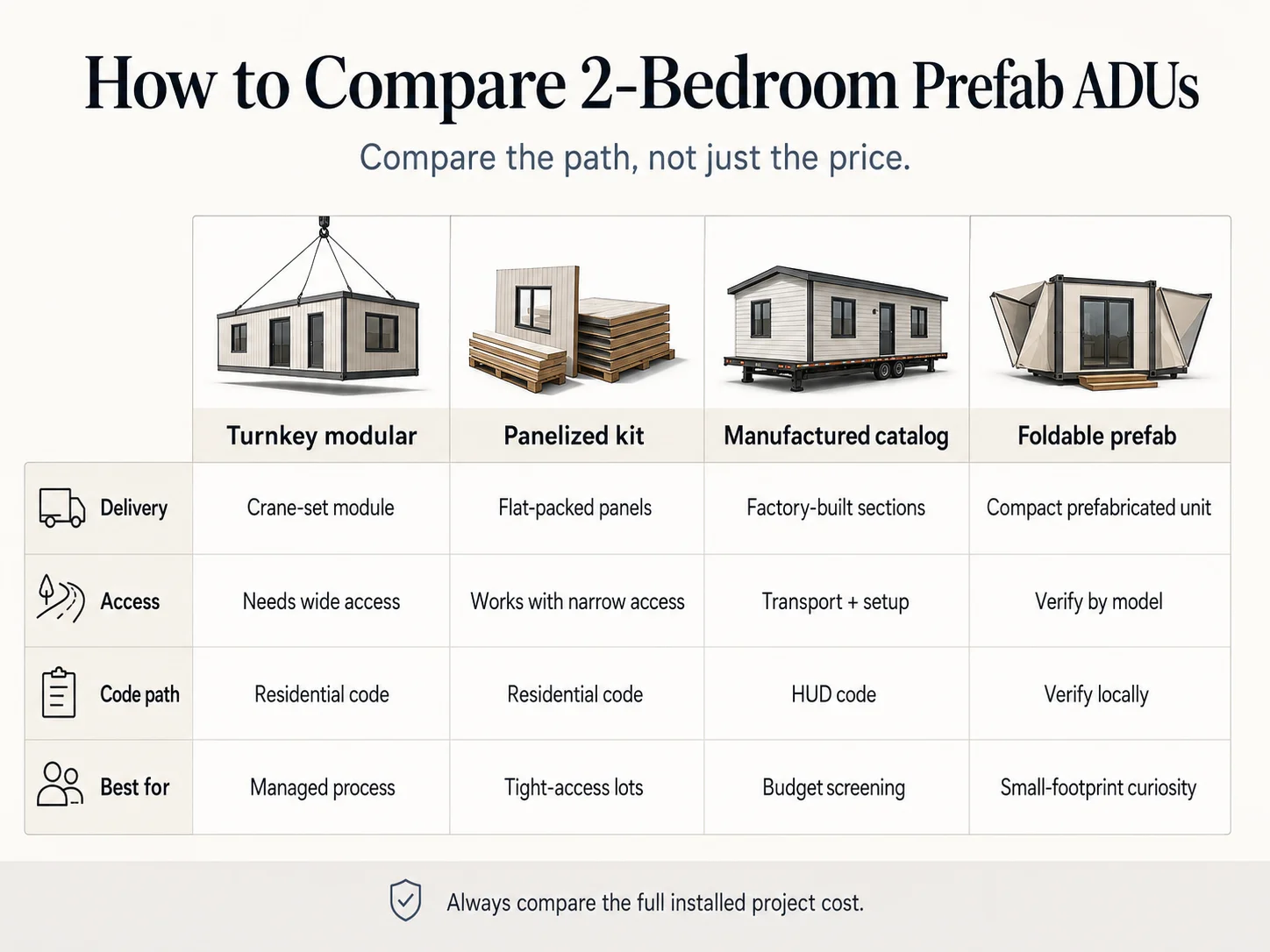
Comparing modular and prefab options across the country?
Compare ADU BuildersWill a 2 bedroom prefab ADU fit on your lot?
A 2 bedroom prefab ADU has two footprints, not one: the building itself, and the much larger clear area you need for setbacks, delivery access, crane or panel staging, and utility trenching. A model that looks compact online can require a clear path several feet wider than the unit, plus crane swing room or a gate panels can pass through, before it can be legally and physically placed.
This is where projects die quietly. The unit fits on paper; the truck can't get down the side yard.
Real footprint vs real yard requirement: verified numbers
Here are the actual published building dimensions and required yard space for popular 2-bedroom models — assembled in one place so you can hold a tape measure to your own backyard tonight:
| Model | Building footprint | Yard space required (published) |
|---|---|---|
| Abodu Two | 43'-8" W × 14'-7" D | 51'-8" W × 26'-7" D |
| Samara Backyard Two Bedroom | 690 sq ft | ~57' × 25' |
| Samara Backyard XL 8 | 800 sq ft | ~35' × 42' |
| LiveLarge L-800 | 800 sq ft | ~45'-8" × 32'-6" |
| LiveLarge L-750 | 750 sq ft | ~63'-10" × 24' |
Source: Abodu, Samara, and LiveLarge model pages, verified May 27, 2026. Note how the Abodu Two needs roughly 51′×26′ of clear yard for a 43′×14′ building — the required area is far larger than the footprint.
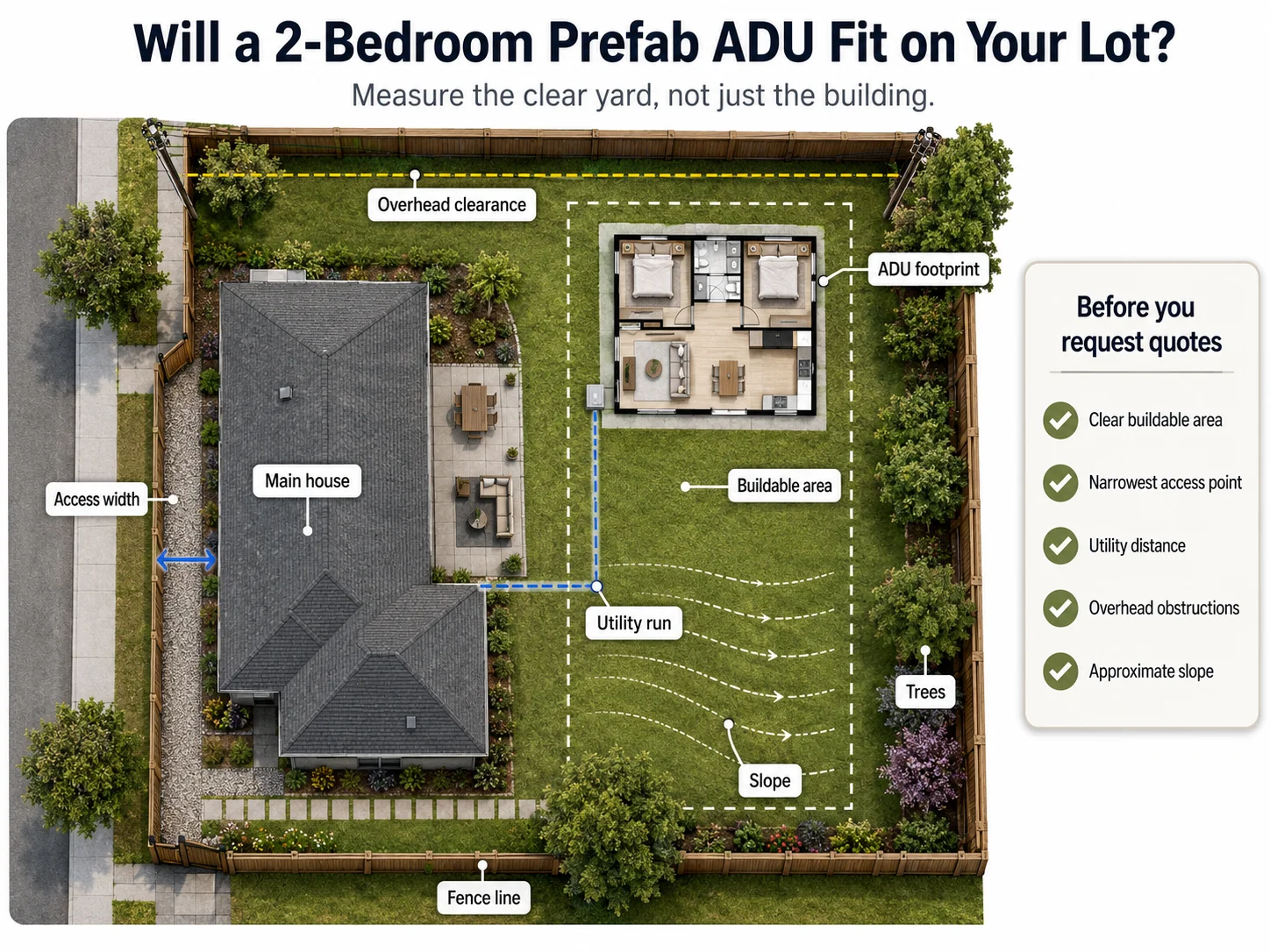
Access width: the make-or-break dimension
- Modular crane-set units (Abodu, Samara, LiveLarge) arrive as finished boxes and are craned over the house or rolled in. They need real access: a wide approach, crane room, and overhead clearance free of wires and mature trees.
- Panelized kits (Studio Home) arrive flat and are carried in piece by piece. They can pass through a standard gate and assemble in a backyard a crane could never reach.
If your only access is a 36-inch side gate, a panelized kit may be your only prefab path. That single fact can reshape your entire shortlist.
Slope, utilities, wires, trees, and HOA rules
Four more lot conditions change feasibility fast. Slope raises foundation cost and can force a site-built solution. Utility distance — how far your trench runs to reach water, sewer, and electric laterals (the connection points at your property line) — can add $5,000–$30,000+. Overhead wires and mature trees can make a crane set impossible. And HOA rules, where they apply, can restrict design or placement even when state law permits the ADU. Check all four before you fall for a model.
The pre-quote measurement checklist
Before you request a single quote, walk your yard with a tape measure and record six numbers:
- Lot width and depth
- The clear buildable area after setbacks
- Narrowest access width (gate, alley, side yard)
- Overhead obstructions (wires, trees)
- Approximate slope
- Distance from the proposed unit to nearest water, sewer, and electric connections
Reading dimensions off a brochure can't tell you whether your lot works.
Check your address before you request quotes → Run the free Fit Checker and get your ADU report in 60 seconds.
See What You Can Build → Get Your Free ADU ReportDo 2 bedroom prefab ADUs need permits?
Yes — prefab is not a permit shortcut. A legal 2 bedroom prefab ADU still requires local zoning approval, a building permit, foundation approval, permitted utility connections, inspections, and a certificate of occupancy or your jurisdiction's equivalent sign-off. The factory builds the structure to code, but placing and connecting it on your property is a fully permitted construction project.
The “installed in one day” marketing refers to setting the unit. The permitting around it is the part that takes months, and it's non-negotiable.
California's size rules for a 2-bedroom ADU, decoded
California is the most active ADU-law state, so its rules are worth decoding precisely. A local agency may set minimum and maximum ADU sizes, but it cannot set a maximum below 850 sq ft generally, or below 1,000 sq ft for an ADU with more than one bedroom (Cal. Gov. Code § 66321). Because a 2-bedroom ADU is by definition “more than one bedroom,” your city cannot apply a maximum-size rule that forces your 2-bedroom ADU below 1,000 sq ft.
Separately, California protects a baseline path: local standards on lot coverage, floor area ratio (FAR), open space, front setbacks, or minimum lot size cannot be used to block an ADU of at least 800 sq ft, up to 16 feet tall, with 4-foot side and rear setbacks (Cal. Gov. Code §§ 66321, 66323). Detached ADUs are commonly capped at 1,200 sq ft under state standards.
These rules have teeth. California's Department of Housing and Community Development (HCD) actively reviews local ordinances and orders cities to fix non-compliant ones — HCD issued an ADU ordinance-review findings letter to the City of Brentwood dated October 15, 2025. Verify against the current California HCD ADU Handbook (March 2026; a December 2025 addendum summarizes State ADU Law changes effective January 1, 2026). See also: ADU laws by state.
Modular vs panelized vs manufactured: why the code path changes everything
These three terms are not interchangeable, and confusing them can cost you a financing approval:
- Modular ADU — built in a factory under the International Residential Code as administered by your state, then assembled or set on-site. Treated like a site-built home for most purposes.
- Panelized / prefabricated ADU — components (walls, roof) built in a factory and assembled on-site; must conform to local building codes where permanently located.
- Manufactured home (HUD-code) — built to the federal manufactured-housing standard (24 CFR Part 3280), not your state's residential code. Some jurisdictions treat HUD-code homes differently when used as ADUs, and some lenders underwrite them differently.
Federal guidance recognizes ADUs across these types: Fannie Mae's Selling Guide treats factory-built modular and panelized units as site-built for eligibility when requirements are met, and treats HUD-code manufactured housing under its separate manufactured-home rules. The practical takeaway: confirm your unit's code path before you choose it, because it affects both city approval and how you finance and appraise the unit.
What pre-approved plans do and don't solve
Many California cities now offer pre-approved ADU plans, and several builders market “build-ready” or pre-approved designs that can shorten plan check — the city's review of your construction documents. Pre-approval speeds the plan portion. It does not eliminate site-specific permitting: your foundation, utility connections, and setbacks still need approval for your actual lot.
Is a 2 bedroom prefab ADU cheaper or better than site-built?
A 2 bedroom prefab ADU is usually better for predictability, speed, and minimal backyard disruption — but it is not automatically cheaper than a site-built ADU once foundation, utilities, site work, and permits are added. Prefab tends to win on standard, flat, accessible lots; site-built tends to win on steep, irregular, or tight-access lots and on fully custom designs.
| Path | Typical strength | Typical weakness | Best when |
|---|---|---|---|
| 2BR prefab (modular/panelized) | Predictable scope, fast install, factory QC | Site work still required; not always cheaper | Flat, accessible, standard lot |
| 2BR site-built | Full customization, handles hard lots | Longer timeline, more on-site disruption, less price certainty | Steep/irregular lot or custom design |
| Garage conversion | Lowest cost to a legal ADU | Limited size; loses the garage | Budget is the hard constraint |
| 1-bedroom prefab | Cheaper than 2BR; smaller footprint | Second bedroom only "nice to have" | Lot or budget can't justify 2BR |
The honest framing: choose prefab for certainty, not for a guaranteed discount. If your lot is difficult or your design is unusual, site-built may be both better and, after equalizing site work, comparable in cost. Your free ADU report compares these paths for your specific lot.
What size 2 bedroom prefab ADU actually feels livable?
A 2 bedroom prefab ADU can technically fit into 550–650 sq ft, but most homeowners find the comfortable balance at 700–850 sq ft, and 850–1,200 sq ft layouts feel like a small standalone home. The sweet spot for a true 2-bedroom, 2-bath unit that rents well and houses family comfortably is roughly 750–850 sq ft.
- 550–650 sq ft (2BR/1BA): Technically possible and code-compliant, but tight. Bedrooms are small, storage is scarce, the living area compresses. Works for a couple plus an office-bedroom; cramped for a family.
- 650–750 sq ft (compact 2BR/1BA): More breathing room. Samara's 690 sq ft Two Bedroom lives larger than its number thanks to a pocket-door flex room. A practical choice if you want to stay at or below California's 750 sq ft impact-fee threshold.
- 750–850 sq ft (2BR/2BA sweet spot): The best balance for most buyers. Two real bedrooms, two baths, a workable kitchen and living area. Studio Home Summit 800 and Samara XL 8 live here.
- 850–1,200 sq ft (family-size / premium rental): Feels like a small house. Studio Home Summit 1000 (1,000 sq ft) and LiveLarge L-1190 (1,190 sq ft) suit permanent family housing or higher-rent long-term rentals. In California, remember a city can't cap a two-bedroom unit below 1,000 sq ft.
Layout matters as much as square footage: split bedrooms (one at each end), in-unit laundry, an efficient hallway, and generous windows make a small 2BR feel far larger than its number.
How long does a 2 bedroom prefab ADU take from contract to move-in?
A realistic 2 bedroom prefab ADU timeline runs roughly 4–12 months from contract to move-in — and the “installed in one day” claim refers only to setting the unit, not the full project. The schedule is dominated by feasibility, design, permitting, and factory build, with installation as a short step near the end.
| Phase | Typical duration | What happens |
|---|---|---|
| Feasibility & site assessment | 2–4 weeks | Lot check, access, utilities, code path |
| Design & configuration | 2–6 weeks | Model selection, finishes, plan set |
| Permitting / plan check | 4–16 weeks | City review; faster with pre-approved plans |
| Factory build | 8–16 weeks | Often overlaps permitting |
| Foundation & site work | 2–6 weeks | Done while the unit is in the factory |
| Delivery & install | 1 day–2 weeks | Crane set (modular) or assembly (panelized) |
| Inspections & final sign-off | 2–6 weeks | Utility connections, certificate of occupancy |
Provider claims line up with this when you read them closely: Abodu markets a signed-contract-to-move-in window of roughly six to eight months, and Studio Home's FAQ notes unpermitted kit orders ship in about 4–6 weeks while permitted structures depend entirely on your city or county building department (Abodu; Studio Home, verified May 27, 2026). The hidden bottleneck is rarely the factory — it's permitting and utility coordination.
Can you rent out a 2 bedroom prefab ADU?
In most jurisdictions, a permitted 2 bedroom prefab ADU can be used as a long-term rental, and the second bedroom meaningfully widens your tenant pool to families, roommates, and remote workers — but short-term rental rules vary sharply by city. Rental income should be modeled as an illustrative scenario, not a predictable return.
California also requires ADUs created under Government Code § 66323 to be rented for a term longer than 30 days — which effectively rules out nightly short-term rentals for those units. Before you underwrite any rent figure, pull current local long-term rental comps for a comparable 2-bedroom unit, confirm your city's short-term vs long-term rules, and budget for management and maintenance.
If you're planning to rent, set up the operational side before move-in. See our ADU rental income guide for comping rent and managing a unit.
How do homeowners pay for a 2 bedroom prefab ADU?
Most homeowners pay for a 2 bedroom prefab ADU through home equity, a cash-out refinance, a construction-to-permanent loan, a renovation loan, manufacturer financing, savings, or an ADU-specific lending program — and the right lane depends on your equity, credit, existing mortgage, and the unit's code path. Fannie Mae confirms ADUs can be financed with standard mortgage products, including renovation and construction-to-permanent financing, when eligibility requirements are met (Fannie Mae, verified May 27, 2026).
We present financing as lanes, not as a ranked list of lenders, and we never sort by anything but what fits your situation:
- HELOC / home equity loan — borrow against existing equity; a HELOC is flexible but carries variable-rate exposure. See: using a HELOC for an ADU.
- Cash-out refinance — replace your mortgage with a larger one and take the difference; resets your rate.
- Construction-to-permanent loan — funds the build, then converts to a standard mortgage; well-suited to ground-up ADUs.
- Renovation loan — folds the project into your mortgage based on the home's after-completion value.
- Manufacturer financing — some prefab builders offer in-house or partner financing; read the full terms, not just the monthly estimate.
How your unit's code path shapes financing
| Unit code path | How lenders generally treat it | What to have ready |
|---|---|---|
| Modular / panelized / prefabricated | Typically as real property, like site-built, when permanently affixed | Permit, foundation, plans showing code compliance |
| HUD-code manufactured | Under separate manufactured-housing rules | Foundation certification, title/de-titling, HUD tags |
| Provider-estimated monthly payment | Not a financing approval — a marketing figure | Verify full terms, rate type, and total cost before relying on it |
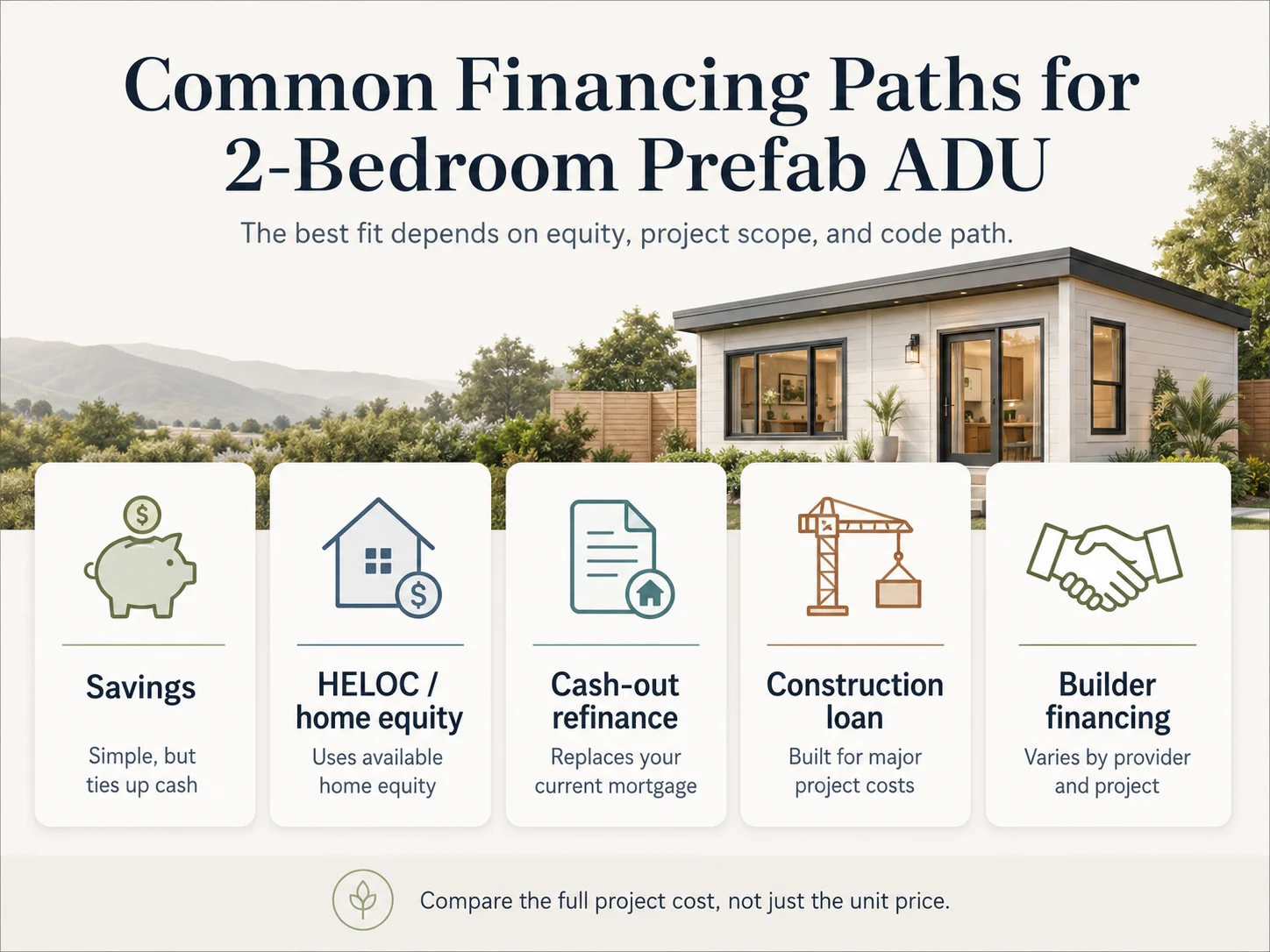
Want to understand your financing options without a sales pitch? Read our independent ADU financing paths guide — lane by lane, no rate promises. For mortgage, refinance, cash-out, and construction-loan questions, compare common funding routes and their eligibility limits before contacting a lender.
Compare ADU Financing OptionsWhat questions should you ask before putting down a deposit?
Before any deposit, get written answers on total installed cost, every exclusion, who is responsible for permits and site work, delivery access and method, timeline with recent local examples, warranty, cancellation and change-order terms, and the unit's exact code path. A deposit should follow clear written scope, never a verbal “starting at” number.
Use this as a literal checklist with every provider:
- What is the total installed cost for my specific lot, not the starting price?
- Exactly what does that number exclude (foundation, utilities, permits, tax, upgrades)?
- Who pulls permits, and who is responsible if plan check is delayed?
- Is delivery a crane set or panel assembly, and does my access support it?
- What's the realistic timeline based on your recent completed projects in my city?
- Is the unit modular, panelized, or HUD-code manufactured?
- Who handles utility connections and trenching?
- What's the warranty, and what's covered after year one?
- What are the cancellation and refund terms on my deposit?
- How are change orders priced once we start?
- Can you share references from recent local customers?
- What happens to my timeline if a city inspection fails?
- Are sales tax and local fees included or separate?
- What site conditions could change the price after I sign?
- Is the unit financeable and appraisable as I intend to use it?
Download the free ADU Starter Kit — it includes this 15-question checklist and the quote-comparison worksheet as printable PDFs you can bring to every vendor meeting.
Download the Free ADU Starter Kit →Which 2 bedroom prefab ADU options should you verify carefully?
Be cautious with very cheap portable, expandable, container, or “tiny home” listings — including the $10,000–$50,000 prefab units widely advertised online — that don't clearly prove local building-code compliance, permanent-foundation compatibility, permitted utility connections, warranty support, and a real permit pathway. A low online price is not the same as a legal, financeable ADU.
Shoppers ask this constantly: whether the cheap prefab homes advertised on major marketplaces are “legit,” and whether they can even connect to sewer and electric. The honest answer is that many of these units aren't designed or certified as permanent dwellings, and placing one as a legal ADU often requires modifications and approvals that erase the apparent savings.
Before considering any ultra-cheap unit, demand documentation of: the building code it's certified to, foundation requirements, utility-connection design, warranty, and whether your jurisdiction will permit it as an ADU. If a seller can't produce those, walk away. See also: best prefab ADU under $100K and under $150K for verified low-cost options.
How we ranked and verified these 2 bedroom prefab ADUs
We ranked these models by fit for a real homeowner decision — published specs, price transparency, code-path clarity, service area, installed-cost risk, and lot-fit practicality — not by affiliate payout. Where we earn a commission, it never changes a model's placement or your price.
What we verified on May 27, 2026:
Published model sizes, bedroom/bath counts, starting and base prices, stated installation exclusions, published building footprints and yard-space requirements, provider claims about delivery timelines and service area, California ADU size, setback, impact-fee, and rental-term rules (Cal. Gov. Code §§ 66311.5, 66321, 66323; California HCD ADU Handbook, March 2026, with the December 2025 addendum for January 1, 2026 changes; HCD's October 15, 2025 ordinance-review findings letter to Brentwood), Fannie Mae ADU and factory-built-housing guidance, and federal HUD manufactured-home code references (24 CFR Part 3280).
What still requires address-level verification:
Your local zoning and ordinance, utility capacity and lateral distance, HOA rules, site access, exact installed price, financing eligibility, current provider availability and pricing, and your jurisdiction's permit timeline. Where provider pages conflict (Abodu's headline-vs-carousel price; Villa's third-party vs direct pricing), confirm the current figure directly with the provider before you budget.
What we included: 2-bedroom prefab, modular, panelized, and HUD-code manufactured units that publish enough current data — beds/baths, square footage, dimensions, a price-scope label, and service area — for a homeowner to compare.
What we excluded: render-only concepts, models with no published price signal, units with no documented code path, and ultra-cheap portable/tiny-home listings that don't demonstrate a legal ADU pathway.
How we normalized cost: every price is labeled as DIY kit, base/unit-only, unit-plus-installation, provider-estimated financing, or turnkey-leaning. Installed-cost ranges are editorial estimates unless a provider publishes a full turnkey number.
How we classified code path: modular and panelized units are built to state/local residential code; manufactured homes are built to the federal HUD standard. This affects both city approval and financing.
How we handled affiliates: comparison tables are sorted by neutral criteria (size, price scope, availability). Partner links are disclosed and never influence ranking.
Update cadence: provider pricing and service areas are reviewed monthly for top-table models and quarterly for secondary models; legal and code references are reviewed quarterly or when statutes change.
What changes outside California (verification checklist)
California has the most developed statewide ADU law, but every state and locality differs — outside California, treat the items below as things to verify locally rather than assume. This page decodes California in depth because its rules are the most defined; for other states, use this as a checklist, not a set of answers. See the full ADU laws by state guide.
| What to verify | Where it's set | Why it matters |
|---|---|---|
| State ADU law | State statute / housing agency | Some states have permissive statewide ADU laws; many leave it fully local |
| Local zoning & size limits | City/county ordinance | Setbacks, height, lot coverage, and max size vary widely |
| Modular approval | State modular program / local building dept. | How factory-built units are inspected and labeled |
| Manufactured-home acceptance | Local ordinance | Whether HUD-code homes are allowed as ADUs at all |
| Utility connection fees | Local utility/water district | Separate meters, capacity fees, trenching rules |
| Impact fees | Local agency / special districts | California caps these for ≤750 sq ft units; other states may not |
| Rental rules | Local ordinance | Long-term vs short-term limits, minimum lease terms |
When you run your free ADU report, it pulls the rules that apply to your specific address, so you're not guessing from a national average.
2 Bedroom Prefab ADU FAQ
How much does a 2 bedroom prefab ADU cost?
Published "starting at" prices range from about $71,750 (a DIY panelized kit) to $426,800 (a premium turnkey modular unit). Installed project totals run higher once foundation, utilities, delivery, permits, sales tax, and finishes are added — commonly tens of thousands of dollars more, and highly site-dependent (model pages verified May 27, 2026).
What is the best 2 bedroom prefab ADU?
There's no universal best. For California turnkey buyers, Abodu Two+ and Samara XL 8; for national reach and tight-access lots, Studio Home Summit 800/1000; for the lowest base price, manufactured catalogs like Homes Direct (after code-path and installed-cost verification).
Can an ADU have 2 bedrooms?
Yes. ADUs can have two or more bedrooms. In California, because a 2-bedroom unit is "more than one bedroom," a local agency cannot set a maximum-size rule below 1,000 sq ft for it (Cal. Gov. Code § 66321).
What size should a 2 bedroom ADU be?
Most homeowners find 700–850 sq ft the comfortable balance; 750–850 sq ft is the sweet spot for a true 2BR/2BA. Units of 550–650 sq ft are possible but tight; 850–1,200 sq ft feels like a small house.
Is a 2 bedroom prefab ADU cheaper than site-built?
Often on a unit basis, but not always on a project basis. After foundation, utilities, site work, and permits, prefab and site-built can land in a similar range. Prefab's reliable advantage is predictability and speed, not a guaranteed discount.
Do prefab ADUs need permits?
Yes. Prefab is not a permit bypass. You still need zoning approval, a building permit, foundation approval, permitted utility connections, inspections, and a certificate of occupancy.
What is the smallest livable 2 bedroom ADU?
Around 550–650 sq ft is the practical floor for a 2BR/1BA, though it lives tight. California's absolute minimum for any ADU is far smaller, but that's well below a comfortable two-bedroom layout.
Can I rent out a 2 bedroom prefab ADU?
In most jurisdictions a permitted 2-bedroom ADU can be a long-term rental; short-term rules vary by city, and California requires units created under Gov. Code § 66323 to be rented for terms longer than 30 days. Treat rent figures as illustrative, not guaranteed.
Is BOXABL a good 2 bedroom ADU option?
BOXABL's 722 sq ft Two Bedroom Casita is worth considering for buyers specifically interested in compact, foldable prefab, but it's a verify-first option — confirm local approval, total package price, and financing for your address before committing.
Are the cheap prefab tiny homes advertised online legal ADUs?
Usually not without significant verification. Many aren't certified as permanent dwellings or designed for permitted utility connections. Demand code certification, foundation and utility documentation, and a permit pathway before relying on one as a legal ADU.
What is the difference between modular and manufactured ADUs?
Modular units are built to your state's residential building code (IRC-based) and treated like site-built homes; manufactured (HUD-code) homes are built to the federal standard (24 CFR Part 3280) and are sometimes treated differently by cities and lenders.
What questions should I ask before buying a prefab ADU?
Get written answers on total installed cost, all exclusions, permit and site-work responsibility, delivery method and access, realistic local timelines, warranty, cancellation terms, and the unit's code path. Our free Starter Kit includes the full 15-question checklist.
Related guides:
Not sure where to start?
See what's possible at your address — get your free ADU report in 60 seconds.
See What You Can Build → Get Your Free ADU Report