
Best ADU Builders San Diego County (2026): Costs, Rules & Builder Fit
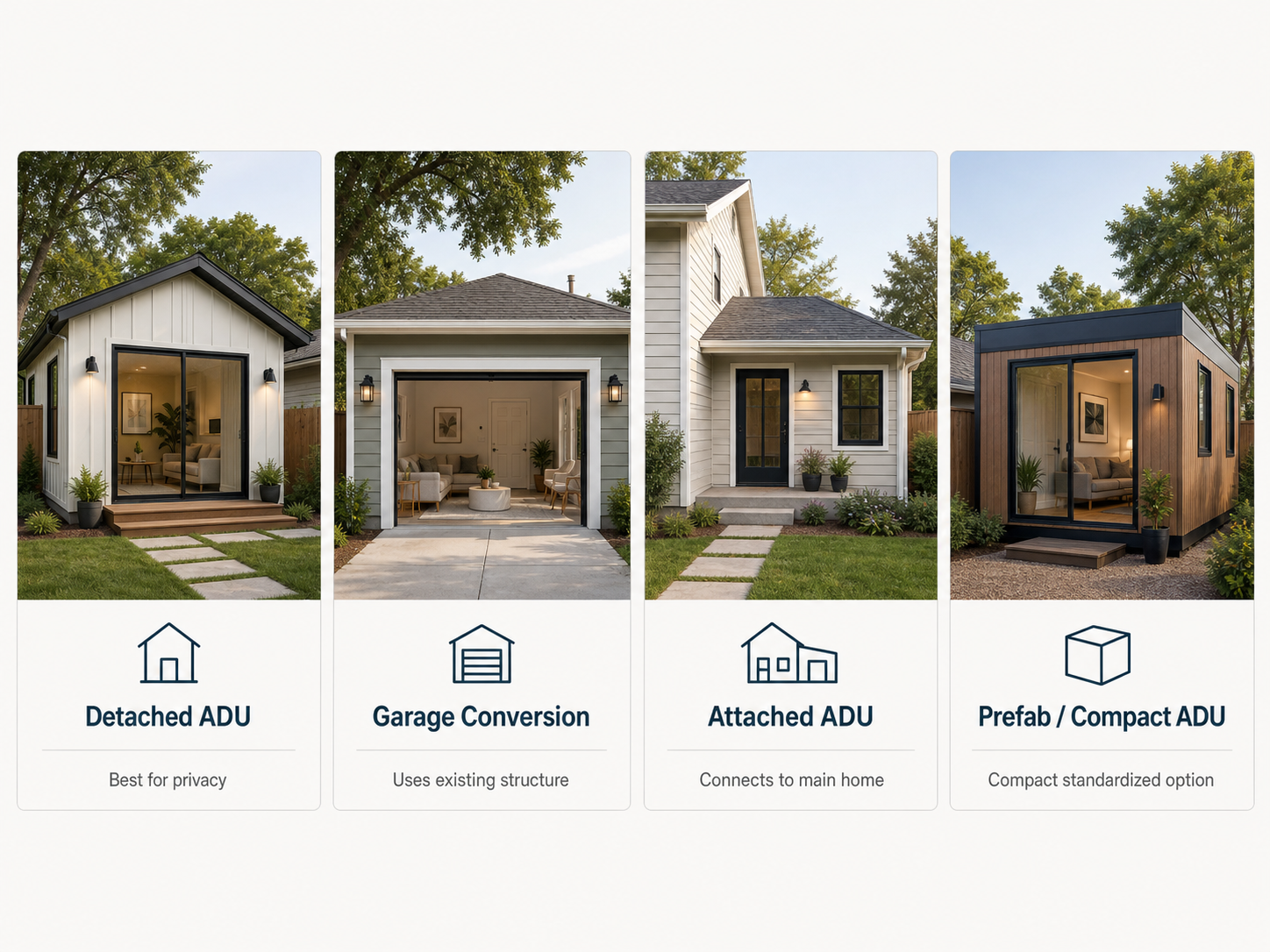
There is no single “best ADU builder in San Diego County” — the right builder is the licensed team whose specialization matches your city, ADU type, lot conditions, budget, and risk tolerance. For a typical detached new-construction accessory dwelling unit (ADU) in 2026, plan around $300,000–$450,000+ all-in (about $375–$600+ per square foot). Garage conversions usually run $100,000–$210,000. Junior ADUs (JADUs) under 500 square feet typically come in at $50,000–$100,000+. Get three written bids on identical scope, verify each builder's California Contractors State License Board (CSLB) license is active, and run a property-specific feasibility check before signing anything. The shortlist below organizes the best ADU builders San Diego County offers by the situation each one fits.
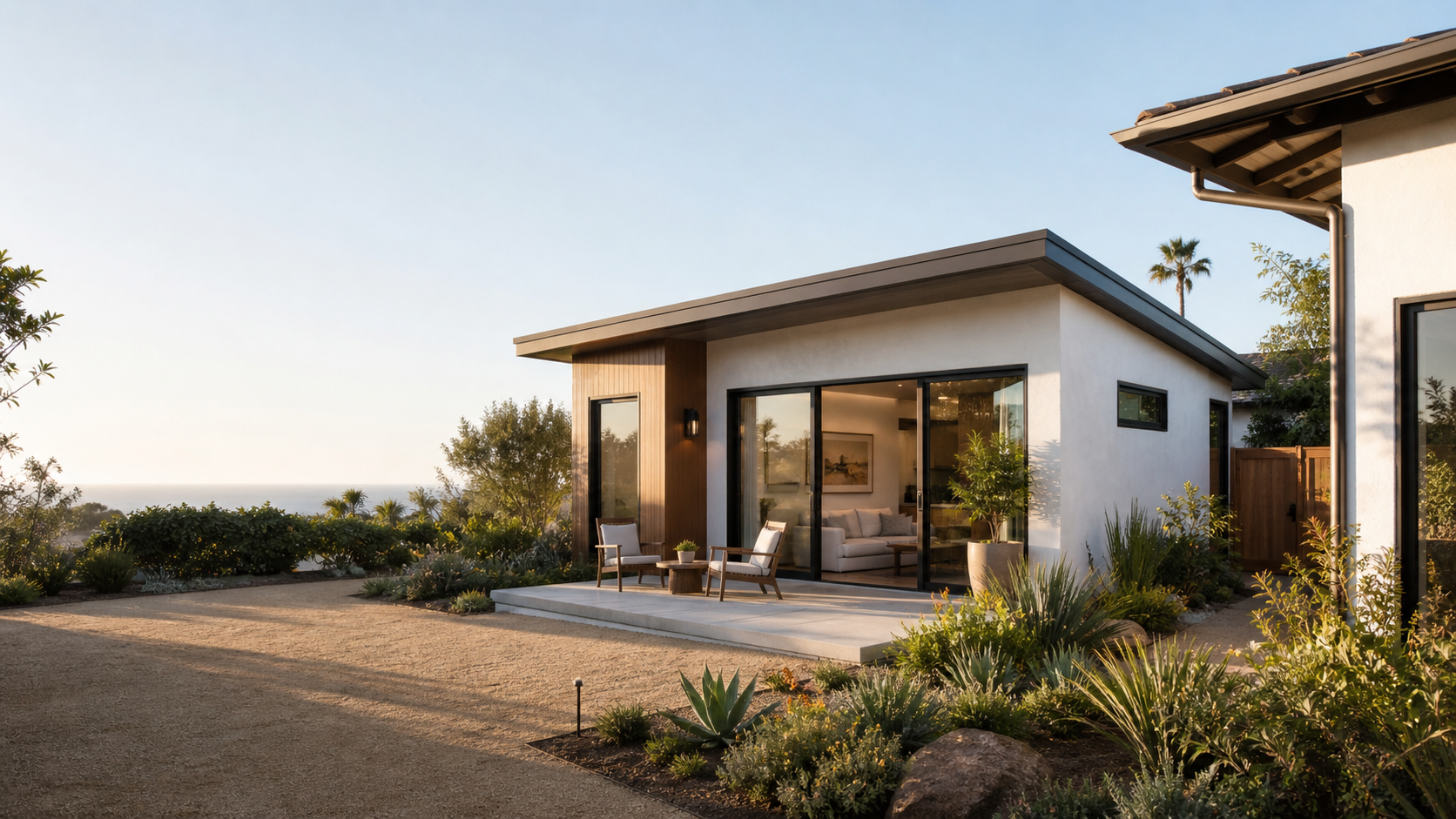
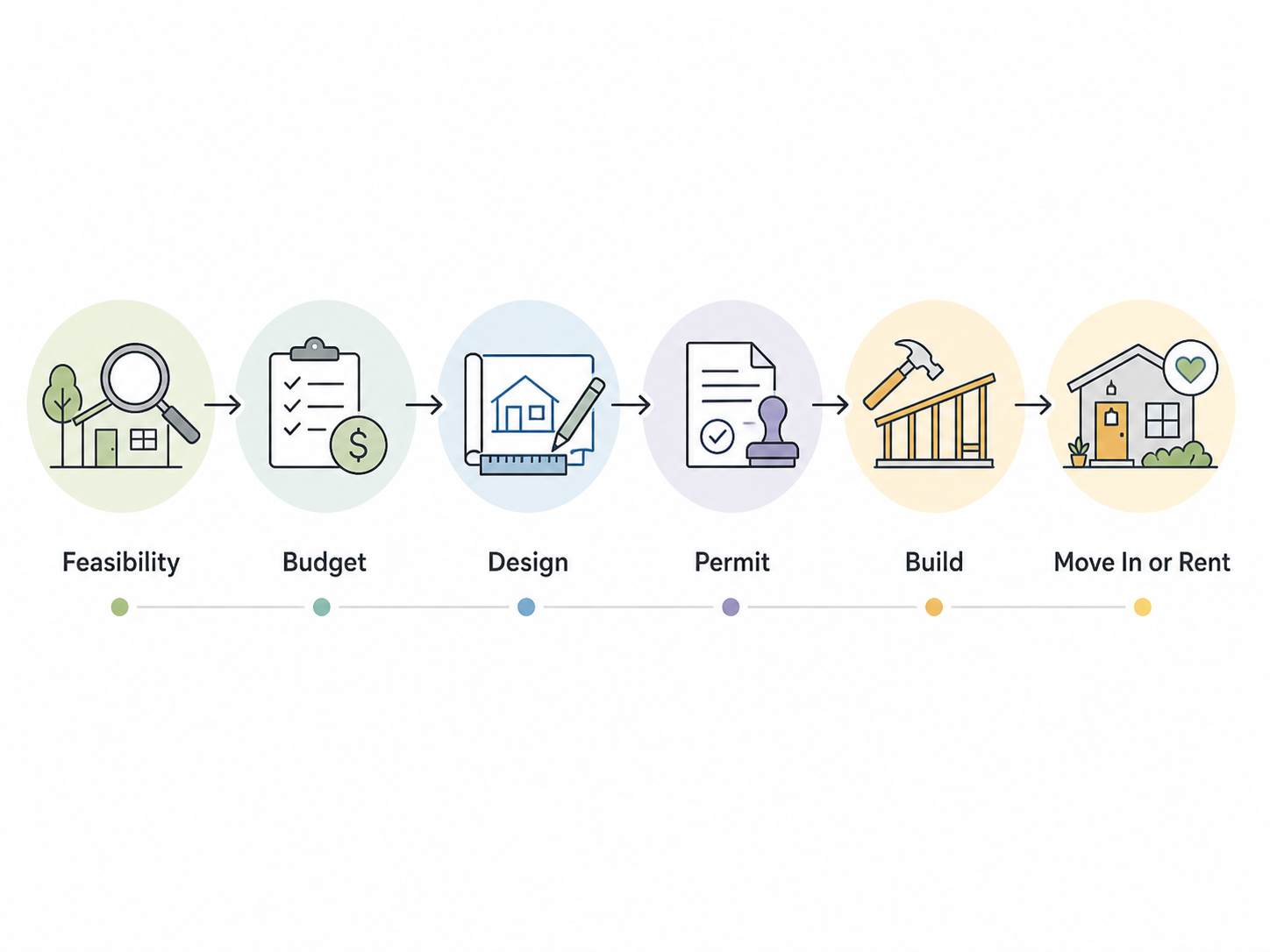
San Diego County ADU builder shortlist by project fit
| Your situation | Best-fit builder type | Shortlist to research | The watch-out |
|---|---|---|---|
| Detached new-construction ADU; one team for design + permits + build | ADU-specialized design-build firm | SnapADU, Better Place Design & Build, Crest Backyard Homes, YNK Construction | “Turnkey” means different things by company — compare exact inclusions line by line |
| Garage conversion (existing structure) | GC with conversion + code-upgrade specialty | BNC Builders, Specialty Design Build, Remodel Works, Better Place Design & Build | Slab condition, ceiling height, fire separation, sewer route, and electrical capacity can erase the savings |
| Junior ADU (JADU) inside the existing home | Most listed firms; pick a builder who does small projects routinely | Specialty Design Build, Better Place Design & Build | JADU rules around shared sanitation can still trigger owner-occupancy requirements |
| Compact / tiny-home-style ADU on a flat lot | Tiny-home or modular provider serving Southern California | Nest Tiny Homes, plus prefab options | Confirm permanent foundation, code path, transport, utilities, and your city's classification of the unit |
| Already have plans, need build-only pricing | Licensed GC with ADU permit history in your city | CRS Builders, JDB Builders, Groysman Construction | Confirm responsibility for plan-check corrections and engineering revisions in writing |
| Coastal lot, high-fire zone, sloped lot, multifamily, or unusual site | Architect first, then ADU-savvy GC | Project-specific | Run feasibility before any fixed-price contract |
Affiliate disclosure: SnapADU is our active partner. All builders in this table were evaluated under the same seven criteria; commercial relationship does not affect placement.
Get this matched to your specific address.
Run our free Feasibility Engine — we'll pull your lot's zoning, the applicable permit path for your city, and which of the builders below actually serves your address.
See What You Can Build → Get Your Free San Diego ADU ReportHow we built this San Diego ADU builder comparison
We started with more than 30 active companies that explicitly market ADU services in San Diego County and applied seven inclusion criteria, then verified every builder against three independent sources: the California Contractors State License Board (cslb.ca.gov), the Better Business Bureau (bbb.org), and each builder's own published portfolio.
Our criteria — reproducible if our list is out of date when you read this:
- Active California contractor's license, B (General Building) classification, in good standing on CSLB.gov as of May 4, 2026.
- ADU-specific portfolio — detached, attached, or conversion ADU work visible, not just kitchen and bath remodels.
- Verifiable physical address in or adjacent to San Diego County.
- BBB rating of A or higher where a profile exists, or no profile combined with a clean CSLB record.
- Public website with disclosed leadership or ownership — not a thin lead-gen page.
- At least three years operating under the current legal entity.
- No public-record CSLB enforcement actions at the time we checked.
What we did not use: paid placement, sponsored rankings, or builder-supplied “best of” awards. The list is alphabetical for that reason.
Conflict of interest, fully disclosed: SnapADU is the only builder on this page with which we have a commercial relationship. They were vetted under the identical seven criteria and held to the same honest-weakness disclosure standard as every other builder.
The San Diego ADU builders worth shortlisting
The 12 builders below all passed our inclusion criteria as of the verification date above. Build-count claims are self-reported by each company unless we marked otherwise. Ask any builder you meet with for a verifiable list of completed permits in your specific city.
Better Place Design & Build
- Leadership: Co-owned by licensed general contractor Bar Zakheim. Family-owned San Diego firm.
- Service area: San Diego County, including Bonita, Carlsbad, Carmel Valley, Chula Vista, Coronado, El Cajon, Escondido, Imperial Beach, La Mesa, Lemon Grove, Mission Valley, National City, Oceanside, Poway, Rancho Santa Fe, San Marcos, Santee, Solana Beach, Spring Valley, and Vista (per their published service-area page).
- Project types: Detached, attached, garage conversion, room addition, full design-build.
- Pricing model: “Verify before we price” approach — they verify zoning, utilities, and site conditions before quoting.
- Where they fit best: Homeowners comparing two or three full-service design-build firms head-to-head and who want a builder with strong cost transparency.
- Honest weakness: Their “top-ranked” claim is a self-claim with no third-party methodology; treat their published cost ranges as their own quote experience, not an industry-wide truth.
BNC Builders
- Service area: San Diego County.
- Project types: Detached new-build, garage conversion, attached, JADU.
- Pricing model: Per-square-foot ranges published openly in their cost guide.
- Published 2026 ranges: Detached ADUs averaging $200,000–$350,000; garage conversions $100,000–$200,000; JADU conversions starting around $50,000; large custom detached units $400,000+.
- Where they fit best: Garage conversions and homeowners who want transparent per-square-foot pricing to compare bids on a like-for-like basis.
- Honest weakness: Smaller public footprint than the largest specialists — ask for a verifiable list of ADUs they've permitted in your specific city.
CRS Builders
- Service area: San Diego County.
- Project types: Detached ADUs, garage conversions, JADUs, room additions, custom homes.
- Pricing model: Custom bidding.
- Where they fit best: Homeowners who already have plans and want a build-only or design-light bid from an established licensed general contractor.
- Honest weakness: Less ADU-specific marketing than dedicated ADU-only firms — confirm recent ADU permit history in your city before signing.
Crest Backyard Homes
- Service area: San Diego City and County, including La Jolla and Vista per their published portfolio.
- Project types: Detached ADUs; markets both prefab and site-built capability.
- Where they fit best: Homeowners exploring detached ADUs who want a single firm with both prefab and stick-built options on the table.
- Honest weakness: Verify any deposit terms in writing — California's Contractors State License Board (CSLB) caps residential down payments at $1,000 or 10% of the contract, whichever is less, regardless of what any builder's marketing says.
Gather ADU
- Founder: Argi Avetisyan publicly named on company profile.
- Service area: San Diego County and broader California.
- Project types: Full ADU design-build services.
- Pricing model: Custom.
- Where they fit best: Homeowners who want a builder with an active editorial knowledge base alongside services.
- Honest weakness: Some of their published “top builders” articles use templated language; rely on their service work, not their listicles.
Groysman Construction Remodeling
- Founded: 30 years operating in San Diego.
- Service area: San Diego County, including Escondido and La Jolla.
- Project types: ADUs, kitchen/bath remodels, full home remodels.
- Where they fit best: Homeowners with combined ADU-plus-remodel scope who want one team handling both projects.
- Honest weakness: Primarily a remodeler that also does ADUs — confirm ADU-specific project volume when interviewing.
JDB Builders
- Service area: California, Arizona, and Texas.
- Project types: Custom homes, ADUs, renovations, fire restoration.
- Where they fit best: Custom-design ADUs where a multi-state operator's broad code experience adds value.
- Honest weakness: Service quality may vary by location across three states; ask specifically about San Diego project managers and recent local builds.
Remodel Works
- Founded: 40+ years in San Diego.
- Service area: Centered on San Diego.
- Project types: ADUs, kitchen/bath, whole-home remodels.
- Pricing model: Fixed-cost approach with dedicated project manager and one of the larger material showrooms in the region.
- Where they fit best: Garage conversions and ADU-plus-renovation projects where strong material selection support matters.
- Honest weakness: ADU services area is heavily centered on the City of San Diego — verify coverage if you're in the unincorporated County or far North County.
Ritz ADU Design Build
- Founded: Building in San Diego County since 1965.
- Service area: San Diego County, with experience across multiple jurisdictions.
- Project types: Detached ADUs, garage conversions, two-story (carriage house) units.
- Where they fit best: Homeowners who value institutional longevity and want a builder familiar with multiple SD County permit offices.
- Honest weakness: Less prominent online than newer ADU-only specialists — ask for current backlog and recent permits in your city.
SnapADU
our partner — disclosure below- Founded: 2020. Co-founders Whitney Hill (CEO) and Mike Moore (CFO) named publicly on their About page.
- Service area: Greater San Diego — San Diego, Oceanside, Carlsbad, Encinitas, Del Mar, Solana Beach, Poway, San Marcos, Escondido, La Mesa, El Cajon, Vista, Chula Vista, Rancho Santa Fe, Santee, Lemon Grove, Imperial Beach, National City, Bonsall, Camp Pendleton, Cardiff By The Sea, La Costa, and unincorporated San Diego County.
- Project types: Detached new-construction ADUs, two-story carriage houses, multi-unit ADU sites. Stick-built (not prefab).
- Pricing model: Fixed-bid with 6-month price lock; in-house design, permitting, and construction.
- Build count claim: 100+ completed ADUs (company-reported, last published March 2026). SnapADU also publicly states approximately 90% of their projects started in 2022–2023 were built — a self-reported figure they contrast with their stated industry average. We have not independently audited either number.
- Pre-approved plans: SnapADU designed the pre-approved plan libraries for the City of Chula Vista and the City of San Marcos through competitive bid processes; the City of San Diego accepts the Chula Vista plans under California Assembly Bill (AB) 1332.
- Where they fit best: Detached new-construction ADUs in Greater San Diego where the homeowner wants a fully accountable in-house team.
- Honest weakness: Stick-built only — not a fit if you want prefab. Most competitive on detached new-build; less competitive on simple garage conversions. The 6-month price-lock structure works for most homeowners but is less flexible than cost-plus for buyers wanting to defer scope decisions.
If a stick-built detached ADU in Greater San Diego matches your project, request a free SnapADU consult.
Request a Free SnapADU Consult →*(sponsored)*
Affiliate disclosure: The Dwelling Index is reader-supported. Some links on this page are affiliate links. If you click one and take a qualifying action, we may earn a commission at no extra cost to you. Affiliate relationships do not influence our editorial rankings or conclusions. Read our full disclosure.
Affiliate disclosure: The Dwelling Index is reader-supported. Some links on this page are affiliate links. If you click one and take a qualifying action, we may earn a commission at no extra cost to you. Affiliate relationships do not influence our editorial rankings or conclusions. Read our full disclosure.
Specialty Design Build
- Founded: 1993.
- Service area: San Diego County.
- Project types: ADUs, granny flats, casitas, additions.
- Where they fit best: JADUs and smaller-footprint ADUs where a small specialist's attention pays off.
- Honest weakness: Smaller team — backlog matters; ask for projected start dates upfront.
YNK Construction
- Service area: San Diego County.
- Project types: Full ADU design-build, additions, kitchen/bath, whole-home remodels. Will take build-only when plans are pre-existing.
- Pricing model: Custom.
- Where they fit best: Family-owned operation with strong communication; works well for homeowners with pre-existing plans.
- Honest weakness: Less brand recognition than the largest ADU specialists; confirm recent ADU build volume.
Match this list to your specific property.
Run our free Feasibility Engine — see which builders' service areas cover your address and what your city's permit process actually looks like.
Run the Free San Diego ADU Feasibility CheckHow to choose the right ADU builder for your project
The single biggest cost mistake San Diego County homeowners make is hiring a builder whose specialization doesn't match the project. A custom-detached specialist will overprice a garage conversion. A volume prefab seller will struggle with a sloped or coastal lot. A general remodeler doing their first ADU will learn at your expense.
If you're building a detached new-construction ADU
Real 2026 cost expectation: roughly $300,000–$450,000+ all-in for a typical 600–1,200 square foot turnkey detached ADU in San Diego County, equivalent to $375–$600+ per square foot for design, permits, sitework, utilities, finishes, and construction. SnapADU's January 2026 cost analysis cites this range; Better Place Design & Build's 2025 cost guide cites the same $200,000–$450,000+ at $375–$600 per square foot. Both reflect the California Construction Cost Index (CCCI) rising approximately 44% from January 2021 through December 2025 — a $300,000 ADU in 2021 would now cost about $430,000 to build the same way.
Best-fit builders from our list: SnapADU (Greater San Diego, stick-built design-build), Better Place Design & Build, Crest Backyard Homes, YNK Construction.
Why these: detached new-construction is the most logistically demanding ADU type. Utility tie-ins, fire-zone setback compliance, soils reports on irregular lots, and Title 24 (the California Energy Code) compliance are routine. The builders above run dedicated detached-ADU operations rather than treating ADU work as overflow from larger remodels.
Considering a detached ADU in Greater San Diego?
If a stick-built detached ADU in Greater San Diego matches your project, request a free SnapADU consult.
Request a Free SnapADU Consult*(sponsored)*
Affiliate disclosure: The Dwelling Index is reader-supported. Some links on this page are affiliate links. If you click one and take a qualifying action, we may earn a commission at no extra cost to you. Affiliate relationships do not influence our editorial rankings or conclusions. Read our full disclosure.
If you're converting a garage
Real 2026 cost expectation: $100,000–$210,000 total ($150–$350 per square foot), depending on shell condition, plumbing route, and electrical capacity. The City of Carlsbad's official ADU page documents construction costs ranging from “as low as $10,000 for a simple bedroom conversion” up to “approximately $300,000 for a high-end companion unit” — useful confirmation that the spread is real and depends heavily on what the existing structure delivers.
Best-fit builders: BNC Builders, Specialty Design Build, Remodel Works, Better Place Design & Build.
A specific coastal-overlay note: even a garage conversion may need a Coastal Development Permit (CDP) if your property is inside the Coastal Overlay Zone in Carlsbad, Encinitas, Oceanside, coastal San Diego, Solana Beach, or Del Mar. AB 462 streamlined the coastal review timeline for jurisdictions with certified Local Coastal Programs and limited Coastal Commission appeals (subject to exceptions), but you'll still face additional documentation. Senate Bill (SB) 1077 directs the California Coastal Commission, with the Department of Housing and Community Development (HCD), to develop written guidance for local governments on simplifying coastal-zone ADU permitting by July 1, 2026 — that guidance is not a blanket exemption, and the draft version is now in the public-comment phase.
If you want a Junior ADU (JADU) under 500 square feet
A Junior ADU (JADU) is an accessory dwelling unit no larger than 500 square feet, contained entirely within an existing single-family residence, with permanent provisions for living, sleeping, eating, cooking, and at least an efficiency kitchen.
Real 2026 cost expectation: $50,000–$100,000+, depending on whether the JADU shares plumbing with the main house or requires new fixtures.
Best-fit builders: most builders on our list will do JADUs, but the question is whether they'll prioritize a small project. Specialty Design Build and Better Place Design & Build handle JADUs as routine. SnapADU focuses on detached new construction and is generally not the right fit for a JADU-only scope.
The owner-occupancy detail many readers miss: for any standard ADU in California, owner-occupancy cannot be required by a local agency — AB 976 was signed October 11, 2023 and took effect January 1, 2024, permanently prohibiting local agencies from imposing owner-occupancy requirements on ADUs (per Government Code § 66315). For JADUs, owner-occupancy can still apply when the JADU shares sanitation facilities with the existing home; AB 1154 removed the owner-occupancy requirement for JADUs that have separate bathrooms. Verify with your city before counting on either rule.
If you're considering prefab vs. stick-built
Prefab and modular ADUs can save time but rarely save money in San Diego once foundation, crane delivery, sitework, utility hookups, and city tie-ins are added. Most San Diego County builders on our shortlist are stick-built (site-built) design-build firms. Prefab is a separate market. For prefab-specific shopping, see our national Best Prefab ADU Companies review and our Prefab ADU Cost: Real All-In Prices (2026) breakdown.
For a compact, tiny-home-style ADU, Nest Tiny Homes is one of our approved partners that publicly serves Southern California, with a California office in El Centro and a CSLB license shown on their site. Their California ADU service area includes San Diego and Imperial County.
Considering a compact ADU?
Explore Southern California tiny-home and compact ADU options with Nest Tiny Homes.
Explore Nest Tiny Homes Options*(sponsored) Confirm code classification, foundation type, and your city's acceptance before relying on a tiny-home unit as a permitted ADU.*
Affiliate disclosure: The Dwelling Index is reader-supported. Some links on this page are affiliate links. If you click one and take a qualifying action, we may earn a commission at no extra cost to you. Affiliate relationships do not influence our editorial rankings or conclusions. Read our full disclosure.
How to vet a San Diego ADU builder before signing
Most homeowners ask the wrong questions during builder interviews. “What's your price?” and “How long will it take?” are both unreliable until feasibility is complete. The 14 questions below predict whether your project will finish on budget, on time, and without a contractor's lien on your property.
The 14-question San Diego ADU builder vetting framework
1. License verification. What is your CSLB license number, and what classifications does it carry?
A good answer: “B / General Building, active for [N] years under this entity.” A red flag: license issued under a recently formed entity, or a recent classification change. Verify directly at the CSLB lookup at cslb.ca.gov — the Contractors State License Board confirms license status, classifications, bonding, and complaint disclosures.
2. Bond and insurance. Show me proof of your $25,000 contractor's bond and general liability insurance.
Every California licensed contractor must maintain a $25,000 contractor's license bond under Business & Professions Code § 7071.6 (the bond amount increased from $15,000 to $25,000 effective January 1, 2023). Limited Liability Company (LLC) contractors must also file an additional $100,000 employee/worker bond. Ask for the bond and the Certificate of Insurance directly.
3. Are you a design-build firm or do you subcontract design?
Design-build means design, engineering, and construction are managed by a single accountable entity. Design-bid-build means you hire an architect first, then the contractor bids on those plans. Design-build is usually faster for routine ADUs; design-bid-build is often better for complex, custom, or coastal projects.
4. How many ADUs have you permitted in my city specifically in the last 12 months?
Permit data is public. Builders should be able to answer with addresses (or at least cross-streets) and project sizes. “We've done hundreds across the county” is not an answer.
5. What's your fixed-bid versus allowance percentage on a typical project?
Fixed-bid covers known scope at a guaranteed price. Allowance items (flooring, countertops, fixtures) are budgeted but reconciled to actual cost. A bid that's 60% allowance is not really a fixed bid.
6. Show me your last three change-order logs.
This is the single most predictive question on the list. A builder who can't or won't show you change-order patterns from real recent projects is hiding either disorganization or a culture of upselling.
7. What's the down-payment structure?
California's Contractors State License Board states that for home improvement contracts, the down payment cannot be more than $1,000 or 10% of the contract price, whichever is less. Anyone asking for more is operating outside California contractor law.
8. Who is my dedicated project manager and what's their direct contact?
You should have a name, an email, a phone number, and a backup contact before signing.
9. What does your warranty cover and for how long?
California's statute of limitations on construction defects runs up to 10 years for latent defects. Standard residential warranties are often 1 year on labor with longer coverage on specific systems. Get it in writing.
10. Who handles the city permit-corrections process?
First-cycle plan rejection in San Diego is the rule, not the exception. Plan-check correction cycles are common across San Diego County jurisdictions. The question for your contract is who pays for the resubmittals — you or the builder.
11. Show me a feasibility study you completed for a similar property.
A real feasibility study identifies zoning constraints, utility capacity, fire-zone implications, and rough budget envelope before a design contract. Builders who skip this and go straight to design are increasing your risk.
12. What's your current backlog and projected start date?
Real ADU specialists usually have meaningful backlog. A builder with “we can start next week” is either between projects (possibly because clients aren't returning) or oversold. Ask for the projected design-kickoff date in writing.
13. What happens if you go out of business mid-project?
Ask about CSLB bond status, insurance, and any continuity arrangements with another licensed contractor. Your protections include the $25,000 bond, mechanics-lien rights, and homeowner's insurance — but the best protection is structural, asked before signing.
14. Will you put it all in writing — schedule, allowances, exclusions, and payment milestones?
California Business & Professions Code § 7159 requires home improvement contracts to disclose specific contract terms in writing. If a builder resists detailed exclusions, you're being set up for change orders.
Print it. Bring it to every builder meeting. Score each builder 1–5 per question. The lowest-scoring builder is rarely the one you should hire — even if their bid is the lowest.
Red flags: how to spot a San Diego ADU builder who will cost you money
Most ADU disasters are predictable from the first sales call. The eight red flags below come from documented California contractor-licensing patterns, BBB complaint themes, and our editorial review of public ADU-builder bid materials.
- Down payment demand over $1,000 (or 10% of contract, whichever is less). California's CSLB enforces this limit for home improvement contracts. Anyone asking for more is operating outside the law. This is a hard line.
- A bid suspiciously below the realistic range. If your three bids land at $400,000, $385,000, and $220,000, the $220,000 bid is almost certainly under-pricing allowances that will balloon during construction. Every line item that “rounds to zero” early shows up as a six-figure addition later.
- A vague or missing permit-corrections clause. First-cycle plan rejection is normal in San Diego. The contract must specify who pays for resubmittals.
- No written exclusions list. Quality builders volunteer their exclusions. Problem builders bury them.
- Pressure tactics. “This price is only good today” or “I have another customer waiting.” Real ADU builders run real backlog. They don't operate like furniture stores.
- Brand-new entity with vague history. The CSLB license record shows entity formation date and license issuance date. If both are recent and the marketing is heavy, ask why.
- Resistance to providing references in active construction phase. Anyone can produce a happy past client. Fewer can produce a happy current client mid-build.
- No real ADU portfolio. A general remodeler is not an ADU specialist. Ask for the last five permitted ADUs by city. If they can't list five, they're not a specialist.
How much does an ADU cost in San Diego County in 2026?
A realistic 2026 planning range is $200,000–$450,000+ for a detached ADU, $100,000–$210,000 for a garage conversion, and $50,000–$100,000+ for a JADU. Cost per square foot runs $375–$600+ for detached new-build, $200–$350 for attached, and $150–$350 for garage conversion. The wide ranges reflect site conditions, finish level, and which city you're in — not which builder you choose.
For a full breakdown, see our How Much Does an ADU Cost in 2026? guide and our ADU Cost Per Square Foot in 2026 analysis.
Cost benchmark table by ADU type
| ADU type | All-in turnkey range (2026) | $/sq ft range | Source / source type |
|---|---|---|---|
| Detached new-build (typical) | $300,000–$450,000+ | $375–$600+/sq ft | SnapADU cost analysis, March 2026 — builder-published |
| Detached new-build (broad SD County) | $200,000–$450,000+ | $375–$600+/sq ft | Better Place Design & Build cost guide, September 2025 — builder-published |
| Detached new-build (alternate) | Up to $460,000 | $350–$500/sq ft | Realm Home San Diego ADU cost article, March 2026 — third-party editorial |
| Garage conversion (BNC range) | $100,000–$200,000 | $150–$350/sq ft | BNC Builders cost guide, 2026 — builder-published |
| JADU (under 500 sq ft) | starting around $50,000 | $100–$300/sq ft | BNC Builders cost guide, 2026 — builder-published |
| Carlsbad official spread | $10,000 – $300,000 | n/a | City of Carlsbad ADU page — official city |
Cost figures shown are illustrative ranges from public sources cited above, not guarantees. Actual project cost depends on lot conditions, design, finish level, permit jurisdiction, and current market conditions at the time of bid. Always obtain three written bids before signing a contract.
Why ranges this wide are real, not lazy
- Construction cost inflation. The California Construction Cost Index rose 44% from January 2021 through December 2025. Older quotes are usable only as a memory of a different market.
- Fixed costs don't scale down. Every ADU has a kitchen, a bathroom, a mobilization charge, and design fees. Spreading those costs over fewer square feet means higher cost per square foot on smaller units.
- Permit fees vary 3–5x by city. See the city matrix below.
- Site conditions add cost categories, not just numbers. Common cost categories homeowners should ask each builder to address explicitly: utility connection fees, school impact fees (for ADUs over 500 square feet), soil and geotechnical reports, drainage and stormwater compliance, electrical service upgrades, and fire-rated construction in High or Very High Fire Hazard Severity Zones.
See your likely budget path for your specific address.
Get Your Free San Diego ADU Report →San Diego County ADU permit costs and timelines: city-by-city matrix
Permit costs vary across San Diego County by 3–5x depending on jurisdiction. The matrix below pulls from official city pages where available; cells without primary-source confirmation are flagged so you know what to verify with your city before relying on a number.
City-by-city permit, fee, and timeline matrix
| Jurisdiction | Permit fee range / source | Pre-approved plans? | Typical permit timeline | CDP risk | Notable fee waivers / programs |
|---|---|---|---|---|---|
| City of San Diego | Per City of San Diego DSD fee schedule — verify current schedule before relying | Yes — accepts City of Chula Vista, City of Encinitas, and County of San Diego pre-approved plans | 30-day review for pre-approved plans (AB 1332); custom projects vary | Yes within Coastal Overlay Zone | SDHC ADU Finance Program (construction-to-permanent loans up to $250,000 for income-eligible homeowners) |
| Carlsbad | ~$2,000–$4,000 (City of Carlsbad ADU page) | Yes — Carlsbad Permit Ready ADU Program | Permit-ready plans save est. 3–6 months and $8,000–$16,000 in design fees (City of Carlsbad) | Yes — coastal lots require CDP | Permit-ready plan program |
| Chula Vista | Verify with city | Yes — Chula Vista Standard ADU Plans | Streamlined under permit-ready | No | Same water/sewer laterals allowed; Chula Vista ADU loan program closed June 2024 |
| Encinitas | Plan review and inspection fees waived with exceptions (City of Encinitas ADU page) | Yes — Permit-Ready ADU (PRADU) Program | Faster than custom; varies | Yes within Coastal Zone | Geotech report required for new construction ≥ 500 sq ft. School impact fees may apply. |
| Escondido | Verify with city | Yes | Streamlined | No | No parking required; no rentals under 30 days |
| Oceanside | Verify with city | Verify | 60-day review target with clock pausing for resubmittals (City of Oceanside ADU page) | Yes within coastal zones | Detached ADUs allowed up to 1,200 sq ft; rentals must be longer than 30 days |
| Poway | Verify with city | Verify | Custom timeline | No | Inland zoning |
| San Marcos | Verify with city | Yes — Permit-Ready ADU Program with free single-story detached ADU designs | 30-day approve-or-deny for unaltered city plan sets (City of San Marcos) | No | Alterations to city plan sets disqualify from permit-ready track |
| Vista | Verify with city | Verify | Standard | No | ADUs under 750 sq ft auto-waived for impact fees under SB 13 |
| La Mesa | Verify with city | Verify | Standard | No | ADU-only projects may be exempt from park fees and RTCIP fees — confirm with city |
| El Cajon | Verify with city | Yes | Standard | No | Encourages ADU development with expedited permitting |
| Solana Beach | Verify with city | Verify | Standard | Yes within coastal zones | Coastal review process applies |
| Unincorporated SD County | Verify County PDS fee schedule | Yes — County Standard ADU Plans | Custom timeline | Varies by overlay | County Board voted March 4, 2026 to adopt separate-sale program for ADUs through condo conversion (AB 1033) |
Sources: each city's official ADU page (verified May 4, 2026); SnapADU permit-fee analysis (last updated February 2026) used as cross-check only; cells marked “verify with city” indicate where we did not find a current primary-source number we could confidently publish — pull the fee schedule directly from the city's Development Services Department before relying on any number.
Builder × city service-area fit at a glance
The matrix below shows the cities each builder explicitly publishes service for. Verify directly with the builder during your consult — service areas can shift based on current backlog.
| Builder | City of San Diego | Coastal SD (PB, La Jolla, OB) | North County Coastal | North County Inland | South Bay | East County | Uninc. SD County |
|---|---|---|---|---|---|---|---|
| Better Place Design & Build | ✓ | ✓ | ✓ | ✓ | ✓ | ✓ | Verify |
| BNC Builders | ✓ | Verify | Verify | Verify | ✓ | Verify | Verify |
| CRS Builders | ✓ | Verify | Verify | Verify | Verify | Verify | Verify |
| Crest Backyard Homes | ✓ | ✓ (La Jolla) | Verify | Verify (Vista) | Verify | Verify | Verify |
| Gather ADU | ✓ | Verify | Verify | Verify | Verify | Verify | Verify |
| Groysman Construction | ✓ | ✓ (La Jolla) | Verify | ✓ (Escondido) | Verify | Verify | Verify |
| JDB Builders | ✓ | Verify | Verify | Verify | Verify | Verify | Verify |
| Remodel Works | ✓ | Verify | Verify | Verify | Verify | Verify | Verify (limited) |
| Ritz ADU Design Build | ✓ | ✓ | ✓ | ✓ | ✓ | ✓ | ✓ |
| SnapADU | ✓ | ✓ | ✓ | ✓ | ✓ | ✓ | ✓ |
| Specialty Design Build | ✓ | Verify | Verify | Verify | Verify | Verify | Verify |
| YNK Construction | ✓ | Verify | Verify | Verify | Verify | Verify | Verify |
✓ = service published. “Verify” = not explicitly confirmed in the builder's published service area; ask during consult.
Affiliate disclosure: SnapADU is our active partner. Their row in this table reflects published service area data, not commercial arrangement.
State law baseline every builder should understand cold
California's ADU statute, codified across Government Code Sections 66310–66342 and amended through a series of bills, requires:
- Ministerial review of qualifying ADU applications without discretionary public hearings.
- 15 business days for the local agency to determine whether the application is complete.
- 60 days for the agency to approve or deny a complete application (Government Code § 66317).
- State-level minimum size protections: local agencies cannot prevent at least 850 sq ft for an ADU, 1,000 sq ft for an ADU with more than one bedroom, or an 800 sq ft ADU with four-foot side and rear setbacks.
- Impact fee prohibition for ADUs of 750 sq ft or less and JADUs of 500 sq ft or less.
- Rental term: local agencies may require ADU rentals to be 30 days or longer (per AB 976, Government Code § 66315).
- No owner-occupancy requirement on standard ADUs (AB 976, effective January 1, 2024).
- Separate sale of ADUs as condominiums allowed in jurisdictions that opt into AB 1033.
- Pre-approved ADU plans: AB 1332 (effective January 1, 2025) requires every California city and county to operate a pre-approval program; 30-day review applies when an applicant uses an accepted pre-approved plan.
For a complete breakdown, see our California ADU Laws 2025 guide. A builder who can't explain how these state-law floors interact with your specific city's ordinance is not a builder you should hire.
Want this customized to your address?
Run the Free San Diego ADU Feasibility Check →How long does it take to build an ADU in San Diego County?
A full ADU project typically takes 10–18+ months in San Diego County. Design takes 2–5 months, permitting 3–8 months for custom plans (or as little as 30 days for pre-approved plans under AB 1332), and construction 6–10+ months.
| Stage | Realistic range | What it covers |
|---|---|---|
| Feasibility / site check | 1–4 weeks | Zoning, utility availability, fire-zone analysis, rough budget envelope |
| Design and construction documents | 2–5 months | Architectural drawings, structural engineering (typically 2–6 weeks), Title 24 energy compliance, full submittal package |
| City pre-screen | 2–4 weeks | Application completeness review, fee invoice |
| Plan check (review) cycles | 3–6 weeks per cycle | Multiple cycles are common across SD County jurisdictions |
| Permit issuance | After review and corrections are complete | City of San Diego DSD permit timeline dashboard updates weekly |
| Construction | 6–10+ months | Mobilization, foundation, framing, MEP rough-in, finishes, inspections |
| Closeout / final | 1–4 weeks | Final inspections, utility release, certificate of occupancy |
| Total typical | 10–18+ months | Builder-published planning ranges from SnapADU (December 2025) and YNK Construction (August 2025) |
Why timelines slip
- Incomplete submittal — pre-screen kickback adds weeks.
- Coastal Overlay Zone — additional CDP review even with AB 462 streamlining.
- Very High Fire Hazard Severity Zone — fire-rated construction and defensible-space requirements.
- Soils or geotech surprises — bad news on a soils report can mean deeper footings, more rebar, and meaningful redesign cost.
- SDG&E electrical service coordination — can add weeks of utility coordination.
- Water/sewer capacity issues — meter upsizing, lateral replacement.
- Plan-check correction cycles — every resubmittal restarts the cycle clock.
- Material lead times — windows, custom cabinetry, specialty fixtures.
- HOA review — applies in some neighborhoods; can run parallel or sequential to city review.
When an ADU builder is not the right next step
Before you book a builder consult, check whether your situation calls for feasibility, financing, or an architect first. The order matters — calling a builder with bad inputs is how homeowners spend $5,000+ on design fees for a project that turns out to be infeasible or unfinanceable.
Start with a feasibility study if any of these are true
- Your lot is in the Coastal Overlay Zone (much of Carlsbad, Encinitas, Oceanside, coastal San Diego, Solana Beach, Del Mar).
- Your lot is in a Very High Fire Hazard Severity Zone.
- The lot has noticeable slope, drainage, or access constraints.
- You're on septic rather than sewer (much of the unincorporated County).
- Your electrical service is older than 30 years or you have a 100-amp panel.
- You're considering a garage conversion where the existing garage may not have a permitted slab or current code clearance.
- The property is multifamily and you're trying to maximize ADU count under state law.
- Lot lines or easements look unclear.
- There's an HOA.
- The property is historic or in a designated historic district.
- You want a roof deck or second story.
- You want to sell the ADU separately under AB 1033.
- You need the project to be short-term-rental viable — most San Diego cities prohibit ADU short-term rentals under 31 days.
Start with financing if any of these are true
- You need to borrow funds to build.
- You're unsure whether your home equity supports the build.
- You're depending on rental income to make the project work. See our ADU Rental Income guide.
- You're considering SDHC, CalHFA, or other grant/loan programs with eligibility windows. See our ADU Grants guide.
- Your debt-to-income ratio is borderline for a construction or HELOC loan.
Start with an architect (not a design-build firm) if any of these are true
- You want truly custom design.
- The lot is coastal bluff, steep, or heavily constrained.
- The project is a major addition to the primary residence.
- You're doing multifamily conversion beyond ADU rules.
- You want a condo or separate-sale strategy under AB 1033 with independent representation.
- You want to bid the architect's plans out to multiple GCs for competitive pricing.
Not sure which step comes first?
Run our Feasibility Engine — it flags whether you should call a builder, talk to a lender, or hire an architect first.
Run our Feasibility Engine →How to pay for a San Diego County ADU without letting financing drive your builder choice
Compare financing paths separately from builder selection. Your builder should help you understand budget and draw timing, but you should never choose a builder because they steer you to a specific lender. Below are the routes most San Diego homeowners use in 2026 — sorted by which type of borrower they fit, not by who pays our affiliate the most.
Local option: SDHC ADU Finance Program (City of San Diego only)
The San Diego Housing Commission (SDHC) ADU Finance Program helps homeowners with moderate income in the City of San Diego build ADUs on their property. Per SDHC's published program details (verified May 2026), the program offers construction-to-permanent loans up to $250,000 plus technical assistance at no cost.
Restrictions to verify before applying:
- Income cap (varies by household size).
- Owner-occupancy requirement.
- Minimum credit score and underwriting standards.
- Rents for the ADU must remain affordable for seven years to tenants with income up to 80% of Area Median Income (AMI) — meaning you can't rent at full market rate during the affordability period.
- Property owner cannot rent to a family member during the affordability period.
Common financing paths to compare
- Home Equity Line of Credit (HELOC) — for homeowners with substantial equity who want flexibility and a draw structure that matches a long ADU build.
- Cash-out refinance — for homeowners willing to reset their primary mortgage to access a lump sum, typically when the existing rate is no longer significantly below current market.
- Construction loan / Construction-to-permanent loan — for homeowners who don't have enough equity for HELOC/cash-out or who want to lock financing before owning the equity created by the ADU.
- Renovation loan (FHA 203(k) or similar) — for homeowners with limited equity who want to roll renovation cost into the mortgage.
We don't rank lenders. We don't quote rates. We do explain how each path fits which homeowner profile in our ADU Financing: Every Option Explained guide.
Explore mortgage and refinance options for your ADU.
Compare construction loans, cash-out refis, and HELOCs with Mortgage Research Center.
Compare ADU Financing Options*(sponsored — educational only; no rate, payment, or approval is guaranteed)*
Affiliate disclosure: The Dwelling Index is reader-supported. Some links on this page are affiliate links. If you click one and take a qualifying action, we may earn a commission at no extra cost to you. Affiliate relationships do not influence our editorial rankings or conclusions. Read our full disclosure.
Financial disclaimer: financing examples are illustrative, not guarantees of returns or approval. Actual results depend on local market conditions, construction costs, financing terms, and regulatory approvals.
What questions should you ask each ADU builder on the first call?
The first call is not for asking “How much?” The first call is for finding out whether the builder understands your city, your build path, and the real scope that has to be priced before bids can be compared fairly.
The 15-question first-call worksheet
Use this list at every consult. Score each builder.
- Have you permitted an ADU in my specific city in the last 12 months? Can you share the address or cross-streets of two of them?
- Which parts of the project do you handle in-house versus subcontract?
- Who is responsible for zoning feasibility before design?
- Who responds to plan-check corrections? Who pays for them?
- What is excluded from your first estimate? Read me your exclusions list.
- How do you price utility upgrades — water lateral, sewer lateral, electrical service, gas?
- Is solar included if Title 24 requires it for new construction?
- How do you handle soils/geotech, drainage, stormwater, and grading?
- What assumptions are you making about sewer, water, and electrical capacity at my property?
- What is your typical timeline from design agreement to final inspection in my city?
- How many correction rounds are typical in this city for a project like mine?
- Can I speak with three current clients whose ADUs are mid-build right now?
- What warranty do you provide and what does it cover?
- How are change orders priced and approved?
- What would make you tell me not to build this ADU?
The answer to question 15 is the most diagnostic on the list. A good builder has told some clients “no” — and they'll tell you about it. A bad builder claims everything is buildable.
Same scope columns for three builders, scoring rubric, and red-flag scoring.
Quote-scope comparison: the line items that should appear in every bid
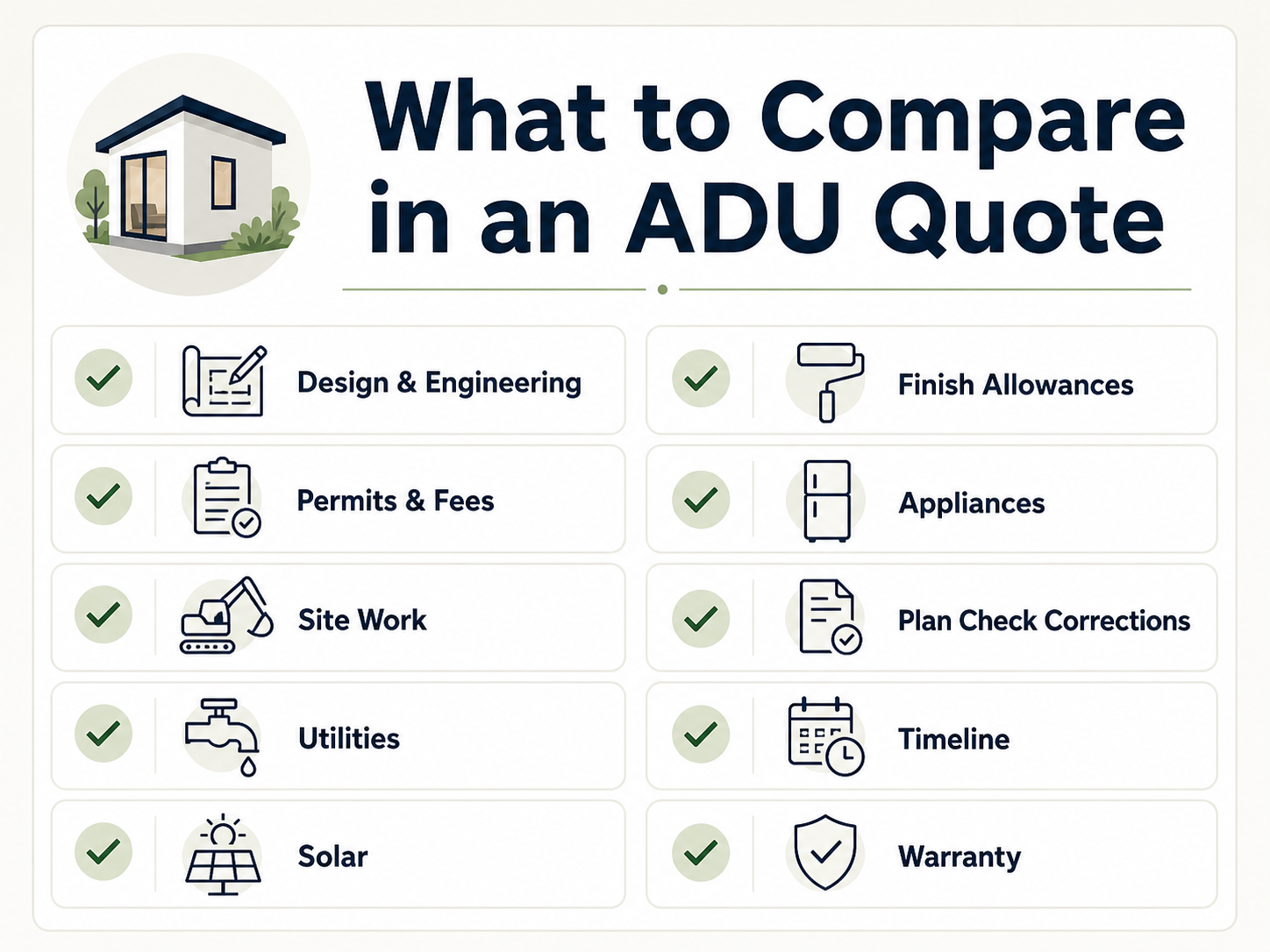
The single most useful thing you can do before signing is force every bid into the same scope template. If a line is silent in one bid and priced in another, that's not a savings — that's a future change order.
| Line item | Why it matters |
|---|---|
| Architectural design & construction documents | Often $7,500–$15,000; varies with custom vs. pre-approved |
| Structural engineering | Required for new construction; 2–6 week add to design |
| Survey | Boundary, topography, easement clarity |
| Soils / geotech report | Required for sloped lots, foundations, or by city |
| Title 24 energy compliance | Mandatory for new construction in California |
| City permit fees | Vary 3–5x by jurisdiction (see matrix above) |
| School impact fees | Apply to ADUs over 500 sq ft per current code |
| Utility laterals & trenching | Water, sewer, electrical, gas |
| SDG&E coordination | Service upsize, panel work |
| Solar (if required) | New construction often triggers Title 24 solar requirement |
| Foundation, framing, MEP rough-in | Core construction |
| Finish allowances (flooring, cabinets, fixtures, appliances) | Should be itemized; vague 'allowances' are change-order land |
| Landscaping & fencing | Often excluded from base bids |
| Plan-check corrections | Who pays for resubmittals |
| Inspections & closeout | Final approvals, certificate of occupancy |
| Warranty | Length and coverage |
What we verified for this guide
- California state law baseline for ADUs and JADUs, including AB 976 (signed October 11, 2023, effective January 1, 2024) on owner-occupancy; AB 1033 on separate-sale provisions; AB 1332 on pre-approved plans (effective January 1, 2025); AB 1154 on JADU owner-occupancy; AB 462 on coastal review timing; SB 1077 on Coastal Commission guidance development by July 1, 2026. (Sources: California Legislative Information, California Department of Housing and Community Development ADU Handbook.)
- City of San Diego ADU rules including pre-approved plan acceptance and ADU/JADU amendments. (Source: City of San Diego Information Bulletin 400; City of San Diego Companion/Junior Units page; adopted single-issue code updates noting outside-Coastal-Zone effective date of August 22, 2025.)
- Unincorporated San Diego County rules including the March 4, 2026 Board vote to adopt a separate-sale program for ADUs through condominium conversion. (Source: County of San Diego Planning & Development Services.)
- City of Carlsbad ADU permit fees ~$2,000–$4,000; construction range $10,000–$300,000; permit-ready plans save 3–6 months and $8,000–$16,000. (Source: City of Carlsbad Accessory Dwelling Units page.)
- City of Encinitas plan review and inspection fees waived with exceptions; geotechnical report required for additions or new construction ≥ 500 sq ft. (Source: City of Encinitas ADU page.)
- City of Chula Vista same water/sewer laterals allowed; Chula Vista ADU loan program closed June 2024. (Source: City of Chula Vista ADU page.)
- City of Escondido no parking required; no rentals under 30 days. (Source: City of Escondido ADU page.)
- City of Oceanside detached ADUs up to 1,200 sq ft; 60-day review with clock pausing for resubmittals. (Source: City of Oceanside ADU page.)
- City of San Marcos Permit-Ready ADU Program with 30-day approve-or-deny for unaltered city plan sets. (Source: City of San Marcos Permit-Ready ADUs page.)
- CSLB requirements: $25,000 contractor's license bond under Business & Professions Code § 7071.6 (effective January 1, 2023); $1,000 / 10% down-payment cap on home improvement contracts. (Source: CSLB Bond Requirements page; CSLB Home Improvement Contracts page.)
- Cost ranges triangulated across SnapADU (March 2026), Better Place Design & Build (September 2025), Realm Home (March 2026), BNC Builders (2026), and the City of Carlsbad official ADU page.
- SDHC ADU Finance Program details including up to $250,000 construction-to-permanent loan and 7-year affordability requirement. (Source: San Diego Housing Commission ADU page.)
Last full verification: May 4, 2026. Next scheduled re-verification: August 2026 for builder list and city matrix; June 2026 for financing partner links.
If you spot an error, request a correction at corrections. If you're a San Diego County ADU builder who believes you should be on this list, see our Partner Vetting Policy.
Methodology
We don't accept pay-to-play, and we sort our comparisons by neutral documented criteria — never by affiliate compensation. The builders we name met every one of our seven inclusion criteria as of May 4, 2026 (active CSLB license, ADU-specific portfolio, verifiable physical address, BBB rating where applicable, public ownership disclosure, three years operating under the current entity, and no public-record CSLB enforcement actions at the time we checked). SnapADU is on the list under the same criteria as every other builder; that they are also our partner is disclosed prominently and inline at every CTA.
The city matrix was built from each city's primary source pages and cross-checked against industry permit-fee analyses where the city did not publish a current schedule. Cells we couldn't independently verify against a current primary source are marked “verify with city” rather than estimated.
The cost ranges in this guide are triangulated from at least three independent published sources per ADU type, dated within the last 12 months. Where ranges differ by source — which happens frequently — we show the spread rather than picking one.
We do not include star ratings, “best of [year]” awards, or testimonials we cannot independently verify. The Dwelling Index is an independent research resource covering ADU financing, costs, and regulations. We are not a builder, broker, or lender. See our full Methodology and Affiliate Disclosure.
Frequently asked questions
Who is the best ADU builder in San Diego County?
There is no universal best ADU builder. The right builder depends on your city, ADU type, lot conditions, and budget. For a detached new-construction ADU in Greater San Diego, ADU-specialized design-build firms like SnapADU, Better Place Design & Build, Crest Backyard Homes, and YNK Construction are logical shortlist candidates. For a garage conversion, BNC Builders, Specialty Design Build, and Remodel Works are typically more cost-efficient. For a tiny-home-style compact ADU, Nest Tiny Homes serves Southern California including San Diego and Imperial County.
How much does it cost to build an ADU in San Diego County in 2026?
A typical 2026 detached ADU in San Diego County costs $300,000–$450,000+ all-in ($375–$600+ per square foot). Garage conversions run $100,000–$210,000 ($150–$350 per square foot). JADUs come in around $50,000–$100,000+. The City of Carlsbad's official ADU page confirms construction can range from $10,000 for a simple bedroom conversion to $300,000 for a higher-end companion unit.
How long does it take to build an ADU in San Diego County?
A full ADU project typically takes 10–18+ months in San Diego County. Design takes 2–5 months, permitting 3–8 months for custom plans (or 30 days for pre-approved plans under AB 1332), and construction 6–10+ months.
Are ADUs legal in every San Diego County city?
Yes — every San Diego County city must allow ADUs on qualifying residential properties under California state law (Government Code Sections 66310–66342). Local rules vary on size limits, setbacks, height, parking, owner-occupancy (now permanently removed for standard ADUs under AB 976), and short-term rental restrictions. Most San Diego County cities cap detached ADUs at 1,200 sq ft, though some cities use lower local caps within the state-law floor.
Can I rent my San Diego ADU on Airbnb?
In the City of San Diego, an ADU or JADU may not be used for any rental term shorter than 31 consecutive days — short-term vacation rentals are prohibited. Oceanside and Escondido also enforce 30-day-minimum rules. State law allows local agencies to require rental terms of 30 days or longer (per AB 976). Verify your specific city before underwriting your project on short-term rental income.
What's the maximum ADU size in San Diego?
The state floor is at least 850 sq ft for a one-bedroom ADU and 1,000 sq ft for an ADU with more than one bedroom (no city can prohibit these minimums). Most San Diego County jurisdictions cap detached ADUs at 1,200 sq ft. JADUs are capped at 500 sq ft statewide and must be contained entirely within an existing single-family residence.
Do San Diego ADU builders handle the permit process?
Most ADU-specialized design-build firms handle the entire process — feasibility, design, engineering, permit submittal, plan-check corrections, and construction — under one accountable team. Design-bid-build arrangements (architect first, then GC) require coordination between two firms. Confirm in writing who is responsible for plan-check corrections and who pays for resubmittals — this is one of the most common contract gaps.
What's the down-payment limit for ADU contractors in California?
California's Contractors State License Board (CSLB) caps the down payment on a home improvement contract at $1,000 or 10% of the contract price, whichever is less. Anyone asking for more is operating outside CSLB rules. This is a hard line.
How much is a California contractor's bond?
California requires every licensed contractor to maintain a $25,000 contractor's license bond under Business & Professions Code § 7071.6 (the bond amount increased from $15,000 to $25,000 effective January 1, 2023). LLC contractors must also file a $100,000 employee/worker bond.
Are pre-approved ADU plans cheaper than custom plans?
Yes, when they fit your lot. Pre-approved plans can save thousands of dollars in design fees and shorten review to 30 days under AB 1332. The City of Carlsbad estimates their permit-ready program can save $8,000–$16,000 in private design fees and 3–6 months of review time. Substantive alterations to city plan sets typically disqualify the application from streamlined treatment.
Will my ADU need a Coastal Development Permit?
If your property is inside the Coastal Overlay Zone — which covers much of Carlsbad, Encinitas, Oceanside, Solana Beach, Del Mar, and coastal portions of San Diego — and the ADU is not entirely within the existing primary structure, a Coastal Development Permit (CDP) is generally required. AB 462 applies a 60-day approval/denial timeline and limits Coastal Commission appeals for ADU CDPs in jurisdictions with certified Local Coastal Programs, subject to exceptions. SB 1077 directs the Coastal Commission and HCD to develop guidance for local governments by July 1, 2026; that guidance is not a blanket exemption.
What if my ADU builder goes out of business mid-project?
Protections include California's CSLB $25,000 license bond under Business & Professions Code § 7071.6; your contract's liquidated damages clause; your title and mechanics-lien rights; and your homeowner's insurance. The best protection is preventive — ask the questions in our 14-question vetting framework above before signing.
Can I sell my ADU separately as a condominium in San Diego?
The City of San Diego adopted ADU/JADU amendments addressing separate sale; outside the Coastal Zone, those amendments became effective August 22, 2025, with the Coastal Zone version still pending Coastal Commission approval. San Diego County's Board voted on March 4, 2026 to adopt a program allowing separate sale of ADUs in unincorporated communities through condominium conversion. Other San Diego County cities may follow under AB 1033 — verify with your city before underwriting your project on a separate-sale strategy.
Is owner-occupancy still required for San Diego ADUs?
For standard ADUs, no — AB 976 took effect January 1, 2024 and permanently prohibits local agencies from imposing owner-occupancy requirements on ADUs. Both the main home and the ADU can be tenant-occupied. For JADUs, owner-occupancy may still apply when the JADU shares sanitation facilities with the existing home; AB 1154 removes this for JADUs with separate bathrooms.
How many ADU builders should I get bids from?
Three is the right number. Two is too few to spot pricing outliers; four-plus burns time without adding decision quality. Bid all three on identical scope — design, engineering, permits, sitework, utilities, finishes, solar if required, contingency. The lowest bid is not always the best answer; the bid you can match line-for-line against the others is the one you should trust.
What's the biggest red flag in an ADU contractor's bid?
A low total bid with no written exclusions list. The cheapest bid is rarely the cheapest project. Builders win bids by under-pricing allowance items they expect to upcharge during construction. Always read the exclusions before reading the price.
Not sure where to start?
See what's possible at your address — get your free ADU report in 60 seconds.
See What You Can Build → Get Your Free San Diego ADU ReportReady to move forward?
The right order is: feasibility check → financing plan → builder shortlist → three bids on identical scope. Start with the feasibility check — it takes 60 seconds and tells you which builders actually serve your address.
See What You Can Build → Get Your Free San Diego ADU ReportWant a printable, builder-meeting-ready resource?
Download the Free ADU Starter Kit — checklists, scope templates, and the 14-question vetting framework in one PDF.
Download the Free ADU Starter Kit →Related city guides