
San Diego County Pre-Approved ADU Plans (2026)
By The Dwelling Index Editorial Team · About our team · Methodology · Editorial standards
· Last verified May 8, 2026 against 19 jurisdiction sources and California Government Code Section 65852.27 · Next scheduled review: August 2026
Bottom line.
San Diego County pre-approved ADU plans are real and spread across 19 jurisdictions — the unincorporated County plus 18 incorporated cities. As of May 2026, ten jurisdictions publish active in-house plan libraries (the unincorporated County plus the cities of Chula Vista, El Cajon, Encinitas, Escondido, Imperial Beach, La Mesa, San Marcos, Solana Beach, and Vista), two accept external plans without their own library (the City of San Diego and Santee — both accept the County, Chula Vista, and Encinitas sets), one city publishes sample plans only (Del Mar — not permit-ready), one library is temporarily unavailable while being updated to the 2025 California Building Code (Carlsbad, anticipated summer 2026), three have processes posted but no plans yet (Oceanside, Poway, Lemon Grove), one is in development (Coronado), and one has no active program verified as of May 2026 (National City).
The 2025 California Building Code cycle (effective January 1, 2026) is the biggest active variable: several plan libraries haven’t completed updates, and submitting a 2022-cycle plan under the new code can eliminate the AB 1332 30-day shot clock entirely. This guide gives you the verified status of each program so you know before you pay for anything.
Where do I start? (60-second routing table)
Find your jurisdiction in the table below and follow the path. If you’re not sure which jurisdiction your parcel is in, use the free property check — it maps your address and routes you to the right program.
| If your property is in… | Start here |
|---|---|
| Unincorporated San Diego County | County of San Diego Standard ADU Plans (six free plan sets, 600–1,200 sq ft) |
| City of San Diego | County, Chula Vista, or Encinitas plan sets — the City accepts these three sources and gives a 30-day permit decision for complete applications |
| Chula Vista | City Standard ADU Plans (six plans at 498, 748, 749, 749, 999, and 1,199 sq ft) — 14-business-day review and roughly $1,000 less in plan-review fees, after you contract with the designer responsible for the plan set |
| Encinitas | PRADU (Permit-Ready ADU) program — eight plans across studio, 1-, 2-, 3-bedroom layouts; the City says PRADU plans have been updated regularly to current building-code requirements |
| Carlsbad | ⚠ Plans currently unavailable — being updated to 2025 California Building Codes, anticipated summer 2026 |
| San Marcos | PRADU plans (single-story detached, drawn by SnapADU) — verify 2025-CBC status with the City before submittal |
| Escondido | PAADU program — four detached plans at 484, 644, 851, and 1,000 sq ft |
| El Cajon | City Standard Plans paired with the El Cajon ADU Loan Program — note the published standard-plan PDF still references 2022 California codes; verify 2025-code availability before relying on it for AB 1332's 30-day track |
| La Mesa | PADU plans — five sets at 224 sq ft (studio), 400 sq ft (1-BR), 499 sq ft (1-BR), 990 sq ft (2-BR), and 1,199 sq ft (3-BR); email Planning for the official construction permitting set |
| Solana Beach | PADU detached plans up to 800 sq ft and 16-foot height; approximately 15-day review per cycle for complete and accurate plans |
| Imperial Beach | City pre-approved 600 sq ft ADU plan |
| Vista | Active pre-approved ADU library — 10 plan options, plan-check fees waived when these plans are used (permit/inspection fees still apply); City notes plans updated to 2025 Building Codes are coming soon |
| Del Mar | Three sample floor plans only (446–955 sq ft) — not permit-ready out of the box |
| Santee | Accepts County, Chula Vista, and Encinitas plans (no in-house library); fee waiver ended September 27, 2024 |
| Oceanside | AB 1332 program exists but no published plan library yet as of May 2026 — license a third-party plan |
| Poway | Pre-approved plan policy effective March 4, 2025 — no submitted plans listed yet; license a third-party plan |
| Lemon Grove | AB 1332 preapproval process posted — no preapproved ADU plans have been approved for use to date; license a third-party plan |
| Coronado | No-cost pre-approved plans in development per the 2025 Housing Element fact sheet — not yet active |
| National City | No active pre-approved plan library verified as of May 2026 — use a third-party plan or commission custom drawings |
Not sure which jurisdiction you’re in?
See What You Can Build at Your Address
Get Your Free San Diego County ADU Report →Enter your address. We map your parcel, identify the jurisdiction, and surface the pre-approved plan path that actually applies. Sixty seconds.
What we verified (and why this matters)
We compiled this guide from primary sources only: California Government Code Section 65852.27 (the AB 1332 statute itself); each jurisdiction’s official ADU webpage and current plan downloads; the SANDAG AB 1332 implementation framework; and the publicly posted code-cycle status notices and ordinance pages from each program. Every claim is sourced to a government document or a clearly identified secondary source — no forum posts, no Facebook groups, no BiggerPockets threads used as legal or code proof. We update this page on a quarterly cadence and on-demand when material program changes occur.
Last verified: May 8, 2026. Next scheduled review: August 2026.
What “pre-approved” actually means for your San Diego County ADU (and what it doesn’t)
A pre-approved ADU plan — sometimes called permit-ready, standard, or master — is a base architectural and structural drawing set that a city or county has reviewed in advance for code compliance. When you submit a building permit application using one of those plans, you skip a chunk of design review and, under California AB 1332, you can receive a 30-day ministerial permit decision once the application is complete. The County of San Diego and most city programs describe their plans as approximately 85% complete — meaning the architecture and structure are substantially ready, but the homeowner or design professional must still add project-specific information before submittal.
Pre-approved vs. permit-ready vs. permit-approved (these are not the same thing)
| Term | What it actually means | What you still need to do |
|---|---|---|
| Pre-approved plan | A base plan a jurisdiction has reviewed and accepted in advance, typically as a 'type design' not tied to any specific lot. | Site plan, soils report (if required), Title 24 energy compliance, utility connections, fire/coastal/septic clearances where applicable, plan-check fees, building permit fees, and (in some cities) a contract with the designer who owns the plan. |
| Permit-ready plan | Marketing language. Sometimes a synonym for pre-approved; sometimes loosely used by builders for 'we already drew this once.' | Confirm the exact status with the city. Ask which California Building Code cycle the plan was approved under and whether it has been updated to 2025 codes. |
| Permit-approved plan | Your specific project has been approved by the building department for your specific lot. This is what you actually build from. | Pay all fees, build to the approved plan, pass all inspections, receive certificate of occupancy. |
The four acronyms that confuse everyone — PRADU, PAADU, PADU, Standard Plan
- PRADU — Permit-Ready ADU. Used by Encinitas and San Marcos.
- PAADU — Pre-Approved ADU. Used by Escondido.
- PADU — Preapproved ADU. Used by La Mesa and Solana Beach.
- Standard ADU Plan — Used by Chula Vista (City Standard ADU Plan) and the County of San Diego (Standard / Dwelling Unit Plans).
They all operate under California AB 1332’s framework, but the rules around plan ownership, designer-contract requirements, and code-cycle status vary city by city. Don’t let the acronyms throw you.
What pre-approval covers — and what it doesn’t
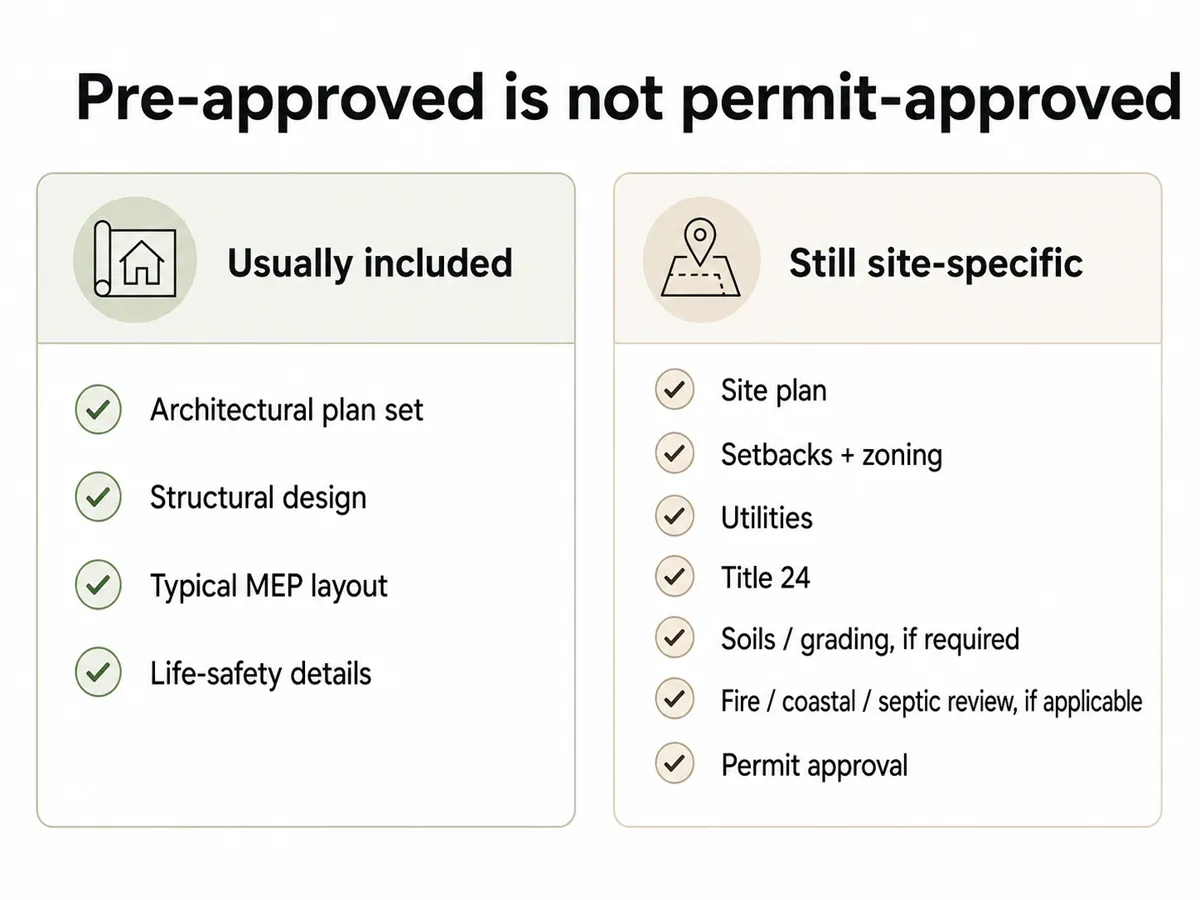
What’s covered
- Structural design, framing details, foundation type, roof structure
- Mechanical / electrical / plumbing layout (MEP plans)
- Insulation and energy specs as drawn
- Life-safety provisions (egress windows, smoke alarms)
- Architectural plans, elevations, sections
What’s not covered
- Site plan (where the ADU goes on your lot)
- Setback compliance (depends on your zoning)
- Utility connection to your home’s existing systems
- Soils and grading, drainage
- Defensible-space landscaping in fire zones
- Septic clearance if you’re on septic
- Coastal review if in the Coastal Overlay Zone
- Project-specific Title 24 energy calculations
Two terms worth knowing throughout this guide:
- Setback:
- The minimum legal distance between your structure and your property line. State law sets a 4-foot minimum for ADU side and rear setbacks; front setbacks follow the underlying zone.
- Ministerial approval:
- A non-discretionary decision by city staff. No public hearing. No subjective design review. Either your application meets the rules or it doesn’t. AB 1332 ministerial review is the legal mechanism behind the 30-day decision clock.
How AB 1332 reshaped San Diego County ADU permitting in 2025–2026
California AB 1332 (codified at Government Code Section 65852.27) took effect January 1, 2025. It requires every California jurisdiction — including all 18 incorporated cities and the unincorporated County in San Diego County — to (a) accept pre-approval plan submissions from any qualifying applicant, (b) review submitted plans for pre-approval within 60 days, and (c) ministerially approve or deny a building permit application for a detached ADU within 30 calendar days when the application uses a qualifying pre-approved plan and the plan is current under the active California Building Code cycle.
The 30-day rule, in plain English
If your application is complete (every site-specific item filled in, fees paid, no missing forms), and your plan was pre-approved by the same jurisdiction reviewing your permit, and that pre-approval is current under the active California Building Code cycle, the local agency must approve or deny ministerially within 30 days. Discretion is removed. This is the single biggest practical change for homeowners since the original 2017–2020 wave of California ADU laws.
The detached-ADU scope matters. Garage conversions, attached ADUs, and JADUs are not covered by AB 1332’s 30-day clock the same way — those still go through standard ADU permit processing (a 60-day review for ministerial decisions, not 30).
The 60-day rule (different rule, often confused)
A separate clock applies when a designer or homeowner submits a new plan to a jurisdiction for pre-approval consideration. The local agency has 60 days to review and either pre-approve or deny that plan. This is how new private pre-approved plans get added to a city’s accepted list.
What AB 1332 does NOT do
- It does not require plans to be free. Free is a city policy choice, not a state mandate.
- It does not exempt your project from impact fees, school fees, or utility connection fees.
- It does not waive your obligation to comply with site-specific code — setbacks, height, fire zone, coastal zone, soils, drainage, etc.
- It does not make ADUs a right in zones where residential use is prohibited. Industrial-only and certain agricultural zones still cannot host an ADU.
- It does not override one city’s plans onto another city’s permitting process. Cross-acceptance is a city-by-city policy choice.
The two state laws that interact with AB 1332 most often
- AB 976 (effective January 1, 2024) made the prohibition on owner-occupancy requirements permanent for ADUs. You generally cannot be required to live on the property. JADUs are different — owner occupancy is still required if a JADU shares sanitation facilities with the primary house.
- AB 1033 — adopted in San Diego County’s unincorporated jurisdiction on March 4, 2026, when the County Board of Supervisors voted unanimously to allow separate sale of ADUs through a condominium-conversion process. Each city has its own implementation timeline; verify locally.
2026 code-cycle status — which San Diego County pre-approved ADU plans are usable right now
The 2025 California Building Code cycle took effect January 1, 2026. Plans pre-approved under the prior 2022 cycle technically require updates to remain eligible for AB 1332’s 30-day ministerial track. As of May 8, 2026, Carlsbad has pulled its public plans pending updates with availability anticipated by summer 2026. Encinitas’s official PRADU page states the plans have been updated regularly to current building-code requirements. El Cajon’s published standard-plan PDF still references the 2022 California codes — a flag to verify 2025-code availability before relying on the AB 1332 30-day track. Vista’s official page notes that updated 2025-code plans are “coming soon.” For Chula Vista and San Marcos, the firm that originally drew those public libraries (SnapADU) has publicly stated as of April 2026 that the public sets are not currently permit-ready under the new code cycle — that’s a provider statement, not a city confirmation, so verify directly with each city before submittal.
This is the single most important freshness signal on this page. Most competing guides have not made this disclosure. A pre-approved plan submitted under the wrong code cycle is no longer eligible for AB 1332’s 30-day ministerial track — it reverts to standard review timelines (60 days), and revisions may be required. In practice this can turn a “30-day permit” promise into a 90- to 120-day reality for homeowners who didn’t ask the right question at submittal.
| Program | Code-cycle status (verified May 8, 2026) | What this means for you today |
|---|---|---|
| County of San Diego Standard Plans (A–F) | Active library; County PDS does not currently flag a 2025 CBC update notice on the plan page | Usable; confirm with County PDS at submittal |
| City of San Diego (accepts external) | Accepts current County, Chula Vista, and Encinitas plans | Status passes through from the source library |
| Chula Vista City Standard | Plans posted; SnapADU stated April 2026 the public library is not permit-ready under 2025 CBC — this is a provider statement, not a city confirmation | Verify the specific plan's status with City of Chula Vista before submittal; license an updated set if needed |
| Encinitas PRADU | Active library; the City states plans have been updated regularly to current building-code requirements | Usable; confirm specific plan's 2025-CBC status at submittal |
| Carlsbad Permit Ready | Pulled, awaiting summer 2026 release for 2025 California Building Code update | Use a third-party plan or wait |
| San Marcos PRADU | Plans posted; SnapADU stated April 2026 the public library is not permit-ready under 2025 CBC — provider statement, not a city confirmation | Verify with City of San Marcos before submittal |
| Escondido PAADU | Active library posted | Confirm specific plan's 2025-CBC status at submittal |
| El Cajon Standard Plans | Active library posted; published standard-plan PDF references 2022 California codes | Verify whether updated 2025-code plans are available before relying on the AB 1332 30-day track |
| La Mesa PADU | Active library; five plan sets posted | Confirm specific plan's 2025-CBC status at submittal |
| Imperial Beach Pre-Approved | Active 600 sq ft plan posted | Confirm specific plan's 2025-CBC status at submittal |
| Solana Beach PADU | Active library posted | Confirm specific plan's 2025-CBC status at submittal |
| Vista | Active 10-plan library; plans updated to 2025 Building Codes 'coming soon' per City | Confirm plan version with City of Vista before submittal |
| Del Mar | Sample floor plans only, not permit-ready | Use as inspiration; not a permit shortcut |
| Oceanside, Poway, Lemon Grove | AB 1332 process posted; no preapproved plans approved for use yet | License a third-party plan |
| Coronado | In development per 2025 fact sheet | Library not yet active |
| Santee | Accepts County, Chula Vista, Encinitas plans; status passes through | Same caveat as the source library |
| National City | No active program verified as of May 2026 | Use third-party plans or custom |
How to confirm a plan’s status before you commit
- Check the city’s program webpage for a “updated for 2025 CBC” or equivalent notice.
- If absent, email the city’s planner directly with the plan number and ask in writing.
- Request that the city’s response be included as an attachment to your permit submittal.
- If you’re licensing from a third-party designer, require an explicit statement in your license agreement that the plan is current under the active CBC cycle.
Want this as a printable checklist?
Get the Free San Diego ADU Plan Code-Cycle Verification Checklist →The same questions we use, organized as a one-page submittal cover sheet. Part of the free ADU Starter Kit.
Which San Diego County pre-approved ADU plans are available in each city? (the verified matrix)
As of May 8, 2026, ten San Diego County jurisdictions publish active in-house pre-approved ADU plan libraries: the unincorporated County (Plans A–F) and the cities of Chula Vista, El Cajon, Encinitas, Escondido, Imperial Beach, La Mesa, San Marcos, Solana Beach, and Vista. Two jurisdictions accept external plans without publishing their own libraries: the City of San Diego and Santee (both accept County, Chula Vista, and Encinitas). One city publishes sample plans only (Del Mar). One library is temporarily unavailable (Carlsbad). Three cities have an AB 1332 process posted but no plans approved yet (Oceanside, Poway, Lemon Grove). One is in development (Coronado). One has no active program verified (National City).
The San Diego County Pre-Approved ADU Plan Status Matrix
| Jurisdiction | Program | Plan inventory | Plan rights / cost | Streamlined review | 2025 CBC status | Cross-accepted by | Source |
|---|---|---|---|---|---|---|---|
| Unincorporated San Diego County | Standard / Dwelling Unit Plans (Plans A–F) | 6 ADU plans: 600 sq ft (F), 800 sq ft (E), 1,000 sq ft (D), 1,200 sq ft (A, B, C) | Free download (PDF + AutoCAD); no designer contract required | 30 days under AB 1332 for detached ADU | Active library; confirm with County PDS at submittal | City of San Diego, Santee | sandiegocounty.gov — adu_plans.html |
| City of San Diego | Accepts external plans only; master-plan submittals via Information Bulletin 114a | None in-house; accepts County, Chula Vista, Encinitas | Per source provider; applicants must contact the source provider for license cost | 30 days for complete applications using accepted preapproved plans | Status passes through from source | — | sandiego.gov — ADU/JADU page |
| Chula Vista | City Standard ADU Plan | 6 plans: 498, 748, 749, 749, 999, 1,199 sq ft (drawn by SnapADU) | Plans posted; homeowner must contract with the designer responsible for the plan set | 14 business days vs. 21 standard; ~$1,000 less in plan-review fees | ⚠ Provider (SnapADU) statement: public library not permit-ready under 2025 CBC; verify with City | City of San Diego, Santee | chulavistaca.gov — ADU page |
| Encinitas | Permit-Ready ADU (PRADU) | 8 sets — studio, 1-BR, 2-BR, 3-BR by Design Path Studio + DZN Partners | Free download; license through the original designer for use | 30 days under AB 1332 for detached ADU | Active; City states plans have been updated regularly to current building-code requirements | City of San Diego, Santee | encinitasca.gov — ADU page |
| Carlsbad | ADU Permit Ready Program | 4 floor plans × 3 architectural styles (single-story detached) | Free when active | 30 days under AB 1332 (when reactivated) | ⚠ Pulled, awaiting summer 2026 release for 2025 CBC update | — | carlsbadca.gov — ADU Permit Ready page |
| San Marcos | Permit-Ready ADU (PRADU) | Multiple single-story detached plans (drawn by SnapADU) | Free posted; designer-contract questions should go to the City | 30 days under AB 1332 for detached ADU | ⚠ Provider (SnapADU) statement: public library not permit-ready under 2025 CBC; verify with City | — | sanmarcosca.gov — PRADU page |
| Escondido | Pre-Approved ADU (PAADU) | 4 detached plans: 484, 644, 851, 1,000 sq ft | Free download | 30 days under AB 1332 for detached ADU | Active library posted | — | escondido.gov — PAADU page |
| El Cajon | Standard Plans + ADU Loan Program | Studio, 1-BR, 2-BR options including a 560 sq ft example | Free download; pairs with City ADU loan | 30 days under AB 1332 for detached ADU | ⚠ Published standard-plan PDF references 2022 California codes — verify 2025-code availability | — | elcajon.gov — ADU Loan and Standard Plans |
| La Mesa | Preapproved ADU (PADU) | 5 plan sets: 224 sq ft (studio), 400 sq ft (1-BR), 499 sq ft (1-BR), 990 sq ft (2-BR), 1,199 sq ft (3-BR) | Free; email Planning for the official construction permitting set | 30 days under AB 1332 for detached ADU | Active library posted | — | cityoflamesa.gov — ADU page |
| Imperial Beach | Pre-Approved ADU Plans | 600 sq ft city plan + checklist | Free | 30 days under AB 1332 for detached ADU | Active library posted | — | imperialbeachca.gov — Pre-Approved ADU Plans |
| Solana Beach | Preapproved ADU (PADU) | Detached ADU plans up to 800 sq ft, 16 ft height | Free | ~15 days per review cycle for complete and accurate plans | Active library posted | — | cityofsolanabeach.org — Planning Permits |
| Vista | Pre-Approved ADU Plans | 10 plan options | Plan-check fees waived when these plans are used; permit/inspection fees still apply | 30 days under AB 1332 for detached ADU | ⚠ Active; plans updated to 2025 Building Codes 'coming soon' per City | — | vista.gov — ADU page |
| Del Mar | ADU Sample Floor Plans (3D models) | 3 sample plans, 446–955 sq ft | Free | Standard review (sample plans only — not permit-ready) | Not applicable; sample only | — | delmar.ca.us — ADU Sample Floor Plans |
| Santee | No in-house library; accepts external | County, Chula Vista, Encinitas | Per source | 30 days under AB 1332 with complete app | Pass-through; fee waiver ended Sept 27, 2024 | — | cityofsanteeca.gov — Housing Streamlining |
| Oceanside | Pre-Approved ADU Program (process active, no library posted) | None published as of May 2026 | n/a | 30 days planned for future complete applications | n/a | — | ci.oceanside.ca.us — Pre-Approved ADU Program |
| Poway | Preapproved ADU Policy effective March 4, 2025; no submitted plans listed | None published as of May 2026 | n/a | 30 days planned for future complete applications | n/a | — | poway.org — PreApproved ADU Policy |
| Lemon Grove | AB 1332 preapproval process posted | No preapproved ADU plans approved for use to date | n/a | n/a until plans approved | n/a | — | lemongrove.ca.gov — ADU page |
| Coronado | In development per 2025 Housing Element fact sheet | n/a | n/a | n/a | n/a | — | coronado.ca.us — Housing Element fact sheet |
| National City | No active pre-approved plan library verified as of May 2026 | n/a | n/a | n/a | n/a | — | nationalcityca.gov — ADU page |
Reading the matrix. The “30 days under AB 1332” column applies only when (1) you submit a complete application, (2) the application is for a detached ADU, and (3) the plan is current under the active California Building Code cycle. If any condition is missing, the application reverts to standard review. The cross-acceptance column is short on purpose — only the City of San Diego has formalized acceptance of three external plan sources, and Santee accepts the same three. No other San Diego County city has formally cross-accepted another’s library in writing as of May 2026.
Decision resolution point
Run the San Diego ADU Plan Picker
Find the plan path that matches your address →We map your parcel, identify the jurisdiction, surface the program that applies, and flag the 2026 code-cycle gotchas before you spend a dollar on plans.
The County of San Diego’s six Standard ADU Plans (Plans A–F)
The County of San Diego Planning & Development Services publishes six free Standard ADU plan sets at sandiegocounty.gov, designated Plan A through Plan F, sized 600 to 1,200 square feet across 1- to 3-bedroom layouts. Each plan is offered as a 36″×24″ PDF, an 11″×17″ PDF, and an editable AutoCAD .dwg file. The County describes the plans as approximately 85% complete; the homeowner or design professional must add project-specific information per Form PDS 607 (the Dwelling Unit Checklist) before submittal. Two additional plans — Plan G (1,728 sq ft) and Plan H (1,500 sq ft) — are listed for single-family-dwelling (SFD) use only and cannot be used as ADUs.
The County plan set, by the numbers
| County plan | File ref. | Sq ft | BR | BA | Best fit |
|---|---|---|---|---|---|
| Plan A | PDS670 | 1,200 | 3 | 1 | Larger family ADU; multigenerational use; rental with three sleeping rooms |
| Plan B | PDS673 | 1,200 | 2 | 1 | Standard 2-bed rental; cost-efficient mid-size build |
| Plan C | PDS675 | 1,200 | 2 | 2 | Roommate flexibility |
| Plan D | PDS674 | 1,000 | 1 | 1.5 | Larger 1-bed with extra half bath for guests |
| Plan E | PDS672 | 800 | 1 | 1 | Compact 1-bed; above the 750 sq ft impact-fee threshold |
| Plan F | PDS671 | 600 | 1 | 1 | Smallest detached unit; tight lot fit; below the 750 sq ft impact-fee threshold |
Plan A through Plan F: the trade-offs worth flagging
- Plan F (600 sq ft) is below the typical 750-sq-ft threshold that some San Diego County cities use to exempt ADUs from local development impact fees. Verify the threshold with your specific city — and note that school fees are separate from city development impact fees and are calculated by the local school district independently.
- Plan E (800 sq ft) is above the 750-sq-ft DIF threshold in cities that use it, so don’t assume Plan E enjoys the same fee treatment as Plan F.
- Plan A (1,200 sq ft, 3 BR / 1 BA) has the most rental upside but only one bathroom, which can limit effective rental rate per bedroom in markets where renters value en-suites.
- Plan D (1,000 sq ft, 1 BR / 1.5 BA) is expensive per usable bedroom and doesn’t have a clear best-fit for most use cases.
- All six plans are detached. The County does not publish a pre-approved attached ADU plan or a JADU plan. If you’re converting a garage or repurposing internal space, you’ll need custom drawings.
What you still pay even with a free County plan
| Item | Typical cost (verified May 2026) | Source |
|---|---|---|
| Site plan + drafting on your specific lot | $1,500 – $4,000 | Local drafter quote ranges; verify with your designer |
| Soils report (if required for size, slope, or pad conditions) | $1,500 – $3,500 | Local geotechnical engineer quote ranges; some cities waive for one-story ADUs on natural-grade sites |
| Title 24 / energy calculations | $400 – $1,200 | Local energy consultant quote ranges |
| Plan-check fee | Per County PDS schedule | County PDS fee schedule; trial fee waiver expired Jan 9, 2024 |
| Building permit fee | Per County PDS schedule | County PDS fee schedule |
| Fire / DEH (Department of Environmental Health) review | Varies | Required for septic and fire-zone parcels |
| Septic plan check / permit (if on septic) | Varies | County DEH fee schedule |
| Construction (turn-key) | $300 – $500+ per sq ft typical for unincorporated County | Indicative range from local San Diego County builder pricing |
The “free plan” saves you the architect’s design fee — typically $8,000 to $16,000 according to the City of Encinitas (at the launch of its PRADU program in 2019, citing $8,000–$14,000 in design-fee savings) and Carlsbad’s Housing Element Program 1.2 documentation ($8,000–$16,000 in private architectural design fees). It does not save you the rest. For a deeper cost breakdown, see our How Much Does an ADU Cost? guide.
See What You Can Build at Your Address
Get Your Free San Diego County ADU Report →If you’re in unincorporated County, we’ll route you to Plans A–F. If you’re inside city limits, we’ll route you to your city’s program (or flag the ones that aren’t currently usable under the 2025 CBC cycle).
Which San Diego cities accept which pre-approved plans (the cross-acceptance map)
Cross-acceptance of pre-approved plan libraries between San Diego County jurisdictions is the exception, not the rule. Only two jurisdictions have formally published lists of external plan sources they accept under AB 1332: the City of San Diego accepts the County of San Diego, Chula Vista, and Encinitas plan sets, and Santee accepts the same three. Every other city expects you to use either its own program or a third-party plan that has been individually pre-approved through that city’s master-plan process. Living in San Marcos does not let you use Encinitas plans as if you lived in Encinitas — even though both are in San Diego County and both follow the same state law.
The City of San Diego specifically — what it accepts and what it requires
Under AB 1332, applicants in the City of San Diego may apply for a permit using preapproved plans from one of three accepted sources:
- County of San Diego Standard ADU Plans (Plans A–F)
- City of Chula Vista Standard ADU Plans
- City of Encinitas Permit-Ready ADU Plans
Applications using these accepted plans receive a 30-day permit review when the application is complete. Applicants must comply with the San Diego Municipal Code (the City’s zoning, fire, coastal, and design rules still apply), and applicants must contact the source provider directly to find the cost to license the plan.
What the City of San Diego does not accept as of May 2026: pre-approved plan sets from Carlsbad, San Marcos, Escondido, El Cajon, La Mesa, Solana Beach, Vista, Imperial Beach, Del Mar, or any other San Diego County jurisdiction. If you live in the City of San Diego, your three accepted-plan options are the County, Chula Vista, and Encinitas sets — full stop.
What Santee accepts (and the September 2024 catch)
Santee’s Housing Streamlining page lists the same three external sources — County, Chula Vista, Encinitas — as accepted pre-approved plans. The trap: Santee’s ADU fee waiver program ended September 27, 2024. If you started a Santee project before that date and didn’t pull permits in time, you’re now on the standard fee schedule.
How much you actually save (and how the math works)
The honest, source-verified savings from a pre-approved ADU plan in San Diego County is roughly $8,000 to $16,000 in private architectural design fees plus four to eight weeks of design time. That figure is published by the City of Encinitas at the launch of its PRADU program in 2019 (“$8,000 to $14,000 in design fees” plus three to six months saved) and by Carlsbad’s Housing Element Program 1.2 (“$8,000 to $16,000 in private architectural design fees”). On a total ADU project that typically costs $250,000 to $550,000 in San Diego County, that’s a meaningful savings — but it is not the construction-cost windfall some marketing copy implies.
What pre-approved plans actually save you
| Item | Typical without pre-approved | With pre-approved | Savings |
|---|---|---|---|
| Architectural design fees | $8,000 – $16,000 | $0 (free plan) – ~$2,000 (license fee for some third-party plans) | $6,000 – $16,000 |
| Initial design timeline | 4 – 10 weeks | 0 – 2 weeks | 4 – 8 weeks |
| Plan-check first-cycle review (Chula Vista example) | 21 business days | 14 business days | ~7 business days |
| Plan-review fee differential (Chula Vista example) | Full schedule | ~$1,000 less | ~$1,000 |
| Solana Beach review per cycle (PADU example) | Standard review | ~15 days per cycle | Faster cycles |
| Vista plan-check fee | Per fee schedule | Waived when using City pre-approved plans | Plan-check savings |
What pre-approved plans do NOT save you
| Item | Typical cost in San Diego County (verified May 2026) | Savings from pre-approved |
|---|---|---|
| Site plan + drafting on your specific lot | $1,500 – $4,000 | None |
| Soils / geotechnical report (if required) | $1,500 – $3,500 | None |
| Title 24 / energy calculations | $400 – $1,200 | None |
| Plan-check fee balance | $2,000 – $4,000+ | Modest in some cities (Chula Vista, Vista); none in others |
| Building permit issuance fees | $2,000 – $4,000+ | None |
| Impact fees / school fees (city- and district-specific) | $4,000 – $15,000+ | None directly |
| Utility connection (water meter, sewer tie-in, electrical service upgrade) | $5,000 – $25,000+ | None |
| Construction (turn-key) | $250 – $600+ per sq ft | None |
Why the “$50,000 savings” headlines are misleading
Some marketing claims combine three things into one inflated number: design-fee savings (real, $8K–$16K), hypothetical fee waivers (jurisdiction-specific, time-limited, and many have expired — the County’s waiver ended January 9, 2024 and Santee’s ended September 27, 2024), and assumed construction-method savings from “value-engineered” pre-approved plans (a builder-marketing claim, not a verified line-item). The conservative, source-verified figure published by the cities themselves is $8K–$16K in design fees. Anything beyond that should be checked against a specific source you can read.
The honest version
Pre-approved plans don’t save you six months and they don’t save you $50,000. They save you four to eight weeks of design work and roughly $8,000 to $16,000 in private architectural fees — which still matters, but only if the plan actually fits your lot and is current under the 2025 California Building Code cycle. If those two conditions hold, take the savings. If they don’t, you’re better off licensing a current third-party plan or commissioning custom drawings than forcing a free plan onto a lot it doesn’t suit.
See What You Can Build at Your Address
Get Your Free San Diego County ADU Report →Confirm the plan fits, the code cycle is right, and the program applies to your address — before you spend a dollar on plans or reports.
What’s still required before a pre-approved ADU plan can be permitted
Pre-approved plans are about 85% complete in most San Diego County programs. You — or your design professional — still have to provide a site plan tied to your specific parcel, project-specific Title 24 energy compliance documents, utility connection plans, drainage and grading information, soils or geotechnical reports where triggered, fire-zone clearances, coastal review if applicable, septic clearance from County DEH if on septic, and any HOA or covenant compliance documentation. Submitting an “85% complete” plan as 100% complete is the most common reason AB 1332’s 30-day clock never starts.
The site-specific checklist every pre-approved plan submittal needs
| Required item | Why it matters | Typical cost or time (verified May 2026) |
|---|---|---|
| Confirmed jurisdiction (city vs. unincorporated County) | Determines which agency reviews and which rules apply | Free; check with parcel APN lookup |
| Site plan tied to your property | Shows ADU placement, setbacks, easements, existing structures, utility paths | $1,500 – $4,000 from a drafter |
| Project-specific Title 24 energy compliance | Required for energy code; cannot use generic plan numbers | $400 – $1,200 |
| Utility plan (water, sewer/septic, gas, electric, solar) | Shows how the ADU connects to existing services and whether service-panel upgrades are needed | Often included in site plan; $2,000 – $10,000+ for actual hookups |
| Soils / geotechnical report | Required for many projects over 500 sq ft, especially on slopes, fill, or coastal sites | $1,500 – $3,500 (waivable in some cities for one-story ADUs on natural-grade sites) |
| Grading and drainage plan | Required if the site requires earthwork or has stormwater concerns | Often included in site plan; can require separate engineering |
| Fire-zone clearance (Very High Fire Hazard Severity Zone) | Triggers 4-foot side/rear setbacks in the City of San Diego; other cities and the County have their own VHFHSZ provisions | Verified through fire-zone overlay map |
| Coastal review (if Coastal Overlay Zone) | May trigger a Coastal Development Permit and 6-month timelines | City-specific |
| Septic plan check (County DEH) | Required for unincorporated County parcels on septic | County DEH fees; can add weeks |
| HOA / CC&R review | State law (AB 670, AB 3182) limits HOA ADU restrictions, but design-related CC&R clauses can still apply | Time only; read your CC&Rs |
| Plan-check fee + building permit issuance fee | Per jurisdiction's fee schedule | Varies; see permit fees table below |
| Impact fees / school fees | Often waived under 750 sq ft for city development impact fees; school fees calculated by the school district independently | Varies |
The owner-occupancy rule (and the JADU exception)
State law AB 976, which took permanent effect January 1, 2024, prohibits San Diego County jurisdictions from requiring you to live on the property as a condition of permitting your ADU. You can rent both the primary residence and the ADU. Junior ADUs (JADUs) — a unit no more than 500 sq ft, contained entirely within the primary single-family residence — are different. If a JADU shares sanitation facilities with the main house, owner occupancy is still required.
Short-term rental restrictions (verified cities only)
- City of San Diego prohibits ADU and JADU rentals for terms shorter than 31 consecutive days.
- City of Vista requires ADU/JADU rental terms to be no less than 30 consecutive days; short-term rentals are not permitted in ADUs/JADUs.
- City of Santee states ADUs and JADUs are intended for permanent housing and not short-term rentals.
Other San Diego County cities have their own rules; verify each city individually before underwriting any short-term-rental income.
When pre-approved plans make sense (and when they don’t)
Pre-approved plans are a strong fit when (a) your lot is flat, regular-shaped, and outside the Coastal Overlay, Very High Fire Hazard Severity, or septic-required zones; (b) you do not need design changes; (c) your jurisdiction’s program is currently 2025-CBC-compliant; and (d) you accept a “good enough” floor plan instead of a custom one. They are a poor fit when you have site complications (slope, septic, coastal, fire), need any non-trivial modifications, or live in a jurisdiction whose program is currently being updated to the 2025 code.
The decision matrix
| Your situation | Recommended path |
|---|---|
| Unincorporated San Diego County, flat lot, no septic complications | County Plans A–F (free), confirm 2025 CBC status with County PDS |
| City of San Diego, flat residential lot, no coastal overlay | County / Chula Vista / Encinitas accepted plan; verify each source's current code status before licensing |
| Encinitas, simple lot, design works for you | PRADU plan, free download, City states plans are updated regularly to current building-code requirements |
| Encinitas, Coastal Overlay, complex lot | Custom plans + Coastal Development Permit |
| Carlsbad, any lot | Wait until summer 2026 for updated plans, OR license a current third-party plan now |
| Chula Vista or San Marcos, simple lot | Verify plan's 2025-CBC status with the City; license updated set if needed |
| Escondido, El Cajon, La Mesa, Imperial Beach, Solana Beach, Vista | Use the city's program; verify code-cycle status at submittal |
| Santee — flat lot, simple project | Use County, Chula Vista, or Encinitas plan; confirm Santee's site-specific overlay; note fee waiver ended Sept 27, 2024 |
| Oceanside, Poway, Lemon Grove, Coronado | No active plans yet — license a third-party plan or commission custom |
| National City | No verified program — license a third-party plan or commission custom |
| Any city, complex lot or modifications needed | Custom plans (the AB 1332 30-day track will not apply anyway) |
The modification trap
The moment you change a load-bearing wall, move a window beyond what the plan permits, or alter the structural envelope, the plan loses its pre-approval status — meaning you also lose the AB 1332 30-day ministerial track. A drafter typically charges $2,000 to $4,000 to redraw, and you’ll be on standard review timelines for the modified plan. Encinitas and Solana Beach explicitly warn applicants about this on their program pages.
Pre-approved vs. custom vs. design-build vs. prefab
| Your priority | Best path | Why |
|---|---|---|
| Lowest design starting cost | County or city pre-approved plan | Free or low-cost base plans reduce design friction |
| Fastest plan-check first-cycle review | City-accepted pre-approved plan | Some jurisdictions publish shortened review targets (Chula Vista 14 business days; Solana Beach ~15 per cycle) |
| Maximum design control | Custom architect or designer | Better for unusual lots, second stories, view corridors, or layout optimization |
| One accountable team for design, permits, and construction | Design-build firm | Fewer handoffs between designer, engineer, permit runner, and general contractor |
| Productized factory build | Prefab / modular ADU | Better for buyers comparing standard models and factory delivery |
| Don't know feasibility yet | Address-level feasibility check first | Avoid choosing a plan before confirming jurisdiction and constraints |
Want a San Diego ADU specialist to sanity-check your plan path? SnapADU originally drew the City of Chula Vista Standard ADU Plans and the City of San Marcos PRADU plans through competitive city bid processes, and they serve all of greater San Diego — San Diego, Oceanside, Carlsbad, Encinitas, Del Mar, Solana Beach, Poway, San Marcos, Escondido, La Mesa, El Cajon, Vista, Chula Vista, Rancho Santa Fe, Santee, Lemon Grove, Imperial Beach, National City, Bonsall, Cardiff By The Sea, La Costa, and unincorporated San Diego County.
Disqualify yourself from this CTA if you live outside San Diego County, want a JADU-only or pure-garage-conversion project, or need a ground-up custom architectural design rather than a design-build path.
Compare your lot with SnapADU →From plan download to certificate of occupancy: the 9-step path
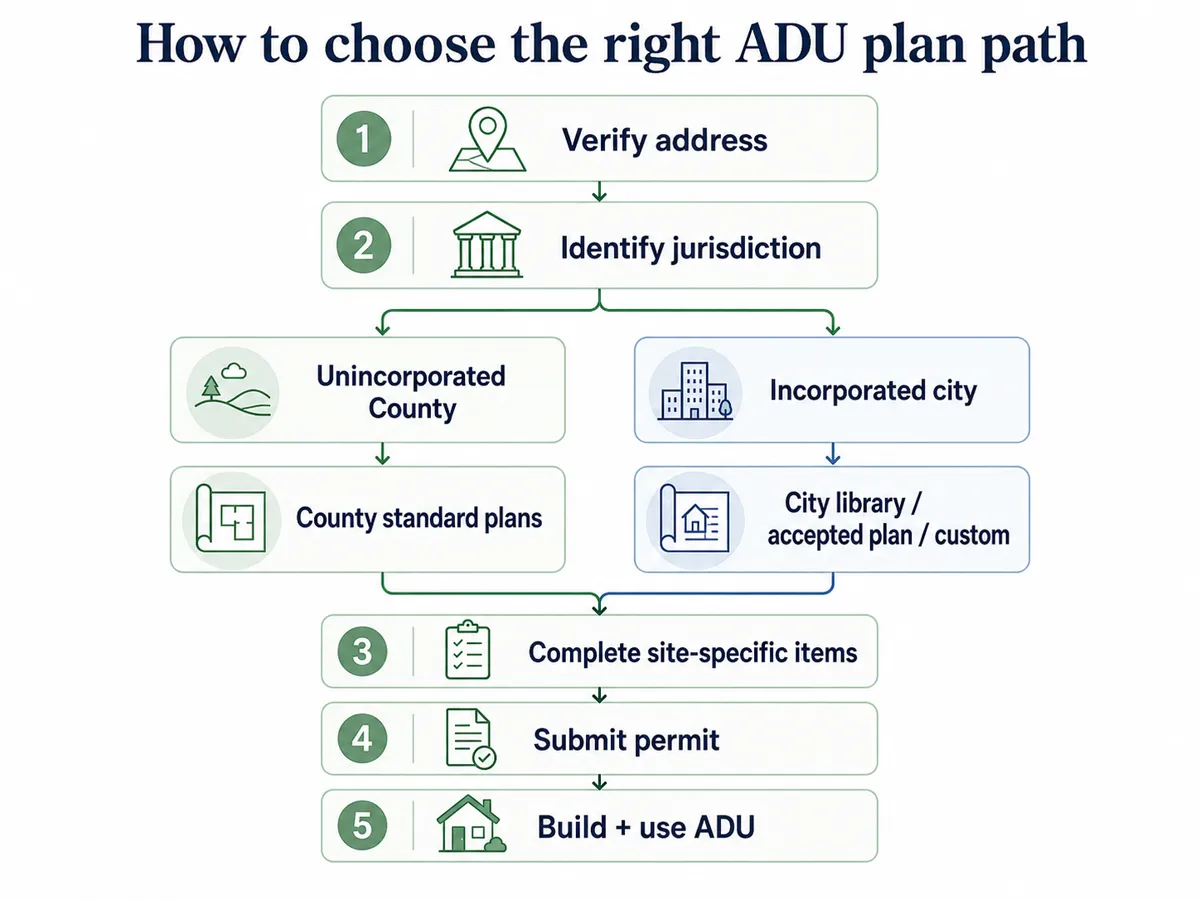
Once you’ve selected a pre-approved plan, the path from download to certificate of occupancy in San Diego County in 2026 typically takes 8 to 14 months and follows nine stages.
- 1
Verify your jurisdiction (1 day)
Look up your APN through the San Diego County Assessor's parcel viewer. 'San Diego County' is not a single permitting authority. If your address is inside any of the 18 incorporated cities, you go through that city's building department. If it isn't, you go through County PDS.
- 2
Verify the plan's code-cycle status (1–3 days)
Check the program webpage; if no 2025 CBC update notice is posted, email the city's planner and request written confirmation. This step is the single biggest predictor of whether you'll actually get a 30-day decision. Encinitas's PRADU page states its plans have been updated regularly; Vista notes plans updated to 2025 codes are coming soon; Carlsbad's plans are pulled until summer 2026; El Cajon's published standard-plan PDF still references 2022 codes; for Chula Vista and San Marcos, SnapADU's April 2026 statement (a provider statement, not a city confirmation) flags the public sets as not currently permit-ready.
- 3
Confirm zoning eligibility (1–7 days)
Use the city's zoning portal. The City of San Diego's ZAPP tool and most North County cities have similar interfaces. Confirm your zone allows residential use, that you don't have an unusual easement, and that your lot can physically accommodate the plan's footprint with required setbacks.
- 4
Commission a site plan (2–4 weeks)
This is where most homeowners hire a drafter. The site plan shows the ADU placement, setbacks, easements, existing structures, utility paths, and any required grading or landscaping. Budget $1,500 to $4,000.
- 5
Order required reports (2–6 weeks (parallel with Step 4))
Soils report ($1,500–$3,500) for projects over 500 sq ft on slopes or fill (waivable in some cities for one-story ADUs on natural grade). Septic plan check via County DEH for unincorporated parcels on septic. Fire-zone clearance if in a Very High Fire Hazard Severity Zone. Coastal review if in the Coastal Overlay Zone.
- 6
Prepare Title 24 (1–2 weeks)
Project-specific energy compliance documents tied to your actual orientation, glazing, and equipment. Generic Title 24 numbers from the plan itself won't pass. Budget $400 to $1,200.
- 7
Submit a complete permit package (1 day)
Online portal submittals are now standard in most San Diego County jurisdictions (Chula Vista went digital-only December 13, 2024; Encinitas is fully on its CSS portal). The day you submit a complete application is the day the AB 1332 clock starts.
- 8
Receive the 30-day ministerial decision (30 days)
If your plan is current and your application is complete and the project is for a detached ADU, the city must approve or deny within 30 calendar days. A 14-business-day path is published in Chula Vista for City Standard plan applications; Solana Beach publishes ~15 days per review cycle for PADU submissions.
- 9
Build, inspect, occupy (5–9 months for the build)
Construction itself takes longer than the permit. Expect a typical detached ADU build in San Diego County to take 5 to 9 months from groundbreaking, with progress inspections at foundation, framing, rough MEP, drywall, and final stages. Certificate of occupancy is issued after the final inspection passes.
Total elapsed time, plan selection to occupancy: 8–14 months for most projects. Faster on the simplest unincorporated lots; slower for coastal, sloped, septic, or HOA-restricted parcels.
Permit fees by city (FY 2024–25 baseline)
| City | ADU permit fees (typical range) | Source |
|---|---|---|
| Carlsbad | $2,000 – $4,000 (size-dependent) | Carlsbad Master Fee Schedule FY 2024-25 |
| Encinitas | $2 – $4 per sq ft | Encinitas Building Division |
| Chula Vista | Standard plan applications: ~$1,000 less than full submittal | chulavistaca.gov Fee Bulletin 10-400 |
| City of San Diego | Per Information Bulletin 501 | sandiego.gov Information Bulletin 501 |
| County of San Diego (unincorporated) | Plan check + permit at standard schedule; trial waiver expired Jan 9, 2024 | sandiegocounty.gov ADU Information page |
| Vista | Plan-check fees waived when using City pre-approved plans; permit/inspection fees still apply | vista.gov ADU page |
| Other cities | See each city's Master Fee Schedule | Individual city pages |
Disclaimer: Fees change annually (typically July 1) and are project-size-dependent. The figures above are typical ranges, not guarantees. Confirm with your jurisdiction’s current fee schedule before budgeting.
Edge cases — coastal, fire zone, septic, HOA, and separate sale
Five situations most often disqualify a pre-approved ADU plan or change the timeline materially: lots in the Coastal Overlay Zone, lots in Very High Fire Hazard Severity Zones, lots requiring septic systems, HOA-restricted parcels, and separate-sale projects under AB 1033.
Coastal Overlay Zone
The City of San Diego’s Coastal Overlay Zone has its own ADU rules per Housing Action Package 1.0, which the California Coastal Commission certified on September 12, 2024. Encinitas’s coastal areas often do not require extensive coastal permits for ADUs, but each lot must be checked individually. Carlsbad, Del Mar, Solana Beach, Imperial Beach, and parts of Oceanside also have coastal jurisdictions to navigate. If your parcel is in any coastal zone, expect to add 30–180 days to the timeline and potentially a Coastal Development Permit on top of the building permit.
Very High Fire Hazard Severity Zone
The City of San Diego requires ADUs in Very High Fire Hazard Severity Zones to observe a minimum 4-foot side and rear setback regardless of structure height (per City of San Diego Municipal Code §141.0302). Other San Diego County cities and the unincorporated County have their own VHFHSZ provisions, which can include defensible-space landscaping requirements, automatic fire sprinkler systems if the primary residence is sprinklered, and Wildland-Urban Interface (WUI) building-material standards. Verify your specific city’s VHFHSZ rules before assuming the City of San Diego provisions apply elsewhere.
Septic systems (mostly unincorporated County)
Department of Environmental Health septic plan check and permit are typically required when the ADU is on septic. Septic capacity is one of the most common dealbreakers for unincorporated County ADU projects — if your existing system can’t handle the additional load, you’re either upgrading the system (often a substantial capital expense) or you’re not building. The County’s prior fee waiver program ended January 9, 2024.
HOA / CC&R conflicts
California state laws AB 670 (2019) and AB 3182 (2020) generally prohibit HOAs from outright banning ADUs on single-family lots, but design-related CC&R clauses can still affect exterior choices, materials, and rooflines. Read your CC&Rs before committing to a pre-approved plan with a fixed exterior style. Some HOAs in San Diego County’s master-planned communities (parts of Carmel Valley, Rancho Bernardo, 4S Ranch, Carlsbad master plans) have architectural review committees that will require modifications to the County or city plan’s elevations — and modifications knock you out of the AB 1332 30-day track.
Separate sale of ADUs (AB 1033 / SB 9)
The County of San Diego adopted its AB 1033 implementation on March 4, 2026, allowing the separate sale of ADUs in unincorporated County jurisdiction through a condominium-conversion process. The City of San Diego allows ADU condominiums under SDMC §141.0302(f), with the constraint that ADUs developed under the ADU Home Density Bonus Program are not eligible for separate sale. JADUs are never eligible for separate sale. Each incorporated city has its own implementation; verify locally. SB 9 is a separate California law that splits a single-family lot into two and allows up to four units total; AB 1033 keeps the lot intact and allows the ADU to be sold as a condo. Different mechanisms, different rules.
A note on financing your pre-approved ADU project
Pre-approved plans don’t change how you finance an ADU. The five common San Diego County financing paths are:
- A HELOC (home equity line of credit) layered with construction financing and refinanced into a permanent mortgage at completion
- A single-close construction-to-permanent loan
- A cash-out refinance against current home equity
- An FHA 203(k) renovation loan
- For income-qualified City of San Diego homeowners, the San Diego Housing Commission’s ADU Finance Program — construction-to-permanent loans up to $250,000 paired with technical assistance and a seven-year affordability covenant on the rented ADU
YMYL disclaimer: Rates, loan terms, and program availability change frequently. The Dwelling Index is not a lender, broker, or financial advisor. Verify all loan terms with the lender directly before committing. Any rental-income or ROI estimates referenced anywhere on this site are illustrative examples, not guarantees of returns. Actual results depend on local market conditions, construction costs, financing terms, and regulatory approvals.
For deeper financing path coverage, see our ADU Financing: Every Option Explained guide and our HELOC for ADU page.
What we verified (methodology)
Every claim on this page is sourced to either a primary government document or a clearly identified secondary source. The all-jurisdiction matrix was assembled by reading California Government Code Section 65852.27 directly and verifying each of the 19 listed jurisdictions’ ADU pages between May 5 and May 8, 2026. The SANDAG AB 1332 Compliance Brief was used as a starting point for the AB 1332 implementation framework, not as a complete jurisdiction inventory. We update this page on a quarterly cadence and on-demand when material program changes occur.
Last verified: May 8, 2026. Next scheduled review: August 2026.
Verification protocol
- Read California Government Code Section 65852.27 directly to confirm 30-day ministerial review scope, 60-day pre-approval review scope, and the detached-ADU/current-code-cycle conditions.
- Fetched each jurisdiction’s official ADU page (sandiegocounty.gov, sandiego.gov, carlsbadca.gov, chulavistaca.gov, coronado.ca.us, delmar.ca.us, elcajon.gov, encinitasca.gov, escondido.gov, imperialbeachca.gov, cityoflamesa.gov, lemongrove.ca.gov, nationalcityca.gov, ci.oceanside.ca.us, poway.org, sanmarcosca.gov, cityofsanteeca.gov, cityofsolanabeach.org, vista.gov) and cross-checked program existence, plan inventory, plan sizes, posted fees, and code-cycle status.
- Confirmed plan inventories where the city publishes specific plan sizes (Chula Vista: 498/748/749/749/999/1,199 sq ft; Escondido PAADU: 484/644/851/1,000 sq ft; La Mesa PADU: 224/400/499/990/1,199 sq ft; Vista: 10 plan options).
- Cross-referenced cost-savings figures against the City of Encinitas’s 2019 PRADU launch documentation and Carlsbad’s Housing Element Program 1.2 documentation.
- For Chula Vista and San Marcos code-cycle status, distinguished between provider statements (SnapADU’s April 2026 statement) and city confirmations; presented both transparently and instructed readers to verify with the city directly.
- For the County of San Diego, confirmed the six Plans A–F sizes and the SFD-only status of Plans G and H from the County PDS Dwelling Unit Building Plans page.
- Confirmed AB 976 (permanent prohibition on ADU owner-occupancy requirements) and AB 1033 (separate sale of ADUs) with the County of San Diego ADU Zoning Ordinance Amendment page (March 4, 2026 ordinance adoption) and the City of San Diego ADU/JADU page.
What we didn’t do
- We didn’t quote any plan as “permit-approved” in advance — that designation belongs to your specific lot, not a generic plan.
- We didn’t cite forum posts, Facebook groups, or Reddit threads as proof for legal, code, or cost claims.
- We didn’t fabricate testimonials, expert reviewers, or third-party credentials.
- We didn’t rank lenders, builders, or design firms by payout.
- We didn’t extend any single-city rule to “most cities” without specific verification.
For our full editorial standards and corrections process, see /editorial-standards/ and /corrections/.
Frequently asked questions
Are San Diego County pre-approved ADU plans actually free?
Many official plan files are posted publicly, but usable plan rights vary. Chula Vista's program requires homeowners to contract with the designer responsible for the plan set. The City of San Diego accepts external plans but applicants must contact the source provider directly to find the cost to license the plan. The County of San Diego's Plans A–F are free to download with no designer-contract requirement. Most other city programs (Encinitas PRADU, La Mesa PADU, Solana Beach PADU, Imperial Beach, Escondido PAADU, El Cajon, Vista) post plans publicly. Even when the plan file is free, you still pay for site-specific drafting, plan-check fees, permit fees, impact fees, and construction.
How much do pre-approved ADU plans really save?
Roughly $8,000 to $16,000 in private architectural design fees and four to eight weeks of design time, per the City of Encinitas's PRADU launch announcement (2019) and Carlsbad's Housing Element Program 1.2 documentation. The plan does not reduce construction, impact, school, or utility-connection costs.
Can I use the County of San Diego's plans inside the City of San Diego?
Yes. The City of San Diego accepts the County of San Diego, City of Chula Vista, and City of Encinitas pre-approved plan sets under AB 1332. Santee accepts the same three. No other San Diego County city is on a published cross-acceptance list as of May 2026.
Does Vista have pre-approved ADU plans?
Yes. Vista has an active pre-approved ADU plan library with 10 plan options. The City waives plan-check fees when these plans are used (permit and inspection fees still apply), and the City's official ADU page notes that plans updated to 2025 California Building Codes are coming soon.
Does Lemon Grove have approved pre-approved ADU plans?
Lemon Grove has posted its AB 1332 preapproval process on its ADU page, but as of May 2026 no preapproved ADU plans have been approved for use to date. If your project is in Lemon Grove and you want to use a pre-approved plan, you'll need to either license a third-party plan or commission custom drawings.
What does '85% complete' mean?
The base architectural and structural drawings are substantially prepared, but the homeowner or design professional still must complete site-specific information — site plan, project-specific Title 24, soils, utilities, and other items per the jurisdiction's checklist — for the specific property.
Do pre-approved plans guarantee permit approval?
No. They reduce design-review friction, but your project still has to meet parcel-specific zoning, building, fire, utility, coastal, grading, and local code requirements. AB 1332's 30-day ministerial decision applies only to detached ADU applications when the application is complete and the plan is current under the active California Building Code cycle.
Can I modify a pre-approved ADU plan?
Yes, but modifications often take you out of the AB 1332 30-day track and revert the application to standard plan review. A drafter typically charges $2,000 to $4,000 to redraw, and you'll be on standard timelines for the modified plan.
How long does pre-approved plan review actually take?
It depends on jurisdiction and whether the application is complete. AB 1332 mandates 30-day ministerial approval for complete detached-ADU applications using qualifying preapproved plans. The City of San Diego specifies 30-day review for accepted external plans. Chula Vista publishes 14 business days for its City Standard plan path. Solana Beach publishes approximately 15 days per review cycle. The catch is 'complete application' — most rejected 30-day clocks fail at completeness, not at code compliance.
Are Carlsbad's pre-approved ADU plans available right now?
Not as of May 8, 2026. Carlsbad's program webpage states the permit-ready plans are being updated for the 2025 California Building Codes and are currently unavailable, with updated plans anticipated by summer 2026.
What happened to the County's ADU fee waiver?
The County of San Diego trial impact fee waiver went into effect January 9, 2019, and ended January 9, 2024. If your qualifying County project was started before that date but the permit was not issued by January 9, 2024, the standard fees apply.
What is the 2025 California Building Code cycle and why does it matter?
Effective January 1, 2026, California adopted updated building standards. Plans pre-approved under the prior 2022 cycle technically need updates to remain permit-ready under AB 1332's 30-day track. As of May 2026, Carlsbad's plans are pulled until summer 2026; El Cajon's published standard-plan PDF still references 2022 codes; for Chula Vista and San Marcos, the original designer (SnapADU) has stated the public sets are not currently permit-ready under the new code cycle, which homeowners should verify directly with each city.
What's the difference between PRADU, PAADU, PADU, and Standard ADU Plan?
Same kind of program, different city names. Encinitas and San Marcos use PRADU. Escondido uses PAADU. La Mesa and Solana Beach use PADU. The County of San Diego and Chula Vista use Standard ADU Plan or Dwelling Unit Plan. All operate under California AB 1332's framework.
Can I rent a San Diego County ADU as an Airbnb or short-term rental?
Generally no, in the verified cities. The City of San Diego prohibits ADU rentals for terms shorter than 31 days. Vista requires terms of 30 consecutive days or longer. Santee states ADUs are intended for permanent housing. Verify each other city's short-term rental ordinance before committing to a build that depends on nightly rentals.
Can I sell my ADU separately from the main house?
Sometimes. The County of San Diego adopted its AB 1033 implementation on March 4, 2026, allowing separate sale of ADUs in unincorporated County jurisdiction through a condominium-conversion process. The City of San Diego allows ADU condominiums under SDMC §141.0302(f), with restrictions for Bonus ADUs. JADUs are never eligible for separate sale. Each incorporated city has its own implementation timeline.
What if my San Diego County city doesn't have a pre-approved plan program?
You have three options: license a current-code-compliant plan from a third-party designer; commission custom plans from an architect or designer; or — if your parcel is in unincorporated County jurisdiction — use the County's free Plans A–F.
Related guides
- San Diego pre-approved ADU plans — the City-specific deep-dive (26 options compared)
- Real San Diego ADU all-in cost ranges
- How much does an ADU cost in California?
- ADU Financing: Every Option Explained
- HELOC for ADU construction
- Best ADU builders in San Diego County
- Best ADU builders in Chula Vista — City Standard plans explained
- Best ADU builders in Encinitas — PRADU program inventory
- Best ADU builders in unincorporated San Diego County — County Plans A–F
- Detached ADU floor plans — custom alternatives
- Prefab ADU as an alternative to pre-approved site-built plans
Not sure where to start?
See what’s possible at your address — get your free ADU report in 60 seconds.
See What You Can Build → Get Your Free San Diego County ADU ReportFree. No call required. We pull your jurisdiction, zone overlays, and buildable footprint.