
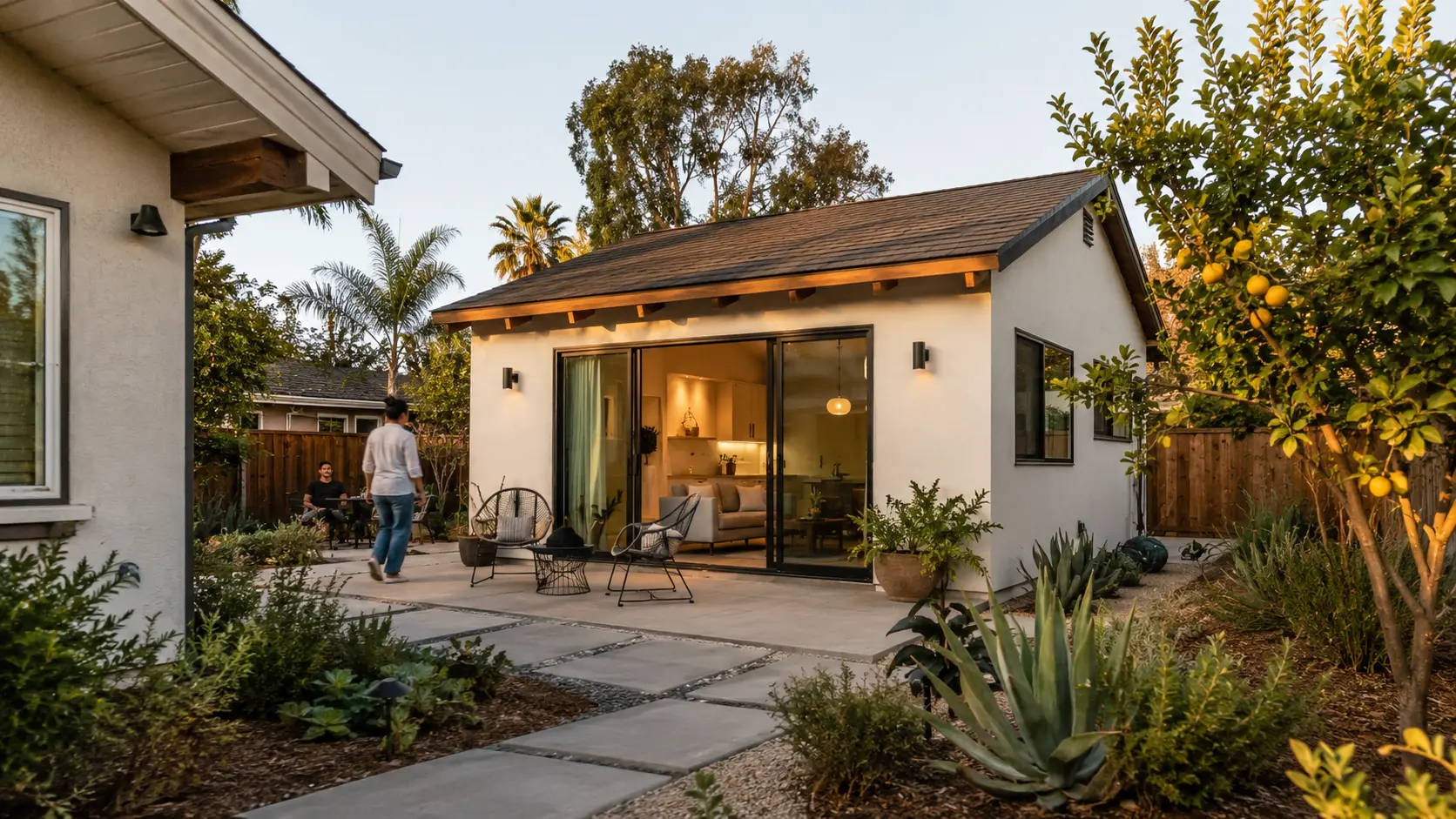
San Diego Detached ADU Cost 2026: Real Prices, City Fee Math, and What August 2025 Changed
By The Dwelling Index Editorial Team · Last updated · Last verified May 8, 2026 · Next scheduled review: July 2026 · Independent editorial — referral relationships disclosed
The bottom line
A new detached ADU in the City of San Diego costs $300,000–$500,000 all-in for a typical 750–1,200 sqft unit in 2026. Smaller 500 sqft units run $220K–$300K. The City’s Development Impact Fees do not apply to the first or second ADU on a premises under SDMC §142.0640(b)(1) — a fact most cost guides miss. What you do pay: plan check, inspection, school-district fees (for units over 500 sqft), utility connections, solar, and sitework. The August 22, 2025 Bonus Program rollback changed nothing for homeowners building one standard detached ADU.
1. What a detached ADU actually costs in San Diego in 2026
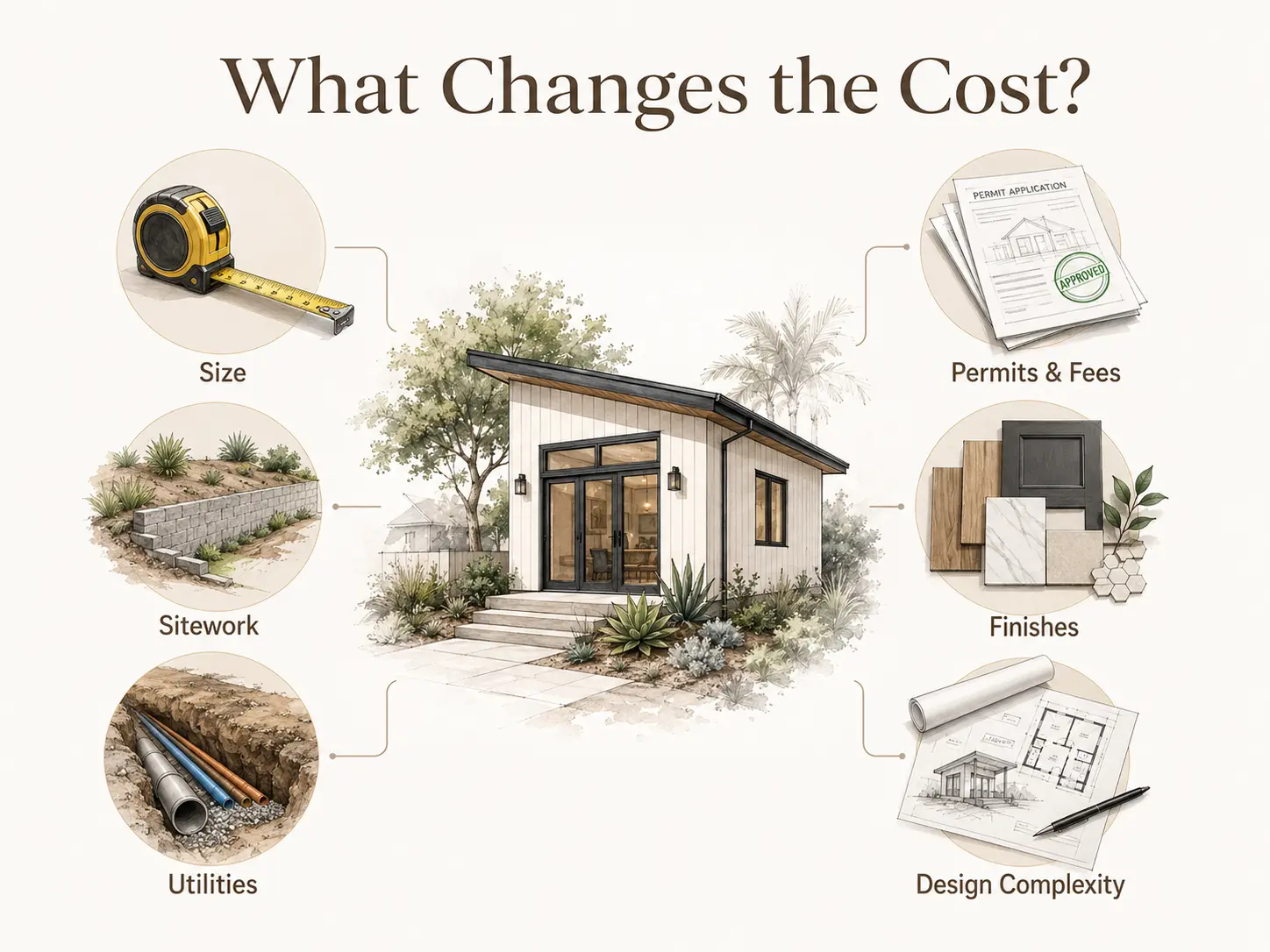
The $300K–$500K range is a reconciled planning band across five active San Diego design-build firms, not a single builder’s marketing range. The methodology for building that reconciliation is in Section 4. The reason the spread is $200K wide isn’t that the market is chaotic — it’s that the biggest variables are size, lot conditions, finish level, and neighborhood tier, not builder-to-builder price wars.
Three numbers worth anchoring before you read further:
- $425/sqft — SnapADU’s published 2026 price for a 1,000 sqft detached ADU all-in, the most transparent published data point in the San Diego market
- $0 — the Development Impact Fee for the first or second ADU on most City of San Diego premises, per SDMC §142.0640(b)(1); most competing cost guides get this wrong
- $5.17/sqft — the San Diego Unified School District developer fee rate through May 10, 2026, rising to $5.38/sqft on May 11, 2026; applies to new units over 500 sqft
Run your address before you request quotes. The report flags size, setback, fee, and overlay issues that change your real budget.
2. Quick-reference cost table by lot type
| Lot type (City of San Diego) | 750 sqft 2BR/1BA | 1,000 sqft 2BR/2BA | 1,200 sqft 3BR/2BA | Key cost drivers |
|---|---|---|---|---|
| Inland flat (baseline) | $275K–$345K | $330K–$430K | $390K–$500K | Standard sitework, no coastal or fire-zone premium |
| Coastal flat (CDP required) | $310K–$390K | $370K–$480K | $435K–$560K | Coastal Development Permit (+$5K–$15K soft cost), salt-air construction (+8–15%) |
| Hillside (retaining walls) | $335K–$430K | $390K–$505K | $450K–$580K | Retaining walls, grading, piered foundation, soils report (+$25K–$80K) |
| VHFHSZ (fire zone) | $300K–$375K | $355K–$460K | $415K–$530K | Fire-rated construction, 4-ft setbacks (+$8K–$30K) |
| Unincorporated County (septic) | $305K–$385K | $360K–$470K | $420K–$540K | County fee formula; septic upgrades where needed (+$15K–$45K) |
All-in figures include design, permits, sitework, utility connections, solar, and standard finishes. Level inland City of San Diego lot as baseline. Coastal and hillside adders are additive and can stack. Source: Dwelling Index reconciliation of May 2026 builder data.
3. What “all-in” actually includes
| Category | Typical share of total | Typical dollar range (1,000 sqft) | What it includes |
|---|---|---|---|
| Vertical construction | 70–80% | $250K–$340K | Foundation, framing, MEP rough, drywall, roofing, windows, finishes, fixtures, appliances, standard kitchen/bath |
| Sitework | 6–12% | $25K–$50K | Grading, trenching, basic utility runs to the unit, demo of existing flatwork, finish grading |
| Permits, plan check, agency fees | 4–8% | $19K–$33K | City building permit, plan check, school district fee, water/sewer capacity, addressing |
| Soft costs (design, engineering) | 3–6% | $10K–$20K | Architectural plans, structural engineering, Title 24 compliance, surveys, soils report if required |
| Utility upgrades | 3–8% | $10K–$30K | New ADU electric meter and panel, sewer lateral upgrades, water service, sometimes gas |
| Solar PV system | 2–4% | $8K–$15K | Required on new detached construction under California Energy Code, with limited exemptions |
| Contingency | ~10% | $35K–$45K | Buffer for change orders, corrections, inflation, surprises |
Source: Dwelling Index reconciliation of published cost breakdowns from SnapADU, BNC Builders, Subworkit, Better Place Design & Build, and Streamline Design & Permitting; verified May 2026.
The City of San Diego ADU bulletin (Information Bulletin 400) lists typical permit submittal requirements: site plan, floor and roof plans, elevations and sections, structural plans, structural calculations, truss calculations, Title 24 documentation, and several required forms. If your “design” line item from a builder is $2,500, ask which of those documents are included and which are billed separately.
The solar requirement is real but often misunderstood. New detached ADUs are subject to California Energy Code solar requirements, but the panels can be installed on the ADU or on the primary dwelling — which often makes compliance cheaper for properties with a south-facing main house roof. Smaller ADUs and ADUs in certain climate zones have additional exemptions.
The contingency line is the one homeowners are most tempted to delete to “make the budget work.” Don’t. The completion data in Section 14 is sobering about what happens to projects without one.
4. Detached ADU cost by size: 500, 750, 1,000, and 1,200 sqft
The Dwelling Index Reconciled Cost Matrix (2026)
This table reconciles published 2026 pricing from five active San Diego design-build firms. Cells are labeled by source type. All ranges assume a level lot in non-coastal City of San Diego neighborhoods with standard finishes.
| ADU size | SnapADU (published exact) | Better Place D&B | BNC Builders | Subworkit | Realm | DI Reconciled Median |
|---|---|---|---|---|---|---|
| 500 sqft (1BR/1BA) | $300K ($600/sf) | $200K–$300K | $150K–$200K | $150K–$200K | $175K–$250K | $220K–$300K |
| 750 sqft (2BR/1BA) | $350K ($465/sf) | $250K–$340K | $200K–$280K | $200K–$280K | $260K–$375K | $275K–$345K |
| 1,000 sqft (2BR/2BA) | $425K ($425/sf) | $330K–$465K | $250K–$350K | $300K–$400K | $350K–$500K | $330K–$430K |
| 1,200 sqft (3BR/2BA) | $450K ($375/sf) | $400K–$550K | $325K–$450K | $360K–$480K | $420K–$600K | $390K–$500K |
“Published exact”: firm publishes a discrete size-by-size price table. Other columns extrapolated from published ranges using the firm’s stated assumptions. “DI Reconciled Median” is editorial central tendency, not a single-firm quote. Sources verified May 2026: SnapADU, Better Place Design & Build, BNC Builders, Subworkit, Realm. Coastal Zone, hillside, and VHFHSZ sites add 8–25%.
Size-specific notes
5. City of San Diego permit fees: line-item math (2026)
The DIF rule that changes the fee math
City of San Diego SDMC §142.0640(b)(1) exempts the first two proposed ADUs on a premises from Development Impact Fees, regardless of gross floor area. DIF only applies to ADUs in excess of the first two on the premises that are 750 gross sqft or larger. For the homeowner building one detached ADU — the most common case — DIF is $0. Independent of size.
The full line-item permit fee table
| Fee category | Detached ADU up to 500 sqft | Detached ADU over 500 sqft (Group R-3) | Source |
|---|---|---|---|
| Plan check fee | $3,512.92 | $8,085.26 | City of SD DSD IB 501 |
| Building inspection fee | $2,228.29 | $8,401.90 | City of SD DSD IB 501 |
| Development impact fees (DIF) | $0 for first or second ADU on premises | $0 for first or second ADU on premises | SDMC §142.0640(b)(1) |
| SDUSD school fee | $0 (under 500 sqft threshold) | $5.17/sqft through May 10, 2026; $5.38/sqft from May 11, 2026 | SDUSD developer fee resolution |
| Water & sewer capacity | Determined during plan review | Determined during plan review | City of SD Public Utilities; IB 501 |
| General Plan Maintenance Fee | Variable | Variable | IB 501 |
| Addressing | Typical $200–$500 | Typical $200–$500 | IB 501 |
| New ADU electrical meter/panel | $1,500–$4,000 if needed | $2,000–$5,000 if needed | Varies by existing service |
| Typical permit-fee total range | ~$7,500–$12,500 | ~$22,000–$32,000 | Excludes utility upgrades & offsite work |
Sources: City of San Diego DSD Information Bulletin 501; IB 400; SDUSD developer fee schedule; SDMC §142.0640(b)(1). Verified May 8, 2026. Re-verify quarterly; SDUSD rate changes May 11, 2026.
The pre-approved plan path
California Assembly Bill 1332 (Government Code §65852.27) created a pre-approved ADU plan program. Cities that participate must approve or deny applications within 30 days — half the standard 60-day period. The City of San Diego participates and accepts pre-approved plans from several jurisdictions including County of San Diego, City of Chula Vista, and City of Encinitas PRADU plans. Plans still require adaptation to your specific lot conditions.
The free report runs your address against the City fee schedule, school district boundary, coastal overlay, and fire zone.
6. How San Diego neighborhood tier changes your budget
| Neighborhood tier | Examples | Typical premium over baseline | Reason |
|---|---|---|---|
| Inland flat (baseline) | Clairemont, Mira Mesa, Tierrasanta, Linda Vista, Rancho Peñasquitos | 0% | Standard sitework, no coastal review, level lots |
| Mid-tier urban | North Park, Hillcrest, South Park, Mission Hills, Normal Heights | 0–8% | Older infrastructure, sometimes constrained access, occasional historic review |
| Coastal flat | Pacific Beach (non-Beach Impact), Point Loma, Sunset Cliffs (some areas) | 8–15% | Coastal premium, often Process One CDP, salt air |
| Coastal premium | La Jolla, Bird Rock, Mission Beach, Ocean Beach core | 15–25% | Full CDP, severe access constraints, premium labor |
| Hillside (any) | Mt. Helix, parts of La Jolla, canyon-edge lots | +$25K–$80K (situation-specific) | Retaining, grading, soils, stormwater |
| VHFHSZ | Canyon-adjacent zones, east edges of City | +$8K–$30K | Fire-rated construction, expanded setbacks |
Source: Dwelling Index analysis of published San Diego builder cost data and City of San Diego overlay maps; verified May 2026.
Properties within the City’s Coastal Overlay Zone may require a Coastal Development Permit. Since September 7, 2022, eligible ADU projects in the non-appealable area of the Coastal Overlay Zone can receive a City-issued Process One CDP, with the City’s decision not appealable to the California Coastal Commission. The typical cost impact: $5,000–$15,000 in added soft cost and 8–12 weeks of added timeline. Coastal Zone properties in the Beach Impact Area may also require ADU parking unless an exemption applies.
Properties in Very High Fire Hazard Severity Zones must observe at least 4-foot side and rear setbacks. ADU Bonus Program developments in VHFHSZ areas must be on a public street with at least two evacuation routes — cul-de-sac and single-egress lots no longer qualify for Bonus Program units.
7. What the August 22, 2025 Bonus Program rollback means for your detached ADU
What still works (the state-law floor)
California Government Code §§66310–66342 (post–SB 477 renumbering, effective March 25, 2024) guarantees as of May 2026:
- One detached ADU plus one JADU are permitted on any residentially zoned lot with an existing or proposed single-family dwelling.
- Size: 150 sqft minimum, 1,200 sqft maximum. Government Code §66323 protects a state-law pathway of at least 800 sqft even where local lot coverage or FAR rules would otherwise block it.
- Height: Up to 16 feet for detached single-story, or 18 feet within ½ mile of major transit, or up to 25 feet for two-story detached on multifamily lots.
- Setbacks: New detached ADUs may encroach into side and rear setbacks unless the California Building Standards Code or Fire Code requires separation. Detached structures over 16 feet adjacent to residential property must observe at least 4-foot side and rear setbacks. Front setback follows the underlying zone.
- Parking: No ADU parking required within ½ mile of public transit, in historic districts, or for ADUs within an existing structure. Most of the City qualifies.
- Approval: Ministerial review. Completeness check within 15 business days; approval or denial within 60 days of a complete application.
- Owner-occupancy: Not required for ADUs (Government Code §66315). JADUs still have owner-occupancy rules.
What changed on August 22, 2025 (Bonus Program only)
The ADU Density Bonus Program was eliminated in zones RS-1-1, RS-1-2, RS-1-3, RS-1-4, RS-1-8, RS-1-9, RS-1-10, and RS-1-11 unless the development site is in a CTCAC High or Highest Opportunity Area. Lot-size caps now apply in zones where the Bonus Program still applies (4 ADUs up to 8,000 sqft; 5 ADUs for 8,001–10,000 sqft; 6 ADUs for lots over 10,000 sqft). A new Community Enhancement Fee applies on Bonus and Affordable ADUs under 750 sqft. Off-street parking is required for each affordable ADU and bonus ADU outside Transit Priority Areas.
Inside the Coastal Zone, the new ADU regulations associated with Housing Action Package 1.0 (Ordinance Numbers O-21618, O-21758, O-21836, and O-21989) become effective only when the California Coastal Commission certifies them. As of May 2026, certification is pending. Homeowners with Coastal Zone projects should monitor timelines closely.
Source: City of San Diego Regulatory Updates page; IB 400; verified May 2026.
AB 1033: the new condo conversion option
The same ordinance package adopted California AB 1033, codified at Government Code §66342, which lets local agencies permit ADUs to be sold separately from the primary residence as condominiums. The City of San Diego is the first jurisdiction in San Diego County to opt in. The County of San Diego adopted its program on March 4, 2026, effective April 4, 2026. ADUs that received SDHC financial assistance or are subject to rent-restriction or affordability covenants are not eligible for separate sale during the deed restriction.
8. Unincorporated San Diego County: the fee formula math
| Detached ADU size | Plan review | Building permit | Combined plan + permit |
|---|---|---|---|
| 500 sqft | $2,062.00 | $1,864.50 | $3,926.50 |
| 750 sqft | $2,160.50 | $1,998.75 | $4,159.25 |
| 1,000 sqft | $2,259.00 | $2,133.00 | $4,392.00 |
| 1,200 sqft | $2,337.80 | $2,240.40 | $4,578.20 |
Source: County of San Diego Planning & Development Services fee schedule (PDS613), effective July 1, 2025. Verified May 2026. Does not include school district fees, utility fees, septic review, fire department review, or impact fees.
Septic systems are common in unincorporated areas. If your existing main house is on a septic system, the ADU typically needs to tie into a properly sized existing system or upgrade it. Septic upgrades can run $15,000–$45,000+. This is the most underestimated unincorporated County line item.
The County’s earlier impact fee waiver program (which had waived certain fees from January 9, 2019 to January 9, 2024) has ended. Projects that didn’t pull permits by January 9, 2024 are now subject to current fees. For a deeper County guide, see our Best ADU Builders Unincorporated San Diego County page.
9. Can I build a detached ADU on my San Diego lot?
The five questions that decide feasibility
- Is the property residentially zoned with an existing or proposed primary dwelling? If yes, state law guarantees you can build at least one ADU.
- Is your address in the City of San Diego, unincorporated County, or another incorporated city? This determines which permit office, fee schedule, and ordinance applies. The City of San Diego ZAPP zoning lookup is the fastest free check.
- Are you in the Coastal Overlay Zone? If yes, you may need a Coastal Development Permit. See Section 6 for cost impact.
- Are you in a Very High Fire Hazard Severity Zone? If yes, expect 4-foot minimum side and rear setbacks, fire-rated construction, defensible space requirements, and Bonus Program restrictions on cul-de-sacs.
- What are the lot’s physical realities? Slope, soils, utility access distance, equipment access, existing structures. These don’t typically block feasibility — they shape sitework cost.
What feasibility does not require in California state law
- Minimum lot size (none required)
- FAR or lot coverage compliance for the §66323 state-law-protected pathway up to 800 sqft
- Off-street parking within ½ mile of public transit or for conversion ADUs
- Owner-occupancy for ADUs (Government Code §66315)
- A specific architectural style beyond objective standards
The free report runs your address against jurisdiction, zoning, overlays, fire zone, slope, and lot geometry.
10. How long does a detached ADU take in San Diego?
| Phase | Typical duration | What happens | What can extend it |
|---|---|---|---|
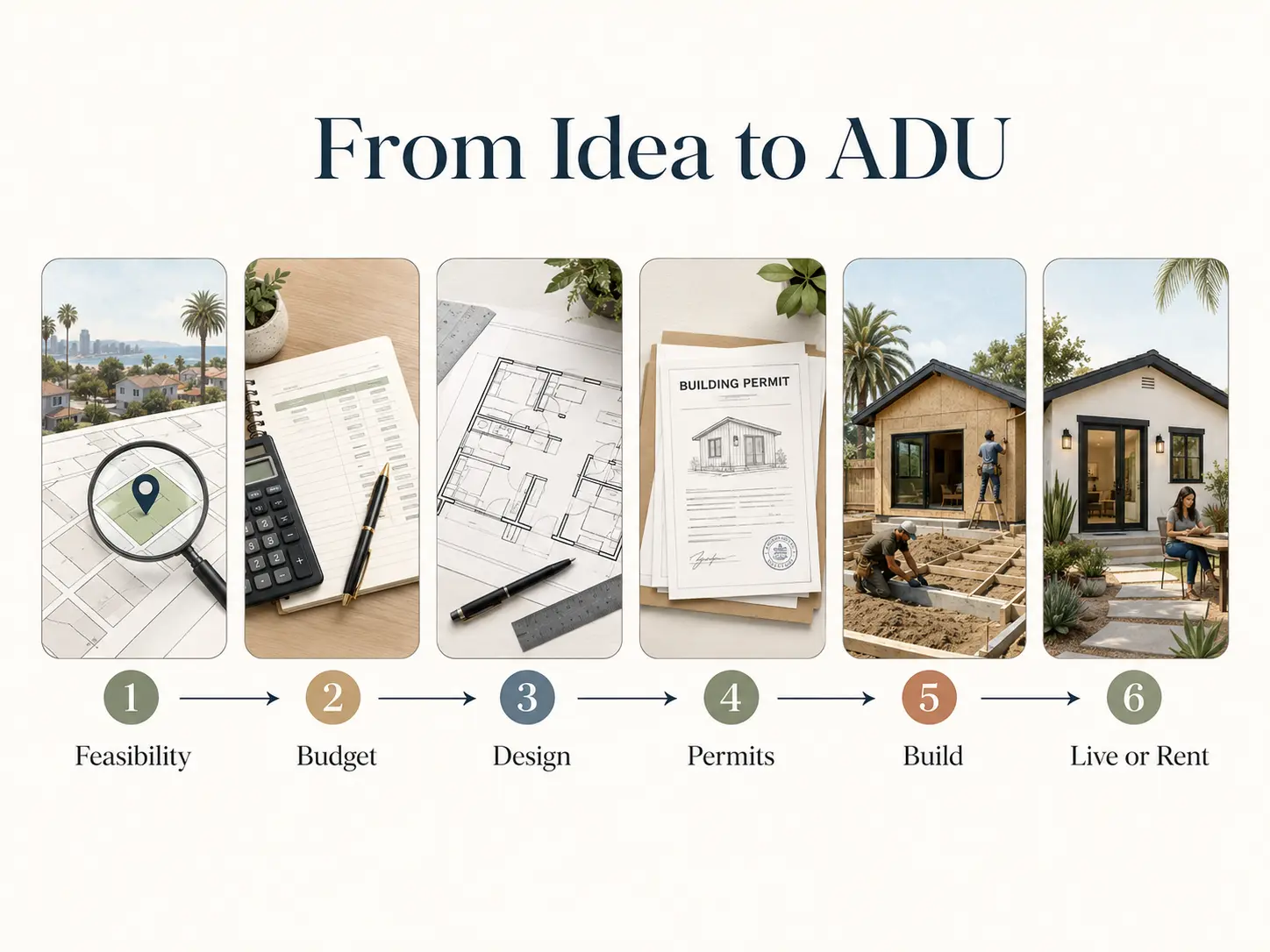
| Design & feasibility | 2–4 months | Site visit, zoning review, utility assessment, plan production, structural engineering, Title 24, soils if required | Custom design, HOA review, complex lot, multiple revisions |
| Plan check & permitting | 3–5 months (custom) / ~30 days (pre-approved) | DSD intake, completeness check (15 business days per §66317), plan check, correction cycles, fee payment, permit issuance | Coastal Development Permit (+8–12 weeks), historic review, multiple correction rounds |
| Construction | 6–10 months | Foundation, framing, MEP rough, drywall, finishes, inspections, utility connections, certificate of occupancy | Subcontractor scheduling, weather, change orders, supply issues |
Source: SnapADU permit data 2020–2026; City of San Diego DSD permit timeline dashboard (updated weekly); California Government Code §66317. Verified May 2026.
The City of San Diego’s permit timeline page is updated weekly and reflects current DSD processing volume. State law requires the City to perform a completeness check within 15 business days and to act on a complete ADU application within 60 days. In practice, the bottleneck is usually completeness — incomplete submittals don’t trigger the 60-day clock.
11. Rental income and ROI: does a detached ADU pay for itself?
| Bedroom count | Inland flat (Clairemont, Mira Mesa) | Central urban (North Park, Hillcrest) | Coastal (Pacific Beach, La Jolla) |
|---|---|---|---|
| 1BR | $1,800–$2,200 | $2,200–$2,600 | $2,500–$3,000 |
| 2BR | $2,400–$2,800 | $2,800–$3,300 | $3,200–$3,700 |
| 3BR | $2,800–$3,200 | $3,200–$3,600 | $3,400–$3,900 |
Source: Rentometer March 2026 pulls, cross-verified with Apartments.com San Diego market trends and SnapADU published comps. Sanity-check ranges only. Run real comps on your zip code, bedroom count, and finish level before committing.
Worked example: 750 sqft 2-bed/1-bath ADU in North Park
| Build cost (median, level lot, standard finishes) | $310,000 |
| Annual gross rent at $2,800/mo | $33,600 |
| Property tax increase (Prop 13: only new ADU value reassessed, ~1.1% of build cost) | $3,400 |
| Insurance increase | $1,200 |
| Maintenance reserve (5% of rent) | $1,680 |
| Vacancy reserve (5% of rent) | $1,680 |
| Annual operating costs | $7,960 |
| Net annual cash flow | $25,640 |
| Simple payback (cash basis, no appreciation) | ~12.1 years |
Illustrative example only. Your numbers will differ.
Run real comps on your actual zip code before committing. A non-trivial share of ADU homeowners overestimate rent by 15–25% by anchoring on coastal premium numbers when their property is inland. City of San Diego rules prohibit ADU rental terms shorter than 31 consecutive days — Airbnb-style short-term rental is not a permitted use for ADUs.
As of 2026, the City of San Diego allows separate sale of qualifying ADUs as condominiums under AB 1033 — an exit option that changes long-term ROI math for some homeowners. For financing paths, see Section 13.
Run your address to see what size you can build, what it likely costs on your specific lot, and what the rental ceiling is in your zip code.
12. Detached vs. attached vs. garage conversion vs. prefab in San Diego
| ADU type | Typical all-in cost | $/sqft | Best use case | Trade-off |
|---|---|---|---|---|
| Detached new construction | $300K–$500K | $325–$475 turnkey | Rental income, separate-sale exit, multi-generational housing | Highest upfront, longest timeline |
| Attached new construction | $200K–$350K | $300–$450 | Connection to main house, shared utilities | Limited by existing structure |
| Garage conversion | $100K–$200K | $200–$300 | Lowest cost, existing shell, fastest permit | Lose garage; ceiling height issues; layout constrained |
| JADU (within existing home) | $50K–$120K | Varies | In-law suite, lowest-cost path | 500 sqft cap of interior livable space; owner-occupancy required |
| Prefab/modular detached | $180K–$350K all-in (small units) | $300–$450 | Faster timeline, good for flat accessible lots | Crane/delivery costs ($20K–$40K); customization limited |
Sources: SnapADU, Better Place Design & Build, BNC Builders, Subworkit, Realm; verified May 2026.
Prefab is cheaper in narrow conditions and the same price as site-built in most others. Factory savings exist on the vertical build only (about 80% of cost). The remaining 20% (sitework, utilities, permits) is the same regardless of where the structure was assembled. For a deeper comparison, see our guides on Prefab ADU Cost and Detached ADU Floor Plans.
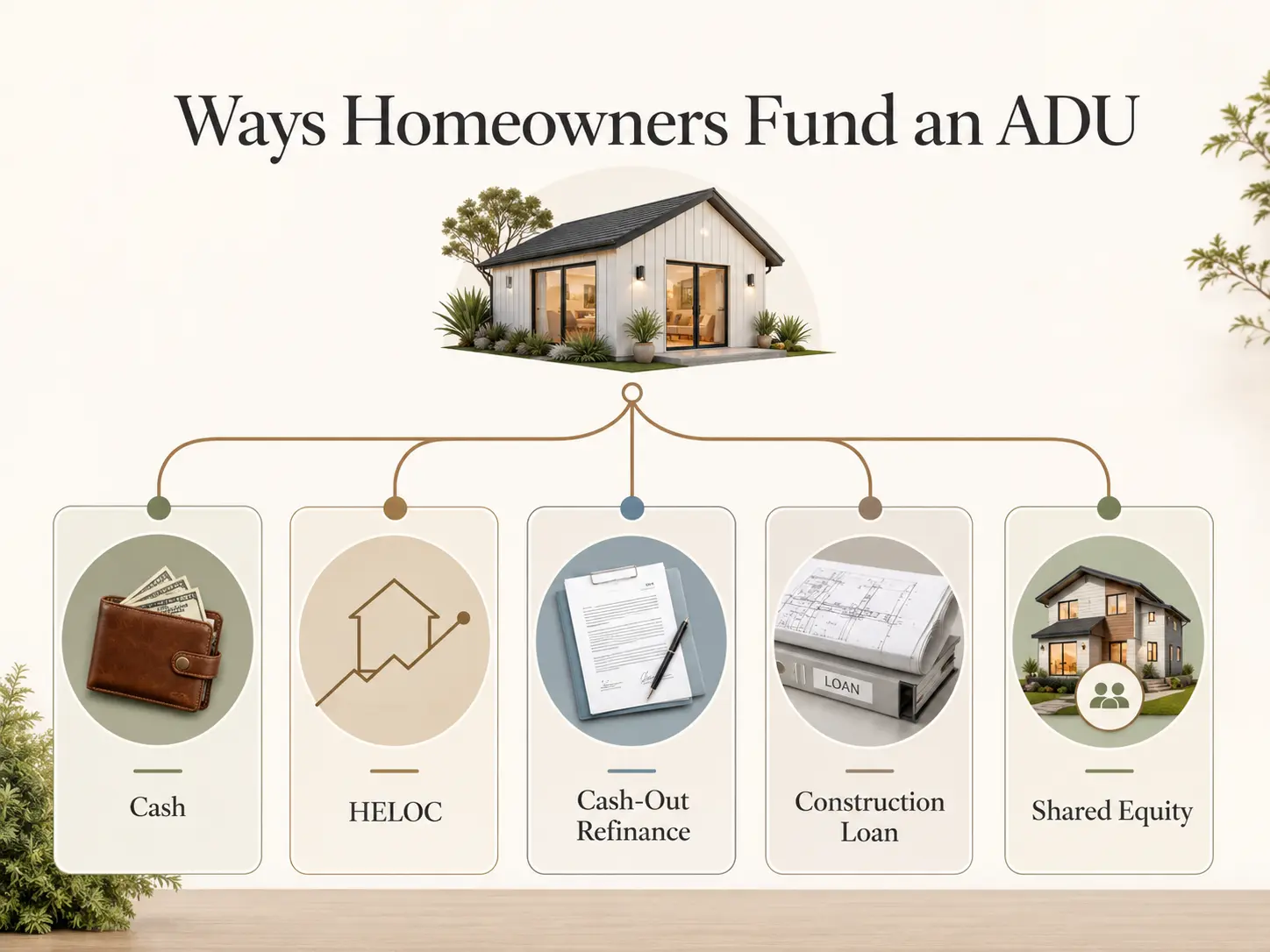
13. How San Diego homeowners actually pay for a $300K–$500K ADU
Two San Diego-specific public programs
14. The cost-to-completion reality check
What you can verify before you sign
- Check the CSLB license at cslb.ca.gov before signing any contract. Look at license status, classification, bond status, complaint history, and any suspensions. This takes about 90 seconds.
- Verify insurance. Ask for current certificates, not photocopies from prior years. Workers’ compensation is required for licensed contractors with employees. General liability should be current.
- Demand a written progress payment schedule. Under California home improvement contract law, down payments are capped at $1,000 or 10% of the contract price, whichever is less. Progress payments cannot exceed the value of work performed and materials delivered. Pay in arrears against verifiable milestones — never in advance against future work. (CSLB progress payment rules)
- Run references against completed projects. Ask for addresses of three completed builds you can drive by, ideally at least one from the past 12 months. “Plans submitted” is not “ADU built.”
Builder volume and completion track record matter. SnapADU, one of San Diego County’s larger detached ADU design-build firms, published completion of 100 detached new-construction ADUs across the county between 2020 and 2025, and reports an 85% submitted-to-completion rate on its own projects in the 2022–2023 cohort, against the ~33% baseline across the region as a whole (SnapADU Lessons from 100 ADUs report, April 2026, SnapADU-reported). The point isn’t that one builder is the answer — the point is that completion track record is a real variable, and the cheapest bid is often the one that stalls.
Talk to a Greater San Diego ADU Design-Build Firm With a Published 100+ Project Completion Record
Request a Discovery Call With SnapADUUse this after you’ve checked your property and have at least one all-in quote in hand to compare. SnapADU serves Greater San Diego and San Diego County, including all 18 incorporated cities and unincorporated areas.
15. What to ask before you trust any San Diego ADU quote
| Quote item | Green flag | Red flag |
|---|---|---|
| All-in vs. vertical build | Explicitly separated; total all-in number stated | "Starting at" price only; no all-in figure |
| Permit fees | Included or estimated with stated assumptions (size, jurisdiction, school district) | "Owner responsibility" with no estimate |
| Utility upgrades | Distance to existing service, trenching length, panel/meter assumptions listed | "By others" or "TBD" with no allowance |
| Sitework | Access conditions, grading, retaining, demo addressed for your specific lot | Generic sitework allowance with no lot-specific assumptions |
| Solar / Title 24 | Included or clearly excluded with reason | Not mentioned |
| Soils report | Included if required or marked "may be required" | Not addressed for sloped or canyon-edge lots |
| Plan revisions / corrections | Number of revision rounds included; cost of additional rounds stated | Vague allowance or "minor changes only" |
| Change orders | Written process; markup percentage stated | "We'll work with you" language |
| Timeline | Design, permit, build phases separated with start-to-finish ranges | Single blended promise ("done in 6 months") |
| License / insurance | License number provided; current insurance certificates available | "Available on request" |
| Warranty | Written warranty terms included | Verbal assurance only |
| Down payment / payment schedule | Down payment ≤10% or $1,000 (whichever is less) per California law; tied to verifiable milestones | Front-loaded payments; large mobilization fee; down payment over the legal cap |
A common pattern: your highest quote is often your most accurate one. Builders who price in feasibility-stage diagnostics, soils reports, utility upgrades, and contingency look “expensive” until you compare them to lower bids that quietly omit those items. The lower bid catches up — and often surpasses — the higher bid through change orders during construction. Force the comparison upfront.
16. What to do if your budget is under $300,000
If you need family housing: Prioritize layout, accessibility, privacy, and approval certainty over maximum rent. A JADU inside the existing home with its own entrance, a small kitchenette, and a private bath often delivers everything aging-parent or adult-child housing needs at a fraction of detached cost. JADUs are capped at 500 sqft of interior livable space.
If you need rental income: A garage conversion ADU with a separate entrance, its own bath, and basic kitchen rents at $1,800–$2,400/month in most San Diego neighborhoods. The math frequently works better at $150K than at $400K because the payback period is shorter.
If you need the lowest total cost: JADU first (cheapest, fastest), garage conversion second, small detached with pre-approved plans third, prefab fourth.
If you need the most resale and rental value: A 1,000–1,200 sqft detached new-construction ADU is the strongest combination for both. If your budget is $300K–$500K with financing available, this is usually where the value sits.
For a deeper comparison, see our broader ADU cost guide and our prefab ADU cost guide.
17. Edge cases and things that change your number
Most ADU budget surprises come from a small set of site-specific issues that aren’t itemized in early bids. Run through this list before you sign anything.
For state-level context, see our California ADU Laws guide.
18. Frequently asked questions
How much does it cost to build a detached ADU in San Diego in 2026?
A new detached ADU in the City of San Diego typically costs $300,000 to $500,000 all-in in 2026 for a 750–1,200 sqft unit on a level inland lot, including design, permits, sitework, utilities, and standard finishes. Smaller units (around 500 sqft) cost $220K–$300K. Coastal Zone and hillside lots add 8–25%.
How much does a 1,000 sqft detached ADU cost in San Diego?
A 1,000 sqft detached 2-bed/2-bath ADU in San Diego typically costs $330,000–$430,000 all-in in 2026, or roughly $330–$430 per square foot turnkey on a level inland lot. Coastal and hillside premiums apply on top.
How much does a 1,200 sqft detached ADU cost in San Diego?
A 1,200 sqft detached 3-bed/2-bath ADU — the maximum size allowed under City of San Diego rules — typically costs $390,000–$500,000 all-in in 2026. This is the best per-square-foot economics in the standard size range, and the worst absolute-dollar exposure.
How much does a 500 sqft detached ADU cost in San Diego?
A 500 sqft detached 1-bedroom ADU in San Diego typically benchmarks around $220,000–$300,000 all-in in 2026, or roughly $440–$600 per square foot. The high per-square-foot cost reflects the fixed costs of kitchen, bath, foundation, permits, and design that don't shrink with the floor plan.
Are ADU permit fees waived in the City of San Diego?
For the typical homeowner building one or two detached ADUs, City Development Impact Fees do not apply at all, regardless of unit size, per SDMC §142.0640(b)(1). What you do pay: City plan check and inspection fees from IB 501 (about $5,741 for a detached ADU up to 500 sqft, or about $16,487 for a detached over 500 sqft), school fees for units over 500 sqft, water and sewer capacity charges, and addressing fees.
How long does it take to build a detached ADU in San Diego?
Plan on 10–18 months from decision to move-in. Roughly 2–4 months of design and feasibility, 3–5 months of plan check and permitting (about 30 days with pre-approved plans under Government Code §65852.27), and 6–10 months of construction. Coastal Development Permit review adds 8–12 weeks.
Did the August 2025 changes affect my detached ADU project?
Almost certainly not, if you're building one detached ADU on a single-family lot. The August 22, 2025 rollback affected the ADU Density Bonus Program — not standard ADU construction. State law still guarantees one detached ADU plus one JADU per single-family lot, with ministerial approval and a 60-day decision deadline. The amendments took effect outside the Coastal Zone on August 22, 2025; Coastal Zone projects await California Coastal Commission certification.
Can I rent my San Diego ADU on Airbnb?
No, not as a short-term rental. City of San Diego rules prohibit ADU rental terms shorter than 31 consecutive days. Long-term rental and mid-term furnished rental (31+ days) are both allowed.
Can I sell my ADU separately from my house?
Yes, in many cases. The City of San Diego adopted AB 1033 in August 2025, permitting ADUs to be sold as separate condominiums under Government Code §66342. The County of San Diego adopted its program March 4, 2026, effective April 4, 2026. ADUs that received SDHC financial assistance or are subject to rent-restriction or affordability covenants are not eligible for separate sale during the duration of the deed restriction.
Will my property taxes go up if I build an ADU?
Yes, but only on the new ADU value — not your full property. Under California's Proposition 13, only the new construction is reassessed at current rates. A $400,000 ADU typically adds $4,000–$5,000/year in property taxes, while the original home retains its prior assessed value.
Do I need parking for my San Diego detached ADU?
Generally no. The City of San Diego requires no ADU parking in most situations: within ½ mile of public transit, in historic districts, in residential permit-parking districts where ADU occupants aren't offered permits, or for ADUs within an existing primary structure. Coastal Overlay Zone properties in the Beach Impact Area outside Transit Priority Areas may require parking unless an exemption applies.
Do new detached ADUs in San Diego require solar?
Yes. California Energy Code requires solar PV on new detached, non-manufactured ADUs, with limited exemptions. The panels can be installed on the ADU itself or on the primary dwelling.
What's the cheapest way to build a detached ADU in San Diego?
A small unit (under 750 sqft), pre-approved plans (30-day permit, lower plan check), a level inland lot with utilities close by, standard finishes, single-story construction. Realistic floor for a genuinely new detached structure: about $220,000–$280,000 all-in.
Do I need owner-occupancy in San Diego anymore?
No — for ADUs, per Government Code §66315. The main house and the ADU can both be rented. JADUs (Junior ADUs inside the main home) still require owner-occupancy.
Is detached or attached ADU cheaper?
Attached is typically cheaper ($200K–$350K vs. $300K–$500K detached) because of shared walls, foundation, and sometimes utilities. Detached offers more design flexibility, separate-sale potential under AB 1033, and stronger rental and resale economics.
Can I build a detached ADU on my San Diego lot?
Almost certainly yes if the property is residentially zoned, has an existing or proposed primary dwelling, and the ADU can be configured to meet objective setback, height, and code requirements. State law guarantees an 800 sqft pathway under §66323 even where local rules would otherwise block it.
19. Methodology
We built the Dwelling Index Reconciled Cost Matrix in Section 4 by collecting published 2026 turnkey “all-in” pricing from five active San Diego ADU design-build firms: SnapADU, Better Place Design & Build, BNC Builders Inc., Subworkit Contracting, and Realm. Each cell in the matrix is labeled with its source type — published exact, extrapolated from broad range, or Dwelling Index reconciled median. Builder ranges are turnkey “all-in” figures and exclude coastal review, hillside grading, retaining walls, geological reports, custom finishes, and offsite improvements unless explicitly noted by the source.
Permit fee math in Section 5 is sourced from the City of San Diego Development Services Department’s Information Bulletin 501 and IB 400, cross-referenced against the SDUSD developer fee resolution and SDMC §142.0640(b)(1). Unincorporated County fee math in Section 8 is calculated from the County of San Diego PDS613 fee schedule, effective July 1, 2025.
State-law citations reference California Government Code §§66310–66342, post–SB 477 renumbering effective March 25, 2024. The California Department of Housing and Community Development ADU Handbook (March 2026 update) was also consulted. Rental income data is sourced from Rentometer March 2026 pulls and SnapADU’s published rent analysis, cross-checked against Apartments.com San Diego market trend data. We did not use forum posts, Reddit threads, or Facebook group commentary as proof for cost, code, or financing claims.
Editorial recommendations are based on independent research and are not influenced by partner compensation. The Dwelling Index is an independent research resource covering ADU financing, costs, and regulations. We are not a builder, lender, or licensed real estate professional. See our Editorial Standards, Methodology, and Partner Vetting Policy for details.
20. What we verified
| Verified item | Source | Verification date |
|---|---|---|
| City of San Diego ADU rules (size, parking, setback, solar, rental, permit) | City of San Diego DSD Information Bulletin 400 | May 8, 2026 |
| City of San Diego construction permit fee categories | City of San Diego DSD Information Bulletin 501 | May 8, 2026 |
| City of San Diego DIF exemption for first two ADUs | SDMC §142.0640(b)(1); City of San Diego Public Spaces FAQ | May 8, 2026 |
| August 22, 2025 Bonus Program rollback details (non-Coastal); Coastal pending CCC certification | City of San Diego Regulatory Updates | May 8, 2026 |
| County of San Diego ADU eligibility and 1,200 sqft detached cap | sandiegocounty.gov ADU page | May 8, 2026 |
| County PDS plan + permit fee formula (PDS613) | County of San Diego PDS613 Attachment B | May 8, 2026 |
| County AB 1033 program adopted Mar 4, 2026, effective Apr 4, 2026 | sandiegocounty.gov ADU page | May 8, 2026 |
| SDUSD school fee rate ($5.17/sf through May 10, 2026; $5.38/sf from May 11, 2026) | SDUSD developer fees | May 8, 2026 |
| State law ADU size, approval, owner-occupancy, parking, impact fee, condo sale (§§66310–66342) | California Government Code §§66310–66342; HCD ADU Handbook March 2026 | May 8, 2026 |
| Multi-builder cost matrix data | SnapADU, Better Place Design & Build, BNC Builders, Subworkit, Realm (URLs cited inline) | May 8, 2026 |
| Permit timeline data | City of San Diego DSD permit timeline; SnapADU 'Lessons from 100 ADUs' report April 2026 | May 8, 2026 |
| Cost-to-completion data (SnapADU-reported) | SnapADU Lessons from 100 ADUs report, April 2026 | May 8, 2026 |
| Multitaskr scandal context | NBC 7 Investigates, January 2025 | May 8, 2026 |
| CSLB contractor down payment / progress payment rules (10% or $1,000) | CSLB Industry Bulletin on Progress Payment Restrictions | May 8, 2026 |
| SDHC ADU Finance Program currently active ($250,000 construction-to-permanent loans) | sdhc.org/housing-opportunities/adu/ | May 8, 2026 |
| Rental income comps | Rentometer March 2026; Apartments.com San Diego market trends | May 8, 2026 |
Next scheduled review: July 2026, after the City of San Diego fee schedule and SDUSD developer fee update cycles.
Plan your detached ADU build
You came here looking for a number. Here’s what you have now: a verified all-in range for your size, a complete line-item breakdown of City of San Diego permit fees with the DIF exemption math most pages miss, neighborhood-tier premium math, a clear read on what August 2025 changed and didn’t change, the County formula for unincorporated properties, a feasibility checklist for your specific lot, an honest financing path map, and the cost-to-completion reality check most builder pages won’t give you. The next step depends on where you are.
If you don’t yet know what you can build on your specific property:
See What You Can Build → Get Your Free ADU Property ReportRun your address. The free report flags size, setback, fee, and feasibility issues that change your real budget — before you spend a dollar on design.
If you’re ready to compare a fixed-price proposal from a vetted local design-build firm:
Talk to SnapADU → Request a Discovery CallGreater San Diego ADU design-build firm with a published 100+ project completion record.
This page was independently researched and written by the Dwelling Index Editorial Team. The Dwelling Index is an independent research resource covering ADU financing, costs, and regulations. We are not a builder, lender, or licensed real estate professional. Content is for informational purposes only and does not constitute financial, legal, tax, construction, or lending advice. Verify all information with qualified local professionals before making decisions. Last verified May 8, 2026.