
San Diego Pre-Approved ADU Plans (2026): All 26 Options Compared
San Diego pre-approved ADU plans save real time and meaningful money for the right homeowner — and quietly fail for the wrong one. The City of San Diego’s Development Services Department (DSD) currently accepts three pre-approved ADU plan libraries: the County of San Diego Standard ADU Plans (6 plans, free download), the City of Chula Vista Standard ADU Plans (12 standard options designed by SnapADU, designer-licensed), and the City of Encinitas Permit-Ready ADU Plans / PRADU (8 plans by Design Path Studio and DZN Partners, free download). The San Diego Housing Commission also publishes 4 template sets that received initial DSD approval — usable inside City limits but not on DSD’s accepted-source list. That’s 26 official plan options across the three currently listed City-accepted sources (City of San Diego DSD, ADU/JADU page, verified May 8, 2026).
Under California Government Code §65852.27 (added by AB 1332 and recodified by SB 477, effective March 25, 2024), a complete permit application for a detached ADU using a qualifying pre-approved plan shall be approved or denied within 30 days (CA Government Code §65852.27). Realistic upfront savings on design and plan-check work land in the $5,500–$18,000 range. All-in build cost still runs $300,000–$450,000 for most detached units. Time saved on the design and plan-check phases is typically 2–4 months for projects that fit without modification.
The catch nobody surfaces clearly: the plan must be current under the 2025 California Building Standards Code rulemaking cycle (effective January 1, 2026), and several public plan libraries in the region are not currently in that compliance window. SnapADU published a public advisory in April 2026 stating the publicly posted Chula Vista and San Marcos plan sets are not currently permit-ready under the 2025 code cycle without a per-project update (SnapADU April 2026 guide). The City of Carlsbad confirms its permit-ready ADU plans are currently unavailable while being updated to the 2025 California Building Codes, with updated plans anticipated summer 2026.
This page is the consolidated decision tool we built so you don’t have to open ten tabs to figure out which plan applies to your lot, what the 30-day rule actually delivers, and whether a pre-approved plan is the right move at all.
By The Dwelling Index Editorial Team · About our team · Methodology · Editorial standards · Corrections
Last updated · Last verified May 8, 2026 · Next scheduled review: August 8, 2026 · Independent editorial — referral relationships disclosed
Start here — free property check
See What You Can Build at Your Address
Get Your Free ADU Report →Free, 60 seconds. We pull your jurisdiction, zone overlays (Coastal Overlay Zone / Very High Fire Hazard Severity Zone), and the maximum buildable footprint for your lot before you pay to license or modify anything.
What is a pre-approved ADU plan, exactly?
A pre-approved ADU plan (sometimes called a permit-ready or standard plan) is a complete architectural plan set that a city or county has already reviewed for general code compliance and posted publicly so any homeowner can use it as the starting point for a permit application. The plan is not site-specific — the local agency reviewed the building itself, not your lot. You still have to layer in your property-specific information (site plan, foundation engineering, utility tie-ins, energy compliance) before the permit package is complete.
A few terms we’ll use throughout
- ADU (Accessory Dwelling Unit):
- A self-contained living unit on the same lot as a primary residence, with its own kitchen, bath, and sleeping area. In San Diego it can be 150 to 1,200 square feet.
- JADU (Junior Accessory Dwelling Unit):
- A unit no larger than 500 square feet contained within an existing single-family residence, with kitchen and (usually shared) bath.
- Detached ADU (or DADU):
- A standalone structure separate from the primary house. This is the type AB 1332's 30-day rule covers.
- Attached ADU:
- Shares one or more walls with the primary house.
- Plan check:
- The city's review of your permit drawings for code compliance.
- Site work:
- Grading, excavation, drainage, and utility connections specific to your lot.
- Setback:
- The minimum legal distance between a structure and a property line.
- FAR (Floor Area Ratio):
- The ratio of total floor area to lot size.
- Ministerial approval:
- A permit decision made on objective criteria with no public hearing or discretionary review.
- Triennial code cycle:
- California adopts a new Building Standards Code every three years; the current cycle is the 2025 California Building Standards Code, effective January 1, 2026.
- CDP (Coastal Development Permit):
- Permit required for development in California's Coastal Zone.
Which San Diego pre-approved ADU plans does the City accept?
The City of San Diego’s Development Services Department accepts pre-approved ADU plans from three sources: County of San Diego Standard ADU Plans, City of Chula Vista Standard ADU Plans, and City of Encinitas Permit-Ready ADU Plans (PRADU). Plans from other San Diego County cities are not on the City of San Diego’s current accepted-source list unless DSD later adds them. The San Diego Housing Commission separately publishes 4 template sets that received initial DSD approval and can be used inside City limits, but they are not part of the DSD pre-approved-plan list and require additional site-specific review.
The 3-library snapshot
| Plan source | Accepted by City of San Diego? | Published options | Size range | Cost to homeowner | Best first look |
|---|---|---|---|---|---|
| County of San Diego | ✅ Yes | 6 ADU plans (A–F) | 600–1,200 sq ft | Free PDF + CAD download | Simple detached ADUs on standard lots |
| City of Chula Vista | ✅ Yes | 12 standard options (six layouts × two orientations) | 498–1,199 sq ft | Designer license fee (contact SnapADU) | 1–3 BR layouts with mirrored siting flexibility |
| City of Encinitas (PRADU) | ✅ Yes | 8 plans (4 from each architect firm) | 224–1,199 sq ft | Free download | Studio through 3-BR with a true small-footprint option |
| San Diego Housing Commission templates | ⚠️ City-only, separate program | 4 template sets | Studio–3 BR | Free reference + initial DSD approval | Homeowners who want another City-only template source |
Total publicly posted, City-accepted plan options: 26.
Sources: City of San Diego DSD ADU/JADU page; San Diego County PDS Dwelling Unit Building Plans; City of Chula Vista DSD ADU page; City of Encinitas ADU page. All verified May 8, 2026.
All 26 plans compared (the master inventory)
Below is the full inventory of every pre-approved ADU plan currently accepted by the City of San Diego, with sizes, layouts, designer of record, cost to use, and a direct link to the official source page so you can verify each plan and download files yourself. Where the underlying source page does not date-stamp its inventory, we recommend a quick verification step before you commit money to any path.
County of San Diego Standard ADU Plans (6 plans, free)
The County of San Diego Planning & Development Services (PDS) publishes a set of dwelling unit building plans available for free download in 36″×24″ PDF, 17″×11″ PDF, and CAD (.dwg) formats. The County states its own plans are approximately 85% complete and require project-specific information before submittal (San Diego County PDS Dwelling Unit Building Plans, verified May 8, 2026). The City of San Diego separately accepts these plans for use inside City limits. Plans G (1,728 sq ft) and H (1,500 sq ft) are designated single-family-dwelling-only and cannot be used as ADUs because they exceed the 1,200 sq ft maximum.
| Plan | Size | Layout | Best fit | ADU-eligible in City of San Diego? |
|---|---|---|---|---|
| Plan A | 1,200 sq ft | 3 BR / 1 BA | Family rental, multigenerational housing | ✅ Yes |
| Plan B | 1,200 sq ft | 2 BR / 1 BA | Long-term rental at maximum size | ✅ Yes |
| Plan C | 1,200 sq ft | 2 BR / 2 BA | Two-tenant rental with private baths | ✅ Yes |
| Plan D | 1,000 sq ft | 1 BR / 1.5 BA | Aging-parent or adult-child unit | ✅ Yes |
| Plan E | 800 sq ft | 1 BR / 1 BA | 1-BR rental at near-mid size | ✅ Yes |
| Plan F | 600 sq ft | 1 BR / 1 BA | Maximum-savings rental under 750 sq ft | ✅ Yes |
| Plan G | 1,728 sq ft | SFD only | Not ADU-eligible | ❌ No |
| Plan H | 1,500 sq ft | SFD only | Not ADU-eligible | ❌ No |
View official source: San Diego County PDS — Dwelling Unit Building Plans →
The cost-savings angle on County plans is real but narrow: the PDF and CAD files are free, so you skip the architectural design fee entirely (typically $8,000–$15,000 in San Diego). What you still pay for: a draftsperson or designer to produce your site-specific package, structural calculations tied to your foundation, Title 24 energy compliance, geotechnical work where required, and any modifications you need to make the plan work on your lot.
City of Chula Vista Standard ADU Plans (12 plans, designer-licensed)
The City of Chula Vista contracted with SnapADU through a competitive bid process to produce its Standard ADU Plan library. The plans are organized as six base layouts, each available in a standard orientation and a reversed (mirror) orientation — for 12 total plan-orientation combinations.
| Base layout | Footprint type | Size | Bedrooms | Orientations available |
|---|---|---|---|---|
| 498 Square | Compact square | 498 sq ft | 1 | Standard + reverse |
| 748 Long | Linear | 748 sq ft | 1–2 | Standard + reverse |
| 749 Square | Square | 749 sq ft | 1–2 | Standard + reverse |
| 749 L-Shape | L-shaped | 749 sq ft | 1–2 | Standard + reverse |
| 999 L-Shape | L-shaped | 999 sq ft | 2–3 | Standard + reverse |
| 1,199 L-Shape | L-shaped | 1,199 sq ft | 2–3 | Standard + reverse |
View official source: City of Chula Vista — Accessory Dwelling Units → Sources: City of Chula Vista DSD ADU page; SnapADU plans page. Verified May 8, 2026.
Chula Vista’s plans require a license arrangement with the designer (SnapADU) before you can use them. Public statements suggest licensing budget in the $1,500–$4,000 range depending on which base plan, level of customization, and whether a build contract follows; we recommend confirming the current fee directly with SnapADU before relying on this number.
The City of San Diego accepts these plans for in-City use; you would still license them from SnapADU and submit a complete site-specific package to City of San Diego DSD. Inside Chula Vista city limits, the City’s own pre-approved review path delivers 14-business-day plan review and reduces plan-review fees by approximately $1,000 (City of Chula Vista DSD ADU page, verified May 8, 2026). Those Chula Vista–specific savings do not automatically transfer to City of San Diego projects.
City of Encinitas Permit-Ready ADU Plans / PRADU (8 plans, free)
The City of Encinitas’s Permit-Ready Accessory Dwelling Unit (PRADU) program started in 2019. The City contracted two local architectural firms — Design Path Studio and DZN Partners — and each produced four plan sizes: a studio, a 1-bedroom, a 2-bedroom, and a 3-bedroom unit. That’s 8 PRADU plans total. All eight are free to download and require designer attribution on the permit submittal.
| Designer | Plan name | Size | Layout | Design philosophy |
|---|---|---|---|---|
| DZN Partners | Studio | 224 sq ft | Studio | Compact studio with extensive exterior options and roof line variations |
| Design Path Studio | Studio (base) | 350 sq ft | Studio | Expandable base — designed to grow over time as budget allows |
| DZN Partners | 1-BR | 499 sq ft | 1 BR / 1 BA | Small-lot 1-BR with multiple exterior treatments |
| Design Path Studio | 1-BR | 555 sq ft | 1 BR / 1 BA | Adds bedroom over the studio base infrastructure |
| Design Path Studio | 2-BR | 745 sq ft | 2 BR / 2 BA | Adds second bedroom; under 750 sq ft impact-fee threshold |
| DZN Partners | 2-BR | 990 sq ft | 2 BR / 2 BA | More generous living space; over impact-fee threshold |
| Design Path Studio | 3-BR | 938 sq ft | 3 BR / 3 BA | Maximum-density family unit at sub-1,000 sq ft |
| DZN Partners | 3-BR | 1,199 sq ft | 3 BR / 3 BA | Largest published PRADU option, near the 1,200 sq ft cap |
View official source: City of Encinitas — Accessory Dwelling Units →
Sources: City of Encinitas DSD ADU/PRADU page; Design Path Studio Encinitas PRADU portfolio; The Coast News January 2019 program launch coverage. Verified May 8, 2026.
The two design firms took different philosophical approaches. Design Path Studio’s plans are intentionally expandable — the studio includes the full plumbing, electrical, and structural infrastructure needed for the 1-BR, 2-BR, and 3-BR variants, so a homeowner who can only afford the studio today can expand later without redoing utilities. DZN Partners’ plans emphasize exterior customization — extensive options for siding, roof lines, and window/door variations to match neighborhood character.
The smallest accepted pre-approved ADU plan in any of the three City-accepted libraries is the DZN Partners 224 sq ft studio. The largest is a tie at 1,200 sq ft (County Plans A, B, and C).
The City of Encinitas’s official PRADU page states its plans have been updated to current building code requirements (City of Encinitas ADU page, verified May 8, 2026). We still recommend a quick verification call to Encinitas Development Services confirming the specific plan is current under the 2025 California Building Standards Code before paying any drafting fees. The verification step: ask the city plan-check counter, “Is plan [name] still permit-ready under the 2025 California Building Standards Code?” Get the answer in writing.
San Diego Housing Commission ADU Templates (4 templates, City-only)
The San Diego Housing Commission (SDHC) developed four ADU template sets through its Pilot Program — built on five SDHC-owned single-family lots and refined into reusable plans ranging from studios to 3-bedroom units with customization options. SDHC says these plans received initial approval from the City of San Diego DSD but still require site-specific review. SDHC also makes clear it cannot authorize use of these plans outside the City of San Diego (San Diego Housing Commission ADU page, verified May 8, 2026).
| Template | Approximate use case | Status with DSD |
|---|---|---|
| Studio | Single-occupant unit, accessibility-friendly base | Initial DSD approval; site-specific review required |
| 1-BR | Long-term rental, adult-child or aging-parent housing | Initial DSD approval; site-specific review required |
| 2-BR | Family rental, multigenerational | Initial DSD approval; site-specific review required |
| 3-BR | Larger family unit at near-maximum ADU footprint | Initial DSD approval; site-specific review required |
View official source: San Diego Housing Commission — ADU page →
The SDHC templates are worth knowing about for two reasons. First, they are an additional City-of-San-Diego-only source of pre-developed plans — useful if none of the County, Chula Vista, or Encinitas plans fit your design goals. Second, SDHC also runs an ADU Finance Program offering construction-to-permanent loans up to $250,000 to moderate-income City of San Diego homeowners, with a 7-year affordability commitment. We cover that in the financing section below.
Decision resolution point
See Which Plan Library Applies to Your Address
Get Your Free ADU Report →Pulls your jurisdiction, Coastal Overlay Zone status, Very High Fire Hazard Severity Zone status, and the maximum ADU footprint that fits your buildable area. Free, 60 seconds. No call required.
Are San Diego pre-approved ADU plans still valid under the 2025 code cycle?
This is the question most pages dance around. Here’s the direct answer with each library’s current status.
The 2025 California Building Standards Code took effect for permit applications received on or after January 1, 2026. AB 1332’s 30-day shot clock applies to a pre-approved plan only when that plan is current under the triennial California Building Standards Code rulemaking cycle — which is now the 2025 cycle. Plans drawn under the prior 2022 cycle do not automatically remain compliant.
Code-cycle status table (City-accepted libraries)
| Library | Source’s stated status | Independent advisory | Action homeowners should take |
|---|---|---|---|
| County of San Diego (Plans A–F) | County PDS does not publicly post a 2025 code-cycle compliance certification for individual plans | None we found that flags non-compliance | Email County PDS plan-check or call the Building Services counter. Ask in writing whether the specific plan is current under the 2025 California Building Standards Code |
| City of Chula Vista (12 standard options) | Chula Vista page states standard plans remain valid until City adopts new building or zoning codes; designers are responsible for updates | SnapADU's April 2026 advisory states the publicly posted Chula Vista and San Marcos plan sets are not currently permit-ready under the 2025 code cycle without a per-project update | Contact SnapADU before relying on a publicly downloaded plan; expect to license an updated plan rather than use the public file as-is |
| City of Encinitas PRADU (8 plans) | Encinitas page states PRADU plans are updated to current building code requirements | None we found that flags non-compliance | Verify the specific plan with Encinitas Development Services before submittal |
| City of Carlsbad (separate program — not City of San Diego accepted) | Carlsbad confirms permit-ready plans currently unavailable while being updated to 2025 California Building Codes | Carlsbad anticipates updated plans summer 2026 | If building in Carlsbad, wait or pursue semi-custom; not relevant to City of San Diego applicants |
| San Diego Housing Commission (4 templates, City-only) | Initial DSD approval; site-specific review required | None we found that flags non-compliance | Confirm with SDHC at adu@sdhc.org and DSD before relying on initial approval status |
The 60-second verification step
Before you pay anyone for site-specific work tied to a specific pre-approved plan:
- Call the city DSD plan-check counter (City of San Diego DSD, City of Encinitas Development Services, or San Diego County PDS, depending on which plan you’re using).
- Ask: “Is the [Plan A from County / 749 Square from Chula Vista / Design Path Studio 2-BR PRADU] currently permit-ready under the 2025 California Building Standards Code, or has it been flagged for update?”
- Get the answer in writing (email is fine).
- If the city says the plan is current, move forward. If not, either wait for the city’s update, retain the original designer to update it under contract, or pivot to a semi-custom path.
That single phone call protects you from the most expensive failure mode of the pre-approved plan path: paying for soils, energy compliance, and structural work tied to a plan the city will reject in plan check.
AB 1332 and the 30-day shot clock — how it really works
Government Code §65852.27 (added by AB 1332 and recodified by SB 477, effective March 25, 2024) requires every California city and county to run a program for pre-approving ADU plans, and requires local agencies to approve or deny a complete detached-ADU permit application within 30 days when the application uses a qualifying pre-approved plan. The 30-day rule applies only to detached ADUs, only on a complete application, and only when the plan is current under the triennial California Building Standards Code rulemaking cycle. Misunderstanding any of those three conditions is how homeowners end up frustrated when their “30-day permit” sits in plan check for six weeks.
What the statute actually says (in plain English)
Government Code §65852.27 mandates the 30-day approve-or-deny window when an application uses one of two qualifying types (CA Government Code §65852.27):
- A plan that has been preapproved by the local agency within the current triennial California Building Standards Code rulemaking cycle, or
- A plan identical to a plan already used in an approved detached ADU application by the same local agency within the current triennial code cycle.
First, the clock applies only to detached ADUs. Attached ADUs and JADUs are not covered — they are processed under Government Code §§66317 and 66320 (the recodified ADU/JADU framework), which give local agencies 60 days to act on a complete application. Second, the clock starts only when the application is complete. Submitting a half-finished package doesn’t start the 30 days. Third, the plan has to be current under the triennial cycle.
The Coastal Overlay Zone exception — and the AB 462 update most pages miss
For ADU projects in the Coastal Overlay Zone, a Coastal Development Permit (CDP) may be required. Assembly Bill 462 (2025) changed how CDPs work for ADUs: ADU coastal development permit applications must generally be approved or denied within 60 days of a complete application and processed concurrently with the ADU application (CA AB 462 bill text, verified May 8, 2026). That’s a significant improvement over the historical 3–6 month CDP processing baseline, but it doesn’t eliminate the CDP requirement itself, and the 60-day CDP clock doesn’t replace the AB 1332 30-day window. Coastal Overlay Zone homeowners should plan for the longer of the two timelines and verify their specific project’s CDP requirement with the City (City of San Diego Information Bulletin 400).
What “30-day approval” doesn’t mean
| Marketing claim | The honest reality |
|---|---|
| "30-day permits in San Diego!" | The 30-day window is the AB 1332 review clock for detached ADUs — not the total permit timeline. Counting in real-world resubmittals, fee payments, and corrections, full permit issuance for a smooth project typically lands in our editorial estimate of 60–90 days |
| "Skip plan check entirely!" | You don't skip plan check. The shot clock just compresses it. The reviewer still verifies your site-specific package |
| "Build in 90 days!" | The full project from permit issuance to certificate of occupancy typically takes 6–12 months, depending on builder schedule and inspections |
| "Coastal-zone permits as fast as inland!" | Coastal Overlay Zone projects often require a Coastal Development Permit. AB 462's 60-day CDP clock helps significantly, but the CDP requirement itself can still apply, and is not subject to AB 1332's 30-day rule |
| "No engineering needed!" | Foundation engineering, structural calculations, and Title 24 compliance are still required for every project |
Want this in a printable one-page checklist?
Download the Free ADU Starter Kit →Includes the pre-approved-plan verification call script, the AB 1332 eligibility checklist, the 2025 code-cycle verification protocol, and the document tracker for City of San Diego permit submittal.
Are these plans really permit-ready?
No. A pre-approved ADU plan is approximately 80% of what your permit submittal needs and only about 30% of what your project needs. That ratio is our editorial framework based on standard San Diego ADU project breakdowns — not a number from a single source. The plan covers the building itself: floor plans, elevations, structural and energy basics for a generic version of the unit. Your permit application still requires a property-specific package on top of that. And your project — the 6-to-12-month, $300,000+ effort to actually build the thing — looks identical regardless of whether you started with a pre-approved plan or a custom one.
Methodology note for the 80%/30% framework: We allocate the 80% on the permit-submittal side based on the City of San Diego’s published Information Bulletin 400 minimum submittal list — most architectural drawings, structural details, and code-compliance scaffolding are covered by the pre-approved plan, while site-specific items remain. The 30% on the project side reflects that design and plan check are roughly one-quarter to one-third of total project effort and budget. The 80/30 framework is editorial, not a primary-source statistic.
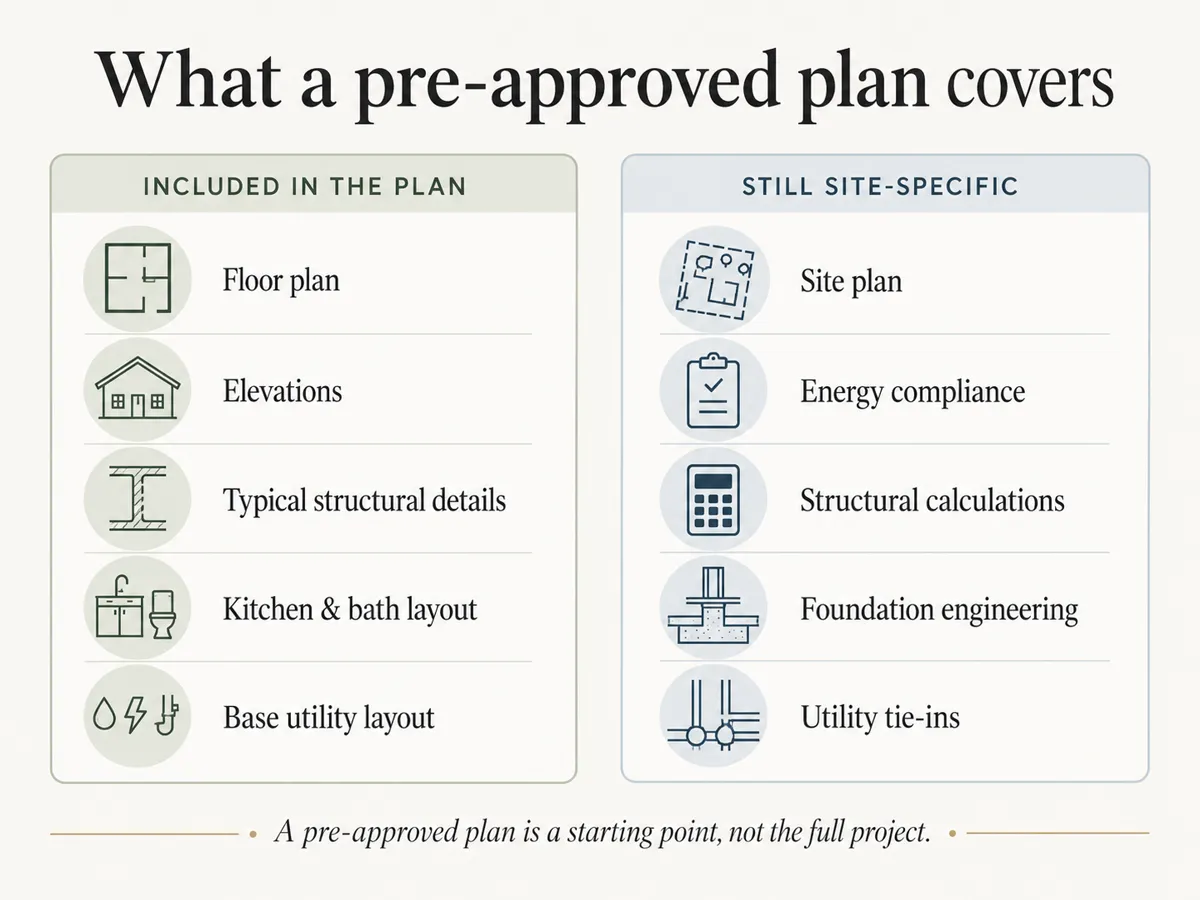
What the pre-approved plan actually covers
- Generic floor plan and dimensional drawings
- Elevation drawings (the building's exterior appearance)
- Architectural sections
- Standard structural details (typical foundation, framing, roof system)
- Code-compliant kitchen and bath layouts
- Generic energy-compliance scaffolding (still requires project-specific update)
- Plumbing, electrical, and mechanical layout templates
- Some specifications and material schedules
What you still produce yourself (the site-specific package)
Per City of San Diego DSD Information Bulletin 400 and the City’s standard submittal requirements. Verify geotechnical requirements with your reviewing agency.
| Required item | Why it’s project-specific | Who typically produces it |
|---|---|---|
| Site plan and vicinity map | Shows your specific lot, setbacks, easements, existing structures, and ADU placement | Designer, surveyor, or drafter |
| Structural plans, details, and calculations | Tied to your foundation, lateral loads, and site conditions | Structural engineer |
| Title 24 energy compliance documents | Tied to your orientation, glazing area, climate zone, and HVAC selection | Title 24 consultant |
| Roof truss design / calculations | Specific to your span and roof structure | Truss manufacturer |
| Geotechnical / soils report (where required) | Requirements vary by jurisdiction and project size — verify with your reviewing agency | Geotechnical engineer |
| Foundation engineering | Specific to your soil and slope | Structural engineer |
| Utility tie-in plans | Sewer lateral, water service, electrical service to your existing main | Civil designer + utility consultant |
| Stormwater management documentation | Required where impervious area thresholds apply | Civil designer |
| Solar PV plans | Per California Energy Code, newly constructed non-manufactured detached ADUs require solar; panels may be on the ADU or primary dwelling | Solar contractor |
| DSD forms (DS-3032, DS-16, DS-560 as applicable) | Standard city forms required for every submittal | Applicant or designer |
| Plan provider license/agreement (Chula Vista plans) | The City directs applicants to contact the designer of record for licensing terms | Plan designer |
The honest math: real net savings (with methodology)
The realistic upfront net savings band for a homeowner who doesn’t modify the plan is $5,500–$18,000 — based on the worked methodology below. This range applies to a typical City of San Diego project.
| Cost line | Custom-design path | Pre-approved path | Difference (savings) |
|---|---|---|---|
| Architectural design & drafting | $8,000–$15,000 | $0 (County/Encinitas) or $1,500–$4,000 (Chula Vista licensing) | $4,000–$15,000 |
| Site plan production | $1,500–$3,500 | $1,500–$3,500 | $0 |
| Title 24 energy compliance | $700–$1,500 | $700–$1,500 | $0 |
| Geotechnical / soils report (where required) | $1,500–$3,500 | $1,500–$3,500 | $0 |
| Structural calculations | $1,500–$4,000 | $500–$2,000 (some structural already in plan) | $1,000–$2,000 |
| Plan check fees (City of San Diego) | Per IB 501 fee schedule | Same per IB 501 (no published City plan-check fee discount tied to AB 1332 path) | Time savings, not direct fee savings |
| Modification redraw cost (if you change the plan) | n/a | $2,000–$4,000 (also loses pre-approval status) | Erases savings if triggered |
| Realistic upfront net savings band | — | — | $5,500–$18,000 |
Sources: SnapADU April 2026 cost guide; City of San Diego DSD Information Bulletin 501 (fee schedule); regional 2026 design-build cost data from multiple San Diego builder publications; The Coast News Encinitas PRADU launch coverage (2019, baseline range). Verified May 8, 2026.
Damaging admission
A pre-approved ADU plan is not a cheat code, and we’re not going to pretend it is. On a flat suburban lot with standard utilities and a homeowner whose goals match a published layout, the path saves real time and real money — typically two to four months on the design and plan-check phases, and somewhere between $5,500 and $18,000. On a sloped lot, a coastal-zone property, a fire-zone parcel, a lot with complex utility extensions, or any project where the homeowner wants meaningful design customization, starting from a pre-approved plan can be slower and more expensive than a semi-custom design from the beginning. Multiple San Diego builders publicly note that real-world permit timelines for PRADU plans are often not faster than custom plans when modifications are common.
The good news: if you fit the profile where it does work, this is one of the cleanest cost-and-timeline wins available to a San Diego homeowner today, and the Encinitas PRADU program’s first-year statistics showed roughly 25% of all Encinitas ADU permits used PRADU plans — meaningful adoption from informed homeowners.
What fees still apply if I use a pre-approved ADU plan?
The pre-approved plan path doesn’t change the fee structure. You still pay City permit fees, plan-check fees, capacity charges, and (above the size thresholds) impact fees, school fees, and any applicable affordable-housing fees. Here is how the categories actually break down.
The fee categories explained
| Fee category | What it pays for | Triggered by | Threshold for waiver |
|---|---|---|---|
| Building permit fee | City review and inspections | All ADU permits | None — paid on every project |
| Plan check fee | City review of permit drawings | All ADU permits | Per IB 501 fee schedule; no City plan-check fee discount tied to AB 1332 path |
| Local development impact fees | Roads, parks, utilities improvements | ADUs over 750 sq ft of interior livable space | Waived for ADUs of 750 sq ft or less per California SB 13 |
| School impact fees | Local school district | ADUs over 500 sq ft (district-specific rates) | Waived for ADUs and JADUs under 500 sq ft |
| Capacity charges (water/sewer) | Utility connections and capacity | New connections | ADU rates calculated at reduced 0.5 EDU per City practice |
| Community Enhancement Fee | Neighborhood infrastructure (active transportation, fire, libraries, parks) | ADUs in the City of San Diego ADU Home Density Bonus Program under 750 sq ft | Deed-restricted affordable ADUs at qualifying levels excluded |
| Inclusionary housing fees | Affordable housing fund | Certain ADU configurations under SDMC Article 14 Division 13 | Verify with DSD for your specific project |
Sources: City of San Diego IB 400 and IB 501; California Senate Bill 13. Verified May 8, 2026.
The plan-size decision that actually moves fees
The single biggest fee decision a homeowner makes is plan size, not plan source.
- At or under 500 sq ft: Both school fees and impact fees are typically waived. Encinitas DZN Partners 224 and 499 sq ft and County Plan F at 600 sq ft (school exemption applies through 500 sq ft) are the smallest-fee-footprint options.
- At or under 750 sq ft: Impact fees waived under SB 13. School fees may apply but the impact-fee waiver alone typically saves $5,000–$15,000 in San Diego per the City’s published fee context.
- Over 750 sq ft: Full impact fees apply, calculated proportionally per current state rules; school fees apply over 500 sq ft.
Do the August 2025 Bonus ADU reforms affect your plan choice?
For most homeowners building one or two ADUs on a single-family lot with the base-state path, the answer is no — the 30-day pre-approved-plan review, the 26 accepted plans, the base setbacks, and the base size limits are all unchanged. But if you are on a larger lot and considering the City’s ADU Home Density Bonus Program (which is what triggers the Community Enhancement Fee in the table above), the reforms the City Council adopted on July 22, 2025 — effective August 22, 2025 outside the Coastal Overlay Zone — reshaped the Bonus path substantially.
Inside the Coastal Overlay Zone, implementation is pending California Coastal Commission approval (anticipated in 2026), so Coastal Zone Bonus projects continue under the pre-August 2025 rules for now. Verify current status directly before planning any Coastal Overlay Zone project.
| Reform (effective Aug 22, 2025 outside Coastal Zone) | What it says | Practical meaning for your plan choice |
|---|---|---|
| Lot-size-based ADU caps under the Bonus program | Up to 4 ADUs on lots up to 8,000 sq ft; up to 5 ADUs on lots 8,001–10,000 sq ft; up to 6 ADUs on lots over 10,000 sq ft. Limits are inclusive of state-law ADUs. | If you were planning the largest stacked Bonus projects, recalibrate. Building 1–3 ADUs (the vast majority of projects) is unaffected. |
| Eight RS zones made ineligible for the Bonus program | RS-1-1, RS-1-2, RS-1-3, RS-1-4, RS-1-8, RS-1-9, RS-1-10, and RS-1-11 lose Bonus eligibility. | Exception: parcels in a High or Highest CTCAC Opportunity Area identified as residential in the land use plan remain eligible. Check zoning via ZAPP and CTCAC status separately. |
| Sustainable Development Area now requires continuous sidewalks | SDA status requires a continuous sidewalk pedestrian path to a major transit stop. | Some parcels previously in the SDA on paper are no longer in the SDA in practice. Re-verify on the City's updated layer. |
| All Bonus ADUs require fire sprinklers | Every Bonus ADU must include an automatic fire sprinkler system regardless of primary residence status. | If you chose a pre-approved plan because it was sprinkler-free, confirm it can accommodate a sprinkler riser and any tank/booster. |
| Community Enhancement Fee on Bonus/Affordable ADUs under 750 sq ft | New fee on qualifying Bonus and Affordable ADUs under 750 sq ft to fund neighborhood infrastructure. | The sub-750 sq ft size was the fee-savings sweet spot; on the Bonus path the math has changed, so re-run it. |
| Detached ADUs limited to two stories | No 3-story detached ADUs. | Affects some stacked Bonus plans; base-state single-family ADUs are typically unaffected. |
| Parking required for Bonus ADUs outside Transit Priority Areas | One on-site parking space per Bonus ADU outside a TPA. | Affects buildable-area math. Check TPA status via ZAPP. |
| 4-ft side/rear setbacks in High or Very High FHSZ | ADUs in a High or Very High Fire Hazard Severity Zone require the 4-ft setback regardless of height (previously only over 16 ft outside the FHSZ). | Re-check the pre-approved plan's footprint against your buildable area if your lot is in a High or Very High FHSZ. |
| FHSZ lots on cul-de-sacs or single-egress roads ineligible | Fire-access concerns disqualify these lots from the Bonus path. | Verify road topology and access via ZAPP. |
| AB 1033 implemented (sell an ADU as a separate condo) | The City now allows ADU condominium subdivision and separate sale. | Different financial calculus, but ADUs built through the Bonus path remain ineligible for separate sale. |
Sources: City of San Diego Regulatory Updates and Adopted Single-Issue Land Development Code Amendments pages; City Council action of July 22, 2025 (effective Aug 22, 2025 outside the Coastal Overlay Zone). Coastal Zone implementation pending California Coastal Commission approval. Verified May 11, 2026.
How much money can a pre-approved ADU plan actually save?
The honest answer is $5,500–$18,000 in upfront design and plan-check work for a homeowner whose lot and goals fit the plan without major modification — the worked range above. The pre-approved plan does not reduce construction cost, impact fees (which are tied to plan size, not source), school fees, capacity charges, utility connection costs, or inspection fees. All-in construction cost for a typical detached ADU in the City of San Diego in 2026 lands at $300,000–$450,000, and the smaller pre-approved options can land at $250,000–$320,000 for a 600–800 sq ft unit on a clean lot — based on multiple regional design-build cost publications cross-referenced for 2026.
Methodology note: All-in cost ranges in this guide are Dwelling Index estimates triangulated from publicly available 2026 cost data published by San Diego design-build firms (SnapADU, Streamline Design Group, Better Place Design + Build) cross-referenced against the City’s published IB 501 fee schedule and current builder quote ranges. They are estimates, not guarantees. Verified May 8, 2026.
For a complete walk-through of which financing lane fits which homeowner, see our ADU Financing Options guide and the dedicated HELOC for ADU guide.
Mapping out the $300K–$450K all-in cost?
See Your ADU Financing Options →Independent path-by-path comparison. Mortgage Research Center is our active mortgage partner; we disclose this on the financing page. We do not rank lenders by payout.
Financial disclaimer: These are educational examples, not guarantees of approval, rates, payments, or returns. Actual options depend on property value, equity, credit profile, income, construction scope, lender requirements, and local approvals.
Can you modify a pre-approved ADU plan?
You can — but if you do, the plan typically loses its pre-approved status and your application no longer qualifies for the AB 1332 30-day review window. The City of Encinitas states this directly: changes to a pre-approved PRADU plan disqualify it from pre-approved review and the application reverts to standard ADU plan check (City of Encinitas ADU page, verified May 8, 2026). The other accepted libraries follow the same logic. In practice, “modify” usually means the plan goes back into standard plan check timelines, you pay a redraw fee of $2,000–$4,000, and the design becomes a custom plan dressed in pre-approved scaffolding — often the worst of both worlds.
What modifications break pre-approval
- Changing the building footprint (length, width, or shape)
- Adding or removing a bedroom, bathroom, or kitchen
- Significantly relocating plumbing or major electrical
- Changing roof form or pitch in ways that affect structural calculations
- Anything structural — beams, posts, foundations, lateral systems
- Combining elements from two different pre-approved plans
What modifications may be tolerated (verify with the city before relying on this)
- Cosmetic finishes (siding color, roofing material) where the plan documents include menu options
- Window/door swaps where the rough opening dimensions and structural framing don't change
- Some interior finish choices (flooring, cabinets, fixtures) that don't affect plan check
- Encinitas Design Path Studio plans are specifically designed to be expanded over time — but the expansion still requires its own permit
The verification rule is simple: any change that’s not explicitly listed as a customization option in the plan documents themselves should be checked with the city’s plan-check counter before you commit money. Email is fine. Get the answer in writing.
When to walk away from the pre-approved path
If you’ve identified more than two modifications you need to make a plan work for your lot or your goals, the math usually flips toward semi-custom. A semi-custom path takes the same total timeline as standard plan check, costs roughly the same as a heavily-modified pre-approved plan, but produces a building actually optimized for your site. The honest read: pre-approved plans are a niche tool that fits well-prepared homeowners on standard lots with standard goals. They are not the default starting point for every San Diego ADU project, even though much of the marketing implies otherwise.
Will the pre-approved plan work for your specific lot?
For a meaningful share of San Diego homeowners considering an ADU, yes. For many others, lot conditions or design goals make a semi-custom path a better fit. The deciders are five lot conditions — Coastal Overlay Zone, Very High Fire Hazard Severity Zone, slope, setback geometry, and utility distance — plus your design goal. When any of those conditions is present, the AB 1332 30-day shot clock often doesn’t apply or doesn’t help as much as the marketing implies, even though the pre-approved plan itself is still legal to use.
The override matrix
| Lot/zone condition | Effect on pre-approved plan path | Verification step |
|---|---|---|
| Coastal Overlay Zone | May require Coastal Development Permit (CDP). AB 462's 60-day CDP clock applies, but the CDP requirement itself does not disappear, and is not subject to AB 1332's 30-day rule. Coastal-zone ADU rules subject to ongoing California Coastal Commission certification per IB 400 | Use ZAPP to check Coastal Overlay status |
| Very High Fire Hazard Severity Zone | Per City IB 400: requires minimum 4-foot side and rear yard setback regardless of building height. Defensible-space requirements apply. Fire Code/Brush Management may require additional measures | Check the City's Fire Hazard Severity Zone overlay; Cal Fire maps confirm parcel status |
| Slope >5% | Most pre-approved plans assume a flat or near-flat building pad. Sloped lots typically need a custom foundation design and stepped pad — usually triggering enough modification to disqualify the plan from pre-approved status | Survey or topo report |
| Front-yard setback | Detached ADUs proposed as new structures must comply with the front setback of the zone per SDMC §131.0422 and §141.0302. Pre-approved plans don't tell you where on your lot the building can sit — that's site-specific | Use ZAPP to check zone; consult SDMC §131.0422 for base zone setbacks |
| Side/rear setback | Per IB 400: ADUs may encroach into side and rear setbacks, including up to the property line, unless California Building Standards Code, fire-separation, or height rules apply. ADUs over 16 feet adjacent to residential premises require at least 4 feet or the zone setback. VHFHSZ requires at least 4 feet regardless | SDMC §141.0302; check property zoning |
| Beach Impact Area (Coastal parking overlay) | One off-street parking space required for some ADUs unless an exception applies — overrides the otherwise no-parking-required ADU rule. Exceptions include ADUs ≤500 sq ft, attached units, designated historical districts, residential permit parking districts, and proximity to a car-share vehicle | DSD Information Bulletin 400; check Parking Impact Overlay |
| Easements | Plan placement must avoid easements; pre-approved plan doesn't account for these | Title report; survey |
| Septic system (unincorporated County only) | County PDS may require additional review and clearance from environmental health. Some unincorporated communities may require automatic fire sprinkler systems and on-site water tank storage | County PDS environmental health division; local fire district |
| Tree protection ordinances | May restrict where the ADU can sit if mature trees are present | Local tree ordinance review |
The Coastal Overlay Zone reality check
The Coastal Overlay Zone covers significant parts of the City of San Diego (Pacific Beach, La Jolla, Mission Beach, Ocean Beach, parts of Point Loma) and surrounding cities. The big 2026 update most pages haven’t caught up with: AB 462 set a 60-day approve-or-deny clock on ADU CDP applications, processed concurrently with the ADU application. That’s a meaningful improvement over the historical baseline, but it doesn’t eliminate the CDP requirement itself, and the AB 1332 30-day clock does not override the CDP timeline. Coastal-zone homeowners should plan for the longer of the two timelines. For coastal-zone homeowners, the pre-approved plan path can still save money on design work, but it won’t deliver a 30-day permit — plan accordingly.
Very High Fire Hazard Severity Zone considerations
For parcels in a Very High Fire Hazard Severity Zone, the 4-foot side and rear setback minimum applies regardless of building height per City IB 400. Defensible-space requirements (clearing vegetation around the structure, fire-resistant landscaping) layer on top. Detached ADUs are exempt from fire sprinkler protection if the primary dwelling is not sprinkler-protected and the ADU qualifies as a Group R-3 occupancy; ADUs built under the Home Density Bonus Program require automatic sprinkler systems regardless. None of that is covered by a pre-approved plan; all of it is site-specific work the homeowner pays for.
Check your specific lot conditions
See Your Lot’s Specific Constraints
Run Your Address Through the Free Plan Eligibility Check →Pulls Coastal Overlay Zone, Very High Fire Hazard Severity Zone, parking overlay, base zone setbacks, and the maximum buildable footprint for your lot. Free, 60 seconds. No call required.
The 4-Filter Decision Framework
If you can pass these four filters in order, a pre-approved ADU plan is likely the right call for your project. If any filter fails, follow the alternative path noted. We built this framework specifically to resolve the active-planning homeowner’s central question: “Should I do this, or am I better off going semi-custom?”
Filter 1: Is your jurisdiction served?
If your property is in the City of San Diego, the three accepted plan libraries are: County of San Diego, City of Chula Vista, and City of Encinitas — plus the SDHC templates as a separate City-only source.
If your property is in unincorporated San Diego County, the County’s six standard plans (A–F) are the natural starting point.
If your property is in any other San Diego County city — Chula Vista, Encinitas, Carlsbad, San Marcos, Escondido, El Cajon, La Mesa, Imperial Beach, Del Mar, Oceanside, Vista, Poway, Coronado, Solana Beach, Lemon Grove, National City, Santee — your city has its own program with its own accepted plans.
If this filter fails: Skip pre-approved. Go semi-custom with a local design-build firm. Design fees are similar, the design fits your lot, and you bypass any AB 1332 mismatch entirely.
Filter 2: Are the plans current under the 2025 Building Code cycle?
Verification step: call the city DSD plan-check counter or the listed designer of record for your chosen plan. Ask in writing whether the plan is currently permit-ready under the 2025 California Building Standards Code. Use the code-cycle status table above for current status by library.
If this filter fails: Either pay the designer to update the plan (often the cheapest semi-custom path because the designer already knows the geometry) or wait for the city’s update.
Filter 3: Will the plan fit your lot without modification?
Run our Property Eligibility Check or hire a feasibility consultant to confirm setback compliance, lot dimensions, and utility tie-in feasibility for your chosen plan on your specific lot. The most common failure mode here: a plan that fits within the buildable area on paper but requires utility extension that adds significant cost to the project, or a setback assumption that doesn’t match your zoning.
If this filter fails: Semi-custom. You’ll keep some cost benefits without the headache of trying to force a misfit plan through the AB 1332 30-day path.
Filter 4: Does the design meet your primary goal?
| Your goal | Best-fit plan options across libraries |
|---|---|
| Long-term rental income, maximum yield/sqft | County Plan F (600 sq ft, 1-BR, sub-750 fee waiver) or Encinitas DZN Partners 499 sq ft 1-BR |
| Multi-tenant rental (privacy between rooms) | County Plan C (1,200 sq ft, 2-BR/2-BA) or Chula Vista 999 L-Shape |
| Aging-parent / accessibility / single-floor | County Plan D (1,000 sq ft, 1-BR/1.5-BA) or SDHC Studio template |
| Adult-child returning home | County Plan E (800 sq ft, 1-BR/1-BA) or Encinitas Design Path Studio 555 sq ft 1-BR |
| Multigenerational + future flexibility | County Plan A (1,200 sq ft, 3-BR/1-BA) or Encinitas DZN Partners 1,199 sq ft 3-BR |
| Smallest possible footprint (guest unit, studio rental) | Encinitas DZN Partners 224 sq ft Studio |
| Phased build with future expansion | Encinitas Design Path Studio (designed for expandability) |
If this filter fails (no plan matches your goal): Semi-custom. The cost of a non-optimized plan over 10–30 years of use almost always exceeds the upfront design-fee savings.
Pass all four filters?
Pre-approved is the right call. Move to the step-by-step permit path below.
The honest distribution
Based on regional lot-condition prevalence (Coastal Overlay Zone reach across coastal communities, VHFHSZ across hillside neighborhoods, and the share of San Diego County lots with slope or irregular geometry), our editorial estimate is that a pre-approved plan is a clean fit for roughly one-third of homeowners considering an ADU and a poor fit for the remaining majority. The pre-approved plan path is overhyped in its marketing as the default; in practice it’s a focused tool that works very well for a specific homeowner profile and overpromises for the rest.
When pre-approved makes sense — and when it doesn’t
These are illustrative scenarios for decision pattern-matching, not verified case studies; cost and timeline assumptions are rounded estimates from the methodology elsewhere on this page.
Three illustrative scenarios where pre-approved is genuinely the best call
Scenario 1: Multigenerational housing on a flat suburban lot in unincorporated County
Mom is moving in. The lot is rectangular, has utility access on the existing side of the house, and County Plan B (1,200 sq ft, 2-BR/1-BA) fits within setbacks without modification. Estimated total project: 6 months from plan selection to occupancy, ~$385,000 all-in. Estimated net upfront design savings: ~$13,000.
Scenario 2: Aging-parent ground-floor 1-BR on a standard City of San Diego lot
Single story, accessibility-friendly, no Coastal Overlay, no VHFHSZ. County Plan D (1,000 sq ft, 1-BR/1.5-BA) is a clean fit. The 30-day AB 1332 clock works as advertised. Estimated total project: 7 months, ~$340,000 all-in. Estimated net upfront savings: ~$11,000.
Scenario 3: First-time landlord building a sub-750 sq ft ADU to capture the impact-fee waiver
Encinitas DZN Partners 499 sq ft 1-BR PRADU plan in Encinitas city limits. Free plan download, low Encinitas plan-check fees, SB 13 impact fee waiver under 750 sq ft. Estimated total project: 6 months, ~$240,000 all-in. Estimated net upfront savings: ~$14,000+.
Three illustrative scenarios where pre-approved is the wrong call
Scenario 1: Coastal-zone Pacific Beach property where a CDP is required
The 30-day shot clock won’t apply (the CDP runs on its own AB 462–accelerated 60-day track). Plan-fee savings remain, but the timeline benefit attenuates. A semi-custom design optimized for ocean breeze ventilation, view orientation, and HOA design review often produces a meaningfully better result for similar effort.
Scenario 2: Sloped or irregular lot where any plan needs structural modification
The redraw cost erases the design savings. The AB 1332 30-day path is lost the moment the structure changes. Better to start semi-custom and design the foundation around the actual slope.
Scenario 3: Rental investor calculating long-term yield on a 1,200 sq ft 2-BR rental
Optimization wins matter here. Window placement, kitchen layout, soundproofing, and bedroom-to-bathroom ratios each shape achievable rent and tenant retention. Over a 20-year hold, layout-driven cash-flow differences can substantially exceed upfront design-fee savings.
If your gut says “I just want a clean small ADU done in the standard way” — pre-approved is your tool. If your gut says “I want this thing to be exactly right for my lot/goals” — semi-custom is your tool. Don’t fight your gut for a $5,500–$18,000 upfront savings figure.
If you’ve decided pre-approved is the right path and you want a plan-fit consultation with a builder who specializes in San Diego County ADU projects — including builds from the County, Chula Vista, and Encinitas plan libraries — SnapADU is the natural fit. Their service area covers San Diego, Oceanside, Carlsbad, Encinitas, Del Mar, Solana Beach, Poway, San Marcos, Escondido, La Mesa, El Cajon, Vista, Chula Vista, Rancho Santa Fe, Santee, Lemon Grove, Imperial Beach, National City, Bonsall, Cardiff by the Sea, and unincorporated San Diego County.
Request a plan-fit consultation with SnapADU →We may earn a commission. Best for detached ADU projects in Greater San Diego; not a guarantee that any specific pre-approved plan will fit your lot.
How to use a pre-approved ADU plan in the City of San Diego: step-by-step
The shortest path from plan selection to permit issuance using a pre-approved ADU plan in the City of San Diego is typically 60–90 days in our editorial estimate when no Coastal Development Permit is required, and the AB 1332 30-day clock starts only on a complete application.
The 10-step path
- Confirm your property is in the City of San Diego (and not unincorporated County or another city). Use ZAPP (Zoning and Parcel Information Portal) to verify jurisdiction.
- Select your plan from one of the three accepted libraries. Use the master inventory above. Match plan size to your lot’s buildable area and your goal.
- Verify code-cycle compliance with the city. Call the DSD plan-check counter. Ask in writing whether the plan is current under the 2025 California Building Standards Code. Get the answer documented before you spend money. Use the code-cycle status table above as your starting point.
- Contact the plan designer of record if licensing is required. For Chula Vista plans, this means contacting SnapADU and signing a license agreement. For County and Encinitas plans, this means including the designer attribution on your permit submittal. For SDHC templates, contact SDHC directly at adu@sdhc.org.
- Hire a draftsperson or designer to produce the site-specific package. This is the homeowner’s responsibility. The package includes site plan, vicinity map, soils/geotechnical report (where required for your jurisdiction and project size), structural calculations, foundation engineering, Title 24 energy compliance, utility tie-in plans, and any required forms (DS-3032, DS-16, DS-560, JADU agreement if applicable).
- Compile the full submittal. Use City of San Diego DSD Information Bulletin 400 as the master checklist. Cross-check that you have every item before submission.
- Submit a complete application to City of San Diego DSD. Submission is electronic via the City’s permit portal. The 30-day AB 1332 clock starts on a complete submission.
- Pay plan-check fees, impact fees (if applicable above 750 sq ft), school fees (if applicable above 500 sq ft), and capacity charges. Reference Information Bulletin 501 for the current fee schedule.
- Address corrections during plan check. Even with a pre-approved plan, plan check almost always returns at least one round of corrections — usually on site-specific items like utility tie-ins or stormwater compliance. Respond promptly to keep the clock running.
- Receive permit issuance, build, and final inspections. Construction typically runs 4–8 months for a detached ADU once permits are in hand. Final inspections cover building, electrical, plumbing, mechanical, and fire if applicable.
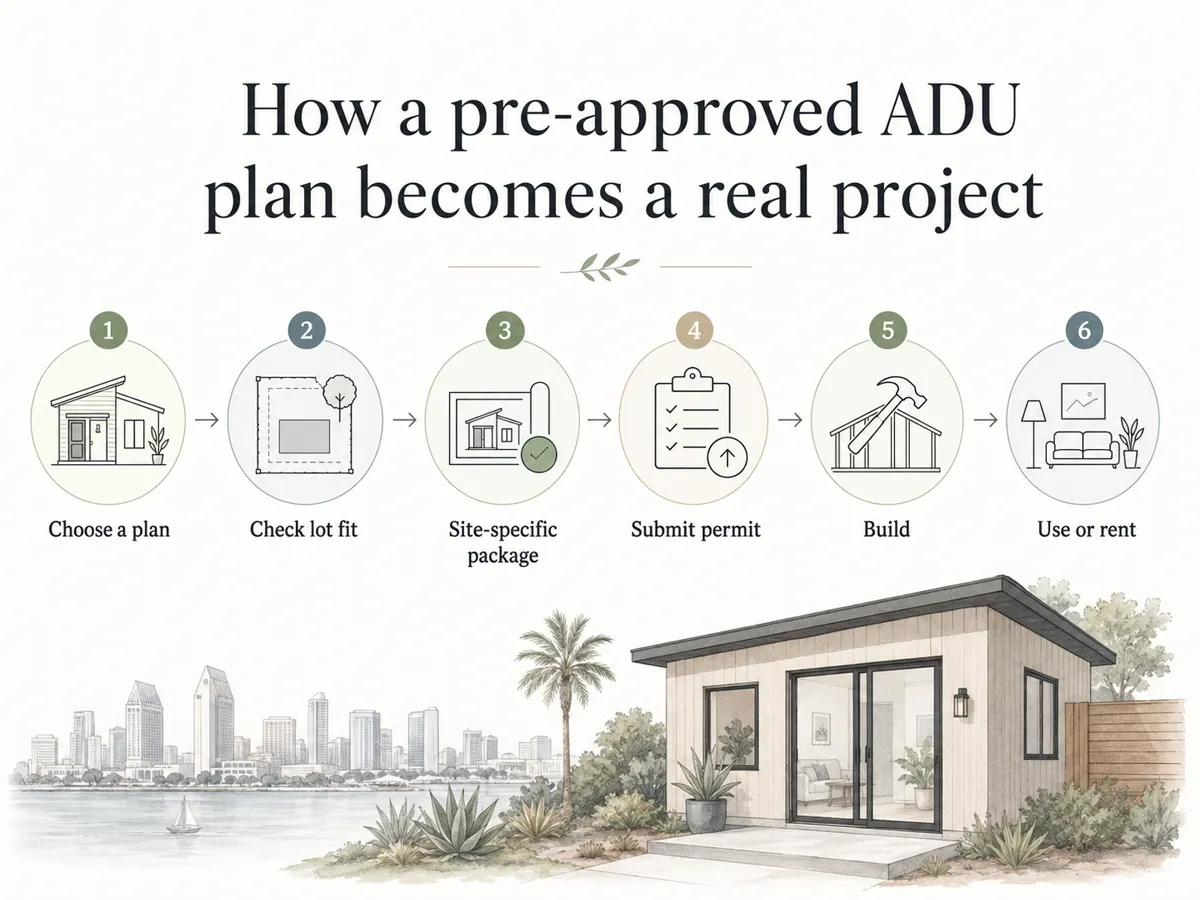
Realistic timeline by phase (Dwelling Index editorial estimates)
| Phase | Pre-approved plan path | Custom plan path |
|---|---|---|
| Plan selection / design | 0–4 weeks (already designed) | 8–16 weeks (custom design) |
| Site-specific package preparation | 4–8 weeks | Concurrent with design |
| Plan check (AB 1332 30-day window starts on complete submission) | 30 days target; 30–60 days realistic with corrections | 60–120 days |
| Permit issuance | 1–2 weeks after approval | 1–2 weeks |
| Construction | 16–32 weeks | 16–32 weeks |
| Final inspection / certificate of occupancy | 1–2 weeks | 1–2 weeks |
| Total: plan selection to occupancy | 6–12 months | 8–16 months |
Timeline ranges are Dwelling Index editorial estimates triangulated from regional builder publications; verify your specific project timeline with your reviewing agency and selected builder.
Build cost and rental income reality
A typical detached ADU using a pre-approved plan in the City of San Diego in 2026 costs $300,000–$450,000 all-in (construction + soft costs + site work + permits) — based on multiple regional design-build cost publications cross-referenced for 2026. The construction cost does not vary meaningfully based on whether you started from a pre-approved plan or a custom design.
All-in cost ranges (Dwelling Index estimates triangulated from 2026 sources)
| ADU type | Size | All-in cost range (2026) |
|---|---|---|
| Garage conversion (JADU or attached ADU) | 300–500 sq ft | $120,000–$180,000 |
| Small detached ADU | 500–750 sq ft | $250,000–$320,000 |
| Mid-size detached ADU | 750–1,000 sq ft | $300,000–$380,000 |
| Large detached ADU | 1,000–1,200 sq ft | $350,000–$450,000+ |
Sources: SnapADU 2026 cost guide; Streamline Design Group San Diego ADU cost data 2026; Better Place Design + Build 2026 cost data. Verified May 8, 2026.
Illustrative rental benchmarks for ADU-sized units
These ranges describe rental benchmarks for ADU-sized units across much of the City of San Diego — derived from broader San Diego rental market data, not exclusively from ADU-only comparable sets.
| ADU size | Submarket low | Submarket median | Submarket high |
|---|---|---|---|
| Studio (224–500 sq ft) | $1,800/month | $2,200/month | $2,800/month |
| 1-BR (500–800 sq ft) | $2,200/month | $2,700/month | $3,300/month |
| 2-BR (800–1,000 sq ft) | $2,800/month | $3,300/month | $3,800/month |
| 3-BR (1,000–1,200 sq ft) | $3,400/month | $3,900/month | $4,500/month |
Sources: 2026 San Diego rental market data including Rentometer average rent benchmarks and other 2026 regional rental publications; ranges adjusted for ADU-typical unit sizes. Coastal-proximity submarkets trend toward the high end. Verified May 8, 2026.
Disclaimer: These are illustrative examples, not guarantees of returns. Actual results depend on local market conditions, ADU finishes, neighborhood, regulatory environment, and rental market trends.
The City of San Diego prohibits short-term residential occupancy (rental terms under 31 days) for ADUs and JADUs.
SDHC’s ADU Finance Program: the moderate-income financing path
The San Diego Housing Commission’s ADU Finance Program offers construction-to-permanent loans up to $250,000 plus free technical assistance to moderate-income City of San Diego homeowners building an ADU on their property. In exchange, the homeowner agrees to keep the ADU’s rents affordable to tenants earning up to 80% of Area Median Income (AMI) for seven years. The program funds one ADU per property and excludes rentals to family members during the affordability period (San Diego Housing Commission ADU page, verified May 8, 2026).
SDHC Finance Program criteria (verify current with SDHC)
- Property must be in the City of San Diego
- Owner-occupied primary residence required
- Income limits apply (verify current limits with SDHC; limits update annually)
- Minimum credit score required (current published threshold around 680; verify with SDHC)
- Application fee due at construction-loan closing
- Affordable rent restriction: 7 years, tenants up to 80% AMI
- Affordable rent definition: 30% or less of tenant's monthly household income
Source: San Diego Housing Commission ADU page. Verified May 8, 2026. Specific income limits, credit thresholds, and program availability are subject to change — always confirm current eligibility directly with SDHC at adu@sdhc.org before relying on these figures.
The program pairs especially well with the four SDHC ADU template plans because both are designed for the same homeowner profile: City of San Diego owner-occupants who want a streamlined path to building their first ADU. For homeowners who don’t fit SDHC’s income or owner-occupancy criteria, the alternative financing paths (cash-out refinance, HELOC, construction loan, home equity investment) are covered in our ADU Financing Options guide.
What we verified
This guide combines verified primary-source facts and clearly-labeled Dwelling Index editorial framework. We separate them transparently so you know what’s documented and what’s our analysis.
Verified against primary sources (verified May 8, 2026)
| Verified fact | Primary source |
|---|---|
| City of San Diego accepts County, Chula Vista, and Encinitas pre-approved plan libraries; 30-day review applies; applicants must contact ADU provider for licensing cost | City of San Diego DSD ADU/JADU page |
| City of San Diego ADU minimum submittal items, ADU size and setback rules, parking exceptions, solar requirements, fire sprinkler treatment, short-term-rental prohibition | City of San Diego DSD Information Bulletin 400 |
| County of San Diego Standard ADU Plans inventory (A–F ADU plans, G–H SFD-only) and 'approximately 85% complete' statement | San Diego County PDS Dwelling Unit Building Plans |
| Chula Vista 12 standard plan options across six base layouts; designer-licensing requirement; 14-business-day in-Chula-Vista review and approximately $1,000 plan-review fee savings inside Chula Vista | City of Chula Vista DSD ADU page |
| Encinitas 8 PRADU plans by Design Path Studio and DZN Partners; site-specific plans required; modifications disqualify pre-approved review; PRADU plans updated to current code | City of Encinitas DSD ADU page |
| SDHC 4 ADU template sets with initial DSD approval; site-specific review required; not authorized outside City of San Diego; ADU Finance Program $250,000 cap, 7-year affordability commitment | San Diego Housing Commission ADU page |
| AB 1332 / Government Code §65852.27 mandatory 30-day approve-or-deny window for qualifying detached ADU applications using qualifying pre-approved plans within current triennial code cycle | CA Government Code §65852.27 |
| AB 462 (2025) introduced 60-day CDP clock for ADU coastal applications, processed concurrently with the ADU application | California AB 462 (2025) |
| Carlsbad permit-ready ADU plans currently unavailable while updated to 2025 code; updated plans anticipated summer 2026 | City of Carlsbad ADU Permit-Ready Program page |
| 2025 California Building Standards Code current effective date (January 1, 2026) | California HCD ADU resources |
Labeled as Dwelling Index editorial framework or estimate
| Editorial item | What we did |
|---|---|
| 80%/30% framework (plan covers 80% of submittal, 30% of project) | Editorial framework based on standard San Diego ADU project breakdowns and IB 400 minimum submittal list |
| $5,500–$18,000 net savings band | Worked methodology shown above; line items derived from regional design-build cost guidance and IB 501 fee schedule |
| 60–90 day full permit issuance estimate; 6–12 month total project estimate; 4–8 month construction estimate | Triangulated from regional builder publications; not a primary-source City of San Diego figure |
| All-in cost ranges by ADU size | Cross-referenced from multiple 2026 San Diego design-build cost publications |
| Rental benchmarks for ADU-sized units | Derived from broader San Diego rental market data, not exclusively ADU-specific comparable sets |
| 'Roughly one-third of homeowners are a clean fit' | Editorial estimate based on regional lot-condition prevalence (Coastal Overlay Zone reach, VHFHSZ, slope and irregular lots) |
Claims attributed to a single source
| Claim | Source |
|---|---|
| Chula Vista and San Marcos publicly posted plan sets are not currently permit-ready under the 2025 code cycle without per-project update | SnapADU April 2026 guide — designer of record for both libraries |
| Encinitas PRADU launch upfront savings range of $10,000–$18,000 | The Coast News Encinitas PRADU launch coverage (2019); Encinitas-specific and includes Encinitas-specific fee waivers |
We use this transparency standard so you can decide for yourself which claims to weight heavily. Last updated: . Last verified: May 8, 2026. Next scheduled verification: August 8, 2026 (quarterly cadence).
Frequently Asked Questions
Does the City of San Diego have its own pre-approved ADU plans?
The City of San Diego itself does not produce its own pre-approved ADU plan library. Instead, the City's Development Services Department accepts pre-approved plans from three external sources: County of San Diego, City of Chula Vista, and City of Encinitas. The San Diego Housing Commission separately publishes 4 template sets with initial DSD approval that can be used inside City limits.
Are pre-approved ADU plans free in San Diego?
The plan files themselves are free for County of San Diego plans (downloaded directly from the County PDS website) and for Encinitas PRADU plans (downloaded from the City of Encinitas DSD page). City of Chula Vista standard plans require a license agreement with the designer of record (SnapADU); the City directs applicants to contact the designer for current licensing terms. None of the libraries makes the project free — every project still requires site-specific site plan, Title 24 energy compliance, structural calculations, and foundation engineering.
Are San Diego pre-approved ADU plans still valid under the 2025 code cycle?
It depends on the library. Encinitas's PRADU page states its plans are updated to current building code requirements. The County of San Diego does not publicly post a 2025 code-cycle compliance certification per plan; verify with County PDS. SnapADU's April 2026 advisory states the publicly posted Chula Vista and San Marcos plan sets are not currently permit-ready under the 2025 cycle without per-project update. Carlsbad confirms plans currently unavailable, with updates anticipated summer 2026. Always verify the specific plan you're using with the city DSD plan-check counter or the listed designer of record before relying on the AB 1332 30-day path.
Does AB 1332's 30-day approval apply to attached ADUs?
No. Government Code §65852.27 specifies that the 30-day approve-or-deny shot clock applies to applications for detached ADUs that use a qualifying pre-approved plan. Attached ADUs and JADUs are processed under separate ministerial timelines now codified at Government Code §§66317 and 66320 (the recodified ADU/JADU framework), which give local agencies 60 days to act on a complete application.
Can I use Encinitas PRADU plans if I live outside Encinitas?
For projects inside the City of San Diego, yes — the City of San Diego DSD explicitly accepts Encinitas PRADU plans as a pre-approved source. For projects in other San Diego County cities, acceptance varies. Verify directly with your local DSD before relying on a PRADU plan in any city other than Encinitas or City of San Diego.
Can I use San Diego County plans inside the City of San Diego?
Yes. The City of San Diego DSD explicitly accepts the County of San Diego Standard ADU Plans (Plans A through F) as a pre-approved source. Plans G and H are designated single-family-dwelling-only and exceed the 1,200 sq ft ADU maximum; they cannot be used as ADUs.
How long does an ADU permit actually take in San Diego with a pre-approved plan?
The AB 1332 review window is 30 days from receipt of a complete application. In our editorial estimate, most City of San Diego pre-approved-plan permits issue in 60–90 days total, accounting for at least one round of plan-check corrections on site-specific items. The full project from plan selection to certificate of occupancy typically takes 6–12 months. For Coastal Overlay Zone projects requiring a Coastal Development Permit, the AB 462 60-day CDP clock applies and runs concurrently with the ADU application.
Are pre-approved plans truly permit-ready?
No. The County of San Diego states its own plans are approximately 85% complete. Encinitas's PRADU documentation similarly notes that site-specific information must be added. Pre-approved plans cover the building itself — site plan, soils where required, foundation engineering, utility tie-ins, Title 24 documents, and applicable forms remain the homeowner's responsibility. Pre-approval reduces design effort, not project effort.
Does the 30-day approval apply if my property is in the Coastal Zone?
Coastal Overlay Zone projects may require a Coastal Development Permit. AB 462 (2025) introduced a 60-day approve-or-deny clock on ADU CDP applications and requires concurrent processing with the ADU application. The CDP itself is not subject to AB 1332's 30-day rule. The City's coastal-zone ADU rules are also subject to ongoing California Coastal Commission certification per City of San Diego IB 400.
What if my city's pre-approved plans are out of date?
Verify code-cycle compliance with the city's plan-check counter or the listed designer of record before proceeding. If the plan is non-compliant under the current 2025 California Building Standards Code cycle, your three options are: (a) wait for the city to fund a public-library refresh, (b) retain the original designer to update the plan under contract for your specific project, or (c) pivot to a semi-custom path. SnapADU's April 2026 public advisory flagged the publicly posted Chula Vista and San Marcos plan sets as needing per-project update. Carlsbad confirmed in 2026 that updates are anticipated summer 2026.
Can I sell my ADU separately from the main house if I use a pre-approved plan?
Yes, in jurisdictions that have adopted Assembly Bill 1033. The County of San Diego Board of Supervisors voted unanimously on March 4, 2026 to adopt a program allowing separate sale of ADUs in unincorporated areas through a condominium conversion process. The City of San Diego allows separate sale through subdivision into condominium units. Two important City of San Diego rules: for 30 days following the initial listing, for-sale ADUs must be offered to buyers who intend to occupy the unit as their primary residence, and ADUs developed through the City's ADU Home Density Bonus Program are not eligible for separate sale.
What is the smallest accepted pre-approved ADU plan?
The smallest plan in any of the three City-of-San-Diego-accepted libraries is the DZN Partners 224 sq ft Studio PRADU plan from the City of Encinitas program. The City of San Diego's minimum gross floor area for any ADU is 150 sq ft.
What is the largest accepted pre-approved ADU plan?
The largest plans are tied at 1,200 sq ft: County Plans A (3-BR/1-BA), B (2-BR/1-BA), and C (2-BR/2-BA). The largest Encinitas PRADU is the DZN Partners 3-BR at 1,199 sq ft; the largest Chula Vista standard plan is also 1,199 sq ft (the L-Shape). The City of San Diego's maximum gross floor area for a detached ADU is 1,200 sq ft.
Does my ADU need solar panels?
Per the California Energy Code, newly constructed non-manufactured detached ADUs are subject to solar PV requirements. The California Energy Commission allows the panels to be installed on either the ADU itself or the primary dwelling. Conversion ADUs (built within existing space) and JADUs are typically exempt. Verify your specific project's solar requirements with City of San Diego DSD before relying on this summary.
Can I rent my ADU on Airbnb or Vrbo?
No. The City of San Diego prohibits short-term residential occupancy (rental terms under 31 consecutive days) for ADUs and JADUs. This is a hard rule. Long-term rental is permitted and is the basis for most ADU investment cases.
Will using a pre-approved plan reduce my impact fees?
The plan source itself doesn't change impact fees. What changes impact fees is plan size. Per California Senate Bill 13, ADUs at 750 square feet or smaller are exempt from local development impact fees. County Plan F (600 sq ft) and Encinitas DZN Partners 499 sq ft 1-BR keep you under the threshold; County Plan E (800 sq ft) is over the threshold and may incur impact fees if your project triggers them in your zone.
What's the difference between PRADU and pre-approved plans?
"PRADU" is specifically the City of Encinitas's Permit-Ready Accessory Dwelling Unit Program, which produces 8 free pre-approved plans by Design Path Studio and DZN Partners. "Pre-approved plans" is the broader category — including the County of San Diego Standard ADU Plans, City of Chula Vista Standard ADU Plans, City of Encinitas PRADU plans, SDHC templates, and any other locally-approved plan library across California's cities and counties.
Do the August 2025 Bonus ADU reforms change my pre-approved plan options?
For most homeowners building one or two ADUs on a single-family lot with the base-state path, no — the 30-day pre-approved-plan review, the 26 accepted plans, and the base setbacks and size limits all remain. The reforms the City Council adopted on July 22, 2025 (effective August 22, 2025 outside the Coastal Overlay Zone) reshaped the ADU Home Density Bonus Program: lot-size-based caps of up to 4 ADUs on lots up to 8,000 sq ft, up to 5 on lots 8,001-10,000 sq ft, and up to 6 on lots over 10,000 sq ft; eight RS zones (RS-1-1 through RS-1-4 and RS-1-8 through RS-1-11) made ineligible except in High/Highest CTCAC Opportunity Areas; mandatory fire sprinklers on all Bonus ADUs; a Community Enhancement Fee on Bonus and Affordable ADUs under 750 sq ft; and parking for Bonus ADUs outside Transit Priority Areas. Inside the Coastal Overlay Zone, implementation is pending California Coastal Commission approval, so Coastal projects continue under the pre-August 2025 rules for now.
Methodology
The Dwelling Index is an independent research resource covering ADU financing, costs, and regulations. We are not a builder, a lender, a designer, or a broker. We don’t take pay-to-play placements. We do work with vetted partners (disclosed at every mention), and our editorial recommendations are independent of those partnerships.
This guide was assembled by:
- Direct fetch and review of every primary source listed above on the verification date
- Statutory analysis of California Government Code §65852.27, AB 1332 (Carrillo, 2023) as recodified within the current ADU framework by SB 477, AB 462 (2025), and supporting administrative guidance from SANDAG, California Building Officials (CALBO), and HCD's 2026 ADU Handbook
- Cross-reference of each plan library's published inventory against the City of San Diego DSD's current accepted-plan list
- Code-cycle compliance verification using the California Building Standards Commission's current cycle posting and current designer-of-record advisories
- Cost-and-timeline triangulation across multiple 2026 San Diego builder publications, the City's published fee schedule (Information Bulletin 501), and regional rental market data, transparently labeled as Dwelling Index estimates rather than primary-source figures
- Editorial framework built around the four-filter homeowner decision question, structured for active-planning readers who want to make a decision they won't regret
For our full editorial standards and corrections process, see /editorial-standards/ and /corrections/. For our partner vetting policy, see /partner-vetting-policy/.
Source notes
Primary sources consulted for this guide (all verified May 8, 2026):
- City of San Diego Development Services Department, Accessory Dwelling Unit / Junior Accessory Dwelling Unit page
- City of San Diego Development Services Department, Information Bulletin 400 (Accessory Dwelling Unit permit guidance)
- City of San Diego Development Services Department, Information Bulletin 501 (fee schedule)
- City of San Diego Development Services Department, Information Bulletin 114a (master plan production process)
- San Diego County Planning & Development Services, Dwelling Unit Building Plans
- City of Chula Vista Development Services Department, Accessory Dwelling Units page
- City of Encinitas Development Services, Accessory Dwelling Units / PRADU program page
- California Government Code §65852.27 (added by AB 1332, recodified within the current ADU framework by SB 477)
- California AB 462 (2025) (60-day Coastal Development Permit clock for ADUs, concurrent processing)
- SnapADU, San Diego pre-approved ADU plans guide (April 2026)
- Design Path Studio, City of Encinitas PRADU portfolio
- The Coast News, Encinitas PRADU program launch coverage (January 2019)
- San Diego Housing Commission, ADU page
- City of Carlsbad ADU Permit-Ready Program page
- San Diego Municipal Code Chapter 14, Article 1, Division 3 (ADU regulations); §131.0422 (zone setbacks); §141.0302 (ADU regulations and home density bonus)
- California Department of Housing and Community Development (HCD), 2026 ADU Handbook
- California Building Standards Commission (2025 California Building Standards Code rulemaking cycle)
- Regional 2026 cost data: Streamline Design Group; Better Place Design + Build
- Rental benchmark data: Rentometer and other 2026 regional rental publications
Related guides
- Real San Diego ADU all-in cost ranges
- How to finance the $300K–$450K all-in cost
- HELOC route for ADU construction
- The City's accepted pre-approved ADU plan libraries
- The City Standard ADU plan path explained
- The Encinitas PRADU program inventory
- The County's six standard ADU plans
- How much does an ADU cost?
- Custom alternatives if a pre-approved plan doesn't fit
- Prefab ADU paths as an alternative to pre-approved site-built plans
Not sure where to start?
See what’s possible at your address — get your free ADU report in 60 seconds.
Get Your Free ADU Report →Free. No call required. We pull your jurisdiction, zone overlays, and buildable footprint.