
Escondido Pre-Approved ADU Plans: Which PAADU Option Fits Your Lot in 2026?
Escondido offers four free pre-approved ADU plans through its PAADU program: a 484 sq ft studio, a 644 sq ft 2-bedroom/1-bath, an 851 sq ft 2-bedroom/2-bath, and a 1,000 sq ft 2-or-3-bedroom unit. The plans themselves cost nothing to download. Escondido is also unusually friendly on fees because qualifying ADUs are exempt from wastewater, water, traffic, public facility, drainage, and park development impact fees under Article 70 — roughly a $32,500 exemption. Plan to spend $190,000–$625,000+ all-in by the time construction is done, and budget three to six months for permit approval — that’s the City’s own published timeline, not ours.
AB 1332 promises a 30-day approval clock, but only after your application is complete. Reaching “complete” is where the months go. Below, we decode all four plans, walk every fee and cost threshold, and tell you exactly when PAADU is the right call — and when it isn’t.
By The Dwelling Index Editorial Team · · Last verified against City of Escondido sources: May 11, 2026
Independent ADU research. We may earn commissions from partner links — that compensation never changes which plans or providers we recommend. Read our affiliate disclosure.
What We Verified — May 11, 2026
- 4 PAADU plans active: City of Escondido PAADU page — 484, 644, 851, and 1,000 sq ft detached single-story plans by RRM Design Group
- Article 70 fee exemption (~$32,500): Escondido 2025 Fee Guide (Sept 16, 2025) — ADUs exempt from wastewater, water, traffic, public facility, drainage, and park fees
- 3–6 month approval timeline: PAADU Brochure — City’s own published range; AB 1332 30-day clock starts after application is “complete”
- No owner-occupancy requirement: PAADU FAQ — AB 976 (effective Jan 1, 2024) permanently eliminated owner-occupancy requirements; Fee Guide still contains older conflicting language
- No parking required: Article 70 — City will not impose parking standards for ADUs or JADUs
- SDCWA Capacity Charge (Jan 1, 2026): $6,501 for 5/8” or 3/4” meter; $10,402 for 1” meter (where a new meter is required)
Escondido pre-approved ADU plans: the short answer
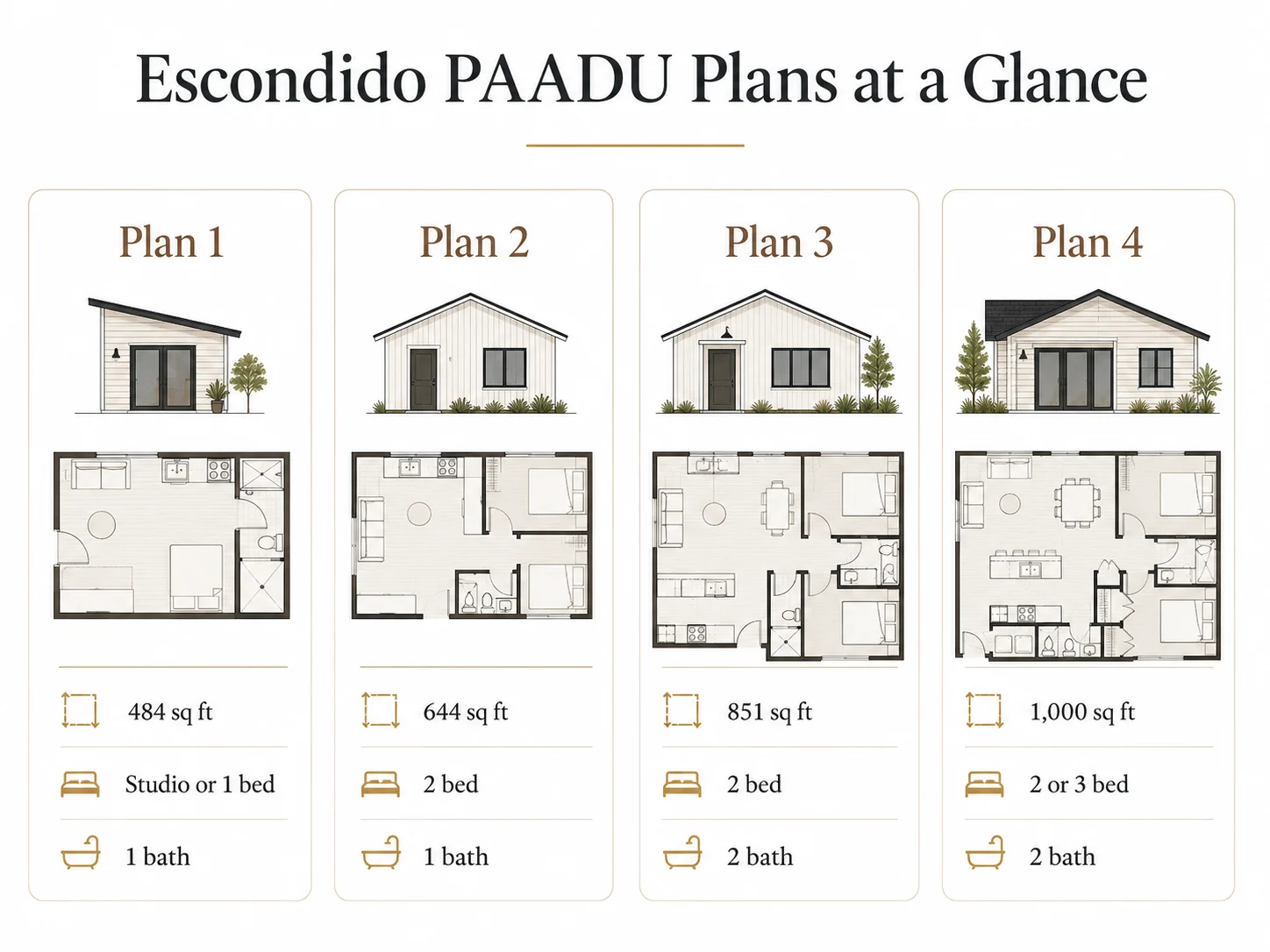
Escondido PAADU plans at a glance
Sources: City of Escondido PAADU Brochure; SnapADU PAADU plan pages. Verified May 11, 2026.
| Plan | Official size | Beds / baths | Layout shape | Best for | Watch out |
|---|---|---|---|---|---|
| Plan 1 | 484 sq ft | Studio (optional 1-bed) / 1 bath | Square (22 × 22 ft) | Smallest footprint; office, guest suite, single-occupant rental | Studio flexibility only; school-fee threshold at 500 sq ft |
| Plan 2 | 644 sq ft | 2 bed / 1 bath | Narrow rectangular | Two-bedroom on a narrow lot; adult-child housing | One bathroom; crosses 500 sq ft school-fee threshold |
| Plan 3 | 851 sq ft | 2 bed / 2 bath | Square | Long-term rental with two baths; multigenerational | Crosses 750 sq ft impact-fee threshold (Gov. Code §66311.5) |
| Plan 4 | 1,000 sq ft | 2 bed (optional 3) / 2 bath | Larger rectangular | Maximum bedroom flexibility; top-of-market rental | Biggest site impact; school fees apply; highest all-in cost |
Run the Lot-Fit Checker before you pick a plan
See which of the four PAADU plans your specific lot can accept inside required setbacks, what fire-zone and HOA flags apply, and whether you should be looking at semi-custom instead. Runs against your address in about 60 seconds.
Open the Escondido PAADU Lot-Fit Checker →60-second address check. No phone call. No commitment.
Does Escondido have pre-approved ADU plans?
The legal driver behind PAADU is California Assembly Bill 1332 (Carrillo, 2023), codified at Government Code §65852.27, which required every California jurisdiction to offer pre-approved ADU plans by January 1, 2025. Escondido didn’t wait — the City had already started work in 2020 under its Sixth Cycle Housing Element, Program 2.1, which targets accessory housing as a way to add lower- and moderate-income units without changing neighborhood character.
What AB 1332 actually buys you: when an application uses one of these pre-approved plans, the local agency must approve or deny the application within 30 days of the application being complete. Those last two words do a lot of work. We’ll come back to them.
Plain-English rule: “Pre-approved plan” means the plan starts closer to ready. It does not mean your property is ready. The City has reviewed the building. The City has not seen your lot.
Who developed the plans
RRM Design Group, a California-based architecture and planning firm, drew the four plans under contract to the City. The plans went through structural engineering and code review at the City level. As of May 11, 2026, all four PAADU plan sets are still posted by the City for download at escondido.gov/1207.
Before you submit — current code cycle check: AB 1332’s 30-day approval clock applies to plans pre-approved within the current triennial California Building Standards Code rulemaking cycle. Before submitting, confirm with the Escondido Building Division at (760) 839-4647 that your selected PAADU plan qualifies under the current code cycle.
What plan types are included — and what isn’t
The four PAADU plans are detached, single-story, new-construction ADUs. The program does not include:
- Attached ADUs
- Garage conversions
- ADUs above an existing structure (over-garage ADUs)
- Two-story ADUs
- Prefab, modular, or HUD-manufactured units
- Junior ADUs (JADUs)
- Any customization that changes the building footprint, exterior dimensions, or structural layout
If your project needs any of the above, you can still build an ADU in Escondido — but you’ll go through the standard custom process, not PAADU.
The 4 PAADU plans, decoded
We pulled the dimensions, options, and intended use cases for each plan directly from the City’s published PAADU Brochure and cross-referenced layout descriptions against the four individual PAADU plan pages on SnapADU.
Plan 1 — 484 sq ft studio / optional 1-bedroom
Plan 1 is a 22-by-22-foot square footprint. Inside, you’ll find a kitchen/dining area (12’6” × 13’), a living room (12’6” × 9’), a bedroom or studio area (8’ × 9’6”), a full bathroom (8’ × 5’), a small closet (8’ × 2’), and a laundry alcove (5’6” × 3’). Options let you pick a covered porch or no porch, a left-side or right-side entry, a 5’ window or 5’ sliding door, side-by-side or stacked laundry, and a tub or 3’ × 5’ shower.
Best fit: A homeowner who wants the lowest-footprint detached ADU possible — for a parent, a single adult child, a home office, a guest unit, or a simple one-tenant long-term rental. The compact 484 sq ft footprint fits on more lots than any other PAADU plan.
Strongest financial angle: Plan 1 is the only PAADU under 500 sq ft of interior livable space, which means it falls outside the threshold where school districts may levy school impact fees. Combined with Escondido’s Article 70 ADU exemptions, this is the cheapest of the four plans to permit by a meaningful margin.
Plan 2 — 644 sq ft, 2-bedroom / 1-bath
Plan 2 is a narrow rectangular two-bedroom layout. It packs two real bedrooms, one full bath, a living area, and a kitchen into 644 square feet. The narrow profile makes it the best PAADU choice for long, narrow lots where Plan 1’s 22-foot face won’t fit cleanly.
Best fit: Households or rentals where bedroom count matters more than bathroom count. Typical use cases include an adult child with their own room, a parent plus a caregiver, a two-person rental, or a home office plus guest room.
Watch-out — one bathroom: Two-bedroom one-bath ADUs typically rent at a discount to two-bedroom two-bath units in San Diego County. If you’re building primarily for rental income, run the rent math against Plan 3 before defaulting to Plan 2.
Still under the impact-fee line: Plan 2 stays at or under 750 sq ft of interior livable space, so under Government Code §66311.5, it’s exempt from local-agency, special-district, and water-corporation impact fees. Combined with Escondido’s Article 70 ADU fee exemption, this is the second-cheapest plan to permit.
Plan 3 — 851 sq ft, 2-bedroom / 2-bath (square)
Plan 3 is a square 2-bed/2-bath layout with a full kitchen and a living area. At 851 sq ft, it’s the balanced middle option — bigger than Plan 2’s compact two-bedroom but well under Plan 4’s footprint, and a square shape that fits a wider, more conventional lot.
Best fit: Multigenerational households where two adults need privacy, long-term rentals where two bathrooms unlock higher rents, or a property owner who plans to age in place in the ADU and rent the main home.
Plan 4 — 1,000 sq ft, 2-bedroom (optional 3-bedroom) / 2-bath
Plan 4 is the largest PAADU at 1,000 sq ft. It features two bedrooms with the option to add a third by partitioning the front of the unit. Two bathrooms, an open kitchen/living/dining area at the front, and an optional covered porch round out the layout. This is the City’s maximum-flexibility plan.
Best fit: Families building for a multi-person household, investors targeting the top of the local long-term rental market, or homeowners who want to combine current family use with future rental optionality. The third-bedroom option is the differentiator — if you need three bedrooms in an ADU, Plan 4 is the only PAADU option.
In long-term-rental markets, a 1,000 sq ft 2-bed/2-bath or 3-bed/2-bath ADU commands meaningfully higher rent than a 644 sq ft 2-bed/1-bath unit in the same neighborhood. The extra construction and fee cost amortizes faster against higher monthly income. Use local rental comparables to model your specific submarket before committing. These are illustrative examples, not guarantees of returns. Actual results depend on local market conditions, construction costs, financing terms, and regulatory approvals.
See your specific lot and which plan fits
Open the Escondido PAADU Lot-Fit Checker →See lot dimensions, setbacks, fire zone, and which PAADU plan likely fits, all from your address.
What “pre-approved” actually covers — and what still has to be reviewed
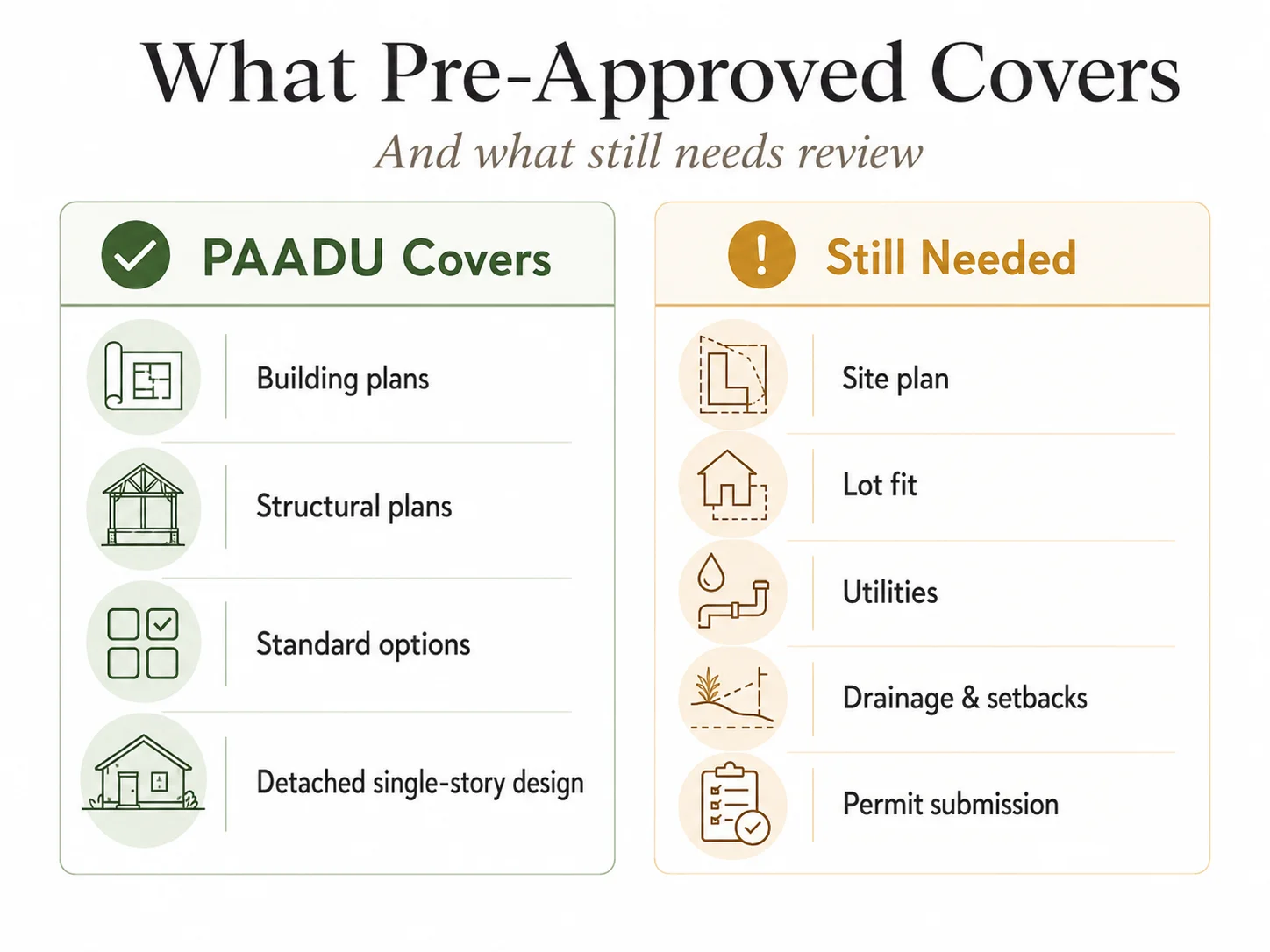
What PAADU does for you
- Provides a complete set of architectural and structural plans drawn by RRM Design Group, including floor plans, elevations, sections, structural sheets, and standard option selections.
- Removes most of the design and engineering uncertainty for the building itself. The plans have already passed Energy Code and Building Code review at the City level.
- Reduces the design fee homeowners would otherwise pay an architect for a similar detached ADU. Custom detached ADU design in San Diego County typically runs $15,000–$25,000; the PAADU plan downloads cost $0.
- Triggers the AB 1332 30-day approval clock — once your full application is complete.
What PAADU does NOT do for you
- It does not draw your site plan. You (or a designer) have to show how the building sits on your lot, where utilities run, where drainage flows, where setbacks land.
- It does not engineer your foundation. Soil conditions, slope, and seismic considerations are site-specific.
- It does not verify your lot can accept the building. If your setbacks or lot coverage don’t allow the plan’s footprint, the pre-approval is irrelevant.
- It does not issue your permit. You still submit through the City’s ProjectDox portal and pay applicable fees.
- It does not waive site-specific reviews — Fire, Engineering, County DEHQ (if on septic), or SDG&E.
- It does not handle HOA approval. If you’re in an HOA, you still have to navigate that separately.
The “PAADU covers / PAADU doesn’t cover” table
Source: City of Escondido PAADU program documentation; PAADU Brochure; PAADU Process Sheet. Verified May 11, 2026.
| ✓ PAADU helps with | ✗ PAADU does not solve |
|---|---|
| Free architectural and structural plan sets | Whether the plan fits your parcel |
| Pre-reviewed compliance with Energy Code and Building Code | Site plan preparation |
| Less blank-page design work | Foundation engineering for your soil |
| Standardized building options | Utility routing and sizing |
| AB 1332 30-day approval clock (once application is complete) | Fire, flood, septic, HOA, and OEN review |
| Reduced design fee vs custom (saves $15K–$25K) | Permit fees, school fees, inspections |
| Faster path to a complete permit application | Construction itself |
The “missing 15%” — what it costs
Homeowners regularly read that PAADU plans are “85% complete” without anyone explaining what the remaining 15% costs. Based on Dwelling Index review of San Diego County ADU project records and design-build firm scopes (2024–2026), the missing 15% typically breaks down like this:
| Site-specific work item | Typical Escondido cost range |
|---|---|
| Site plan drawing | $800–$2,000 |
| Foundation / soils engineering (where required) | $1,500–$3,500 |
| Utility connection plan | $500–$1,500 |
| Drainage plan | $500–$1,500 |
| Optional surveying (lot boundary, easement) | $1,000–$3,000 if required |
| Total typical “missing 15%” | ~$3,500–$6,000+ |
This is still real savings versus the $15,000–$25,000 you’d pay an architect for a fully custom detached ADU design. It’s just not “free.”
The real all-in cost of building an Escondido PAADU in 2026
We assembled the full cost stack from three primary sources: the City’s 2025 Fee Guide (updated September 16, 2025), the City’s Utilities Rates and Fees Schedule (effective January 1, 2026), and SnapADU’s 2026 construction cost analysis for San Diego County.
What Escondido’s Article 70 fee exemption actually waives
Under “Fee Incentives — Accessory Dwelling Units” in the City’s Fee Guide, ADUs built pursuant to Article 70 of the Escondido Zoning Code are exempt from payment of wastewater, water, traffic, public facility, drainage, park, and other development impact fees. This exemption is not unique to PAADU — any Escondido ADU built under Article 70 gets the same fee treatment.
| Standard single-family fee | Standard rate (Escondido) | ADU exempt? |
|---|---|---|
| Wastewater Connection Fee | $7,500 | ✓ Exempt |
| Water Connection Fee (3/4” meter) | $4,690 | ✓ Exempt |
| Traffic Fee (Local) — Single family | $3,047.57 | ✓ Exempt |
| Traffic Fee (Regional RTCIP) — SFD | $4,191.77 | ✓ Exempt |
| Public Facility Fee | $4,969.99 | ✓ Exempt |
| Park Fee — Single-family | $6,986.29 | ✓ Exempt |
| Drainage Facilities Fee | $1,136.12 | ✓ Exempt |
| Total exempted | ~$32,500 |
Source: City of Escondido 2025 Fee Guide, updated September 16, 2025.
Impact-fee exemption does not mean every utility cost disappears. If your ADU triggers a new water meter, SDCWA capacity charges still apply ($6,501 for a 5/8” or 3/4” meter; $10,402 for a 1” meter, per January 1, 2026 rates). Confirm utility scope with the Engineering Department at (760) 839-4651 before relying on the exemption alone.
The owner-occupancy footnote — read carefully. The Fee Guide adds a line to the ADU fee exemption section: “One limitation on these units is that the owner of the property must reside on the parcel on which the unit is located.” This appears to conflict with state law. California AB 976 (effective January 1, 2024) permanently eliminated owner-occupancy requirements for ADUs. The City’s own PAADU FAQ confirms there is no owner-occupancy requirement and cites AB 976. Our read: the Fee Guide language is pre-AB 976 text the City has not yet revised. Confirm in writing with the Escondido Planning Division at (760) 839-4671 before relying on either interpretation for a rental-both-units strategy.
Plan-check and permit fee math by PAADU plan
Permit fees in Escondido are valuation-based. The City’s Fee Guide specifies that ADUs are “calculated in the same manner as fees assessed for residential room additions.” From the 2024 Valuation Multipliers table, V-Wood Frame dwellings are valued at $189.08 per sq ft; the standard AC adder is $7.19 per sq ft. That gives a typical ADU valuation around $196.27 per sq ft. Actual valuation is set by the Building Division at permit issuance.
| Cost item | Plan 1 (484 sf) | Plan 2 (644 sf) | Plan 3 (851 sf) | Plan 4 (1,000 sf) |
|---|---|---|---|---|
| Building valuation @ $196.27/sf | ~$95,000 | ~$126,400 | ~$167,000 | ~$196,300 |
| Building Permit Fee (Table 3-A) | ~$1,660 | ~$2,060 | ~$2,540 | ~$2,860 |
| Plan Check Fee (75%) | ~$1,250 | ~$1,550 | ~$1,900 | ~$2,150 |
| State Energy plan-check surcharge (20% of PC) | ~$250 | ~$310 | ~$380 | ~$430 |
| State Energy inspection surcharge (20% of BP) | ~$330 | ~$410 | ~$510 | ~$570 |
| Planning Plan Review Fee (room-addition rate) | $160 | $160 | $160 | $160 |
| Fire Plan Review + Inspection Fees | ~$660 | ~$698 | ~$698 | ~$698 |
| MEP issuance (10% × 3 trades) | ~$500 | ~$620 | ~$760 | ~$860 |
| Other surcharges (Processing, GP Maintenance, Technology, SMIP, Green Building, Citywide Facilities) | ~$377 | ~$436 | ~$507 | ~$563 |
| Subtotal (City fees only) | ~$5,200 | ~$6,300 | ~$7,500 | ~$8,300 |
Illustrative calculation only — not a quote. Actual fees are determined by the Escondido Building Division at permit issuance. Source: Escondido 2025 Fee Guide (Sept 16, 2025 update).
To this, add school fees — paid directly to Escondido Union School District and Escondido Union High School District before the City issues your building permit (only applies if your ADU exceeds 500 sq ft of interior livable space) — and the SDCWA System Capacity Charge of $6,501 for a 5/8” or 3/4” meter if a new or separate water meter is required.
Construction cost — the big number
The construction itself is the dominant cost. SnapADU, a San Diego County ADU design-build contractor serving Escondido, lists a 2026 turnkey construction cost range of $375–$600+ per square foot for detached ADUs in the County.
| Plan | Sq ft | Vertical build @ $375–$600/sf | Site drawings | City fees + school + utilities | Estimated all-in range |
|---|---|---|---|---|---|
| Plan 1 | 484 | $181,500–$290,400 | $3,500–$6,000 | $6,000–$10,000 | $191,000–$306,000 |
| Plan 2 | 644 | $241,500–$386,400 | $3,500–$6,000 | $9,500–$14,000 | $254,500–$406,000 |
| Plan 3 | 851 | $319,000–$510,600 | $3,500–$6,000 | $12,000–$17,000 | $334,500–$534,000 |
| Plan 4 | 1,000 | $375,000–$600,000+ | $3,500–$6,000 | $13,500–$19,000 | $392,000–$625,000+ |
Construction cost source: SnapADU, Cost to Build an ADU in San Diego, updated March 2026. Sitework, utility upgrades, fire-sprinkler-related premiums, and high-fire-zone requirements can push specific projects above these ranges. These are illustrative estimates, not guarantees.
The honest take on “savings”
PAADU is real savings, just not the savings the marketing implies:
- Design savings (real): You skip $15,000–$25,000 in custom architectural design fees by using free plans.
- Plan-check time savings (real, with caveats): The City’s review focus is on your site-specific work, not the building, which speeds plan check once your application is complete.
- Impact-fee savings (real, but available to non-PAADU ADUs too): Escondido’s Article 70 ADU fee exemptions apply to any compliant ADU, not just PAADU.
- Construction savings (zero): PAADU does not reduce construction cost. Your $/sq ft is what your builder charges to build, regardless of whose plans they’re building from.
Want to compare specific quotes from the Escondido market? SnapADU publishes Escondido PAADU plan pages and offers personalized all-in quotes for builds in Greater San Diego.
See SnapADU’s Escondido PAADU options → Affiliate link — see disclosure.
AB 1332’s 30-day promise vs. Escondido’s 3-to-6-month reality
What AB 1332 says
Government Code §65852.27, added by AB 1332 (Carrillo, 2023), requires every California local agency to “approve or deny an application within 30 days from the date the local agency receives a completed application” if the application uses a pre-approved ADU plan. The bill became effective January 1, 2025. The 30-day shot clock does not start when you submit. It starts when your application has no outstanding deficiencies.
What the City of Escondido actually says
The City’s PAADU Brochure tells homeowners directly: “Approval time for PAADU plans vary on a project by project basis. Generally, it can take anywhere from three to six months to receive permit approval, depending on the revisions to the plans.”
How to shrink the gap
The path to a faster permit is submitting a complete package the first time. The applicants who close fastest tend to:
- Pull all site data before submitting. APN, lot dimensions, existing structures, setbacks, lot coverage, FAR, easements, fire severity zone, FEMA flood zone, septic vs sewer, SDG&E service.
- Engage a designer fluent in PAADU site plans. A few designers in the Escondido market have now drawn site plans for multiple PAADU applications. They know what reviewers flag.
- Pre-clear high-fire or septic conditions. If you’re in a high-fire severity zone, talk to Fire Prevention before submitting. If you’re on septic, get County DEHQ sign-off on capacity first.
- Get HOA sign-off in writing before plan check. HOAs cannot prohibit ADUs (state law), but they can require design conformance. Document this in advance.
- Submit through ProjectDox with the City’s exact file-naming convention. Files with incorrect naming get rejected. Rename each plan file using your permit number exactly as the City’s PAADU page instructs.
Damaging admission: If your project requires fire sprinklers (only required if your primary home is sprinklered), is on septic with capacity questions, sits in the Old Escondido Neighborhood, or has unclear easements — PAADU’s “30 days after complete” promise won’t save you. Those projects spend the same months in iterative review as a custom ADU. PAADU is fastest for clean lots with city sewer, city water, no HOA complications, and no historic overlay.
Which Escondido PAADU plan fits which homeowner
| If your priority is… | And your situation is… | Pick |
|---|---|---|
| Lowest total cost | Single occupant or office use | Plan 1 (484 sf) |
| Lowest footprint | Narrow or constrained lot | Plan 1 if it fits; Plan 2 if you need 2 BR |
| Two bedrooms on a narrow lot | Adult child, two-person rental | Plan 2 (644 sf) |
| Two bathrooms for two adults | Multigenerational, top-tier rental | Plan 3 (851 sf) |
| Maximum bedroom flexibility | Family or premium rental | Plan 4 (1,000 sf, with 3-bed option) |
| Best rental return per dollar | Investor build | Typically Plan 3 (best $/rent ratio in most North County submarkets) |
| Avoiding school fees entirely | Maximizing fee waivers | Plan 1 (only plan under 500 sf interior livable space) |
| Avoiding the §66311.5 impact-fee trigger | Building at or under 750 sf | Plan 1 or Plan 2 |
The plan-match logic, plain English
Pick Plan 1 if you need a true ADU — separate kitchen, bath, living area — but only one occupant at a time. It’s the cheapest plan to permit, the cheapest to build, the easiest to fit on a tight lot, and the only one under the 500 sq ft interior-livable-space threshold that triggers school impact fees.
Pick Plan 2 if you need two real bedrooms and your lot is narrow. The compact rectangular footprint fits on narrow lots where Plan 1’s 22-foot square would crowd setbacks. The one-bathroom trade-off matters more if you’re building for rental than for family.
Pick Plan 3 if you want two bedrooms and two bathrooms — for two unrelated adults, for a true multigenerational household, or for the rental market where two baths command a premium.
Pick Plan 4 if you need three bedrooms (using the optional partition), or you want the maximum-rent unit. If budget is tight, this plan is the hardest to make pencil.
Pick none of them — go semi-custom — if your lot can’t accept the footprint within setbacks, you want a different room layout, you want an attached or two-story ADU, you’re doing a garage conversion, or you want a prefab/modular unit.
Run the plan-match against your actual address
Open the Escondido PAADU Lot-Fit Checker →See lot dimensions, setbacks, fire zone, and which PAADU plan likely fits, all from your address.
Who should use PAADU — and who shouldn’t (the disqualification matrix)
PAADU disqualification matrix — Escondido-specific triggers
Source: Aggregated from City of Escondido PAADU FAQ, Article 70 (eCode360), PAADU Process Sheet, and the OEN Style Adaptation Guide. Verified May 11, 2026.
| If your project includes… | Use PAADU? | Where to go instead |
|---|---|---|
| Garage conversion | ✗ No | Custom permit path for conversion |
| Attached ADU | ✗ No | Custom attached ADU plans (City Article 70 limits) |
| Prefab or modular ADU | ✗ No | HCD-approved factory plans + local site permit |
| Two-story ADU | ✗ No | Custom design |
| ADU over an existing structure | ✗ No | Custom design |
| Footprint or layout change | ✗ No | Semi-custom or custom |
| Old Escondido Neighborhood with non-historic exterior preference | ⚠ Possible but limited | Custom design or OEN Style Adaptation Guide |
| Septic property with capacity questions | ⚠ Possible but adds DEHQ review | Verify with County DEHQ before plan selection |
| High-fire severity zone | ⚠ Possible but adds Fire pre-clearance | Fire Prevention sign-off first |
| Lot too narrow or shaped to accept any PAADU footprint | ✗ No | Semi-custom design optimized for your lot |
| HOA with active design-conformance standards | ⚠ Possible with HOA approval | Get HOA written sign-off before plan check |
The active design-build firm in the Escondido market with both PAADU-specific and semi-custom catalog options is SnapADU. If you want to compare a semi-custom path to PAADU before committing, that’s where most homeowners start.
Compare SnapADU’s Escondido ADU options → Affiliate link — see disclosure.
For a broader comparison across multiple Escondido design-build firms, see our Best ADU Builders Escondido guide.
Escondido ADU rules that apply on top of PAADU
Even with a pre-approved building, every PAADU project still has to satisfy Escondido’s zoning code (Article 70) and California state ADU law. These come straight from the City of Escondido ADU page, the PAADU Brochure, the PAADU FAQ, Article 70 of the Escondido Zoning Code, and current state ADU law. Verified May 11, 2026.
Setbacks
Detached ADUs require a minimum 4-foot setback from side and rear property lines. Front setbacks follow the underlying zoning district. Fire-separation conditions or slope can push you further.
Maximum size
Per Article 70, Escondido caps detached ADUs at 850 sq ft for one-bedroom-or-less ADUs on lots under 20,000 sq ft, 1,000 sq ft for more-than-one-bedroom ADUs on lots under 20,000 sq ft, and 1,000 sq ft on lots 20,000 sq ft or larger. All four PAADU plans fall within these limits.
Height limits
PAADU plans are single-story only. Escondido allows detached ADUs up to 16 feet in height regardless of underlying zoning.
Parking
No additional parking is required for ADUs in Escondido. Article 70 explicitly states the City will not impose parking standards for an ADU or JADU. Replacement parking is also not required when a garage, carport, or covered parking structure is demolished for an ADU.
Owner-occupancy
No owner-occupancy requirement applies to PAADU or any standard ADU in Escondido. AB 976 permanently eliminated owner-occupancy requirements for ADUs as of January 1, 2024. As noted above, the City’s Fee Guide still contains older owner-occupancy language; confirm current policy with Planning at (760) 839-4671 before relying on it for a rental-both-units strategy.
Rental rules
ADUs may be rented for terms of 30 days or longer. Short-term rentals (under 30 days) are prohibited citywide in Escondido.
Sale of the ADU separately
An ADU may not be sold separately from the primary home. AB 1033 (2023) created a state framework allowing this, but Escondido has not adopted that ordinance as of May 11, 2026.
Solar requirement
Newly constructed detached ADUs are generally subject to California Energy Code solar requirements under Title 24, Part 6. In many cases, the required solar generation can be located on the primary residence rather than the ADU itself. Confirm scope with your installer and the Building Division at plan check.
Fire sprinklers
Fire sprinklers are required in the ADU only if the primary residence has them. If sprinklers are required, a minimum 1-inch water meter, water service, and backflow are also required — which can trigger the SDCWA Capacity Charge ($10,402 for a 1” meter as of January 1, 2026).
Property taxes
The ADU is assessed at its construction value as new construction; the primary home is not reassessed. A rough base-tax estimate is about 1% of the added assessed value per year. Confirm specifics with the San Diego County Assessor at (619) 531-5507.
HOA restrictions
An HOA cannot prevent you from building or renting an ADU. State law (Civil Code §4751) and the City’s PAADU FAQ both confirm this. An HOA may impose “reasonable” restrictions on design conformance — but cannot block the project.
Old Escondido Neighborhood (OEN)
If your property is in the Old Escondido Neighborhood or has historic structures, additional architectural design requirements apply. The City publishes an OEN ADU Style Adaptation Guide with decorative detailing options for six architectural styles: Craftsman, Victorian, Spanish Colonial Revival, Mission Revival, Mid-Century, and Folk Vernacular.
Fire and flood
High-fire severity zones trigger additional fire-department review, ignition-resistant materials, and defensible-space requirements. FEMA flood zones trigger floodplain compliance and elevation requirements. Check your property’s status at the CAL FIRE FHSZ map and FEMA’s Map Service Center before selecting a plan.
Septic vs sewer
Most Escondido properties are on City sewer, but some outer-area parcels are on septic. Properties on septic require San Diego County Department of Environmental Health (DEHQ) review of septic-system capacity for the additional unit. Get the DEHQ letter before plan check.
The Escondido PAADU permit process, step by step
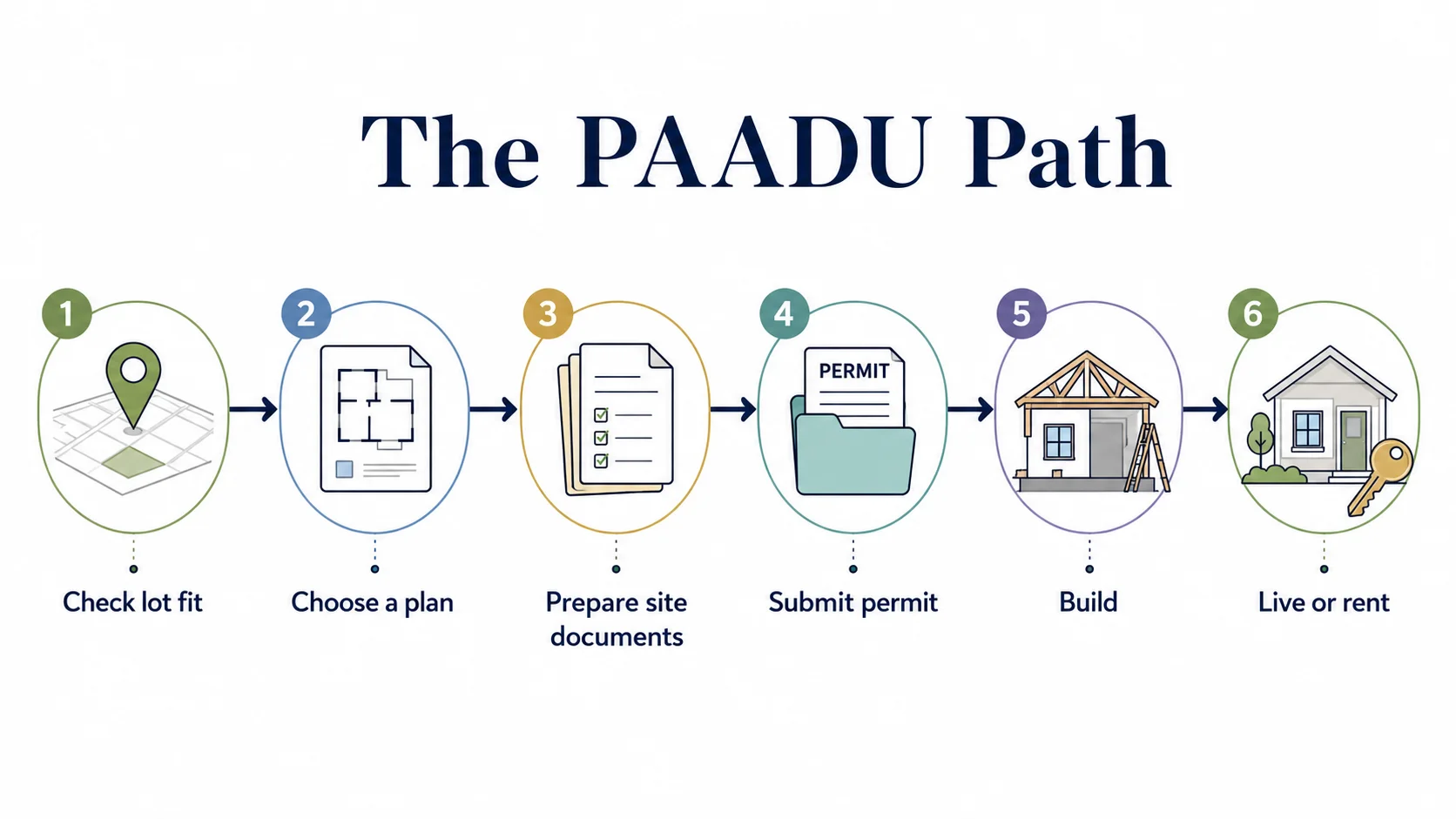
Compiled from the City’s official PAADU Process Sheet, Initial Considerations Handout, Option Selections Handout, and ADU Submittal Checklist. Verified May 11, 2026.
Step 1 — Gather property information
Before you pick a plan, get the data the City will ask for:
- Assessor’s Parcel Number (APN)
- Lot dimensions (width, depth, total sq ft)
- Existing primary residence sq ft
- Existing structures on the lot
- Zoning district
- Lot coverage and FAR
- Fire severity zone status
- FEMA flood zone status
- HOA presence and requirements
- Old Escondido Neighborhood / historic status
- Existing sewer connection (city or septic)
- Existing water meter size
- SDG&E service
Step 2 — Pick a PAADU plan and select options
Use the plan-match matrix above. Then work through the PAADU Option Selections Handout, which lists the specific selections the City pre-approves for each plan: window/door variants, porch options, kitchen layouts, laundry configuration, optional rear door, and other small/cosmetic choices.
Step 3 — Build your permit team
A typical PAADU project involves:
- Licensed contractor (CSLB-licensed) for the build
- Civil engineer or designer for site plan and drainage
- Structural engineer if foundation calcs are required
- MEP engineer if utility runs are complex
- City of Escondido Planning Division (760) 839-4671
- City of Escondido Building Division (760) 839-4647
- Escondido Fire Department (if in a high-fire zone)
- SDG&E (utility notification)
- San Diego County Water Authority (if new meter required)
- San Diego County DEHQ (if on septic)
- Title insurance company (for grant deed and preliminary title report)
- HOA (if applicable)
Step 4 — Prepare the permit submittal package
The City’s ADU Submittal Checklist specifies required documents: PAADU plan cover sheet (selected plan + options), parcel-specific site plan, ADU tracking form, grant deed and preliminary title report (within 30 days), SDG&E Notification Form, Hazardous Wastes Disclosure Statement, exterior photos and materials/colors, plus septic documentation, HOA approval documentation, OEN architectural detailing, or Fire pre-clearance if applicable.
Step 5 — Submit through ProjectDox
Escondido uses ProjectDox for plan submission. Two specific PAADU rules apply: (1) plan files must be uploaded individually, not as a combined PDF, and (2) files must follow the City’s exact naming convention. Rename each plan file using your assigned permit number. Files with incorrect naming get rejected.
Step 6 — Respond to City comments
Plan check generates City comments. You respond, resubmit, and the cycle repeats until the application is “complete.” This is where the 30-day clock waits. Faster turnaround in this step is the single biggest determinant of total elapsed time.
Step 7 — Permit issuance, construction, and inspections
Once approved, the City issues the building permit. You pay fees; the school district collects school fees separately. The contractor schedules required inspections (foundation, framing, plumbing, electrical, mechanical, final). After final inspection, the City issues the Certificate of Occupancy.
Required documents — PAADU permit-readiness checklist
Use this checklist as a final review before submitting through ProjectDox. Every item has been pulled from the City’s official ADU Submittal Checklist and PAADU process documents. Verified May 11, 2026.
| Document | Why it matters | Source |
|---|---|---|
| PAADU cover/title sheet (selected plan + options) | Identifies plan and options | City PAADU process docs |
| Site plan (parcel-specific) | Shows where the building sits, setbacks, easements | City Site Plan Worksheet |
| Existing + proposed structures shown | Required for setbacks, separation, lot coverage | City Submittal Checklist |
| Utility connection info (water, sewer, gas, electric) | City reviews capacity and routing | City Site Plan Worksheet |
| Drainage and topography arrows | Stormwater compliance | City Site Plan Worksheet |
| Grant deed | Ownership verification | City Submittal Checklist |
| Preliminary title report (within 30 days) | Easements, liens, encumbrances | City Submittal Checklist |
| ADU tracking form | City-required ADU documentation | City Submittal Checklist |
| SDG&E Notification Form | Utility coordination | City Submittal Checklist |
| Hazardous Wastes Disclosure Statement | Required disclosure | City Submittal Checklist |
| Exterior photos + materials/colors | Design review (especially OEN) | City Submittal Checklist |
| Septic documentation if applicable | County DEHQ approval | City + County DEHQ |
| HOA approval documentation if applicable | Design conformance | City PAADU FAQ |
| OEN Style Adaptation submittal if in OEN | Historic-district conformance | OEN Style Adaptation Guide |
| Fire dept pre-clearance if in high-fire zone | Defensible space, materials | Escondido Fire Dept. |
| Solar plan (per Title 24) | California Energy Code | CA Title 24, Part 6 |
How to pay for the build
Our editorial framing on ADU financing is detailed in ADU Financing: Every Option Explained. We don’t rank lenders by what they pay us. We present financing as four lanes, sorted by which equity situation each best fits.
Lane 1 — Cash-out refinance
Best for: Homeowners with enough equity to refinance and take cash out, who are willing to take a new rate on the entire mortgage. You refinance the full primary mortgage at current rates and pull out cash to fund the ADU build. Trade-off: If your current mortgage rate is well below current market rates, a cash-out refi resets you to today’s higher rate on the whole loan.
Lane 2 — HELOC or home equity loan
Best for: Homeowners who want to keep the existing primary mortgage rate intact. A HELOC is a revolving credit line secured by your home equity, drawn as needed during construction. A home equity loan is a fixed-rate second mortgage with one lump sum. Trade-off: Variable rates mean your payment can change.
Lane 3 — Construction-to-permanent loan
Best for: The largest builds (Plans 3 and 4), or when equity is thin and you need to finance against the future value of the property post-build. A construction-to-permanent loan funds the build in draws against a future appraised value, then converts to a long-term mortgage once construction is complete. Trade-off: More paperwork, stricter draw schedules, and an appraisal of the future ADU value before funding.
Lane 4 — Cash and reimbursement
Best for: Homeowners with the liquidity to pay out of pocket, especially those chasing grants or rebates that reimburse after the fact. California’s CalHFA $40,000 ADU grant was the most well-known reimbursement-style program for ADUs. The latest round of CalHFA ADU grant funding was fully allocated on December 28, 2023 with no confirmed relaunch date as of May 11, 2026. See our ADU Grants 2026 page for the current state of every verified ADU grant program.
Plan-by-plan financing fit
| Plan | All-in cost band | Typical financing fit |
|---|---|---|
| Plan 1 | $190K–$310K | HELOC, cash-out refi, or cash |
| Plan 2 | $255K–$406K | HELOC, cash-out refi, or construction loan |
| Plan 3 | $335K–$534K | Cash-out refi or construction loan |
| Plan 4 | $392K–$625K+ | Cash-out refi or construction-to-permanent |
Estimates by Dwelling Index based on all-in cost bands above and typical product fit by loan amount. Not a guarantee of approval or rate. Each lender sets its own qualification standards.
Explore mortgage and refinance financing options with Mortgage Research Center → Compare options Affiliate link — see disclosure.
These are illustrative examples of financing structures, not guarantees of returns, rates, or approval. Actual results depend on local market conditions, construction costs, financing terms, and regulatory approvals.
When PAADU is the wrong call — and what to do instead
PAADU is the wrong call when your lot, use case, or design preferences fall outside what the four detached single-story plans cover. The most common “PAADU doesn’t fit” situations we see in Escondido:
Your lot is too narrow or oddly shaped
Plan 1 is 22 × 22 ft. Plans 2 and 4 are rectangular. Plan 3 is square but larger. If your buildable area inside setbacks can’t accommodate any of those shapes, you need a different footprint. A semi-custom design from a local firm can often fit a 600–800 sq ft ADU on a lot where no PAADU plan works.
You want an attached ADU or garage conversion
PAADU is detached new-construction only. Garage conversions are often the cheapest path to add an ADU because the structural shell is already there. Custom plans are required.
You want two stories or an over-garage ADU
The City’s PAADU FAQ confirms PAADU plans are single-story only. If you want a two-story ADU, hire a designer.
You want a prefab or modular ADU
PAADU plans are site-built. Prefab and modular ADUs come with state-pre-approved plans through HCD or the manufacturer.
You’re in the Old Escondido Neighborhood and want a non-historic exterior
You can use a PAADU plan in OEN with the Style Adaptation Guide, but if you want a modern or contemporary exterior, you’re outside what OEN’s design framework will approve.
Where to go from here
For semi-custom catalog ADUs in the Escondido market, SnapADU publishes over 40 floor plans across one-, two-, and three-bedroom configurations and serves every city in San Diego County including Escondido. For a broader comparison of Escondido ADU builders by project type, see our Best ADU Builders Escondido guide.
Frequently asked questions
Are Escondido pre-approved ADU plans really free?
Yes — the plan downloads themselves cost nothing. The City’s PAADU plan sets are available at no charge from the Pre-Approved ADU Program page. What’s not free: site-specific drawings ($3,500–$6,000), permit and plan-check fees (~$5,200–$8,300 illustrative), school fees if your ADU exceeds 500 sq ft of interior livable space, utility upgrades if required, and construction itself ($375–$600+ per sq ft for turnkey builds in San Diego County in 2026).
How long does PAADU approval really take in Escondido?
The City's own PAADU Brochure says approval generally takes three to six months. AB 1332 promises 30 days, but only after your application is "complete." Plan for three to four months if you submit a clean package and respond quickly to comments. Plan for six months or longer if you have site-plan, fire, septic, or HOA complications.
Can I customize an Escondido PAADU plan?
Only within the City's official Option Selections — window and door variants, porch options, kitchen layout choices, laundry configuration, optional rear door, and similar small selections. You cannot move walls, resize rooms, change the building footprint, add a story, or change the structural system.
Can I use PAADU for a garage conversion?
No. PAADU plans are for new, detached, single-story ADUs only. If you want a garage conversion, you need custom plans through the standard ADU permit path.
Can I use PAADU for a prefab or modular ADU?
No. PAADU is site-built only. The City's PAADU FAQ confirms PAADU does not apply to prefabricated ADUs.
Can I build a PAADU over a garage or make it two stories?
No. All four PAADU plans are single-story.
Do Escondido PAADU plans require solar?
Generally yes. Newly constructed detached ADUs are subject to California Title 24, Part 6 solar requirements, with limited exceptions. Required solar generation can often be located on the primary residence rather than the ADU. Confirm scope with your installer and the Building Division at plan check.
Are the Escondido PAADU plans valid under the current California Building Code cycle?
As of May 11, 2026, all four PAADU plan sets are posted for download by the City. AB 1332's 30-day approval clock applies to plans pre-approved within the current triennial California Building Standards Code rulemaking cycle. Confirm with the Escondido Building Division at (760) 839-4647 before submitting.
How much are Escondido school impact fees for an ADU?
For ADUs larger than 500 sq ft of interior livable space, the Escondido Union School District (K–8) and Escondido Union High School District (9–12) may levy school impact fees, paid directly to the districts before the City issues the building permit. Per-square-foot rates change periodically. Confirm current rates with the Carilyn Gilbert Education Center at (760) 432-2382.
Does Escondido require parking for an ADU?
No. Article 70 states the City will not impose parking standards for an ADU or JADU. Replacement parking is also not required when a garage, carport, or covered parking structure is demolished for an ADU.
Can an HOA stop my Escondido ADU?
No. State law (Civil Code §4751) and the City's PAADU FAQ confirm that HOAs cannot prevent the construction or rental of an ADU. HOAs can impose "reasonable" restrictions on design conformance but cannot block the project.
Can I rent my Escondido ADU short-term (under 30 days)?
No. Escondido prohibits short-term rentals citywide. ADUs may be rented for terms of 30 days or longer. No owner-occupancy requirement applies — AB 976 eliminated owner-occupancy requirements for ADUs statewide effective January 1, 2024.
Can I sell my ADU separately from the main home?
Not currently. AB 1033 (2023) created a state framework allowing cities to permit separate ADU sale as condominiums, but Escondido has not adopted that ordinance as of May 11, 2026.
Will building an ADU increase my property taxes?
Yes, partially. The new ADU is assessed at its construction value as new construction; the primary home is not reassessed under California Proposition 13. A rough base-tax estimate is about 1% of the added assessed value, plus voter-approved local assessments. Verify with the San Diego County Assessor at (619) 531-5507.
What if my home is in the Old Escondido Neighborhood?
You can still use a PAADU plan, but you'll apply additional architectural detailing from the City's OEN ADU Style Adaptation Guide, which provides decorative options for six historic styles: Craftsman, Victorian, Spanish Colonial Revival, Mission Revival, Mid-Century, and Folk Vernacular. The adaptation adds an architectural-review layer to your application.
Do I need a permit if I use a PAADU plan?
Yes. PAADU streamlines plan check for the building itself but does not eliminate the building permit.
Who actually builds Escondido PAADU plans?
Any licensed CSLB contractor can build a PAADU. The pre-approval is on the plans, not the builder. SnapADU is an active San Diego County design-build firm serving Escondido that publishes PAADU plan pages. Always verify CSLB license status (Class B General Building) before signing a contract.
What we verified
Last verified: May 11, 2026 (Next scheduled review: August 11, 2026, or earlier if state ADU law, Escondido fee schedules, or PAADU plan availability changes.)
| Verified item | Source | Date checked |
|---|---|---|
| PAADU program structure and plan list | City of Escondido PAADU page | May 11, 2026 |
| Plan dimensions, options, and 3–6 month timeline | City of Escondido PAADU Brochure (PDF) | May 11, 2026 |
| Article 70 ADU fee exemptions and valuation multipliers | City of Escondido 2025 Fee Guide (Sept 16, 2025 update) | May 11, 2026 |
| SDCWA System Capacity Charges (Jan 1, 2026 rates) | City of Escondido Utilities Rates and Fees Schedule | May 11, 2026 |
| Article 70 zoning, parking, setback, max-size rules | Article 70 (eCode360) | May 11, 2026 |
| Required submittal documents | City of Escondido ADU Submittal Checklist (PDF) | May 11, 2026 |
| AB 1332 30-day approval and current-code-cycle requirement | Gov. Code §65852.27 | May 11, 2026 |
| 750 sq ft impact-fee threshold under §66311.5 | Gov. Code §66311.5 | May 11, 2026 |
| 500 sq ft school-fee threshold; solar requirement framing | California HCD ADU Handbook | May 11, 2026 |
| CalHFA grant status (fully allocated Dec 28, 2023) | CalHFA ADU Grant Program | May 11, 2026 |
| Construction $/sq ft range for San Diego County | SnapADU, Cost to Build an ADU in San Diego (March 2026) | May 11, 2026 |
Where the City’s Fee Guide and the PAADU FAQ appear to conflict (specifically on owner-occupancy under AB 976), we noted the conflict and recommended direct verification with the Escondido Planning Division at (760) 839-4671.
About this guide
The Dwelling Index is an independent research resource covering ADU financing, costs, and regulations. We don’t sell plans, builds, or financing. This guide exists to help Escondido homeowners answer one question — “Should I use one of the City’s four free PAADU plans, and what does that actually cost me?” — without having to read every City PDF, parse every fee schedule, and reconcile state law against local documents themselves.
We earn affiliate commissions when readers use links to vetted partners, including SnapADU for Greater San Diego ADU design-build services and Mortgage Research Center for mortgage and refinance options. That compensation never changes which plans or partners we recommend. Our full methodology, partner-vetting policy, and corrections process are public at dwellingindex.com/methodology.
This guide was written and verified by the Dwelling Index editorial team. We do not list fictional authors, credentials, or expert reviewers we don’t have.
Not sure where to start? See what’s possible at your address — free in 60 seconds.
Free, no phone call, no commitment. You’ll see whether one of the four PAADU plans likely fits your lot, what setbacks and rules apply, and what to do next.
See What You Can Build → Get Your Free Escondido ADU ReportWant to compare specific builder quotes after that? Explore SnapADU’s Escondido PAADU options → Affiliate link.
Want the PAADU permit-readiness checklist in your inbox? Download the Free ADU Starter Kit → Includes the document checklist, fee worksheet, and our 14-point CSLB vetting protocol.