
El Cajon Pre-Approved ADU Plans (2026): The Complete Guide to the City’s 3 Free Standard Plans
El Cajon pre-approved ADU plans are three free, city-prepared detached ADU plan sets — a 560 sq ft Studio, a 649 sq ft One Bedroom, and an 802 sq ft Two Bedroom — published together in a single 45-page City PDF, with each plan set running 14 sheets. Using a city standard plan triggers California Government Code §65852.27 (AB 1332), which requires the city to approve or deny a complete detached ADU application within 30 days when it uses a qualifying pre-approved plan. The catch nobody else surfaces clearly: the city’s published Standard Plan PDF references the 2022 California Code and bears print dates of September 14, 2023, while the 2025 California Building Standards Code took effect January 1, 2026. Before relying on the 30-day timeline, confirm with El Cajon Building Safety (619-441-1726, option 2; building@elcajon.gov) that the plan version is accepted under the current triennial code cycle. You still pay city permit and plan-check fees ($906 ADU permit, $1,982 AB 1332 pre-approved plan permit, $567 Title 24 plan check, plus valuation-based fees per the FY26 schedule), site-specific engineering, and construction at roughly $375–$600 per square foot.
Next step: See what you can build at your El Cajon address — get your free ADU report. Free, 60 seconds.
By The Dwelling Index Editorial Team · Methodology · Editorial standards · Corrections
Last updated: May 11, 2026 · Last verified: May 11, 2026 · Next scheduled review: August 11, 2026
Affiliate disclosure: The Dwelling Index is reader-supported. Some links on this page are affiliate links. If you click one and take a qualifying action, we may earn a commission at no extra cost to you. Affiliate relationships do not influence our editorial rankings or conclusions. Read our full disclosure.
What we verified for this guide
- City of El Cajon Standard ADU Plans PDF — 3 plans, 14 sheets each, 45 pages total (May 11, 2026)
- FY26 Planning and Building Department Fee Schedule (published by the city)
- El Cajon ADU Loan Program Guidelines V.6 (reviewed May 11, 2026)
- California Government Code §65852.27 (AB 1332), SB 543, SB 13, SB 1211, AB 130
- HCD March 2026 ADU Handbook and HCD rent limit tables
- El Cajon Municipal Code §17.140.180 (ADU regulations)
El Cajon pre-approved ADU plans at a glance
| Plan | Size | BR | BA | Under 750 sq ft? | Code on PDF | Best fit |
|---|---|---|---|---|---|---|
| Studio Standard | 560 sq ft | 0 | 1 | ✓ Yes | 2022 (printed 9/14/23) | Aging parent, guest suite, lowest-complexity rental |
| 1 Bedroom Standard | 649 sq ft | 1 | 1 | ✓ Yes | 2022 (printed 9/14/23) | Best balance of privacy and under-750 sq ft fee shield |
| 2 Bedroom Standard | 802 sq ft | 2 | 1 | ✗ No (52 sq ft over) | 2022 (printed 9/14/23) | Family use or long-term 2-BR rental; higher fee exposure |
Source: City of El Cajon Standard ADU Plans PDF (45 pages total — Studio pp. 2–16, One Bedroom pp. 17–31, Two Bedroom pp. 32–46). Reviewed May 11, 2026.
Why the 750 sq ft line matters. California SB 13 exempts ADUs of 750 sq ft or smaller from local development impact fees. The Studio (560) and One Bedroom (649) clear that threshold cleanly. The Two Bedroom (802) is 52 sq ft over — which means El Cajon Municipal Code §17.140.180 allows proportional impact fees to be charged.
Verify before you file. The September 2023 Standard Plans reference 2022 California Codes. The 2025 California Building Standards Code took effect January 1, 2026. Whether the posted Standard Plan PDF qualifies for AB 1332’s 30-day timeline is a question every El Cajon applicant should confirm with the city in writing.
Does El Cajon have pre-approved ADU plans?
We confirmed this against the city’s own published documents on May 11, 2026. The PDF is linked from the Planning Permit Information page and the ADU Loan Program page.
A pre-approved plan is a complete architectural plan set the city has already reviewed for general building-code compliance and made available publicly. The architecture is reviewed. Your lot is not. You still have to layer in property-specific information — site plan, foundation engineering tied to soils, utility connections, energy compliance for your specific orientation — before the permit package is complete.
The pre-approved program exists because of California Assembly Bill 1332, which Governor Newsom signed in 2023. AB 1332 required every California local agency — including El Cajon — to establish a preapproval program for ADU plans by January 1, 2025, and to post approved plans on the agency’s website (CA Government Code §65852.27). El Cajon’s three Standard Plans are the city’s response to that mandate.
The three El Cajon Standard ADU Plans, decoded
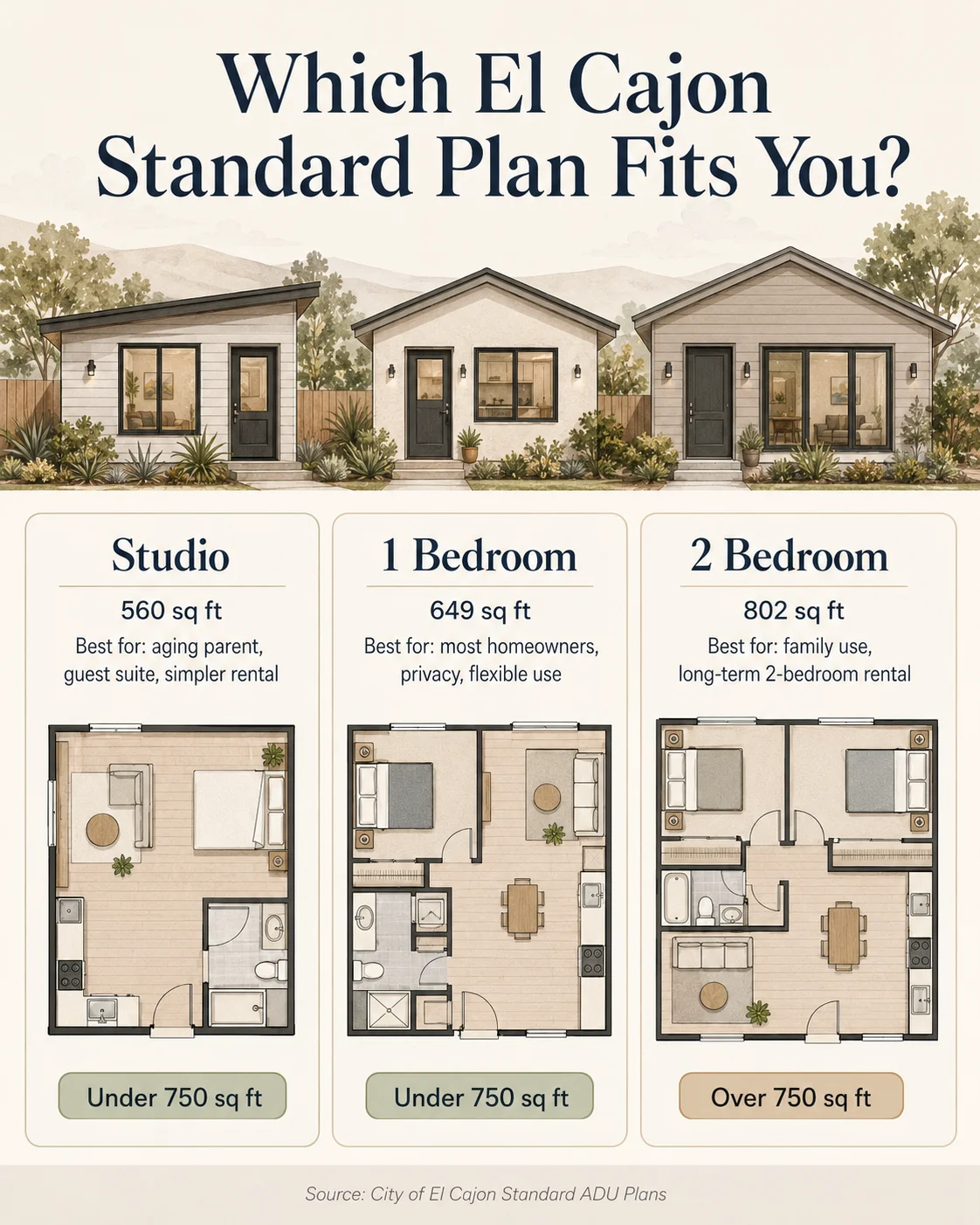
Studio Standard Plan — 560 sq ft
The Studio is an open-concept layout with a full kitchen, full bathroom with in-unit washer/dryer, and enough room for both a living area and a sleeping area. It includes a small side porch and a front porch. Construction type per the plan set: Type V-B, Group R-3. Plain English: standard wood-frame residential construction, single-family residential occupancy.
Best for: Aging parents, multigenerational living arrangements where simplicity matters, a guest suite that occasionally turns into a rental, or the lowest-complexity income property you can build. The Studio is the strongest fit when your top priorities are getting the unit built and minimizing city-fee exposure.
Watch out for: A 560 sq ft studio rents at the lower end of El Cajon’s market range. Median asking rent for studio-class units in El Cajon ran roughly $1,500–$1,800 in early 2026. If maximum long-term rental return is your top goal, the One Bedroom usually wins.
One Bedroom Standard Plan — 649 sq ft
The One Bedroom is the goldilocks plan in the city’s set. It gives renters a real separate bedroom — which commands meaningfully higher rent than a studio — while staying 101 sq ft under the 750 sq ft impact-fee threshold. That gap matters: under SB 13 and El Cajon Municipal Code §17.140.180, ADUs at or under 750 sq ft are not subject to local development impact fees.
Best for: Most general-purpose ADU goals — adult child returning home, a long-term rental targeting a young professional or downsizing tenant, a guest unit that will eventually become rental income. We think the One Bedroom is the default best fit for most El Cajon homeowners.
Watch out for: The published city PDF is laid out at a specific footprint dimension. Confirm that footprint fits your lot before getting attached to this plan. If you can’t site the plan’s footprint within El Cajon’s height-and-setback combinations, the plan won’t work as drawn.
Two Bedroom Standard Plan — 802 sq ft
The Two Bedroom is two separate bedrooms, one bathroom, kitchen, and living area in 802 sq ft. It’s the largest of the three city plans, and it’s the only one that crosses the 750 sq ft impact-fee threshold by 52 sq ft. That extra 52 sq ft can trigger proportional development impact fees under ECMC §17.140.180.
Best for: A family situation that genuinely needs two bedrooms — two adults sharing the unit, a parent with a school-age child, or higher-rent two-bedroom investment intent. Two-bedroom rentals in El Cajon listed around $2,400–$3,000 per month in early 2026, so the rental upside is real — just verify the impact-fee math with the city first.
Watch out for: The 802 sq ft footprint is larger and may not fit some narrower El Cajon lots. The impact-fee exposure can add several thousand dollars to your permit costs.
What’s in every plan set: the 14 sheets
The city’s standard plan set is more comprehensive than most homeowners expect. Every plan contains the same 14 sheets:
- A0.1 — Title Sheet. Project information block, applicable codes, deferred submittals, site plan template, vicinity map template.
- A0.2 — General Notes. California Green Building, Energy, Mechanical, Plumbing, Structural, and Fire notes plus architectural general notes.
- A0.3 — CRC Minimum Construction Specifications. Lighting, GFCI/AFCI, smoke/CO detectors, water heater seismic strapping, foundation reinforcement, framing, fireblocking, material specs.
- A0.4 — Erosion Control / BMP. Construction stormwater best management practices.
- A1.1 — Floor Plan and Roof Plan.
- A1.2 — Foundation Plan and Roof Framing Plan.
- A1.3 — Utility Plan.
- A2.1 — Elevations. All four sides.
- A3.1 — Sections.
- A4.1, A4.2, A4.3 — CRC Schedules and Details. Door, window, finish schedules; structural and architectural details.
- T24.1, T24.2 — Energy Calculations. Title 24 energy compliance for the building shell as drawn.
What’s not in the plan set: anything your specific lot triggers — site-specific drainage, deferred fire sprinkler design if your existing house is sprinklered, photovoltaic solar panel system design (explicitly listed as a deferred submittal), and soils-specific foundation calculations if your lot has expansive or unstable soils.
Does “pre-approved” mean I can start building?
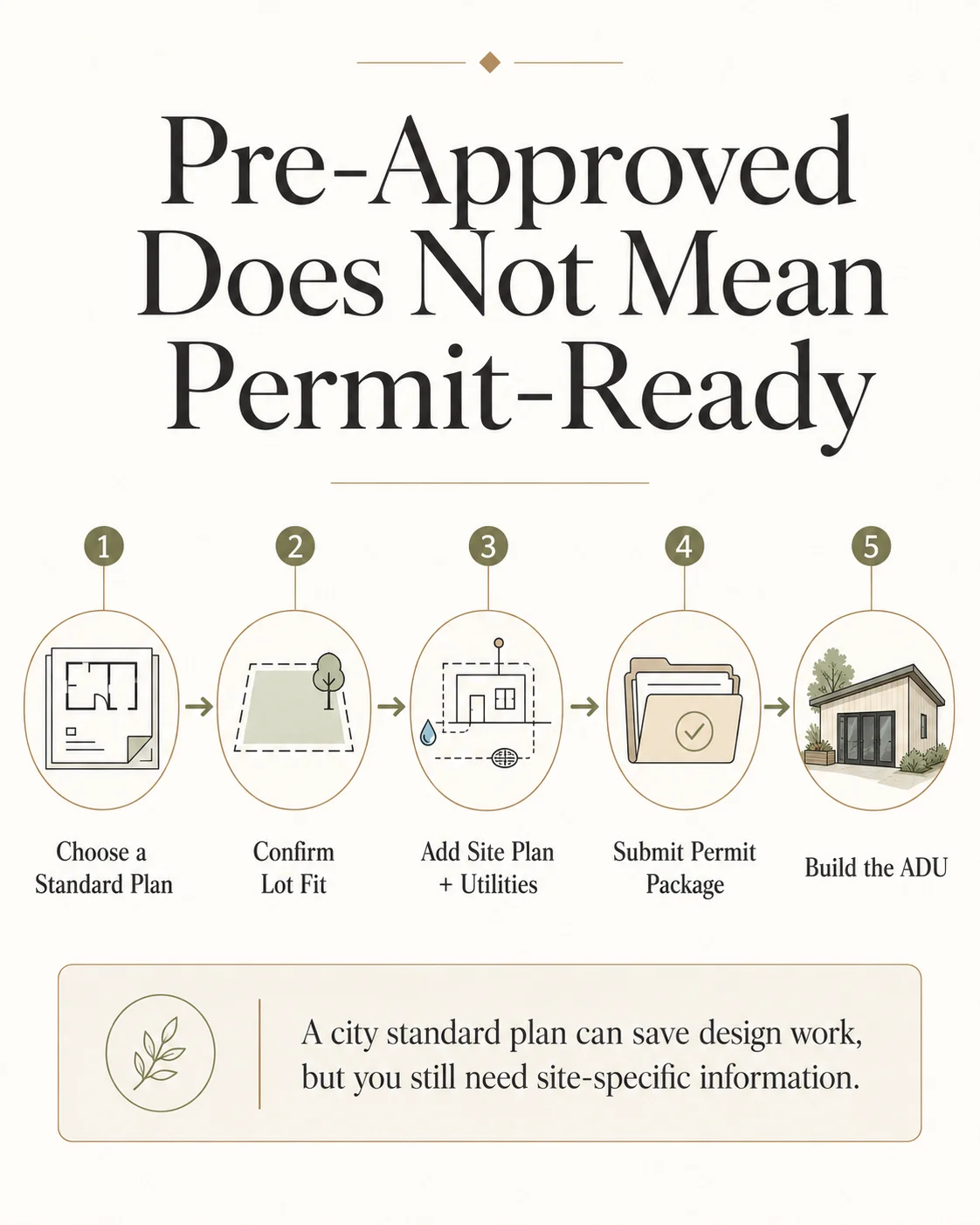
Here’s the honest framing: the free city plan can still be the wrong plan. If your yard, easements, utilities, setbacks, or layout don’t fit the standard design, forcing the pre-approved plan can cost more than choosing a custom or semi-custom path.
What the standard plan may save you
- Design and drafting fees. A custom ADU architectural plan set typically costs $7,500–$15,000 in California. The city PDF replaces most of that.
- Code-research time. The city’s plan reflects El Cajon-specific amendments to the California Code.
- Some plan-check back-and-forth. Because the city already reviewed the building drawings, plan check on the architecture itself should move faster.
- Apples-to-apples bidding. Three contractors looking at the same plan give you cleaner bids.
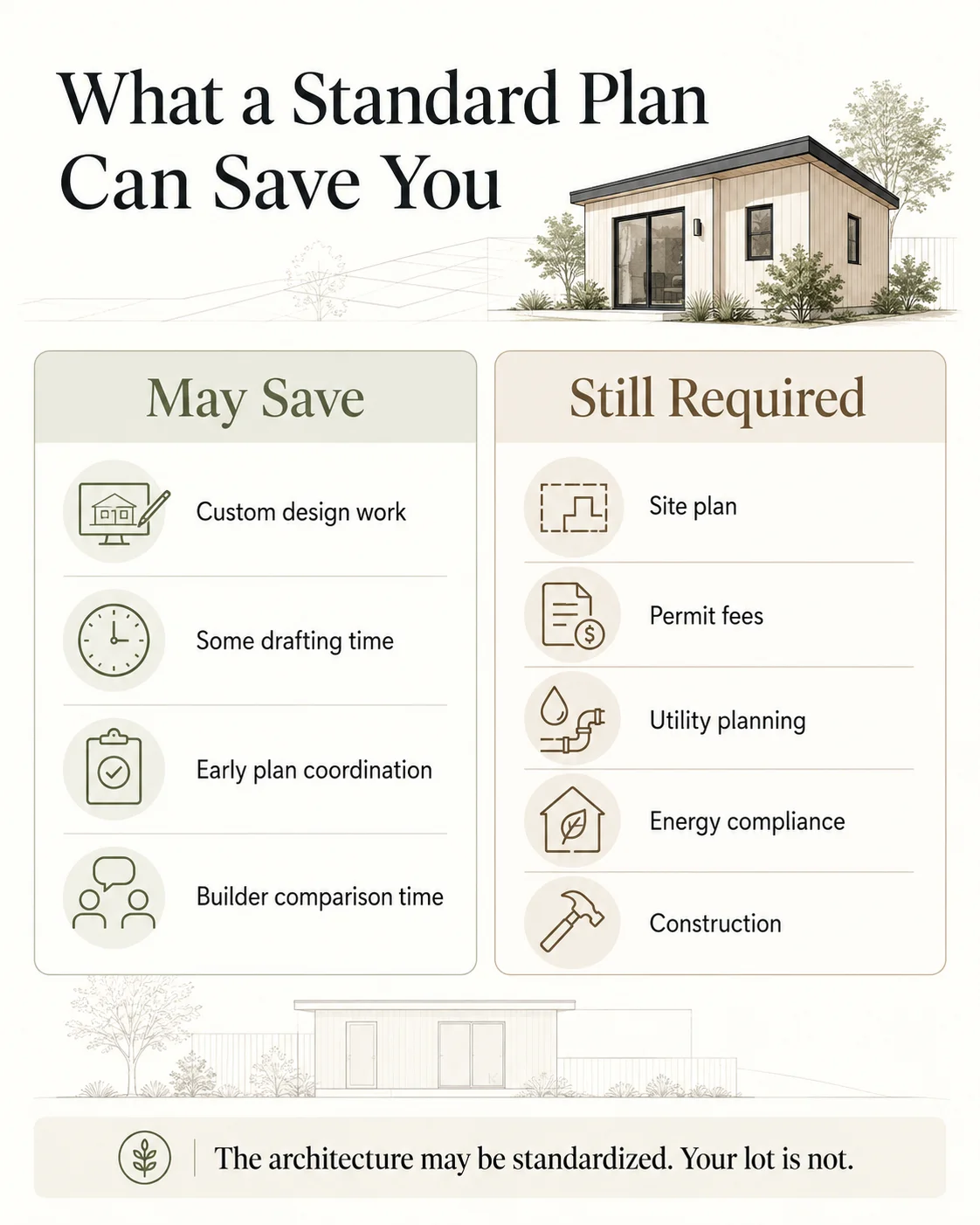
What the standard plan does NOT save you
- City permit and plan-check fees ($906 ADU permit + $1,982 AB 1332 pre-approved plan permit + valuation-based fees)
- Site plan and vicinity map (permittee responsibility)
- Soils and foundation work specific to your lot
- Title 24 energy compliance updates if orientation changes
- Solar PV system design (listed as a deferred submittal)
- Fire sprinkler system design if your existing house is sprinklered
- Utility laterals (water, sewer, gas, electrical connections)
- Sewer-lateral video inspection (consistently required in El Cajon)
- Construction cost — typically $375–$600 per square foot for new detached ADUs in El Cajon
The honest takeaway: a city standard plan typically saves $7,500–$15,000 in design costs and 4–8 weeks of design time. It doesn’t change the construction cost, doesn’t eliminate permit fees, and doesn’t waive the city’s normal plan-check and inspection process.
Decision moment: See whether one of the three city plans actually fits your lot before you commit → (free, 60 seconds)
Will El Cajon approve a pre-approved ADU plan in 30 days?
What AB 1332 actually says
AB 1332 was authored by Assemblymember Juan Carrillo, passed in 2023, and added Section 65852.27 to the California Government Code. Three things matter for an El Cajon homeowner:
- Every local agency must accept and post pre-approved ADU plans. El Cajon meets this requirement with its published Studio, One Bedroom, and Two Bedroom Standard Plans.
- A complete permit application for a detached ADU using a qualifying pre-approved plan must be approved or denied within 30 days — ministerially, meaning on objective criteria with no public hearing or discretionary review.
- The plan must be within the current triennial California Building Standards Code rulemaking cycle, or identical to a plan approved by the local agency within that current cycle (CA Government Code §65852.27(b)(1)–(2)).
Senate Bill 543 (effective January 1, 2026, codified in Government Code §66317) adds that the city has 15 business days to determine whether your application is complete. If they miss that deadline, the application is automatically deemed complete. On resubmittal, they can only review items they originally flagged.
Typical El Cajon ADU application timeline (assuming plan qualifies for 30-day rule)
| Stage | Statutory clock | Typical duration |
|---|---|---|
| Submit application via PACO | Day 0 | — |
| City issues invoice for review fees | — | 1–2 business days |
| Completeness determination (SB 543) | 15 business days max | 1–3 weeks |
| Plan check / corrections | — | Variable |
| Permit decision (AB 1332 detached ADU) | 30 days from complete application | Up to 30 days if plan qualifies |
| Issue building permit; construction begins | — | Within days of decision |
The 2022 → 2025 code-cycle question every El Cajon applicant should ask
El Cajon’s published Standard Plan PDF references the 2022 California Code and was last printed September 14, 2023. The 2025 California Building Standards Code took effect January 1, 2026, and El Cajon Building Safety has stated that plans submitted on or after January 1, 2026 must comply with the 2025 code. AB 1332’s 30-day ministerial-approval window only triggers when the pre-approved plan is within the current triennial code cycle.
Several other San Diego County jurisdictions have publicly addressed this. The City of Carlsbad announced its permit-ready ADU plans are unavailable while being updated to the 2025 California Building Codes (anticipated summer 2026). AB 130, passed in 2025, froze the California residential building code cycle — the 2025 code is in effect through at least the 2031 cycle. This helps pre-approved plans that are current under the 2025 code, but it doesn’t help a plan prepared under the previous (2022) cycle.
Verification box — read this before you bank on 30 days
As of our verification on May 11, 2026, the city’s posted Standard Plan PDF still references 2022 codes, and El Cajon Building Safety has stated that plans submitted on or after January 1, 2026 must comply with the 2025 code. Whether the currently posted Standard Plan PDF qualifies for the 2025 cycle and AB 1332’s 30-day timeline is a question every applicant should resolve with the city in writing before relying on the 30-day timeline.
Email script to El Cajon Building Safety
Subject: Current-code status of El Cajon Standard ADU Plan — [Studio / 1 BR / 2 BR]
Hello,
I am preparing to apply for an ADU permit using the City of El Cajon Standard ADU Plan — [the 560 sq ft Studio / the 649 sq ft One Bedroom / the 802 sq ft Two Bedroom].
Can you confirm:
- Whether the city’s currently posted Standard ADU Plan PDF (which references 2022 California Codes and a 9/14/2023 print date) is currently accepted as a pre-approved ADU plan under the 2025 California Building Standards Code rulemaking cycle?
- Whether a complete detached ADU permit application using this plan is eligible for the 30-day ministerial approve/deny timeline under California Government Code §65852.27 (AB 1332)?
- If the plan requires updates or a code-cycle bridge, what the city’s preferred path is?
Thank you very much for your time.
[Your name] · [Property address] · [Phone number]
What do I still have to submit with an El Cajon standard ADU plan?
The city’s title sheet explicitly leaves several items blank, marked “PERMITTEE TO COMPLETE.” These are the items you (or your designer, engineer, or contractor) must add before submitting for permit:
- Site Plan (added to template area on Sheet A0.1, or submitted as a separate sheet)
- Vicinity Map
- Owner name, address, phone, email
- Contact information (designer, engineer, contractor)
- Project information: site address, APN, legal description, zone
- Whether the existing structure is sprinklered (yes/no)
- Whether the new ADU requires sprinklers (yes/no)
- Square footage breakdown: existing residence, new ADU, other structures
- Distances from buildings and overhangs to property lines
- Locations of utilities, easements, driveways, parking
The site plan requirements alone are 13 specific bullet points — including parcel dimensions, APN, location of bordering streets and easements, all existing and proposed buildings, and distances between buildings. This is real work. For most lots, expect to engage a licensed civil engineer or architect to prepare the site-specific package — typically $1,500–$4,000 of work depending on lot complexity.
You may also need to attach deferred submittal items (photovoltaic solar system per the Title 24 report; fire sprinkler design if applicable).
What city fees still apply with an El Cajon pre-approved ADU plan?
Fee data from the City of El Cajon’s published Planning and Building Department Fee Schedule FY26 as of May 11, 2026. The schedule is updated annually — pull the current version before submitting.
Selected published city fee categories
| Fee category | Amount or formula | Applies to |
|---|---|---|
| ADU Permit | $906 | Standard ADU permit fee |
| AB 1332 Pre-Approved ADU Plans (permit) | $1,982 | Pre-approved plan applications |
| Title 24 Plan Check (new structure) | $567 | Energy/code plan check |
| New sewer connection (flat fee) | $297 | When separate sewer service required |
| Building permit ($100K–$500K valuation) | $2,788 + $9.79/add’l $1K | All ADU permits |
| Plan check ($100K–$500K valuation) | $1,113 + $1.12/add’l $1K | All ADU permits |
| Impact fees | $0 at/under 750 sq ft; proportional over | Studio & 1BR exempt; 2BR may apply |
| School fees | Verify with school district | All three plans (560/649/802 sq ft all over 500) |
Illustrative all-in fee worksheet — not a city quote
| Line | Example A: Studio $250K valuation | Example B: 1BR $300K valuation | Example C: 2BR $400K valuation |
|---|---|---|---|
| ADU Permit | $906 | $906 | $906 |
| AB 1332 Pre-Approved Plan Permit | $1,982 | $1,982 | $1,982 |
| Title 24 Plan Check | $567 | $567 | $567 |
| Building Permit (FY26 formula) | $4,257 | $4,746 | $5,725 |
| Plan Check (FY26 formula) | $1,281 | $1,337 | $1,449 |
| Sewer connection (if needed) | $297 | $297 | $297 |
| Impact fees | $0 | $0 | Verify with city |
| Subtotal (illustrative) | ~$9,290 | ~$9,835 | ~$10,926+ |
Illustrative examples for planning purposes only — not city quotes or guarantees. School fees not included (verify with applicable school district). Building permit = $2,788 base + $9.79 per additional $1,000 over $100,000; plan check = $1,113 base + $1.12 per additional $1,000 over $100,000.
Cost-side decision point: See your address-specific feasibility report before you commit → (free, 60 seconds)
The El Cajon ADU rules every applicant needs to know
Size
- Maximum ADU size: 1,200 sq ft. An ADU cannot be larger than the primary residence.
- Junior ADU (JADU) maximum: 500 sq ft, contained within an existing single-family residence.
- State-law floor: California Government Code §66321 prevents local rules from being applied in a way that prevents an ADU of at least 800 sq ft with 4-foot side and rear setbacks.
Setbacks and height (detached ADUs)
El Cajon’s height-and-setback matrix per ECMC §17.140.180:
| Detached ADU height | Required setback (side/rear) |
|---|---|
| Up to 12 ft | 3 ft |
| Up to 16 ft | 4 ft |
| Up to 20 ft | 5 ft |
Detached ADUs require a minimum 3-foot rear and side setback. All three city standard plans are single-story. Transit-proximate increases apply within ½ mile of a major transit stop or high-quality transit corridor.
Parking
- One paved off-street parking space per ADU is generally required.
- Tandem parking and front-yard setback parking for ADUs are allowed.
- State-law parking exemptions: within ½ mile of public transit, within a historic district, when the ADU is part of an existing primary residence or accessory structure, or when a car-share vehicle is within one block.
Key restrictions
- Minimum rental term: 30 days. Short-term vacation rentals (Airbnb) are not permitted.
- Fire sprinklers: Required if the primary residence is sprinklered, or if the ADU exceeds 1,200 sq ft.
- Sewer-lateral video: El Cajon ADU builders consistently report this as a required item. Budget $400–$800 for the inspection.
- Separate address: Every ADU receives a unique address during permitting.
- Separate sale: Not currently permitted as of May 11, 2026 (AB 1033 ordinance not adopted).
The El Cajon ADU Loan Program: $100K and what comes with it
Source: City of El Cajon ADU Loan Program Guidelines V.6 (reviewed May 11, 2026).
The loan tiers
| Affordability level (tenant income) | Loan term | Interest rate | Max loan |
|---|---|---|---|
| Under 50% AMI (Very-Low Income) | 30 years | 0% | $100,000 |
| 51%–80% AMI (Low Income) | 15 years | 0% | $100,000 |
| 81%–120% AMI (Moderate Income) | 10 years | 3% | $100,000 |
| 121%–150% AMI (High-cost area) | 5 years | 5% | $100,000 |
Maximum rents under the program
| Affordability tier | Studio | 1 BR | 2 BR |
|---|---|---|---|
| Very-Low Income (<50% AMI), MHP | $1,447 | $1,550 | $1,861 |
| Low Income (60% AMI), MHP | $2,316 | $2,481 | $2,978 |
| Moderate Income (110%), HCD | $2,518 | $2,878 | $3,237 |
| High-cost area (140%), HCD | $3,205 | $3,662 | $4,120 |
Loan rent caps vs. El Cajon market rent
| Unit size | El Cajon market rent (May 2026) | Loan cap at Low (60% AMI) | Loan cap at Moderate (110%) |
|---|---|---|---|
| Studio | ~$1,500–$1,800 | $2,316 | $2,518 |
| 1 BR | ~$1,982 | $2,481 | $2,878 |
| 2 BR | ~$2,398–$2,500 | $2,978 | $3,237 |
At the moderate-income tier, the city’s rent cap is generally above current El Cajon market rate for the same unit class — the practical effect is preventing high-end pricing rather than forcing below-market rent. At the very-low-income tier, the cap is below market and the affordability subsidy is significant. The point: don’t assume “affordable” means “you’ll lose money.” Run the math at your target tier before deciding.
Eligibility (the short list)
- Owner-occupied primary residence within El Cajon city limits
- Minimum 640 credit score for borrower and any co-borrower
- Maximum combined loan-to-value (existing first lien + new city lien) of 75%
- No outstanding code enforcement issues on the property
- All collections and judgments paid in full; no bankruptcy or foreclosure within 5 years
- Owned and occupied the property for at least one year
- U.S. citizen or permanent resident with social security number
- Three contractor bids required; contractor must hold CA state license, El Cajon business license, $1M general liability, and worker’s comp
Critical warning on stacking the city loan with cash-out / HELOC / construction loans
El Cajon’s ADU Loan Program Guidelines state that subordination requests will be denied for cash-out, debt-consolidation, or adjustable-rate-mortgage purposes. If you take the city loan first and later need to cash-out refinance to pay for finishes, landscaping, or cost overruns, the city won’t subordinate its lien — which can block the refinance entirely. Get clear advice on lien order before you accept the city loan, not after.
For most homeowners, the gap-funding options fall into three lanes: (1) cash-out refinance of the primary residence, (2) home equity line of credit (HELOC), or (3) construction or renovation loan. For the math on each path:
- Compare ADU financing options → (no lender ranking; an honest framework for matching the financing path to your situation)
- How a HELOC works for ADU construction →
Affiliate disclosure: The Dwelling Index is reader-supported. Some links on this page are affiliate links. If you click one and take a qualifying action, we may earn a commission at no extra cost to you. Affiliate relationships do not influence our editorial rankings or conclusions. Read our full disclosure.
To explore current cash-out refinance and refinance options nationally, Mortgage Research Center (one of our active financing partners) provides mortgage and refinance education and lender matching across cash-out refi and refinance products.
Program details above are educational, not financial advice. Verify all current program details — including funding availability, income limits, rent limits, and underwriting requirements — directly with the City of El Cajon Housing Division at 619-441-1710 or housing@elcajon.gov before applying. These rental and ROI figures are illustrative examples, not guarantees of returns.
Priority and funding
After April 1, 2024, applications are processed on a first-come, first-served basis. The funding pool is allocated by fiscal year through California’s Permanent Local Housing Allocation (PLHA) program. Contact the Housing Division for current availability before counting on it in your budget.
Which El Cajon ADU plan should I choose: 560, 649, 802, or custom?
Choose 560 sq ft Studio if…
- Your priority is the simplest, fastest project — fewer rooms to finish, lower construction cost, fewer choices to make.
- Your rental strategy is solo professionals or a single occupant.
- Your lot is tight and the Studio’s smaller footprint is the only one that fits.
- You want to maximize the percentage of the project funded by the $100,000 city loan — at $375–$540/sq ft, a Studio build runs roughly $210K–$300K all-in (illustrative).
- You want to avoid every form of impact-fee exposure — the Studio is well under 750 sq ft.
Choose 649 sq ft One Bedroom if…
- You want the highest rental yield per dollar invested. A real bedroom commands meaningfully more rent than a studio in El Cajon while staying 101 sq ft under the 750 sq ft impact-fee threshold.
- Your tenant target is a young professional, downsizing renter, or single tenant who wants privacy.
- You can fit the plan’s footprint on your lot within El Cajon’s height-and-setback matrix.
- You’re using the city ADU Loan Program and want to clear underwriting cleanly.
We think the One Bedroom is the default best choice for most El Cajon homeowners if it fits the lot. The math of staying under 750 sq ft while still offering a real bedroom is what makes it win in more situations than any other plan.
Choose 802 sq ft Two Bedroom if…
- You need two bedrooms specifically — a parent with a school-age child, two adult siblings, or a couple where one person works from home.
- You want the highest possible rent in El Cajon — two-bedroom rentals listed around $2,400–$3,000+ per month in early 2026.
- You can absorb the proportional impact fees triggered by crossing 750 sq ft.
- Your lot can comfortably fit an 802 sq ft footprint plus working area.
Choose custom or semi-custom if…
- Your lot is too narrow, too sloped, or too constrained for any of the three rectangular standard footprints.
- You need a garage conversion rather than a new detached structure.
- You want an attached ADU that shares a wall with the existing house.
- You need a two-story unit (all three city plans are single-story).
- You have accessibility needs (wheelchair turning radii, roll-in shower, lower counter heights) that the standard plans don’t address.
- The city has not confirmed current-code eligibility of the September 2023 Standard Plans for the 2025 code cycle, and a custom plan prepared under the current code is faster.
Semi-custom as the middle path
If a city standard plan doesn’t fit and a full custom architectural plan ($7,500–$15,000 design fees, 2–4 months) is more than you want to take on, the middle path is a designer-builder with library plans optimized for El Cajon. For a review of all the El Cajon ADU builders we’ve reviewed, see our dedicated guide.
SnapADU (CSLB License #1075582 (B), verified May 2026) is the design-build firm we see most often serving El Cajon in San Diego County. Their plans allow configurability for finish level, orientation, and mirroring while staying within El Cajon’s code envelope. See our SnapADU review and SnapADU’s full floor-plan catalog.
Affiliate disclosure: The Dwelling Index is reader-supported. Some links on this page are affiliate links. If you click one and take a qualifying action, we may earn a commission at no extra cost to you. Affiliate relationships do not influence our editorial rankings or conclusions. Read our full disclosure.
Decision Resolution Point: Ruled out the three free city plans?
See SnapADU’s El Cajon ADU regulation and plan options — request an all-in quote →
When the El Cajon standard plans don’t fit
Don’t use a city standard plan if…
- Your lot can’t physically accommodate the plan’s footprint. All three standard plans are rectangles. If your lot’s buildable area (after setbacks, easements, and existing structure footprint) can’t fit the plan’s footprint plus working area, the plan won’t work as drawn.
- You want any design change. Any building-design change (added door, expanded kitchen, relocated bathroom, different window layout) should be confirmed with Building Safety before assuming AB 1332’s 30-day treatment still applies.
- You want a two-story ADU. All three city plans are single-story.
- You want a garage conversion or attached ADU. The standard plans are detached, new-construction units.
- Your existing house is sprinklered. The ADU then requires sprinklers, which has real cost implications.
- Your sewer lateral has known defects. A failed lateral can trigger replacement before permits issue.
- Your project goal is short-term rental income. El Cajon requires a 30-day minimum rental term.
- The city has not confirmed current-code eligibility. Until El Cajon Building Safety confirms the September 2023 Standard Plans qualify under the 2025 California Building Standards Code, treat the plan as a starting point — not a guaranteed fast-track permit.
When two or more of these apply to your situation, the standard plans aren’t your shortcut. A semi-custom or fully custom plan, prepared correctly under the 2025 code, is likely faster and cheaper net of the failed-shortcut costs.
A worked example: building the 802 sq ft Two Bedroom in El Cajon
Numbers are realistic for 2026 but illustrative, not a quote. They reflect midpoints observed across Better Place Design & Build, SnapADU, and ADU Geeks cost sources plus the city’s published FY26 fee schedule.
| Line | Illustrative cost |
|---|---|
| Construction (802 sq ft × ~$470/sq ft midpoint) | $377,000 |
| Site plan + civil drawings for permittee items | $2,500 |
| Foundation engineering (lot-specific soils review) | $3,000 |
| Title 24 update (if orientation changes envelope performance) | $800 |
| Sewer-lateral video inspection | $600 |
| ADU Permit (city) | $906 |
| AB 1332 Pre-Approved Plan Permit (city) | $1,982 |
| Title 24 Plan Check (city) | $567 |
| Building permit (FY26 formula at ~$377K valuation) | $5,500 |
| Plan check (FY26 formula at ~$377K valuation) | $1,423 |
| New sewer connection (city) | $297 |
| Impact fees (proportional, 52 sq ft over 750) | $1,500–$3,000 (verify) |
| Utility connections (electrical panel, water meter, gas) | $8,000–$15,000 |
| Site work (grading, driveway, drainage) | $10,000–$18,000 |
| Landscape / final grading | $4,000–$8,000 |
| Contingency (5%) | $20,000 |
| All-in subtotal (illustrative range) | $397,000–$437,000 |
With the city ADU Loan Program at the moderate-income tier ($100,000, 10 years, 3% simple deferred): The loan covers roughly 23–25% of the project. Remaining funding gap of approximately $295,000–$335,000 is typically bridged through cash-out refinance, HELOC, or construction loan — subject to the subordination warning above. See also our ADU cost per square foot guide and best ADU builders in San Diego County.
Rental income illustration at moderate-income tier (2-BR cap $3,237 before utility allowance): roughly $35,000 in pre-utility-allowance rental income annually. Net of utility allowance, vacancy, maintenance, property tax adjustment, and management costs, an investor model might pencil $24,000–$28,000 in net annual income. Illustrative; not a guarantee. Actual results depend on tenant credit, vacancy timing, repair frequency, and local market conditions.
How to apply: step by step via PACO
- 1
Confirm jurisdiction
Confirm your property address is inside El Cajon city limits, not unincorporated San Diego County. Lots in Bostonia, Granite Hills, or pockets along the city border can be either side. Quick check: your property tax bill will identify the jurisdiction.
- 2
Choose your plan and download the PDF
Download the City of El Cajon Standard ADU Plans PDF from the city’s Planning Permit Information page. The 45-page PDF contains all three plans (14 sheets each).
- 3
Verify current-code eligibility with Building Safety
Send the email script above to building@elcajon.gov or call 619-441-1726, option 2. Get the answer in writing. This is the single most important step.
- 4
Engage your professional team
You’ll need a California-licensed general contractor (verify at cslb.ca.gov), a licensed civil engineer or architect for site-specific items, and possibly a structural engineer or Title 24 energy consultant.
- 5
Prepare the site-specific package
Complete every permittee-reserved item from the city’s title sheet. Add deferred submittal items (photovoltaic solar system per the Title 24 report; fire sprinkler design if applicable).
- 6
Submit through PACO
Submit your complete application package through the Project Assistance Center Online. The city typically issues an invoice for initial review fees within 1–2 business days.
- 7
Pay the invoice; plan check begins
Once fees are paid, the city’s plan check begins. Track progress through PACO.
- 8
Receive completeness determination (within 15 business days under SB 543)
The city has 15 business days to determine whether your application is complete. If they request items, the request must be specific and in writing. On resubmittal, they can only review items originally flagged.
- 9
Permit decision (within 30 days for a qualifying AB 1332 application)
For a complete application using a qualifying pre-approved plan, the city’s approve/deny decision is due within 30 days. If denied, you receive a written list of issues.
- 10
Building permit issues; construction begins
Permit fees are due before issuance. Build per the approved plan with the contractor you’ve contracted.
- 11
Phased construction inspections
California Residential Code inspection phases include foundation, framing, rough mechanical/electrical/plumbing, insulation, drywall, and final. Each is requested and passed before the next phase proceeds.
- 12
Final inspection and certificate of occupancy
Final inspection generates the certificate of occupancy. Address assignment is finalized. Utility billing transfers if separately metered. Now you can occupy or rent the unit.
Free check before you start: See whether your address looks like a fit for one of the three city plans → (free, 60 seconds)
After it’s built: renting and managing your El Cajon ADU
Setting the rent
If you used the city loan, the affordable rent caps apply. If you didn’t, your rent is governed by California state law and El Cajon’s general residential rental rules — fair housing, anti-discrimination, just-cause eviction protections, and similar standards apply.
Tenant screening basics
Run a credit check. Verify income (most landlords want 2.5–3× monthly rent in gross monthly income). Check rental history. Use a written lease that complies with California Civil Code requirements. Make required disclosures (lead-based paint for pre-1978 properties, etc.).
Self-management vs. property management
For a single ADU, many homeowners self-manage. For ease of rent collection, maintenance requests, and tenant communication, property-management software is useful.
Affiliate disclosure: The Dwelling Index is reader-supported. Some links on this page are affiliate links. If you click one and take a qualifying action, we may earn a commission at no extra cost to you. Affiliate relationships do not influence our editorial rankings or conclusions. Read our full disclosure.
Buildium is a property-management platform we’ve reviewed for landlords managing 1–10 units. It handles lease creation, online rent collection, maintenance ticketing, accounting, resident portals, and reporting — useful even for one ADU.
See Buildium’s pricing and features for small landlords →
For homeowners who’d rather hand off management entirely, full-service property management companies in San Diego County typically charge 8–10% of monthly rent.
Tax and insurance
- Updated homeowner’s insurance to reflect the additional unit (often a landlord-policy rider).
- Reporting rental income on Schedule E of your federal tax return.
- Depreciation of the ADU as residential rental property (consult a tax professional).
- Potential property tax reassessment of the new construction only (the existing residence’s value is not, under Prop. 13 protections).
This is general information, not tax advice. Consult a licensed CPA for your specific situation.
What we verified for this guide
Last verified: May 11, 2026 · Next scheduled review: August 11, 2026
- The City of El Cajon publishes three Standard ADU Plans — Studio (560 sq ft), One Bedroom (649 sq ft), and Two Bedroom (802 sq ft) — as a 45-page PDF (14 sheets per plan) on the Planning Permit Information page and the ADU Loan Program page.
- The city’s Standard ADU Plans PDF references 2022 California Codes and bears print dates of September 14, 2023.
- The 2025 California Building Standards Code took effect January 1, 2026 (California Building Standards Commission).
- El Cajon Building Safety has stated that plans submitted on or after January 1, 2026 must comply with the 2025 California Building Standards Code.
- California Government Code §65852.27 (added by AB 1332, amended by SB 477) requires the local agency to approve or deny a complete detached ADU application using a qualifying pre-approved plan within 30 days.
- SB 543 (codified in Government Code §66317, effective January 1, 2026) requires a 15-business-day completeness determination on ADU applications.
- SB 543 specifies that ADUs under 500 sq ft don’t increase assessable space for school-fee purposes; none of El Cajon’s three plans (560/649/802 sq ft) qualify for this carve-out.
- SB 1211 (effective January 1, 2025) allows detached ADUs on multifamily lots up to the number of existing primary units, max 8.
- SB 13 (effective 2020) exempts ADUs at or under 750 sq ft from local development impact fees.
- AB 130 (effective 2025) froze the California residential building code cycle; the next residential code update is not expected until the 2031 cycle.
- El Cajon Municipal Code §17.140.180 contains the city’s ADU regulations including size, parking, setback, rental term, sprinkler, design compatibility, and impact-fee provisions.
- El Cajon’s FY26 Planning and Building Department Fee Schedule lists: ADU Permit $906, AB 1332 Pre-Approved ADU Plans permit $1,982, Title 24 Plan Check (new structure) $567, new sewer connection $297, plus valuation-based building permit and plan-check formulas.
- The El Cajon ADU Loan Program is a deferred loan up to $100,000 with 0%–5% simple interest depending on tenant income tier, owner-occupied 1+ year, 640 minimum credit score, 75% maximum combined LTV.
- El Cajon market rent figures from Apartment List, reviewed May 2026: Studio ~$1,538+, 1 BR ~$1,982+, 2 BR ~$2,398+.
- Cost ranges of $375–$600 per square foot verified across Better Place Design & Build, SnapADU, and ADU Geeks (early 2025–2026 cost reports).
Items flagged for verification before relying on them
- Current-code eligibility of the September 2023 Standard Plans for the 2025 California Building Standards Code (call El Cajon Building Safety, 619-441-1726, option 2)
- The project valuation El Cajon will assign to your specific ADU
- The exact proportional-impact-fee calculation for an 802 sq ft plan under ECMC §17.140.180
- Current school-district impact-fee rates for ADUs over 500 sq ft
Frequently asked questions about El Cajon pre-approved ADU plans
Does El Cajon have pre-approved ADU plans?
Yes. The City of El Cajon publishes three free pre-approved Standard ADU Plans — a 560 sq ft Studio, a 649 sq ft One Bedroom, and an 802 sq ft Two Bedroom — combined in a 45-page PDF (14 sheets per plan) available on the city’s Planning Permit Information and ADU Loan Program pages.
How many pre-approved ADU plans does El Cajon offer?
Three. All are detached, single-story, rectangular footprints.
Are El Cajon’s pre-approved ADU plans free?
The plan PDF is free to download. The project is not. You still pay city permit and plan-check fees (including a $906 ADU permit fee and a $1,982 AB 1332 pre-approved plan fee per the FY26 schedule), site-specific engineering, the sewer-lateral video inspection, utility connections, and construction at roughly $375–$600 per square foot.
Does “pre-approved” mean my ADU permit is already approved?
No. It means the building’s architecture has been reviewed by the city for general code compliance. Your specific lot, site plan, utilities, and project still require a permit application, plan check, payment of fees, and city decision.
How long does ADU permit approval take in El Cajon with a pre-approved plan?
Under California Government Code §65852.27 (AB 1332), the city must approve or deny a complete detached ADU application using a qualifying pre-approved plan within 30 days. SB 543 (effective January 1, 2026) adds a 15-business-day completeness window. The 30-day rule depends on whether the plan version is current under the 2025 California Building Standards Code — confirm with El Cajon Building Safety before counting on the timeline.
What is the maximum ADU size allowed in El Cajon?
1,200 sq ft, and an ADU cannot be larger than the primary residence. JADUs are capped at 500 sq ft. The city’s three standard plans (560, 649, 802 sq ft) are all well under the 1,200 sq ft cap.
Which El Cajon plan avoids the 750 sq ft impact-fee threshold?
The 560 sq ft Studio and 649 sq ft One Bedroom are both under 750 sq ft and exempt from local development impact fees under SB 13 and ECMC §17.140.180. The 802 sq ft Two Bedroom is 52 sq ft over the threshold and may be subject to proportional impact fees.
Can I modify El Cajon’s pre-approved ADU plans?
You can complete the permittee/site-specific fields on the title sheet. But any building-design change — added door, expanded kitchen, relocated bathroom, different window layout — can take the application out of the AB 1332 pre-approved path. Confirm any design change with Building Safety before assuming the 30-day benefit still applies.
Do I still need Title 24 energy compliance with a pre-approved plan?
The standard plan set includes Title 24 energy calculations for the building as drawn. If your specific site orientation materially changes the building’s energy performance, you may need updated Title 24 documentation. Solar PV is listed as a deferred submittal on the city’s title sheet.
Can I use the El Cajon ADU Loan Program with a pre-approved plan?
Yes, if you meet the program’s eligibility requirements (owner-occupied 1+ year, 640+ credit score, max 75% combined LTV, no outstanding code issues, U.S. citizen or permanent resident) and accept the affordability covenant. The loan is up to $100,000, deferred, with 0%–5% simple interest depending on the tenant income tier. Note that the city denies subordination requests for cash-out, debt-consolidation, or ARM purposes.
Can I short-term rent (Airbnb) an El Cajon ADU?
No. El Cajon Municipal Code §17.140.180 requires a minimum 30-day rental term for ADUs. Short-term vacation rentals are not permitted. The city ADU Loan Program guidelines also explicitly prohibit short-term rental use for assisted units.
Can I sell my ADU separately in El Cajon?
No, as of May 11, 2026. California AB 1033 (effective 2024) permits cities to adopt ordinances allowing ADUs to be sold separately as condominiums, but El Cajon has not adopted such an ordinance.
Do El Cajon ADUs require sprinklers?
Only if the existing primary residence is sprinklered, in which case the new ADU also requires sprinklers. ADUs exceeding 1,200 sq ft of living space require sprinklers regardless. None of the city’s three standard plans exceed 1,200 sq ft.
Are El Cajon’s published Standard Plans current under the 2025 California Building Standards Code?
The published PDF references 2022 California Codes and bears print dates of September 14, 2023. The 2025 California Building Standards Code took effect January 1, 2026, and El Cajon Building Safety has stated that plans submitted on or after January 1, 2026 must comply with the 2025 code. Before relying on the 30-day timeline, confirm current-code eligibility directly with El Cajon Building Safety at 619-441-1726, option 2, or building@elcajon.gov.
How many ADUs can I build on my El Cajon property?
On single-family lots, HCD’s 2026 ADU Handbook says local agencies must allow at least one ADU created from existing space, one JADU, and one new detached ADU on eligible lots. On a multifamily lot, per SB 1211 (effective January 1, 2025): detached ADUs up to the number of existing primary units, maximum 8, plus conversion ADUs within existing non-livable space (capped at 25% of existing units, minimum 1).
Who do I contact at the city for questions?
- Building permit and code questions: El Cajon Building & Fire Safety Division, 619-441-1726 option 2, building@elcajon.gov
- Zoning and planning questions: El Cajon Planning Division
- ADU Loan Program questions: El Cajon Housing Division, 619-441-1710, housing@elcajon.gov
- Permit application status: Project Assistance Center Online (PACO) at elcajon.gov/paco
Related guides
The bottom line
We don’t think pre-approved plans are right for every El Cajon homeowner. They’re right for the ones whose lot, family, and goals match one of the three rectangles. For everyone else, the better path is usually a semi-custom plan that’s been prepared correctly under the 2025 code and fits the way you actually want to live.
What we believe matters more than which plan you pick is asking the right questions in the right order:
- Does my lot physically fit one of the standard plans within El Cajon’s setbacks and footprint?
- Are the city’s currently posted Standard Plans accepted under the 2025 California Building Standards Code for AB 1332’s 30-day timeline?
- Is the unit I actually need under 750 sq ft (Studio or One Bedroom) or over 750 sq ft (Two Bedroom)?
- Am I willing to accept affordability and rental restrictions to access up to $100,000 from the city ADU Loan Program — and have I confirmed I won’t need cash-out flexibility later?
- If a city standard plan isn’t the right fit, what’s the next-best semi-custom or custom path?
Not sure where to start? See what’s possible at your address.
Want the full prep package?
Download the Free ADU Starter Kit — includes our El Cajon site-plan checklist, the 2025-code email script, the FY26 fee worksheet, and the three-plan decision matrix.
Content is for informational purposes only and does not constitute financial, legal, tax, construction, or lending advice. Verify all information with qualified local professionals before making decisions. Rental and ROI examples are illustrative, not guarantees of returns. Verify current program details, fees, and code-cycle status with the City of El Cajon before applying or signing contracts.