
Chula Vista Pre-Approved ADU Plans: The 2026 Complete Guide
By The Dwelling Index Editorial Team · About our team · Methodology · Editorial standards
· Last verified May 11, 2026 against chulavistaca.gov, Chula Vista Fee Bulletin 10-400 (rev. Sept 2024), 2025 California Building Standards Code, and Cal. Gov. Code §§ 66310–66346 (as renumbered by SB 543) · Next scheduled review: August 2026
Independently verified against chulavistaca.gov, Chula Vista Fee Bulletin 10-400 (revised September 2024), the 2025 California Building Standards Code, and California Government Code §§ 66310–66346 (as renumbered by SB 543, effective January 1, 2026). The Dwelling Index is an independent research resource covering ADU financing, costs, and regulations. We are not a builder, lender, or broker.
Bottom Line, Up Front
Yes — Chula Vista publishes 12 pre-approved ADU plans, officially called City Standard ADU Plans. Six base detached designs ranging from 498 to 1,199 square feet, each with a reverse (mirrored) layout. All twelve were prepared by SnapADU through a competitive bid the firm won against more than two dozen applicants.
Using one delivers three concrete benefits: It reduces your city fees by $1,012 (per Chula Vista Fee Bulletin 10-400, revised September 2024 — Standard path: $3,951 total vs. nonstandard: $4,963). It shortens plan review to 14 business days vs. 21 for nonstandard submittals. It saves 6–8 weeks of design time per SnapADU.
But there’s a catch most pages skip: SnapADU, the designer of all 12 plans, stated in their April 2026 guidance that with the new code cycle in effect, the public Chula Vista plan sets must be updated to remain compliant and are not currently permit-ready under the new cycle. The 2025 California Building Standards Code took effect January 1, 2026. Before downloading a PDF and assuming you can submit it as-is, verify the specific plan’s current code-cycle status with Chula Vista Development Services (DSD@chulavistaca.gov or 619-476-2332).
The one number to remember: 750 square feet of interior livable space. Under California Government Code § 66311.5(c) (as renumbered by SB 543, effective January 1, 2026), an ADU with 750 sq ft or less is exempt from all impact fees; above that, fees are proportional to your primary residence’s square footage.
Address-specific · 60 seconds · no phone call required
See What You Can Build in Chula Vista → Get Your Free ADU Report
Get Your Free ADU Report →No phone number required. Just a property-specific snapshot.
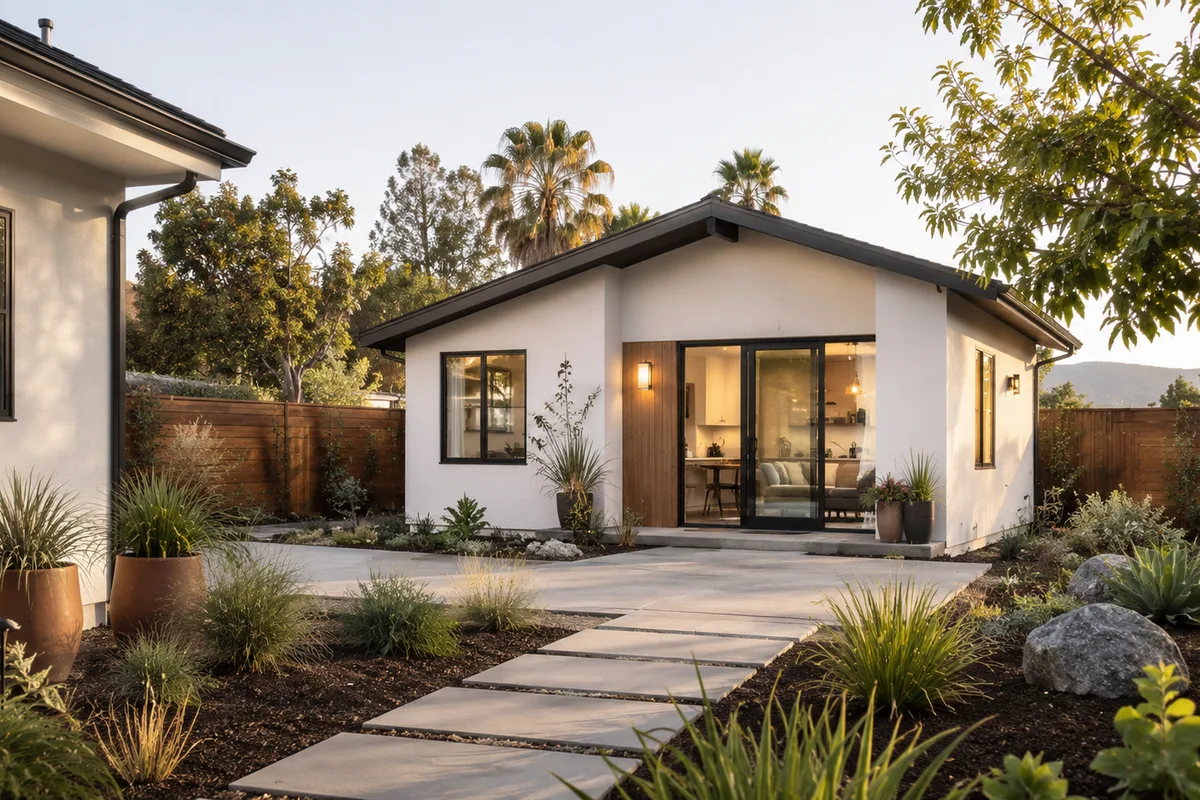
SnapADU is the firm the City of Chula Vista selected to design all 12 City Standard plans — disclosing both that factual role and our affiliate relationship is required for honest coverage. Full affiliate disclosure.
Pre-approved ≠ Permit-approved
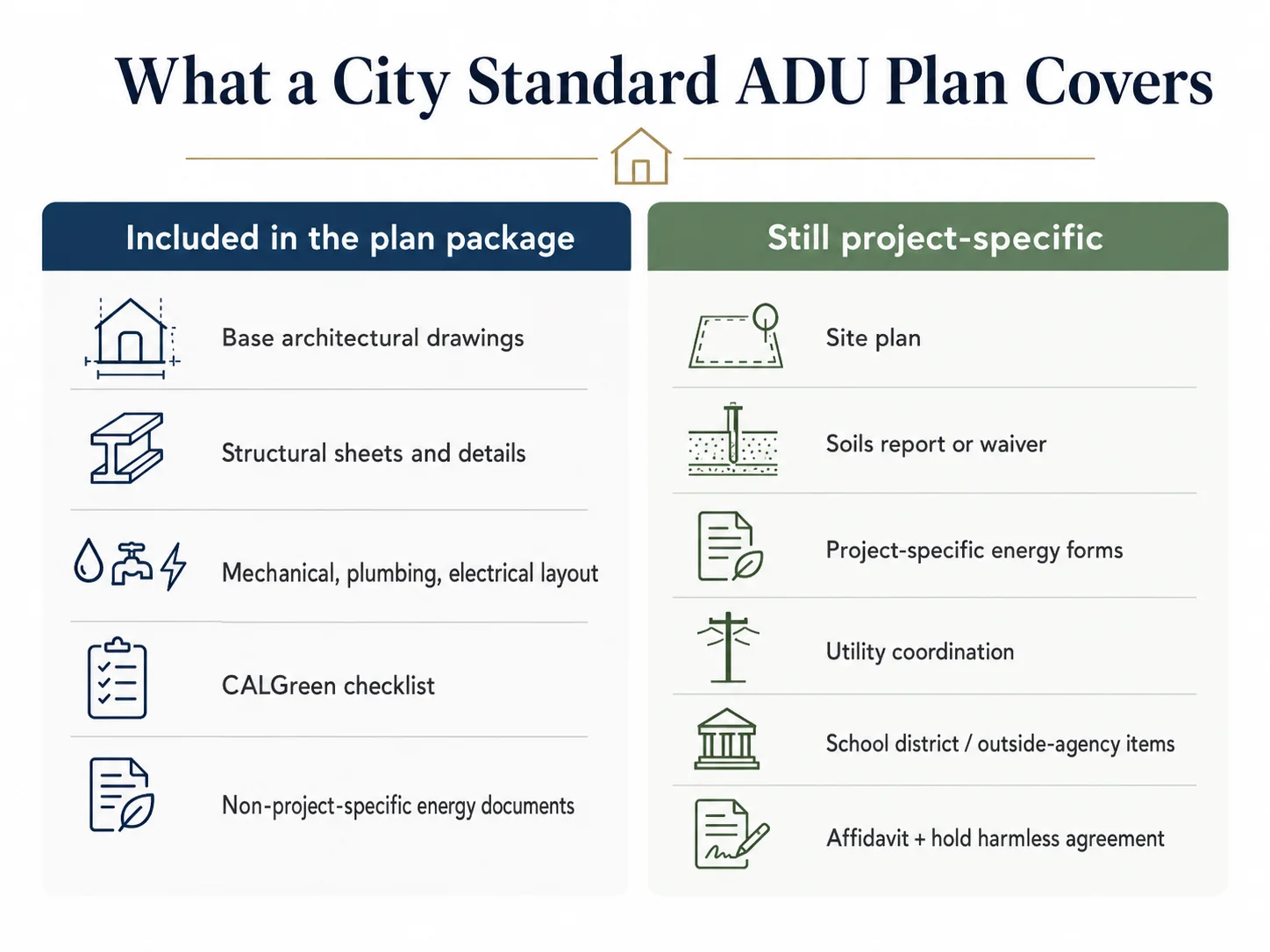
| Already pre-reviewed by Chula Vista | Still requires project-specific review and submittal |
|---|---|
| Base architectural design | Your lot, setbacks, easements, site plan |
| Structural sheets and standard details | Soils (geotechnical) report or qualifying waiver |
| Mechanical, plumbing, electrical layout | Utility connections (water, sewer, electric meter) |
| CALGreen checklist | Project-specific Title 24 energy calculations |
| Standard plan calculations | Outside-agency items (school district fees, fire review, coastal permit if applicable) |
| Signed Affidavit + Hold Harmless Agreement |
A City Standard plan covers approximately 80% of a complete submittal, per SnapADU. The remaining 20% is on you (or your design professional).
At a Glance: Chula Vista City Standard ADU Plans
| Quick question | Verified answer |
|---|---|
| Official program name | City Standard ADU Plans |
| Number of plan options | 12 (6 sizes × reverse layouts) |
| Size range | 498 – 1,199 sq ft |
| Designer of all 12 plans | SnapADU (selected through competitive bid with 24+ applicants) |
| Plan review with City Standard plan | 14 business days per city ADU page (21 calendar-day goal listed elsewhere — confirm with DSD) |
| Standard submittal review | 21 business days |
| Total fee, City Standard detached ADU | $3,951 ($476 intake + $533 plan check + $2,942 inspection) |
| Total fee, nonstandard detached ADU ≤1,200 sq ft | $4,963 ($546 intake + $1,475 plan check + $2,942 inspection) |
| Documented total-fee savings | $1,012 |
| Plan-license fee | Paid directly to designer (not published publicly) |
| Impact fees | Exempt for ADUs with 750 sq ft of interior livable space or less; proportional above that |
| School fees | ADU under 500 sq ft exempt per SB 543; district policies vary above |
| Code cycle of public plan PDFs | SnapADU states plans need updates for the new code cycle — confirm with DSD before submittal |
| Soils report | Required by default; one-story waiver possible on natural/cut grade |
| Coastal Zone | Bayfront LCP applies to some bayfront parcels |
| City ADU loan program | Closed as of June 2024 (interest list maintained) |
Sources: chulavistaca.gov ADU page; Chula Vista Fee Bulletin 10-400 (rev. Sept 2024); Cal. Gov. Code § 66311.5(c); SnapADU April 2026 guidance. All verified May 11, 2026.
Does Chula Vista Have Pre-Approved ADU Plans?
Yes. Chula Vista publishes City Standard ADU Plans — 12 pre-reviewed detached ADU designs prepared by SnapADU and made available free on the city’s website. Using one shortens plan review, reduces your total city fee by $1,012 per Fee Bulletin 10-400, and (per SnapADU) saves 6–8 weeks of design time. Site-specific work — site plan, soils report or waiver, project-specific energy calculations, utility connections, and structural engineering for your specific site — is still required.
What “pre-approved” means in Chula Vista
The official term is City Standard ADU Plan. The plan set has been reviewed by the city for general compliance with the California Building Code and Chula Vista’s citywide design guidelines. The city commits to a shortened plan-review window and a reduced total fee on the city’s side. That’s the trade.
What it does not mean: your permit is approved. The city has pre-reviewed the design. It has not pre-reviewed your lot, your utilities, your site conditions, or any outside-agency requirements like school district fees, Fire Department review, or coastal development permits. Those still apply.
How the program came to be
In April 2023, the City of Chula Vista received a Housing Acceleration Program (HAP) grant from the San Diego Association of Governments (SANDAG). The grant funded four homeowner-facing tools: a comprehensive ADU resource page, the City Standard plan library, the “Build for Chula Vista” placement visualization tool (developed with Symbium), and a pilot ADU loan program. The plan library went live with 12 pre-designed ADU options prepared by SnapADU. The pilot loan program is currently closed to new applications as of June 2024 per the Chula Vista ADU page.
In parallel, California Assembly Bill 1332 (Carrillo, 2023) required every local agency in California to develop an ADU plan preapproval program by January 1, 2025. AB 1332 is codified at California Government Code § 65852.27. Among its requirements: a local agency must approve or deny a permit application that uses a preapproved plan within 30 days, provided the plan is preapproved by the agency within the current triennial California Building Standards Code rulemaking cycle, or is identical to a plan previously approved by the agency during the current cycle. That code-cycle clause matters; we return to it below.
Pre-approved vs. City Standard vs. permit-ready
You’ll hear these terms used interchangeably. They’re not identical.
- Pre-approved is the umbrella term for plans a local agency has reviewed for general code compliance ahead of a specific project.
- City Standard ADU Plan is Chula Vista’s official program name.
- Permit-Ready is a different program name used by some cities (Encinitas has a PRADU — Permit-Ready ADU — program). Permit-ready also implies the plan is current under the active code cycle.
- Pre-Approved ADU Program (PAADU) is Escondido’s program name.
- County of San Diego Standard ADU Plans is a separate library administered by the County, not the city.
The City of San Diego accepts preapproved plans from three sources: Chula Vista’s, the County’s, and Encinitas’s. We cover that interaction below.
The 12 City Standard ADU Plans: Full Catalog
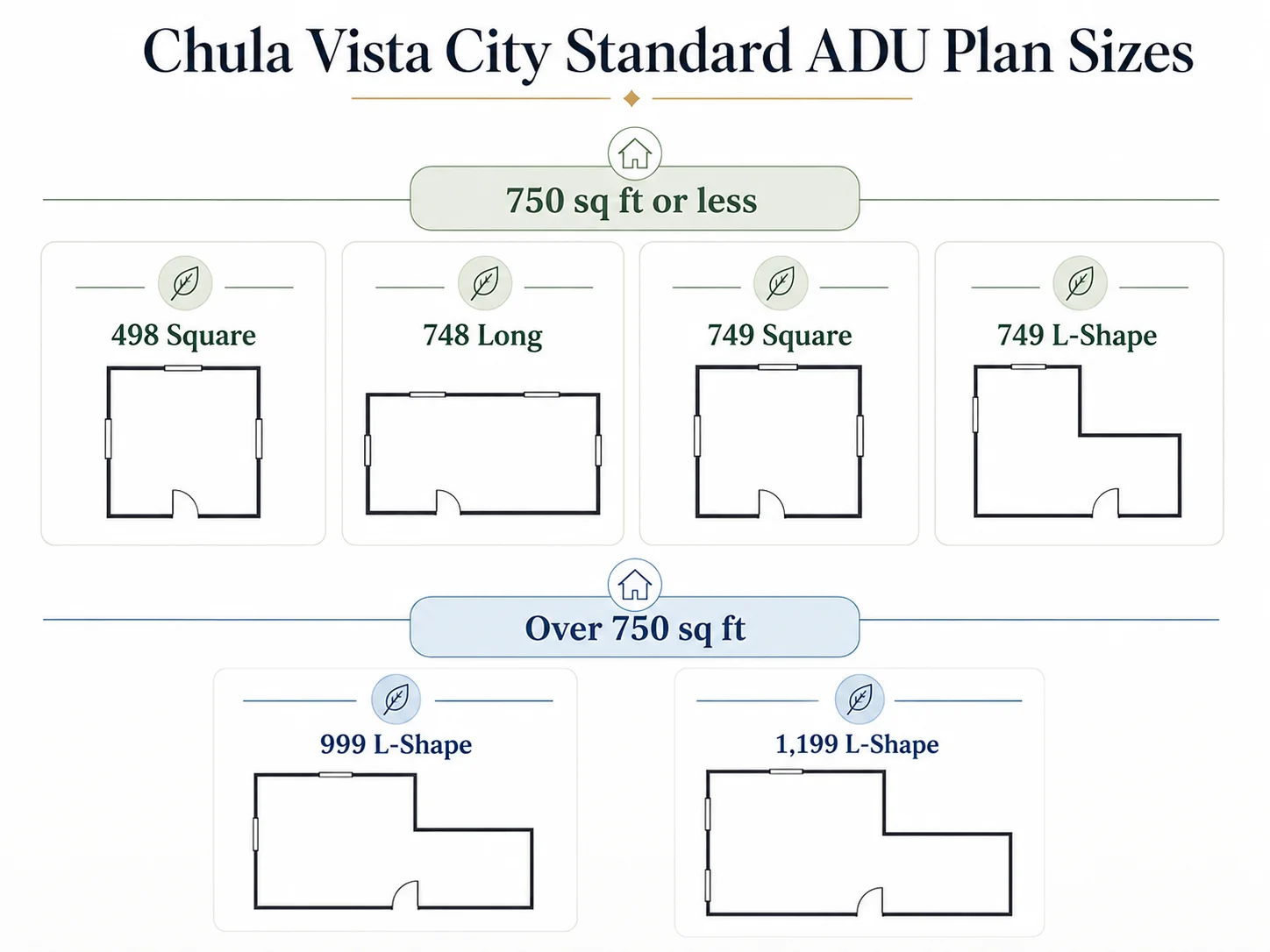
Chula Vista’s City Standard library contains six base plan sizes — 498, 748 (long), 749 (square), 749 (L-shape), 999, and 1,199 square feet — each available in a reverse (mirrored) layout, for 12 total options. Bedrooms range from one to three depending on plan size. Foundation options include slab-on-grade (SOG) and raised foundation (RF); energy compliance documentation is published for both California Climate Zone 7 and Climate Zone 10. All twelve are single-story detached designs.
The catalog below was verified against the city’s ADU page on May 11, 2026.
| Plan family | Size | Bedrooms | Shape | Reverse | Impact fees | Best fit |
|---|---|---|---|---|---|---|
| 498 Square | 498 sq ft | 1 BR | Square | Yes | Exempt (≤750 sq ft) | Studio/1-BR rental, guest suite, lowest-complexity build; also likely school-fee exempt at under 500 sq ft per SB 543 |
| 748 Long | 748 sq ft | 1–2 BR | Rectangle | Yes | Exempt (≤750 sq ft) | Narrow lots; long backyards; maximize space under impact-fee threshold |
| 749 Square | 749 sq ft | 1–2 BR | Square | Yes | Exempt (≤750 sq ft) | Square lots; balanced floor plan; one sq ft from the cliff |
| 749 L-Shape | 749 sq ft | 1–2 BR | L-shape | Yes | Exempt (≤750 sq ft) | Lots needing courtyard separation; existing structure avoidance |
| 999 L-Shape | 999 sq ft | 2–3 BR | L-shape | Yes | Applies (proportional) | Family ADU, aging parents, dual-use rental |
| 1,199 L-Shape | 1,199 sq ft | 2–3 BR | L-shape | Yes | Applies (proportional) | Maximum detached size; multi-generational living |
Foundation options: SOG = slab-on-grade, RF = raised foundation. Energy compliance docs published for Climate Zones 7 and 10. You must still commission a property-specific Title 24 calculation under the current code cycle.
What “reverse” actually changes
A reverse (mirrored) layout flips the floor plan around its long axis. Square footage, room sizes, and structural layout stay identical; orientation changes. Practical use: match the front door to the side of your lot that faces the primary house, lock a kitchen window away from a neighbor’s bedroom, place the ADU bedroom against an existing fence rather than a shared driveway. Reverse layouts use the same plan PDF, follow the same review path, and don’t require additional review.
What’s in the plan package
The Chula Vista City Standard ADU plan submittal guide describes the standard package as generally including:
- Base architectural drawings (floor plans, elevations, sections)
- Structural sheets and standard details
- Mechanical, plumbing, and electrical layout
- CALGreen compliance checklist
- Non-project-specific energy documentation (you pick the matching variant)
- Standard structural calculations for the plan as designed
SnapADU characterizes the plan set as approximately 80% complete; the remaining 20% is site-specific.
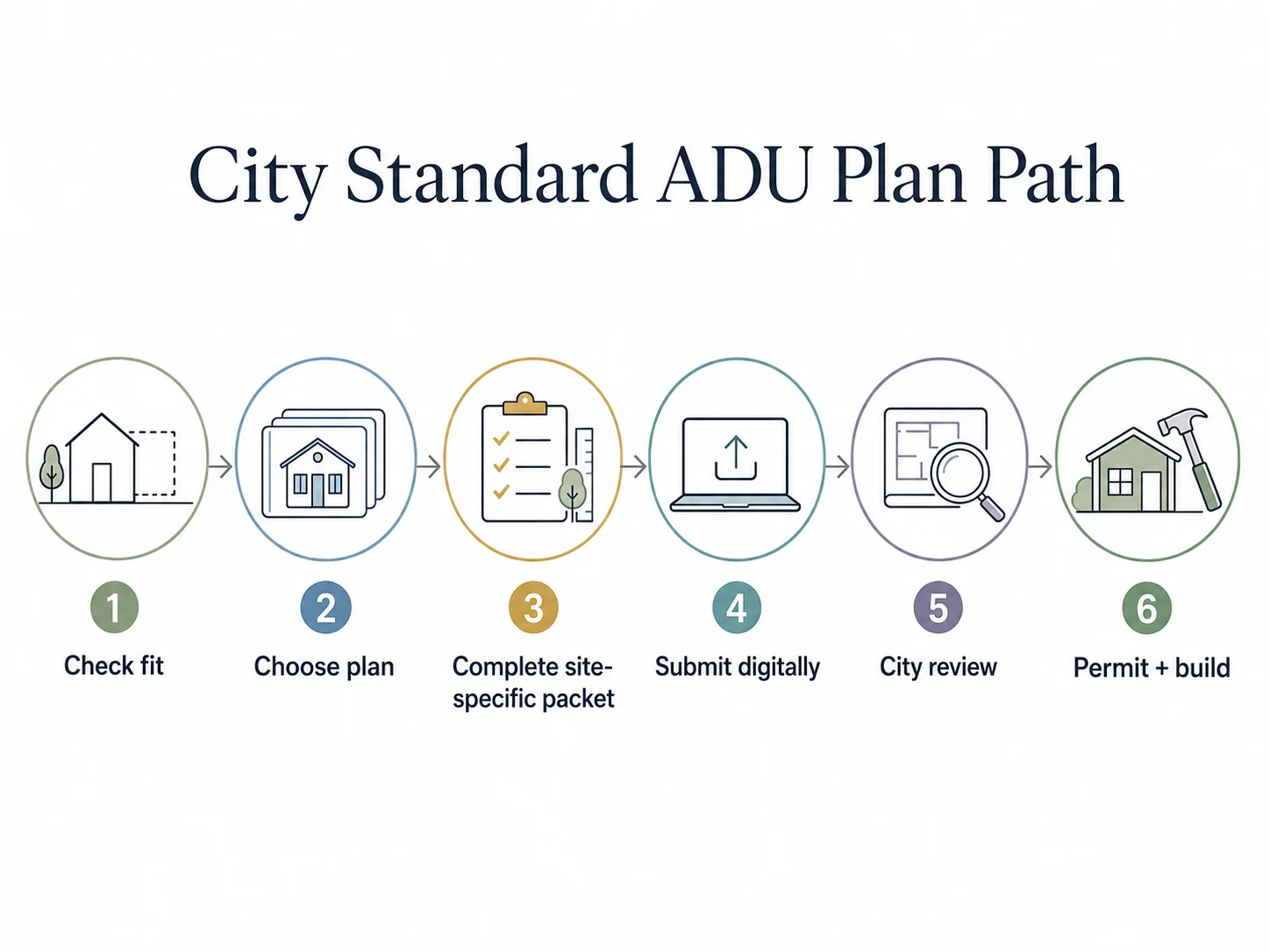
Using a plan in a permit application
- Sign and submit the City Standard ADU Plan Affidavit
- Sign and submit the Hold Harmless Agreement
- Contract with the designer (SnapADU for the original 12; another approved designer if using a plan from the “City Standard ADU Plans by Others” list)
- Produce all site-specific documents (see What the Plan Doesn’t Include)
The designer retains copyright on the plan. The city makes the PDF available for evaluation; you license the right to use it from the designer.
Two paths after picking a plan
After shortlisting a plan size, two paths exist.
Path A — License from SnapADU (the firm that authored all 12 plans):
SnapADU is on our approved active partner list for Greater San Diego, which includes Chula Vista. They offer plan-license-only engagements as well as full design-build.
Best for detached new-build ADUs in Greater San Diego.
Path B — Use a different city-approved designer:
Chula Vista actively maintains a “City Standard ADU Plans by Others” list, and the city accepts applications from new design professionals on an ongoing basis.
Browse the city’s approved designer list → (direct city link, not affiliate)
The 2026 Title 24 Code-Cycle Catch (What Most Pages Skip)
SnapADU — the firm that authored all 12 City Standard ADU Plans — states in its April 2026 pre-approved plans guide that with the new code cycle in effect, the public Chula Vista and San Marcos plan sets must be updated to remain compliant and are not currently permit-ready under the new cycle. The 2025 California Building Standards Code took effect January 1, 2026. Before submitting a permit using a publicly posted plan PDF as-is, confirm with Chula Vista Development Services whether the specific plan has been republished under the 2025 cycle — if not, your designer will need to bring it current.
This section exists because most other pages either don’t surface this issue or bury it. It’s the single most important thing to verify before you assume a “free” plan PDF is free to use.
What the 2025 code cycle means for ADUs
California adopts a new building code cycle every three years (the triennial code cycle). The 2022 cycle applied through December 31, 2025. The 2025 cycle — formally the 2025 California Building Standards Code (Title 24) — applies to permit applications submitted on or after January 1, 2026. For ADUs specifically:
- New detached ADUs are treated as newly constructed single-family buildings under the 2025 Energy Code
- Newly constructed ADUs must meet battery energy storage system (BESS) readiness requirements unless an exception applies
- Newly constructed detached ADUs have PV-readiness and electric-readiness requirements depending on configuration
Translation: plan sets prepared under the 2022 cycle generally need to be updated before they’re ready to submit under the 2025 cycle. The base design is fine; the energy and readiness documentation typically needs refreshing.
How AB 1332’s “current code cycle” clause interacts with this
AB 1332 (Gov. Code § 65852.27) requires a local agency to approve or deny a detached-ADU permit within 30 days when the application uses a plan preapproved by the local agency within the current triennial code cycle — or a plan identical to one previously approved by the agency during the current cycle.
Translated: the statutory 30-day fast-track is on firmest ground when the preapproved plan is on the current cycle. A plan that hasn’t yet been updated still benefits from the city’s local 14-business-day commitment, but the AB 1332 statutory 30-day clock is strongest when the plan is current.
What the designer of the plans has said publicly
SnapADU, stated publicly in April 2026 that the public Chula Vista and San Marcos plan sets must be updated to remain compliant under the new cycle, and that the firm is not updating the entire public library independently because the city has not allocated budget for that purpose. SnapADU notes it can update plans efficiently when engaged on a specific project.
That’s the designer of the city’s plans openly stating the publicly posted PDFs may not be submission-ready as-is. We surface it. The reader who decides to proceed is making an informed decision.
Two clean paths forward
Don’t let this freeze you. The plans are still your fastest path.
Path 1: Engage a designer to refresh the plan to the 2025 cycle. The simplest route. The base design has already been pre-reviewed; the update is incremental.
Path 2: Confirm with DSD in writing before downloading. Get the city’s answer before you spend money on a code-cycle refresh that may not be necessary.
The exact email to send Development Services
Send it to DSD@chulavistaca.gov or call 619-476-2332. The answer determines whether you can use a free PDF download or need to budget a designer engagement up front.
Get the city’s answer in writing before paying for anything. A short email costs you zero. A code-cycle refresh you didn’t need to pay for, or a permit correction cycle you could have avoided, can cost thousands.
What City Standard ADU Plans Actually Cost in Chula Vista
Downloading the plan PDF is free. The city’s published total fee for the City Standard detached ADU path is $3,951 (intake + plan check + inspection combined), versus $4,963 for the nonstandard detached path — a documented total-fee savings of $1,012. On top of that you still owe a plan-license fee to the designer, development impact fees for ADUs over 750 sq ft of interior livable space, school district fees per district policy, soils report or waiver, project-specific Title 24 calculations, and any outside-agency fees.
The verified fee math from Fee Bulletin 10-400
Chula Vista Fee Bulletin 10-400 (revised September 2024) lists two relevant line items for detached ADUs. Both are total fees, not just plan-check fees:
| Line item | Intake | Plan check | Inspection | Total fee |
|---|---|---|---|---|
| Accessory Dwelling Unit, Detached, Standard (All Plans) | $476 | $533 | $2,942 | $3,951 |
| Accessory Dwelling Unit, Detached (Non-Standard, up to 1,200 sq ft) | $546 | $1,475 | $2,942 | $4,963 |
| Difference (City Standard savings) | $70 | $942 | $0 | $1,012 |
Source: Chula Vista Fee Bulletin 10-400, revised September 2024, verified May 11, 2026.
The $3,951 figure is the city’s combined fee for intake, plan check, and inspection. It does not include impact fees, school fees, Fire Department plan review, soils report, energy calculations, designer plan-license fee, or outside-agency fees.
The full money stack table
| Cost line | ≤750 sq ft | >750 sq ft | Source / notes |
|---|---|---|---|
| Plan PDF download | $0 | $0 | chulavistaca.gov |
| Designer plan license fee | Quote from designer | Quote from designer | SnapADU or other approved designer; designer retains copyright |
| Code-cycle update fee (if 2025 Title 24 refresh needed) | Quote from designer | Quote from designer | See code-cycle section above |
| Chula Vista total fee (City Standard detached ADU) | $3,951 | $3,951 | Fee Bulletin 10-400 (Sept 2024) |
| Development Impact Fees (DIFs) | $0 — fully exempt | Proportional to primary residence sq ft | Cal. Gov. Code § 66311.5(c) as renumbered by SB 543. Request from FF@chulavistaca.gov |
| CVESD school fee (grades K–6) | $0 per CVESD policy (exempts ADUs under 750 sq ft) | $2.27/sq ft per CVESD published schedule | cvesd.org developer fees |
| Sweetwater UHSD school fee (grades 7–12) | $0 (state-law exemption under 500 sq ft; 500–750 sq ft: confirm district policy) | $2.90/sq ft general SUHSD area; $2.02/sq ft inside San Ysidro HS boundary | finance.sweetwaterschools.org |
| Fire Department plan review fee | Per current city fee schedule | Per current city fee schedule | chulavistaca.gov |
| Soils report (default required) | $1,500–$4,000 typical | $1,500–$4,000 typical | Waiver criteria per SnapADU; confirm with DSD |
| Project-specific Title 24 / energy calc | $300–$1,000 typical | $300–$1,000 typical | Required regardless of plan path; must reflect current code cycle |
| Coastal Development Permit (Bayfront LCP area) | Additional permit fee + timeline | Additional permit fee + timeline | Doesn’t apply to most parcels |
| Utility connection fees | Varies | Varies | SDG&E + Otay Water District, Sweetwater Authority, or California American Water depending on parcel |
Cost ranges marked “typical” are planning estimates from typical San Diego County ADU projects, not Chula Vista–specific verified figures. For binding figures, contact the designer, DSD, and the applicable utility/school district.
Construction cost is separate
The fees above are city + outside-agency costs. Construction itself, per the Chula Vista City Council staff report dated September 17, 2024, runs $300–$500/sq ft in Chula Vista depending on design preferences, complexity, and materials. Provider-published 2025–2026 ranges run higher (Better Place Design & Build’s published range as of February 2026: $375–$600+/sq ft).
A worked example — illustrative, not a quote — using the council’s mid-range and a 999 sq ft City Standard plan:
- Construction (999 sq ft × $400/sq ft): ~$399,600
- City total fee + designer license + soils + Title 24 + utility coordination: highly variable; ask the designer + DSD + Facilities Financing for property-specific figures
Illustrative example only. Actual costs depend on lot conditions, finish levels, current fee schedules, utility upgrades, and site work. We are not a contractor or estimator. Get binding figures from your designer, builder, and the City of Chula Vista Facilities Financing office (FF@chulavistaca.gov). These are illustrative examples, not guarantees of returns.
The 750-Sq-Ft Decision: Why Plan Size Drives Total Cost
The largest cost lever you control is whether the ADU is at or under 750 square feet of interior livable space. Per California Government Code § 66311.5(c) (as renumbered by SB 543, effective January 1, 2026), an ADU with 750 square feet of interior livable space or less is exempt from all impact fees; an ADU with more than 750 square feet pays impact fees proportional to your primary residence. The 749 sq ft City Standard plans are designed to sit just under that threshold.
The threshold decoder
| Cost element | 749 sq ft (just at the threshold) | 800 sq ft (just over) |
|---|---|---|
| Chula Vista total fee (City Standard detached) | $3,951 | $3,951 |
| Development impact fees | $0 — fully exempt | Proportional (parcel-specific; request from Facilities Financing) |
| CVESD school fee (K–6) | $0 per district policy | Per current $2.27/sq ft schedule |
| SUHSD school fee (7–12, general area) | $0 (state-law exemption under 500 sq ft; 500–749 sq ft: confirm district policy) | $2.90/sq ft × 800 = $2,320 |
The fee delta of moving from 749 to 800 sq ft is several thousand dollars before you’ve added a single additional square foot of construction. At $400/sq ft construction, the extra 51 sq ft of livable space costs roughly $20,400 in construction plus the fee crossover penalty. The 51-foot upgrade actually costs ~$22,000–$25,000+.
When to push through the 750 sq ft cliff anyway
- True 2- or 3-bedroom family housing. A 999 or 1,199 plan gives meaningful bedroom space; a 749 plan with two bedrooms is tight.
- Investor-focused rental yield. A 2-bedroom or larger ADU rents at a meaningful premium over a 1-bedroom in most Chula Vista submarkets. The break-even period on the additional fees can be 18–36 months in rent differential. Illustrative examples, not guarantees of returns.
- Multigenerational use. Two seniors plus an adult caregiver or grandchild needs space a 1-BR ADU can’t provide.
- Property value optimization at sale. A 1,199 sq ft ADU near a primary residence adds different value to the parcel than a 498 sq ft studio.
When to stay at or under 750 sq ft
- Fastest, cheapest path with maximum fee savings
- Tight lot, setback-constrained, or shape-constrained sites
- Guest unit, home office, or 30+-day rental where size adds operating cost without adding demand
- Cash-constrained budget without a clear long-term use case for the upgrade
One email closes most of the uncertainty in this decision. Subject line: “Property-specific impact-fee estimate request — 749 sq ft vs 800 sq ft scenarios at [your address].”
See What You Can Build at Your Chula Vista Address → Free 60-Second Report
Run the Property Eligibility Check →Property-specific lot fit, fee class, and overlay checks. No phone calls.
How Long Does a Chula Vista ADU Permit Actually Take?
Chula Vista’s ADU page commits to a 14-business-day first plan review for City Standard ADU Plans versus 21 business days for nonstandard submittals. The city’s broader application/plan-review documentation lists a 21-calendar-day first-review goal for the same City Standard intake — that apparent discrepancy is worth confirming with Development Services before relying on a specific timeline. Realistically, expect 8–12 weeks from intake to permit issuance for clean submittals, and 12–18 weeks for projects with corrections, soils reports, or coastal permits.
The 14-business-day vs 21-calendar-day discrepancy in city sources
Two official city sources state different review targets for the same City Standard intake:
- The city’s ADU page states: “Applications using City Standard ADU Plans are reviewed in 14 business days, rather than 21 business days for standard applications.”
- The city’s broader application/plan-review documentation lists City Standard ADU Plans with a 21-calendar-day first-review goal.
Both are official sources. The practical takeaway: don’t budget 14 business days as a guarantee. Budget 21 calendar days as a reasonable first-pass expectation; treat 14 business days as the best case.
What state law guarantees
California Government Code § 66317 requires a permitting agency to approve or deny an ADU application within 60 days of receiving a completed application when a primary residence already exists on the lot. AB 1332 ratchets this down to 30 days for applications using a plan preapproved by the local agency within the current triennial code cycle, or a plan identical to one previously approved during the current cycle.
Realistic timeline by phase
| Phase | City Standard plan | Full custom submittal |
|---|---|---|
| Designer engagement / plan license | 1–2 weeks | 6–8 weeks (custom design) |
| Site-specific work (soils, Title 24, structural, utility planning) | 2–4 weeks | 2–4 weeks |
| Digital plan submittal | Required | Required |
| First city plan review | 14 business days (city ADU page) or 21 calendar days (city application page) | 21 business days |
| Corrections cycle, if required | 1–2 weeks per cycle | 1–2 weeks per cycle |
| Fees paid + permit issued | 1–2 weeks after final approval | Same |
| Typical total intake-to-permit | 8–12 weeks (clean projects) | 12–18 weeks |
Coastal Development Permits, hillside review, or significant corrections cycles add to these timelines.
What the Plan Doesn’t Include
A City Standard ADU plan is approximately 80% complete (per SnapADU). The site-specific 20% — site plan, soils report or qualifying waiver, project-specific Title 24 energy calculations, truss calculations, utility connection verification, storm water Best Management Practices documentation, signed Affidavit and Hold Harmless Agreement, and outside-agency items — is on you (or your design professional). Skipping any of these in your submittal will result in correction requests that stop the review clock.
| Already in the City Standard plan package | Still your project-specific responsibility |
|---|---|
| Base architectural drawings | Site plan with property boundaries, setbacks, easements |
| Structural sheets and standard details | Topographic survey if site is sloped or graded |
| Mechanical / plumbing / electrical layout | Utility connection verification (existing or new water, sewer, electric meter) |
| CALGreen compliance checklist | Project-specific Title 24 (CF1R) energy documentation matched to your foundation, climate zone, and bedroom count |
| Non-project-specific energy docs (template) | Soils (geotechnical) report or qualifying waiver |
| Standard plan structural calculations | Truss calculations specific to your lot |
| Plan-set details | Storm water Best Management Practices (BMP) documentation |
| Signed City Standard ADU Plan Affidavit | |
| Signed City Standard ADU Plan Hold Harmless Agreement | |
| Title sheet and project-specific checklist | |
| Fire Department review (if applicable per WUI or other triggers) | |
| Coastal Development Permit (if in Bayfront LCP area) | |
| School district fee compliance (CVESD K–6 and Sweetwater UHSD 7–12) | |
| Outside-agency items (SDG&E for electric/gas service, water district for new/upgraded water service) |
Soils report — and the one-story waiver criteria
Chula Vista requires a soils (geotechnical) report by default for all ADUs. SnapADU’s Chula Vista regulations page (verified May 11, 2026) describes the waiver criteria as:
- One-story detached ADU: site must be on natural grade or cut grade (not fill); foundation must include 18-inch footings and a 4-inch concrete slab.
- Two-story detached ADU: 24-inch footings (in addition to natural/cut grade and 4-inch slab).
We cite these criteria to SnapADU because the city’s published checklist confirms the geotechnical-report-or-waiver requirement but does not publish the exact footing/slab dimensions on its public ADU page. Confirm specific waiver criteria with Development Services before designing your foundation to qualify.
If your lot has fill — often the case for older Chula Vista subdivisions where lots were graded for a primary residence — the waiver isn’t available and a soils report (typically $1,500–$4,000) is required. The report can take 2–4 weeks and may add recommendations that affect foundation design.
Utility connections and outside agencies
Chula Vista water service is split among three districts depending on parcel location:
- Otay Water District (south and east portions of the city)
- Sweetwater Authority (most of western Chula Vista)
- California American Water (smaller service area)
Sewer service is generally provided by the City of Chula Vista. Electric and gas service are provided by SDG&E. New gas service or upgraded water service triggers a separate utility-level review with its own fees and timeline.
Free Planning Checklist
Get the City Standard plan checklist, contractor questions to ask, and the fee-trigger worksheet before you start calling builders.
Download the Free ADU Starter Kit (PDF) →One email; unsubscribe anytime; no credit card.
Can You Customize a City Standard ADU Plan?
Some customization is allowed without losing City Standard plan status, including (per the city) larger bedrooms or different kitchen layouts. But SnapADU’s guidance is more cautious: moving even a door or window may invalidate the pre-approved path and require re-drafting. Before paying a designer to modify a plan, confirm with both the designer and Development Services that the proposed changes keep the project in the City Standard ADU Plan program.
The plans are pre-reviewed for code compliance against their specific designed configuration. Change the configuration enough, and the city has to re-review. The exact line between “fine to adjust” and “now you’re custom” is judged on a case-by-case basis by Development Services and the designer.
| Change type | Risk to City Standard status |
|---|---|
| Use the published reverse/mirrored version | Lower — already in the library |
| Exterior finish selections (siding, roof, trim) | Lower — confirm with designer |
| Interior finish selections (cabinets, counters, flooring) | Lower — no structural or code impact |
| Window or door relocation | Medium to high — per SnapADU, may invalidate the pre-approved path |
| Add or remove a window | Medium to high — affects egress, Title 24 calcs |
| Bedroom or kitchen layout reconfiguration | Medium to high — the city’s own page allows this in some cases; confirm before paying |
| Footprint dimension change | High — likely falls off City Standard |
| Foundation type change (SOG ↔ RF) outside published variants | High — re-review required |
| Framing modifications (load-bearing walls, roof structure) | High — structural re-review required |
| Add a second story | High — all current City Standard plans are single-story |
| Combine two plans or create a hybrid | High — treated as custom |
When a Pre-Approved Plan Is Right — and When It Isn’t
City Standard plans are the fastest, cheapest path when your lot is reasonably flat or cut-grade (not fill), you can live within one of the 12 fixed footprints, you don’t need a two-story unit, and you’re not in the Bayfront Coastal Zone. Semi-custom or full custom designs make sense when you have a difficult lot, want a two-story ADU, need strict architectural alignment with the primary residence, or are doing an attached or garage-conversion ADU instead of detached.
| Your situation | Best path | Why |
|---|---|---|
| Flat or cut-grade lot, single-story, ≤750 sq ft, fits a standard footprint | City Standard plan (498, 748, or 749) | Maximum savings — no impact fees, $1,012 city-fee reduction, fastest review, 6–8 wks design time saved per SnapADU |
| Single-story, 750+ sq ft, fits L-shape or rectangle | City Standard plan (999 or 1,199) | Still benefits from the city’s review window + $1,012 fee reduction; impact fees apply but are unavoidable at this size |
| Want a 2-story ADU | Semi-custom or full custom | All 12 current City Standard plans are single-story |
| Sloped or hillside lot | Semi-custom or full custom | City Standard plans assume flat or cut-grade sites |
| Lot has fill rather than natural grade | Likely semi-custom | Soils waiver unavailable; site-specific engineering required |
| Property in Bayfront Local Coastal Program area | Either, plus coastal permit overlay | Coastal Development Permit applies regardless of plan path |
| Want strict architectural match to a Spanish/Mediterranean/historic primary residence | Semi-custom | City Standard plans allow exterior flexibility but not full style match |
| Need ADU under 500 sq ft (true micro-unit) | JADU within primary residence, or full custom | City Standard smallest is 498 sq ft; JADUs are a separate track |
| Comparing prefab/modular pricing | Run the comparison | Prefab plans are pre-approved by California HCD and may bypass city design review entirely |
| Multi-family lot under SB 1211 (up to 8 detached ADUs) | City Standard plan, repeated | Designed to scale; review window applies per unit |
| Attached ADU or garage conversion | Different review path entirely | City Standard library is detached-only |
| Maximum rental income optimization | Compare 749 vs 999 vs 1,199 | Run the rent-vs-fee math at your specific parcel |
Honest negative handling
We’d be doing you a disservice to claim the City Standard path is right for every Chula Vista homeowner. Where it genuinely doesn’t work:
- You want a craftsman-style 2-story ADU with a wraparound porch to match your 1920s primary residence. Build custom. The City Standard library is detached, single-story, modern in feel.
- Your lot has 5 feet of fill from a 1970s grading operation and significant slope. The soils waiver won’t apply, the structural assumptions in the plans may not work, and you’ll be modifying the plans enough to lose City Standard status. Run semi-custom from a structural baseline.
- You’re inside the Bayfront LCP and need a coastal permit. The City Standard plan can still be used, but the timeline savings get diluted by the coastal process. The cost savings still apply.
- You’re doing a garage conversion. Completely different review path. The City Standard library is for new detached construction.
The honest answer: the City Standard library is purpose-built for new detached single-story ADUs on flat or cut-grade lots without unusual complications. That’s the sweet spot.
Run the Chula Vista Property Eligibility Check →
Lot fit against all six plan sizes, Bayfront Coastal Zone overlap, height-category check, school district assignment. 60 seconds. No phone calls.
Check My Chula Vista Property →Multifamily ADUs in Chula Vista: SB 1211 and City Standard Plans
On lots with an existing multifamily dwelling, California Senate Bill 1211 (effective January 1, 2025) allows up to 8 detached new-construction ADUs (not exceeding the existing residential unit count). On lots with a proposed multifamily dwelling (not yet built), the statutory detached-ADU cap remains two. Multifamily owners may also convert non-habitable space — storage rooms, boiler rooms, passageways, attics, basements, garages — into ADUs, up to 25% of existing units. City Standard plans can be used for the detached units; converted ADUs follow a separate, non-standard-plan review path.
What SB 1211 actually changed
Before SB 1211, California limited multifamily property owners to two detached ADUs regardless of how many residential units already existed. SB 1211, codified at California Government Code § 66323, changed the ratio: one detached ADU per existing residential unit, capped at 8 — but only for lots with an existing multifamily dwelling.
For Chula Vista property owners with existing multifamily buildings:
- Existing duplex (2 units): up to 2 detached ADUs
- Existing triplex (3 units): up to 3 detached ADUs
- Existing fourplex (4 units): up to 4 detached ADUs
- Existing 5–8-unit building: up to 5–8 detached ADUs (one per existing unit, cap at 8)
- Existing 9+ unit building: up to 8 detached ADUs (the statutory cap)
How City Standard plans interact with multifamily lots
The City Standard library is designed for detached new construction, which fits SB 1211’s detached-ADU expansion perfectly. An investor with an existing duplex on a large enough lot could permit two 749 sq ft L-shape detached ADUs using the same City Standard plan in mirrored orientations. Each unit goes through its own plan check with its own $3,951 total fee.
Height rules for multifamily detached ADUs
- 16 feet generally
- 18 feet if the lot is within a half-mile of transit (bus stop or rail station)
- Up to 20 feet to match the primary multifamily structure’s roof pitch (when the base limit is 18 feet, not 16)
Two-story is permitted as long as total height conforms.
Multifamily setbacks and parking
4 feet from side and rear property lines. Front yard setback encroachment only if it’s not possible to accommodate an 800 sq ft ADU within the side and rear setbacks alone. No parking required for multifamily ADUs.
Investor math: A duplex owner on a 12,000 sq ft Chula Vista lot can legally permit two 749 sq ft City Standard detached ADUs, each fee-exempt from impact fees. Illustrative example only; lot-specific feasibility, construction conditions, and finish levels can move these figures significantly. These are illustrative examples, not guarantees of returns.
For investors evaluating multifamily ADU expansion under SB 1211, our ADU financing options guide covers construction loan and cash-out refi paths typically used for this kind of project.
Coastal Zone, Soils, and Edge Cases
Properties inside Chula Vista’s Bayfront Local Coastal Program (LCP) area may require a Coastal Development Permit on top of the building permit. All ADUs require a soils report by default; one-story detached ADUs on natural or cut grade can request a waiver per SnapADU’s published criteria (confirm with DSD). Both items can add several weeks and several thousand dollars to a project.
Bayfront Local Coastal Program — checking your parcel
Chula Vista’s coastal zone is defined by the Bayfront Local Coastal Program, which governs land use along the western (San Diego Bay) edge of the city. If your parcel is inside the LCP boundary, an ADU project may require a Coastal Development Permit (CDP) in addition to the standard building permit. AB 462, approved October 10, 2025 and effective immediately, created a narrow exception to the CDP requirement for some detached ADUs — check with DSD whether the exception applies to your specific parcel and project.
Most Chula Vista parcels are inland of the LCP boundary and aren’t affected. To check whether your address is inside, contact Development Services or use the city’s online zoning tool.
Fire Department plan review and sprinklers
The Fire Department reviews ADU plans for fire-life-safety items. Fire sprinklers are not required for an ADU if they are not required for the primary residence (per Cal. Gov. Code § 66323 and the city’s ADU page). Most existing Chula Vista primary residences are not required to have sprinklers, so most ADUs don’t either.
Projects in Very High Fire Hazard Severity Zones (VHFHSZ) may have additional requirements (fire-resistive exterior materials, increased setbacks, defensible-space rules), but VHFHSZ does not by itself trigger a sprinkler requirement that wasn’t otherwise required.
Wildland-Urban Interface, methane, and floodplain considerations
These overlays affect a small subset of Chula Vista parcels but can significantly change project scope:
- WUI: requires fire-resistant exterior materials, mesh screening on vents, and other Chapter 7A CBC requirements.
- Methane area (legacy landfill or naturally occurring methane): may require methane mitigation systems under the foundation.
- Floodplain: may require elevated finished floor and additional flood-resistant construction.
These items are not covered by the base City Standard plan and require designer attention. Run the Property Eligibility Check to see whether any overlays affect your specific address.
HOAs
California Civil Code § 4751 makes CC&R provisions that effectively prohibit or unreasonably restrict compliant ADUs and JADUs void and unenforceable. HOAs can impose reasonable design standards, but they cannot effectively block a compliant project. If you’re in an HOA, review your CC&Rs and engage the HOA design review early — but know your state-law protections.
Can You Use Chula Vista’s Plans in San Diego or Another City?
Yes. The City of San Diego officially accepts Chula Vista’s City Standard ADU Plans under AB 1332. Permit applications using these plans in San Diego are subject to a 30-day review window — but applicants must still comply with the San Diego Municipal Code’s local development regulations and contact the plan provider to license the plan. The same plan can also be submitted to other San Diego County cities, but acceptance varies by jurisdiction; verify with the target city before relying on it.
What the City of San Diego officially accepts
The City of San Diego Development Services Department states it accepts three preapproved plan libraries under AB 1332:
- County of San Diego Standard ADU Plans
- City of Chula Vista Standard ADU Plans
- City of Encinitas Permit-Ready ADU Plans (PRADU)
For all three, the city commits to a 30-day review of permit applications. The Chula Vista plans must still comply with the City of San Diego Municipal Code — setbacks, height, parking, and design standards may differ from Chula Vista’s. To use the plan, the applicant must contract directly with SnapADU to license its use.
Other San Diego County cities
Beyond the City of San Diego, acceptance varies. Cities with their own libraries:
- City of San Diego: accepts Chula Vista, County, Encinitas plans
- Encinitas: has its own PRADU library
- Escondido: has its own PAADU library
- San Marcos: has its own pre-approved library (also designed by SnapADU)
- El Cajon: has its own pre-approved library
- County of San Diego (unincorporated): has its own Standard ADU Plans library
For the complete city-by-city picture, see our San Diego pre-approved ADU plans guide and San Diego County pre-approved ADU plans guide.
How Designers Submit a New Plan for City Standard Approval
Architects, designers, and builders can submit detached ADU plans to Chula Vista’s Development Services Department for City Standard approval — either concurrently with a site-specific plan check or as an independent submission. Approved plans are posted to the city’s website, the designer retains copyright, and the plan remains valid until the city adopts a building or zoning code change that affects it.
The two submission paths
Concurrent Processing (with a site-specific plan check):
- Designer submits the City Standard ADU Plan Concurrent Processing Request alongside a site-specific application
- The plan gets City Standard approval while the specific project moves through plan check
- Designer retains copyright; future homeowners must contract with the designer to license
Independent Application (standalone):
- Designer submits the plan for City Standard approval without a paired site-specific project
- Applications are submitted online via the city’s electronic permit services
- Once approved, the plan is added to the city’s “City Standard ADU Plans by Others” list
The “City Standard ADU Plans by Others” list is the city’s mechanism for diversifying beyond SnapADU’s 12 plans. Over time, additional plans from other designers will be added. If you have a specific designer you want to work with, that designer can pursue a City Standard plan submission for your project.
Financing a Chula Vista ADU: Brief Orientation
Once you’ve picked a plan path, ADU financing typically falls into one of four lanes: cash-out refinance, home equity line of credit (HELOC), construction loan, or ADU-specific renovation loan. The right lane depends on your current first-mortgage rate, home equity position, ADU use case, and project timeline.
The four common lanes
Cash-out refinance replaces your existing first mortgage with a larger one. Best when current rates support a refi and you have meaningful equity. Resets your loan term.
HELOC (home equity line of credit) is a second-position line you draw against during construction and repay over time. Doesn’t touch your first mortgage; flexibility to draw incrementally. Typically variable rate.
Construction loan is a short-term loan that funds construction draws and converts (or is refinanced into) a permanent loan at completion. Structured around construction milestones.
Renovation loan products lend against after-renovation value rather than current equity. Best when you’re equity-limited but the completed ADU will materially improve appraised value.
Where to go next on financing
We are an independent research resource. We are not a lender or broker. Financing examples and lender capabilities change frequently — verify with a licensed mortgage professional before making financing decisions. We do not quote specific rates, APRs, or monthly payments as guarantees.
Who to Contact Next
The right next contact depends on the specific question you still need answered. Start with the city for current plan-status and fee questions, the designer for plan-license and modification questions, the school districts for fee specifics, the utility districts for connection requirements, and a builder for site-fit and construction-cost questions.
| Question | Best next contact | Contact path |
|---|---|---|
| Is this plan version currently accepted under the 2025 code cycle? | Chula Vista Development Services | DSD@chulavistaca.gov, 619-476-2332 |
| Does my specific lot fit this plan? | Property Eligibility Check, then a designer | Run the eligibility check |
| What site-specific documents will I need? | Designer or permit professional | SnapADU or other approved designer |
| What’s my impact fee estimate? | Chula Vista Facilities Financing | FF@chulavistaca.gov |
| What utility upgrades does my lot need? | SDG&E + your water district | Otay Water District, Sweetwater Authority, or California American Water depending on parcel |
| What school fees apply? | CVESD (K–6) and Sweetwater UHSD (7–12) | cvesd.org developer fees; finance.sweetwaterschools.org |
| Can I license a City Standard plan? | The plan’s designer | SnapADU for the 12 original plans; other approved designers per city list |
| Can I get a fixed-price design-build quote? | Local ADU builder | Request a SnapADU fit check (affiliate) or compare our Chula Vista ADU builders guide |
| How do I finance the project? | After feasibility, see our financing guides | ADU financing options |
| Is the city’s ADU Loan Program open? | Closed as of June 2024; interest list maintained | Email bwarwick@chulavistaca.gov to join the interest list |
Two clean designer paths
Path A — SnapADU (the original designer of all 12 City Standard plans)
Serves San Diego, Oceanside, Carlsbad, Encinitas, Del Mar, Solana Beach, Poway, San Marcos, Escondido, La Mesa, El Cajon, Vista, Chula Vista, Rancho Santa Fe, Santee, Lemon Grove, Imperial Beach, National City, Bonsall, Cardiff, La Costa, and unincorporated San Diego County.
Request a SnapADU plan fit check →(affiliate — disclosure)Path B — A different city-approved designer
Chula Vista actively maintains a “City Standard ADU Plans by Others” list.
See the City of Chula Vista’s approved designer list →(direct city link, not an affiliate)What We Verified, What We Couldn’t
This page exists to give you an honest answer, not a marketing answer. Here’s the source-by-source breakdown.
What we verified (with date and source)
| Item | Source | Verified |
|---|---|---|
| 12-plan inventory and PDF download links | chulavistaca.gov ADU page | May 11, 2026 |
| SnapADU as designer of all 12 plans | chulavistaca.gov + SnapADU | May 11, 2026 |
| Competitive bid with 24+ applicants for plan authorship | SnapADU | May 11, 2026 |
| $3,951 total fee for City Standard detached ADU ($476 intake + $533 plan check + $2,942 inspection) | Chula Vista Fee Bulletin 10-400, rev. Sept 2024 | May 11, 2026 |
| $4,963 total fee for nonstandard detached ADU up to 1,200 sq ft ($546 + $1,475 + $2,942) | Fee Bulletin 10-400 | May 11, 2026 |
| $1,012 total-fee difference (and $942 plan-check-fee difference) | Calculated from Fee Bulletin 10-400 | May 11, 2026 |
| 14-business-day plan review for City Standard plans (per city ADU page) | chulavistaca.gov ADU page | May 11, 2026 |
| 21-calendar-day first-review goal in city application/plan-review documentation | chulavistaca.gov | May 11, 2026 |
| Impact fee exemption for ADUs with ≤750 sq ft of interior livable space | Cal. Gov. Code § 66311.5(c), as renumbered by SB 543 | May 11, 2026 |
| Proportional impact fees for ADUs >750 sq ft of interior livable space | Gov. Code § 66311.5(c) | May 11, 2026 |
| School fee exemption for ADUs <500 sq ft of interior livable space | Gov. Code § 66311.5(c)(3); Cal. Education Code § 17620 | May 11, 2026 |
| 2025 California Building Standards Code effective date (Jan 1, 2026) | California Energy Commission | May 11, 2026 |
| AB 1332 statutory text + 30-day review for current-code-cycle plans | Cal. Gov. Code § 65852.27 | May 11, 2026 |
| SB 1211 multifamily framework (up to 8 detached ADUs on existing multifamily) | Cal. Gov. Code § 66323 | May 11, 2026 |
| AB 1154 JADU owner-occupancy clarification (shared-sanitation trigger) | Cal. Gov. Code § 66333(b) as amended | May 11, 2026 |
| AB 462 narrow CDP exception for some detached ADUs (Oct 10, 2025) | AB 462 statutory text | May 11, 2026 |
| SB 543 statutory renumbering and impact-fee threshold language | Leginfo SB 543 bill text | May 11, 2026 |
| City ADU Loan Program closed as of June 2024 | chulavistaca.gov ADU page | May 11, 2026 |
| Bayfront LCP applicability | chulavistaca.gov | May 11, 2026 |
| Sweetwater UHSD developer fee rate ($2.90/sq ft general; $2.02/sq ft San Ysidro HS area) | finance.sweetwaterschools.org | May 11, 2026 |
| CVESD published rate $2.27/sq ft; ADUs under 750 sq ft exempt per district policy | cvesd.org developer fees | May 11, 2026 |
| Fire sprinklers not required for ADU if not required for primary residence | Cal. Gov. Code § 66323 | May 11, 2026 |
| HOA limitations on prohibiting compliant ADUs | Cal. Civ. Code § 4751 and § 714.3 | May 11, 2026 |
| 4 ft side and rear setbacks; no parking requirement | chulavistaca.gov ADU standards | May 11, 2026 |
| Height limits: 16/18/20 ft framework | chulavistaca.gov ADU standards | May 11, 2026 |
| City of San Diego accepts Chula Vista plans under AB 1332 with 30-day review | sandiego.gov ADU page | May 11, 2026 |
| Sept 17, 2024 City Council staff report: $300–$500/sq ft typical construction in Chula Vista | Chula Vista City Council Sept 17, 2024 staff report | May 11, 2026 |
| Plans approximately 80% complete; 6–8 wks design time savings | SnapADU April 2026 guidance | May 11, 2026 |
| Soils waiver criteria (18″/24″ footings, 4″ slab) | SnapADU Chula Vista regulations page | May 11, 2026 |
What we couldn’t independently verify
| Item | Why we couldn’t | What to do |
|---|---|---|
| Whether each of the 12 publicly posted plan PDFs has been republished under the 2025 California Building Standards Code | The city’s website does not publish revision-date metadata for each PDF; SnapADU has publicly stated the public library has not been fully updated | Confirm with DSD@chulavistaca.gov before relying on any specific PDF for submittal |
| Whether the 14-business-day vs 21-calendar-day plan-review discrepancy is reconcilable or active | Two city sources state different targets | Confirm current target with DSD before relying on a timeline |
| Whether Chula Vista has adopted an ordinance under AB 1033 allowing separate ADU condominium conveyance | We found no current Chula Vista AB 1033 ordinance in our review | Confirm with DSD; state law leaves separate-sale to local ordinance adoption |
| Current Chula Vista Development Impact Fee rates (reindexed each October 1) — property-specific | DIF rates are parcel-specific and not published in a single homeowner-facing rate card | Email FF@chulavistaca.gov for a binding property-specific estimate |
| Current Sweetwater UHSD rate revisions for FY 2026–27 | District publishes rates in cycles | Contact finance.sweetwaterschools.org or call 619-585-6081 before relying on a figure |
| The ~$20/sq ft permit-fee observation by SnapADU for units over 750 sq ft as a current Chula Vista line item | We could not match the figure to a specific Fee Bulletin 10-400 line | Pull the current bulletin or call DSD at 619-476-2332 |
Frequently Asked Questions
Does Chula Vista have pre-approved ADU plans?
Yes. The official program is City Standard ADU Plans. Twelve plan options — six base sizes from 498 to 1,199 sq ft, each available in a reverse layout — all designed by SnapADU through a competitive bid with more than two dozen applicants.
Are the Chula Vista pre-approved ADU plans free?
The PDF downloads are free from chulavistaca.gov. To actually use a plan in a permit application, you must license it from the designer, produce site-specific documents, pay the $3,951 city total fee (City Standard detached), pay any applicable impact fees (for ADUs over 750 sq ft of interior livable space), and pay school fees per district policy.
Who designed Chula Vista’s pre-approved ADU plans?
SnapADU, a San Diego–based design-build firm. The city selected SnapADU through a competitive bid with more than two dozen applicants. SnapADU has also designed pre-approved plans for the City of San Marcos.
How many City Standard ADU plans does Chula Vista offer?
Twelve listed options: six base plan families (498 Square, 748 Long, 749 Square, 749 L-Shape, 999 L-Shape, 1,199 L-Shape), each available as a reverse layout. Bedroom configurations range from 1 to 3.
Which Chula Vista pre-approved ADU plans avoid development impact fees?
Any plan that stays at 750 sq ft of interior livable space or less. The 498 Square, 748 Long, and both 749 sq ft plans (Square and L-Shape) all qualify under California Government Code § 66311.5(c), as renumbered by SB 543 (effective January 1, 2026). The 999 L-Shape and 1,199 L-Shape are over 750 sq ft and pay proportional impact fees.
Can I modify a Chula Vista pre-approved ADU plan?
The city allows some customization (larger bedrooms, different kitchen layouts), but SnapADU’s guidance is more cautious: moving even a door or window may invalidate the pre-approved path and require re-drafting. Major footprint, bedroom layout, foundation, or framing changes generally push the project to the nonstandard path, which forfeits the $1,012 total-fee savings. Confirm with both the designer and DSD before paying for modifications.
How long does it take to permit an ADU in Chula Vista using a pre-approved plan?
The city’s ADU page commits to 14 business days for the first plan review. The city’s broader documentation lists a 21-calendar-day target — confirm the current target with DSD. Realistically, expect 8–12 weeks from digital submittal to permit issuance for clean projects; 12–18 weeks if corrections, soils reports, or coastal permits are involved.
Are the City Standard plans up to current building code?
SnapADU, the firm that authored all 12 plans, stated in their April 2026 guidance that with the 2025 California Building Standards Code now in effect (effective January 1, 2026), the public Chula Vista plan sets must be updated to remain compliant and are not currently permit-ready under the new cycle. Confirm code-cycle status of any specific plan with Chula Vista Development Services (DSD@chulavistaca.gov) before submittal.
How much are Chula Vista City Standard ADU permit fees?
The total city fee for the City Standard detached ADU path is $3,951 per Fee Bulletin 10-400 (revised September 2024) — $476 intake + $533 plan check + $2,942 inspection. The nonstandard detached path is $4,963 — a $1,012 difference. Impact fees apply only to ADUs over 750 sq ft of interior livable space.
Do I need parking for an ADU in Chula Vista?
No. Chula Vista’s ADU standards list no parking requirement for ADUs. This matches California state ADU law (Gov. Code § 66314 et seq.).
Do Chula Vista ADUs require fire sprinklers?
Fire sprinklers are not required for an ADU if they are not required for the primary residence (Cal. Gov. Code § 66323). Most existing Chula Vista primary residences are not required to have sprinklers, so most ADUs aren’t either.
Do I have to use SnapADU for a Chula Vista City Standard plan?
No. You must contract with the designer of the specific plan you use. SnapADU designed all 12 of the original City Standard plans, so to use one of those you’d license from SnapADU. The city’s “City Standard ADU Plans by Others” section is actively adding plans from additional approved designers.
Can I use Chula Vista plans in the City of San Diego?
Yes. The City of San Diego officially accepts Chula Vista’s City Standard ADU Plans under AB 1332. San Diego reviews permit applications using these plans within 30 days, subject to compliance with the San Diego Municipal Code and the requirement to license the plan from SnapADU.
What if I want a 2-story ADU in Chula Vista?
All 12 current City Standard plans are single-story. For a 2-story ADU, you’ll need a semi-custom or full custom design, which forfeits the 14-business-day review window and the $1,012 fee savings.
Is the Chula Vista ADU Loan Program still open?
No. Per the Chula Vista ADU page, the city is no longer accepting ADU loan applications as of June 2024. The city maintains an interest list — email bwarwick@chulavistaca.gov to be added.
Can I rent the ADU?
Yes, but minimum 30-day stays. Short-term vacation rentals are prohibited for ADUs and JADUs under current state law (per AB 1154 and Gov. Code § 66333).
Can I sell the ADU separately from the primary residence?
California AB 1033 (2023) allows a local agency to adopt an ordinance permitting separate ADU conveyance via condominium conversion. Whether Chula Vista has adopted such an ordinance as of May 2026 was not verifiable in our review — confirm directly with DSD before assuming.
Do I need a soils report?
By default, yes. SnapADU’s guidance describes a waiver for one-story detached ADUs on natural or cut grade with 18-inch footings and a 4-inch slab (24-inch footings for two-story projects). Confirm specific criteria with DSD. If your lot has fill, plan to budget $1,500–$4,000 and 2–4 weeks for the soils report.
What’s the difference between “pre-approved” and “permit-ready” plans?
“Pre-approved” and “City Standard” are functionally similar — the city has pre-reviewed a design for general code compliance. “Permit-ready” (used by Encinitas’s PRADU program) implies the plan is also current under the active code cycle and submission-ready. In practice, any preapproved plan still requires site-specific documents to actually permit a project.
Methodology & Sources
This guide was created by the editorial team at The Dwelling Index, an independent research resource covering ADU financing, costs, and regulations. We are not a lender, broker, or builder. Our coverage is informed by:
- Primary city documentation: chulavistaca.gov ADU page; City Standard ADU Plan submittal guide; Standard ADU checklist; Fee Bulletin 10-400 (rev. Sept 2024).
- California state law: Government Code §§ 66310–66346 (post-SB 543 renumbering); § 66311.5(c) (impact fee exemption); § 65852.27 (AB 1332 / preapproval program); § 66323 (SB 1211 multifamily); § 66317 (60-day clock); § 66333 (JADU rules per AB 1154); Civil Code §§ 4751 and 714.3 (HOA limits).
- California HCD: 2025 ADU Handbook + 2026 addendum.
- California Energy Commission: 2025 California Building Standards Code (Title 24) effective date.
- City of San Diego Development Services: ADU preapproved plans page (cross-jurisdictional acceptance).
- Sweetwater Union High School District developer fees page.
- Chula Vista Elementary School District developer fees page.
- SnapADU: provider-specific claims about plans authored by SnapADU, including their April 2026 code-cycle disclosure and waiver criteria.
Every factual claim about zoning, permits, costs, regulations, or code citations is sourced with a verification date of May 11, 2026. Editorial conclusions are clearly labeled as editorial judgment, not guarantees of outcomes. For our full editorial process, see our methodology page. To report a correction, see our corrections page.
Related guides
Last updated: May 11, 2026. Last verified against primary sources: May 11, 2026. Next scheduled review: August 2026 (quarterly), or sooner if the City of Chula Vista republishes plan PDFs under the 2025 California Building Standards Code, if Fee Bulletin 10-400 is revised, or if material state-law changes affect ADU rules.
The Dwelling Index is an independent research resource covering ADU financing, costs, and regulations. We are not a builder, lender, or broker. Content is for informational purposes only and does not constitute legal, financial, construction, lending, or zoning advice. Verify all information with qualified local professionals and the City of Chula Vista Development Services Department before making decisions.
Not sure where to start? See what’s possible at your address.
Get your free ADU report in 60 seconds. No phone number, no builder calls, no commitment.
Run the Chula Vista Property Eligibility Check →