
City of San Diego ADU Plans (2026): 26 Accepted Options + 4 SDHC Templates
By The Dwelling Index Editorial Team · About our team · Methodology · Editorial standards
· Last verified May 11, 2026 against City of San Diego DSD, County PDS, Chula Vista DSD, Encinitas PRADU, SDHC, California Government Code §65852.27 and §66311.5 · Next scheduled review: August 2026
The 60-second answer.
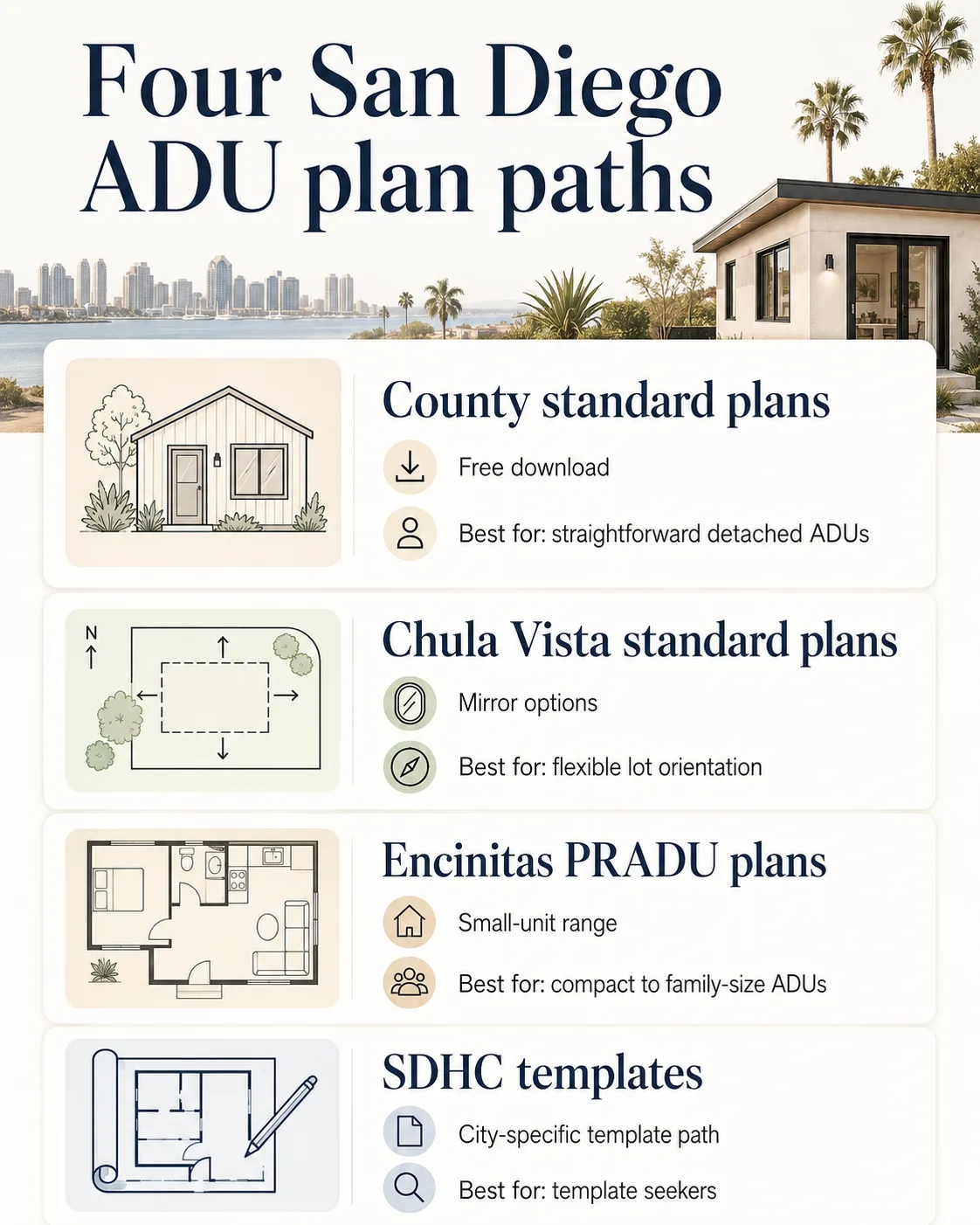
City of San Diego ADU plans come from four practical paths. Under California AB 1332 (Carrillo, 2023) — codified at Government Code §65852.27, as amended by SB 477 effective March 25, 2024 — the City of San Diego Development Services Department (DSD) currently accepts pre-approved ADU plans from three outside sources: the County of San Diego (6 plans), the City of Chula Vista (12 plan files designed by SnapADU), and the City of Encinitas (8 plans by Design Path Studio and DZN Partners), for a combined 26 accepted pre-approved options (per the City DSD ADU/JADU webpage). The San Diego Housing Commission (SDHC) separately publishes 4 City-specific ADU template designs that sit outside the DSD AB 1332 acceptance list. Per City DSD, applications using these plans are subject to a 30-day review and must comply with the San Diego Municipal Code. As of August 22, 2025, the City’s ADU Home Density Bonus program is meaningfully tighter for single-family zones (lot-size-based ADU caps of 4/5/6 by lot square footage, eight RS zones now ineligible outside CTCAC Opportunity Areas, fire sprinklers required for all Bonus ADUs).
If you read only one line: pick the smallest pre-approved plan that satisfies your use case, then verify your parcel with the City before licensing the plan. Order matters.
Address-specific, 60 seconds, no phone call required.
See What You Can Build → Get Your Free ADU Report
Get Your Free ADU Report →
Quick plan-path lookup
| Your situation | Where to look first | Why |
|---|---|---|
| You want the broadest free starting point | County of San Diego Plans A–F | Six ADU-relevant plans from 600 to 1,200 sq ft, free PDF + CAD download. |
| You want 498–1,199 sq ft layouts with mirror options | Chula Vista standard plans (SnapADU) | Six size families, each with a “Reverse” mirror version (12 files). |
| You want the smallest accepted unit | Encinitas PRADU plans | Includes the smallest accepted plan at 224 sq ft (DZN Partners studio). |
| You want a City-specific template path and may qualify for SDHC support | SDHC ADU templates | Four templates from studio to 3-bedroom; income, owner-occupancy, 7-year affordability, and family-tenant restrictions apply. |
| You need meaningful layout changes | Custom or build-ready provider plan | Modifying a pre-approved plan can erase the 30-day fast path. |
| You are in coastal, Beach Impact, high-fire, or steep-slope conditions | Parcel feasibility check first | Pre-approval does not override site-specific constraints. |
What we verified for this guide.
Verified May 11, 2026. Sources reviewed include the City of San Diego DSD ADU/JADU webpage (sandiego.gov), City Information Bulletin 400 (ADU/JADU) and Information Bulletin 501 (fee schedule for construction permits), the City Regulatory Updates page, the City Adopted Single-Issue Land Development Code Amendments page, the City permit-processing timeline page, the County of San Diego PDS dwelling unit plans catalog, the City of Chula Vista standard ADU plan page, the City of Encinitas PRADU page, the SDHC ADU program page, and California Government Code §65852.27 and §66311.5 (as amended by SB 477). Plan counts were assembled directly from each jurisdiction’s official catalog. Items we could not independently confirm at primary source — including current per-plan licensing terms from each designer, individual parcel-level Bonus ADU eligibility post-August 22, 2025, the date of California Coastal Commission approval of the Bonus reforms inside the Coastal Zone, and current-code-cycle permit-readiness of each posted public plan library — are marked [Verify directly] in the relevant sections.
What City of San Diego ADU plans can I actually use in 2026?
The City of San Diego currently accepts pre-approved ADU plans from three outside jurisdictions under California AB 1332: the County of San Diego, the City of Chula Vista, and the City of Encinitas — per the City DSD ADU/JADU webpage (sandiego.gov, verified May 11, 2026). The San Diego Housing Commission separately offers four City of San Diego template designs, which should be treated as a distinct City-specific path rather than part of the AB 1332 list (per sdhc.org).
AB 1332 (Carrillo, 2023) — codified at California Government Code §65852.27, as amended by SB 477 effective March 25, 2024 — required every California jurisdiction by January 1, 2025 to establish a process for accepting pre-approved ADU master plans and to grant qualifying applications a streamlined review. SB 477 did not eliminate §65852.27; it updated cross-references to the consolidated ADU statutory framework now beginning at Article 2 §66314.
Here is the unified count, verified directly against each official catalog:
| Source | Count | Size range | Bedrooms | Access model | Notes |
|---|---|---|---|---|---|
| County of San Diego Standard ADU Plans (Plans A–F) | 6 | 600–1,200 sq ft | 1–3 BR | Free PDF + CAD download from sandiegocounty.gov | County describes plans as ~85% complete; site-specific work still required. |
| City of Chula Vista Standard ADU Plans (SnapADU) | 12 (6 floor plans × mirror) | 498–1,199 sq ft | 1–3 BR | Contact SnapADU for licensing terms | Each plan has a “Reverse” mirror version. |
| City of Encinitas PRADU Plans (Design Path Studio + DZN Partners) | 8 (2 architect sets) | 224–1,199 sq ft | Studio–3 BR | Downloadable from encinitasca.gov; verify reuse terms with each architect | Includes the smallest accepted plan (224 sq ft DZN studio). |
| Total accepted under AB 1332 | 26 | 224–1,200 sq ft | Studio–3 BR | — | Per City of San Diego DSD ADU/JADU page. |
| San Diego Housing Commission (SDHC) ADU templates | 4 (separate path) | Studio, 1BR/1BA, 2BR/2BA, 3BR/3BA | Studio–3 BR | Available to qualifying City of San Diego homeowners through SDHC | City-specific only; SDHC states approval is not guaranteed and templates are not authorized outside the City. |
Two important points. First, “City of San Diego ADU plans” does not mean plans designed by the City of San Diego — it means plans the City accepts. Three of the four paths above were designed by neighboring jurisdictions or their selected design teams. Second, “accepted” is not the same as “permit-ready as-is under the current code cycle” — a critical distinction addressed in the next section.
Are these plans permit-ready under the current California Building Code cycle?
Acceptance by the City of San Diego DSD is not automatically the same as permit-readiness under the California Building Code cycle the City is currently enforcing. California Government Code §65852.27 ties the 30-day pre-approved-plan review path to plans that are pre-approved within the current triennial code cycle. Before you license or download any of the 26 plans, confirm directly with the plan provider that the specific set you intend to use has been updated for the current code cycle.
The 30-day fast-path review only applies cleanly when: the application is for a detached ADU (per §65852.27), the application is complete at intake, the pre-approved plan set is current under the California Building Code cycle the City is enforcing at submittal, and no modifications disqualify the pre-approved status. If any of those conditions fail, the 30-day clock does not apply and your application drops back to standard plan check.
| Plan source | Accepted by City DSD | Public access | Current-code-cycle status | Who to contact | What to ask |
|---|---|---|---|---|---|
| County of San Diego Plans A–F | Yes (per City DSD page) | Free PDF + CAD download | Plans described as ~85% complete; verify current code-cycle alignment at submittal | County PDS Building Services | "Are PDS670 through PDS675 current under the building code cycle the City is enforcing right now?" |
| Chula Vista SnapADU standard plans | Yes (per City DSD page) | Posted on Chula Vista DSD page | Verify directly with SnapADU — publicly posted versions may not be current [Verify directly] | SnapADU | "Is the specific plan I'm licensing updated for the City of San Diego's current building code cycle?" |
| Encinitas PRADU (Design Path Studio + DZN Partners) | Yes (per City DSD page) | Downloadable from Encinitas page; Encinitas states plans updated regularly | Updated regularly per Encinitas; verify version at submittal | Design Path Studio / DZN Partners | "Has this PRADU plan been updated for the current code cycle?" |
| SDHC City of San Diego templates | Separate path (not on the AB 1332 list) | Available through SDHC | SDHC states templates received initial DSD approval; further site-specific review required and approval is not guaranteed | SDHC ADU Program | "What is the current version date of the template I'm using?" |
The 26 accepted pre-approved plans, decoded
Below is every plan the City of San Diego currently accepts under AB 1332, normalized into a single comparison from each jurisdiction’s official catalog. Plan licensing terms and current-code-cycle status are best confirmed by contacting the designer directly — the City of San Diego DSD page explicitly says applicants must reach out to the ADU provider.
| # | Source | Plan ID / Name | Sq Ft | BR | BA | Designer | Mirror | License / Access | Notes |
|---|---|---|---|---|---|---|---|---|---|
| 1 | County of SD | Plan A (PDS670) | 1,200 | 3 | 1 | County PDS | No | Free PDF + CAD | Family / multi-generational |
| 2 | County of SD | Plan B (PDS673) | 1,200 | 2 | 1 | County PDS | No | Free PDF + CAD | Larger long-term rental |
| 3 | County of SD | Plan C (PDS675) | 1,200 | 2 | 2 | County PDS | No | Free PDF + CAD | Two-bath premium rental |
| 4 | County of SD | Plan D (PDS674) | 1,000 | 1 | 1.5 | County PDS | No | Free PDF + CAD | High-rent 1BR with powder room |
| 5 | County of SD | Plan E (PDS672) | 800 | 1 | 1 | County PDS | No | Free PDF + CAD | Compact 1BR; above 750 sq ft impact-fee threshold |
| 6 | County of SD | Plan F (PDS671) | 600 | 1 | 1 | County PDS | No | Free PDF + CAD | Smallest County plan; under 750 sq ft impact-fee threshold per §66311.5(c)(1) |
| 7 | Chula Vista | 498 Square | 498 | 1 | 1 | SnapADU | Yes (Reverse) | Contact SnapADU | Tight lot; under 750 threshold |
| 8 | Chula Vista | 498 Square Reverse | 498 | 1 | 1 | SnapADU | Mirror of #7 | Contact SnapADU | Lot orientation flip |
| 9 | Chula Vista | 748 Long | 748 | 1–2 | 1 | SnapADU | Yes (Reverse) | Contact SnapADU | Rectangular lot; under 750 threshold |
| 10 | Chula Vista | 748 Long Reverse | 748 | 1–2 | 1 | SnapADU | Mirror of #9 | Contact SnapADU | Flipped entry orientation |
| 11 | Chula Vista | 749 Square | 749 | 1–2 | 1 | SnapADU | Yes (Reverse) | Contact SnapADU | Square footprint |
| 12 | Chula Vista | 749 Square Reverse | 749 | 1–2 | 1 | SnapADU | Mirror of #11 | Contact SnapADU | Square footprint, flipped |
| 13 | Chula Vista | 749 L-Shape | 749 | 1–2 | 1 | SnapADU | Yes (Reverse) | Contact SnapADU | Corner siting |
| 14 | Chula Vista | 749 L-Shape Reverse | 749 | 1–2 | 1 | SnapADU | Mirror of #13 | Contact SnapADU | Opposite corner siting |
| 15 | Chula Vista | 999 L-Shape | 999 | 2–3 | 1–2 | SnapADU | Yes (Reverse) | Contact SnapADU | Family ADU |
| 16 | Chula Vista | 999 L-Shape Reverse | 999 | 2–3 | 1–2 | SnapADU | Mirror of #15 | Contact SnapADU | Family ADU, flipped |
| 17 | Chula Vista | 1199 L-Shape | 1,199 | 2–3 | 2 | SnapADU | Yes (Reverse) | Contact SnapADU | Maximum-size detached |
| 18 | Chula Vista | 1199 L-Shape Reverse | 1,199 | 2–3 | 2 | SnapADU | Mirror of #17 | Contact SnapADU | Maximum size, flipped |
| 19 | Encinitas | Studio (Design Path) | 350 | 0 | 1 | Design Path Studio | No | Download from Encinitas; verify reuse terms | Future-expandable studio |
| 20 | Encinitas | 1BR (Design Path) | 555 | 1 | 1 | Design Path Studio | No | Download from Encinitas; verify reuse terms | Expandable 1BR |
| 21 | Encinitas | 2BR (Design Path) | 745 | 2 | 2 | Design Path Studio | No | Download from Encinitas; verify reuse terms | Expandable 2BR; under 750 threshold |
| 22 | Encinitas | 3BR (Design Path) | 938 | 3 | 3 | Design Path Studio | No | Download from Encinitas; verify reuse terms | Family 3BR |
| 23 | Encinitas | Studio (DZN Partners) | 224 | 0 | 1 | DZN Partners | No | Download from Encinitas; verify reuse terms | Smallest accepted plan |
| 24 | Encinitas | 1BR (DZN Partners) | 499 | 1 | 1 | DZN Partners | No | Download from Encinitas; verify reuse terms | Under 750 threshold; multiple exterior options |
| 25 | Encinitas | 2BR (DZN Partners) | 990 | 2 | 2 | DZN Partners | No | Download from Encinitas; verify reuse terms | Larger 2BR with exterior choices |
| 26 | Encinitas | 3BR (DZN Partners) | 1,199 | 3 | 3 | DZN Partners | No | Download from Encinitas; verify reuse terms | Maximum-size 3BR |
Three things to notice. The County path is the only fully free download on the list. The Chula Vista path has the most flexibility for lot orientation thanks to consistent mirror versions. The Encinitas path has the widest size range — from the smallest accepted plan (224 sq ft) to a 1,199 sq ft three-bedroom.
See which of these 26 plans potentially fits your lot
Free property check →Address-specific, 60 seconds, no phone call required.
County of San Diego Standard ADU Plans (Plans A through F): the free path
The County of San Diego Planning & Development Services Department publishes six standard ADU plans — labeled Plans A through F, internal IDs PDS670 through PDS675 — that are free to download in PDF or CAD from sandiegocounty.gov. They were originally drafted for the unincorporated County, but the City of San Diego accepts them under AB 1332. The County describes the plans as approximately 85% complete; you still need a designer to add the site-specific package per the Dwelling Unit Checklist (PDS-607).
Plan A (PDS670) is the largest 3-bedroom option at 1,200 sq ft. Plans B (PDS673) and C (PDS675) are also 1,200 sq ft, configured as 2-bedroom layouts (Plan C with a second bath). Plan D (PDS674) is a 1,000 sq ft 1-bedroom with 1.5 baths. Plan E (PDS672) is an 800 sq ft 1BR/1BA. Plan F (PDS671) is the smallest at 600 sq ft, a 1BR/1BA — and the only County plan that sits below the 750 sq ft interior-livable-space threshold for full impact-fee exemption under California Government Code §66311.5(c)(1).
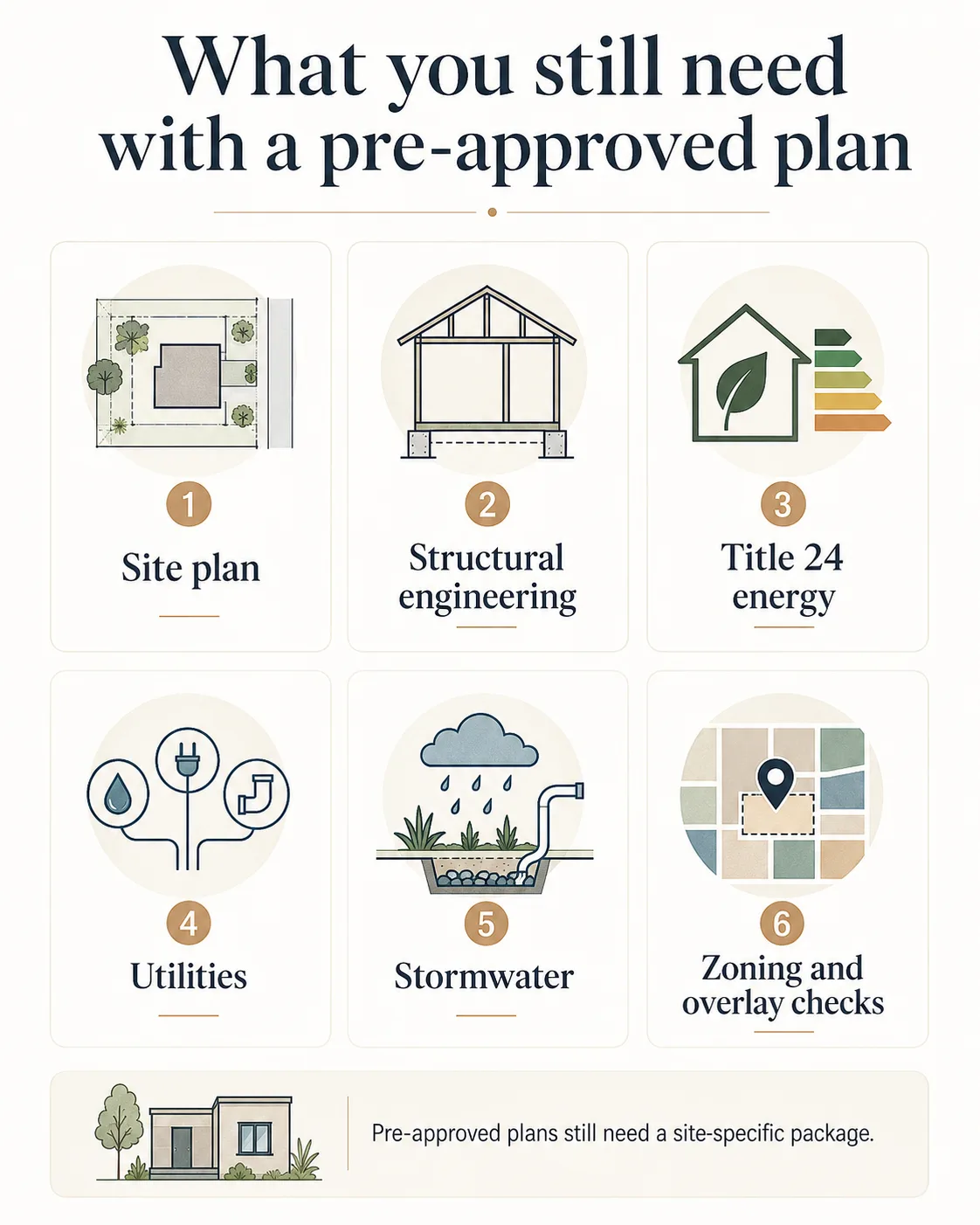
The free download is the headline benefit. The watch-out is what “85% complete” actually means. You will need a designer or engineer to add: a site plan oriented to your specific parcel and setbacks; structural calculations adapted to your soil and seismic conditions; California Title 24 energy compliance documentation specific to your climate zone (Climate Zone 7 covers most of the City of San Diego west of I-15; Climate Zone 10 covers parts of inland communities); utility connection plans; foundation type selection (slab-on-grade vs. raised); and any required geotechnical or soils report.
City of Chula Vista Standard ADU Plans (SnapADU-designed): 12 files, mirror options included
The City of Chula Vista standard ADU plans were designed by SnapADU, a San Diego–based design-build firm, through a competitive bid process. The library contains six floor-plan families ranging from 498 to 1,199 sq ft, with each family available in a “Reverse” mirror version for a total of 12 plan files (per chulavistaca.gov). The City of San Diego accepts them under AB 1332.
The Chula Vista catalog is the most thoughtfully constructed of the three. The 498 sq ft Square plan is a true compact 1-bedroom optimized for tight lots, well below the 750 sq ft interior-livable-space threshold. The three 748–749 sq ft variants (Long, Square, L-Shape) give homeowners three different footprints at almost identical square footage; if your buildable area is a narrow strip you want the Long, if you have a roughly square pad you want the Square, and if you are building into the corner of the lot the L-Shape uses the geometry better.
Mirror versions matter more than people expect. They let you flip the floor plan so the kitchen, bedrooms, and entrance face the direction that actually fits your lot’s orientation, solar exposure, and neighbor relationships — without disqualifying pre-approved status. On a non-mirrored library, achieving the same flip would require redrawing.
SnapADU also builds ADUs across Greater San Diego, including in the City of San Diego itself. Confirm plan licensing terms — including which contractor may build from a licensed plan — directly with SnapADU.
Request a property assessment from the firm that designed these plans
Request a Property Assessment from SnapADU →SnapADU offers assessments across Greater San Diego County, including all 18 incorporated cities and unincorporated areas.
City of Encinitas PRADU Plans (Design Path Studio + DZN Partners): widest size range and smallest accepted unit
The City of Encinitas Permit-Ready Accessory Dwelling Unit (PRADU) program offers eight pre-approved plans from two local architectural firms — Design Path Studio and DZN Partners — selected by Encinitas through a request-for-proposal process starting in 2019 (per encinitasca.gov). Plans range from a 224 sq ft DZN Partners studio (the smallest plan the City of San Diego accepts under AB 1332) to a 1,199 sq ft DZN Partners 3-bedroom. Encinitas states the plans have been updated regularly to current building code requirements and that modifications disqualify pre-approved status.
Design Path Studio’s set uses an “expandable” concept: the studio at 350 sq ft contains the primary plumbing, utilities, and structural openings needed for the larger plans, so a homeowner can start with a studio and add bedrooms later with minimal plumbing rework. The four Design Path units are 350, 555, 745, and 938 sq ft.
DZN Partners’ set emphasizes exterior options and rooflines — useful when matching the ADU to a specific architectural style. The four DZN units are 224, 499, 990, and 1,199 sq ft.
The PRADU plans are downloadable from the City of Encinitas page. Reuse terms for use on a City of San Diego submittal should be confirmed with each architect; do not assume any specific licensing or fee structure without that confirmation. Note: the fee waivers Encinitas offers on Encinitas projects do not transfer to a City of San Diego submittal — you pay San Diego’s fees on a San Diego submittal.
SDHC’s four City-specific ADU templates: the separate path
The San Diego Housing Commission publishes four City of San Diego–specific ADU template plans — a studio, a 1-bedroom/1-bath, a 2-bedroom/2-bath, and a 3-bedroom/3-bath — derived from its ADU Development Pilot Program (per sdhc.org). SDHC explicitly states the templates received initial approval from the City of San Diego DSD but will require further site-specific review and that approval is not guaranteed. SDHC also states the templates are not authorized for use outside the City of San Diego. Treat these as a fourth path distinct from the AB 1332 list.
Why does SDHC have its own templates? They came out of a pilot program SDHC ran to test ADU construction on its own properties; SDHC then made the designs available to City of San Diego homeowners. SDHC pairs the templates with its ADU Finance Program, which offers construction-to-permanent loans up to $250,000 plus no-cost technical assistance for eligible moderate-income City of San Diego homeowners, subject to SDHC and lender underwriting, current program availability, and current SDHC guidelines. Program restrictions per SDHC: applicants must be income-qualifying City of San Diego homeowners; the property must be owner-occupied; completed ADUs must be rented at affordable rents to low-income households for seven years; family members may not be tenants in the SDHC-financed unit during the affordability period; one ADU per property is financed.
If you are income-qualifying and the affordability commitment fits your goals, the combination of a City-derived template plus SDHC’s financing assistance can substantially lower the all-in cost — subject to the restrictions above. If those constraints do not fit (for example, you want to house a family member, you want market-rate rent, or your income exceeds the program ceiling), the SDHC templates are not the right path even if the floor plans look attractive.
How the 30-day review rule actually works
Per City of San Diego DSD, applications using pre-approved ADU plans are subject to a 30-day review and must comply with the San Diego Municipal Code. California Government Code §65852.27 ties the 30-day approve/deny window specifically to a complete detached-ADU application using a current-code-cycle pre-approved plan. Site-specific components — Title 24 energy compliance, structural calculations adapted to your site, geotechnical reports when triggered by site conditions, utility connection plans, stormwater compliance, and any Coastal Overlay, Fire Hazard Severity Zone, or Special Studies overlay reviews — run on separate timelines.
| What the 30-day window applies to (per §65852.27 / City DSD) | What runs on separate timelines |
|---|---|
| A complete application for a detached ADU | Land Development / Planning review (zoning, setbacks, overlays) |
| Using a qualifying current-code-cycle pre-approved plan | Fire Department plan review |
| With no modifications that disqualify pre-approval | Coastal Development Permit review (Coastal Overlay Zone) |
| Title 24 energy compliance specific to your site | |
| Site-specific structural review | |
| Utility connections (water, sewer, electrical, SDG&E coordination) | |
| Stormwater compliance review | |
| School fee form processing (San Diego Unified or local district) | |
| Outside-agency holds |
Two strategies that reliably shorten total time. First, resolve corrections as a single coordinated package rather than piecemeal — the City re-routes the application to each relevant division on resubmittal, so multiple round trips compound. Second, complete the water, sewer, school, and SDG&E forms in parallel with plan review, not after.
What it actually costs to use a pre-approved plan in the City of San Diego
City of San Diego permit fees are set in Information Bulletin 501 (IB-501), the City’s published fee schedule for construction permits. Specific dollar amounts depend on the permit category, project size, and applicable add-ons; verify the current IB-501 line items at the time of submittal. ADUs with 750 sq ft of interior livable space or less are exempt from impact fees under California Government Code §66311.5(c)(1); ADUs above 750 sq ft of interior livable space are charged proportionately. JADUs with 500 sq ft of interior livable space or less are also exempt from impact fees under the same statute.
Soft costs you incur before submitting (Dwelling Index editorial estimates; verify directly with local providers):
- Plan licensing or download (varies by source; County plans are free)
- Site-specific drafting to add site plan, foundation, utilities, and structural details to the master plan
- Title 24 energy compliance documentation
- Geotechnical / soils report (may be required based on site conditions)
- Survey or preliminary title report (often requested)
City of San Diego permit-stage fees and charges that may apply (per IB-501):
- Building permit plan check fee
- Building permit inspection fee
- Mechanical, electrical, and plumbing permits
- General Plan Maintenance Fee
- Mapping fee
- Water Meter Data Card and water/sewer plan check
- Stormwater applicability checklist review
- School fees (for ADUs at the size threshold under the applicable school district resolution)
- Recordation fees for ADU covenant and/or JADU agreement
Fees that only apply in certain situations:
- Development Impact Fees (only for ADUs over 750 sq ft of interior livable space per §66311.5; proportional to primary residence per state law)
- Community Enhancement Fee (new under the August 2025 reforms; applies to qualifying Bonus and Affordable ADUs under 750 sq ft to support neighborhood infrastructure)
- Coastal Development Permit fees (Coastal Overlay Zone projects)
- Inclusionary Housing fees (ADUs are subject to the City’s Inclusionary Housing Regulations)
- RTCIP fees (for projects with more than one ADU at applicable thresholds)
Worked example — 600 sq ft detached ADU using County Plan F (PDS671)
| Category | Estimate (verify directly) | Notes |
|---|---|---|
| Plan download | $0 | County publishes Plans A–F for free. |
| Site-specific drafter | Provider-quoted | Adds site plan, foundation detail, utility connections. |
| Title 24 energy consultant | Provider-quoted | Climate zone-specific (CZ 7 or 10). |
| Geotech / soils report | Provider-quoted; trigger depends on site | Common for new construction; not universal. |
| Building permit plan check + inspection | Per current IB-501 | Pull the matching row at submittal. |
| Mapping fee + General Plan Maintenance Fee | Per current IB-501 | Pull current rows. |
| Water/sewer plan check | Per current IB-501 | Lower if no meter change. |
| School fees | Per district resolution | District depends on lot location. |
| Development Impact Fees | $0 | Plan F is 600 sq ft, below the 750 sq ft threshold per §66311.5(c)(1). |
| Solar PV system (required for new detached non-manufactured ADUs) | Provider-quoted | Counts toward total budget. |
Get the free ADU Starter Kit
Includes our City of San Diego fee worksheet, the plan-selection checklist, and the 14 questions to ask before licensing any plan.
Get the Free ADU Starter Kit →What the August 2025 Bonus ADU reforms changed (and whether they affect your plan choice)
On July 22, 2025, the San Diego City Council adopted a comprehensive reform package to the City’s ADU Home Density Bonus Program. The reforms became effective August 22, 2025 outside the Coastal Overlay Zone; inside the Coastal Overlay Zone, implementation is pending California Coastal Commission approval, anticipated in 2026. The reforms do not change the state-mandated base ADUs — you can still build one detached ADU, one attached or conversion ADU, and one JADU on most single-family lots. They reshape the Bonus path, which previously allowed up to unlimited Bonus ADUs in Sustainable Development Areas in exchange for affordable deed-restricted units.
| Reform (effective Aug 22, 2025 outside Coastal Zone) | What it says | Practical meaning for your plan choice |
|---|---|---|
| Lot-size-based ADU caps under the Bonus program in single-family zones | Up to 4 ADUs on lots up to 8,000 sq ft; up to 5 ADUs on lots 8,001–10,000 sq ft; up to 6 ADUs on lots over 10,000 sq ft (per City Regulatory Updates page). Limits are inclusive of state-law ADUs. | If you were planning the largest stacked Bonus projects, recalibrate; if you are building 1–3 ADUs (the vast majority of all projects), this changes nothing for you. |
| Eight RS zones ineligible for the Bonus program | RS-1-1, RS-1-2, RS-1-3, RS-1-4, RS-1-8, RS-1-9, RS-1-10, and RS-1-11 lose Bonus ADU Program eligibility | Exception: parcels in a High or Highest CTCAC Opportunity Area that are identified as residential in the land use plan remain eligible. Check zoning via ZAPP and CTCAC opportunity-area status separately. |
| Sustainable Development Area now requires continuous sidewalks | SDA status requires a continuous sidewalk pedestrian path of travel to a major transit stop | Some properties previously in the SDA on paper are no longer in the SDA in practice. Re-verify SDA status on the City's updated layer. |
| All Bonus ADUs require fire sprinklers | Every Bonus ADU must include an automatic fire sprinkler system, regardless of primary residence sprinkler status | If you selected a pre-approved plan because it was sprinkler-free, the Bonus path adds sprinklers — confirm the plan can accommodate a sprinkler riser and tank/booster as needed. |
| Community Enhancement Fee on Bonus/Affordable ADUs under 750 sq ft | New fee on qualifying Bonus and Affordable ADUs under 750 sq ft to fund neighborhood infrastructure | Was the sub-750 sq ft size sweet spot for fee savings? The math has changed; re-run it. |
| Detached ADUs limited to two stories | No 3-story detached ADUs | Affects some stacked Bonus plans; base-state single-family ADUs are typically unaffected. |
| Parking required for Bonus ADUs outside Transit Priority Areas | One on-site parking space per Bonus ADU outside TPAs | Affects buildable-area math. Check TPA status via ZAPP. |
| 4-ft side/rear setbacks for ADUs in High or Very High Fire Hazard Severity Zones | Previously the 4-ft setback applied only to ADUs over 16 ft tall outside the FHSZ; now ADUs in High or Very High FHSZ require it regardless of height | Re-check the pre-approved plan's footprint vs. your buildable area if your lot is in a High or Very High FHSZ. |
| FHSZ lots on cul-de-sacs or single-egress roads ineligible for the Bonus program | Fire-access concerns disqualify these lots from the Bonus path | Verify road topology and access via ZAPP. |
| Environmentally sensitive lands and steep slopes excluded from developable lot size | These areas no longer count toward Floor Area Ratio baseline | Reduces FAR available to support Bonus ADUs on impacted lots. |
| AB 1033 implemented (sell an ADU as a separate condo) | City of San Diego now allows ADU condominium subdivision and separate sale | Different financial calculus. ADUs built through the Bonus path remain ineligible for separate sale. |
The plain reading for most homeowners: if you are building one or two ADUs in a single-family zone using the base-state path, none of this changes your plan options at all. The 30-day pre-approved-plan review remains. The 26 accepted plans remain. The base setbacks remain. The base size limits remain.
One critical caveat: the August 2025 reforms have not yet taken effect inside the Coastal Overlay Zone. As of our verification date, Coastal Zone Bonus ADU projects continue to operate under the pre-August 2025 rules. The City has indicated it expects Coastal Commission approval in 2026. [Verify directly at the time of any Coastal Overlay Zone project planning.]
Check whether the August 2025 reforms affect your specific parcel
Check Your Parcel →City of San Diego ADU rules at a glance
Independent of which pre-approved plan you choose, the City of San Diego’s base ADU rules govern your project (per Information Bulletin 400 and SDMC §141.0302). ADUs are sized 150 to 1,200 sq ft; JADUs are 150 to 500 sq ft of interior livable space and must be carved from an existing or proposed single-family residence. Side and rear setbacks are 0 ft if the ADU is 16 ft tall or shorter and the premises is outside a High or Very High Fire Hazard Severity Zone; 4 ft side/rear setback applies if the ADU exceeds 16 ft tall or sits in a High or Very High FHSZ. Parking is not required for new base-state ADUs except in specific Beach Impact Area situations outside Transit Priority Areas. ADUs may not be rented for terms shorter than 31 consecutive days. Newly constructed non-manufactured detached ADUs require solar PV under the California Energy Code.
| Rule | City of San Diego ADU | City of San Diego JADU |
|---|---|---|
| Size | 150–1,200 sq ft | 150–500 sq ft interior livable space |
| Allowed locations | Single-dwelling, multi-dwelling, mixed-use, planned districts | Single-residential zones only |
| Attached or detached | Conversion, attached, or detached | Must be conversion or attached |
| Number allowed per single-family lot (base state) | 1 detached + 1 conversion/attached | 1 |
| Number allowed per multi-family lot (base state) | Proposed: up to 2 detached ADUs; Existing: up to 8 detached ADUs (not exceeding existing units) + conversions up to 25% of existing units | Not permitted |
| Owner occupancy | Not required | Required if JADU shares sanitation with primary |
| Side / rear setback (≤16 ft) | 0 ft outside High/Very High FHSZ | N/A (within existing structure) |
| Side / rear setback (>16 ft) | 4 ft when next to residential | N/A |
| High or Very High FHSZ side / rear setback | 4 ft minimum regardless of height; Fire Code Official may require greater setbacks | N/A |
| Height (single-dwelling zone) | Per base zone, max 2 stories | N/A |
| Parking | None for base-state ADUs (with specific Beach Impact Area exceptions outside TPA) | None |
| Short-term rental (<31 days) | Not allowed | Not allowed |
| Solar PV requirement | Required for new detached non-manufactured ADUs (CA Energy Code) | Not required |
| Fire sprinklers (base state) | Required if primary has them; required for all Bonus and Affordable ADUs | Required if primary has them |
| Inclusionary Housing fees | Subject | Subject |
What you still need to submit even with a pre-approved plan
Per City of San Diego DSD’s Information Bulletin 400 (ADU/JADU) and the DSD ADU/JADU webpage, a pre-approved plan is one component of a complete submittal. You still need a site-specific package on top: site plan and vicinity map, floor plans, roof plans, elevations, sections, structural plans and details, structural and truss calculations, Title 24 energy compliance documents specific to your climate zone and foundation type, the General Application (DS-3032), the Water Meter Data Card (DS-16), the Storm Water Applicability Checklist (DS-560), and a Housing Development Tracking Form.
| Item | Why it matters | Who prepares it |
|---|---|---|
| Pre-approved master plan set | The core architectural/structural document | Plan provider (County, SnapADU, Design Path, DZN, SDHC) |
| Site plan / vicinity map | Shows ADU location, setbacks, easements, slopes, utilities | Designer or licensed surveyor |
| Floor plans + roof plans | Site-specific orientation and roof drainage | Designer or drafter |
| Elevations + sections | Height verification, exterior design | Designer or drafter |
| Structural plans + details | Site-specific structural compliance | Licensed structural engineer |
| Structural / truss calculations | Engineering verification for your soil and seismic site class | Engineer / truss designer |
| Title 24 energy calculations | California energy compliance (CZ 7 or 10 for City of San Diego) | Title 24 / energy consultant |
| General Application DS-3032 | City application form | Applicant or preparer |
| Water Meter Data Card DS-16 | Water service review | Applicant or plan preparer |
| Storm Water Applicability Checklist DS-560 | Stormwater compliance | Applicant or civil engineer |
| Housing Development Tracking Form | State housing tracking | Applicant |
| Geotech / soils report | May be required based on site conditions, foundation design, grading, slope, or City review | Licensed geotechnical engineer |
| Solar PV plan | Required for new detached non-manufactured ADUs per CA Energy Code | Solar contractor or designer |
| Fire sprinkler plan | Mandatory for all Bonus ADUs; base-state required only if primary has sprinklers | Fire protection engineer or sprinkler contractor |
| School fees form | District-specific | Applicant |
| Coastal Development Permit (if Coastal Overlay) | Coastal review; City decision on an ADU CDP is not appealable to the California Coastal Commission per IB-400 | Plan preparer + City processing |
Modifying a pre-approved plan: what’s allowed and what disqualifies it
Per Encinitas’s published PRADU guidance and consistent with the City of San Diego DSD page, the moment you change the floor plan, structural footprint, or door/window locations beyond a pre-approved master plan’s documented variation options, the plan is no longer pre-approved. The application falls back to standard plan check — typically longer review than the 30-calendar-day pre-approved window, plus higher plan-check fees.
What’s generally OK: site-specific orientation, foundation selection where the plan offers both slab-on-grade and raised options, exterior material choices within documented variations, and standard Title 24 adjustments.
What disqualifies pre-approved status: moving structural walls, changing window or door sizes beyond options, expanding square footage, mirroring a plan that is not published with a mirror version, and modifying the structural foundation type beyond what the plan offers.
If the plan does not fit, two better options exist. Look at all 26 plans and SDHC’s four templates again, sort by size and bedroom count, and see if a different plan fits better. Or go semi-custom from day one with a build-ready provider plan that includes layout flexibility in its base price.
When a pre-approved plan isn’t actually faster
Pre-approved plans save time and money on simple, well-fitted projects — flat lots with utilities nearby, no Coastal review, no fire-zone constraints, base-state (not Bonus) projects, and a plan that already matches the homeowner’s use case. They can cost more time and money on complex projects when the homeowner needs significant modifications, the lot needs structural adjustments anyway (slope, drainage, retaining walls), the project is in the Coastal Overlay Zone, or the homeowner is going through the Bonus path with the added sprinkler, parking, and Community Enhancement Fee requirements.
The honest framing: a pre-approved plan is a tool. Like any tool, it works on the right job and fails on the wrong one. The right job is a straightforward lot with a use case that one of the 26 plans already serves cleanly. The wrong job is a complicated lot, a custom layout vision, or a Bonus path on a tight buildable area.
If your project fits the second profile, our companion guides on San Diego detached ADU costs and the best ADU builders in San Diego County walk through the semi-custom math and the design-build firms that produce fully bespoke plans in a similar total timeline to a modified pre-approved plan. You are not stuck.
Which path should you use? County, Chula Vista, Encinitas, SDHC, or custom?
Use the County path if a 600 to 1,200 sq ft layout from Plans A through F already fits your goal — the plans are free and the design is straightforward. Use the Chula Vista (SnapADU) path if you want a 498 to 1,199 sq ft layout with a mirror option and value working with the firm that designed the plans. Use the Encinitas path if you want the widest size range or the very smallest accepted plan (224 sq ft). Use the SDHC path only if you are an income-qualifying City of San Diego homeowner who wants the templates paired with SDHC’s financing and accepts the seven-year affordability commitment and family-tenant restrictions. Use a custom or build-ready provider plan if your lot or use case needs meaningful changes that would disqualify pre-approved status.
| Use this path | Best fit | Avoid if |
|---|---|---|
| County of San Diego Plans A–F | Straightforward 600–1,200 sq ft detached ADU; cost-sensitive homeowners willing to pay a drafter to complete the plan | You need very small (<600 sq ft) or you need major customization |
| Chula Vista (SnapADU) standard plans | 498–1,199 sq ft with mirror options; homeowners who want to work with the plan's designer for construction | Your lot does not fit any of the six SnapADU footprints (Long, Square, L-Shape) |
| Encinitas (Design Path or DZN Partners) | Studio through 3BR with the widest size range; smallest accepted plan (224 sq ft); expandable concepts | You need significant layout modifications |
| SDHC City of San Diego templates | Income-qualifying City homeowners pursuing the SDHC ADU Finance Program who accept the 7-year affordability commitment and family-tenant restriction | You want market-rate rental, family-member tenants, or do not qualify on income |
| Custom or build-ready provider plan | Coastal-zone projects, sloped lots, unique architectural goals, high-end finishes, complex stacked ADU strategies | You only need a basic plan and want to minimize design fees |
Request a property assessment from SnapADU
SnapADU offers assessments across Greater San Diego County, including all 18 incorporated cities and unincorporated areas.
Request a Property Assessment from SnapADU →How to submit a City of San Diego ADU permit using a pre-approved plan
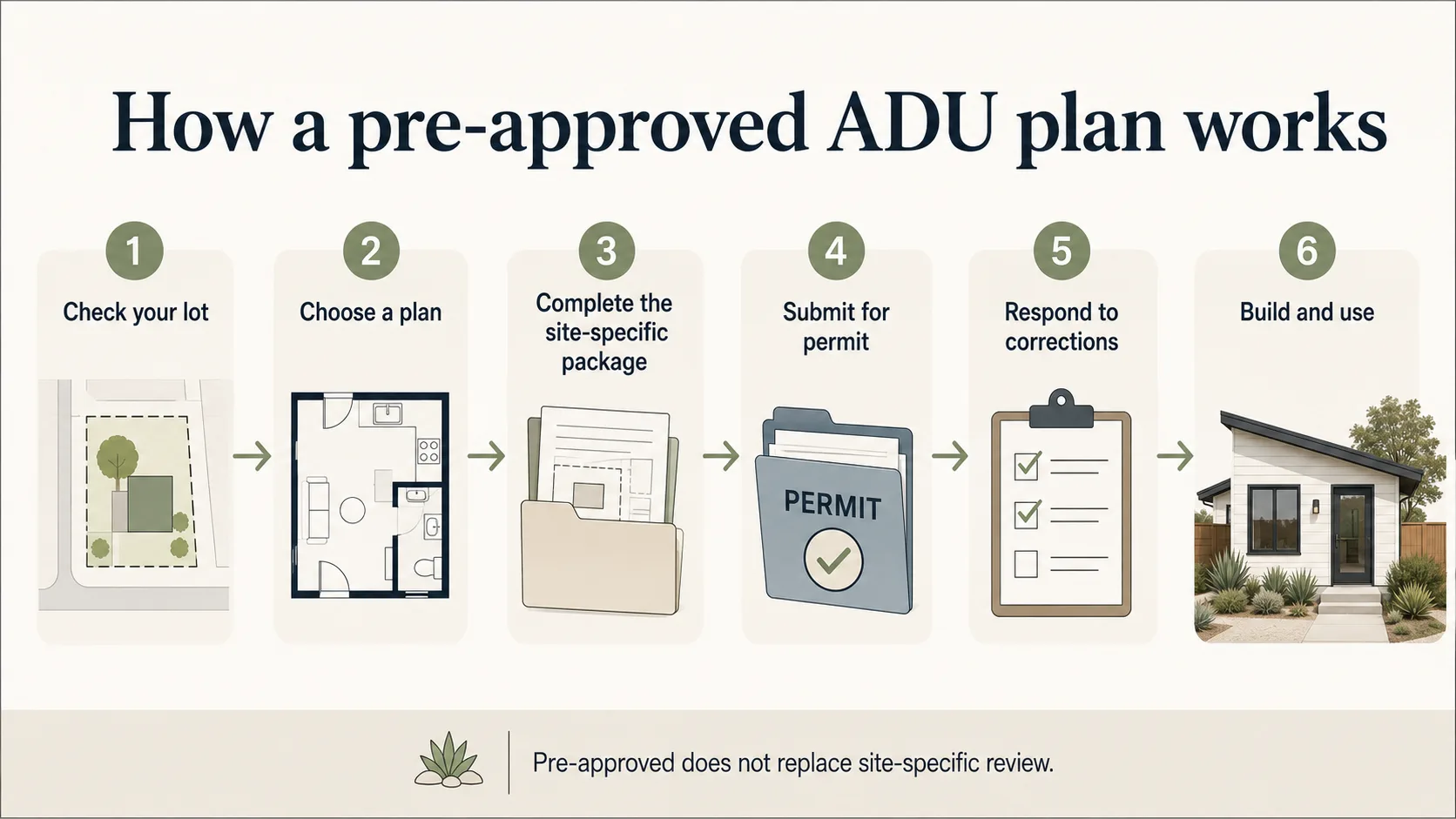
The City of San Diego DSD permit submittal flow for a pre-approved plan is: confirm the property is in the City of San Diego; check zoning and overlays via ZAPP; select the pre-approved plan source and verify current-code-cycle status with the provider; license or download the plan; assemble the site-specific package; submit through the City’s online permitting portal; respond to corrections as one coordinated package; pay required fees; and proceed through inspections after permit issuance.
- Confirm the property is in the City of San Diego. Jurisdiction is determined by parcel location, not homeowner preference. Adjacent unincorporated land falls under San Diego County PDS rules. Neighboring incorporated cities each have their own rules. If you are near a city boundary, confirm before relying on this guide.
- Check zoning and overlays via ZAPP. Confirm base zone, SDA status, TPA status, FHSZ status, Coastal Overlay status, Parking Impact Overlay (Beach Impact Area) status, Airport Influence Areas, and check CTCAC opportunity-area status separately. Five minutes; free.
- Select the pre-approved plan source and verify current-code-cycle status. Match plan size and bedroom count to your use case and your buildable area. Confirm current-code-cycle validity with the plan provider.
- License or download the plan. County plans are a free download. Confirm Chula Vista, Encinitas, and SDHC access terms with the plan provider.
- Assemble the site-specific package per the submittal checklist above. Engage a designer, a structural engineer, a Title 24 consultant, and (if needed) a geotechnical engineer.
- Submit through the City’s online permitting portal. Select the Building Construction permit type. Identify the pre-approved plan source in the project description.
- Respond to corrections as one coordinated package. The City routes the application to Building, Fire, Land Development (Planning), Land Development Engineering, and any overlay-specific divisions.
- Pay fees and obtain permit issuance. Outside-agency forms (water, sewer, school, SDG&E workorder) must be complete.
- Build, inspect, and close out. Schedule inspections through the City’s portal.
Coastal, fire, slope, and historic edge cases
Properties in the Coastal Overlay Zone, a High or Very High Fire Hazard Severity Zone, on steep slopes or special-study overlays, or with structures over 45 years old face additional review on top of the 30-day pre-approved-plan window. These conditions do not block a pre-approved plan — but they extend the total timeline, add fees and reports, and in some cases change the available plan footprint on your buildable area.
| Site condition | What it adds | Verification before plan licensing |
|---|---|---|
| Coastal Overlay Zone | Coastal Development Permit (CDP) required for ADUs/JADUs not completely contained in the existing primary structure (per IB-400); Process One treatment if findings are met; City's decision on the CDP for the ADU is not appealable to the California Coastal Commission per IB-400 | Verify Coastal Overlay status on the City's Coastal map. August 2025 Bonus reforms do not yet apply inside the Coastal Zone pending Coastal Commission approval (anticipated 2026). |
| Beach Impact Area of the Parking Impact Overlay (outside TPA) | One replacement parking space required for garage-conversion ADUs (with exemptions for ADUs ≤500 sq ft, attached ADUs, historic-district premises, residential permit parking districts, or car-share within one block) | Verify via Parking Impact Overlay map. |
| High or Very High Fire Hazard Severity Zone | 4-ft side/rear setback required regardless of ADU height; Fire Code Official may require greater setbacks; defensible-space requirements apply | Confirm FHSZ status via ZAPP. |
| FHSZ on cul-de-sac or single-egress road | Ineligible for the Bonus ADU Program post-August 2025 | Check road topology and access. |
| Narrow lot | Standard plan footprint may not fit buildable area | Overlay the plan footprint on your site plan before licensing. |
| Slope / retaining / drainage | Additional civil and structural engineering | Geotechnical evaluation early. |
| Special Studies Overlay (steep slopes, hillside/inland bluff, environmentally sensitive lands) | Special-study reports; FAR recalculation; encroachment restrictions on slopes ≥25% | Verify Special Studies Overlay status. |
| Structures over 45 years old | City intake guidance adds assessor record and photo survey documentation requirements | Pull assessor record and complete photo survey. |
| HOA or recorded private covenants (CC&Rs) | Private restrictions are separate from City approval; the City does not enforce them | Pull recorded title documents and HOA architectural review requirements separately. |
HOA note: The City of San Diego does not enforce private CC&Rs, HOA architectural rules, or recorded private restrictions. The City will approve a permit that complies with City code regardless of HOA rules. That does not mean your HOA cannot pursue you for violating its covenants. Pull your HOA’s architectural guidelines before licensing a plan.
Check your parcel’s edge-case overlays in 60 seconds
Free Property Check →Can I rent, Airbnb, or sell an ADU built from a City plan?
ADUs and JADUs in the City of San Diego may not be rented for terms shorter than 31 consecutive days — no Airbnb-style short-term rental is permitted (per City DSD). Long-term rentals (31 days or longer) are allowed. As of the August 2025 reforms, the City has implemented California AB 1033, allowing homeowners to subdivide an ADU into a condominium and sell it separately from the primary residence. ADUs developed through the City’s ADU Home Density Bonus Program are not eligible for separate sale.
- Long-term rental (31+ days). Permitted on all City of San Diego ADUs and JADUs. This is the path most homeowners take.
- Short-term / vacation rental (under 31 days). Not permitted on ADUs or JADUs. Do not build a financial pro forma around nightly rental income.
- SDHC-financed ADUs. Must be rented at affordable rents to income-qualifying tenants for seven years; SDHC’s program rules prohibit family-member tenants in the SDHC-financed unit during the affordability period.
- Selling the ADU as a separate condo (AB 1033 implementation). Under the August 2025 reforms, the City now allows ADU condominium subdivision and separate sale. Key conditions: final building inspection before final condominium plan recordation; first-30-days primary-occupancy listing requirement; ADUs developed through the Home Density Bonus Program ineligible.
Cost to build (not just permit): a realistic 2026 budget walkthrough
Per SnapADU’s March 2026 published cost guidance, detached turnkey ADU construction in San Diego typically runs $375 to $600+ per square foot, with most complete builds in the $300,000 to $450,000+ range. The California Construction Cost Index has risen approximately 44% from January 2021 to December 2025 per SnapADU’s tracking, meaning an ADU that cost $300,000 to build in 2021 would require approximately $430,000 in 2026 to build the same way.
Key cost drivers beyond size:
- Labor and materials: 50%+ of budget
- Sitework: Grading, retaining walls, drainage, utility trenching — flat lots with utilities nearby cost less
- Utility upgrades: Main panel upgrade and water meter upgrades add costs that vary by project
- Solar PV system: Required for new detached non-manufactured ADUs (California Energy Code)
- Fire sprinklers: Required for all Bonus ADUs and where the primary has them
- Finish level: Standard vs. premium can swing the budget materially
- Foundation type: Slab-on-grade is generally cheaper than raised foundation
- Fixed costs: Permit, design, kitchen, bathroom — these do not scale down with size
For detailed cost breakdowns by ADU type, finish level, and site condition — including worked examples for 500, 750, and 1,200 sq ft detached projects in the City of San Diego — see our companion guide: San Diego Detached ADU Cost (2026).
These are illustrative considerations, not guarantees of returns. Actual results depend on local market conditions, construction costs, financing terms, tenant demand, and regulatory approvals.
How the City of San Diego compares to neighboring jurisdictions
The City of San Diego’s pre-approved-plan acceptance, fees, and Bonus rules differ from neighboring jurisdictions. Verify which jurisdiction your parcel sits in before applying — jurisdiction is determined by parcel location, not homeowner preference.
| Jurisdiction | Accepts external pre-approved plans? | Pre-approved review time | Plan-check fees | Coastal process | Bonus / density program |
|---|---|---|---|---|---|
| City of San Diego | Yes (County, Chula Vista, Encinitas) | 30 calendar days per City DSD; §65852.27 ties to complete detached-ADU applications and current code cycle | Per IB-501 | Coastal Overlay Zone, CDP required for some scope per IB-400 | Home Density Bonus, reformed effective Aug 22, 2025 (outside Coastal) |
| County of San Diego (unincorporated) | Own Plans A–F, free download | County standard review | County PDS fee schedule | County Coastal process | State minimum |
| Chula Vista | Own SnapADU standards + by-others | Chula Vista publishes 14 business days for City Standard Plans | Approximately $1,000 less in plan-check fees vs. full submittal (per chulavistaca.gov) | Local Coastal Program for Bayfront | State minimum |
| Encinitas | Own PRADU + by-others (since Jan 2025 under AB 1332) | Per Encinitas | Plan-check + inspection fees largely waived for ADUs per Encinitas | Coastal Development Permit often required | State minimum |
| San Marcos | Own SnapADU-designed plans | Expedited per local rules | Per local fee schedule | None | State minimum |
How are San Diego homeowners actually paying for ADUs?
Most City of San Diego homeowners finance ADUs through home equity (HELOC), cash-out refinance, renovation-specific financing (loans against after-renovation value), construction-to-permanent loans, or — for income-qualifying City homeowners who accept the program restrictions — the SDHC ADU Finance Program. This page does not rank lenders. For financing-path education, see our companion guide.
Plan choice affects financing in a few ways. Smaller plans cost less to build, so HELOCs at typical combined loan-to-value ratios can fund them without refinancing the primary mortgage. Larger plans (1,000+ sq ft) often exceed HELOC capacity and require construction loans, cash-out refinances, or renovation loans that lend against post-construction value.
For the full financing comparison — which path fits which credit profile, which lenders serve California, and how to compare construction loans against cash-out refinances on present-value terms — see our ADU Financing Options guide.
The SDHC ADU Finance Program merits a separate look if you are an income-qualifying City of San Diego homeowner. It provides construction-to-permanent loans up to $250,000 plus no-cost technical assistance, subject to SDHC and lender underwriting, current program availability, and current SDHC guidelines (per sdhc.org). Restrictions: income eligibility, owner-occupancy, seven-year affordability commitment with affordable rents, no family-member tenants during the affordability period, one ADU per property. Verify current funding availability directly with SDHC.
Download the free ADU Starter Kit
Includes our City of San Diego fee worksheet, the plan-selection checklist, and the 14 questions to ask before licensing any plan.
Download the Free ADU Starter Kit →What we verified and what still needs property-specific confirmation
Verified May 11, 2026.
| Verified item | Source | Last verified |
|---|---|---|
| City accepts County, Chula Vista, Encinitas pre-approved plans under AB 1332 | City of San Diego DSD ADU/JADU webpage | 2026-05-11 |
| 30-day review language for pre-approved-plan applications | City of San Diego DSD ADU/JADU webpage | 2026-05-11 |
| Statutory scope of the 30-day window (complete detached-ADU applications, current code cycle) | California Government Code §65852.27 (Justia, 2025 California Code) | 2026-05-11 |
| §66311.5 impact-fee threshold (750 sq ft interior livable space) | California Government Code §66311.5(c)(1) (Justia, 2025 California Code) | 2026-05-11 |
| County Plans A–F catalog (sizes, bedrooms, formats) | County of San Diego PDS Dwelling Unit Plans page | 2026-05-11 |
| Chula Vista standard plan catalog (SnapADU-designed, 12 files) | City of Chula Vista DSD ADU page | 2026-05-11 |
| Encinitas PRADU catalog (Design Path Studio + DZN Partners, 8 plans) | City of Encinitas ADU page | 2026-05-11 |
| SDHC templates and Finance Program structure including restrictions | SDHC ADU program page | 2026-05-11 |
| City Information Bulletin 400 (ADU/JADU) and IB-501 (fees) | City of San Diego DSD forms-publications | 2026-05-11 |
| August 22, 2025 Bonus reform package; adopted July 22, 2025 | City of San Diego Adopted Single-Issue LDC Amendments page and Regulatory Updates page | 2026-05-11 |
| Lot-size-based Bonus ADU caps (4/5/6 by lot sq ft) | City of San Diego Regulatory Updates page | 2026-05-11 |
| AB 1332 effective Jan 1, 2025 jurisdictional requirement | leginfo.legislature.ca.gov | 2026-05-11 |
| Construction cost range $375–$600+/sq ft | SnapADU March 2026 cost guidance (snapadu.com/adu-costs) | 2026-05-11 |
Items that still need property-specific or time-sensitive confirmation:
- Current per-plan licensing terms and costs from SnapADU, Design Path Studio, DZN Partners — confirm directly
- Whether the specific plan version you intend to use is current under the California Building Code cycle the City is enforcing at submittal — confirm with the plan provider
- Current dollar amounts in Information Bulletin 501 — fee schedules update
- California Coastal Commission approval status for the August 2025 Bonus reforms inside the Coastal Overlay Zone (anticipated 2026)
- Your specific parcel’s zoning, SDA, TPA, FHSZ, Coastal Overlay, Parking Impact Overlay, Special Studies Overlay status (verify via ZAPP) and CTCAC opportunity-area status
- Current SDHC ADU Finance Program funding availability and waitlist status
- HOA architectural review rules if your parcel is in an HOA
Frequently asked questions
Does the City of San Diego have free ADU plans?
The County of San Diego offers Plans A through F as free PDF and CAD downloads, and the City of San Diego accepts those plans under AB 1332 — so yes, there is a free pre-approved-plan path available to City of San Diego homeowners. County plans are described as approximately 85% complete; you still pay a drafter to add site-specific components, plus standard City permit fees. The Chula Vista, Encinitas, and SDHC paths have their own access and licensing terms; contact the plan provider directly.
Are pre-approved ADU plans automatically approved by the City of San Diego?
No. Pre-approved plans receive a 30-day review window for qualifying complete detached-ADU applications using current-code-cycle plans, but the City still reviews site-specific components (zoning, setbacks, overlays, fire, utilities, stormwater, Title 24) on standard timelines. Applications must comply with the San Diego Municipal Code. The pre-approved status accelerates one part of the review.
Are the publicly posted City-accepted plans permit-ready under the current California Building Code cycle?
Not automatically. Acceptance by the City of San Diego DSD is not the same as current-code-cycle permit-readiness. California Government Code §65852.27 ties the 30-day review path to current-triennial-code-cycle plans, and some publicly posted libraries may not be updated to the latest cycle without contacting the plan provider. Always verify the version you intend to use with the plan provider before licensing.
What is the smallest City-accepted ADU plan?
The smallest pre-approved plan the City of San Diego accepts is the DZN Partners studio in the Encinitas PRADU catalog at 224 sq ft. The Design Path Studio studio in the same catalog is 350 sq ft.
What is the largest City-accepted ADU plan?
The largest pre-approved plans are 1,200 sq ft (County Plans A, B, and C) and 1,199 sq ft (Chula Vista 1199 L-Shape and Encinitas DZN 3BR). 1,200 sq ft is the maximum ADU size under California state law and the City of San Diego Municipal Code.
Can I modify a pre-approved ADU plan?
You can modify exterior finishes, door and window selections, and other components within each plan's documented variation options without disqualifying pre-approved status. Modifying the floor plan, structural footprint, foundation type beyond what the plan offers, or window/door sizes beyond documented options disqualifies pre-approval and pushes the application into standard plan check.
Do I need parking for an ADU in the City of San Diego?
For base-state ADUs, no parking is required — with one exception: the Beach Impact Area of the Parking Impact Overlay Zone outside Transit Priority Areas requires one replacement parking space for garage-conversion ADUs (with several sub-exemptions). As of August 22, 2025, Bonus ADUs outside Transit Priority Areas require one on-site parking space per Bonus ADU.
Can I rent my City of San Diego ADU on Airbnb?
No. Under City ADU rules, ADUs and JADUs may not be rented for terms shorter than 31 consecutive days. Long-term rentals (31 days or longer) are permitted.
Do I need fire sprinklers in my City of San Diego ADU?
Detached base-state ADUs are exempt from sprinkler requirements when the primary dwelling does not have sprinklers and the detached ADU is classified as Group R-3 occupancy. Attached ADUs and JADUs require sprinklers when the primary dwelling has them. All affordable ADUs and Bonus ADUs under the Home Density Bonus Program require sprinklers regardless of primary residence status (confirmed in the August 2025 reforms).
Do new detached ADUs need solar?
Yes. Newly constructed non-manufactured detached ADUs require solar PV under the California Energy Code. Per the California Energy Commission, the panels can be installed on the ADU itself or on the primary dwelling unit. JADUs do not require solar.
Can I sell my ADU as a separate condo in the City of San Diego?
Yes, as of August 22, 2025, the City has implemented California AB 1033, allowing ADU condominium subdivision and separate sale. The ADU must complete its final building inspection before condo recordation; subdivision follows SDMC Chapter 12, Article 5; and for the first 30 days of listing, the for-sale ADU must be offered to owner-occupants. ADUs developed through the Home Density Bonus Program are not eligible for separate sale.
Did the Bonus ADU program get repealed in 2025?
No. The Council voted to reform the program, not repeal it. The 25-item reform package was adopted July 22, 2025 and took effect August 22, 2025 outside the Coastal Overlay Zone; Coastal-Zone implementation is pending California Coastal Commission approval (anticipated 2026). The reforms tightened eligibility (including lot-size-based ADU caps of 4/5/6 by lot square footage), added fire-safety and parking requirements, and added a Community Enhancement Fee, but did not eliminate the Bonus path.
How long does it actually take to get an ADU permit using a pre-approved plan?
The 30-day window per §65852.27 applies to complete detached-ADU applications using a current-code-cycle pre-approved plan, with no disqualifying modifications. Total time from City submittal to permit issuance varies based on application completeness, current City workload, required corrections, and any overlay-specific reviews (Coastal, Fire, Special Studies). Check the City's permit-processing timeline dashboard for current snapshots.
What is a JADU and how is it different from an ADU?
A Junior Accessory Dwelling Unit (JADU) is a unit of 500 sq ft of interior livable space or less, contained entirely within a single-family residence, with an efficiency kitchen and either separate or shared sanitation. JADUs require an owner-occupancy agreement if sanitation is shared. ADUs can be up to 1,200 sq ft, can be detached or attached, have full independent living facilities, and do not require owner occupancy. You can build both an ADU and a JADU on the same single-family lot.
Where do I check whether my property is in the Sustainable Development Area or a Transit Priority Area?
Use the City's ZAPP — Zoning and Parcel Information Portal. It includes layers for base zone, SDA, TPA, Fire Hazard Severity Zone, Coastal Overlay, Parking Impact Overlay, and Special Studies Overlay. For CTCAC opportunity-area status — relevant if your base zone is one of the eight RS zones now ineligible for the Bonus program outside CTCAC areas — check the CTCAC opportunity map separately.
Can I use a County of San Diego Plan A–F outside the City of San Diego?
Yes, within the unincorporated areas of San Diego County (which the plans were originally drafted for). You can also use County plans in jurisdictions that accept them under AB 1332 — the City of San Diego accepts them; other San Diego County cities may or may not. Verify acceptance with the specific jurisdiction before licensing or starting design. SDHC's templates are explicitly limited to the City of San Diego.
Should I use a pre-approved plan or just go custom?
Use a pre-approved plan when your lot is straightforward (flat or near-flat, utilities nearby, no Coastal or fire-zone constraints), your use case matches one of the 26 plans cleanly, and you are building base-state (not Bonus). Go custom or semi-custom when you need meaningful layout changes, your lot has slope or unusual constraints, you are pursuing the Bonus path, or you are in the Coastal Overlay Zone.
Related guides
- San Diego pre-approved ADU plans — the City-specific companion reference (26 options)
- San Diego County pre-approved ADU plans — for the unincorporated County path
- San Diego Detached ADU Cost 2026: Real Prices + Fee Math
- Best ADU builders in San Diego County — when pre-approved isn't right
- ADU Financing: Every Option Explained
- HELOC for ADU construction
- Best ADU builders in Chula Vista — City Standard plans explained
- Best ADU builders in Encinitas — PRADU program inventory
- California ADU Laws 2025 — state-law context
Methodology
This guide was researched and written by The Dwelling Index editorial team. The Dwelling Index is an independent research resource covering ADU financing, costs, and regulations. We are not a lender, builder, designer, brokerage, or property management company.
For this guide, we fetched the City of San Diego DSD ADU/JADU webpage, the City Regulatory Updates page, the City Adopted Single-Issue Land Development Code Amendments page, the City permit-processing timeline page, City Information Bulletin 400 and Information Bulletin 501, the County of San Diego PDS dwelling unit plans page, the City of Chula Vista ADU page, the City of Encinitas ADU page, and the San Diego Housing Commission ADU program page directly. We counted plans against each source’s official catalog and normalized the data into the 26-plan comparison table. The August 2025 Bonus ADU reform content was cross-referenced against the City Regulatory Updates page and the City’s Adopted Single-Issue LDC Amendments page. Statutory references were checked against California Government Code §65852.27 and §66311.5 as amended by SB 477.
Cost data was triangulated against SnapADU’s March 2026 published cost guidance. Where we cite specific dollar amounts that change frequently (fee schedule line items, plan licensing fees), we direct the reader to the primary source or label our estimates as editorial estimates pending direct verification. This page is reviewed quarterly; the next scheduled refresh is approximately August 11, 2026.
Where we recommend specific builders or financing partners, those recommendations come from our Partner Vetting Policy. We disclose all material commercial relationships at the first relevant link. If you find an error, please use our Corrections page.
Not sure where to start?
See what’s possible at your address — get your free ADU report in 60 seconds.
See What You Can Build → Get Your Free ADU ReportFree. No call required. Address-specific, 60 seconds.