
San Diego ADU Permit Process: 2026 Steps, Fees, Timeline & Checklist
Bottom line. The San Diego ADU permit process starts with a Building Permit from the City’s Development Services Department (DSD) — required before any work begins on a new ADU, attached addition, garage conversion, or interior Junior ADU (JADU), per City of San Diego Information Bulletin 400 (IB-400). California Government Code §66317 gives the City 15 business days to determine whether your application is complete and 60 days to approve or deny a complete application; qualifying detached ADUs using eligible pre-approved plans get a 30-day clock under §65852.27 (added by AB 1332). Most delays don’t happen inside that clock — they happen before it starts or during correction cycles. Source-calculated 2026 City permit fees for a detached ADU under 500 sq ft start at $6,490.37 in City plan-check/inspection/admin before water/sewer adders, school fees, and exclusions; a 750 sq ft detached ADU in San Diego Unified School District (SDUSD) totals approximately $21,271 before water/sewer line items. The August 22, 2025 ordinance update changed almost nothing for a regular one-ADU homeowner — but California HCD found that Ordinance O-21989 fails to comply with State ADU Law on several items in an October 6, 2025 letter, so verify DSD’s current implementation before relying on any disputed provision.
Your fastest next step: See What You Can Build → Get Your Free San Diego ADU Report. Enter your address and we’ll return your jurisdiction, zoning, applicable setbacks, coastal/fire overlay status, max ADU count, and the fee schedule that applies — no commitment.
By The Dwelling Index Editorial Team · Methodology · Editorial standards · Corrections
Last updated: May 11, 2026 · Last verified: May 11, 2026 · Next scheduled review: August 11, 2026
Affiliate disclosure: The Dwelling Index is reader-supported. Some links on this page are affiliate links. If you click one and take a qualifying action, we may earn a commission at no extra cost to you. Affiliate relationships do not influence our editorial rankings or conclusions. Read our full disclosure.
What we verified for this guide
- City of San Diego Information Bulletin 400 (IB-400) — ADU/JADU rules, size, parking, rental, solar, sprinkler, setback (May 11, 2026)
- City of San Diego Information Bulletin 501 (IB-501) — construction-permit fee schedule (May 11, 2026)
- City of San Diego Information Bulletin 146 (IB-146) — school-fee assessment process and 500 sq ft exemption
- SDUSD residential developer-fee rate: $5.38/sq ft effective May 11, 2026
- California Government Code §§66310–66342 (current consolidated state ADU framework)
- HCD ADU Handbook (2026 update) and HCD October 6, 2025 review letter for Ordinance O-21989
- City Council action June 16, 2025; Ordinance O-21989 effective August 22, 2025
- County of San Diego AB 1033 adoption (March 4, 2026; effective April 4, 2026)
- SDHC ADU Finance Program materials and current funding status (May 11, 2026)
We’ve been independently tracking San Diego’s ADU rules through every major ordinance update since 2020. This guide is built from the City’s Information Bulletins (IB-400, IB-501, IB-146), the Project Submittal Manual, California ADU statutes (Gov. Code §§66310–66342), the HCD ADU Handbook, the HCD October 6, 2025 review letter for San Diego’s O-21989, and the San Diego Housing Commission program materials — all verified May 11, 2026. We’re not a builder, lender, or permit expediter. We’re an independent research resource covering ADU financing, costs, and regulations.
Jurisdiction warning: “San Diego” does not always mean “City of San Diego.” If your address is in Bonsall, Lakeside, Alpine, Ramona, Fallbrook, Spring Valley, Valley Center, Julian, or any other unincorporated community, you’re under the County of San Diego’s Planning & Development Services (PDS), which uses different rules. A “San Diego, CA” mailing address does not mean City jurisdiction — many ZIP codes in the 92020s, 92040s, 92060s, 92070s, and 92080s are unincorporated County or other cities. Use ZAPP to confirm definitively.
At a glance: your permit lane
| Your project | Likely permit lane | Main risk | First move |
|---|---|---|---|
| Garage conversion or JADU | Conversion / remodel ADU or JADU | Fire separation, egress, existing as-built conditions, title-sheet and site-plan completeness | Confirm the existing structure was permitted; document its conditions |
| New detached backyard ADU | Detached ADU building permit | Setbacks, height, utility routing, school fees, Title 24, structural docs | Confirm zone and overlays before commissioning design |
| Detached ADU using City-accepted pre-approved plan | Pre-approved plan detached lane (30-day clock under Gov. Code §65852.27) | Site-specific review still applies; plan must be current-code | Verify plan is eligible and confirm site conditions |
| Coastal, brush/fire, historic, or ESL lot | Standard permit + overlay review | Extra documents, larger setbacks, plan corrections, longer feasibility | Verify overlays at the address before any design spend |
| Multiple ADUs / Bonus ADU project | ADU Home Density Bonus path (post-Aug 22, 2025 caps) | Deed restrictions, parking, fire-sprinkler treatment, lot-size caps; HCD has found portions of O-21989 noncompliant | Verify Bonus Program eligibility under current DSD implementation |
See What You Can Build → Get Your Free San Diego ADU Report
Free address-level check before you pay for plans.
Check My PropertyDo you need a permit for an ADU in San Diego?
Every ADU type requires a permit — including conversions
Homeowners assume that because a garage is “already there” or because a JADU is “just an interior conversion,” no permit is needed. Per IB-400, that’s not true. The City reviews all of the following:
- Detached ADU (DADU): a standalone structure on the same lot as the primary residence
- Attached ADU: a new addition that shares one or more walls with the primary residence
- Conversion ADU: turning an existing garage, basement, attic, or accessory structure into a dwelling
- Junior ADU (JADU): 150–500 sq ft, contained entirely within the existing or proposed single-family residence (may share sanitation with the main house per IB-400 and state law)
- Manufactured / factory-built ADU: delivered to the site under HCD certification, but still requires a City foundation permit and site-work approval
A “JADU” is defined narrowly — 150 to 500 square feet, inside an existing or proposed single-dwelling structure. If your project is a new conversion of a detached garage into a unit with its own kitchen, that’s a conversion ADU, not a JADU.
What “ministerial review” actually means
California’s ADU laws (now consolidated at Gov. Code §§66310–66342) require ADU permit applications be reviewed ministerially — meaning if your project meets objective development standards, the agency cannot deny it. They can issue corrections to bring it into compliance. They cannot deny based on neighborhood character, aesthetic preferences, or planning-commissioner judgment. They cannot require discretionary review for a compliant ADU. When a reviewer pushes back with a subjective objection, you can respectfully cite the ministerial-review standard.
Already have an unpermitted ADU? AB 2533 created a legalization path
If your property has an unpermitted ADU built before January 1, 2020, California’s AB 2533 (effective 2025) provides a structured path to retroactive permitting. The HCD ADU Handbook explains that local agencies cannot deny these permits based solely on the prior lack of authorization, subject to listed health/safety/substandard-building exceptions. City of San Diego applicants should confirm the current City legalization submittal path directly with DSD before filing — the City has not historically published the same checklist format as the County.
City of San Diego vs. San Diego County: make sure you’re using the right rules
| Property location | Permit authority | Primary code | Key verification |
|---|---|---|---|
| Inside City of San Diego limits | City DSD + City Planning | SDMC Chapter 14, Article 1, Division 3; IB-400 | Look up your address on ZAPP (Zoning and Parcel Information Portal) |
| Unincorporated San Diego County | County PDS | County Zoning Ordinance + State ADU law | County PDS property lookup; check septic, brush, and fire-zone overlays |
| Other incorporated city in San Diego County | That city’s planning/building department | Local ADU ordinance | Confirm with city website — every city has its own fee schedule |
The rest of this guide is City of San Diego specific. If you’re in unincorporated County, see our Unincorporated San Diego County ADU Builders guide. If you’re in another city, see our guides for Chula Vista, Carlsbad, Encinitas, El Cajon, La Mesa, Poway, Santee, Lemon Grove, National City, and other San Diego County cities.
The San Diego ADU permit process, step by step
Step 1 — Confirm City jurisdiction and check zoning
This is the cheapest and highest-leverage hour you’ll spend on the entire project:
- Confirm City jurisdiction. ZAPP returns your parcel’s zone designation, base zone allowances, and applicable overlays.
- Identify your zone. Most residential lots are RS-1-1 through RS-1-14 (single-dwelling), RM zones (multi-dwelling), or planned-district zones. Your zone determines base setbacks, height, FAR, and lot coverage.
- Check overlays. Coastal Overlay, Beach Impact Area, Parking Impact Overlay, Very High Fire Hazard Severity Zone, Brush Management Zone, Environmentally Sensitive Lands (ESL), Historic Resources, Transit Priority Area (TPA), Sustainable Development Area (SDA), Airport Influence Area.
- Confirm the existing dwelling is legal. Per IB-400, ADUs are allowed where residential uses are allowed and where there is an existing or proposed primary dwelling. Unpermitted additions on your main house may need to be resolved.
Enter your address into our free property eligibility check and we return your zone, applicable setbacks, overlay status, maximum ADU count, and the fee schedule that applies.
Step 2 — Choose your ADU type before drawing plans
Every ADU type triggers a different fee category, a different setback table, and a different document set. Decide first:
| ADU type | Key constraints | When to choose it |
|---|---|---|
| JADU (150–500 sq ft, interior) | Must be within existing/proposed single-family residence; kitchen required; may share sanitation | Smallest budget, fastest path, can sacrifice independence |
| Conversion ADU (existing structure) | Existing structure must be legal; egress, fire separation, Title 24 apply | Lowest hard-cost build with existing structure |
| Attached ADU (new addition) | Setbacks, height, structural integration | Full ADU privacy without separate exterior structure |
| Detached ADU (new freestanding) | Setbacks, height (16-ft baseline; 18-ft near transit), Title 24 solar required | Highest-value, most independent option |
| Multifamily ADUs | Up to 8 detached on existing multi-dwelling lots per SB 1211 | Multifamily owners adding density |
A single-family lot can have one detached ADU, one conversion ADU, and one JADU concurrently under the state-baseline rules, plus potentially more under the Bonus Program (now capped — see the August 2025 changes section).
Step 3 — Prepare plans, forms, and required documents
The City’s Project Submittal Manual (Section 2A for construction permits) defines a complete ADU application. Per IB-400’s minimum submittal list:
- Title sheet with project scope, owner info, APN/legal description, lot size, occupancy, construction type, applicable code year, zoning and overlays, FAR / floor area calculation, dwelling unit summary, deferred submittals
- Site plan with property lines, setbacks, easements, streets, parking, drainage flow, existing and proposed structures, impervious surfaces, separation distances, contours where applicable, utility routing
- Floor plans and roof plans for proposed construction
- Elevations and sections showing exterior treatments and structural relationships
- Structural plans and calculations where engineering is required
- Title 24 energy compliance documentation
- General Application form
- Water Meter Data Card
- Storm Water Applicability Checklist
- Historic-resource documentation if any structure on the property is 45+ years old
- Conditional items triggered by overlays — coastal exhibits, brush management plans, geotechnical reports for hillsides, ESL biological surveys
Step 4 — Submit through the City’s Online Permitting Account
The City of San Diego accepts ADU applications digitally through the Online Permitting Account and DSD Application Portal — no paper copies required. This is one area where San Diego has materially streamlined the process compared to many other Southern California cities.
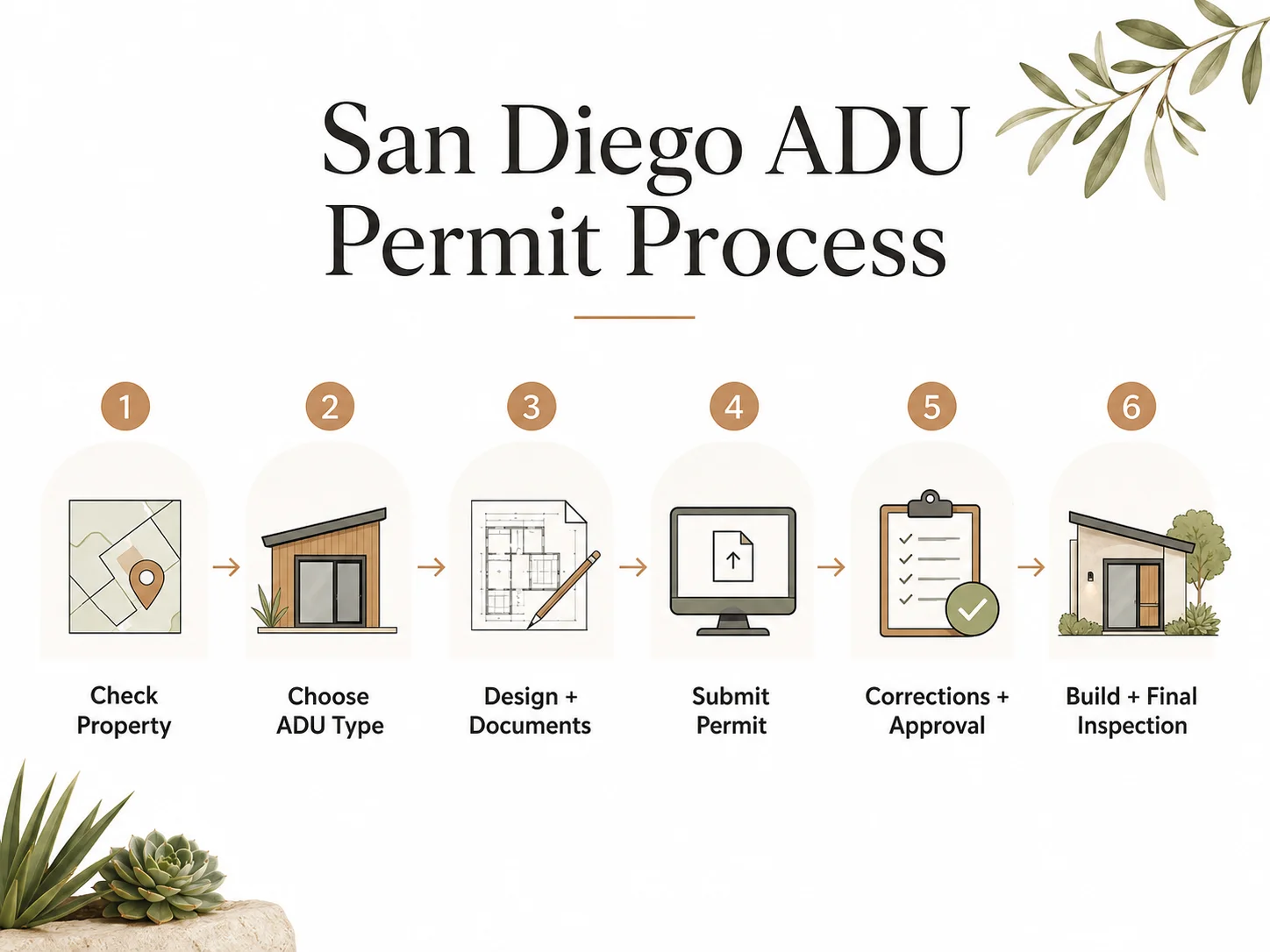
Step 5 — Pay plan-check fees and enter review
Plan-check fees are due at submittal. IB-501 lists the construction-permit fee categories. Per DSD’s permit-processing timeline page, the legal review clocks do not start ticking until the application is complete. Under Gov. Code §66317 (and SB 543, effective 2025), the City has 15 business days to determine completeness and must provide written notice of any deficiencies with specific fix requirements — and it cannot add new requirements when you resubmit.
Step 6 — Respond to corrections in one consolidated resubmittal
Most ADU projects receive corrections after the first plan-check round. Multiple departments review concurrently (Building, Land Development Review, Engineering, Fire, and Coastal if applicable). Per DSD’s published guidance, do not upload resubmittals piecemeal — wait until all disciplines have completed their reviews, consolidate all corrections, and resubmit a single package. Cycles after the first typically run shorter (often 30 days or less).
Step 7 — Clear permit issuance items
Once your plans are approved, the project moves into the issuance queue — typically 2–4 weeks. As of DSD’s May 8, 2026 issuance-dashboard snapshot, building-permit issuance was running about 2 business days once a project reached issuance. During issuance you clear:
- Remaining City fees — building permit fee, MEP fees, water/sewer plan-check line items
- School-fee certificate or receipt from the applicable school district — per IB-146, proof must be uploaded at permit issuance
- Construction and Demolition (C&D) debris deposit if the project meets the threshold
- Utility clearances — SDG&E interconnection scheduling; water meter sizing if a new or upsized meter is needed
- Contractor information — CSLB license number, workers’ comp insurance, City business tax certificate
- Final approved plans distributed to the contractor and inspectors
This is also when impact fees (where they apply) are paid. Per Gov. Code §66311.5, no impact fee may be imposed on an ADU with 750 sq ft of interior livable space or less, or on a JADU with 500 sq ft or less. “Impact fees” under that statute do not include connection fees or capacity charges — water and sewer capacity remain payable.
Step 8 — Build, inspect, and finalize
Construction inspections follow the standard sequence: foundation/slab, framing, rough mechanical/electrical/plumbing, insulation, drywall, exterior weatherproofing, solar interconnection where applicable, and final. SDG&E coordinates the electrical service connection separately. Final inspection clears the project for occupancy. Do not rent or occupy the unit before final approval — this can trigger code enforcement and complicate later compliance.
See What You Can Build → Get Your Free San Diego ADU Report
We built the free property check because homeowners were paying $10,000–$15,000 for plans before they confirmed their lot’s overlays, zone setbacks, and applicable fees. An hour of free verification can save you that.
Check My AddressHow long does the San Diego ADU permit really take in 2026?
Methodology note: the 3–5 month range is The Dwelling Index’s planning estimate based on current City legal clocks, the City’s published issuance-queue dashboard, and local design-build firms’ published permitting timelines. The City’s dashboard “2-business-day” issuance figure is for the issuance queue only — not the full review cycle.
Legal clocks vs. real-world project stages
| Stage | What homeowners think | What actually matters |
|---|---|---|
| Pre-design | “Can I build one?” | Jurisdiction, zone, lot constraints, overlays, ADU type |
| Submittal intake | “I submitted, the clock started” | The City has 15 business days under Gov. Code §66317 (per SB 543) to deem the application complete; missing items pause the clock entirely. |
| Plan check (standard ADU) | “The City has 60 days” | True — but only after completeness. §66317 applies to ADUs on lots with existing dwellings. Correction cycles extend the calendar. |
| Plan check (pre-approved plan) | “Pre-approved means automatic” | Gov. Code §65852.27 (added by AB 1332) provides a 30-day approve/deny clock for qualifying detached ADUs using eligible pre-approved plans — but site-specific review still applies. |
| Permit issuance | “Approved means I can build tomorrow” | Issuance can require final fee payment, school-fee certificate, C&D deposit, and utility clearances — typically 2–4 weeks. |
| Construction + inspections | “Permit done = project done” | Field inspections continue throughout construction. Final inspection and Certificate of Occupancy mark legal completion. |
Realistic 2026 phase-by-phase timeline
| Phase | Low end | High end | What extends it |
|---|---|---|---|
| Pre-design (zoning verification, design selection, engineering, Title 24) | 1 month | 4 months | Coastal/hillside complications, designer scheduling, custom vs. pre-approved choice |
| Pre-screen / completeness review | 2 weeks | 4 weeks | Incomplete title sheet, missing site-plan details, missing forms |
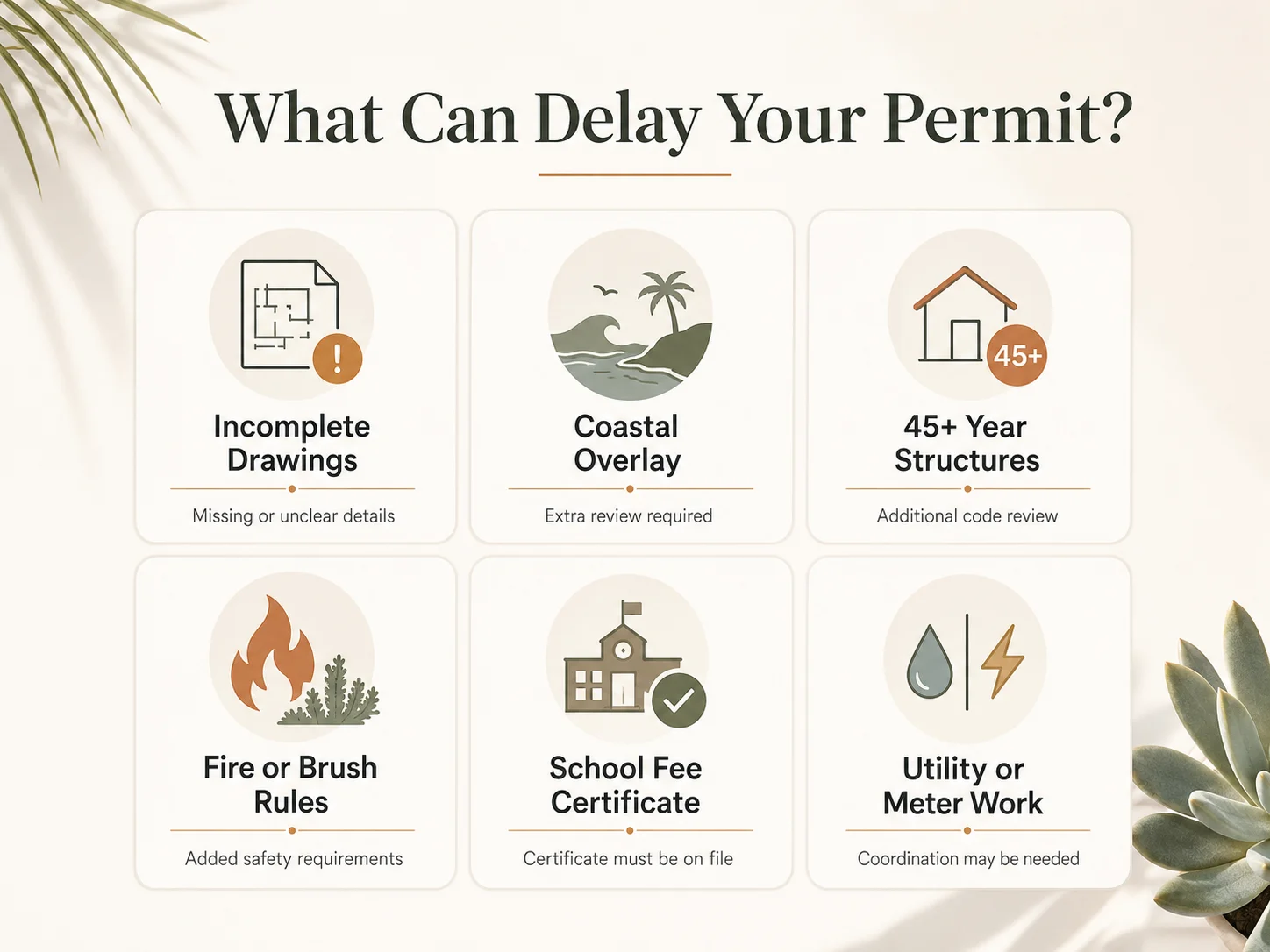
| First plan-check round | ~30 days | ~60 days | Multi-discipline review, coastal overlay (adds CDP review), historic age (45+ years) |
| Correction cycle(s) | 2–4 weeks | 8+ weeks | Multiple disciplines, incomplete resubmittals, piecemeal uploads, design changes |
| Issuance queue | 2 business days | 4 weeks | School-fee certificate delays, SDG&E coordination, contractor license issues |
| Construction + inspections (new detached ADU) | 5 months | 10 months | Supply chain, contractor scheduling, custom finishes, slope/hillside grading |
How much does a San Diego ADU permit cost in 2026?
Fee figures below are source-calculated planning estimates from IB-501 (May 2026 line items) and the SDUSD developer-fee page ($5.38/sq ft effective May 11, 2026). Actual fees depend on the property, project type, school district, and fee schedule in effect at issuance. Verify with DSD and your designer before relying on these figures for project budgeting.
Worked example A: Detached ADU under 500 sq ft (no school fee, no DIF)
| Line item | Amount | Source |
|---|---|---|
| City plan check (detached ADU <500 sq ft base) | $3,512.92 | IB-501 |
| City building inspection | $2,228.29 | IB-501 |
| General Plan Maintenance fee | $737.00 | IB-501 |
| Mapping fee | $12.16 | IB-501 |
| City plan-check/inspection/admin subtotal | $6,490.37 | Before water/sewer plan-check |
| Water/sewer plan-check adders | $176.57–$529.70 | IB-501 Table 501D |
| School impact fee (residential increase ≤500 sq ft) | $0 (exempt per IB-146) | IB-146 |
| Development impact fees | $0 (exempt under Gov. Code §66311.5) | State law |
Worked example B: Detached ADU, 750 sq ft, in SDUSD
| Line item | Amount | Source |
|---|---|---|
| City plan check ($3,512.92 base + 250 × $6.98) | $5,257.92 | IB-501 |
| City building inspection ($2,228.29 base + 250 × $4.46) | $3,343.29 | IB-501 |
| General Plan Maintenance fee | $737.00 | IB-501 |
| Mapping fee | $12.16 | IB-501 |
| City plan-check/inspection/admin subtotal | $9,350.37 | Before water/sewer plan-check |
| Water/sewer plan-check adders | $176.57–$529.70 | IB-501 Table 501D |
| School impact fee (750 × $5.38) | $4,035.00 | SDUSD |
| Development impact fees | $0 (exempt under Gov. Code §66311.5) | State law |
| Estimated total (before capacity charges) | ~$13,562–~$13,915 | Calculated |
Worked example C: Detached ADU, 1,200 sq ft, in SDUSD (with DIF)
| Line item | Amount | Source |
|---|---|---|
| City plan check ($3,512.92 base + 700 × $6.98) | $8,398.92 | IB-501 |
| City building inspection ($2,228.29 base + 700 × $4.46) | $5,350.29 | IB-501 |
| General Plan Maintenance fee | $737.00 | IB-501 |
| Mapping fee | $12.16 | IB-501 |
| Water/sewer plan-check adders | $176.57–$529.70 | IB-501 Table 501D |
| School impact fee (1,200 × $5.38) | $6,456.00 | SDUSD |
| Development impact fees (proportional DIF on sq ft over 750) | Project-specific — verify with DSD | Gov. Code §66311.5 |
| Water/sewer capacity charges | Project-specific — verify at issuance | Not included in IB-501 plan-check subtotal |
The 750 sq ft threshold is the largest single fee saver in the entire process. Some homeowners spec 749 sq ft to maximize square footage while staying under the §66311.5 threshold. Pushing to 751 sq ft to “round up” can trigger proportional DIF — almost always not worth it.
What these examples exclude: architectural design and engineering ($7,500–$15,000+), construction labor/materials, C&D recycling deposit, SDG&E interconnection charges, water/sewer capacity charges, geotechnical/soils reports, grading and stormwater design, coastal permits, historic-resource investigation reports, brush management plans, Title 24 third-party energy reports, and correction-cycle redesign labor.
For full project budgets, see our companion guide: San Diego Detached ADU Cost 2026.
Impact fees vs. connection/capacity fees — they are not the same
Gov. Code §66311.5 limits impact fees on small ADUs, but the same statute explicitly states that connection fees and capacity charges are not “impact fees” under that provision. Water and sewer capacity charges remain payable on every ADU project that triggers them. The 750 sq ft fee saver applies to traffic, park, and public-facilities-type impact fees — not to your water meter or sewer connection.
When the 500, 750, and 1,200 sq ft thresholds matter
| Threshold | What it controls | Source |
|---|---|---|
| 500 sq ft | School-fee exemption — residential increases at or below 500 sq ft are exempt from school impact fees | IB-146 |
| 750 sq ft | Impact-fee exemption — no impact fees on ADUs ≤750 sq ft interior livable space (JADU threshold is 500 sq ft) | Gov. Code §66311.5 |
| 1,200 sq ft | General state maximum for detached ADUs on single-dwelling lots (HCD has taken the position that this cap does not apply to detached ADUs on multifamily lots under Gov. Code §66323(a)(4)) | Gov. Code §§66310–66342 / IB-400 |
Available 2026 financing programs
SDHC ADU Finance Program — funding caveat first: the San Diego Housing Commission’s program application page currently states that FY2025 funds are not available, and limited FY2024 funds are first-come, first-approved. If funding is available, the SDHC ADU Finance Program provides construction-to-permanent loans of up to $250,000 (construction-phase rate around 1% and permanent-phase rate around 4%) to moderate-income homeowners (≤150% AMI, credit ≥680, owner-occupied primary residence inside City zip codes 921xx). Participating ADUs must be rented to income-qualified tenants for 7 years.
The CalHFA ADU Grant Program previously offered up to $40,000 for pre-development costs but was paused after funds were exhausted in 2024. Verify current CalHFA status directly before counting on grant funding.
Figuring out how to pay for the permit and construction phase? See our ADU Financing Options guide — independent education on HELOCs, construction loans, cash-out refis, and renovation loans, with current 2026 considerations.
These are educational financing paths, not loan recommendations or guarantees. Actual eligibility, rates, fees, and terms depend on the lender, borrower qualifications, property, and current program rules.
What documents do you need for a San Diego ADU permit?
The 24-point San Diego ADU permit package checklist
| # | Item | Why it matters |
|---|---|---|
| 1 | Building permit application form, fully completed | Required for any construction permit |
| 2 | Project scope written description (clear, specific) | Ambiguous scopes invite reviewer questions |
| 3 | Owner information and signature blocks | Missing signatures stop completeness |
| 4 | Contractor information (or owner-builder declaration) | Required at issuance |
| 5 | Title sheet with APN, legal description, lot size | Required to confirm jurisdiction and zoning |
| 6 | Zone designation and overlay information on title sheet | Required for ministerial review |
| 7 | FAR / floor area / dwelling unit summary | Required to verify code compliance |
| 8 | Applicable code year (CBC, CRC, Title 24) | Avoids review against wrong code cycle |
| 9 | Construction type and occupancy classification | Required for plan check |
| 10 | Site plan with dimensioned setbacks to all property lines | The most common correction item |
| 11 | Site plan showing all existing structures (permitted and as-built) | Reveals legal-conformance issues early |
| 12 | Site plan showing impervious surface coverage | Required for stormwater review |
| 13 | Site plan showing utilities, easements, and rights-of-way | Affects routing and grading review |
| 14 | Floor plans and roof plans for the ADU | Core construction review |
| 15 | Elevations and sections | Required for exterior treatment and structural review |
| 16 | Structural plans and calculations where engineering is required | Required for engineered framing |
| 17 | Title 24 energy compliance documentation | Required for all habitable construction |
| 18 | General Application form | Per IB-400 |
| 19 | Water Meter Data Card | Determines whether meter upsize is needed |
| 20 | Storm Water Applicability Checklist | Required for any new impervious area |
| 21 | Historic resource documentation (if any structure 45+ years old) | Triggers historic review if missed |
| 22 | Coastal Development Permit application items (if in Coastal Overlay) | Required for coastal-zone ADUs |
| 23 | Brush management plan (if in VHFHSZ or designated brush zones) | Required for fire-zone ADUs |
| 24 | Geotechnical / ESL / parking exhibit (conditional based on site) | High-impact when missed |
Download the Free San Diego ADU Permit Package Checklist (PDF)
Full 24-point list with source citations to IB-400, IB-501, IB-146, and the Project Submittal Manual. Email-only download, no spam, unsubscribe anytime.
Get the Checklist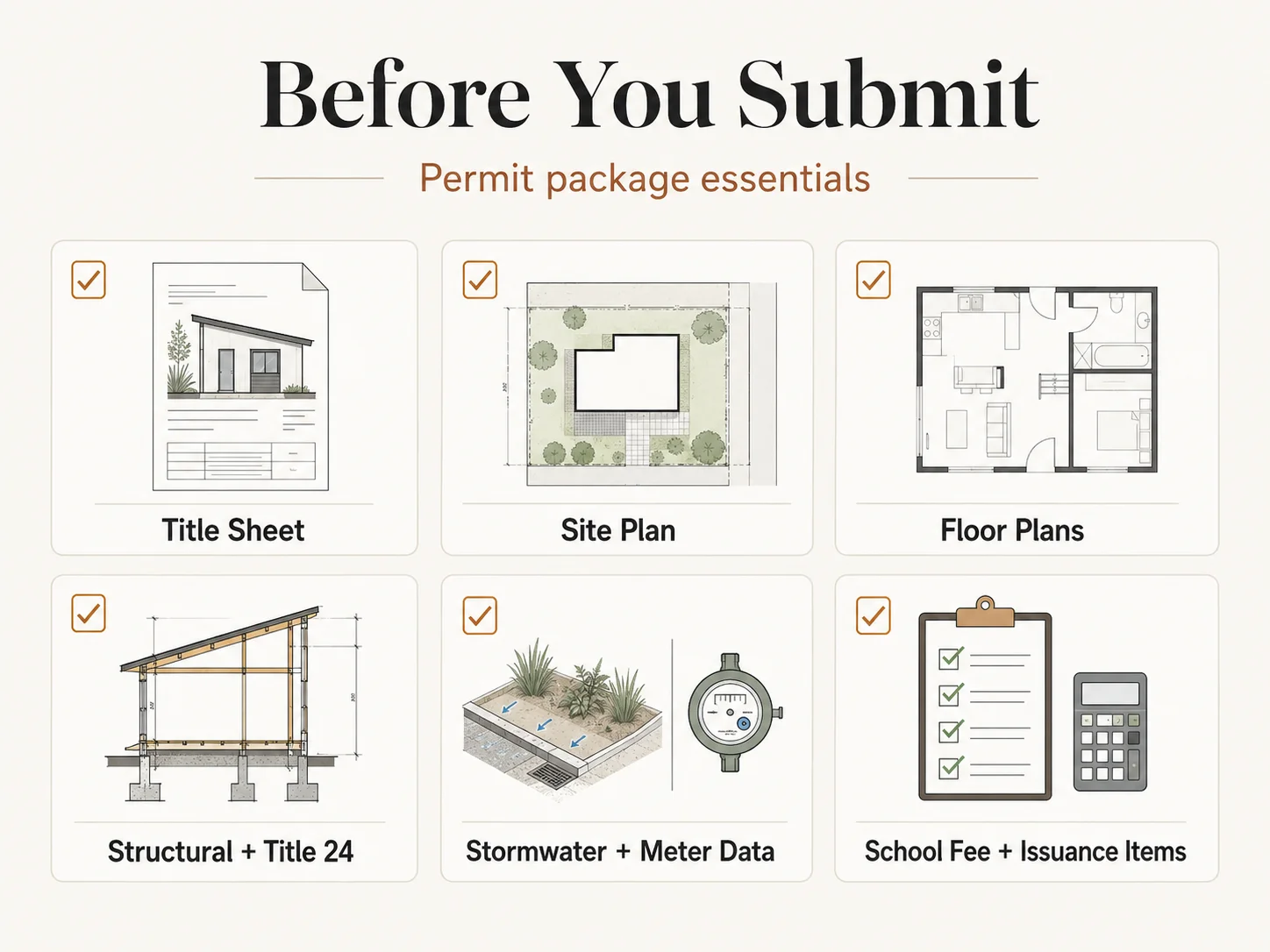
The “missing details” that quietly stall submittals
- Scope ambiguity (“interior remodel” instead of “convert existing detached garage to 480 sq ft ADU with new bathroom and kitchen”)
- Missing or incorrect APN / legal description on the title sheet
- Setbacks not dimensioned to property lines on the site plan
- Existing structures not shown on the site plan (City compares to assessor and aerial records)
- Parking notes missing for coastal-zone projects where any parking is involved
- Utility routing not shown for new utility laterals
- Building separation distances missing between primary dwelling and new ADU
- Historic-age documentation absent for structures 45+ years old
- Solar PV note missing for new detached ADU construction (Title 24 PV requirement)
- Setbacks shown but conflicting between site plan and floor plan
Rules that can change your San Diego ADU permit
How big can a San Diego ADU be?
Per IB-400 and California law:
- ADU minimum size: 150 sq ft (must include kitchen and bathroom for independence)
- ADU maximum size on single-dwelling lots: 1,200 sq ft (general state maximum)
- JADU size range: 150–500 sq ft, contained within an existing or proposed single-family residence
- State by-right minimum: California law guarantees the right to build at least an 800 sq ft ADU with 16-foot height and 4-foot side/rear setbacks on most residential lots
HCD multifamily caveat: HCD has taken the position in its October 6, 2025 review letter that detached ADUs on lots with existing multifamily dwellings reviewed under Gov. Code §66323(a)(4) are not subject to a local 1,200-sq-ft maximum. The City’s O-21989 imposes a size limit that HCD has flagged as noncompliant for that scenario — verify current DSD implementation if you’re a multifamily owner adding detached ADUs.
What setbacks apply in San Diego?
| Situation | Setback rule |
|---|---|
| Conversion of an existing legal structure (e.g., garage) | Existing setbacks may generally remain |
| Demolition and reconstruction in the same footprint | Prior location and dimensions can be preserved under stated conditions |
| New detached ADU (general baseline outside fire zones) | Front setbacks from base zone; 4-ft side/rear setbacks (zero-ft side/rear may apply in some cases per IB-400) |
| New detached ADU in a Very High Fire Hazard Severity Zone (VHFHSZ) | Minimum 4-ft side/rear setback regardless of structure height per IB-400; fire/brush rules may require more |
| Attached ADU | Follows primary-residence addition rules |
Does San Diego require ADU parking?
For most properties, no. Per IB-400, outside the Coastal Overlay Zone, no parking is required for ADUs or JADUs. Within the Coastal Overlay Zone, no parking is required unless the property is in the Beach Impact Area (Parking Impact Overlay Zone) and outside a Sustainable Development Area — in which case one off-street parking space is required, with several specific exemptions (including a car-share vehicle available within one block). For Bonus ADU Program projects, parking rules tightened after August 22, 2025.
Can you rent your San Diego ADU as a short-term rental?
No. Per IB-400, ADUs may not be leased for a term of less than 31 consecutive days; JADUs must be rented for a period longer than 30 days. State authority for those rental-term rules is in Gov. Code §§66315 / 66323(e) (ADUs) and §66333(g) (JADUs). Long-term rentals (31+ days) are permitted.
Do San Diego ADUs require solar panels?
Per IB-400 and California Title 24:
- Newly constructed non-manufactured detached ADUs: yes — must include solar PV per Title 24
- Conversions and additions: generally no
- Manufactured/factory-built ADUs: verify with the manufacturer based on certification path
Do San Diego ADUs require fire sprinklers?
Per IB-400, fire sprinklers are not required for ADUs unless they are required for the primary dwelling. For Affordable ADUs and Bonus ADUs, IB-400 states sprinklers shall be provided.
HCD compliance caveat: in its October 6, 2025 review letter, HCD found that the City’s broader fire-sprinkler language in Ordinance O-21989 is inconsistent with State ADU Law where sprinklers are not required for the primary residence. The City has not yet amended its ordinance to resolve this finding as of May 11, 2026. Verify current DSD implementation.
Can you sell your San Diego ADU separately under AB 1033?
Yes, as of August 22, 2025 — the City opted into AB 1033 via Ordinance O-21989, making San Diego the first city in the county to adopt the condo-conversion option for ADUs. The County of San Diego Board adopted the AB 1033 implementation amendment on March 4, 2026, with implementation effective April 4, 2026.
It’s not automatic. Selling an ADU as a condominium requires:
- Lender consent on the underlying property
- Subdivision mapping process completion
- Davis-Stirling Common Interest Development compliance (HOA/CC&R creation)
- Lienholder consent
- Final inspections completed
- Utility notification of the conversion
- Exclusions: SDHC-financed ADUs are excluded during the affordability restriction period; deed-restricted Bonus ADUs are generally excluded during restricted terms
Note: HCD’s October 6, 2025 review letter also flagged portions of San Diego’s separate-sale ordinance for noncompliance.
Two-story limit on detached ADUs (August 2025)
As of August 22, 2025, detached ADUs in the City of San Diego are limited to two stories citywide, even if the zone height would permit three or more stories. This is a meaningful design constraint for narrow lots where stacking units was being used to maximize density.
Check Your Lot’s Rules → Get Your Free San Diego ADU Report
The free address check returns your applicable setbacks, parking requirements, solar status, fire-zone status, coastal status, and AB 1033 eligibility in one summary.
Check My PropertyWhat changed for San Diego ADUs in 2025 and early 2026
HCD compliance finding (October 6, 2025)
In a written review letter, HCD found that San Diego Ordinance O-21989 fails to comply with State ADU Law on several items, including fire-sprinkler mandates that exceed state-law triggers, multifamily detached ADU size limits, setback and fire-separation wording, and separate-sale provisions. The City had not amended the ordinance to resolve these findings as of May 11, 2026. Verify DSD’s current implementation before relying on any disputed provision — state law takes precedence where the local ordinance is found inconsistent. Read the full HCD letter.
The August 22, 2025 changes — Regular ADU vs. Bonus Program decoder
| Change effective August 22, 2025 | Affects regular ADU? | Affects Bonus Program? |
|---|---|---|
| Hard caps on total ADUs/JADUs per lot: max 4 on lots ≤8,000 sf; 5 on 8,001–10,000 sf; 6 on 10,001+ sf | No — state law still guarantees one detached + one conversion + one JADU per SFR lot | Yes — caps total project count |
| Bonus Program eliminated in eight RS-1 zones (RS-1-1 through -4, -8 through -11), with exception for CTCAC High/Highest Opportunity Area properties | No | Yes — major restriction for low-density zones |
| Mandatory fire sprinklers on all Bonus ADUs (subject to HCD Oct. 6 noncompliance finding) | No (unless primary dwelling has sprinklers) | Yes per City ordinance, but HCD has flagged inconsistency |
| Parking required outside Transit Priority Areas for Bonus ADUs | No (regular ADUs keep their parking waivers) | Yes |
| 4-ft side/rear setbacks for ALL ADUs in High Fire Hazard Severity Zones | Yes if your lot is in a High Fire Hazard zone | Yes |
| Two-story cap on detached ADUs citywide | Yes | Yes |
| AB 1033 condo-sale option opted in by City (subject to HCD review of separate-sale provisions) | Yes — your ADU can now be sold as a condominium subject to conditions | Yes (with restrictions) |
| Landscape requirements eliminated (state preemption) | Yes — practical relief | Yes (with limited exception for Bonus Program projects with 2+ units) |
| Community Enhancement Fee on Bonus ADUs <750 sf | No | Yes — new fee to fund infrastructure |
Coastal Overlay Zone status as of May 2026
IB-400’s January 2026 editor’s note states that certain San Diego ADU regulations are not effective in the Coastal Overlay Zone until the California Coastal Commission certifies specific ordinances. The Coastal Commission certified Housing Action Package 1.0 (Ordinance O-21439) on September 12, 2024. Ordinances O-21618, O-21758, O-21836, and O-21989 — the post-August 2025 bundle — are not yet certified for application inside the Coastal Overlay Zone as of May 11, 2026. Until certified, ADUs in the coastal zone follow the prior ruleset on those specific items.
AB 462 (effective October 10, 2025) imposes a 60-day deadline on Coastal Development Permit decisions for ADUs in the coastal zone, running concurrently with ministerial review. If the City misses the deadline, the project is deemed approved as a matter of law.
Other meaningful 2025–2026 state law changes
- SB 543 (2025): 15 business days for completeness determination; written deficiency list with specific fix requirements; no new requirements on resubmittal; 60 business days for final decision on appeals. Now reflected in Gov. Code §66317.
- AB 253 (2025): may apply to eligible projects after the application is deemed complete and fees are paid, when the review timeframe exceeds 30 business days. Private plan check is limited to specified building-code review areas.
- AB 976 (effective January 1, 2024): permanently prohibited local agencies from requiring owner-occupancy for ADUs.
- AB 1332 (effective January 1, 2025): added Gov. Code §65852.27 and required every California city to develop a pre-approved ADU plan program; qualifying detached ADUs using eligible pre-approved plans get a 30-day approve/deny clock.
- SB 1211 (effective January 2025): allows up to 8 detached ADUs on lots with existing multifamily structures.
- AB 2533 (effective 2025): structured retroactive permitting path for unpermitted ADUs built before January 1, 2020.
- 2026 Land Development Code Update: 134 proposed amendments (103 Citywide, 31 Downtown). City Council hearing was scheduled for May 11, 2026 — re-check the Council outcome before relying on any draft items.
Coastal, fire, historic, and ESL overlays — special rules
Coastal Overlay Zone
IB-400 explicitly notes that certain San Diego ADU regulations are not effective within the Coastal Overlay Zone until the California Coastal Commission certifies the specific ordinance. As of May 11, 2026, the post-August 2025 ordinance bundle (O-21618, O-21758, O-21836, O-21989) is still awaiting Coastal Commission certification for coastal-zone application.
Coastal-zone projects require:
- A Coastal Development Permit application alongside the building permit
- Coastal exhibits showing visual character impact, public-view protection, and compliance with the Local Coastal Program (LCP)
- For properties in the appealable area of the Coastal Overlay Zone, public-noticing requirements
- For qualifying JADUs in the coastal zone meeting exemption criteria under SDMC §126.0704, a CDP may not be required
Very High Fire Hazard Severity Zone (VHFHSZ) and Brush Management
Per IB-400, detached ADUs in VHFHSZ are subject to:
- Minimum 4-foot side/rear setbacks regardless of structure height
- Bonus Program exclusions for cul-de-sac and single-ingress/egress lots
- Conditional fire-sprinkler requirements (with HCD’s October 6, 2025 noncompliance caveat)
- Brush management plan requirements per City Brush Management Zone overlays
- Defensible-space requirements per CAL FIRE standards
Historic resources (45+ year-old structures)
Per DSD timeline guidance, if any structure on the property is 45 years old or older, the City may require:
- Assessor building record retrieval
- Photo survey of the existing structures
- Historic-resource evaluation for properties potentially eligible for historic designation
- Additional review by City Historic Resources staff
A 45+ year structure does not automatically mean the property is historic — but it does mean the City wants to verify before approving any work that could affect a historic resource.
Environmentally Sensitive Lands (ESL)
ESL overlay includes designated steep hillsides, sensitive habitat, wetlands, floodplains, and seismic-hazard areas. ESL-overlay parcels often require biological surveys, geotechnical reports, and grading review. ESL lands are also excluded from Bonus Program FAR calculations.
Transit Priority Area (TPA)
TPA is not a restriction — it’s an incentive zone. Properties within a TPA (within one-half mile of a major transit stop) can qualify for:
- Greater height allowance (up to 18 ft on detached ADUs near transit)
- Floor Area Ratio bonuses for Bonus Program projects
- Parking requirement waivers even for some Bonus ADUs
Pre-approved ADU plans in San Diego
When pre-approved plans actually save you time
- Simple detached ADU on a flat or near-flat lot
- No coastal, fire, historic, or ESL overlay complications
- No tight setbacks or unusual lot geometry
- Owner wants to compress design time and cost
- Selected plan is current-code-compliant
When pre-approved plans don’t solve the hard parts
- Coastal Overlay Zone (CDP still required)
- VHFHSZ (brush management still required)
- Historic-age structures on lot (historic review still required)
- Steep slope / hillside grading
- Nonstandard lot geometry requiring custom site fit
- Major customization desired (defeats the pre-approval benefit)
- Multi-ADU or Bonus Program projects
For the full pre-approved plan catalog and which plans the City accepts, see our dedicated San Diego Pre-Approved ADU Plans (2026): 26 Options and our County of San Diego Pre-Approved ADU Plans guide.
What happens after the ADU permit is approved
Inspection sequence
| Stage | What’s inspected | When to schedule |
|---|---|---|
| Foundation / slab | Footings, reinforcing, slab prep before concrete pour | After excavation, before pour |
| Underground plumbing | Drain lines under slab | Before slab pour |
| Framing | Walls, roof framing, sheathing, structural connections | After framing complete, before insulation |
| Rough mechanical / electrical / plumbing | HVAC ducting, wiring, plumbing rough-in | After framing |
| Insulation | Wall and ceiling insulation before drywall | After rough inspections pass |
| Drywall nailing | Drywall fasteners before tape and texture | After drywall hung |
| Exterior / weatherproofing | Building wrap, roof underlayment, flashings | Before siding/roofing |
| Solar PV (new detached) | PV installation and interconnection | After roofing |
| Final | All systems functional, code-compliant | When construction is complete |
Critical reminder: do not move into or rent the unit before final inspection passes and the Certificate of Occupancy is issued. Occupying without final approval is a code violation that can complicate insurance claims, resale, and any future permit applications.
DIY vs. designer vs. design-build: which path is right?
| Your situation | Best-fit path |
|---|---|
| Simple JADU or interior conversion, no overlays, owner has construction-document experience | DIY may work; check City tutorials and customer-service line |
| Conversion ADU of legal existing garage, flat lot, no overlays | Architect or designer alone may suffice; hire a GC for construction |
| New detached ADU, simple site, in SDUSD district | Architect/designer + general contractor, or design-build |
| Coastal, fire, historic, or ESL overlay | Experienced local ADU professional |
| Bonus Program project (multiple ADUs, deed restrictions) | Specialist firm with Bonus Program permitting experience and Housing Commission coordination |
| Want one accountable team end-to-end | Design-build provider |
Honest admission
Hiring a builder doesn’t make the permit process predictable. Even San Diego design-build firms with 100+ permitted ADUs cite 3–5 months as the typical City permit timeline and call out coastal, hillside, and septic projects as routinely longer. A great builder makes the process navigable, reduces correction-loop cycles, and front-loads the overlay/setback verification — but they cannot make City staff move faster than City staff move. If a builder promises you a 60-day permit on a coastal or fire-zone project, walk.
Recommended Greater San Diego design-build partner
If your project is in Greater San Diego (City of San Diego, North County coastal, East County inland, or South Bay), and you want one team handling design, permitting, and construction in-house:
SnapADU is a Greater-San-Diego-only design-build firm with over 100 permitted San Diego ADUs and pre-approved plans accepted by the City of San Diego. They publish their floor-plan catalog and pricing on their website. They handle the full permit process end-to-end and have recent City of San Diego permitting experience. They are an active partner of The Dwelling Index for the Greater San Diego service area.
They’re not the right fit for every project. SnapADU does not serve outside Greater San Diego. If your all-in budget is under $250,000, a smaller local GC or a prefab path is likely a better economic match — see our SnapADU Alternatives 2026 guide for verified options.
Affiliate disclosure: The Dwelling Index may earn a commission when readers request a SnapADU quote through our links. SnapADU was selected as our recommended Greater San Diego partner based on independent vetting (license verification, customer-review signals, transparent pricing, service-area fit) — not on compensation. Our editorial recommendations are independent of compensation.
Seven most common San Diego ADU permit mistakes
- Submitting before pre-screen is genuinely ready. The City’s pre-screen catches incomplete submittals. Homeowners have lost 4–8 weeks recovering from a rejected first submittal. Use the 24-point checklist before clicking submit.
- Discovering coastal overlay late in design. A homeowner pays $12,000 for plans, then learns the lot is in the Coastal Overlay Zone and needs CDP-compliant exhibits. Fix this in Step 1.
- Wrong assumptions about the 4-foot fire-zone setback. Per IB-400, the minimum 4-foot side/rear setback applies in High Fire Hazard zones. Designers using outdated setback templates trigger corrections.
- Missing the school-fee certificate at issuance. Per IB-146, school-fee proof must be uploaded at issuance. The school district is a separate agency with its own timeline. Submit the school-fee paperwork as soon as plans are approved — not at the City issuance counter.
- Speccing 800 sq ft instead of 749 sq ft. Crossing the §66311.5 threshold of 750 sq ft adds proportional development impact fees on top of higher school fees. If 50 sq ft isn’t critical to your design, staying under 750 sq ft can be a significant fee saver.
- Assuming no soils report is needed. The City does not categorically require soils reports for ADUs — but hillside, slope, or soil-condition projects do. Conditions can trigger soils reports for unincorporated lots as well.
- Overlooking SDG&E interconnection scheduling. SDG&E coordination is not a City process — it’s separate, and it has its own timeline. Schedule the service-upgrade conversation early in construction, not at final inspection.
What we verified for this guide
| Verified item | Source |
|---|---|
| ADU and JADU Building Permit requirement; size, parking, rental, solar, sprinkler, and setback rules | City of San Diego IB-400 |
| Construction-permit fee schedule (plan check, inspection, General Plan Maintenance, mapping, MEP, water/sewer plan-check line items) | City of San Diego IB-501 |
| School-fee assessment process and 500 sq ft exemption | City of San Diego IB-146 |
| SDUSD residential developer-fee rate ($5.38/sq ft effective May 11, 2026) | SDUSD developer-fee page |
| 15-business-day completeness determination; 60-day approval/denial clock | California Government Code §66317 |
| Impact-fee limits (750 sq ft ADU / 500 sq ft JADU; capacity/connection fees excluded) | Gov. Code §66311.5 |
| 30-day clock for pre-approved plan detached ADUs | Gov. Code §65852.27 (AB 1332) |
| State ADU framework (now consolidated at §§66310–66342) | HCD ADU Handbook (2026 update) |
| HCD October 6, 2025 noncompliance finding for Ordinance O-21989 | HCD letter to City of San Diego, October 6, 2025 |
| August 22, 2025 City ordinance (O-21989) — Bonus Program rollback, AB 1033 adoption, two-story cap | City Council action June 16, 2025; ordinance effective August 22, 2025 |
| County of San Diego AB 1033 adoption (March 4, 2026); implementation effective April 4, 2026 | County of San Diego ADU Zoning Ordinance Amendment page |
| Coastal Commission certification status (O-21439 certified Sep 12, 2024; O-21618/O-21758/O-21836/O-21989 pending) | City of San Diego IB-400 editor's note (January 2026) |
| DSD permit-processing timeline (issuance ~2 business days as of May 8, 2026) | City of San Diego DSD timeline page |
| SDHC ADU Finance Program parameters and current funding status | SDHC ADU program page |
| SnapADU service area; 100+ completed San Diego ADUs; in-house design/permitting/construction | SnapADU homepage |
Methodology
The Dwelling Index is an independent research resource covering ADU financing, costs, and regulations. We are not a builder, lender, broker, or permit expediter.
This guide was researched by reading the City of San Diego’s ADU Information Bulletins (IB-400 for ADU/JADU rules, IB-501 for construction-permit fees, IB-146 for school fees), the Project Submittal Manual, California Government Code §§66310–66342 (the current consolidated state ADU framework), the HCD ADU Handbook, HCD’s October 6, 2025 review letter for San Diego’s Ordinance O-21989, the City Council’s June 16, 2025 action and August 22, 2025 ordinance, the County of San Diego PDS ADU page, the San Diego Housing Commission ADU Finance Program materials, the San Diego Unified School District developer-fee page, and the California Coastal Commission’s certification record for City ordinances. We cross-verified fee ranges and timelines against builder-published cost guides, local news reporting, and legal alerts from major California land-use law firms.
This guide is not legal advice, not tax advice, not financing advice, and not a substitute for City review of your specific project. Verify your property’s zoning, overlays, and applicable fees with the City of San Diego before submitting plans or making financial commitments. Read our complete editorial standards, methodology, and partner vetting policy.
Rental-income disclaimer: Any rental-income figures in this guide are illustrative examples, not guarantees of returns. Actual results depend on local market conditions, construction costs, financing terms, and regulatory approvals.
Frequently asked questions about the San Diego ADU permit process
Do you need a permit for an ADU in San Diego?
Yes. The City of San Diego’s IB-400 states that a Building Permit is required to construct an ADU or JADU. This applies to detached new construction, attached additions, garage and basement conversions, JADUs, and manufactured/factory-built ADUs.
How long does it take to get an ADU permit in San Diego?
The legal review clock under Gov. Code §66317 is generally 60 days after a complete application is submitted, with a 15-business-day completeness determination preceding it (SB 543). Qualifying detached ADUs using eligible pre-approved plans get a 30-day clock under Gov. Code §65852.27 (AB 1332). In practice, total time from submittal to issuance is typically 3–5 months in 2026 for a clean City of San Diego submittal, with longer timelines for coastal, fire-zone, hillside, and Bonus Program projects.
How much does a San Diego ADU permit cost in 2026?
Source-calculated examples using IB-501 May 2026 line items and the SDUSD $5.38/sq ft developer-fee rate show permit-related costs starting at $6,490.37 in City plan-check/inspection/admin for a detached ADU under 500 sq ft. A 750 sq ft detached ADU in SDUSD totals approximately $21,271 before water/sewer line items. ADUs over 750 sq ft also pay proportional development impact fees under Gov. Code §66311.5. Actual fees depend on the property, project type, school district, and fee schedule in effect at issuance.
Does San Diego require parking for ADUs?
For most properties, no. Per IB-400, no parking is required for ADUs or JADUs outside the Coastal Overlay Zone. Within the coastal zone, no parking is required unless the property is in the Beach Impact Area (Parking Impact Overlay Zone) and outside a Sustainable Development Area, in which case one off-street parking space is required — with several specific exemptions. Bonus Program projects outside Transit Priority Areas require parking after August 22, 2025.
Can I rent my San Diego ADU as an Airbnb?
No. Per IB-400 and Gov. Code §§66315 / 66323(e) / 66333(g), ADUs may not be leased for a term of less than 31 consecutive days, and JADUs must be rented for a period longer than 30 days. Long-term rentals are permitted; short-term/vacation rentals are not.
How big can my San Diego ADU be?
Per IB-400, an ADU can be a minimum of 150 sq ft and a maximum of 1,200 sq ft on single-dwelling lots. JADUs must be 150–500 sq ft and contained within an existing or proposed single-family residence. California state law guarantees the right to build at least an 800 sq ft ADU with 16-ft height and 4-ft side/rear setbacks on most residential lots regardless of base zone.
Do pre-approved ADU plans guarantee approval?
No. Pre-approved plans can shorten the design phase and may qualify for a faster 30-day review clock under Gov. Code §65852.27, but the City still reviews site-specific conditions including setbacks, overlays, utility routing, and code-cycle compatibility.
Can I sell my ADU separately under AB 1033 in San Diego?
Yes, as of August 22, 2025 — the City opted into AB 1033 through Ordinance O-21989. Selling an ADU as a condominium requires lender consent, subdivision mapping, Davis-Stirling compliance, and other conditions. SDHC-financed and deed-restricted Bonus ADUs are generally excluded during restriction periods. HCD has flagged portions of the City’s separate-sale ordinance for noncompliance — verify current DSD implementation.
Does a garage conversion ADU need a permit in San Diego?
Yes. A garage conversion to an ADU requires a Building Permit and must meet building, fire, egress, electrical, plumbing, and energy code. The existing garage’s permit history matters — if the garage itself is unpermitted, that may need to be resolved before or alongside the ADU conversion.
Do new detached ADUs in San Diego require solar panels?
Yes for new construction. Per IB-400 and California Title 24, newly constructed non-manufactured detached ADUs require solar photovoltaic systems. Conversions and additions generally do not.
Do San Diego ADUs require fire sprinklers?
Per IB-400, fire sprinklers are not required for ADUs unless required for the primary dwelling. IB-400 states that Affordable and Bonus ADUs shall be provided with sprinklers, but HCD’s October 6, 2025 review letter found that broader sprinkler mandate inconsistent with State ADU Law where sprinklers are not required for the primary residence. Verify current DSD implementation.
What if my HOA or CC&Rs restrict ADUs?
California state law (Gov. Code §4751 and Gov. Code §§66310–66342) limits HOAs’ ability to prohibit or unreasonably restrict ADU construction on single-family lots. Restrictions that effectively prohibit ADUs are generally unenforceable. Consult a California real-estate attorney if your CC&Rs appear to prohibit ADUs.
What’s the difference between the City and County permit process?
The City of San Diego DSD process is fully digital through the Online Permitting Account, typically takes 3–5 months for a clean submittal, and operates under City IB-400 and the SDMC. The County of San Diego PDS process offers both in-person submittal at the Permit Center and online services through Accela, typically takes 4–10 weeks for simple projects, and operates under County ordinances with state ADU law taking precedence per the County Director’s Determination Letter.
Can the City legally take more than 60 days?
The 60-day clock under Gov. Code §66317 applies to a complete application. If the City returns your submittal for completeness corrections, the clock pauses. As of 2025, SB 543 (15-business-day completeness with deficiency list) and AB 253 (eligible projects may bring in a certified private plan checker after 30 business days) have added enforcement teeth. AB 462 (October 10, 2025) added a 60-day hard deadline for coastal CDPs with deemed-approval consequences.
Your next step in San Diego
Three honest paths from here:
1. You want clarity on YOUR specific property before paying anyone.
Run the free address eligibility check. It returns your jurisdiction, zone, applicable setbacks, coastal/fire overlay status, maximum ADU count under current rules, and the fee schedule that applies.
See What You Can Build → Get Your Free San Diego ADU Report2. You’re ready to talk to a builder who handles the full permit process in-house.
If you’re in Greater San Diego, SnapADU is our approved-affiliate design-build partner for the region. They are not the right fit if you’re outside Greater San Diego or if your budget is under $250K all-in.
Read Our Independent SnapADU Review →3. You want to keep researching before talking to anyone.
Pick up the free checklist and our companion guides.
Download the Free San Diego ADU Permit Package Checklist (PDF) →Related guides:
Affiliate disclosure: The Dwelling Index is reader-supported. Some links on this page are affiliate links. If you click one and take a qualifying action, we may earn a commission at no extra cost to you. Affiliate relationships do not influence our editorial rankings or conclusions. Read our full disclosure.