
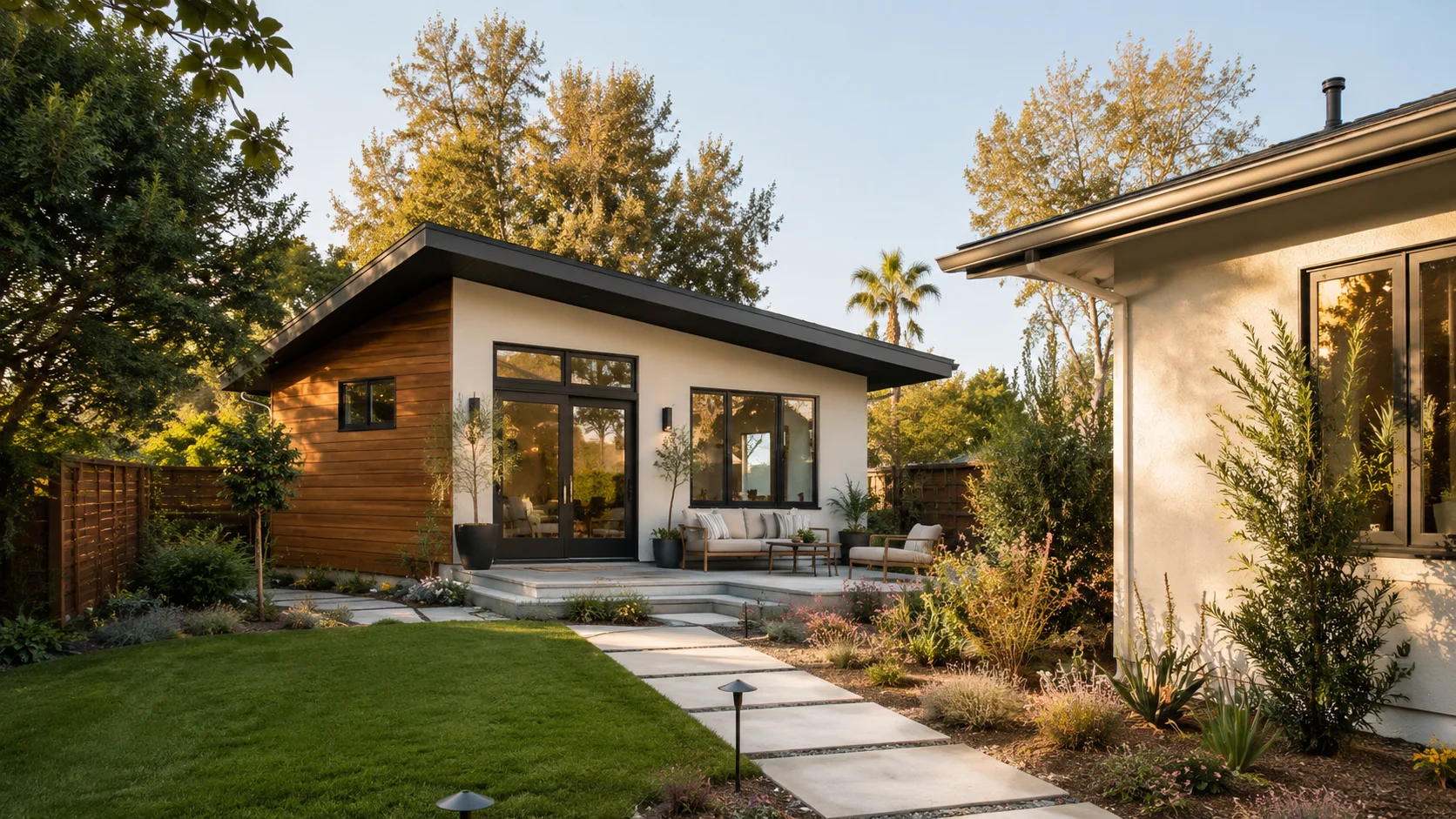
SnapADU Alternatives: Which ADU Path Actually Fits Your Property?
Five delivery paths, real prices, verified exclusions. SnapADU is the right call for a specific homeowner profile. For everyone else, there's a named alternative that actually fits.
By the Dwelling Index Editorial Team · Updated May 7, 2026 · Last verified: May 7, 2026 · 35 min read
Free property report · ~60 seconds · No commitment
SnapADU Alternatives 2026: the short answer
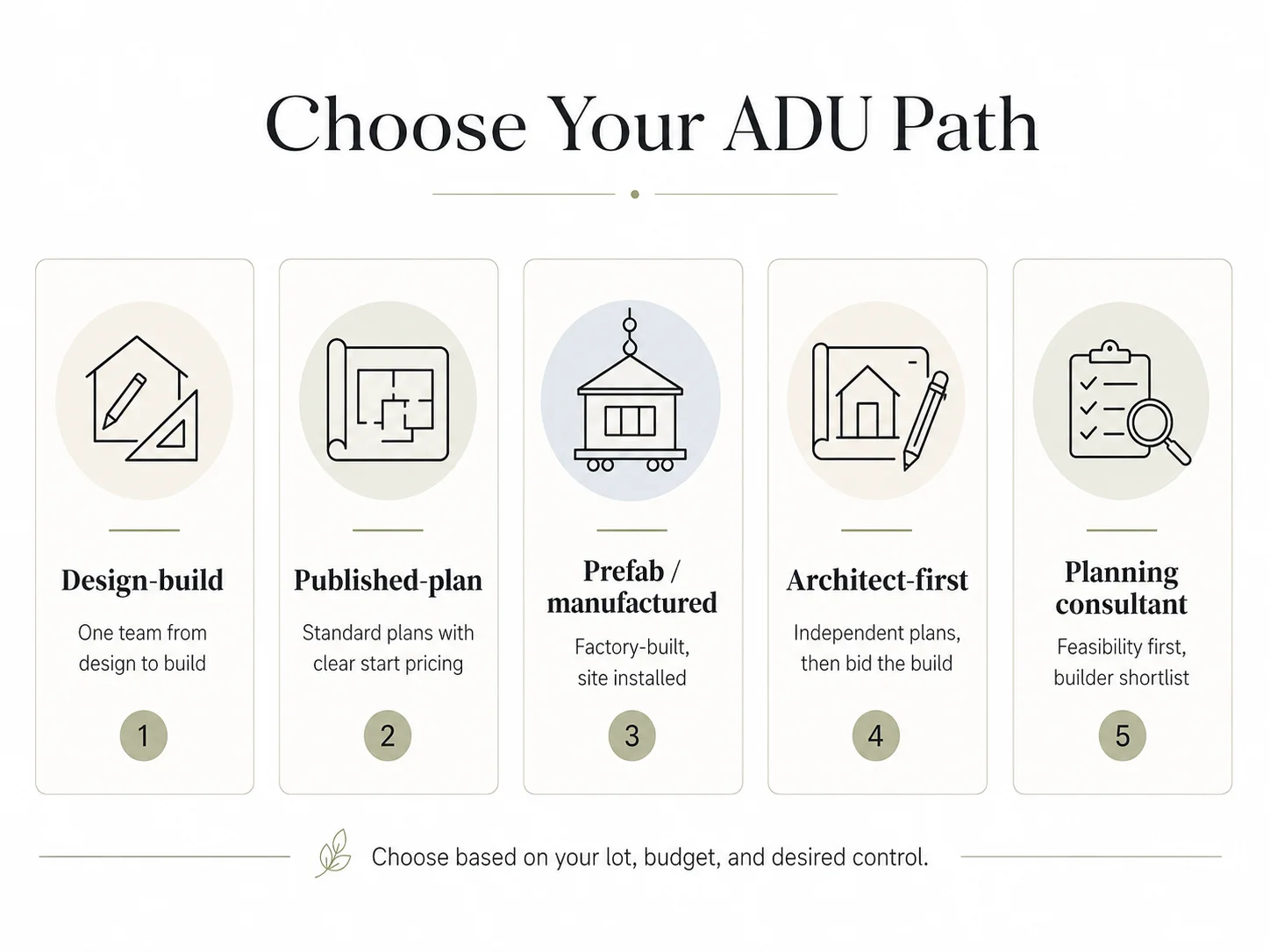
The short answer. Most SnapADU alternatives fall into one of five delivery paths: another San Diego design-build firm (Better Place Design & Build), a published-plan builder (OneStop ADU), a prefab/modular/manufactured brand (Abodu, Villa Homes, Samara, USModular, Crest Backyard Homes), an architect-first route (Ruland Design Group + competitive GC bidding), or a planning-consultant path (Maxable). SnapADU is the right call when three things are all true: your property is in Greater San Diego County, you want a new-construction detached ADU, and your all-in budget is $300,000+. Outside those three conditions, one of the five paths below fits better.
SnapADU alternatives at a glance
| Your situation | Compare these first | Why |
|---|---|---|
| Detached ADU in Greater San Diego, one-team design-build | SnapADU + a comparable bid from Better Place | Two San Diego specialists with overlapping service areas and similar feasibility-first process |
| A second design-build bid for an apples-to-apples comparison | Better Place Design & Build | Comparable one-stop San Diego positioning; publishes detached, attached, and garage-conversion pricing |
| Garage conversion, attached ADU, JADU, or basement conversion | Better Place or a local design-build GC | SnapADU focuses on detached new-construction only |
| Published starting price by plan size | OneStop ADU | Publishes plan-size pricing from $215,000 (400 sq ft studio) to $350,000 (1,200 sq ft 4-bedroom) before exclusions |
| Prefab or manufactured speed | USModular, Crest Backyard Homes, Abodu, Villa Homes, Samara | Factory build cycles compress on-site time; verify installed price after sitework, permits, taxes |
| Property outside San Diego County | Modular Home Direct (national); Nest Tiny Homes (Utah / Southern California) | SnapADU's service area is hard-bounded by San Diego County |
| Maximum design control + bidding leverage | Ruland Design Group or another ADU-experienced architect, then competitive GC bids | Architect-first separates plans from construction so you can bid the build |
| Help deciding before you commit | Free Feasibility Engine | Maps your specific lot, city, ADU type, and budget to a recommended path |
What is SnapADU, and when is it the right fit?
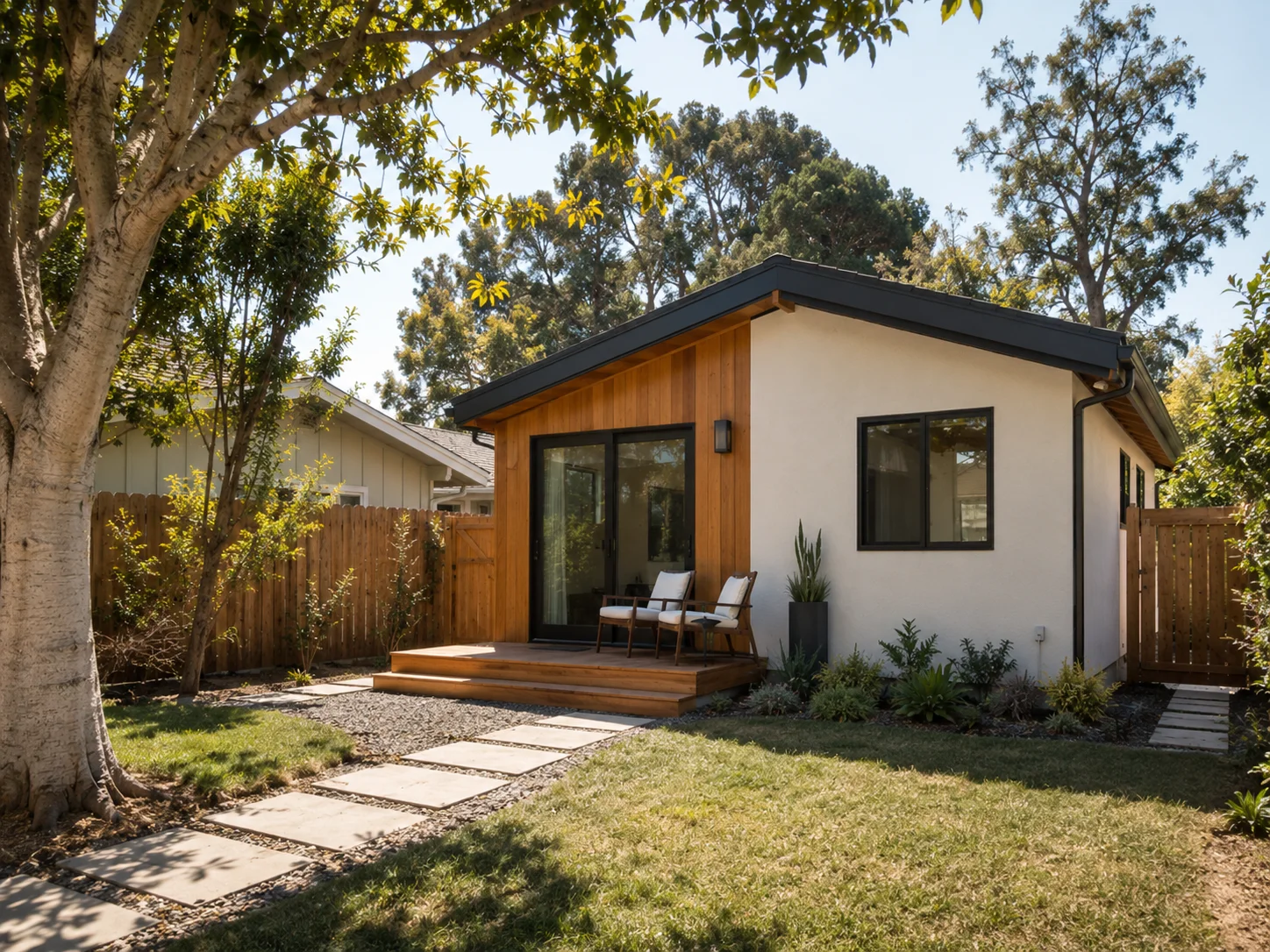
Answer capsule. SnapADU is a San Diego County design-build general contractor that has focused exclusively on detached new-construction ADUs since 2020. The company is BBB-accredited (A+ since April 1, 2021), holds CSLB General Contractor License #1075582, and reports 100+ completed ADUs with 126 built or under construction as of May 2026. Their published all-in cost range is $375–$600+ per square foot, with typical projects landing at $300,000–$450,000+. We pulled the verified facts below from public records, official company pages, and third-party directories.
Verified facts on SnapADU
All facts verified May 7, 2026 against primary sources.
| Fact | Detail | Source |
|---|---|---|
| Specialization since | 2020 | snapadu.com |
| Headquarters | 1223 Cleveland Ave #200, San Diego, CA 92103 | BBB profile |
| CSLB license | General Contractor #1075582 — verify current status at cslb.ca.gov before signing | BuildZoom; CSLB |
| BBB rating | A+, accredited since April 1, 2021 | bbb.org |
| Liability insurance | $2,000,000 policy through Gemini Insurance Company per BuildZoom — verify current coverage directly before signing | BuildZoom |
| Completed ADUs | 100+ completed; 126 built or under construction | snapadu.com |
| Building permits filed (3-year window) | 81 total permitted projects, with 72+ recent | BuildZoom |
| Founders | Whitney Hill (CEO), Mike Moore (CFO) | BBB; LinkedIn |
| Pre-approved plan partnerships | City of Chula Vista, City of San Marcos (also accepted in City of San Diego) | snapadu.com |
| What they build | Detached new-construction stick-built ADUs, typically 500–1,200 sq ft | snapadu.com |
| What they don't build | Prefab/modular, garage conversions, attached ADUs, JADUs, basement conversions | snapadu.com |
| Published timeline | 8–12 months from proposal signing to move-in | snapadu.com FAQ |
| Published cost range | $375–$600+ per sq ft, all-in; $300,000–$450,000+ typical complete build | snapadu.com/adu-costs |
Key terms you need to know
- CSLB
- California Contractors State License Board — your one source of truth for whether a contractor's license is currently active, who is bonded, and what classification they hold.
- Stick-built
- Wood-framed and constructed on-site (the "sticks" are the framing lumber).
- JADU
- Junior Accessory Dwelling Unit — up to 500 sq ft created within the existing walls of a primary residence.
- DADU
- Detached ADU — used interchangeably with "detached ADU" throughout.
- Plan check
- The city's review of your construction documents for code compliance — typically the longest phase of permitting.
- Sitework
- Grading, foundation prep, demolition if needed, and trenching for water, sewer, electrical, and gas.
- Ministerial approval
- City reviews against objective standards and must approve if you meet them — no public hearings, no discretion to deny. Most California ADU applications are ministerial under state law.
SnapADU's confirmed service area
The cities SnapADU explicitly lists on their service-area page: San Diego, Oceanside, Carlsbad, Encinitas, Del Mar, Solana Beach, Poway, San Marcos, Escondido, La Mesa, El Cajon, Vista, Chula Vista, Rancho Santa Fe, Santee, Lemon Grove, Imperial Beach, National City, Bonsall, Camp Pendleton, Cardiff By The Sea, La Costa, plus surrounding unincorporated San Diego County.
When SnapADU is genuinely the strongest choice
The strongest fit is a homeowner who:
- Owns a single-family lot in Greater San Diego County
- Wants a new-construction detached ADU (not a conversion of existing space)
- Is comfortable in the $300,000–$450,000+ all-in budget band
- Values one accountable team handling design, engineering, plan check, permitting, and construction
- Is willing to pay a feasibility fee upfront in exchange for a price that locks early
The pre-approved plan partnerships also matter. SnapADU was selected by the City of Chula Vista and the City of San Marcos to author municipal pre-approved ADU plans — also accepted in the City of San Diego. Those selections came through competitive bid against other architectural firms.
The single thing most reviews miss
By choosing to build only detached, new-construction, stick-built ADUs in San Diego County only, SnapADU has to say “no” to a meaningful share of homeowners who reach out. That isn't a weakness — it's a positioning choice that produces better quality on the projects they take. But it means a substantial slice of homeowners who hear SnapADU's name will need a different builder. The rest of this guide is for those people.
For a deeper SnapADU-only walkthrough, see our SnapADU review and SnapADU cost breakdown — both updated separately on their own verification cycles.
What do SnapADU reviews and public records actually show?
SnapADU is BBB-accredited with an A+ rating since April 1, 2021. The company holds CSLB General Contractor License #1075582 (verify current status before signing). BuildZoom shows 81 total permitted projects, with 72 in the most recent 3-year window.
- License + bond: Confirmed via CSLB. Re-verify status the day before you sign.
- Insurance: $2M general liability listed via BuildZoom. Ask for a current Certificate of Insurance.
- Permit volume: 80+ permitted projects in San Diego County is unusually high for an ADU specialist. That depth shows up in plan-check fluency and city relationships.
- Complaint pattern: BBB shows accreditation since 2021 with the company's complaint-response history visible on the BBB profile. Read how the company communicates when something has gone wrong, not just whether the rating is A+.
When SnapADU is the wrong fit: 5 honest scenarios
Five situations make a SnapADU alternative the better answer: your property is outside Greater San Diego County, you want a garage conversion or attached ADU, you specifically want prefab or modular, your all-in budget is below approximately $250,000, or your timeline to break ground is shorter than four months.
Scenario 1 — Your property is outside Greater San Diego County
SnapADU does not build outside San Diego County. Their deep specialization in San Diego permitting is non-transferable.
What to do instead:
- Anywhere in California: Compare modular options through Modular Home Direct (national) or Villa Homes (panelized + ReadyBuilt, California-broad).
- Southern California outside San Diego (LA, OC, Riverside, San Bernardino): USModular serves Riverside, San Bernardino, San Diego primarily, with select LA and OC projects. Nest Tiny Homes serves Utah (Utah County / Salt Lake / Weber) and Southern California (San Diego / Imperial County).
- Outside California: Modular Home Direct is the broadest national starting point.
Scenario 2 — You want a garage conversion, attached ADU, JADU, or basement conversion
SnapADU does new detached construction only. If your project is a conversion of an existing structure, you need a contractor who understands the structural, fire-separation, ceiling-height, and utility-rerouting issues that come with it.
What to do instead:
- Better Place Design & Build publishes garage-conversion pricing at $370–$470 per sq ft on existing footprint per their ADU cost guide.
- A practical note: per square foot, garage conversions aren't always cheaper than new construction because fixed costs (kitchen, bathroom, electrical, sewer) don't scale down with size. But the total project cost is typically lower because the existing footprint eliminates substantial vertical-construction expense.
Scenario 3 — You specifically want prefab or modular
SnapADU's materials describe prefab as a fit “for smaller builds on spacious, flat lots.” If your priority is factory-controlled timeline, fixed-price predictability, or a specific design aesthetic, you want a prefab specialist. The hardest truth in prefab shopping: unit price is not installed price. Always ask for full installed cost — base unit + foundation + sitework + utility trenching + crane + delivery + sales tax + permits.
Scenario 4 — Your all-in budget is below ~$250,000
SnapADU's published $375–$600+ per sq ft on a 600 sq ft unit lands at $225,000–$360,000+ for vertical construction before sitework, design, drawings, and permits. A $250,000 ceiling on a 600 sq ft new detached unit is realistic only on the absolute easiest lots.
What to do instead:
- Garage conversion via Better Place ($370–$470 per sq ft on existing footprint)
- Manufactured ADU via USModular — can fall into the $200,000s all-in for a small unit
- Smaller plan via OneStop ADU — published 400 sq ft studio start at $215,000
For sub-$250K ambitions, the conversation should also include ADU financing path education — HELOCs, cash-out refinances, construction loans, and 203(k) rehab loans. The cost ceiling often loosens when financing is matched correctly to the project type.
Scenario 5 — You need to break ground in under four months
SnapADU's published end-to-end timeline is 8–12 months from proposal signing to move-in. If your timeline is genuinely four months or shorter to break ground, no responsible stick-built design-build firm can help you — plan check alone takes weeks to months in San Diego.
What to do instead:
- Manufactured ADU via USModular — factory build, delivery, and installation typically takes about three months after permits are issued.
- Pre-approved plans — under AB 1332 (effective 2025), local agencies must approve or deny a complete application using a preapproved plan within 30 days.
- JADU — conversions within the primary residence's existing footprint, capped at 500 sq ft, with a faster review cycle in most jurisdictions.
SnapADU alternatives by delivery path
“Alternatives to SnapADU” is not a list of similar companies — it's a choice between five delivery models: one-team design-build, published-plan site-built, prefab/modular/manufactured, architect-first with competitive bidding, and planning-consultant-led shortlist. The price for “an ADU” varies by delivery model more than by company.
Path A — Comparable San Diego design-build firms
This is the path SnapADU represents: one company owns design, engineering, plan check, permitting, and construction. You sign one contract. There is one phone number when something goes wrong.
SnapADU vs Better Place Design & Build
Better Place Design & Build is the closest direct competitor to SnapADU in San Diego. Their published service area covers most of San Diego County: Bonita, Carlsbad, Carmel Valley, Chula Vista, Coronado, El Cajon, Escondido, Imperial Beach, La Mesa, Lemon Grove, Mission Valley, National City, Oceanside, Poway, Rancho Santa Fe, San Marcos, Santee, Solana Beach, Spring Valley, and Vista.
Crucially, Better Place publishes prices for three ADU types where SnapADU publishes one:
| ADU type | Better Place published $/sq ft | SnapADU |
|---|---|---|
| Detached new construction | $390–$490 | $375–$600+ |
| Garage conversion | $370–$470 | Not offered |
| Attached ADU | $380–$475 | Not offered |
Source: betterplacedesignbuild.com/resources/adu-cost-guide/, verified May 7, 2026.
When Better Place beats SnapADU: Any non-detached project. Any project where a second design-build bid is useful for comparison. Any property in a Better Place service-area city where SnapADU is also available.
ADU Geeks is a third San Diego design-build option with published cost guidance in the $350–$600 per sq ft range for detached units.
Path B — Published-plan site-built builders
These firms publish plan-size starting prices publicly. The advantage is benchmark visibility before you talk to anyone. The catch — exclusions matter as much as the headline number.
SnapADU vs OneStop ADU
OneStop ADU holds CSLB License #1094838(B) and publishes service across San Diego County from Oceanside to San Ysidro and Alpine. Their published starting prices:
| OneStop plan size | Starting price |
|---|---|
| 400 sq ft studio | $215,000 |
| 600 sq ft | $241,000 |
| 749 sq ft | $260,000 |
| 800 sq ft | $273,000 |
| 1,000 sq ft | $314,000 |
| 1,200 sq ft 4-bedroom | $350,000 |
Source: onestopadu.com, verified May 7, 2026.
When OneStop beats SnapADU: You want price visibility before consulting, and a standardized plan from their catalog fits your lot and goals.
Path C — Prefab, modular, and manufactured brands
Factory builds avoid weather delays, construction quality is consistent, and design decisions are pre-made. The published-price prefab brands in our research:
| Brand | Published price | Includes | Source |
|---|---|---|---|
| Abodu (studio) | $278,800 base / $300,500 avg customer | Unit, design, factory build | abodu.com/pricing |
| Abodu (800 sq ft 2BR) | $426,800 base / $478,800 avg customer | Unit, design, factory build | abodu.com/pricing |
| Abodu (avg permit fees + taxes) | ~$17,000 | On top of unit pricing | abodu.com/pricing |
| Villa Homes (unit only) | $95,000–$180,000 excl. installation/permitting; one project example totaling $353,745 | Unit; direct pricing not verified | Business Insider |
| Samara Studio | $152,000+ | Plus installation | samara.com |
| Samara 540 | $170,000+ | Plus installation | samara.com |
| Samara 690 | $190,000+ | Plus installation | samara.com |
| Samara XL8 | $249,000+ | Plus installation | samara.com |
| Samara XL10 | $277,000+ | Plus installation | samara.com |
| USModular | Starting prices published; full installed pricing by quote | — | usmodularinc.com |
| Crest Backyard Homes | Pricing not publicly itemized — request quote | — | crestbackyardhomes.com |
| Studio Shed | Kit-priced; DIY-leaning | Kit only; coordination outside Colorado | studio-shed.com |
All prices verified May 7, 2026 from each brand's public pricing page.
Standard exclusion list every prefab buyer must verify
Abodu's pricing page is the most transparent in this list. Their published exclusions are explicit and apply broadly to any prefab comparison:
- Trenching beyond approximately 50 feet from existing utility connections
- Crane access beyond approximately 100 feet from the placement site
- Demolition of existing structures
- Tree removal
- Unique engineering for slope, soil, or seismic conditions
- Sales tax
- Permit fees
When prefab beats SnapADU: Your lot is flat, accessible, and close to existing utilities; you accept a standardized plan; the published installed price genuinely beats stick-built; and your priority is timeline compression after permits issue.
For a deeper national prefab comparison, see our Best Prefab ADU Companies guide, updated separately on its own verification cycle.
Path D — Architect-first + competitive GC bidding
In the architect-first model, you hire an architect to produce permit-ready plans. Once plans are approved, you put the construction phase out to bid with two or three GCs. Ruland Design Group is the named San Diego-area architect to explore for this path; they describe themselves as ADU-focused.
Why some homeowners prefer it:
- Maximum design freedom — the architect works for you, not for a builder's catalog
- Bidding leverage — three GCs bidding on identical plans produces a real price comparison
- Cost transparency — architect fees and GC fees are separated
Why some homeowners regret it:
- Coordination burden — you become the bridge between architect, engineer, plan check, and GC
- Delayed cost certainty — you don't know construction cost until plans are 100% complete and bids return
- Bid disparity — three GCs can produce three numbers tens of thousands of dollars apart
Path E — Planning-consultant shortlist (Maxable)
Maxable is the most prominent planning-consultant brand in the San Diego ADU market. They do upstream work that doesn't fit cleanly into either design-build or architect-first: feasibility analysis, builder vetting, and apples-to-apples bid comparison. The Dwelling Index Feasibility Engine is a free version of the same upstream filter. For most homeowners, the free version is sufficient. For more on Maxable vs SnapADU, see our SnapADU vs Maxable comparison.
The prefab pre-quote screening questions
Before requesting a prefab quote, answer these for your property. If three or more answers are problems, prefab probably isn't the right path:
- Is the proposed placement site accessible to a delivery truck and crane?
- Are existing water, sewer, and electrical service within 50 feet of the placement site?
- Is the lot flat enough that minor grading (under $5,000) can level the foundation pad?
- Do you accept the brand's catalog without major modifications?
- Are you outside Coastal Overlay Zone, hillside development overlays, or historic district overlays?
- Will the brand handle plan-check corrections in your jurisdiction directly, or will you need a local consultant?
- Has the brand built in your specific city before?
- Can the brand demonstrate active production capacity and warranty backing today?
Design-build vs. architect-first vs. planning-consultant: the deeper choice
Design-build (SnapADU, Better Place, OneStop) consolidates accountability under one team and one contract. Architect-first (Ruland Design Group + competitive GC bidding) maximizes design control and bid leverage at the cost of homeowner coordination. A planning consultant (Maxable, the Dwelling Index Feasibility Engine) is the upstream filter that decides which path you should take. Most homeowners benefit from spending two hours on the third option before committing to the first or second.
The decision matrix between paths
| If this is true | Choose | Why |
|---|---|---|
| You want one accountable team and minimum coordination | Design-build (SnapADU, Better Place, OneStop) | Single contract, single phone number |
| You have a custom design vision the catalogs can't accommodate | Architect-first | Maximum design freedom |
| You want competitive GC bidding on completed plans | Architect-first | Bid leverage on identical scope |
| You don't yet know which delivery path fits your lot | Planning consultant or the free Feasibility Engine | Upstream filtering before commitment |
| You want price visibility before any consultation | Published-plan builder (OneStop) | Public price by plan size |
| You need factory speed and have a friendly lot | Prefab/modular | On-site disruption compressed |
How to compare an ADU quote line by line
Whether you're comparing SnapADU to Better Place, a prefab brand to a stick-built quote, or an architect-first bid to a design-build proposal, every comparison requires normalizing for scope. Comparing headline prices without normalizing scope produces false conclusions.
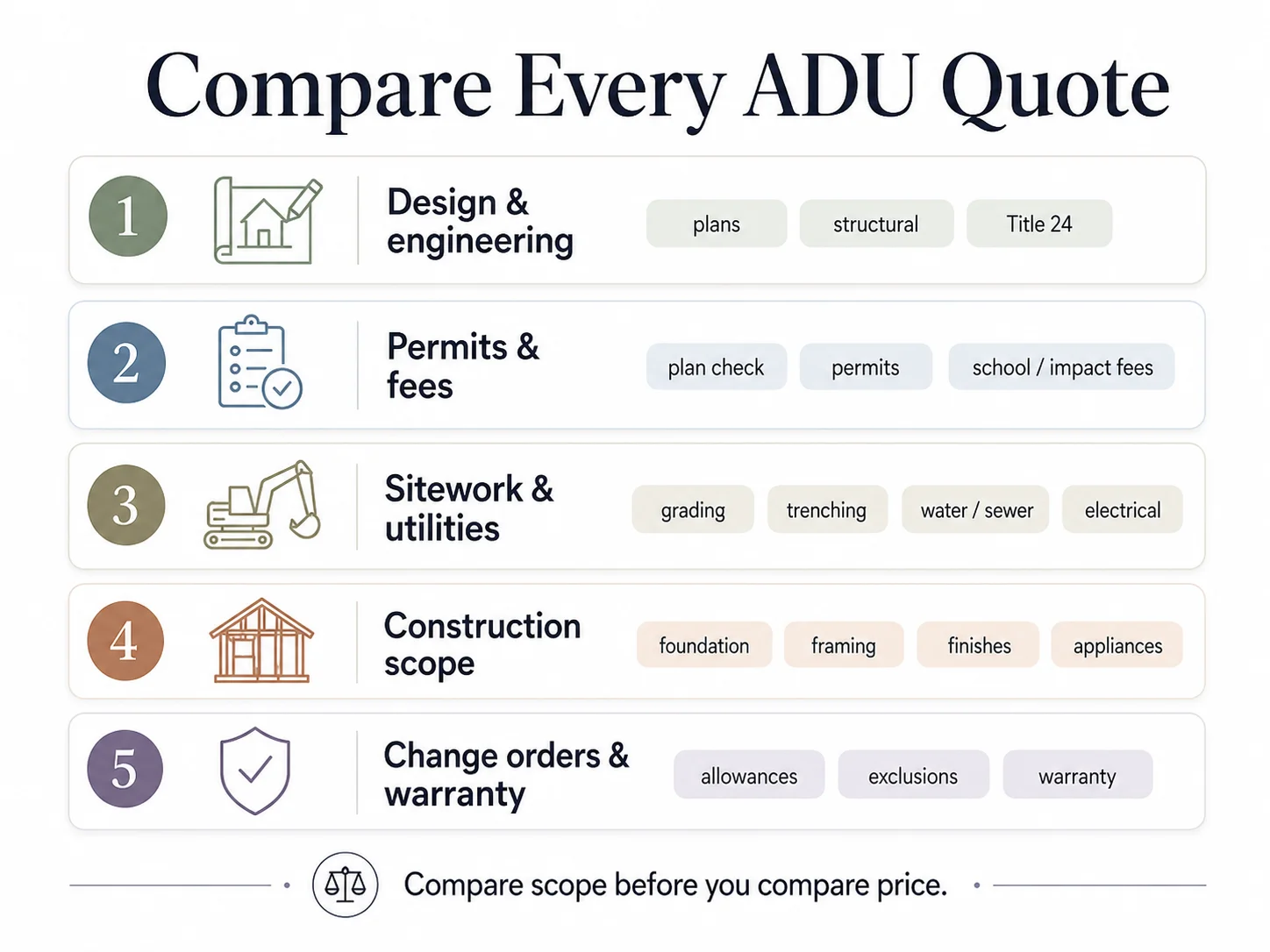
The normalized quote checklist
For each quote you receive, verify these five scope areas:
| # | Scope area | What to ask |
|---|---|---|
| 1 | Design & engineering | Are architectural plans, structural engineering, and Title 24 calculations included? |
| 2 | Permits & fees | Are city plan-check fees, building permits, school fees, and impact fees included or are they allowances? |
| 3 | Sitework & utilities | Are grading, drainage, trenching, sewer, water, gas, and electrical service included? |
| 4 | Construction scope | Is the number turnkey, or only vertical construction? What specifically is excluded (landscaping, appliances, finishes)? |
| 5 | Change orders & warranty | What triggers a change order? Who pays if a plan-check correction requires redesign? What is the warranty and who backs it? |
San Diego rules that change which builder path makes sense
San Diego ADU rules vary by jurisdiction, ADU type, and overlay zones. The biggest decision triggers are the City of San Diego's 1,200 sq ft maximum for new attached/detached ADUs, Coastal Overlay Zone Coastal Development Permit requirements, AB 1332's 30-day pre-approved-plan review cycle (effective 2025), and the City of San Diego's amended ADU Home Density Bonus Program. All facts below cite primary sources; verify against your specific address and current city policy before signing any contract.
Maximum ADU size: 1,200 sq ft (City of San Diego)
The City of San Diego's Information Bulletin 400 sets a 1,200 sq ft maximum for new attached or detached ADUs. Conversions of existing accessory structures are not subject to that 1,200 sq ft maximum — a meaningful advantage if your existing footprint is larger. JADUs are capped at 500 sq ft and must be created within the existing walls of a single-family residence.
Coastal Overlay Zone
If your property sits within the Coastal Overlay Zone, building an ADU may require a Coastal Development Permit (CDP) in addition to the standard ADU permit. CDP review adds significant time and uncertainty, and not every prefab brand has experience with the process. Coastal-zone ADUs are routinely a poor fit for prefab and a strong fit for an experienced local design-build firm or architect.
AB 1332 — 30-day approve-or-deny rule for pre-approved plans
Under California Government Code §65852.27 (added by AB 1332, effective 2025), local agencies must approve or deny a complete application using a preapproved or identical prior-approved plan within 30 days. The statute does not guarantee approval — it caps the timeline. The City of Chula Vista and the City of San Marcos both have pre-approved plan programs; SnapADU is one of the firms whose plans were selected via competitive bid, and those plans are also accepted in the City of San Diego.
City of San Diego ADU Home Density Bonus Program
The City of San Diego operates an ADU Home Density Bonus Program allowing additional ADUs in exchange for affordable-rate restrictions on the bonus units. The program was amended in 2025 with changes to size, conversions, rental terms, location, parking, fire sprinklers, and tree requirements. Effective outside the Coastal Zone on August 22, 2025; coastal-zone effective status pending Coastal Commission approval at time of publication.
Current Information Bulletin 400 ADU Home Density Bonus totals in single-dwelling zones by lot size:
| Lot size | Maximum total ADU homes |
|---|---|
| Up to 8,000 sq ft | 4 |
| 8,001–10,000 sq ft | 5 |
| Over 10,000 sq ft | 6 |
Permit fees across San Diego County
Permit costs vary across San Diego County. Verified as of May 7, 2026:
- Encinitas: ADU plan-review and inspection fees are waived for ADUs, except state fees, postage if a CDP is required, and covenant recorder fees.
- Carlsbad: Permit fees for most ADUs approximately $2,000–$4,000 (flat range).
- City of San Diego: Charges standard plan-check and building-permit fees per the master fee schedule. Some third-party sources misquote a "$13–$28 per sq ft" figure; verify the City's current fee schedule directly.
- Other San Diego County cities (Chula Vista, Oceanside, Poway, San Marcos, etc.) maintain their own master fee schedules — check the city's development-services page.
School district developer fees
San Diego Unified's residential developer fee is $5.17 per square foot through May 10, 2026 and $5.38 per square foot effective May 11, 2026 for ADUs over 500 sq ft. Other school districts in the county set their own rates.
Impact-fee waiver for ADUs ≤750 sq ft
Local impact fees generally cannot be imposed on ADUs/JADUs of 750 sq ft or less of interior livable space under California ADU law. Building at 749 sq ft instead of 760 sq ft can save $5,000–$15,000 in impact fees depending on jurisdiction.
The 31-day rental rule (City of San Diego)
City of San Diego Information Bulletin 400 states that ADUs may not be leased for less than 31 consecutive days. Verify your specific city's current rental rule directly.
Owner-occupancy: not required for ADUs
Owner-occupancy is not required for ADUs under current California rules — AB 976 made the prohibition on ADU owner-occupancy requirements permanent. JADU owner-occupancy can still apply where the JADU shares sanitation facilities with the primary residence.
Selling an ADU separately: now possible in some jurisdictions
Two San Diego County jurisdictions matter here: Unincorporated San Diego County adopted an AB 1033 ordinance effective April 4, 2026, allowing separate sale of ADUs through a condominium-conversion process. The City of San Diego's 2025 ADU amendments also include separate-sale provisions, with coastal-zone effective status subject to Coastal Commission approval at publication.
How to verify SnapADU or any alternative before signing
Before signing any ADU contract, verify five things at the public-record level: CSLB license status, insurance coverage, building permit history in your specific city, BBB record, and at least one reference from a similar project in the same jurisdiction.
Step 1 — Verify CSLB license status, directly
Go to cslb.ca.gov and use the Check a License tool. Look for: Active status (not Inactive or expired); B-classification (General Building Contractor); $25,000 minimum bond; Workers' compensation in force; and formal complaint filings. For reference: SnapADU #1075582, OneStop ADU #1094838(B).
Step 2 — Verify insurance
Ask any builder for a current Certificate of Insurance (COI) showing general liability ($1M minimum, $2M preferred), workers' compensation (if they have employees), and auto liability. The COI should be issued by an insurance agent or broker, not by the contractor.
Step 3 — Verify project history in your specific city
Use BuildZoom or your city's permit-search portal. Look for permit count in your city (not just total), permit value consistent with ADU work, and recent permit dates showing the contractor is still active.
Step 4 — Verify BBB record
BBB ratings are not regulatory, but the complaint response pattern tells you a lot. A company with five complaints, all responded to substantively and resolved, is more reassuring than a company with one complaint that was ignored.
Step 5 — Verify at least one reference from a matching project
Ask for two to three recent customers with projects most similar to yours — same city, same ADU type, similar lot conditions, similar budget. Ask: Did the final price match the contracted price? Did the project finish on the agreed timeline? Would you hire them again?
The SnapADU Fit Decision Matrix
Six variables determine whether SnapADU is the right fit: location, ADU type, budget, lot conditions, timeline, and customization need. The matrix below gives a recommendation in every cell.
| Variable | Your situation | SnapADU fit | Alternative if SnapADU misses |
|---|---|---|---|
| Location | Greater San Diego County (cities listed above) | ✅ Strong fit | — |
| Location | Anywhere else in California | ❌ Not in service area | Modular Home Direct, Villa, USModular, regional design-build |
| Location | Outside California | ❌ Not in service area | Modular Home Direct, regional prefab |
| ADU type | Detached new construction | ✅ Strong fit | — |
| ADU type | Garage conversion of existing structure | ❌ Not offered | Better Place Design & Build |
| ADU type | Attached ADU / addition | ❌ Not offered | Better Place; design-build GC |
| ADU type | JADU (within existing primary) | ❌ Not offered | Local design-build GC |
| ADU type | Prefab / modular / manufactured | ❌ Not offered | USModular, Crest, Abodu, Villa, Samara, Studio Shed |
| Budget | $350K+ | ✅ Strong fit | — |
| Budget | $250K–$350K | ⚠ Possible on smaller units; verify | Better Place; OneStop pre-approved plan; Crest |
| Budget | $200K–$250K | ⚠ Tight; lot-dependent | Garage conversion (Better Place); manufactured (USModular) |
| Budget | Under $200K | ❌ Out of range for new detached | Garage conversion; manufactured prefab; financing consultation |
| Lot conditions | Flat, easy utility access | ✅ Strong fit | — |
| Lot conditions | Sloped, hillside, complex grading | ✅ Stick-built handles complexity well | — |
| Lot conditions | Coastal Overlay Zone | ✅ SnapADU has CDP experience | — |
| Timeline to break ground | 6+ months acceptable | ✅ Normal cycle | — |
| Timeline to break ground | 4–6 months | ⚠ Pre-approved plan path may compress | OneStop pre-approved plan |
| Timeline to break ground | Under 4 months | ❌ Not achievable at any stick-built firm | Manufactured prefab post-permit |
| Customization | Standard plan with finish choices | ✅ Strong fit | — |
| Customization | Semi-custom (modify a catalog plan) | ✅ Strong fit | — |
| Customization | Architect-led full custom | ⚠ Architect-first may better fit | Ruland Design Group + competitive GC |
If you have all greens, SnapADU is a strong fit — next step is requesting a proposal. If any row is red and you have a workable alternative listed, that alternative is your starting point. If you have multiple yellows, run the Feasibility Engine first.
Honest tradeoffs nobody else mentions
Three real tradeoffs apply to every San Diego ADU project. This is the damaging admission section — things that don't help us close a sale.
Tradeoff 1: Specialization is a tax on flexibility
Choosing a hyper-specialist like SnapADU means you get an excellent process for the project type they do — and zero help if your project drifts. If you start designing a detached ADU and decide six weeks in that you want a garage conversion, or that you want to add an attached unit, SnapADU can't pivot with you. You'd need to start over with a different builder. A generalist design-build GC (Marrokal, Eco Home Builders, Lumina) can pivot scope — the trade-off is they're not as fluent in ADU-specific permitting and code.
The repositioning:
If you know what you want and it's in SnapADU's lane, specialization is the right answer. If you're still exploring scope, start with a feasibility study (paid or free) before committing to any specialist.
Tradeoff 2: Predictable pricing requires upfront paid feasibility
SnapADU and Better Place both charge a feasibility fee before they commit to a final price. Other builders give “free quotes.” Sometimes that's because the builder is desperate for work. Sometimes it's because they haven't done the verification and the number is a guess. Comparing a feasibility-backed quote against three free guesses is unfair to the disciplined firm.
The repositioning:
Ask each builder: “What verification did you do before producing this number, and what's still TBD?” Pay for the feasibility work somewhere — either upfront with a disciplined firm, or later as change orders with an undisciplined one.
Tradeoff 3: California rental rules apply to every builder
City of San Diego rules require ADU rental terms of at least 31 consecutive days. The prohibition on shorter rentals is enforced via covenant signed before permit issuance. This applies whether you build with SnapADU, Better Place, OneStop, Abodu, USModular, or anyone else. Picking a different builder doesn't change the rule.
Rental-income figures published elsewhere on Dwelling Index are illustrative examples, not guarantees of returns. Actual results depend on local market conditions, construction costs, financing terms, and regulatory approvals.
Edge cases: HOA, lot rules, and resale
HOA restrictions
California ADU law substantially restricts what HOAs can do to block ADUs. HOAs may impose reasonable objective restrictions, including design-review restrictions, only if they do not effectively prohibit or unreasonably restrict ADU construction or use (Davis-Stirling: Civil Code §4751). For HOA-governed properties, ask the builder for references from prior projects in HOA communities.
Owner-occupancy: permanently prohibited from being required
Owner-occupancy of the primary residence is not required for ADUs under current California rules — AB 976 made this permanent. JADU owner-occupancy can still apply where the JADU shares sanitation facilities with the primary residence.
Selling an ADU separately
ADUs cannot generally be sold separately unless your jurisdiction has adopted an AB 1033-style separate-sale program. Unincorporated San Diego County adopted such an ordinance effective April 4, 2026. The City of San Diego's 2025 ADU amendments also include separate-sale provisions, with coastal-zone effective status subject to Coastal Commission approval. Verify your specific jurisdiction's current rule before committing to a separate-sale strategy.
Lot-size minimums
Under California state law, ADUs are generally allowed on any residentially zoned lot where a primary dwelling exists or is being built. Some city overlays (coastal, hillside, historic) impose additional requirements. Verify against your specific address.
Frequently asked questions
Are there companies like SnapADU in San Diego?
Yes. The closest direct alternatives by delivery model are Better Place Design & Build (comparable design-build, broader project-type coverage), OneStop ADU (published-plan starting prices), Crest Backyard Homes (local modular), and ADU Geeks (design-build with published cost guidance). The right alternative depends on whether you want one-team design-build, prefab speed, published plan pricing, or independent design with competitive GC bidding.
Is SnapADU expensive compared to other San Diego builders?
SnapADU's published $375–$600+ per sq ft is in the middle of the San Diego market band. Better Place Design & Build publishes $390–$490 for detached ADUs. OneStop ADU's published plan-size pricing ranges from $215,000 (400 sq ft) to $350,000 (1,200 sq ft) before exclusions. Prefab brands publish lower unit prices; installed prices land closer to stick-built once sitework, taxes, and permits are added. SnapADU is not the cheapest; it's also not the most expensive.
Does SnapADU build outside San Diego?
No. The service area is hard-bounded to Greater San Diego County. National prefab brands (Modular Home Direct, Villa Homes, Abodu) and regional builders (USModular for SoCal, Nest Tiny Homes for Utah and parts of SoCal) are the alternatives.
Does SnapADU build prefab or modular ADUs?
No. SnapADU builds new-construction stick-built (wood-framed, on-site) only. Compare Abodu, Villa Homes, Samara, USModular, Crest Backyard Homes, or Studio Shed.
Does SnapADU do garage conversions?
No conversions of existing garage structures. For conversion of an existing garage, Better Place Design & Build publishes a $370–$470 per sq ft range and explicitly handles garage conversion scope.
What does a SnapADU ADU cost per square foot?
The company's published all-in range is $375–$600+ per sq ft for typical 500–1,200 sq ft detached units, with $300,000–$450,000+ as a typical complete-build range per their March 2026 cost guide. A 750 sq ft detached ADU is published at approximately $350,000 all-in, or about $465 per sq ft.
How long does a SnapADU ADU take to build?
Published end-to-end timeline (proposal signing through move-in): 8–12 months. Most of that is design, engineering, plan check, and permit issuance — typical for any stick-built ADU project. Manufactured/prefab paths can compress on-site construction time but the upstream permit phase is largely the same.
Is SnapADU licensed?
Yes — CSLB General Contractor license #1075582. Verify current license status directly at cslb.ca.gov before signing a contract.
What is SnapADU's BBB rating?
A+, accredited since April 1, 2021. BBB ratings are useful for complaint history but are not regulatory — they should be one input among the verification steps, not the whole decision.
What is the cheapest legitimate alternative to SnapADU in San Diego?
Two options compete: a garage conversion via Better Place Design & Build ($370–$470 per sq ft on existing footprint) when you have a garage to convert, or a manufactured ADU via USModular when your lot has good access. Both paths can land in the $200,000s all-in for a small unit on a friendly lot.
Is prefab actually cheaper than SnapADU?
Sometimes. Prefab vertical-construction costs are real savings; prefab total project cost lands closer to stick-built once foundation, sitework, utility trenching, crane access, delivery, taxes, and permits are added. On a flat, accessible lot with short utility runs, prefab can save real money. On a difficult lot, prefab loses.
How we built this guide
We built this guide from official provider information, primary-source municipal documents, public license and permit records, and homeowner forum discussions. We used homeowner forums (Reddit, Houzz Q&A, Nextdoor) only to identify decision friction and language patterns — never as proof for legal, cost, or regulatory claims.
We did not rank providers by affiliate compensation. SnapADU is on our active partner roster; that does not make SnapADU the right fit for every reader, and we tell readers explicitly when SnapADU is not the right call. Where we route readers to non-partner alternatives (Ruland Design Group, Better Place Design & Build, Studio Shed, Maxable), we link to public information without affiliate tracking.
We applied the FTC's Endorsement Guides standards: every comparative statement is anchored to a verified source; every price figure has a source citation at the point of use; every regulatory claim has a primary-source reference.
By the Dwelling Index editorial team. An independent research resource covering ADU financing, costs, and regulations. We are not a builder, broker, or lender.
Last updated: • Last verified:
Related reading: SnapADU Review 2026 • SnapADU Cost Guide 2026 • SnapADU vs Maxable 2026 • Best Prefab ADU Companies • ADU Financing Options
Bottom line
SnapADU is one of San Diego's strongest detached-ADU specialists. They are the right call for a specific homeowner profile — Greater San Diego, detached new construction, $300K+ all-in budget, 6+ month timeline, comfortable with one-team design-build accountability. For that buyer, the next step is requesting a SnapADU proposal.
For everyone else — homeowners outside San Diego County, garage-conversion shoppers, prefab buyers, sub-$250K budgets, sub-4-month timelines, full custom design — there is a named alternative that fits. Better Place Design & Build, OneStop ADU, Ruland Design Group, USModular, Abodu, Villa Homes, Samara, Modular Home Direct, Nest Tiny Homes — each one solves a specific situation SnapADU doesn't.
The decision isn't which company is “best.” It's which delivery model fits your lot, budget, and timeline. Once you know the model, the company falls out naturally.
Not sure where to start?
See what's possible at your address — get your free ADU report in 60 seconds. We'll tell you what you can build and route you to the right delivery path.
See What You Can Build → Get Your Free ADU Report