
SnapADU Review (2026): Real Costs, Verified Reputation, and When They're the Right Fit
By The Dwelling Index Editorial Team · · Last verified · Next scheduled review: August 7, 2026
The bottom line
This SnapADU review is for Greater San Diego homeowners deciding whether to put SnapADU on their shortlist for a detached new-construction accessory dwelling unit (ADU). Here is the verdict in one paragraph.
SnapADU is a legitimate, BBB-accredited California design-build firm focused only on detached, new-construction, stick-built ADUs in Greater San Diego. Co-founded in 2020 by Whitney Hill (CEO) and Mike Moore (CFO), the company holds California Contractors State License Board (CSLB) license #1075582, an A+ Better Business Bureau rating, and a public 100+ completed-ADU portfolio (self-reported). Real 2026 cost: roughly $300,000 for a 500-square-foot detached ADU up to $450,000+ for a 1,200-square-foot unit, all-in — about $375–$600+ per square foot, on a fixed-bid model with a 6-month price lock. They are a strong fit for detached new-construction ADUs in San Diego County and a poor fit for prefab, garage conversions, junior ADUs (JADUs), or anything outside Greater San Diego.
Next step: Confirm whether SnapADU's published service area covers your property and whether your project type is a fit before you spend a dollar on feasibility.
See What You Can Build → Get Your Free ADU Report
Free, 60 seconds, no phone call required.
In Greater San Diego and planning a detached ADU? Request a free SnapADU consult → (sponsored partner)
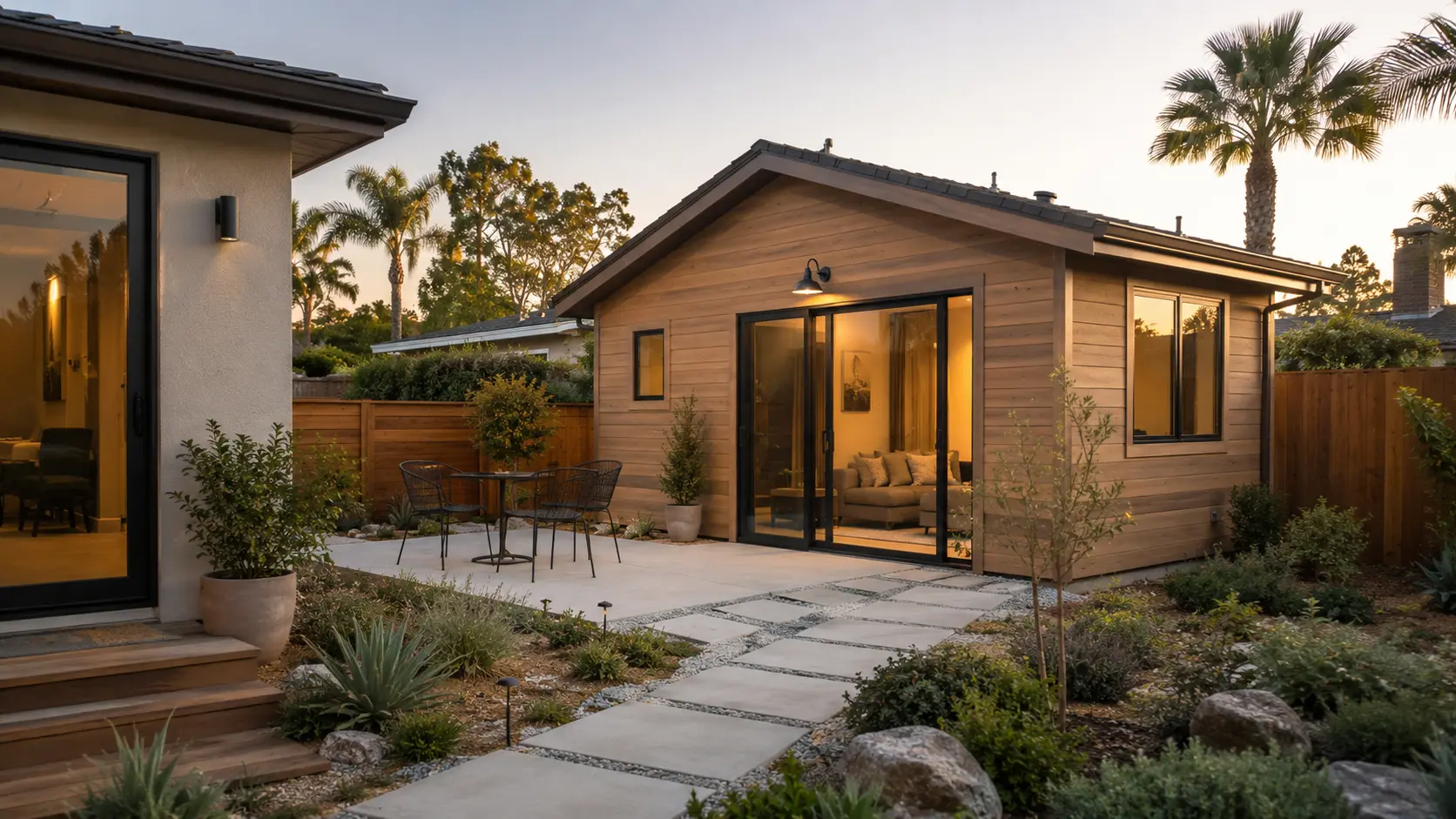
SnapADU at a glance: is it a fit for your project?
We assembled this above-the-fold table so you can rule SnapADU in or out before reading 8,000 more words. Each row is sourced; the full breakdown lives in later sections.
| Your situation | SnapADU fit | Why |
|---|---|---|
| Detached new-construction ADU, 500–1,200 sq ft, in Greater San Diego | Strong fit | SnapADU specializes exclusively in detached new ADUs in San Diego County; City of San Diego permits ADUs at 150–1,200 sq ft and County allows detached ADUs up to 1,200 sq ft. |
| You want one accountable team for design, permits, and build | Strong fit | In-house design, permitting, and construction; no architect-to-GC handoff. |
| Two-story / carriage-house ADU on a tight lot | Strong fit | Public portfolio includes two-story builds; over 75% of San Diego County cities permit two-story ADUs. |
| Garage conversion as your primary scope | Weaker fit | SnapADU's stated focus is detached new construction; specialists exist for conversions. |
| Junior ADU (JADU) under 500 sq ft | Weaker fit | Same — small interior conversions are not the focus. |
| Prefab or modular ADU | Not a fit | SnapADU is stick-built only; they do not sell modular or panelized units. |
| Outside San Diego County | Not a fit | Service area is Greater San Diego only. |
| Total budget below ~$250,000 for a turnkey detached ADU | Likely weak fit | SnapADU's smallest published all-in example starts around $300K for 500 sq ft. |
| Coastal Overlay, hillside, septic, or unusual lot | Possible — feasibility study first | Site conditions can move cost and timeline materially. |
Sources: SnapADU homepage and service-area page (snapadu.com/service-area/); ADU Costs page (snapadu.com/adu-costs/, updated March 2026); City of San Diego Development Services ADU page; San Diego County Planning and Development Services. Verified May 7, 2026.
Run the free San Diego ADU Fit Check → Check My Property
60 seconds, no phone call required.
Check whether SnapADU fits your property — before you call
Before you spend $1,325 on a SnapADU feasibility study, take 60 seconds to confirm two things: (1) your address is inside their service area, and (2) your project type matches what they actually build. Our free tool handles both.
What you tell us: city or zip code; ADU type (detached, attached, conversion, JADU); target size; rough budget; intended use; site notes (slope, coastal, fire zone, HOA).
What you get back: a personalized fit signal — strong, possible-with-conditions, or look-elsewhere — plus the right next step for your specific situation. We don't sell your data, and we don't push you toward SnapADU when SnapADU isn't your answer.
Check My Property — Free ADU Fit CheckIs SnapADU legit? The 11-point verification dossier
Answer capsule: Yes. SnapADU has multiple independent legitimacy signals. The company holds CSLB license #1075582 (BuildZoom reported the license active when checked April 2026; verify current status directly at cslb.ca.gov before signing). It has been BBB-accredited since April 2021 with an A+ rating. The City of Chula Vista publicly confirms its City Standard ADU Plans were prepared by SnapADU. Whitney Hill (CEO) and Mike Moore (CFO) are publicly named as co-founders on the company's About page and on the BBB principal-contacts list.
The phrase "is this builder legit" is doing a lot of work. It usually means three different things at once: Are they a real licensed contractor? Are the reviews real? Will I get the project I'm being sold? The first two are verifiable in public records. The third you can only de-risk through references, contract review, and feasibility — which is why the rest of this page exists.
We pulled SnapADU's claims from their own pages and cross-checked them against the California Contractors State License Board, the Better Business Bureau, BuildZoom, Houzz, and the City of San Diego planning system. Here is what each source actually shows.
The verification dossier — sourced and dated
| # | Verification check | What we found | Source | Last verified |
|---|---|---|---|---|
| 1 | Is SnapADU a real, named entity? | Founded 2020; co-founders Whitney Hill (CEO) and Mike Moore (CFO) named on company About page and BBB principal contacts | snapadu.com/about; bbb.org SnapADU profile | May 7, 2026 |
| 2 | California contractor's license? | License #1075582 listed on SnapADU site; BuildZoom reported the license active when checked April 2026 | SnapADU footer; buildzoom.com/contractor/snap-adu | May 7, 2026 (verify on cslb.ca.gov before signing) |
| 3 | License classification appropriate for ADU work? | B (General Building) is the right CSLB classification for ground-up residential construction | cslb.ca.gov classification guide | May 7, 2026 |
| 4 | BBB accredited? | Accredited since April 1, 2021; A+ rating | bbb.org SnapADU profile | May 7, 2026 |
| 5 | Project portfolio publicly available? | Houzz profile shows project photos and homeowner reviews; SnapADU testimonials page lists named clients with cities | houzz.com SnapADU profile; snapadu.com/testimonials | May 7, 2026 |
| 6 | Houzz review signal | 5.0 average rating across 22 reviews on accessible Houzz pages | houzz.com SnapADU profile pages | May 7, 2026 |
| 7 | Google and Yelp review signals | Multiple positive reviews visible on each platform; we have not independently audited current counts | google.com/maps; yelp.com/biz/snapadu-san-diego | Re-verify on the day you sign |
| 8 | Industry recognition | The City of Chula Vista publicly confirms its City Standard ADU Plans were prepared by SnapADU; SnapADU also states it designed the City of San Marcos pre-approved plan library | chulavistaca.gov; snapadu.com (Chula Vista confirmed; San Marcos per SnapADU statement) | May 7, 2026 |
| 9 | 100+ ADU build claim | Self-reported by SnapADU on the homepage; not independently audited | snapadu.com homepage | May 7, 2026 |
| 10 | ~90% project completion rate claim | Self-reported by SnapADU on their homepage and "Lessons from 100 Builds" article; not independently audited | snapadu.com/lessons-from-100-adu-builds-detached-adu-report-san-diego/ | May 7, 2026 |
| 11 | Owner-disclosable contact path | Phone, email, and a publicly listed San Diego contact address (1223 Cleveland Ave, #200-115, San Diego, CA 92103) | snapadu.com/contact | May 7, 2026 |
How to verify the license yourself in under three minutes
- Open the CSLB license lookup at cslb.ca.gov.
- Enter license number 1075582.
- Confirm: status (should read "Active"), classification (B), bonding ($25,000 contractor's bond minimum), workers' compensation status, and any complaint disclosures.
- Take a dated screenshot for your records before signing anything.
The CSLB explicitly directs consumers to use this lookup to verify license, bond, insurance, and complaint disclosures before hiring a contractor. License status, complaint records, and bond filings can change between when we verified this page and when you read it. Always re-check on the day you sign.
What "legit" doesn't prove
A license, a BBB accreditation, and a portfolio of project photos prove that the company exists, is permitted to do construction work in California, and has built recognizable units. They do not prove the price is fair, the bid is complete, the schedule is realistic, the change-order process is honest, or that the team will be a good fit for your lot, your city, and your family. That's what the rest of this review is for.
Two SnapADU claims we want to be clear about. The "100+ completed ADUs" and the "~90% project completion rate" figures are reported by SnapADU and not independently audited. We aren't disputing them — they're consistent with the public footprint and the city contract Chula Vista publicly confirmed — but you should ask SnapADU directly for a verifiable list of permits pulled in your specific city.
What we verified for this review
- — SnapADU service area, project specialty, and ownership: snapadu.com (Home, About, Service Area)
- — License #1075582 listed on SnapADU footer; cross-referenced on BuildZoom (active when checked April 2026)
- — BBB accreditation date (4/1/2021), A+ rating: bbb.org
- — Houzz 5.0 / 22 reviews: houzz.com SnapADU profile pages
- — March 2026 SnapADU cost ranges and size-specific examples: snapadu.com/adu-costs/
- — SnapADU process fees and timeline: snapadu.com/process/ and snapadu.com/adu-costs/
- — Chula Vista City Standard ADU Plans authorship (SnapADU): chulavistaca.gov
- — AB 1332 30-day path; City of San Diego accepts pre-approved plans from County of San Diego, Chula Vista, and Encinitas: City of San Diego ADU page
- — California Construction Cost Index ~44% rise (Jan 2021–Dec 2025): California Department of General Services public CCCI release
- — CSLB ADU Fast Facts (down-payment cap, written-contract guidance): cslb.ca.gov ADU Fast Facts publication
- — $25,000 contractor's license bond (B&P §7071.6, raised 1/1/2023): California Legislative Information
- — AB 976, AB 1154, AB 1332, SB 1077: California Legislative Information; California Coastal Commission
- — City of San Diego ADU permit and size rules: sandiego.gov/development-services
- — San Diego County unincorporated-area ADU rules and impact-fee waiver expiration (1/9/2024): sandiegocounty.gov/pds
- — SDHC ADU Finance Program eligibility: sdhc.org/housing-opportunities/adu/
Still to verify on the day you sign: current CSLB license status; current bond filing; current insurance certificates; current complaint disclosures; current proposal exclusions; current Google, Yelp, and Houzz review counts; current waitlist or backlog; SDHC program capacity if applicable.
Primary CTA — verify your property fits before any builder call
See What You Can Build → Get Your Free ADU Report(60 seconds, free, no phone call)Where SnapADU builds: the service-area decoder
Answer capsule: SnapADU's published service area covers Greater San Diego only — 18 named cities plus the County of San Diego (unincorporated areas), 19 jurisdictions in total. Outside that footprint, they do not take projects. Inside it, they build in nearly every incorporated city and across the unincorporated County.
This matters more than people think. The single fastest way to waste a Saturday is to read 6,000 words about a builder who doesn't serve your address. We've assembled the table below from SnapADU's own published service-area page, cross-referenced against each city's ADU page on the SnapADU site and against the relevant city planning departments.
SnapADU's San Diego service area, decoded
| Jurisdiction | SnapADU serves | Pre-approved plan path | Local permitting note |
|---|---|---|---|
| City of San Diego | ✅ | Accepts qualifying pre-approved plans from County of San Diego, Chula Vista, and Encinitas under AB 1332 (30-day review) | Permit/plan-check fees roughly $13–$28 per sq ft per SnapADU's permit-fee analysis (verify against the City fee schedule for your project) |
| Chula Vista | ✅ | SnapADU prepared the City Standard ADU Plans (Chula Vista publicly confirms); City Standard plan reviews can run as fast as ~14 business days vs. ~21 for standard | Confirm current code-cycle status of the specific plan set before relying on the fast-track path |
| San Marcos | ✅ | SnapADU states it designed the city's pre-approved plan library | Confirm current code-cycle status before relying on the fast-track path |
| Carlsbad | ✅ | Standard | Coastal Overlay considerations on the western half of the city |
| Coronado | ✅ | Standard | Tight historic-district review and coastal-zone rules |
| Del Mar | ✅ | Standard | Coastal — Coastal Development Permit (CDP) process commonly applies pending SB 1077 guidance |
| El Cajon | ✅ | Standard | Standard inland process |
| Encinitas | ✅ | Standard | Permit fees roughly $2–$4 per sq ft per SnapADU's analysis; partial fee waivers depending on size |
| Escondido | ✅ | Standard | Larger lots common; standard inland process |
| Imperial Beach | ✅ | Standard | Coastal-zone considerations near the shore |
| La Mesa | ✅ | Standard | Standard inland process |
| Lemon Grove | ✅ | Standard | Standard inland process |
| National City | ✅ | Standard | Standard process |
| Oceanside | ✅ | Standard | Coastal Overlay on the western edge |
| Poway | ✅ | Standard | Lot-size-sensitive rules |
| Santee | ✅ | Standard | Updated 2024 fee schedule applies — verify with city |
| Solana Beach | ✅ | Standard | Coastal-zone considerations |
| Vista | ✅ | Standard | Fee waiver pathway exists for ADUs over 750 sq ft; potential significant savings on impact fees |
| County of San Diego (unincorporated) | ✅ | Standard | County PDS handles permitting; the County's trial impact-fee waiver program ended January 9, 2024 |
Source: SnapADU service-area page (snapadu.com/service-area/) listing 18 cities + County of San Diego; cross-referenced against City of San Diego, City of Chula Vista, San Diego County Planning and Development Services, and SnapADU's permit-fee analyses. Verified May 7, 2026.
Some adjacent communities (Bonsall, Cardiff By The Sea, La Costa, Rancho Santa Fe, Camp Pendleton-adjacent) may fall under the County or one of the incorporated cities above. SnapADU's broader service map includes shaded surrounding areas — confirm address-level eligibility on a discovery call.
What if you're outside Greater San Diego?
Then SnapADU is not your builder, and that is the most useful sentence on this page for you. We've published city-specific shortlists for many San Diego County cities; for everywhere else, the right next step is the property eligibility check. It will identify the relevant builder type for your address (detached design-build, prefab, modular, garage-conversion specialist, architect-led) without sending you to anyone outside their service area.
Match your address against the service area now.
Run the free Feasibility Check →How much does SnapADU cost in 2026?
Answer capsule: SnapADU's published 2026 examples range from about $300,000 all-in for a 500-square-foot detached ADU to about $450,000 all-in for a 1,200-square-foot detached ADU, equivalent to $375–$600+ per square foot (source: snapadu.com/adu-costs/, updated March 2026). The all-in number includes design, permits, basic sitework, and utilities; vertical build alone runs roughly 80–85% of the total. SnapADU operates on a fixed-bid model with a 6-month price lock that begins after construction documents are complete. Site-specific factors — slope, soils, sewer extension, coastal review, fire-zone requirements — can move the number up.
Three things are true at the same time about ADU pricing in San Diego in 2026:
- Detached ADU costs in San Diego are higher than most homeowners expect. A turnkey detached ADU at 1,000 square feet routinely lands in the $400K range.
- The cost is not arbitrary. The California Construction Cost Index (CCCI) has risen approximately 44% from January 2021 through December 2025, per the California Department of General Services public CCCI release. A $300,000 ADU in 2021 costs roughly $430,000 to build the same way today.
- Cost varies more by lot than by builder. A flat lot with the sewer at the curb and the panel at the side yard costs dramatically less than a sloped lot needing retaining walls, a soils report, and a sewer extension.
SnapADU's published 2026 cost table
These are SnapADU's own published examples, dated March 2026 on their cost page.
| ADU type / size | Vertical build | $/sq ft (vertical) | Typical all-in cost | All-in $/sq ft |
|---|---|---|---|---|
| 1BR/1BA, 500 sq ft | ~$220,000 | $440 | ~$300,000 | $600 |
| 2BR/1BA, 750 sq ft | ~$275,000 | $365 | ~$350,000 | $465 |
| 2BR/2BA, 1,000 sq ft | ~$335,000 | $335 | ~$425,000 | $425 |
| 3BR/2BA, 1,200 sq ft | ~$360,000 | $300 | ~$450,000 | $375 |
Source: SnapADU ADU Costs page (snapadu.com/adu-costs/), examples updated March 2026. The "Typical all-in cost" includes design, permits, basic sitework, and utilities per SnapADU's own description; the vertical build runs roughly 80–85% of the all-in.
- Per-square-foot cost falls as size rises. That isn't a discount; it's the math of fixed costs. A kitchen, a bathroom, a foundation, a roof, and a service connection cost about the same whether the unit is 500 or 1,200 square feet.
- $300K is the floor, not the ceiling. The 500-sq-ft example is all-in for a flat, easy lot with no surprises. Site-specific complications, finish upgrades, and city-specific impact and school fees on the higher end can push the same project meaningfully higher.
What you'll actually be quoted, line by line
| Line item | Published cost signal (2026) | What it covers | What to ask |
|---|---|---|---|
| ADU Feasibility Study | $1,325–$2,375 | Site visit, site plan, zoning review, initial utility assessment, third-party report integration | What does the upper end include that the lower end doesn't? |
| Additional design (modifications) | $500–$1,500 basic; $4,500+ full custom | Plan modifications above standard | What changes trigger which tier? |
| Property Reports | $5,525+ | Topo/planimetric survey, utility mapping, plus boundary survey, soils report, or grading plan if needed | Which reports are mandatory for my city and lot? |
| Construction Drawings | $2,300 (standard) – $6,000 (semi-custom) – $8,500+ (custom) | Building plans, structural engineering, Title 24 energy compliance | When does the 6-month price lock begin? |
| Permitting Management | $3,500+ | SnapADU's labor managing the city plan-check and permit process | Who pays if the city requires more than X correction cycles? |
| Permits & Fees | $5,000+ | City pass-through fees: plan check, permits, school, sewer connection, impact (where applicable) | Which specific city fees are inside your number vs. passed through? |
| Basic Site Work & General Conditions | $35,000 | Trenching and utility connections, finish grading, site protection, temporary facilities, soils compaction and energy testing | Does my lot qualify as 'basic' or does it need additional sitework? |
| Vertical Building Construction | $200,000–$400,000+ | The ADU structure itself: slab-on-grade foundation, framing, MEP, finishes, warranty | What's in your standard finish package vs. an upgrade? |
| Finish Material Upgrades | TBD | Optional upgrades to wood, quartz, fixtures, etc. | What's the typical client overage on finishes? |
Source: SnapADU ADU Costs page (snapadu.com/adu-costs/), verified May 7, 2026. The $35,000 basic sitework figure is current SnapADU pricing — older industry rules of thumb of $15,000 are out of date.
What homeowners get surprised by
- Sewer lateral extension — if your house sits 80 feet from the street and the new ADU sits 30 feet behind that, you may be paying for a long new run.
- Utility panel upgrade — a new ADU often requires a 200-amp panel; older homes may need an upgrade just to support the unit.
- Grading and retaining walls — sloped lots can add tens of thousands.
- Soils reports — sometimes mandatory, sometimes recommended; SnapADU bundles them inside Property Reports.
- Fire access and brush management — particularly in high-fire severity zones; SnapADU has publicly written that brush-management enforcement has tightened in recent years.
- Coastal Development Permits — if you're inside the Coastal Overlay Zone in Carlsbad, Encinitas, Oceanside, coastal San Diego, Solana Beach, Del Mar, or Coronado.
- School and impact fees — vary by city. San Diego Unified School District residential developer fees are approximately $5.17 per square foot through May 10, 2026 and increase to approximately $5.38 per square foot on May 11, 2026 (verify the school district for your property). Encinitas and Vista offer partial waivers; the City of San Diego's permit math can run $13–$28 per square foot per SnapADU's permit-fee analysis.
Compare ADU Financing Paths → ADU Financing: Every Option Explained (education only; no rate quotes)
What's included in SnapADU's design-build process
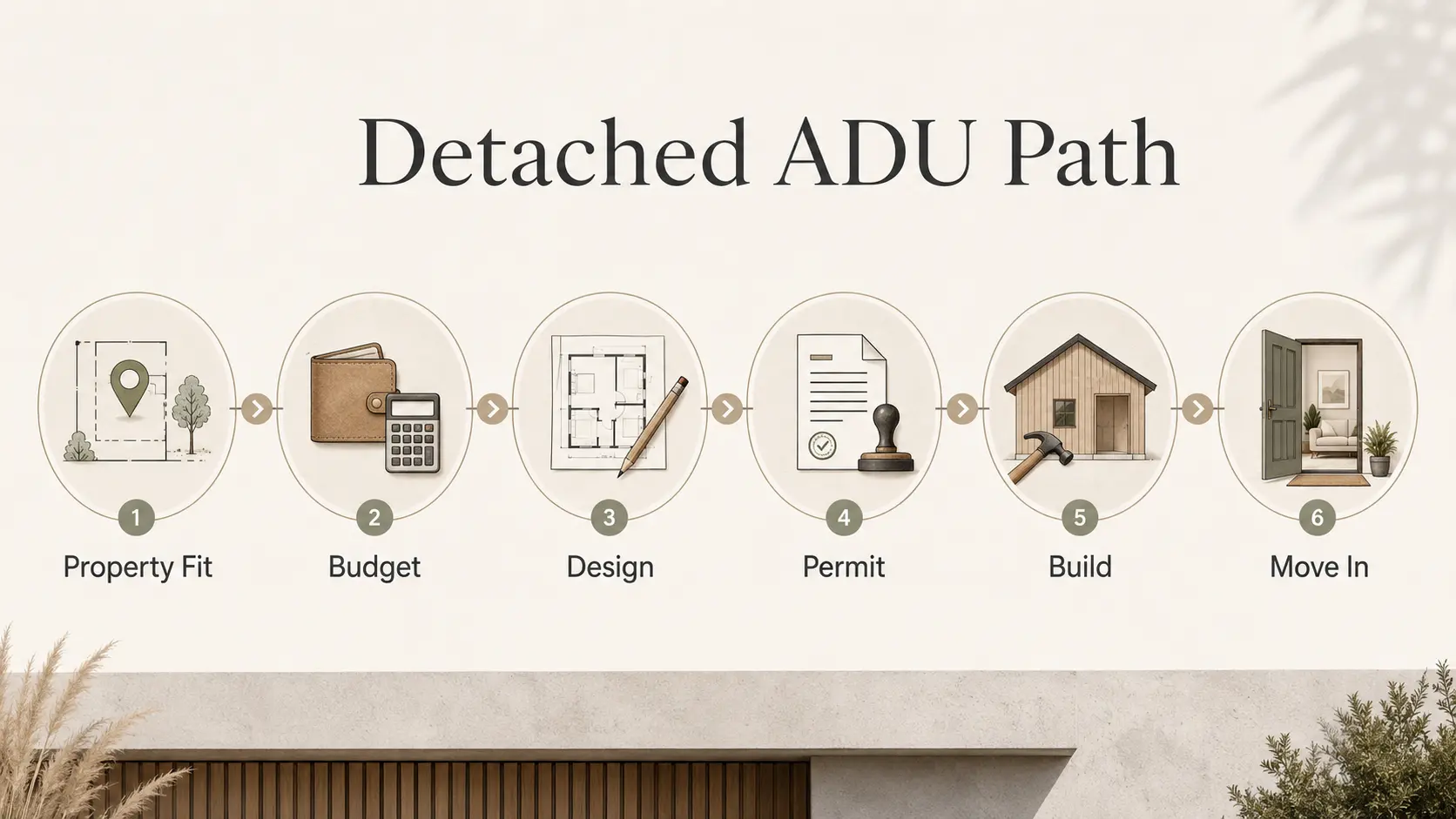
SnapADU's process runs in seven phases, from feasibility through final inspection. The biggest practical benefit of the design-build model is single-team accountability: the same team that draws the plans is responsible for permitting them and building them.
Initial Consult (Free)
A discovery call — free, approximately 30 minutes — to determine whether your property, project type, and budget are a plausible fit. This is where SnapADU should disqualify you if you're outside their service area or project type.
ADU Feasibility Study ($1,325–$2,375)
Site visit, site plan, zoning review, initial utility assessment, and third-party report integration. This is the most important money you will spend in the whole process — it finds lot-killers before you've committed to design. Ask what triggers the upper end of the range.
Property Reports ($5,525+)
Topographic and planimetric survey, utility mapping, plus boundary survey, soils report, or grading plan if needed. Which reports are mandatory depends on your lot, city, and project scope.
Additional Design / Modifications ($500–$1,500 basic; $4,500+ full custom)
Plan modifications above the standard design. Get the written definition of what changes trigger each pricing tier before you select a plan.
Construction Drawings ($2,300 standard / $6,000 semi-custom / $8,500+ custom)
Building plans, structural engineering, Title 24 energy compliance, and code checks. The 6-month price lock begins when these construction documents are complete and signed.
Permitting Management ($3,500+) plus Permits & Fees ($5,000+ pass-through)
SnapADU prepares applications, responds to city comments, and coordinates with agencies. City fees are pass-through and vary by jurisdiction.
Construction (typically 6–9 months)
Site prep and excavation; foundation; framing; rough mechanical, electrical, and plumbing; insulation and drywall; finishes; final inspection.
Where the 6-month price lock actually applies
The 6-month price lock is real, but it's narrower than the marketing implies. It locks the construction cost from the date construction documents are signed. It does not lock:
- City fees (those are pass-through and set by the jurisdiction).
- Site conditions discovered later (a hidden utility, a soils issue not flagged in the report).
- Homeowner-initiated change orders (you decide to upgrade the kitchen mid-build).
- Material allowances if you select higher-cost finishes than the standard package.
Get the start date, the end date, and the re-pricing triggers in writing. If the design phase runs long, the 6-month clock can run out before the city issues the permit.
The advantage of single-team accountability
The biggest practical benefit of design-build is the absence of the "blame game." When the architect and the builder are different companies, plan-check corrections are an opportunity for each side to point at the other. Inside a single design-build firm, the same team that drew the plans is responsible for permitting them and building them. That doesn't eliminate problems; it eliminates a category of finger-pointing.
How long does SnapADU take from first call to move-in?
Answer capsule: SnapADU publishes a typical full-project timeline of 10–18 months from first call to move-in: roughly 3–4 months for design and feasibility, 3–6 months for permitting (varies sharply by city), and 6–9 months for construction. Pre-approved plan paths under California Assembly Bill 1332 (effective 2025) require qualifying applications to be reviewed within 30 days. The single biggest variable is the city's permit queue, which neither you nor your builder controls.
Phase-by-phase timeline
| Phase | Typical published range | What can compress it | What can extend it |
|---|---|---|---|
| Feasibility + design | 3–4 months | Standard plan, no major site issues | Custom design, multiple revisions |
| Permitting | 3–6 months | AB 1332 qualifying pre-approved plan path (30-day review); experienced city like Chula Vista (~14 business days for City Standard plans) | Coastal Development Permit, fire-zone review, brush-management requirements, City of San Diego peak queue |
| Construction | 6–9 months | Flat lot, easy access, standard finishes | Sloped lot, sewer extension, utility upgrade, custom finishes, weather, inspection scheduling |
| Total | 10–18 months | All of the above | All of the above |
Source: SnapADU Process page (snapadu.com/process/) and SnapADU ADU Costs page; verified May 7, 2026.
Comparing the official review windows
| Plan path | Jurisdiction | Stated review window |
|---|---|---|
| AB 1332 qualifying pre-approved plan | All California cities offering it | 30 days |
| Chula Vista City Standard ADU Plan (SnapADU-prepared) | Chula Vista | ~14 business days |
| Standard custom plan | Chula Vista | ~21 business days |
| County of San Diego dwelling unit building plans | Unincorporated County | Standard process; no promised shortcut |
| City of San Diego custom plan | City of San Diego | Standard plan check; no promised shortcut |
Sources: California AB 1332; City of Chula Vista ADU page; San Diego County PDS; City of San Diego Development Services. Verified May 7, 2026.
The AB 1332 pre-approved plan path
If you're in the City of San Diego and willing to use one of the pre-approved plan options, the permitting timeline can compress materially. California Assembly Bill 1332 requires participating jurisdictions to review qualifying pre-approved ADU plans within 30 days. SnapADU prepared Chula Vista's City Standard ADU Plans (publicly confirmed by Chula Vista), and the City of San Diego accepts qualifying pre-approved plans from the County of San Diego, the City of Chula Vista, and the City of Encinitas.
The catch: any meaningful modification to a pre-approved plan can disqualify it from the 30-day path and put you back in standard plan check. Some older publicly available pre-approved plan sets may need updates to match the current California code cycle before they're permit-ready off the shelf. Confirm the current plan-set status before relying on the fast-track timeline.
Why San Diego permitting takes what it takes
- First-cycle plan rejection is the norm, not the exception, across San Diego County jurisdictions. Plans typically come back with a punch list; revisions are submitted; the cycle repeats. Two cycles is common; three happens on harder projects.
- The City of San Diego has the largest permit queue in the County and can run longer than smaller cities.
- Coastal-zone projects (Carlsbad, Encinitas, Oceanside coastal, Solana Beach, Del Mar, coastal San Diego, Coronado) face additional review. California Senate Bill 1077 directs the California Coastal Commission, in coordination with the Department of Housing and Community Development, to develop guidance to clarify and simplify coastal-zone ADU permitting by July 1, 2026.
- High-fire severity zones can trigger fire-sprinkler requirements, brush-management mitigation, and fire-access measurements that add cost and time.
Timeline questions to ask SnapADU
Before signing, get answers in writing to:
- What is your current average from feasibility kickoff to permit submittal, in my city?
- What is your current average from permit submittal to permit issuance, in my city?
- How often do projects like mine require redesign after the Feasibility Study?
- What timeline assumptions are baked into the proposal?
- What happens to the price lock if the permit takes longer than expected?
What real customer reviews say (and what reviews don't prove)
Answer capsule: SnapADU's public review signals across BBB, Houzz, Google, and the company's own testimonials page are largely positive, with recurring themes around communication, process clarity, and detached-ADU specialization. Houzz shows a 5.0 average across 22 visible reviews on accessible profile pages; BBB shows accreditation since April 2021 and an A+ rating with multiple recent positive reviews. No public review platform is a substitute for asking the builder directly for three current homeowner references in your specific city.
What's actually visible across review platforms
| Platform | What we see (verified May 7, 2026) | What it tells you | What it doesn't tell you |
|---|---|---|---|
| Better Business Bureau | Accredited since 4/1/2021; A+ rating; multiple recent named-client reviews | Institutional accreditation and repeated positive sentiment | Whether your lot, city, or budget will produce a similar experience |
| Houzz | 5.0 average rating across 22 visible reviews; project portfolio with detailed Q&A | Visual proof of completed work and homeowner engagement | Reviews concentrate where Houzz is the homeowner's research platform |
| Google reviews | Multiple positive reviews visible (re-verify count and average on day of decision) | Many homeowners use Google as their primary review platform | Public review counts shift |
| Yelp | Positive sentiment in displayed reviews; total visible review count is smaller than the company's stated build volume — Yelp's algorithm filters reviews automatically | Some homeowners post on Yelp; many don't | Yelp's filter is opaque; total review counts are not a clean measure of project volume |
| BuildZoom | License #1075582 reported active; permit data displayed | Useful for license/permit visibility | Not a homeowner-review platform in practice |
| SnapADU testimonials page | Multiple named-client written and video testimonials from across San Diego County | Identifies real people who can be cross-referenced | First-party, so curated by definition |
Sources: bbb.org SnapADU profile; houzz.com SnapADU profile pages; yelp.com/biz/snapadu-san-diego; google.com/maps SnapADU listing; buildzoom.com/contractor/snap-adu; snapadu.com/testimonials/. Verified May 7, 2026.
A short representative quote
"Clean, simple, straightforward, and fairly priced."
— Bret D., Encinitas, via snapadu.com/testimonials/
That's representative of the tone across SnapADU's own testimonials and BBB reviews.
The most useful customer document on the public web
SnapADU publishes a homeowner interview with a client named Susan in Vista on their own blog. In it, she describes the experience as positive overall and offers specific feedback: she felt some delays were "out of her hands," the job calendar tool could improve, and SnapADU shouldn't show clients a best-case scenario schedule because reality is messier. The fact that SnapADU publishes a client giving them mixed feedback on their own site is a meaningful trust signal. Most builders curate testimonials more aggressively.
Why the Yelp count is small for a 100+-project company
Yelp's algorithm hides reviews. Yelp's documented "not recommended" filter automatically removes a meaningful percentage of reviews from the public count, and that share varies by category and time. The visible count understates the actual volume across virtually every category, not just construction. Rather than counting reviews, the right move for a $400K decision is to ask SnapADU directly for three current homeowner references in your specific city, with permission to call them, and to ask each one: Would you hire this team again? What did you wish you'd asked before signing? What did the change-order process look like?
What no review platform can tell you
- Whether your specific lot has a utility constraint that will move the budget
- Whether your city will approve the size, height, or placement you want
- Whether the proposal you receive excludes a costly sitework category
- Whether the financing path you're planning to use will actually fund in time
- Whether the reviewer had a budget, slope, HOA, coastal zone, or family situation similar to yours
This is why even the strongest review profile is a starting point, not a finish line.
Get the bid review checklist before you sign
Download the free SnapADU Bid Review Checklist (PDF) →The 14 questions to ask after you receive a quote, including the CSLB-mandated deposit cap most homeowners don't know about.
Who SnapADU is a strong fit for — and who should look elsewhere
Answer capsule: SnapADU is the right call when you want a single accountable team to design, permit, and build a detached new-construction ADU in Greater San Diego. They are not the right call for prefab/modular projects, garage conversions or JADUs as primary scope, projects outside San Diego County, or budgets meaningfully below their published all-in ranges.
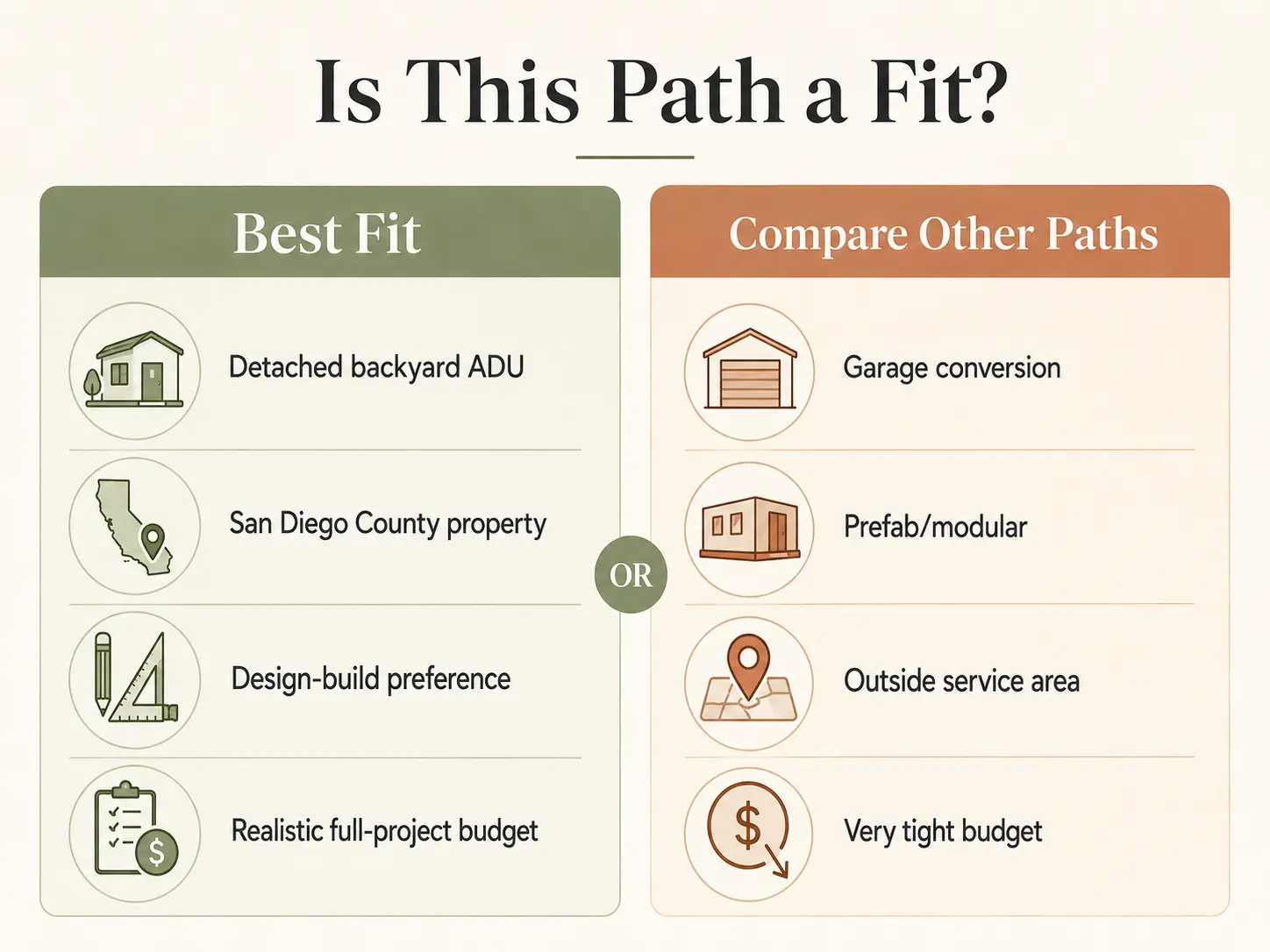
There is no universally "best ADU builder." There is the builder whose specialization matches your project, your city, your lot, and your budget — and the builders whose specialization does not. SnapADU is unusually clear about their own scope: they build new detached ADUs in Greater San Diego, stick-built, and that is the entirety of their offering. That clarity is a feature.
Project-fit decision matrix
| Your project / situation | SnapADU fit | Best alternative path if not |
|---|---|---|
| Detached new-construction ADU, 500–1,200 sq ft, in Greater San Diego | ✅ Strong fit | n/a |
| Two-story / carriage-house ADU on a tight lot in Greater San Diego | ✅ Strong fit | n/a |
| Multi-unit ADU site (where local rules allow) | ✅ Likely fit | n/a — SnapADU has built multi-unit configurations |
| Coastal-overlay lot in Greater San Diego | ✅ Possible — feasibility study first | Architect-led path is sometimes better for complex coastal projects |
| High-fire severity zone or sloped lot | ✅ Possible — feasibility study first | Same — feasibility decides |
| Garage conversion as primary scope | ⚠️ Not their focus | Local conversion specialists; see our San Diego County builder guide |
| JADU under 500 sq ft as primary scope | ⚠️ Not their focus | Smaller specialists who treat JADUs as routine |
| Prefab or modular ADU | ❌ Not a fit | Crest Backyard Homes (modular path, San Diego); or Nest Tiny Homes for compact ADUs in San Diego/Imperial County (sponsored partner) |
| Tiny home or movable unit | ❌ Not a fit | Code-classified tiny-home or manufactured-home providers |
| ADU outside San Diego County | ❌ Not a fit | A region-specific specialist; run the property eligibility check for the right pointer |
| Lowest possible cost is the priority | ❌ Likely not a fit | Garage conversion, owner-builder, JADU, smaller prefab |
| Highly custom architecture with extensive design iteration | ⚠️ Possible — ask | Architect + GC path can give you more design control with bid-competition leverage |
Who SnapADU was built for, in plain language
If you are a Greater San Diego homeowner who:
- Wants a real ADU, not an unpermitted bonus room
- Wants a single team responsible from feasibility through final inspection
- Has a budget in the $300K–$500K+ envelope (or has financing lined up to support that)
- Values predictability over the absolute cheapest sticker price
- Is willing to pay a small feasibility fee to avoid a large design mistake
…then SnapADU is at the top of the shortlist for the project type they actually do.
Where SnapADU will tell you "no" — and that's a feature
- Out of service area → they will (and should) tell you on call one.
- Garage conversion as primary scope → they will route you elsewhere because the margin and process don't match their setup.
- Prefab interest → they will tell you they are stick-built, and you should compare prefab providers separately.
- Budget materially below the floor → they will tell you the math doesn't pencil rather than burn your feasibility fee.
A builder who agrees to take any project that walks through the door is the builder you should be most worried about.
In Greater San Diego and detached is your fit?
Request a free SnapADU consult → (sponsored partner)
Not a fit on the matrix above? Run the free Feasibility Check → — it routes you to the right builder type for your address and project, not to SnapADU when SnapADU isn't your answer.
What are the honest downsides and dealbreakers?
Answer capsule: SnapADU's main limitations are exactly the flip side of their strengths: a narrow geographic footprint (Greater San Diego only), a narrow product focus (detached new-construction stick-built only), and a price floor that doesn't suit ultra-low-budget shoppers. None of these are quality issues; all of them are fit issues.
The damaging admission, said honestly
Construction in San Diego is hard. Permitting is real work. Lot-specific surprises — soils, utilities, brush management, coastal review, fire access — show up on a meaningful share of projects. Even with experienced builders, a real percentage of San Diego ADU projects don't finish on the originally quoted budget or timeline. SnapADU has publicly stated they complete approximately 90% of the projects they start, and they've contrasted that with an industry average they describe as much lower. We have not independently audited either figure.
The point isn't the exact percentage. The point is that you should assume scope surprises will happen and budget for them with a 10–15% contingency on top of the quoted scope, plus the small upfront feasibility fee that lets you find lot-killers before you've committed to design.
The dealbreakers, with the right next step for each
Dealbreaker 1: You're outside San Diego County.
Their service area is fixed. There is no version of 'but I'm in Riverside' that ends with SnapADU as the answer.
Right next step: Run the free Feasibility Check →
Dealbreaker 2: You want prefab or modular.
SnapADU is stick-built only, by their own statement. They don't sell modular boxes, panelized kits, container-based units, or factory-built modules.
Right next step: See our prefab ADU comparison guide →
Dealbreaker 3: Your primary scope is a garage conversion.
SnapADU will entertain conversion work, but it isn't their focus and you'll generally get more attention from a conversion specialist.
Right next step: See our San Diego County builders guide →
Dealbreaker 4: Your primary scope is a JADU under 500 square feet.
JADUs require a different operational rhythm than a detached new-build.
Right next step: See our JADU guide →
Dealbreaker 5: Your budget is materially below ~$300K all-in for the smallest detached unit.
Their published examples don't go below this floor. The right answer might be a smaller scope, a phased plan, or a different ADU type.
Right next step: Explore ADU financing options →
Dealbreaker 6: You want maximum bid competition on a custom architectural design.
Design-build and architect-plus-GC are different tools. If you want to bid the construction drawings to multiple GCs to drive down the construction price, an architect-led process gives you more leverage.
Dealbreaker 7: Your project requires deeply custom architectural personality.
SnapADU does custom work, but a homeowner who wants a one-of-one architectural object will usually be better served by an architect-led process.
SnapADU vs the alternatives
Answer capsule: SnapADU's most relevant alternatives in Greater San Diego are other detached-focused design-build firms (Crest Backyard Homes, Better Place Design & Build, BNC Builders), conversion specialists for garage projects, the prefab/modular path for product-led shopping, and the architect-plus-GC path for highly custom designs. The right comparison is by project type, not by brand.
| Path | Best for | Main advantage | Main risk | Sponsored partner? |
|---|---|---|---|---|
| SnapADU (detached design-build, San Diego) | Detached new-construction in Greater San Diego | Single accountable team; SnapADU prepared Chula Vista's City Standard ADU Plans; in-house design + permit + build | Not the right call for prefab, conversions, or out-of-area | Yes (active) |
| Crest Backyard Homes (San Diego, modular + site-built) | Buyers wanting modular and site-built optionality from one firm | Both build methods on the table | Verify deposit terms in writing — California's CSLB caps ADU down payments at $1,000 (or 10% of contract, whichever is less) | No |
| Better Place Design & Build (San Diego, design-build) | Comparing 2–3 design-build firms head-to-head | "Verify before we price" approach; broad service area | Self-claimed differentiators without independent third-party methodology | No |
| BNC Builders (San Diego, design-build incl. conversions) | Garage conversions; per-square-foot transparent pricing | Published per-sq-ft ranges enable like-for-like bid comparison | Smaller public footprint than the largest specialists | No |
| Architect + General Contractor | Highly custom design; maximum bid competition | More design control; multi-bid leverage on construction price | More coordination burden for the homeowner | No |
| Prefab / modular ADU | Standardized product comparison shopping | Faster product evaluation; published unit pricing | Sitework, permits, foundation, and crane delivery are still local — and they're a real cost | See prefab guide |
| Nest Tiny Homes (Southern California compact / tiny-home) | Compact tiny-home-style ADUs on flat lots in San Diego or Imperial County | Lower entry price for very small footprints; California office in El Centro | Confirm code classification, foundation type, and your city's acceptance before relying on a tiny-home unit as a permitted ADU | Yes (active) |
| Owner-builder | Experienced homeowners with construction skills and time | Maximum control; lowest labor cost | Maximum risk; no contractor warranty; financing harder | No |
Source notes: SnapADU partnership with Chula Vista publicly confirmed by the City of Chula Vista; other competitor product, service area, and pricing claims are from each company's website and have not been independently audited. Verify directly before relying on any.
How to read the table
- Brand-vs-brand comparisons within the same path are mostly noise. SnapADU vs Better Place is a real comparison. SnapADU vs a national prefab company is a path comparison — you're not comparing builders, you're comparing fundamentally different ways of building.
- Match the path to the project, then compare brands within the path. If you've decided detached design-build in San Diego is the path, comparing SnapADU and Better Place head-to-head on identical scope is a good use of your time.
- Service area is the first filter, not the last. SnapADU and Crest both serve Greater San Diego. The prefab industry serves California broadly but the real economics depend on whether they have efficient delivery and assembly capacity to your zip code.
Considering a compact ADU on a flat lot in San Diego or Imperial County? Explore Nest Tiny Homes options → (sponsored partner)
How San Diego rules can override builder fit
Answer capsule: Even the right builder cannot build an ADU your city or county will not permit. The four most important rule changes for 2026 buyers are AB 976 (no local owner-occupancy requirement on standard ADUs), AB 1154 (JADU owner-occupancy fix), AB 1332 (30-day review for qualifying pre-approved plans), and SB 1077 (coastal-zone ADU guidance, due July 1, 2026).
City of San Diego ADU basics
- Building permit required for all ADUs and JADUs.
- ADU size range: 150–1,200 square feet (per current city ordinance reflecting state law).
- Parking: generally not required for ADUs except in specific Beach Impact Areas.
- Pre-approved plans: the City of San Diego accepts qualifying pre-approved plans from the County of San Diego, the City of Chula Vista, and the City of Encinitas under California Assembly Bill 1332, with 30-day review for qualifying pre-approved plan applications.
- Coastal Overlay: projects within the Coastal Overlay Zone require additional review and may require a Coastal Development Permit (CDP).
- Solar: newly constructed, non-manufactured detached ADUs are subject to California Energy Code solar requirements; panels can be installed on the ADU itself or on the primary dwelling. JADUs are not subject to the solar requirement.
- Permit and impact fees: roughly $13–$28 per square foot per SnapADU's permit-fee analysis (verify against the City's published fee schedule for your specific project).
San Diego County (unincorporated areas)
- Building permit required for all ADUs.
- Detached ADU size: up to 1,200 square feet (consistent with state law for detached units).
- Impact fees: the County's trial impact-fee waiver program ended January 9, 2024; current standard fees apply.
- Setbacks and lot coverage: governed by the underlying zone.
State law — the floor below local rules
- AB 976 (effective January 1, 2024): permanently prohibits local agencies from imposing owner-occupancy requirements on standard ADUs. No city in California can require you to live on your own property in order to have a standard ADU.
- AB 1154: removed the owner-occupancy requirement for Junior ADUs (JADUs) that have separate sanitation facilities from the main dwelling per Government Code §66333. JADUs that share sanitation with the main house may still trigger owner-occupancy; verify with your city.
- AB 1332: provides for 30-day review of qualifying pre-approved ADU plans in jurisdictions that participate.
- SB 1077: directs the California Coastal Commission, with HCD, to publish written guidance to clarify and simplify coastal-zone ADU permitting by July 1, 2026. Public draft and workshop are scheduled for spring 2026 ahead of the July 2026 finalization.
Builder-fit override table
| Rule / constraint | Source | What it can kill | What to ask SnapADU on the discovery call |
|---|---|---|---|
| Coastal Overlay / CDP | City of San Diego, Carlsbad, Encinitas, Oceanside, Solana Beach, Del Mar, Coronado | Timeline; sometimes ADU placement | Have you completed an ADU on a CDP-required lot recently? |
| High-fire severity zone | CAL FIRE / city fire department | Sprinkler + brush mitigation costs; sometimes placement | Brush-management impact on my lot? |
| Beach Impact Area parking | City of San Diego | Parking requirement adds to footprint or cost | Does my zip code fall inside a Beach Impact Area? |
| 1,200 sq ft hard cap (City + County) | Local ordinance reflecting state law | Larger ADU dreams | Can my lot legally support the size I want? |
| HOA restrictions | Recorded CC&Rs | Style, height, materials — sometimes the entire ADU | Have you worked with my HOA before? |
| Septic vs sewer | Lot-level | Cost; sometimes feasibility | Is my lot on sewer? |
Property tax note
Your existing primary residence's tax base is generally not reassessed in California, but the new ADU is added to the property's assessed value. California property tax is roughly 1% of assessed value annually plus local additions, so a $400,000 ADU could add roughly $4,000 per year in property tax. Verify with your county assessor before relying on any specific number — assessment treatment of ADUs can vary by jurisdiction and by use type (rental vs family).
These are illustrative planning examples, not guarantees of returns. Actual results depend on local market conditions, construction costs, financing terms, and regulatory approvals.
How to vet a SnapADU bid before you sign — the 14-question framework
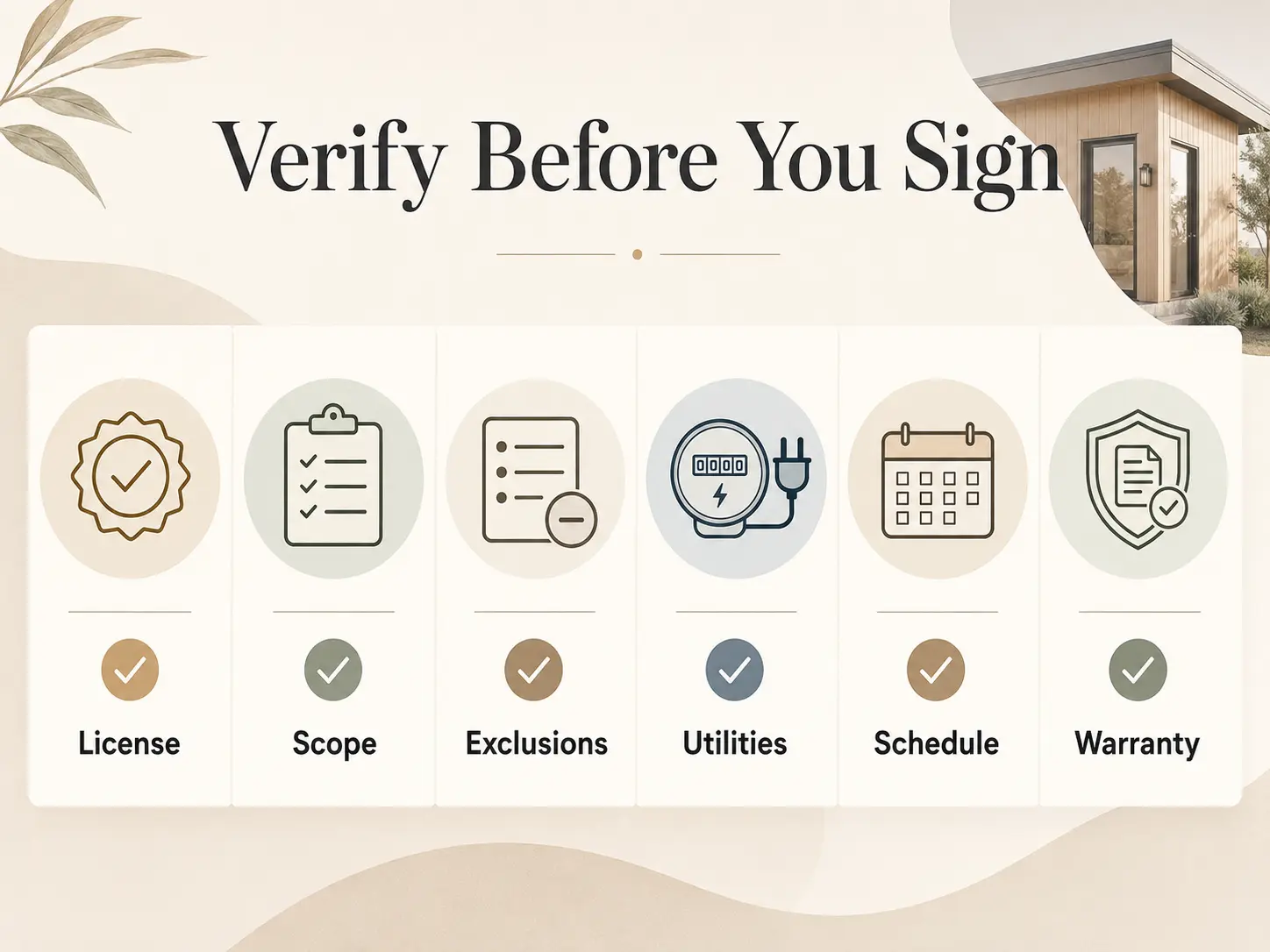
Answer capsule: Use the 14 questions below before signing any SnapADU contract (or any builder's contract). Each question is tied to California contractor law (CSLB ADU Fast Facts), SnapADU's specific pricing model, or a known San Diego permit reality. The most important: the deposit cap (capped at $1,000 for ADU contracts under CSLB ADU Fast Facts), the bond, the change-order log, and the permit-corrections responsibility.
Most homeowners ask the wrong questions during builder interviews. "What's your price?" and "How long will it take?" are both unreliable until feasibility is complete. The 14 questions below predict whether your project will finish on budget, on time, and without a contractor's lien on your property.
License number and classification
Verify the active CSLB license at cslb.ca.gov. For SnapADU, license #1075582; classification should be B (General Building), active, in good standing. Take a dated screenshot.
Bond and insurance
Every California licensed contractor must maintain a $25,000 contractor's license bond under California Business and Professions Code §7071.6 (raised from $15,000 to $25,000 effective January 1, 2023). Ask for the bond and the Certificate of Insurance directly.
Down payment
California's CSLB ADU Fast Facts states clearly: for ADU work, the down payment cannot exceed $1,000 (the general rule is $1,000 or 10% of the contract price, whichever is less; for ADU contracts of $300K+, the $1,000 cap is what applies in practice). Anyone — including any builder — asking for more is operating outside CSLB rules.
Fixed-bid vs allowance percentage
Confirm what's locked at the contracted price versus what's an allowance. SnapADU markets a fixed-bid model with a 6-month price lock; get the exact line items in writing. A bid that's 60% allowance is not really a fixed bid.
Six-month price lock terms
Confirm the start date (typically when construction documents are signed), the end date, what triggers re-pricing, and how scope changes are handled.
Solar (Title 24)
Confirm whether solar is included in the bid. The California Energy Code requires solar on most new detached ADUs; panels can be installed on the ADU itself or on the primary dwelling. Ask which path SnapADU is bidding for your project.
Plan corrections — who pays?
First-cycle plan rejection is normal in San Diego County. Multiple correction cycles are common. Ask whether SnapADU pays for resubmittals or you do.
Change-order log
The single most predictive question on this list. Ask to see the last three real change-order logs from completed projects. A builder who can't or won't show change-order patterns is hiding either disorganization or a culture of upselling.
References — three current homeowners in your specific city
Ask for three references in your city, with permission to call. Ask each one: Would you hire this team again? What did you wish you'd asked? What was the change-order experience? Did the schedule hold?
Project manager
Name, email, phone, and backup contact — before signing.
Backlog and projected start date
Real ADU specialists have backlog. A builder who says 'we can start next week' is either between projects or oversold. Get the projected design-kickoff date in writing.
Warranty
California's statute of limitations on construction defects can run up to 10 years for latent defects. Standard residential warranties are often 1 year on labor with longer coverage on specific systems. Get the SnapADU warranty terms in writing.
Plan ownership if you don't move forward
If you pay for design and don't continue to construction, who owns the plans? Get the answer in the design-phase contract.
What happens if SnapADU goes out of business mid-build
Legitimate question for any contractor. The answer involves the contractor's bond, your insurance coverage, and what assignable rights exist in the contract. A confident answer is reassuring; an uncomfortable answer is informative.
Get the printable version.
Download the SnapADU Bid Review Checklist (PDF) → print and bring it to the consult.Should you contact SnapADU? Final decision matrix
Answer capsule: Contact SnapADU if all four conditions are true: your property is in Greater San Diego, you want a detached new-construction ADU, your budget aligns with realistic San Diego detached ADU costs ($300K+), and you prefer a single accountable design-build team.
Contact SnapADU if all four are true
Compare alternatives first if any of these are true
- You want prefab, modular, or panelized construction.
- You want a garage conversion as your primary scope.
- You're outside San Diego County.
- Your maximum budget is materially below the published all-in floor.
- You want multiple GC bids on completed architectural plans.
- You need to confirm financing before paying for design or feasibility.
- You want highly custom architectural design with full creative latitude.
Questions to ask before paying for any feasibility or design fee
- What scope is included in the price you'd quote me?
- What is explicitly excluded?
- What sitework allowances are assumed, and what would push them higher?
- What utility assumptions are baked in?
- What happens to the price if the city requires changes after the price lock?
- What is the change-order process and the typical change-order rate on a project like mine?
- What is the payment schedule, and is it within California's CSLB rules?
- Who owns the plans if I do not move to construction?
- What warranties apply, and for how long?
- Can I speak with a recent client in my specific city?
A realistic next-step sequence
- Verify the license at cslb.ca.gov on the day of the call.
- Take the discovery call. Free; 30 minutes.
- Pay for the ADU Feasibility Study ($1,325–$2,375) before paying for anything else. This is the fastest way to find a lot-killer.
- Read the feasibility report honestly. If it surfaces a major site issue, do not skip past it because you're attached to the idea.
- Get three current references in your city before any design contract.
- Run the bid through the 14-question checklist before signing.
- Confirm financing is approved and ready to disburse on the timeline the contract assumes.
- Sign with the deposit cap respected ($1,000 for ADU contracts per CSLB ADU Fast Facts).
Verify your property fits before any builder call
See What You Can Build → Get Your Free ADU ReportGreater San Diego, detached new-build
Request a free SnapADU consult → (sponsored partner)
Still in early research?
Download the Free ADU Starter Kit →SnapADU FAQ
Is SnapADU legit?
Yes. SnapADU is a BBB-accredited California design-build firm with CSLB license #1075582 (verify current status at cslb.ca.gov), an A+ BBB rating since April 2021, named ownership, a public 100+ project portfolio (self-reported), and pre-approved plans publicly confirmed by the City of Chula Vista as prepared by SnapADU.
How much does SnapADU cost in 2026?
SnapADU's published 2026 examples range from about $300,000 all-in for a 500-square-foot detached ADU to about $450,000 all-in for a 1,200-square-foot detached ADU, equivalent to $375–$600+ per square foot. These are planning numbers; site-specific factors (slope, utilities, coastal review, fire-zone requirements, finishes) move them.
Where does SnapADU build?
Greater San Diego only — 18 named cities (San Diego, Carlsbad, Chula Vista, Coronado, Del Mar, El Cajon, Encinitas, Escondido, Imperial Beach, La Mesa, Lemon Grove, National City, Oceanside, Poway, San Marcos, Santee, Solana Beach, Vista) plus unincorporated San Diego County.
Does SnapADU build prefab or modular ADUs?
No. SnapADU is stick-built (site-built) only. They do not sell modular boxes, panelized kits, container-based units, or factory-built modules.
Who owns SnapADU?
Co-founded in 2020 by Whitney Hill (CEO) and Mike Moore (CFO), both publicly named on the company's About page and on the BBB principal-contacts list.
Does SnapADU do garage conversions or JADUs?
They will entertain conversion and JADU work, but it isn't their stated focus. Conversion specialists and smaller-footprint design-build firms are usually a better operational fit.
What is SnapADU's BBB rating?
A+, accredited since April 1, 2021. BBB accreditation is one trust signal, not a guarantee of project outcome.
How long does a SnapADU build take?
SnapADU publishes a typical full-project timeline of 10–18 months: roughly 3–4 months for design and feasibility, 3–6 months for permitting, and 6–9 months for construction. Pre-approved plan paths under California AB 1332 require qualifying applications to be reviewed within 30 days; Chula Vista City Standard ADU plans (prepared by SnapADU) can be reviewed in approximately 14 business days per Chula Vista's published process.
Is the 6-month SnapADU price lock real?
Yes. The price lock begins when construction documents are signed. It does not lock city fees (those are pass-through), site conditions discovered later, or homeowner-initiated change orders. Get the start date, end date, and re-pricing triggers in writing.
Why are there few Yelp reviews for a 100+-project company?
Yelp's algorithm filters reviews automatically; many reviews end up in the "not recommended" bucket and don't appear in the public count. The right move for a $400K decision isn't to count Yelp reviews — it's to ask SnapADU directly for three current references in your specific city.
Are there any SnapADU complaints I should know about?
Across the public surfaces reviewed (BBB, Houzz, BuildZoom, plus visible Google and Yelp listings), no repeating, verified complaint pattern strong enough to publish as a trend was identified as of May 7, 2026. The most candid criticism is in SnapADU's own published homeowner interview with Susan in Vista, who described real frustration with schedule transparency. Absence of public complaints is not proof that no complaints exist; always check current CSLB complaint disclosures, recent reviews, and references before signing.
Can I finance a SnapADU project?
Financing is separate from the builder decision. The main lanes are HELOC, cash-out refinance, construction-to-permanent loan, renovation HELOC, and (for eligible City of San Diego homeowners) the SDHC ADU Finance Program. Each has its own qualification rules and timing. We do not quote specific rates, APRs, or monthly payments.
Is SnapADU more expensive than other San Diego ADU builders?
SnapADU's published all-in ranges are consistent with other detached design-build firms in San Diego County. SnapADU is not the cheapest path; it's not unusually expensive either. The cheapest paths in San Diego (garage conversions, JADUs, owner-builder) come with tradeoffs SnapADU's offering doesn't carry.
Will my property tax go up if I build a SnapADU ADU?
Your existing primary residence's tax base is generally not reassessed in California, but the new ADU is added to the property's assessed value. Property tax in California is roughly 1% of assessed value annually plus local additions, so a $400,000 ADU could add roughly $4,000 per year in property tax — verify with your county assessor before relying on this estimate.
These are illustrative examples, not guarantees of returns. Actual results depend on local market conditions, construction costs, financing terms, and regulatory approvals.
How we researched this review
The Dwelling Index is an independent research resource covering ADU financing, costs, and regulations. We do not call builders for off-the-record interviews; we don't relay anything we couldn't verify in public.
What we did
- Reviewed SnapADU's official site (snapadu.com): About, ADU Costs, Process, Service Area, Plans, Testimonials, and the "Lessons from 100 ADU Builds" article.
- Cross-checked public trust signals on the Better Business Bureau, Houzz, and BuildZoom; noted Google and Yelp signals where visible.
- Verified the CSLB license-check pathway and instructed readers to verify license #1075582 at cslb.ca.gov on the day they sign.
- Reviewed City of San Diego Development Services Department and San Diego County Planning and Development Services published guidance.
- Reviewed California state law: AB 68, AB 976, AB 1154, AB 1332, AB 462, SB 1077, and the relevant Government Code sections.
- Reviewed CSLB ADU Fast Facts publication for ADU-specific consumer protections.
- Reviewed San Diego Housing Commission (SDHC) ADU Finance Program eligibility — without quoting rates or approval likelihood.
- Reviewed San Diego Unified School District residential developer fee schedule for the May 11, 2026 fee change.
- Used homeowner discussions on Reddit, Houzz Q&A, and similar forums only as voice-of-customer — to understand which questions homeowners actually ask, not as proof of cost, law, or construction outcomes.
- Cross-checked SnapADU-published claims against at least one other public source (BBB, BuildZoom, Houzz, City of Chula Vista, or city planning) where possible.
- Marked self-reported claims (100+ ADU build count; ~90% completion rate; San Marcos pre-approved plan authorship) clearly as self-reported where they couldn't be independently confirmed.
What we did not do
- We did not generate fake reviews or testimonials.
- We did not use Review or AggregateRating schema; this is an independent brand-research review, not a starred product review.
- We did not invent an author, expert reviewer, or credentials.
- We did not rank SnapADU as "best" — they are the right fit for specific projects and the wrong fit for others.
- We did not quote specific rates, APRs, or payments on financing programs.
- We did not promise approval, timelines, or rental income outcomes.
Editorial standards
SnapADU is one of our active partners. The affiliate relationship did not influence the structure or conclusions of this review. Our editorial methodology and affiliate disclosure describe the standards we hold every commercial page to.
Sources
- SnapADU: snapadu.com (Home, About, ADU Costs, Process, Service Area, Plans, Testimonials, "Lessons from 100 Builds")
- Better Business Bureau: bbb.org/us/ca/san-diego/profile/general-contractor/snapadu-1126-1000081121
- BuildZoom: buildzoom.com/contractor/snap-adu
- Houzz: houzz.com SnapADU project pages
- Yelp: yelp.com/biz/snapadu-san-diego (live count not independently audited)
- Google reviews: google.com/maps SnapADU listing (live count not independently audited)
- California Contractors State License Board: cslb.ca.gov (license lookup; ADU Fast Facts; B&P §7071.6 bond rule; deposit-cap rule)
- City of San Diego Development Services Department: sandiego.gov/development-services
- City of Chula Vista (City Standard ADU Plans / SnapADU partnership): chulavistaca.gov
- San Diego County Planning and Development Services: sandiegocounty.gov/pds
- San Diego Housing Commission ADU Finance Program: sdhc.org/housing-opportunities/adu/
- California Coastal Commission SB 1077 ADU Guidance Development page: coastal.ca.gov/sb1077/
- California Legislative Information: AB 976, AB 1154, AB 1332, AB 462, SB 1077; Government Code §66333
- California Department of General Services California Construction Cost Index: dgs.ca.gov (~44% rise Jan 2021–Dec 2025)
- San Diego Unified School District developer fee schedule: sandiegounified.org
- Voice-of-customer (objections only, not factual claims): Reddit r/sandiego, Houzz Q&A
What we will refresh next
We refresh this page on a published quarterly cadence. Specifically:
- — Cost ranges — re-verified monthly against snapadu.com/adu-costs/
- — Process fees — quarterly against snapadu.com/process/ and snapadu.com/adu-costs/
- — Service area — quarterly against snapadu.com/service-area/
- — License status — monthly against cslb.ca.gov
- — BBB rating + Houzz / Yelp / Google review counts — monthly
- — AB 1332 acceptance and SB 1077 coastal guidance status — quarterly
- — SDHC ADU Finance Program status — monthly during program activity windows
- — SDUSD developer fee schedule — at each scheduled fee change
- — Affiliate / partner status — monthly
Spotted something stale or incorrect? Email editorial@dwellingindex.com.
Final next step
You read this far because you wanted a clear answer, not a sales pitch. Here it is, one more time, plainly:
If you're in Greater San Diego and you want a detached new-construction ADU built by a single accountable team, SnapADU is a defensible choice and worth a free consult. If you're outside that footprint, or your project is a garage conversion, prefab, JADU, or anything else, do not start with SnapADU — start with a property check that points you to the path that actually fits.
Not sure where to start? See what's possible at your address — get your free ADU report in 60 seconds.
See What You Can Build → Get Your Free ADU Report