
Best ADU Builders in Coronado, CA (2026): Compared by Project Type, with Real Costs, Permit Records & Code Decoded
By the Dwelling Index editorial team · Last updated May 6, 2026 · Last verified May 6, 2026
Primary sources: City of Coronado Building Services issued-permit PDFs (Jan 2025–Feb 2026), Coronado Municipal Code §86.56.105 (current through Ord. 2025-11), California HCD ordinance-review letter to City of Coronado dated December 10, 2025, California Government Code §§ 66310–66342, HCD ADU Handbook (updated March 2026), Coronado Planning Fee Schedule effective July 1, 2024, Coronado Unified School District fee notice dated March 17, 2025, CSLB license database, and current builder-published cost data.
The short answer
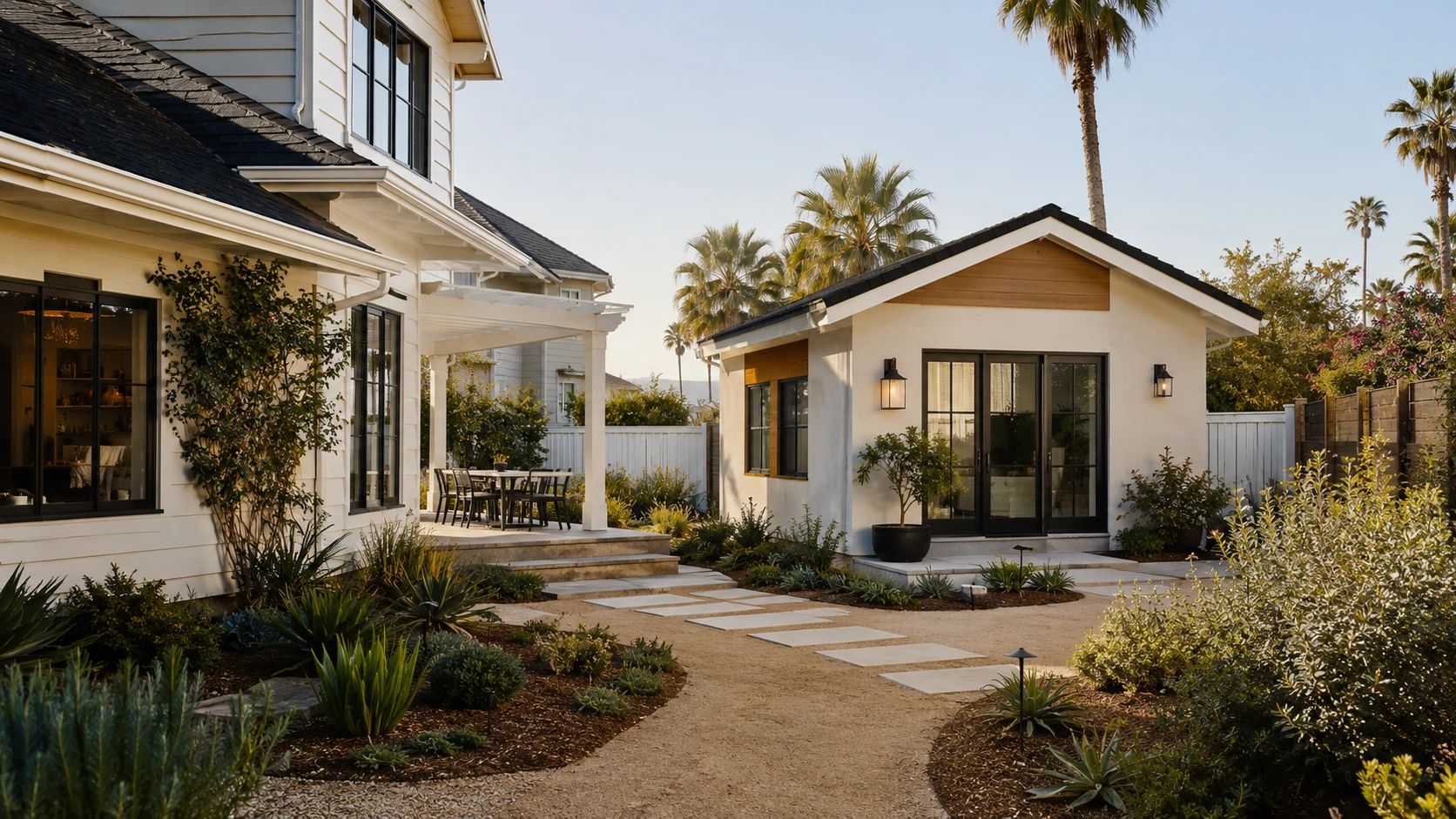
The best ADU builders Coronado homeowners can hire in 2026 are the ones whose track record matches your specific project lane — detached new build, garage conversion, junior accessory dwelling unit (JADU), carriage-house conversion, multi-family ADU under SB 1211, or prefab — not whoever runs the loudest “top-rated” badge. Most San Diego County ADU companies will technically take a Coronado job. Only a small group has actually completed projects on Coronado lots, and those are the ones who know how the city plan-checks the Local Coastal Program, when state law overrides Coronado's stricter local rules, and how to staging-plan a single-bridge build site.
For a typical detached new build on a Coronado single-family lot in 2026, the working San Diego County turnkey range runs roughly $375 to $600+ per square foot all-in, with Coronado projects often landing toward the upper end of that band because of single-bridge access via the Coronado Bay Bridge or State Route 75, narrow alley-loaded grid lots, and finish-quality pressure from the local “matching architecture” standard. Coronado's local code currently caps detached ADUs at 850 square feet (studio or one-bedroom) or 1,000 square feet (two or more bedrooms), with a 16-foot height limit. State law goes further: the 16-foot limit becomes 18 feet (or 20 feet matching primary roof pitch) within a half-mile of a major transit stop — and HCD has explicitly named the Coronado ferry terminal as one such stop. The local 6-month minimum rental term is contradicted by state law's 30-day floor. And for three of the four §66323 ADU types, Coronado's 850/1,000 size cap is also unenforceable.
The 60-day ministerial review clock is real (and the 15-business-day completeness clock comes first), but real-world application-to-issue spans on Coronado public permit records ranged from same-day (administrative issuance) to 412 days (a complex outlier) in our January 2025–February 2026 sample. Plan to budget 8 to 14 months from first call to certificate of occupancy, depending on lane.
Free Tool
See What You Can Build on Your Coronado Lot
Free 2-minute eligibility report. Tell us your address; we'll show you what's buildable under both Coronado code and state-law overrides — plus the builder lane that fits.
At a glance: Coronado ADU builder fit by project type
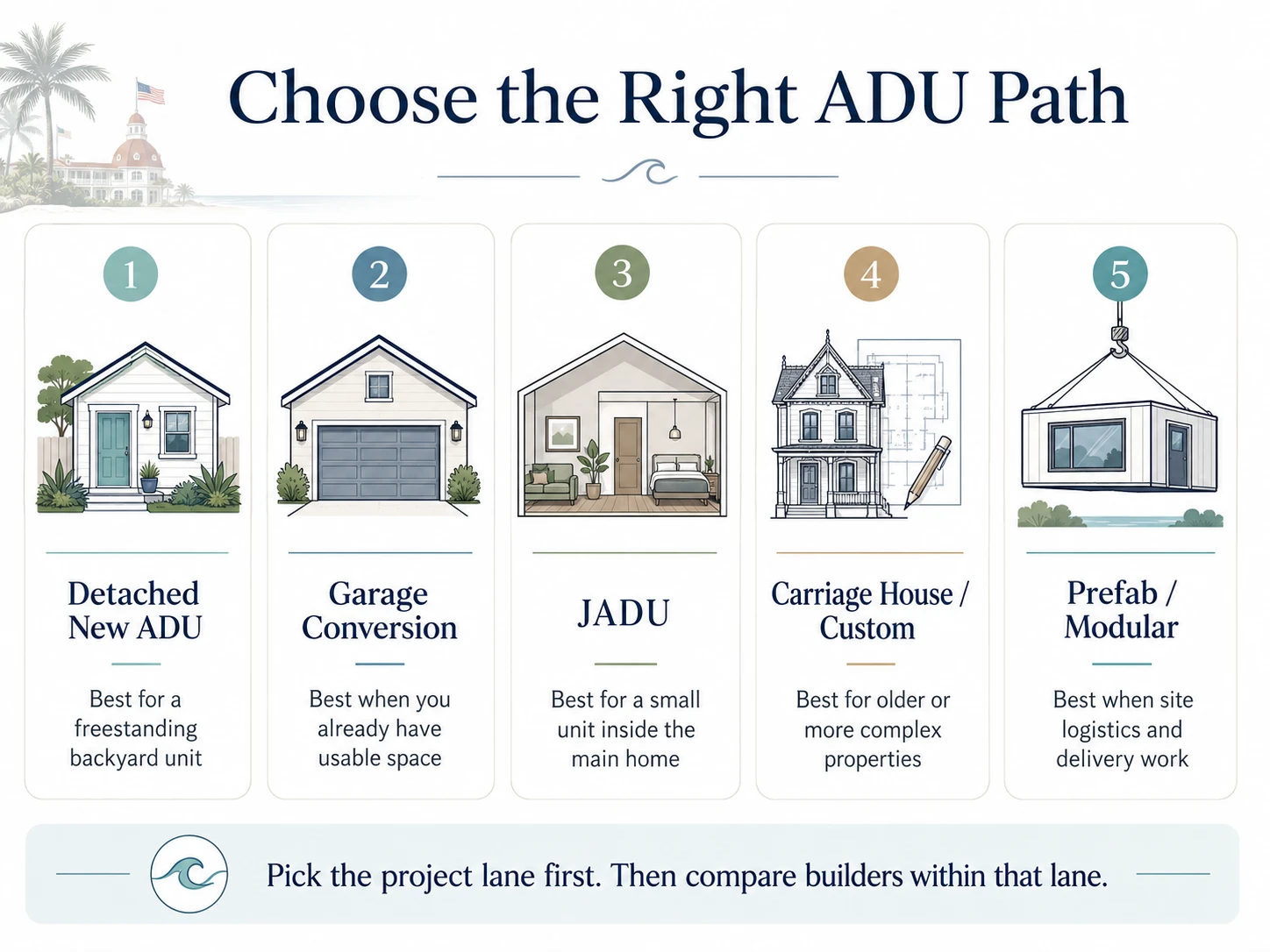
The “best ADU builders Coronado” question has no single answer because Coronado projects fall into six distinct lanes, and a builder excellent at one lane is often the wrong call for another. We built this matrix to point you to the lane first, the builder second.
| Your project | Best builder lane | Why this lane | First question to ask |
|---|---|---|---|
| Detached new ADU (backyard, freestanding) | San Diego County detached design-build specialist | One contract for design, permitting, and construction; predictable pricing on standard plans | “Can you show two completed detached ADUs in Coronado or coastal San Diego County, with addresses?” |
| Garage conversion or accessory-structure conversion | Remodel-focused general contractor with conversion experience | Existing structure history, fire separation, and utility extensions matter more than new-build speed | “How will you verify the original garage permit and any code upgrades needed?” |
| Junior ADU (JADU) — within the existing home, ≤500 sq ft | Remodel-focused contractor + designer | Interior walls, efficiency kitchen, and separate exterior entrance; no new foundation | “Will the JADU share sanitation with the main house, and what owner-occupancy rule applies?” |
| Carriage-house conversion or older-home project | Architect-led custom GC | Coronado has specific carriage-house standards (CMC §86.56.110) plus historic compatibility pressure | “Have you handled a Coronado carriage-house conversion before?” |
| Prefab or modular ADU | Prefab provider + local sitework/permitting partner | Coronado's narrow grid streets and single-bridge access make crane staging non-trivial | “What is excluded from the installed price, and where will the crane stage?” |
| Multi-family lot (duplex, triplex, fourplex) | Builder fluent in §66323 unit types | SB 1211 unlocks up to 8 detached ADUs on multi-family lots — Coronado's local cap of 2 is superseded | “Are you proposing §66323(a)(4) units, and how does that change parking and size?” |
Free Tool
Not sure which lane fits your lot?
See What You Can Build → We'll match your address to the right Coronado ADU lane in 2 minutes — free.
What we verified for this guide
- Coronado Municipal Code §86.56.105 (Accessory Dwelling Units and Junior Accessory Dwelling Units), current through Ordinance 2025-11, passed December 16, 2025.
- HCD ordinance-review letter addressed to Richard Grunow, Director of Community Development, City of Coronado, dated December 10, 2025, finding 31 specific provisions of Coronado's ADU ordinance non-compliant with state ADU law.
- HCD Accessory Dwelling Unit Handbook, updated March 2026 with a December 2025 addendum summarizing recent state-law changes.
- California Government Code §§ 66310–66342 (state ADU law, post-SB 477 renumbering effective March 25, 2024).
- Recent California legislation: SB 1211 (multi-family detached ADU expansion, effective 1/1/2025), SB 543 (effective 1/1/2026), AB 1154 (JADU owner-occupancy update, effective 1/1/2026), AB 462 (effective 10/10/2025), and AB 976 (2023, effective 1/1/2024).
- Coronado public permit data: issued-permit PDFs from City of Coronado Building Services for January 2025 through February 2026.
- Coronado Planning Fee Schedule effective July 1, 2024.
- Coronado Unified School District statutory school-fee notice dated March 17, 2025 ($5.17 per square foot of assessable space for new residential construction).
- Cost figures cross-referenced from SnapADU's published 2026 cost data, Better Place Design & Build's published Coronado figures, and the California Construction Cost Index through December 2025.
- CSLB license verified at cslb.ca.gov for SnapADU (#1075582, B classification). Verification of the remaining named contractors is in progress; unverified items are flagged below.
Where data is approximate or builder-supplied, we say so. We are not lawyers, lenders, or builders; this guide is independent research, not legal, financial, or construction advice.
Editorial disclosure: The Dwelling Index is reader-supported. When you use our links to explore financing options, request feasibility reports, or contact a featured builder, we may earn a commission at no extra cost to you. SnapADU is a Dwelling Index affiliate partner; that relationship does not affect their position in our comparison or our editorial conclusions. Our editorial recommendations are based on independent research and are never influenced by compensation. See our partner vetting policy.
Best ADU builders Coronado: who actually builds here in 2026?
Most ADU builders advertising “Coronado” coverage are San Diego County firms whose service maps include the city. Of those, a small group has either headquarters in Coronado, dedicated Coronado service-area pages with named neighborhoods, or appearances in Coronado's public issued-permit records over the last 14 months. We list seven below with what we could verify from public sources, plus the contractors we found in actual issued-permit data — which is the most reliable signal of who has actually done the work.
The honest reality is that Coronado is a small market within a much larger San Diego ADU industry. With about 23,000 residents and Navy population per the City of Coronado, the city issues a modest number of ADU permits each month. Many builders list Coronado on a service map but have never plan-checked a project there. We separate self-reported coverage from verified history below.
The seven Coronado-serving builders we could identify
| Builder | Type | Verified Coronado coverage | Years in ADU work | CSLB license | Public price floor (2026) | Notes |
|---|---|---|---|---|---|---|
| SnapADU Affiliate | Stick-built design-build, detached new construction focus | ✅ Dedicated Coronado guide page + service-area map listing Coronado | Since 2020, 100+ ADUs in San Diego County (per SnapADU) | #1075582 (B) — verified active, May 2026 | $375–$600+/sq ft all-in (publicly published, county-wide) | Woman-owned per SnapADU; selected by City of Chula Vista and City of San Marcos for pre-approved-plan programs (verify directly on city websites). Dwelling Index affiliate partner. |
| Better Place Design & Build | Custom design-build | ✅ Coronado service-area page naming The Village, The Shores, The Cays, Bayside, Silver Strand | 20+ years general construction (per company) | Verification pending | ~$370–$435/sq ft (their published figure, excludes site-specific costs) | Detailed neighborhood coverage for Coronado |
| Nicolls Construction | Custom homes + ADU, Coronado-headquartered | ✅ Headquartered in Coronado | 20+ years general construction (per company) | Verification pending | Custom; quote-only | Local Coronado roots; ADU is one of several lines |
| GatherADU | Design-build, multi-city | ✅ Coronado info page | Verification pending | Verification pending | National range cited; no Coronado-specific number | Templated structure across cities |
| Nestadu | Design-build, prefab + custom | ✅ Coronado page | Verification pending | Verification pending | Not published | Page last meaningfully updated September 2024 — verify currency before contacting |
| USModular Home Builders | Prefab/modular installer | ✅ Coronado service-area page | 75+ combined years (per company) | Verification pending | $110/sq ft starting; ~$178,000 1BR base unit (2022 figures) | Page hasn't been substantively refreshed since 2022 — verify current 2026 pricing directly |
| Precision Home Design & Remodeling | Design-build, remodel + ADU | San Diego-wide; Coronado not explicitly listed | Verification pending | Verification pending | Not published | Generalist remodeler; ADU is one of several lines |
Sources: each builder's published service-area page as of May 2026; CSLB license database for verified entries. We did not pay any builder for placement. SnapADU is a Dwelling Index affiliate partner — they appear first because they have the most public Coronado-specific documentation, not because of compensation. The other six receive no compensation from us.
Contractors who actually appear in Coronado's recent ADU permit records
The most useful signal of “this builder has actually done a Coronado ADU” is whether their name appears as the contractor on a Coronado issued-permit PDF. We pulled ADU-related rows from the City of Coronado Building Services issued-permit listings between January 2025 and February 2026 (see the Coronado ADU Permit Snapshot below) and found these contractors named on actual ADU or JADU records during that window:
- Affordable Design and Remodel Inc. (ADU at 939 Olive Ave)
- Z-4 Builders Inc. (JADU/garage conversion + remodel at 4 Buccaneer Way)
- Patriot High Performance (new SFD with attached ADU at 700 Glorietta Blvd; ADU at 731 Adella Ave)
- Creative Design & Build (ADU at 1099 1st St #102)
- Kelly Custom Glass / SD Design & Development (ADU at 1425 7th St)
- Zanker Inc. (ADU at 1760 Avenida Del Mundo #202, condo context)
- Kevin Rugee Architect (designer of record on the 731 Adella Ave ADU)
A damaging admission worth saying out loud
Coronado is not the city to chase the cheapest ADU bid. Tight grid lots, single-bridge equipment access via the Coronado Bay Bridge or State Route 75, the city's “matching architecture” finish standard (which, while HCD has flagged it as subjective, still creates real social and resale pressure to use higher-end finishes), and the possibility of an HOA or Coronado Cays Specific Plan layer all push a marginal bid toward the expensive column. An aggressive low bid in this market is structurally suspicious — the cost factors that drive Coronado pricing (logistics, finish, site access) don't disappear because someone quotes them lower.
The good news: most of that risk surfaces before you sign, if you ask the right questions. The 14-point checklist later in this guide is built to surface it.
Affiliate Partner
Considering a detached design-build path?
SnapADU has completed 100+ ADUs in San Diego County and publishes a Coronado-specific guide. They're our affiliate partner for detached new construction in Greater San Diego.
Affiliate link. Full disclosure.
What did Coronado's public ADU permit records actually show?
The City of Coronado Building Services publishes monthly issued-permit PDFs that include ADU-related projects. In our sample of records issued between January 2025 and February 2026, ADU application-to-issue spans ranged from same-day administrative issuance to 412 days for a complex JADU/whole-house remodel outlier; most non-administrative ADU records fell roughly between 57 and 240 calendar days. These public spans are not the same as California's ministerial review clock, but they give homeowners a far more honest expectation of real-world Coronado timelines than any builder's marketing copy.
The Coronado ADU Permit Snapshot (January 2025 – February 2026)
| Permit # | Address | Project description | Applied | Issued | Days | Valuation | Fees paid | Contractor / applicant |
|---|---|---|---|---|---|---|---|---|
| B2410-003 | 1215 3rd St | ADU | 2024-10-03 | 2025-01-06 | 95 | $30,000 | $7,502.70 | Chris Eader |
| B2411-009 | 1760 Avenida Del Mundo #202 | ADU (condo context) | 2024-11-18 | 2025-01-14 | 57 | $276,800 | $3,790.04 | Zanker Inc. |
| B2410-012 | 939 Olive Ave | ADU | 2024-10-22 | 2025-02-28 | 129 | $800,000 | $2,461.21 | Affordable Design and Remodel Inc. |
| B2406-002 | 4 Buccaneer Way | JADU + garage conversion + remodel/addition | 2024-06-05 | 2025-07-22 | 412 | (combined) | (combined) | Z-4 Builders Inc. |
| NC2503-005 | 700 Glorietta Blvd | New SFD with attached ADU | 2025-03-20 | 2025-07-17 | 119 | (combined) | (combined) | Patriot High Performance |
| B2508-005 | 1099 1st St #102 | ADU | 2025-08-19 | 2025-08-19 | 0 | $6,075 | $1,346.29 | Creative Design & Build |
| B2508-009 | 731 Adella Ave | ADU | 2025-08-22 | 2025-12-15 | 115 | $0 | $4,306.45 | Patriot High Performance; Kevin Rugee Architect |
| B2506-011 | 1425 7th St | ADU | 2025-06-17 | 2026-02-12 | 240 | $200,000 | $6,000.20 | Kelly Custom Glass / SD Design & Development |
Source: City of Coronado Building Services issued-permit PDFs, January 2025 through February 2026, retrieved May 2026 from coronado.ca.gov/247/Building-Services. Description text reflects what is shown on each issued-permit row; we do not characterize scope beyond what the record states.
How to read this data without misreading it
Application-to-issue days are not the statutory review clock. California Government Code § 66317 requires Coronado to determine whether an ADU/JADU application is complete within 15 business days and to ministerially approve or deny a completed application within 60 days. The “applied” date in a public record is the initial submission date, which is often before the application is deemed complete. Time spent in completeness review, applicant revisions, and resubmittals shows up in the public span but is not “the city sitting on it.”
Valuation is not contract price. Permit valuations are owner-declared figures used for fee calculation. They are often well below the true construction cost. Do not budget against valuation.
Same-day issuance is administrative. Records like the 1099 1st St #102 row showing zero days typically reflect administrative paperwork or a separately-classified scope — not a full ADU permit issued in a single day.
Outliers reflect scope, not city behavior. The 412-day span at 4 Buccaneer Way involves a JADU bundled with a major remodel and addition. The 240-day span at 1425 7th St may reflect plan-check correction cycles. Both are useful as ceilings — not as what your project will take.
What the data does tell you
After stripping outliers, our sample suggests that most Coronado ADU-only permits issue somewhere between two and eight months from initial application, depending on completeness, scope, and revisions. Coronado's small Community Development Department is generally responsive for clean submittals — the longer spans we observed correlate with bundled or correction-heavy projects, which are largely applicant-side variables. A clean submittal from a builder fluent in Coronado's local code and the relevant Government Code sections is the single biggest variable in your timeline. It is also the variable most under your control when choosing who to hire.
Free Tool
Want a property-specific feasibility check before you call any builder?
We'll show you what's buildable on your Coronado lot, the realistic permit timeline for your scope, and the builder lane that fits — in 2 minutes.
Match your Coronado project to the right builder lane
A 400-square-foot garage conversion has nothing in common with a 1,000-square-foot two-bedroom detached new build, and neither has much in common with a JADU or a multi-family ADU portfolio under SB 1211. The right builder for each lane is different. Pick the lane first, then shortlist two or three builders within that lane.
If you're converting a garage
What it is. A conversion of an existing detached or attached garage (or other accessory structure) into a habitable ADU. Common in The Village, where alley-loaded lots routinely have older 1- or 2-car garages.
Coronado-specific considerations. Original garage permit history matters. If your garage was added without a permit or had unpermitted modifications, the city will require correction before issuing the ADU permit. Replacement parking is the next question — under California Government Code § 66314(d)(11), Coronado generally cannot require replacement parking when a garage is converted to an ADU, but Coronado's local code still references replacement-parking language in some contexts under the Coastal Act savings clause. HCD's December 10, 2025 letter (Findings #18 and #28) instructed the city to specifically cite the Coastal Act provisions and consider less restrictive alternatives. Practically, talk to plan-check about your specific lot before assuming either rule applies.
Best builder fit. Remodel-focused general contractor with documented conversion experience. Affordable Design and Remodel Inc., Z-4 Builders Inc., and Creative Design & Build all appear in the city's recent ADU permit records.
Approximate 2026 all-in cost in Coronado: $180,000–$280,000 for a 400–600 sq ft conversion, depending on garage condition and trenching distance to existing utilities.
If you're building a small detached new ADU (≤800 sq ft)
What it is. A freestanding, single-story ADU under 800 square feet. The most common size for a one-bedroom backyard rental or family unit.
Coronado-specific considerations. Under California Government Code § 66321(b)(3) — and reinforced by HCD Finding #6 — Coronado must permit at least an 800 sq ft / 16-foot / 4-foot-setback “baseline ADU” regardless of local lot coverage, FAR, open space, or front setback rules that would otherwise preclude that size. This is a hard floor that protects you. Setbacks are 4 feet on side and rear for the protected baseline.
Best builder fit. A San Diego County detached design-build specialist. SnapADU and Better Place Design & Build both publish work in this lane; SnapADU specifically built its model around standard detached new construction.
Approximate 2026 all-in cost in Coronado: $300,000–$430,000 for 500–800 sq ft, all-in (design + permits + utilities + sitework + vertical construction + standard finishes).
If you're building a larger 2BR detached (up to 1,000 sq ft)
What it is. A detached new build at Coronado's local code maximum for a multi-bedroom unit. Common when the goal is meaningful long-term rental income or a self-contained unit for an aging parent or adult child.
Coronado-specific considerations. This is where the December 10, 2025 HCD letter matters most. Coronado's 1,000 sq ft cap is enforceable for some §66323 ADU types and unenforceable for others. A builder fluent in §66323 categories — single-family ADU under §66323(a)(2), single-family conversion ADU under §66323(a)(1), multi-family conversion ADU under §66323(a)(3), multi-family detached ADU under §66323(a)(4) — can sometimes get you a larger unit on the same lot than the city's plain-text cap suggests.
Best builder fit. A design-build firm whose plan-check submittals routinely cite Government Code sections, not just city code. Ask explicitly: “Which §66323 unit type are you proposing, and why?”
Approximate 2026 all-in cost in Coronado: Plan toward the upper end of the San Diego County range — meaningfully into the $400,000s and above, depending on size, finishes, and site logistics.
If you're building a JADU
What it is. A junior accessory dwelling unit — interior conversion within the existing single-family home, capped at 500 square feet, with an efficiency kitchen and either a separate bathroom or shared sanitation with the main house.
Coronado-specific considerations. Under AB 1154 (effective January 1, 2026), owner-occupancy is required only when the JADU shares sanitation with the main house, and never when the owner is a government agency, land trust, or housing organization. Coronado's existing ordinance still requires owner-occupancy for all JADUs and includes a recorded covenant requirement. HCD Findings #14, #16, and #30 flag both as non-compliant with state law as amended.
Best builder fit. Remodel-focused contractor + interior designer. JADUs are essentially detailed interior remodels with code compliance, not new construction.
Approximate 2026 all-in cost in Coronado: $90,000–$165,000.
If you're on a multi-family lot
What it is. Your property has an existing duplex, triplex, fourplex, or larger multi-family building.
Coronado-specific considerations. SB 1211, effective January 1, 2025, allows up to eight detached ADUs on a lot with an existing multi-family dwelling, capped at the number of existing units. Coronado's local code still says two. Per HCD Finding #25, that local cap is preempted. Multi-family conversion ADUs are also permitted (up to 25% of existing unit count via interior conversions). For multi-family lot owners, this is the largest single change in California ADU law in years.
Best builder fit. A builder who has actually run an SB 1211 project — preferably one who can show you their plan-check submittal citing Government Code § 66323(a)(4)(A)(ii).
Approximate 2026 all-in cost in Coronado: Per-unit costs are typically lower than single-family detached new builds because of shared infrastructure; total project sizes are larger. Get scope-specific bids.
If you're considering prefab or modular
What it is. A factory-built ADU delivered to your site and set on a foundation, sometimes in a single day.
Coronado-specific considerations. Coronado is on a peninsula. Equipment access via the Coronado Bay Bridge or State Route 75 is the only way in. Many lots in The Village are alley-loaded with narrow turning radii. Crane staging requires planning. None of this kills prefab as an option — but it adds to the installed cost in ways the factory price doesn't show.
Best builder fit. A prefab or modular provider who has documented Coronado set experience, paired with a local sitework/permitting partner. USModular Home Builders has historical Coronado experience and previously published a $110/sq ft starting figure with a 398 sq ft 1BR base unit listed around $178,000 (under stated assumptions: level lot, sewer within 100 feet, plus 5–15% local fees on top); their published page predates 2026 — verify current pricing and fully-loaded site costs directly before treating any number as a current budget.
If you're on a Coastal Bluff or Beach Overlay parcel
What it is. Properties on the Silver Strand seaward of the first public roadway, parcels in the Coastal Bluff Overlay Zone, or those subject to the Beach Overlay Initiative setback.
Coronado-specific considerations. Standard ADU rules apply, but additional setback requirements protect public scenic views to the ocean, and bluff setbacks must still be observed under the certified Local Coastal Program. This is a small slice of Coronado parcels but consequential — and the only segment where some homeowners genuinely do face elevated coastal-review friction.
Best builder fit. A builder who can produce a completed project in the same overlay zone. This is a narrow market.
What does an ADU really cost in Coronado in 2026?
All-in costs for a typical detached ADU in San Diego County in 2026 run roughly $375 to $600+ per square foot, per current published figures from SnapADU's 2026 cost guide. For Coronado specifically, plan toward the upper end of that band or above — driven by single-bridge equipment access, narrow alley-loaded grid lots, and the practical pressure to meet Coronado's “matching architecture and equal-or-greater-quality materials” finish standard (which, while HCD has flagged it as a subjective standard not enforceable as written, still drives social and resale-value pressure). Get itemized written bids from at least three builders before locking in a budget.
The California Construction Cost Index (CCCI) rose 44% from January 2021 through December 2025 — meaning a project that cost $300,000 to build in early 2021 would cost roughly $430,000 in early 2026 for the same scope. Construction costs have not meaningfully declined in any 12-month window since 2021; “I'll wait for prices to come down” is no longer a realistic plan.
Coronado-specific cost ranges by ADU type (2026 planning estimates)
| Project type | Typical size | Working all-in cost range | What's usually included | Common cost surprises |
|---|---|---|---|---|
| JADU (within home) | ≤500 sq ft | $90,000–$165,000 | Interior conversion, efficiency kitchen, separate exterior entrance | Egress windows, smoke/CO alarm rewire, sometimes electrical panel upgrade |
| Garage conversion | 400–600 sq ft | $180,000–$280,000 | Foundation slab if needed, framing, plumbing, HVAC, finishes | Trenching to existing sewer if >50 ft from main, parking-replacement if not waived, structural reinforcement of original garage walls |
| Small detached (under 800 sq ft) | 500–800 sq ft | $300,000–$430,000 | Slab, structure, full kitchen + bath, standard finishes | Utility separation, electrical panel upgrade, soils report on irregular lots |
| Large detached (up to 1,000 sq ft) | 850–1,000 sq ft | Plan toward the upper end of the SD County range | All of the above + 2BR layout, larger MEP | Crane and equipment staging in narrow alleys, materials hauling, longer construction duration |
| Two-story attached | 800–1,000 sq ft (local cap unless state-law pathway applies) | Quote-driven; expect upper-end SD County pricing | Stairs, structural attachment to primary, separate entrance | Engineering for second story, must match primary dwelling's height limit, fire-rating of shared wall |
| Prefab installed (per USModular's published 2022 figures) | ~400 sq ft (1BR base) | ~$178,000 base unit + 5–15% local fees + site-specific work | Factory unit, transportation, set, utility connection per provider | Crane staging, narrow-street logistics, foundation work; verify 2026 pricing directly |
Sources: SnapADU “Cost to Build an ADU in San Diego” (last updated February 2026, available at snapadu.com/adu-costs); Better Place Design & Build “Coronado ADU Regulations” (March 2026, $370–$435/sq ft figure published with note that it excludes site-specific costs); USModular Home Builders Coronado service-area page (2022 published figures); California Construction Cost Index through December 2025. Last verified May 6, 2026.
Coronado-specific permit and connection fees (verified-only)
Coronado does not publish a single combined ADU fee schedule on its website. We list only the figures we could verify from primary sources below; treat every other fee category as “verify directly with the City and applicable utility before budgeting.”
| Fee | Verified figure | Source |
|---|---|---|
| Coastal Permit with other Permits | $1,434 | Coronado Planning Fee Schedule effective July 1, 2024 |
| Coastal Permit Exemption | $849 | Coronado Planning Fee Schedule effective July 1, 2024 |
| Coronado Unified School District statutory school fee | $5.17 per sq ft of assessable space | CUSD notice dated March 17, 2025 (new residential construction) |
Fees you must verify directly with Coronado Community Development and the applicable utility before budgeting:
- Plan check fee
- Building permit fee
- Sewer connection / capacity charge (verify with the City)
- Water connection / capacity charge (Coronado contracts with California American Water for water services, per the City's About Coronado page; verify connection charges directly with Cal-Am Water)
- Right-of-way permit (if equipment, dumpsters, or cranes occupy the public right-of-way)
- Impact fees (state law generally waives impact fees on ADUs of 750 sq ft or less of interior livable space, per Gov. Code § 66311.5(c)(1) as renumbered by SB 543 effective January 1, 2026)
Important: the school-fee question is not the same as the impact-fee carveout. State law allows school fees to be applied to certain ADU configurations even when impact fees are waived. Verify how CUSD's $5.17/sq ft rate is applied to your specific project with the City and the school district.
Why “$110 per square foot” claims can mislead Coronado homeowners
Some prefab and modular pages quote “starting at” prices around $100–$200 per square foot. Read these carefully. They typically describe a factory unit — the structure delivered to your site — not a turnkey installed project. The factory unit excludes: design, plan check, permits, foundation, transportation, crane setting, utility connections, finish work, landscaping, and city fees. Once those are added on a Coronado lot, the actual installed cost lands much closer to the $300–$600+/sq ft band that site-built and modular projects converge into. Compare fully-loaded apples to fully-loaded apples.
Educational Resource
Cost shock? Compare ADU financing routes →
Educational only — we don't rank lenders. Learn how cash-out refinance, HELOC, construction loans, and renovation loans differ for a Coronado-scale build.
See ADU financing optionsCoronado's ADU rules, decoded — and what state law overrides
Coronado Municipal Code §86.56.105 governs ADUs in the city and is stricter than California state ADU law on multiple points. On December 10, 2025, the California Department of Housing and Community Development sent the City of Coronado a 14-page letter formally finding 31 specific provisions of the local ordinance non-compliant with state law. The City submitted a response by the January 9, 2026 deadline; as of our last verification on May 6, 2026, HCD's ordinance-review tracking shows the response received but the substantive HCD analysis of that response is not yet public on hcd.ca.gov. Until either HCD publicly accepts Coronado's response, Coronado adopts amendments, or HCD escalates enforcement, the December 10, 2025 findings remain the most authoritative public guidance on which provisions of Coronado's ordinance state law preempts.
This section is the heart of this guide and the largest gap between what Coronado homeowners are typically told they can build and what state law actually allows.
What Coronado's local code says today
A faithful summary of CMC §86.56.105, current through Ordinance 2025-11 (passed December 16, 2025):
- Eligibility. ADUs allowed on lots with an existing or proposed primary dwelling (single-family or multi-family).
- Quantity. One ADU + one JADU per single-family lot. Per HCD's ADU Handbook (March 2026), a single-family converted ADU may also coexist, so up to three units total on qualifying lots.
- Multi-family lots. Up to two detached ADUs per the local ordinance.
- Size — detached. 850 sq ft for studio or 1BR; 1,000 sq ft for 2+BR.
- Setbacks. Minimum 4 ft on side and rear; the protected 800 sq ft / 16-ft / 4-ft-setback 'baseline ADU' is shielded from local lot coverage, FAR, open space, and front setback rules.
- Height. 16 ft for new detached. Attached ADUs follow primary dwelling height limit (may allow 2-story).
- Lot coverage. ADUs ≤800 sq ft are exempt from the underlying zone's lot coverage limits.
- Parking. Up to one space per ADU (under the certified Local Coastal Program). No additional parking for JADUs.
- Rental. Local code says minimum 6-month rental term; short-term/vacation rentals prohibited.
- JADU. ≤500 sq ft; efficiency kitchen required; owner-occupancy required (per local code, before AB 1154 effective 1/1/2026); recorded covenant required.
- Architecture. 'Same architectural style, exterior materials, and colors as the primary dwelling,' with materials of equal or greater quality.
- Coastal review. Processed under the certified Local Coastal Program; coastal review must be processed concurrently with the ADU/JADU approval and without a public hearing.
- Review timing. 15 business days for completeness review; 60-day ministerial review of completed applications.
- Surveys. Pre- and post-construction land surveys required for setback verification on certain conversions.
- Deed restriction. Recorded covenant required for both ADUs and JADUs.
How many ADUs can I build on my Coronado lot?
For a single-family lot, you may generally build one detached ADU + one JADU + one single-family converted ADU, per the HCD Handbook (updated March 2026 with December 2025 addendum) read together with Coronado Municipal Code §86.56.105. That's a practical maximum of three units on a qualifying single-family lot. For a multi-family lot, SB 1211 allows up to eight detached ADUs, capped at the number of existing dwelling units on the lot — Coronado's local cap of two is preempted.
The HCD December 10, 2025 letter, in plain English
HCD reviews local ADU ordinances and issues formal findings when local rules conflict with state ADU law. After Coronado adopted Ordinance 2024-02 (April 16, 2024) and submitted it for review (received May 7, 2025), HCD issued findings on December 10, 2025 identifying 31 specific ways Coronado's ordinance fails to comply with state law (Government Code §§ 66310–66342). We've decoded the findings most likely to affect a Coronado homeowner's actual project below.
The Coronado ADU State-Law Override Map
Each row pairs a Coronado local rule against the corresponding HCD finding and the controlling Government Code section, with a plain-English explanation of what state law actually allows.
| Coronado local rule | HCD finding | What state law actually allows | Practical effect for homeowners |
|---|---|---|---|
| Size cap: 850 sq ft (studio/1BR) or 1,000 sq ft (2+BR) — CMC §86.56.105.B.7 | Finding #9 | Cap is not enforceable for three of the four §66323 ADU types: single-family conversion ADU (§66323(a)(1)), multi-family conversion ADU (§66323(a)(3)), and ADUs detached from a multi-family dwelling (§66323(a)(4)) | If your project is one of those types, state law allows you to exceed Coronado's local 850/1,000 cap |
| Height: 16 ft for detached — CMC §86.56.105.B.7 + .C.2 | Findings #6, #24, #25 | 18 ft within ½ mile of a major transit stop under Gov. Code § 66321(b)(4); plus an additional 2 ft (20 ft total) when matching primary dwelling roof pitch — and HCD explicitly cites Coronado's ferry terminal as a major transit stop under Public Resources Code § 21155(b) | A large portion of The Village, Bayside, and Ferry Landing lies within ½ mile of the Coronado ferry terminal — those parcels can build to 18 ft (or 20 ft with roof match) under state law |
| Minimum 6-month rental term — CMC §86.56.105.B.10 | Finding #11 | State law caps the local minimum at 30 days. Cities may require ≥30-day minimums but not 6-month minimums | Short-term/vacation rental use under 30 days is not allowed for ADUs/JADUs. Coronado's six-month minimum should not be treated as enforceable; state law's floor is 30 days |
| Pre- and post-construction land surveys required — CMC §86.56.105.B.3.a | Finding #5 | Survey requirement exceeds city authority under Gov. Code § 66314; city should rely on its own permit records | You may not be required to pay for two separate land surveys |
| 'Same architectural style, exterior materials, and colors' with equal-or-greater quality materials — CMC §86.56.105.B.13 | Finding #20 | Subjective standards are not allowed for ADU review under state law; only objective standards permitted; §66323 units exempt from standards not in §66323 | The 'matching architecture' finish standard is unenforceable as written |
| JADU owner-occupancy required for all JADUs — CMC §86.56.105.B.11.c | Findings #14, #16 | Per AB 1154 effective January 1, 2026, owner-occupancy is required only when JADU shares sanitation facilities with the main house — and never if owner is a government agency, land trust, or housing organization | If your JADU has its own bathroom, no owner-occupancy requirement applies |
| Replacement parking required when ADU/JADU replaces existing parking — CMC §86.56.105.B.12.d | Findings #18, #28 | State law generally prohibits replacement-parking requirements when a garage is converted to or demolished for an ADU. Coronado's Coastal Act savings clause may preserve some authority, but HCD instructed the city to specifically cite Coastal Act provisions and consider less restrictive means | Verify replacement-parking applicability with plan-check for your specific project — it is not automatic |
| Recorded covenant/deed restriction required on ADUs — CMC §86.56.105.E | Finding #30 | Covenants and deed restrictions exceed the development standards Gov. Code § 66314 allows for ADUs (valid for JADUs only) | The recorded covenant requirement is invalid as applied to ADUs |
| Multi-family lot cap: 2 detached ADUs — CMC §86.56.105.C.4 | Finding #25 | SB 1211 (effective 1/1/2025) allows up to 8 detached ADUs on a lot with an existing multi-family dwelling, capped at the number of existing units | Multi-family lot owners can build well beyond Coronado's local cap of 2 |
| Coastal review may be processed before building permit — CMC §86.70.120 | Finding #31 | State law (Gov. Code § 66329(a)) requires coastal review and building-permit review to be processed concurrently, not sequentially, unless the applicant requests otherwise. Coastal review must occur without a public hearing for ADU projects | Coastal review should not be a separate gate that delays your building permit; coastal-related fees do still apply per the Coronado Planning Fee Schedule |
| Separate sale of ADU prohibited — CMC §86.56.105.B.9 | Finding #10 | State law allows separate sale of an ADU under Gov. Code § 66341 when developed by a qualified nonprofit and sold to a qualified buyer at affordable housing cost | Limited applicability, but the blanket prohibition is invalid |
| Cooking-appliance specifics for JADU efficiency kitchen ('stove, oven, microwave') — CMC §86.56.105.B.11.a | Finding #13 | State law requires only 'cooking facility with appliances'; specific appliance type is the applicant's choice | You're not required to install a stove + oven + microwave specifically |
| Impact fee waiver: ADUs <750 sq ft — CMC §86.56.105.B.17 | Finding #22 | Per SB 543 (effective January 1, 2026), waiver applies to ADUs with 750 sq ft or less of interior livable space and JADUs with 500 sq ft or less of interior livable space | The 'interior livable space' qualifier matters; verify how your floor plan measures |
Sources: HCD letter to Richard Grunow, Director of Community Development, City of Coronado, dated December 10, 2025, decoded against Coronado Municipal Code §86.56.105 (current through Ord. 2025-11). State law citations: California Government Code §§ 66310–66342 (renumbered by SB 477, effective March 25, 2024); Public Resources Code § 21155; recent amendments by SB 543, AB 1154, AB 462 (all 2025), and earlier AB 976 (2023, effective January 1, 2024). Last verified May 6, 2026.
Are you within ½ mile of the Coronado ferry terminal?
The ferry-transit-stop height unlock is one of the most consequential overrides on the map above, and it depends on a simple geographic fact: is your parcel within a half-mile walking distance of the Coronado ferry terminal? A large portion of The Village, Bayside, and Ferry Landing falls inside that radius. The Strand, the Cays, and parts of the southern peninsula generally fall outside.
If the height unlock matters to your design (a two-story carriage-house conversion, for example, or a roof-pitched ADU you'd otherwise have to compress to 16 feet), confirm your specific parcel against the ½-mile radius before relying on the override. Our property feasibility report runs this check against your address.
Why this matters for choosing a Coronado ADU builder
Most Coronado-serving builders know the local code. Far fewer are prepared to cite specific Government Code sections in a plan-check submittal. The difference between those two postures is the difference between a builder who designs to Coronado's plain-text rule (and gives up size, height, or rental flexibility you're entitled to) and one who designs to state law and documents the override.
A real and honest limitation. Until Coronado either amends its ordinance or HCD publicly accepts the City's January 2026 response, invoking these state-law overrides may require a homeowner — and their builder — to push back against a city plan-checker citing the local rule. Most Coronado plan-check staff are reasonable and will follow state law when it is clearly cited in the submittal. Some projects have resolved smoothly; others have required formal appeal or HCD-assistance requests. If your project depends on a specific override (the height unlock near the ferry terminal; the size cap exception for a §66323(a)(1) conversion; the elimination of replacement parking on a garage conversion), hire a builder who will document the Government Code citation directly in the permit file.
This is editorial judgment based on the verified facts above. We are not lawyers; consult one if your project hinges on a state-law override.
Coronado's Coastal Zone — separating fact from internet noise
A persistent piece of misinformation across other Coronado ADU pages: that you need a separate Coastal Development Permit (CDP) hearing because Coronado is in the Coastal Zone. The truth is more nuanced.
The entire City of Coronado lies within the California Coastal Zone, and the City's Local Coastal Program (LCP) Land Use Plan was certified by the California Coastal Commission in December 1983. The LCP is the framework Coronado uses to apply Coastal Act protections — most visibly, the parking requirement for ADUs under the City's Coastal Act savings clause.
For ordinary code-compliant ADUs, coastal review is processed concurrently with the building permit and without a public hearing under Government Code § 66329(a). Coronado's Planning Fee Schedule (effective July 1, 2024) does list coastal-related fees: $1,434 for a Coastal Permit processed with other permits, and $849 for a Coastal Permit Exemption. Verify with the City whether either fee applies to your specific ADU configuration before budgeting.
Coronado-specific edge cases
- Coronado Cays Specific Plan (CMC Title 90) overlays much of the Cays neighborhood, and HOA covenants frequently layer additional architectural and landscape standards on top of city code.
- Roof decks and balconies above 14 ft require design review approval (CMC §86.56.140).
- Carriage houses have their own conversion pathway under CMC §86.56.110 and additional compatibility, alley, and open-space requirements.
- Coastal Bluff Overlay Zone setbacks still apply to ADUs.
- Beach Overlay Zone: parcels between the ocean and the first public roadway must comply with street-yard setbacks to protect public scenic views.
Are Coronado pre-approved ADU plans available yet?
Coronado's Housing Element Ordinance Amendments Fact Sheet identifies pre-approved ADU plans as a city objective. As of our last verification, no pre-approved plan library is publicly published on coronado.ca.gov. If you're hoping to use pre-approved plans (which can shave plan-check time and design fees), verify the current status directly with Coronado Community Development before assuming they're available — and ask whether the City accepts pre-approved plans developed for other San Diego County jurisdictions. SnapADU's plans, for example, were selected by the City of Chula Vista and the City of San Marcos for those cities' pre-approved-plan programs (verify these claims directly on the cities' websites).
Free Tool
Want a property-specific report telling you which state-law overrides apply to YOUR Coronado lot?
We'll cross-reference your address against the HCD findings, the ½-mile ferry-terminal radius, the Coastal Zone overlays, and the §66323 unit-type pathways — in 2 minutes.
How long do Coronado ADU permits and builds actually take?
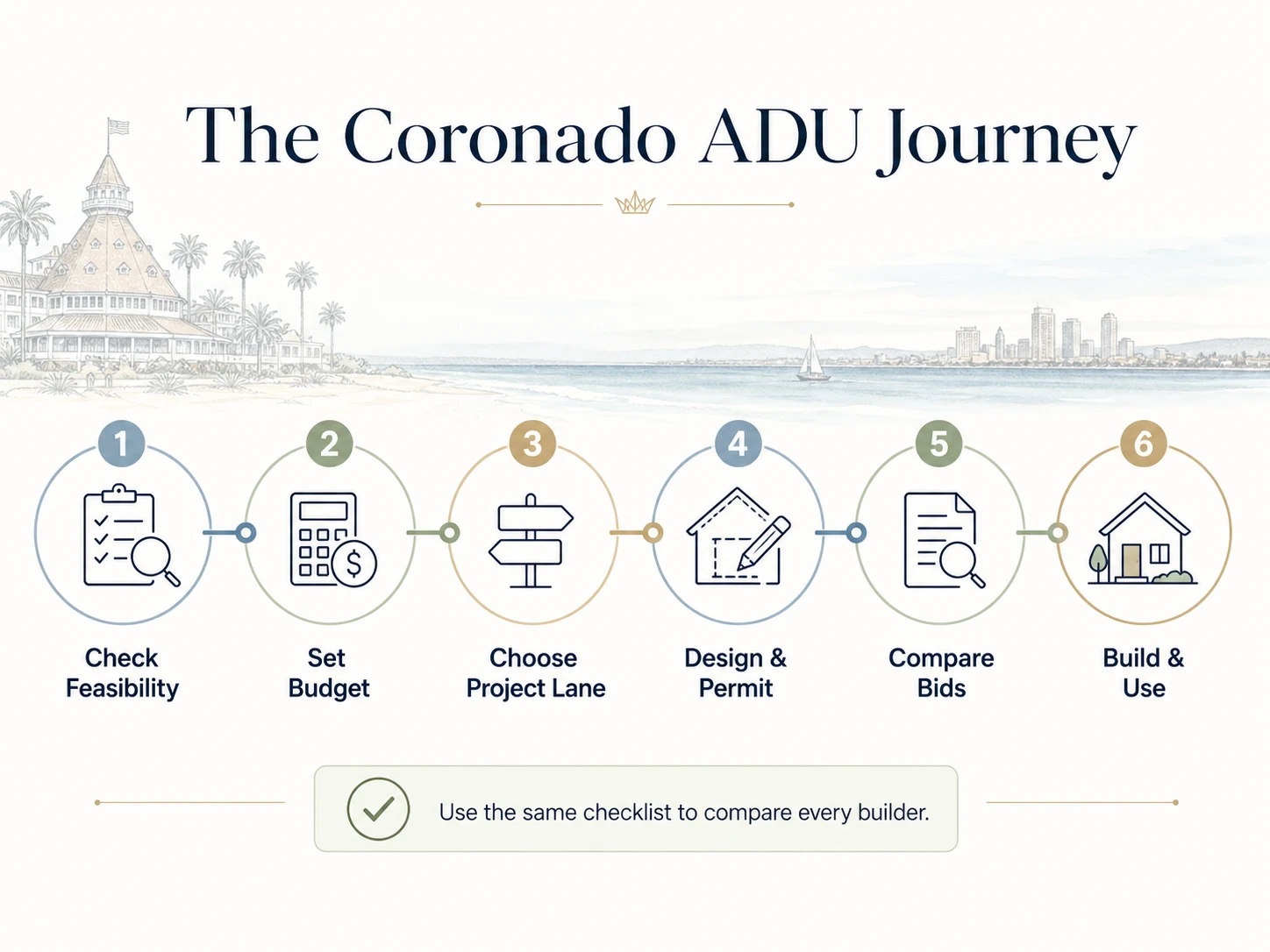
California Government Code § 66317 requires Coronado to determine ADU/JADU application completeness within 15 business days and to ministerially approve or deny a complete application within 60 days of receipt. In practice, your overall design + permit + construction runtime is closer to 8 to 14 months from first call to certificate of occupancy because design and engineering (1 to 3 months), permit submittal preparation, plan-check correction cycles, and construction (4 to 6 months for new build, 2 to 4 months for conversions) sit on either side of the statutory clock.
Coronado's small Community Development Department is generally fast for clean submittals. The longest delays we observed in public records (412 days at 4 Buccaneer Way, 240 days at 1425 7th St) involved either bundled scope or apparent correction cycles — both applicant-side variables, not city sluggishness.
The phases, broken down
- 1
Feasibility & site analysis (1–4 weeks)
Verify lot eligibility, setbacks, utilities, overlay zones (Coastal Bluff, Beach Overlay), historic considerations, HOA review if applicable. Run the §66323 unit-type analysis if a state-law override matters for your project.
- 2
Design & engineering (4–10 weeks)
Schematic design, then construction drawings, structural engineering, Title 24 (California's energy efficiency code) compliance, site plan, soils report if required, and any additional documentation Coronado plan-check may request.
- 3
Plan submittal
Coronado has historically required in-person submittal at City Hall, 1825 Strand Way. Verify the current process before submittal — many San Diego County jurisdictions have moved to digital, and Coronado may follow.
- 4
City completeness review (15 business days statutory)
The City has 15 business days under Gov. Code § 66317 to determine whether your application is complete. State law's 60-day clock for ministerial approval or denial begins from the complete-application date, not the initial submittal date.
- 5
Plan-check corrections (2–6 weeks)
Most clean submittals clear in one or two correction cycles. Builders fluent in Coronado-specific design standards (the Coastal Act parking clause, the carriage-house standards if applicable, the §66323 documentation if invoking a state-law override) clear faster.
- 6
Permit issuance
Pay fees (plan check, building permit, school fees if applicable, sewer/water connection); receive permits.
- 7
Construction (4–6 months for new detached; 2–4 months for garage conversion or JADU)
Multiple inspections at framing, MEP rough-in, insulation, drywall, and final. Certificate of occupancy at final inspection.
Where Coronado projects actually get stuck
- Incomplete drawings on first submittal. Missing structural calcs, missing Title 24 compliance documentation, missing site plan dimensions. Generates a correction cycle that adds 4–8 weeks.
- Owner-driven design changes after submittal. Each change resets some portion of plan-check.
- Utility distance miscalculation. Surprise trenching for sewer or water laterals is the most common cost-and-schedule overrun on Coronado conversions.
- Coastal overlay surprises. Bluff or Beach Overlay constraints not caught in feasibility surface during plan-check.
- HOA review in Coronado Cays or covenanted neighborhoods running parallel to city plan-check, sometimes contradicting it.
A good builder front-loads all of these in feasibility and design. A bad builder discovers them during plan-check.
Renting your Coronado ADU & the property tax math
Can I rent for 30 days vs. six months?
Coronado's local code (CMC §86.56.105.B.10) sets a 6-month minimum rental term and prohibits short-term/vacation rentals. Per HCD Finding #11 in the December 10, 2025 letter, the 6-month minimum is contradicted by state law — the lawful floor under Government Code §§ 66315 and 66323(e) is 30 days, not 6 months. Short-term and vacation rentals (under 30 days) remain prohibited. Until the City formally amends its ordinance or HCD publicly accepts the City's January 2026 response, treat 30 days as the operative state-law minimum and confirm with Coronado plan-check or a California land-use attorney before relying on it for a specific project.
Realistic Coronado rental expectations
Coronado is ZIP code 92118. Median rents in 92118 run substantially above San Diego County medians because of location, school district, and beach access.
| Unit type | Approximate long-term monthly rent | Source / verification status |
|---|---|---|
| 1-bedroom ADU | ~$3,500–$3,900 | SnapADU's Coronado regulations page cites Rentometer data for 92118 (March 2026); verify directly at Rentometer or HotPads at time of underwriting |
| 2-bedroom ADU | ~$4,100–$4,600 | Same source; verify directly |
| 3-bedroom (rare in ADU sizing) | ~$5,000–$5,500 | Same source; verify directly |
The Proposition 13 reassessment math, in plain English
Under California Proposition 13 (Cal. Const. Art. XIIIA) and the State Board of Equalization's new construction rules (boe.ca.gov/proptaxes/newconstructionproperty.htm), property is assessed at its purchase price, with annual increases capped at 2%. New construction triggers a partial reassessment — only the new construction portion is reassessed at current value. Your existing home retains its base-year value.
For a Coronado ADU build at $400,000 of new construction value, illustrative property tax math:
- Roughly $4,000–$5,000 per year in additional property taxes (≈1.0–1.25% of construction value, including local bonds and assessments — verify the current Coronado-specific rate with the San Diego County Assessor).
- The reassessment is a one-time event tied to the ADU's certificate of occupancy.
- The existing home's base-year value is not affected.
This is meaningful but not catastrophic. We are not tax professionals; verify with a CPA or the San Diego County Assessor's office before relying on these numbers for underwriting.
If you plan to rent the unit long-term
- Coronado rentals lease quickly to qualified tenants, but vacancy still runs 4–8% on small unit counts.
- Maintenance and capital reserves typically run 1–2% of replacement cost annually.
- Insurance for a property with an ADU rental unit will increase. Get a binding quote before closing.
- Rental income is taxable; passive-activity loss rules may limit deductions depending on your situation.
If you plan to manage the unit yourself, a property-management software platform like Buildium can simplify lease management, rent collection, maintenance ticketing, and accounting. Buildium is national and serves Coronado landlords.
Paying for your Coronado ADU
Most Coronado ADU homeowners self-finance through home equity — either a HELOC (home equity line of credit), a cash-out refinance, or a renovation loan. Coronado's high property values mean most owners have substantial equity to draw against; pure construction loans are less common. Less common pathways include FHA 203(k) renovation loans (subject to program rules), specialized ADU renovation loans, and FHA One-Time Close construction loans for buyers purchasing a property with the intent to add an ADU.
We don't rank lenders. We explain the lanes.
Financing lanes by Coronado project size
| Project size | Typical financing fit | Why |
|---|---|---|
| JADU $90k–$165k | Cash, HELOC, or unsecured renovation loan | Smaller scope; shorter draw period; HELOC's revolving structure fits well |
| Garage conversion $180k–$280k | HELOC or cash-out refinance | Mid-range; equity-secured products typically more cost-effective than unsecured |
| Detached new build $300k–$650k+ | HELOC, cash-out refinance, construction-to-permanent loan, or renovation loan | Larger draw schedule; construction-to-permanent or renovation loan can underwrite against after-renovation value |
| Multi-family ADU portfolio (SB 1211) | Construction loan; possibly commercial financing | Multi-unit context; commercial underwriting may apply |
The financing lanes, explained
Cash-out refinance
Replace your existing mortgage with a larger one and take the difference in cash. Best when current mortgage rates are at or below your existing rate. Resets the loan term.
HELOC (home equity line of credit)
A revolving credit line secured against your home equity. Variable rate. Flexible draws — useful for ADU builds where draws happen over months. Does not reset your existing mortgage.
Construction loan
Short-term loan funding the construction directly, often converted to a permanent mortgage at completion (a 'construction-to-permanent' or 'single-close' loan). Requires builder approval and a draw schedule.
Renovation loan / after-renovation HELOC
Underwrites against the after-renovation value of the property, not the current value. Useful when current equity is limited. Verify program-specific terms, state availability, and underwriting rules directly with the lender.
FHA 203(k) Standard
Government-backed renovation loan that can fund ADU construction. Lower down payment but tight property and contractor requirements. Verify program terms with HUD or an FHA-approved lender.
FHA One-Time Close construction loan
For homebuyers purchasing a property with the intent to construct (or add) a unit at closing. The loan funds purchase + construction in one closing. Verify down-payment and program rules directly with HUD or an FHA-approved lender.
Cash + sequential builds
Especially common in Coronado given owner equity and demographics.
What to compare across financing options
- Interest rate (or rate range; rates are not guaranteed by any lender)
- Loan term and amortization
- Closing costs and origination fees
- Whether the loan funds at draw or as a single advance
- Whether the loan is variable or fixed
- Underwriting standard (DTI, credit score, equity position)
- Whether the loan requires a specific builder, a fixed contract, or detailed plans
We don't quote specific rates because rates change daily. Verify current terms directly with the lender. Loan availability, rates, and terms vary by lender and are subject to change.
For more depth on each path, see the Dwelling Index ADU financing options guide and HELOC for ADU guide.
The 14-question checklist before you sign with any Coronado ADU builder
Most ADU projects that go sideways do so because one or two contractual or scope items weren't pinned down on paper before the deposit. The 14 questions below surface most of the failure modes — before they cost you.
Verify the CSLB license.
Pull the Contractors State License Board record at cslb.ca.gov. Confirm the license number is active, in good standing, and includes the appropriate classification (B for general building; C-9 for drywall; etc.). Verify the company name on the license matches the company name on the contract. Look for any complaint history.
Demand two completed Coronado projects with addresses.
Coronado public permit records will confirm the builder actually submitted and saw the project through to issue. Drive by the addresses if you can; ask the homeowners about their experience.
Get a written cost breakdown by scope.
Sitework / foundation / framing & vertical / MEP (mechanical, electrical, plumbing) / finishes / soft costs (design, plan check, permits, inspections). A single lump-sum bid hides the cost of every change.
Confirm the contract type.
Fixed-price, cost-plus, or T&M (time and materials)? What triggers a change order, and how is the change-order price calculated? California Civil Code requires a written change-order process for any change to a home improvement contract.
Ask which §66323 unit type they're proposing — and why.
If the answer is a blank stare or 'I don't really know about that,' you're looking at a builder who designs to plain-text Coronado code without invoking state-law overrides where they apply. That can cost you size, height, or rental flexibility.
Pin down the “matching architecture” finish budget in writing.
Coronado's local code says ADUs must use the same architectural style, exterior materials, and colors as the primary dwelling, with materials of equal or greater quality. HCD Finding #20 found this standard subjective and unenforceable. The resale and neighbor-aesthetics pressure to meet it is real. Confirm the finish allowances on your bid match what plan-check is likely to pass and what your neighborhood expects.
Ask how they handle a plan-check correction citing a non-compliant Coronado rule.
'If plan-check tells us we can only build 850 sq ft on this lot but state law allows 1,000 because we're proposing a §66323(a)(3) conversion, what do you do?' The answer should be a confident process, not improvisation.
Confirm the deposit complies with California law.
Per CSLB consumer guidance and Business and Professions Code, a contractor cannot require a down payment greater than $1,000 or 10% of the contract price, whichever is less. Don't sign anything that violates this — it's a flag for both compliance and cash-flow stability.
Read the contract — change-order clause, warranty, dispute-resolution language — before any deposit.
Especially: how are change orders priced (fixed markup or cost-plus)? What's the warranty period for structure vs. systems vs. finishes? What's the dispute mechanism (mediation, arbitration, litigation)? Is the right to a mechanic's lien preserved or waived?
Confirm general liability and workers' compensation insurance.
Get a current Certificate of Insurance from the carrier directly, not from the contractor. Verify the policy is active and the coverage limits are appropriate (typically $1M general liability, $1M aggregate). Workers' comp is required by California law for any contractor with employees.
Ask about subcontractor backup.
Who's the foundation sub? Who's the electrician? What happens if a key sub is unavailable for 6 weeks? In a tight Coronado labor market, a subcontractor delay can cost more than the line-item itself.
Confirm site-access logistics.
Where will the dumpster sit? Where will materials stage? How will trucks reach the alley? Does Coronado require a temporary right-of-way permit for equipment, dumpsters, or cranes occupying public space? Who pays for it?
Get the permit-runner's name.
Who physically interfaces with Coronado plan-check? Is it the principal, a project manager, or a third-party permit expediter? Permit-running is a relationship business; familiarity with Coronado plan-check staff matters.
Confirm the start date is conditional on permit issuance.
Not the contract signature date. Not the deposit date. Permit issuance. This protects you from a builder who cashes the deposit and then delays construction during plan-check.
Free Download
▶ Download the Free Coronado ADU Starter Kit
Includes the 14-question builder checklist, the bid-comparison worksheet, the Coronado rules cheat sheet, and the Coronado ADU Permit Snapshot dataset for your reference.
Bid red flags that should make you walk away
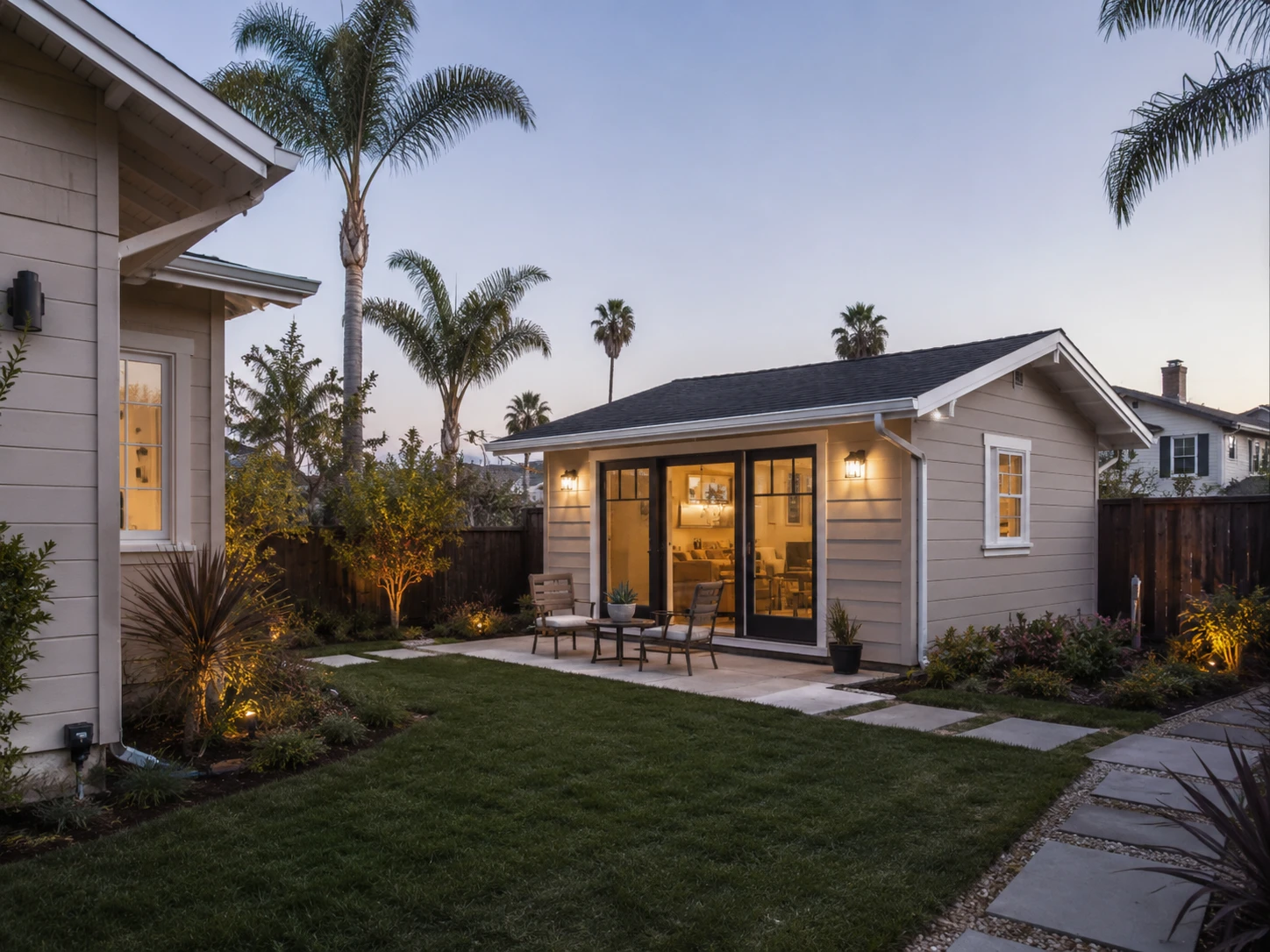
The riskiest Coronado ADU bid is not always the highest. It is the bid that omits the assumptions that actually drive the cost — utility upgrades, foundation type, trenching distance, permit-correction allowance, site access, finish allowances, and change-order pricing. A bid without exclusions is a bid that will surprise you.
| Red flag | What it tells you | What to do |
|---|---|---|
| No CSLB license number on the proposal | Cannot verify license, complaint history, or insurance coverage | Walk. Don't even meet again. |
| Down payment >$1,000 or 10%, whichever is less | Violates CSLB and Business & Professions Code | Walk. This is a compliance issue, not a negotiation. |
| "All-in" price with no exclusions | Cost overruns are coming through change orders | Demand a written exclusions list before any deposit |
| No written change-order process | Budget will drift without paper trail | Require a contractually-specified change-order process |
| No Coronado-specific questions during the site visit | Generic ADU experience; Coronado constraints not yet considered | Ask for two Coronado portfolio projects |
| Pushes prefab unit price as turnkey project price | Misrepresents installed cost | Demand fully-loaded comparison including sitework, foundation, utility, permits |
| Promises specific rental income, ROI, or financing approval | Cannot lawfully be guaranteed | Treat as a compliance flag — this builder may overpromise on construction too |
| "Don't worry about the permit, we'll figure it out" | Either uninformed or planning to skip permits | Walk. Coronado's small department remembers builders who skip permits. |
| Refuses to provide a Certificate of Insurance from the carrier | Insurance may be lapsed or non-existent | Walk. |
| Significantly lower than the next-highest bid with same scope | Either understated scope or financial distress | Compare line-item exclusions; if exclusions match, ask why the bid is lower |
If any of these surface, it's almost always cheaper to find another builder than to sign and hope.
Your four-step plan if you're ready to build an ADU in Coronado
Before calling five builders, do four things in order: confirm feasibility on your specific lot, identify your project lane, verify the rules that affect your design, and use a single bid checklist so every contractor prices the same scope. Doing these four things in this order saves more than money — it saves you from the wrong builder lane entirely.
Step 1: Run a feasibility check.
Confirm what's buildable on your lot under both Coronado code and state-law overrides. Check for overlay zones (Coastal Bluff, Beach Overlay, Coronado Cays Specific Plan), historic designations, HOA covenants, utility distances, the ½-mile ferry-terminal radius for height unlocks, and §66323 unit-type pathways. The 2-minute feasibility report does this against your address.
Step 2: Identify your project lane.
Garage conversion, JADU, small detached, large detached, multi-family, prefab, or carriage house. Use the project-type matching matrix above. Each lane has different builder requirements.
Step 3: Verify the rules that affect your design.
Read the Coronado ADU State-Law Override Map above. If your project relies on a state-law override (height unlock near the ferry terminal; size cap exception for a §66323 unit type; elimination of replacement parking on a garage conversion; reduced JADU owner-occupancy under AB 1154), document the relevant Government Code sections in writing before any builder begins design.
Step 4: Use one bid checklist for apples-to-apples comparison.
Get itemized written bids from at least three builders in the right lane. Same scope, same exclusions, same finish allowances, same change-order process. Compare line-item by line-item. The free Starter Kit includes the worksheet.
Frequently asked questions
How many ADUs can I build on my single-family lot in Coronado?
Up to one detached ADU plus one JADU (junior accessory dwelling unit, ≤500 sq ft within the existing home). Per HCD's ADU Handbook (updated March 2026 with December 2025 addendum), you may also have a single-family converted ADU (interior conversion of existing space within the primary home), so the practical maximum on a single-family lot is three units total: detached ADU + converted ADU + JADU. Source: Coronado Municipal Code §86.56.105.C and HCD ADU Handbook.
Do I need a Coastal Development Permit (CDP)?
For most code-compliant ADUs, no separate CDP hearing is required. Coastal review is processed concurrently with the building permit and without a public hearing under California Government Code § 66329(a) and HCD Finding #31. Coronado's Planning Fee Schedule (effective July 1, 2024) does list coastal-related fees ($1,434 for a Coastal Permit with other Permits; $849 for a Coastal Permit Exemption); verify whether either fee applies to your specific project. Properties in the Coastal Bluff Overlay Zone or seaward of the first public roadway in the Beach Overlay Zone face additional setback requirements and may face elevated coordination, but generally do not require a separate public CDP hearing.
Will my property taxes go up?
Yes, but only the new ADU construction is reassessed under California Proposition 13 (per the State Board of Equalization's new construction rules at boe.ca.gov/proptaxes/newconstructionproperty.htm). The existing home retains its base-year value. Plan on roughly 1.0–1.25% of the ADU's construction value annually as additional property tax — for a $400,000 build, illustratively about $4,000–$5,000 per year. Verify the current Coronado-specific rate with the San Diego County Assessor.
Is Coronado's 850/1,000 sq ft cap really enforceable?
For some §66323 ADU types, yes. For three of the four §66323 types — single-family conversion ADU (§66323(a)(1)), multi-family conversion ADU (§66323(a)(3)), and ADUs detached from a multi-family dwelling (§66323(a)(4)) — HCD found the cap unenforceable in its December 10, 2025 letter (Finding #9). If your project qualifies under one of those §66323 categories, state law allows you to exceed Coronado's local 850/1,000 cap.
How tall can my Coronado ADU be?
Coronado's local code says 16 feet for new detached ADUs. State law allows 18 feet within ½ mile of a major transit stop, plus an additional 2 feet (20 feet total) when matching the primary dwelling's roof pitch. HCD explicitly cited the Coronado ferry terminal as a major transit stop under Public Resources Code § 21155(b), unlocking the higher limit for parcels within ½ mile of the ferry — which covers a substantial portion of The Village, Bayside, and Ferry Landing. Attached ADUs follow the primary dwelling's height limit and may be two stories.
Can I rent my Coronado ADU short-term?
No. Both Coronado's local code (which sets a 6-month minimum, contradicted by state law per HCD Finding #11) and California state law prohibit rentals under 30 days for ADUs and JADUs. Short-term/vacation rentals (Airbnb, VRBO under 30 days) are not permitted. The state-law floor is 30 days; Coronado's 6-month rule is contradicted by state law.
How long does the whole project take?
Realistically 8 to 14 months from first call to certificate of occupancy: 1 to 3 months for feasibility and design, 2 to 4 months for permitting (the city has 15 business days for completeness review and a 60-day ministerial clock from complete-application date), and 4 to 6 months for construction on a typical detached new build. Garage conversions and JADUs often run shorter on the construction end (2 to 4 months) but require careful permit-history verification on the front end.
Do I need owner-occupancy?
Not for ADUs. AB 976 (2023, effective January 1, 2024) made permanent the prohibition on owner-occupancy requirements for ADUs. For JADUs, AB 1154 (effective January 1, 2026) limits the owner-occupancy requirement to JADUs that share sanitation facilities with the main house. Owner-occupancy is never required when the owner is a government agency, land trust, or housing organization. If your JADU has its own bathroom, no owner-occupancy rule applies.
What happens if Coronado plan-check denies my application citing a rule HCD found non-compliant?
California HCD operates a Housing Accountability Unit and can intervene when local agencies enforce ordinances HCD has formally found non-compliant. Document the relevant Government Code citation in writing, request a formal denial letter from Coronado, and contact HCD's Housing Accountability Unit. This is information, not legal advice — consult a California land-use attorney if your project hinges on a state-law override.
Can I convert my garage into an ADU in Coronado?
Yes, in most cases. Coronado's code recognizes conversions of accessory structures (including detached and attached garages) as a valid ADU type. State law generally prohibits Coronado from requiring replacement parking when a garage is converted to an ADU, though the Coastal Act savings clause may preserve some authority — verify with plan-check for your specific lot. Existing garage permit history must be in order; unpermitted modifications may require correction before the ADU permit issues.
Are prefab ADUs allowed in Coronado?
Yes. Prefab and modular ADUs are permitted as long as they meet all applicable state, local, building-code, site-access, foundation, and utility requirements. The constraints are practical, not regulatory: Coronado's narrow grid streets and single-bridge access make crane staging non-trivial. Compare fully-loaded installed costs (factory unit + transportation + crane + foundation + utilities + permits + finishes), not factory-only quotes.
Are there Coronado-specific ADU grants?
The CalHFA ADU Grant Program is the most commonly referenced California ADU grant; verify current funding and eligibility status at calhfa.ca.gov before relying on it for a specific project, as program funding has paused in past cycles. Confirm income eligibility against the published program rules at the time of application; do not plan a Coronado ADU around grant funding unless a current program is open and you meet the published rules.
Who reviews ADU applications in Coronado?
The Coronado Community Development Department, located at City Hall, 1825 Strand Way. Building Services counter hours and permit-application hours are listed on coronado.ca.gov; verify current hours before visiting. The Director of Community Development has the ministerial approval authority for code-compliant ADUs.
What school district applies for Coronado ADU statutory school fees?
Coronado is served by Coronado Unified School District (CUSD), not San Diego Unified. CUSD's notice dated March 17, 2025 lists statutory school fees at $5.17 per square foot of assessable space for new residential construction. Verify how the fee is applied to your specific project with the City and CUSD; state ADU law treats certain ADU/JADU configurations differently for assessable-space purposes under Education Code § 17620.
Methodology
We compiled this guide by reading Coronado Municipal Code §86.56.105 (current through Ordinance 2025-11) against the California HCD's December 10, 2025 ordinance-review letter and the post-SB 477 renumbered Government Code (§§ 66310–66342). We extracted ADU-related rows from the City of Coronado Building Services issued-permit PDFs spanning January 2025 through February 2026 and computed application-to-issue spans from the public dates. We pulled cost ranges from publicly published builder pricing (SnapADU, Better Place Design & Build, USModular Home Builders) and the California Construction Cost Index through December 2025. We verified SnapADU's CSLB license at cslb.ca.gov; verification for the remaining named builders is in progress. We pulled verified fee data from the Coronado Planning Fee Schedule (effective July 1, 2024) and the Coronado Unified School District statutory school-fee notice dated March 17, 2025.
We did not pay any builder for inclusion. SnapADU is a Dwelling Index affiliate partner; that affiliation does not affect their position in our comparison or our editorial conclusions. Where we could not verify a specific number from a primary source, we said so.
We are not lawyers, lenders, or builders. This page is independent research, not legal, financial, or construction advice. Where state-law overrides apply, consult a California land-use attorney before relying on them in a permit submittal. Where financing decisions are involved, consult a licensed lender directly.
We will re-verify the HCD ordinance-review status, all cost ranges, and partner service areas at least quarterly and update the “Last verified” stamp at the top of this guide accordingly.
About this guide
Who wrote this: the Dwelling Index editorial team. Our editorial team page lists current editors and our process. We do not invent expert reviewers, license credentials, or first-party projects we don't have.
How we keep it current: see our methodology and corrections policy. Quarterly re-verification on regulatory and cost data; monthly verification on partner status and service areas.
Who we are: Dwelling Index is an independent research resource covering ADU financing, costs, and regulations. We are not a lender, broker, or builder. Our revenue comes from clearly disclosed affiliate relationships with a vetted set of partners; editorial judgments are not influenced by compensation. See our partner vetting policy for the standard.
Final word
Coronado is one of the most distinctive ADU markets in California — a small affluent peninsula city, entirely within the Coastal Zone, with stricter local rules than the surrounding county and a December 2025 HCD letter that quietly rebalanced what's actually buildable. The right builder for your project is the one whose lane matches your scope and whose plan-check submittals cite Government Code sections, not just city handouts. The wrong builder is the one selling on price alone in a market where price alone almost always means scope holes.
Match the lane. Verify the rules. Ask the 14 questions. Get itemized bids. Don't rush the deposit. The city will be here next month; the wrong contract will outlive every relationship in your project.
Free Tool
Not sure where to start? See what's possible at your address.
Get your free Coronado ADU report in 60 seconds.