
SnapADU vs Maxable (2026): One Builds, One Matches — How to Pick
They aren't the same kind of company. SnapADU is a design-build contractor. Maxable is a matching service. We verified what each really costs and where they don't fit — so you know which is yours before you call anyone.
By the Dwelling Index Editorial Team · Updated May 7, 2026 · Last verified: May 7, 2026 · 35 min read
Free property report · ~60 seconds · No commitment
SnapADU vs Maxable: the answer in 30 seconds
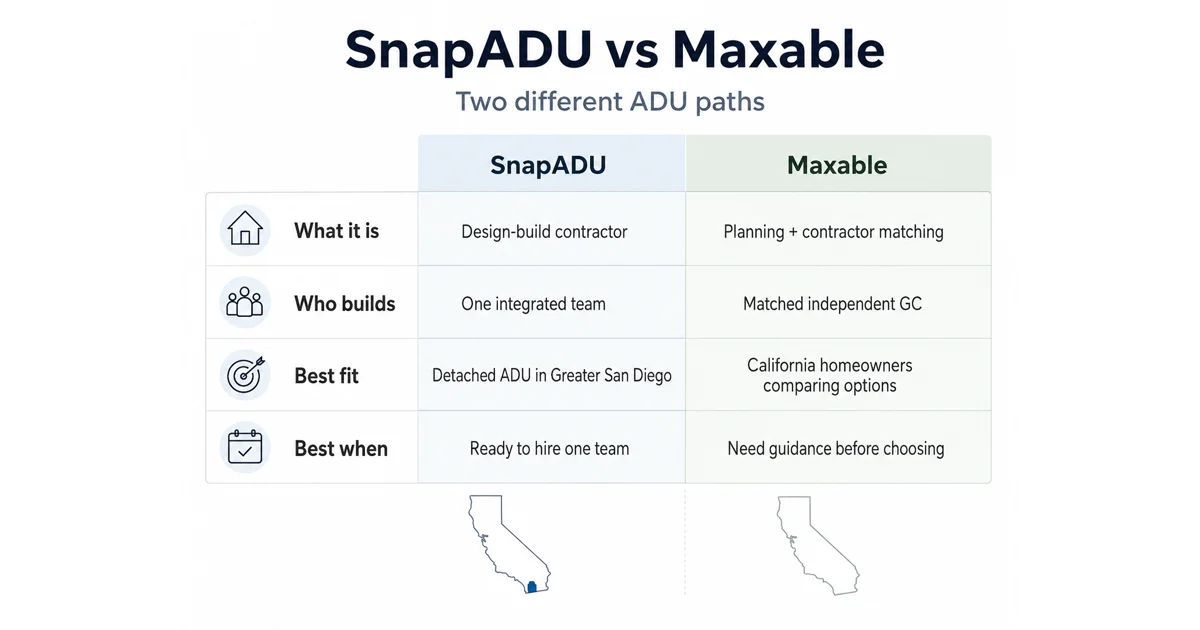
Bottom line on SnapADU vs Maxable: they aren't the same kind of company. SnapADU is a design-build general contractor that designs, permits, and constructs ADUs end-to-end — and only in Greater San Diego County. Maxable is a California-focused marketplace and concierge service that doesn't build anything itself; it educates you, evaluates your lot, and matches you with vetted local designers, contractors, and lenders.
If you own in Greater San Diego County and you're ready to build a stick-built detached ADU, SnapADU is a legitimate direct call — typical complete-project budgets run $300,000–$450,000+ at $375–$600+ per square foot.¹ If you're elsewhere in California and earlier in the process, Maxable's concierge ($299 for “Maxable Pro” as a limited-time offer at the time of writing²) can compress weeks of vetting into a 60-minute call. If you're outside California, SnapADU's official service area doesn't cover you and Maxable's matching network isn't marketed as available.
| SnapADU | Maxable | |
|---|---|---|
| What it is | Design-build general contractor (builds in-house) | Marketplace + consultant (matches you with separate firms) |
| Where it works | Greater San Diego County, CA only¹ | California-focused; expert help marked CA-only² |
| Entry point | Free initial consultation | Free Planning Call; Maxable Pro currently $299² |
| Who actually builds | SnapADU's in-house team | A separate matched general contractor |
¹ snapadu.com/adu-costs/ and /service-area/, verified May 7, 2026. ² maxablespace.com/maxable-pro/, verified May 7, 2026.
🟢 See What You Can Build → Get Your Free ADU Report
Run your address through our Feasibility Engine and get a personalized buildable-area, setback, and zoning summary in about 60 seconds — before you call any builder. No phone number required.
Check My Property →What we verified for this comparison
| Source category | What we checked |
|---|---|
| SnapADU primary sources | snapadu.com homepage, About, FAQ, Service Area, Process, Cost guide (updated March 2026), Warranty page, Plans, Projects, BBB profile, BuildZoom permit history |
| Maxable primary sources | maxablespace.com homepage, About, Maxable Pro page, How It Works, case studies; Hollywood Times feature on Maxable's leadership and business model |
| California ADU law | California Government Code §66311.5 (impact and utility fees), §66317 (60-day ministerial approval), §66321 (size limits and setback floor), §66323 (state-mandatory ADU categories); SB 543, AB 462, AB 1154, SB 9 (signed October 2025); HCD ADU Handbook |
| Contractor compliance | California Business & Professions Code §7159.5 (contractor home-improvement contract rules) and the Contractors State License Board (CSLB) |
| Funding programs | CalHFA ADU Grant Program status, San Diego Housing Commission ADU Finance Program |
Why this comparison confuses almost everyone
If you've spent any time researching ADUs in California, both names show up — and they show up in different contexts. SnapADU appears in San Diego ADU builder lists, in city-specific permit articles, and on Houzz portfolios. Maxable appears in cost-of-an-ADU explainers, in California ADU-law content, and as the host of a free Planning Call.
That's because they occupy different rungs of the ADU project stack. SnapADU is a vertically integrated builder — they hold the construction contract and put hammers in the ground. Maxable is a horizontal facilitator — they help you decide what to build and who to hire, then step back when the construction contract is signed with somebody else.
Comparing them as if they're two builders bidding on the same job is like comparing a car dealership to a car-buying service. Both useful. Different category.
The visible exact-match competitor page on this query misses this distinction entirely. It frames both companies as direct alternatives serving Sacramento — even though SnapADU's official service-area page lists only San Diego County jurisdictions. That kind of factual conflict is exactly why this page exists, and we'll come back to the specifics later.
What is SnapADU? (And does SnapADU build outside San Diego?)
SnapADU is a design-build general contractor focused exclusively on accessory dwelling units in Greater San Diego County. It handles design, permitting, and construction in-house under an integrated process, builds with traditional stick-frame (wood-framed) construction, and does not work outside its San Diego service area. The official service-area page lists only San Diego County jurisdictions — if you're elsewhere, SnapADU isn't your builder.
Who they are
- Refocused exclusively on ADUs in 2020 after years in custom homebuilding and renovation work.
- Co-founder Whitney Hill leads operations and runs the company's educational webinars.
- Woman-owned; BBB-accredited with an A+ rating; CSLB License #1075582 (verify current status on the CSLB License Lookup before contracting).
- 100+ completed ADU projects as of the company's About page in early 2026.
- Selected by the City of Chula Vista and the City of San Marcos to design pre-approved ADU plans, which are also accepted in the City of San Diego.
What SnapADU actually delivers
A SnapADU engagement covers feasibility through construction under one accountable team. The published process page shows distinct pre-construction line items before build-out — meaning the all-in budget rolls up multiple deliverables you can see priced individually:
- Feasibility Study ($1,325–$2,375 published) and property reports ($5,525+) confirm what your lot will support before design begins.
- Construction documents ($2,300–$8,500) depending on whether you use a standard plan, semi-custom, or full custom — and permitting/revisions ($2,000+) carry you through plan check.
- Architectural design and engineering are handled in-house using either standard plans, semi-custom modifications, or full-custom designs.
- Construction is performed by SnapADU's own team — stick-built, traditional wood frame, on-site. Not modular, not panelized, not prefab.
- Six-month price-lock guarantee on the build cost once the proposal is signed.
- Warranty package through 2-10 Home Buyers Warranty: 1-year workmanship, 2-year distribution systems (electrical, plumbing, HVAC), and 10-year structural. SnapADU directly handles workmanship and distribution-systems claims for the first two years; after year two, the 10-year structural warranty is administered and insurance-backed by 2-10 Home Buyers Warranty as an independent third party.
Where SnapADU actually works — verified service area
SnapADU's official service-area page lists the following San Diego County jurisdictions:
Carlsbad, Chula Vista, Coronado, County of San Diego (unincorporated), Del Mar, El Cajon, Encinitas, Escondido, Imperial Beach, La Mesa, Lemon Grove, National City, Oceanside, Poway, San Diego, San Marcos, Santee, Solana Beach, and Vista.
What SnapADU actually costs
Figures pulled directly from snapadu.com/adu-costs/, last updated by SnapADU in March 2026:
| Project size | Approximate complete-project cost |
|---|---|
| 500 sq ft | ~$300,000 |
| 750 sq ft | ~$350,000 |
| 1,000 sq ft | ~$425,000 |
| 1,200 sq ft | ~$450,000+ |
- Per-square-foot range: $375–$600+ per sq ft for a turnkey detached ADU, depending on size, finishes, and site conditions.
- What's typically inside that number: design, engineering, permits, sitework, utilities, vertical construction, finishes, mobilization.
- What you should still ask about: for unusual lots or complex permitting, a portion of the pre-construction cost may be quoted separately. Always confirm scope inclusions in writing.
Source: snapadu.com/adu-costs/, updated March 2026.
What homeowners actually report
SnapADU's published homeowner interview with Susan, a Vista CA homeowner, captures the texture better than a cherry-picked five-star quote. She described the team as nice and great to work with, singled out a superintendent named Sean for strong customer service, and called out a real frustration too: she wanted more proactive communication during inevitable mid-project schedule changes. Source: SnapADU homeowner interview.
Independent third-party data: BuildZoom's permit-history database displays 72 SnapADU projects across San Diego County over its three displayed years (33 in 2023, 23 in 2024, 16 in 2025), with a typical permit value around $147,385 — that figure captures the construction line submitted to the city, not the all-in turnkey cost. BBB lists SnapADU as accredited with an A+ rating.
How long does SnapADU take?
SnapADU's published process page describes 10–18 months for the full design/permit/build cycle (roughly 3–4 months for design, 3–6 months for permitting, and 6–9 months for build). SnapADU's FAQ separately states that 8–12 months is typical from a signed proposal to move-in — which excludes the early-stage feasibility and design-development time. Both figures are accurate; they measure different windows. When comparing timelines with any builder, ask which window the quote covers.
The honest dealbreaker — said plainly
The trade-off SnapADU's site doesn't lead with: a single design-build contract is more expensive on paper than separately hiring a designer (typically $7,500–$15,000 for ADU construction documents) and then a general contractor. What you're paying the premium for is one phone number when something goes wrong. On a stick-built job, problems happen — a city correction, a soil issue, a slow utility connection — and a fragmented project can leave you triangulating between three separate contracts.
For most homeowners building their first ADU, that consolidation is worth it. For homeowners who already have a trusted designer or genuinely want to manage their own subcontractors, it isn't. That's the trade-off — not whether SnapADU is “good.”
What is Maxable? (Does Maxable build ADUs?)
Maxable does not build ADUs. Maxable is a California-focused ADU marketplace and concierge service. It does not design, permit, or construct anything itself. What it sells is the upfront work of figuring out what your lot can support, then introducing you to vetted designers, general contractors, and lenders in its network. The free entry-point is a Planning Call. The paid product is “Maxable Pro,” priced at $299 as a limited-time offer at the time of writing per maxablespace.com/maxable-pro/.
Who they are
- Founded by Caitlin Bigelow, who grew up with a converted granny flat on her family's East San Diego County property.
- Now co-owned and run as Co-CEOs by Paul Dashevsky and Jon Grishpul, who also co-founded the contractor-marketplace platform GreatBuildz. (Hollywood Times feature, September 2025.)
- Self-described as “California's leading ADU marketplace” / “California's Leading ADU Educators.”
- Core team is content/educators plus ADU consultants — there are no construction crews on staff.
- Has supported between 300 and 500+ homeowner projects depending on which Maxable page you read; their Maxable Pro page cites 500+ projects directly supported, while broader profile language has used 300+. These are supported/planned homeowner-project counts, not completed builds by Maxable itself.
- Public stated mission: add 1 million ADUs to the U.S. housing supply by 2030.
What you get for the free Planning Call
A scheduled phone consultation, a discussion of your goals and your lot's potential, education on ADU types and California rules, and a soft hand-off into Maxable Pro if you want deeper help.
What “Maxable Pro” actually buys you
Verified from their public Pro page on May 7, 2026:
- 60-minute virtual site evaluation and budget planning session
- A site report covering zoning, setbacks, parking, size limits, and utility access for your specific lot
- Curated referrals to vetted local architects, contractors, and lenders
- Sample ADU floor plans and layouts
- Access to the “ADU Blueprint” e-course (~6 hours of content)
- Construction bid guidance, assessment, and review when bids come in
- Email and phone support through the project, “from planning to punchlist”
Where Maxable actually works
Maxable's expert-help CTA is marked California-only on their published pages, and their educational content covers multiple California metros (Los Angeles, San Diego, San Francisco Bay Area, Burbank, Anaheim, Irvine, Altadena, and others). Outside California, their educational content remains useful, but their network of vetted designers and contractors is not marketed as available, and you should not pay for Maxable Pro expecting matched introductions in non-California markets.
If you're in California but in a thinly served area (Central Valley away from Sacramento, far-north counties, rural inland), ask on the free Planning Call whether Maxable currently has multiple vetted GCs in your specific ZIP before paying for Maxable Pro.
What homeowners actually report
Maxable's case studies are published with attribution on their site. Penny & Richard C., Sarah & Bill A., and Denny P. each describe the same value proposition: they didn't want to do the homework themselves, and Maxable's consultants handled the matching of designer, GC, and lender. One client (Penny & Richard C.) said the scale of the homework felt overwhelming and they were relieved to hand it off — a useful description of who the service serves well. Source: maxablespace.com/maxable-pro/, retrieved May 2026.
Independent third-party reviews of Maxable specifically are sparse — partly because Maxable isn't a contractor, so post-project reviews tend to attach to whichever designer or builder Maxable matched, not to Maxable itself.
The honest dealbreaker — said plainly
The trade-off Maxable's site doesn't lead with: most of Maxable Pro's deliverables are replicable yourself in 6–10 hours of work — calling your city's planning department, reading your municipal code, browsing free zoning lookup tools (including ours), and emailing three local builders for first calls. What $299 buys is time saved and a curated shortlist, not exclusive information. For a homeowner balancing a job, kids, and a six-figure construction project, “compress 10 hours of confusion into a 60-minute call plus a vetted intro” is a fair trade. For a homeowner who has the time and likes a research project, it's optional.
We did not place an affiliate CTA at the end of this section. Maxable is not a Dwelling Index partner, and pushing readers there for commercial reasons would be backwards. If Maxable Pro is the right fit for your situation, maxablespace.com is one click away.
What's the difference between SnapADU and Maxable? (The structural comparison)
Read the table below once and the choice stops being “which is better” and starts being “which model fits.”
| Dimension | SnapADU | Maxable |
|---|---|---|
| Business model | Design-build general contractor (builds in-house) | Marketplace + concierge (matches you with vetted independent firms) |
| Do they construct your ADU? | Yes — with their own team | No — a separate matched GC builds it |
| Service area | Greater San Diego County only¹ | California-focused; expert help marked CA-only² |
| Available outside California? | No¹ | Educational content yes; matching service no² |
| Entry-point cost | $0 (free consultation) | $0 (free Planning Call) |
| Paid product cost | None separate — you sign a build contract for the project | "Maxable Pro" $299 (limited-time price)² |
| Total cost of ADU built through them | $300K–$450K+ for a stick-built detached unit¹ | Whatever the matched GC bids — Maxable doesn't price the construction |
| Construction method | Stick-built (traditional wood frame), on-site | Whatever the matched contractor offers (stick-built, modular, prefab) |
| Project count claimed | 100+ completed builds | 300–500+ supported homeowner projects (figure varies by page) |
| Single point of accountability | Yes — one design-build counterparty | No — separate designer, separate GC, separate contracts |
| Permit handling | Done by SnapADU in-house | Done by your matched designer |
| Warranty | 1-yr workmanship / 2-yr distribution / 10-yr structural via 2-10 Home Buyers Warranty | Whatever the matched contractor offers |
| Price lock | 6-month price lock once proposal signed | Not applicable — Maxable doesn't price your build |
| Ownership / leadership | Woman-owned; co-founder Whitney Hill | Founder Caitlin Bigelow; Co-CEOs Paul Dashevsky and Jon Grishpul (also co-founders of GreatBuildz) |
| License visibility | CSLB #1075582 publicly listed | Not a contractor — no construction license required |
| Best for | A San Diego homeowner ready to commit to one team and one contract | A California homeowner who wants help vetting their options before signing |
| Worst for | Anyone outside Greater San Diego, anyone wanting prefab | Anyone needing the build itself done (Maxable doesn't build) |
¹ snapadu.com/adu-costs/ and /service-area/, verified May 7, 2026. ² maxablespace.com/maxable-pro/, verified May 7, 2026.
You don't choose between SnapADU and Maxable the way you'd choose between two builders. You choose between “I want one team to handle everything in my San Diego project” and “I want help finding the right team for my California project.” Different question. Different answer.
Which path fits your situation (the decision matrix)
The right answer depends on two variables: where your property is, and how far along your decision is. The matrix below maps the most common situations to a recommended path.
| Your situation | Recommended path | Why |
|---|---|---|
| Greater San Diego County + ready to build a stick-built detached ADU | Talk to SnapADU directly. Run our Feasibility Engine first so you walk in knowing your buildable footprint. | You're in their core market; they're an ADU-only specialist with 100+ completed Greater San Diego projects. |
| Greater San Diego County + early research, not ready to commit | Run our Feasibility Engine. Consider attending SnapADU's free webinar (educational, no hard sell). Maxable Pro is fine but may be redundant if you're in San Diego. | Free + low pressure. You'll know whether SD's specifics work for your goals before paying anyone. |
| California outside SD County (LA / OC / Bay Area / Central Coast) | Run our Feasibility Engine. Then either book Maxable Pro for $299 to compress contractor vetting, or DIY using your city's planning department and our free guides. | SnapADU doesn't serve you. Maxable's network is strongest in CA metros. |
| California in a thinly served area (Central Valley, far-north, rural inland) | Run the Feasibility Engine. Call your city planning department directly. Use our city-specific ADU guides where available. Ask Maxable on the free Planning Call whether they have multiple GCs in your specific ZIP before paying. | Maxable's value is the introduction. If they don't have introductions in your area, you're paying for a course and a site report. |
| Outside California entirely | Neither company is the right call. Run the Feasibility Engine, see our ADU funding programs, and our financing options page. | Neither has a meaningful matching network outside CA. |
| Anywhere + you want a prefab / modular / panelized ADU | Start with a prefab ADU comparison. SnapADU is stick-built only. | Different category for both. SnapADU doesn't do prefab; Maxable can discuss it but doesn't sell or build it. |
| Garage conversion (any location) | A local remodeling GC or independent design-build firm with garage-conversion experience. | Converting an existing structure is a different skillset than new detached construction. |
How much do SnapADU and Maxable cost? (Costs compared, scope normalized)
Both companies publish cost figures. Comparing them directly is meaningless — they're pricing different products. SnapADU prices a complete construction project. Maxable prices a research-and-introduction service. Comparing those as if they're competing dollar amounts is the single most common mistake we see in this query.
The pricing fallacy nobody warns you about
When a homeowner reads “SnapADU detached ADU: $300,000–$450,000+” and “Maxable Pro: $299” side by side, the natural read is “Maxable is $299,701 cheaper.” It isn't. Those numbers describe different categories. The construction Maxable matches you with will be priced separately by whichever builder you select. Maxable's $299 is research and matching; your build cost is paid to your matched GC, not to Maxable.
| What you're paying for | SnapADU | Maxable |
|---|---|---|
| Research, education, vetting your options | Included free in the consultation | $0 free Planning Call; $299 Maxable Pro |
| Architectural design and engineering | Rolled into the all-in budget | Paid separately to matched designer (typically $7,500–$15,000 for ADU CDs) |
| Permit submission | Handled by SnapADU in-house | Handled by matched designer |
| Sitework, utilities, foundation, framing, finishes | Included in build contract | Paid separately to matched GC |
| The total your project actually costs | $300K–$450K+ in San Diego | Set by your matched GC's bid; varies by metro, scope, and date |
Maxable's own published cost data, normalized
Maxable's cost guides give California starting numbers that are often lower than San Diego turnkey design-build figures, because they describe different scopes:
| Project type | Maxable's published starting cost | Context |
|---|---|---|
| Detached ADU (CA general) | ~$200,000 | Starting cost — not San Diego turnkey |
| Attached ADU | ~$200,000 | Starting cost |
| Garage conversion | ~$140,000 | Starting cost; condition-dependent |
| Above-garage ADU | ~$300,000 | Often structurally complex |
| 500 sq ft San Diego case study | $209,000 total ($23K design/permits, $156K construction, $20K landscaping/fencing, $10K appliances/furnishings) | Older case study; not a current quote |
Source: maxablespace.com cost guides and case studies, retrieved May 2026.
The contrast is real but not what it looks like. SnapADU's $300K figure for 500 sq ft is turnkey, current San Diego market, with sitework and utilities loaded in. Maxable's $209K case-study figure is older, with separate landscaping/appliances lines, and not necessarily comparable to current construction labor costs. Apples and slightly-different-apples.
Cost questions to ask any builder before you sign
Whether you're getting a SnapADU proposal, a Maxable-matched GC bid, or an independent local quote, ask these eight questions. They expose the real differences between cheap-looking and expensive-looking numbers:
- Is this number turnkey, or only construction?
- Are design, engineering, Title 24 calculations, permits, and utility coordination included?
- Are city plan-check fees, permit fees, and impact fees in the number, or are they allowances?
- Are sitework, grading, drainage, trenching, sewer, water, gas, and electrical included?
- What's specifically excluded? (Landscaping, appliances, finished floors, window coverings often are.)
- What triggers a change order?
- Who pays if a city plan-check correction requires redesign?
- Does the payment schedule comply with California's contractor down-payment rule?
Frequently asked questions
Is SnapADU more expensive than hiring a designer and GC separately?
On the design-fee line, sometimes yes — separate-designer paths typically run $7,500–$15,000 in construction documents alone before construction. On the total-project line, often no — a GC's markup is built into the construction quote regardless of who designed the plans. SnapADU's premium covers the integration: one accountable team. Whether that's worth it depends on how much risk and coordination you want to take on yourself.
Is Maxable Pro worth $299?
It depends on what you need. It's a fair value if you want a curated shortlist of vetted contractors plus help reviewing bids — work that would take you 5–10+ hours to do yourself. It's overpriced if you've already done your homework, you live in a high-network metro where every builder is a phone call away, and you're comfortable interviewing GCs directly. Try the free Planning Call first to gauge fit before paying.
Can I use SnapADU and Maxable together?
Practically, no — they overlap. Maxable's value is matching you with builders. SnapADU is a builder. If you're in San Diego and Maxable matches you with SnapADU, you've paid $299 for an introduction you could have made for free in 30 seconds. If you're outside San Diego, Maxable can't match you with SnapADU regardless.
Who founded SnapADU and Maxable?
Maxable was founded by Caitlin Bigelow, who grew up with a converted granny flat on her family's East San Diego County property. Maxable is now run by Co-CEOs Paul Dashevsky and Jon Grishpul, who also co-founded the contractor-marketplace platform GreatBuildz. SnapADU's co-founder is Whitney Hill, who leads operations and runs the company's educational webinars. Sources: maxablespace.com, Hollywood Times feature (Sept 2025), snapadu.com.
How long does an ADU take in San Diego?
SnapADU's published process page describes 10–18 months for the full design/permit/build cycle (3–4 months design, 3–6 months permitting, 6–9 months build). Their FAQ separately states 8–12 months from a signed proposal to move-in for a typical project — that's the post-design window only. California Government Code §66317 requires cities to approve or deny a complete ADU application within 60 calendar days, but reaching “complete” — design, engineering, soils, Title 24 calculations, plan corrections — consumes most of the timeline. Coastal-zone properties under certified Local Coastal Programs are now also bound to a 60-day CDP decision window under AB 462 (October 2025).
Does Maxable serve states outside California?
Their public expert-help CTA is marked California-only. Their educational content is broader, but the matching service of vetted contractors and lenders is concentrated in California. Verify directly on a free Planning Call before assuming service in your state.
What is California's 60-day ADU permit rule?
Under California Government Code §66317, local jurisdictions must approve or deny a complete ADU permit application within 60 calendar days, ministerially — meaning without public hearings, design committees, or discretionary review. As of SB 543 (signed October 2025), the city has 15 business days to determine whether your application is complete; if it isn't, they must issue a written list of all missing items at that time and cannot add new items later. If they miss the 60-day clock on a complete application, the application is deemed approved.
What is California's contractor down-payment limit?
Under California Business & Professions Code §7159.5, a home improvement contractor cannot collect a down payment greater than $1,000 or 10% of the contract price, whichever is less. On a $400,000 ADU project, the legal initial deposit cap is $1,000. Any contractor demanding more upfront is in violation of CSLB rules — verify their license at cslb.ca.gov and report violations to CSLB.
Why does the existing SnapADU vs Maxable page on Google look so different from this one?
Many pages currently in this query contain claims that conflict with primary sources — wrong founding dates, unsupported office locations, project counts that don't match the companies' own published numbers, and outdated Maxable pricing that's an order of magnitude above the current price. We verified every number on this page against primary sources and noted the verification date. If you want to confirm anything, every claim above is sourced.
When neither one is the right call
If you're outside California entirely, neither SnapADU nor Maxable serves you. If you want a prefab or modular ADU, SnapADU is stick-built only and Maxable can discuss options but doesn't sell or build them. If you're doing a garage conversion, look for a local remodeling GC with specific conversion-project examples — converting an existing structure involves different structural, plumbing, and fire-separation considerations than new detached construction.
In those cases, start with your lot. Our Feasibility Engine will tell you what you can build at your address, which narrows down which builder type is the right category — and from there, use our prefab ADU comparison, our ADU funding programs guide, and our financing options page to fill in the gaps.
How we built this comparison
We started with the public-facing pages of both companies (snapadu.com and maxablespace.com), then cross-checked their claims against independent third-party sources where possible: Yelp, BuildZoom's permit-record database, Houzz's public Q&A and project galleries, the Better Business Bureau accreditation profiles, Maxable's published case studies with attributed names, and a Hollywood Times feature confirming Maxable's current ownership and Co-CEO structure. For California ADU statute and permit rules, we cited California Government Code §§66311.5, 66317, 66321, and 66323 as amended through October 2025 (SB 543, AB 462, AB 1154, SB 9), supplemented by the California Department of Housing and Community Development (HCD) ADU Handbook updates. For contractor compliance, we cited California Business & Professions Code §7159.5 via the CSLB.
We did not interview either company for this article — both have published the relevant facts publicly, and an interview-driven approach would risk the appearance of a sponsored profile. We did not include compensated quotes. Where Maxable's own pages cited inconsistent figures (their “supported projects” count varies between 300+ and 500+), we showed the range honestly rather than picking the most flattering number. Where the visible exact-match competitor page on this query contained claims that conflict with primary sources, we noted it directly with the primary source cited.
This page will be re-verified quarterly. If a fact has gone stale or a price has changed, please contact us at editorial@dwellingindex.com.
By the Dwelling Index editorial team. The Dwelling Index is an independent research resource covering ADU financing, costs, and regulations. We are not a builder, broker, or lender. SnapADU is a verified service partner; Maxable is not.
Last updated: • Last verified:
Related reading: SnapADU Review 2026 • SnapADU Cost Guide 2026 • SnapADU Floor Plans 2026 • ADU Financing Options
Not sure where to start?
See what's possible at your address — get your free ADU report in 60 seconds. We'll tell you what you can build, your setbacks and zoning, and route you to the right next step.
See What You Can Build → Get Your Free ADU Report