
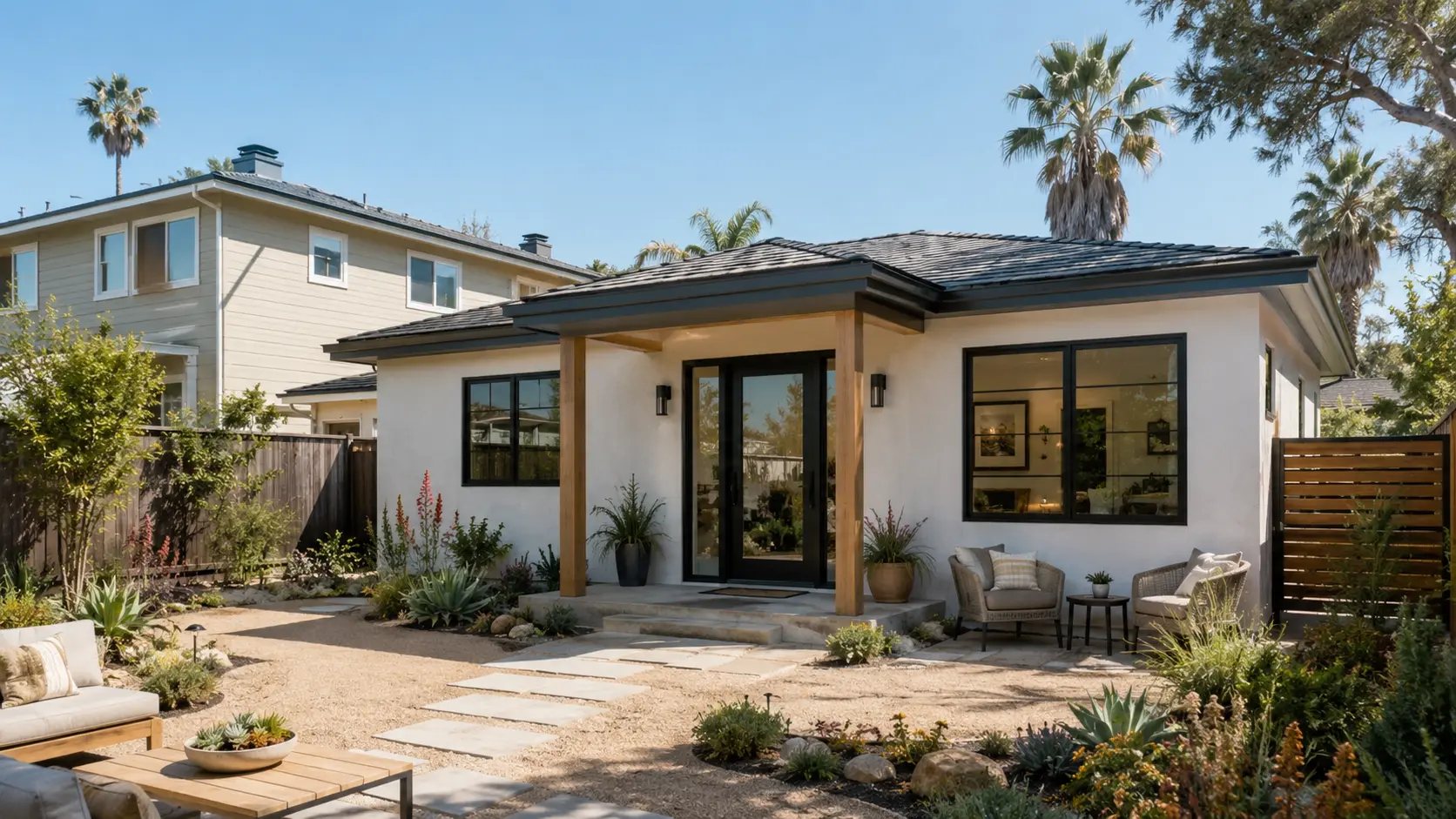
SnapADU Cost 2026: Real Plan Prices, Adders & Quote Decoder
SnapADU cost in 2026 starts around $300K and runs past $450K all-in. Here's what the published numbers include, what they don't, every adder verified from primary sources, permit fees by city, and the 15 questions to ask before you sign.
Free property report · ~60 seconds · No commitment
The honest answer up front
SnapADU cost in 2026 typically lands between $300,000 and $450,000+ all-in for a turnkey detached ADU in San Diego County — roughly $375 to $600+ per square foot, depending on plan size and lot conditions. That's the range SnapADU itself publishes on its 2026 cost page, refreshed in March 2026 to reflect roughly 44% in California construction-cost inflation between January 2021 and December 2025.
Smaller units cost more per square foot. Larger units cost more in absolute dollars. The published floor-plan prices you see on SnapADU's site — like $219,000 for a 1BR narrow plan or $359,000 for a 1,199 sq ft L-shape — are not the full project cost. Those numbers cover vertical build plus standard finish materials. Plans, permits, sitework, utility upgrades, and lot-specific work get added on top.
This guide answers what "SnapADU cost" really means: the published numbers, the gap to a realistic all-in budget, every adder we could verify from primary sources, the city-by-city permit reality, who SnapADU is and isn't a fit for, what to ask before you sign, and how San Diego homeowners actually pay for a project this size.
Who this applies to: Homeowners in Greater San Diego County considering SnapADU for a new detached ADU build. If you're outside San Diego County, SnapADU isn't your provider.
Next step: Compare SnapADU's published ranges to your specific property using a free, no-commitment Dwelling Index property report.
Get Your Free ADU Report — Free, ~60 secondsSnapADU Cost Decoder: published plan price vs. realistic all-in budget
SnapADU's own published per-plan prices stacked against SnapADU's own published all-in benchmarks, with the gap calculated. This is the single comparison most homeowners need before talking to any builder.
| SnapADU example | Published plan price | All-in benchmark | Typical gap |
|---|---|---|---|
| 497 sq ft 1BR/1BA narrow | $219,000 | ~$300,000 | ~$80K–$120K+ |
| 500 sq ft 1BR/1BA benchmark | $220,000 vertical | ~$300,000 | ~$80K |
| 749 sq ft 2BR/2BA | $284,000 | ~$350,000 | ~$66K–$75K |
| 999 sq ft 2BR/2BA L-Shape | $329,000 | ~$425,000 | ~$90K–$100K |
| 1,199 sq ft 2BR/2BA L-Shape | $359,000 | ~$450,000 | ~$90K–$110K+ |
| 749 sq ft 2BR/2BA over-garage carriage | $389,000 | Case-specific | Case-specific |
Sources: SnapADU floor-plan pages and SnapADU "ADU Costs" page (verified May 7, 2026). Vertical Build = structure + standard finish materials. All-in = vertical + design + permits + standard sitework + utilities. Editorial synthesis by Dwelling Index — these are not quotes.
The takeaway most homeowners need:
For a typical level-lot San Diego County project, the realistic SnapADU all-in budget runs roughly $65,000–$110,000+ above the published floor-plan price, and meaningfully more on lots with slope, septic, long utility runs, coastal-zone review, or fire-overlay constraints.
How much does SnapADU cost in 2026?
SnapADU's official 2026 pricing for a detached ADU in San Diego runs $375 to $600+ per square foot turnkey, with most homeowners spending $300,000 to $450,000+ for a complete project. Vertical build (the structure plus standard finishes) accounts for roughly 80–85% of all-in cost; the remainder covers feasibility, design, surveys, permits, sitework, and utilities.
Smaller ADUs carry higher per-square-foot costs because kitchens, bathrooms, mobilization, and design effort are largely fixed regardless of unit size.
Cost by size — SnapADU's published 2026 benchmarks
| Size and layout | Vertical build | Build $/sq ft | Typical all-in | All-in $/sq ft |
|---|---|---|---|---|
| 1BR/1BA, ~500 sq ft | $220,000 | ~$440 | ~$300,000 | ~$600 |
| 2BR/1BA, ~750 sq ft | $275,000 | ~$365 | ~$350,000 | ~$465 |
| 2BR/2BA, ~1,000 sq ft | $335,000 | ~$335 | ~$425,000 | ~$425 |
| 3BR/2BA, ~1,200 sq ft | $360,000 | ~$300 | ~$450,000 | ~$375 |
Source: SnapADU "ADU Costs" page (verified May 7, 2026). All-in includes feasibility, design, surveys, permits, basic sitework on a level lot, and utilities. Typical level-lot conditions and standard San Diego jurisdictions.
Why per-square-foot cost drops as the ADU gets larger
A 1,200 sq ft ADU isn't twice as expensive as a 600 sq ft ADU. An ADU at any size still needs one full kitchen, at least one bathroom, an HVAC system, an electrical panel, a foundation, a roof structure, designed plans, a permit submission, and a project supervisor. Those costs don't scale linearly — they're more like a fixed base with a smaller marginal cost per added square foot. That's why SnapADU's 1BR/1BA at 500 sq ft costs ~$600/sq ft all-in, while its 3BR/2BA at 1,200 sq ft costs ~$375.
Second units and stacked ADUs
If you're building two ADUs on the same lot, SnapADU's published rule of thumb is that the second unit costs roughly 85% of the first. You save on shared mobilization and management. You don't save on the second kitchen, HVAC system, or electrical panel. Stacked configurations add structural complexity and inter-floor sound mitigation; SnapADU's published guidance suggests roughly $12 per square foot for a resilient-channel ceiling system that reduces sound transmission by approximately 70%.
Why is the SnapADU floor-plan price lower than the full project cost?
Floor-plan prices on SnapADU's website represent vertical build plus standard finish materials — not the complete project cost. Each plan page states explicitly that a project also requires plans, permits, sitework, and lot-dependent work, quoted separately. For a typical level-lot San Diego project, these additions run roughly $65,000 to $110,000+ on top of the published floor-plan price.
This gap is the single most common source of sticker shock in the SnapADU search. Searchers see $219,000 or $329,000 on a plan page, mentally lock in that number, then meet a real proposal that comes back $80,000–$110,000 higher — and assume something is wrong. Nothing is wrong. Two different things are being measured.
What's in the floor-plan price (and what isn't)
| Line item | In plan price? |
|---|---|
| Vertical build (foundation, framing, MEP, drywall, etc.) | Yes |
| Standard finish materials (cabinets, counters, appliances, flooring, fixtures) | Yes |
| Feasibility study | No |
| Property reports (survey, utility mapping, soils, title) | No |
| Construction documents (permit-ready plans, structural, Title 24) | No |
| Permitting management | No |
| Permit fees (city plan check, building permit, impact fees, school fees) | No |
| Basic sitework on a level lot (general conditions, trenching, finish grading) | No |
| Utility upgrades (separate electric meter, sewer/water tap, solar where required) | No |
| Solar (where required by code) | No |
| Slope, retaining walls, custom foundation | No |
| Custom design changes or non-standard finishes | No |
Source: SnapADU "ADU Costs" page, individual floor-plan pages, "Hidden ADU Sitework Costs" blog, and "All About ADU Permit Fees & Waivers" blog (all verified May 7, 2026).
Two scenarios where this gap costs homeowners real money
Scenario A — Comparing apples to oranges. A homeowner gets a $329,000 number from SnapADU's floor-plan page, then a $345,000 "ADU build" quote from a different local contractor. They pick the SnapADU price as cheaper. But the $329,000 was vertical-only; the $345,000 might be all-in. The actual SnapADU all-in equivalent in that size band is closer to $425,000.
Scenario B — Financing a project that's underfunded. A homeowner builds the loan around the floor-plan price. When the all-in number lands $80,000–$110,000 higher, the loan can't cover it. The project pauses, descopes, or limps forward with a financing patch.
Simple rule: always compare like-scope numbers. Always ask any builder: "Is this vertical build, or is this all-in?"
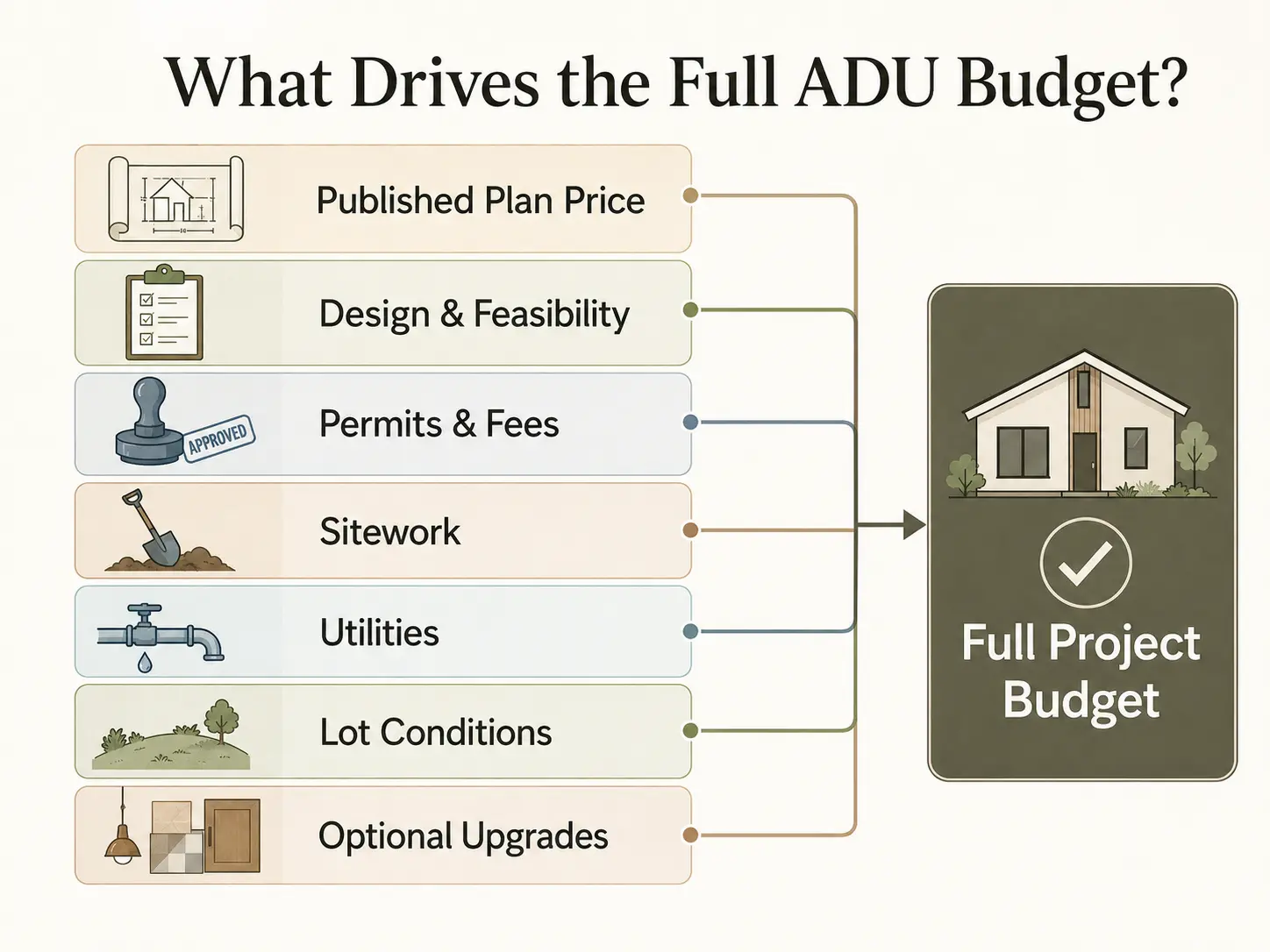
What can make your SnapADU quote higher than the table?
The most common reasons a SnapADU quote lands above the published all-in benchmark are sitework complexity, utility distance and upgrades, septic systems, slope and retaining walls, restricted access, special-zone review (coastal, fire, historic, HOA), permit fees in higher-fee cities, mandated solar, fire-rated construction, separate electric meters, and finish upgrades.
SnapADU itself publishes specific dollar ranges for most of these adders, which means homeowners can build a fairly accurate gap estimate before requesting a formal proposal. We pulled every adder we could find from SnapADU's "Hidden ADU Sitework Costs" article, "All About ADU Permit Fees & Waivers" article, and main cost page.
The complete adders table
| Cost driver | Published range | When it applies |
|---|---|---|
Feasibility study Required up-front for a real proposal | $1,325–$2,375 | Automatic |
Construction drawings Semi-custom averages ~$6,000; full custom starts at $8,500 | $2,300–$8,500 | Automatic |
Property reports (survey, utility mapping) | $5,525+ | Automatic |
Permitting management | $3,500+ | Automatic |
Permit fees See permits section below | $5,000+; ~$10–$20/sq ft | City-specific |
Basic sitework (general conditions, trenching, finish grading) On level-lot projects | ~$35,000 | Automatic |
Separate electric meter SDG&E now requires all new-construction ADUs to have a separate meter | ~$10,500 | Automatic |
Construction-loan coordination Adds documentation and lender-draw coordination if financing | ~$3,000 | Optional |
Soils report Declining one means building to most stringent UBC standards | ~$3,000 | Often required |
Building access constraints (<8 ft clearance, soft soil) Hand-digging or crane needed | $5,000–$8,000 | Lot-specific |
Grading and soil export When lot can't absorb cut soil on-site | $5,000–$10,000 | Lot-specific |
Tree removal | $2,000–$4,000 | Lot-specific |
Solar New-construction non-manufactured detached ADUs subject to CA Energy Code solar requirements; JADUs exempt | ~$12,000–$18,000 | City-specific |
Boundary survey Required when ADU sits within ~2 ft of a setback line | $4,000–$10,000 | Lot-specific |
Existing-home floor plan Poway, some HOAs, some Coastal Zone projects | ~$750 | City-specific |
Private water meter Oceanside | ~$1,500 | City-specific |
Deepened footings Corner differential >1–2 ft, or within 10 ft of slope or structure | ~$4,500 | Lot-specific |
Steep slopes, retaining walls, terracing Combined grading plan and retaining wall work | $20,000–$30,000+ | Lot-specific |
Long utility runs Distance from existing tie-ins | Up to $200/linear foot | Lot-specific |
Septic system (where no sewer) Major driver in unincorporated and rural areas | $30,000–$40,000 | Lot-specific |
Sewage pump When gravity sewer connection isn't feasible | ~$5,000 | Lot-specific |
Fire-rated construction Very High Fire Hazard Severity Zones, lot proximity | Varies | Zone-specific |
Fire sprinkler system CA guidance: ADUs cannot be required if primary dwelling isn't required. City of SD bonus-program ADUs do require sprinklers. | $5,000–$10,000 | Conditional |
Stormwater mitigation | Varies | City-specific |
Coastal-zone review Coastal lots only | Varies (timeline + design adders) | Lot-specific |
HOA-mandated exterior upgrades | Varies | HOA-specific |
Two-story or carriage-house premium Stair, structural, and engineering adders | Varies | Optional |
Custom finish upgrades (tiled showers, kitchen islands, premium appliances) Standard finishes already included | Varies | Optional |
Sources: SnapADU "Hidden ADU Sitework Costs," "All About ADU Permit Fees & Waivers," "ADU Costs" page, and individual plan pages. Fire-sprinkler note cross-referenced against the California HCD ADU Handbook and the City of San Diego ADU/JADU page. Verified May 7, 2026.
The damaging admission, said plainly
SnapADU is not the cheapest path for every San Diego homeowner, and it isn't trying to be. Their business is full-service detached design-build, which means they price in the soft costs, sitework, utility upgrades, project management, and warranty most low-bid contractors leave off the proposal. That's a feature for a homeowner who wants completion certainty and a single accountable team. It's a bug for a homeowner who wants the lowest sticker price and is willing to coordinate separate designers, engineers, permit consultants, and a low-overhead general contractor themselves.
SnapADU publishes that 90%+ of projects it started in 2022–2023 were built, against a stated San Diego industry average around 30%. A meaningful share of cheaper bids in this market never finish.
Is SnapADU expensive compared with other San Diego ADU options?
SnapADU sits in the upper-mid tier of San Diego pricing for full-service detached new builds. For a flat-lot 1,000 sq ft 2BR/2BA in 2026: SnapADU $400K–$450K all-in (stick-built, in-house design-build); Better Place Design & Build cites $200,000–$450,000+ and $375–$600 per sq ft; Abodu publishes prefab pricing from $278,800; Villa Homes lists ~20 floor plans in panelized prefab. Prefab unit prices that look much lower upfront often close the gap once delivery, crane access, foundation, utility tie-ins, sitework, and permits are added.
The San Diego builder comparison table
| Builder | Build method |
|---|---|
| SnapADU | Stick-built, in-house design-build |
| Better Place Design & Build | Stick-built design-build |
| Villa Homes | Panelized prefab |
| Abodu | Modular prefab |
| Crest Backyard Homes | Modular |
| Studio Shed | Modular / panelized |
Sources: each builder's currently published pricing page; Better Place Design & Build's published SD ADU cost guide; SnapADU's published prefab comparison; Chula Vista ADU page (credits SnapADU as designer). Verified May 7, 2026.
SnapADU is a Dwelling Index partner. Better Place Design & Build, Villa Homes, Crest Backyard Homes, Abodu, and Studio Shed are not — we receive nothing if you choose them. We include them anyway because the comparison is more useful to you than the page is profitable to us. If reading this comparison sends you to a competitor, that's a fine outcome — the alternative was you signing without comparing.
Editorial conclusion: For a San Diego County detached new-construction ADU on a level-to-moderate lot, SnapADU's published range is consistent with what the local labor market, materials cost, regulatory burden, and design-build accountability actually cost in 2026. The better question isn't "is SnapADU expensive?" — it's "does SnapADU's scope and service area match what I want to build?"
Affiliate disclosure: SnapADU is a Dwelling Index partner. We may earn a commission if you book through our link, at no cost to you. The other builders named above are not partners — we receive nothing if you choose them.
In Greater San Diego County and SnapADU is your shortlist?
Request a SnapADU Discovery Call — Free, No CommitmentBest for detached new-construction ADUs in SnapADU's service area. The 6-month price lock applies after the CEA is executed and first-round plan check is complete.
Who is SnapADU a good fit for — and who should look elsewhere?
SnapADU is most likely a fit for homeowners in Greater San Diego County who want a new detached ADU, prefer a single design-build team, and have a budget of approximately $275,000 and up. SnapADU is not the right fit for homeowners outside San Diego County, those primarily seeking a garage conversion, projects with a hard ceiling under $275,000, or homeowners who specifically value the lowest possible bid over completion certainty.
| Reader situation | Fit level |
|---|---|
| San Diego County homeowner wanting a detached new ADU | Strong fit |
| Wants full-service design-build accountability under one team | Strong fit |
| Comparing published plan prices to realistic all-in budget | Strong fit |
| Wants the published 6-month price lock during permitting | Strong fit |
| Plans to live in the ADU and rent out the main house | Strong fit (if in service area) |
| Multigenerational housing for aging parent or adult child | Strong fit (if in service area) |
| Outside Greater San Diego County | Not a fit |
| Primarily seeking garage conversion | Weak-to-medium fit |
| Hard budget ceiling under $275,000 all-in | Weak fit |
| Difficult slope, severe access constraints, or coastal-zone complications | Case-specific |
| Specifically wants prefab modular | Case-specific |
| Wants the absolute lowest bid and is comfortable coordinating separate trades | Not a primary fit |
Where SnapADU's stated service area covers
SnapADU's service-area page lists: Carlsbad, Chula Vista, Coronado, County of San Diego, Del Mar, El Cajon, Encinitas, Escondido, Imperial Beach, La Mesa, Lemon Grove, National City, Oceanside, Poway, San Diego, San Marcos, Santee, Solana Beach, and Vista. SnapADU's homepage also references Rancho Santa Fe and "surrounding areas of San Diego County."
If your address sits outside this footprint, SnapADU is not your provider. Start with the national ADU cost page and our state-by-state coverage.
How does SnapADU's price lock work?
SnapADU offers a published Price Lock Guarantee that fixes the construction price for six months after the Construction Estimate Agreement (CEA) is executed, which happens once first-round plan check is complete and any required revisions are incorporated, provided construction mobilizes within that period. SnapADU also states that its initial estimates land within 3–5% of the final contract price, and that it has not historically increased prices mid-build.
The Price Lock does not protect against city-mandated changes that arise during inspection or after permits are issued, homeowner-initiated scope or finish changes, or HOA-driven design changes. The design-and-permitting window — SnapADU's published process guidance puts permitting at roughly 3–6 months in many cases, sometimes longer — is exactly the period when material and labor costs most often shift. A locked construction price during that window means a homeowner can finalize financing on a real number, not a moving estimate.
The Price Lock scope risk table
| Item | Status under SnapADU's Price Lock |
|---|---|
| Construction cost (materials and labor) for the locked scope, for 6 months | Locked |
| Standard finishes selected during design | Locked |
| City permit fees | Pass-through — verify written contract |
| Utility upgrades quoted in the CEA | Locked if quoted; outside-of-quote conditions may trigger change order |
| Soils, surveys, and special inspections | Verify per contract — typically separate line items |
| Finish allowances | Verify per contract — fixed vs. adjustable language matters |
| City-mandated changes during plan check or inspection | Change order — not absorbed by the lock |
| HOA-driven design or exterior changes | Change order |
| Homeowner-initiated scope, layout, or finish changes | Change order |
| Force-majeure-style market disruption | Outside scope — SnapADU has published its own approach to mid-build cost spikes |
| Solar | Verify per contract — locked, excluded, or conditional on code |
10 questions to ask before relying on the Price Lock
- 1What exact scope is locked? (Vertical build only? Vertical plus standard sitework? All-in?)
- 2Are permit fees inside the lock or pass-through?
- 3Are utility upgrade costs inside the lock or quoted separately?
- 4Are soils, surveys, and special inspections included?
- 5Are finish allowances fixed or adjustable?
- 6What specific site conditions can trigger a change order?
- 7What happens if city plan check requires design revisions?
- 8How long does the lock last from CEA signature? (SnapADU's published answer is six months — verify in your contract.)
- 9What happens if I (the homeowner) change the layout or finishes?
- 10Is solar inside the locked scope, excluded, or conditional on code requirements?
How long does a SnapADU project take?
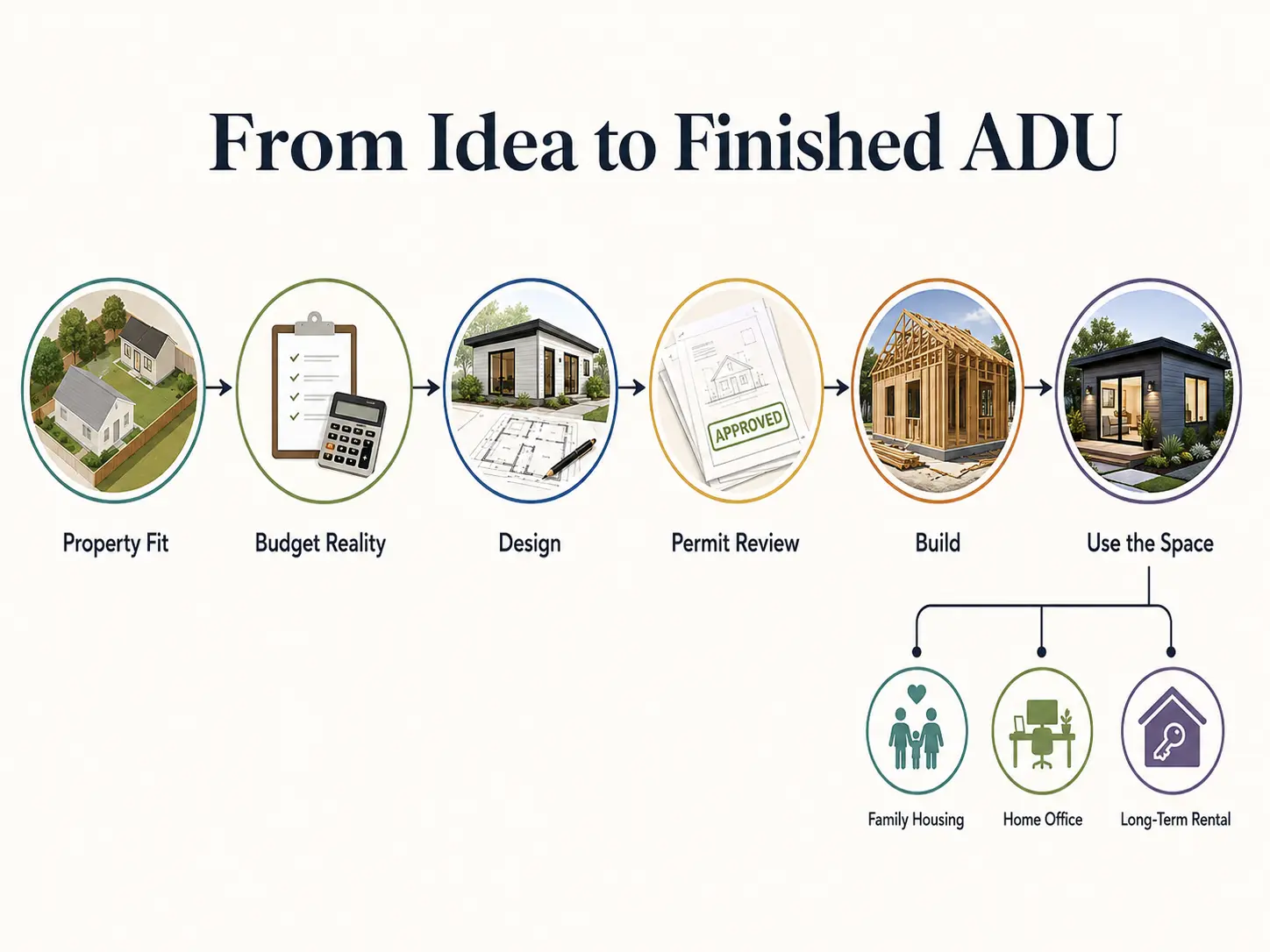
A SnapADU project moves through four phases — Discovery / Feasibility, Design & Construction Documents, Permitting, and Construction — for a typical end-to-end timeline of 10 to 18 months, depending on city, design complexity, and site conditions. SnapADU's published process guidance breaks this down as roughly: design 3–4 months, permitting 3–8 months (highly city-dependent), and build 6–9 months.
This timeline matters when you're financing the project. Construction loans, HELOCs, and renovation loans all have draw schedules tied to build phases. Misaligned financing — for example, a loan that expects to break ground in 6 months when the city actually takes 8 — is one of the most common avoidable delays in any San Diego ADU project. The Price Lock window is calibrated to this same reality: 6 months of locked pricing covers the median permitting case, with room for some slippage.
Sources: SnapADU "Process" and "How Long Does it Take to Build an ADU?" pages (verified May 7, 2026).
How do San Diego permits and California ADU rules affect the final cost?
San Diego ADU permit fees can swing by $20,000 or more between cities for the same square footage. California state ADU law — primarily codified in California Government Code §66317, §66321, §66323, and §66311.5 — sets the ministerial-approval framework, the four-foot setback floor, the 30-day-minimum rental requirement, and the fire-sprinkler exemption that flow down to every project. SnapADU's published February 2026 permit-fee analysis shows City of San Diego permit totals running $10,734 for a 499 sq ft ADU up to $31,111 for a 1,199 sq ft ADU.
California state ADU law in plain English
Note: SB 543 was approved October 10, 2025 and took effect January 1, 2026, renumbering and amending several ADU code sections. Current citations are below.
| State law / source | Plain English |
|---|---|
| California Gov. Code §66317 — ministerial path | All qualifying ADU and JADU applications must be processed ministerially (no discretionary review) on a 60-day clock when complete. |
| California Gov. Code §66323 — state-exempt detached new ADU pathway | A homeowner may build one detached new-construction ADU with side/rear setbacks no more than four feet and a state-protected floor area of at least 800 sq ft of livable space. Local jurisdictions may allow larger ADUs (commonly up to 1,200 sq ft), but the 800-sq-ft/4-ft setback pathway is the state-law floor. |
| California Gov. Code §66323 — long-term rental requirement | ADUs cannot be rented for periods of 30 days or less. Long-term rental only — no Airbnb-style short-term rentals. |
| California Gov. Code §66311.5 — impact fees (renumbered from former §66324 by SB 543) | An ADU with 750 sq ft of interior livable space or less cannot be charged impact fees. ADUs over 750 sq ft can be charged impact fees proportional to the ADU's size relative to the main house. |
| California Gov. Code §66321 — minimum protections | Local rules cannot block at least an 800 sq ft ADU with four-foot side/rear setbacks regardless of lot coverage maximums. |
| California HCD ADU Handbook — fire sprinklers | An ADU cannot be required to have fire sprinklers if the primary dwelling isn't required to have them. (City of San Diego affordable/bonus ADUs under the ADU Home Density Bonus Program are a separate case and do require automatic fire sprinklers.) |
| California HCD ADU Handbook — school fees | School districts may charge fees on ADUs around the 500 sq ft threshold. The exact treatment varies by city and district — confirm against your local fee schedule. |
Sources: California Legislative Information (leginfo.legislature.ca.gov); California HCD ADU Handbook; SB 543 (2025–2026 session). Verified May 7, 2026. State law evolves — verify current code text directly before relying on any specific number for permitting.
Translation for a SnapADU-curious homeowner
- Your ADU application has a state-law-protected ministerial path (§66317).
- You will not be able to short-term-rent it under the §66323 path.
- You probably do not need fire sprinklers if your existing house doesn't have them — unless you're using the City of San Diego bonus program.
- If you build with 750 sq ft of interior livable space or less, impact fees do not apply (§66311.5).
- If you build over 750 sq ft, expect proportional impact fees.
- Plan for school fees around the 500 sq ft threshold and confirm against your district's schedule.
- The state-law floor protects at least 800 sq ft and four-foot setbacks. Many San Diego County jurisdictions allow ADUs up to 1,200 sq ft, but that's a local allowance, not a state-law guarantee.
San Diego permit fees by ADU size (City of San Diego)
SnapADU's February 2026 permit-fee analysis publishes specific City of San Diego dollar examples:
| ADU size | Estimated City of San Diego permit total |
|---|---|
| 499 sq ft | $10,734 |
| 749 sq ft | $25,138 |
| 999 sq ft | $26,430 |
| 1,199 sq ft | $31,111 |
Source: SnapADU "All About ADU Permit Fees & Waivers" (February 2026 analysis). Permit fees change. Verify against the current City of San Diego fee schedule before relying on these numbers.
The 750 sq ft threshold matters: The single biggest jump in City of San Diego fees happens between 499 sq ft and 749 sq ft — that's the impact fee activation point under §66311.5. If your project is borderline on that threshold, the math on staying at 750 sq ft of interior livable space or less is worth running carefully.
How permit fees vary across San Diego County cities
| City / jurisdiction | Permit-fee profile |
|---|---|
| Encinitas | ~$3–$5/sq ft |
| Vista | Variable |
| City of San Diego | $10,734–$31,111 (by size) |
| County of San Diego (unincorporated) | $1,565 + $0.331/sq ft (plan review) + $1,287 + $0.433/sq ft (permit) |
| Chula Vista | City Standard ADU Plans available (designed by SnapADU) |
| Oceanside | Private water meter (~$1,500) required |
| Poway | Existing-home floor plan (~$750) required |
Sources: SnapADU "All About ADU Permit Fees & Waivers" blog; County of San Diego ADU fee waiver notice; City of San Diego Information Bulletin 400; City of Chula Vista ADU page. Verified May 7, 2026.
If your property is in Encinitas under 750 sq ft, your permit fees may run $3–$5 per square foot — meaningfully closer to SnapADU's $5,000+ rule of thumb than to higher-fee cities. If your property is in City of San Diego at 1,199 sq ft, your permit fees alone could run $31,000+. That single variable can move your all-in budget by $20,000 or more between two otherwise identical projects.
Can prefab, garage conversion, or a smaller ADU cost less than SnapADU?
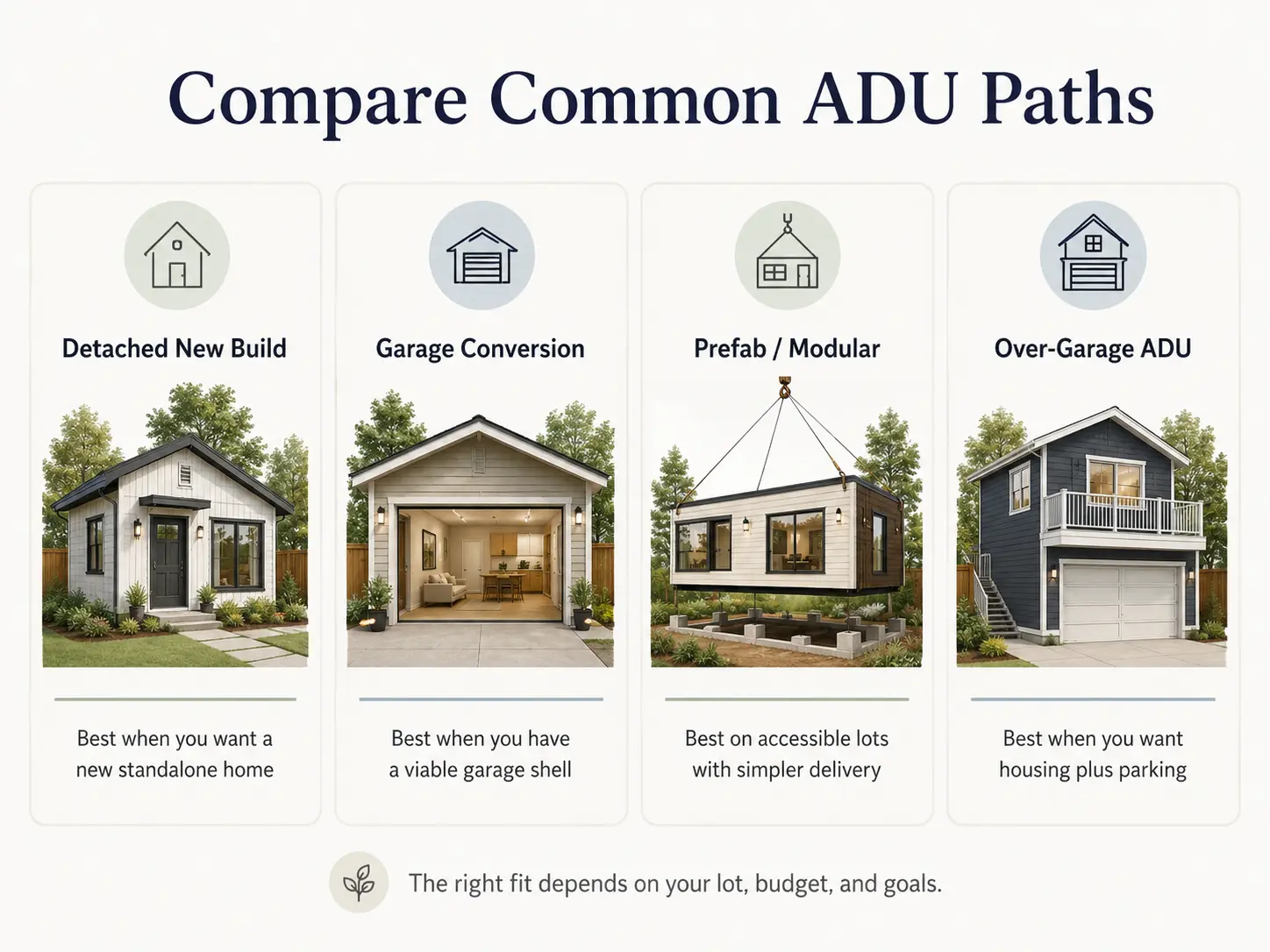
Yes, all three can cost less than a SnapADU full-service detached new build, but the comparison only holds when scope and lot conditions are accounted for honestly. Prefab unit prices that look much lower upfront frequently close the gap once delivery, crane access, foundation, utility tie-ins, sitework, and permits are added — and on larger or two-story builds, prefab and stick-built often land in the same range. Garage conversions can be meaningfully cheaper because the existing structure replaces some new-build costs, but they bring their own structural, parking, utility, and design constraints.
When prefab can beat SnapADU-style site-built
- The lot is flat, with easy crane and delivery access
- The unit is on the smaller end (≤750 sq ft)
- Utility tie-ins are short
- The homeowner accepts the available floor-plan and finish options
- The jurisdiction is familiar with the prefab manufacturer's product
When SnapADU-style site-built makes more sense
- The lot is tight, sloped, or irregular
- Customization matters (layout, finishes, matching the main house)
- The unit is larger (1,000+ sq ft)
- The project is over-garage or two-story
- HOA, design review, or privacy constraints apply
- You want one accountable local team, not a prefab manufacturer + separate site-prep contractor
Garage conversion math
A garage conversion can be a strong path for the right homeowner — typically saving meaningful dollars versus new detached construction, because the existing structure, foundation, and roof are already in place. The catches: many older garages need significant structural, electrical, and insulation upgrades to meet ADU code; you may lose required parking; and conversion ADUs follow a different state-law pathway (their own ministerial protections under §66323) than the new detached pathway. SnapADU's public positioning emphasizes detached new construction, not conversions — so if conversion is your primary path, comparison-shop with a local contractor who specializes in conversions.
Deeper coverage on alternatives
What questions should you ask before accepting a SnapADU quote?
The single best protection against quote-comparison errors and post-signing surprises is a structured set of questions that separates base construction price from realistic all-in project cost, identifies what's included versus excluded, surfaces site-specific risk, and pins down what triggers a change order. Use these questions on every builder you talk to — not just SnapADU. A bid that comes in $40,000 lower than SnapADU's may look cheaper until the answers reveal $80,000 in excluded scope.
The 15-question quote-check checklist
Print this. Bring it to every builder meeting. Get written answers, not verbal ones.
If a builder pushes back on any of these questions — particularly questions 1, 9, 12, or 13 — that's data. Note it.
Want this checklist as a printable PDF?
Download the Free 2026 ADU Starter KitIncludes the quote-check worksheet, a cost-decoder cheat sheet, and the questions to ask any builder before signing. Free, no obligation.
How can you pay for a SnapADU-sized ADU?
A $300,000–$450,000+ SnapADU build is typically funded through one or a combination of cash, HELOC, cash-out refinance, home equity loan, renovation loan products (such as Fannie Mae HomeStyle or FHA 203(k)), construction loans, or home equity investment products (HEIs). The right path depends on your existing mortgage rate, your equity, your income documentation, your timeline, and whether you want a monthly payment or an equity-share structure. SnapADU itself charges roughly $3,000 in additional coordination cost when a homeowner uses construction-loan financing.
Compliance framing: This section is independent financing-path education, not lender ranking. We do not quote rates, APRs, monthly payments, or specific approval terms as guarantees. Actual financing terms depend on your credit, income, equity, the property, lender underwriting, and current market conditions. For tax questions, consult a qualified tax professional.
Cash
When the homeowner has liquid funds and prefers no loan complexity.
Opportunity cost of capital and reserves for surprise change orders.
HELOC (Home Equity Line of Credit)
Flexible, draw-as-you-go — often the most common ADU financing path. The homeowner draws funds during construction as bills come due.
Variable rates and variable payments mean the long-term carrying cost is uncertain. State availability and lender requirements vary.
Cash-out refinance
When the existing mortgage rate is high and current rates are equal or lower, this can roll the ADU cost into one mortgage balance at one rate.
It replaces your existing mortgage terms — if your existing rate is below market, this is usually the wrong path.
Home equity loan
Lump sum, fixed payment, fixed term. Cleaner predictability than a HELOC.
Less flexibility if the project's actual cost shifts.
Renovation or construction loans
Specifically structured for new builds, including ADUs. Includes products like Fannie Mae HomeStyle and FHA 203(k). The lender disburses funds in stages tied to construction milestones.
Extra documentation, draw coordination with the builder, and stricter contractor requirements.
Home equity investments (HEIs)
No monthly payment; in exchange, the homeowner gives up a share of the property's future appreciation. Products include Hometap, Unlock, and Point.
State availability is limited; the cost of capital can be significant over time. Always confirm current state availability with the provider.
A realistic worked example
For illustration only, not a quote: a San Diego homeowner financing a $400,000 SnapADU build with an existing $300,000 mortgage at 3.25% would generally not benefit from a cash-out refinance — the new blended rate would push the existing low-rate balance up. A HELOC for $400,000 against a property with sufficient equity would preserve the existing mortgage at 3.25% while adding a separate variable-rate line for the build. A construction loan that converts to permanent financing would be a third option, particularly when there isn't sufficient existing equity to support a $400,000 HELOC.
These are illustrative examples, not guarantees of returns. Actual results depend on local market conditions, construction costs, financing terms, and regulatory approvals.
Affiliate disclosure: Mortgage Research Center is a Dwelling Index partner for mortgage, refinance, cash-out refinance, and construction-loan content. We may earn a commission if you use our link, at no cost to you. The HEI providers and other lenders mentioned above are not Dwelling Index partners.
What do reviews and third-party records say about SnapADU?
SnapADU's third-party records support the company's identity and licensing claims and skew positive on customer sentiment, but reviews are not a substitute for cost analysis. SnapADU operates under California CSLB License #1075582 (B). Better Business Bureau lists SnapADU as BBB Accredited and A+ rated. BuildZoom shows SnapADU's license as Active as of April 2026. Public homeowner feedback surfaces a constructive critique around schedule transparency — a reasonable signal for any homeowner to probe directly during the discovery call.
California CSLB (cslb.ca.gov)
Verify the contractor's license is active today. SnapADU's published license is #1075582 (B). Verify directly at the CSLB site immediately before signing — not from any third-party page.
BBB profile
Confirms business identity, accreditation, and complaint history. SnapADU shows as BBB Accredited and A+ rated. Useful as identity verification, less useful as cost data.
BuildZoom
Shows public permitting activity and project record. BuildZoom's own page advises homeowners to verify license status directly with CSLB.
Yelp, Houzz, Google, Nextdoor
Watch the complaint patterns, not just the star count. Consistent themes around communication are more informative than single-star complaints. Public reviews describe SnapADU as organized, experienced, professional, and accountable.
What not to do
Do not use reviews to validate cost. Do not pull a star rating into your budget assumption. Do not assume because someone else got a $329,000 price that you will. The cost analysis lives in the published price tables, the city fee schedule, and your specific lot — not in the reviews.
What we verified — and what still needs checking before you sign
Every cost figure, code citation, and partner status on this page is sourced and dated. Where we couldn't directly confirm a number, we marked it. Before you sign any contract, verify your own current quote against the source-of-truth checklist below.
What we verified
| Verified item | Date |
|---|---|
| SnapADU all-in cost range $300K–$450K+ and $375–$600+/sq ft | May 7, 2026 |
| SnapADU benchmark cost-by-size table | May 7, 2026 |
| Selected SnapADU floor-plan prices ($219K, $284K, $329K, $359K, $389K) | May 7, 2026 |
| Floor-plan price excludes plans, permits, sitework, and lot-specific work | May 7, 2026 |
| City of San Diego permit-fee dollar examples by ADU size | May 7, 2026 |
| Sitework and utility adders | May 7, 2026 |
| SDG&E separate-electric-meter requirement for new-construction ADUs | May 7, 2026 |
| California construction-cost inflation ~44% Jan 2021–Dec 2025 | May 7, 2026 |
| California Gov. Code §66317, §66321, §66323, §66311.5 | May 7, 2026 |
| HCD ADU Handbook fire-sprinkler exemption | May 7, 2026 |
| County of San Diego fee-waiver end date (January 9, 2024) | May 7, 2026 |
| SnapADU CSLB License #1075582 (B) | May 7, 2026 |
| BBB Accredited and A+ rated | May 7, 2026 |
| Chula Vista City Standard ADU Plans designed by SnapADU | May 7, 2026 |
| SnapADU 6-month Price Lock structure | May 7, 2026 |
| Comparison-builder price points (Better Place $200K–$450K+, Abodu from $278,800) | May 7, 2026 |
What you should still verify before signing
- Your current written quote — line by line, against the 'What's included / What isn't' matrix earlier in this guide
- Current SnapADU contract terms and price-lock language — read the CEA before signing
- Current CSLB license status — verify directly at cslb.ca.gov, not from any third-party source
- Current city fee schedule — verify against your specific city's published 2026 schedule
- Insurance, bond, and warranty terms — confirmed in writing
- Change-order trigger language — what events trigger a change order, and how is each priced
- Financing eligibility and current state availability — confirmed with the lender directly
- HOA, coastal-zone, historic-overlay, fire-hazard-zone, and easement constraints — confirmed for your specific parcel
- SnapADU's completion-rate claims — ask them directly during the discovery call to walk you through their current pipeline data
SnapADU cost FAQ
How much does SnapADU charge for a 500 sq ft ADU?
SnapADU's 2026 cost benchmark for a 500 sq ft 1BR/1BA detached ADU lists vertical build at approximately $220,000 and typical all-in cost at approximately $300,000 — roughly $600 per square foot all-in. The all-in figure assumes a level lot in a standard San Diego jurisdiction with normal utility tie-ins. (Source: SnapADU "ADU Costs" page, verified May 7, 2026.)
Is SnapADU's floor-plan price the total project price?
No. SnapADU's floor-plan prices represent vertical build plus standard finish materials. SnapADU's plan pages state explicitly that plans, permits, sitework, and lot-dependent work are still required and quoted separately. Expect the realistic all-in to land roughly $65,000–$110,000+ above the published plan price for typical level-lot projects.
Why does the 750 sq ft size threshold matter?
California Government Code §66311.5 (renumbered from former §66324 by SB 543, effective January 1, 2026) prohibits impact fees on ADUs with 750 sq ft of interior livable space or less. ADUs over 750 sq ft can be charged impact fees proportional to the ADU's size relative to the main house. School fees may apply around the 500 sq ft threshold — confirm with your district and city.
What can push a SnapADU project over $450,000?
Larger size, slope and retaining-wall work, severe access constraints, long utility runs, septic systems where no sewer connects, separate electric meters, mandated solar, coastal-zone or fire-hazard-zone review, over-garage or two-story construction, HOA-driven exterior upgrades, and custom finish selections. Each adder is documented in our adders table earlier in this guide.
How long does a SnapADU project take?
Typical end-to-end timeline is 10–18 months: design 3–4 months, permitting 3–8 months (city-dependent), and build 6–9 months. The Price Lock window of six months is calibrated to cover the median permitting case.
Does SnapADU build garage conversions?
SnapADU's public positioning emphasizes detached new-construction ADUs in Greater San Diego County. Their floor-plan and project portfolio reflect that focus. Homeowners primarily seeking a garage conversion should compare that path with conversion-focused local contractors before assuming SnapADU is the best fit.
Does SnapADU serve Los Angeles or Orange County?
No. Based on SnapADU's published service area, the company serves San Diego County and Greater San Diego only. If your address is outside this footprint, look elsewhere.
Is SnapADU cheaper than prefab?
Sometimes; sometimes not. Prefab can be cheaper on small, simple, accessible lots. On larger or two-story builds, prefab and stick-built often land in similar ranges once delivery, crane access, foundation, utility tie-ins, sitework, and permits are added.
Should I get another bid?
Yes — for a $300K+ project, a scope-comparable second bid is cheap insurance. Compare bids by scope, not by headline price. A bid that lists $345,000 may be apples-to-oranges with a SnapADU $425,000 if the cheaper bid excludes design, permits, sitework, utilities, or finish allowances.
Does SnapADU's price lock mean no change orders?
No. The Price Lock fixes construction-cost exposure for six months after the Construction Estimate Agreement is executed. It does not protect against city-mandated changes during inspection, HOA-driven design changes, or homeowner-initiated scope or finish changes. Verify the exact lock terms in writing.
Can I rent a SnapADU-built ADU short-term?
ADUs built under California's §66323 state-law pathway must be rented for periods longer than 30 days. Short-term rentals (Airbnb, VRBO) on a state-law-path ADU are not permitted. Local rules may add further restrictions. Verify with your specific city before relying on rental income from any short-term-rental scenario.
Who owns SnapADU?
SnapADU is co-founded and led by Whitney Hill (CEO). It is a woman-owned business operating under CSLB License #1075582 (B). Verify current ownership and contact details on SnapADU's About page directly.
Is SnapADU's completion-rate claim verifiable?
SnapADU publishes claims around project completion — a 90%+ figure on its homepage for projects started in 2022–2023, and an 85% submitted-to-completed figure in its '100 builds' report on a different time cut. Both are SnapADU-published; neither has been independently audited by Dwelling Index. We recommend asking SnapADU directly during the discovery call to walk you through their current data.
Methodology
How we researched this guide
Dwelling Index editors compiled SnapADU's currently-published pricing and process detail directly from snapadu.com — including the "ADU Costs" page, "ADU Pricing in San Diego" blog, individual floor-plan pages, "Hidden ADU Sitework Costs" article, "All About ADU Permit Fees & Waivers" article, prefab comparison post, homeowner-interview content, team page, process and timeline pages, and service-area page. Each cost figure was verified against the page's own "updated" date. California construction-cost inflation was cross-referenced against the California Department of General Services Construction Cost Index. State ADU law was verified against California Legislative Information primary sources, including SB 543 (effective January 1, 2026), and the California HCD ADU Handbook. City of San Diego rules were verified against City of San Diego Information Bulletin 400 and the City's ADU/JADU page. Comparison-builder pricing was verified against each builder's currently published pricing page. Third-party business records (CSLB license number, BBB profile, BuildZoom profile) were verified through each platform directly.
How we treated cost claims
Published SnapADU prices were treated as source claims from SnapADU. The cost-decoder gap analysis is an editorial synthesis comparing published per-plan prices against published all-in benchmarks — it is not a quote and not a guarantee. Actual project cost depends on property conditions, utility distance, jurisdiction, finish selections, contract terms, financing, and regulatory approvals.
Material connection disclosure
SnapADU and Mortgage Research Center are Dwelling Index partners — when readers use our links to schedule a SnapADU discovery call or explore mortgage paths, we may earn a commission at no extra cost. Better Place Design & Build, Villa Homes, Crest Backyard Homes, Abodu, Studio Shed, Hometap, Unlock, and Point are not partners; we receive nothing if a reader chooses them. Editorial recommendations are made independently of partner status. The Dwelling Index is an independent research resource covering ADU financing, costs, and regulations.
Final note before you book any builder call
A SnapADU build is a meaningful commitment of money and time. The published numbers are real. The Price Lock is real. The service area is San Diego County. The completion-rate claims are SnapADU-published — strong directional signals that deserve a direct question during your discovery call. If those things line up with your situation, SnapADU is a strong fit and we'd say so even without an affiliate relationship. If they don't, the honest answer is to look elsewhere, and we'd say that too.
What you need before you talk to any builder isn't a sales call. It's a clear picture of what's possible on your specific lot, what your realistic budget band is, and what financing path makes sense for your situation. That's free, takes about 60 seconds, and doesn't commit you to anyone.