
Utah state law guide · Building code, zoning and vehicle code
Tiny Home Laws in Utah (2026): Which Tiny Homes Are Legal, Where, and Under What Code
By The Dwelling Index Editorial Team · Last updated · Last verified
Bottom line up front: Utah has no single “tiny home law.” Whether a tiny home is legal in Utah depends on what it is, legally. A tiny house on a permanent foundation of 400 square feet or less is a dwelling built under the 2021 International Residential Code and its tiny-house appendix, Appendix AQ, which Utah adopts by statute (Utah Code § 15A-2-103(1)(b)–(c)). A tiny home on wheels built to recreational-vehicle standards is generally a vehicle, not a house: Utah defines a park model RV as temporary living quarters “not permanently affixed to real property for use as a permanent dwelling” (§ 41-1a-102). And a tiny home used as a backyard ADU must meet “all applicable building, health, and fire codes” under Utah's detached-ADU statute (§ 10-21-304). Your next step: figure out which path your unit is on, then check your city's zoning for your exact lot.
| If your tiny home is… | How Utah law treats it | Can you live in it full time on a residential lot? |
|---|---|---|
| Built on a permanent foundation, 400 sq ft or less | A dwelling under the 2021 IRC + Appendix AQ | Yes, if local zoning allows a dwelling of that size on that lot (as a main house or an ADU) |
| On wheels, built to RV / park model standards | A recreational vehicle (park model RV is capped at 400 sq ft in setup mode) | Only where your city or county zoning allows it; it doesn't meet the residential building code |
| A modular unit built in a factory to the State Construction Code | A modular unit, regulated like site-built construction | Yes, under the same zoning as a site-built home or ADU |
| A backyard unit behind your house | A detached ADU, if it meets code and your city's ADU ordinance | Yes, in cities that allow detached ADUs; most larger cities must allow them on lots of 11,000+ sq ft since Oct 1, 2026 |
Scroll the table sideways to see every column.
The Dwelling Index is an independent research resource covering ADU financing, costs, and regulations. We wrote this guide because most “Utah tiny home law” pages mix up three different legal questions: what the building code says, what your city's zoning says, and what the vehicle code says. Those are separate rulebooks, and a tiny home can pass one while failing another. We read the statutes on the Utah Legislature's site, the building-code appendix Utah adopted, and one full city ordinance, and put them side by side.
Disclosure: The Dwelling Index is reader-supported. When you use our links to request builder pricing, explore financing options, or purchase floor plans, we may earn a commission at no extra cost to you. Our editorial recommendations are based on independent research and are never influenced by compensation. This page is educational, not legal advice. Confirm every rule with your city or county before you buy a unit or pay for plans.
Are tiny homes legal in Utah?
Answer capsule: Yes, but only in the right legal form. Utah's State Construction Code adopts building standards for tiny houses of 400 square feet or less (Appendix AQ of the 2021 IRC), so a code-built tiny house on a foundation can be a legal dwelling. Tiny homes on wheels are generally treated as recreational vehicles, and whether you can live in one depends on local zoning. Cities and counties decide where each type can go.
Here's the short version of how Utah's rules stack up. The Utah Office of the Property Rights Ombudsman (OPRO), the state office that explains land-use law to property owners, puts it this way: there's no comprehensive definition of a tiny home, but tiny houses are “generally considered to be a single dwelling structure that is 400 square feet or less.” OPRO also says that whether a tiny home is permitted “will depend on local land use regulations,” including how it's used (a primary dwelling or an accessory dwelling) and whether it's a modular unit or a manufactured home.
So the law gives you a framework, and your city fills in the details. Four state-level pieces do most of the work:
| Utah rule | What it does for tiny homes | Source |
|---|---|---|
| Utah Code § 15A-2-103(1)(b)–(c) | Adopts the 2021 International Residential Code and its Appendix AQ (tiny houses of 400 sq ft or less) as part of the State Construction Code | Utah Legislature, current version effective July 1, 2026 |
| Utah Code § 41-1a-102 | Defines a park model recreational vehicle: temporary living quarters, not permanently affixed for use as a permanent dwelling, single chassis on wheels, no more than 400 sq ft in setup mode | Utah Legislature, current version |
| Utah Code § 15A-1-302 | Defines “manufactured home” (HUD Code) and “modular unit” (State Construction Code) for factory-built housing | Utah Legislature, current version |
| Utah Code § 10-20-618 | Generally bars cities from requiring a minimum building dimension, or a minimum square footage over 1,000 sq ft (not counting a garage), on one- and two-family dwellings, subject to statutory exceptions | Utah Legislature, current version |
| Utah Code § 10-21-304 | Since Oct 1, 2026, most larger cities must allow a detached ADU on lots of 11,000+ sq ft with a permitted single-family home; the ADU must meet building, health and fire codes | Utah Legislature, enacted 2026 General Session, ch. 166 |
Scroll the table sideways to see every column.
Which of the four legal paths is your tiny home on?
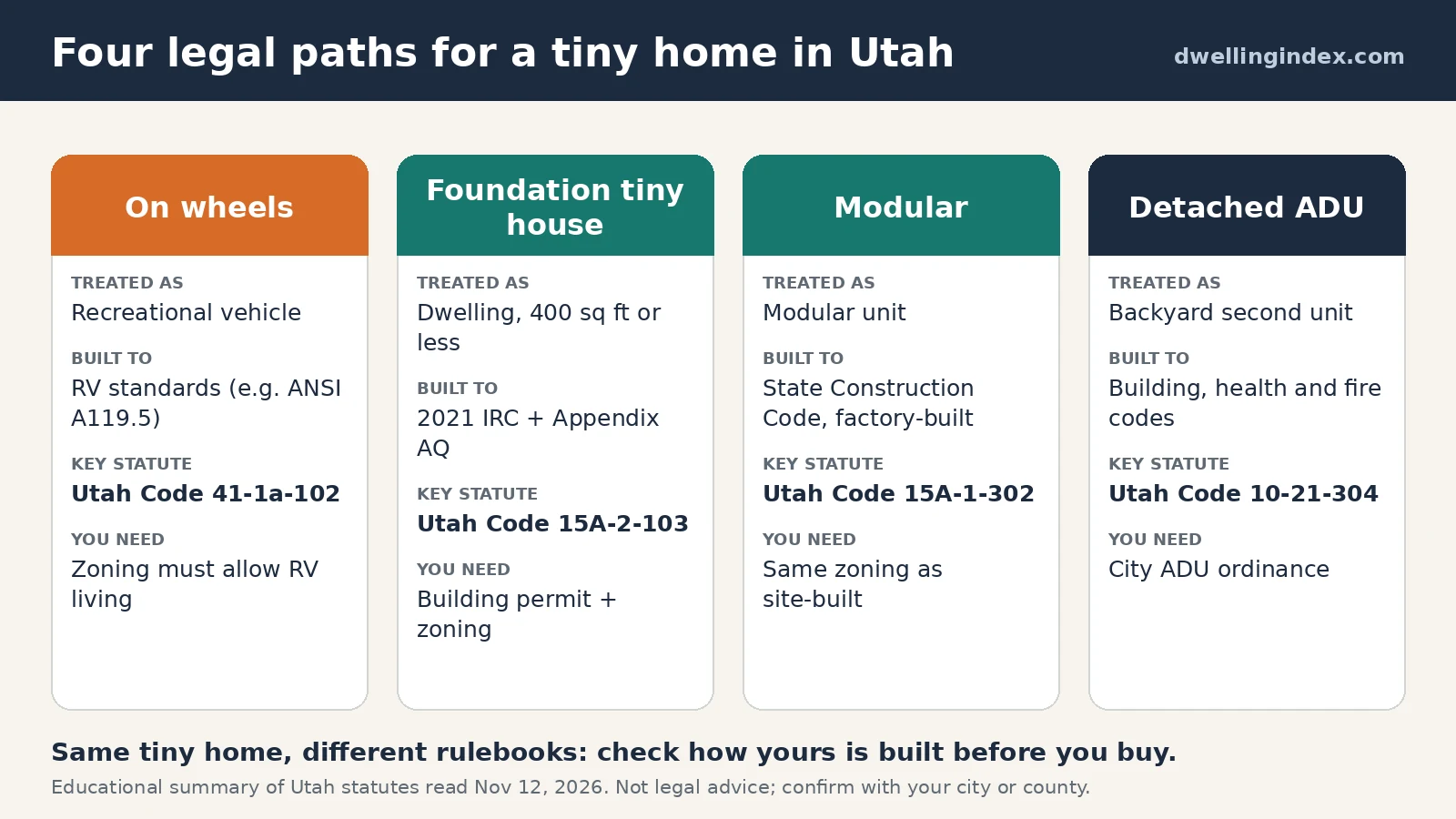
Answer capsule: Sort your tiny home by how it's built, not what it's called. On wheels and built to RV standards: vehicle path. Built on site or on a foundation at 400 sq ft or less: Appendix AQ dwelling path. Built in a factory to the State Construction Code: modular path. Placed behind an existing house as a second unit: ADU path, which layers city ADU rules on top of the code path.
The word “tiny home” covers very different products. A tiny house on a trailer and a code-built backyard studio can look alike in photos, but Utah law treats them differently. Here's the matrix we built from the statutes:
| Question | Path 1: Tiny home on wheels (RV / park model) | Path 2: Foundation tiny house (Appendix AQ) | Path 3: Modular tiny home | Path 4: Tiny home as a detached ADU |
|---|---|---|---|---|
| What code is it built to? | RV standards (commonly ANSI A119.5 for park models or NFPA 1192 for RVs), not the residential building code | 2021 IRC + Appendix AQ (State Construction Code) | State Construction Code, built in a factory and inspected under Utah's modular rules (Modular Building Institute Standards 1200 and 1205 are adopted) | IRC (with Appendix AQ if 400 sq ft or less), or modular |
| How Utah law classifies it | Park model RV under § 41-1a-102 if it meets that definition | A dwelling | A “modular unit” under § 15A-1-302(12), which by definition isn't a manufactured home | An accessory dwelling unit under your city's ordinance |
| Permit you'll need | Vehicle title/registration; land-use approval only where zoning allows RV occupancy | Building permit + zoning approval | Building permit for foundation and utilities + zoning approval | Building permit + ADU zoning approval (no conditional use permit in primarily residential zones of covered cities, § 10-21-304(3)(a)) |
| Full-time living on a house lot? | Local zoning decides; many residential zones aren't written for it | Yes, where zoning allows a dwelling of that size | Yes, same as site-built | Yes, where your city's ADU ordinance allows it |
| Biggest legal risk | Buying the unit before confirming any lot will accept it | Local minimum square footage for a primary home | Foundation, utilities and transport costs | Lot size, owner occupancy, rental minimums, utility capacity |
| Typical buyer | Travelers, RV park residents, rural landowners | Owner-builders wanting a small primary home | Buyers wanting factory speed with code status | Homeowners adding a rental or family unit |
Scroll the table sideways to see every column.
The rest of this guide walks through each path, then shows what one Utah city's ordinance looks like in practice.
Path 1Can you live full time in a tiny home on wheels in Utah?
Answer capsule: Only where local zoning allows it. Utah's vehicle code defines a park model RV as temporary living quarters for “recreational, camping, travel, or seasonal use” that isn't permanently affixed for use as a permanent dwelling and is no larger than 400 square feet in setup mode. A unit built to RV standards isn't built to the residential building code, so it generally can't be permitted as a house or an ADU without meeting that code.
This is the riskiest path, so here's the exact statutory language. Utah Code § 41-1a-102 defines a “park model recreational vehicle” as a unit that:
- is designed and marketed as temporary living quarters for recreational, camping, travel, or seasonal use;
- is not permanently affixed to real property for use as a permanent dwelling;
- requires a special highway movement permit for transit; and
- is built on a single chassis mounted on wheels with a gross trailer area not exceeding 400 square feet in the setup mode.
Read those four points together and the problem is clear. The vehicle code describes these units as temporary and seasonal. Residential zones are written for permanent dwellings that meet the building code. The two don't line up unless your city or county has written a rule that bridges them.
What that means in practice
- On a residential lot behind a house: You need your city's or county's zoning to allow a recreational vehicle to be occupied there. Utah's detached-ADU statute doesn't help a unit built only to RV standards, because it requires a detached ADU to “comply with all applicable building, health, and fire codes” (§ 10-21-304(2)(a)).
- In an RV park or campground: These are built for RVs, but each park sets its own length-of-stay rules. Ask in writing whether the park allows year-round occupancy before you sign anything.
- On rural land you own: County zoning decides whether, and for how long, an RV can be occupied. You'll also need legal water and wastewater service, which raw rural parcels often don't have.
Our read on wheels: If your plan is to live full time on a house lot in a Wasatch Front city, a unit on wheels is the riskiest choice, not the cheapest. Before you pay a deposit, get the city's answer in writing to one question:
“Can a park model RV certified to ANSI A119.5 be occupied as a dwelling on this parcel, and under which code section?”
If the answer is no, the foundation or ADU path is the way to get a legal small home on that lot.
Some states and cities have written specific rules that let certified tiny homes on wheels serve as ADUs (San Diego is one; see our tiny home ADU guide for how those rules work). We didn't find a Utah statute that does this statewide. If your city has adopted one, it will be in the city's zoning code, so ask the planning counter for the section number.
Path 2What building code applies to a tiny house on a foundation in Utah?
Answer capsule: The 2021 International Residential Code plus Appendix AQ, which Utah adopts in Utah Code § 15A-2-103(1)(b)–(c). Appendix AQ applies to dwellings of 400 square feet or less, not counting lofts. It allows 6'8" ceilings in habitable rooms (6'4" in bathrooms and kitchens), lofts reached by ladders or ship's ladders, and a roof window in a sleeping loft as the emergency escape opening.
This is the good news in Utah. Appendix AQ is an optional appendix: the code itself says its provisions aren't mandatory unless the adopting law references them. Utah references it by name in the statute that lists the State Construction Code, so it applies statewide alongside the IRC.
Appendix AQ doesn't create a separate, looser code. A tiny house still has to meet the IRC “except as otherwise stated in this appendix” (AQ101.1). What the appendix does is relax the handful of rules that make very small homes hard to build. Here are the numbers, read from the 2021 IRC Appendix AQ as published for Utah on UpCodes on November 12, 2026:
- max floor area, excluding lofts
- 400 sq ft
- max floor area, excluding lofts
- habitable rooms and hallways
- 6'8"
- habitable rooms and hallways
- bathrooms, toilet rooms, kitchens
- 6'4"
- bathrooms, toilet rooms, kitchens
- max sill height for loft roof-window egress
- 44 in
- max sill height for loft roof-window egress
| Appendix AQ rule | What it says | Why it matters for a tiny house |
|---|---|---|
| Definition of tiny house (AQ102.1) | A dwelling of 400 sq ft or less in floor area, excluding lofts | A 399 sq ft main floor plus a loft still qualifies |
| Ceiling height (AQ103.1) | Habitable space and hallways at least 6'8"; bathrooms, toilet rooms and kitchens at least 6'4" | The standard IRC asks for more in most rooms; this saves height in a small shell |
| Loft ceiling (AQ103.1 exception) | Lofts may have ceilings lower than 6'8" | Sleeping lofts under a roofline are allowed |
| Loft size (AQ104.1.1–.2) | At least 35 sq ft and at least 5 ft in every horizontal direction | A loft narrower than 5 ft won't count as a sleeping or living space |
| Low-ceiling areas (AQ104.1.3) | Areas under a sloped ceiling below 3 ft don't count toward the minimum loft area (below 16 in under gable roofs of 6:12 or steeper) | Measure the usable loft, not the whole floor |
| Loft access (AQ104.2) | Stairs, ladders, alternating-tread devices or ship's ladders are allowed if they meet AQ's sizing rules | You don't need a full code stairway to reach the loft |
| Ladders (AQ104.2.2) | Rungs at least 12 in wide, 10–14 in apart, rated for 300 lb per rung, installed at 70–80 degrees | Cheap “decor” ladders won't pass inspection |
| Loft guards (AQ104.2.5) | At least 36 in high, or half the clear height to the ceiling, whichever is less | Low lofts get a shorter guard |
| Loft egress (AQ105.1 exception) | A roof window or skylight can be the emergency escape for a sleeping loft if its bottom is no more than 44 in above the loft floor and it meets IRC opening-size rules | Solves the egress problem for lofts that can't have a wall window |
| Air leakage (AQ106.1) | No more than 0.30 cubic feet per minute at 50 Pascals per square foot of enclosure area, tested; then whole-house mechanical ventilation is required | Plan for a blower-door test and a ventilation fan in the budget |
Scroll the table sideways to see every column.
Two practical notes. First, Utah amends parts of the IRC statewide (Title 15A, Chapter 3) and lets some local amendments stand (Chapter 4), so your building department applies the Utah-amended version. Second, Appendix AQ only covers the building. It doesn't make a tiny house allowed in a zone where a small dwelling isn't allowed. That's a zoning question, covered next.
Can a Utah city block a tiny home with a minimum square footage rule?
Answer capsule: Partly. Utah Code § 10-20-618 generally bars cities from requiring a minimum square footage over 1,000 square feet (not counting a garage) or any “minimum building dimensions” for one- and two-family dwellings, subject to the exceptions below. But a city can still set a minimum below 1,000 square feet. OPRO says state law is silent on smaller minimums and appears to leave that choice to local communities, which means a city can allow or block a tiny house through its minimum-size rule.
This is the rule that decides whether a tiny house can be the main home on a lot. Utah's building-design statute lists things a city may not require for a one- or two-family dwelling. Two items on that list matter here:
- “minimum square footage over 1,000 square feet, not including a garage” (§ 10-20-618(1)(b)(ix)); and
- “minimum building dimensions” (§ 10-20-618(1)(b)(xi)).
Generally, a city can't demand that every house be at least 1,500 square feet, and it can't require a house to be at least 24 feet wide. But it can still say “every dwelling must be at least 800 square feet,” and a 350-square-foot tiny house won't meet that. The exceptions below can change the result.
The statute has exceptions. Under § 10-20-618(3), the design-element limits don't apply in places like designated historic districts, areas zoned primarily residential that were substantially developed before 1950, wildland-urban interface ordinances, flood insurance ordinances, development agreements, or zones a property owner asks for in exchange for extra density. If your lot is in one of those, the city has more room to regulate.
What to ask your city: “What is the minimum dwelling size in my zone, and does it apply to accessory dwelling units?” Many cities set different minimums for primary homes and ADUs. The answer tells you whether your tiny house can be the only home on the lot, a backyard ADU, or neither.
Path 4Can a tiny home be an ADU in Utah?
Answer capsule: Yes, if it's built to code and your city's ADU ordinance allows a detached unit on your lot. Since October 1, 2026, Utah Code § 10-21-304 requires “specified municipalities” to allow a detached ADU on any lot of 11,000 square feet or more that contains a permitted single-family home. The ADU must meet building, health and fire codes, and a city can't require more than one parking space for one under 650 square feet.
For most Utah homeowners, the ADU path is the clearest way to put a tiny home in the backyard legally. Here's how the 2026 statute applies to a tiny home specifically. (Our Utah ADU laws guide covers the full statute, including internal basement ADUs.)
Who has to allow it. A “specified municipality” is a city of the first through fourth class, plus a fifth-class city of 5,000 or more people in a first-, second- or third-class county (§ 10-21-101(25)). Under Utah's city classifications (§ 10-2-301), fourth class starts at 10,000 residents. In plain terms: most cities of 10,000 or more, plus cities of 5,000 or more in Utah's larger counties.
What the city must do (§ 10-21-304)
| Rule | What it means for a tiny home ADU |
|---|---|
| Permit a detached ADU on lots of 11,000 sq ft or more with a permitted single-family home | Under 11,000 sq ft, the state doesn't require it, though cities may still allow it (Salt Lake City has no minimum lot size) |
| Require the ADU to meet all building, health and fire codes | A code-built tiny house (IRC + Appendix AQ) or a modular unit fits; an RV-standard unit doesn't |
| No conditional use permit in a primarily residential zone | A covered city cannot require a conditional use permit for the detached ADU; confirm its review process locally |
| No more than one on-site parking space for an ADU under 650 sq ft | Nearly every tiny home is under 650 sq ft, so one space is the most a covered city can require |
| Design standards can't conflict with § 10-20-618 | The city generally can't require a minimum building dimension for the ADU, subject to statutory exceptions, though it can still require the ADU to be “designed consistent with” the house |
| Include a process to convert a legal accessory structure into an ADU | An existing legal shed or garage can be converted, subject to setbacks and codes |
Scroll the table sideways to see every column.
What the city may still require (§ 10-21-304(4)): size, height, setbacks and lot coverage limits; design consistent with the main house; no ADU larger than the house, in a front yard, or in a recorded easement; no rentals under 90 consecutive days; the owner living in the main house or the ADU; only one ADU per lot; replacement of garage parking if a garage is converted; and denial if the ADU won't have adequate utility access or the utility system lacks capacity.
That last point is easy to miss. A tiny home ADU needs adequate access to sewer, water and power, and the city can deny it if the required utility system can't take the extra load. Whether separate connections are required depends on local requirements. Ask for a utility capacity answer early.
Lots under 11,000 square feet. The statute is a floor, not a ceiling. Section 10-21-304(1)(b) says it doesn't stop a city from allowing detached ADUs on smaller lots, and many Wasatch Front cities already do. Check your own city's ordinance.
What does Salt Lake City allow for a tiny home ADU?
Answer capsule: Salt Lake City allows one ADU per property where its zoning tables permit it, with no minimum lot size. A detached ADU can be up to 1,000 square feet, must sit at least 3 feet from side and rear lot lines, and is capped at 17 feet tall (more with extra setbacks). The owner must live on the property, short-term rentals are banned, and every ADU needs a building permit and must meet all adopted codes.
State law sets the floor. City ordinances are where you find the actual numbers. We read Salt Lake City's full ADU section (21A.40.200) on American Legal Publishing on November 12, 2026, to show what a tiny home ADU has to meet in Utah's largest city.
| Salt Lake City rule (21A.40.200) | What it says | Tiny home takeaway |
|---|---|---|
| Building permit (M) | Required for any ADU; all ADUs must meet adopted building, fire and public-utility codes | An RV-standard unit on wheels doesn't fit this rule as written |
| Minimum lot size (N.1) | None | Small city lots can qualify |
| Number (D) | One ADU per property where Chapter 21A.33 permits it | One tiny home ADU, not a cluster |
| Maximum size (J.1) | Detached ADU up to 1,000 sq ft gross floor area; loft space under 7 ft ceiling height isn't counted | A tiny house is well under the cap |
| Setbacks (E.3) | 3 ft from rear and side lot lines; corner side 20% of lot width or 10 ft, whichever is less | Tiny homes fit narrow side yards and rear corners |
| Location (E.2) | Not in a front yard; interior side yard only behind the rear façade of the house | Plan for the backyard |
| Height (F.1) | 17 ft; up to 24 ft (pitched roof) or 20 ft (flat roof) if side and rear setbacks increase 1 ft per extra foot | A one-story or loft tiny house fits easily |
| Parking (G.1) | One stall for the ADU, waived within ¼ mile of a transit stop, within ½ mile of a city bike lane or path, in zones with no parking minimum, or when the lot already has at least one stall above the main home's minimum | Many SLC lots qualify for a waiver |
| Owner occupancy (C) | Owner must live on the property, with listed exceptions (for example, a duplex or a temporary absence of 3 years or less) | Not an investor-rental path |
| Short-term rental (Q.1) | Not allowed | No Airbnb |
| Restrictive covenant (P) | Recorded with the Salt Lake County Recorder before final inspection | Budget a small recording step |
Scroll the table sideways to see every column.
Note that American Legal Publishing flags that its posted code may not reflect the most current legislation. Before you rely on any number, confirm it with Salt Lake City Planning. Salt Lake City also runs a separate ADU loan program (Backyard Keys) for qualifying homeowners; see our Salt Lake City ADU loan program guide.
Path 3Are modular and manufactured tiny homes treated differently?
Answer capsule: Yes. A modular unit is built in a factory to Utah's State Construction Code and is regulated like site-built construction. A manufactured home is built to the federal HUD Code on a permanent chassis. Utah's definitions in § 15A-1-302 keep the two separate, and a modular unit by definition isn't a manufactured home.
Factory-built tiny homes come in two legal flavors, and the difference matters for zoning, financing and resale.
| Item | Modular unit | Manufactured home |
|---|---|---|
| Built to | Utah's State Construction Code (§ 15A-1-302(12)), with Modular Building Institute Standards 1200 and 1205 adopted in § 15A-2-103(1)(o) | The federal HUD Code (§ 15A-1-302(6), (8)) |
| Chassis | Set on a site foundation | Built on a permanent chassis, “with or without a permanent foundation” |
| Size trigger in the definition | None | 8 body feet or more wide or 40 body feet or more long in traveling mode, or 400 sq ft or more when erected on site |
| Proof of compliance | A decal from a third-party inspection agency showing the module meets code (§ 15A-1-302(3)) | HUD label |
| How it's treated | Like site-built construction | As factory-built housing, with its own installation standard (NFPA 225 is adopted for installation) |
Scroll the table sideways to see every column.
For tiny homes, modular is usually the cleaner path. A modular tiny house built to the State Construction Code can use Appendix AQ if it's 400 square feet or less, and it goes through the same zoning as a site-built ADU. A manufactured home has to be built to the HUD Code, and most tiny homes on wheels are built to RV standards instead, so they don't qualify as manufactured homes even if their dimensions fit the definition.
See our modular ADU guide and manufactured home ADU guide for how each path works nationally.
What does a legal tiny home cost in Utah?
Answer capsule: Published Utah prices for code-built tiny-size ADUs start around $148,000. Nest Tiny Homes listed its 240-square-foot Sparrow studio at $148,105 and its 300-square-foot Willow studio at $151,124 on November 12, 2026, both “starting at” prices. Those are under Appendix AQ's 400-square-foot line. Site work, utility connections and fees can add to that.
Tiny homes on wheels are often advertised for less than a code-built tiny house. The gap closes once you price what it takes to make a unit legal on your lot. Here's what one Utah builder publishes for its tiny-size models:
| Nest Tiny Homes Utah model | Size | Layout | Listed “starting at” | Our calc: $/sq ft | Under Appendix AQ's 400 sq ft line? |
|---|---|---|---|---|---|
| The Sparrow | 240 sq ft | Studio, 1 bath | $148,105 | $617 | Yes |
| The Willow | 300 sq ft | Studio, 1 bath | $151,124 | $504 | Yes |
| The Quail | 436 sq ft | 1 bed, 1 bath | $174,433 | $400 | No (standard IRC) |
Scroll the table sideways to see every column.
Costs to ask about on any Utah tiny home quote
- Foundation. Utah foundations are designed for local frost depth, which varies by elevation. Mountain lots usually cost more.
- Utilities. A new sewer lateral, water line and electrical service, plus the utility district's connection fees. Under § 10-21-304(4)(f), a city can deny a detached ADU if the utility system lacks capacity.
- Impact fees. Utah bars impact fees on an internal ADU built inside an existing home (§ 11-36a-202). That exemption doesn't cover a detached tiny home, so ask your city what it charges.
- Parking. One space at most for a covered city's ADU under 650 sq ft, but a new pad still costs money if you don't qualify for a waiver.
- Blower-door test and ventilation. Appendix AQ's air-leakage limit means a test and a whole-house ventilation fan.
Want a rough budget for your own size and finish level first? Try our ADU cost calculator.
Can you rent out a tiny home in Utah, or Airbnb it?
Answer capsule: Long-term, usually yes, within your city's rules. Short-term, often no. Under § 10-21-304, a city may ban rentals of a detached ADU for less than 90 consecutive days. For internal ADUs, a city may ban rentals under 30 consecutive days. Salt Lake City bans short-term rental of any ADU. A tiny home on wheels in an RV park follows that park's rules.
Rental rules depend on which path your tiny home is on:
| Path | Short-term rental (Airbnb, VRBO) | Long-term rental |
|---|---|---|
| Detached ADU (tiny home in the backyard) | City may ban rentals under 90 consecutive days (§ 10-21-304(4)(b)(iv)); Salt Lake City bans short-term rental of ADUs | Usually allowed; city may require owner occupancy and a rental license |
| Internal ADU (inside the house) | City may ban rentals under 30 consecutive days (§ 10-21-303) | Allowed as a permitted use in primarily residential zones, with city conditions |
| Tiny house as the only home on a lot | Depends on your city's short-term rental ordinance and zone | Allowed if the dwelling is legal |
| Tiny home on wheels in an RV park or campground | The park's rules decide | The park's length-of-stay rules decide |
Scroll the table sideways to see every column.
If your plan depends on nightly rental income, get the city's short-term rental rules in writing before you buy. Our guide to ADU rental income covers long-term rent math.
What about HOAs, counties and development agreements?
Answer capsule: HOA covenants can still restrict outbuildings and tiny homes, because Utah's detached-ADU statute governs cities, not private covenants. The detached-ADU statute also doesn't override ADU restrictions in development agreements signed on or before May 6, 2026. Unincorporated county land follows county zoning.
Three situations change the answer:
- HOAs and CC&Rs. Section 10-21-304 tells cities what they must allow. It doesn't rewrite private covenants. If your subdivision's CC&Rs limit accessory buildings, structures on wheels, or minimum home size, those limits can still apply. (Utah law does protect renting an internal ADU from some HOA bans where the unit meets local ordinances and codes; that protection is for internal units.)
- Development agreements. Under § 10-21-304(5)(b), prohibitions or restrictions on detached ADUs in a development agreement a city signed on or before May 6, 2026 aren't superseded. Newer master-planned communities are where you're most likely to hit one.
- Unincorporated county land. Section 10-21-304 covers municipalities. If you're outside city limits, your county's zoning decides whether a tiny house, an RV dwelling, or a detached ADU is allowed. Counties also control the rural-land uses where tiny homes on wheels sometimes fit.
A separate oddity: Utah's construction code has a “remote yurt” category. OPRO describes it as a yurt of no more than 710 square feet in an unincorporated area that isn't zoned residential, commercial, industrial or agricultural, set back at least 300 feet from water. Remote yurts register with the local health department and are largely exempt from the building code. That's a narrow backcountry exception, not a path for a tiny home in a neighborhood.
The 7 questions to ask your Utah city before you buy a tiny home
Answer capsule: Ask the city, in writing: which code applies to your unit, the minimum dwelling size in your zone, whether a detached ADU is allowed on your lot, the setbacks and height limits, parking, utility capacity and fees, and the rental rules. Get the code section number for each answer.
Bring these to the planning counter or email them to the planner assigned to your area:
- Question 1: “Is my unit a dwelling, an ADU, or a recreational vehicle under your code?” Describe the unit exactly: foundation or wheels, and the standard it's built to (IRC/Appendix AQ, modular decal, HUD label, or ANSI A119.5).
- Question 2: “What is the minimum dwelling size in my zone, and does it apply to ADUs?” Under § 10-20-618, it generally can't be over 1,000 sq ft, subject to the statutory exceptions above; smaller minimums may be set locally.
- Question 3: “Is a detached ADU allowed on my lot, and is my city a ‘specified municipality’ under § 10-21-304?” Bring your lot size. At 11,000 sq ft or more, the state requires covered cities to allow one.
- Question 4: “What are the setbacks, height limit and lot coverage cap for a detached ADU?”
- Question 5: “How many parking spaces will the ADU need, and do I qualify for a waiver?”
- Question 6: “Does the sewer and water system have capacity, and what are the connection and impact fees?” Ask the utility district too.
- Question 7: “What are the rental rules: minimum lease length, owner occupancy, and rental license?”
Then check your HOA's CC&Rs and any development agreement on your plat.
What we verified
- Utah Code §§ 15A-2-103, 15A-1-302, 10-20-618, 10-21-101, 10-21-304 and 41-1a-102, and § 10-2-301 (city classes), read on the Utah Legislature's code site on November 12, 2026, including the § 15A-2-103 version effective January 1, 2027.
- 2021 IRC Appendix AQ (Tiny Houses) as published for Utah on UpCodes, read November 12, 2026.
- Utah Office of the Property Rights Ombudsman, “Accessory Dwellings (ADU's) and other dwelling types,” read November 12, 2026.
- Salt Lake City Code 21A.40.200 (Accessory Dwelling Units), American Legal Publishing, read November 12, 2026.
- Nest Tiny Homes Utah models page and Utah regulation page, read November 12, 2026.
- Not verified: any individual city's rule on occupying an RV on a residential lot. These vary by city and county, so we tell you what to ask instead of listing rules we couldn't confirm.
Methodology
We started from the statutes, not from other tiny home articles. For each type of tiny home, we found the Utah definition that controls it (vehicle code, construction code, or land-use code), read the current version on le.utah.gov, and noted the effective date. We read Appendix AQ section by section and turned it into a table. We used Salt Lake City as a worked example because it's the state's largest city and its ADU section is available in full. Builder prices are copied from the builder's own page on the date shown, and price per square foot is our arithmetic. We'll re-check the statutes after each Utah legislative session and the builder prices quarterly.
Sources
- Utah Code § 15A-2-103, Specific editions adopted of construction code (opens in a new tab)
- Utah Code § 15A-1-302, Definitions (factory-built housing and modular units) (opens in a new tab)
- Utah Code § 10-20-618, Regulation of building design elements prohibited (opens in a new tab)
- Utah Code § 10-21-101, Definitions (opens in a new tab)
- Utah Code § 10-21-304, Detached accessory dwelling units (opens in a new tab)
- Utah Code § 10-2-301, Classification of municipalities (opens in a new tab)
- Utah Code § 41-1a-102, Definitions (park model recreational vehicle) (opens in a new tab)
- 2021 IRC Appendix AQ, Tiny Houses (Utah Residential Code on UpCodes) (opens in a new tab)
- Utah Office of the Property Rights Ombudsman, Accessory Dwellings and other dwelling types (opens in a new tab)
- Salt Lake City Code 21A.40.200, Accessory Dwelling Units (opens in a new tab)
- Nest Tiny Homes, Utah models page (reached through our tracked affiliate link in the cost section above).
Frequently asked questions
Are tiny homes legal in Utah?
Yes, in the right legal form. A tiny house of 400 square feet or less built on a foundation to the 2021 IRC and Appendix AQ can be a legal dwelling under Utah's State Construction Code (§ 15A-2-103). Whether it's allowed on a specific lot depends on local zoning, including any applicable minimum dwelling size. The statutory limits on city size requirements have exceptions.
Can I live in a tiny home on wheels in Utah?
Only where your city or county zoning allows it. Utah's vehicle code defines a park model RV as temporary living quarters not permanently affixed for use as a permanent dwelling (§ 41-1a-102), and an RV-standard unit doesn't meet the residential building code. RV parks and some rural county zones are the usual options.
What is the smallest house you can legally build in Utah?
Utah doesn't set a statewide minimum house size. Subject to statutory exceptions, cities can't require more than 1,000 square feet (not counting a garage) under § 10-20-618, but they can set smaller minimums, and those decide whether a tiny house is allowed. Appendix AQ covers dwellings of 400 square feet or less, with minimum ceiling heights of 6'8" in habitable rooms.
Does Utah use Appendix Q or Appendix AQ for tiny houses?
Appendix AQ of the 2021 International Residential Code, per Utah Code § 15A-2-103(1)(c) as read on November 12, 2026. Older sources, including OPRO's summary page, cite Appendix Q of the 2018 IRC, the earlier adoption.
Can I put a tiny home in my backyard in Utah?
Usually, as a detached ADU built to code. Since October 1, 2026, most cities with 10,000 or more residents (and cities of 5,000 or more in larger counties) must allow a detached ADU on lots of 11,000 square feet or more with a permitted single-family home (§ 10-21-304). Many cities allow them on smaller lots too.
How many parking spaces does a tiny home ADU need in Utah?
In a city covered by § 10-21-304, no more than one on-site space for a detached ADU under 650 square feet. Salt Lake City requires one stall but waives it near transit stops, near city bike lanes, and in some other cases.
Can I Airbnb a tiny home in Utah?
Often not as an ADU. A city may ban rentals of a detached ADU under 90 consecutive days, and Salt Lake City bans short-term rental of ADUs. Check your city's short-term rental ordinance before buying for nightly-rental income.
Is a tiny home on wheels a manufactured home in Utah?
Usually not. A manufactured home must be built to the federal HUD Code on a permanent chassis (§ 15A-1-302(8)). Most tiny homes on wheels are built to RV standards such as ANSI A119.5, which puts them in the park model RV category instead.
This page is educational, not legal advice. Last verified . Confirm every rule with your city or county before you buy a unit or pay for plans.