
Utah ADU Laws (2026): What Your City Must Allow — and What It Can Still Require
By The Dwelling Index Editorial Team Last updated Last verified
Bottom line: Under current Utah ADU laws, an internal ADU (a separate apartment inside your house, such as a basement unit) is a permitted use in residential zones statewide under Utah Code § 10-21-303 for cities and § 17-80-303 for counties. Since October 1, 2026, most Utah cities with 5,000 or more residents must also allow a detached ADU on a lot of 11,000 square feet or more that already has a permitted single-family home (Utah Code § 10-21-304). Cities can still set size, height, setbacks, parking within limits, owner-occupancy, and minimum rental terms. Confirm your lot size and your city's current ordinance before paying for plans; the free planning tool provides general context, not a parcel-specific check.
| If your property is… | What Utah law says | What to check next |
|---|---|---|
| A detached single-family home and you want a basement or other internal ADU | Permitted use in primarily residential zones; city may bar it on lots of 6,000 sq ft or less | Building/fire code path (egress, ceiling height), parking, rental license |
| A lot of 11,000 sq ft or more with a permitted single-family home, in a city of 5,000+ people | City must allow a detached ADU with no conditional use permit in a primarily residential zone | City's new detached-ADU ordinance: size, height, setbacks, owner occupancy |
| A lot under 11,000 sq ft and you want a detached ADU | State law doesn't require your city to allow it, but many cities already do (Salt Lake City has no minimum lot size) | Your city's own ordinance |
Disclosure: The Dwelling Index is reader-supported. When you use our links to explore financing options, request prefab pricing, or purchase floor plans, we may earn a commission at no extra cost to you. Our editorial recommendations are based on independent research and are never influenced by compensation. This page is educational, not legal advice. Confirm every rule with your city or county before you pay for plans.
What are the Utah ADU laws in 2026?
Answer: Utah has two statewide ADU laws. Utah Code § 10-21-303 (cities) and § 17-80-303 (counties) make one internal ADU a permitted use in primarily residential zones. Utah Code § 10-21-304, effective October 1, 2026, requires “specified municipalities” to allow a detached ADU on lots of 11,000 square feet or more that contain a permitted single-family home.
Utah didn't pass a California-style law that sets one statewide rulebook. Instead, the state sets a floor, and each city writes the details. The floor is now much higher than it was. Here are the statutes that matter, verified on the Utah Legislature's code site on November 9, 2026:
| Statute | What it covers | Effective | Replaced / created by |
|---|---|---|---|
| Utah Code § 10-21-303 | Internal ADUs in cities and towns | Nov 6, 2025 (current numbering) | Renumbered and amended from § 10-9a-530 (Laws of Utah 2025, 1st Special Session, ch. 15) |
| Utah Code § 17-80-303 | Internal ADUs in unincorporated county areas | Nov 6, 2025 (current numbering) | Renumbered from § 17-27a-526 |
| Utah Code § 10-21-304 | Detached ADUs in “specified municipalities” | Oct 1, 2026 | Enacted by Laws of Utah 2026, ch. 166 (S.B. 284, 2026 General Session, per the Utah League of Cities and Towns) |
| Utah Code § 10-20-618 | Building design elements cities can't regulate (applies to detached ADUs through § 10-21-304) | Nov 6, 2025 (current numbering) | Renumbered from § 10-9a-534 |
| Utah Code § 11-36a-202(2)(a)(vi) | No impact fees on an internal ADU built inside an existing home | Current | — |
Three quick definitions from Utah Code § 10-21-101 (current version, effective July 1, 2026). An internal ADU is a unit created within a primary dwelling, within its footprint at the time it's created, for long-term rental of 30 consecutive days or longer (§ 10-21-101(16)). A primary dwelling is a detached single-family home occupied as the primary residence of the owner of record. It includes a garage that is habitable space and shares a common wall with the house (§ 10-21-101(21)). A detached ADU (sometimes called a DADU or backyard cottage) is an ADU that isn't attached to or inside the house but sits on the same lot (§ 10-21-101(9)).
That owner-residence piece of the definition matters. The statewide internal-ADU protections are written around homes the owner lives in, so an investor-owned rental house generally doesn't get them.
One practical note on numbering: if a city web page, contractor, or older article cites “10-9a-530,” it's citing the old number. The substance carried over, with amendments. Ask for the current section when you're reading a denial letter.
For a state-by-state overview, see ADU laws by state.
What does Utah's internal ADU law allow?
Answer: In any area zoned primarily for residential use, one internal ADU inside a detached single-family home is a permitted use. A Utah city can't regulate its size relative to the house, total lot size, street frontage, or internal connectivity. It can still require code compliance, one extra parking space, a rental license, and long-term rentals only, and it can bar internal ADUs on lots of 6,000 square feet or less.
This is the law that made Utah basement apartments legal on most single-family lots. It was first enacted in 2021 and now lives at § 10-21-303. Here's what it actually says, decoded.
What a city cannot do for one internal ADU
- Restrict the internal ADU's size in relation to the primary dwelling.
- Set a minimum total lot size, except the 6,000-square-foot option below.
- Require minimum street frontage.
- Regulate “internal connectivity,” meaning whether the unit connects to the main house inside.
- Regulate architectural elements differently than it regulates single-family homes, including in historic districts.
What a Utah city may require under § 10-21-303(3)
| A Utah city may… | Plain-English meaning |
|---|---|
| Prohibit a separate utility meter | You may have to share meters and split bills privately |
| Require the home to keep looking like a single-family home | Usually means no second front door facing the street, or limits on exterior changes |
| Require one additional on-site parking space | Not allowed if the city already requires four off-street spaces |
| Require replacement of garage or carport parking | Only if the internal ADU is built inside that garage or carport |
| Prohibit internal ADUs in mobile homes | As defined in Utah Code § 57-16-3 |
| Require a rental permit or license | Common across the Wasatch Front |
| Limit internal ADUs to certain zones | Only up to 25% of the city's residential-zoned area (67% in a city with a 10,000+ student university), and not for newer subdivisions with final plat approval on or after Oct 1, 2021 |
| Prohibit them if the home is on a failing septic tank | — |
| Prohibit them on lots of 6,000 sq ft or less | The only lot-size restriction the statute allows for internal ADUs |
| Prohibit rentals of less than 30 consecutive days | Short-term rental ban |
| Prohibit renting it if the home isn't the owner's primary residence | Owner-occupancy rule, at the city's option |
| Record a lien up to $100 per day for uncured violations | Only after written notice, a cure period (14 days for short-term-rental violations, 30 days for others), and a hearing if you object in writing within 14 days |
Two things here save homeowners real money. First, under Utah Code § 11-36a-202(2)(a)(vi), cities, counties, and private utility entities can't charge an impact fee for building an internal ADU inside an existing home. Building permit and plan review fees still apply. Second, the internal ADU still has to meet the building, health, and fire codes. In basements, that usually means emergency egress windows, ceiling height, smoke and carbon-monoxide alarms, and fire separation. That's where most basement-conversion budgets go. It's a construction issue, not a zoning one.
Counties work the same way. Utah Code § 17-80-303 mirrors the city statute for unincorporated areas.
If you're considering a garage conversion, see our garage-conversion ADU guide.
What changed for detached ADUs on October 1, 2026?
Answer: Utah Code § 10-21-304 took effect October 1, 2026. It requires every “specified municipality” to adopt rules permitting a detached ADU on any lot of 11,000 square feet or more that contains a single-family home, where the home is a permitted use. In a primarily residential zone, the city can't require a conditional use permit, and it can't require more than two parking spaces for a detached ADU of 650 square feet or more, or more than one space for a smaller one.
Before this law, a detached ADU in Utah was entirely up to each city. Some allowed them, some banned them, and many required a conditional use permit (CUP). A CUP is a discretionary approval that goes through a public hearing, where neighbor opposition could stall or sink a project. In primarily residential zones, that hearing is now gone for qualifying lots.
Who has to comply. The law applies to “specified municipalities.” Under Utah Code § 10-21-101(25), that means a city of the first, second, third, or fourth class, or a fifth-class city of 5,000 or more people located in a first-, second-, or third-class county. The Utah League of Cities and Towns (ULCT) summarizes this as cities that must file a moderate-income housing plan, generally cities of more than 5,000 people. Small towns may not be covered.
What every compliant city ordinance must include
- A detached ADU allowed on any qualifying lot of 11,000 sq ft or larger with a permitted single-family home.
- Compliance with building, health, and fire codes.
- A process to convert a legally constructed accessory structure (a garage, shop, or studio) into a detached ADU, subject to dwelling and accessory-structure setbacks and code.
What a city's detached-ADU rules may not do
- Require a CUP for a detached ADU in a primarily residential zone.
- Require more than two on-site parking spaces for a detached ADU of 650 sq ft or larger.
- Require more than one on-site space for a detached ADU smaller than 650 sq ft.
- Impose design standards that conflict with Utah Code § 10-20-618.
What a city may still do
- Regulate structure size, dimensions, height, and lot coverage.
- Set setbacks, and consider closeness to property lines and other structures, easements, window orientation, and massing.
- Require the ADU to be designed consistently with the house.
- Bar a detached ADU that's larger than the house, sits in a recorded easement, or is in the front yard.
- Ban rentals shorter than 90 consecutive days.
- Require that the owner live in either the house or the ADU.
- Require replacement parking when a detached garage is converted.
- Limit the lot to one ADU total.
- Deny the ADU if utilities (sewer, culinary water, electric, storm water) aren't adequately available or don't have system capacity.
The law also says cities may allow detached ADUs on lots smaller than 11,000 sq ft. It doesn't override development agreements a city signed on or before May 6, 2026. And it doesn't override other lawful regulations of detached ADUs.
The fine print that matters: “11,000 square feet or more” is a floor that cities must meet, not a ceiling. A city that allowed detached ADUs on smaller lots before October 1 can keep doing so. A city that required a larger minimum lot must come down to 11,000 sq ft for qualifying lots.
What lot size do you need for an ADU in Utah?
Answer: For an internal ADU, Utah law lets a city bar it only on lots of 6,000 square feet or less. For a detached ADU, cities covered by § 10-21-304 must allow one on lots of 11,000 square feet or more (about 0.25 acres) that have a permitted single-family home. Smaller lots depend entirely on the city's own ordinance.
| Lot size | Internal ADU | Detached ADU |
|---|---|---|
| 6,000 sq ft or less | City may prohibit | Only if your city's ordinance allows it |
| 6,001–10,999 sq ft | Permitted use (residential zone) | Only if your city's ordinance allows it |
| 11,000 sq ft or more (≈0.2525 acre) | Permitted use (residential zone) | Must be allowed in specified municipalities (since Oct 1, 2026) |
How to find your lot size in two minutes. Look up your parcel on your county's parcel viewer or assessor record. Salt Lake, Utah, Davis, and Weber counties all publish them online. Parcel acreage is often shown in acres. Multiply by 43,560 to get square feet. A “0.25 acre” lot is 10,890 sq ft, which is just under the 11,000-sq-ft threshold. That gap catches people. If your record says 0.25, ask the city which measurement it uses before assuming you qualify.
Three more lot-level gates. Even on a qualifying lot, the detached ADU can't sit in a recorded easement or the front yard, and the city can deny it if utilities lack access or capacity. Older Wasatch Front lots with rear easements, or with sewer laterals that can't reach the back of the lot by gravity, are where we see the “yes on paper, hard in practice” cases.
What can your city still require for an ADU in Utah?
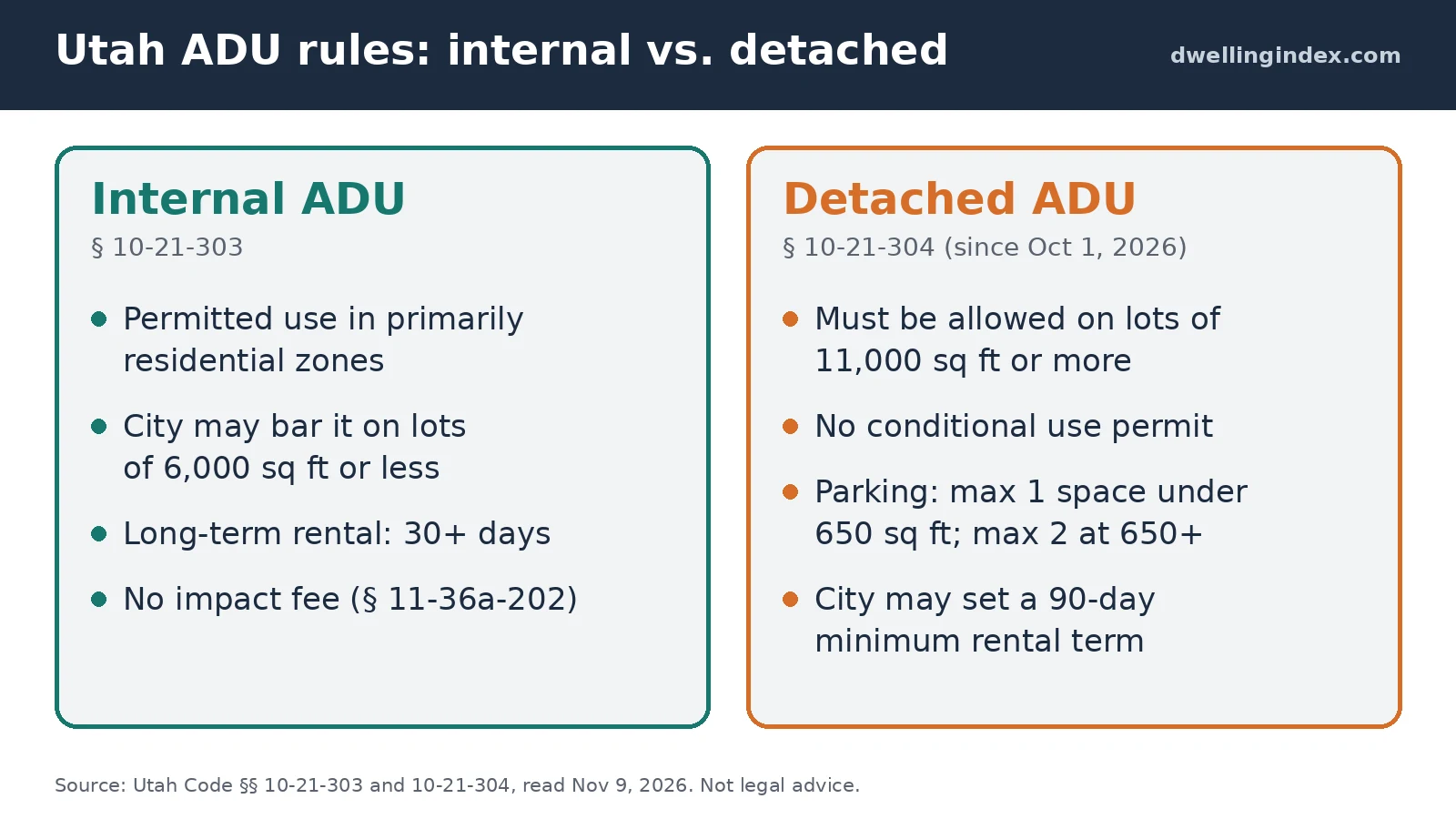
Answer: Utah cities keep control over most physical standards. For internal ADUs, they can require parking, a rental license, owner occupancy, and 30-day minimum rentals. For detached ADUs, they can regulate size, height, setbacks, coverage, design consistency, owner occupancy, and 90-day minimum rentals. They can't require a CUP or regulate the design elements protected by Utah Code § 10-20-618.
This is the comparison most pages skip. We built it from the statute text of §§ 10-21-303 and 10-21-304 (read November 9, 2026):
| Can a Utah city require… | Internal ADU (§ 10-21-303) | Detached ADU (§ 10-21-304) |
|---|---|---|
| A conditional use permit / hearing | No (it's a permitted use) | No, in a primarily residential zone |
| A minimum lot size | Only “6,000 sq ft or less” may be barred | Can't exceed 11,000 sq ft for qualifying lots |
| Extra parking | Up to 1 extra space (not if 4 already required) | Up to 1 space (<650 sq ft) or 2 spaces (650+ sq ft) |
| Replacement of lost garage parking | Yes, if the ADU is in the garage/carport | Yes, if a detached garage is converted |
| Owner occupancy | Yes: can bar renting if the home isn't the owner's primary residence | Yes: owner must live in the house or the ADU |
| Minimum rental term | 30 consecutive days | 90 consecutive days |
| Size limits | No limit tied to house size | Yes: size, height, dimensions, coverage; can't be larger than the house |
| Setbacks | Must fit within the existing footprint | Yes, including window orientation and massing |
| Matching design | Can require it to look like a single-family home | Can require design consistent with the house, within § 10-20-618 |
| Separate utility meter | Can prohibit one | Not addressed in § 10-21-304; check the city |
| One ADU per lot | Statute covers one internal ADU | City may limit the lot to one ADU total |
| Deny for utility capacity | Failing septic only | Yes: sewer, water, electric, storm water access or capacity |
Design elements a Utah city can't regulate for a detached ADU
Utah Code § 10-20-618, as summarized in ULCT's July 2026 training:
- Exterior color.
- Type or style of exterior cladding.
- Roof style, dimensions, materials, or pitch; porch style.
- Exterior nonstructural ornamentation.
- Window and door location, design, or styling, with one carve-out: § 10-21-304 lets cities consider window orientation in setback rules.
- Garage door styling (except rear-loading garage doors).
- Number or type of rooms, and interior layout.
- Minimum square footage over 1,000 sq ft (not including a garage).
- Rear-yard landscaping requirements, minimum building dimensions, and front-yard fencing requirements.
In practice, a city can say “match the house” and “keep it subordinate.” It can't dictate that your cottage use cedar shakes or a 12:12 roof.
Can you rent your ADU in Utah, and can you Airbnb it?
Answer: Yes, you can usually rent a Utah ADU long term, but Utah cities may require a rental license and owner occupancy. Short-term rental is the big limit: cities can ban internal-ADU rentals under 30 consecutive days and detached-ADU rentals under 90 consecutive days. Many Wasatch Front cities do both.
Long-term rental is the default use. The statutory definition of an internal ADU is built around rentals of 30 days or longer. That's why Utah internal ADUs pencil well as long-term rentals, family housing, or a mortgage helper.
Short-term rental is where most plans break. Millcreek, for example, prohibits short-term rentals in detached ADUs and requires owners to certify they live on the property at least 183 days a year (ULCT DADU training deck, July 2026). North Logan conditionally permits short-term rental with a CUP. That shows the range. If your budget only works as an Airbnb, verify your city's STR rule in writing before you design anything.
Owner occupancy is built into internal ADUs and optional for detached ones. The state's definition of “primary dwelling” in § 10-21-101(21) assumes the home is the owner's primary residence. On top of that, § 10-21-303(3)(j) lets a city prohibit renting an internal ADU if the home isn't the owner's primary residence. For detached ADUs, § 10-21-304 lets a city require the owner to live in either the house or the ADU. Salt Lake City requires owner occupancy, with exceptions for duplex or multifamily principal uses, bona fide temporary absences of up to three years, and owners placed in a medical-care facility (SLC Code § 21A.40.200(C)).
Enforcement has teeth. For internal ADUs, a city can record a lien of up to $100 per day after written notice and a cure window. The cure window is 14 days for short-term-rental violations and 30 days for other violations, and you get a hearing if you file a written objection within 14 days. Cities may also record a notice on title that the home contains an internal ADU.
If you plan to rent, the next problem after permits is managing the unit. Our ADU property management guide covers self-managing vs. software vs. a manager.
How do Utah cities actually write their ADU rules?
Answer: Utah city ADU ordinances vary widely within the state floor. In examples documented by the Utah League of Cities and Towns in July 2026, detached-ADU minimum lot sizes ranged from no minimum (Logan) to 10,000 square feet (Murray, Cedar City). Size caps ranged from 800 square feet (Cedar City) to 1,250 square feet (North Logan). Salt Lake City has no minimum lot size and caps detached ADUs at 1,000 square feet.
These examples show how much the details differ between cities. They come from ULCT's DADU training deck (posted July 2026) and Salt Lake City's code. Cities had to be compliant with § 10-21-304 by October 1, 2026, so some of these values may have changed. Treat each row as a starting point to verify, not a final answer.
| City | Detached ADU min. lot | Max size | Height | Setbacks / location | Parking / other | Source (as documented) |
|---|---|---|---|---|---|---|
| Salt Lake City | No minimum | 1,000 sq ft gross floor area | 17 ft (up to 24 ft pitched / 20 ft flat with added setbacks) | 3 ft side and rear; not in front yard | Owner occupancy required (exceptions); one ADU per property | SLC Code § 21A.40.200 |
| Millcreek | 8,000 sq ft | Lesser of main building's gross floor area or 1,000 sq ft | Lesser of 24 ft or main building | Rear yard; 5 ft side/rear; 6 ft from main building | Owner-occupied 183 days/yr; STR prohibited; 2 adults + children | ULCT deck, July 2026 |
| Murray | 10,000 sq ft | 50% of primary dwelling, max 1,000 sq ft | 20 ft, 1 story | 10 ft rear and side; not in front yard | 1 extra off-street space (3 total) | ULCT deck, July 2026 |
| Cedar City | 10,000 sq ft | 800 sq ft | 16 ft, 1 story | Same as main building | 12-ft minimum driveway access | ULCT deck, July 2026 |
| Logan | No minimum | 50% of main residence, max 1,000 sq ft | 20 ft or main residence height (lesser) | Same as main residence | 1 extra space (driveway OK) | ULCT deck, July 2026 |
| Ogden (proposed in July 2026) | 4,000 sq ft | 300–1,200 sq ft, ≤50% of main home | Up to main residence | Accessory-structure setbacks | No added parking if lot has 2 spaces | ULCT deck, July 2026 |
| North Logan | 10,000 sq ft (single-family zones) | 50% of footprint up to 1,250 sq ft | Up to main residence | Generally 6 ft side/rear | Owner occupancy covenant; STR by CUP; no trailers/mobile homes | ULCT deck, July 2026 |
Watch for minimums above the new floor. Draper's ADU ordinance was reported with a 12,000 sq ft minimum lot. For qualifying lots, that's stricter than the 11,000 sq ft floor now required by § 10-21-304. [NEEDS VERIFICATION: confirm Draper's current ordinance after October 1, 2026.] If your city's posted rules still show a minimum above 11,000 sq ft, ask planning staff whether the October 1, 2026 ordinance update has been adopted, and get the answer in writing.
Cities must now post their rules. Under S.B. 284 (2026), as summarized by ULCT, municipalities with an actively maintained website had to post their land use laws and fee schedules online by May 6, 2026. By October 1, 2026, they also had to post checklists of what makes a complete land-use application. That's your document list.
What about counties, HOAs, and development agreements?
Answer: Unincorporated county areas follow Utah Code § 17-80-303 for internal ADUs. The new detached-ADU mandate in § 10-21-304 is in the municipal code, so county detached-ADU rules come from each county's ordinance. § 10-21-304 also doesn't override city development agreements signed on or before May 6, 2026. Private HOA covenants are a separate legal question.
- Unincorporated counties. Internal ADUs are a permitted use under § 17-80-303. We didn't find a county-code counterpart to the detached-ADU mandate in Title 17. [NEEDS VERIFICATION] So check your county ordinance. Unincorporated Salt Lake County, for example, publishes its own detached-ADU standards.
- Development agreements. In master-planned communities, a development agreement the city signed on or before May 6, 2026 can still restrict detached ADUs.
- HOAs and CC&Rs. The ADU statutes discussed here regulate cities and counties, not private covenants. Read your CC&Rs and ask your HOA board before you design. If there's a conflict, a real-estate attorney can tell you what's enforceable.
How much does an ADU cost in Utah, and who builds them?
Answer: Utah ADU costs depend mostly on type. Internal basement conversions usually cost far less than detached new builds. Nest Tiny Homes, a Salt Lake City-based ADU design-build firm, publishes Utah model starting prices from $148,105 for a 240-square-foot studio to $276,083 for a 1,000-square-foot, three-bedroom model (checked November 9, 2026).
Rules tell you whether you can build. Cost tells you whether you should. Here are seven of the ten starting prices Nest Tiny Homes lists on its Utah models page, with the price per square foot we calculated:
| Nest Tiny Homes Utah model | Size | Beds / baths | Listed "starting at" | Our calc: $/sq ft |
|---|---|---|---|---|
| The Sparrow | 240 sq ft | Studio / 1 | $148,105 | $617 |
| The Willow | 300 sq ft | Studio / 1 | $151,124 | $504 |
| The Quail | 436 sq ft | 1 / 1 | $174,433 | $400 |
| The Hearth | 450 sq ft | 1 / 1 | $178,783 | $397 |
| The Haven | 535 sq ft | 2 / 1 | $202,794 | $379 |
| The Cedar | 748 sq ft | 2 / 2 | $240,814 | $322 |
| The Summit | 1,000 sq ft | 3 / 2 | $276,083 | $276 |
Source: Nest Tiny Homes Utah models page, read November 9, 2026. Prices are the company's published “starting at” figures, not quotes. The page doesn't state what's excluded, so ask in writing about site work, utility trenching, permit and impact fees, and finish upgrades. Price per square foot is our arithmetic.
See Nest Tiny Homes' Utah ADU models & pricingThe pattern matters for Utah's parking rule. Units under 650 sq ft can't be required to have more than one parking space under § 10-21-304. On tight lots, that can make a 600-sq-ft plan easier to site than an 800-sq-ft one. Smaller units cost more per square foot, though, because the kitchen, bathroom, and utility connections cost about the same at any size.
Nest Tiny Homes is also one of five firms whose plans appear on Salt Lake City's pre-approved ADU standard plans list (plan 2B-775, 775 sq ft, 2 bedrooms). A pre-approved plan has already been reviewed for building-code compliance. A site review and permit are still required, and fees still apply.
Want to compare providers before you call? See our guide to Utah ADU builders. For costs at a national level, see how much an ADU costs. If you're in Salt Lake City, also check the city's Backyard Keys ADU loan program and our Salt Lake City ADU loan program guide.
How do you check your own lot in Utah?
Answer: To check a Utah lot for an ADU, confirm five things in order: your jurisdiction (city or unincorporated county), the zone, the lot's square footage, your city's current detached-ADU ordinance and any HOA or development agreement, and utility access. Then confirm rental and parking rules before you pay for design.
- Find your jurisdiction. Your mailing city isn't always your zoning authority. Many “Salt Lake City” addresses are in Millcreek, Holladay, or unincorporated Salt Lake County. Check the county parcel record.
- Find your zone. It must be primarily residential, and the single-family home must be a permitted use there, not a conditional or nonconforming use, for § 10-21-304 to apply.
- Measure the lot. Use the 43,560 sq ft-per-acre conversion, and watch the 0.25-acre trap (10,890 sq ft).
- Pull your city's current ADU ordinance. Confirm it was updated for October 1, 2026, and look up size, height, setbacks, owner occupancy, and the STR rule.
- Check private restrictions. CC&Rs, HOA rules, and any development agreement signed on or before May 6, 2026.
- Check utilities. Find where sewer and water connect, whether sewer can reach the backyard by gravity, and whether your service provider has capacity. Cities can deny a detached ADU over this.
- Decide internal vs. detached. An internal ADU skips impact fees and the lot-size floor. A detached ADU gives more privacy and rental appeal but costs more.
Methodology
We read each statute's current text on the Utah Legislature's site rather than relying on summaries, and noted the effective date and history line for each. We compared the “may” and “may not” lists in §§ 10-21-303 and 10-21-304 line by line to build the comparison matrix. City examples come from ULCT's published training material and Salt Lake City's code. We kept each row labeled with its source, because cities were changing ordinances around the October 1, 2026 deadline. Provider pricing was read directly from the provider's site on the date shown. We didn't contact cities or providers for this version. We plan to re-verify quarterly and after each Utah legislative session.
Sources
- Utah Code § 10-21-303, Internal accessory dwelling units (effective 11/6/2025) — official Utah Code § 10-21-303
- Utah Code § 10-21-304, Detached accessory dwelling units (effective 10/1/2026) — official Utah Code § 10-21-304
- Utah Code § 17-80-303, Internal accessory dwelling units (counties) — official Utah Code § 17-80-303
- Utah Code § 11-36a-202, Prohibitions on impact fees — official Utah Code § 11-36a-202
- Utah Code § 10-21-101, Definitions (current version effective 7/1/2026) — official Utah Code § 10-21-101
- Utah League of Cities and Towns, “Detached ADUs” training deck (July 2026); “DADU Roadmap” one-pager (July 2026); 2026 Legislative Session Recap (May 2026) — ulct.org
- Salt Lake City Code § 21A.40.200, Accessory Dwelling Units — Salt Lake City Code
- Salt Lake City Building Services, Accessory Dwelling Unit Standard Plans — slc.gov
- Nest Tiny Homes, Utah ADU models — via our tracked link nest-tiny-homes
Frequently asked questions
Are ADUs legal in Utah?
Yes. Internal ADUs are a permitted use in primarily residential zones statewide (Utah Code § 10-21-303 for cities, § 17-80-303 for counties). Since October 1, 2026, most cities with 5,000+ residents must also allow detached ADUs on lots of 11,000 sq ft or more with a permitted single-family home (§ 10-21-304).
What is the minimum lot size for a detached ADU in Utah?
State law requires covered cities to allow a detached ADU on lots of 11,000 sq ft or more. Cities can allow smaller lots, and some do: Salt Lake City and Logan have no minimum, and Millcreek's documented minimum is 8,000 sq ft. For internal ADUs, a city can bar them only on lots of 6,000 sq ft or less.
Do I need a conditional use permit for an ADU in Utah?
Not for an internal ADU, which is a permitted use. For a qualifying detached ADU in a primarily residential zone, § 10-21-304 bars cities from requiring a conditional use permit. You still need a building permit and any city zoning clearance.
Can I Airbnb my ADU in Utah?
Often not. Cities can prohibit internal-ADU rentals under 30 consecutive days and detached-ADU rentals under 90 consecutive days. Some cities, like Millcreek, prohibit short-term rentals in detached ADUs. Check your city's STR ordinance before designing around nightly income.
Do I have to live on the property to have an ADU in Utah?
For an internal ADU, generally yes. Utah's statutory definition of "primary dwelling" is a detached single-family home occupied as the owner's primary residence, and cities may bar renting an internal ADU when the owner doesn't live there. For a detached ADU, it's the city's choice: § 10-21-304 lets cities require the owner to live in the house or the ADU. Salt Lake City requires owner occupancy, with limited exceptions.
Do Utah ADUs pay impact fees?
An internal ADU built inside an existing home can't be charged an impact fee under Utah Code § 11-36a-202(2)(a)(vi). Detached ADUs aren't covered by that exemption, so check your city's fee schedule. Cities had to post fee schedules online by May 6, 2026.
How much parking can a Utah city require for an ADU?
For an internal ADU, one extra on-site space (none if the city already requires four). For a detached ADU, no more than one space if it's under 650 sq ft and no more than two if it's 650 sq ft or larger. Cities can also require replacement of parking lost in a converted garage.
Can I convert my detached garage into an ADU in Utah?
Yes, in cities covered by § 10-21-304. Their ordinances must include a process to convert a legally constructed accessory structure into a detached ADU, subject to setbacks and building, health, and fire codes. The city may require you to replace any required parking that was in the garage.