
Tiny Home ADU — Complete Guide
Tiny Home ADU: Costs, Rules, and the Wheels-vs-Foundation Decision That Changes Everything (2026)
By the Dwelling Index Research Team · Last updated: May 27, 2026 · Last verified: May 27, 2026 · ~26 min read
The Short Answer
Yes, a tiny home ADU is possible — but only if the unit fits a legal ADU category your city actually recognizes, and that hinges almost entirely on one thing: permanent foundation vs. wheels. A tiny home on a foundation is reviewed like any small detached ADU (an accessory dwelling unit — a self-contained second home on a lot that already has a main house). It’s the normal detached-ADU path wherever detached ADUs are allowed. A tiny home on wheels (often called a THOW or Movable Tiny House) is only permitted as an ADU in specific jurisdictions that wrote a movable-tiny-house ordinance; everywhere else it’s classified as a recreational vehicle.
Applies to: U.S. homeowners evaluating a tiny home or THOW as a backyard ADU, especially on single-family lots.
Do this first: Confirm the legal category that applies to your lot before you buy a unit, place a deposit, or call a builder. See What You Can Build → Get Your Free ADU Report
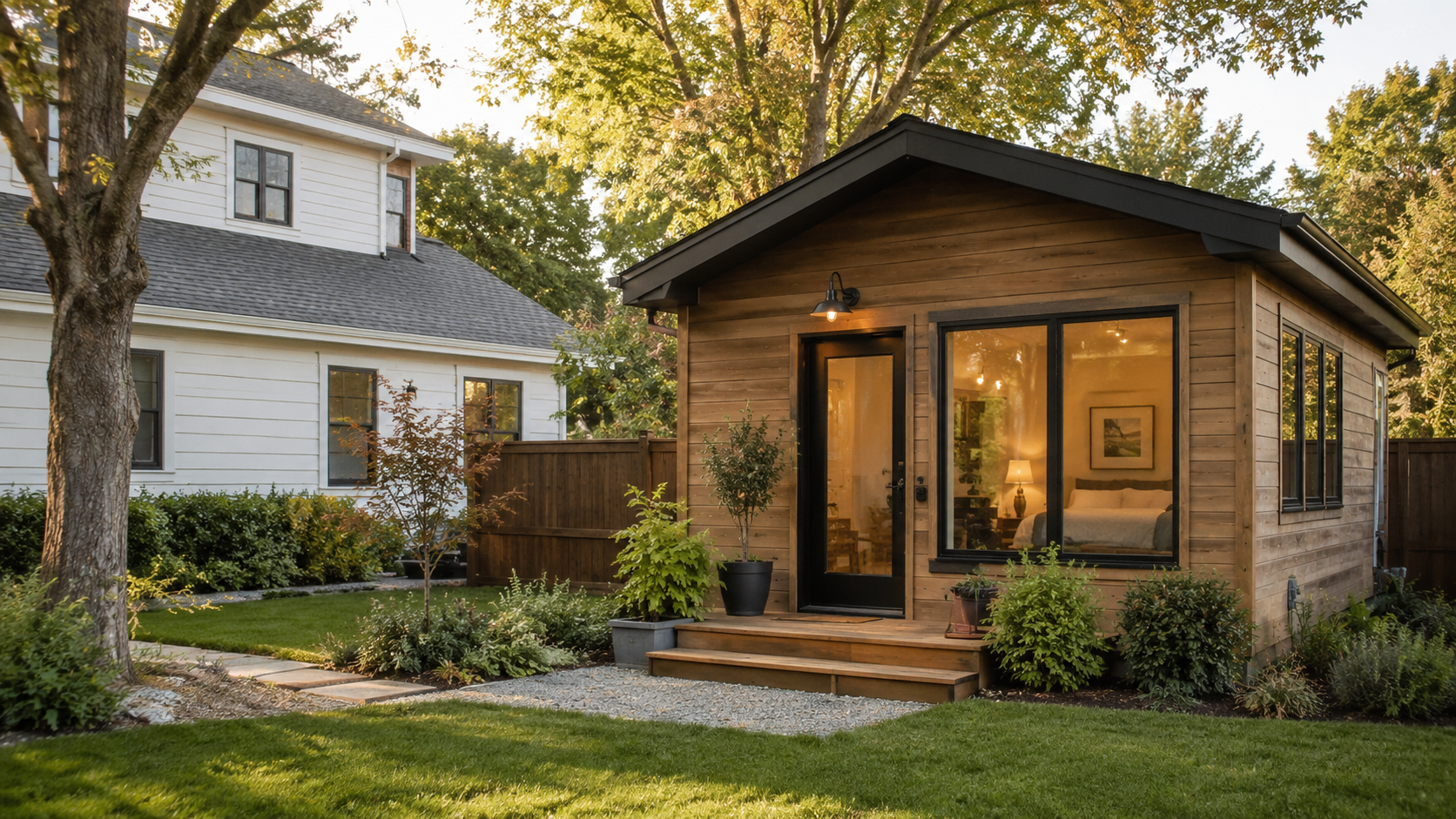
Dwelling Index is an independent research resource covering ADU financing, costs, and regulations. We don’t sell tiny homes or ADUs — which is why we can tell you the part the sales pages won’t.
We’ve read the sales pages too. A backyard tiny home for $60,000 next to an ADU quote for $300,000 makes the choice look obvious. The catch is that those two numbers aren’t measuring the same thing — one is a unit, the other is a finished, permitted, occupiable project. This guide closes that gap. We’ll show you the four code regimes that decide your unit’s legal fate, a city-by-city legality matrix assembled from official municipal and state sources, a real 2026 cost stack for both paths, and a 20-point pre-deposit checklist that catches the mistakes most buyers make.
See What You Can Build → Get Your Free ADU Report
Check your likely path before you buy a unit, place a deposit, or call a builder. Two minutes, your address, no obligation.
Check My Property →Which tiny home ADU path are you actually considering?
Most readers arrive here picturing one product. In reality you’re choosing between five or six legally distinct objects, each with its own permit path, cost, and rental outcome. Here’s the orientation table — the one to screenshot before you talk to anyone.
| Path | Usually legal as an ADU? | What proves it’s legal housing? | Best for | Biggest catch |
|---|---|---|---|---|
| Foundation-built tiny home | Often — reviewed as a detached ADU | Building permit + final inspection / certificate of occupancy | Long-term housing, resale, financing, rentals | Highest all-in cost; full building permit |
| Modular / prefab tiny ADU | Often, on a foundation to local code | State modular insignia + local ADU permit + final | Faster production, predictable design | Factory “starting at” price is not the all-in project cost |
| Manufactured tiny home (HUD-code) | Possible where local rules allow it | HUD label/data plate + permanent foundation + local ADU permit | Permanent smaller housing | Must satisfy HUD, foundation, and local ADU rules |
| Tiny home on wheels (THOW / MTH) | Only in specific jurisdictions | ANSI/NFPA certification label + DMV registration + local MTH approval | Lowest upfront unit cost where allowed | Treated as an RV unless a local ordinance says otherwise |
| Park model / RV | Usually not an ADU | Local occupied-RV approval (not an ADU) where it exists | Temporary or limited use where permitted | Occupancy, rental, and utility limits |
| Shed / cabin / “tiny office” | No, unless permitted as a dwelling | Full dwelling permit with kitchen, bath, code compliance | Workspace, storage | Not legal housing without a permitted conversion |
Sources: SnapADU “Tiny Home vs. ADU” (Feb 2026); City of San José ADU page and Bulletin 291; City of San Diego Information Bulletin 403. Verified May 2026.
The single most expensive mistake in this category is buying the unit first and asking the city later. Get the category right, and everything downstream — permits, financing, insurance, rental income — falls into place.
Can a tiny home be an ADU?
The legal definition is more demanding than the marketing. The Los Angeles ADU ordinance, for example, defines an ADU as a residential dwelling unit with complete independent living facilities on the same lot as a single-family or multifamily home — and it explicitly folds manufactured homes and “Movable Tiny Houses” into that definition (City of Los Angeles, Ordinance 186,481). The phrase “complete independent living facilities” is the bar. A beautiful shell with no permitted kitchen, sanitation, or utility connection is not an ADU.
The five categories people blur together
Searchers type one phrase and mean very different legal objects:
| What they type | What it might legally be |
|---|---|
| “tiny home” | Small site-built dwelling, modular unit, manufactured home, RV, or THOW |
| “tiny home ADU” | Detached ADU, prefab ADU, manufactured ADU, or a local MTH/THOW path |
| “tiny house on wheels” | RV, park model, THOW, MTH, or a state-approved tiny house |
| “backyard cottage” | Detached ADU (sometimes called a DADU — detached accessory dwelling unit) |
| “shed conversion” | Usually not a dwelling unless fully permitted |
The takeaway: the word on the price tag tells you almost nothing about whether you can legally live in it or rent it. The construction type and your local code tell you everything.
Does it matter if the tiny home has wheels? (Yes — wheels change the category)
This is the fork the whole page turns on. Seattle is the cleanest cautionary tale: the city’s permitting department treats tiny houses on wheels like camper trailers — they cannot be lived in on a standard lot — while a tiny house with a foundation is considered a DADU (Seattle SDCI). Same square footage, same finishes, opposite legal outcome. The wheels are the difference.
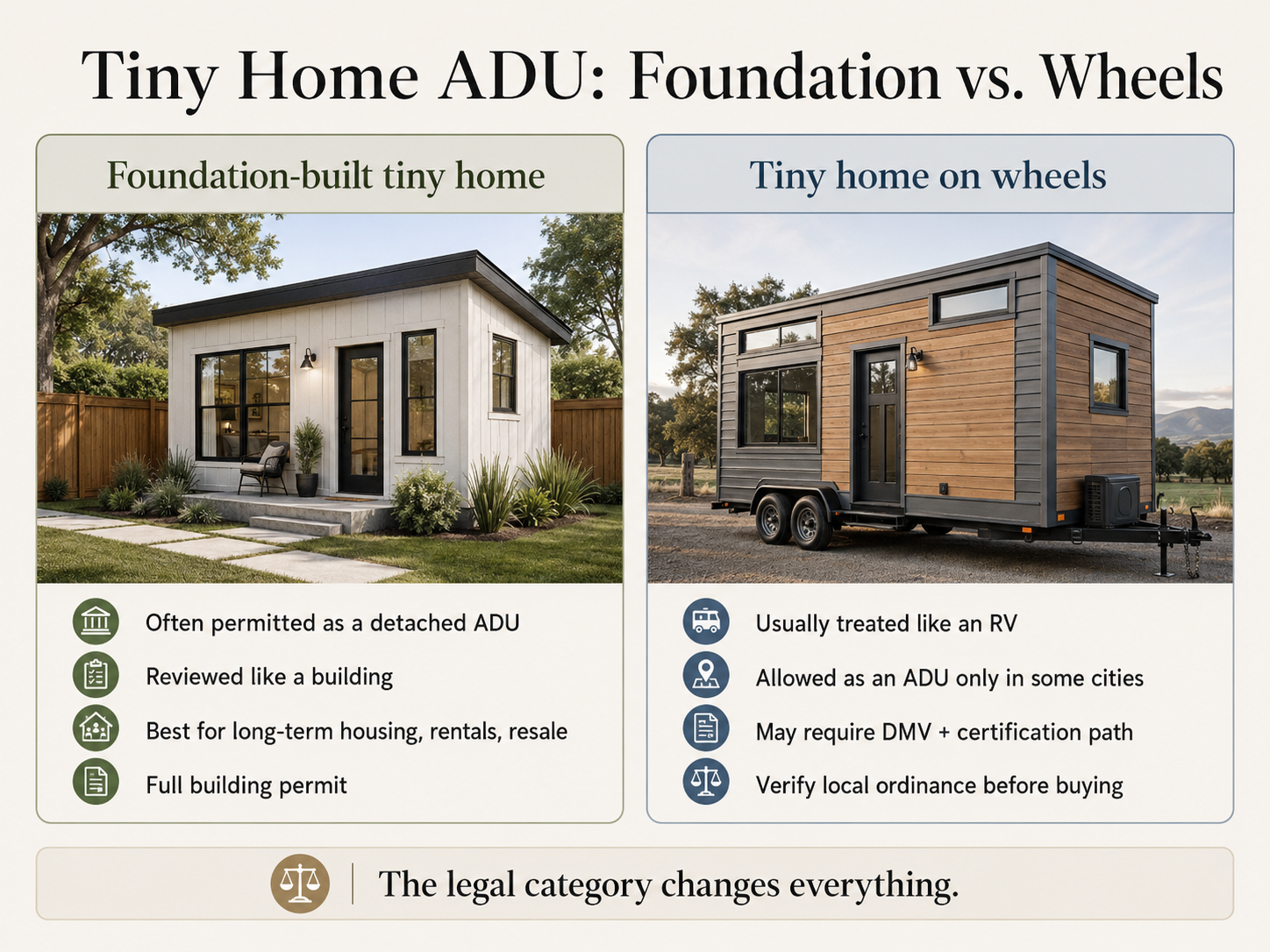
Foundation-built tiny home → real property
- Treated like real estate. It can be mortgaged, refinanced, insured as a dwelling, and it generally appreciates and adds appraised value.
- Requires a full building permit and staged inspections.
- The standard detached-ADU path wherever detached ADUs are allowed and the unit meets local building, zoning, utility, and occupancy rules.
- Costs more than the unit-only sticker price because you’re building a permitted structure, not parking one.
Tiny home on wheels (THOW / MTH) → a vehicle, usually
- A THOW (tiny home on wheels) or MTH (Movable Tiny House — the term used in city ordinances) is built to a recreational-vehicle standard, not a residential building code.
- Most builders certify to ANSI A119.5 (the park-model RV standard) or NFPA 1192 (the RV standard); a third-party agency affixes a compliance label, and the unit is licensed and registered with the DMV (Tiny Home Industry Association).
- Critically, that RV certification does not make it an ADU. It becomes an ADU only where a city wrote movable tiny houses into its code.
- Financed and insured like an RV; generally depreciates like a vehicle.
Park model or RV → rarely an ADU
Some cities permit an occupied RV or THOW on a residential lot without calling it an ADU at all. Portland is the textbook example, and we break down exactly how that works in the matrix below.
The damaging admission, stated plainly: the cheapest tiny home to buy can become the most expensive mistake if it’s the wrong legal category. We’ve seen the pattern — a homeowner falls for a $90,000 wheeled unit, assumes “ADU,” and discovers their city classifies it as an RV they can’t permanently occupy or rent. The good news: this is entirely avoidable. Confirm the category first (the checklist near the end does exactly that), and the wheels-vs-foundation decision becomes straightforward.
The 4 code regimes that decide your tiny home’s legal status
This is the framework most pages mention one piece of and never assemble. Here are all four, decoded — including the document you should ask to see for each.
| Code regime | What your unit legally is | Can it be a permitted ADU? | Ask for this document | Plain-English “so what” |
|---|---|---|---|---|
| IRC Appendix Q / AQ (Int’l Residential Code tiny-house appendix; named Appendix Q in 2018 IRC, Appendix AQ in 2021 IRC) | A small site-built dwelling (≤400 sq ft) on a foundation | Yes | Building permit + final inspection approval | The cleanest path. Relaxes loft, stair, and ceiling-height rules so a tiny footprint still passes residential inspection. “A regular house that happens to be small.” |
| HUD Code (federal manufactured-housing standard; min. 320 sq ft, built on a permanent chassis to federal construction and safety standards) | A factory-built manufactured home with a HUD label | Possible where local ADU rules allow manufactured homes | HUD label / data plate + foundation + local ADU permit | A HUD label alone does not make it a permitted ADU. The unit must also meet foundation, utility, and local siting rules. |
| ANSI A119.5 / NFPA 1192 (park-model & RV standards, RVIA) | A recreational vehicle / “Movable Tiny House” | Only where a local MTH ordinance exists | Third-party ANSI/NFPA certification label + DMV registration + local MTH approval | The wheels path. RV-certified, DMV-titled. An ADU only in cities that specifically wrote movable tiny houses into code. |
| State modular program | A modular dwelling with a state insignia | Yes, on a foundation to local code | State modular insignia + local ADU permit | Built in a factory to the same residential code as a site-built home, then set on a foundation. Treated as real property like any stick-built ADU. |
Sources: ICC Digital Codes (IRC Appendix Q/AQ); U.S. Department of Housing and Urban Development (manufactured-home definition); Recreational Vehicle Industry Association (ANSI A119.5 / NFPA 1192); Tiny Home Industry Association. Verified May 2026.
The IRC tiny-house appendix exists precisely so a dwelling of 400 square feet or less can pass inspection without meeting full-size-home dimensions for lofts, stairs, and ceilings. The name changed across code versions — Appendix Q in the 2018 IRC, Appendix AQ in the 2021 IRC — so check which your jurisdiction adopted.
ANSI A119.5 / NFPA 1192 is where the confusion lives. A movable tiny house certified to these standards gets a VIN and a DMV title — which makes it roadworthy, not occupiable as an ADU. The Tiny Home Industry Association is explicit that the industry adopted RV standards in lieu of movable-tiny-house-specific building standards. That borrowed framework is exactly why wheeled units sit in a regulatory gray zone.
Download the Free ADU Starter Kit
Includes a code-and-permit checklist and a city-call script so you can confirm which regime applies to your lot — and which document to ask the builder for.
Get the Free Starter Kit →Where are tiny homes on wheels allowed as ADUs? (The 2026 legality matrix)
This is our proprietary asset, assembled from official municipal and state sources. To reproduce it, you’d have to open a dozen code pages and decode each one — so we did. Each row links to the governing document.
2026 Tiny Home ADU Legality Matrix
| Jurisdiction | THOW = ADU? | Key rules & conditions | The catch | Source |
|---|---|---|---|---|
| City of Los Angeles, CA | Yes | Movable Tiny House included in the ADU ordinance. 150–430 sq ft; licensed and registered with the CA DMV; ANSI A119.5 or NFPA 1192; cannot move under its own power | Must meet MTH design/siting rules (no slide-outs, residential-style windows); one MTH per lot | City of LA Ordinance 186,481 |
| City of San Diego, CA | Yes | MTH must be 150–430 sq ft, one story, licensed/registered with the CA DMV, not self-propelled, not separately addressed, located behind or to the side of the primary home, ≥5 ft from lot lines / ≥10 ft from other structures, and connected to water, sewer, and electricity. Natural gas connections are prohibited. Rentals must be 30+ consecutive days. Exempt from DIF impact fees. | No short-term rental (the 30-day floor blocks Airbnb-style use); coastal/brush-management/MHPA limits can apply | City of San Diego Information Bulletin 403 |
| San Jose, CA | Yes | THOW is officially “a type of detached ADU,” single-family lots only; ANSI A119.5 or NFPA 1192; licensed/registered with the CA DMV; wheels stay on but concealed; no extra parking required; must sit ≥6 ft from the primary dwelling | A detached ADU and a THOW are not both allowed on the same lot; remove the wheels and set it on a foundation, and it converts to a standard detached ADU | City of San José ADU page + Bulletin 291 |
| Unincorporated San Diego County, CA | Yes | THOW may serve as a primary or accessory dwelling when requirements are met: ANSI A119.5 third-party certification, DMV registration, no self-propulsion, no slide/pop-outs, max ~430 sq ft, paved pad, utility hookups with building permits, one story / 16 ft max, plus density/setback compliance | Doesn’t override density or unit-count rules | County of San Diego THOW determination |
| Santa Clara County, CA | Yes | County ADU ordinance includes Movable Tiny Homes. One MTH per lot in lieu of one standard ADU; must be self-contained, ANSI A119.5 certified by an accredited third party, licensed/registered with the CA DMV, ≥100 sq ft enclosed, and directly connected to water, sewer/wastewater, and electricity. Holding tanks cannot be used for required waste storage. Rentals must be 30+ days. | One MTH replaces — doesn’t add to — your standard ADU allowance | Santa Clara County Zoning Ordinance |
| Portland, OR | No — but occupied THOW allowed | An occupied RV or tiny house on wheels may be hosted on a developed residential lot with a primary home; one per lot; wheels stay on; parked behind the front face; ≥5 ft from the primary dwelling; potable-water/sanitary-sewer connections required when the unit has internal plumbing | Explicitly not an ADU and doesn’t count toward density; no short-term rentals; not allowed on vacant lots | Portland.gov “Occupied RVs and Tiny Houses on Wheels” |
| Seattle, WA | No (wheels) / Yes (foundation) | THOW is treated like a camper trailer — can’t be lived in on a standard lot; a foundation tiny house is a DADU | The wheels are the dealbreaker; the foundation path is the ADU path | Seattle SDCI |
| Washington (statewide) | Conditional | The state has a tiny-house / tiny-house-with-wheels approval path for dwellings ≤400 sq ft built to the Washington State Building Code; offsite-built units carry an L&I insignia | State approval ≠ local ADU approval; local permits still control use, placement, utilities, foundations | Washington State L&I tiny-homes guidance |
| Maine (statewide) | Conditional | State law sets a 190 sq ft ADU minimum unless the Technical Building Codes and Standards Board adopts a different figure; 2026 state housing guidance reports the Board set a 160 sq ft minimum in March 2025 | Municipal land-use rules and water/wastewater verification still govern | Maine Title 30-A §4364-B + 2026 state housing guidance |
What the matrix actually proves
- “Allowed in the state” never means “allowed on your lot.” California has the most verified local MTH/THOW ADU paths we found — Los Angeles, San Diego, San Jose, and Santa Clara County — and even within it, the rule changes city by city and county by county.
- Some places allow the unit but not the use you want. Portland will let you live in a backyard THOW long-term — but it’s an RV, not an ADU, it doesn’t add density, and you can’t run it as a short-term rental.
- Remove the wheels and the category flips. San Jose is explicit: take a THOW off its chassis and onto a foundation, and it stops being a THOW and becomes a standard detached ADU — with the standard detached-ADU permit path.
- Rental rules are written into the ordinance. San Diego and Santa Clara County both impose a 30-day minimum rental term on movable tiny houses. If your plan was nightly rentals, the city already decided otherwise.
Check Your Lot Before You Buy → Get Your Free ADU Report
The same unit can be a legal ADU in one city, an occupied-RV-only in the next, and flatly prohibited a county over. See what your specific address allows.
Check My Property →How much does a tiny home ADU cost in 2026?
The most important sentence in this section: the unit price is not the project price. Tiny-home ads quote a shell, a factory base model, or a “starting at” number. A legal, occupiable ADU adds design, permits, delivery, foundation or pad, sewer, water, electrical, inspections, and contingency. Here’s the full stack.
Affiliate disclosure: The Dwelling Index is reader-supported. Some links on this page are affiliate links. If you click one and take a qualifying action, we may earn a commission at no extra cost to you. Affiliate relationships do not influence our editorial rankings or conclusions. Read our full disclosure.
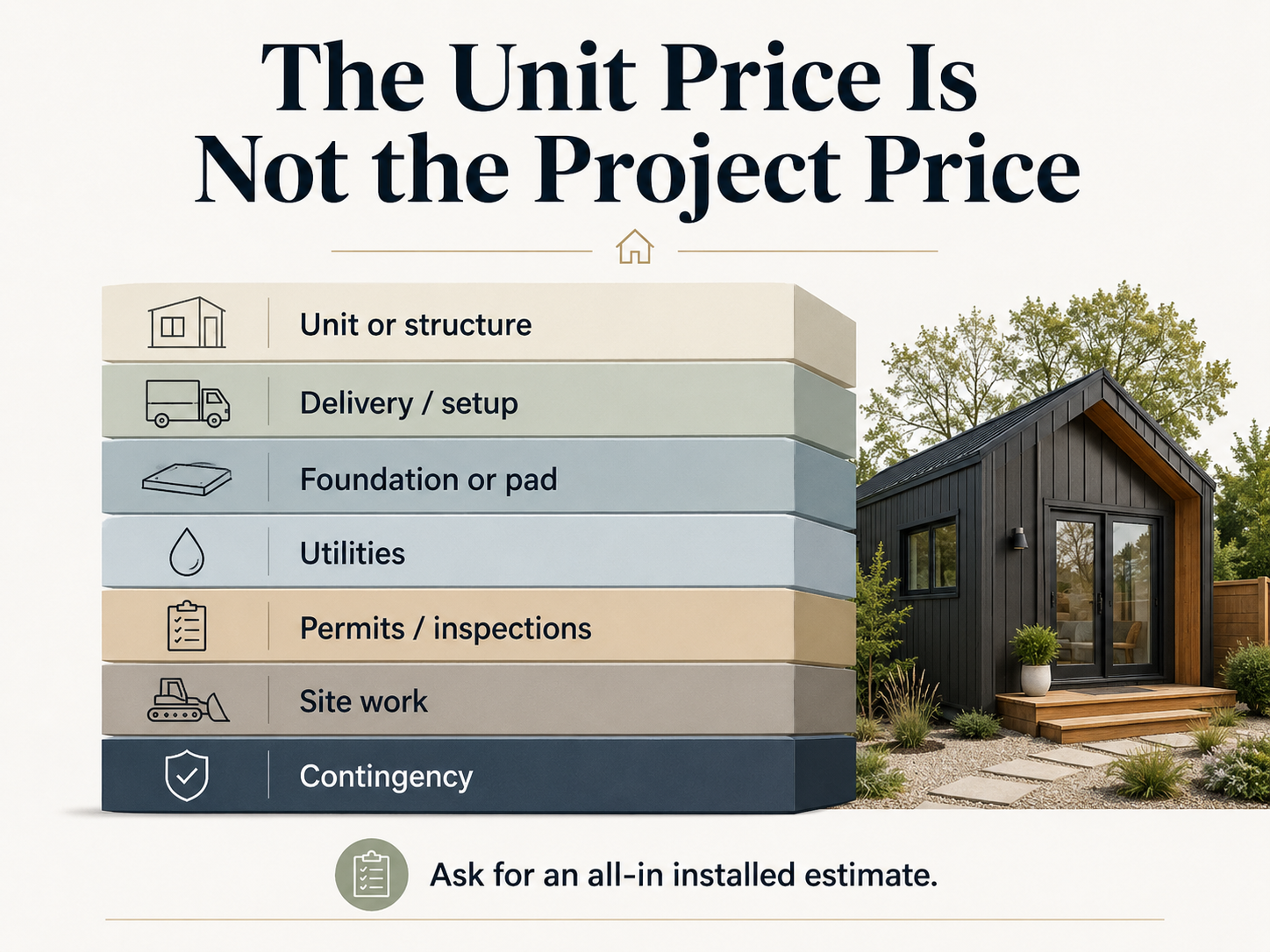
Tiny home ADU all-in cost stack by path (2026)
| Cost component | Tiny home on wheels (THOW) | Foundation-built tiny ADU |
|---|---|---|
| The unit / structure | $70k–$150k pro-built turnkey (most $80k–$130k; $30k DIY at the low end) | $80–$160/sq ft prefab · $200–$400/sq ft site-built |
| Foundation / pad | Pad + anchoring (paved pad required in most MTH ordinances) | Concrete slab foundation ≈ $12,000–$28,000 |
| Transport, hookups & site setup | Quote-specific; delivery and installation commonly $5,000–$10,000+, plus pad and utility work | Utility connections vary widely by lot |
| Permits & fees | DMV registration + local MTH permits (where allowed) | Building permits ≈ $1,350–$9,000+ (city-dependent) |
| Typical all-in | Low-to-mid six figures once site work is included | Low six figures for simple projects; $300k–$450k+ in high-cost metros |
Sources: HomeGuide tiny-house cost and ADU cost guides (Jan 2026; concrete slab foundation $12k–$28k; detached ADU $150–$250/sq ft); Angi “How Much Does an ADU Cost? [2026 Data]” (permits $1,350–$9,000; prefab saves ~20%); Clever Tiny Homes THOW cost (Apr 2026: $70k–$150k, most $80k–$130k); Investopedia (delivery/installation $5k–$10k+); SnapADU (Apr 2026: San Diego detached ADUs $375–$600+/sq ft, $300k–$450k+ all-in). Verified May 2026. Site-specific delivery, pad, and utility totals should be confirmed against installer or completed-project quotes for your lot.
Why a tiny ADU can cost a lot per square foot
This surprises people: smaller doesn’t scale down proportionally. A kitchen and a bathroom are fixed-cost rooms whether the unit is 350 or 800 square feet. The utility trench, the plan check, the inspections, and the crane or delivery don’t shrink with the floor plan. SnapADU notes this directly — because fixed costs spread across a smaller footprint, price per square foot is often higher for a small ADU than for a large house (SnapADU, Apr 2026). That’s why a charming 400-square-foot detached unit in a high-cost market can still cross $200,000.
The costs buyers forget
| Forgotten item | Why it matters |
|---|---|
| Delivery & setup | Tiny-home delivery and installation commonly runs $5,000–$10,000+ depending on distance and site access (Investopedia, 2025). |
| Utility connection | Running sewer/septic, water, and electrical to a backyard unit is the biggest variable line item, especially on difficult lots. |
| Permit fees vary wildly | One San Diego–area analysis found Encinitas permit fees around $2–$4/sq ft while the City of San Diego ran $13–$28/sq ft (SnapADU, Apr 2026). |
| Certification | THOW/MTH paths require third-party ANSI/NFPA certification before the city signs off. |
| Foundation or pad | A concrete slab foundation averages $12,000–$28,000; even wheeled units need an approved paved pad (HomeGuide, 2026). |
| Property taxes | In California, new ADU construction generally triggers a supplemental assessment on the incremental value of the new unit — your existing home is not reassessed because of the ADU. The actual rate depends on county and local levies (California State Board of Equalization). |
| Contingency | Utility surprises and site conditions are the most common budget-breakers. Hold 10–15%. |
Explore Ways to Pay for a Tiny Home ADU → See Your Financing Paths
If the all-in number gave you sticker shock, this is the next problem to solve. We map the financing lanes homeowners actually compare — sorted by neutral criteria, never lender rankings, never rates as promises.
See Financing Options →Is a tiny home ADU actually cheaper than a regular ADU — or did I just reinvent one?
This is the part sales pages tend to skip. The clean way to think about it:
- You want maximum savings and you’re fine with RV status in a limited set of locations? The wheels path can genuinely be cheaper upfront — if you’ve confirmed your city allows MTH-as-ADU first. Otherwise you may own a beautiful object you can’t legally live in.
- You want a permanent, financeable, appreciating, rentable unit? You’re building a small detached ADU. The smartest lever to cut its cost is going prefab/modular to capture the roughly 20% factory savings and keeping the footprint compact — not chasing the “tiny home” label.
Either way, the trap is identical: paying for the unit on the assumption it’s an ADU, then learning your jurisdiction classifies it as something you can’t occupy. Categorize first, buy second.
What permits and site work will you need?
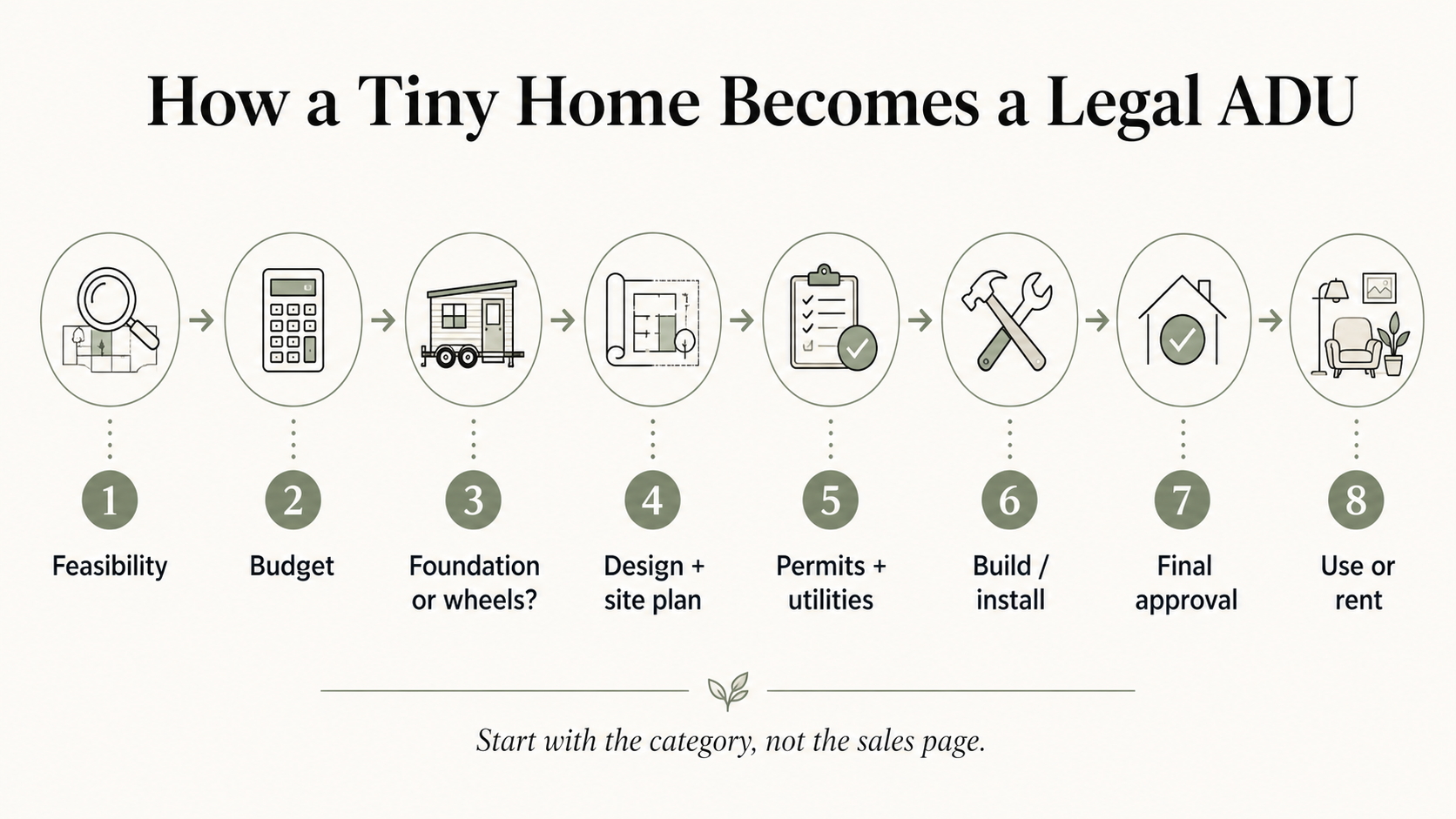
Here’s the sequence we’d run, in order.
Step 1 — Confirm zoning and ADU allowance. Identify your zoning district, confirm there’s an existing legal primary dwelling, and check how many ADUs/JADUs your lot already allows. A JADU (junior ADU) is a smaller unit, capped at 500 sq ft in California, usually carved from the existing home. Also check lot coverage, setbacks (the minimum distance a structure must sit from each property line — commonly 4 ft side/rear for detached ADUs in California), height limits, and any coastal, flood, slope, wildfire (WUI), or historic overlays.
Step 2 — Confirm the unit category. Run the decision tree:
| Question | If yes | If no |
|---|---|---|
| Permanent foundation? | Detached ADU path | Continue |
| On wheels? | MTH / THOW / RV path | Continue |
| Factory-built to modular/manufactured standards? | Modular / manufactured path | Continue |
| Has kitchen, bath, sleeping, sanitation? | Possible dwelling | Not an ADU yet |
| Does your city explicitly allow that category? | Proceed to permit scope | Do not buy yet |
Step 3 — Confirm utilities. Sewer or septic capacity, water meter and service size, electrical panel capacity (a panel upgrade is a common hidden cost), trenching route, easements, separate metering, and the utility lateral (the pipe or line connecting your unit to the public main). Real ordinances are specific here: San Diego’s MTH rules require connections to water, sewer, and electricity and prohibit natural gas; Portland’s occupied-RV path requires potable-water and sanitary-sewer connections when the unit has internal plumbing; Santa Clara County prohibits holding tanks for required waste storage.
Step 4 — Confirm pad, foundation, anchoring, and fire separation. Concrete pad or foundation, tie-down/anchoring for wheeled units, and distance from the primary home. San Jose requires a THOW to sit at least 6 feet from the primary dwelling; San Diego requires at least 5 feet from lot lines and 10 feet from other structures.
Step 5 — Confirm inspection and occupancy. A delivered unit is not legal housing until the final sign-off. Ask the single most important question early: what document proves this unit is legally occupiable?
On timing: don’t trust a one-size national number. Seattle says pre-approved DADU plans can be permitted in as little as 2–6 weeks in most cases, while a custom detached ADU or a THOW with full underground electrical, sewer, water, and final inspections takes considerably longer. Prefab and modular units compress the construction window because the box is built in the factory in parallel with your site prep — but they do not eliminate the local permit process. The slow part was never the building; it’s the approvals, and those happen regardless of where the unit is made.
Which tiny home ADU path fits your situation?
| Your situation | Best first path | Avoid this mistake | Next action |
|---|---|---|---|
| Housing a parent long-term | Foundation-built or modular ADU | A wheeled unit with no accessibility, utility, or legal-occupancy review | Feasibility report + accessibility checklist |
| Adult child or guest housing | Small detached / prefab ADU | Assuming a shed or RV can be lawfully occupied | Verify dwelling status |
| Rental income | A legally permitted ADU with clear rental rules | Counting short-term-rental income before checking the 30-day-minimum and STR limits | Review rental rules; run conservative numbers |
| Lowest upfront unit cost | THOW/MTH only where explicitly allowed | Buying before zoning approval | Check jurisdiction first |
| Fastest path | Pre-approved plan or prefab/modular where the local process supports it | Assuming factory speed eliminates permits | Verify the permit timeline |
| Rural land | State/local tiny-home or manufactured-home path | Assuming “rural” means “no code” | Call county planning/building |
| High resale focus | Permanent foundation ADU | A wheeled unit that may not appraise as real estate | Talk to a lender, assessor, and insurer |
If your goal is family housing, prioritize legal occupancy, safety, accessibility, heating/cooling, and long-term maintenance over mobility. A foundation or modular ADU is almost always the more durable answer.
If your goal is rental income, count income only from a legally permitted unit, confirm the minimum rental duration (30 days in several MTH ordinances), and check short-term-rental restrictions before you build a spreadsheet around nightly stays.
These are illustrative examples, not guarantees of returns. Actual results depend on local market conditions, construction costs, financing terms, and regulatory approvals.
If your goal is the lowest possible budget, start with legality, not price. The cheapest legal path is often a garage conversion, a JADU, or a compact foundation ADU — not a THOW you can’t permit.
Can you finance a tiny home ADU?
Why foundation matters here: real property can serve as collateral, appraises as part of your home’s value, and fits standard lending products. A wheeled unit titled as a vehicle generally can’t. As Investopedia notes, many tiny homes don’t qualify for traditional mortgages, and wheeled units may only qualify for RV-style financing (Investopedia, 2025).
We present financing lanes, not lender rankings — and never quote rates, APRs, or payments as guarantees. Here’s how the code category you chose earlier maps to your likely financing treatment:
| Your unit’s legal category | Likely financing treatment |
|---|---|
| Foundation-built ADU (real property) | Mortgage, cash-out refinance, home equity loan/HELOC, renovation loan, construction loan |
| Modular on a foundation | Same real-property lanes as a site-built ADU |
| HUD manufactured ADU, permanently affixed | Possible under conventional guidelines when it’s real property on a permanent foundation and meets local code |
| THOW / RV-titled unit | RV-style or personal loan; not standard mortgage collateral |
| Occupied-RV path (e.g., Portland) | Not real-property ADU financing; treat as a vehicle/personal purchase |
A HELOC is a revolving line of credit secured by your home equity. A cash-out refinance replaces your existing mortgage with a larger one and returns the difference in cash.
One prefab-specific wrinkle: factory builders often require a deposit before conventional construction financing fully disburses, which can create a funding gap. Fannie Mae’s Selling Guide addresses this — its HomeStyle update allows an initial disbursement at closing of up to 50% of total renovation costs for eligible items such as material purchases, permit fees, design and architectural services, and borrower deposits. For a manufactured-home ADU, Fannie’s guidance requires the unit to be real property, permanently affixed to a foundation, and compliant with local and state code. We walk through the workarounds in our prefab financing guide.
Affiliate disclosure: The Dwelling Index is reader-supported. Some links on this page are affiliate links. If you click one and take a qualifying action, we may earn a commission at no extra cost to you. Affiliate relationships do not influence our editorial rankings or conclusions. Read our full disclosure.
Explore ADU Financing Paths → See Your Options
Learn the lanes homeowners compare before committing to a prefab, modular, or detached ADU. Education first, no pressure.
See Financing Options →Can you rent out a tiny home ADU?
The rental answer has three layers, and skipping any one of them breaks the income plan.
Long-term vs. short-term — and the 30-day rule. Long-term rental is typically allowed wherever ADU rental is allowed. Short-term is a different ordinance entirely, and several jurisdictions write a minimum rental term directly into their tiny-home rules:
| Jurisdiction | Rental rule for the wheeled/movable unit |
|---|---|
| City of San Diego, CA | MTH cannot be rented for fewer than 30 consecutive days — effectively no Airbnb-style use |
| Santa Clara County, CA | MTH rentals must be 30 days or longer |
| Portland, OR | Occupied RV / tiny house on wheels cannot be used as an accessory short-term rental |
Sources: City of San Diego Information Bulletin 403; Santa Clara County Zoning Ordinance; Portland.gov. Verified May 2026.
Family use still needs legality. Letting a parent live rent-free doesn’t exempt you from code. The unit still needs legal occupancy status, safe utilities, and proper egress.
Run conservative numbers. Use an illustrative worksheet, not a builder’s best case:
| Input | You fill in |
|---|---|
| All-in project cost | $____ |
| Estimated monthly rent | $____ |
| Vacancy reserve | $____ |
| Maintenance reserve | $____ |
| Property tax / insurance change | $____ |
| Monthly financing cost | $____ |
| Estimated net monthly | $____ |
These are illustrative examples, not guarantees of returns. Actual results depend on local market conditions, construction costs, financing terms, and regulatory approvals.
What can go wrong if you buy the tiny home before checking the rules?
| Red flag | Why it matters | What to do |
|---|---|---|
| “No permit needed” sales language | Usually misleading for residential occupancy | Ask the city what permits are actually required |
| Wheels, but no local MTH/THOW ordinance | May be RV/camper-only — not an ADU | Verify legal occupancy in writing |
| No ANSI/NFPA/state certification | May fail THOW/MTH rules | Request certification documents upfront |
| No sewer/septic plan | Can’t legally occupy without sanitation | Confirm utility/septic capacity |
| Too small or too large | May fail local size limits (e.g., 150–430 sq ft for CA MTH) | Compare to the local ordinance |
| No delivery/crane access | A factory unit may not physically reach the backyard | Do a site-access review |
| HOA or private covenant | Can restrict even when the city allows ADUs | Read the CC&Rs |
| Short-term-rental assumption | Many MTH rules impose a 30-day minimum | Verify the local rental ordinance |
| No funding plan for deposit/site work | Projects stall mid-build | Solve financing before the deposit |
Check Your Lot Before You Put Money Down → Get Your Free ADU Report
This is the exact moment to verify, not after the deposit clears. Enter your address and see whether your likely path is a foundation ADU, a modular/prefab ADU, an MTH/THOW, an occupied RV, or “do not buy yet.”
Check My Property →The tiny home ADU checklist to run before you make a deposit
Run all 20. If you can’t answer one, that’s your next phone call.
- 1Which city or county has jurisdiction?
- 2Is there an existing legal primary dwelling on the lot?
- 3How many ADUs/JADUs are allowed here?
- 4Is a tiny home on wheels explicitly allowed as an ADU?
- 5Is a permanent foundation required?
- 6What are the minimum and maximum size limits?
- 7What construction standard must the unit meet?
- 8Is DMV registration required?
- 9Is ANSI A119.5 or NFPA 1192 certification required?
- 10Are direct water, sewer/septic, and electrical connections required (and is natural gas allowed)?
- 11Are holding tanks allowed, or prohibited?
- 12What setbacks apply?
- 13Does fire separation affect placement?
- 14Is the lot in a coastal, flood, slope, WUI, or historic overlay?
- 15Are additional parking spaces required?
- 16Is short-term rental allowed, or is there a minimum rental term?
- 17Is a separate address required or prohibited?
- 18Will a lender/insurer treat the unit as real property or personal property?
- 19What is the full installed cost, not just the unit price?
- 20What document proves the unit is legally occupiable?
Download the Free ADU Starter Kit
Includes this pre-deposit checklist, a city-call script, and a cost-scope worksheet you can take into your first planning-department conversation.
Get the Free Starter Kit →Edge cases most pages skip
- HOA restrictions can limit or ban an ADU even where your city allows it. Read the CC&Rs before you design anything.
- Owner-occupancy rules have loosened in many states but still vary; some jurisdictions require the owner to live on the property.
- Size and setback caps differ everywhere — California generally caps detached ADUs at 1,200 sq ft with common 4-ft side/rear setbacks, but your city may differ.
- Resale favors the foundation path: a foundation ADU conveys with the property and adds value; a wheeled unit titled as a vehicle may be treated as personal property.
- Provider availability is regional. Many strong prefab and modular builders only serve specific areas. Always check availability in your state before committing to a brand — a builder being excellent doesn’t help if they don’t deliver to you.
How we built this guide and what we verified
Dwelling Index is an independent research resource covering ADU financing, costs, and regulations. We separate three kinds of claims: verified commercial facts (cost ranges, each with a source and date), regulatory facts (code regimes and ordinances, traced to code bodies and municipal sources), and editorial judgments (which path fits which buyer — clearly framed as our conclusion based on the verified facts). We used homeowner forums and Q&A threads only to understand objections and language — never as proof for laws, costs, or zoning. We invented no figures. We hold no position favoring wheels or foundation. We use no fake reviews, no fake ratings, and no compensation-based rankings.
What we verified
| Verified item | Source | Last verified |
|---|---|---|
| Foundation-vs-wheels legal classification | Multiple city codes + Tiny Home Industry Association | May 27, 2026 |
| The four code regimes (IRC Appendix Q/AQ, HUD, ANSI A119.5/NFPA 1192, state modular) | ICC Digital Codes, HUD, RVIA, THIA | May 27, 2026 |
| Los Angeles Movable Tiny House ADU definition (150–430 sq ft, ANSI/NFPA, no self-propulsion) | City of LA Ordinance 186,481 | May 27, 2026 |
| City of San Diego MTH rules (150–430 sq ft, 30-day rental min, water/sewer/electric, natural gas prohibited, setbacks) | City of San Diego Information Bulletin 403 | May 27, 2026 |
| San Jose THOW = detached ADU; ANSI/NFPA; DMV; wheels concealed; 6 ft from primary | City of San José ADU page + Bulletin 291 | May 27, 2026 |
| Santa Clara County MTH-as-ADU (one per lot, ANSI, ≥100 sq ft, holding tanks prohibited, 30-day rental) | Santa Clara County Zoning Ordinance | May 27, 2026 |
| Portland occupied-RV/THOW path (not an ADU; no STR) | Portland.gov official zoning page | May 27, 2026 |
| Seattle THOW-vs-foundation rule | Seattle SDCI | May 27, 2026 |
| Washington 400 sq ft state path; Maine 190/160 sq ft ADU minimum | WA L&I; Maine Title 30-A §4364-B + 2026 state guidance | May 27, 2026 |
| Cost ranges | HomeGuide, Angi (2026), Clever Tiny Homes (Apr 2026), SnapADU (Apr 2026), Investopedia | May 27, 2026 |
| California ADU property-tax treatment (incremental supplemental assessment) | California State Board of Equalization | May 27, 2026 |
We re-check costs quarterly and statutes/ordinances semi-annually. Rules and costs change — always confirm with your local planning/building department before buying a unit or signing a contract.
Tiny home ADU FAQ
Can a tiny home be an ADU?
Yes, if your jurisdiction permits it as an ADU and it meets dwelling, utility, size, safety, and permit requirements. A tiny home on a foundation is usually the most straightforward path; a tiny home on wheels qualifies only where local code specifically allows a movable tiny house. (Verified May 27, 2026.)
Can a tiny house on wheels be an ADU?
Only in jurisdictions with a specific movable-tiny-house ordinance — for example Los Angeles, the City of San Diego, San Jose, and Santa Clara County, where a movable tiny house is treated as a type of ADU under set conditions. Elsewhere a tiny home on wheels is legally a recreational vehicle; some cities like Portland allow it as an occupied RV but not as an ADU, and others like Seattle prohibit living in it on a standard lot. (Verified May 27, 2026.)
What’s the difference between a tiny home and an ADU?
“Tiny home” describes size and style. “ADU” describes a legal status — a permitted secondary dwelling on a lot with a primary home. A tiny home becomes an ADU only when it meets local requirements, which almost always means a permanent foundation.
Does a tiny home ADU need a foundation?
Usually, yes. Most jurisdictions require the ADU path to be a permanent structure. A minority have separate movable-tiny-house rules that allow a wheeled unit to serve as an ADU under specific conditions, typically including ANSI A119.5 certification, DMV registration, and a 150–430 sq ft size range in California. (Verified May 27, 2026.)
How much does a tiny home ADU cost?
A professionally built wheeled unit commonly runs $70,000–$150,000 (most $80,000–$130,000) before site work; a foundation-built tiny ADU is priced like a small ADU, from the low six figures up to $300,000–$450,000+ in high-cost metros like San Diego. The unit price is always less than the finished, permitted project cost. (Verified May 27, 2026.)
Is a tiny home cheaper than a traditional ADU?
A wheeled tiny home is usually cheaper upfront but trades away financeability, appreciation, and broad legality. A foundation-built tiny home is a small ADU — its savings come from size and prefab construction, not from the “tiny home” label.
Can I rent out a tiny home ADU?
A permitted foundation ADU can generally be rented long-term. Short-term rentals are separately restricted in many cities, and several movable-tiny-house ordinances (San Diego, Santa Clara County) impose a 30-day minimum rental term. A wheeled unit can be rented as a dwelling only where local code recognizes it as an ADU. (Verified May 27, 2026.)
Can I use a shed as a tiny home ADU?
Not unless it’s legally converted and permitted as a dwelling with required living, cooking, sleeping, and sanitation facilities plus utility and safety compliance.
Are prefab tiny homes automatically ADUs?
“Prefab” describes how the unit is built. It still has to meet local ADU, building, utility, and placement rules to be a legal ADU.
Which states allow tiny home ADUs?
State law can help, but the practical answer is local. Maine guidance recognizes a tiny home as a dwelling/ADU, and Washington has a state tiny-house approval path for units up to 400 sq ft — but both still require local placement approval. Always verify with your city or county. (Verified May 27, 2026.)
What’s the safest path if my city doesn’t allow tiny homes on wheels?
Consider a small foundation-built detached ADU, a modular/prefab ADU built to local code, a garage conversion, or a JADU if your state allows that category.
Not sure where to start?
See what’s possible at your address — get your free ADU report in 60 seconds.
See What You Can Build → Get Your Free ADU Report