
San Diego jurisdiction guide · City code vs County determination
Are Tiny Homes Legal in San Diego? City and County Tiny Home Rules (2026)
By The Dwelling Index Editorial Team · Last updated · Last verified
Bottom line up front: Yes, tiny homes are legal in San Diego, but the rules depend on which government controls your address. Inside the City of San Diego, one movable tiny house (a tiny home on wheels) is allowed per qualifying residential lot in eligible zones under San Diego Municipal Code § 141.0318. It must be 150 to 430 square feet, registered with the DMV, certified to NFPA 1192 or ANSI A119.5, and it can't be rented for less than 30 days. In unincorporated San Diego County, a September 4, 2025 Director's Determination lets a tiny home on wheels certified to ANSI A119.5 count as a dwelling, either a primary home or an ADU, if it meets 17 conditions, including a 430-square-foot cap and a 16-foot height limit. A tiny house on a permanent foundation can be permitted as a regular ADU in both, subject to applicable requirements. The other 17 incorporated cities in the county set their own rules. Your next step: confirm which jurisdiction your parcel is in, then check what your lot qualifies for.
| Where your property is | Tiny home on wheels | Tiny house on a foundation |
|---|---|---|
| City of San Diego | Allowed as a “movable tiny house,” one per qualifying lot in eligible zones, accessory to the main house, 150–430 sq ft, NFPA 1192 or ANSI A119.5 certified (SDMC § 141.0318) | Allowed as an ADU under the City's ADU rules |
| Unincorporated San Diego County Ramona, Alpine, Fallbrook, Lakeside, Spring Valley and other unincorporated areas | Allowed as a primary dwelling or an ADU if certified to ANSI A119.5 and it meets the County's conditions (Director's Determination, Sept 4, 2025) | Allowed as an ADU under the County's ADU rules |
| Another city Chula Vista, Oceanside, Escondido, Carlsbad and others | Depends on that city's code; we didn't find a published movable tiny house ordinance for these cities | Allowed as an ADU under California ADU law and that city's ordinance |
Scroll the table sideways to see every column.
The Dwelling Index is an independent research resource covering ADU financing, costs, and regulations. We wrote this page because “tiny homes are legal in San Diego” is true and still gets people in trouble. The City and the County use different names, different certification rules, and different size measurements. A tiny home that passes in Clairemont can fail in Ramona, and the reverse. We read the City's current municipal code (September 2026 edition), the City's Information Bulletin 403, and the County's 2025 Director's Determination, and lined them up rule by rule.
Disclosure: The Dwelling Index is reader-supported. When you use our links to request builder pricing, explore financing options, or purchase floor plans, we may earn a commission at no extra cost to you. Our editorial recommendations are based on independent research and are never influenced by compensation. This page is educational, not legal advice. Confirm every rule with the City or County before you buy a unit.
Are tiny homes legal in San Diego?
Answer capsule: Yes, subject to applicable requirements. The City of San Diego has allowed movable tiny houses as an accessory use since November 29, 2020 (SDMC § 141.0318). Unincorporated San Diego County has allowed certified tiny homes on wheels as dwellings since a Director's Determination dated September 4, 2025. Tiny houses on foundations can qualify as ADUs under California's ADU law and local rules.
California's statewide ADU law doesn't, by itself, make a tiny home on wheels legal. Government Code § 66313 defines an ADU as a residential dwelling unit with “complete independent living facilities,” and says an ADU “also includes” an efficiency unit and a manufactured home as defined in Health and Safety Code § 18007. A tiny home on wheels is usually neither. Most are built as recreational vehicles or park trailers, and California defines a park trailer as a trailer “designed for human habitation for recreational or seasonal use only,” with 400 square feet or less of floor area (Health and Safety Code § 18009.3).
That's why local rules matter so much here. San Diego is one of the places that wrote its own:
| Jurisdiction | Rule | Date | What it allows |
|---|---|---|---|
| City of San Diego | SDMC § 141.0318, Movable Tiny Houses | Added Oct 30, 2020 (O-21254), effective Nov 29, 2020; amended 2022 and 2023 | One movable tiny house per premises, as an accessory unit, through Process One (staff-level approval) |
| Unincorporated San Diego County | Planning & Development Services Director's Determination, “Tiny Homes on Wheels (THOW)” | Sept 4, 2025 | A THOW meeting 17 conditions can be a primary dwelling or an ADU with a building permit |
| Both | California ADU law (Gov. Code § 66310 and following) | Current | Tiny houses on permanent foundations, built to the California Residential Code, as ADUs |
Scroll the table sideways to see every column.
Which rulebook applies to your San Diego address?
Answer capsule: Check whether your parcel is inside the City of San Diego, inside one of the county's 17 other cities, or in unincorporated county land. A “San Diego” mailing address doesn't settle it. The City's movable tiny house code only applies inside City limits, and the County's THOW determination only applies in unincorporated areas.
Mailing addresses can mislead you. A postal city name doesn't always match city limits, so some unincorporated parcels carry a nearby city's mailing address. Use this order:
- Confirm your parcel's jurisdiction. Ask the County's Planning & Development Services counter or your city's planning department whether the parcel is inside city limits. If it's in a city, that city's code is your rulebook.
- If it's the City of San Diego: the movable tiny house rules below apply, plus the City's ADU rules for a foundation build.
- If it's unincorporated county land: the County's THOW determination applies, plus the County's ADU rules. Our unincorporated San Diego County ADU laws guide covers the County's ADU side.
- If it's another city: ask that city's planning department whether it permits a tiny home on wheels as a dwelling, and under which code section. If it doesn't, the foundation ADU path still works under state law.
What are the City of San Diego's movable tiny house rules?
Answer capsule: Under SDMC § 141.0318, a movable tiny house must be DMV-registered, unable to move under its own power, one story, between 150 and 430 square feet, certified to NFPA 1192 or ANSI A119.5, connected to water, sewer and electric (no gas), and placed behind or beside the main house on a paved surface with its undercarriage hidden. One is allowed per premises, in addition to an ADU and a JADU. It can't be rented for less than 30 consecutive days.
The City calls it a “movable tiny house,” defined in SDMC § 113.0103 as “an accessory structure that is between 150 and 430 square feet in size on a residential lot” with permanent provisions for living, sleeping, eating, cooking and sanitation. Here's every rule in § 141.0318, from the September 2026 edition of the municipal code we read on November 12, 2026:
| Rule | City of San Diego requirement (SDMC § 141.0318) |
|---|---|
| Approval process | Limited use, Process One (staff-level), in zones marked “L” in the use tables |
| Size | 150 to 430 sq ft (definition, § 113.0103); no larger than state law allows for highway movement |
| Height | One story maximum |
| Vehicle status | Licensed and registered with the California DMV; can't move under its own power |
| Construction standard | NFPA 1192 (RVs) or ANSI A119.5 (park model RVs), certified by a recognized national certification body, with the certification label on the unit |
| How many | One per premises, in addition to ADUs and JADUs allowed under § 141.0302, guest quarters and non-habitable structures |
| Address | No separate address from the main house |
| Street access | Lot must front a public right-of-way at least 20 ft wide; no part of the tiny house more than 150 ft from it; a path at least 5 ft wide from the street |
| Placement | Behind or to the side of the main house, not in any front yard |
| Fire separation | At least 5 ft from an adjacent lot line and 10 ft from other structures on the lot |
| Off-limits areas | Brush management zones and the MHPA (the City's habitat preserve area) |
| Wheels and undercarriage | Wheels stay on; wheels and jacks sit on a paved surface built to § 142.0560(h)(1); undercarriage, axles, tongue and hitch hidden from view |
| Utilities | Connected to water, sewer and electricity; natural gas connections prohibited |
| Mechanical equipment | Built into the structure, not on the roof |
| Fire sprinklers | Required if the main house has an automatic sprinkler system under CRC § R313; always required in a Very High Fire Hazard Severity Zone, plus ignition-resistant walls and glazing (CRC § R337) |
| Design | No single-piece composite, laminate or interlocked metal exterior; double-pane windows labeled for building use, with exterior trim and no radius corners; at least 50% of the roof sloped 2:12 or more; no slide-outs or tip-outs |
| Parking | Exempt, except in the Beach Impact Area outside a transit priority area, where one space is required if the lot already has an ADU or JADU |
| Coastal sea-level-rise areas | Inside the Coastal Overlay Zone in a future sea-level-rise area: no shoreline armoring, and the owner records an acknowledgment agreement with the City |
| Rental | No rental term under 30 consecutive days |
Scroll the table sideways to see every column.
A few of these rules decide most projects
The street-access rule
If your lot sits on a narrow private drive or the backyard is more than 150 feet from the street, a movable tiny house fails before anything else is reviewed.
The 5-foot and 10-foot fire separation
On a 50-foot-wide lot, 5 feet from the side line and 10 feet from the house and garage leaves less room than people expect.
The certification label
A self-built tiny house without a certification label from a recognized national body doesn't qualify, however well it's built.
The brush management exclusion
Many canyon-edge lots in San Diego have brush management zones. A movable tiny house can't go in one.
How it's permitted. The City's Information Bulletin 403 (October 2020) says you apply online for a building permit with a site plan, floor and roof plans, elevations, and the utility connection locations, plus the general application and water meter data card. It says plan check and inspection fees are charged as a single-dwelling addition, and that Development Impact Fees and the Regional Transportation Congestion Improvement Program fee don't apply. It also notes that moving the unit on City streets needs a City transportation permit, and on state highways a Caltrans permit. The bulletin predates the 2022 and 2023 code amendments (for example, it still says a lot could have a movable tiny house or a companion unit, while the current code allows one in addition to an ADU), so treat its fee notes as a starting point and confirm current fees with Development Services.
What are San Diego County's tiny home on wheels rules?
Answer capsule: In unincorporated San Diego County, a tiny home on wheels can be a primary dwelling or an ADU if it's built and certified to ANSI A119.5, stays DMV-registered, is no larger than 430 square feet measured inside the walls, is one story and no taller than 16 feet, sits on a paved pad, meets added fire-safety rules, and is connected to utilities with building permits. The County's Director's Determination is dated September 4, 2025.
The County took a different route than the City. Instead of a new ordinance, the Planning & Development Services Director decided that a tiny home on wheels built to ANSI A119.5 meets the Zoning Ordinance's existing definition of a “dwelling.” The memo says PDS will bring amendments to the Board of Supervisors later to write this into the Zoning Ordinance. Until then, the Director's Determination is the rule.
Here are the County's conditions, from the determination itself:
| # | County of San Diego THOW requirement (Director's Determination, Sept 4, 2025) |
|---|---|
| 1 | Designed and built to ANSI A119.5 (park models), with a certification sticker from an accredited third-party inspection agency before the permit is issued |
| 2a | Non-combustible exterior walls (stucco, masonry, cement-fiber board, metal and similar), ignition-resistant, heavy timber or log; stucco or cement plaster at least 7/8 in thick |
| 2b | Dual-glazed windows with at least one tempered pane, or a 20-minute fire rating |
| 2c | Eaves, soffits and fascia, if any, built to ignition-resistant standards |
| 2d | Class A fire-rated roofing |
| 2e | Residential fire sprinklers (if used as an ADU, ADU exemptions apply) |
| 2f | Direct exiting from any loft |
| 2g | Carbon monoxide and smoke detectors |
| 3 | No more than 430 sq ft measured from the inside face of the walls; at least R-13 insulation in exterior walls |
| 4–5 | Stays licensed and registered with the DMV; can't move under its own power |
| 6, 10 | No slide-outs, pop-outs or tip-outs |
| 7 | At least 6 ft from any other structure |
| 8 | Parked on a paved pad with bumper guards or curbs; asphalt at least 2 in thick after compaction, or cement at least 3 in thick |
| 9 | Connected to electric, water and sewer with building permits |
| 11 | Mechanical equipment built in, not on the roof |
| 12–13 | One story, no taller than 16 ft; a sleeping loft up to 150 sq ft isn't a second story |
| 14 | Used as the main home: must meet main-building setbacks, building type and density rules |
| 15–16 | Used as an ADU: no added parking, and displaced parking needn't be replaced; but it can't block or remove required parking for the main house |
| 17 | Doesn't change zoning or allowed density |
Scroll the table sideways to see every column.
Two more lines in the memo matter. A THOW meeting these standards “can be used on any lot that would allow for a single-family dwelling upon issuance of a building permit.” And when a THOW is removed, the owner files a demolition permit so the dwelling comes off the County's records.
City vs County: what's different, and where people get caught
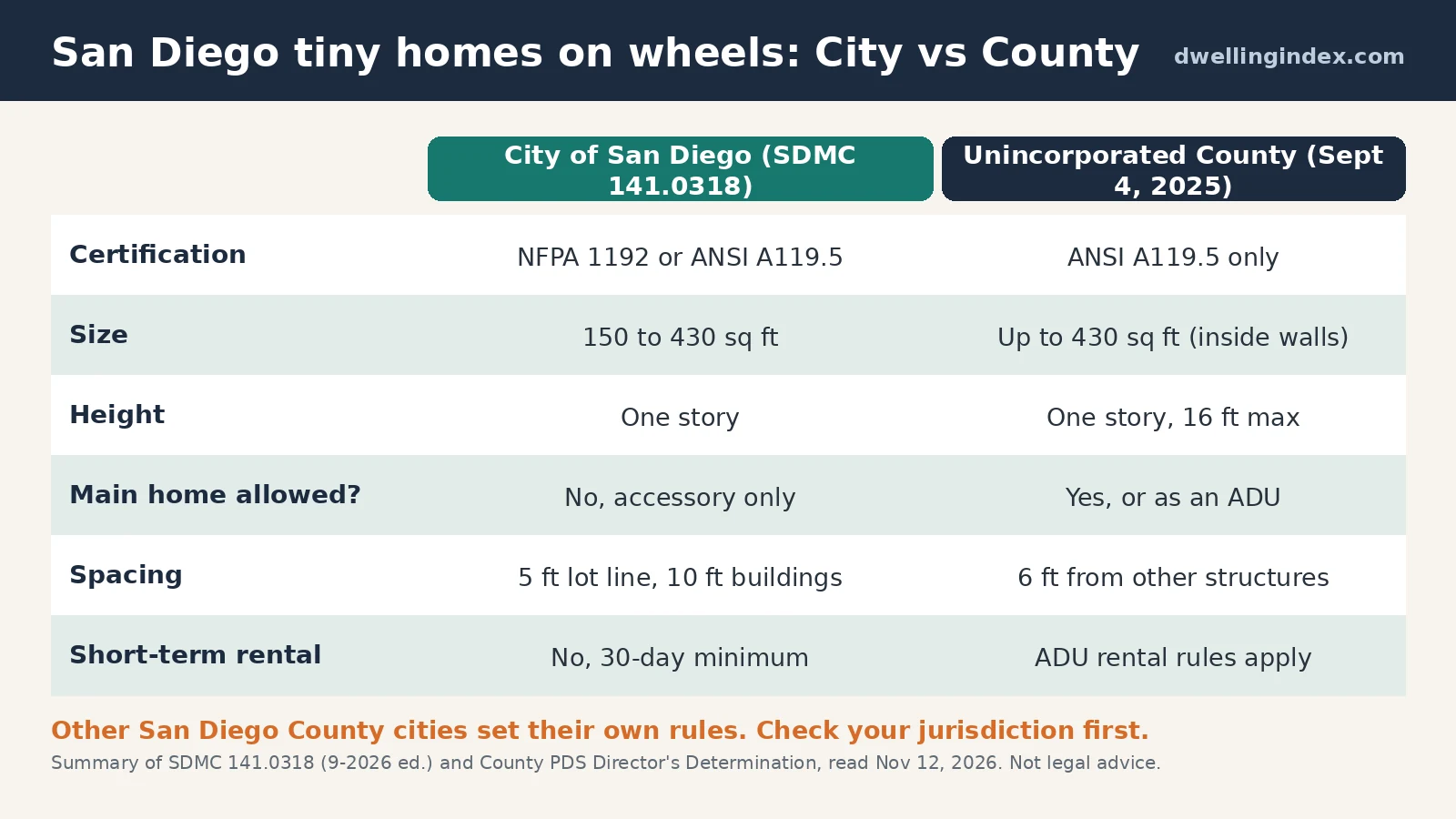
Answer capsule: The County accepts only ANSI A119.5 certification, while the City accepts ANSI A119.5 or NFPA 1192. The County lets a tiny home on wheels be the main home on a lot; the City treats it as an accessory unit only. The County caps height at 16 feet and specifies exterior-wall materials, including non-combustible or ignition-resistant construction; the City requires one story and limits exterior materials. Size limits are worded differently too.
This side-by-side is the reason we wrote the page. Here's the comparison, rule by rule:
| Question | City of San Diego (SDMC § 141.0318) | Unincorporated County (Director's Determination, Sept 4, 2025) |
|---|---|---|
| What it's called | Movable tiny house | Tiny Home on Wheels (THOW) |
| Accepted certification | NFPA 1192 or ANSI A119.5 | ANSI A119.5 only |
| Can it be the main home? | No, it's an accessory structure | Yes, on any lot that allows a single-family dwelling |
| Size | 150–430 sq ft | Up to 430 sq ft, measured from inside face of walls |
| Height / stories | One story | One story, 16 ft max; loft up to 150 sq ft allowed |
| Loft | Not addressed in § 141.0318 | Up to 150 sq ft, with direct exiting |
| Exterior walls | No single-piece composite, laminate or interlocked metal | Non-combustible, ignition-resistant, heavy timber or log |
| Sprinklers | If the main house has them, and always in a Very High Fire Hazard Severity Zone | Required (ADU exemptions apply if used as an ADU) |
| Spacing | 5 ft from adjacent lot line, 10 ft from other structures | 6 ft from other structures; main-building setbacks if it's the main home |
| Paving | Paved surface per § 142.0560(h)(1) | Asphalt 2 in or cement 3 in, with bumper guards or curbs |
| Street access | Lot on a 20-ft-wide right-of-way; within 150 ft; 5-ft path | Not specified in the determination; must be on the private lot, not in the County road right-of-way |
| Gas | Prohibited | Not addressed |
| Parking | Exempt (one exception in the Beach Impact Area) | No added parking when used as an ADU |
| Count per lot | One, in addition to an ADU and a JADU | Set by zoning and density; the determination doesn't change density |
| Minimum rental term | 30 consecutive days | Not set in the determination; ADU rental rules apply |
| Legal basis | Codified ordinance | Director's interpretation, pending Zoning Ordinance amendment |
Scroll the table sideways to see every column.
The certification trap
A tiny home certified only to NFPA 1192 (the RV standard) can qualify in the City but not in unincorporated County areas, where the determination names ANSI A119.5 only. If you might move, or you're buying a unit before you've picked a lot, ANSI A119.5 certification keeps both doors open.
The fire-safety gap
Many tiny homes on wheels are sold with wood or composite siding. The County requires qualifying non-combustible, ignition-resistant, heavy-timber or log wall construction, so some siding may need to change. Ask for the exterior specification in writing and confirm it with the County.
The main home difference
If you own a vacant lot in an unincorporated area and want to live in a tiny home on wheels as your only home, the County determination allows it, subject to setbacks, building type and density. In the City, a movable tiny house is accessory to a primary dwelling, so you'd need a main house first.
Should you build a tiny house on a foundation instead?
Answer capsule: Often, yes. A qualifying tiny house on a permanent foundation can be permitted as a regular ADU under California law and local rules, with no DMV registration or RV certification. The movable-tiny-house street-frontage rule does not automatically apply, though other access and fire requirements may. A foundation ADU may cost more per square foot; it becomes part of the real estate and is governed by ADU size and height rules rather than the movable-unit 430-square-foot and one-story limits.
A movable tiny house solves a specific problem: a small unit you could move later. If you don't need to move it, the foundation path removes most of the rules above:
| Question | Tiny home on wheels (City MTH or County THOW) | Tiny house on a foundation (ADU) |
|---|---|---|
| Legal basis | City § 141.0318 or County determination | California ADU law (Gov. Code § 66310 and following) + local ADU ordinance |
| Code it's built to | NFPA 1192 / ANSI A119.5 (City) or ANSI A119.5 (County), plus local add-ons | California Residential Code |
| Size | 150–430 sq ft | ADU size rules (well above 430 sq ft) |
| Registration | DMV, kept current | None; it's part of the real estate |
| Works in other cities? | Only where a city has a rule | Yes, ADUs are allowed statewide |
| Ownership | A DMV-registered vehicle, separate from the real estate; ask lenders how they'd finance it | Part of the real estate; ADU financing paths apply |
Scroll the table sideways to see every column.
In the City of San Diego, the movable tiny house sits in addition to an ADU and a JADU, so you don't have to choose. Some owners build a permanent ADU and keep the option to add a movable tiny house later.
See our San Diego ADU requirements guide for the City's ADU rules, and our tiny home ADU guide for how the wheels-versus-foundation choice works nationally.
What does a legal tiny home cost in San Diego?
Answer capsule: Published prices for code-built tiny-size ADUs in Southern California start around $163,000. Nest Tiny Homes listed a 240-square-foot California studio at $163,211 and a 300-square-foot studio at $179,458 on November 12, 2026, both “starting at” prices. SnapADU, a site-built San Diego ADU builder, says a new detached ADU in San Diego generally costs $300,000 to $450,000 or more all-in.
There's no single price for a tiny home in San Diego, because the legal path changes the scope. A tiny home on wheels adds site costs the sticker price doesn't show: the paved pad, utility connections and permits, sprinklers where required, and transport. A foundation ADU builder's scope may include design, permits, foundation and utilities; confirm the inclusions in each quote.
Here's what two builders that work in San Diego publish:
| Builder and product | Size | Published price | Our calc: $/sq ft | Path |
|---|---|---|---|---|
| Nest Tiny Homes, California Studio 240 | 240 sq ft | $163,211 “starting at” | $680 | Code-built ADU |
| Nest Tiny Homes, California Studio 300 | 300 sq ft | $179,458 “starting at” | $598 | Code-built ADU |
| Nest Tiny Homes, California 1 Bedroom 450 | 450 sq ft | $211,554 “starting at” | $470 | Code-built ADU |
| SnapADU, new detached ADU in San Diego | Varies | $300,000–$450,000+ all-in estimate | n/a | Site-built (stick-built) ADU |
Scroll the table sideways to see every column.
Costs to ask about on any San Diego tiny home quote
- Utility connections: water, sewer and a separate electrical panel or subpanel; capacity of the existing water meter and sewer line.
- Paving: the City's § 142.0560(h)(1) surface or the County's 2-inch asphalt or 3-inch cement pad with bumper guards.
- Fire sprinklers and ignition-resistant materials, depending on the lot and fire hazard zone.
- Transport and transportation permits for a unit on wheels.
- Plan check, inspection and any utility fees.
Ask Nest, or any seller, whether a specific model is a foundation build or a certified tiny home on wheels, and which certification label it carries. For a rough budget at your size and finish level, try our ADU cost calculator. For a fuller comparison of the two builders, see SnapADU vs Nest Tiny Homes.
Can you rent out or Airbnb a tiny home in San Diego?
Answer capsule: Long-term, yes. Short-term, no in the City: SDMC § 141.0318(c) bars renting a movable tiny house for less than 30 consecutive days. In unincorporated County areas, the THOW determination doesn't set its own rental term; a THOW used as an ADU follows the County's ADU rental rules. RV parks follow their own length-of-stay rules.
| Path | Nightly rental (Airbnb, VRBO) | Long-term rental |
|---|---|---|
| City of San Diego movable tiny house | Not allowed (30-day minimum) | Allowed |
| County THOW used as an ADU | Follow County ADU rental rules | Allowed under County ADU rules |
| Foundation tiny house as an ADU | Follow the city's or County's ADU rental rules | Allowed |
Scroll the table sideways to see every column.
If nightly income is the plan, get the rule in writing before you buy. Our ADU rental income guide covers long-term rent math.
Coastal, canyon and fire-zone lots
Answer capsule: Lots in the Coastal Overlay Zone, brush management zones, the MHPA, or a Very High Fire Hazard Severity Zone get extra rules or are off-limits for a City movable tiny house. County THOWs face exterior fire-safety and sprinkler requirements throughout unincorporated areas, with applicable ADU sprinkler exemptions. Check overlays before you buy a unit.
- Coastal Overlay Zone (City). The current code includes rules for movable tiny houses in future sea-level-rise areas of the Coastal Overlay Zone: no hard shoreline armoring, and a recorded acknowledgment agreement that the unit may have to be removed or relocated if the site becomes unsafe. The City's 2020 bulletin said movable tiny houses weren't allowed in the Coastal Overlay Zone until the Coastal Commission certified the ordinance; the current code's coastal provisions suggest that changed, but confirm with Development Services. See our San Diego coastal zone ADU guide.
- Brush management zones and the MHPA (City). A movable tiny house can't be placed in either.
- Very High Fire Hazard Severity Zone (City). Sprinklers are required even if the main house has none, plus ignition-resistant exterior walls and glazing.
- County fire rules. The County's exterior-wall, tempered or fire-rated window, Class A roofing and sprinkler requirements apply throughout unincorporated areas, not only in high fire zones. If the unit is used as an ADU, applicable ADU sprinkler exemptions apply.
The 8 questions to ask before you buy a tiny home in San Diego
Answer capsule: Confirm your jurisdiction, the unit's certification label, its interior square footage and height, your lot's street access and fire separation, overlays, utility capacity, paving, and the rental rule. Get answers in writing from the City or County.
- Is my parcel in the City of San Diego, another city, or unincorporated County?
- What certification label does the unit carry: ANSI A119.5, NFPA 1192, or neither?(County: ANSI A119.5 only.)
- What is the interior floor area and the total height?(City: 150–430 sq ft, one story. County: 430 sq ft inside walls, 16 ft.)
- Does my lot front a 20-foot public right-of-way, and is the spot within 150 feet of it?(City.)
- Can I keep 5 feet from the side lot line and 10 feet from other buildings (City), or 6 feet from other structures (County)?
- Is my lot in a brush management zone, the MHPA, the Coastal Overlay Zone, or a Very High Fire Hazard Severity Zone?
- Can my water meter and sewer line handle another unit, and where will the electrical panel go?
- What's the minimum rental term?
What we verified
- San Diego Municipal Code § 141.0318 (Movable Tiny Houses) and § 141.0302, Chapter 14, Article 1, Division 3, September 2026 edition PDF, read November 12, 2026.
- SDMC § 113.0103 definition of “movable tiny house,” Chapter 11, Article 3, Division 1, September 2026 edition, read November 12, 2026.
- City of San Diego Information Bulletin 403, Movable Tiny House (October 2020), read November 12, 2026.
- County of San Diego Planning & Development Services, Director's Determination, “Tiny Homes on Wheels (THOW),” September 4, 2025, read November 12, 2026.
- California Government Code § 66313 and Health and Safety Code §§ 18007 and 18009.3 on leginfo.legislature.ca.gov, read November 12, 2026.
- Nest Tiny Homes California models and service-area pages; SnapADU FAQ; read November 12, 2026.
- Not verified: movable tiny house or THOW rules in the county's other 17 cities. We searched and didn't find published ordinances for the cities we checked, which isn't proof none exist. Ask the city.
Methodology
We started from the primary documents: the City's current municipal code PDFs, the City's information bulletin, and the County's signed Director's Determination. We copied each rule into a table, then built the City-versus-County comparison line by line. Where the 2020 City bulletin and the current code differ, we follow the code and say so. State-law definitions come from the California Legislature's official code site. Builder prices are copied from each builder's own page on the date shown; price per square foot is our arithmetic. We'll re-check the County determination for a Zoning Ordinance amendment and the City code at each new edition.
Sources
- San Diego Municipal Code, Chapter 14, Article 1, Division 3 (§§ 141.0302, 141.0318): docs.sandiego.gov (opens in a new tab)
- San Diego Municipal Code, Chapter 11, Article 3, Division 1 (definitions, § 113.0103): docs.sandiego.gov (opens in a new tab)
- City of San Diego Information Bulletin 403, Movable Tiny House (Oct 2020): sandiego.gov (opens in a new tab)
- County of San Diego PDS, Director's Determination: Tiny Homes on Wheels (Sept 4, 2025): sandiegocounty.gov (opens in a new tab)
- County of San Diego PDS, Tiny Homes on Wheels page: sandiegocounty.gov (opens in a new tab)
- California Government Code § 66313: leginfo.legislature.ca.gov (opens in a new tab)
- California Health and Safety Code § 18007: leginfo.legislature.ca.gov (opens in a new tab)
- California Health and Safety Code § 18009.3: leginfo.legislature.ca.gov (opens in a new tab)
- Nest Tiny Homes, California models: via our tracked link dwellingindex.com/go/nest-tiny-homes/ (affiliate)
- SnapADU, FAQ (San Diego ADU cost, construction type): via our tracked link dwellingindex.com/go/snapadu/ (affiliate)
Frequently asked questions
Are tiny homes legal in San Diego?
Yes, subject to local rules. The City of San Diego allows one movable tiny house per qualifying residential lot under SDMC § 141.0318, and unincorporated San Diego County allows certified tiny homes on wheels as dwellings under a September 4, 2025 Director's Determination. Tiny houses on foundations can qualify as ADUs under California law and applicable local rules.
Can I live in a tiny home on wheels in my backyard in San Diego?
In the City of San Diego, yes, if it meets § 141.0318: 150–430 sq ft, one story, DMV-registered, NFPA 1192 or ANSI A119.5 certified, behind or beside the house on a paved surface, and connected to water, sewer and electric. You'll need a permit.
What size tiny home is allowed in San Diego?
In the City, a movable tiny house must be between 150 and 430 square feet. In unincorporated County areas, a tiny home on wheels can be up to 430 square feet measured from the inside face of the walls, one story and no taller than 16 feet, with a sleeping loft of up to 150 square feet.
Does San Diego County allow tiny homes on wheels?
Yes, in unincorporated areas. The County's September 4, 2025 Director's Determination treats an ANSI A119.5-certified THOW that meets 17 conditions as a dwelling, usable as a primary home or an ADU with a building permit. Incorporated cities set their own rules.
Do I need a permit for a tiny home in San Diego?
Yes. The City requires a building permit for a movable tiny house, applied for online with a site plan, floor and roof plans, and utility connection details. The County requires building permits, including for the electric, water and sewer connections.
Can I Airbnb a tiny home in San Diego?
Not in the City of San Diego: a movable tiny house can't be rented for less than 30 consecutive days. In unincorporated County areas, a THOW used as an ADU follows the County's ADU rental rules.
Is a tiny home on wheels an ADU under California law?
Not automatically. California's ADU definition (Gov. Code § 66313) includes efficiency units and manufactured homes as defined in Health and Safety Code § 18007, but most tiny homes on wheels are built as RVs or park trailers. They count only where a city or county has adopted a rule, as San Diego and the County have.
Can I put a tiny home on wheels and an ADU on the same lot in San Diego?
In the City of San Diego, yes. Section 141.0318(b) allows one movable tiny house per premises in addition to ADUs and JADUs, guest quarters and non-habitable structures.