
SnapADU vs Nest Tiny Homes 2026: Which ADU Path Fits Your Property?
The bottom line up front
SnapADU vs Nest Tiny Homes is not really a brand-vs-brand comparison. It's a service-area-plus-build-path decision, and for most readers, geography already decides. Choose SnapADU if you own property in Greater San Diego and want a fully custom, site-built detached ADU — published all-in pricing runs $375–$600+ per square foot, with most complete builds landing $300,000–$450,000+. Choose Nest Tiny Homes if you own property in Utah or Southern California and want a compact, model-based ADU — a tiny-home-style studio or one-bed unit, an attached ADU, a detached ADU, or a garage conversion — with visible model prices ranging from $60,000 (Casita) to $363,707 (one-bed two-story). The catch most homeowners miss: those Nest model prices are not all-in project costs — city/county permit fees and utility hookup fees are excluded until property-specific analysis.
See What You Can Build → Get Your Free ADU Report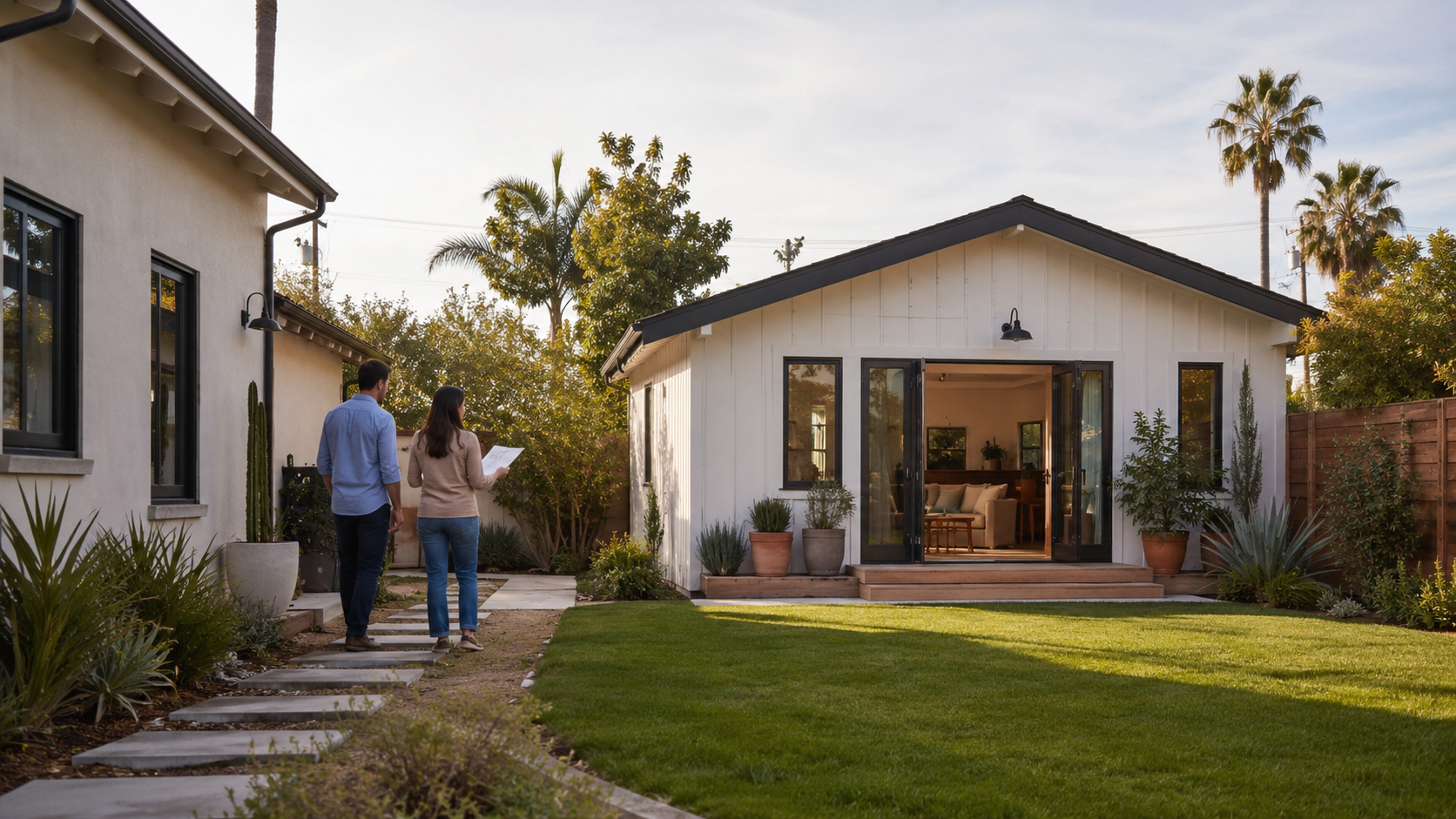
At-a-glance: who fits which scenario
The rest of this guide walks every objection blocking a confident next step — service area, build method, real costs, permit classification, track record, hidden risks, and the questions that separate a fair quote from a costly mistake.
| If this describes you | Start here | Why |
|---|---|---|
| Greater San Diego homeowner, detached new-construction ADU, $300K+ realistic budget | SnapADU | Stick-built specialist; Greater San Diego only; 100+ completed ADUs since 2020; in-house design, permit, and construction. |
| Utah homeowner (Salt Lake / Davis / Weber / Utah counties), compact or model-based ADU | Nest Tiny Homes | Utah HQ in Salt Lake City; offers stick-built and BOXABL Casita; published model catalog with starting prices around $60,000. |
| Southern California homeowner outside core San Diego County, compact or tiny-home-style ADU | Nest Tiny Homes | Nest serves Southern California from a documented service area including San Diego County, with a California office in El Centro. |
| Garage conversion anywhere | Nest or a conversion specialist (not SnapADU) | SnapADU's FAQ states it no longer handles garage conversions and now focuses on standalone ADUs. |
| Movable tiny house first (RV-classified unit on wheels) | Neither — verify city rules first | California cities classify tiny homes on wheels separately from ADUs. San Diego's MTH rules require DMV registration and impose 150–430 sq ft limits and a 30-day rental minimum. |
| Outside San Diego County, Southern California, or Utah | Use the Feasibility Engine first | Neither company serves you; route to local builder shortlists. |
See What You Can Build at Your Address — Get Your Free ADU Report
Free, 60 seconds, no obligation. We check your zoning, lot dimensions, and city rules before you call any builder.
SnapADU vs Nest Tiny Homes: what's actually being compared
Two different products, not two versions of the same product
We've seen this comparison framed online as “stick-built vs prefab” or “expensive vs affordable” or “big vs small.” None of those framings is accurate.
SnapADU in one sentence
SnapADU sells one thing: a fully custom, on-site, wood-framed ADU built on a poured slab in Greater San Diego. Their FAQ states it directly — accessory dwelling units by SnapADU are wood-framed construction, built much like traditional homes with slab-on-grade foundations and on-site framing. Every SnapADU project is permitted and built like a small custom home.
Founded in 2020 by Whitney Hill (CEO) and Mike Moore (CFO). Reports a 90%+ project completion rate against a San Diego market average closer to 30% per their own published comparison.
Nest Tiny Homes in one sentence
Nest Tiny Homes sells multiple paths: a stick-built ADU on slab (their flagship Utah product), services across detached ADUs, attached ADUs, and garage conversions, and a BOXABL Casita catalog presence as an authorized dealer (at $60,000). Nest's published catalog lists 86 model variants, with floor-plan footprints ranging from a 240 sq ft studio to a 1,000 sq ft three-bedroom.
HQ: Salt Lake City, Utah. California office: El Centro. BBB Accredited, A+ since April 8, 2026.
Three meaningful differences — before we get to price
- Construction method: SnapADU is exclusively stick-built. Nest's confirmed product mix includes stick-built, BOXABL Casita installation, attached ADU construction, and garage conversions.
- Geography: SnapADU is San Diego County only. Nest is Utah plus Southern California.
- Size class: SnapADU's reported size range is 400–1,200 sq ft, often weighted to the larger end. Nest's catalog leans smaller, with multiple models under 600 sq ft.
The damaging admission
This is not a clean head-to-head comparison. If you force this decision into “which company is better,” you are likely to make the wrong call. The better question — the one that actually saves a wasted deposit — is “Which delivery path matches my property, my city's permit rules, and my budget?” Once that path is clear, the brand decision usually answers itself.
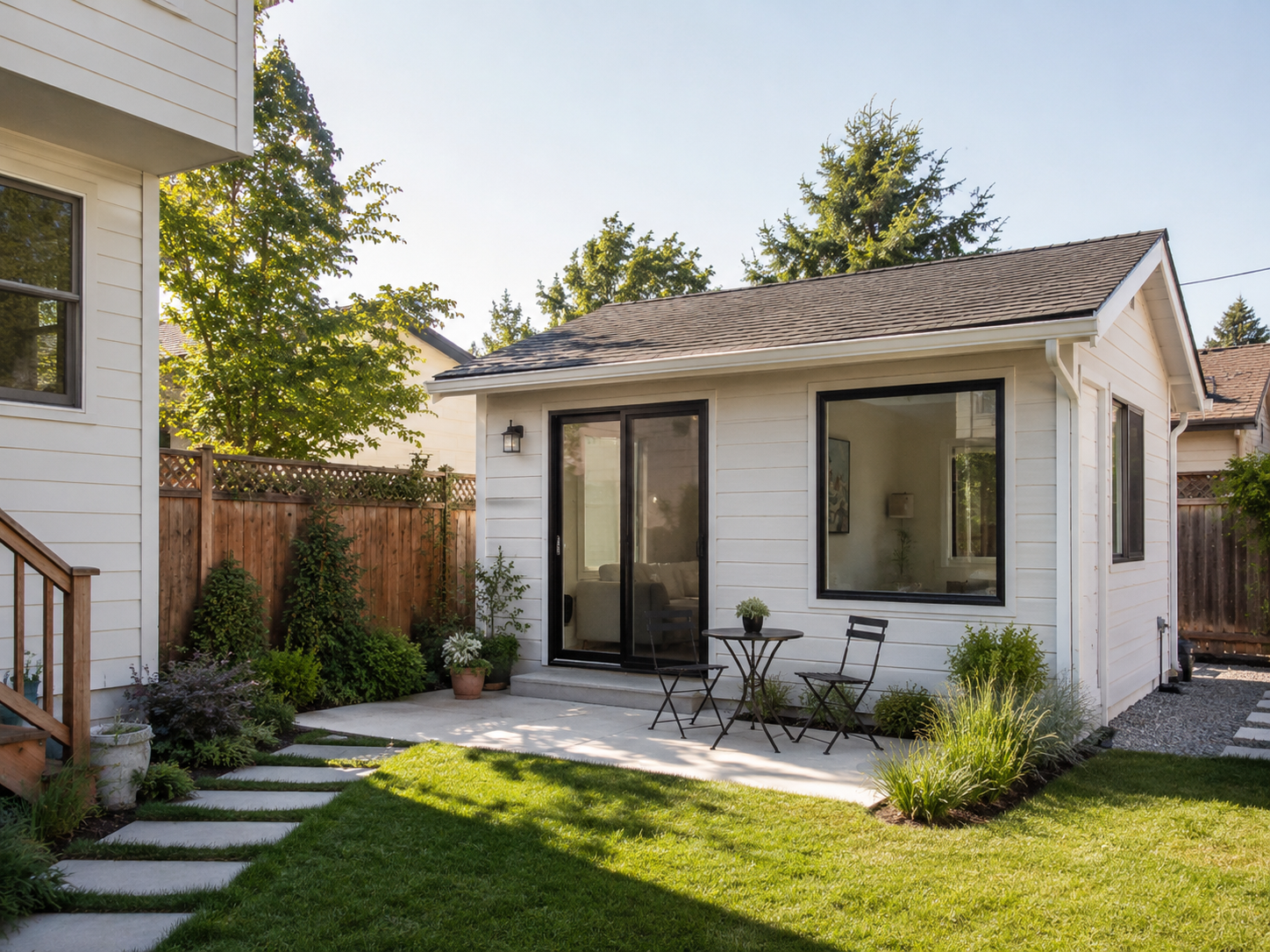
Which company serves your address?
Service area is the single most decisive filter and the one we keep seeing buried halfway down competing comparison pages. We're putting it first because it eliminates the wrong half of the comparison for most readers in under 30 seconds.
SnapADU's verified service area (May 2026)
| San Diego County jurisdiction | SnapADU service confirmed |
|---|---|
| City of San Diego | Yes |
| Oceanside | Yes |
| Carlsbad | Yes |
| Encinitas | Yes |
| Del Mar | Yes |
| Solana Beach | Yes |
| Poway | Yes |
| San Marcos | Yes |
| Escondido | Yes |
| La Mesa | Yes |
| El Cajon | Yes |
| Vista | Yes |
| Chula Vista | Yes |
| Coronado | Yes |
| Santee | Yes |
| Lemon Grove | Yes |
| Imperial Beach | Yes |
| National City | Yes |
| Unincorporated County of San Diego | Yes |
| Anywhere outside San Diego County | No |
Source: SnapADU service area page, verified May 2026. SnapADU also lists Rancho Santa Fe on its homepage; surrounding communities such as Bonsall, Cardiff By The Sea, La Costa, and Camp Pendleton sometimes fall under unincorporated San Diego County coverage — verify directly with SnapADU if your parcel is in one of these communities.
Nest Tiny Homes' verified service area (May 2026)
| Region | Nest Tiny Homes service confirmed |
|---|---|
| Salt Lake County, Utah | Yes (HQ) |
| Davis County, Utah | Yes |
| Weber County, Utah | Yes |
| Utah County, Utah | Yes |
| Documented Utah cities (Murray, Pleasant Grove, Farmington, Taylorsville) | Yes |
| San Diego County, California | Yes |
| Imperial County, California (El Centro office) | Yes |
| Other Southern California regions (LA, OC, IE) | Verify directly with Nest |
| Outside Utah and Southern California | No |
The Nest contact page confirms “Proudly Serving: SLC Utah & Southern California” with the Utah office at 4190 South Highland Dr. Ste 114, Salt Lake City, Utah 84124, plus a California office in El Centro.
Where they actually overlap
There is exactly one zone where both companies serve the same homeowner: Greater San Diego County and adjacent Imperial County. Even there, the comparison isn't symmetrical — Nest's San Diego presence is newer and lighter than SnapADU's 100+ project track record built over six years in this exact market. Outside that zone, this comparison reduces to a one-company decision in Utah or in non-San-Diego Southern California. Most readers searching this query are in one of those single-option zones.
Not in either service area? Don't keep clicking through builder lists.
We'll match your ZIP to vetted local options for your build type. No email required to see basic results.
Stick-built, modular, or BOXABL: what each builder actually delivers
Defining the methods in plain English
Stick-built
The structure is framed piece by piece on your property over a permanent foundation, just like a custom home. Maximally adaptable to weird lot shapes, slopes, coastal-zone aesthetic rules, and HOA architectural requirements. It is also the slowest construction phase and typically the most expensive per square foot.
Modular
The building is constructed in large sections at a factory, trucked to your property, and craned into place onto a foundation already poured. This method compresses the on-site construction window dramatically (often to weeks instead of months) but requires crane access and a relatively flat lot. Nest lists modular as a website category but the public catalog filters were unpopulated at our verification date — verify live availability directly with Nest.
BOXABL
A specific brand of factory-built housing — most famously the “Casita” — built in a Las Vegas factory and shipped folded to a buyer's site, where it unfolds into a roughly 361 sq ft single-room dwelling. Nest Tiny Homes is one of the dealers that handles BOXABL site placement and installation in their service areas. Listed in Nest's catalog at $60,000.
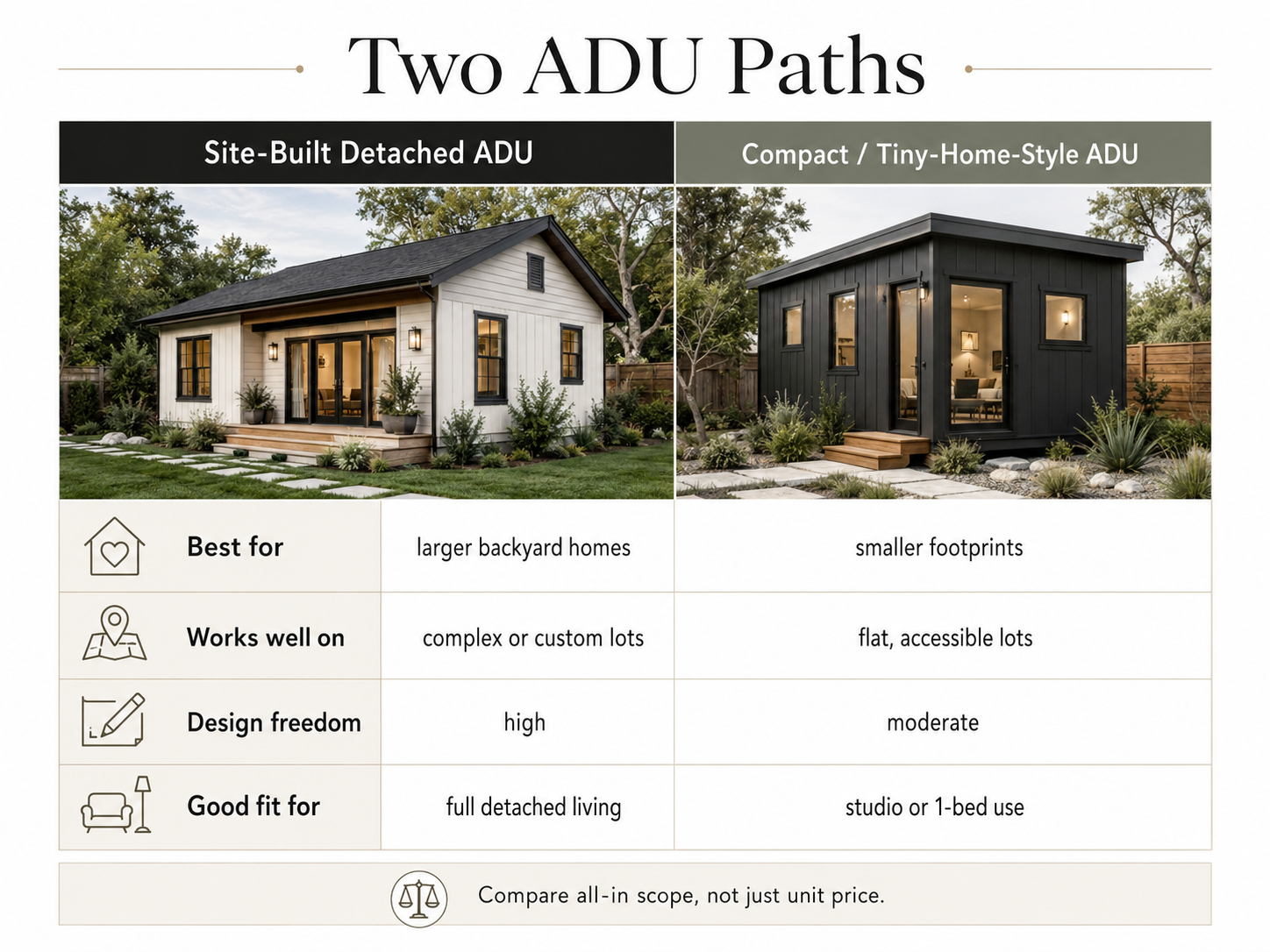
What each company actually offers
| Construction method | SnapADU | Nest Tiny Homes |
|---|---|---|
| Stick-built on slab | Yes — exclusive method | Yes — flagship Utah product |
| Modular prefab | No | Listed as website category in both Utah and California; verify live availability with Nest before signing |
| BOXABL dealer / installer | No | Yes — BOXABL Casita listed in catalog at $60,000 |
| Custom architectural design | Yes — in-house drafting team | Limited; most projects start from catalog models |
| Garage conversion | No — discontinued (SnapADU FAQ) | Yes — listed service |
| Attached ADU | Limited; not a core product | Yes — listed service |
The garage conversion line item
This is the one most likely to misroute a homeowner. SnapADU's FAQ states a standard garage conversion might cost around $120,000, but the company no longer handles conversion work because they focus on standalone ADUs. If you arrived at this page because you want to convert your garage, SnapADU is not your starting point. Nest can do garage conversions in their service area; alternatively, our Best ADU Builders San Diego County guide lists local conversion specialists.
Which method fits which lot
| Lot or project condition | Stick-built (SnapADU or Nest UT) | Modular (verify Nest) | BOXABL Casita via Nest |
|---|---|---|---|
| Steep slope or unusual grade | Best | Difficult; may require extensive site prep | Generally not viable |
| Tight side-yard or narrow access | Best | Crane access becomes the bottleneck | Crane access required |
| Coastal-zone or HOA aesthetic match | Best | Possible if model exterior matches | Limited match flexibility |
| Flat suburban lot, easy access | Workable but expensive | Best — fastest path | Workable for compact unit |
| Project size 800+ sq ft | Best | Workable; multiple modules | Not applicable (~361 sq ft max) |
| Project size 240–500 sq ft | Workable but cost-inefficient | Best | Best for ~361 sq ft single-room intent |
| Want maximum design control | Best | Limited to model catalog | None — fixed product |
You've narrowed the build method — now pressure-test the lot
Confirms zoning, lot size, utility access, and overlay zones in one shot, before any builder consult.
How do SnapADU and Nest Tiny Homes compare on cost?
SnapADU's published cost data (verified March 2026)
- Turnkey range: $375 to $600+ per square foot for a detached ADU in San Diego, depending on size.
- Complete-build typical investment: roughly $300,000 to $450,000+ including design, permits, sitework, and utilities.
- Permits and city fees: $5,000+ at minimum, scaling to $10–$20 per square foot in some San Diego cities.
- Basic site work: approximately $35,000.
- Additional utility work (trenching, upgrades, hookups): often $15,000 to $30,000+ depending on existing infrastructure.
| SnapADU example unit | Size | Typical all-in cost |
|---|---|---|
| 1BR / 1BA | 500 sq ft | $300,000 |
| 2BR / 1BA | 750 sq ft | $350,000 |
| 2BR / 2BA | 1,000 sq ft | $425,000 |
| 3BR / 2BA | 1,200 sq ft | $450,000 |
SnapADU also offers a feature they call the Price Lock Guarantee — after first-round plan check is complete, they issue a Construction Estimate Agreement that locks pricing for six months while permits finish. That's a meaningful protection in a market where construction cost forecasts project a 3.5% increase annually in San Diego.
Nest Tiny Homes' published cost signals (verified May 2026)
| Nest catalog model | Visible published price |
|---|---|
| Casita (BOXABL) | $60,000 |
| Studio 240 Craftsman | $110,192 |
| Studio 300 Craftsman | $130,620 |
| 3 Bedroom 1000 Modern | $361,398 |
| 1 Bedroom 598 Modern 2-Story | $363,707 |
Critical: what Nest model prices include and exclude
Nest's published pricing language defines inclusions: foundation, construction, finishes, design and engineering, and permit submission.
Explicitly excluded: city/county permit fees and utility hookup fees — until measured in a property-specific estimate.
A $110,192 Studio 240 Craftsman is a factory-and-finished-unit price that excludes the local permit cost, trenching, and any sitework specific to your lot. Add those, and the all-in delivered cost of even a small Nest unit can rise materially.
The apples-to-apples cost normalizer
Use this table as a quote-comparison checklist before putting any numbers into a spreadsheet.
| Cost item | SnapADU (typical) | Nest (typical) | Ask in writing |
|---|---|---|---|
| Architectural design & engineering | Included; in-house | Included; in-house | At which phase is design fully scoped? |
| Permit submission (labor) | Included; in-house permit team | Included | Who owns city correspondence and revisions? |
| City / county permit FEES | Pass-through; $5,000+ to $10–$20/sq ft depending on city | Excluded from model price | What's the estimated permit fee for my exact address? |
| Utility hookup fees | Pass-through / measured | Excluded; measured in property estimate | What does my hookup distance cost? |
| Foundation | Included | Included | Slab spec and code basis? |
| Sitework / grading | $35K typical baseline | Allowance | What's covered if soils require import? |
| Crane / delivery / install (modular or BOXABL only) | N/A | Verify | Are crane, delivery, road-closure permits, and installation all included? |
| Warranty | 1-year full-service, 2-year MEP, 10-year structural | Closeout packet with warranty docs | Transferable to next owner? |
| Timeline (proposal-to-keys) | 8–12 months typical | 6–8 months typical | What's my expected timeline given my city's plan check? |
What not to write down on a spreadsheet
Do not put “Nest is cheaper than SnapADU” in your decision matrix. The accurate version: Nest's model prices are visibly lower at the catalog level, but the comparable number is all-in permitted, utility-connected project cost — not the model price. Match scope before matching numbers. A $60,000 Nest Casita (361 sq ft, excluding permits and hookups) and a $300,000 SnapADU 1BR (500 sq ft, fully permitted, utility-connected in one of California's highest-cost markets) are not comparable products.
Looking at $200K+? Most homeowners don't pay cash.
Compare ADU financing paths →HELOCs, cash-out refinances, construction-to-permanent loans, and renovation HELOCs each suit different situations. We are not a lender — this is education, not a rate quote.
Which ADU type are you actually building?
Defining every term, with the local code tie-in
ADU (Accessory Dwelling Unit)
A self-contained dwelling on the same lot as a primary residence. Has its own kitchen, bathroom, and entrance. Permanently affixed to a foundation. In California, governed by Government Code §§66310–66342. In Utah, governed by Utah Code §§10-21-303 and 10-21-304.
DADU (Detached ADU)
An ADU that is structurally separate from the primary residence — a backyard cottage, a guest house, a “granny flat.”
Attached ADU
Shares at least one wall with the primary house. Often built as an addition. Sometimes shares utility infrastructure with the main house.
JADU (Junior ADU)
A sub-500 sq ft unit carved out of the existing primary residence's footprint. Streamlined permitting in many California cities; size capped at 500 sq ft.
Garage conversion
Converting an existing detached or attached garage into livable space. Cheaper per square foot than new construction but constrained by the existing structure's footprint, ceiling height, and foundation.
IADU (Internal ADU)
A unit created within the primary home's existing walls — often a basement apartment in Utah, where Utah Code §10-21-303 specifically requires municipalities to permit internal ADUs in single-family zones.
MTH (Movable Tiny House)
In San Diego municipal code, a manufactured and transportable accessory structure on wheels, classified separately from a permanent ADU under Information Bulletin 403. Subject to different rules.
THOW (Tiny Home on Wheels)
An RV-classified unit. In California, generally not eligible to be a permanent ADU.
Build-type fit matrix
| Project type | SnapADU fit | Nest Tiny Homes fit | Notes |
|---|---|---|---|
| Detached new-construction ADU, 600+ sq ft, Greater San Diego | Strong | Possible if compact/model path fits the lot | SnapADU is the cleanest fit for full-service custom San Diego detached ADUs. |
| Detached new-construction ADU, 600+ sq ft, Utah | Not available | Strong | Geography decides. |
| Compact ADU under 600 sq ft (240–500 sq ft studio) | Possible but cost may not fit smaller scopes well | Stronger | Nest's catalog is built for this size class. |
| Garage conversion, anywhere | Poor — discontinued | Possible | Use a conversion specialist. SnapADU's FAQ confirms discontinuation. |
| Attached ADU | Not core; verify | Possible — listed service | Nest lists attached ADU as a service category. |
| Junior ADU (JADU) | Not core; verify | Verify | JADUs are typically a remodeling project, not a new-build category. |
| Movable Tiny House (on wheels) | Not applicable | Verify | Likely classified separately by your city. |
| Two-story or large custom detached ADU (1,000+ sq ft) | Strong | Verify against catalog limits | SnapADU's portfolio includes two-story ADUs and ocean-view custom builds. |
| Multi-unit property / two ADUs on one lot | Strong | Verify | SnapADU routinely builds stacked or multi-unit projects. |
| Owner-builder / DIY | Poor | Poor | Use owner-builder resources, not a design-build firm. |
Decide your build type before you call anyone
Our free 60-second check asks the right type-classification questions in order so you don't waste a call.
Will your city legally permit the unit you want?
City of San Diego ADU rules (verified May 2026)
Building permit required
Yes — for new construction ADUs
ADU size range
150–1,200 sq ft for standard ADUs
JADU size range
150–500 sq ft, contained within the existing single-family dwelling
Parking
No parking required for ADUs except in the Beach Impact Area
Owner-occupancy
California law prohibits imposing an owner-occupancy requirement on ADUs (Government Code §66315). JADUs have separate rules.
Rental terms
Standard ADUs and JADUs in the City of San Diego cannot be rented for fewer than 31 consecutive days.
Setbacks
ADUs taller than 16 feet or in a VHFHSZ require 4-foot side and rear setbacks. Single-story ADUs 16 feet or less outside VHFHSZ may have no side or rear setback.
Utility connections
ADUs must connect to water, sewer, and electrical infrastructure.
City of San Diego Movable Tiny House rules — Information Bulletin 403
The most misunderstood code path in the San Diego ADU market
- Definition: A Movable Tiny House (MTH) is a manufactured and transportable accessory structure — built on a chassis, not a permanent foundation.
- DMV requirement: Must be licensed and registered with the California Department of Motor Vehicles as a vehicle.
- Size limits: Floor area between 150 and 430 square feet.
- Rental restriction: Cannot be rented for fewer than 30 consecutive days — eliminates Airbnb use as a revenue path.
- Key distinction: Most of Nest's catalog is permanent stick-built or BOXABL-installed construction on a slab — not movable tiny houses on wheels. Ask Nest directly: “Is this model permitted as a standard ADU on my lot, or as a movable tiny house?”
Utah ADU rules (verified May 2026)
The Utah 2026 ADU law update — what changes October 1, 2026
- Utah Code §10-21-303 (Internal ADUs): Specified municipalities must allow an internal accessory dwelling unit on a single-family residential lot, subject to local conditions on health, safety, and habitability.
- Utah Code §10-21-304 (Detached ADUs — effective October 1, 2026): Specified municipalities must allow a detached ADU on a lot of 11,000 square feet or larger. Still permits local regulation of setbacks, utilities, owner occupancy, rental duration, and other reasonable conditions.
- HOA caveat: Utah Department of Commerce HOA guidance confirms HOAs can prohibit detached units even where state and city law allows them. Verify your HOA's CC&Rs before assuming permittability.
Lot minimum for internal ADU (IADU)
6,000 sq ft
Lot minimum for detached ADU (DADU)
7,000 sq ft (PC Zone allows 6,000 sq ft)
Permit fees (regional benchmark)
$1,000–$5,000 (verify with your municipality)
Owner-occupancy (Utah)
Required by Salt Lake County — owner must occupy either primary home or ADU
HOA detached prohibition
Utah HOAs can prohibit detached ADUs even after October 1, 2026
Utility connection
Separate water lateral may be required; separate address marker required
Verify your code path before any builder quote
Cross-references your address against city ADU rules, lot size, utility access, and zoning overlays.
Track record, reviews, and licensing: what does the public record show?
SnapADU at a glance
- Founded: 2020, in San Diego
- Founders: Whitney Hill (CEO), Mike Moore (CFO — licensed GC since 2013)
- Project count: 100+ ADUs completed since 2020 (117 per third-party source, December 2025)
- Construction method: Wood-framed, slab-on-grade, on-site framing only
- Pre-approved plans: Originally designed the pre-approved ADU plan libraries for Chula Vista and San Marcos via competitive bid
- Price Lock Guarantee: Fixed pricing locked for six months after first-round plan check
- Warranty: 1-year full-service, 2-year MEP and solar, 10-year structural
- CSLB license: #1075582 — verify active status before signing
- BBB: A+, accredited since April 2021
Nest Tiny Homes at a glance
- HQ: 4190 South Highland Dr. Ste 114, Salt Lake City, UT 84124. Plus California office in El Centro.
- Catalog: 86 model variants across studio, 1BR, 2BR, and 3BR configurations
- Construction methods: Stick-built on slab; BOXABL Casita as authorized dealer/installer; modular/prefab listed (verify availability)
- Services: Detached ADU, attached ADU, garage conversion, custom garage, pool house, home office
- Process: Discovery call → site visit → quote → financing → architecture → engineering → permit → construction (6–8 months total)
- BBB: A+, accredited since April 8, 2026
- California CSLB license: #1131365 — verify active status before signing
- Utah licensure: Verify at dopl.utah.gov before signing for Utah work
How to verify each company yourself in five minutes
- CSLB: cslb.ca.gov — confirm SnapADU's license #1075582 and Nest's California license #1131365 are active and any disciplinary history is clean.
- Utah DOPL: dopl.utah.gov — confirm Nest Tiny Homes' Utah contractor license is active.
- BBB profiles: Check accreditation, complaint volume, and resolution history for both companies.
- Google Business Profile reviews for each — check post dates.
- Ask each company for two recent project addresses in your jurisdiction so you can confirm permits with the city directly.
See your address through a verified lens
Get your free 60-second ADU report before you spend an hour on a sales call.
Who should choose SnapADU?
Strong SnapADU fit
- Your property is in Greater San Diego — one of the cities listed in the service-area table above.
- You want a detached new-construction ADU (not a conversion).
- Your project size is roughly 500–1,200 sq ft.
- You want one team managing design, engineering, plan check, and construction.
- Your budget is realistic for San Diego — $300K minimum, up to $450K+ for larger builds.
- You have a complex lot (slope, tight access, coastal-zone overlay, HOA aesthetic match) where stick-built adapts better.
- Your goal is long-term rental income, multigenerational housing, or a property-value play.
- You want price certainty — SnapADU's Price Lock Guarantee is structured to deliver this.
Weak SnapADU fit
- Your property is outside San Diego County.
- You want a garage conversion (discontinued by SnapADU per their FAQ).
- You want an attached ADU as the primary product (not their core).
- You want a JADU only (Junior ADU within the existing house).
- You are committed to a movable tiny house on wheels.
- Your hard budget is below $250,000 all-in for a new detached unit.
- You want to shop national prefab catalogs before committing to a design.
- You plan to owner-build or general-contract yourself.
Why SnapADU works when it works
The SnapADU value proposition is essentially risk reduction in a market where projects often stall. Their published 90%+ completion rate against an estimated 30% San Diego market completion rate means a SnapADU project is roughly 3x more likely to actually finish than the average ADU project that starts in their market. The combination of an in-house permit team, the Price Lock Guarantee, and pre-approved plan recognition by Chula Vista and San Marcos creates a feasibility-first model that resolves the most common San Diego ADU failure mode: a project that gets approved on paper but never breaks ground because costs ballooned during plan check.
For Greater San Diego homeowners pursuing a detached new-construction ADU
Request Your SnapADU Feasibility Consultation →Get a property-specific feasibility review and a fixed-pricing path before you commit to construction documents. Best for detached new ADUs in Greater San Diego. If you're outside San Diego County or considering a garage conversion, start with our free Dwelling Index feasibility report instead.
Who should choose Nest Tiny Homes?
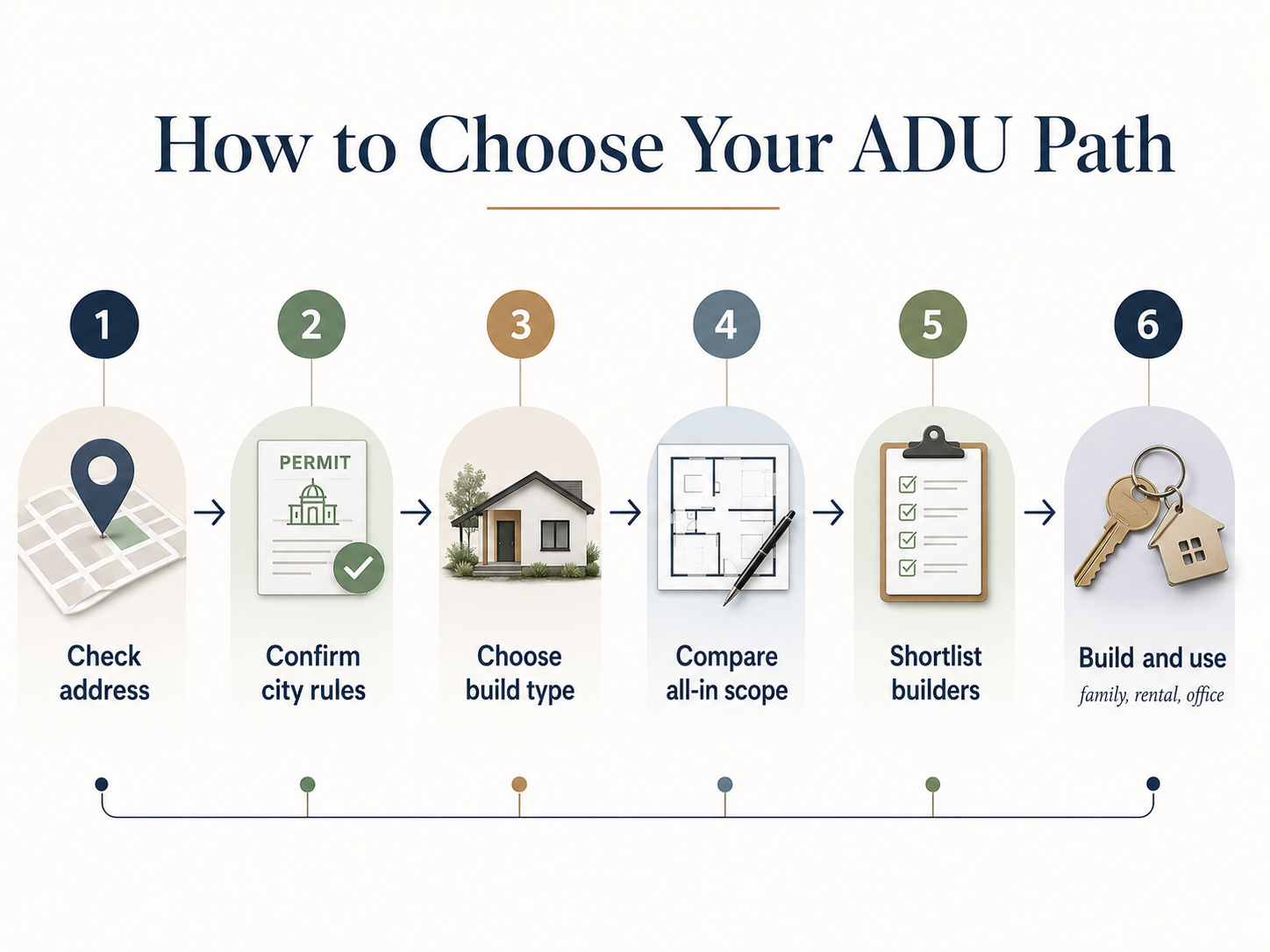
Strong Nest Tiny Homes fit
- Your property is in Utah (Salt Lake, Davis, Weber, or Utah county) or Southern California (especially San Diego County or Imperial County).
- You want a compact ADU — studio (240–300 sq ft), one-bedroom (436–598 sq ft), or two-bedroom under 800 sq ft.
- You want a catalog-driven starting point — pick a published model and customize from there.
- You are considering an attached ADU or a garage conversion as your build type.
- You're open to a BOXABL Casita or modular path if Nest confirms availability.
- Your project goal is rental income, multigenerational housing, or a smaller-footprint guest space.
Weak Nest Tiny Homes fit
- Your property is outside Utah or Southern California.
- Your city does not permit your chosen unit type — verify before any quote.
- Your HOA prohibits detached ADUs (Utah HOAs can do this even where state and city law allows them).
- You have coastal, fire, or site constraints that make compact placement difficult.
- You need a large fully custom detached ADU in Greater San Diego where SnapADU is the cleaner fit.
- You require certainty from a headline model price alone — the model price is not the all-in delivered cost.
Why Nest works when it works
Nest's strength is breadth of options matched to a smaller-footprint, more cost-conscious project profile. The combination of stick-built, BOXABL-installed Casita, attached ADUs, and garage conversions across two states means a Utah homeowner choosing a 436 sq ft 1BR detached ADU and a San Diego homeowner choosing a garage conversion are both legitimate Nest customers. The catalog-first approach reduces the “blank-page paralysis” that custom-design firms can produce. The catch: published model prices are not all-in project costs, and a homeowner who treats them as such will be surprised at the property-specific quote stage.
For Utah and Southern California homeowners considering a compact, model, or conversion ADU
See Current Nest Tiny Homes Models and Pricing →Browse 86 model variants across studio, 1-bed, 2-bed, and 3-bed configurations. Request a property-specific estimate that includes the items model prices exclude (permit fees, hookups, sitework). If you're outside Utah and Southern California, start with our free Dwelling Index feasibility report instead.
14 questions to ask before signing with either company
| # | The question | What proof looks like |
|---|---|---|
| 1 | What state contractor license number and classification will appear on my contract? | Lookup result from cslb.ca.gov (California) or dopl.utah.gov (Utah) showing active status, no recent disciplinary actions |
| 2 | Who is the legal contracting entity? | LLC or corporation name on the signed agreement, matching the entity tied to the active license |
| 3 | Which parts of design, engineering, permitting, and construction are included in the quoted price? | Phase-by-phase scope document with line items |
| 4 | Which city, county, school, and impact fees are excluded? | Specific itemized fee estimate for your address, listed as pass-through |
| 5 | Are utility hookup fees included or estimated separately? | Allowance amount in writing; documented overage policy |
| 6 | How far is the utility trenching path on my property, and what is the per-foot cost or allowance? | Measured trench drawing or site walk notes with per-foot cost |
| 7 | What happens if the city requires changes after first-round plan check? | Written change-order process showing who pays for revisions |
| 8 | Is the foundation included, and to what specification? | Slab thickness, rebar spec, post-tension if needed, code citation |
| 9 | Are crane, delivery, road-closure permits, and installation costs included (modular or BOXABL only)? | Itemized delivery and install line in the contract |
| 10 | What is the payment schedule, and what work is associated with each draw? | Draw schedule with milestone-based releases, not back-loaded |
| 11 | Will I receive lien releases from subcontractors at each draw? | Conditional and unconditional lien-release forms at each milestone |
| 12 | What warranty applies, and is it transferable to the next owner? | Written warranty document specifying years and transferability |
| 13 | What is the cancellation policy if I need to back out before construction starts? | Written cancellation clause in the contract |
| 14 | Can I see two recent permitted projects in my exact jurisdiction, and may I confirm those permits with the city? | Project addresses you can call the city to verify against the permit record |
If a contractor balks at any of these, treat that as the answer. The good ones expect these questions.
Use the checklist before you call any builder
Printable version of this 14-question vetting checklist, plus the hidden-risk table and a permit-fee worksheet.
Financing an ADU project at this scale
Lane 1: Home Equity Line of Credit (HELOC)
When it works: You have substantial existing equity, a solid credit profile, and want flexibility to draw funds as needed rather than borrowing the full amount up front.
What to verify: Lifetime cap, draw period, repayment terms after draw period ends.
Lane 2: Cash-out refinance
When it works: Your existing mortgage rate is at or above current market rates, you want one fixed monthly payment, and you have enough equity to pull the project amount without breaching the lender's LTV cap.
What to verify: Closing costs, break-even on closing costs versus the new rate.
Lane 3: Construction-to-permanent loan
When it works: The project is a true new build, you don't have enough existing equity for a HELOC or cash-out path, and you can document the project plans and contractor at application.
What to verify: Whether the lender pre-qualifies your specific contractor, draw inspection process, conversion terms.
Lane 4: Renovation HELOC (e.g., RenoFi)
When it works: Your project will materially increase your home's appraised value, but you don't have enough existing equity for a traditional HELOC.
What to verify: State availability (confirm directly), how the post-renovation appraisal works, lender's preferred-builder list.
| Scenario | Best-fit lane |
|---|---|
| Long-time homeowner, substantial equity, low original mortgage rate | HELOC |
| Recent buyer, current mortgage rate above market, prefers single payment | Cash-out refinance |
| New build, limited existing equity, project is a true detached ADU | Construction-to-permanent |
| Limited existing equity, project will significantly increase home value | Renovation HELOC (e.g., RenoFi) |
Compliance note: Any rental income from an ADU should be modeled cautiously. Illustrative example only: a $400,000 ADU project producing $2,500/month in long-term rent generates $30,000/year gross. These are illustrative examples, not guarantees of returns. Actual results depend on local market conditions, construction costs, financing terms, and regulatory approvals.
Compare ADU financing paths in detail
See our full ADU Financing guide →Lane-by-lane breakdown with qualification checklists. We are not a lender — this is education, not a rate quote, and we do not rank lenders by compensation.
If neither serves your area: how to find your local fit
The biggest mistake we see at this point is continuing to research SnapADU and Nest content when neither company is geographically available. That's a sunk-cost trap.
Step 1: Run the Property Eligibility Check
The fastest way to break out of brand-comparison loop: enter your address into our Property Eligibility Check and let the tool route you to vetted local options for your specific lot, zoning, and build type.
Step 2: Use our city-specific builder guides
For San Diego County readers, our city pages compare every active local builder against neutral criteria — published prices, permit fee schedules, project track records, and license verification:
- Best ADU Builders San Diego County (2026)
- Best ADU Builders Chula Vista (2026)
- Best ADU Builders Poway (2026)
- Best ADU Builders El Cajon (2026)
- Best ADU Builders Escondido (2026)
- Best ADU Builders Vista (2026)
- Best ADU Builders Oceanside (2026)
- Best ADU Builders Encinitas (2026)
- Best ADU Builders Carlsbad (2026)
- Best ADU Builders La Mesa (2026)
- Best ADU Builders Santee (2026)
- Best ADU Builders Del Mar (2026)
- Best ADU Builders Unincorporated San Diego County (2026)
Related resources:
Step 3: 15-minute local contractor vetting
- License lookup — CSLB (California) or DOPL (Utah) — confirm active status.
- BBB profile — check accreditation, complaint volume, and resolution history.
- Two completed-project references in your specific jurisdiction — call the city to verify the permits.
- Written fixed-price commitment with itemized scope.
- Written warranty terms — transferability matters.
Find your local fit in 60 seconds
No email required to see basic results.
How we built this comparison
This comparison was built from each company's published service-area, pricing, FAQ, and process pages; the City of San Diego DSD's ADU and Movable Tiny House code documents; the Utah Department of Commerce HOA guidance; Utah Code §§10-21-303 and 10-21-304; Salt Lake County ADU rules; the Better Business Bureau profiles for both companies; the California Contractors State License Board; and existing Dwelling Index city-specific builder pages. We did not rank either company by compensation. We disqualify both partners when neither is the right fit. Sources are cited inline.
Affiliate disclosure
SnapADU and Nest Tiny Homes are active referral partners of The Dwelling Index. We may earn a commission if you complete a project with either through our links, at no extra cost to you. We do not rank by compensation. We explicitly disqualify both companies in this guide where they are the wrong fit. Our editorial recommendations are based on independent research and are never influenced by compensation.
View all sources used
- SnapADU homepage
- SnapADU cost guide
- SnapADU service area page
- SnapADU FAQ
- SnapADU about page
- SnapADU pricing blog
- SnapADU pre-approved plans guide
- Nest Tiny Homes homepage
- Nest Tiny Homes Utah/California services page
- Nest Tiny Homes contact page
- Nest Davis County service area page
- Nest San Diego County service area page
- Nest Tiny Homes models archive
- BOXABL Casita product page
- City of San Diego DSD ADU/JADU page
- City of San Diego Information Bulletin 403 (Movable Tiny House)
- Utah Department of Commerce HOA / ADU guidance
- Salt Lake County ADU page
- California Contractors State License Board
- Utah Division of Professional Licensing
What we verified — May 8, 2026
| Item | Verified source | Notes |
|---|---|---|
| SnapADU cost range | SnapADU cost guide | $375–$600+/sq ft turnkey; $300K–$450K+ complete build |
| SnapADU example all-in cost table | SnapADU cost guide | 500 sq ft = $300K, 750 sq ft = $350K, 1,000 sq ft = $425K, 1,200 sq ft = $450K |
| SnapADU service area | SnapADU service area page | Greater San Diego cities and unincorporated county |
| SnapADU project count | SnapADU homepage; Remodel Works (Dec 2025) | 100+ per company; 117 per third-party source |
| SnapADU garage conversion status | SnapADU FAQ | Discontinued; no longer handles conversions |
| SnapADU warranty terms | SnapADU homepage | 1-year full-service, 2-year MEP and solar, 10-year structural |
| SnapADU pre-approved plans recognition | SnapADU pre-approved plans guide | Cities of Chula Vista and San Marcos via competitive bid |
| SnapADU timeline | SnapADU FAQ | 8–12 months proposal-to-keys typical |
| SnapADU public license number | SnapADU site / BBB profile | CSLB #1075582 (verify active status at cslb.ca.gov before signing) |
| Nest Tiny Homes service area | Nest contact page | SLC Utah and Southern California; offices in SLC and El Centro |
| Nest Tiny Homes Utah county coverage | Nest Davis County page | Salt Lake, Davis, Weber, Utah counties |
| Nest Tiny Homes catalog | Nest model archive | 86 model variants; sizes 240–1,000 sq ft |
| Nest visible model prices | Nest model archive | Casita $60K, Studio 240 $110,192, Studio 300 $130,620, 3BR 1000 $361,398, 1BR 598 $363,707 |
| Nest pricing inclusions/exclusions | Nest published pricing FAQ | Foundation/construction/finishes/design/permit-submission included; permit fees and hookups excluded until property estimate |
| Nest BBB rating | BBB Nest profile | A+ Accredited since April 8, 2026 |
| Nest published timeline | Nest homepage | 6–8 months total; ~4 months construction; starts within ~3 weeks of permit |
| Nest public California license number | Nest publicly listed | CSLB #1131365 (verify active status at cslb.ca.gov for California work) |
| City of San Diego ADU rules | San Diego DSD | 150–1,200 sq ft; setbacks tied to height and VHFHSZ; rental terms ≥31 days |
| City of San Diego MTH rules | San Diego Information Bulletin 403 | DMV registration, 150–430 sq ft, 30-day rental minimum |
| Utah ADU statute (internal) | Utah Code §10-21-303 | Internal ADUs required to be allowed in single-family zones |
| Utah ADU statute (detached) | Utah Code §10-21-304 | Detached ADUs on lots ≥11,000 sq ft, effective October 1, 2026 |
| Utah ADU / HOA distinction | Utah Commerce | Internal ADUs mandated; detached ADUs may still be HOA-prohibited |
| Salt Lake County ADU rules | Salt Lake County | IADU lot ≥6,000 sq ft; DADU lot ≥7,000 sq ft (PC Zone 6,000 sq ft) |
Frequently asked questions
Is Nest Tiny Homes the same kind of company as SnapADU?
Is Nest Tiny Homes cheaper than SnapADU?
Does SnapADU build tiny homes?
Does SnapADU do garage conversions?
Can a tiny home be a legal ADU in San Diego?
Can a tiny home be a legal ADU in Utah?
Are owner-occupancy rules required for ADUs in California?
Which is better for rental income?
How long does an ADU project take with each company?
Should I contact both SnapADU and Nest Tiny Homes?
What if my project is somewhere neither company serves?
Are SnapADU and Nest Tiny Homes paying for placement in this comparison?
The decision in one paragraph
SnapADU is the cleaner fit for Greater San Diego homeowners who want a detached, site-built ADU with one design-permit-build team and a budget aligned with $300,000–$450,000+ realistic San Diego pricing. Nest Tiny Homes is the cleaner fit for Utah or Southern California homeowners exploring compact, model-based, tiny-home-style ADUs, attached ADUs, detached ADUs, or garage conversions — provided the local permit path checks out and the all-in scope (including permit fees and hookups, which Nest's model prices exclude) is verified before signing. Outside Greater San Diego, Salt Lake / Wasatch Front Utah, and Imperial County, neither company is your starting point — use the Property Eligibility Check to find your local fit.
Not sure where to start? See what's possible at your address — get your free ADU report in 60 seconds.
→ Run the Property Eligibility Check