
Best ADU Builders Unincorporated San Diego County (2026): Costs, Rules & Builder Fit
By The Dwelling Index Editorial Team · Published May 6, 2026 · Last updated May 6, 2026 · Last verified May 6, 2026 · Next scheduled review: August 6, 2026 · Independent editorial — referral relationships disclosed
The short answer
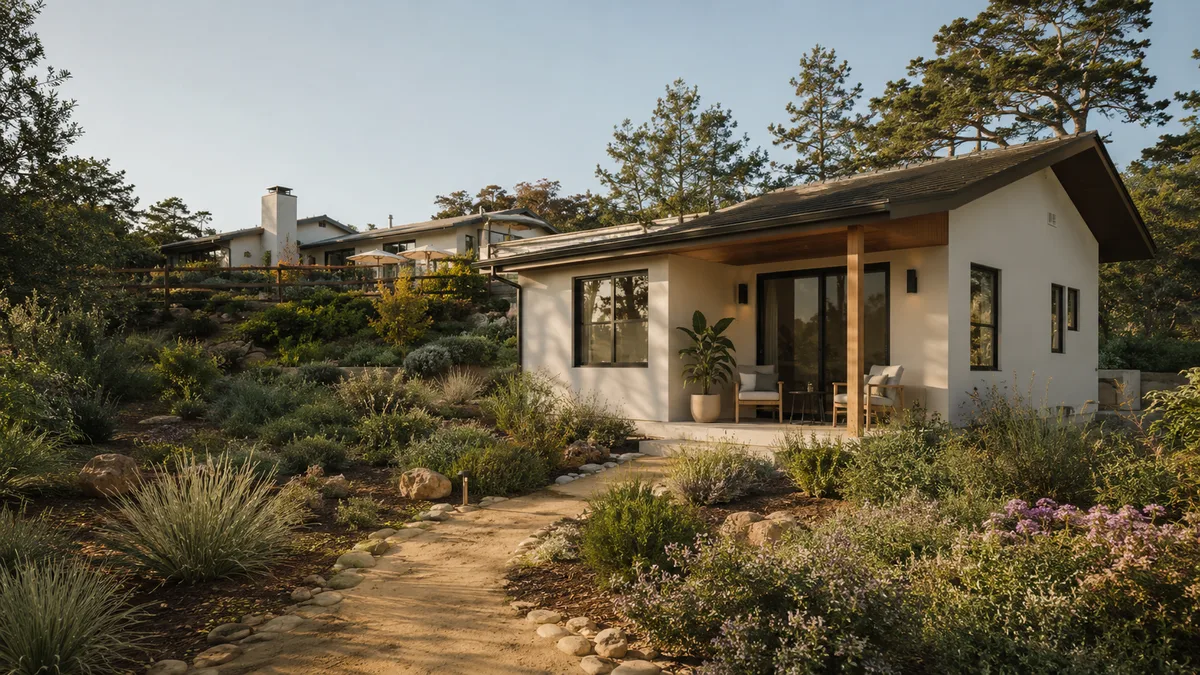
The best ADU builders for unincorporated San Diego County are not always the same firms that dominate City of San Diego or coastal-city ADU lists. Why? Your accessory dwelling unit (ADU) permit goes through County of San Diego Planning & Development Services (PDS) at 5510 Overland Ave, Suite 110 — not a city office. That single fact changes which builders can permit your project, what septic and fire requirements you face, and what fees you actually pay.
For a typical detached new-construction ADU in 2026, plan around $300,000–$475,000+ all-in (about $375–$600+ per square foot) based on multiple builders' published 2026 cost guides. Rural-lot adders for septic, wildland-urban-interface (WUI) fire construction, and access roads add $5,000–$45,000+ beyond a comparable city project. The County's trial impact-fee waiver program ended January 9, 2024 (per sandiegocounty.gov/ADU); California state law still exempts ADUs of 750 sq ft or less from most impact fees under Government Code §66311.5.
The eight builders below have at least one of: stated unincorporated-County coverage on their public service-area page, publicly visible projects in unincorporated communities, or documented County PDS permit experience. The right one for you depends on whether you're building detached, converting a garage, going prefab, planning a separate sale, or working around a septic system, a fire zone, or a homeowners association.
Best next step: confirm your jurisdiction with your Assessor's Parcel Number (APN), then run a parcel-specific feasibility check.
Confirms your jurisdiction, screens project type and lot constraints, and flags County-specific friction before you spend hours interviewing builders.
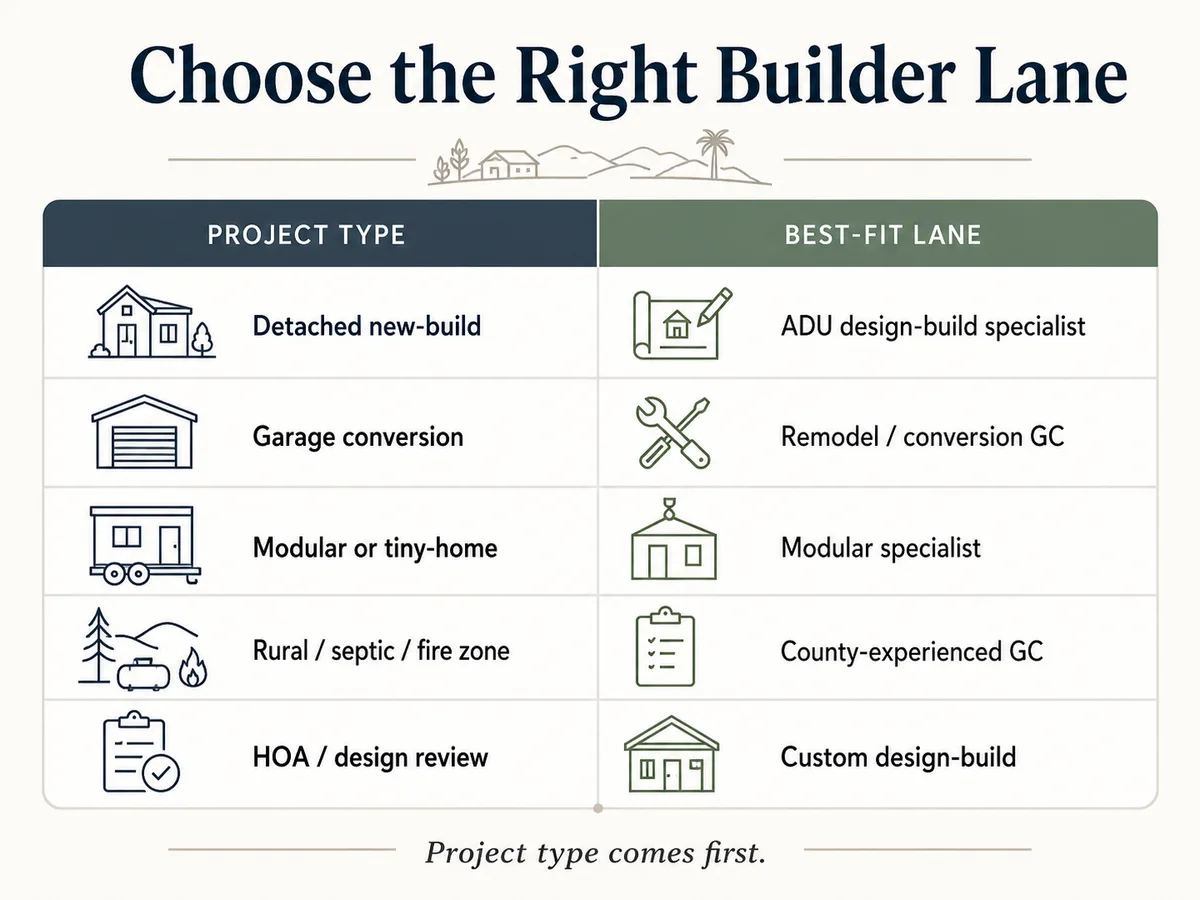
First-screen builder-fit matrix
| If your project is… | Start with this builder lane | Why this lane fits |
|---|---|---|
| Detached 600–1,200 sq ft new-build ADU | Detached ADU design-build specialist | Utilities, sitework, plan check, fixed scope |
| Garage conversion (existing structure) | Remodel/conversion specialist GC | Existing-structure code upgrades drive risk |
| Compact, modular, manufactured, or tiny-home-style | Modular/tiny-home specialist | Foundation, transport, code path, all-in scope |
| Rural lot with septic, well, or VHFHSZ fire zone | County-experienced GC with site-risk fluency | Site constraints can reshape feasibility before design |
| HOA / Rancho Santa Fe / design-review parcel | Custom design-build with HOA submittal experience | Design review and CC&Rs run parallel to County permit |
| AB 1033 separate-sale / condo-conversion intent | Builder + civil engineer + land-use counsel | A condo conversion is not just a building permit |
“Best” here means best-fit for your project type, not a universal ordinal ranking. We don't rank builders 1-through-8 because project-fit beats reputation for most homeowners — see our methodology section for why.
Are you actually under County jurisdiction? (the APN-first check)
Answer: Your mailing city does not determine your ADU jurisdiction — your parcel does. The County of San Diego Planning & Development Services governs ADU permits for properties inside the unincorporated area of the county, regardless of which post office delivers your mail. Confirm your jurisdiction by looking up your Assessor's Parcel Number on the County's Property Summary Report before comparing builders. Mailing addresses for “Vista,” “Escondido,” “El Cajon,” “San Marcos,” and many other cities can belong to unincorporated parcels. We link to city-jurisdiction readers at the bottom of this section.
San Diego County has many unincorporated communities, ranging from suburban-density places like 4S Ranch, Bonita, and Spring Valley to rural and backcountry communities like Julian, Borrego Springs, Pine Valley, and Boulevard. Each one routes its ADU permit through County PDS at 5510 Overland Ave, Suite 110, San Diego, CA 92123 — not a city desk. (For the official County list of unincorporated communities, see the Unincorporated Map Communities document at sandiegocounty.gov.)
How to confirm your jurisdiction in three minutes
- Find your APN. It's printed on your annual property tax bill from the San Diego County Assessor.
- Run the County's Property Summary Report. The County's official ADU page directs homeowners to use the report to confirm zoning and unincorporated status before calling builders.
- Verify residential and SFD status. For a single-family-homeowner ADU project, PDS requires the property to be in the unincorporated area, considered residential, and to have an existing or planned single-family dwelling. (Multifamily lots have separate ADU rules under County Zoning Ordinance §6156.x and California Government Code §66323 — those projects need different guidance than this page.)
Communities almost always under County PDS
The following communities are entirely or almost entirely unincorporated and therefore under County jurisdiction for ADU permits: Alpine, Bonita, Bonsall, Borrego Springs, Boulevard, Campo, Crest, Descanso, Dulzura, Fallbrook, Granite Hills, Harbison Canyon, Hidden Meadows, Jacumba, Jamul, Julian, Lakeside, Lake San Marcos, Mount Helix, Pala, Pala Mesa, Pauma Valley, Pine Valley, Potrero, Rainbow, Ramona, Rancho San Diego, Rancho Santa Fe, San Diego Country Estates, Santa Ysabel, Spring Valley, Sweetwater, Twin Oaks, Val Verde, Valle de Oro, Valley Center, 4S Ranch (portions), and others. The County's own mapping tool is the authoritative source — use it.
Mailing-address traps to avoid
A “Vista, CA” or “Escondido, CA” mailing address can still belong to an unincorporated parcel. We've seen homeowners interview five “Vista ADU builders” before realizing the property is County-jurisdiction and not a single one of those city-focused builders had recent County PDS permit history. Don't trust the mailing city alone — APN wins. Our existing Vista and Escondido builder guides flag the same trap from the city side; this page covers it from the County side. City-jurisdiction readers should also see our broader San Diego County builder guide.
Run the parcel check first. Our Feasibility Engine takes your address, screens jurisdiction, project type fit, and likely County-specific friction points, then routes you to the correct builder lane.
Check My Property → Get My Free ReportBest ADU builders unincorporated San Diego County: 8 builder-fit lanes
Answer: Most San Diego ADU builders advertise “San Diego County” but in practice work primarily inside the City of San Diego or coastal cities. The eight builders below have at least one of: stated unincorporated-County coverage on their public service-area page, public project portfolios in unincorporated communities, or documented County PDS permit experience. We screen all builders against the same seven inclusion criteria across every Builder Guide on Dwelling Index — active CSLB B (General Building) license, ADU-specific portfolio, verifiable address in or adjacent to San Diego County, BBB A or higher where a profile exists, public website with disclosed leadership, at least three years operating, and no public-record CSLB enforcement actions. For this page, we also require stated unincorporated-County coverage OR documented unincorporated-community projects OR explicit County PDS permit experience.
Affiliate disclosure: The Dwelling Index is reader-supported. Some links on this page are affiliate links. If you click one and take a qualifying action, we may earn a commission at no extra cost to you. Affiliate relationships do not influence our editorial rankings or conclusions. Read our full disclosure.
Affiliate disclosure (table-adjacent): SnapADU is our active commercial partner. SnapADU was screened under the same criteria as every other builder named on this page; the commercial relationship does not affect inclusion. We do not accept payment for placement.
Comparison table — verified evidence basis
| Builder | HQ / Years | Evidence basis | Best-fit project | Fee model | One honest weakness |
|---|---|---|---|---|---|
| SnapADU (our partner)(partner) | San Diego, since 2020; 100+ ADUs (self-reported) | Lists "unincorporated San Diego County" by name on their public service-area page; CSLB #1075582 publicly posted | Detached new-build, two-story carriage house, multi-unit | Fixed-bid with 6-month price lock | Stick-built only — not for prefab shoppers |
| Hedges Construction | North County, decades operating | Public North County / unincorporated portfolio and ADU practice page | Detached + larger custom | Custom | No published per-sq-ft pricing — request directly |
| Youngren Construction | Fallbrook, 32+ years | Built throughout Fallbrook + unincorporated North County | Conversions and new-build | Custom | Smaller online presence; verify backlog |
| EG Construction | San Diego County | Markets unincorporated specifically — Alpine to Fallbrook | County-permitted detached, septic experience | Custom | Per-sq-ft pricing not openly published |
| Better Place Design & Build | San Diego County | Lists Bonita, Rancho Santa Fe, Spring Valley | Detached + garage conversions | Verify-before-price | "Top-ranked" claim is self-claim |
| LADU | San Diego City + County | Architect-led; aligns drawings to County standards | Architect-first design path with builder partners | Fixed-fee design | Build is via partners — verify partner GC license separately |
| Crest Backyard Homes | San Diego County | Stated in published portfolio | Detached, stick-built or prefab options | Custom | Confirm scope inclusions; some published photos cross multiple cities |
| OneStop ADU | San Diego County | Explicit "entire county, Oceanside to San Ysidro to Alpine" | Pre-designed plan library + permit + build | Plan-package pricing | Plans are pre-fixed; less custom flexibility |
Critical for every reader: License status, BBB rating, ownership, and service area all change. Verify the CSLB license number directly at cslb.ca.gov before you sign with any builder named here. Confirm B (General Building) classification, active status, posted bond, and current workers' compensation. We checked these things in May 2026; your build is happening later.
SnapADU
- Founded: 2020 by Whitney Hill (CEO) and Mike Moore (CFO), publicly named on their About page.
- License: CSLB #1075582 (publicly posted on snapadu.com — verify status at cslb.ca.gov before signing).
- Service area, stated: Greater San Diego — San Diego, Oceanside, Carlsbad, Encinitas, Del Mar, Solana Beach, Poway, San Marcos, Escondido, La Mesa, El Cajon, Vista, Chula Vista, Rancho Santa Fe, Santee, Lemon Grove, Imperial Beach, National City, Bonsall, Camp Pendleton, Cardiff By The Sea, La Costa, and unincorporated San Diego County. They are one of the few specialists with stated unincorporated coverage on their public service-area page.
- Project types: Detached new-construction ADUs only — including two-story carriage houses and multi-unit ADU sites. Stick-built (on-site traditional wood-framed), not prefab.
- Pricing model: Fixed-bid with a six-month price lock. In-house design, permitting, and construction.
- Build count claim: 100+ completed ADUs (company-reported, last published March 2026). SnapADU's self-published 2026 lessons report states approximately 85% of their 2022–2023 submitted projects reached completion by December 2025 — a self-reported figure they contrast with their stated industry average. We have not independently audited this number.
- County-community evidence: SnapADU publishes specific unincorporated-County project pages, including a documented Lakeside two-story 933 sq ft project at $339K reported build cost (per snapadu.com/projects/palm-row-dr-lakeside-ca/). Build cost is not the same as homeowner all-in cost — ask any builder which fees, sitework, finishes, and contingency are included before comparing numbers.
- Pre-approved plans: SnapADU designed the pre-approved plan libraries for the City of Chula Vista and the City of San Marcos through competitive bid processes; the City of San Diego accepts the Chula Vista plans under California Assembly Bill (AB) 1332. (For County-jurisdiction parcels, the County's own ~85%-complete Plans A–F are the relevant pre-approved set — see the standard-plans section below.)
- Where they fit best: Detached, stick-built ADUs in Greater San Diego where you want a single in-house team accountable for design, permits, and build, with a fixed bid rather than cost-plus.
- Honest weakness: Stick-built only — not a fit for prefab. Most competitive on detached new-build; less competitive on simple garage conversions. The six-month price-lock structure works for most homeowners but is less flexible than cost-plus for buyers who want to defer scope decisions. Confirm your specific unincorporated community at the consult stage before assuming coverage.
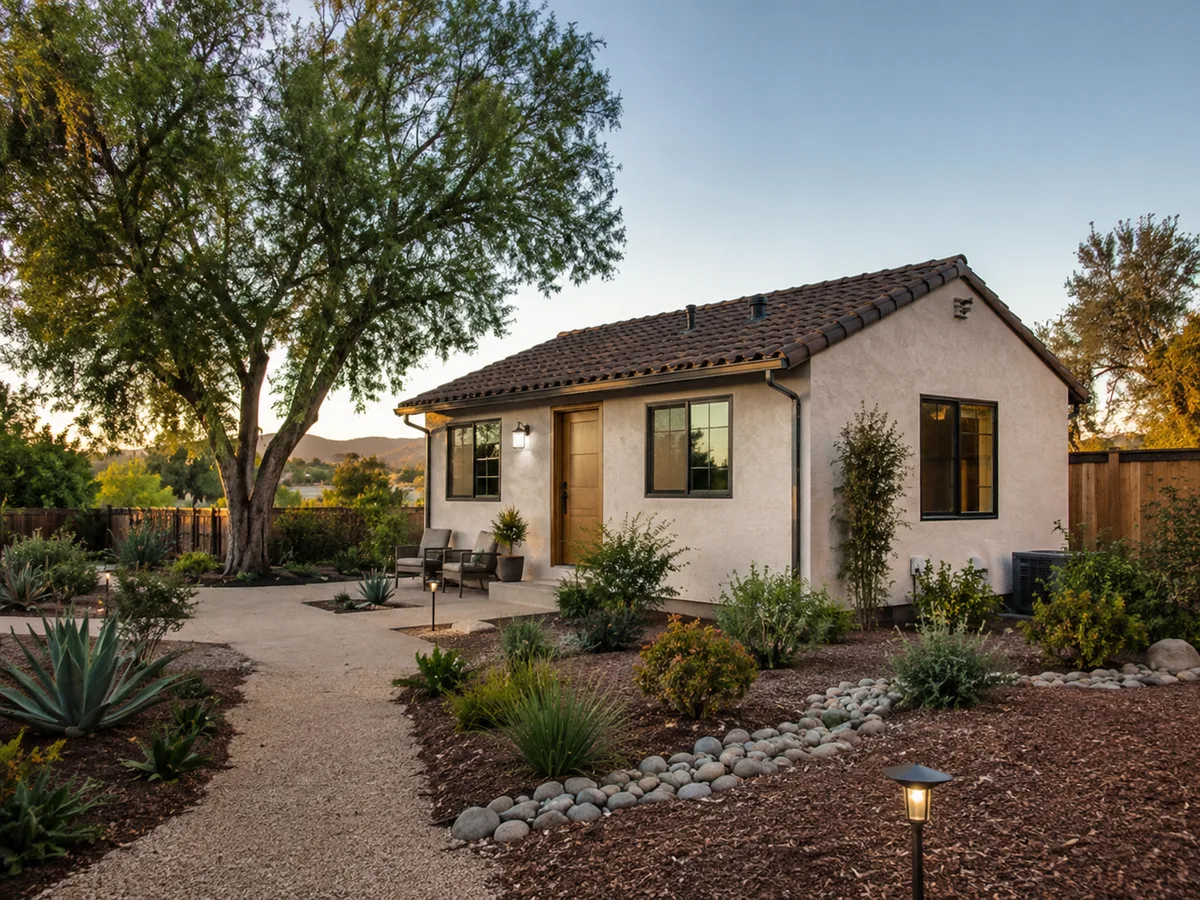
If a stick-built detached ADU on your unincorporated lot matches what SnapADU does, request a free consult.
Request a Free SnapADU Consult → (sponsored)Best fit if you want a detached site-built ADU in Greater San Diego County. Not the right first call for garage-conversion-only, JADU-only, or prefab-only projects.
Affiliate disclosure (CTA-adjacent): SnapADU is our active commercial partner. We may earn a commission if you proceed. Editorial inclusion is criterion-based; the commercial relationship does not affect placement.
Hedges Construction
- Service area: North San Diego County, with deep Fallbrook and inland-North-County experience.
- Project types: Detached ADUs, attached ADUs, garage conversions, larger custom guest houses. Note: Hedges publishes a client testimonial referencing a 1,400 sq ft completed unit. Current County rules cap detached ADUs at 1,200 sq ft; older or differently-classified projects may not reflect current ADU size limits — confirm any quoted size against current code before designing.
- Pricing model: Custom bidding.
- Where they fit best: North County rural and semi-rural lots where local knowledge of fire districts (e.g., North County Fire Protection District), well/septic infrastructure, and parcel grading matters more than a slick design portfolio.
- Honest weakness: Single-builder operation with no published per-sq-ft cost ranges. Ask for current cost ranges and recent permit examples in your specific community.
Youngren Construction
- Founded: Fallbrook, 32+ years operating.
- Service area: Centered on Fallbrook with broader unincorporated North County reach.
- Project types: Design-build general contractor handling residential and ADU work, including conversions and new builds.
- Where they fit best: Homeowners in Fallbrook, Bonsall, Rainbow, Pala, and Pauma Valley who want a long-tenured local with named ownership and personal accountability.
- Honest weakness: Smaller online footprint than the largest specialists; ask for a verifiable list of completed unincorporated-County ADUs in the last 24 months and the projected start date for your project — backlog matters.
EG Construction
- Service area: San Diego County, with a published service-area page that specifically markets to unincorporated areas from Alpine to Fallbrook to Lakeside to Ramona.
- Project types: County-permitted detached ADUs, with stated experience handling septic, fire access, and rural site conditions.
- Where they fit best: Unincorporated parcels with septic systems or fire-access challenges — the kind of project a city-only builder won't bid.
- Honest weakness: Per-square-foot pricing is not openly published, so direct cost comparison is harder until you sit down with their team. Verify project examples in your specific community before assuming experience there.
Better Place Design & Build
- Leadership: Co-owned by licensed general contractor Bar Zakheim; family-owned San Diego firm.
- Service area: San Diego County. Their public service-area pages list Bonita, Rancho Santa Fe, and Spring Valley among the unincorporated communities they serve, alongside many incorporated cities.
- Project types: Detached ADUs, attached ADUs, garage conversions, room additions; full design-build under one roof.
- Pricing model: “Verify before we price” — they confirm zoning, utilities, and site conditions before a binding quote.
- Where they fit best: Homeowners comparing two or three full-service design-build firms head-to-head and who want a builder with strong cost-transparency on the front end.
- Honest weakness: Their “top-ranked” claim is a self-claim with no third-party methodology behind it; treat their published cost ranges as their own quote experience, not industry-wide truth.
LADU
- Service area: San Diego City and County. Their public site explicitly states they align drawings to County standards for unincorporated parcels.
- Project types: Architect-led ADU design and permitting, with a clean handoff to proven builder partners for construction.
- Pricing model: Fixed-fee design, with separate construction contracts through their partner GCs.
- Where they fit best: Homeowners on tricky lots — coastal, sloped, design-sensitive, or HOA-controlled — who want architect-led design before committing to a builder.
- Honest weakness: Build is delivered through partners, so verify each partner GC's CSLB license, insurance, and recent unincorporated-County work separately.
Crest Backyard Homes
- Service area: San Diego City and County, including La Jolla and Vista per their published portfolio.
- Project types: Detached ADUs; markets both prefab and site-built capability.
- Where they fit best: Homeowners exploring detached ADUs who want a single firm with both prefab and stick-built options on the table.
- Honest weakness: Confirm scope inclusions and exclusions in writing — especially around prefab vs. stick-built site-work assumptions.
OneStop ADU
- Service area: Their public site claims “the entire county, from Oceanside to San Ysidro, all the way to Alpine.”
- Project types: Six pre-designed floor plans in three exterior styles (Contemporary, Craftsman, Spanish/Mediterranean), with permit processing, in-house construction, architectural plans, structural plans, Title 24 energy report, electrical upgrade, and required solar bundled.
- Pricing model: Plan-package pricing — easier to compare bids on a like-for-like basis when you stick with one of the six plans.
- Where they fit best: Homeowners who want a faster path to permit by avoiding custom design and who like one of the pre-designed layouts.
- Honest weakness: Plans are pre-fixed; less custom flexibility than a true design-build approach. SDG&E utility fees and most site-specific extras are typically excluded from the bundled price — read inclusions and exclusions line by line.
Match this list to your specific property.
Run the Free Unincorporated SD County Feasibility Check →Which builder lane fits your project type?
Answer: Pick the lane before you pick the builder. A detached-ADU specialist is rarely the cheapest path for a garage conversion. A volume prefab seller will struggle on a sloped, treed, or fire-access-constrained lot. A general remodeler doing their first ADU will learn at your expense. The single biggest cost mistake unincorporated San Diego County homeowners make is hiring a builder whose specialization doesn't match the project.
Detached new-construction ADU
Real 2026 cost expectation: roughly $300,000–$475,000+ all-in for a typical 600–1,200 square foot turnkey detached ADU in unincorporated San Diego County, equivalent to $375–$600+ per square foot including design, permits, sitework, utilities, finishes, and reasonable contingency. Smaller ADUs cost more per square foot because fixed costs (permit fees, foundation mobilization, utility laterals, sitework) get spread over fewer feet.
Lane to start with: detached ADU design-build specialist with stated unincorporated coverage. SnapADU, Better Place, OneStop, and Hedges all qualify. Ask each for three completed ADU addresses in unincorporated communities permitted in the last 24 months and verify those addresses against publicly available County PDS permit records before signing.
Garage conversion
Real 2026 cost expectation: roughly $100,000–$210,000 for a permitted garage-to-ADU conversion (planning estimate from multiple builders' 2026 published cost guides), depending on the garage's current condition, utility capacity, ceiling height, slab, and code-upgrade scope. A garage conversion sounds cheaper than detached new-build because you keep the foundation and the walls — but the savings can erase fast if the slab fails inspection, the existing electrical service is too small, the ceiling isn't tall enough, the sewer route requires trenching, or the original garage wasn't legally permitted in the first place.
Lane to start with: remodel/conversion-specialist GC. Better Place handles conversions, several smaller specialists in the East and North County lean into conversion work. Skip detached-only specialists for this — their cost structure isn't built for it.
Junior ADU (JADU)
A JADU is a smaller unit, maximum 500 square feet, contained entirely within an existing or proposed single-family home. JADUs may share sanitation facilities with the main house (with interior access) and require an efficiency kitchen at minimum. Cost typically runs $50,000–$110,000+ depending on scope and finish level (planning estimate from multiple builders' 2026 published guides). Under current California Government Code §66333, owner-occupancy is generally not required for a JADU with separate sanitation facilities, but JADU owner-occupancy still applies broadly. County Zoning Ordinance §6156.x continues to contain JADU owner-occupancy deed-restriction language; confirm current implementation directly with County PDS before signing if owner-occupancy affects your plans.
Prefab, modular, manufactured, or tiny-home-style
Lane to start with: modular/tiny-home specialist. The honest comparison isn't sticker price — it's all-in installed scope. The factory price excludes the foundation, the transport, the crane, the utility laterals, the County plan check (because the County still needs to approve site placement, fire access, and connections), and often any sitework over a few thousand dollars. Get every quote written as a complete on-site, ready-to-occupy total.
For a flat unincorporated lot with reasonable access, a modular or compact ADU can be faster and price-competitive. For a sloped Alpine ridge, a treed Pine Valley parcel, or a long-driveway Pauma Valley property, the access and sitework costs alone can erase the prefab savings. Nest Tiny Homes is an approved partner for Southern California / San Diego County tiny-home and compact-ADU intent (CSLB #1131365 publicly posted on nest-tinyhomes.com — verify status before signing). USModular publishes Southern California ADU service. Verify HUD-Code versus California Building Code (CBC) path with any prefab vendor — those are legally different products and the County reviews them differently.
Rural lot, septic, or VHFHSZ fire zone
Lane to start with: County-experienced GC with documented site-risk fluency. Ask the builder to walk the lot before quoting. Ask which fire authority will weigh in on your project (it varies by community — see the fire-district matrix below). Ask whether the bid includes the County Department of Environmental Health (DEH) septic plan check, ignition-resistant exterior construction, and any required automatic sprinklers or on-site water supply. A bid that doesn't address these on a rural unincorporated parcel is a low bid because it's incomplete, not because the builder is efficient.
HOA or design-review communities
Lane to start with: custom design-build with documented HOA submittal experience. Rancho Santa Fe is the canonical example — its fire protection district has stricter standards (fire truck access, sprinklers, water supply, defensible space, fire-resistant landscaping), and the Rancho Santa Fe Association has its own architectural review process layered on top of County PDS. The County review and the HOA review run in parallel; a builder who has only done County work and never an HOA submittal will lose months at the HOA gate.
AB 1033 separate-sale intent
Lane to start with: builder + civil engineer + land surveyor + land-use counsel. The construction contract is necessary but not sufficient. A separate-sale path through condominium conversion requires creation of condominiums under the Davis-Stirling Common Interest Development Act in conformance with the Subdivision Map Act, County Code, and County zoning, plus lienholder consent (or refinance), utility provider notification, and — if the parcel is in a planned development — HOA authorization. Get a written AB 1033 feasibility memo before you sign a construction contract, not after. If the path doesn't pencil, you may want to scope the build differently.
County of San Diego ADU rules — and how they differ from City rules
Answer: California ADU law is now organized primarily in Government Code Chapter 13, §§66310–66342. Unincorporated-County rules align with state law but layer on local conditions specific to County PDS and the County Zoning Ordinance §6156.x. Detached ADUs cap at 1,200 square feet; attached ADU size is generally limited to 50% of the primary residence, up to 1,200 square feet — but the 50% limitation does not apply to attached ADUs up to 850 square feet, or up to 1,000 square feet if the ADU has more than one bedroom. JADUs cap at 500 square feet. Side and rear setbacks for new detached ADUs are 4 feet minimum. Owner-occupancy is no longer required for ADUs (state law preempts most local rules); JADU owner-occupancy rules are evolving — see the FAQ. Short-term rentals (under 31 days) are prohibited under County code §6156.x.
Plain-English decoder: County rule versus City of San Diego rule
We've seen homeowners get tripped up reading “San Diego” rules online and assuming they apply to their unincorporated parcel. They often don't.
| Topic | County of San Diego (unincorporated) | City of San Diego |
|---|---|---|
| Permitting authority | County PDS at 5510 Overland Ave, Suite 110 | City of San Diego DSD at 1222 First Ave |
| Detached ADU max size | 1,200 sq ft (County §6156.x) | See current City IB-400 |
| Attached ADU max size | Lesser of 50% of primary or 1,200 sq ft, with exceptions for ADUs ≤850 sq ft (1-bed) or ≤1,000 sq ft (2+ bed) | See current City IB-400 |
| JADU max size | 500 sq ft | 500 sq ft |
| Detached ADU height | Generally limited to 25 ft (County §6156.x); under the §66323 ministerial path a single-family detached ADU is 800 sf / 18 ft; existing-multifamily detached: 18 ft; proposed-multifamily detached: 25 ft | See current City IB-400 |
| Side / rear setback | Minimum 4 ft for newly constructed detached/attached ADUs (County §6156.x) | See current City IB-400 |
| Building separation | Minimum 6 ft between structures; 4 ft eave-to-eave | Generally similar |
| Coastal Overlay | Tiny portion of Rancho Santa Fe only | Full coastal zone applies |
| Fire authority | Local fire protection district (varies by community) | San Diego Fire-Rescue Department |
| Short-term rental | Rentals under 31 days prohibited (County §6156.x) | See current City rules |
| Fire sprinklers in ADU | Required only if required for the primary dwelling (County §6156.x); local fire agencies may impose access, water-supply, WUI, and defensible-space conditions where applicable | Same baseline |
| AB 1033 separate sale | Adopted March 4, 2026; effective April 4, 2026 (sandiegocounty.gov/ADU) | Adopted earlier; in effect |
| Ministerial review window | 60 days from a complete application (Government Code §66317) | Same — 60 days from a complete application |
A few practical things to flag:
- Government Code §66317 sets a 60-day ministerial review window from the date of a complete application — not from initial submission. Real-world County PDS review timelines are reported by builders as roughly 4 to 10 weeks for clean projects and 3 to 4 months for projects requiring septic, fire-district, or coastal review.
- Owner-occupancy was removed for standard ADUs by AB 68 and successor legislation. If a builder cites pre-2020 owner-occupancy rules, they're working from outdated material.
- Multifamily ADU rules expanded under SB 1211 — multifamily property owners may now build as many detached ADUs as there are existing units, capped at eight per property.
- AB 2533 (passed 2024) opened a streamlined amnesty path for unpermitted ADUs built before January 1, 2020.
What does an ADU really cost in unincorporated San Diego County in 2026?
Answer: A typical 600–1,200 square foot detached new-construction ADU in unincorporated San Diego County runs $300,000–$475,000+ all-in based on multiple builders' published 2026 cost guides, equivalent to roughly $375–$600+ per square foot including design, permits, sitework, utilities, finishes, and contingency. Garage conversions run $100,000–$210,000. JADUs under 500 sq ft typically come in at $50,000–$110,000+. Rural unincorporated lots add adders that City of San Diego homeowners usually don't face: septic system evaluation or upgrade, fire-zone construction adders, access road or driveway upgrades, and well or water-tank requirements.
Cost ranges by ADU type — sourced and dated
| ADU type | 2026 planning range (all-in) | Per-sq-ft equivalent | Source / method |
|---|---|---|---|
| Detached, 500 sq ft | ~$300,000+ | ~$600/sq ft | SnapADU public cost guide (March 2026); builder-published planning estimate |
| Detached, 750 sq ft | ~$300,000–$365,000 | ~$400–$485/sq ft | SnapADU cost guide; cross-referenced against Better Place 2026 ranges |
| Detached, 1,000 sq ft | ~$365,000–$425,000 | ~$365–$425/sq ft | SnapADU cost guide |
| Detached, 1,200 sq ft | ~$425,000–$475,000+ | ~$355–$395+/sq ft | SnapADU cost guide; County size cap |
| Attached ADU | ~$160,000–$280,000 (500–800 sq ft) | varies | Realm Home San Diego analysis (2026); planning estimate |
| Garage conversion | ~$100,000–$210,000 | varies by scope | Realm Home; BNC Builders public ranges (2026) |
| JADU (≤500 sq ft) | ~$50,000–$110,000+ | varies | Realm Home; multiple builders' 2026 planning ranges |
Sources cross-checked for these ranges (verified May 2026): SnapADU's public cost guide and project pages, Better Place Design & Build's published 2026 ranges, BNC Builders' published per-sq-ft ranges, the San Diego Housing Commission ADU Pilot Program's documented per-sq-ft observed range of $276–$521, and Realm Home's 2026 San Diego cost analysis. Different sources draw the line between “build cost” and “all-in homeowner cost” differently — when comparing, ask each builder explicitly whether the number includes design, permits, sitework, utilities, contingency, and finishes.
These figures are illustrative planning ranges based on multiple builders' published 2026 estimates. They are not guarantees. Actual costs depend on lot conditions, design choices, finishes, and the current material and labor markets. Get three written bids on identical scope before you commit.
Unincorporated-specific cost adders (planning estimates)
| Adder | Typical 2026 planning range | When it applies | Source / method |
|---|---|---|---|
| Septic evaluation + minor upgrade | $5,000–$10,000 | Most rural parcels with existing septic | Builder-reported planning range; verify with septic professional |
| Septic system replacement | $20,000–$40,000+ | Older or undersized OWTS, alternative systems | Builder-reported planning range |
| DEH septic plan check fee | Several hundred dollars | All projects on septic | County DEH fee schedule — confirm current amount |
| Well evaluation + setback compliance | $1,500–$5,000 | Parcels with private well | Builder-reported planning range |
| Water tank for fire flow | $8,000–$25,000+ | Some fire districts (e.g., Rancho Santa Fe FPD) | Builder-reported planning range |
| Ignition-resistant exterior (VHFHSZ) | $5,000–$20,000+ | All Very High Fire Hazard Severity Zone parcels | Builder-reported planning range |
| Defensible space landscaping | $2,000–$8,000 | All VHFHSZ parcels | Builder-reported planning range |
| Fire-rated assemblies + sprinklers | $3,000–$15,000 | When primary requires sprinklers, or by FPD discretion | Builder-reported planning range |
| Access road / driveway upgrade | $3,000–$15,000+ | Long driveways, fire apparatus turnaround | Builder-reported planning range |
| Long utility trench (sewer/water/electric) | $50–$200 per linear foot | Distant connection points | Builder-reported planning range |
| Solar (California Energy Code) | $8,000–$15,000 | New detached non-manufactured ADUs may trigger Title 24 solar requirements | Builder-reported planning range |
| In-person plan-submission printing + drop-off | $300–$700 | When full plan-set is submitted in person | Builder-reported planning range |
Worked example: 750 sq ft detached ADU in Alpine, on septic, in VHFHSZ
A two-bedroom 750 sq ft detached ADU in Alpine on an existing septic system needing minor upgrades, in a Very High Fire Hazard Severity Zone with adequate fire-flow water at the hydrant, conservatively budgets like this:
- Design + County permit submittal + DEH septic plan check: $18,000–$30,000
- County PDS plan review (Plan Review $1,865 + $0.394/sf for ADUs per PDS-613 effective 7/1/2025): ~$2,161
- County PDS permit (Permit $1,596 + $0.537/sf per PDS-613): ~$1,999
- Foundation, framing, mechanical, electrical, plumbing: $190,000–$240,000
- Fixtures, finishes, cabinets, flooring, appliances: $35,000–$65,000
- Septic upgrade: $7,500–$15,000
- VHFHSZ ignition-resistant materials + defensible space: $7,000–$18,000
- Solar: $9,000–$13,000
- Sitework, utilities, driveway, contingency (15–20%): $40,000–$80,000
Realistic all-in: $310,000–$470,000.
That range matches the broader detached-ADU planning range and explains why “$300K” and “$475K” are both honest answers for the same square footage on the same kind of lot, depending on site conditions.
Worried your quote isn't realistic? Run the parcel check.
Get Your Free Unincorporated SD County ADU Report →Confirms jurisdiction, screens project type and lot constraints, and flags County-specific friction.
The damaging admission
Building an ADU in unincorporated San Diego County costs more and takes longer than building one in the City of San Diego. The septic and fire-zone realities are real, the in-person paper plan-set submittal slows things down for many projects, and not every builder will take the project. What we'd never tell you, though, is that this means you shouldn't build. What it means is that you need to budget honestly, screen builders for unincorporated permit history, and run feasibility on your lot before you commit. The homeowners who succeed out here are the ones who treated those realities as line items, not surprises.
Includes the 15-question builder interview guide, the County PDS submission checklist, a septic-evaluation worksheet, and a bid-comparison spreadsheet.
Can I use the County's pre-approved ADU plans? (Plans A through F)
Answer: Yes — the County of San Diego offers six pre-developed dwelling unit plans (A through F) that can be used as detached ADUs in unincorporated areas. The County website explicitly states the plans are approximately 85% complete and require project-specific information to be filled in (per sandiegocounty.gov/content/sdc/pds/bldg/adu_plans.html). They are a starting point, not a finished permit package. Plans G and H are single-family dwelling plans rather than ADU plans.
County standard ADU plans at a glance
| County plan | Size | Layout | Best fit |
|---|---|---|---|
| Plan A | 1,200 sq ft | 3 bed / 1 bath | Family use, larger rental, multi-bedroom value |
| Plan B | 1,200 sq ft | 2 bed / 1 bath | Simpler 1,200 sq ft layout, larger living space |
| Plan C | 1,200 sq ft | 2 bed / 2 bath | Aging-parent + caregiver, dual-suite arrangement |
| Plan D | 1,000 sq ft | 1 bed / 1.5 bath | Larger one-bedroom, accessibility-friendly |
| Plan E | 800 sq ft | 1 bed / 1 bath | Standard rental size, common compact build |
| Plan F | 600 sq ft | 1 bed / 1 bath | Smallest footprint, lowest construction cost |
The plans cost nothing to use — but the engineering, structural, energy compliance, site-specific fire-rated assembly modifications, and any septic/utility integration must be added by your builder or design professional. The 85% completion figure is a real number, not marketing — the homeowner or builder is responsible for the remaining 15%, which is often the most expensive 15%.
The smart question to ask any builder
“For my parcel, will you start from a County standard plan (A–F), modify one, or design custom — and exactly what's included in your fee to take a 600 to 1,200 square foot plan from 85% to a permit-ready submittal that passes plan check on the first or second cycle?”
A clear, specific answer tells you a builder has actually used these plans recently. A vague answer or a “we always start custom” deflection tells you they haven't.
What's actually still waived in 2026 (the County's trial program ended in January 2024)
Answer: The County's trial impact-fee waiver program — which waived plan check, building permit, drainage, DEH septic plan check, Parks & Recreation, and Transportation Impact Fees for unincorporated homeowners — ran from January 9, 2019 through January 9, 2024 and is no longer accepting new applications, per sandiegocounty.gov/ADU. If you're reading older articles citing it as active, those are out of date. (Contemporaneous reporting from County News Center cited an $11 million Board allocation for the five-year trial.)
What's still in effect in 2026 under state law
- Government Code §66311.5 impact-fee exemption. ADUs with 750 square feet of interior livable space or less, and JADUs, are exempt from impact fees.
- §66311.5 utility-connection fee cap. For ADUs over 750 sq ft, utility connection fees are capped, not eliminated.
- AB 1332 pre-approved plan path. California cities and counties must approve permits using vetted pre-approved plans within as little as 30 days. The County's Plans A–F qualify as the local version of this path.
- County PDS green-design discount. Per PDS-613 (effective 7/1/2025): qualifying projects in the County Green Building Program receive a 7.5% reduction in plan check and permit fees.
- AB 2533 amnesty path. For unpermitted ADUs built before January 1, 2020, a streamlined permit pathway exists if the structure can be brought up to specific health, safety, and building standards.
Old waiver versus what's still available
| Fee category | Old County trial waiver (Jan 2019 – Jan 2024) | What's still in effect (2026) |
|---|---|---|
| Plan check fee | Waived | Charged — see PDS-613 (Plan Review $1,865 + $0.394/sf for ADUs) |
| Building permit fee | Waived | Charged — see PDS-613 (Permit $1,596 + $0.537/sf for ADUs) |
| Development impact fees | Waived | Waived under §66311.5 if ADU is ≤750 sq ft of interior livable space |
| DEH septic plan check | Waived | Charged for septic projects |
| Drainage fee | Waived | Charged — varies |
| Parks & Recreation fee | Waived | Charged — varies |
| Transportation Impact Fee (TIF) | Waived | Waived under §66311.5 for ADUs ≤750 sq ft interior livable; charged otherwise |
| School fees | Not addressed by County waiver | ADU/JADU with less than 500 sq ft treated as not increasing assessable space; larger ADUs vary by local district |
AB 1033 and the new condo-conversion path for unincorporated SD County (adopted March 2026)
Answer: On March 4, 2026, the County of San Diego Board of Supervisors voted unanimously to adopt California Assembly Bill 1033, allowing ADUs in unincorporated communities to be subdivided and sold separately from the primary residence through a condominium conversion process. Implementation took effect April 4, 2026. Additional draft options related to owner occupancy and homeownership support were released for public review from May 1–31, 2026, with County staff collecting feedback toward a Board hearing in late summer 2026 (per the County's ADU Zoning Ordinance Amendment page). AB 1033 does not increase the number of dwelling units allowed on a parcel, and JADUs are not eligible for separate sale.
For the first time in San Diego County history, your detached ADU may be sold separately from the primary residence under a condominium conversion. The ADU and primary dwelling are structured as condominium units within a common-interest development under the Davis-Stirling Common Interest Development Act, in conformance with the Subdivision Map Act, County Code, and County zoning requirements.
What's required to take advantage of AB 1033
- Condominium structure under Davis-Stirling. ADU and primary dwelling must be structured as legal condominium units in conformance with the Subdivision Map Act, County Code, and County zoning requirements.
- Tentative Parcel Map or Tentative Map. Under the County's adopted process, separate-sale eligibility runs through PDS as a condominium conversion supplemental to the standard subdivision map application.
- Lienholder consent. Your existing mortgage lender must agree — or the loan must be paid off, refinanced, or the collateral modified. Lender refusal is a real possibility.
- Utility provider notification. State law requires notice to each impacted utility provider.
- HOA authorization (if applicable). If your parcel is in a planned development, the homeowners association must authorize the conversion.
- Final inspection / Certificate of Occupancy. County code requires the ADU to receive its final inspection and Certificate of Occupancy before condominium recordation.
- A reasonable wait for the County's implementing rules. Owner-occupancy and tenant first-right-of-refusal options were under public review May 1–31, 2026, with a Board hearing expected in late summer 2026.
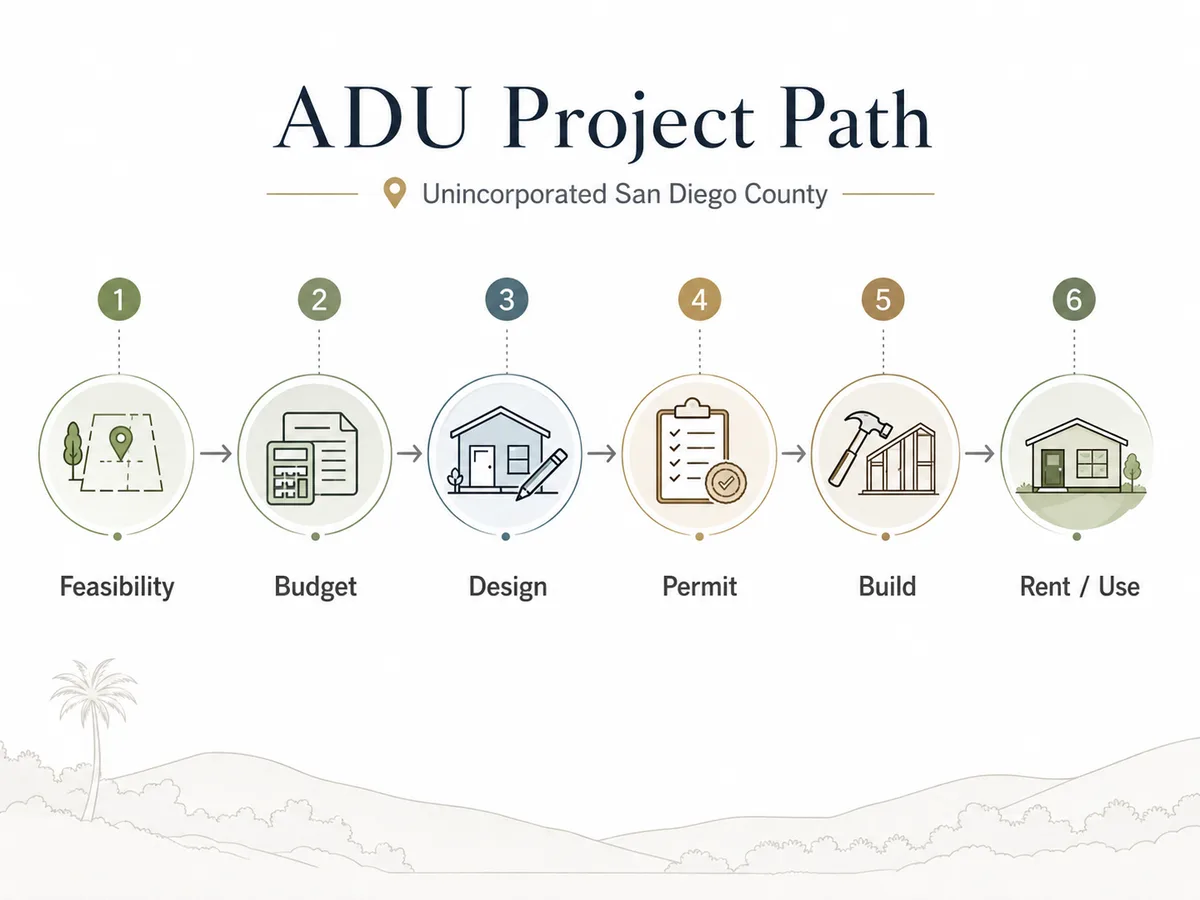
How long does the County permit process take? (Timelines, submission, and the 60-day clock)
Answer: California Government Code §66317 sets a 60-day approve-or-deny window for ministerial ADU review — but that clock starts when your application is complete, not when you first submit. Builder-reported real-world County PDS timelines run roughly 4 to 10 weeks for clean projects and 3 to 4 months for projects on septic, in fire zones, with HOA review, or with corrections cycles. The County PDS Application Summary indicates applications can be submitted online or in person; multiple builders report that full ADU plan-set submittals have historically been delivered as paper sets at PDS — verify the current method directly with PDS before planning your timeline.
The County permit process, step by step
- Pre-application research. Run your APN, confirm zoning, confirm fire authority, confirm sewer or septic.
- Design, structural, and energy compliance. Architectural plans, structural calculations, Title 24 energy compliance documents, site plan, septic plan if applicable, and fire access plan if in VHFHSZ.
- Submission to PDS. Application fees due at submission. Confirm with PDS whether your project's full plan-set is accepted online or requires an in-person paper submittal.
- Plan check. PDS reviews the plans, with parallel routing to the local fire authority and County DEH (for septic projects) where applicable.
- Corrections. Plan check almost always returns at least one round of corrections.
- Permit issuance. Once corrections clear, permit fees are due and the building permit is issued.
- Construction inspections. Foundation, framing, mechanical, electrical, plumbing, insulation, drywall, and final.
- Certificate of Occupancy. Once final inspection passes, the ADU is legally habitable.
County PDS fee math by ADU size (per PDS-613 effective July 1, 2025)
| ADU size | Plan review ($1,865 + $0.394/sf) | Permit ($1,596 + $0.537/sf) | County PDS subtotal |
|---|---|---|---|
| 500 sq ft | ~$2,062 | ~$1,865 | ~$3,927 |
| 600 sq ft | ~$2,101 | ~$1,918 | ~$4,020 |
| 750 sq ft | ~$2,161 | ~$1,999 | ~$4,159 |
| 800 sq ft | ~$2,180 | ~$2,026 | ~$4,206 |
| 1,000 sq ft | ~$2,259 | ~$2,133 | ~$4,392 |
| 1,200 sq ft | ~$2,338 | ~$2,240 | ~$4,578 |
County PDS subtotal does not include impact fees, school fees, water/sewer connection fees, fire mitigation fees, DEH septic plan check, or any utility upsizing. Figures based on the County PDS-613 fee schedule effective 7/1/2025; verify directly with PDS at PDSZoningPermitCounter@sdcounty.ca.gov before you commit. ADUs ≤750 sq ft of interior livable space are exempt from most impact fees under Government Code §66311.5. Qualifying projects in the County Green Building Program receive a 7.5% reduction in plan check and permit fees per PDS-613.
Septic, fire zones, wells, and the unincorporated reality
Answer: A large share of unincorporated San Diego County parcels are on septic (Onsite Wastewater Treatment Systems, or OWTS) rather than municipal sewer, and many fall inside Cal Fire's Very High Fire Hazard Severity Zone (VHFHSZ) map. Both add cost and review time. Septic upgrades to handle a new ADU's wastewater run $5,000 to $25,000+ depending on the existing system's age, type, and percolation. VHFHSZ parcels typically require ignition-resistant exterior construction, defensible space, fire-rated assemblies, sometimes automatic sprinklers, and verified water supply — all per local fire authority and County Department of Environmental Health and Quality (DEHQ) requirements. Confirm your specific parcel's status with County GIS and Cal Fire's FHSZ Viewer; the table below is a planning screen, not a determination.
Community → fire authority + likely conditions (planning screen)
Planning screen only — verify with County GIS, Cal Fire FHSZ Viewer, and your specific fire protection district. Our Feasibility Engine pulls these for your address.
| Community | Likely fire authority | Typically VHFHSZ? | Sewer or septic norm |
|---|---|---|---|
| Alpine | Alpine FPD | Yes — most parcels | Septic typical |
| Bonita | Bonita-Sunnyside FPD | Variable | Sewer typical |
| Bonsall | North County FPD | Yes | Septic typical |
| Borrego Springs | Borrego Springs FPD | Variable | Septic typical |
| Boulevard | Cal Fire (state responsibility) | Yes | Septic typical |
| Campo | Cal Fire / Campo FPD | Yes | Septic typical |
| Crest | San Miguel Consolidated FPD | Yes | Mixed |
| Descanso | Cal Fire / local | Yes | Septic typical |
| Fallbrook | North County FPD | Yes — most parcels | Mixed; septic common |
| Hidden Meadows | Deer Springs FPD | Yes | Septic typical |
| Jamul | San Miguel Consolidated FPD / Cal Fire | Yes | Septic typical |
| Julian | Cal Fire / Julian-Cuyamaca FPD | Yes | Septic typical |
| Lakeside | Lakeside FPD | Yes — many parcels | Mixed |
| Mount Helix | San Miguel Consolidated FPD | Variable | Sewer typical |
| Pala / Pala Mesa | North County FPD / local | Yes | Septic typical |
| Pauma Valley | North County FPD | Yes | Septic typical |
| Pine Valley | Pine Valley FPD / Cal Fire | Yes | Septic typical |
| Rainbow | North County FPD | Yes | Septic typical |
| Ramona | Ramona MWD / Cal Fire | Yes | Mixed |
| Rancho Santa Fe | Rancho Santa Fe FPD | Yes | Mixed; large parcels |
| Spring Valley | San Miguel Consolidated FPD | Variable | Sewer typical |
| Sweetwater | Bonita-Sunnyside FPD | Variable | Sewer typical |
| Twin Oaks | Deer Springs FPD | Yes | Septic typical |
| Valley Center | Deer Springs FPD / Valley Center FPD | Yes | Septic typical |
| Valle de Oro | San Miguel Consolidated FPD | Variable | Mixed |
| 4S Ranch | Rancho Santa Fe FPD | Variable | Sewer typical |
What an OWTS evaluation actually involves
If your parcel is on septic, your builder or a separate certified septic professional needs to:
- Confirm the existing system is permitted and adequately sized for the additional bedroom count.
- Run a percolation test if the system needs to be expanded.
- Submit the septic plan to the County DEH for plan check.
- Pay the DEH septic plan check fee.
- Coordinate any required system upgrades — alternative systems (mound, drip, aerobic) cost substantially more than a conventional gravity replacement.
A bid that doesn't address the OWTS isn't comprehensive. Ask explicitly: “Is the DEH septic plan check fee in your bid? Have you assumed any upgrades to the existing system?” Vague answers mean you'll see change orders.
What VHFHSZ construction costs in practice
- Ignition-resistant exterior materials (Class A roofing, fire-rated siding, ember-resistant vents, dual-pane tempered windows): $5,000–$20,000+ adder.
- Defensible space (cleared, irrigated, or fire-resistant landscaping): $2,000–$8,000 to install if it's not already there.
- Automatic sprinklers if the local fire authority requires them: $3,000–$10,000 adder. Per County §6156.x, ADU sprinklers are not required if sprinklers are not required for the primary residence; local fire agencies may impose their own conditions, so confirm with the relevant fire district directly.
- On-site water storage tanks where hydrant flow doesn't meet fire-flow requirements: $8,000–$25,000+ adder.
- Driveway / fire apparatus turnaround that meets the FPD's specifications: $3,000–$15,000+.
Run the parcel-specific check before you call builders.
Get Your Free ADU Report →We screen jurisdiction, project type fit, and likely County-specific friction so you walk into builder calls with the right questions.
15 questions to ask any unincorporated SD County ADU builder before you sign
Answer: Beyond the standard CSLB/insurance/references checklist, builders working unincorporated San Diego County need specific local fluency. The 15 questions below surface that fluency in a single 30-minute interview — and surface its absence.
- How many ADUs have you permitted with County PDS at 5510 Overland Ave specifically — not city-jurisdiction projects? Listen for a specific number.
- Show me three completed unincorporated-County ADU project addresses from the last 24 months. Listen for verifiable addresses, not just photos.
- What's your relationship with [my likely fire district]? Listen for the FPD name on the first try.
- Walk me through your last septic-system ADU project. Listen for OWTS, percolation test, DEH plan check, conventional vs. alternative system.
- What's your typical timeline from contract signing to permit issuance through County PDS? Listen for 4–10 weeks for clean projects.
- Are DEH septic plan check fees included in the proposal? Listen for a specific fee, not “we'll figure that out.”
- What's your assumption for fire-zone ignition-resistant construction in the bid? Listen for material-specific answers.
- What's your contingency reserve recommendation? Listen for 15–20%.
- Is your bid fixed-price, cost-plus, or hybrid — and what triggers a change order? Listen for clarity, not vague comfort.
- CSLB license number, please. Verify on cslb.ca.gov before any second meeting. Confirm B (General Building) classification, active status, posted bond, and current workers' comp.
- Proof of current general liability and workers' comp insurance? Ask for certificates with you named as additional insured.
- Who is the named superintendent on my project, and what's their cell phone? Listen for a specific person, not a “we'll assign someone.”
- What's your deposit structure? California's CSLB caps residential-improvement contract down payments at $1,000 or 10% of the contract, whichever is less. A request for more than that is illegal.
- How is the County plan-set submitted for my project — online or in-person paper, and who handles it? Listen for a clear process owner in the bid.
- Will you walk the lot before quoting, including the access road and where the septic tank is? Listen for “yes, before we send numbers.” A walk-before-quote is the single best signal of a builder who won't change-order you to death.
Bonus: California-specific contract checks
- Home-improvement contracts over $500 must be in writing under California law (CSLB).
- Read the Mechanic's Lien Warning included in every legal California home-improvement contract.
- Verify the three-day right-to-cancel is included where required.
- Ask for a written change-order process — change orders should be quoted and signed before work begins.
How do unincorporated homeowners pay for it?
Answer: Unincorporated lots tend to have higher land equity than urban lots, which makes equity-based financing — a home equity line of credit (HELOC), cash-out refinance, or a renovation/construction loan — a common path for ADU funding. Many homeowners stack: a cash-out refinance for the bulk of the build, supplemented by a HELOC for finishes and contingency. Don't rely on rental-income projections to qualify the loan unless you have a documented signed lease. ADU-specific construction loans exist but the lender pool is narrower; vet them carefully.
- Cash-out refinance is a common primary funding source for builds in the $300K–$475K range when the homeowner has substantial equity.
- HELOCs are flexible top-up sources, especially during finish stages and as contingency.
- Renovation loans (Fannie HomeStyle, Freddie CHOICERenovation, FHA 203(k)) can bundle the ADU into the primary mortgage but require more documentation.
- Hard-money construction loans are a fallback for non-conforming situations but cost considerably more.
Compare ADU financing paths — see our financing options guide to read the trade-offs without lender pressure.
We are not lenders or financial advisors. Rates and qualification criteria change weekly. Compare written offers from multiple lenders before committing. These are illustrative examples, not guarantees of returns or approval.
The downsides nobody tells you upfront — and how to handle them
Answer: Before you sign anything, know the realistic friction points. Cheap quotes without a site walk, prefab prices that exclude on-site work, builders who can't identify your reviewing jurisdiction, deposit demands above California legal limits, no recent County PDS permit history, and vague “permit included” language are all yellow-to-red flags.
Honest negatives we don't bury
- Unincorporated does not mean simple. Larger lots and fewer density constraints come with septic, well, fire access, WUI, drainage, grading, and utility-distance issues that suburban lots don't have.
- County standard plans (A–F) still require project-specific completion. “Free pre-approved plans” doesn't mean “free permit.”
- Prefab can be fast on-site but slow or expensive end-to-end. If the access road is hard, the foundation has to be custom, or utilities are far away, the apparent savings disappear.
- AB 1033 separate sale isn't automatic. Lenders, HOAs, mapping requirements, and condominium documentation can all block or delay the path.
- Short-term rentals are off the table. County code §6156.x prohibits ADU rentals for terms shorter than 31 days. If your spreadsheet assumed Airbnb income, redo the math against long-term rental comps.
- The County's trial fee waiver is gone. Don't budget for fees that haven't been waived since January 2024.
- The 60-day permit clock can stretch. Government Code §66317 sets the ministerial standard from a complete application, but real timelines depend on completeness, fire and septic agency review, and correction cycles.
How to route around these without panicking
- Cost shock? → Run the financing paths page; sometimes the answer is a different financing structure, not a different builder.
- Detached too expensive? → Look hard at garage conversion or JADU.
- Site constraints look severe? → Run feasibility before any builder calls.
- Want separate-sale eligibility? → Read the AB 1033 section and budget for the legal/subdivision overhead.
What should I do next? (the actual sequence)
Answer: Don't start with “get three bids.” Start with jurisdiction and feasibility. Then choose the right builder lane. Then request comparable proposals on identical scope.
- Confirm APN and County jurisdiction. Use the Property Summary Report.
- Choose project type: detached, attached, conversion, JADU, prefab/modular, or AB 1033 condo-intent.
- Run a parcel-specific feasibility check. Screens jurisdiction, project type fit, and likely County-specific friction.
- Interview 2–3 builders in the correct lane. Use the 15 questions above.
- Verify CSLB license, insurance, and recent unincorporated-County project addresses. Before any deposit.
- Compare written scope, not headline price. A complete bid will be longer than an incomplete one.
- Decide whether to finance, phase, resize, or pause. A “no” or “not yet” is a rational outcome.
Frequently asked questions
Who is the best ADU builder in unincorporated San Diego County?
There is no single best builder for every parcel. For detached site-built ADUs, SnapADU has the strongest publicly available unincorporated-County coverage among builders we've screened. For garage conversions, prefab/modular projects, rural septic lots, HOA parcels, or AB 1033 separate-sale projects, the right builder is different — see the project-fit lanes above.
Does San Diego County still waive ADU fees?
The County's trial impact-fee waiver program ended January 9, 2024, per sandiegocounty.gov/ADU. California state law (Government Code §66311.5) still exempts ADUs with 750 square feet of interior livable space or less from impact fees, and the County offers a 7.5% reduction in plan check and permit fees for qualifying County Green Building Program projects per PDS-613.
How much does an ADU cost in unincorporated San Diego County in 2026?
A detached new-construction ADU runs roughly $300,000–$475,000+ all-in (about $375–$600+ per square foot) based on multiple builders' published 2026 cost guides. Garage conversions run $100,000–$210,000. JADUs run $50,000–$110,000+. Rural-lot adders for septic, fire-zone construction, and access roads add $5,000–$45,000+ on top of comparable city projects.
How long does an ADU permit take with the County of San Diego?
California Government Code §66317 sets a 60-day ministerial review window from the date of a complete application. Builder-reported real-world County PDS timelines run 4–10 weeks for clean projects and 3–4 months for projects on septic, in fire zones, with HOA review, or that need correction cycles. Confirm against your specific project at the application stage.
Can I build an ADU on a septic system in unincorporated San Diego County?
Yes. The County DEH plan checks the septic system, the system must be sized for the additional bedroom count, and any required upgrades are part of your scope. Budget $5,000–$25,000+ depending on the existing system's age, type, and condition.
Are ADUs allowed in Very High Fire Hazard Severity Zones?
Yes, with VHFHSZ-specific construction conditions imposed by the local fire authority and applicable code: ignition-resistant exterior, defensible space, fire-rated assemblies, automatic sprinklers when required, and verified water supply. Setbacks of 4 feet from side and rear lot lines apply to newly constructed detached/attached ADUs per County §6156.x.
Can I sell my ADU separately in unincorporated San Diego County?
As of April 4, 2026, yes — through a condominium conversion process under AB 1033, adopted by the County Board of Supervisors on March 4, 2026. Owner-occupancy and homeownership-support options were under public review through May 31, 2026, with a Board hearing expected in late summer 2026. JADUs are not eligible for separate sale.
Do I need owner-occupancy for an ADU in unincorporated San Diego County?
Standard ADUs do not require owner-occupancy under current state law. JADU owner-occupancy is more nuanced: under Government Code §66333, owner-occupancy is generally not required if the JADU has separate sanitation facilities (and certain qualifying owners are exempt). County §6156.x continues to contain JADU owner-occupancy deed-restriction language; confirm current implementation directly with County PDS before signing if owner-occupancy affects your plans.
Can I rent my unincorporated ADU on Airbnb?
No. County code §6156.x prohibits ADU rentals for terms shorter than 31 days. ADUs in unincorporated San Diego County are long-term-rental assets, not short-term-rental assets.
What's the difference between an ADU and a JADU in unincorporated San Diego County?
An ADU is a separate dwelling unit (attached or detached) with complete independent living facilities, capped at 1,200 sq ft for detached or governed by the attached-ADU sizing rules. A JADU is a smaller unit (max 500 sq ft) within an existing or proposed single-family home, may share sanitation with the main house, and has its own owner-occupancy framework.
How big can an ADU be in unincorporated San Diego County?
Detached: 1,200 sq ft maximum per County §6156.x. Attached: generally the lesser of 50% of the primary residence or 1,200 sq ft, with exceptions allowing attached ADUs up to 850 sq ft, or up to 1,000 sq ft if the ADU has more than one bedroom. JADU: 500 sq ft maximum, minimum 150 sq ft.
Does the County require digital plan submission?
The County PDS Application Summary indicates applications can be submitted online or in person. Multiple builders report that full ADU plan-set submittals have historically been delivered as paper sets at PDS, 5510 Overland Ave, Suite 110. Confirm the current submission method for your project directly with PDS at the application stage.
Do I need parking for my ADU?
County code generally requires one off-street parking space for an ADU unless an exemption applies. State law exemptions include ADUs within one-half mile of public transit, ADUs within an architecturally significant historic district, ADUs in single-family homes converted from existing space, ADUs in areas requiring permits the occupant can't get, and ADUs within one block of a car-share area. Most rural unincorporated parcels have available driveway space and parking is rarely a binding constraint.
Are fire sprinklers required in an unincorporated ADU?
Per County §6156.x, fire sprinklers are not required in an ADU if they are not required in the primary dwelling. Local fire authorities may impose access, water-supply, WUI, and defensible-space conditions independently, so confirm with the relevant fire protection district directly.
What if I have an unpermitted ADU built before 2020?
California Assembly Bill 2533 (passed 2024) opened a streamlined amnesty pathway for unpermitted ADUs built before January 1, 2020. Eligibility requires meeting certain health, safety, and building standards. Talk to a builder familiar with the County's substandard-structure checklist before tearing anything down.
What we verified
Verified May 2026:
- The eight named builders' public service-area claims and project evidence on each builder's published website
- SnapADU's publicly posted CSLB #1075582 (snapadu.com); Nest Tiny Homes' publicly posted CSLB #1131365 (nest-tinyhomes.com); other builders' license numbers should be verified directly at cslb.ca.gov before signing
- County PDS-613 fee schedule effective July 1, 2025, including ADU plan review $1,865 + $0.394/sf and ADU permit $1,596 + $0.537/sf, plus the 7.5% green-design reduction in plan check and permit fees
- The County trial impact-fee waiver program ran January 9, 2019 through January 9, 2024 and is no longer accepting new applications, per sandiegocounty.gov/ADU
- AB 1033 County adoption — March 4, 2026 unanimous Board vote; April 4, 2026 effective date; May 1–31, 2026 public review window for owner-occupancy and homeownership-support draft options; late summer 2026 Board hearing — per sandiegocounty.gov/content/sdc/pds/longrangeplanning/ADU-ZO.html
- California ADU law as organized in Government Code Chapter 13, §§66310–66342, including §66317 (ministerial review), §66323 (allowed unit combinations), §66311.5 (interior-livable-space-based fee exemptions), §66333 (JADU framework), and §66342 (separate-conveyance pathway)
- County standard ADU Plans A through F descriptions, sizes, and the “approximately 85% complete” disclosure per the County PDS Dwelling Unit Building Plans page
- CSLB residential down-payment cap of $1,000 or 10% of contract, whichever is less, per cslb.ca.gov
- County Zoning Ordinance §6156.x rules referenced inline on rentals, setbacks, height, parking, sprinklers, OWTS, and AB 1033 condominium conversion
Items we have not independently verified: specific DEH septic plan-check fee amounts by system type; certain self-reported builder build-counts; full ADU plan-set submission method (paper-set vs digital) for any specific current project — confirm with PDS at the application stage.
Cost ranges are planning estimates drawn from multiple builders' 2026 published cost guides (SnapADU, Better Place, BNC Builders, Realm Home) plus the SDHC ADU Pilot Program report. They are not guarantees. Spot-check anything before you act on it. We update this page quarterly and on triggering events. If you find an error, email us — corrections published within seven days carry a visible changelog.
Methodology
The Dwelling Index is an independent research resource covering ADU financing, costs, and regulations. We screen unincorporated San Diego County ADU builder options under the same seven inclusion criteria we use across every Builder Guide on the site:
- Active California CSLB license, B (General Building) classification, in good standing on cslb.ca.gov as of the verification date.
- ADU-specific portfolio — detached, attached, or conversion ADU work visible publicly, not just kitchen and bath remodels.
- Verifiable physical address in or adjacent to San Diego County.
- BBB rating of A or higher where a profile exists, or no profile combined with a clean CSLB record.
- Public website with disclosed leadership or ownership — not a thin lead-generation page.
- At least three years operating under the current legal entity.
- No public-record CSLB enforcement actions at the time we checked.
For this page, we added one unincorporated-specific filter: stated unincorporated-County coverage on the builder's public service-area page, OR a documented portfolio of unincorporated-community projects, OR explicit County PDS permit experience. Builders that serve only the City of San Diego or only incorporated coastal cities don't make this list, regardless of how good their work is in their actual service area.
We do not use paid placement, sponsored rankings, or builder-supplied “best of” awards. We do not rank builders 1 through 8 by a universal “best” metric — that would be misleading because project-fit beats reputation for most homeowners. SnapADU is our active commercial partner; their inclusion is criterion-based, not commercial, and they were screened under the identical seven criteria as every other named builder.
We re-verify this page quarterly and on triggering events: changes to County PDS fees, state law amendments, Board of Supervisors votes affecting unincorporated ADUs, material changes to a named builder's service area or license status, or implementing-rule changes for AB 1033.
See our full methodology and affiliate disclosure.
Not sure where to start?
See what's possible at your address — get your free ADU report in 60 seconds.
Check My Property →