
Best ADU Builders Rancho Santa Fe: 2026 Costs, Rules & 8 Picks
Real 2026 costs, the Covenant Art Jury decoded, the septic flag, AB 1033 update, and 8 Rancho Santa Fe ADU builders compared by project fit.
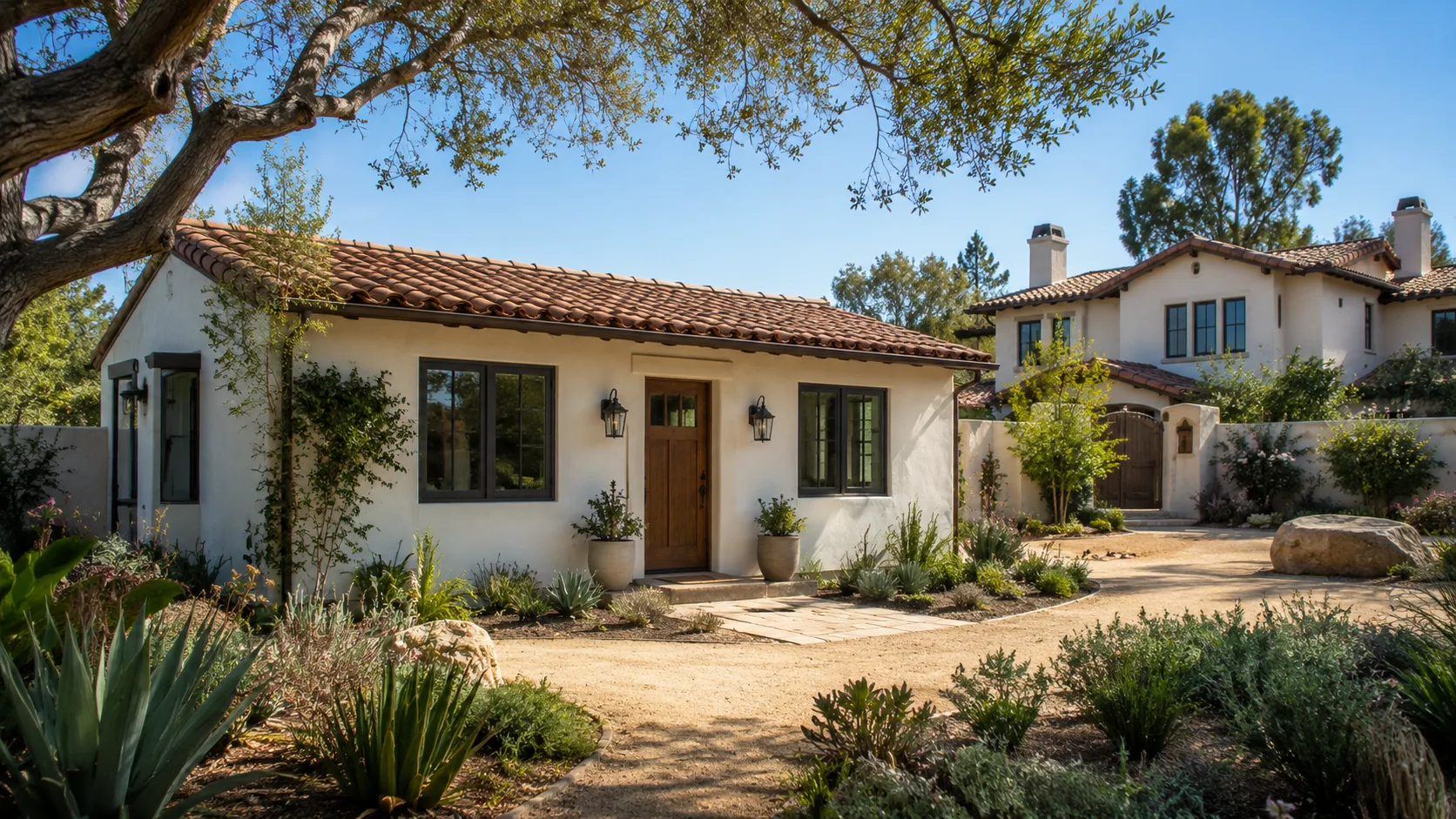
See What You Can Build → Get Your Free Rancho Santa Fe ADU Report
See likely jurisdiction, ADU size limits, septic indicators, and which builder type fits your specific address — in 60 seconds, no commitment.
Check My RSF PropertyShort Answer
A turnkey detached ADU in Rancho Santa Fe realistically costs $400,000–$900,000 depending on finish level, slope, and septic status. Every Covenant-parcel project must clear three rule layers: California state law, San Diego County PDS, and the RSF Association Art Jury. Most projects take 10–18 months end-to-end. AB 1033 (effective April 4, 2026 in unincorporated SD County) now allows ADUs to be sold separately as condominiums. Eight builders are active in RSF; the right two or three for your project depend on your parcel's specific constraints.
At a glance: Rancho Santa Fe ADU facts (2026)
| Factor | RSF Reality |
|---|---|
| Jurisdiction | Unincorporated San Diego County (most parcels); verify APN — some RSF-adjacent communities fall inside City of San Diego |
| Permit authority | San Diego County Planning & Development Services (PDS) |
| Max detached ADU size | 1,200 sq ft (California state law; Art Jury may request smaller based on lot context) |
| Setbacks | 4 ft interior side + rear (state floor); larger setbacks may apply on large parcels |
| Additional review (Covenant parcels) | RSF Association Art Jury — three-week meeting cycle; story poles may be required |
| Sub-HOA review | Fairbanks Ranch, The Crosby, Cielo, Del Rayo, Rancho Pacifica, and others add a fourth approval layer |
| Septic | Most unincorporated RSF parcels on private septic; DEHQ approval required for ADUs; expansion/replacement $15K–$80K |
| New detached ADU cost range | $400,000–$900,000 turnkey at Covenant-grade finishes (800–1,200 sq ft) |
| Site costs | $30,000–$65,000 (typical; excludes septic and long utility runs) |
| Permit fees | $9,000–$21,000 typical; county impact-fee waiver ended January 9, 2024 |
| Garage conversion cost range | $100,000–$210,000 (existing sound structure) |
| Owner-occupancy required? | No for ADUs (Govt Code § 66315); JADU rules differ (§ 66333) |
| Short-term rental (Airbnb)? | Prohibited — minimum 31-day rental required |
| AB 1033 separate sale | Effective April 4, 2026 in unincorporated SD County; condo conversion path available on top of subdivision process |
| Permit timeline (County) | 60-day decision on complete application; 15 business days completeness review |
| End-to-end project timeline | 10–18 months (Covenant detached); 12–20 months (two-story or sloped) |
| Parent guide | San Diego County ADU Builders |
What does an ADU cost in Rancho Santa Fe in 2026?
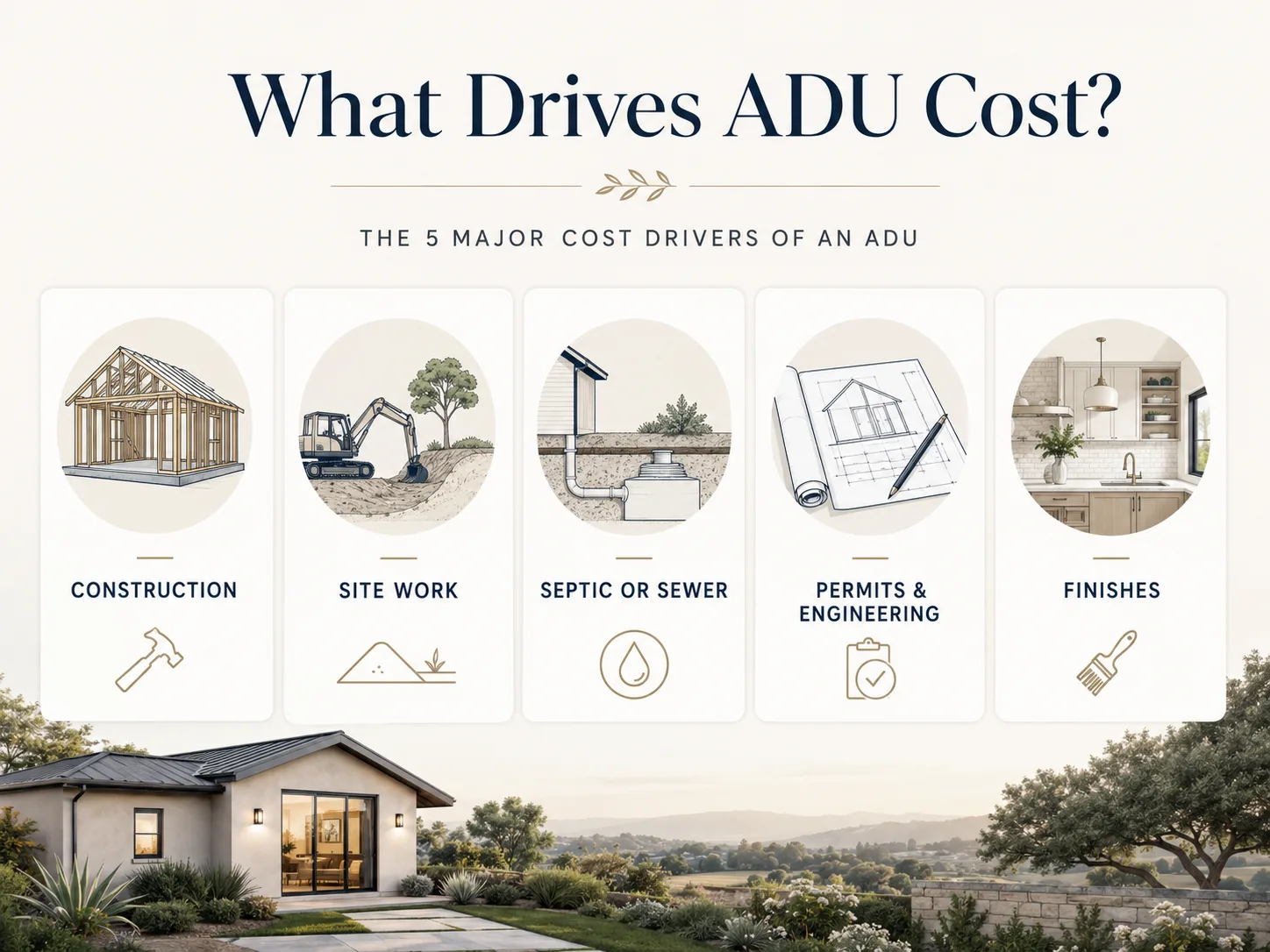
The Rancho Santa Fe cost premium — why it's real
RSF builds cost more than most San Diego County projects for four reasons that are intrinsic to the community:
- Estate-grade architectural matching. The Art Jury's Residential Design Guidelines require exterior materials, roof pitch, and massing that integrate with the existing primary home. Most estate primaries in RSF are Spanish-Revival or California ranch style — clay tile roofs, stucco exteriors, copper gutters, heavy-timber elements. Matching that from scratch costs more than a standard finish build.
- Sloped and wooded lots. RSF parcels are large and often graded. Retaining walls, cut-and-fill engineering, and long access roads add $30,000–$100,000+ to site costs versus a flat suburban lot.
- Septic complexity. Most unincorporated RSF parcels are on private septic. Adding an ADU triggers DEHQ approval — if the system needs expansion ($15K–$45K) or replacement ($40K–$80K+), that's real money before a single framing nail is driven.
- Long utility runs. Estate parcels commonly have utility distances of 200–400 ft or more from the existing structures to the ADU site. At $50–$120 per linear foot, that's $10,000–$48,000 in utility trench costs alone.
Cost matrix by unit type
| ADU type | Size range | Hard construction cost | Site costs (typical RSF) | Soft costs + permits | All-in range | Notes |
|---|---|---|---|---|---|---|
| Detached new-build (Covenant-grade) | 800–1,200 sq ft | $340,000–$720,000 | $30,000–$65,000 | $30,000–$115,000 | $400,000–$900,000 | Includes architectural matching, story-pole studies if required; septic and fire-zone costs additional |
| Detached new-build (mid-finish, non-Covenant RSF) | 600–1,200 sq ft | $200,000–$480,000 | $25,000–$55,000 | $22,000–$75,000 | $247,000–$610,000 | Sub-HOA review still applies on many parcels; septic still a variable |
| Attached ADU | 400–1,200 sq ft | $180,000–$540,000 | $15,000–$45,000 | $20,000–$65,000 | $215,000–$650,000 | Roof tie-in and exterior elevation matching add cost; Art Jury reviews the full combined exterior |
| Garage / accessory-structure conversion | Up to existing footprint | $60,000–$160,000 | $10,000–$30,000 | $15,000–$20,000 | $85,000–$210,000 | Sound, legal-permitted structure required; code bring-up (insulation, fire separation, egress) can surface surprises |
| Junior ADU (JADU) | Up to 500 sq ft | $30,000–$70,000 | Minimal | $8,000–$12,000 | $50,000–$100,000 | Inside existing primary home; owner-occupancy may apply when sharing sanitation; not salable under AB 1033 |
Cost ranges are Dwelling Index 2026 estimates based on multiple published sources including SnapADU (March 2026), Realm (March 2026), ADU Geeks SD County guide, Better Place Design & Build calculator, Freeman's Construction RSF breakdown, Santa Fe Construction Group published pricing, and TNT Design & Build RSF range. Ranges reflect parcel variation across Rancho Santa Fe — your project cost depends on site conditions, finish level, and current bids. Request itemized fixed-scope proposals from multiple builders.
Worked example: 900 sq ft Covenant-grade detached
| Line item | Amount | Notes |
|---|---|---|
| Hard construction (900 sq ft @ ~$475/sq ft) | $427,500 | Spanish-style stucco, clay tile, copper gutters; SnapADU March 2026 range $375–$600/sq ft for SD County detached |
| Architecture + engineering (structural, Title 24) | $25,000–$45,000 | Custom Covenant-matched design; Title 24 energy compliance; structural calcs |
| Story-pole study (if required by Art Jury) | $3,000–$8,000 | Physical mock-up of building corners and ridgelines; typical per RSF builder reports |
| Site grading and earthwork | $15,000–$40,000 | Depends on slope; RSF lots commonly require engineered grading |
| Utility connections (electrical, water, sewer/septic lateral) | $18,000–$45,000 | Long utility runs common on estate parcels; septic lateral separate |
| Landscaping and hardscape (ADU surrounds) | $12,000–$30,000 | Art Jury reviews landscape integration; defensible space compliance required |
| San Diego County permit fees | $9,000–$21,000 | After county impact-fee waiver ended January 9, 2024; school, fire, RTCIP fees additional |
| Defensible space / fire-zone compliance | $5,000–$15,000 | Class A roofing, ember-resistant venting, 100-ft defensible space per RSF Fire Protection District |
| Contingency (10%) | $51,000–$65,000 | Recommended — septic, Art Jury design iterations, unforeseen sitework |
| Total contracted budget estimate | $565,000–$716,000 | Excludes septic replacement (add $40K–$80K if needed) and AB 1033 conversion fees |
Add story-pole studies if Art Jury requests them (typical $3,000–$8,000 from RSF builders we've reviewed), defensible space for the Rancho Santa Fe Fire Protection District, and contingency. A reasonable contracted budget is $580,000–$640,000, with a 10% reserve.
Not sure how to fund a $400K–$900K build? See our ADU financing options guide — HELOCs, cash-out refinances, construction loans, and renovation-to-permanent products.
Financing availability and terms depend on borrower, property, and lender criteria. No specific rate, approval, or qualifying outcome is guaranteed. The Dwelling Index is reader-supported; we may earn a commission when you use our financing-path links.
Why Rancho Santa Fe is different: three rule layers every project must clear
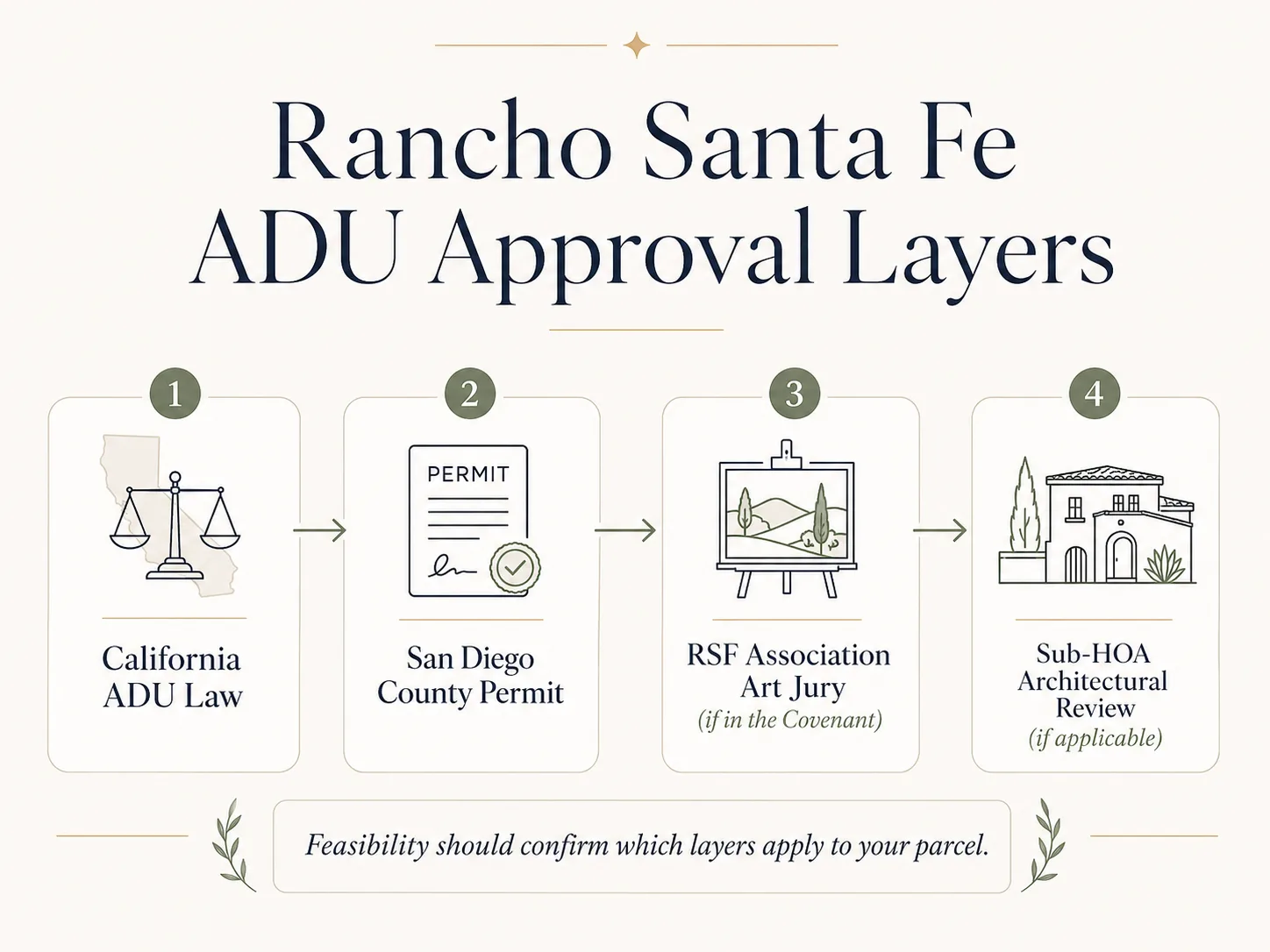
This is the single most-missed fact on competing pages. Most RSF builder pages mention “we handle HOA approval” without explaining what that actually means, how long it takes, or what authority overrides what. We'll decode it.
Layer 1 — California state ADU law (the floor)
State law preempts most local restrictions. The relevant statutes were recodified in 2024 and now sit at California Government Code §§ 66314–66326. The key provisions for an RSF homeowner:
- ✓Detached ADUs up to 1,200 sq ft allowed by right on residential single-family parcels (
- ✓Setbacks of 4 feet from interior side and rear property lines are the maximum a local agency can require for new construction (Govt Code § 66314).
- ✓Owner-occupancy cannot be required for ADUs. Local agencies are barred from imposing an owner-occupant requirement through local ADU standards (Govt Code § 66315).
- ✓Parking is not required for an ADU within ½ mile walking distance of a public transit stop, in a historic district, or on a parcel where the ADU was created from existing space (Govt Code § 66314).
- ✓Permit decision in 60 days after a complete application is mandated (Govt Code § 66317). The completeness review must finish in 15 business days of submittal.
- ✓Rentals must be longer than 30 days. State law and San Diego County zoning prohibit ADU rentals of less than 31 days (Govt Code § 66323).
- ✓HOAs cannot prohibit ADUs. Per California Civil Code § 4751, governing documents that effectively prohibit or unreasonably restrict ADU/JADU construction or use on qualifying single-family lots are void and unenforceable. Reasonable design and aesthetic restrictions remain allowed if they don't effectively prohibit the unit.
- ✓Impact-fee exemption for ADUs with 750 sq ft or less of interior livable space and JADUs of 500 sq ft or less (Govt Code § 66311.5).
- ✓AB 1033 (effective January 1, 2024 statewide; locally opted in by SD County effective April 4, 2026) lets a permitted ADU be sold separately from the primary home through a condominium structure — see the dedicated section below.
In plain English: state law gives you a floor. The Covenant and HOAs cannot drop you below it. They can shape what you build above it.
Layer 2 — San Diego County Planning & Development Services
Rancho Santa Fe proper is unincorporated. Unincorporated RSF parcels are governed by San Diego County PDS for the building permit. Per County Form PDS-611 (Revised January 7, 2026), the County's ADU rules align with state law: detached ADU up to 1,200 sq ft, attached ADU up to 50% of the primary dwelling's floor area or 1,200 sq ft (whichever is less), JADU up to 500 sq ft within the existing or proposed single-family dwelling.
| County PDS factor | Detail |
|---|---|
| Submittal location | County Operations Center, 5510 Overland Avenue, Suite 110, San Diego, CA 92123. Rolling out Accela digital intake — verify current submittal channel before filing. |
| Pre-approved plans | County publishes pre-approved ADU plans (~85% complete) that accelerate plan check substantially when used. |
| Plan check timeline | State law's 60-day decision clock applies; most homeowners experience 4–10 weeks total County processing once application is complete. |
| Outside-agency approvals | Septic permits (DEHQ), fire district approval, grading — run alongside or before building permit per County guidance PDS-658. |
| Fire-zone | Much of unincorporated RSF is in Very High Fire Hazard Severity Zones — defensible space (typically 100 ft), sprinkler requirements, Class A roofing all live considerations. |
| Impact-fee waiver | County impact-fee waiver ended January 9, 2024. Current projects pay full fee schedule. |
Jurisdictional note: Adjacent communities marketed as “Rancho Santa Fe” but carrying 92127 ZIP codes — including parts of The Crosby and Santaluz — may fall within City of San Diego boundaries rather than unincorporated County. Verify by APN. The rules above apply to unincorporated parcels.
Layer 3 — The Rancho Santa Fe Covenant Art Jury
If the parcel is inside the Covenant boundary, the Rancho Santa Fe Association's Art Jury reviews exterior changes including ADUs. The Art Jury operates under three governing documents:
- The Protective Covenant (PC) — the original recorded document drafted to maintain the historic integrity of architect Lilian Rice's master plan.
- The Association Regulations (Regs) — numerical “backstops” like maximum height, lot density, and grading limits.
- The Residential Design Guidelines (RDG) — illustrated design manual showing the rural, restrained aesthetic the Association expects.
The Art Jury meets every three weeks. Story poles — physical mock-ups of building corners and ridgelines — can be required to evaluate visual impact, even on projects that meet every numeric Reg. As the Rancho Santa Fe Post reported in April 2024, meeting all the numeric Regulations is a starting point — not a guarantee of approval.
| Art Jury process step | Detail |
|---|---|
| Pre-design consultation | Encouraged before any design spend — Association Building Department will informally signal what's likely to fly. |
| Submittal package | Plans, elevations, materials and color samples, landscape and grading details, and any requested studies. |
| Approval sequence | Art Jury / RSFA review can run parallel to County. Association's final permit is contingent on stamped County permit. |
| Parallel strategy | Smartest scheduling decision: run County plan check and Art Jury review simultaneously on the same plan set. |
Layer 3.5 — Sub-HOA architectural review (where applicable)
If your parcel is also in a sub-HOA — Fairbanks Ranch, The Bridges, The Crosby, Cielo, Del Rayo Estates, Rancho Pacifica, Rancho Santa Fe Lakes, Whispering Palms, Santa Luz/Santaluz, Rancho Valencia, or others — that HOA's Architectural Review Committee adds another approval layer. Note that The Crosby is outside the Covenant, so a Crosby project clears County (or City, depending on APN) plus the Crosby ARC, not the Art Jury. Conversely, a Del Rayo project inside the Covenant clears County plus Art Jury plus Del Rayo ARC — three layers.
Each sub-HOA has its own design standards. Most are not published publicly; members must request them from the ARC. Plan on 30–90 days for sub-HOA review on top of County and Art Jury timelines.
Need to know which layers apply to your specific parcel?
Run our free Rancho Santa Fe ADU Feasibility Check — see likely jurisdiction, Covenant indicators, sub-HOA flags, and septic/sewer status for your address.
Run Free Feasibility CheckAB 1033 in unincorporated San Diego County: what April 4, 2026 changed
What AB 1033 does — and doesn't
AB 1033 was signed into law by Governor Newsom on October 11, 2023, and became California law effective January 1, 2024. But the law is a local-option statute — cities and counties have to affirmatively adopt it for it to operate in their jurisdiction. San Diego County's official ADU Zoning Ordinance Amendment page confirms the County's adoption.
AB 1033 does NOT:
- ✗ Change construction standards, design requirements, or zoning
- ✗ Override Art Jury or HOA design rules
- ✗ Increase the number of ADUs allowed per parcel
- ✗ Apply to Junior ADUs (JADUs are explicitly excluded)
- ✗ Force any homeowner to convert — it's purely optional
- ✗ Bypass the County subdivision process
AB 1033 DOES:
- ✓ Allow the parcel to be subdivided into two condominium interests
- ✓ Enable separate deeding, selling, financing, and insuring of the ADU
- ✓ Open a new liquidity path for ADU investors
- ✓ Allow gifting or transfer of the ADU to family members with separate ownership
- ✓ Enable two-condo developments on single SFR-zoned parcels
The condominium conversion process
Per the SD County official AB 1033 guidance, the full path includes:
- Tentative Parcel Map or Tentative Map application through County PDS (the standard subdivision path).
- Final building permit and Certificate of Occupancy for the ADU. The unit must be fully permitted and signed off before final map recordation.
- Lienholder consent. Existing mortgage lenders must consent; many conventional mortgages have due-on-encumbrance or due-on-sale clauses that can be triggered.
- HOA or planned-development authorization (where applicable) — the Art Jury / RSF Association for Covenant parcels, or the sub-HOA for parcels inside their boundaries.
- Condominium map recording with the County Recorder.
- CC&Rs and condominium plan documenting the physical boundaries of each unit.
- HOA formation under the Davis-Stirling Common Interest Development Act (Cal. Civil Code §§ 4000+) to govern shared maintenance, insurance, and common areas.
- Utility, environmental health (DEHQ), fire district, and WUI compliance as applicable to the parcel.
Per industry coverage from VerifiedADU's April 2026 AB 1033 guide, total legal and filing fees typically run $15,000–$30,000 depending on attorney rates and parcel complexity. That's separate from the ADU build cost, County subdivision filing fees, and any required engineering.
The RSF Covenant interaction (open question)
The RSF Protective Covenant predates AB 1033 by nearly a century. We have not seen the RSF Association publish guidance on whether condo-converted ADUs on Covenant parcels can be separately sold. If you are considering AB 1033 conversion on a Covenant parcel, call the Rancho Santa Fe Association's legal counsel and your title insurer before committing to the conversion path. Budget legal fees of $5,000–$10,000 above the standard conversion to navigate the Covenant interaction cleanly. (Status: unresolved in published RSF Association materials as of May 6, 2026.)
When AB 1033 conversion is worth doing
- 1.You built the ADU as an investment and want a clean exit. A separately-titled ADU is more liquid and more financeable than a “house with an ADU.”
- 2.You want to gift or transfer the unit to a family member with separate ownership. A child, parent, or sibling can hold title to the ADU independently.
- 3.You're an investor planning to develop two condominium units intentionally. AB 1033 essentially lets you create a two-condo development on a single SFR-zoned parcel.
For most RSF homeowners building for family, staff quarters, or rental income, conventional ADU ownership remains simpler. Conversion adds $15K–$30K in fees plus ongoing HOA administration costs for what may not be a meaningful liquidity benefit.
What the County is finalizing later in 2026: Per the County's official ADU-ZO page, draft policy options on additional AB 1033 parameters were circulated for public review May 1–31, 2026. Future Planning Commission and Board of Supervisors hearings are anticipated in late summer 2026. Topics include owner-occupancy preconditions and tenant right-of-first-refusal provisions.
Permit timeline: state mandate vs. Art Jury cycle
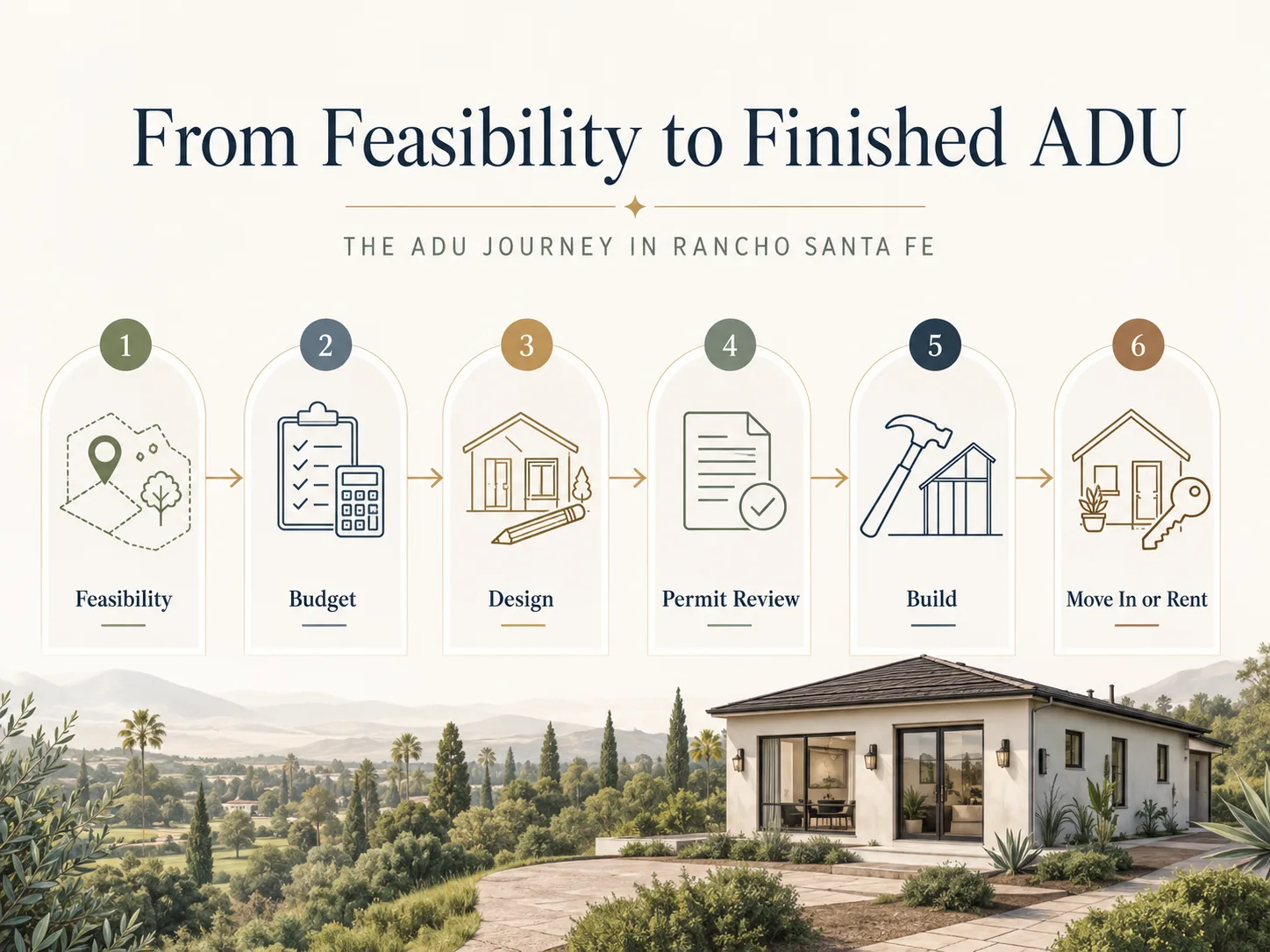
Stage-by-stage timeline
| Stage | Realistic range | What controls the duration |
|---|---|---|
| Parcel feasibility | 1–3 weeks | APN check, jurisdiction confirmation, Covenant title review, septic/sewer check, fire-zone review, slope assessment |
| Concept design | 3–8 weeks | Custom Covenant-matched architecture takes longer than a stock plan; pre-approved County plans can compress this to 1–2 weeks |
| Architectural design and construction documents | 6–12 weeks | Full set of buildable plans, structural engineering, Title 24 energy compliance, fire-safety detailing |
| Art Jury / RSFA review (Covenant only) | 6–14 weeks | Three-week meeting cycle; story poles add 1–2 weeks; multi-cycle reviews extend timeline |
| Sub-HOA ARC review (where applicable) | 4–12 weeks | Varies by HOA |
| County completeness review | 15 business days from submittal | State-mandated per Govt Code § 66317 |
| County decision after complete application | Up to 60 days | State-mandated; 'deemed approved' if missed |
| Outside-agency approvals (septic, fire, grading) | 2–8 weeks | Often runs concurrent with County |
| Construction | 5–9 months | ADU type, sitework, finishes, inspection passes |
| End-to-end (Covenant detached) | 10–18 months | — |
| End-to-end (two-story or sloped) | 12–20 months | — |
The parallel-track strategy
The single most valuable scheduling decision: submit to the County and the Art Jury at the same time, on the same plan set. Most builders default to sequential — wait for Art Jury approval, then submit to County. That adds 6–14 weeks to the timeline for no reason. The County's review and the Art Jury's review look at different things. Run them together.
If Art Jury requires design changes, you'll have to revise both packages. In practice, the small revision cost is dwarfed by the holding-cost savings — every additional month of delay on a $500K project is real money in design fees, financing, and opportunity cost.
The “deemed approved” backstop
State law (Govt Code § 66317) says that if a local agency fails to act within the statutory time limits on a complete ADU application, the application is deemed approved. Document your submittal timeline. Track the 15-business-day completeness deadline. Track the 60-day decision deadline from the date the application is deemed complete. If the County misses either, you have a path to force approval.
See What You Can Build → Get Your Free ADU Report
See likely jurisdiction, ADU size limits, septic indicators, and a realistic timeline for your specific RSF address — in 60 seconds, no commitment.
Check My PropertyWho are the best ADU builders Rancho Santa Fe homeowners should shortlist?
No single builder is “the best in Rancho Santa Fe.” We surfaced eight builders publicly active in RSF and sorted them by what they've actually documented — a Covenant project page, published cost data, a referenced license number, sub-HOA service area — then matched each to the project type they're best positioned for. The right shortlist for your project is two or three builders aligned with your specific build path, not a ranked top 10.
We did not call references, drive past projects, or audit financials. We sorted public evidence into project-fit recommendations. Every builder's profile below names what we couldn't verify so you know where to do your own diligence — and verifying current CSLB license status is always your responsibility before signing any contract.
Affiliate disclosure (repeated for the comparison table)
SnapADU is a paid affiliate partner of The Dwelling Index. SnapADU appears in the comparison below because they have the only publicly documented Covenant project (Via De Maya) among RSF builders we reviewed — the same documentation criterion we applied to every builder. Their inclusion is not a function of compensation. We recommend comparing two or three builders matched to your project type.
The fit matrix
| Builder | RSF Covenant project documented? | Build method | Best fit for | License / verify status | What we couldn't verify |
|---|---|---|---|---|---|
| SnapADU (partner) | Yes — Via De Maya 980 sq ft 2BR/2BA Spanish-style ADU within Covenant standards; 100+ ADUs across SD County | Stick-built design-build | Detached new-builds requiring Covenant-grade architectural matching; fixed-scope Feasibility SnapShots | License referenced on company materials — verify CSLB current status before signing | RSF total-project pricing specific to your parcel |
| Better Place Design & Build | Lists every RSF sub-HOA on service-area page; runs RSF-specific cost calculator | Stick-built design-build | Multi-bid shoppers; comparison stage; garage conversion vs. attached vs. detached evaluation | Verify CSLB before signing | Documented Covenant project under their name |
| TNT Design & Build | RSF service-area page emphasizes Covenant coordination | Stick-built design-build | Luxury / Covenant-sensitive custom; homeowners prioritizing schedule risk (TNT publishes a $250/day delay credit) | CSLB #1012379 referenced — verify current status | Specific completed Covenant ADU photos with addresses; published RSF cost range needs direct confirmation |
| REMCON Design & Build | RSF page; high-end remodeler positioning | Stick-built design-build | Combined remodel + ADU scope; kitchen/primary remodel alongside the casita | Verify CSLB before signing | Documented Covenant ADU; published cost data |
| RiseCon | RSF page; '30+ years' experience; explicitly markets full-build custom ADU | Stick-built design-build | Homeowners who've decided against prefab and want stick-built | Verify CSLB before signing | Documented Covenant case study; published cost ranges |
| USModular | RSF prefab page (last meaningful update 2020); modular ADU set on permanent foundation | Modular / prefab | Flat lot with truck and crane access; modular shell acceptable to Art Jury after on-site finish work | HCD dealer + contractor licenses referenced — verify current | 2026-current pricing; Art Jury approvals on delivered units |
| Santa Fe Construction Group | RSF page publishes '$350K+' baseline and '6–9 months including HOA/Covenant review' | Stick-built | Homeowners who appreciate transparent pricing and weekly progress reports | Verify CSLB before signing | Volume of completed RSF projects; case studies with addresses |
| Freeman's Construction (Ramona) | Publishes detailed RSF cost breakdown ($30K–$65K site, $9K–$12K fees) | Stick-built; custom homes + ADUs | Homeowners who value upfront cost transparency | CSLB #494766 referenced — verify current | Sub-HOA-specific design experience |
SnapADU — best for documented Covenant work, fixed-scope design-build
Affiliate PartnerSnapADU specializes exclusively in detached new-construction ADUs in San Diego County. Per their company materials, they've completed 100+ ADUs across the county and have at least one publicly documented Rancho Santa Fe Covenant project — Via De Maya, a 980 sq ft 2BR/2BA Spanish-style unit completed within Covenant standards. The project page shows the boosted clay tile roof matching the main house, copper gutters, and a homeowner-installed septic system supporting the new unit.
What that single case study tells us: SnapADU has navigated Art Jury submittals, septic capacity work, and architectural matching to estate-grade primaries — three of the four hardest things about RSF projects.
SnapADU's cost guide as of March 2026 quotes $375–$600+ per square foot for detached SD County builds, with most homeowners spending $300,000–$450,000 — but Covenant-grade RSF projects will run higher, as discussed in the cost section above.
Best fit: Detached new-build, Covenant-compliant, where you want a fixed-scope Feasibility SnapShot before design.
Less ideal: Garage conversions or attached ADUs (they don't do them).
Verification step: Ask for two RSF references with current contact information; ask whether pricing includes site work and septic, or excludes them as allowances.
Compare a Rancho Santa Fe detached ADU proposal — talk with SnapADU
SnapADU is the RSF builder with documented Covenant work. Their fixed-scope Feasibility SnapShot evaluates 75+ project variables for predictable pricing. (Affiliate link — Dwelling Index may earn a commission. Editorial recommendation is independent. SnapADU is one of multiple capable RSF builders; we recommend comparing two or three quotes.)
Talk with SnapADU →Better Place Design & Build — best for multi-bid comparison shoppers
Better Place positions as a full-service San Diego County ADU one-stop shop. Their RSF service-area page lists every meaningful sub-HOA in the area — The Covenant, Fairbanks Ranch, Del Rayo Estates, The Bridges, Whispering Palms, Cielo, Rancho Pacifica, RSF Lakes, Santa Luz, and roughly 30 more — which signals familiarity with the local jurisdictional layers.
They run an RSF-specific online cost calculator. We weren't able to verify a specific Covenant project under Better Place's name on their public materials, though their website includes case studies elsewhere in San Diego County.
Best fit: Homeowners in early comparison stage who want to evaluate detached vs. attached vs. garage conversion paths.
Less ideal: Homeowners who already know they need a custom Covenant detached and want a builder with proven Art Jury submittals on file.
Verification step: Ask specifically: “Show me three RSF completed projects with addresses I can drive past, and tell me how many were inside the Covenant.”
TNT Design & Build — best for luxury / Covenant-sensitive custom
TNT's RSF service-area page emphasizes Covenant coordination and publishes a $250-per-day delay credit if they miss the contracted timeline — a confidence signal on schedule that's rare among local builders. Industry coverage references TNT's RSF ADU pricing in the $350,000–$750,000 band; verify the current published number directly with TNT. License: CSLB #1012379 referenced on their published page. (Verify current status at the CSLB lookup before signing.)
Best fit: High-finish, architecturally-matched custom ADUs where the homeowner is prioritizing design quality and schedule certainty over the lowest bid.
Less ideal: Budget-constrained homeowners who'd benefit from a stock plan or pre-approved County plan.
Verification step: Ask whether the published range is fully turnkey or excludes site work, septic, and fees; ask for finished ADU photos at the addresses where the work happened.
REMCON Design & Build — best for combined remodel + ADU scope
REMCON's RSF page presents them as a high-end remodeler that also designs and builds ADUs. The angle is real: many RSF homeowners building a casita are also touching the main house — kitchen remodel, primary suite addition, outdoor living. Bundling under one design-build firm reduces interface complexity. We couldn't verify a specific Covenant ADU under REMCON's name in their public materials, though their broader RSF remodel portfolio appears strong.
Best fit: Combined ADU + main-house remodel projects.
Less ideal: Standalone ADU builds where you want an ADU specialist.
Verification step: Ask how many of their RSF projects in the last 24 months included an ADU vs. just a remodel.
RiseCon — best for stick-built advocates
RiseCon explicitly argues against prefab on RSF lots in their marketing — the position is that on-site construction lets the design adjust to site conditions rather than ship a fixed shell. They claim 30+ years building in the area on their RSF page.
Best fit: Homeowners who've already concluded they want stick-built and want a builder who'll commit to that path.
Less ideal: Homeowners genuinely open to prefab as an option.
Verification step: Documented case study; published costs.
USModular — the prefab option (when prefab fits)
USModular has a long-standing Rancho Santa Fe page presenting modular/prefab ADUs that arrive on a flatbed and set on a permanent foundation, often in one day. Their published example pricing — around $78,000 for a 398 sq ft 1BR — comes with explicit assumptions including a level lot and sewer within 100 feet of the house, and does not represent a finished, permitted, Covenant-ready project on a typical RSF parcel.
The bigger question for RSF: can a modular shell pass Art Jury? The answer is “sometimes, with on-site finish work” — but the modular advantage erodes once the exterior has to be re-skinned with stucco and clay tile to match the primary home.
Best fit: Flat lot, simple architecture, willing to accept that the prefab cost advantage may compress against on-site finishing work.
Less ideal: Sloped lots, complex access, Covenant parcels with strict aesthetic matching to estate primaries.
Verification step: Ask for an all-in delivered-and-finished cost on a similar RSF lot. Ask whether they've delivered a unit that received Art Jury approval.
Santa Fe Construction Group — best for transparent baseline pricing
Santa Fe Construction Group publishes RSF ADU pricing of “$350K+” baseline with 6–9 months of estimated end-to-end timeline (including HOA/Covenant review). That's the closest any RSF builder comes to a candid public starting figure.
Best fit: Homeowners shopping for pricing transparency and a builder willing to commit to weekly progress reports.
Less ideal: Homeowners who want a portfolio of named completed RSF projects to drive past.
Verification step: Ask for volume of completed RSF projects in the last 24 months; ask for two references inside the Covenant if applicable.
Freeman's Construction (Ramona) — best for upfront cost transparency
Freeman's publishes the most detailed RSF cost breakdown we found in our research: $30K–$65K typical site costs, $9K–$12K typical fees, and a methodology for estimating per-square-foot construction costs. License #494766 referenced on their published page. (Verify current status.) They serve RSF from inland Ramona.
Best fit: Homeowners who value cost transparency and want to understand the math behind the bid.
Less ideal: Homeowners requiring a builder with a primary office in coastal North County.
Verification step: Ask about sub-HOA-specific experience if your parcel is in Fairbanks Ranch, The Crosby, Cielo, or another sub-community.
Honorable mentions and the watchlist
A few builders appear in our research but with thinner public RSF documentation. We list them so you can investigate yourself:
- Kaminskiy Design & Remodeling. RSF service-area page; San Diego County remodeler. Best for garage conversions integrated with broader remodel.
- Caliber Construction & Remodeling. RSF luxury remodel positioning; female-owned. ADU work appears secondary to whole-home remodels.
- Cali Dream Construction. RSF garage conversion guide on their blog; CSLB #1054602 per their published page. Verify direct ADU experience.
- Enjoy Build. New-construction ADU project documented; CSLB #1141989 per their pages. Verify RSF-specific work.
- Optimal Home Remodeling & Design. Broad San Diego ADU coverage; CSLB #1091450; useful as a quote-benchmark builder.
- Elevated Remodeling. Lists ADU services and RSF among cities served; CSLB #906490; published cost table dates to early 2023 — treat as a stale benchmark.
Want a Feasibility SnapShot from SnapADU specifically — the RSF builder with documented Covenant work?
SnapADU is one of multiple capable RSF builders. We recommend comparing two or three quotes. Affiliate disclosure: paid partner.
Talk with a SnapADU specialist →Septic vs. sewer in Rancho Santa Fe: the feasibility flag nobody mentions first
Per San Diego County Zoning Ordinance § 6156, an ADU on a parcel served by an onsite wastewater treatment system (OWTS) must be approved by the County Department of Environmental Health and Quality (DEHQ). In plain English: no DEHQ approval, no ADU permit if you're on septic.
Three septic scenarios
Scenario 1: System has reserve capacity
Your existing system was sized for more bedrooms than the main house actually has, or for occupancy that's lower than design. A licensed septic engineer can evaluate the existing system, calculate the additional load from the ADU, and document DEHQ's approval.
Cost: $1,500–$3,500 for the evaluation, no additional construction.
Scenario 2: System needs expansion
The existing tank is large enough but the leach field needs more area, or the tank needs upsizing.
Cost: typically $15,000–$45,000 depending on what's required. Includes engineering, DEHQ permit, and construction.
Scenario 3: System needs replacement
The existing system is undersized, failing, or non-conforming. New tank, new leach field, possibly an aerobic system if the lot is tight.
Cost: typically $40,000–$80,000+. Includes engineering, percolation testing, DEHQ permit, demolition of old system, new construction, and inspection.
When sewer is available
The Rancho Santa Fe Community Services District serves a limited area near the Village. Connection fees and lateral extension costs can be substantial — figure $10,000–$30,000+ depending on distance to the main. If you're within the District's boundaries, sewer is often the better long-term answer (no system maintenance, no replacement risk, easier to sell) but the upfront cost varies. Confirm boundaries directly with the District. (Verified May 6, 2026 against published Community Services District materials.)
How to handle septic in your builder conversation
- “Have you confirmed septic capacity on my parcel — or is that excluded from the bid?” Most quotes exclude it. If it's excluded, you need to know.
- “What's your contractual exposure if my septic eval comes back as a replacement instead of an expansion?” Look for a written change-order procedure, not an open-ended “we'll figure it out.”
- “Do you have a preferred septic engineer who's worked in RSF, and can I have their independent assessment in writing before I sign?” A builder who pushes back on this is a builder you don't want.
RSF projects can swing $50K+ on the septic line item alone. Don't sign before you know the answer.
Run a free RSF Feasibility Check
See likely septic vs. sewer status and other parcel-specific feasibility flags for your address.
Check Septic StatusPrefab vs. site-built in Rancho Santa Fe: when modular actually fits
Where prefab wins
- ✓Lot is flat with good access. A 60-ft truck and a crane need to reach the set point.
- ✓Schedule predictability matters. Factory builds run on a tight schedule; weather delays are minimal.
- ✓Mid-finish is acceptable. If your main home is a mid-finish ranch, the factory exterior may pass Art Jury without significant re-skinning.
- ✓Cost ceiling matters more than design distinction. Turnkey prefab ADUs typically run $180,000–$300,000+ for the unit, with on-site costs adding $30,000–$70,000.
Where prefab loses in RSF
- ✗Sloped lots. A factory shell sized for a flat foundation can't adjust to slope without significant site engineering.
- ✗Long, narrow access. RSF estate driveways are often ¼-mile long with mature landscaping.
- ✗Covenant aesthetic match. A flat-roofed modular shell on a Spanish-Revival estate parcel rarely passes Art Jury without clay tile re-roofing, re-stuccoing, and trim work.
- ✗Customization demand. RSF homeowners frequently want one-of-one architectural details. Prefab is built for repeatability.
The honest math
Industry coverage reports that prefab “starting at $250,000” projects routinely become $400,000–$450,000 all-in once site work, transport, crane, foundation, utility runs, permits, septic, and on-site finishing are included. That's within $50K–$100K of stick-built for the same finished product. If you're considering prefab in RSF, ask for an all-in delivered-and-finished cost on a similar RSF lot — not the unit-only figure.
Which ADU type fits your Rancho Santa Fe property?
The right ADU type for an RSF homeowner depends on use case and parcel constraints. Detached new-builds suit most RSF lots because parcels are large enough to accommodate them with proper setbacks and architectural separation. Garage conversions are cost-effective when an existing legal accessory structure is sound. Attached ADUs make sense when integrating with the primary home is desirable. JADUs (Junior ADUs inside the primary residence) are the lowest-disruption option but carry conditional owner-occupancy rules.
Detached ADU (most common in RSF)
A standalone structure, separate from the primary home, on the same parcel. State law allows up to 1,200 sq ft. Setbacks: 4 feet from interior side and rear property lines per state floor.
Best for
Aging parents who need privacy, adult children, long-term rentals, guest casitas, staff quarters. Most RSF homeowners default here because parcels are large enough that a detached structure with proper landscape separation feels right.
Trade-offs
Most expensive option per square foot. Full foundation, full utilities, full envelope. Subject to Art Jury and HOA architectural review on the full exterior.
Attached ADU (addition to the primary home)
Shares at least one wall with the primary residence. State law caps attached ADUs at 50% of the primary dwelling's floor area, up to 1,200 sq ft.
Best for
Homeowners who want the ADU to feel integrated with the main home — caregiving for aging parents, multigenerational suites, large families consolidating.
Trade-offs
Architectural matching to the main house is essential. Privacy/sound separation requires careful design. Roof tie-in and exterior elevation changes are more visible to Art Jury and neighbors.
Garage / accessory-structure conversion
Converting an existing legal garage, pool house, or barn into a dwelling unit. Subject to building-code bring-up (insulation, fire separation, egress, ceiling height, kitchen/bath plumbing, electrical service) but skips foundation and shell costs.
Best for
Cost-conscious homeowners with a sound existing structure. Particularly common where a former pool house or detached studio already has utilities.
Trade-offs
Limited to the existing footprint and ceiling heights. Code bring-up can surface surprises (non-permitted past work, undersized electrical, fire separation). Many RSF accessory structures lack the dimensional generosity to make a comfortable living unit.
Junior ADU (JADU)
A unit of 500 sq ft or less, fully contained within the existing or proposed single-family dwelling, with its own separate entrance. May share sanitation facilities with the main home or have its own.
Best for
Lower-disruption family suites, especially aging parents who want close proximity. Lowest cost option overall.
Trade-offs
Owner-occupancy may be required when the JADU shares sanitation facilities with the existing structure (Govt Code § 66333). JADUs cannot be sold separately under AB 1033. Size cap is hard at 500 sq ft.
Renting and selling: what you can do with your finished ADU
Long-term rental (most common rental path)
State law and County zoning prohibit ADU rentals shorter than 31 days (Govt Code § 66323). Short-term rentals (Airbnb, VRBO under 31 days) are not permitted. Long-term rental of 31 days or more is allowed.
For Covenant-area RSF ADUs of 800–1,200 sq ft with estate-grade finishes, regional rental data shows meaningful premiums to median San Diego County ADU rentals. We don't publish a single specific dollar figure because reliable parcel-comparable rent data for RSF is limited. Pull current comps from a property manager familiar with the area before underwriting an investment decision.
Sale via AB 1033 condominium conversion
As of April 4, 2026, RSF homeowners can sell a permitted ADU separately from the main residence through a condominium structure on top of the County subdivision process. See the dedicated AB 1033 section above for the full process, costs ($15K–$30K legal/filing fees plus subdivision filing fees), and the Covenant interaction (currently unresolved as a published policy).
Tax and property assessment considerations
ADU construction in California triggers a partial reassessment of the new improvement only — not a full reassessment of the entire property. Your existing Proposition 13 base for the primary residence is preserved. The new ADU is assessed at its construction value and added to your property tax bill incrementally. This is a significant benefit for long-term RSF homeowners with low Prop 13 base values. (Consult a property tax professional for your specific situation — this is general information, not tax advice.)
When property management matters
If you're building for long-term rental, you'll want a system for tenant screening, lease management, rent collection, and maintenance coordination. Larger RSF homeowners often prefer a property manager to handle the day-to-day. Buildium is one option for landlord software at the high end. (Affiliate disclosure: Buildium is a paid partner of The Dwelling Index — we may earn a commission. Editorial recommendation is independent.)
How to vet any RSF ADU builder: 14 questions to ask before you sign
Use this checklist on every builder you interview. The answers separate competent RSF design-build firms from contractors who happen to have a Rancho Santa Fe page. Print this. Ask each question. Note the answer. Compare across builders.
- 1
Show me three RSF projects you've completed in the last 24 months — with addresses I can drive past.
A builder who can't produce three drive-by addresses isn't a Rancho Santa Fe specialist regardless of marketing.
- 2
Of those, how many were inside the Covenant?
This separates 'we serve RSF' from 'we have actually navigated Art Jury submittals.'
- 3
Show me your CSLB license — name, number, and current status.
Use the CSLB lookup tool to verify license number is active, in good standing, and matches the legal entity signing the contract. Confirm workers' comp and general liability coverage.
- 4
Are you the GC, or are you subbing it out?
Some 'design-build' firms are actually design firms that hire a GC. The accountable party should be the same legal entity for design and construction.
- 5
Who manages the Art Jury submittal — your team, our architect, or us?
A builder who hands you off to 'your architect' for Art Jury isn't bringing the Covenant fluency you're paying for.
- 6
Walk me through your fixed-scope vs. allowance line items.
Identify exactly what's locked and what's an estimate that can move. Septic, utility runs, finish allowances, and grading are the most common allowance items.
- 7
What's your change-order policy when Art Jury requires design changes mid-process?
Look for a written procedure with a defined markup (typically 15–20%) and a maximum cumulative cap.
- 8
What's your delay policy if Art Jury runs three or more cycles?
Some builders price for two cycles; the third costs you. Understand the pricing structure for delay scenarios that aren't your fault.
- 9
Have you confirmed septic capacity on my parcel — or is it excluded?
This is the single most-missed item. See the septic section above.
- 10
Are utility extensions and long laterals included or excluded?
RSF utility runs commonly exceed 300 ft. Get a written length and per-ft cost.
- 11
What's your defensible space and fire-zone scope (RSF Fire Protection District compliance)?
Most of unincorporated RSF requires defensible space, ember-resistant venting, Class A roofing, and 100-ft defensible space.
- 12
What's your warranty?
Workmanship vs. structural — separate. Most California GCs offer a one-year workmanship warranty and a 10-year statutory structural warranty.
- 13
Can you provide references specific to my sub-HOA (Fairbanks Ranch, The Crosby, Cielo, Del Rayo, etc.)?
HOA-specific architectural reviewers have personalities and preferences. A builder who's worked your specific HOA will know what flies.
- 14
Will you sign a contract that's contingent on Art Jury approval, with no penalty if Art Jury denies the design?
A 'yes' here means the builder takes design risk seriously. A 'no' or hedge means you're absorbing it.
Download the free RSF ADU Builder Interview Checklist →
A printable PDF with these 14 questions plus a scoring rubric, included in the free ADU Starter Kit.
Get the Free Starter KitEdge cases that trip up Rancho Santa Fe ADU projects
Beyond the basic ADU rules, RSF projects fail or balloon for parcel-specific reasons. The most common: Covenant boundary uncertainty, sub-HOA design layers, septic capacity, fire zoning, slope and grading limits, easements, existing unpermitted structures, and the interaction between AB 1033 conversion and existing financing. If any of these apply to your project, surface them in feasibility — not in design.
Covenant boundary uncertainty
The Covenant boundary is recorded but not always obvious on a parcel-by-parcel basis. Some parcels in 92067 are inside the Covenant; some are not. Confirm via your title report or by calling the Rancho Santa Fe Association Building Department. Don't assume.
Sub-HOA layers
Even non-Covenant parcels in RSF often sit inside a sub-HOA — Fairbanks Ranch, The Crosby, Rancho Pacifica, Cielo, or others. Each has its own ARC. Get the current design guidelines from the HOA in writing before architectural design begins.
Adjacent communities with different jurisdiction
The Crosby, Santaluz, and certain other RSF-adjacent gated communities carry 92127 ZIP codes and may fall within City of San Diego boundaries rather than unincorporated County. Verify by APN before applying County or Covenant rules to your parcel.
Septic at capacity
Budget the $15K–$80K range until you have a written engineer's evaluation and DEHQ feasibility confirmation.
Fire zoning
Much of unincorporated RSF is in Very High Fire Hazard Severity Zones. Defensible space requirements (typically 100 ft per RSF Fire Protection District guidance), Class A roofing, ember-resistant venting, double-paned tempered windows, and fire access roads with specific width and turning radius all apply where the District has jurisdiction.
Slope and grading limits
Per RSF Association Regulations Chapter 41, encroachment into slopes greater than 25% gradient is restricted. Maximum cut/fill limits apply. The Art Jury can require revisions to grading plans even when projects meet the numeric Regs. If your lot has slope, get a grading concept reviewed early.
Easements and trail networks
Rancho Santa Fe has an extensive trail network. Trail easements can cross or border a parcel. Confirm via title and trail maps before siting an ADU.
Existing unpermitted structures
Many older RSF properties have detached studios, guest rooms, or storage structures built without permits. These cannot be straightforwardly converted to ADUs without permitting catch-up — including bringing the structure to current code.
Existing mortgage and AB 1033 conversion
If you're planning AB 1033 condominium conversion to sell the ADU separately, your existing mortgage on the primary residence may require lender consent before subdivision. Most conventional mortgages have due-on-encumbrance or due-on-sale clauses that can be triggered. Talk to your lender before filing the condo map.
Existing main-home addition or remodel concurrent with ADU
Combining a main-home remodel with an ADU build is common in RSF, but it interacts with Art Jury review. A combined project package gets reviewed as a whole — including details that might have flown under the radar as separate submittals. Plan for this in scope and timeline.
Outstanding Covenant or HOA violations
If the property has open enforcement actions (unpermitted fence, non-compliant landscaping, violation notices), those typically need to be cleared before the Association will issue a new building permit for an ADU. Run a status check at the Building Department before you commit to design fees.
Coastal Overlay Zone
A small portion of unincorporated Rancho Santa Fe may fall within the Local Coastal Program Coastal Zone. ADUs in the Coastal Zone may require a Coastal Development Permit. Most RSF parcels are not in the Coastal Zone, but verify by APN before designing — the difference in approval timeline is significant.
How we built this guide (methodology)
The Dwelling Index is an independent research resource covering ADU financing, costs, and regulations. We are not a builder, lender, broker, or HOA. We assembled this guide on May 6, 2026 from four data streams:
- Primary regulatory sources. California Government Code §§ 66311.5, 66314, 66315, 66317, 66323, 66333; California Civil Code § 4751; San Diego County PDS Form PDS-611 (Revised January 7, 2026); County guidance PDS-658; County ADU-ZO Amendment page (AB 1033 implementation); SD County Zoning § 6156; RSF Association Architectural Review Process page; Association Regulation Chapter 41.
- Cost data. Multiple 2026 published cost guides (SnapADU March 2026, Realm March 2026, ADU Geeks SD County guide, Better Place Design & Build cost calculator, Freeman's Construction RSF breakdown, Santa Fe Construction Group, TNT Design & Build RSF range). Editorial composites are clearly labeled as Dwelling Index 2026 estimates.
- Builder evidence. Each builder's public service-area page, project gallery, license number where published, and any documented RSF or Covenant project. Where evidence didn't exist, we said so explicitly.
- Editorial framing. We did not call references, drive past projects, or audit financials. We did not rank builders 1-N. We routed builders to project types based on what they publicly document.
Affiliate transparency. SnapADU is a paid affiliate partner. Mortgage Research Center is our financing-path affiliate. Buildium is our property-management affiliate. We do not rank builders or lenders by payout.
Corrections. If you find an error, please email us at corrections@dwellingindex.com. We refresh every quarter and correct verified errors immediately.
What we verified — May 6, 2026
Frequently asked questions
How much does an ADU cost in Rancho Santa Fe in 2026?▼
Do I need Art Jury approval for an ADU in Rancho Santa Fe?▼
How long does an RSF ADU take from start to finish?▼
What's the maximum size for a detached ADU in Rancho Santa Fe?▼
Can I sell my Rancho Santa Fe ADU separately as a condo?▼
Is Rancho Santa Fe on septic or sewer?▼
Do I need parking for my ADU in RSF?▼
Is owner-occupancy required for my ADU in Rancho Santa Fe?▼
Can I rent my RSF ADU on Airbnb or VRBO?▼
What's the cheapest path to an ADU in Rancho Santa Fe?▼
Is a prefab ADU allowed in the Rancho Santa Fe Covenant?▼
How do I confirm whether my parcel is in the Rancho Santa Fe Covenant?▼
Your next step
Choosing the right Rancho Santa Fe ADU builder isn't about picking from a ranked list. It's about matching the right builder to your parcel's specific constraints — Covenant or not, septic or sewer, sloped or flat, estate-grade primary or mid-finish — and to your project's specific use case.
The most expensive mistake we see RSF homeowners make is signing a design agreement before they understand feasibility. A $25,000 design fee on a project that turns out to require a $60,000 septic replacement and a $40,000 grading change is real money wasted on a path that was wrong from the start. Check feasibility first. Pick builders second.
Two or three builders matched to your project type — not one. Get written Feasibility SnapShots or fixed-scope estimates from each. Compare exclusions, allowances, change-order language, and timeline structure. The lowest bid rarely wins on a project this complex; the most accurate bid does.
Not sure where to start? See what's possible at your address — get your free ADU report in 60 seconds.
We'll surface likely Covenant indicators, sub-HOA flags, septic vs. sewer status, and likely max ADU size for your specific parcel. No commitment, no spam.
See What You Can Build → Get Your Free Rancho Santa Fe ADU ReportPrefer to start with reading?
Download the free RSF ADU Starter Kit — includes the 14-question builder interview checklist, a feasibility worksheet, and a sample line-item budget.
Download the free RSF ADU Starter Kit →Related guides
The Dwelling Index is an independent research resource covering ADU financing, costs, and regulations. Last updated: May 6, 2026. Last verified: May 6, 2026. Editorial team contact: editorial-team.
Content is for informational purposes only and does not constitute financial, legal, tax, construction, or lending advice. Verify all information with qualified local professionals before making decisions. Cost ranges, regulatory citations, and partner/builder details may change after publication; we refresh quarterly. See our methodology, editorial standards, and corrections policies.