
Best ADU Builders in Poway, CA (2026): Real Costs, Local Rules, and Who to Call First
Independent research by the Dwelling Index Research Team · Last updated May 5, 2026 · Last verified May 5, 2026 · 16 sources · No paid placement
The bottom line
The best ADU builders in Poway aren’t ranked one through ten. They’re matched to your project. For a detached backyard ADU in Greater San Diego, a San Diego ADU design-build specialist is usually the strongest first call — SnapADU is our affiliate-disclosed pick in that lane, with Poway listed in their service area and published Poway projects on file. For a garage conversion or attached addition, a remodeler-GC typically beats an ADU-only firm on price and timeline. For a custom 1,200–1,500 sq ft build on a Poway RR-zoned (Rural Residential) lot with slope or septic, a Poway-experienced custom home builder is usually the safer first call.
Real cost ranges to plan against. Builder-published Poway construction-cost benchmarks span roughly $220–$600+ per square foot, and the source matters: Better Place Design & Build’s March 2026 Poway page describes that range as build/construction cost, while SnapADU’s San Diego-wide turnkey/all-in benchmark for completed detached ADUs is $375–$600+ per square foot and $300,000–$450,000+ all-in for many projects. Published Poway project costs in SnapADU’s portfolio range from $219,000 (498 sq ft, Bronco Lane) to $565,000 (1,500 sq ft + garage, Avenida Florencia).
Permit fees vary by project size and scope. Cali Dream Construction’s February 2026 Poway guide cites $1,500–$3,000, while Better Place Design & Build cites $4–$8/sq ft. Plan-review cycles are 14 calendar days for building review and 28 calendar days for planning/engineering review per the City’s Building Services page. Most Poway ADUs take 6–12 months total from design start to certificate of occupancy in industry-typical timelines.
| If your goal is… | Start with this builder type | Typical Poway cost (2026) | Realistic timeline |
|---|---|---|---|
| JADU inside or attached to primary residence (≤500 sq ft) | Remodeler-GC with conversion experience | $90K–$180K | 4–7 months |
| Small detached ADU 600–800 sq ft | San Diego ADU design-build specialist | $180K–$330K | 7–10 months |
| Detached ADU 800–1,200 sq ft | San Diego ADU design-build specialist | $250K–$450K | 8–11 months |
| Detached ADU 1,200–1,500 sq ft (sprinklers triggered) | Poway-experienced custom home builder | $330K–$600K+ | 9–12 months |
| Two ADUs on a multifamily Poway lot | ADU specialist with multi-unit permit experience | $500K–$900K+ | 10–14 months |
Cost ranges sourced from Better Place Design & Build (Mar 2026), Cali Dream Construction (Feb 2026), and SnapADU project pages and 2026 cost guide. Data verified May 5, 2026. Cost-per-sq-ft figures vary depending on whether the source is quoting construction cost, build cost, or turnkey/all-in cost — see the cost section below for source-by-source detail.
See What You Can Build at Your Address → Get Your Free Poway ADU Report
See What You Can Build → Get Your Free Poway ADU Report60 seconds. Public-record check. No phone call required.
What you’ll get from this guide
Many of the top results for Poway ADU builders are owned by builders themselves. That’s a structural problem: a builder’s own page can’t tell you when you should hire someone else. Below, we walk through the four red flags that mean walk away from a builder call, the decoded Poway permit rules straight from Poway Municipal Code §17.08.180(A), the City of Poway’s most recent ADU handout, and California ADU Law (Gov. Code §§ 66310–66342); published Poway project costs by square foot; the architectural-compatibility rule Poway is famous for and most builders underprice; the fire-sprinkler trigger at 1,200 sq ft per the Poway handout; the builder fit matrix by project type (no fake 1-2-3 ranking); the 12-question vetting checklist; honest math on rental income; and the edge cases that blow up Poway projects — septic, slope, VHFHA, HOA, and unpermitted existing structures.
We’re not a builder. We don’t sell ADUs. We’re an independent research resource covering ADU financing, costs, and regulations, and we get paid only when readers use our partner links — disclosed every time, never sorted by payout.
Who are the best ADU builders in Poway for each project type?
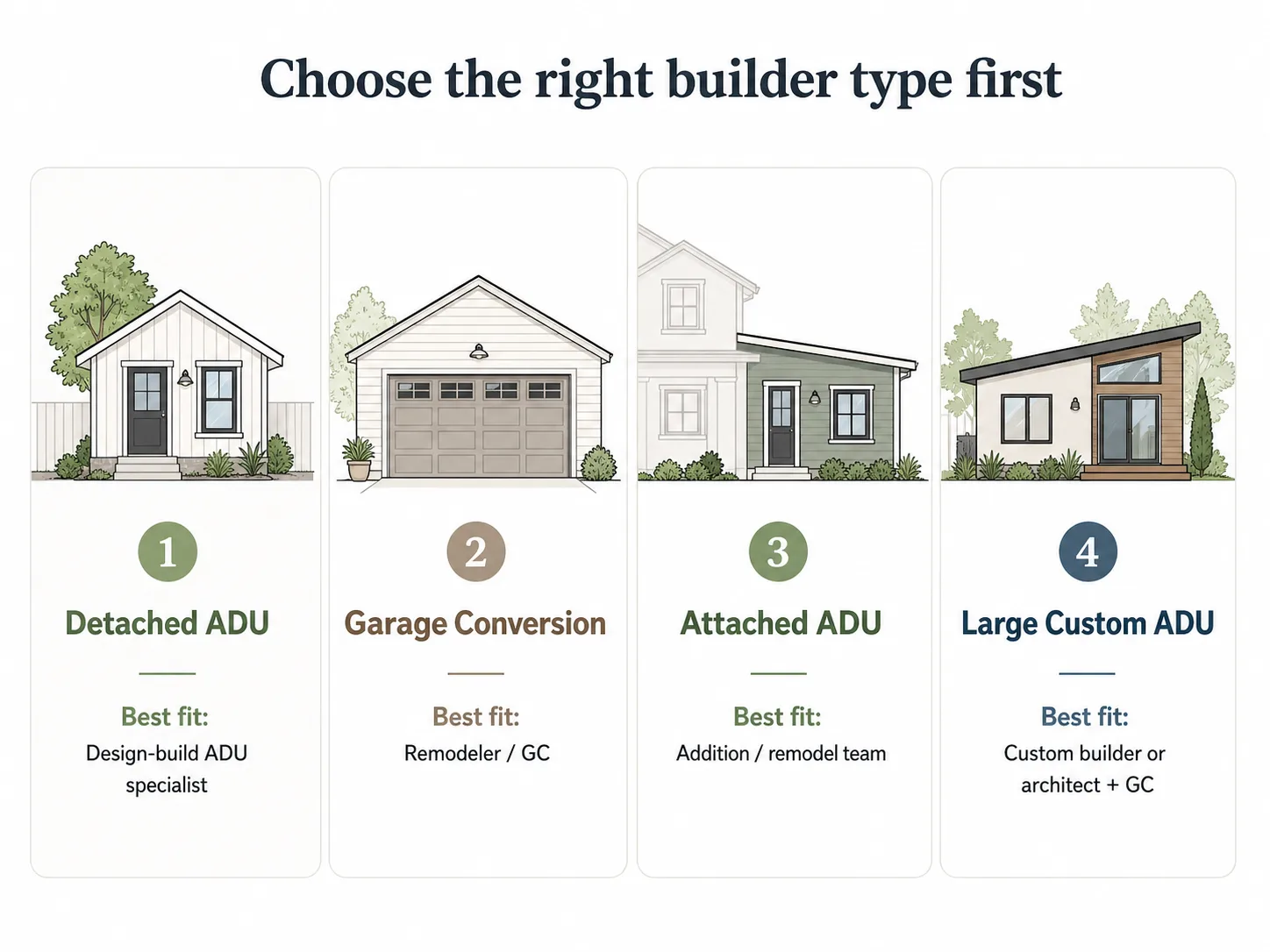
The honest answer is project-by-project. For detached new-build ADUs between 600 and 1,200 sq ft in Greater San Diego, a San Diego ADU design-build specialist is the strongest first call. SnapADU is our affiliate-disclosed pick in that lane: their site lists Poway in the service area, and they publish multiple completed Poway projects (Bronco Lane, Grange Place, Avenida Florencia) with cost data and photos. For garage conversions, attached additions, or projects under $200K, a Poway-experienced remodeler-GC will usually fit better than an ADU-only specialist. For custom 1,200–1,500 sq ft builds on RR-zoned lots — where slope, septic, and grading often dominate the budget — a custom home builder with Poway track record is the safer starting point.
We segmented every Poway-active builder we identified into the project type they fit best in the matrix below. We did not rank builders 1-2-3 because the right answer changes with your project type, lot, budget, and use case.
How to tell a real Poway ADU specialist from a “we do Poway too” builder
A real Poway ADU specialist can answer four questions on the spot, in their first phone call: how many ADUs they’ve permitted through Poway Development Services in the last 24 months; how they handle the architectural-compatibility rule; how their plan submission flows through the city’s process; and whether your lot is in a Very High Fire Hazard Area. Anyone who hesitates on those four is either learning on your job or hoping you don’t notice.
The City of Poway’s handout requires the ADU to be similar and compatible with the primary residence in exterior color, architectural style, window treatments, siding, and roof materials — language that, in builder practice, often means matching the primary residence’s finish package. Most generic California ADU build packages start with stucco, asphalt shingles, and white vinyl windows. If your house is wood-sided with cedar trim and dark composition shingles, that “package price” is no longer a real number. SnapADU’s Poway summary calls this out directly, noting that compatibility requirements “can add some expense beyond our standard build prices, which includes stucco, asphalt shingles and white vinyl windows” (SnapADU, Poway: Accessory Dwelling Unit Regulations & Zoning, last updated April 2026).
The four red flags that mean walk away
They don't know how Poway plans get submitted right now.
The City of Poway has accepted only electronic submittals through Online Services at services.poway.org since June 1, 2022. A builder who is confidently wrong on this in 2026 has not submitted a Poway permit recently. Confirm the current submission path with the Building Division before you finalize a contract.
They quote a finish package that doesn't match your primary residence's exterior.
Stucco-and-shingle baseline is fine if your house is stucco-and-shingle. If your house isn't, and the contract still reads stucco-and-shingle, the compatibility redline is coming.
They tell you a two-story ADU is allowed without checking the underlying conditions.
Poway's handout treats two-story ADU height through two paths: standard SFR setback (height generally tied to existing residence) or four-foot reduced setback path (limited to one story and 16 feet). A builder who waves at 'state law overrides' without naming the specific corridor exception or showing the city's interpretation has not done the work.
They don't ask about VHFHA status, septic vs. sewer, or your zone before pricing.
Poway has VHFHA-mapped neighborhoods and many RR-zoned lots are on septic. Both materially change scope and cost. A builder who quotes you before asking is quoting a number that probably won't survive contact with your specific lot.
The four green flags that mean keep talking
They cite PMC §17.08.180(A) by section.
Or they pull up the City's ADU handout (poway.org/DocumentCenter/View/8712) on the call. They've read the actual document.
They ask for your zone before estimating.
RR-A vs. RS-7 vs. MFR materially changes what the city expects and what the design has to satisfy.
They include the architectural-compatibility cost as a line item, not a vague 'allowance.'
A real Poway specialist treats finish coordination as a hard scope item they own, not a discretionary upgrade.
They give you three Poway homeowner references whose units finished and got certificates of occupancy in the last 18 months.
Finished, not just permitted — finished and inspected. The references should be reachable and recent.
Want our team to confirm which Poway rules apply to your specific lot before you start interviewing builders?
See What You Can Build → Get Your Free Poway ADU ReportSee What's Possible at Your Address → Get Your Free Poway ADU Report
What an ADU in Poway actually costs in 2026 (real numbers, real projects)
Cost data on this category is messy because different sources use different definitions. Some publish hard construction cost (just the build), some publish “build cost” (build plus design), and some publish turnkey/all-in cost (design + permits + build + utilities + finishes). Don’t compare numbers across definitions. Below, we labeled each source by the definition it uses.
Better Place Design & Build’s March 2026 Poway page cites Poway-specific construction-cost figures of $220 to over $600 per square foot, depending on size, design, and finish. Cali Dream Construction’s February 2026 Poway guide cites a typical all-in project range of $150,000 to $400,000+ for the city. SnapADU’s 2026 San Diego cost page benchmarks turnkey detached ADUs at $375–$600+ per square foot and $300,000–$450,000+ for many complete builds.
Verified published Poway ADU project costs
These are real, named Poway projects from SnapADU’s published portfolio with disclosed totals. They are published project build costs — what the homeowner paid the builder for design and construction. They exclude financing carry, deferred utility upgrades, certain owner-selected upgrades, furnishings, and any items priced separately. Treat them as planning benchmarks for similar scope, not quotes.
| Project | Size | Published cost | Cost per sq ft | Project type |
|---|---|---|---|---|
| Bronco Lane, Poway | 498 sq ft | $219,000 | ~$440/sq ft | 1-bedroom detached ADU (granny flat) |
| Grange Place, Poway | 840 sq ft | $254,000 | ~$302/sq ft | Detached ADU |
| Avenida Florencia, Poway | 1,500 sq ft + garage | $565,000 | ~$377/sq ft on living area | Large custom detached ADU + garage scope |
| San Diego County detached benchmark (turnkey) | 500–1,200 sq ft | $300,000–$450,000+ all-in typical | ~$375–$600+/sq ft | Multiple completed projects |
Sources: SnapADU project pages (snapadu.com/projects/) and SnapADU “Cost to Build an ADU in San Diego (2026)” page. Data verified May 5, 2026. Smaller projects show higher cost per square foot because fixed costs — design, permitting, utility hookups, kitchen, bathroom — spread across fewer square feet.
The full Poway ADU cost stack
When a homeowner asks why one quote is $250K and another is $400K for the same square footage, the answer almost always lives in this table.
| Cost component | Poway range (2026) | Source / label |
|---|---|---|
| Hard construction cost (detached, custom) | $220–$600/sq ft | Better Place Design & Build, Mar 2026 (construction cost) |
| All-in project cost (detached, typical) | $150,000–$400,000+ | Cali Dream Construction, Feb 2026 (all-in) |
| Turnkey detached benchmark (San Diego) | $300,000–$450,000+ all-in; $375–$600+/sq ft | SnapADU, 2026 (turnkey) |
| Plan check + building permit fees | $1,500–$3,000 typical, scaling with size | Cali Dream Construction, Feb 2026 |
| Permit fee per square foot (alternate calc) | $4–$8/sq ft (800 sq ft ≈ $3,200–$6,400) | Better Place Design & Build, Mar 2026 |
| Official city guidance | Fees vary by project size and scope; check current Master Fee Schedule | City of Poway Building Services |
| Development Impact Fees on ADUs >750 sq ft of interior livable space | Charged proportionally; Poway charges 50% of standard schedule | Cal. Gov. Code §66324(c)(1); City of Poway ADU handout |
| PUSD school district developer fee | $5.17/sq ft for residential construction/additions over 500 sq ft — verify before payment, fees subject to change | PUSD Planning page |
| Architectural-compatibility cost premium | Editorial estimate: $5K–$25K typical depending on primary-residence finishes; requires project-specific quote verification | Dwelling Index editorial estimate |
| Fire sprinkler upgrade if ADU >1,200 sq ft and primary has none | Varies by water service and house size; get written line item | Per Poway ADU handout sprinkler trigger |
| Septic upgrade or new system | $10,000–$50,000+ (Dwelling Index editorial estimate) | County DEH approval required |
| Soils report | $2,500–$6,000 (industry typical) | Required by Poway for new structures per city's online ADU handout |
| Soft costs (design, engineering, surveys) | 8%–15% of project | Industry-typical |
Data verified May 5, 2026 against the sources cited. Items labeled “Dwelling Index editorial estimate” are planning ranges and require project-specific quote verification.
Why your three quotes are $150,000 apart
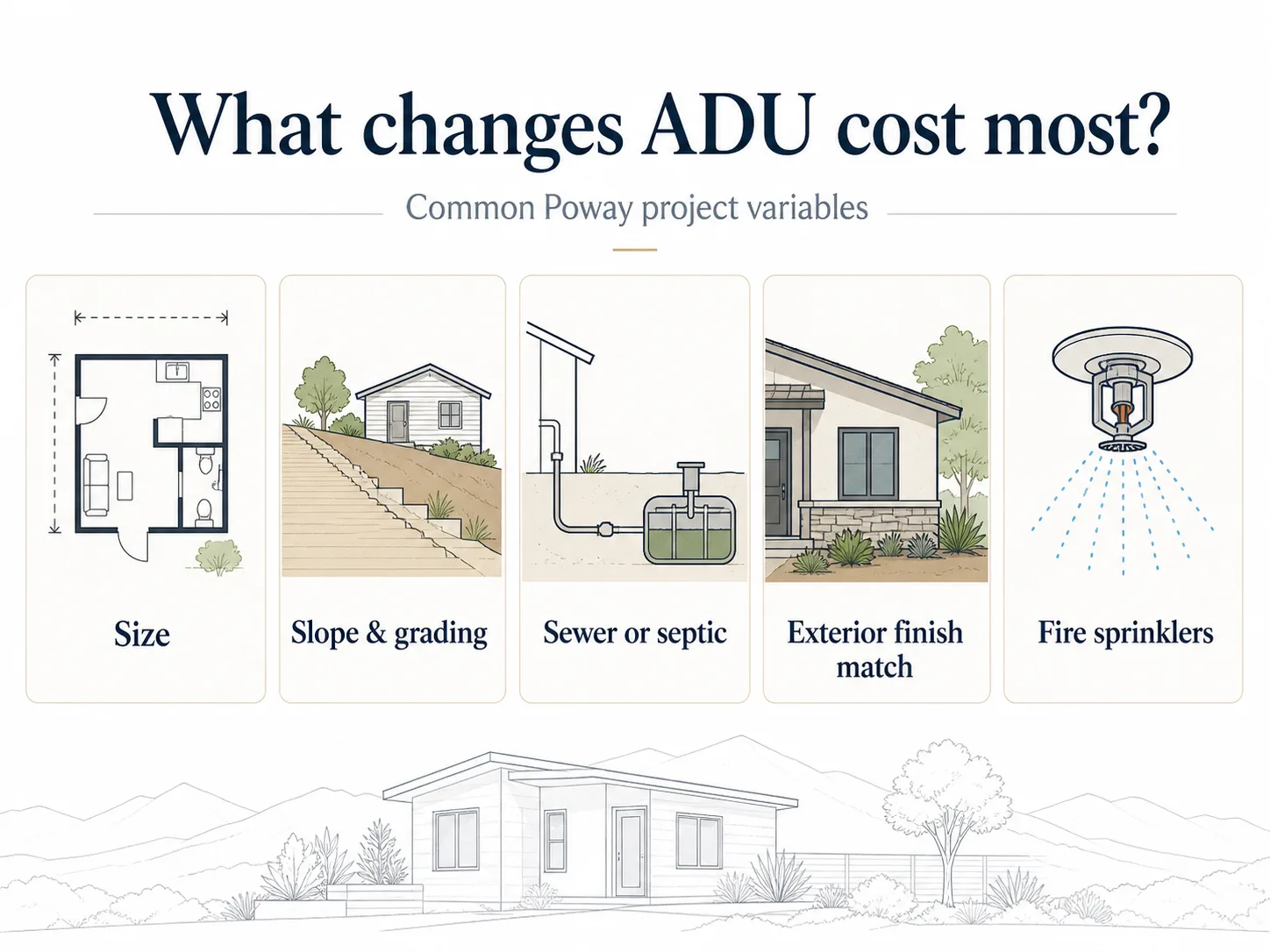
Five things drive almost all Poway quote variance:
Sprinkler trigger
Poway's ADU handout requires fire sprinklers when the ADU exceeds 1,200 sq ft, regardless of whether the primary residence has them. Your primary residence's water service may also need an upgrade to handle the new sprinkler load. Builders who size an ADU at 1,199 sq ft are not being cute — they're avoiding the sprinkler scope and the possible water-meter upgrade.
Sewer vs. septic
Poway has both. A builder who assumes sewer when you're on septic is missing real scope, and a septic project also requires San Diego County Department of Environmental Health approval before permit issuance per the city's online ADU handout.
Slope, grading, and retaining
The Rural Residential zones (RR-A, RR-B, RR-C) where Poway's 'City in the Country' character is most concentrated have slope. Slope drives engineering, retaining walls, drainage, and sometimes import or export of soil. A builder who hasn't walked the lot can't price this honestly.
Finish-coordination depth
The architectural-compatibility rule. If your house is plain stucco with composition shingles, the cost is small. If your house has wood siding, custom roof, premium windows, and designer paint, the cost can be material. Builders pricing without seeing your house photos are guessing.
Allowance-vs-fixed pricing
'Allowance' pricing (e.g., '$8,000 allowance for cabinets') is how builders quote low and end high. Fixed-price contracts force the builder to commit. The two are not directly comparable, and a $250K allowance-heavy quote can land at $350K once allowances become real costs.
Costs nobody mentions until you’re three months in
The five we see most often: plan-check correction-cycle resubmittal fees when first-cycle redlines pile up; PUSD school impact fees that aren’t always on a builder’s preliminary worksheet; SDG&E service upgrade if your existing electrical panel is undersized for the new load; construction debris haul-out on tight Poway driveways where dumpster placement is constrained; and HOA architectural review fees in master-planned communities. None of these are catastrophic individually, but stacked, they can add 5%–15% to a project that didn’t budget for them.
Common financing paths for Poway ADUs
Cash-out refinance, HELOC, and construction loans are the most common financing paths for Poway homeowners.
Explore Your ADU Financing Options → (partner link)Poway-specific ADU rules every builder must actually know (decoded)
Poway’s ADU rules differ from generic California ADU law in five places that directly affect your contract: maximum size up to 1,500 sq ft (with conditions), mandatory architectural compatibility with the primary residence, current online plan submission only, fire sprinkler trigger at >1,200 sq ft, and detailed setback structure tied to height and story count. We decoded each rule below from Poway Municipal Code §17.08.180(A), the City’s “Accessory Dwelling Units and Junior Accessory Dwelling Units: General Information” handout (Updated 06.2024), the HCD review letter to the City of Poway dated October 8, 2025, and the relevant California Government Code sections.
Definitions used in this section
- ADU (Accessory Dwelling Unit): A dwelling unit with complete independent living facilities — sleeping, cooking, bathroom — on a lot with a primary single-family or multi-family residence.
- JADU (Junior Accessory Dwelling Unit): An ADU within or attached to an existing single-family residence, no more than 500 sq ft of interior livable space, with separate exterior entrance and either separate kitchen facilities or efficiency-kitchen facilities.
- Setback: The minimum required distance between a structure and the property line.
- VHFHA (Very High Fire Hazard Area): A state-mapped fire-risk overlay that triggers additional setback, materials, and defensible-space requirements.
- Ministerial approval: Permit approval based on objective standards with no public hearing required, mandated by California ADU law for compliant applications.
- Interior livable space: Per California's SB 543 (effective 2026), references to ADU and JADU square footage in state law refer to interior livable space rather than gross building area (Cal. Gov. Code §66313(d)).
The Poway Permit Reality Matrix
Print this. Bring it to every builder call. It maps generic California ADU law against Poway-specific reality, with a source-strength column.
| Rule | Generic California ADU law | Poway-specific reality | Source strength |
|---|---|---|---|
| Max detached ADU on single-family lot | State floor protections under California ADU law | Up to 1,500 sq ft, conditioned on ≤50% of primary residence floor area; >1,200 sq ft triggers fire sprinklers per Poway handout | Official city + state law |
| Max attached ADU | 50% of primary residence (with state floor protections) | Up to 1,500 sq ft, capped at 50% of primary residence; min. 1,000 sq ft for ≥1-bedroom; min. 850 sq ft for studio | Official city |
| JADU | ≤500 sq ft of interior livable space, within or attached to primary single-family residence; separate exterior entrance | Same; kitchen facilities can be efficiency-kitchen; bathroom may be separate or shared with primary | Official city + state law |
| Architectural compatibility | Local agencies may impose objective design standards | Poway handout requires the ADU be similar and compatible to the SFR in exterior color, architectural style, window treatments, siding, and roof materials | Official city (handout language) |
| Plan submission method | Most California cities accept digital | Submit through City of Poway Online Services at services.poway.org; only electronic submittals accepted since June 1, 2022 | Official city |
| Side/rear setback (detached) | 4 ft minimum allowed by state | 4 ft minimum if ADU is ≤16 ft tall and single-story; otherwise standard SFR setback applies | Official city |
| Front yard setback | State allows reduced setbacks under specific conditions | Front-yard setbacks generally follow the underlying zone; fallback: where no other alternative exists to allow an 800-sq-ft ADU with 4-ft side/rear setbacks, ADU may be in front-yard setback | Official city (read fallback carefully) |
| Two-story ADU height | Up to 18 ft (plus 2 ft for matching roof pitch) within ½ mile of major transit per Cal. Gov. Code §66321(b)(4)(B) | Two paths: (1) ADU meets standard SFR setback (height generally tied to existing residence); (2) ADU uses 4-ft reduced setback (limited to one story and 16 ft) unless state-law height exception applies | Official city + state law |
| Fire sprinklers | New ADU does not, by itself, trigger sprinklers in the existing primary residence | Required in the ADU if required for the primary residence; also required if ADU exceeds 1,200 sq ft per Poway handout | Official city |
| Plan-review cycle time | 60-day max for ministerial review (Cal. Gov. Code §66317) | 14 calendar days per cycle for building review; 28 calendar days per cycle for planning and engineering review | Official city |
| Plan review provider | Varies by city | City of Poway contracts in part with EsGil Corporation for plan review and inspection support | Official city |
| Impact fees | <750 sq ft of interior livable space exempt; ≥750 sq ft proportional under Cal. Gov. Code §66324(c)(1) | Same; Poway charges 50% of standard Development Impact Fees on qualifying ADUs | State law + official city |
| PUSD school district developer fee | All new residential sq ft over 500 per state law | PUSD Level 1 fee published at $5.17/sq ft for residential construction/additions over 500 sq ft — verify before payment, fees subject to change | Official PUSD |
| HOA permit-process review | Local agency cannot allow third-party HOA review per HCD interpretation | Same applies in Poway per HCD letter dated 2025-10-08 | State law (HCD interpretation) |
| HOA governing documents | Cal. Civil Code §4751 makes provisions void if they effectively prohibit compliant ADU/JADU | Applies in Poway HOAs subject to §4751 | State law |
| Rental term | State law allows local agencies to require rentals ≥30 days per Cal. Gov. Code §66315 | Rental terms must exceed 30 days in Poway | Official city + state law |
| Soils report | Required for new structures per California Building Code | Required per Poway online ADU application handout | Official city |
| Off-street parking | One space per ADU, with state-law exemptions; no replacement parking required when garage/carport is converted | Same per PMC §17.08.180(A) | State law + official city |
| Where local conflicts with state | Local ADU ordinances are superseded by state ADU law per Cal. Gov. Code §66325 | Applies to Poway | State law |
Verified May 5, 2026 against PMC §17.08.180(A), the City of Poway “ADU and JADU: General Information” handout (Updated 06.2024), the HCD letter to the City of Poway dated 2025-10-08, the City of Poway Building Services page, and PUSD Planning page.
The architectural-compatibility rule (the one most builders underprice)
This is the single most expensive Poway-specific rule, and the one most generic California ADU builders fail to price correctly on the first quote. In builder practice, the ADU’s finish package needs to coordinate with the primary residence’s exterior — not necessarily an exact match, but visually consistent.
| Primary residence exterior | ADU coordination required | Editorial cost estimate |
|---|---|---|
| Stained cedar siding instead of stucco | Coordinating cedar or cement-board siding on ADU | $8,000–$15,000 above standard package |
| Architectural-grade composition, tile, or metal roof | Roof must coordinate with primary residence material/color | $4,000–$12,000 |
| Dual-glazed wood-framed or fiberglass windows with custom trim | Vinyl-window package likely doesn't fit; custom trim required | $5,000–$10,000 |
| Custom paint colors | Custom paint match on ADU | $500–$2,000 (small, but adds up) |
Setbacks, height, and the two-story path
Setbacks in Poway depend on three variables: ADU height, story count, and whether your lot is in a Very High Fire Hazard Area.
- Single-story detached ADU at or under 16 feet: 4-foot side and rear setback.
- ADU over 16 feet (or two-story): Must meet the standard single-family residential setback for your zone (can be 5, 10, 25, or more feet depending on RR-A, RR-B, RR-C, RS-1, RS-2, RS-4, RS-7, or RA).
- Front yard setback fallback: Where there is no other alternative to allow an 800-sq-ft ADU with 4-ft side and rear setbacks, the ADU may be located within the front-yard setback. Read the handout’s fallback carefully and discuss with the Planning Division if your lot is constrained.
- Transit-corridor exception (Cal. Gov. Code §66321(b)(4)(B)): Up to 18 feet (plus 2 feet for matching roof pitch) for ADUs within ½ mile of a major transit stop or high-quality transit corridor. Most Poway lots are not within those corridors.
The plan-review timeline (what’s actually realistic)
Poway’s Building Services page states: 14 calendar days per cycle for building review and 28 calendar days per cycle for planning and engineering review. That is per cycle, not total. Most Poway ADU permits clear in two to three review cycles. Plan math: design + first cycle (28 days) + responses + second cycle (14–28 days) + final approvals = typically 8–16 weeks from clean submittal to permit issuance. Plan review and inspection in Poway is provided in part by EsGil Corporation under contract with the City.
Total project timeline (design → permit → build → final) typically runs 6–12 months for a standard detached ADU in industry-typical timelines, and longer for custom 1,200–1,500 sq ft builds with grading or septic.
VHFHA (Very High Fire Hazard Area) properties
Poway has VHFHA-mapped zones, particularly in the eastern and northern hillside neighborhoods. If your lot is in a VHFHA, additional rules layer on: a minimum 4-ft setback from interior side and rear property lines, specific exterior fire-rated material requirements per California Building Code Chapter 7A, and defensible-space rules around the ADU footprint must be maintained. Poway’s Pre-Approved ADU Policy notes that VHFHA projects require Fire Department approval. You can self-check VHFHA status using the city’s PowGIS map. Get a written line item rather than a generic estimate — the variation is wide.
The 750 sq ft sweet spot for impact fees
California state law exempts ADUs with 750 sq ft of interior livable space or less from local development impact fees per Cal. Gov. Code §66324(c)(1). Above that threshold, fees apply proportionally. Poway then takes a further step: the city charges 50% of its standard Development Impact Fees on qualifying ADUs ≥750 sq ft of interior livable space. The school impact fee is separate — PUSD’s current Level 1 fee is $5.17 per sq ft for residential construction (and additions over 500 sq ft), with an explicit warning that “fees subject to change at any time.” Level 2 is currently suspended pending a new School Facilities Needs Analysis. A builder who shows you a fee worksheet without a PUSD line item is missing real cost.
What we verified
Every rule citation in this section was checked against PMC §17.08.180(A), the City of Poway “ADU and JADU: General Information” handout (Updated 06.2024), the City of Poway online ADU handout, the HCD letter dated October 8, 2025, the City of Poway Building Services page, the Poway Pre-Approved ADU Policy, and the PUSD Planning page. Where state and local rules differ, California state ADU law supersedes conflicting local ordinances under Cal. Gov. Code §66325. Verified May 5, 2026.
Want our team to confirm exactly which Poway rules apply to your specific lot before you talk to any builder?
See What You Can Build → Get Your Free Poway ADU ReportSee What's Possible at Your Address → Get Your Free Poway ADU Report
The Poway ADU Builder Selection Matrix (by project type, not ranking)
The right Poway ADU builder depends on what you’re building. We segmented every Poway-active builder we identified into the project type they fit best. We did not rank the builders 1-2-3 because that ranking is dishonest: there is no #1 builder for every reader. There is a #1 builder for your project.
Affiliate disclosure (renewed here per FTC guidance). Dwelling Index is reader-supported. When you use our links to explore financing options or request project pricing, we may earn a commission at no extra cost to you. SnapADU, Mortgage Research Center, and Buildium are disclosed affiliate partners on this page. Editorial recommendations are based on independent research and are never influenced by compensation.
| Project type | Best fit profile | Poway-active examples to verify before shortlisting* | Why this fit |
|---|---|---|---|
| Detached new build, 600–1,200 sq ft, design-build accountability | ADU-specialist firm with in-house design + permit + build, multiple completed ADUs | partnerSnapADU (affiliate partner — disclosure); Specialty Design Build; Better Place Design & Build | Volume + specialization compresses risk on the most permit-sensitive build type. SnapADU's published Poway projects (Bronco Lane, Grange Place, Avenida Florencia) demonstrate Poway-specific build experience. |
| Detached custom on a horse-property or large RR-zoned lot | Custom home builder with Poway track record, comfortable with grading and slope | Freeman's Construction; C.H. Anderson Construction | Poway's RR-A/B/C lots often have slope, septic, and grading complexity standard ADU shops aren't built for. Freeman's publishes Poway-specific setback content. |
| Garage conversion (≤500 sq ft as JADU when within/attached to primary, or as small ADU when detached) | Smaller GC or remodel-specialist with conversion experience, faster cycle | Block Contracting; Remodel Works | Conversions are simpler scope; specialist-only firms often won't quote them or charge a premium that doesn't make sense. |
| Attached ADU integrated with primary home addition | Design-build remodeler comfortable matching architectural details | Remodel Works; Marrokal Design and Remodeling | Architectural-compatibility is most demanding here because the visual transition between old and new is permanent and immediate. |
| Multi-generational large custom build (1,200–1,500 sq ft + premium finishes) | Established custom-home builder | Freeman's Construction; Lars Remodeling & Design | Higher finish budgets; Poway architectural-compatibility handled in stride; experience with grading and slope. |
| Two ADUs on a multifamily Poway lot | ADU specialist with multi-unit permitting experience in San Diego County | partnerSnapADU (affiliate partner — disclosure) | State-law combinations under Cal. Gov. Code §66323 and the multifamily lot allowances require permitting know-how generalists don't have. |
*Verification homeowners should perform before shortlisting any builder: CSLB license number, classification, status, bond, and recent complaint history at cslb.ca.gov; insurance certificates; Poway service area confirmation; published Poway projects or recent Poway permits. We treat affiliate disclosure as a verifiable inclusion criterion: SnapADU is the only Dwelling Index affiliate partner in this matrix. Other firms are not. We don’t take payment for editorial inclusion of any non-affiliate.
Why we don’t publish a “1-2-3” ranking
We’ve watched enough “best of” content collapse under FTC scrutiny to know that ranking ADU builders one through ten is a disservice to readers. The order changes by project type, by lot, by budget, and by what the homeowner cares about most. We’ve chosen segmentation by project type because that’s how a thoughtful contractor referral actually works in real life.
Honest admission: If your project is a detached new-build ADU between 600 and 1,200 sq ft in Greater San Diego, SnapADU is our affiliate-disclosed pick in that lane. They’ve published more Poway-specific cost data, more Poway project examples, and more Poway-rule decoded content than any other San Diego ADU builder we found. We earn a commission when a reader books with them. We’re telling you that here, in writing, before the link. That doesn’t make them the right call for your garage conversion or your custom 1,500 sq ft build with horse-property grading. Those projects belong to a different builder.
Better fit for detached new-build ADUs than for garage conversions, attached additions, or lowest-cost projects.
Choose your build path before you choose your company
The five build paths below are how most Poway ADU projects actually get built. Pick the one that matches your project and budget before you start interviewing companies, because a builder who is excellent at one path can be a poor fit for another.
1. Design-build (one team for design, permit, and build)
Best for: Homeowners who want one accountable team end-to-end, from feasibility through certificate of occupancy. Best fit for most detached new-build ADUs.
Tradeoff: Less competitive bidding pressure once you're in design with a single firm. Mitigate by structuring the early-phase agreement as a fixed feasibility-and-design fee with the right to walk before construction.
Poway-specific evidence to ask about: The firm's experience with Poway's online submittal process and their typical first-cycle plan-review approval rate.
2. Architect-led + general contractor (separate teams)
Best for: Custom designs, design-sensitive neighborhoods, large 1,200–1,500 sq ft builds, tricky lots, RR-zoned properties with slope or grading complexity, or homeowners who want significant design control.
Tradeoff: More coordination overhead, more risk that the architect's design comes in over the GC's bid, longer overall timeline, more decisions on your shoulders.
Poway-specific evidence to ask about: Experience with septic capacity reviews via San Diego County DEH, slope/grading on RR-zoned lots, and VHFHA-driven material specifications.
3. Prefab / modular ADU (factory unit + local site work)
Best for: Homeowners who like repeatable design, want price clarity on the unit itself before site work, and have favorable lot access.
Tradeoff: The factory unit is only part of the cost. Site work — foundation, utilities, crane access, permits, design review for Poway's compatibility rule — can equal or exceed the unit price. Get an all-in quote (unit + site work + permits + utility hookups + crane + setting + finishes) before comparing to a stick-built bid.
Poway-specific evidence to ask about: How the prefab provider plans to satisfy the architectural-compatibility requirement before plan check. Note: we've deliberately chosen not to recommend a specific prefab partner on this page — Poway's architectural-compatibility rule materially conflicts with most prefab catalog finishes.
4. Garage conversion (existing structure → JADU or ADU)
Best for: Homeowners with a permitted, code-readable detached or attached garage in the right location with reasonable existing utilities. Often the lowest-cost path.
Tradeoff: Existing structures hide upgrade costs (foundation cracks, framing irregularities, electrical service, ADA path of travel). Important: a detached garage converted into independent living space is an ADU, not a JADU — the labels matter for permits, fees, and rental rules.
Poway-specific evidence to ask about: The no-replacement-parking allowance under PMC §17.08.180(A) and state law when an existing garage is converted or demolished for an ADU.
5. Owner-builder (you're the GC)
Best for: Experienced owners with construction backgrounds who can manage subs and have time to be on-site multiple times per week.
Tradeoff: Highest coordination risk; financing options are more limited (some construction lenders require a licensed GC of record); and you absorb every error. If you've never run a project, this is not the build to learn on.
Poway-specific evidence to ask about: Not applicable — owner-builder engages directly with Poway Development Services.
Not sure which build path matches your lot, budget, and use case?
See What You Can Build → Get Your Free Poway ADU ReportSee What's Possible at Your Address → Get Your Free Poway ADU Report
12 questions to ask every Poway ADU builder before you sign
Print this list. Bring it to every builder call. Any contractor who can’t answer all twelve cleanly should not be on your shortlist — especially not for a $300K+ project in a city as permit-particular as Poway.
How many ADUs have you permitted specifically through the City of Poway in the last 24 months?
A specific number, named projects, recent dates. 'We've done a lot in San Diego County' is not the same as Poway. If they can't name three Poway projects from the last two years, they're either new to Poway or not specialized.
Walk me through how you handle Poway's architectural-compatibility requirement. What does it change about your standard finish package?
They describe walking your house first, photographing each elevation, and pricing a finish-coordination line item separately. They reference PMC §17.08.180(A) and the city handout's 'similar and compatible' language.
How do you submit plans to the City of Poway right now?
The city has accepted only electronic submittals through Online Services since June 1, 2022. A builder who is unsure or describes in-person submission is not current.
What's your typical Poway plan-review cycle count to permit issuance — first cycle, two cycles, or three?
Two cycles is common. One is rare. Three or more means they're either not catching their own redlines or working a complex site.
If my ADU goes over 1,200 sq ft, what's your line item for the fire sprinkler scope and any water-meter or service upgrade on the primary residence?
A real range with a written line item, separating the sprinkler system from any water-service upgrade.
Is my lot in a VHFHA? Have you pulled it up on PowGIS yet?
They pull up your address on PowGIS during the call (or have already), and walk you through how VHFHA changes setbacks, materials per Chapter 7A, and defensible-space requirements.
Am I on sewer or septic? If septic, who handles the County Department of Environmental Health review and capacity check?
They know the answer for your address before you tell them. If septic, they have a septic engineer or consultant they regularly work with.
What does your contract say about change-order pricing? What's the cost of a typical Poway change order on a project like mine?
A transparent change-order policy in writing and an honest range from prior projects. 'Change orders rarely happen' is a red flag.
What's the latest a Poway-specific issue has surfaced in one of your builds, and how did you handle it?
A real story with a specific issue and how the builder absorbed cost or worked the resolution. Builders without recent Poway projects can't answer this.
Can you give me three Poway homeowner references whose units finished and received certificates of occupancy in the last 18 months?
Yes, in writing, with phone numbers. Then call them. Ask whether the project finished on time, on budget, what surprised them, and whether they'd hire the builder again.
What's your CSLB license number, your bond, your worker's comp policy number, and your general liability policy?
They recite the CSLB number from memory and offer to provide insurance certificates. Verify the CSLB number at cslb.ca.gov before signing — confirms business identity, license status, classifications, bond, and any recent complaints.
If we sign today, what's the realistic permit-issuance date, and what does your contract say if we miss it by 60 days?
A specific date range from prior projects, and a contract clause that addresses delay. 'We'll do our best' is not a contract term.
Download the Free Poway ADU Starter Kit
Includes the 12-question builder checklist, the bid comparison template, and the Poway permit timeline cheat sheet — one printable PDF, emailed in two minutes.
Download the Free ADU Starter Kit →How long does the Poway ADU permit and build process actually take?
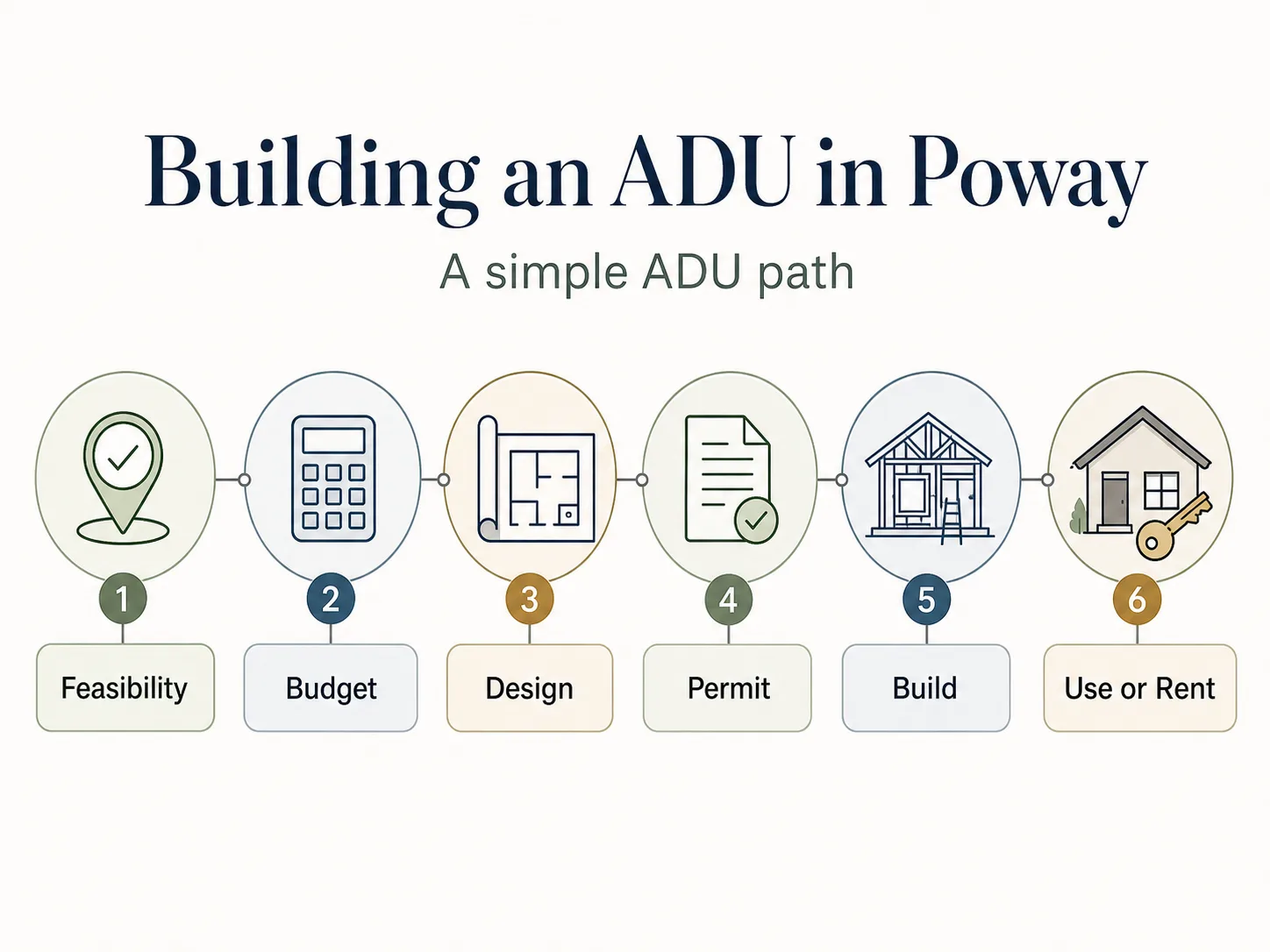
A clean Poway ADU project takes 6–12 months from design start to certificate of occupancy in industry-typical timelines, and longer for custom 1,200–1,500 sq ft projects with grading, septic, or VHFHA-driven materials. The permit phase alone runs 8–16 weeks for a clean application reviewing in two cycles. Construction runs 4–8 months depending on size and complexity.
| Step | What happens | Who owns it | Typical Poway duration |
|---|---|---|---|
| 1. Feasibility | Verify zoning, size, setbacks, utilities, slope, HOA, septic/sewer, budget | Homeowner + designer/builder | 1–2 weeks |
| 2. Design | Site plan, floor plan, elevations, structural, Title 24 energy, utility plan, soils report | Designer/architect/builder | 4–10 weeks |
| 3. Online submittal | Upload application, plans, soils report, calculations through Poway Online Services portal | Applicant/builder | 1 day |
| 4. Intake and first plan check | City intake, fees collected, review begins (14 days building / 28 days planning + engineering per cycle) | City of Poway / EsGil Corporation | 4 weeks |
| 5. Corrections cycle | Applicant responds to first-cycle redlines; resubmittal | Designer/builder | 2–4 weeks |
| 6. Second plan check | City reviews response; may issue second redlines or approve | City | 2–4 weeks |
| 7. Permit issuance | Pay remaining fees (school, impact, sewer/water capacity), receive permit | Applicant | 1–2 weeks |
| 8. Construction | Foundation, framing, MEP rough-in, inspections, drywall, finishes, final inspection | Builder + city inspector | 4–8 months |
| 9. Certificate of occupancy | Final inspection sign-off; ADU legally habitable | City | Same as final inspection |
The City of Poway officially verifies only the per-cycle review timing (14 days for building, 28 days for planning/engineering); total design-to-CO duration reflects industry estimates from Poway/San Diego builders.
What extends the timeline
- Multiple correction cycles
- Septic projects requiring County DEH approval before issuance
- Grading or retaining wall design changes mid-permit
- HOA architectural review delays
- VHFHA-driven material specification updates
- Utility upgrade reviews from SDG&E or water provider
What compresses it
- Builder whose first-cycle submittals are clean
- Pre-application consultation with Poway Development Services
- Using pre-approved or repeated-design floor plans
- ADUs <750 sq ft of interior livable space (lower fee burden, simpler engineering)
Is an ADU in Poway a good investment? The real math
Poway rental income benchmarks (verified)
SnapADU’s Poway page publishes Rentometer-sourced rental benchmarks for the Poway/92064 area as of March 2026. Rentometer aggregates rentals from a mix of apartments, condos, and single-family homes; smaller ADUs comp closer to apartments, larger ADUs closer to single-family rentals. Verify current rents on Rentometer for your specific zip code or with a Poway-licensed real estate professional before relying on any number.
| Unit type | Published rent benchmark | Gross annual rent (before vacancy and expenses) |
|---|---|---|
| 1-bedroom | $2,290/month | $27,480/year |
| 2-bedroom | $2,690/month | $32,280/year |
| 3-bedroom | $3,625/month | $43,500/year |
Source: SnapADU Poway page citing Rentometer, March 2026. Data verified May 5, 2026.
A representative Poway scenario
Project: 800 sq ft, 1-bedroom detached ADU on an RS-7 lot with sewer, no slope, no VHFHA exposure, stucco exterior matching primary residence, no fire sprinkler trigger, financed through a cash-out refinance.
Project cost: $300,000 all-in (within the published Cali Dream Construction Poway range, mid-bracket).
Gross rent: $2,290/month (Rentometer 1-bedroom Poway median, March 2026) = $27,480/year.
Operating expenses to model: property tax incremental on the addition (estimated at ~$3,000/year on a $300K addition at a 1% effective rate — verify your effective rate), insurance, maintenance reserve (~5% of rent), vacancy reserve (~5%–8% of rent), and any owner-paid utilities. These expenses typically total $7,000–$9,000/year before financing in Dwelling Index editorial estimates; your numbers will vary.
Cash flow: depends on your specific financing terms. Run your numbers in a calculator with your actual cash-out refi or HELOC quote.
Property value lift: depends on appraiser comp set at the time of sale or refinance. We’re not publishing a percentage here because the variation is wide. Confirm with a local appraiser if your strategy depends on appraisal lift.
When the Poway ADU math does NOT work
You're planning to sell within three years.
Construction cycles of 6–12 months consume a meaningful chunk of a three-year hold, and the appraisal lift you bank on assumes the ADU is finished, permitted, and rented when you list. If you're 18 months from selling, a kitchen and bath remodel of the primary residence usually beats an ADU on cosmetic ROI for a faster timeline.
You'd have to pull from retirement accounts to fund it.
Drawing from a 401(k) or IRA to fund an ADU triggers tax and penalty exposure that often exceeds the project's expected return. Talk to a fiduciary financial advisor before this strategy. We are not a financial advisor.
Your lot has slope, septic, or VHFHA exposure that pushes hard cost above $700/sq ft.
At that cost level, the rent-to-value ratio for typical Poway rents stops working. Some lots simply aren't economically right for a new-construction ADU. Garage conversion or attached addition may be a better path on those properties.
Already a landlord, or planning to be once your ADU is finished? Buildium offers property management software for landlords → (affiliate link)
Poway-specific edge cases that blow up projects
We’ve seen each of these derail an otherwise straightforward Poway ADU project. Pre-empt them before contract.
HOA covenants in Poway communities
For your permit application
The City of Poway cannot allow third-party HOA review of your ADU permit. The HCD's October 2025 letter to the City of Poway specifically clarified that allowing HOA review violates state ADU law. So your HOA cannot block the city from issuing your permit.
For your HOA governing documents
California Civil Code §4751 makes provisions in HOA governing documents void and unenforceable to the extent they effectively prohibit or unreasonably restrict the construction or use of an ADU/JADU on a single-family planned-development lot. HOAs can still apply non-blocking architectural standards within state ADU-law limits.
For separate-sale strategies
Cal. Gov. Code §66342 includes specific conditions for ADU separate sale, and HOA written authorization can matter under that section. Pull your CC&Rs and architectural review board (ARB) submission requirements before you finalize design.
Septic-only lots in RR-A, RR-B, and RR-C zones
Poway’s “City in the Country” character lives most strongly in the Rural Residential zones, and many of those lots are on septic, not sewer. Septic projects require San Diego County Department of Environmental Health approval before Poway will issue your ADU permit. The DEH review checks septic capacity for the additional bedrooms and may require a system upgrade or full replacement. Bring in a septic engineer before design lock — adding bedrooms to a system already at capacity is a real-money surprise (Dwelling Index editorial estimate: $10,000–$50,000+, but get a site-specific bid).
Slope, grading, and retaining walls
Hillside lots throughout Poway require grading plans, civil engineering, drainage, and often retaining walls. The City’s slope-calculation standards (PMC §17.08.170) determine how grading is computed. A builder who hasn’t walked your slope can’t price retaining walls or import/export of soil. Dwelling Index editorial estimate: typical slope-driven additions in the $20,000–$80,000 range, but get site-specific bids.
Wildfire defensible space in VHFHA zones
If your lot sits in a Very High Fire Hazard Area, the ADU build must comply with California Building Code Chapter 7A fire-resistant construction — non-combustible exterior cladding options, ember-resistant vents, fire-rated decking, and defensible-space landscaping rules around the new structure. Poway’s Pre-Approved ADU Policy notes that VHFHA projects require Fire Department approval. Premium materials add cost; get a written line item rather than a generic estimate.
Unpermitted structures already on the lot
California ADU law (Gov. Code §§66310–66342) limits the ability of a local agency to deny an ADU permit based on unrelated nonconforming zoning conditions, building-code violations, or unpermitted structures on the property — unless those conditions present a health or safety threat or are directly affected by the proposed ADU work. Don’t assume a blanket legalize-or-remove requirement. Ask the Building Division what specifically applies to your situation.
Selling the ADU separately under AB 1033
California’s AB 1033 (codified at Cal. Gov. Code §§66341–66342) lets local agencies opt in to allow ADUs to be sold separately from the primary residence as condominiums under specific conditions. Poway’s AB 1033 separate-sale opt-in status must be confirmed directly with Poway Development Services or the current municipal code before building with a separate-sale exit strategy. Outside an AB 1033 opt-in, separate sale is limited to narrow conditions — including qualified nonprofit ownership and recorded tenancy-in-common restrictions — which are not general homeowner exit options.
How to choose the right Poway ADU builder — step by step
Define the use case.
Family housing, long-term rental, aging parent, adult child, guest space, home office, or future-resale value. Each use case changes the right size, layout, and finish budget.
Qualify the lot.
Run a feasibility check against Poway's specific rules — zone, lot size, setbacks, height path, VHFHA, sewer/septic, slope, primary residence size — before you spend a builder's time.
Pick the build path.
Detached new build, attached, garage conversion, prefab, or architect-led custom. Don't shop builders until you know the path.
Shortlist 2–3 builder types.
Match company-to-project, not just company-to-Poway. Use the matrix above. Verify each builder's CSLB license number at cslb.ca.gov.
Request apples-to-apples scopes.
Identical assumptions for size, finishes, utilities, permits, school fees, sewer/septic capacity, soils report. The bid template should be your template, not theirs.
Verify license, insurance, and references.
Request insurance certificates. Call three recent Poway-finished references. Ask about the change-order experience.
Choose the lowest-risk complete scope, not the lowest headline price.
Cheap bids with vague allowances become expensive in month four. A higher fixed-price quote with no allowances may be the cheaper project once you account for change-order absorption.
Ready to start? See What's Possible at Your Address → Get Your Free Poway ADU Report
See What You Can Build → Get Your Free Poway ADU ReportDownload the Free Poway ADU Starter Kit
Includes the 12-question builder checklist, the bid comparison template, and the Poway permit timeline cheat sheet — one printable PDF, emailed in two minutes.
Download the Free ADU Starter Kit →Frequently asked questions about Poway ADU builders
Who is the best ADU builder in Poway?
There is no single 'best' builder for every Poway homeowner. For a detached new-build ADU between 600 and 1,200 sq ft in Greater San Diego, a San Diego ADU design-build specialist is usually the strongest first call (SnapADU is our affiliate-disclosed pick in this category). For a garage conversion or small attached addition, a remodeler-GC is usually a better fit. For a custom 1,200–1,500 sq ft build on a Poway RR-zoned lot, a Poway-experienced custom home builder is the safer call. Match the builder to your project type, not to a generic ranking.
How much does an ADU cost in Poway in 2026?
Builder-published Poway/San Diego construction-cost benchmarks span roughly $220–$600+ per square foot. SnapADU's San Diego turnkey/all-in benchmark for completed detached ADUs is $375–$600+ per square foot and $300,000–$450,000+ for many complete builds. Published Poway project examples in SnapADU's portfolio: $219,000 (498 sq ft, Bronco Lane), $254,000 (840 sq ft, Grange Place), and $565,000 (1,500 sq ft + garage, Avenida Florencia). Cali Dream Construction's all-in Poway range is $150,000–$400,000+. Always confirm what's in scope before comparing quotes — construction cost, build cost, and turnkey/all-in are not the same number.
Can I build a 1,500 sq ft ADU in Poway?
Possibly, yes. Poway's handout allows detached and attached ADUs up to 1,500 sq ft, conditioned on the ADU being no more than 50% of the primary residence's floor area. ADUs larger than 1,200 sq ft also trigger fire sprinkler requirements per the Poway handout. If your primary residence is 3,000+ sq ft, you have room to consider 1,500 sq ft on the ADU; if it's smaller, you'll be capped at 50% of the primary residence's area or the state-law floor protections, whichever provides the larger guarantee. Run your specific lot through a feasibility check for a definitive answer.
Can I build a two-story ADU in Poway?
Poway's handout treats two-story ADU height through two paths: (1) the ADU meets standard single-family residential setbacks for the zone (height generally tied to the existing residence); (2) the ADU uses the four-foot reduced setback path (limited to one story and 16 feet) unless a state-law height exception applies. The state-law exception under Cal. Gov. Code §66321(b)(4)(B) allows up to 18 feet (plus 2 feet for matching roof pitch) for ADUs within ½ mile of a major transit stop or high-quality transit corridor. Most Poway lots are not within those corridors — verify with Development Services before designing.
Do I need fire sprinklers in my Poway ADU?
Per Poway's handout, fire sprinklers are required in your Poway ADU if they are required for your primary residence, and also if the ADU exceeds 1,200 sq ft regardless of the primary residence's status. State law alone does not generally require an existing primary residence to retrofit sprinklers because of a new ADU; Poway's local rule layers on the >1,200 sq ft trigger. Sprinkler scope and any water-meter or service upgrade should be a written line item on your quote.
Does Poway require parking for an ADU?
Poway generally requires one off-street parking space per ADU, unless a state-law exemption applies. Exemptions include ADUs within ½ mile walking distance of a public transit stop, ADUs in historic districts, ADUs converted from existing permitted structures, ADUs in areas where on-street parking permits are required but not offered to ADU occupants, and ADUs within one block of a car-share vehicle pickup location. Importantly, no replacement parking is required when a garage, carport, or covered parking structure is converted or demolished to create an ADU per state law and PMC §17.08.180(A).
How many ADUs can I build on my Poway property?
On a single-family lot, California ADU law (Cal. Gov. Code §66323) generally allows the combination of: one converted ADU (within existing space), one detached new-construction ADU, and one JADU (within or attached to the primary residence). On multifamily lots, Poway allows at least 2 detached ADUs on lots with an existing multi-family building, with additional units permitted up to a maximum of 8 detached ADUs depending on the existing unit count. Verify the latest combination rules with Development Services — California's 2025 ADU bills have refined these allowances.
Can my HOA stop me from building an ADU in Poway?
No, but the legal split matters. For permit review, the City cannot allow third-party HOA review of your ADU application per HCD interpretation of Cal. Gov. Code §66315 and the HCD letter to the City of Poway dated 2025-10-08. For HOA governing documents, California Civil Code §4751 makes provisions void and unenforceable if they effectively prohibit or unreasonably restrict a compliant ADU/JADU. HOAs can still apply non-blocking architectural standards within state ADU-law limits. For separate-sale condo strategies under AB 1033, HOA written authorization can matter under Gov. Code §66342.
Does Poway require a soils report for an ADU?
For new structures, yes. Poway's online ADU application handout cites the California Building Code/California Residential Code requirement for soils reports on projects that propose new structures. Garage conversions and other interior conversions of existing structures may not require a new soils report — confirm with the Building Division for your specific project type.
How long does Poway ADU plan review take?
The City of Poway Building Services page states first building reviews take up to 14 calendar days per cycle, and planning/engineering reviews take up to 28 calendar days per cycle. Most Poway ADU permits clear in two to three review cycles, putting total permit-issuance time at typically 8–16 weeks from clean submittal to permit pickup. Plan review and inspections are provided in part by EsGil Corporation under contract with the City.
Can I rent my Poway ADU on Airbnb?
Per PMC §17.08.180(A), Poway requires ADU rental terms to exceed 30 days, which functionally precludes typical short-term-rental platforms like Airbnb. California's 2025 ADU bills also extended the 30-day-minimum requirement to JADUs. Long-term and 30+ day mid-term rentals are permitted. Don't model short-term rental income in your project pro forma.
What ADU grants or programs are available to Poway homeowners right now?
The most well-known program — the CalHFA $40,000 ADU Grant — has experienced funding pauses. Per CalHFA's December 28, 2023 notice, the latest ADU Grant funding round was fully allocated/fully reserved. Verify the current status directly with CalHFA at calhfa.ca.gov before relying on any grant in your budget. Most Poway ADUs are funded through cash-out refinance, HELOC, or construction loans rather than grants.
Does Poway charge school fees on ADUs?
Yes, on residential additions over 500 sq ft. Poway Unified School District's Planning page lists the current Level 1 fee at $5.17 per sq ft for residential construction, with an explicit instruction to verify current rates before payment. Level 2 fees are currently suspended pending a new School Facilities Needs Analysis. JADUs at 500 sq ft or less of interior livable space typically fall below the school-fee threshold, but verify your specific scope with PUSD.
Can I sell my Poway ADU separately from the main house?
Maybe, but not by default. California's AB 1033 (Cal. Gov. Code §§66341–66342) allows local agencies to opt in to a framework that permits ADUs to be sold separately as condominiums under specific conditions. Poway's AB 1033 opt-in status must be confirmed directly with Development Services or the current municipal code before building with a separate-sale exit strategy. Outside the local opt-in path, separate sale is limited to narrow conditions and is not a general homeowner exit option.
Even when grant programs are paused, homeowners are still building ADUs every day.
Explore Your ADU Financing Options → (partner link)Mortgage Research Center is a Dwelling Index affiliate partner; we may earn a commission if you use our link, at no cost to you. Not a lender ranking.
What we verified
Every factual claim about Poway zoning, permits, costs, and regulations on this page was cross-checked against the sources below as of May 5, 2026. Where state and local rules differ, California ADU law supersedes conflicting local ordinances per Cal. Gov. Code §66325.
| Source | URL / Note |
|---|---|
| Poway Municipal Code §17.08.180(A) | codepublishing.com/CA/Poway |
| City of Poway 'ADU and JADU: General Information' handout (Updated 06.2024) | poway.org/DocumentCenter/View/8712 |
| City of Poway online ADU application handout | poway.org/DocumentCenter/View/11596 |
| City of Poway Building Services page and Building Division FAQ | poway.org/243 |
| City of Poway Pre-Approved ADU Policy | poway.org/DocumentCenter/View/11749 |
| California HCD letter to the City of Poway (October 8, 2025) | hcd.ca.gov ordinance review letters |
| California Government Code §§ 66310–66342 (current ADU statute) | leginfo.legislature.ca.gov |
| California Civil Code §4751 (HOA governing documents and ADUs) | leginfo.legislature.ca.gov |
| HCD ADU Handbook update (March 2026) | hcd.ca.gov |
| Poway Unified School District Planning / Developer Fee Information page | powayusd.com |
| CalHFA ADU Grant Program page | calhfa.ca.gov/adu — latest round fully allocated per CalHFA's December 28, 2023 notice; verify current status |
| SnapADU 'Poway: Accessory Dwelling Unit Regulations & Zoning' (last updated April 2026) | snapadu.com |
| SnapADU 'Cost to Build an ADU in San Diego (2026)' | snapadu.com/adu-costs |
| SnapADU published Poway project pages (Bronco Lane, Grange Place, Avenida Florencia) | snapadu.com/projects |
| Better Place Design & Build Poway service-area page (March 2026) | betterplacedesignbuild.com |
| Cali Dream Construction 'ADU Cost in Poway 2026' (February 2026) | blog.calidreamconstruction.com |
What still needs spot-verification before commercial reliance on this page
- The architectural-compatibility cost premium ranges are Dwelling Index editorial estimates and should be confirmed in writing on your specific quote.
- The PUSD Level 1 developer fee changes; verify the current rate with the District before payment.
- CalHFA ADU Grant status changes with funding cycles; verify directly at calhfa.ca.gov before including in your budget.
- VHFHA status for your specific lot; self-check at PowGIS.
- Poway’s AB 1033 separate-sale opt-in status; verify with Development Services or current municipal code.
- Slope/grading and VHFHA premium dollar ranges are Dwelling Index editorial estimates; get site-specific bids.
- Builder CSLB license status, classifications, bond, and complaint history for any builder you shortlist; verify at cslb.ca.gov.
Methodology — how we built this page
Dwelling Index is an independent research resource covering ADU financing, costs, and regulations. We are not a builder, lender, or licensed contractor. We do not take payment for editorial inclusion, do not sort providers by affiliate payout, and disclose every commercial relationship inline.
- How we selected builder examples. Inclusion is based on three observable criteria: (1) publicly listed Poway service area, (2) at least one published Poway project, Poway-specific rule reference, or recent Poway content indicating local familiarity, and (3) absence of obvious red flags in publicly available business information. We label every inclusion as “to verify before shortlisting” because final CSLB verification must be done by the homeowner directly at cslb.ca.gov before signing a contract.
- How we sorted them. By project type, not by ranking. We will not publish a “1-2-3 best builder” list because that ranking is dishonest.
- How we compiled costs. Construction-cost ranges come from two builders publishing Poway-specific data within the last 90 days. Turnkey/all-in benchmarks come from SnapADU’s 2026 San Diego cost guide. Where editorial estimates appear, we say so explicitly.
- How we handled affiliate relationships. Three companies on this page are Dwelling Index affiliate partners, all disclosed inline: SnapADU (placed in the matrix as our pick for detached new-build ADUs in Greater San Diego), Mortgage Research Center / MRC (placed in the financing-path block), and Buildium (single mention in the ROI section). Other builders in the matrix are not affiliate partners. We do not take payment for those mentions.
Last updated: May 5, 2026 · Last verified: May 5, 2026 · Next scheduled review: August 5, 2026
Three ways forward
1) Qualify your lot before you call a builder(start here)
Check your address against Poway’s specific rules — zone, setbacks, VHFHA, sewer/septic, size limits — in about 60 seconds. Free, no phone call, no commitment.
See What You Can Build → Get Your Free Poway ADU Report2) Explore a detached design-build ADU with SnapADU(start here if you’ve done feasibility and want detached pricing)
Affiliate disclosure (renewed here per FTC guidance). Dwelling Index is reader-supported. When you use our links to explore financing options or request project pricing, we may earn a commission at no extra cost to you. SnapADU, Mortgage Research Center, and Buildium are disclosed affiliate partners on this page. Editorial recommendations are based on independent research and are never influenced by compensation.
Explore SnapADU’s Poway Process → (partner link)Download the Free Poway ADU Starter Kit
Includes the 12-question builder checklist, the bid comparison template, and the Poway permit timeline cheat sheet — one printable PDF, emailed in two minutes.
Download the Free ADU Starter Kit →Related city guides
- Best ADU Builders El Cajon, CA — 2026 verified fit guide
- Best ADU Builders Vista, CA — 7 local options + 2026 costs
- Best ADU Builders Oceanside, CA — 9 picks + 2026 costs
- Best ADU Builders Escondido, CA — 9 paths + 2026 costs & PAADU
- Best ADU Builders Chula Vista, CA — verified 2026 fit guide
- Best ADU Builders San Diego County — all cities, all builder types
Not sure where to start? Qualify your lot first — 60 seconds, free, no pitch.
Check My Property →Full disclosure. Dwelling Index is reader-supported. SnapADU, Mortgage Research Center, and Buildium are affiliate partners on this page — we may earn a commission if you use our links, at no extra cost to you. All other builders in the matrix are included based on editorial criteria only; we received no payment from them. Full affiliate disclosure policy →
What Is an ADU? · ADU Financing Guide · ADU Grants by State · How Much Does an ADU Cost? · Contact