
San Diego Coastal Zone ADU: Do You Need a Coastal Development Permit? (2026 Guide)
An independent research resource covering ADU financing, costs, and regulations.
A San Diego Coastal Zone ADU is buildable in 2026. Most coastal ADUs in the City of San Diego’s Coastal Overlay Zone require a Coastal Development Permit (CDP), but qualifying Junior ADUs (JADUs) and interior conversions can be CDP-exempt. As of October 10, 2025, California AB 462 (codified at Government Code §66329) caps the CDP decision at 60 days from a complete application, requires CDP processing to run concurrently with the standard ADU permit, holds no public hearing, and allows no appeal to the California Coastal Commission in cities with a certified Local Coastal Program — like the City of San Diego.
The honest version: with a complete application qualifying for the streamlined Process One staff approval, total design-through-permit typically runs 90–120 days, and construction adds 4–7 months. Coastal builds typically cost 8–12% more than equivalent inland ADUs before geotech, view analysis, and CDP design work are added.
This guide is for City of San Diego parcels only. The Process One pathway, SDMC code references, and IB-501 fee math below apply to City of San Diego parcels. We cover neighboring coastal cities briefly at the end.
→ Run your address through the Coastal ADU permit path checker (free, 60 sec)
By The Dwelling Index Editorial Team · Methodology · Editorial standards · Corrections
Last updated: May 11, 2026 · Last verified against primary sources: May 11, 2026 · Next scheduled review: Monthly for AB 462 implementation, SB 1077, and LCP certification; quarterly for permit-path matrix and fee tables.
Affiliate disclosure: The Dwelling Index is reader-supported. Some links on this page are affiliate links. If you click one and take a qualifying action, we may earn a commission at no extra cost to you. Affiliate relationships do not influence our editorial rankings or conclusions. Read our full disclosure.
What we verified — Last checked May 11, 2026
- City of San Diego IB-400 (January 2026) and IB-501 (May 2026)
- AB 462 effective date October 10, 2025; Government Code §66329 provisions
- SDMC §126.0704 exemption criteria and §126.0708(c) administrative findings
- 30-foot Coastal Height Limit (Proposition D, SDMC §132.0505)
- Parking trigger and exceptions per IB-400 and SDMC §141.0302
- SDHC ADU Finance Program terms and funding status (verify current availability with SDHC)
- Certified LCP certification status of pending ordinances O-21618, O-21758, O-21836, O-21989
What this guide covers
- Whether you can build an ADU in San Diego’s Coastal Overlay Zone
- What the San Diego Coastal Zone ADU rules actually require in 2026
- When a Coastal Development Permit is required (and when you’re exempt)
- The difference between appealable and non-appealable coastal area
- What changed under California AB 462 (Government Code §66329)
- How to check your parcel for coastal triggers before paying for plans
- How to look up prior Coastal Development Permits on your lot
- The Beach Impact Area / Transit Priority Area parking decision
- Which ADU rules still apply inside the Coastal Overlay Zone
- What a coastal ADU actually costs in 2026 (with verified May 2026 city fees)
- Realistic permit timelines
- The conditions that quietly kill or delay coastal ADU projects
- Which path fits your goal
- Financing the build
- A brief note on neighboring coastal cities
- How to vet a builder for coastal experience
- A 10-step checklist to run before signing a design contract
Can you build an ADU in San Diego’s Coastal Overlay Zone?
Yes. The California Coastal Act does not ban ADUs in the Coastal Zone, and the California Department of Housing and Community Development (HCD) has confirmed that state ADU laws apply inside the Coastal Zone — though they do not alter or lessen Coastal Act resource-protection policies. For most City of San Diego coastal parcels, the practical path in 2026 is a 60-day, concurrent, City-issued, staff-level CDP that is not appealable to the California Coastal Commission.
Three regulatory steps changed the picture for coastal homeowners:
- September 7, 2022. The Coastal Commission certified amendments to the City of San Diego’s Local Coastal Program (LCP) allowing ADUs and JADUs in the non-appealable portion of the Coastal Overlay Zone to be processed under Process One. Before this, even modest coastal ADU projects could face longer, more contentious paths.
- September 12, 2024. The Coastal Commission certified the ADU regulations associated with the City’s Housing Action Package 1.0 (Ordinance O-21439). This brought setback and landscape requirements into alignment between coastal and non-coastal projects. Several 2024 and 2025 amendments are still pending Coastal Commission certification before they take effect inside the Coastal Overlay Zone — including provisions in Ordinance Numbers O-21618, O-21758, O-21836, and O-21989.
- October 10, 2025. Governor Newsom signed AB 462 as an urgency statute, effective immediately. It capped the local CDP decision at 60 days, required the CDP to run concurrently with the standard ADU permit, and eliminated the ability to appeal ADU CDPs to the Coastal Commission in cities with a certified LCP.
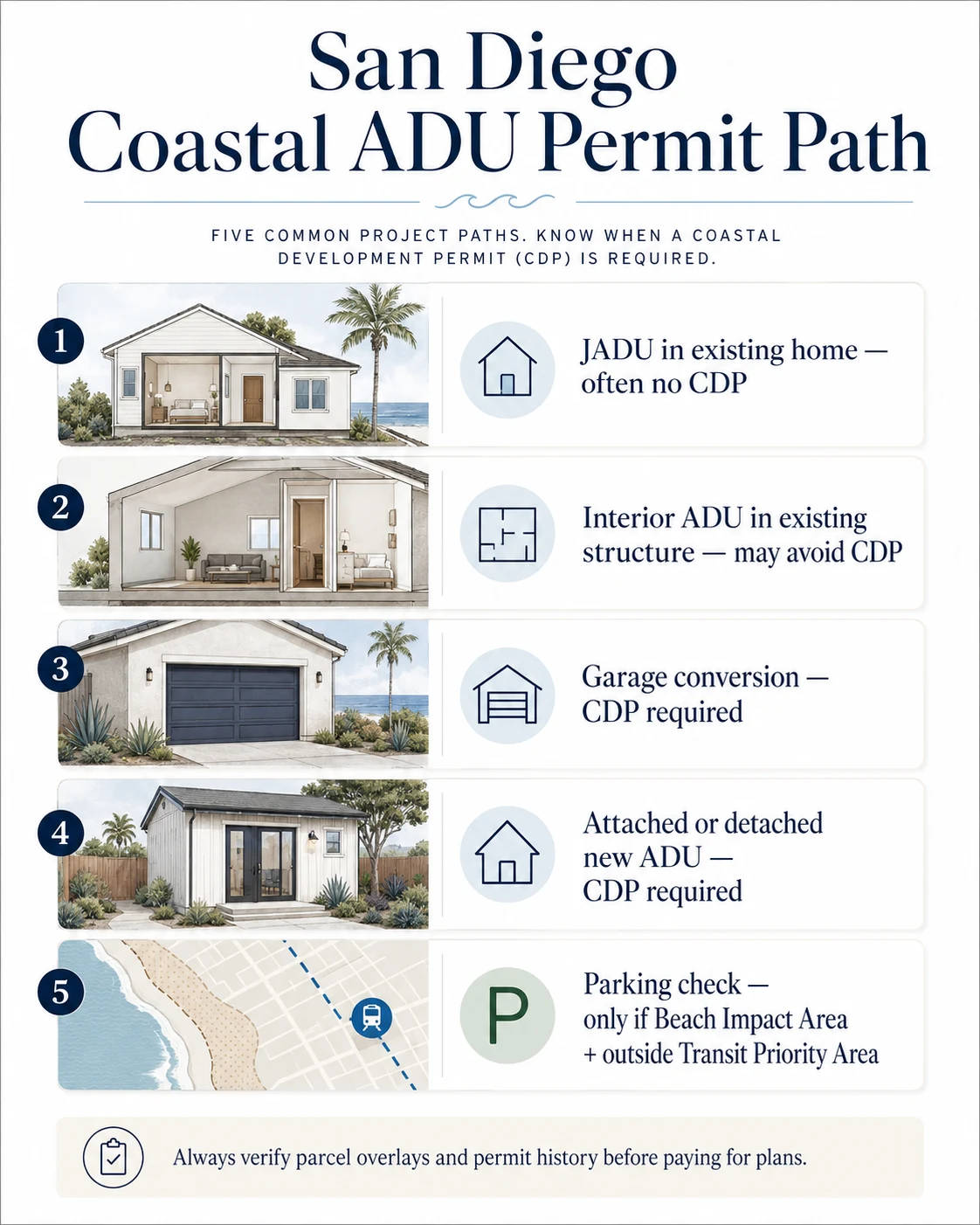
The San Diego Coastal ADU Permit Path Matrix (2026)
Assembled from City of San Diego IB-400 (January 2026), SDMC §126.0704 and §126.0708(c), California Government Code §66329, and the California Coastal Commission’s certified Local Coastal Program for the City of San Diego.
| Your project type | CDP likely required? | Parking likely required? | First action |
|---|---|---|---|
| JADU inside existing single-family home (≤500 sf) | Usually no — qualifying JADUs may be CDP-exempt under §126.0704 | No | Confirm JADU qualifies for §126.0704 exemption; sign required JADU agreement |
| ADU fully contained inside existing primary structure, no added habitable area | Possibly no, but verify — IB-400 requires CDP for ADUs that add habitable area or convert non-habitable space | No | Confirm “fully contained” status against IB-400 definitions |
| Garage conversion (converting non-habitable space to an ADU) | Yes — converting non-habitable space in the Coastal Overlay Zone triggers the CDP requirement | Replacement parking generally not required, except in Beach Impact Area outside a TPA | Pull Coastal Overlay, Beach Impact Area, and TPA layers from ZAPP |
| New detached ADU | Yes — new detached construction in the Coastal Overlay Zone requires a CDP | No, unless in Beach Impact Area + outside TPA | Determine appealable vs. non-appealable area; assess §126.0708(c) findings |
| Detached ADU in Beach Impact Area, outside a Transit Priority Area | Yes | One off-street space required unless an exception applies | Test ≤500 sf, attached, historic-resource, permit-parking, and car-share exceptions |
| Attached ADU (addition to or attached to primary residence) | Yes, if it adds habitable area in the Coastal Overlay Zone | No — attached ADUs are an exception to the parking trigger | Confirm height, FAR, and setback compliance |
| Parcel with prior CCC-issued CDP, bluff-top, wetlands, ESL, brush, or VHFHSZ overlay | Yes; extra review and conditions likely | Depends on overlays | Order a parcel-specific feasibility check before any design spend |
| Detached ADU on a lot within 50 feet of a coastal bluff edge | Yes — and the §126.0704 streamlined exemption is lost | Same parking rules apply | Geotechnical analysis usually required; may move into appealable area |
Sources: IB-400 (January 2026); SDMC §126.0704; §126.0708(c); Government Code §66329. Last verified May 11, 2026.
Key definitions
- CDP (Coastal Development Permit): A regulatory approval required under the California Coastal Act for development in the Coastal Zone. Qualifying non-appealable-area ADU CDPs are issued as “Process One” staff-level building permits with no public hearing.
- Coastal Overlay Zone: The City of San Diego’s name for land inside the California Coastal Zone within city boundaries — an overlay on top of base zoning.
- Beach Impact Area: A defined sub-area of the City’s Parking Impact Overlay Zone, generally within roughly two to three blocks of the coast.
- Transit Priority Area (TPA): Any area within one-half mile of a major transit stop.
- Process One: The City’s lowest-level review path — no public hearing, no Planning Commission, no City Council.
Free Tool — ~60 Seconds
See What You Can Build at Your Coastal Address
Get a parcel-specific report: likely CDP path, parking risk, fee category, top items to verify, and your next step. Not a permit approval.
Get Your Free ADU Feasibility Report \u2192What are the San Diego Coastal Zone ADU rules in 2026?
Inside the City of San Diego’s Coastal Overlay Zone in 2026, the core rules require: a Coastal Development Permit for any ADU that adds habitable area or converts non-habitable space; the same 1,200 sf maximum size as inland ADUs; the same setback rules with a mandatory 4-foot minimum side/rear setback in Very High Fire Hazard Severity Zones; a 30-foot maximum building height in defined Proposition D coastal-height-limit neighborhoods; minimum 31-day rental terms; and the same solar and fire-sprinkler obligations as inland ADUs.
Core San Diego ADU rules — what carries over into the Coastal Overlay Zone
| Rule | Current verified standard | What changes in the Coastal Overlay Zone |
|---|---|---|
| Maximum ADU size | Detached or attached ADU up to 1,200 sf; JADU up to 500 sf (IB-400) | Same baseline, but Coastal Height Limit Overlay may constrain massing |
| Height (general) | Detached ADU up to 16 ft by right with reduced setbacks; up to 18 ft within ½ mile of major transit or on multifamily; up to 20 ft with matching roof pitch | Capped at 30 ft in Coastal Height Limit Overlay neighborhoods |
| Setbacks | 4 ft side/rear for ADUs over 16 ft; 0 ft allowed for single-story ≤16 ft outside VHFHSZ | 4 ft minimum side/rear in Very High Fire Hazard Severity Zone regardless of ADU height (IB-400) |
| Front setback | One ADU ≤800 sf may encroach into front yard setback if it can't fit elsewhere | Same rule; coastal review may scrutinize street-side massing |
| Owner occupancy (ADU) | Not required (IB-400) | Same — not required |
| Owner occupancy (JADU) | Under state law (Gov. Code §66333), not required if the JADU has separate sanitation facilities | Verify: some 2025 ADU/JADU amendments are pending CCC certification in the Coastal Overlay Zone. Confirm with DSD before relying on a no-owner-occupancy JADU |
| Rental term | Minimum 31 consecutive days. No short-term rental. | Same |
| Fire sprinklers | Required for an ADU only if required for the primary dwelling | Same |
| Solar (new detached ADU) | Newly constructed, non-manufactured detached ADUs are subject to California Energy Code Title 24 solar requirements | Same |
| Solar (conversion/addition) | ADUs created within existing space or as additions to existing homes are not subject to the new-construction solar requirement | Same |
| Parking | Generally not required | Triggered only by all three: Coastal Overlay + Beach Impact Area + outside TPA |
Rules pending Coastal Commission certification
Per IB-400 (January 2026), several ordinances adopted by the City Council are not yet effective inside the Coastal Overlay Zone because they require Coastal Commission certification as Local Coastal Program amendments. These include certain Housing Action Package 2.0 provisions and 2024–2025 ADU/JADU amendments in Ordinance Numbers O-21618, O-21758, O-21836, and O-21989. A rule that applies to your inland neighbor may not yet apply to your coastal lot. Verify the current certification status with DSD before relying on any 2024–2025 amendment for a Coastal Overlay parcel.
Do you need a Coastal Development Permit for your ADU?
Per City of San Diego IB-400 (January 2026), a CDP is required for the creation of all ADUs and JADUs within the Coastal Overlay Zone that are not completely contained within the existing primary structure, include increases in habitable area, or involve conversion of non-habitable space. JADUs that meet the §126.0704 exemption criteria may be permitted without a CDP. There are two different tests at play. Understanding the distinction saves time and money.
Test 1: Are you exempt from needing a CDP at all? (SDMC §126.0704)
SDMC §126.0704 lists categories of coastal development exempt from needing a CDP. For ADUs and JADUs, the practical exemption criteria — confirmed in the certified Local Coastal Program and IB-400 — are:
- Not within 50 feet of a coastal bluff edge (§126.0704(a)(1))
- Over 300 feet from the mean high tide line (§126.0704(a)(2) and (a)(7))
- No removal of vegetation within 100 feet of a bluff (§126.0704(a)(4))
- For conversions: not more than 50% of the existing exterior walls demolished (§126.0704(a)(5))
- No expansion of water wells or septic systems (§126.0704(a)(8))
If your project meets these criteria, it may qualify for exemption and skip the CDP entirely. Qualifying JADUs in the Coastal Overlay Zone are most likely to fit.
Test 2: If a CDP is required, can it be issued under Process One? (SDMC §126.0708(c))
If your project triggers the CDP requirement (most new detached ADUs, attached additions adding habitable area, and garage conversions), the next question is whether it qualifies for the streamlined Process One staff approval. Per IB-400, this requires:
- The project is in the non-appealable portion of the Coastal Overlay Zone
- The City makes the administrative findings required under SDMC §126.0708(c) — confirming the project conforms to the certified Local Coastal Program, including provisions related to public coastal access, scenic resources, biological resources, and other Coastal Act protections
If the §126.0708(c) findings are satisfied, the CDP is issued as the Building Permit itself under Process One — staff-level approval, no public hearing, no Planning Commission, no City Council, and under AB 462 no appeal to the California Coastal Commission.
What Process One actually means
- Plans reviewed by City staff in Development Services Department (DSD)
- No public hearing required
- No discretionary review by a hearing officer, Planning Commission, or City Council
- No appeal to the California Coastal Commission for ADU CDPs (AB 462)
- The CDP is issued together with the building permit
- The clock is 60 days from a complete application (Government Code §66329)
Process One isn’t “no review.” Staff verifies LCP conformance, coastal-resource protections, public access requirements, and view corridor and ESL considerations where applicable. The substantive coastal protections are intact — what changed is the timing, the hearing requirement, and the appeal route.
When you can skip the CDP entirely
JADUs (150–500 sf, contained within the existing or proposed single-family dwelling) in the Coastal Overlay Zone are not categorically required to have a CDP. Qualifying JADUs meeting the §126.0704 exemption criteria are commonly permitted without one. ADUs entirely contained within the existing primary structure — with no habitable area added and no non-habitable space converted — may also qualify. This is a narrow path. A genuine interior reconfiguration where existing habitable rooms become an ADU’s bedroom, kitchen, and bathroom can fit; almost anything more ambitious cannot.
Appealable vs. non-appealable area — why it still matters
Even after AB 462 eliminated Coastal Commission appeals of ADU CDPs, the appealable-area designation still drives whether a coastal project gets the streamlined Process One staff approval or goes into fuller CDP review. Non-appealable-area projects with satisfied §126.0708(c) findings can be issued under Process One. Appealable-area projects can’t — they go through more substantive Coastal Act review.
In the City of San Diego’s Coastal Overlay Zone, appealable-area parcels include any of these conditions:
- Between the sea and the first public road paralleling the sea
- Within 300 feet of the inland extent of any beach or the mean high tide line, whichever is greater
- Within 100 feet of any wetland, estuary, or stream
- Within 300 feet of the top of the seaward face of any coastal bluff
- Major public works projects or energy facilities
Non-appealable-area parcels are everything else inside the Coastal Overlay Zone. Most City of San Diego coastal parcels fall in the non-appealable area. You can verify your status using the City’s ZAPP portal or by requesting a zoning verification letter from DSD.
What AB 462 (California Government Code §66329) actually changed
AB 462 took effect October 10, 2025 as an urgency statute, signed by Governor Newsom and filed with the Secretary of State the same day. It added Government Code §66329, which requires a local government with a certified Local Coastal Program to approve or deny a complete CDP application for an ADU within 60 days, process the CDP concurrently with the standard ADU permit, hold no public hearing on the ADU CDP, and accept no appeal of the ADU CDP decision to the California Coastal Commission.
Before and after AB 462
| Pre-October 10, 2025 | Post-October 10, 2025 (AB 462 / §66329) | |
|---|---|---|
| Statutory CDP review timeline for ADUs | None — typically 5–8 months, sometimes 8–18+ with appeals | 60 days from a complete application |
| Concurrent CDP and ADU permit processing | Not required; often sequential | Required |
| Public hearing for an ADU CDP | Sometimes required, varied by jurisdiction | Not required |
| Appeal of an ADU CDP to the California Coastal Commission | Available for appealable-area projects | Eliminated in cities with a certified LCP |
| Detached ADU certificate of occupancy before primary dwelling | Generally prohibited | Permitted in narrow disaster-recovery cases (declared emergency after Feb 1, 2025; primary dwelling destroyed by declared event) |
Sources: California Government Code §66329; AB 462 (Lowenthal, 2025); Burke Williams & Sorensen “2025 ADU Legislative Update”; Best Best & Krieger LLP alert (November 7, 2025).
What AB 462 didn’t fix
- The CDP requirement itself. If your project triggers a CDP under IB-400, you still need one.
- The §126.0704 exemption test. Bluff-edge, wetland, mean-high-tide, vegetation, well/septic, and >50% exterior-wall-demolition triggers still pull you out of the exemption.
- The §126.0708(c) administrative findings. Even Process One requires the City to make findings of LCP conformance, including public access, biological resources, and Coastal Act protections.
- The 60-day clock only starts on a complete application. Submit incomplete and the clock doesn’t run. Per SB 543, completeness review is 15 business days.
- The Coastal Act’s substantive resource protections. Public access, scenic resources, sea-level rise, biological resources, and ESL requirements still apply.
- Tidelands or Port jurisdiction. Bayfront tidelands under Port of San Diego authority follow a different CDP path.
How to check whether your parcel triggers coastal rules
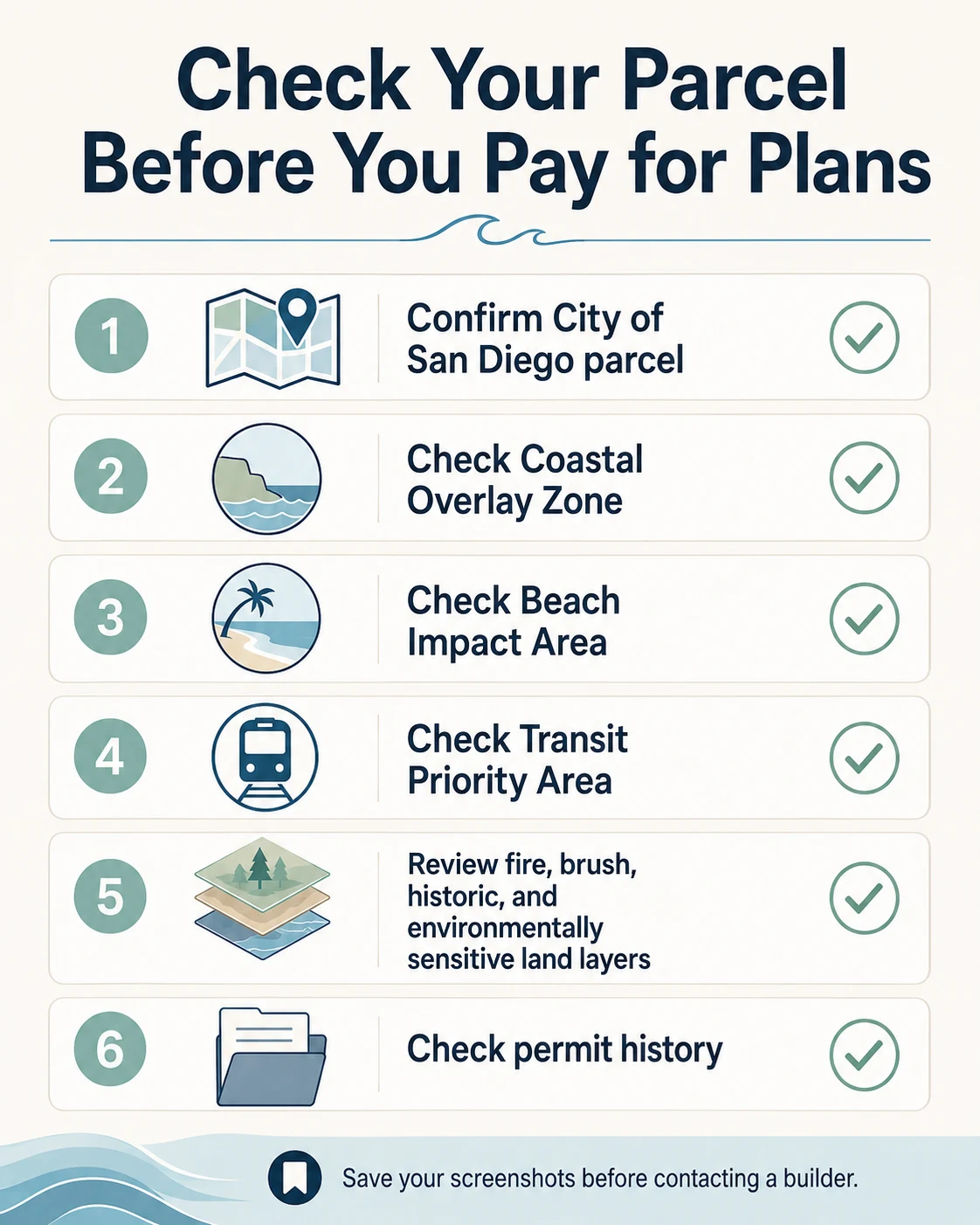
Start with the City of San Diego’s Zoning and Parcel Information Portal (ZAPP), then check overlays — not just base zoning. Pull your Coastal Overlay status (appealable or non-appealable), Beach Impact Area status, Transit Priority Area status, Very High Fire Hazard Severity Zone status, brush management zones, Environmentally Sensitive Lands flags, historical district / historical resource flags, and Sustainable Development Area status. Cross-check against your permit history for any prior Coastal Commission-issued CDPs with active conditions.
The 12-step ZAPP parcel check
- Open the City’s Zoning and Parcel Information Portal (ZAPP) at sandiego.gov.
- Enter your address or APN (Assessor’s Parcel Number).
- Confirm City of San Diego jurisdiction. Some parcels that look like San Diego are actually in unincorporated San Diego County or an adjacent city. The rules differ.
- Record the base zone designation (RS-1-7, RM-1-1, etc.). This sets your starting setbacks, height, and use rules.
- Check the Coastal Overlay Zone status — yes or no, and whether the parcel is in the appealable area or the non-appealable area.
- Check the Beach Impact Area of the Parking Impact Overlay Zone.
- Check the Transit Priority Area status using the City’s Parking Standards Transit Priority Area calculator.
- Check the Very High Fire Hazard Severity Zone using the City’s VHFHSZ map. This triggers the 4-foot side/rear setback regardless of ADU height.
- Check brush management requirements. Properties adjacent to canyon brush may have additional vegetation-clearance requirements.
- Check Environmentally Sensitive Lands (ESL) layers. Where present, biological surveys or habitat mitigation may be required.
- Check historical district and historical resource flags. Designated historical resources have additional review requirements.
- Check the Sustainable Development Area (SDA) layer. SDA properties may have modified parking rules and bonus ADU eligibility.
How to look up prior Coastal Development Permits on your parcel
A prior CDP can place restrictions on what you can build. Check three places:
- City of San Diego DSD Permit Finder. Look up your address and pull the permit history. Note any CDP records.
- San Diego County Recorder’s Office. Some CDP conditions are recorded against the property title.
- California Coastal Commission, San Diego Coast District office. For properties with a CCC-issued CDP (rather than a City-issued CDP), request records directly. The CCC may have conditions that aren’t visible in City records.
The map layers that surprise people
- The Sustainable Development Area (SDA). Properties inside SDAs can qualify for bonus ADU eligibility, modified parking rules, and other allowances. The intersection of SDA + Coastal Overlay can change your project options materially.
- Coastal Height Limit Overlay Zone (Proposition D). A 30-foot building height cap applies in defined coastal communities of La Jolla, Pacific Beach, Mission Beach, Ocean Beach, Sunset Cliffs, and Point Loma. We cover this below.
- Areas of Future Sea Level Rise (AFSLR). Some parcels carry siting, anchoring, and equipment-elevation requirements due to sea-level-rise vulnerability per the City’s certified LCP modifications.
Free Tool — ~60 Seconds
See What You Can Build at Your Coastal Address
Get a parcel-specific report: likely CDP path, parking risk, fee category, top items to verify, and your next step. Not a permit approval.
Run Your Address Through the Coastal ADU Permit Path Checker \u2192When does a coastal ADU need parking?
One off-street parking space is required for a City of San Diego ADU only when all three of the following are true at the same time: the property is in the Coastal Overlay Zone, the property is in the Beach Impact Area of the Parking Impact Overlay Zone, and the property is outside a Transit Priority Area. Multiple exceptions still apply even then. Many coastal parcels do not actually trigger the parking requirement because most of the Beach Impact Area overlaps with a Transit Priority Area.
The three-part parking trigger
Per SDMC §141.0302 and IB-400, an off-street parking space is required only when all three of these conditions apply simultaneously:
- The property is in the Coastal Overlay Zone
- The property is in the Beach Impact Area of the Parking Impact Overlay Zone
- The property is outside a Transit Priority Area
If any one of those three is false, no parking is required.
Parking exceptions when the trigger applies
Even when the three-part trigger is met, the parking requirement is waived if any of these is true (per IB-400):
- The ADU is 500 square feet or smaller
- The property is within a historical district that is a designated historical resource
- The ADU is attached to the primary dwelling or accessory structure
- The premises is in a residential permit parking district
- A car-share vehicle is located within one block of the premises
Garage conversion parking — the special case
Converting or demolishing a garage, carport, or covered parking structure to create an ADU does not require replacement parking, except when the property is in the Coastal Overlay Zone and in the Beach Impact Area and outside a Transit Priority Area. As of January 1, 2025 (SB 1211), no replacement parking is required when uncovered parking is demolished or converted for any ADU statewide.
Free Tool — ~60 Seconds
See What You Can Build at Your Coastal Address
Get a parcel-specific report: likely CDP path, parking risk, fee category, top items to verify, and your next step. Not a permit approval.
See Whether Your Parcel Actually Triggers the Parking Rule \u2192The 30-foot Coastal Height Limit (Proposition D)
San Diego voters enacted Proposition D in 1972, creating the Coastal Height Limit Overlay Zone — codified at SDMC §132.0505 — which limits building height to 30 feet in defined coastal areas of La Jolla, Pacific Beach, Mission Beach, Ocean Beach, Sunset Cliffs, and Point Loma. The 30-foot limit applies to your ADU in those neighborhoods even where state ADU law would otherwise allow more.
Per the City’s technical bulletin on coastal height determination, the 30-foot cap is measured from the reference datum to the highest point of the roof, parapet, mansard, equipment, vent, pipe, antenna, or any other element projecting above the roof. This rarely affects single-story detached ADUs (typically 16–18 feet) but matters significantly for two-story detached ADUs and ADUs above garages.
Areas of Future Sea Level Rise (AFSLR)
Properties in designated Areas of Future Sea Level Rise carry additional siting and design considerations per the City’s certified LCP modifications:
- Structures must be anchored to prevent flotation, collapse, or lateral movement
- Construction methods must minimize flood damage
- Electrical, HVAC, and plumbing equipment must be designed and located to prevent damage from sea-level rise
AFSLR designation doesn’t block ADU construction. It adds scope and may require coordination with a coastal engineer.
What a coastal ADU actually costs in San Diego in 2026
Construction for a turn-key detached coastal ADU in the City of San Diego runs roughly $280–$420 per square foot (construction-only) per Pacific Beach Builder’s 2026 cost analysis, and $375–$600 per square foot turn-key per SnapADU’s 2026 analysis (which includes more design and soft costs). Provider analyses report marine-grade and salt-air construction premiums in the 8–12% range over equivalent inland projects.
Illustrative figures based on 2026 published cost data from independent local sources. Not quotes, not guarantees. Actual costs depend on your lot, design, soil conditions, finish level, and contractor.
Verified May 2026 City of San Diego fee math (IB-501)
This table calculates plan check + inspection + General Plan Maintenance Fee + Mapping Fee using IB-501’s published rate tables. This is not a total project cost — it is the verified municipal-fee starting point.
| ADU category (IB-501) | Plan check | Inspection | Base subtotal | + GPM + Mapping | Starting City fee |
|---|---|---|---|---|---|
| Detached ADU up to 500 sf (or attached/JADU up to 500 sf) | $3,512.92 | $2,228.29 | $5,741.21 | $749.16 | $6,490.37 |
| Attached ADU around 800 sf | $5,606.92 | $3,566.29 | $9,173.21 | $749.16 | $9,922.37 |
| Attached ADU around 1,100 sf | $7,700.92 | $4,904.29 | $12,605.21 | $749.16 | $13,354.37 |
| Detached Group R-3 ADU over 500 sf, or attached ADU over 1,100 sf | $8,085.26 | $8,401.90 | $16,487.16 | $749.16 | $17,236.32 |
Source: City of San Diego Information Bulletin 501, May 2026. Reproducible formula: Plan check at 500 sf base = $3,512.92, increment = $6.98/sf above 500 sf. Inspection at 500 sf base = $2,228.29, increment = $4.46/sf above 500 sf. GPM = $737. Mapping = $12.16. Not included: school fees, water/sewer capacity fees, Development Impact Fees, CDP processing fees, MEP permits, state seismic fees, solar installation, design/engineering/geotech fees.
Coastal cost premium line items
| Premium item | Range (2026) | When it applies |
|---|---|---|
| Marine-grade / salt-air construction premium | +8–12% of construction cost | Within ~½ mile of ocean |
| Geotechnical analysis | $3,000–$8,000 | Within 300 ft of coast or 50 ft of bluff |
| View corridor / coastal analysis | $2,000–$7,000 | Where required by community plan or LCP |
| Fire VHFHSZ premium | +7–15% of construction cost | Very High Fire Hazard Severity Zone |
| Delivery surcharges (concrete, lumber, crane) | $500–$2,000 | Mission Beach particularly; tight infill streets |
| Coastal-experienced architect fee uplift | +$2,000–$5,000 | When using a coastal-experienced architect |
Provider-published planning numbers. Verify against current contractor bids on your specific project.
Worked example: 700 sf detached ADU in Pacific Beach (illustrative)
| Line item | Amount |
|---|---|
| Base construction (700 sf × $350/sf mid-range) | $245,000 |
| Marine-grade / salt-air premium (+10%) | +$24,500 |
| Geotechnical analysis | +$5,000 |
| Coastal-experienced architect fee uplift | +$3,500 |
| City permits, plan check, MEP permits (mid-range) | +$13,000 |
| Illustrative total | ~$291,000 |
For comparison, the same 700 sf detached ADU on an inland San Diego parcel (no coastal premiums) would typically come in around $260,000–$270,000 turn-key — a roughly 8–12% coastal premium, consistent with provider-published marine-grade premium ranges. This is an illustrative budget, not a quote or guarantee.
Savings strategies that actually work
- Stay under 750 sf to avoid Development Impact Fees (California SB 13). Combined savings typically $8,000–$15,000.
- Stay under 500 sf to avoid school fees and land in the lowest fee category.
- Use a City pre-approved plan under AB 1332’s 30-day review path.
- Convert rather than build new. A conversion ADU that stays inside the existing building envelope generally avoids the worst coastal premiums.
- Choose a sub-500 sf JADU. Skips parking, often skips the CDP, and falls into the lowest fee category.
Realistic timelines for City of San Diego coastal ADUs
For a complete, code-compliant ADU application qualifying for the §126.0704 exemption or Process One path, expect total design-through-permit cycles of approximately 90–120 days per provider data (Pacific Beach Builder 2026), under AB 462’s 60-day concurrent CDP and ministerial ADU review. Construction adds 4–7 months. Total project timelines run roughly 7–11 months from initial design through certificate of occupancy in 2026, down from 12–20+ months in 2022–2023.
| Stage | Realistic 2026 duration |
|---|---|
| Site feasibility, scoping, and design intent | 30–60 days |
| Construction documents (plans, structural, MEP, Title 24) | 30–60 days |
| City completeness review (15 business days per SB 543) | 15 business days |
| CDP + ministerial ADU concurrent review (AB 462 / §66329) | Up to 60 days |
| Construction (typical 600–800 sf detached, no major surprises) | 4–7 months |
| Total from project kickoff to certificate of occupancy | ~7–11 months |
Provider-published planning ranges. Verify against recent DSD permit records before committing.
What resets the clock
- Incomplete submittal. Missing site plan, structural calculations, or Title 24 compliance — clock doesn’t start.
- Significant plan corrections. A re-submittal due to substantial errors resets the clock.
- Late discovery of ESL flags. A biology survey requirement found mid-review can delay materially.
- Geotech findings requiring redesign. Particularly on bluff-edge lots.
- Prior CDP conditions on the parcel. May require a CDP amendment before the new ADU CDP can issue.
What can make a San Diego coastal ADU harder, slower, or infeasible
AB 462 streamlined the timeline. It did not eliminate the conditions most likely to slow or block a coastal ADU project. This is the section that most builder pages skip because it complicates the sale. We include it because homeowners deserve to know it before spending money.
Bluff-top lots (within 50 feet of the bluff edge)
The §126.0704 exemption requires the project to be more than 50 feet from any coastal bluff edge. Bluff-top lots in La Jolla (La Jolla Hermosa, Bird Rock, Windansea), Sunset Cliffs, and parts of Pacific Beach commonly fall inside this exclusion. The project doesn’t necessarily get denied — it moves into fuller CDP review with mandatory geotechnical analysis, slope stability findings, and potential setback constraints. Budget more time and several thousand dollars more in soft costs.
Mean high tide line (within 300 feet)
Inside this band, the §126.0704 exemption is lost, and the project may fall within the appealable area. Properties along the immediate beachfront face the most scrutiny.
Wetland, estuary, or stream proximity (within 100 feet)
Triggers appealable-area review. Mission Bay, San Diego Bay marsh edges, and various canyon drainages all have proximity buffers that catch surprising parcels.
Environmentally Sensitive Lands (ESL)
ESL flags require additional information at submittal, may require a biological survey, and can require habitat preservation or payment into a conservation fund. Where ESL is present, the project may need a Site Development Permit or Neighborhood Development Permit (discretionary review) instead of Process One.
Very High Fire Hazard Severity Zone (VHFHSZ)
Properties in a VHFHSZ must observe a minimum 4-foot interior side-yard and rear-yard setback for ADUs regardless of structure height. The state ADU law’s allowance of 0-foot setbacks for sub-16-foot ADUs does not override this. Pacific Beach Builder’s 2026 analysis estimates fire-overlay requirements add roughly 7–15% to baseline construction costs.
Brush management
Properties adjacent to native canyon brush carry 100-foot defensible-space requirements that extend from the ADU as well. Coastal canyon-adjacent properties (parts of La Jolla, Sunset Cliffs, Mission Hills) are particularly affected.
Prior CCC-issued CDPs
If your property has an existing CCC-issued CDP with restrictive conditions, you may need a CDP amendment before the new ADU can be permitted. Contact the California Coastal Commission’s San Diego Coast District office to verify.
Designated historical resources
Properties listed in a historical district or on the City’s, State’s, or National Register face additional review. Design changes may be constrained to preserve historical character. The parking exception for designated historical resources is one upside — but the design constraints are real.
Lot configuration and lot mergers
State ADU law applies to “a lot with an existing residential structure” — singular. If your property is actually two legal lots with one primary residence (common in older San Diego coastal neighborhoods), you may need to merge the lots before the ADU can be permitted. Adds 2–4 months and additional fees.
Bayfront tidelands and Port of San Diego jurisdiction
Properties on bayfront tidelands or under the Port of San Diego’s Port Master Plan fall under Port CDP jurisdiction, not the City’s. AB 462’s certified-LCP framework applies to the City, not the Port. Apply directly to the Port for affected parcels in parts of Coronado (Tidelands Overlay Zone), Shelter Island, Harbor Island, and the Embarcadero.
HOA restrictions — what state law says
California Civil Code §4751 makes any provision of a CC&R void and unenforceable if it effectively prohibits or unreasonably restricts the construction or use of an ADU or JADU on a qualifying single-family residential lot. HOAs can impose reasonable aesthetic standards but cannot make construction impractical or infeasible. If an HOA is being obstructive, document the obstructions in writing — state law preempts.
The honest verdict
A coastal parcel can still be an excellent ADU candidate. It is the wrong place to buy generic plans and ask questions later. The pre-design feasibility step is the most leveraged spend in the entire project — usually a few hundred dollars to verify, potentially saving tens of thousands in design rework.
Free Tool — ~60 Seconds
See What You Can Build at Your Coastal Address
Get a parcel-specific report: likely CDP path, parking risk, fee category, top items to verify, and your next step. Not a permit approval.
Get a Parcel-Specific Coastal ADU Feasibility Check \u2192Which path fits your goal?
The right ADU path depends on what you’re optimizing for: minimum permitting risk, maximum rental income, fastest schedule, family housing, or property value. Each goal points to a different project type.
“I want the lowest permitting risk and the fastest path.”
Your path: JADU or interior conversion qualifying for §126.0704 exemption. JADU up to 500 sf inside the existing single-family home, no exterior envelope changes, likely no CDP required, no parking required, lowest fee category ($6,490 starting point per IB-501). The tradeoff is size — 500 sf is a one-bedroom-or-studio constraint. For aging parents, an adult child, or a single tenant, it’s often enough.
“I want the strongest rental layout in a high-rent coastal neighborhood.”
Your path: 700–1,100 sf detached ADU, potentially with AB 1033 condo-conversion optionality. Provider-published Pacific Beach rental ranges report roughly $2,000–$3,500 per month depending on size, location, and finish (Pacific Beach Builder 2026). ADU must be rented at minimum 31-day terms — no Airbnb. Test the 750 sf threshold carefully — going over loses SB 13 impact fee waivers.
These illustrative examples are not guarantees of returns. Actual results depend on local market conditions, construction costs, and regulatory approvals.
“I want a garage conversion because I have an existing detached structure.”
Your path: Garage-to-ADU conversion, with attention to the CDP and >50% wall demolition triggers. Conversion of non-habitable space in the Coastal Overlay Zone does trigger a CDP (IB-400). If more than 50% of the existing exterior walls are demolished, the §126.0704 exemption is lost. Replacement parking generally not required unless Beach Impact + outside TPA. Garage conversions tend to land in the lowest fee category if under 500 sf.
“I want prefab or modular for predictability.”
Your path: Modular ADU on a site-built foundation, with full pre-design feasibility verification. Prefab does not eliminate coastal review. Foundation, utility connections, crane and staging access, fire requirements, and CDP all still apply. Strong on schedule predictability once site work is scoped. Crane access on tight infill streets in Mission Beach, Bird Rock, and parts of Ocean Beach can be a real constraint — verify the delivery path before committing.
“I want family housing for aging parents or an adult child.”
Your path: Attached ADU or JADU connected to the primary residence. Single-story design with no-step entry, lever handles, 36″ doorways, roll-in shower options. Attached configurations skip the parking requirement entirely. JADU is typically the lowest-cost path for an existing-home reconfiguration. Solar requirement applies only to new detached construction, not conversions or additions.
“I want to maximize property value and exit flexibility.”
Your path: High-quality detached ADU sized to the lot, with attention to AB 1033 condo-conversion options. Detached configurations typically add the most resale value per square foot. AB 1033, effective in San Diego through 2025–2026 phased implementation, allows ADUs to be sold as separate condominiums — creating future monetization optionality beyond rental.
How to pay for a coastal ADU build
Most San Diego coastal ADU builds are financed through a layered approach: a HELOC or home equity loan during construction, a construction loan or construction-to-permanent loan for the build itself, or a cash-out refinance after construction completes. The San Diego Housing Commission’s ADU Finance Program offers up to $250,000 at 1% during construction and 4% permanent for households up to 150% Area Median Income, subject to current funding availability and a seven-year affordability deed restriction. California’s statewide CalHFA ADU Grant Program funds were exhausted at the time of writing per HCD’s March 2026 ADU Handbook.
This section is path education, not lender ranking.
| Path | How it works | Best for | Key constraint |
|---|---|---|---|
| HELOC or home equity loan | Borrow against existing home equity; draw funds during construction | Homeowners with >30% equity who want minimal closing costs | Variable rates (HELOC); secured by primary home |
| Construction loan or construction-to-permanent | Purpose-built loan with staged draws aligned to milestones; converts to permanent mortgage | Larger builds, builds exceeding available equity | More documentation and inspection requirements |
| Cash-out refinance | Refinance existing mortgage at higher balance; take the difference as cash | When rates favor refinancing and you want one fixed-rate mortgage covering everything | Most lenders do not count future ADU rental income for qualification |
| SDHC ADU Finance Program (City of SD only) | Construction-to-permanent loan up to $250K at 1% construction / ~4% permanent | Owner-occupants up to 150% AMI willing to accept 7-year affordability covenant | ADU rents restricted to ≤80% AMI for 7 years; cannot rent to family members; verify current funding availability with SDHC |
CalHFA $40,000 ADU grant — funds exhausted
Per HCD’s March 2026 ADU Handbook, the CalHFA ADU Grant Program funds were exhausted at the time of writing. Do not plan around this grant unless CalHFA announces renewed funding.
Explore Construction Loan, HELOC, and Cash-Out Refi Paths
We don’t lend. We don’t rank lenders by payout. We point you to a comparison resource so you can see real options for your situation.
See ADU Financing Path Options →Affiliate disclosure: The Dwelling Index is reader-supported. Some links on this page are affiliate links. If you click one and take a qualifying action, we may earn a commission at no extra cost to you. Affiliate relationships do not influence our editorial rankings or conclusions. Read our full disclosure.
A brief note on neighboring coastal cities
This guide is for City of San Diego parcels specifically. The broader San Diego region includes eight other jurisdictions with coastal-zone parcels: Carlsbad, Encinitas, Del Mar, Solana Beach, Oceanside, Imperial Beach, Coronado, and a small unincorporated portion of San Diego County. AB 462’s 60-day clock and §66329 framework apply in each of these cities with a certified Local Coastal Program. The City of San Diego’s IB-400, IB-501, SDMC code references, and Process One specifics described above do not directly apply to other jurisdictions.
- Carlsbad and Encinitas report a high proportion of ADU projects in the coastal zone per local builder data (SnapADU reports roughly half of their projects in these cities fall in coastal areas).
- Solana Beach and Coronado are entirely within the California Coastal Zone — every ADU project in these cities triggers coastal review.
- Del Mar is a small city with a coastal-heavy footprint and has been working through 2025–2026 LCP amendments.
- Oceanside has roughly 15% of SnapADU’s local projects in the coastal portion.
- Imperial Beach has a relatively small coastal footprint with ongoing water-quality complications.
City-specific guides:
- Best ADU Builders Carlsbad
- Best ADU Builders Encinitas
- Best ADU Builders Del Mar
- Best ADU Builders Oceanside
Choosing a builder who has actually permitted in the coastal zone
Not every San Diego ADU builder has closed a coastal-zone CDP. The right vetting question for any builder is direct: how many coastal-zone ADU permits have you closed in the last 24 months, and in which neighborhoods? Real coastal specialists name specific permit counts. Generalists pivot to portfolio photos.
The five questions
- “How many coastal-zone ADU permits have you closed in the last 24 months, and in which San Diego coastal communities?” Real specialists name specific neighborhoods and rough counts. Generalists pivot to portfolio photos.
- “Walk me through the §126.0708(c) administrative findings package you’d file for my parcel.” Specialists describe the actual findings process. Generalists describe a generic permit narrative.
- “Is my property in the appealable area or non-appealable area, and how do you know?” Specialists pull up the Coastal Overlay Zone map in the conversation. Generalists offer to “look into it.”
- “How does your process handle the AB 462 60-day clock — specifically, what’s your protocol if the City’s completeness review identifies missing items?” Specialists describe a pre-submittal completeness checklist. Generalists describe a reactive process.
- “Show me your fee schedule’s line items for CDP-specific design work, marine-grade construction, geotechnical analysis, and view analysis — separate from base construction.” Specialists itemize. Generalists offer a single all-in number that masks coastal-specific costs.
A documented coastal-experienced San Diego builder
Affiliate disclosure: The Dwelling Index is reader-supported. Some links on this page are affiliate links. If you click one and take a qualifying action, we may earn a commission at no extra cost to you. Affiliate relationships do not influence our editorial rankings or conclusions. Read our full disclosure.
SnapADU is one of the more publicly documented coastal-experienced San Diego builders, with approximately 50% of their Encinitas and Carlsbad projects, 15% of their Oceanside projects, and 10% of their City of San Diego projects in the coastal zone. They serve Greater San Diego including San Diego, Oceanside, Carlsbad, Encinitas, Del Mar, Solana Beach, Poway, San Marcos, Escondido, La Mesa, El Cajon, Vista, Chula Vista, Rancho Santa Fe, Santee, Lemon Grove, Imperial Beach, National City, and surrounding areas of San Diego County. Our editorial position is independent of our referral relationship.
Request a Free Consultation with SnapADU →The 10-step checklist to run before signing a design contract
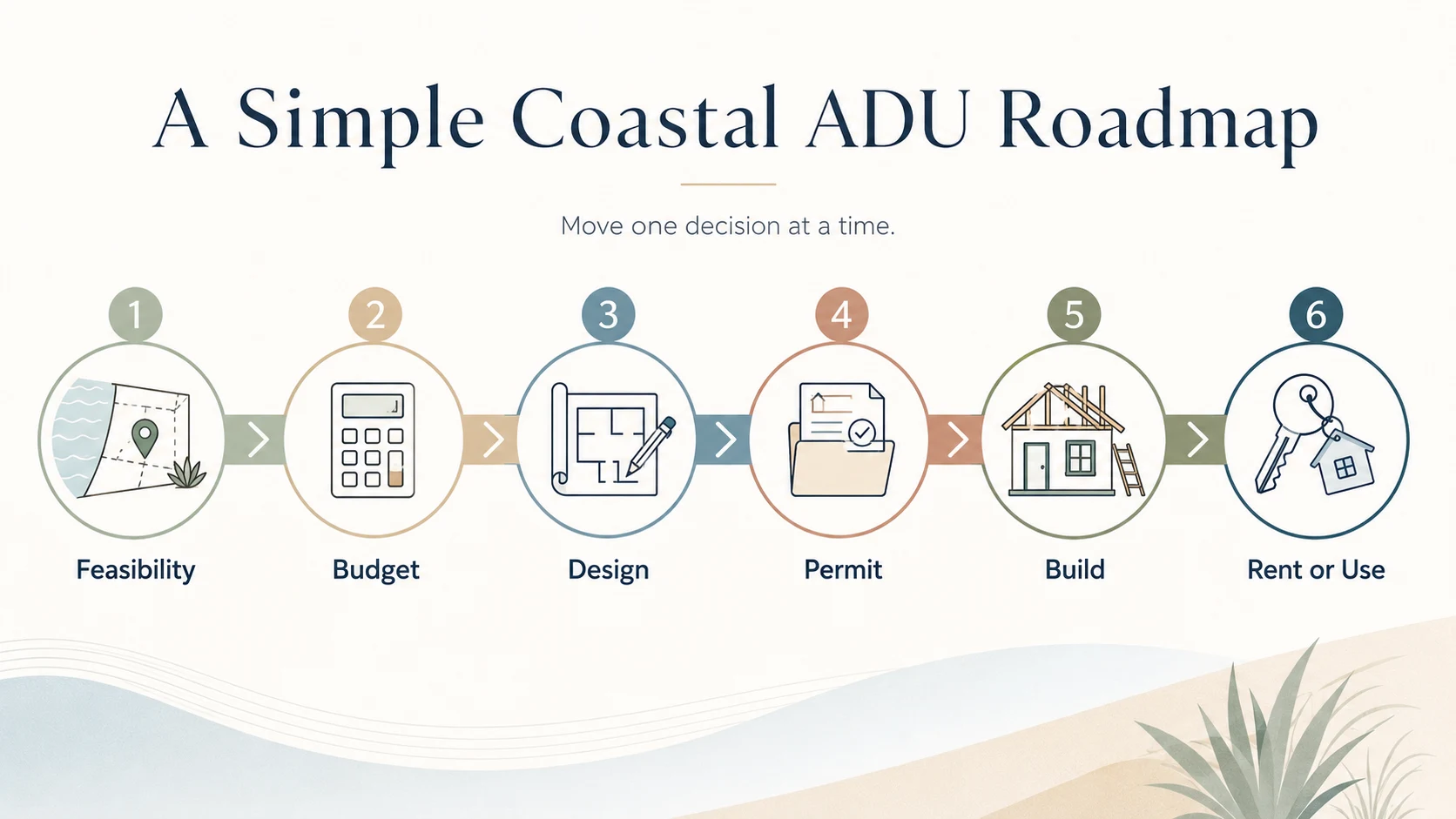
A well-prepared homeowner with a coastal-experienced builder can sign a design contract in January, have permits in hand by late April, break ground in early May, and have a certificate of occupancy by Thanksgiving. This checklist is what makes that possible.
- Confirm City of San Diego jurisdiction. Some parcels addressed “San Diego, CA” are in unincorporated County or another incorporated city.
- Pull all overlay layers. Base zone, Coastal Overlay Zone, appealable/non-appealable status, Beach Impact Area, Transit Priority Area, Very High Fire Hazard Severity Zone, brush management, Environmentally Sensitive Lands, historical district, Sustainable Development Area.
- Check for prior CDPs. Pull permit history; flag any existing Coastal Commission-issued or City-issued CDPs with active conditions on the lot.
- Verify the §126.0704 exemption test. Bluff distance (>50 ft), mean high tide distance (>300 ft), vegetation removal in bluff buffer (none within 100 ft), water well/septic expansion (none), exterior wall demolition for conversions (≤50%).
- Determine your ADU type. JADU, interior conversion, garage conversion, attached, or new detached. Each path has different CDP, parking, and fee implications.
- Choose your target size. Test the 500, 750, 800, 1,100, and 1,200 sf thresholds. SB 13 impact-fee waivers, school fees, fee categories, and parking exceptions all hinge on these.
- Verify utility capacity. Check whether the existing electrical service can handle the added unit. Sewer and water lateral conditions.
- Identify two or three coastal-experienced builders. Use the five questions above. Get three quotes — not one — for comparable scope.
- Confirm financing path readiness. HELOC, construction loan, cash-out refinance, or SDHC ADU Finance Program. Get pre-qualified before committing to design.
- Run a parcel-specific feasibility report. Free. Returns a project-specific output before any design spend.
Free Download
Get the Free San Diego Coastal ADU Starter Kit
The worksheet version of this entire guide: the §126.0704 exemption checklist, IB-501 fee math worksheet, 12-step ZAPP parcel check, 5-question builder vetting script, and the 10-step pre-plan checklist. Free, no obligation.
Download Free Starter Kit →Frequently Asked Questions
Can you build an ADU in San Diego’s Coastal Overlay Zone?
Yes. The California Coastal Act does not ban ADUs, and HCD has confirmed that state ADU law applies inside the Coastal Zone. Most coastal ADUs require a Coastal Development Permit (CDP), and qualifying JADUs and interior conversions may be CDP-exempt under SDMC §126.0704.
Do I need a Coastal Development Permit for a garage conversion ADU?
Likely yes. City of San Diego IB-400 (January 2026) requires a CDP for any ADU in the Coastal Overlay Zone that converts non-habitable space. Garage conversions fall under this category. Process One staff approval may still apply if the project sits in the non-appealable area and the §126.0708(c) findings are satisfied.
Does a San Diego coastal ADU need parking?
Usually no. One off-street space is required only when the property is in the Coastal Overlay Zone AND in the Beach Impact Area AND outside a Transit Priority Area. Many coastal parcels are inside a TPA because major bus routes serve the coast.
What are the coastal ADU parking exceptions?
Per IB-400, the requirement is waived if the ADU is 500 square feet or smaller, the premises is in a historical district that is a designated historical resource, the ADU is attached to the primary dwelling, the premises is in a residential permit parking district, or a car-share vehicle is located within one block of the premises.
Can I rent my San Diego ADU short-term (Airbnb)?
No. City of San Diego rules require all ADU rentals to be a minimum of 31 consecutive days. Short-term rental of an ADU is not permitted.
Does the owner have to live on-site?
For ADUs in the City of San Diego, no — owner occupancy is not required per IB-400. For JADUs, California Government Code §66333 limits owner-occupancy requirements to JADUs with shared sanitation facilities; verify current City implementation in the Coastal Overlay Zone, as some 2025 amendments are pending Coastal Commission certification.
Does state ADU law override the Coastal Act?
No. HCD has clarified that state ADU laws apply inside the California Coastal Zone but do not alter or lessen the substantive Coastal Act protections. AB 462 streamlines the timeline and eliminates appeals for ADU CDPs but does not waive Coastal Act resource protections.
Is there a public hearing for a San Diego coastal ADU CDP?
No. California Government Code §66329 (added by AB 462) does not require public hearings for ADU CDP applications, requires the CDP to run concurrently with the ADU permit, and eliminates appeals to the California Coastal Commission in cities with a certified Local Coastal Program.
How big can my San Diego ADU be?
Up to 1,200 square feet for a detached or attached ADU per IB-400. Up to 500 square feet for a JADU. Specific size thresholds (500, 750, 800, 1,100, 1,200) drive different fee categories, impact-fee waivers (under 750 sf), and zoning exceptions.
Does a detached San Diego ADU need solar?
Newly constructed, non-manufactured detached ADUs are subject to California Energy Code Title 24 solar requirements per IB-400. ADUs created within existing space or as additions to existing homes are not subject to the same solar requirement.
Can the California Coastal Commission still appeal my ADU?
No, not in cities with a certified Local Coastal Program. AB 462 (effective October 10, 2025) eliminated appeals of ADU CDPs to the Coastal Commission in those cities, including the City of San Diego, Carlsbad, Encinitas, Del Mar, Solana Beach, Oceanside, Imperial Beach, and Coronado.
What’s the 30-foot coastal height limit?
San Diego voters enacted Proposition D in 1972, creating the Coastal Height Limit Overlay Zone at SDMC §132.0505. It caps building height at 30 feet in La Jolla, Pacific Beach, Mission Beach, Ocean Beach, Sunset Cliffs, and Point Loma — including your ADU in those neighborhoods.
What’s the difference between appealable and non-appealable coastal area?
Non-appealable Coastal Overlay parcels can have an ADU CDP issued under Process One staff approval if §126.0708(c) findings are satisfied. Appealable-area parcels — generally between the sea and the first public road, within 300 feet of mean high tide or beach, within 300 feet of a bluff edge, or within 100 feet of a wetland — face fuller CDP review.
What if my property is on a bluff?
Bluff-top lots within 50 feet of the bluff edge lose the §126.0704 streamlined exemption. The project moves into fuller CDP review with mandatory geotechnical analysis and may sit in the appealable area.
Can I sell my ADU separately from the main house?
Under California AB 1033 (with phased implementation in San Diego through 2025–2026), ADUs may be sold as separate condominium units, subject to specific subdivision procedures and final building inspection.
What does the SDHC ADU Finance Program offer?
The San Diego Housing Commission’s ADU Finance Program offers a construction-to-permanent loan up to $250,000 at 1% during construction and approximately 4% permanent for City of San Diego homeowners earning up to 150% AMI. The ADU is deed-restricted for seven years and must be rented to households earning up to 80% AMI. Verify current funding availability directly with SDHC.
Is the CalHFA $40,000 ADU grant still available?
No. Per HCD’s March 2026 ADU Handbook, the CalHFA ADU Grant Program funds were exhausted at the time of writing. Do not plan around this grant unless CalHFA announces renewed funding.
What we verified for this guide
| Item verified | Source | Verification date |
|---|---|---|
| AB 462 effective date (October 10, 2025) and §66329 provisions | California LegInfo (AB 462 bill text); BBK Law alert; Burke Williams & Sorensen “2025 ADU Legislative Update” | May 11, 2026 |
| City of San Diego IB-400 ADU/JADU guidance | City of San Diego DSD Information Bulletin 400 (January 2026) | May 11, 2026 |
| Coastal Overlay certification-status note (pending O-21618, O-21758, O-21836, O-21989) | IB-400 editor’s note | May 11, 2026 |
| SDMC §126.0704 exemption criteria | San Diego Municipal Code Chapter 12, Article 6, Division 7 | May 11, 2026 |
| SDMC §126.0708(c) administrative findings | San Diego Municipal Code Chapter 12, Article 6, Division 7 | May 11, 2026 |
| 30-foot Coastal Height Limit (Proposition D) | SDMC §132.0505; City of San Diego Technical Bulletin on coastal height determination | May 11, 2026 |
| Parking trigger and exceptions | IB-400; SDMC §141.0302 | May 11, 2026 |
| Owner-occupancy rules (ADU and JADU, Gov. Code §66333) | IB-400; California Government Code §66333 | May 11, 2026 |
| Rental term minimum | IB-400 | May 11, 2026 |
| Fire sprinkler and solar rules | IB-400 | May 11, 2026 |
| May 2026 City fee schedule (IB-501) | City of San Diego Information Bulletin 501 | May 11, 2026 |
| Construction cost ranges — Pacific Beach Builder 2026 | Pacific Beach Builder published cost analyses (provider-published) | May 11, 2026 |
| Construction cost ranges — SnapADU 2026 | SnapADU published cost data (provider-published) | May 11, 2026 |
| State-law preemption framework | California Government Code §§66317, 66323, 66329, 66333 | May 11, 2026 |
| HCD position on Coastal Act non-preemption | California Department of Housing and Community Development ADU Handbook (March 2026) | May 11, 2026 |
| SDHC ADU Finance Program parameters | San Diego Housing Commission (sdhc.org/housing-opportunities/adu/) and adu.sdhc.org | May 11, 2026 |
| CalHFA ADU Grant program status | HCD ADU Handbook (March 2026): funds exhausted | May 11, 2026 |
| HOA / CC&R restrictions on ADUs | California Civil Code §4751 (Davis-Stirling) | May 11, 2026 |
Items marked for follow-up verification: Specific CDP processing fees outside IB-501; current implementation of JADU owner-occupancy rule inside the Coastal Overlay Zone; precise current Coastal Commission certification status of Ordinance Numbers O-21618, O-21758, O-21836, and O-21989; AFSLR tenant-notification language.
Methodology and limitations
The Dwelling Index is an independent research resource covering ADU financing, costs, and regulations. We do not build, design, or finance ADUs ourselves. Our editorial work is supported by reader use of affiliate links — we disclose these throughout this page — and our analysis is independent of any compensation we receive.
This guide was built primarily from primary regulatory sources: City of San Diego Information Bulletins 400 (January 2026) and 501 (May 2026), San Diego Municipal Code (Chapter 12, Article 6, Division 7 for Coastal Development Permit procedures; Chapter 14, Article 1, Division 3 for ADU regulations), California Government Code §§66317, 66323, 66329, 66333, the California Coastal Commission’s certified Local Coastal Program for the City of San Diego, the California Department of Housing and Community Development ADU Handbook (March 2026), and the text of AB 462, AB 1332, AB 1033, SB 13, SB 543, SB 1077, and SB 1211.
This page is not legal advice, design advice, financial advice, or a permit approval guarantee.
Damaging admission, stated plainly. Coastal-zone ADU projects in the City of San Diego still face real friction even after AB 462. Bluff-top lots, properties within 300 feet of the mean high tide line, wetland-proximate parcels, ESL-flagged lots, and projects with prior Coastal Commission-issued CDPs can still face extended timelines and added scope. AB 462’s 60-day clock is real and meaningful for the majority of coastal ADU projects, but it does not eliminate every coastal challenge. Plan accordingly, build with a coastal-experienced team, and run feasibility before design.
Updates and changelog: May 11, 2026 — Initial publication. Verified against IB-400 (January 2026), IB-501 (May 2026), California Government Code §66329, and the Coastal Commission’s certified LCP for the City of San Diego. Next scheduled review: Monthly for AB 462 implementation guidance, SB 1077, and LCP-certification status; quarterly for the permit-path matrix and fee tables.
Not Sure Where to Start? See What’s Possible at Your Address.
Coastal-zone ADU projects in San Diego are buildable, parcel-specific, and faster than they’ve ever been under AB 462. The single most leveraged step is parcel verification before design. Enter your San Diego address and get your jurisdiction, base zone, ADU eligibility, Coastal Overlay and Fire Hazard Severity Zone flags, likely permit fee range, and recommended path.
Get Your Free San Diego Coastal ADU Feasibility Report →Not a permit approval. Not a guarantee. Just the parcel-specific starting point.
Related San Diego ADU Guides
- San Diego ADU Requirements 2026: Rules & Permits — comprehensive inland ADU rules
- San Diego ADU Laws 2026: Rules, Limits & Reforms — the parallel regulations overview
- San Diego ADU Permit Process 2026 — step-by-step submittal guide and real fee calculations
- San Diego Pre-Approved ADU Plans — the fastest permit path compared
- San Diego ADU Cost 2026 — build-path cost breakdowns
- ADU Financing Options Guide — HELOC, renovation loans, construction-to-permanent
- California ADU Laws — statewide framework including AB 462 context
Affiliate disclosure: The Dwelling Index is reader-supported. Some links on this page are affiliate links. If you click one and take a qualifying action, we may earn a commission at no extra cost to you. Affiliate relationships do not influence our editorial rankings or conclusions. Read our full disclosure.