
San Diego ADU Laws in 2026: What You Can Build, Where, and What Can Change the Answer
Bottom line. The City of San Diego allows most single-family lots to build 1 ADU plus 1 Junior ADU (JADU) by right. ADUs can be 150–1,200 sq ft, and state law guarantees every qualifying lot the right to an 800 sq ft ADU at 4-ft setbacks regardless of base zoning. Parking is waived for nearly all properties; fees start around $6,490 for small detached units and scale with size. The Bonus ADU Program can unlock up to 3 additional units. If your property sits in the Coastal Zone or a Very High Fire Hazard Severity Zone, additional rules apply — but neither prevents you from building an ADU.
San Diego is also the first jurisdiction in San Diego County to let owners sell an ADU as a separate condo under AB 1033 (Ordinance O‑21989, effective August 22, 2025).
Your fastest next step: Get Your Free 60-Second ADU Report → Enter your address and see your exact zoning, overlays, and applicable permit path — no commitment.
| ADU type | Max size | Min rear/side setback | Max height | Parking required? |
|---|---|---|---|---|
| Detached ADU (SFR lot) | 1,200 sq ft | 4 ft | 16 ft (4-ft setback path) / up to 25 ft (base zone path) | No (most areas) |
| Attached ADU (SFR lot) | 1,200 sq ft or 50% of existing primary, whichever is less | Matches primary structure or 4 ft minimum | Base zone or 25 ft for 2-story | No |
| JADU (SFR lot) | 500 sq ft | Within existing/proposed residence | Within existing/proposed residence | No |
| Detached ADU (MFR lot) | HCD position: no local cap; verify | 4 ft | 16 ft minimum | No |
| Bonus ADU | Same as standard ADU for type | 4 ft | 16–25 ft | No (in TPA) / 1 space outside TPA (post-Aug 2025) |
Sources: City of San Diego Information Bulletin 400 (IB-400), Cal. Gov. Code §§66310–66341, Ordinance O-21989. Last verified May 11, 2026.
By The Dwelling Index Editorial Team · Methodology · Editorial standards · Corrections
Last updated: May 11, 2026 · Last verified: May 11, 2026 · Next scheduled review: August 11, 2026
Affiliate disclosure: The Dwelling Index is reader-supported. Some links on this page are affiliate links. If you click one and take a qualifying action, we may earn a commission at no extra cost to you. Affiliate relationships do not influence our editorial rankings or conclusions. Read our full disclosure.
What we verified — Last checked May 11, 2026
- City of San Diego Information Bulletin 400 (IB-400) governs all ADU and JADU permitting requirements including Coastal Overlay Zone CDP requirements.
- The Bonus ADU Program rules (Gov. Code §66321) including the August 22, 2025 parking and Community Enhancement Fee changes under Ordinance O-21989.
- AB 1033 separate-sale opt-in under Ordinance O-21989, effective August 22, 2025. HCD flagged portions for noncompliance — implementation status should be verified directly with the City.
- AB 462 (chaptered October 10, 2025) establishing a 60-day CDP clock for ADU Coastal Development Permit applications.
- State minimum guarantees under Cal. Gov. Code §66316: 800 sq ft, 16-ft height, and 4-ft side/rear setbacks as a regulatory floor on qualifying residential lots.
How Many ADUs Can You Build? The Three-Lane Framework
San Diego ADU law operates in three distinct lanes depending on your property type. Understanding which lane applies to you is the first question any ADU conversation has to answer.
Lane 1: Single-Family Residential (SFR) Lots
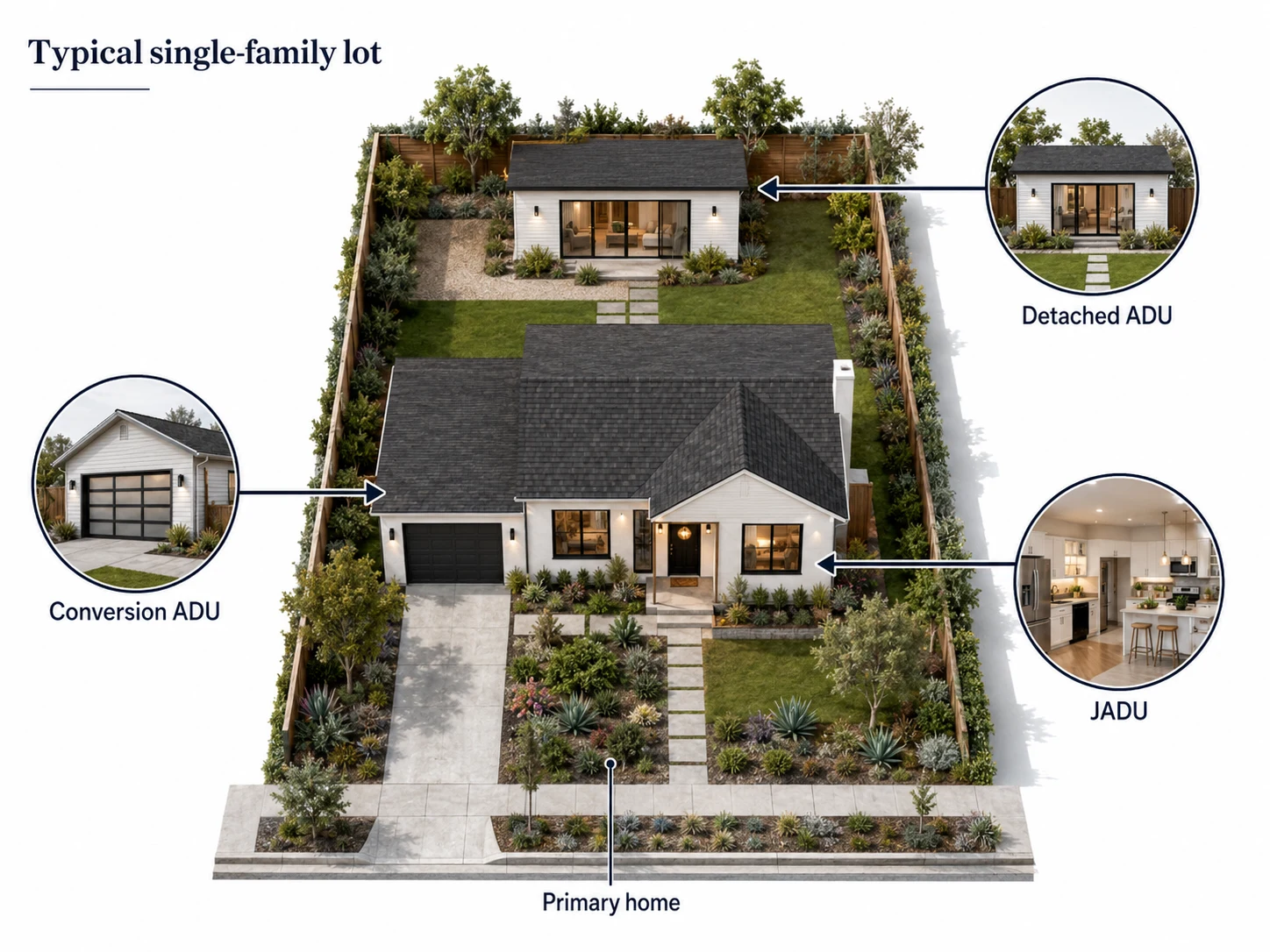
On a lot improved with a single-family dwelling, the City of San Diego must approve 1 ADU plus 1 JADU as a matter of right under Gov. Code §66321(a)(1) and IB-400. The ADU may be detached, attached, or a conversion of an existing accessory structure. The JADU must be within the existing or proposed primary structure and is limited to 500 sq ft.
You can also build an ADU on a lot that has not yet been improved with a primary dwelling — the ADU does not need to wait for the main house to be constructed first, as long as both permits are applied for simultaneously. The primary and ADU applications can move through review together.
Lane 2: Multifamily Residential (MFR) Lots
On a lot improved with an existing multifamily dwelling (two or more units), the City must allow:
- Detached ADUs equal to 25% of the existing unit count, with a minimum of 1 (Gov. Code §66323(a)(4)). A 4-unit building may add 1 detached ADU; a 20-unit building may add 5.
- Conversion ADUs in non-livable space (storage rooms, boiler rooms, basements, garages): the City must allow conversions up to 25% of existing units, minimum 1 (Gov. Code §66323(a)(3)).
HCD has taken the public position that detached ADUs on MFR lots reviewed under Gov. Code §66323(a)(4) are not subject to a local 1,200 sq ft cap. The City has not formally adopted a different size limit for MFR-lot detached ADUs, but this area remains actively monitored by HCD. Verify with a licensed designer before finalizing MFR ADU plans.
Lane 3: The Bonus ADU Program
The ADU Home Density Bonus (Bonus ADU Program, Gov. Code §66321(b)) allows owners to receive additional ADUs beyond the standard limits in exchange for deed-restricting units to affordable rents. Under this program:
- 1 Bonus ADU is permitted for each deed-restricted affordable unit, up to a maximum of 3 Bonus ADUs per project.
- Bonus ADUs are subject to a Community Enhancement Fee and a deed restriction recorded against the property.
- After August 22, 2025 (Ordinance O-21989), Bonus ADUs outside a Transit Priority Area require 1 off-street parking space per ADU. Bonus ADUs inside a TPA remain parking-free.
- SDHC-financed Bonus ADUs and deed-restricted units may not be separately sold under AB 1033 during their restriction period.
Size Limits: What the City Allows and What the State Guarantees
San Diego’s IB-400 sets the following local size limits. These are subject to the state minimums that serve as a regulatory floor — local rules can exceed state minimums but cannot fall below them.
| ADU type | Minimum size | Maximum size (local) | State floor guarantee |
|---|---|---|---|
| Detached ADU (SFR) | 150 sq ft | 1,200 sq ft | 800 sq ft |
| Attached ADU (SFR) | 150 sq ft | Lesser of 1,200 sq ft or 50% of existing primary | 800 sq ft |
| JADU | 150 sq ft | 500 sq ft | 500 sq ft (state JADU cap) |
| Detached ADU (MFR) | 150 sq ft | HCD position: no local cap | 800 sq ft |
State minimum guarantee (Gov. Code §66316)
Even if your base zoning would otherwise block it, California law guarantees the right to build at least an 800 sq ft ADU with a 16-ft height limit and 4-ft side and rear setbacks on any residential lot where a primary dwelling exists or is proposed. This guarantee overrides local FAR limits, lot coverage caps, and open-space requirements that would otherwise prevent construction.
Setbacks and Height: Two Paths, Two Different Outcomes
San Diego ADU setbacks and height limits depend on which regulatory path your project uses. Understanding both paths is essential, because the right choice can meaningfully expand your buildable footprint.
Path A: State Minimum Floor (4-Ft Setbacks)
Any qualifying detached or attached ADU can use the state minimum floor: 4-ft side and rear setbacks, no front setback beyond the primary structure, and a 16-ft maximum height. This path is particularly useful on lots where the base zone would otherwise impose 5-, 10-, or even 15-ft setbacks. The floor setback cannot be decreased below 4 ft even by local variance.
A 2-story detached ADU on the state minimum path may reach up to 18 ft if the lot is within a half-mile of a high-quality transit corridor, and up to 25 ft in some base zones with the additional story allowed by Gov. Code §66316(c).
Path B: Base Zone Standards
If your lot has generous setbacks under the base zone (for example, a 5-ft or 10-ft side yard in an RS-1-14 zone), you can choose to apply those setbacks instead. This may allow a larger footprint for the ADU if the base zone setbacks are less restrictive in aggregate. The tradeoff: you cannot mix and match (you must apply base zone setbacks consistently, not cherry-pick the most favorable number from each path).
| Setback dimension | State minimum path | Base zone path (typical RS zones) |
|---|---|---|
| Front | No encroachment beyond primary structure | 15–25 ft (zone-dependent) |
| Side | 4 ft | 5–10 ft (zone-dependent) |
| Rear | 4 ft | 5–15 ft (zone-dependent) |
| Max height (1-story) | 16 ft | 24–25 ft (zone-dependent) |
| Max height (2-story) | 18–25 ft (transit corridor proximity governs) | Base zone height limit |
Source: IB-400; Cal. Gov. Code §66316; San Diego Municipal Code §141.0302. Verify your specific zone in the San Diego Municipal Code or via DSD’s development services portal.
Fire clearance note: 0-ft setback conversions
Conversion ADUs (garage conversions, basement conversions) that convert existing structures located within 4 ft of a property line are permitted under state law even if they don’t meet the 4-ft setback rule — because the structure already exists. State law prohibits the City from requiring setback compliance as a condition of a conversion permit. However, fire-resistance upgrades to the wall closest to the property line may be required by the Building Code.
Free Tool
See What You Can Build on Your Property
Enter your San Diego address and get your zoning, overlays, applicable ADU rules, and permit path in under 60 seconds. No commitment.
Get Your Free ADU Report →Parking Rules: When None Is Required and When It Is
San Diego’s parking rules for ADUs are straightforward for most owners, but the Coastal Zone and the Bonus ADU Program have site-specific exceptions.
Standard ADUs and JADUs: No Parking Required
Per IB-400 and Gov. Code §66313, the City of San Diego does not require off-street parking for ADUs or JADUs outside the Coastal Overlay Zone. This applies regardless of whether existing garage or carport spaces are being converted. If you convert a garage to an ADU, you are not required to replace the lost covered parking spaces.
Coastal Zone Exception: Beach Impact Area
Within the Coastal Overlay Zone, no parking is required unless your property is:
- Located in the Beach Impact Area (Parking Impact Overlay Zone)
- AND outside a Sustainable Development Area
If both conditions apply, 1 off-street parking space is required per ADU. Several exemptions exist even in the Beach Impact Area, including properties within a half-mile of a transit stop and conversion ADUs. The City’s Coastal Development Permit process will identify your parking obligation.
Bonus ADU Program: Parking After August 2025
Under Ordinance O-21989 (effective August 22, 2025), Bonus ADUs located outside a Transit Priority Area are subject to a 1 off-street parking space per Bonus ADU requirement. Bonus ADUs inside a TPA remain parking-free. If your project relies on the Bonus ADU Program and your property is outside a TPA, factor the parking requirement into your site plan before filing.
ADU Fees in San Diego 2026: What You’ll Pay and Why
San Diego ADU permit fees are calculated using Information Bulletin 501 (IB-501), the City’s fee schedule. The numbers below are source-calculated editorial examples as of the May 2026 IB-501 line items. Actual fees depend on your specific project, property, school district, and the fee schedule in effect at permit issuance.
| Fee category | ADU under 500 sq ft (detached) | ADU 750 sq ft (detached) | Notes |
|---|---|---|---|
| Plan check (Building) | ~$2,800–$3,500 | ~$3,500–$5,500 | Scales with valuation per IB-501 |
| Inspection fees | ~$1,500–$2,200 | ~$2,200–$3,500 | Per IB-501 hourly schedule |
| Admin / other City fees | ~$400–$800 | ~$800–$1,200 | Varies by project complexity |
| School developer fee (SDUSD) | Exempt (<500 sq ft) | ~$4,035 ($5.38/sq ft × 750) | ADUs ≥500 sq ft pay school fees; varies by district |
| Development impact fees | Exempt | Exempt (under 750 sq ft) | ADUs >750 sq ft pay proportional impact fees per Gov. Code §66311.5 |
| Estimated total | ~$6,490 | ~$21,271 (SDUSD) | Editorial estimate; verify at permit application |
Sources: IB-501 (May 2026), SDUSD $5.38/sq ft developer-fee rate, Gov. Code §66311.5. ADUs under 500 sq ft are exempt from school fees. Water and sewer connection fees, SDG&E interconnection costs, and C&D debris deposits are additional and project-specific.
What these numbers don’t include
- Water meter sizing and SDG&E interconnection (project-specific)
- C&D construction debris deposit (refundable upon project completion)
- Coastal Development Permit fees (if in the Coastal Overlay Zone)
- Bonus ADU Community Enhancement Fee (if using the Bonus Program)
- Design fees, engineering fees, or contractor costs — these are separate from City permit fees
Free Resource
Free 2026 ADU Starter Kit
Complete planning checklist: costs, financing, permit timelines by state, and common mistakes. Everything before you talk to a single company or contractor.
Download Free Starter Kit →The Bonus ADU Program: How to Get More Units Than the Base Limit
The ADU Home Density Bonus is one of the most powerful — and least understood — tools in the City of San Diego’s ADU framework. It allows eligible owners to build more ADUs than the standard one-plus-one allows, in exchange for affordable rent restrictions on a portion of the units.
How the Bonus ADU Program Works
- For every affordable unit you deed-restrict (typically at Low-Income or Very Low-Income levels), you receive 1 Bonus ADU.
- Maximum of 3 Bonus ADUs per project.
- The Bonus ADU itself must meet standard ADU size and construction requirements.
- A Community Enhancement Fee applies to each Bonus ADU; the amount is set periodically by the City.
- Bonus ADUs are not eligible for the AB 1033 condo-conversion program during their deed-restriction period.
- The deed restriction is recorded against the property and typically runs for 55 years for Low-Income or Very Low-Income restricted units.
Post-August 2025 Changes to the Bonus Program
Ordinance O-21989 (effective August 22, 2025) made two significant changes to the Bonus ADU Program:
- Parking added for non-TPA properties. Bonus ADUs on lots outside a Transit Priority Area now require 1 off-street space per Bonus ADU. Bonus ADUs inside a TPA are unaffected.
- Community Enhancement Fee formalized. A per-unit fee tied to the Bonus ADU is now required at permit issuance. Verify the current fee amount with DSD before budgeting.
Coastal Zone ADU Rules: What AB 462 Changed in 2025
The Coastal Overlay Zone covers a significant portion of San Diego, including neighborhoods in La Jolla, Pacific Beach, Ocean Beach, Mission Beach, Point Loma, and Coronado (a separate jurisdiction). ADUs are permitted in the Coastal Zone, but an additional layer of review applies.
When a Coastal Development Permit Is Required
Per IB-400, a Coastal Development Permit (CDP) is required for ADUs in the Coastal Overlay Zone unless the ADU is located entirely within an existing building footprint. In practice, this means:
- Conversion ADUs (converting an existing garage or room within the primary structure’s footprint) are generallyexempt from CDP requirements.
- New detached ADUs in the Coastal Zone require a CDP in addition to the standard building permit.
- Attached additions that expand the existing footprint require a CDP.
The AB 462 60-Day Clock
AB 462 was chaptered on October 10, 2025 as an urgency statute. It creates a 60-day approve-or-deny clock for Coastal Development Permit applications that involve ADUs, and requires that CDP review run concurrently with standard ADU building permit review where applicable. Before AB 462, coastal review could run sequentially and add significant time to the overall timeline. The concurrent review requirement meaningfully reduces worst-case coastal timelines.
Coastal Zone Parking Exception
As noted in the parking section above, most properties in the Coastal Zone do not require parking for ADUs. The exception is the Beach Impact Area (Parking Impact Overlay Zone) where the property is also outside a Sustainable Development Area — where 1 space is required per ADU, subject to several exemptions.
Fire Hazard Zone ADUs: What’s Required and What’s Not
Several San Diego neighborhoods — including parts of Tierrasanta, Mira Mesa, Scripps Ranch, Rancho Peñasquitos, and communities in the eastern and inland areas of the city — fall within Very High Fire Hazard Severity Zones (VHFHSZ) designated by Cal Fire, or within State Responsibility Areas (SRA).
State law prohibits local jurisdictions from imposing ADU bans in fire hazard areas (Gov. Code §66329). San Diego complies: ADUs are permitted in fire zones. However, additional construction requirements apply.
Fire-Resistant Construction Requirements
- Type V-A construction (1-hour fire-resistive) is typically required for the exterior wall assembly facing a high-fire exposure direction.
- Ember-resistant vents are required in attic and crawl space openings under California Building Code (CBC) Chapter 7A.
- Class A or B roofing materials are required; wood shingles are not permitted.
- Defensible space clearance of 100 ft (Zone 1: 30 ft; Zone 2: 30–100 ft) must be maintained around all structures.
- Fire flow compliance and hydrant proximity requirements apply regardless of whether the structure is in a fire zone, but are enforced more strictly in high-hazard areas.
How to identify your fire zone
Use Cal Fire’s Fire Hazard Severity Zone viewer or the City of San Diego’s development services interactive map to confirm your property’s fire zone designation before starting design. Your architect and the DSD pre-application process can also identify applicable requirements early.
AB 1033: Selling Your San Diego ADU as a Separate Condo
In August 2025, the City of San Diego became the first jurisdiction in San Diego County to opt into AB 1033, California’s new law that allows ADU owners to sell their ADU as a separate condominium unit — independent from the main house. This changes the ADU equation for many owners who previously couldn’t justify the full build cost without being able to recoup it through a sale.
How the AB 1033 Process Works in San Diego
- Lender consent. Most residential mortgages contain due-on-sale clauses or consent requirements. Your existing mortgage lender must agree to the separation. Refinancing into a product that supports condominium subdivision may be necessary.
- Subdivision map. A condominium plan must be prepared by a licensed civil engineer and recorded with the County. This is a formal subdivision process.
- Davis-Stirling Act compliance. As a multi-unit condominium project, the property becomes subject to California’s Davis-Stirling Common Interest Development Act. This requires CC&Rs, a homeowners association (even a 2-unit HOA), and other documentation.
- Separate utility connections. Buyers of a separate ADU will typically require separate utility accounts. This may require new meters and service connections if the ADU was permitted as a utility-sharing unit.
- Verify current implementation. HCD flagged portions of San Diego’s separate-sale ordinance for noncompliance after its adoption. The City is working to address HCD’s concerns. Before relying on AB 1033 in your project plan, verify the current status directly with DSD.
Who Is Excluded
- ADUs financed through the SDHC ADU Finance Program that carry deed restrictions are generally excluded from separate sale during the restriction period.
- Bonus ADUs that are deed-restricted for affordability are similarly excluded during their restriction period.
- JADUs cannot be separately sold — state law does not extend AB 1033 to JADUs.
What Can Change the Answer: Overlays, Zones, and Property-Specific Factors
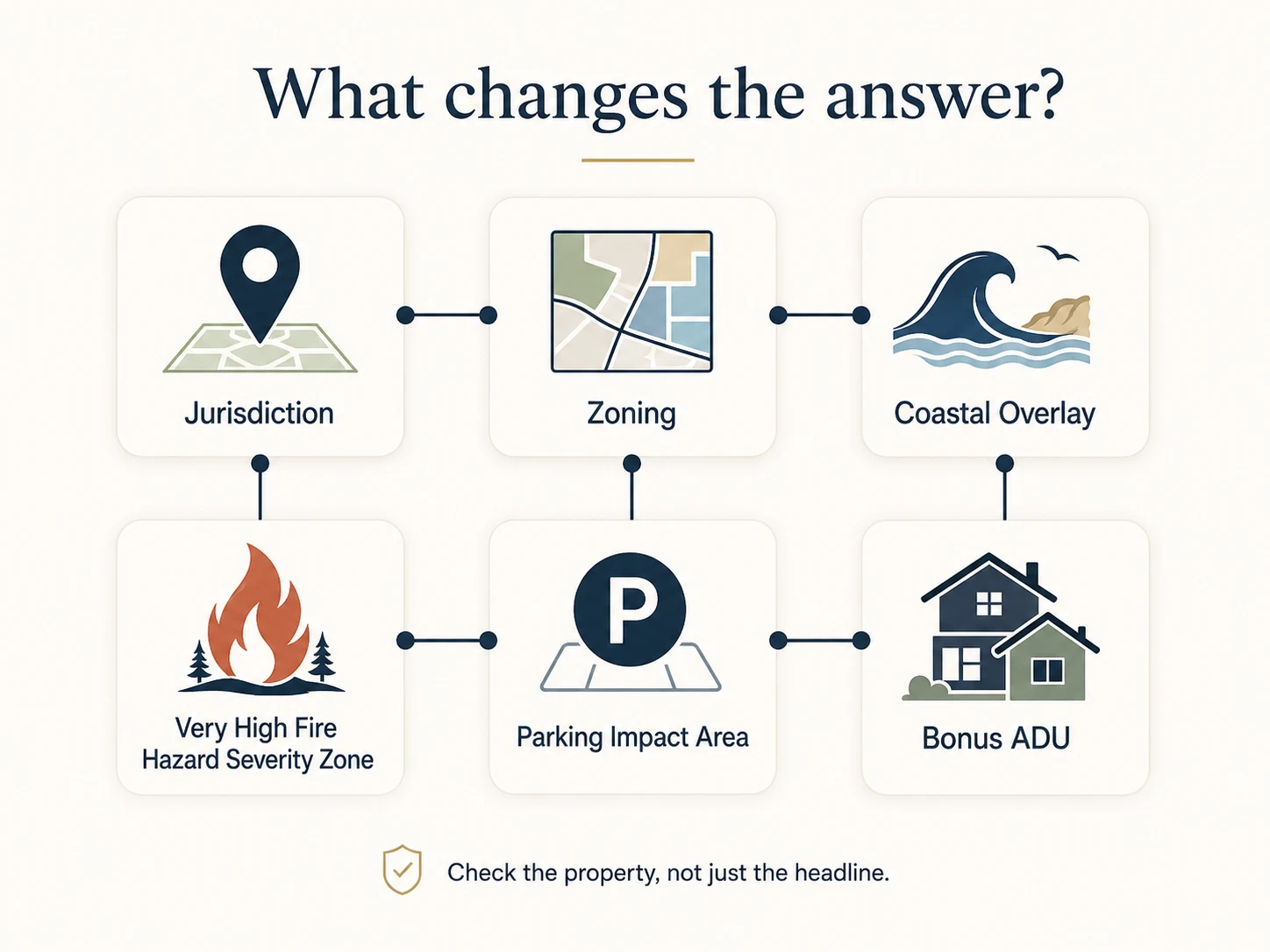
The base ADU rules described in this guide apply to most standard residential lots in the City of San Diego. But several property-level factors can change what you can build, how you have to build it, and how long it takes to get approved. Understanding these is the difference between a clean permit process and an expensive surprise.
1. Coastal Overlay Zone (and Sub-Areas)
A CDP is required for new detached ADUs and attached additions. The Beach Impact Area within the coastal zone imposes parking requirements. The Coastal Commission retains appeal rights on some City-approved CDPs. Your LCP (Local Coastal Program) determines whether your CDP is appealable to the Commission. Verify before filing.
2. Very High Fire Hazard Severity Zone (VHFHSZ)
Requires fire-resistant construction (CBC Chapter 7A), ember vents, Class A/B roofing, and defensible space. Design must incorporate these from the start — attempting to retrofit after plan check submission causes costly corrections.
3. Multifamily vs. Single-Family Lot
The ADU count formula differs significantly. MFR lots use the 25% rule for detached ADUs and can have unlimited non-livable space conversions (up to 25% of existing units for converted units). SFR lots get 1 ADU plus 1 JADU. Misidentifying your lot type leads to incorrect unit count assumptions.
4. Existing Non-Conformities
If your primary structure has existing code violations or non-conforming conditions, the ADU permit process can surface them. State law prohibits the City from requiring correction of unrelated non-conformities as a condition of ADU approval, but the Building Inspector may flag conditions that bear on health and safety during inspections.
5. Hillside Overlay Zone and Sensitive Lands
Properties in the Hillside Review Overlay, Sensitive Lands Overlay, or on slopes exceeding certain grades may face additional review steps, geotechnical requirements, or grading permit obligations. These add time and cost but do not categorically block ADU approval.
6. JADU Owner-Occupancy Requirement
JADUs require the owner to occupy either the primary dwelling or the JADU as their principal residence. Investors who do not owner-occupy cannot use the JADU pathway. The owner-occupancy requirement must be recorded as a deed restriction per IB-400. No such requirement applies to standard ADUs.
7. Short-Term Rental Prohibition
ADUs and JADUs in San Diego may not be rented for periods of less than 31 consecutive days per IB-400 and Gov. Code §§66315, 66323(e), 66333(g). JADUs must be rented for periods longer than 30 days. Long-term rentals are permitted. Short-term vacation rentals (Airbnb-style) are explicitly prohibited for both ADUs and JADUs.
8. School District Boundary
School developer fees depend on which school district serves your lot. SDUSD uses $5.38/sq ft (May 2026); other districts serving parts of the City of San Diego may use different rates. ADUs under 500 sq ft are exempt from school fees. Verify your school district boundary at the San Diego County Office of Education before budgeting.
Free Tool
See What You Can Build on Your Property
Enter your San Diego address and get your zoning, overlays, applicable ADU rules, and permit path in under 60 seconds. No commitment.
Get Your Free ADU Report →Frequently Asked Questions
How many ADUs can I build on my San Diego property?
What is the maximum size for a San Diego ADU in 2026?
Do I need to provide parking for my ADU in San Diego?
What does a San Diego ADU permit cost in 2026?
Can I sell my San Diego ADU as a separate condo unit?
Are ADUs allowed in San Diego’s Coastal Zone?
Are ADUs allowed in San Diego fire hazard areas?
Can a pre-approved plan speed up my ADU permit in San Diego?
Sources & Methodology
- City of San Diego Information Bulletin 400 (IB-400) — ADU and JADU requirements, verified May 11, 2026.
- City of San Diego Information Bulletin 501 (IB-501) — Fee schedule, May 2026 line items used for editorial estimates.
- California Government Code §§66310–66341 (ADU Law), as amended through the 2025 legislative session.
- City of San Diego Ordinance O-21989 — Bonus ADU Program updates, AB 1033 opt-in, effective August 22, 2025.
- AB 462, chaptered October 10, 2025 — 60-day Coastal Development Permit clock for ADUs.
- AB 1332 (Gov. Code §65852.27) — Pre-approved ADU plan program and 30-day review clock.
- HCD ADU Handbook (March 2026 update) — State minimum guarantees and MFR-lot ADU size position.
- SDUSD developer-fee rate: $5.38/sq ft (May 2026 schedule).
Ready to See What’s Possible on Your Property?
Every property in San Diego is subject to a unique combination of zoning, overlays, fire zone, coastal jurisdiction, and transit proximity rules. Enter your address for a free 60-second report that shows your exact limits and which permit path applies.
Get Your Free ADU Eligibility Report →Related San Diego ADU Guides
- San Diego ADU Permit Process 2026: Fees & Timeline — step-by-step submittal guide and real fee calculations
- San Diego ADU Permit Timeline 2026: Stage by Stage — how long each review stage takes and what slows it down
- California ADU Laws 2026: The Complete State Guide — statewide rules that underpin all local ADU ordinances
- San Diego ADU Cost 2026: What It Really Costs to Build — build-path cost breakdowns and financing options
- Best ADU Builders in San Diego County (2026) — vetted builders with permit experience in the City and County
Affiliate disclosure: The Dwelling Index is reader-supported. Some links on this page are affiliate links. If you click one and take a qualifying action, we may earn a commission at no extra cost to you. Affiliate relationships do not influence our editorial rankings or conclusions. Read our full disclosure.