
San Diego ADU Requirements (2026): What You Can Build, What It Costs, and What Just Changed
Independent research by The Dwelling Index — an independent research resource covering ADU financing, costs, and regulations. We are not a builder, lender, or prefab seller.
The short answer on San Diego ADU requirements: Most single-family lots in the City of San Diego can now build one attached or detached accessory dwelling unit (ADU), one conversion ADU, and one junior accessory dwelling unit (JADU) by right — three additional units on top of the primary residence. Larger Bonus ADU strategies were significantly rolled back on August 22, 2025, when Ordinance O-21989 took effect: total ADU/JADU counts are now capped by lot size and restricted by zone.
Not sure if your lot is in the City or the County? Check your property in 60 seconds (free) →
San Diego ADU Requirements at a Glance
We built this quick-answer table so you can verify the verdict before reading further. Every row is sourced inline below.
| Requirement | City of San Diego rule (2026) | Biggest watchout |
|---|---|---|
| Building permit | Required for every ADU and JADU. No exemptions. | Don't start an unpermitted conversion. AB 2533 amnesty exists for pre-2020 work but is conditional. |
| Standard ADU size | 150–1,200 sq ft (attached or detached) | Attached ADUs are also capped at 50% of the primary residence (subject to state size floors). |
| JADU size | 150–500 sq ft, inside the existing or proposed home or attached garage | Owner occupancy required in most cases. |
| Unit count on a single-family lot | 1 attached or detached ADU + 1 conversion ADU + 1 JADU by right | Bonus ADU strategy is now lot-size-capped and zone-restricted. |
| Multifamily unit count | Up to 8 detached ADUs on existing multifamily (not exceeding existing units); 2 on proposed; plus conversions up to 25% of existing units | Attached ADUs are not permitted on multifamily premises. |
| Side & rear setbacks | 4 ft minimum in a Very High Fire Hazard Severity Zone; otherwise variable by ADU type and height | Walls within fire-separation distance of a property line must meet California Building Standards Code requirements. |
| Parking | Usually no new parking required outside the Coastal Overlay Zone | Beach Impact Area of the Parking Impact Overlay Zone outside a Transit Priority Area can still require parking. Affordable/Bonus ADUs outside a TPA require one space each. |
| Permit timeline | 60-day state target; 3.5–5 months in practice | Most projects go through 3–4 plan-check cycles. |
| Permit cost | Roughly $6,500–$21,000 total for most projects (illustrative builder-published range) | Final fees come from the current City IB-501 fee schedule and SDUSD developer fees, not a flat formula. |
| Rental term | 31 consecutive days minimum | No short-term rentals (Airbnb under 30 days) for ADUs or JADUs. |
| Owner occupancy | Not required for standard ADUs; required for JADUs in most cases | Government and qualified-housing-org owners have an exception. |
| Separate sale (AB 1033) | Adopted by City, effective August 22, 2025 | Bonus Program ADUs are not eligible. Lender consent, condo mapping, and HOA review required. |
| HCD compliance status | HCD found four parts of Ordinance O-21989 noncompliant with State ADU Law (October 6, 2025) | Verify edge-case rules with DSD. See §12 below. |
Sources: IB-400; SDMC §141.0302; Ordinance O-21989; HCD ordinance review letter October 6, 2025. Last verified May 11, 2026.
By The Dwelling Index Editorial Team · Methodology · Editorial standards · Corrections
Last updated: May 11, 2026 · Last verified against primary sources: May 11, 2026 · Next scheduled review: August 11, 2026
Affiliate disclosure: The Dwelling Index is reader-supported. Some links on this page are affiliate links. If you click one and take a qualifying action, we may earn a commission at no extra cost to you. Affiliate relationships do not influence our editorial rankings or conclusions. Read our full disclosure.
What we verified — Last checked May 11, 2026
- City of San Diego Information Bulletin 400 (IB-400) and IB-501 (fee schedule) — current as of the May 2026 publication.
- Ordinance O-21989 (adopted July 23, 2025; effective August 22, 2025) — Bonus Program rollback, 8-zone elimination, lot-size caps, fire-zone setbacks, AB 1033 adoption, Community Enhancement Fee.
- HCD ordinance review letter to Heidi Vonblum, October 6, 2025 — four findings of noncompliance with State ADU Law (fire sprinklers, MFR size cap, setback/fire-separation conflation, TIC gap).
- SDUSD developer fee rate: $5.38/sq ft, effective May 11, 2026 (biennial State Allocation Board adjustment).
- California Coastal Commission Item 11C, October 9, 2025 — one-year extension granted for O-21989 LCP amendments.
- California Government Code §§66310–66341, as amended through the 2025 legislative session.
First: Are You in the City of San Diego, the County, or Another Incorporated City?
This page covers the City of San Diego. If your property is in the unincorporated County of San Diego or in any of the 17 other incorporated cities in the region (Chula Vista, Oceanside, Carlsbad, Encinitas, Del Mar, Solana Beach, Poway, San Marcos, Escondido, La Mesa, El Cajon, Vista, Santee, Lemon Grove, Imperial Beach, National City, or Coronado), a different municipal code governs your ADU. Confirm jurisdiction before doing anything else.
We open with this because it’s the single most common source of wasted plan-design dollars in San Diego. A property addressed “San Diego, CA 92019” might actually be in El Cajon. A property addressed “San Diego” might be in unincorporated County land in Lakeside, Bonsall, or Alpine. The rules are not interchangeable.
Why jurisdiction matters
The City of San Diego, the County of San Diego, and each surrounding city publish their own ADU ordinances. They differ on unit counts, lot-size caps after the 2025 Bonus rollback, submittal paths, permit timelines, impact fee schedules, coastal-permit triggers, fire-hazard setback rules, pre-approved plan acceptance, and AB 1033 condo-conversion implementation status.
The County of San Diego, for example, adopted AB 1033 on March 4, 2026 with an effective date of April 4, 2026 — about seven months after the City of San Diego adopted the same statute.
How to confirm your jurisdiction in under 60 seconds
- Find your Assessor’s Parcel Number (APN) on a property tax bill or via the County Assessor’s site.
- Run the parcel through the City of San Diego’s Zoning and Parcel Information Portal (ZAPP) to check whether the City regulates it.
- If ZAPP returns no zone, your parcel is likely in unincorporated County land or another incorporated city.
- Cross-check with the County Assessor’s parcel map to confirm.
- Note overlays: Coastal Overlay Zone, Very High Fire Hazard Severity Zone, Sustainable Development Area, historic district.
Free Tool — 60 Seconds
See What You Can Build on Your Property
Enter your San Diego address and get your jurisdiction, base zone, overlays, ADU eligibility, and permit path — instantly. No commitment.
Get a free jurisdiction + zone report for your address \u2192Three jurisdictions, three rule sets — side by side
| City of San Diego | County of San Diego (unincorporated) | Other incorporated city | |
|---|---|---|---|
| Max ADUs on SFD lot | 1 attached or detached + 1 conversion + 1 JADU (+ Bonus path in eligible zones) | 1 attached or detached + 1 conversion + 1 JADU (no Bonus Program) | Varies — see each city’s ordinance |
| Detached ADU max size | 1,200 sq ft | 1,200 sq ft | Usually 1,200 sq ft (state floor) |
| Bonus ADU program | Yes, scaled back Aug 2025 | No | Mostly no |
| AB 1033 condo conversion | Effective Aug 22, 2025 | Effective April 4, 2026 | Most cities have not adopted |
Sources: SDMC §141.0302; IB-400; County of San Diego PDS; City of San Diego ADU/JADU page. Last verified May 11, 2026.
If you’re in an adjacent city, we have dedicated guides for Chula Vista, Poway, El Cajon, Escondido, Vista, and Oceanside. The rest of this page is City of San Diego only.
How Many ADUs Can You Build on Your San Diego Property?
On a single-family lot in the City of San Diego, you can build one attached or detached ADU, one conversion ADU, and one JADU by right — three additional units on top of the primary residence. Multifamily lots may add up to 8 detached ADUs on existing multifamily property (not exceeding existing units), and may also create conversion ADUs equal to up to 25% of existing units.
Single-family lots: 3 units by right
Under California state law and confirmed by HCD’s 2026 ADU Handbook, a single-family lot may combine:
- One JADU — up to 500 sq ft, inside the existing or proposed primary residence or attached garage
- One conversion ADU — created by converting existing space inside the primary residence or an accessory structure
- One attached or detached ADU — a new build, generally 150–1,200 sq ft
Before HCD’s 2025–2026 clarification, there was widespread confusion about whether having a JADU plus a conversion ADU disqualified the homeowner from building a new attached or detached ADU. HCD resolved this: the three units stack.
Multifamily lots: up to 8 detached, plus conversions
For lots with an existing multi-dwelling structure (a duplex or larger), the City allows:
- Up to 8 detached ADUs — not exceeding the number of existing units on the lot. A fourplex may add up to 4 detached ADUs.
- Conversion ADUs from existing non-livable portions (storage rooms, boiler rooms, passageways, attics, basements, garages), capped at 25% of existing units, with at least one allowed.
For a proposed multifamily structure (not yet built), the maximum is 2 detached ADUs. Attached ADUs are not permitted on multifamily premises — existing or proposed.
The Bonus ADU Program — what’s left after August 22, 2025
Ordinance O-21989 (effective August 22, 2025, adopted in a 5–1 City Council vote on July 22, 2025) made major changes to the ADU Home Density Bonus Program:
- 1. Lot-size caps on total ADU count. Even in eligible Bonus zones:
- 8,000 sq ft or less → maximum 4 total ADUs/JADUs
- 8,001–10,000 sq ft → maximum 5
- 10,000 sq ft or greater → maximum 6
- 2. Eight single-family zones eliminated from the Bonus Program. The Bonus Program is prohibited in: RS-1-1, RS-1-2, RS-1-3, RS-1-4, RS-1-8, RS-1-9, RS-1-10, RS-1-11.
- 3. The CTCAC exception. Even in those eight zones, the Bonus Program can still apply if the parcel is in a High or Highest California Tax Credit Allocation Committee (CTCAC) Opportunity Area and in a residential land use plan area. Most builder summaries skip this entirely.
- 4. Where the Bonus Program still works. Single-family zones RS-1-5, RS-1-6, RS-1-7 retain Bonus eligibility (subject to lot-size caps), and all multifamily zones retain it.
- 5. New Community Enhancement Fee. Now applies to Bonus and Affordable ADUs — including units 750 sq ft or smaller that were previously fully impact-fee-exempt under SB 13. Funds active transportation, fire facilities, libraries, and parks.
- 6. Fire-safety setbacks for Bonus Program lots. Lots in High or Very High Fire Hazard Severity Zones need a minimum 4-foot interior side and rear setback, must be on an improved public street with at least two evacuation routes, and cannot front a cul-de-sac.
| Lot size | Zone | Without Bonus | With Bonus eligible | Notes |
|---|---|---|---|---|
| Any size | RS-1-1 / -2 / -3 / -4 / -8 / -9 / -10 / -11 | 1 attached or detached + 1 conversion + 1 JADU | Bonus eliminated unless parcel is in a High/Highest CTCAC Opportunity Area | Eight-zone rollback |
| 8,000 sf or less | RS-1-5 / -6 / -7 | 1 attached or detached + 1 conversion + 1 JADU | Up to 4 total ADUs/JADUs | Lot-size cap |
| 8,001–10,000 sf | RS-1-5 / -6 / -7 | 1 attached or detached + 1 conversion + 1 JADU | Up to 5 | Lot-size cap |
| 10,000 sf or greater | RS-1-5 / -6 / -7 | 1 attached or detached + 1 conversion + 1 JADU | Up to 6 | Lot-size cap |
| Existing multifamily | RM zones | Up to 8 detached + conversions up to 25% of existing units | Bonus still applies | No attached ADUs |
| Proposed multifamily | RM zones | Up to 2 detached + conversions | Bonus still applies | No attached ADUs |
Sources: Ordinance O-21989; SDMC §141.0302; IB-400. Last verified May 11, 2026.
Free Tool — 60 Seconds
See What You Can Build on Your Property
Enter your San Diego address and get your jurisdiction, base zone, overlays, ADU eligibility, and permit path — instantly. No commitment.
Run the free property check \u2192 see your zone and Bonus pathHow Big Can a San Diego ADU or JADU Be?
Standard City of San Diego ADUs are 150–1,200 sq ft, whether attached or detached. Attached ADUs are also capped at 50% of the primary residence’s floor area, though state law preserves minimum size floors of at least 850 sq ft for a studio or one-bedroom ADU and at least 1,000 sq ft for an ADU with more than one bedroom. JADUs must be 150–500 sq ft. Conversion ADUs are not capped at 1,200 sq ft. Detached ADUs on multifamily lots have no maximum under state law, and HCD has formally challenged the City’s attempt to impose a cap.
Detached ADU: 150–1,200 sq ft
A new detached ADU on a single-family lot must be at least 150 sq ft and no more than 1,200 sq ft. The first 800 sq ft is exempt from floor area ratio (FAR), so an ADU up to 800 sq ft generally won’t trigger an FAR violation even on a constrained lot.
Attached ADU: the 50% rule
An attached ADU is limited to 50% of the existing primary residence’s floor area, up to 1,200 sq ft. A 1,800 sq ft house can have an attached ADU up to 900 sq ft; a 3,000 sq ft house can reach the 1,200 sq ft cap. State law size floors apply regardless:
- Studio or one-bedroom: at least 850 sq ft allowed
- More than one bedroom: at least 1,000 sq ft allowed
JADU: 150–500 sq ft
A junior ADU is no more than 500 sq ft, located inside the existing or proposed primary residence or an attached garage. JADUs may share sanitation with the main house. No impact fees, no school fees (under 500 sq ft), no parking requirement.
Conversion ADUs: not capped at 1,200 sq ft
A conversion ADU — created by converting existing space inside the primary residence or an accessory structure — is not subject to the 1,200 sq ft maximum and may include a 150 sq ft addition for ingress/egress. If your home has a 1,500 sq ft attic or basement, you can convert it into an ADU.
Detached ADUs on multifamily lots: no state-imposed max — and an active HCD dispute
Per California Government Code §66323(a)(4), a detached ADU on a lot with a multifamily dwelling has no maximum floor area under state law. The City’s Ordinance O-21989 retained a 1,200 sq ft cap on these units. In its October 6, 2025 ordinance review letter, HCD told the City to amend the ordinance to exempt ADUs on multifamily lots from size limitations not authorized by Gov. Code §66323.
If you’re planning a large detached ADU on a multifamily property, verify directly with DSD and consider a land-use attorney.
Height limits
The August 2025 ordinance update limits ADUs in single-dwelling zones to no more than two stories. Height limits otherwise follow the base zone, with state-law floors:
- Detached ADU, single-story: Up to 16 ft by right
- Within ½ mile walking distance of a major transit stop or high-quality transit corridor: At least 18 ft must be allowed
- On a lot with an existing or proposed multifamily, multistory dwelling: At least 18 ft must be allowed
- Matching the primary home’s roof pitch: Up to 20 ft
- Attached ADU: Up to 25 ft, or the zoning height limit, whichever is less
Setbacks, Placement, and What Changed in August 2025
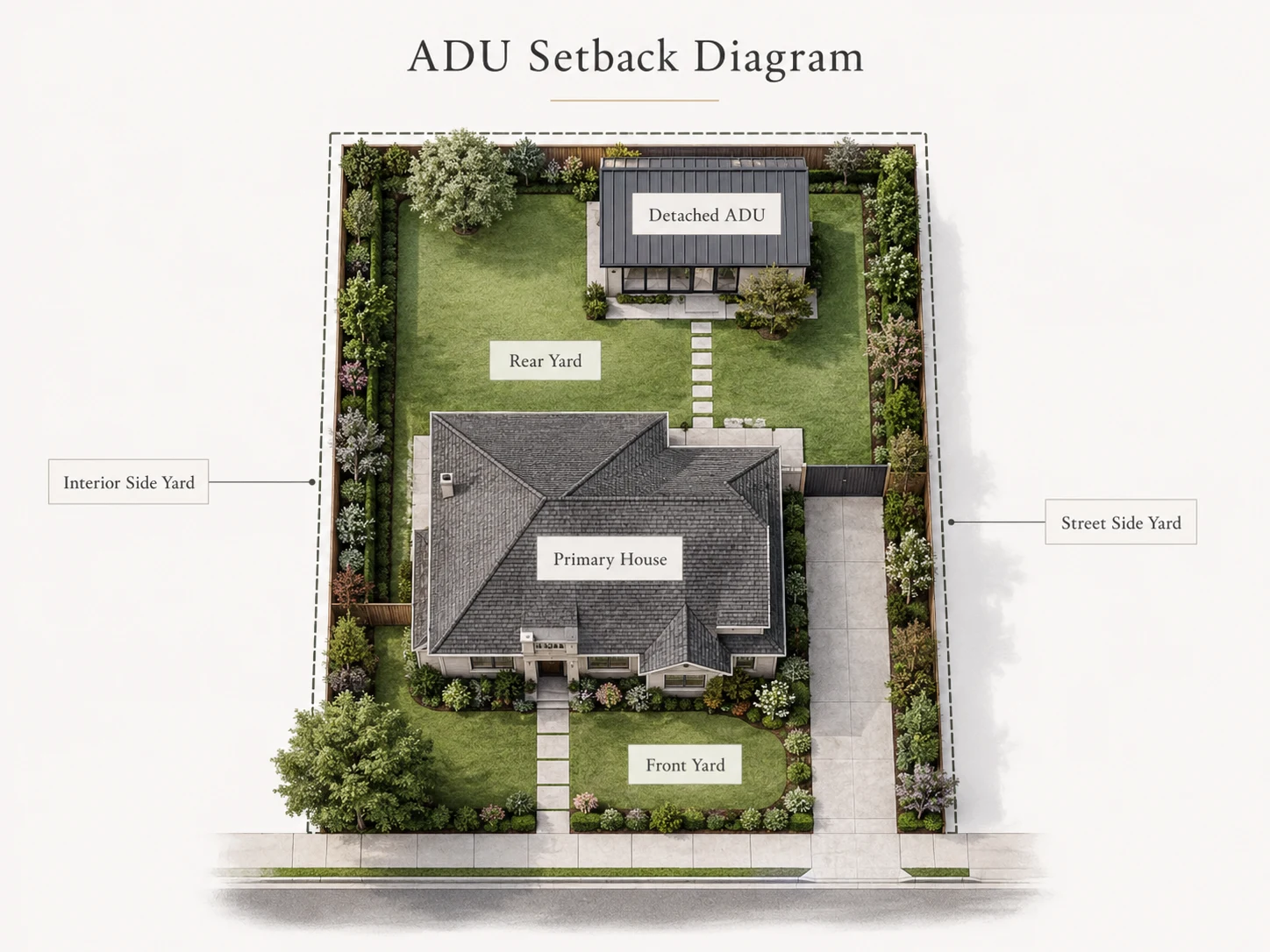
In the City of San Diego, detached ADUs in a Very High Fire Hazard Severity Zone require a minimum 4-foot interior side and rear setback regardless of height (per Ordinance O-21989). Outside fire zones, a detached ADU 16 feet or less can be built with 0-foot side and rear setbacks; taller detached ADUs require 4-foot side and rear setbacks when adjacent to residential premises. Front setbacks follow the base zone.
Interior side and rear setbacks
Outside a Very High Fire Hazard Severity Zone (VHFHSZ):
- Detached ADU 16 ft or less: No required side or rear setback
- Detached ADU over 16 ft, adjacent to residential premises: Minimum 4-foot side and rear setback
- Any wall within fire-separation distance of a property line: Must meet California Building Standards Code fire-rating requirements
Inside a VHFHSZ:
- Any ADU: Minimum 4-foot interior side and rear setback (per O-21989, effective August 22, 2025)
- The Fire Code Official may require additional fire-separation distance for defensible space
Front yard setbacks
ADUs must observe the base zone’s front yard setback. Exception: one ADU of 800 sq ft or less may encroach into the front yard setback when needed, typically when lot geometry doesn’t allow placement in the side or rear yards.
The setback matrix
| ADU type / location | Front | Street-side (corner) | Interior side | Rear |
|---|---|---|---|---|
| Detached, ≤16 ft, outside VHFHSZ | Base zone | 4 ft or base zone, whichever is less | 0 ft (subject to Building Code fire-separation) | 0 ft (subject to Building Code fire-separation) |
| Detached, >16 ft, outside VHFHSZ | Base zone | 4 ft or base zone, whichever is less | 4 ft | 4 ft |
| Detached, any height, inside VHFHSZ | Base zone | 4 ft or base zone, whichever is less | 4 ft (minimum) | 4 ft (minimum) |
| Attached, any height | Base zone | Base zone | Base zone | Base zone |
| JADU | Inside existing home/garage — no new setbacks triggered | |||
| Conversion (existing structure) | Existing | Existing | Existing | Existing |
Sources: SDMC §141.0302; Information Bulletin 400; Ordinance O-21989. Verified May 11, 2026.
HCD fire-separation challenge (verification-heavy area)
HCD’s October 6, 2025 letter flagged the City’s setback language as inconsistent with state law. HCD pointed out the City was conflating “setbacks” (a development standard regulated by state ADU law) with “fire separation distances” (a separate Building Code standard). The Fire Code Official’s authority to require extra distance outside a VHFHSZ is narrower than the ordinance appears to allow. Until the City amends formally, verify your specific parcel with DSD.
Is Parking Required for a San Diego ADU?
Most San Diego ADUs require no new parking. The main exception is the Beach Impact Area of the Parking Impact Overlay Zone outside a Transit Priority Area, where one off-street space may be required. Affordable and Bonus ADUs outside a TPA also require one off-street space each (post-August 2025).
When parking is not required
Parking is not required if any of these apply:
- The ADU is within ½ mile walking distance of public transit
- The ADU is attached to the existing or proposed primary dwelling or an accessory structure
- The premises is in a residential permit-parking district
- A car-share vehicle is located within one block
- The ADU is in a historic district
- The ADU is in the Coastal Overlay Zone but NOT in the Beach Impact Area
- The unit is a JADU
Affordable and Bonus ADUs outside a TPA: one space required
Per the City’s ADU/JADU page, one off-street parking space is required for each Affordable ADU and each Bonus ADU located outside a Transit Priority Area. If you’re stacking Bonus units in a non-TPA neighborhood, factor parking into your site plan.
Replacement parking: generally no, with one exception
SB 1211 (signed September 2024, effective January 2025) confirmed that no replacement parking is required when uncovered or covered parking is demolished or converted for ADU construction. The exception is the Beach Impact Area of the Parking Impact Overlay Zone outside a Transit Priority Area, where replacement parking can still be required unless a listed exemption applies.
Other requirements people forget
- Trees. If building two or more ADUs (including a JADU), San Diego requires at least one tree per property and two trees for every 5,000 sq ft of lot area.
- Refuse and recycling storage. ADU developments must conform to enclosure square footage and screening requirements in SDMC §142.0801.
- Solar PV. New detached non-manufactured ADUs require solar photovoltaic systems under California’s energy code.
- Fire sprinklers. Required for standard ADUs only if the primary residence requires them. All Affordable and Bonus ADUs in the Bonus Program must include automatic fire sprinklers per IB-400 (though HCD has challenged this language).
- Stormwater and drainage. Hillside or sloped lots (typically 25%+ slope) often trigger a geotechnical report ($2,500–$4,000), grading permit review, and stormwater compliance.
Free Tool — 60 Seconds
See What You Can Build on Your Property
Enter your San Diego address and get your jurisdiction, base zone, overlays, ADU eligibility, and permit path — instantly. No commitment.
Get Your Free ADU Eligibility Report →The San Diego ADU Permit Process (and the 60-Day Myth)
The City reviews ADU applications ministerially — no public hearings, no discretionary review — and California Government Code §66317 requires the City to act on a complete application within 60 days. In practice, most San Diego ADU permits take 3.5 to 5 months because applications typically go through three to four plan-check cycles, each running 3–6 weeks. AB 1332 (effective January 2025) requires approval or denial within 30 days for qualifying detached ADU applications using pre-approved plans.
The damaging admission
The 60-day rule sounds fast. Anyone who has actually pulled a San Diego ADU permit knows it isn’t. The state clock applies after the application is deemed complete; in practice, applicants almost always receive correction letters and resubmit. Most projects go through three or four cycles. Plan on 3.5 to 5 months, not 60 days. The faster path is fewer corrections, not faster review.
Step 1 — Confirm eligibility
Before you pay a designer, confirm: jurisdiction, base zone, Coastal Overlay Zone status, Fire Hazard Severity Zone status, Sustainable Development Area / Transit Priority Area status, historic district status, and Bonus Program eligibility.
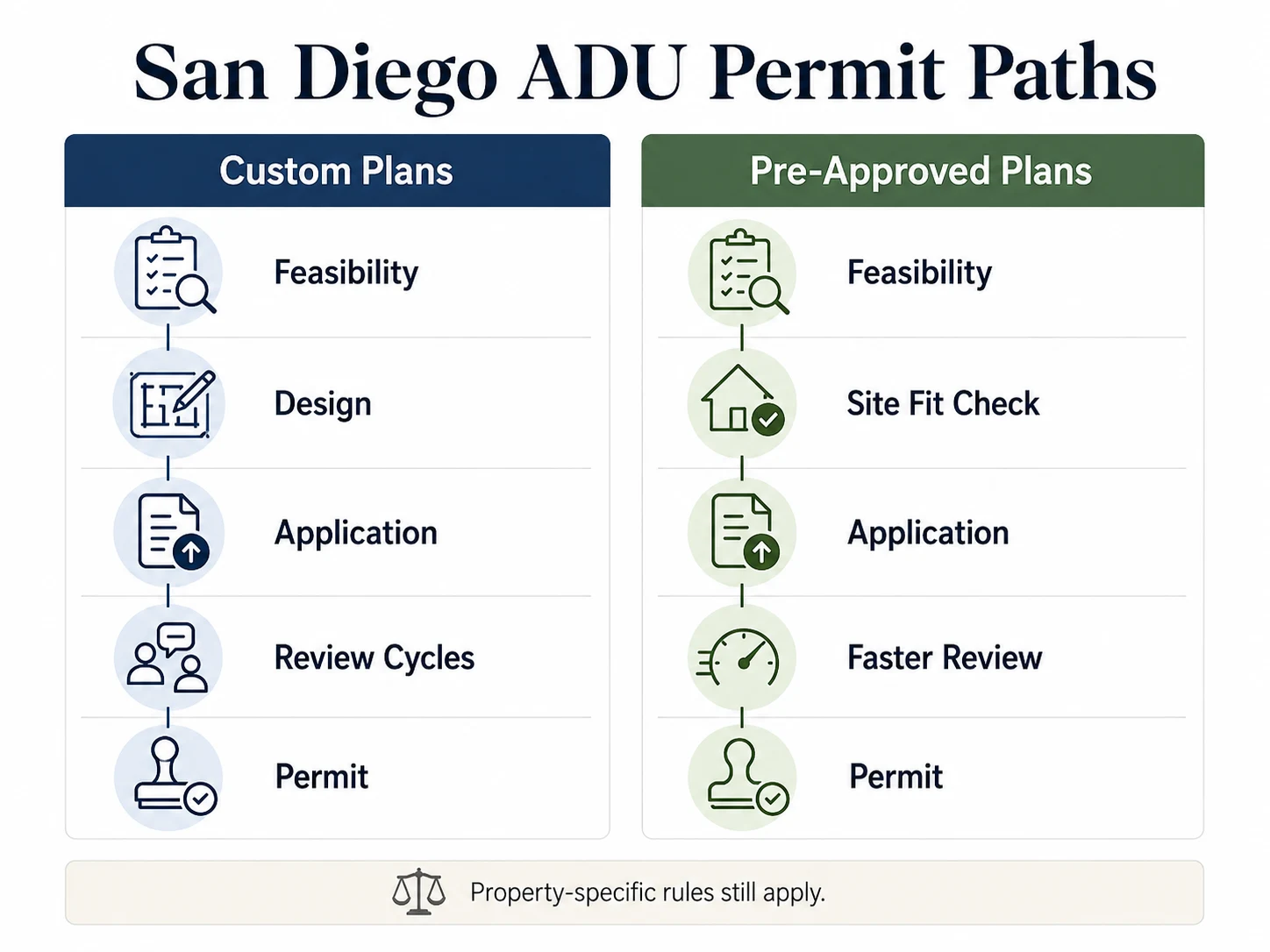
Step 2 — Choose your path
Three paths:
- (a) Custom plans. Highest flexibility, longest timeline, highest soft costs ($7,500–$15,000 for design alone).
- (b) Pre-approved plans (30-day path under AB 1332). AB 1332 requires approval or denial within 30 days for qualifying complete detached ADU applications using pre-approved plans within the current California Building Standards Code cycle. The City maintains a directory of accepted plans including SDHC’s four Pilot Program plans and plans from the County, Chula Vista, Encinitas, and private providers.
- (c) Conversion path. Lowest cost. Setbacks follow the existing structure. No new impact fees on original square footage.
Step 3 — Common plan-check correction causes
- Parking-plan errors on the site plan — by multiple builder reports, the single most common cause of recheck requests
- Title 24 energy calculation gaps — missing or inconsistent envelope, HVAC, and solar PV calculations
- Structural detail gaps — missing engineering for beams, foundations, retaining walls, or shear walls
- Site plans that don’t match field conditions — old surveys, missing easements, incorrect utility line depictions
Step 4 — After issuance: permit expiration rules
Under SDMC §129.0218: 1 year to begin construction after permit issuance; 180 days maximum between inspections once work begins; 3 years total to complete construction and receive final approval. 180-day extensions are available if requested before the permit expires.
Permit timeline matrix
| Stage | Custom plans | Pre-approved plans (AB 1332 path) |
|---|---|---|
| Pre-screen / completeness check | 2–4 weeks | 1–2 weeks |
| First plan-check cycle | 3–6 weeks | 1–2 weeks (30-day statutory target) |
| Corrections (avg 3 cycles) | 9–18 weeks | 2–4 weeks (often single cycle) |
| Ready-to-issue / fee payment | 1–3 weeks | 1 week |
| Total time to permit | ~3.5–7 months | ~5–9 weeks |
| Construction phase | 5–8 months | 4–7 months |
| Total project: design through C of O | 10–18 months | 6–12 months |
Sources: City DSD Permit Timeline page; SnapADU permit data; ADU Geeks 2026 process walkthrough; AB 1332. Builder timeline data is practical, not statutory.
San Diego ADU Permit Costs and Fees (Real 2026 Numbers)
A City of San Diego ADU permit typically lands in the $6,500 to $21,000 range based on builder-published 2025–2026 data, depending on size and type. Final fees come from the City’s IB-501 fee schedule (plan check + inspection), the SDUSD developer fee ($5.38 per assessable square foot, effective May 11, 2026, on ADUs over 500 sq ft), water and sewer capacity fees (at a reduced 0.5 EDU), and development impact fees if the ADU exceeds 750 sq ft.
School fees — the rate increased May 11, 2026
The SDUSD developer fee increased on May 11, 2026 to $5.38 per square foot of assessable space (prior rate: $5.17/sq ft). ADUs at or below 500 sq ft are exempt.
| ADU size | SDUSD school fee (@$5.38/sq ft) |
|---|---|
| 500 sq ft or less | $0 (exempt) |
| 600 sq ft | ~$3,228 |
| 750 sq ft | ~$4,035 |
| 1,000 sq ft | ~$5,380 |
| 1,200 sq ft | ~$6,456 |
Illustrative permit cost ranges (builder-published)
| ADU type | Size | Illustrative total range |
|---|---|---|
| JADU | ≤500 sq ft | $3,000–$6,000 |
| Garage conversion | ~400–500 sq ft | $3,500–$8,500 |
| Attached ADU | 500–750 sq ft | $6,000–$12,000 |
| Attached ADU | 1,000–1,200 sq ft | $12,000–$22,000 |
| Detached ADU | 400–500 sq ft | $9,000–$15,000 |
| Detached ADU | 750 sq ft | $13,000–$19,000 |
| Detached ADU | 1,200 sq ft | $19,000–$28,000 |
Sources: SnapADU February 2026 fee analysis; Better Place Design & Build 2026; Streamline Design Group 2025–2026. Illustrative ranges for budgeting only — final fees come from current IB-501, the SDUSD rate effective May 11, 2026, your water/sewer EDU calculation, and any applicable Community Enhancement Fee. Verify with DSD or your builder before budgeting.
How to lower your permit costs
- Stay at 750 sq ft or less to keep the development impact fee waiver under SB 13
- Stay at 500 sq ft or below to avoid SDUSD school fees
- Use pre-approved plans — cuts plan-check time and may reduce plan-check fees
- Convert instead of new-build — no new structural and impact fees on original square footage
- Share the existing water meter to avoid the SDCWA capacity fee
Free Resource
Free 2026 ADU Starter Kit
IB-400 cheat sheet, jurisdiction lookup walkthrough, the post-August-2025 unit-cap table, the HCD compliance watch list, and the 14-question builder vetting checklist.
Download Free Starter Kit →Coastal Overlay Zone Rules (and What’s Pending Coastal Commission Certification)
Properties in the Coastal Overlay Zone (Pacific Beach, La Jolla, Mission Beach, Ocean Beach, Point Loma, and coastal stretches throughout the city) often require a Coastal Development Permit (CDP) in addition to a building permit. The California Coastal Commission certified Housing Action Package 1.0 (O-21439) on September 12, 2024 and Housing Action Package 2.0 (O-21758) effective March 11, 2026. Ordinance O-21989 (the August 2025 reform package including the Bonus Program rollback and AB 1033 adoption) is still pending Coastal Commission certification — the Commission granted a one-year extension at its October 8–10, 2025 meeting.
Practical implication for coastal properties
If your project is in the Coastal Overlay Zone, certain rules from the August 2025 reforms (including the Bonus Program rollback) don’t yet apply to your property. You may have more Bonus ADU options on a coastal lot than on an identical inland lot — but only until the Coastal Commission certifies O-21989. Recommend a direct DSD pre-application meeting before relying on this gap.
Coastal Commission certification status tracker
| Ordinance | What it does | Coastal Commission status | Last verified |
|---|---|---|---|
| O-21439 (HAP 1.0) | Modernized ADU setback and landscape rules | Certified September 12, 2024 | May 11, 2026 |
| O-21618 | Subsequent ADU reform package | Pending certification | May 11, 2026 |
| O-21758 (HAP 2.0) | Additional ADU and code amendments | Effective in Coastal Zone March 11, 2026 | May 11, 2026 |
| O-21836 | Subsequent ADU reform package | Pending certification | May 11, 2026 |
| O-21989 (Aug 2025 reforms) | Bonus rollback, fire setbacks, AB 1033 adoption | Pending — Coastal Commission granted one-year extension (October 9, 2025) | May 11, 2026 |
Sources: City of San Diego IB-400 Editor’s Note; City Single-Issue LDC Amendments page; California Coastal Commission October 8–10, 2025 meeting (Item 11C). This tracker is updated monthly.
Fire Hazard, Hillside, and Brush Management Triggers
Three local triggers complicate San Diego ADU permits most: (1) Very High Fire Hazard Severity Zones, which require minimum 4-foot interior side and rear setbacks (per O-21989); (2) hillside or sloped lots (typically 25%+ slope), which require a geotechnical report and may trigger grading review; and (3) brush management zones, where defensible-space rules can add additional fire-separation distance.
Fire Hazard Severity Zone requirements
- Minimum 4-foot interior side and rear setbacks for any ADU (regardless of height)
- For Bonus Program lots: property must be on an improved public street with at least two evacuation routes and cannot front a cul-de-sac
- Government Code §51182 requires an ember-resistant “Zone 0” within 5 feet of any VHFHSZ structure under AB 3074 (2020)
- Fire sprinklers required for the standard ADU only if the primary residence requires them; required for all Affordable and Bonus ADUs in the Bonus Program (HCD has challenged this language)
Hillside, steep-slope, and ESL properties
Lots with slopes over 25%, or in Environmentally Sensitive Lands (ESL) overlays, often require:
- Geotechnical report: $2,500–$4,000
- Grading permit review (separate from the building permit)
- Stormwater management plan for runoff control
- Tree protection measures if the lot has mature canopy
These add 4–8 weeks to permitting and $5,000–$15,000 to the budget.
Historic districts
Most San Diego historic districts (Burlingame, Mission Hills, parts of South Park, Sherman Heights, parts of Hillcrest) have additional design review requirements for exterior modifications. ADUs in historic districts can usually still proceed but may need to match the architectural character of contributing structures.
Can You Rent, Airbnb, or Sell Your San Diego ADU Separately?
You can rent your San Diego ADU, but only for 31 consecutive days or longer. Short-term rentals under 30 days are prohibited for ADUs and JADUs. Owner-occupancy is not required for standard ADUs, but is required for JADUs unless the JADU has independent sanitation or the owner is a qualified housing organization. Under AB 1033, the City adopted local condo-conversion implementation effective August 22, 2025 — but ADUs developed through the Bonus Program are not eligible for separate sale.
Long-term rentals only — no Airbnb
ADU leases must be 31 consecutive days or longer. If your business model assumes Airbnb income, that is not legal for San Diego ADUs. We’ve reviewed pro formas where the projected ADU income was 2× the legally allowable rent because the homeowner assumed short-term rental. Treat 31 days as the operating constraint.
AB 1033 condo conversion — adopted, but legally complex
Effective August 22, 2025. New or existing ADUs may be subdivided into condominium units and sold separately from the primary residence. Requirements:
- Lienholder consent — your mortgage company must agree
- Subdivision mapping (tentative parcel map or condo map)
- HOA consent if already in an HOA
- Davis-Stirling Act compliance for the new HOA
- Affordability covenants if the ADU received SDHC financing
HCD’s October 6, 2025 letter also identified a tenancy-in-common gap in the City’s AB 1033 implementation. Legal, but verification-heavy — talk to a land-use attorney before relying on AB 1033 as a financial strategy.
AB 2533 amnesty — legalizing pre-2020 unpermitted ADUs
AB 2533 (signed 2024) extended California’s ADU amnesty program. If your ADU was built before January 1, 2020 and meets basic health and safety standards, you may apply for retroactive permitting. Cities can only require objective health and safety upgrades — not a full redesign to current code. Significant for owners of unpermitted granny flats, garage conversions, and basement ADUs.
Median ADU rent in San Diego
For planning purposes only: median ADU rent in San Diego runs roughly $2,000–$2,400 per month for a 1-bedroom unit in most neighborhoods. Higher in coastal neighborhoods, lower in inland areas.
Rental income and property value figures are illustrative examples drawn from third-party market data (SnapADU March 2026; UC Berkeley Terner Center), not guarantees of returns.
The 2025–2026 Changes Timeline and HCD’s State-Law Conflict Watch
On October 6, 2025, HCD sent the City a formal review letter finding that Ordinance O-21989 fails to comply with State ADU Law in four specific areas: fire sprinklers, unit size for multifamily detached ADUs, fire separation distance versus setbacks, and tenancy-in-common requirements for separate sale. The City had until November 5, 2025 to amend or explain. As of our last verification, the four findings remain open and the City and HCD remain in active dialogue.
| Date | Event |
|---|---|
| Jan 28, 2025 | City Council moves to repeal the Bonus Program (Brown Act concerns raised) |
| Mar 4, 2025 | Council votes 6–3 to reduce Bonus ADUs |
| May 30, 2025 | HCD preliminary review of City's draft ADU ordinance |
| Jun 13, 2025 | HCD memo warning of housing-element and AFFH compliance concerns |
| Jul 22, 2025 | Final Council vote (5–1 with 3 absent) on reform package |
| Jul 23, 2025 | Ordinance O-21989 adopted |
| Aug 22, 2025 | O-21989 effective outside Coastal Overlay Zone |
| Oct 6, 2025 | HCD issues formal §66326 finding letter — O-21989 does not comply with State ADU Law in four areas |
| Oct 8–10, 2025 | Coastal Commission grants one-year extension to certify the LCP amendments (Item 11C) |
| Nov 5, 2025 | City's 30-day deadline to respond to HCD findings |
Sources: Ordinance O-21989; HCD ordinance review letter October 6, 2025; California Coastal Commission agenda October 8–10, 2025; ADU Geeks; Inside San Diego; National Law Review.
Free Tool — 60 Seconds
See What You Can Build on Your Property
Enter your San Diego address and get your jurisdiction, base zone, overlays, ADU eligibility, and permit path — instantly. No commitment.
Get Your Free ADU Eligibility Report →Pre-Approved ADU Plans in San Diego: The Fastest Permit Path
For homeowners on a budget or a timeline, pre-approved plans are usually the smartest single decision. AB 1332’s 30-day path applies only to qualifying detached ADU applications that use a plan preapproved by the local agency within the current triennial California Building Standards Code cycle.
Where to find pre-approved plans
- City of San Diego DSD maintains a directory of accepted pre-approved ADU plans.
- San Diego Housing Commission (SDHC) offers four free pre-approved plans (studio through 3-bedroom) developed through its ADU Development Pilot Program. They’ve received initial DSD approval but still require site-specific review.
- County of San Diego publishes its own standard dwelling unit plans; the City accepts certain of these.
- Third-party providers including local design-build firms have pre-approved plans accepted by the City.
For a full guide, see our San Diego pre-approved ADU plans page (26 options compared) and the City of San Diego ADU plans guide.
When custom plans are still worth it
- Your lot has unusual geometry that no pre-approved plan fits
- You’re building a Bonus ADU strategy requiring bespoke unit configurations
- You want a specific architectural style matching your primary home
- You’re stacking units or building multi-story configurations not in pre-approved libraries
How to Check Your Property Before Paying for Plans
Before you spend money on plans, designers, or builder deposits, run a 7-step pre-check on your property. This single hour prevents the most expensive early mistake — designing an ADU that doesn’t fit your parcel’s rules.
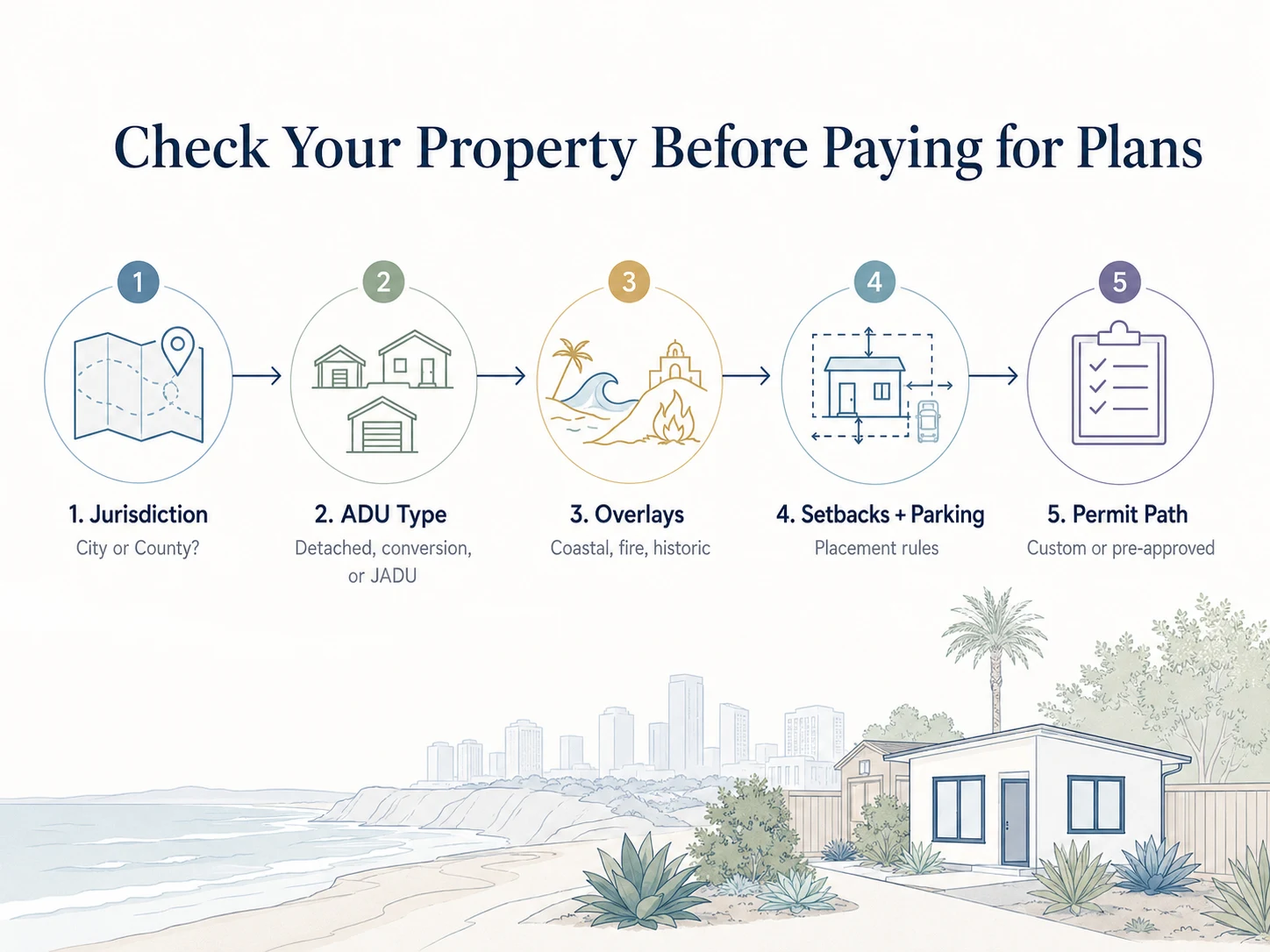
- Confirm jurisdiction. Use ZAPP or our free property check to confirm whether the parcel is in the City of San Diego, the unincorporated County, or another incorporated city.
- Confirm the base zone. RS-1-1 through RS-1-14 (single-dwelling), RM zones (multifamily), RX, mixed-use, etc. Note which Bonus Program category applies.
- Choose the ADU type. Detached, attached, conversion, garage conversion, JADU, multifamily, or Bonus ADU. Each has different rules.
- Check the Coastal Overlay Zone. If yes, you’ll need a CDP, which adds 2–4+ months to your timeline.
- Check the Very High Fire Hazard Severity Zone. If VHFHSZ (or HFHSZ for Bonus Program lots), you’ll trigger 4-foot setbacks, potential evacuation-route requirements, and defensible-space rules.
- Check Sustainable Development Area / Transit Priority Area status. These affect Bonus Program eligibility, parking requirements, and other rules.
- Match the project to a permit path. Custom plans, pre-approved plans, conversion, or Bonus/Affordable ADU.
Free Tool — 60 Seconds
See What You Can Build on Your Property
Enter your San Diego address and get your jurisdiction, base zone, overlays, ADU eligibility, and permit path — instantly. No commitment.
Run the free 7-step check on your address \u2192Which San Diego ADU Path Fits Your Situation?
The right ADU path depends on what you’re trying to solve: family housing, rental income, lowest disruption, small-lot feasibility, coastal compliance, or multi-unit strategy.
| Your situation | Likely path | What to verify first |
|---|---|---|
| Aging parent or adult child moving in | Conversion ADU, JADU, or small detached ADU | Privacy, accessibility, sanitation, owner-occupancy if JADU |
| Rental income (long-term) | Detached ADU or garage conversion | 31-day minimum rental, parking, utility scope, cost vs. rent |
| Small lot (<5,000 sq ft) | Garage conversion or compact pre-approved plan | Setbacks, FAR, front-yard rules, fire access |
| Coastal property | Conversion or carefully reviewed detached ADU | CDP requirement, Beach Impact Area parking, exemptions |
| Fastest permit + lowest cost | Pre-approved plan (30-day path) | Parcel fit, current code cycle, plan inventory |
| Multifamily property | Multifamily conversion + detached ADUs | Existing unit count, non-livable space, attached ADUs not allowed |
| Bonus ADU strategy (stacked units) | Affordable + Bonus ADU path in eligible zone | Zone eligibility (post-Aug 2025), CTCAC area, deed restriction, lot-size cap, separate-sale exclusion |
Want a local team that handles plans, permits, and the recheck cycles for you?
Affiliate disclosure: The Dwelling Index is reader-supported. Some links on this page are affiliate links. If you click one and take a qualifying action, we may earn a commission at no extra cost to you. Affiliate relationships do not influence our editorial rankings or conclusions. Read our full disclosure.
SnapADU specializes exclusively in San Diego ADUs — selected for specialization, not for compensation.
See SnapADU Floor Plans and Service Fit →Disclosure: SnapADU is a Dwelling Index affiliate partner. We may earn a commission if you take action. Selection was based on specialization, not compensation.
What an ADU Actually Costs to Build in San Diego (and How to Pay for It)
Beyond permit fees, total all-in cost for a turnkey detached site-built ADU in San Diego is $300,000–$450,000+ for a 600–1,200 sq ft unit, or about $375–$600 per sq ft based on local builder-published 2025–2026 pricing. Prefab and modular ADUs start around $145,000–$200,000 for smaller units, plus site prep and utilities.
Cost figures and rental income examples are illustrative ranges from local builder-published prices and academic research, not guarantees of returns. Actual results depend on lot conditions, design, finishes, contractor selection, and market conditions.
Construction budget breakdown (750 sq ft detached ADU, mid-range)
| Category | Cost range | Notes |
|---|---|---|
| Design & engineering | $10,000–$18,000 | Lower with pre-approved plans |
| Permit fees | $13,000–$19,000 | All city fees included |
| Sitework & utilities | $15,000–$30,000 | Includes meter, sewer lateral, panel upgrade |
| Foundation | $20,000–$35,000 | Slab on grade or raised |
| Framing, roofing, exterior | $50,000–$90,000 | Includes windows |
| MEP rough-in | $30,000–$50,000 | Mechanical, electrical, plumbing |
| Insulation, drywall, finishes | $40,000–$70,000 | Where finish level shows up |
| Solar PV system | $8,000–$15,000 | Required for new detached ADUs |
| Final inspection + C of O | $1,000–$3,000 | |
| Contingency (10%) | $20,000–$33,000 | Sites with surprises need more |
| Total range | $207,000–$363,000 | Toward $300K–$450K for higher-end finishes |
Sources: SnapADU March 2026 cost data; Better Place Design & Build 2026; UC Berkeley Terner Center. For more detail: San Diego ADU cost analysis.
The 5 financing paths most San Diego ADU homeowners use
- Cash-out refinance. Replace your current mortgage with a larger one and take the difference in cash. Best when rates are similar to your existing rate and you have substantial equity.
- Home equity line of credit (HELOC). Revolving line secured by your equity. Best when you want flexibility to draw funds in construction stages.
- Construction-to-permanent loan. Single loan that funds construction in draws, then converts to a long-term mortgage on completion. Most common path for new detached ADU builds.
- Renovation loan (FHA 203(k), Fannie Mae HomeStyle). Lets you borrow against after-renovation value. Useful when you lack enough equity for a HELOC.
- San Diego Housing Commission ADU Finance Program. For income-qualified City of San Diego homeowners. Typical eligibility: City of San Diego property, income up to 150% AMI, owner-occupied primary residence, minimum credit score 680, rent restricted to tenants up to 80% AMI for 7 years. Funding status note: FY2025 funds were not available; verify current availability directly with SDHC before budgeting around this program.
Want to compare ADU financing paths for your situation?
Affiliate disclosure: The Dwelling Index is reader-supported. Some links on this page are affiliate links. If you click one and take a qualifying action, we may earn a commission at no extra cost to you. Affiliate relationships do not influence our editorial rankings or conclusions. Read our full disclosure.
We frame financing as path education, never “best lender” rankings, and we never rank by compensation.
Explore Renovation Loans, Cash-Out Refinance, and HELOC Options →CalHFA $40,000 ADU Grant — fully allocated
The California Housing Finance Agency’s ADU Grant Program’s latest round was fully allocated on December 28, 2023. Do not count on this grant in a 2026 budget unless CalHFA announces a new funding round. We refresh this status monthly.
Frequently Asked Questions
Can I build an ADU on any San Diego property?
Usually yes if the property is in a zone that allows single-family or multifamily residential uses (including applicable mixed-use zones), with an existing or proposed primary residence. State law eliminated minimum lot size requirements for ADUs. Confirm jurisdiction, zone, and overlays before committing to a design.
How many ADUs can I build on one San Diego lot?
On a single-family lot in the City of San Diego: one attached or detached ADU + one conversion ADU + one JADU by right (3 total). With the Bonus Program in eligible zones, up to 4–6 total depending on lot size after the August 22, 2025 rollback. Multifamily lots can build up to 8 detached ADUs on existing multifamily property plus conversions.
What is the maximum size of an ADU in San Diego?
Standard attached or detached ADUs: 1,200 sq ft. Attached ADUs are also capped at 50% of the primary residence, subject to state-law size floors (850 sq ft for studio/1-BR; 1,000 sq ft for 2+ BR). JADUs: 500 sq ft. Conversion ADUs are not subject to the 1,200 sq ft cap. Detached ADUs on multifamily lots have no maximum under state law.
Do I need a permit for an ADU in San Diego?
Yes. Every ADU requires a building permit from City of San Diego DSD (or County PDS for unincorporated land). No exemptions.
How long does it take to get an ADU permit in San Diego?
3.5–5 months on average for custom plans. Pre-approved plans can shorten this to about 30 days under AB 1332 for qualifying detached ADU applications.
How much does an ADU permit cost in San Diego?
Roughly $6,500–$21,000 depending on size and type based on builder-published 2025–2026 ranges. JADUs and small conversions can be $3,000–$10,000. Final fees come from IB-501, the SDUSD $5.38/sq ft developer fee (effective May 11, 2026), water/sewer EDU, and any applicable impact or Community Enhancement Fee.
What are the setback requirements for ADUs in San Diego?
0-foot side and rear setbacks for single-story detached ADUs under 16 ft outside a Very High Fire Hazard Severity Zone (subject to Building Code fire-separation requirements). 4-foot side and rear setbacks for taller ADUs adjacent to residential premises, and for any ADU in a VHFHSZ. Front setbacks follow base zone.
Is parking required for an ADU in San Diego?
Usually no. Exemptions apply within ½ mile of transit, for attached ADUs and JADUs, in permit-parking districts, in historic districts, and more. The Beach Impact Area of the Parking Impact Overlay Zone outside a Transit Priority Area is the main exception. Affordable and Bonus ADUs outside a TPA also require one off-street space each.
Can I rent my San Diego ADU on Airbnb?
No. Only rentals of 31 consecutive days or longer are allowed for ADUs and JADUs. Short-term vacation rentals are explicitly prohibited.
Do I have to live on the property to have an ADU?
No for standard ADUs. Yes for JADUs (unless the JADU has independent sanitation facilities or you're a qualified housing organization).
Can I sell my San Diego ADU separately from my house?
Yes, under AB 1033 — the City adopted this effective August 22, 2025. Lender consent, condo mapping, and HOA review are required. ADUs developed through the Bonus Program are not eligible for separate sale.
Do San Diego ADUs require solar panels?
New non-manufactured detached ADUs require solar PV systems under California's energy code. Conversions and additions to existing structures are generally treated differently.
Do San Diego ADUs require fire sprinklers?
For standard ADUs, sprinklers are required only if the primary residence requires them. All Affordable and Bonus ADUs in the Bonus Program must include automatic fire sprinklers per IB-400. HCD has formally challenged the City's attempt to require sprinklers more broadly.
What zones allow ADUs in San Diego?
ADUs may be allowed on lots zoned to allow single-family or multifamily residential uses, including applicable mixed-use zones.
Does San Diego have a minimum lot size for ADUs?
No. State law eliminated minimum lot size requirements for ADUs.
Do San Diego County and the City of San Diego have the same ADU rules?
No. The unincorporated County has its own ADU ordinance and PDS process. Always confirm jurisdiction first.
What We Verified for This Guide
Primary Sources & Methodology
| Source | Used for | Last verified |
|---|---|---|
| City of San Diego ADU/JADU page | Definitions, permit requirement, size ranges, bonus ADU overview, pre-approved plans, setbacks | May 11, 2026 |
| City of San Diego IB-400 (January 2026) | Detailed ADU/JADU requirements, parking, owner occupancy, solar, sprinklers, CDP, submittals | May 11, 2026 |
| City of San Diego IB-501 (Fee Schedule) | Building permit fees, plan check fees | May 11, 2026 |
| SDUSD Developer Fees page | School impact fee $5.38/sq ft effective May 11, 2026 | May 11, 2026 |
| Ordinance O-21989 (effective Aug 22, 2025) | Bonus Program rollback, 8-zone elimination, lot-size caps, fire-zone setbacks, AB 1033 adoption, Community Enhancement Fee | May 11, 2026 |
| HCD ordinance review letter, October 6, 2025 | Four findings of noncompliance with State ADU Law | May 11, 2026 |
| California Coastal Commission Item 11C, Oct 9, 2025 | LCP certification timeline for August 2025 reforms | May 11, 2026 |
| California HCD ADU Handbook 2026 | State-law guidance, impact fee threshold, multifamily ADU pathways | May 11, 2026 |
| California Government Code §§66310–66341 | State ADU Law | May 11, 2026 |
| SDHC ADU Finance Program (sdhc.org) | Local financing program details and funding status | May 11, 2026 |
| CalHFA ADU Grant Program | Latest round fully allocated December 28, 2023 | May 11, 2026 |
| Builder data: SnapADU, Better Place Design & Build, ADU Geeks | Local cost ranges and permit timelines | May 11, 2026 |
Methodology: We start with primary sources (City Information Bulletins, ordinance text, SDMC, IB-501, HCD letter, Coastal Commission record) and cross-check against builder-published data. Cost ranges synthesize the City fee schedule with local builder pricing. Editorial conclusions are our judgment, framed as editorial conclusions — not legal or financial advice. We update this page quarterly and within 30 days of any material change to the Bonus Program, HCD compliance status, or Coastal Commission certification.
Not Sure Where to Start? See What’s Possible at Your Address.
You’ve now read the same regulatory framework a San Diego ADU designer would walk you through in a $250 consultation. The next step is parcel-specific. Enter your San Diego address and get your jurisdiction, base zone, ADU eligibility, Coastal Overlay and Fire Hazard Severity Zone flags, likely permit fee range, and recommended path.
Get Your Free ADU Eligibility Report →No commitment. No sales call. Just the answer you came for.
Free Resource
Free 2026 ADU Starter Kit
IB-400 cheat sheet, jurisdiction lookup walkthrough, the post-August-2025 unit-cap table, the HCD compliance watch list, and the 14-question builder vetting checklist.
Download Free Starter Kit →Related San Diego ADU Guides
- San Diego ADU Laws 2026: Rules, Limits & Reforms — the parallel regulations overview
- San Diego ADU Permit Process 2026: Fees & Timeline — step-by-step submittal guide and real fee calculations
- San Diego ADU Permit Timeline 2026: Stage by Stage — how long each review stage takes
- San Diego Pre-Approved ADU Plans (2026): 26 Options — the fastest permit path compared
- San Diego ADU Cost 2026: What It Really Costs to Build — build-path cost breakdowns
- ADU Financing Options Guide — HELOC, renovation loans, construction-to-permanent
- Best ADU Builders in San Diego County (2026) — vetted builders with permit experience
Affiliate disclosure: The Dwelling Index is reader-supported. Some links on this page are affiliate links. If you click one and take a qualifying action, we may earn a commission at no extra cost to you. Affiliate relationships do not influence our editorial rankings or conclusions. Read our full disclosure.