
Unincorporated San Diego County ADU Laws: 2026 Rules & Fee Calculator
Unincorporated San Diego County ADU laws cover a territory of more than 1,700 square miles and dozens of distinct communities — all governed by a single County rule set that most guides get wrong. This page covers PDS‑611 zoning standards, the PDS‑613 fee math nobody else publishes, the 2026 AB 1033 separate‑sale path now in effect, and a source conflict tracker that shows where the County form, the current ordinance, and state law diverge.
Bottom line up front
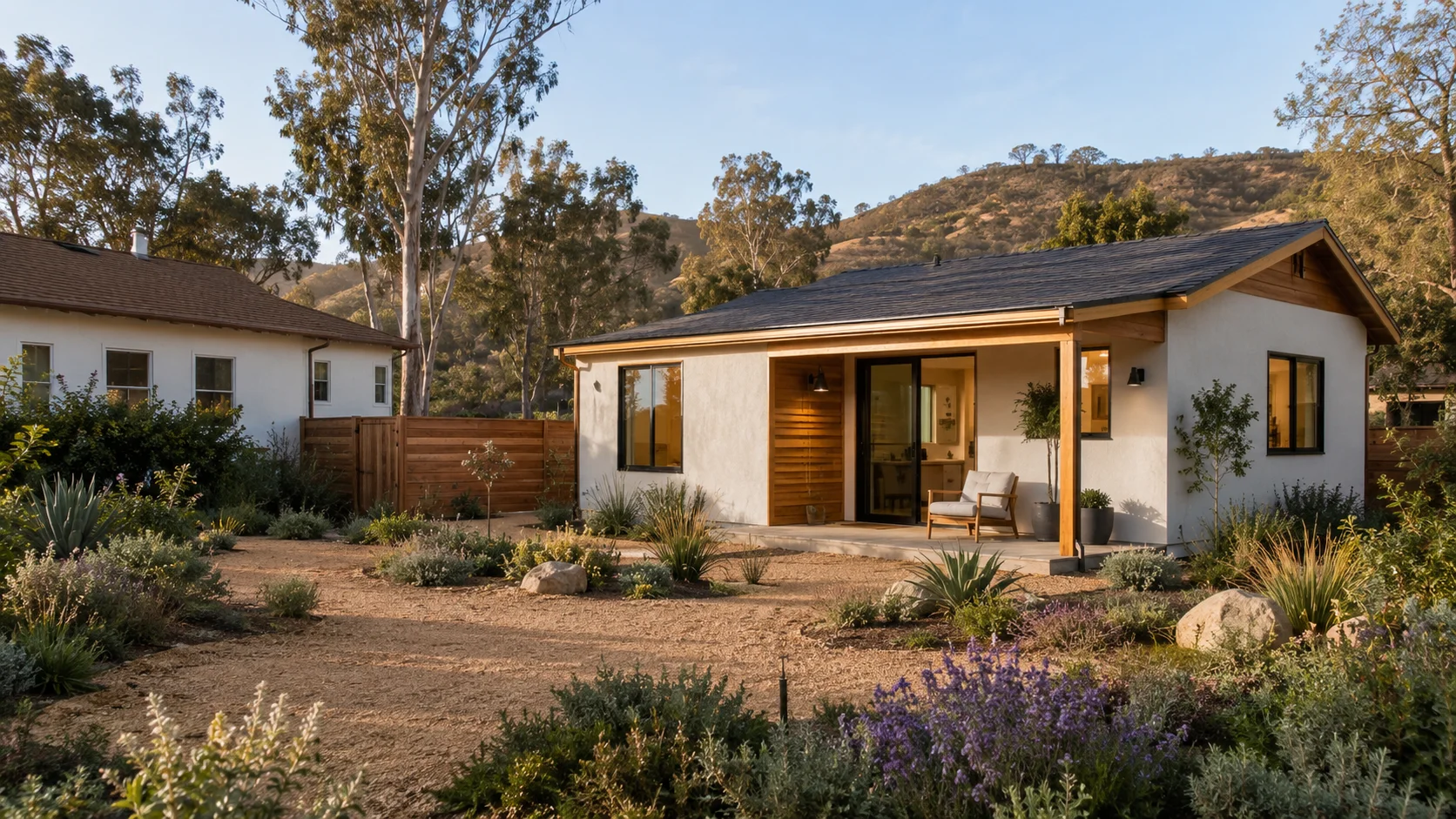
On most residentially zoned lots in unincorporated San Diego County, the 2026 rules allow one detached ADU up to 1,200 sq ft and 25 ft tall, plus one Junior ADU (JADU) up to 500 sq ft inside your home. New ADUs use a 4‑foot side and rear setback unless fire setbacks are larger. The County’s 2019–2024 impact fee waiver expired January 9, 2024 — projects now pay full PDS fees starting near $4,000 for an 800 sq ft ADU before septic, fire, school, and utility costs. The realistic permit timeline is three to five months for a clean project and six to twelve months once septic or fire enter the picture. As of April 4, 2026, qualifying ADUs can be sold separately as condominiums under AB 1033, with no additional local criteria yet adopted.
See what you can build at your address
Get a free, parcel‑specific ADU feasibility report covering jurisdiction, sewer or septic status, fire‑zone exposure, and your buildable envelope. No phone number required.
Get Your Free Unincorporated County ADU Feasibility Report →2026 unincorporated San Diego County ADU rules at a glance
Every cell below has caveats — read the sections that follow before relying on any single number. Parcel‑specific conditions (septic, fire, slope, HOA, easements) govern what is actually buildable on your lot.
| Question | Bottom line (2026) | Primary source |
|---|---|---|
| Who this applies to | Parcels in unincorporated County jurisdiction — not the City of San Diego or any of the 17 other incorporated cities | County PDS ADU page |
| ADUs on a single‑family lot | Typically one ADU plus one JADU; qualifying lots may combine existing‑space ADU, JADU, and newly constructed detached ADU | County §6156.x; Gov. Code §66323 |
| ADUs on a multifamily lot | Up to 8 detached ADUs on existing multifamily (capped at unit count); up to 2 on proposed multifamily; plus interior conversions up to 25% of units | PDS‑611 p. 4 |
| Max detached ADU size | 1,200 sq ft on single‑family lots, independent of primary residence size | PDS‑611 p. 1 |
| Max detached ADU height | 25 ft on single‑family lots (2 stories); 18 ft on existing‑multifamily lots | PDS‑611 p. 1, p. 4 |
| Min side / rear setbacks | 4 ft (unless fire setbacks are larger) | PDS‑611 p. 1 |
| JADU size | Up to 500 sq ft, inside the primary home | PDS‑611 p. 3 |
| Parking | Generally one space for a new detached ADU; exempt within ½ mile of transit, historic district, conversion, or attached path | PDS‑611 p. 1; Gov. Code §66322 |
| Owner‑occupancy (ADU) | Not required (made permanent by AB 976) | County ADU page |
| Owner‑occupancy (JADU) | Required only when sanitation is shared with the primary home (AB 1154, eff. Jan. 1, 2026) | Gov. Code §66333 |
| Short‑term rentals | Prohibited — minimum 31 days | PDS‑611 p. 1; County ADU Handbook |
| Sell ADU separately | Yes, effective April 4, 2026 via AB 1033 condo conversion; no additional local criteria adopted as of May 2026 | County AB 1033 implementation page |
| Review clock | 15 business days to deem complete; 60 days to approve or deny once complete | Gov. Code §66317 |
Primary sources: Cal. Gov. Code §§66310–66344; County of San Diego PDS‑611 (Rev. 01/7/2026); County of San Diego PDS‑613 (Rev. 06/05/2025, eff. 07/01/2025); County ADU Handbook (April 2024); County AB 1033 Implementation page; AB 976; AB 1033; AB 1154.
2026 source conflict tracker
The single most useful thing we can give a reader is honesty about where the County’s own forms, the current codified ordinance, and state law do not match. The County’s Director’s Determination Letter makes clear that state law controls when the County Zoning Ordinance conflicts with state law. Use this tracker when something on this page differs from a published builder source or an older County handout.
| Issue | What County form says | What §6156.x or state law says | Practical consequence | Last verified |
|---|---|---|---|---|
| Floor area measurement | PDS‑611 p. 1: “interior dimensions of the outside walls” | Current codified §6156.x: “exterior dimensions of the outside walls” | Verify the County's current submittal method at intake; controls borderline 1,200 sq ft projects | May 15, 2026 |
| JADU owner‑occupancy | PDS‑611 p. 3: owner must reside in primary or JADU | Gov. Code §66333 (as amended by AB 1154, eff. Jan. 1, 2026): owner‑occupancy required only when sanitation is shared | State law controls; owner‑occupancy not required for a JADU with its own separate bathroom | May 15, 2026 |
| Multifamily detached ADU height | PDS‑611 p. 4: 18 ft for detached ADUs within a multifamily complex | Current §6156.x distinguishes existing multifamily (18 ft cap) from proposed multifamily (up to 25 ft) | Verify per parcel; existing‑multifamily projects use 18 ft, proposed‑multifamily may allow 25 ft | May 15, 2026 |
| Guest quarters on a lot with an ADU | PDS‑345 (Rev. 2019) and current §6156 generally prohibit | SnapADU reported a March 2026 County Planning Manager email indicating this rule changed; official handout not yet updated | Treat as unsettled; confirm in writing with PDS before relying on coexistence | May 15, 2026 |
| AB 1033 additional local criteria | None adopted as of May 2026 | County draft options under public review May 1–31, 2026; Board hearing late Summer 2026 | Current implementation has no additional local criteria; subsequent rules may add owner‑occupancy or right of first refusal | May 15, 2026 |
| Rental minimum stay | PDS‑611: “shall not be rented for less than 30 days” | State law typically framed as “longer than 30 days” | Safest framing: 31‑day minimum to avoid ambiguity | May 15, 2026 |
Are you actually in unincorporated San Diego County?
Mailing city is not the same thing as legal jurisdiction. A property with a Fallbrook, Lakeside, Spring Valley, El Cajon, Escondido, Vista, San Marcos, Oceanside, Encinitas, Del Mar, Chula Vista, or even San Diego mailing address can still be on County land that is outside any incorporated city. The rules on this page do not apply to incorporated‑city parcels.
The unincorporated communities most commonly affected include Alpine, Bonita, Bonsall, Boulevard, Campo, Crest, Del Dios, Descanso, Fairbanks Ranch, Fallbrook, Hidden Meadows, Jamul, Julian, Lakeside, Mount Helix, Pala, Pala Mesa, Pauma Valley, Pine Valley, Rainbow, Ramona, Rancho Santa Fe, Spring Valley, Sweetwater, Twin Oaks, Valle De Oro, Valley Center, Warner Springs, and 4S Ranch, among others.
The APN check, in under five minutes
- Find your Assessor’s Parcel Number (APN) on your property tax bill or via the County Assessor’s lookup.
- Run the Property Summary Report at
publicservices.sandiegocounty.govusing your APN. - Confirm the report shows unincorporated County jurisdiction. If it shows a city name as the land‑use authority, this page is not your page.
- Confirm the zone allows residential or mixed‑use and that an existing or proposed single‑family dwelling exists on the lot.
- Save the report — you will need it for the County PDS pre‑application conference and for any builder you talk to.
| If the Property Summary Report shows… | The permit authority is… | Use this page? |
|---|---|---|
| Unincorporated County | County of San Diego PDS | Yes |
| City of San Diego | City of San Diego Development Services | No — use a City of San Diego ADU guide |
| Any other incorporated city in the County | That city's planning department | No — use a city‑specific guide |
| Unclear (mailing address straddles a boundary) | Verify the APN | Start here, then branch |
Run my parcel through the jurisdiction check →
Enter your address. We’ll pull the basics — jurisdiction, sewer vs. septic, fire‑zone exposure, approximate buildable envelope — so you know which rule set applies before you spend on plans.
Check My Parcel →Can you build an ADU on your unincorporated lot?
Most residentially zoned lots in unincorporated San Diego County with an existing or proposed primary single‑family dwelling are eligible for at least one ADU and one Junior ADU under PDS‑611 and state Government Code. The qualifying factor is rarely the headline “are ADUs allowed?” question — it is whether the parcel can physically support the project once septic, fire, slope, easements, utilities, and HOA constraints are considered.
The County’s PDS‑611 form lays out four eligibility baselines for a single‑family lot (p. 1):
- The property must be in unincorporated San Diego County.
- The zone must allow residential or mixed use.
- An existing or proposed single‑family dwelling must exist on the lot.
- The ADU must be attached to that dwelling or detached and on the same legal lot.
Single‑family lots
The codified §6156.x now allows the state‑law categories to be combined. On a qualifying single‑family lot, that combination can include one ADU from existing space, one JADU, and one newly constructed detached ADU — subject to County interpretation at intake. The simple baseline for most homeowners: one ADU plus one JADU. Combinations beyond that are still being implemented locally and should be confirmed at the County PDS Permit Center before you rely on them.
ADU sale was historically prohibited separately from the primary dwelling, but that changed for unincorporated parcels on April 4, 2026 under the County’s AB 1033 implementation. See the AB 1033 section below.
One point that reassures owners on already‑dense parcels: County Zoning Ordinance §6156.x classifies ADUs as an accessory use, so they are not counted toward the allowable density under the County General Plan. An ADU does not consume a General Plan dwelling‑unit allocation.
Multifamily lots
Per PDS‑611 p. 4, an existing multifamily complex can host detached ADUs equal to the number of existing units, up to a cap of eight. A proposed multifamily complex still under construction is limited to two detached ADUs during construction. Internal conversions of non‑livable space stack on top of the detached count — up to 25% of the existing unit count. A four‑unit building can therefore potentially become four units plus four detached ADUs plus one interior‑conversion ADU.
Empty lots and parcels without a primary dwelling
An ADU is, by definition, accessory to a primary dwelling. If your lot has no primary dwelling and no proposed primary dwelling, your path is to permit the primary dwelling and the ADU together. PDS‑611 confirms that “proposed” SFDs are eligible, but the application must show the primary dwelling either existing or proposed.
Get my parcel‑specific feasibility snapshot →
Free, address‑specific report covering jurisdiction, primary‑dwelling status, septic vs. sewer, fire zone, and your likely buildable envelope. No phone number required.
Get My Feasibility Snapshot →What ADU types does the County allow?
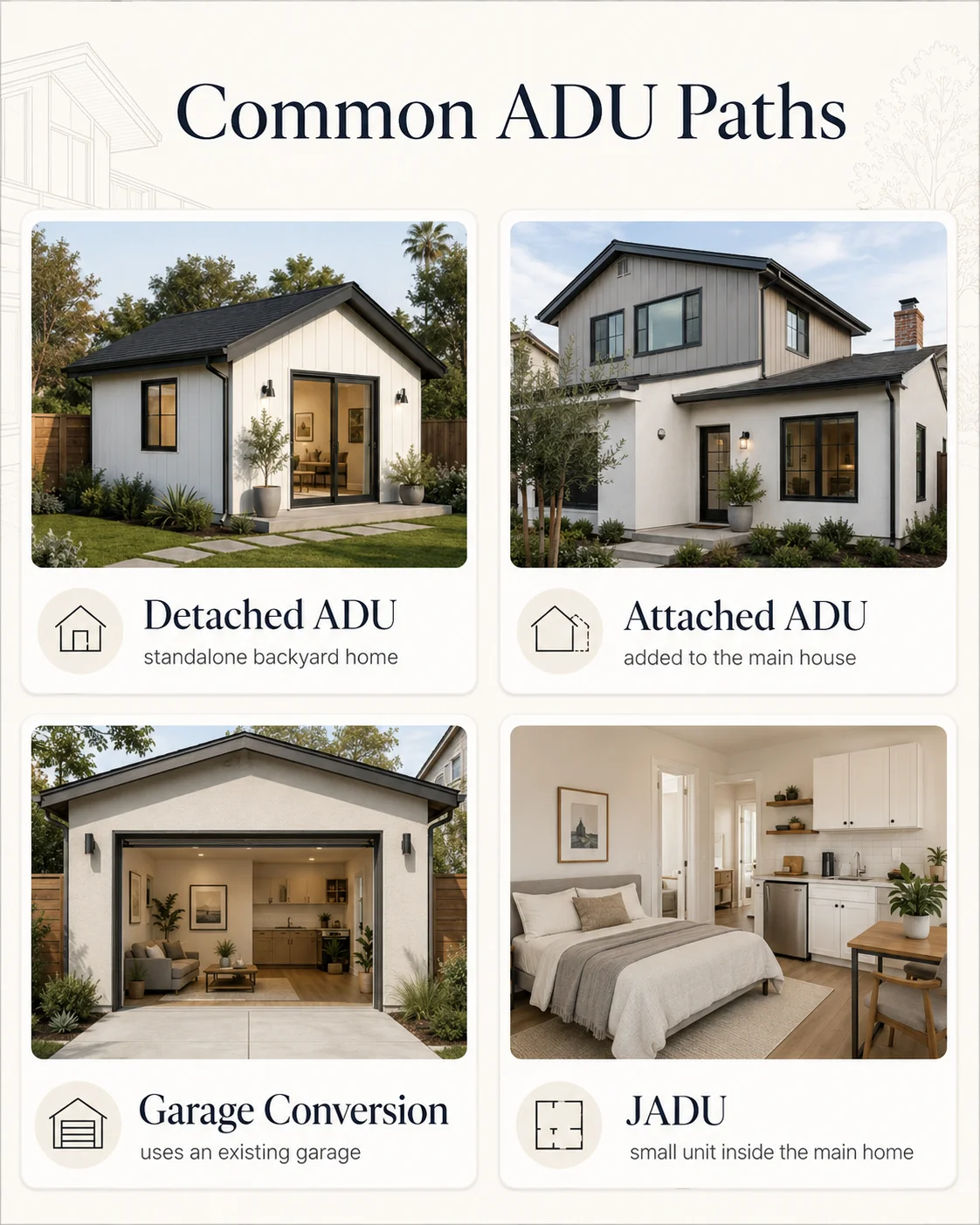
Unincorporated San Diego County permits five recognized ADU paths under PDS‑611: a detached new ADU on the same legal lot; an attached new ADU sharing a wall or floor with the primary residence; a conversion ADU within an existing permitted accessory structure or part of the main home; a Junior ADU (JADU) contained inside the primary residence; and — on multifamily lots — multiple detached or interior‑conversion ADUs. As of April 4, 2026, qualifying ADUs may also be sold separately as condominiums under AB 1033, and since the County’s September 4, 2025 Director’s Determination a Tiny Home on Wheels can qualify as an ADU. We see homeowners pick the wrong path more often than we see them pick the wrong builder.
Detached ADU
A separate freestanding structure with no shared walls or floors with the main house. PDS‑611 caps detached size at 1,200 sq ft and height at 25 feet on single‑family lots, with two stories allowed. Detached units typically have the highest design freedom and rental value, but also the highest sitework exposure — foundation, utilities, possibly new water and sewer/septic taps. Per the California Energy Commission 2025 Energy Code ADU FAQ, newly constructed detached ADUs must satisfy the Title 24 solar PV requirement unless an exception applies.
Attached ADU
An attached ADU shares a wall, ceiling, or floor with the primary home. PDS‑611 limits attached size to 50% of the primary residence’s floor area or 1,200 sq ft, whichever is less — but state law protects up to 850 sq ft (studio or one‑bedroom) or 1,000 sq ft (two bedrooms or more) regardless of the 50% rule. The practical effect: even a 1,400 sq ft primary home can usually still receive a 1,000 sq ft attached ADU. Attached ADUs are not required to add new solar PV because they are treated as additions to the primary residence.
Conversion ADU
Converting an existing permitted accessory structure — a detached garage, barn, workshop, recreation room — into an ADU. PDS‑611 p. 2 confirms that no new development standards (maximum size, height, lot coverage, setbacks) apply if an existing and permitted accessory structure is being converted, except for fire safety. A permitted 3,000 sq ft barn could potentially convert to a 3,000 sq ft ADU without triggering the 1,200 sq ft cap. Conversions also qualify for a 150 sq ft expansion solely to accommodate ingress and egress.
Junior Accessory Dwelling Unit (JADU)
A JADU is a smaller unit — up to 500 sq ft per PDS‑611 p. 3 — created entirely inside an existing or proposed primary single‑family dwelling, with a separate entrance. JADUs may share sanitation facilities with the main house or have their own. JADU owner‑occupancy now applies only when the JADU shares sanitation facilities (AB 1154, effective January 1, 2026). If you demolish or convert a garage to create the JADU, the two required parking spaces for the SFD must be replaced.
Separate‑sale or condominium ADU (AB 1033)
On March 4, 2026, the Board of Supervisors voted unanimously to adopt the ADU Zoning Ordinance Amendment, including a local AB 1033 implementation under Section 6156.x.D. The amendment went into effect April 4, 2026, with no additional local eligibility criteria adopted at that time. The mechanism is a Tentative Parcel Map or Tentative Map application under the Subdivision Map Act, not a simple building permit. JADUs are explicitly excluded. County staff released draft options for additional local criteria for public review from May 1 to May 31, 2026, with a Board of Supervisors hearing scheduled for late Summer 2026. If you are timing an AB 1033 conversion, that hearing is the date to watch.
Tiny Home on Wheels (THOW)
Under the County’s September 4, 2025 Director’s Determination, a Tiny Home on Wheels may qualify as an ADU in unincorporated areas if it meets standard ADU requirements plus specific conditions: a maximum of 430 sq ft measured from the inside face of walls, one story with a maximum height of 16 feet, a non‑combustible exterior, dual‑glazed windows, a Class A roof, connection to electric, water, and sewer/septic utilities under a building permit, and residential fire sprinklers (unless the ADU sprinkler exemption applies). The unit cannot move under its own power. On septic parcels, DEHQ recommends obtaining wastewater layout approval before applying for the building permit. (County Director’s Determination, September 4, 2025; County News Center, October 1, 2025; County DEHQ THOW FAQ.)
ADU path matrix
| ADU path | Typical strengths | Typical trade‑offs | Best fit |
|---|---|---|---|
| Detached new | Privacy, rental flexibility, full size envelope (up to 1,200 sq ft, 25 ft, 2 stories) | Highest sitework exposure, Title 24 solar requirement, longest construction timeline | Backyard rental, ADU‑first investment, family separation |
| Attached new | Lower utility complexity, retains backyard, 850/1,000 sq ft state floor, no solar requirement | Fire rating between ADU and main house, separate entrance required | Smaller primary homes that still want a meaningful ADU |
| Conversion (garage, barn) | No size/height/setback rules if structure is existing and permitted; 150 sq ft ingress/egress bonus | Existing condition determines cost; deep code upgrades can erase the savings | Properties with a sound existing accessory structure |
| JADU | Smallest scope, often lowest cost | Owner‑occupancy if sanitation is shared; 500 sq ft cap | Aging‑in‑place, adult child, in‑law unit, modest rental |
| Multifamily detached | Up to 8 detached ADUs on existing multifamily lots | 18 ft height cap on existing‑multifamily detached ADUs; parking and access more complex | Existing duplex/triplex/quad owners |
| AB 1033 separate sale | Unlocks ADU as an independently saleable asset | Subdivision/condo process, lienholder and utility consent, JADUs excluded | Owners building an ADU specifically to sell or leave to a family member |
| Tiny Home on Wheels (THOW) | Factory‑built product, faster install, qualifies as an ADU under the Sept. 4, 2025 Director's Determination | 430 sq ft / 16 ft / one‑story cap, non‑combustible exterior and fire‑sprinkler conditions, septic layout approval recommended first | Owners who want a manufactured tiny‑home product on an unincorporated lot |
How big can your ADU actually be?
Section 6156.x and PDS‑611 cap detached ADUs at 1,200 sq ft of floor area, independent of the primary residence’s size. Attached ADUs are capped at the lesser of 50% of the primary residence or 1,200 sq ft, but state law protects an attached ADU floor of 850 sq ft (studio or one‑bedroom) or 1,000 sq ft (two bedrooms or more), so the 50% rule rarely binds in practice. JADUs are capped at 500 sq ft. Conversion ADUs inside existing permitted accessory structures are not subject to the 1,200 sq ft cap.
Note on measurement: PDS‑611 says the calculation is measured from the interior dimensions of the outside walls; the current codified §6156.x says exterior dimensions. The two methods can produce a small but consequential difference for a borderline 1,200 sq ft project — confirm the current submittal method with PDS at intake.
| Primary residence | Max detached ADU | Max attached (studio/1‑BR) | Max attached (2+ BR) |
|---|---|---|---|
| 500 sq ft | 1,200 sq ft | 850 sq ft | 1,000 sq ft |
| 1,000 sq ft | 1,200 sq ft | 850 sq ft | 1,000 sq ft |
| 1,800 sq ft | 1,200 sq ft | 900 sq ft | 1,000 sq ft |
| 2,000 sq ft | 1,200 sq ft | 1,000 sq ft | 1,000 sq ft |
| 2,200 sq ft | 1,200 sq ft | 1,100 sq ft | 1,100 sq ft |
| 3,000 sq ft | 1,200 sq ft | 1,200 sq ft | 1,200 sq ft |
| 4,500 sq ft | 1,200 sq ft | 1,200 sq ft | 1,200 sq ft |
Source: County of San Diego ADU Handbook, April 2024, p. 16 — adapted. State‑law floors under Cal. Gov. Code §66323 mean homeowners with smaller primary residences can still receive a 1,000 sq ft two‑bedroom attached ADU.
The 800 sq ft safe harbor
State law (Gov. Code §66321) treats 800 sq ft as a floor that local ordinances cannot dip below for at least one ADU on the lot. ADUs up to 800 sq ft receive a packaged set of advantages: exemption from lot coverage limits, permission to encroach into the required front‑yard setback if the backyard cannot accommodate the unit, no parking requirement, and an 18 ft height cap. If your lot is hostile to a larger ADU — small, irregular, sloped, in a tight neighborhood — the 800 sq ft envelope is usually the path of least resistance.
Where can the ADU sit on the lot?
For newly constructed ADUs, PDS‑611 requires a minimum 4‑foot side and rear setback, except where fire setbacks are larger. The front‑yard setback follows the underlying zone’s measurement, unless the ADU is 800 sq ft or smaller and the backyard cannot accommodate it — in which case front‑yard encroachment is allowed. Detached ADUs on single‑family lots can reach 25 feet in height with two stories. Existing permitted conversions inherit their existing setbacks.
Side & rear setbacks
4 feet from side and rear lot lines for new construction, and 4 feet from the edge of any easement, street, or property line on the exterior side yard of a corner lot. Fire setbacks can override these minimums. The County does not specify zero‑setback rules for small detached units the way the City of San Diego does.
Front‑yard encroachment
An ADU of 800 sq ft or less may encroach into the required front yard setback if siting in the backyard is not feasible. Other state‑mandated benefits travel with sub‑800 sq ft ADUs: no parking requirement, 18 ft height cap, exemption from lot coverage limits.
Height
Detached ADUs on single‑family lots are limited to 25 feet, with two stories explicitly permitted. Attached ADUs cannot exceed the height of the primary residence or 16 feet, whichever is higher. Detached ADUs in existing multifamily complexes are capped at 18 feet; proposed multifamily complexes may allow up to 25 ft per current §6156.x — see Source Conflict Tracker.
Conversion ADU setbacks
Conversion of existing permitted structures: no new setback requirements for the existing footprint. Any new addition beyond the existing footprint must comply with the 4‑foot rule. The 150 sq ft ingress/egress addition is the one exception specifically carved out by PDS‑611.
Building separation
A detached ADU must maintain a minimum 6‑foot separation (wall‑to‑wall) from other structures, with a 4‑foot minimum eave‑to‑eave. If any face sits closer than 5 feet to a property line, the Building Code requires fire‑rated construction on that face — a real added cost on many builds.
Do you need an extra parking space?
The default rule under PDS‑611 is one parking space per ADU. That space may be tandem in an existing driveway and may sit within the setbacks. Replacement parking is not required when a garage, carport, or covered parking structure is demolished or converted as part of an ADU project (SB 1211, effective January 2025). Parking is not required at all for JADUs.
| Project type | Parking space required? |
|---|---|
| Detached new construction, more than ½ mile from public transit, no other exemption | Yes — 1 space |
| Detached new construction, within ½ mile of public transit | No |
| Detached new construction, within a historic district | No |
| Attached ADU (state‑law exemption applies) | No |
| Conversion ADU from existing space within primary residence or accessory structure | No |
| JADU | No |
| Garage or carport being demolished or converted as part of the ADU project | No replacement parking required |
| JADU created from converting a garage or carport | Replacement parking for the SFD is required |
Source: County of San Diego PDS‑611 p. 1; Cal. Gov. Code §66322; SB 1211 (eff. January 2025).
How long does the County permit process actually take?
California Government Code §66317 requires the County to deem an ADU application complete or incomplete within 15 business days of submission, and to approve or deny a complete application within 60 days when an existing single‑family or multifamily dwelling is on the lot. Those numbers describe a clean, complete application that does not require revisions or outside‑agency review. Homeowner‑reported timelines for unincorporated parcels typically run three to five months for a clean project and six to twelve months once septic, fire, or revisions enter the picture.
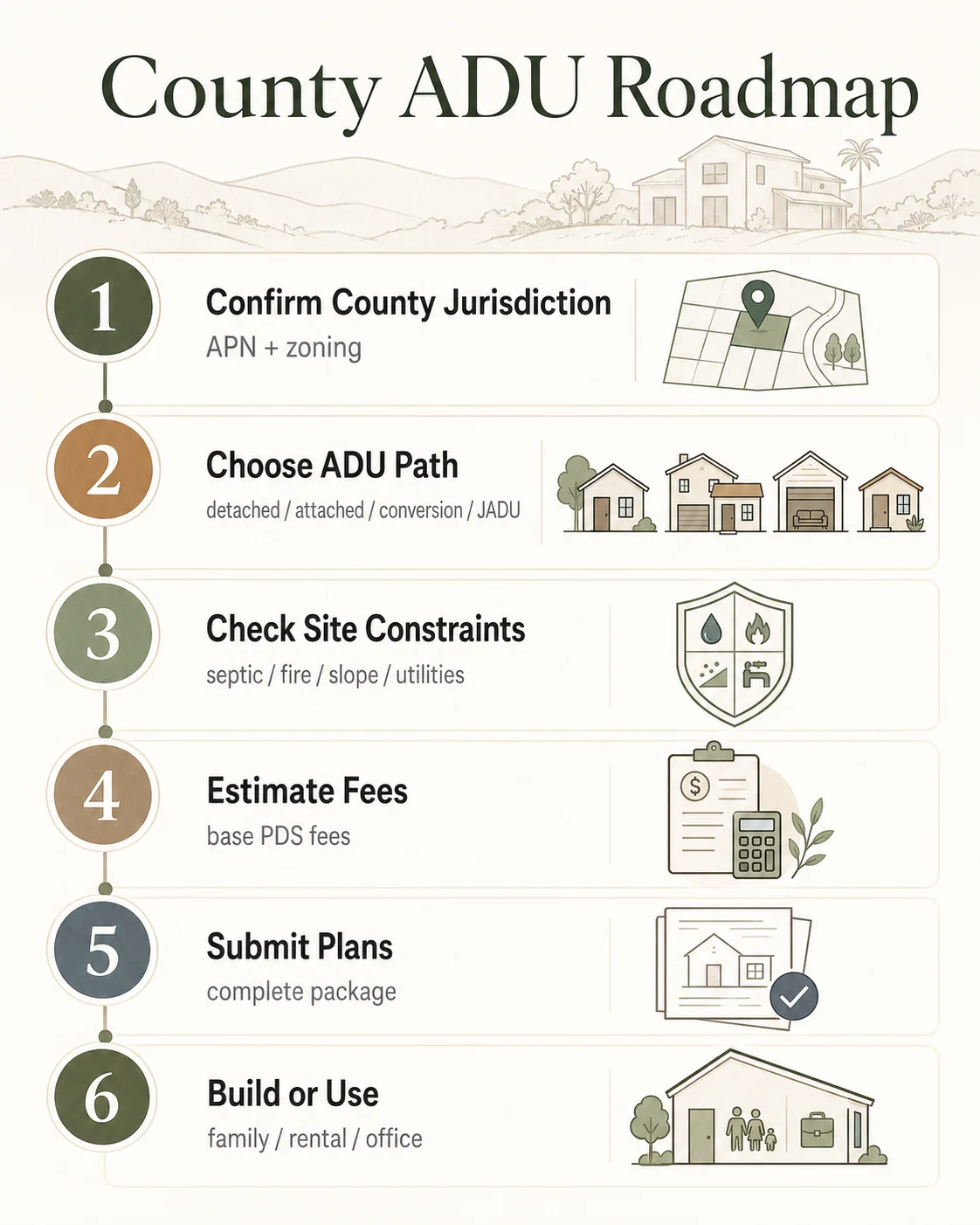
The County’s official build‑an‑ADU process runs 14 steps grouped into four phases:
- Decide and prepare. Photograph the existing residence, retrieve your Property Summary Report, talk to PDS at 5510 Overland Ave Suite 110 about constraints (slope, agricultural buffer, septic, accessory structures), and decide if you will use a pre‑approved County plan, custom design, prefab, or owner/builder permit.
- Design and apply. Draft plans, finalize construction drawings, submit for plan review at the pre‑intake appointment, and pay plan check fees.
- Obtain permit. Revise drawings as needed, receive building permit issuance, obtain bids, select a contractor.
- Construct and occupy. Build, pass inspections, receive Certificate of Occupancy, occupy or rent.
Pre‑approved County plans (the genuine shortcut)
The County publishes six dwelling‑unit plans (Plans A through F) that may be used as ADUs on unincorporated parcels. They are approximately 85% complete — the applicant fills in project‑specific information. They are free, pre‑reviewed for code compliance at the plan level, and materially shorten the front of the permit timeline.
| Plan | Size | Bedrooms / baths | Where it fits |
|---|---|---|---|
| Plan A | 1,200 sq ft | 3 BR / 1 BA | Max‑size family or rental ADU |
| Plan B | 1,200 sq ft | 2 BR / 1 BA | Larger long‑term rental |
| Plan C | 1,200 sq ft | 2 BR / 2 BA | Higher‑utility layout for family or rental |
| Plan D | 1,000 sq ft | 1 BR / 1.5 BA | Larger one‑bedroom, parent or downsizer |
| Plan E | 800 sq ft | 1 BR / 1 BA | State‑law safe‑harbor size with full bonuses |
| Plan F | 600 sq ft | 1 BR / 1 BA | Smallest detached footprint, lower cost exposure |
Pre‑approved plans do not eliminate site‑specific work (septic, fire, foundation, slope, utility) and do not bypass DEHQ or fire authority review. They shorten the path through PDS, not the path through the rest of the County.
How much are ADU permit fees in unincorporated San Diego County?
Under the FY25/26 PDS‑613 fee schedule (Rev. 06/05/2025, effective 07/01/2025), the County charges a plan review fee of $1,865 + $0.394/sq ft and a permit fee of $1,596 + $0.537/sq ft for the standard Guest House/Accessory Dwelling Unit category. For ADUs that qualify for Over‑the‑Counter (OTC) Review, the plan review fee drops to $1,084 + $0.304/sq ft while the permit fee remains the same. These are base County PDS fees only and exclude school fees, impact fees on units above 750 sq ft, fire district review, DEHQ septic review, utility connection fees, grading fees, and any other agency costs.
Fee waiver expired January 9, 2024. The County’s trial impact fee waiver that ran from 2019–2024 has ended. Projects that did not pull a permit by that date now pay the full schedule.
Worked fee examples
Calculated directly from the PDS‑613 formulas: Plan Review = $1,865 + ($0.394 × sq ft) for standard or $1,084 + ($0.304 × sq ft) for OTC; Permit = $1,596 + ($0.537 × sq ft) in both cases.
| ADU size | Standard review + permit | OTC review total | Impact‑fee status | Notes |
|---|---|---|---|---|
| 499 sq ft | $3,925.57 | $3,099.66 | Exempt | Also affects school‑fee treatment — verify district |
| 500 sq ft | $3,926.50 | $3,100.50 | Exempt | School‑fee treatment may shift at 500 sq ft |
| 749 sq ft | $4,158.32 | $3,309.91 | Exempt | At or under 750 sq ft, no impact fees per Gov. Code §66311.5 |
| 750 sq ft | $4,159.25 | $3,310.75 | Exempt | The 750 sq ft impact‑fee cliff |
| 800 sq ft | $4,205.80 | $3,352.80 | Proportional impact fees may apply | State‑law safe‑harbor size |
| 1,000 sq ft | $4,392.00 | $3,521.00 | Proportional impact fees may apply | Plan D match |
| 1,200 sq ft | $4,578.20 | $3,689.20 | Proportional impact fees may apply | Plan A / B / C match; max detached size |
Figures are PDS plan review + permit fees only. They do not include school fees, DEHQ septic review (~$1,100 for OWTS layout, plus $3,500+ for a perc test if required), fire authority review, utility connection or capacity fees, grading, stormwater, or any other agency costs. Source: County of San Diego PDS‑613, Rev. 06/05/2025.
The 750 sq ft impact‑fee cliff
California Government Code §66311.5 prohibits local jurisdictions from imposing impact fees on an ADU with 750 sq ft or less of interior livable space, or on a JADU of 500 sq ft or less. Above 750 sq ft, impact fees may be charged on a proportional basis. A 749 sq ft ADU and a 751 sq ft ADU can differ by several thousand dollars in impact fees alone — one of the most consequential design decisions in an ADU budget.
The 7.5% Green Building discount
PDS‑613 page 5 provides a 7.5% reduction on plan check and permit fees for projects participating in the County’s Green Building Program (Board of Supervisors Policy F‑50). Three qualifying paths exist: exceeding California Energy Commission standards by 15%+, incorporating straw‑bale construction or 20%+ post‑consumer recycled content in primary materials, or installing a permitted gray water system. Solar required under Title 24 does not automatically qualify the project.
Get my real fee estimate →
Free, parcel‑specific report that runs your address against the current PDS‑613 schedule, school district, fire district, and DEHQ status — so you know the actual fee stack before you commit to a design. No phone number required.
Get My Real Fee Estimate →How much does an ADU cost to build in unincorporated San Diego County?
San Diego County builder reporting from late 2025 and early 2026 consistently places all‑in detached ADU costs in the $300,000 to $450,000+ range, equivalent to roughly $375 to $600 per square foot for new detached construction. Conversion ADUs typically run lower per project but vary widely with the existing structure’s condition. Attached ADUs sit between the two. These ranges describe well‑run, code‑compliant projects on relatively favorable lots; the cost drivers that push past $450,000 are nearly all parcel‑specific.
| Cost driver | Typical cost impact | Source basis | When it shows up |
|---|---|---|---|
| Detached new vs. attached or conversion | 25%+ higher per square foot for detached | Builder cost guides, early 2026 | Foundation, framing, roofing, utility runs all new |
| Septic upgrade or replacement | $15,000–$50,000+ | County DEHQ fees + builder reporting | DEHQ determines existing OWTS cannot handle ADU load |
| Long utility runs from street | $5,000–$30,000+ | Builder reporting, parcel‑specific | Rural lots with detached ADU far from existing tie‑in |
| Hillside / slope grading | $20,000–$75,000+ | County grading fee schedule + builder reporting | Slopes over 10%; grading on slopes exceeding 25% not advised |
| Fire‑area construction (WUI / VHFHSZ) | 10%–25% premium on shell | Builder reporting; CBC Chapter 7A requirements | Ignition‑resistant materials, defensible space |
| On‑site water storage tank | $10,000–$25,000+ | Builder reporting; varies by fire district | Required by some fire authorities in rural areas |
| Title 24 solar PV system | $8,000–$20,000+ | Builder reporting; California Energy Commission | Required on new detached non‑manufactured ADUs |
| Separate electric meter | $3,000–$10,000+ | Builder reporting; SDG&E coordination | Optional for ADU; not permitted for JADU per PDS‑611 |
| Custom design vs. pre‑approved plan | $10,000–$25,000+ in design fees | Builder reporting | Custom architecture, two‑story, atypical site |
These are illustrative planning ranges drawn from current San Diego County builder reporting (SnapADU, Better Place Design + Build, Creative Design and Build, Freeman’s Construction, USModular). They are not quotes and are not specific to your parcel. Get itemized written bids from licensed contractors before committing to a budget.
Talk to a local County‑experienced builder → We maintain a separate, regularly verified guide to the best ADU builders for unincorporated San Diego County, including SnapADU, which has reported more than 100 ADU projects in San Diego County and explicitly serves the unincorporated communities listed on this page. The guide explains the affiliate relationship and the geographic fit criteria we use.
Rentals, owner‑occupancy, and the new AB 1033 separate‑sale path
Standard ADUs in unincorporated San Diego County may be rented long‑term, with a 31‑day minimum stay — short‑term rental use under 30 days is prohibited per PDS‑611. There is no owner‑occupancy requirement for standard ADUs under California state law (made permanent by AB 976), so you can rent both the main house and the ADU to separate tenants. JADUs still carry an owner‑occupancy rule when sanitation is shared with the primary home; AB 1154 (effective January 1, 2026) removed the requirement for JADUs with separate sanitation facilities.
31‑day minimum stay
Both PDS‑611 and the County ADU Handbook prohibit ADU rentals of less than 30 days. Safest framing: 31+ day minimum. Do not underwrite an unincorporated County ADU as an Airbnb.
No owner‑occupancy for standard ADUs
California removed the owner‑occupancy requirement for newly permitted ADUs in 2019 and made the removal permanent through AB 976. You can build an ADU and rent both units without living on the property.
JADU owner‑occupancy nuance
AB 1154 (eff. Jan. 1, 2026) requires owner‑occupancy for JADUs only when sanitation is shared. A JADU with its own separate bathroom does not require owner‑occupancy under current law (state law controls).
The AB 1033 condominium pathway
On March 4, 2026, the San Diego County Board of Supervisors voted unanimously to adopt the ADU Zoning Ordinance Amendment, including a local AB 1033 implementation at Section 6156.x.D. The implementation went into effect April 4, 2026 with no additional local eligibility criteria. JADUs are explicitly excluded.
The path is a Tentative Parcel Map or Tentative Map application under the Subdivision Map Act, not a simple building permit. The steps:
- Confirm the property is in unincorporated County jurisdiction.
- Apply for a Tentative Parcel Map or Tentative Map.
- Prepare the condominium plan (a precise, recorded boundary of each unit).
- Create the Homeowners Association Bylaws and CC&Rs under the Davis‑Stirling Common Interest Development Act.
- Obtain written lienholder consent (your mortgage holder must agree).
- Notify all utility providers used by the property.
- Complete final inspection on the ADU and obtain a Certificate of Occupancy.
- Record the Final Map and the Condominium Plan with the County Recorder.
AB 1033 break‑even math
| Component | Typical range | Source basis |
|---|---|---|
| Tentative Parcel Map / Tentative Map filing | $5,000–$15,000+ | County application fees + builder/consultant reporting |
| Civil survey and condominium plan | $20,000–$25,000 | Industry reporting from early 2026 AB 1033 conversions |
| HOA setup: bylaws and CC&Rs | $3,000–$8,000 | Attorney fee reporting for small HOA setups |
| Recording, title, utility notification | $1,000–$3,000 | County Recorder + standard title costs |
| Total conversion documentation (estimate) | $30,000–$55,000+ | Dwelling Index synthesis; ranges only |
AB 2533: amnesty for pre‑2020 unpermitted ADUs
California AB 2533 (2024) expanded a permitting amnesty path for unpermitted ADUs and JADUs constructed before January 1, 2020. The County now accepts permit applications for previously unpermitted construction that meets certain health, safety, and building standards, and prohibits local jurisdictions from denying permits due to most violations unless necessary to address actual health and safety concerns. The County’s Substandard Structure Checklist sets out what eligible applicants must demonstrate. A confidential third‑party code inspection from a licensed contractor is allowed before submission.
What site conditions can derail an unincorporated County ADU?
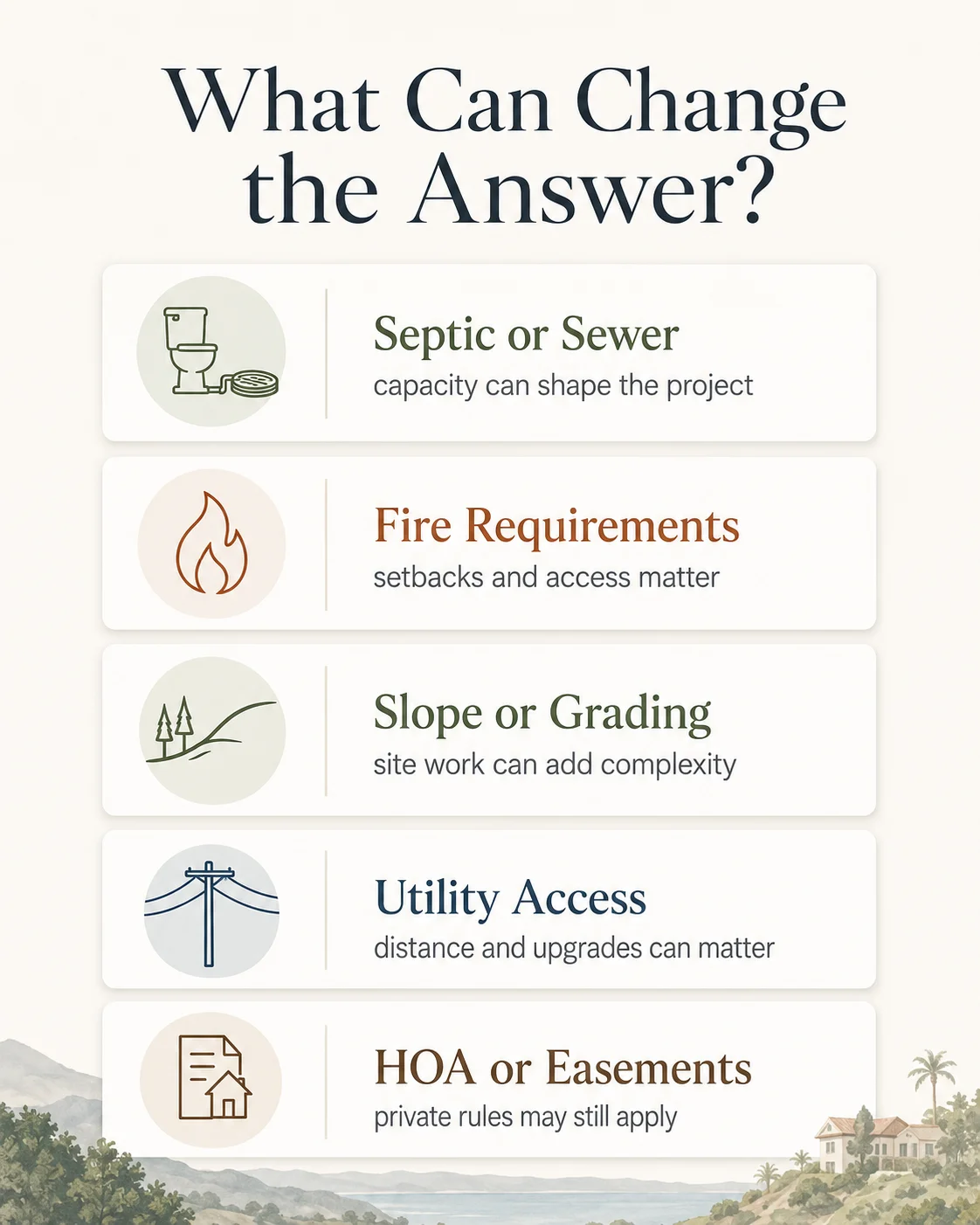
The headline ADU allowance rarely kills an unincorporated County project on its own. The thing that does is some combination of septic capacity, fire‑zone construction requirements, slope and grading, easements, utility distance, HOA or design review, and overlay zones. We treat the site assessment as a separate budget gate that should happen before architectural design begins — not after.
Septic and OWTS
If your property is not on public sewer — which is true of large portions of unincorporated County — your ADU requires Department of Environmental Health and Quality (DEHQ) approval of an OWTS Layout Application before PDS will issue a building permit. The existing disposal field may need to be expanded, an additional septic tank may be required, or a new separate system may be needed if the existing field cannot accommodate the additional flow.
Costs typically include the OWTS Layout Application (~$1,100 per County DEHQ fee structure), a percolation test if required ($3,500 or more), and the system upgrade itself ($15,000 to $50,000+ depending on scope). Sequence DEHQ before design — a failed perc test can rule out a 1,200 sq ft design after $15,000–$20,000 in architectural work is already complete.
Fire zones and defensible space
Most of the rural unincorporated County sits within a Very High Fire Hazard Severity Zone (VHFHSZ) under the CAL FIRE FHSZ maps. Properties in these zones face additional requirements:
- Defensible space under California Public Resources Code §4291 — typically 100 feet of fuel modification around structures
- Ignition‑resistant construction — Chapter 7A of the California Building Code for exterior materials, roofing, eaves, vents, and windows
- Fire access and water supply — driveway widths, turnouts, hydrant proximity, sometimes a dedicated water storage tank
- Zone 0 (AB 3074) — a 5‑foot ember‑resistant zone around structures; confirm current effective dates with the fire authority controlling your parcel
The fire authority covering your parcel matters. Different districts have different supplemental requirements. Check your fire‑zone status at osfm.fire.ca.gov/FHSZ and identify your fire district through County PDS. PDS‑611 strongly encourages early fire‑department contact — typically before final design.
Slope, grading, and access roads
Areas with less than 10% slope are ideal for ADU development. Grading on slopes exceeding 25% is not advised. Combinations of grading and retaining walls can level a portion of a steeper property, but each foot of grade and each linear foot of retaining wall adds materially to the budget. If your project requires grading, a separate grading permit is required ($1,054 plan + $796 permit per PDS‑613, plus site‑specific costs).
HOA, design review, and CC&Rs
A County permit is not the same thing as HOA approval. Rancho Santa Fe Association, 4S Ranch HOAs, and numerous covenanted communities in unincorporated County have their own design review, materials requirements, and approval timelines on top of the County process. State law preempts unreasonable HOA prohibitions on ADUs themselves, but reasonable design review remains enforceable. Check your HOA before you commit to a design.
Utilities, coastal zone, and easements
Unincorporated County parcels vary widely in distance to existing utility connections. Long underground runs add cost. The unincorporated County’s Local Coastal Program zone covers only a small portion of Rancho Santa Fe; Coastal Development Permits may be required for ADUs in that small zone. Many parcels carry utility, access, or open‑space easements that constrain where structures may be placed. Overlay zones — biological, archaeological, agricultural buffer, MSCP conservation areas — can require additional study, mitigation, or setbacks.
Run my site‑risk check →
Get a free, address‑specific snapshot covering septic vs. sewer, fire zone, slope, overlay zones, and likely complexity rating — so you know which gates your project has to clear before you spend on plans.
Run My Site‑Risk Check →Which unincorporated communities are usually higher‑complexity for ADUs?
Site conditions in unincorporated San Diego County vary dramatically by community. The matrix below was assembled from County PDS, DEHQ public records, CAL FIRE FHSZ maps, fire district boundary data, and builder reporting from late 2025 and early 2026. Every row reflects typical conditions for the community as a whole; individual parcels can differ. Confirm sewer/septic, fire district, and VHFHSZ exposure for your specific APN before relying on this matrix.
| Community | Sewer / septic | Fire authority | VHFHSZ exposure | Typical complexity |
|---|---|---|---|---|
| Fallbrook | Mostly septic | North County FPD | Partial; significant in eastern Fallbrook | Medium–High |
| Valley Center | Mostly septic | Valley Center FPD | Significant | High |
| Lakeside | Mixed sewer/septic | Lakeside FPD / CAL FIRE | Partial | Medium |
| Alpine | Mostly septic | Alpine FPD | Significant | High |
| Ramona | Mostly septic | CAL FIRE / Ramona MWD | Significant | High |
| Julian | Septic | CAL FIRE | High | High |
| Bonsall | Mostly septic | North County FPD | Partial | Medium |
| Bonita | Mostly sewered | San Miguel Consolidated Fire | Low | Low–Medium |
| Spring Valley | Mostly sewered | San Miguel Consolidated Fire | Low | Low–Medium |
| Rancho Santa Fe | Mostly septic | Rancho Santa Fe FPD | Significant; small Coastal LCP slice | High |
| Pauma Valley | Septic | CAL FIRE / North County FPD | High | High |
| 4S Ranch | Sewered | Rancho Santa Fe FPD / Deer Springs FPD | Lower | Medium |
| Mount Helix | Mostly sewered | San Miguel Consolidated Fire | Low–Moderate | Medium |
| Hidden Meadows | Septic | Deer Springs FPD | Significant | High |
| Jamul | Septic | San Diego County Fire Authority | High | High |
| Pala | Mostly septic | North County FPD / CAL FIRE | High | High |
| Rainbow | Mostly septic | North County FPD | High | High |
| Sweetwater | Mixed | San Miguel Consolidated Fire | Low–Moderate | Medium |
| Twin Oaks | Mostly septic | Deer Springs FPD / North County FPD | Significant | Medium–High |
| Valle De Oro | Mostly sewered | San Miguel Consolidated Fire | Low | Low–Medium |
| Del Dios | Septic | Rancho Santa Fe FPD | Significant | High |
| Fairbanks Ranch | Septic | Rancho Santa Fe FPD | Significant | High |
| Boulevard / Campo / Pine Valley / Mt. Laguna | Septic | CAL FIRE | High to Very High | High–Very High |
Methodology: typical sewer/septic status reflects public infrastructure mapping and DEHQ records as of early 2026; fire authority assignment reflects current district boundaries; VHFHSZ exposure reflects CAL FIRE FHSZ maps (osfm.fire.ca.gov/FHSZ). Individual parcels can differ. This matrix is a planning aid, not a guarantee for any specific APN.
How do unincorporated County rules differ from the City of San Diego?
The unincorporated County and the City of San Diego both follow the state ADU law floor, but they diverge on setbacks, height treatment, parking, plan submission method, AB 1033 implementation timing, and incentive programs. Confusing one set of rules for the other is the single most common mistake we see in design files.
| Topic | Unincorporated San Diego County | City of San Diego |
|---|---|---|
| Governing rule set | County Zoning Ordinance §6156.x; PDS‑611 (Rev. 01/7/2026) | SDMC Chapter 14, Article 1, Division 3; Information Bulletin 400 |
| Permit authority | County Planning & Development Services (PDS) | City Development Services Department (DSD) |
| Max detached ADU size | 1,200 sq ft | 1,200 sq ft (more if Bonus ADU under affordable program) |
| Detached ADU height | 25 ft on single‑family lots (2 stories); 18 ft on existing multifamily lots | Capped at two stories on single‑dwelling lots; must also comply with base‑zone and overlay‑zone maximum structure height |
| Side / rear setbacks | 4 ft minimum (except fire setbacks) | Varies by ADU type and height per Information Bulletin 400 |
| Plan submission | PDS Permit Center; online portal supports only limited simple‑permit categories | Digital submittal generally supported |
| Owner‑occupancy (ADU) | Not required | Not required |
| Short‑term rentals | Prohibited (31+ day minimum) | Prohibited for ADUs (31+ day minimum) |
| ADU Bonus / Affordable Program | None equivalent | Yes — ADU Home Density Bonus Program |
| AB 1033 separate sale | Effective April 4, 2026 (unincorporated only); no additional local criteria yet | Effective August 22, 2025 outside the Coastal Zone |
| Coastal Overlay | Small portion of Rancho Santa Fe only | Significant — Pacific Beach, La Jolla, Mission Beach, etc. |
| Sewered vs. septic | Mixed; large portions on septic | Almost entirely sewered |
| Fire zone exposure | Substantial — much of backcountry is VHFHSZ | Significant pockets, concentrated in canyons and eastern neighborhoods |
| Typical permit timeline | 3–5 months for clean projects; 6–12 months with septic / fire / revisions | 3–4 months typically |
What should you verify before paying for ADU plans?
We recommend running this 14‑item checklist before you spend money on architectural plans. The full list takes about a week of part‑time work for a homeowner and prevents the most expensive mistakes we see.
- 1Confirm APN and jurisdiction. Pull the Property Summary Report from publicservices.sandiegocounty.gov. If it does not say unincorporated County, stop and go to the right city guide.
- 2Confirm zone and primary dwelling. Residential or mixed‑use zone, existing or proposed SFD or multifamily.
- 3Choose your ADU path. Detached new, attached new, conversion, JADU, multifamily, AB 1033 separate‑sale target.
- 4Size against state‑law floors. Decide whether you want a sub‑800 sq ft, sub‑750 sq ft (impact‑fee threshold), or 1,200 sq ft envelope.
- 5Confirm setbacks and height. Side/rear 4 ft baseline, height 25 ft single‑family (existing‑multifamily 18 ft per PDS‑611).
- 6Run the septic / OWTS feasibility. Contact a DEHQ‑approved OWTS Professional. If you are on septic, do this before paying for architectural plans.
- 7Check the fire authority. Identify the fire district, check the VHFHSZ map, schedule an early consultation about defensible space, Zone 0, and water supply.
- 8Check HOA and CC&Rs. Pull your CC&Rs if you are in a covenanted community.
- 9Estimate base PDS fees. Use the worked examples in this guide and the County's Building Forms & Fee Estimator.
- 10Flag other agency fees. School fees, water/sewer district capacity, fire authority review, grading if applicable.
- 11Decide between Pre‑Approved Plans A–F and custom. If a 600–1,200 sq ft Plan fits your needs, it can shorten the front of your permit timeline.
- 12Sequence the permit submittal. Complete application, 15‑business‑day completeness check, 60‑day approval clock, Permit Center submittal.
- 13Plan for revisions. Build a budget contingency of 10–20% for design revisions and unexpected site conditions.
- 14Document for AB 1033 future‑proofing. Even if you do not plan to sell separately today, building documentation in a condo‑ready way preserves the option.
Mistakes we see homeowners make most often
Most unincorporated County ADU projects that derail do so for one of seven reasons. We list them here not to scare you off — the law is friendlier than ever — but to make sure you go in with eyes open.
| # | Mistake | Source of risk |
|---|---|---|
| 1 | Treating mailing city as jurisdiction. A “Fallbrook” mailing address does not mean Fallbrook city government regulates the parcel. The same can go the other way — a “San Diego” address can be inside the City of San Diego with completely different rules. | County PDS jurisdiction confirmation |
| 2 | Paying for plans before septic feasibility is established. DEHQ does not care that you have spent $20,000 on architecture. If the lot cannot perc, the design must change. | DEHQ OWTS application |
| 3 | Misreading the attached ADU 50% rule. The state‑law floor of 850 sq ft (one‑bedroom) or 1,000 sq ft (two‑bedroom) means the 50% cap rarely binds. Homeowners who skip the floor under‑size their attached ADU and lose rental income. | Gov. Code §66323; PDS‑611 |
| 4 | Ignoring the 750 sq ft impact‑fee cliff. A 749 sq ft ADU and a 751 sq ft ADU can differ by several thousand dollars in impact fees. If you do not need the extra two square feet, design under the threshold. | Gov. Code §66311.5 |
| 5 | Underestimating fire requirements. A VHFHSZ parcel can add 10% to 25% to the construction cost for ignition‑resistant materials and defensible space. Fire is not optional and is not negotiable with the district. | CAL FIRE; CBC Chapter 7A; PRC §4291 |
| 6 | Underestimating the Permit Center submission tax. Each revision round adds days of travel and printing. Plan submissions take longer when the homeowner manages the permit personally. | County PDS Permit Center process |
| 7 | Building without permits. AB 2533 amnesty exists for pre‑2020 unpermitted ADUs, but the path is documented and rigorous. New unpermitted construction is not eligible and creates title and sale issues that take years to unwind. | AB 2533; County Substandard Structure Checklist |
Frequently asked questions
Can I build an ADU in unincorporated San Diego County?
Most residentially zoned parcels with an existing or proposed primary dwelling can. Eligibility is established under PDS‑611 and verified against your specific parcel's zoning, primary dwelling status, septic, fire, and site conditions. (County of San Diego PDS‑611, Rev. 01/7/2026; Cal. Gov. Code §66323.)
How many ADUs can I build on a single‑family lot?
The baseline County allowance is one ADU plus one JADU. The codified §6156.x now allows the state‑law categories to be combined, which on qualifying lots can include an existing‑space ADU, a JADU, and a newly constructed detached ADU. Confirm current County practice at intake for combinations beyond ADU + JADU. (SD County ZO §6156.x; Cal. Gov. Code §66323.)
How big can a detached ADU be?
Up to 1,200 sq ft under PDS‑611, independent of the primary residence's size. The 800 sq ft state‑law safe‑harbor floor applies. Conversion ADUs within existing permitted accessory structures are not subject to the 1,200 sq ft cap. (County of San Diego PDS‑611 p. 1; Cal. Gov. Code §66321.)
How big can an attached ADU be?
50% of the primary residence's floor area or 1,200 sq ft, whichever is less — but the 50% cap does not apply to attached ADUs of up to 850 sq ft (studio or one‑bedroom) or up to 1,000 sq ft (two bedrooms or more). These state‑law floors mean most homes can receive an attached ADU of at least 1,000 sq ft even if 50% of the primary would be smaller. (Cal. Gov. Code §66323; SD County ZO §6156.x.)
How big can a JADU be?
Up to 500 sq ft, and the JADU must be created entirely within an existing or proposed primary single‑family dwelling, with a separate entrance. (County of San Diego PDS‑611 p. 3; Cal. Gov. Code §66333.)
What setbacks apply?
4‑foot side and rear minimums for new construction, except where fire setbacks require more. Front‑yard encroachment is allowed for ADUs of 800 sq ft or less when the backyard cannot accommodate the unit. Conversion ADUs within existing permitted structures inherit the structure's existing setbacks. (County of San Diego PDS‑611 p. 1.)
How tall can my detached ADU be?
25 feet on single‑family lots; 18 feet on existing‑multifamily lots per PDS‑611 (proposed multifamily may be up to 25 ft per current §6156.x — see Source Conflict Tracker). Two stories are permitted on single‑family lots. (County of San Diego PDS‑611 p. 1, p. 4.)
Can I convert my garage into an ADU?
Yes, if the garage is existing and permitted. No additional development standards (size, height, lot coverage, setbacks) apply for the existing structure footprint, except fire safety. New addition beyond the existing footprint must comply with setback and height rules. A 150 sq ft addition for ingress/egress is allowed without triggering new‑construction limits. (County of San Diego PDS‑611 p. 2.)
Do I need an extra parking space?
Generally one space for a new detached ADU, unless the project is within ½ mile of public transit, in a historic district, a conversion from existing space, attached to the primary residence, or meets another state‑law exemption in Government Code §66322. JADUs do not require an additional parking space. Replacement parking is not required when a garage is demolished or converted as part of an ADU project (SB 1211, effective January 2025). (County of San Diego PDS‑611 p. 1; Cal. Gov. Code §66322.)
Can I build on septic?
Yes, but you need Department of Environmental Health and Quality (DEHQ) approval of an On‑Site Wastewater Treatment System (OWTS) Layout Application before PDS will issue a building permit. Sequence DEHQ before architectural design — a failed perc test or insufficient leach field capacity can rule out a larger ADU after $15,000–$20,000 in design work. (County of San Diego ADU Handbook, April 2024, p. 10.)
Can I rent the ADU as a short‑term rental on Airbnb?
No. ADUs in unincorporated San Diego County must be rented for 31 days or longer per PDS‑611 and the County ADU Handbook. Short‑term rental use under 30 days is prohibited. (County of San Diego PDS‑611 p. 1; County ADU Handbook.)
Can I sell the ADU separately?
Yes, as of April 4, 2026, qualifying ADUs in unincorporated areas may be sold separately as condominium units under AB 1033, following a Tentative Parcel Map or Tentative Map application and a condominium plan. JADUs are not eligible for separate sale. No additional local eligibility criteria are adopted as of May 2026; the County's Board hearing on draft options is scheduled for late Summer 2026. (County of San Diego AB 1033 Zoning Ordinance Amendment, effective April 4, 2026; Cal. Gov. Code §66342.)
Does an ADU require owner‑occupancy?
Standard ADUs do not require owner‑occupancy (made permanent by AB 976). JADUs require owner‑occupancy only when sanitation is shared with the primary home, per AB 1154's amendment to Government Code §66333, effective January 1, 2026. A JADU with its own separate bathroom does not require owner‑occupancy under current law. (AB 976; AB 1154; Cal. Gov. Code §66333.)
Does the County still waive ADU fees?
No. The trial impact fee waiver ended on January 9, 2024. Current projects pay the full PDS‑613 fee schedule. The waiver previously eliminated building permit fees, onsite wastewater fees, development impact fees, traffic impact fees, and drainage fees. None of that relief is available today. (County of San Diego ADU Information page.)
How long does County permit review take?
State law sets 15 business days for a completeness determination and 60 days to approve or deny a complete application. Realistic permit timelines for unincorporated County projects run three to five months for clean projects and six to twelve months when septic, fire, or revisions are involved. (Cal. Gov. Code §66317.)
Are County dwelling unit plans pre‑approved?
The County publishes Plans A through F as approximately 85%‑complete sets covering 600–1,200 sq ft. They can shorten the front end of the permit timeline. They are not a full permit approval by themselves and do not eliminate site‑specific work (septic, fire, foundation, slope, utility). (County of San Diego Dwelling Unit Building Plans page.)
Will my property taxes go up?
Yes. The County Assessor will assess the new ADU at current valuation as part of the next property tax cycle. The existing footprint that is not touched by the project is generally not reassessed under Proposition 13. (Cal. Const. Art. XIII A; San Diego County Assessor.)
What if I built an ADU without permits before 2020?
California AB 2533 (2024) provides an expanded amnesty pathway for unpermitted ADUs and JADUs constructed before January 1, 2020, subject to health, safety, and building standards documented in the County's Substandard Structure Checklist. A confidential third‑party code inspection from a licensed contractor is allowed before submission. (AB 2533; County of San Diego PDS‑611.)
Can I have guest quarters and an ADU on the same lot?
This is currently unsettled. The County's PDS‑345 form (Rev. 2019) and the current codified §6156 generally prohibit guest quarters on the same lot as an ADU or JADU. SnapADU has reported a March 2026 email confirmation from a County Planning Manager indicating this rule changed, but the official handout has not yet been updated. Do not plan a project around this coexistence without explicit current PDS confirmation in writing for your specific parcel. (County of San Diego PDS‑345, Rev. 04/05/2019; §6156.)
Do I need solar panels on a new ADU?
Per the California Energy Commission 2025 Energy Code ADU FAQ, newly constructed detached ADUs must satisfy the Title 24 solar PV requirement unless an exception applies. Attached ADUs are not required to add new PV because they are treated as additions. Conversion ADUs and JADUs typically inherit the exemption rules of additions/existing structures. (California Energy Commission 2025 Energy Code ADU FAQs.)
Can my ADU have its own electric meter?
A separate electric meter is permitted for an ADU but is not required. Separate electric meters are not permitted for JADUs per PDS‑611. Coordinate with SDG&E for installation specifics. (County of San Diego PDS‑611.)
Are fire sprinklers required in a new ADU?
Not automatically. Under state law and County code, an ADU is not required to have fire sprinklers if they are not required for the primary residence, and building an ADU does not trigger a sprinkler requirement for the existing primary dwelling. If your existing primary already has sprinklers, expect to provide them in a new detached ADU. (Cal. Residential Code §R313.2; SD County ZO §6156.x.)
Do ADUs count toward density in unincorporated San Diego County?
No. County Zoning Ordinance §6156.x classifies ADUs as an accessory use that is not counted toward the allowable density under the County General Plan. An ADU does not consume a General Plan dwelling‑unit allocation. (SD County ZO §6156.x.)
Can I build a tiny home on wheels as an ADU?
Yes, in many cases. Under the County's September 4, 2025 Director's Determination, a Tiny Home on Wheels may qualify as an ADU if it meets standard ADU requirements plus specific conditions: a maximum of 430 sq ft measured from the inside face of walls, one story with a maximum height of 16 feet, a non‑combustible exterior, dual‑glazed windows, a Class A roof, utility connections under a building permit, and residential fire sprinklers unless the ADU exemption applies. On septic parcels, DEHQ recommends obtaining wastewater layout approval before applying for the building permit. (County Director's Determination, September 4, 2025; County News Center, October 1, 2025; County DEHQ THOW FAQ.)
What we verified, and what you still need to confirm
We verified the rules, fee formulas, and publication dates from the official County and state sources listed below. Your specific parcel still needs project‑specific confirmation.
| What we verified here | What still needs parcel‑specific confirmation |
|---|---|
| County unincorporated eligibility baseline | APN and jurisdiction confirmation via Property Summary Report |
| ADU and JADU size, height, and setback rules under PDS‑611 (Rev. 01/7/2026) | Exact buildable envelope on your lot |
| Base PDS‑613 plan review and permit fee formulas (Rev. 06/05/2025) | Total fees including school, fire, septic, utility, grading, and stormwater |
| 4‑ft side/rear setback baseline | Fire setbacks, easements, overlay requirements |
| State 15‑business‑day completeness and 60‑day approval framework (Gov. Code §66317) | Real timeline for your specific submittal |
| AB 1033 County separate‑sale authorization effective April 4, 2026 | Title, lienholder consent, HOA, condo plan, map compliance |
| AB 2533 amnesty pathway for pre‑2020 unpermitted ADUs | Eligibility of your specific structure |
| State impact‑fee threshold at 750 sq ft (ADU) and 500 sq ft (JADU) per Gov. Code §66311.5 | District‑specific school fees and other agency charges |
| Source conflicts between PDS‑611, current §6156.x, and state law | Current County submittal practice at intake |
Download the free ADU Starter Kit →
A printable property‑owner’s checklist covering jurisdiction, fees, financing paths, rental setup, and AB 1033 conversion questions to ask your contractor and the County. Delivered by email. Unsubscribe anytime.
Get My Free ADU Starter Kit →Methodology
This guide was researched and assembled by the Dwelling Index editorial team. Dwelling Index is an independent research resource covering ADU financing, costs, and regulations. We pulled the primary sources directly and verified each numeric value against the original document.
Primary County sources:
- County of San Diego PDS‑611, Accessory Dwelling Unit & Junior Accessory Dwelling Unit, Rev. 01/7/2026
- County of San Diego PDS‑613, Building Construction Permit Fees, Rev. 06/05/2025, effective 07/01/2025
- County of San Diego Accessory Dwelling Unit Handbook, April 2024
- County of San Diego ADU Information page (sandiegocounty.gov/pds) — Director’s Determination Letter, fee waiver end date, AB 2533, AB 1033
- County ADU Zoning Ordinance Amendment & AB 1033 Implementation page — Board adoption March 4, 2026; effective April 4, 2026
- County of San Diego Guidance for Separate Sale of ADUs under AB 1033, dated April 3, 2026
- County PDS Dwelling Unit Building Plans page (Plans A through F)
Primary state sources:
- California Government Code §§66310–66344 — §66311.5 (impact fee thresholds), §66317 (review clock), §66321 (safe‑harbor size), §66322 (parking exemptions), §66323 (combination rules), §66333 (JADU owner‑occupancy as amended by AB 1154, eff. Jan. 1, 2026), §66342 (AB 1033 authorization)
- California Public Resources Code §4291 (defensible space)
- California Energy Commission, 2025 Energy Code ADU FAQs
- CAL FIRE Fire Hazard Severity Zone maps (osfm.fire.ca.gov/FHSZ)
- California Department of Housing and Community Development (HCD) Findings Letter to San Diego County, September 2024
Secondary sources (planning ranges and context only):
- SnapADU published County of San Diego regulations page, March 2026 update
- Builder cost and timeline data from Urbatect, Better Place Design + Build, Creative Design and Build, Freeman’s Construction, USModular, and Maxable — clearly attributed where used
Fee table calculations were performed by hand directly from the PDS‑613 formulas. We checked every calculation twice.
This page is updated quarterly, with monthly check‑ins on AB 1033 implementation while the County completes its draft‑options review.
This guide is general information about County ADU rules. It is not legal advice. It is not financial advice. It is not a construction quote. Verify any decision that depends on these rules with the County of San Diego Planning & Development Services, your fire district, your water and sewer district, the Department of Environmental Health and Quality, a licensed contractor, a licensed lender, and where appropriate, an attorney.
Affiliate disclosure
For unincorporated San Diego County, our separately published Best ADU Builders Unincorporated San Diego County guide reviews the available options. SnapADU is among the builders we discuss on that page because they have reported more than 100 ADU projects in San Diego County, design and permit in‑house, and explicitly serve the unincorporated communities listed on this page. We do not promise that SnapADU is the right choice for every reader; we explain the criteria and let readers decide.
Not sure where to start?
You now have the rules, the fee math, the timeline reality, the site‑condition checklist, the community matrix, and the source conflict tracker. The remaining work is parcel‑specific. See what’s possible at your address — get your free ADU report in 60 seconds.
Get Your Free ADU Feasibility Report →