
Solana Beach Coastal Zone ADU: The 2026 Rules, Real Permit Path, and What It Actually Costs
By the Dwelling Index Editorial Team.
Bottom Line: What Every Solana Beach Property Owner Should Know First
The verdict. Yes, you can build an ADU in Solana Beach, but every project must be planned as a coastal-zone project from day one. The entire city lies inside the California Coastal Zone, so along with the city’s ministerial ADU permit you need a California Coastal Commission (CCC) approval — a Coastal Development Permit (CDP), waiver, or exemption — and the city now wants the CCC approval letter included with your building permit application. Under AB 462, an urgency statute effective October 10, 2025, complete ADU-related coastal permits are now subject to a 60-day decision clock and must run concurrently with the city’s ministerial review. This removed the main timeline risk that made Solana Beach projects unpredictable. HCD’s December 16, 2025 findings letter flagged multiple specific provisions of Ordinance 525 as noncompliant with state law; where local rules conflict with current state ADU law, state law generally controls.
Sources: City of Solana Beach Planning Permits page; ADU Submittal Process and Basic Plan Requirements (June 2025); SBMC § 17.20.040(D); Ordinance 525; AB 462 (Stats. 2025, ch. 552, urgency); HCD ADU Ordinance Review Letter to City of Solana Beach, December 16, 2025; California Government Code §§ 66311.5, 66317, 66321, 66326, 66329, 66333; Solana Beach Master Fee Schedule effective January 1, 2026; San Diego coastal ADU construction-cost data, March 2026.
Not sure if your specific parcel pencils out before you spend $5,000 to $15,000 on design?
See What You Can Build → Get Your Free Solana Beach ADU ReportSolana Beach ADU Quick-Reference: 2026
| Question | Bottom line for Solana Beach in 2026 |
|---|---|
| Are ADUs allowed in Solana Beach? | Yes, on qualifying lots with an existing or proposed primary residence in residential or mixed-use residential zones. |
| Is all of Solana Beach in the Coastal Zone? | Yes. The City states its entire jurisdiction sits inside the California Coastal Zone. |
| Who issues the coastal approval? | The California Coastal Commission. The City asks for the CCC approval letter with your building permit application. |
| What’s the cap on ADU size? | 850 sq ft studio/1-bed or 1,000 sq ft 2+ bed per local ordinance. State law independently protects at least 800 sq ft with 4-ft side/rear setbacks under § 66321. |
| What’s the fee-sensitive threshold? | 750 square feet. ADUs at or below that size are exempt from impact fees under Government Code § 66311.5. |
| How long should the permit take? | A complete application triggers state timing rules: 15 business days for city completeness review, then 60 days to decide. Complete ADU-related coastal permits also get a 60-day clock under § 66329. |
| Can I list it on Airbnb? | No. Solana Beach’s ADU materials require 30 consecutive days minimum and the city’s STVR framework excludes ADUs. |
| Detached ADU height? | 16 ft baseline; 18 ft within ½ mile of public transit or on a lot with a multifamily primary dwelling; +2 ft to match the primary home’s roof pitch in qualifying cases. |
| Can I sell the ADU separately? | No separate-sale ordinance found as of last verification; reverify with the City before relying on AB 1033. |
| Do bluff lots have a separate path? | Yes. The Solana Beach Land Use Plan requires a 40-ft bluff setback measured from the bluff edge, increased by a 75-year erosion analysis plus factors of safety. Setbacks cannot be reduced by relying on existing or proposed bluff-retention devices. |
What We Verified
We verified Solana Beach’s citywide Coastal Zone designation against the City of Solana Beach Planning Permits page and Chapter 8 of the certified Land Use Plan. We pulled the current ADU submittal sequence from the City’s June 2025 ADU Submittal Process and Basic Plan Requirements document, which directs applicants to email a completed building permit application, project plans, and a copy of the CCC approval letter to counter@cosb.org. We pulled the current ADU size, height, setback, and parking rules from Ordinance 525 and the current SBMC § 17.20.040(D). We confirmed the December 16, 2025 HCD ordinance review letter on hcd.ca.gov. We reviewed current California Government Code sections 66311.5, 66317, 66321, 66322, 66323, 66326, 66329, and 66333. We pulled the city fee data from the Solana Beach Master Fee Schedule effective January 1, 2026.
Items flagged for re-verification at filing: the current CCC San Diego Coast District filing fee for residential ADU CDPs; the property-specific combined SDUHSD plus elementary district school fee amount; Solana Beach’s response to HCD’s December 2025 noncompliance letter and any subsequent ordinance amendment; and the City’s position on AB 1033 separate-sale opt-in.
What Just Changed in Coastal ADU Law (and Why Most Pages You’ll Find Are Already Wrong)
Three changes between October 2025 and January 2026 reset the playing field for Solana Beach ADUs. AB 462, an urgency statute approved October 10, 2025 with immediate effect, applied a 60-day decision deadline to complete ADU-related coastal development permits, required CDP review to run concurrently with the underlying ADU permit review, and made local-government ADU CDP decisions under Government Code § 66329(a) non-appealable to the Coastal Commission. On January 1, 2026, AB 1154 removed owner-occupancy requirements for JADUs with their own bathroom, and SB 543 codified the prohibition on short-term rental of JADUs statewide. HCD’s December 16, 2025 findings letter flagged multiple specific provisions of Ordinance 525 as noncompliant.
Where Solana Beach’s local ordinance is weaker or stricter than current state ADU law on a covered topic, state law generally controls. Solana Beach’s ordinance itself states that state law controls in the case of a conflict. The other shift to watch is the California Coastal Commission’s forthcoming SB 1077 guidance, which the Commission has scheduled for final release in June 2026.
The 2025–2026 Solana Beach ADU Regulatory Timeline
| Date | Event | What it means for a Solana Beach homeowner |
|---|---|---|
| Dec 13, 2023 | Solana Beach adopts Ordinance 525, replacing SBMC § 17.20.040(D) | Current local ADU framework |
| Jan 1, 2025 | SB 1211 takes effect | Multifamily lots can build up to 8 detached ADUs (not 2), capped at existing primary unit count |
| Oct 10, 2025 | Governor signs AB 462 as an urgency statute; effective immediately | 60-day concurrent CDP review for complete ADU-related coastal permits; local ADU CDP decisions not appealable to CCC under § 30603 |
| Dec 16, 2025 | HCD issues findings letter on Ordinance 525 | City must respond within 30 days; state law generally controls in the case of conflict |
| Jan 1, 2026 | AB 1154, SB 543, SB 9 effective | JADUs with their own bathroom no longer subject to owner-occupancy; ordinance compliance regime tightened under § 66326 |
| Jan 1, 2026 | Solana Beach Master Fee Schedule effective | Current fee schedule for valuation-based permit math |
| June 2026 (target) | CCC SB 1077 ADU guidance final release | May further simplify ADU CDP processes in certified Local Coastal Programs |
Can I Build an ADU in Solana Beach’s Coastal Zone?
Answer capsule: Yes, on most lots that already contain or will contain a primary residence and sit in a residential or mixed-use residential zone.
Solana Beach allows ADUs and junior ADUs on single-family lots through several conversion and new-construction paths, and on multifamily lots under the expanded state allowances in SB 1211. The coastal-zone designation does not block ADUs in itself — it adds an approval step that, after AB 462, runs concurrently with the city’s ministerial review. The City of Solana Beach Planning Permits page is unambiguous about coastal-zone scope: every property inside the city limits is in the Coastal Zone, and every building permit application requires CCC approval before the city will issue the building permit. There is no Solana Beach parcel that escapes the CCC step.
Property Types and the ADU Paths Available
| Property type | ADU paths available | First decision to make |
|---|---|---|
| Single-family lot (most common) | One detached ADU, one attached ADU (in lieu of detached), one interior/garage conversion ADU, plus optionally one JADU (≤ 500 sq ft within the existing primary residence) | New-build detached vs. conversion vs. JADU-only |
| Multifamily lot (existing duplex or larger) | Up to 8 detached ADUs (capped at the count of existing primary units) plus conversion ADUs from non-livable space up to 25% of existing units (minimum one conversion) | How many detached units to add; conversion candidates |
| Multifamily lot (proposed, not yet built) | Up to 2 detached ADUs | Whether the unit count justifies entitlement complexity |
| Vacant lot, no proposed primary dwelling | None on its own — ADU must relate to an existing or proposed primary residence | Primary dwelling first, then ADU |
| Bluff-adjacent or oceanfront lot | Same paths as above, subject to the 40-foot LUP bluff setback, 75-year erosion analysis, and bluff-retention prohibition | Whether the geotech and setbacks leave a buildable envelope |
A note on bluff lots specifically: if any portion of your parcel sits within striking distance of a coastal bluff edge, do not assume an ADU is infeasible — but also do not commission a designer for a full plan set before getting a bluff-edge survey and a geotechnical screening.
Do I Need Coastal Commission Approval for a Solana Beach ADU?
Answer capsule: In practice, yes, for almost every project. The City of Solana Beach states that all development applications must obtain California Coastal Commission approval — CDP, waiver, or exemption — and the city’s current June 2025 handout asks applicants to submit a copy of the CCC approval letter with the building permit application. Narrow exemptions exist for interior conversions of existing legal space that do not increase habitable area or alter major structural elements, but city planning staff makes that determination.
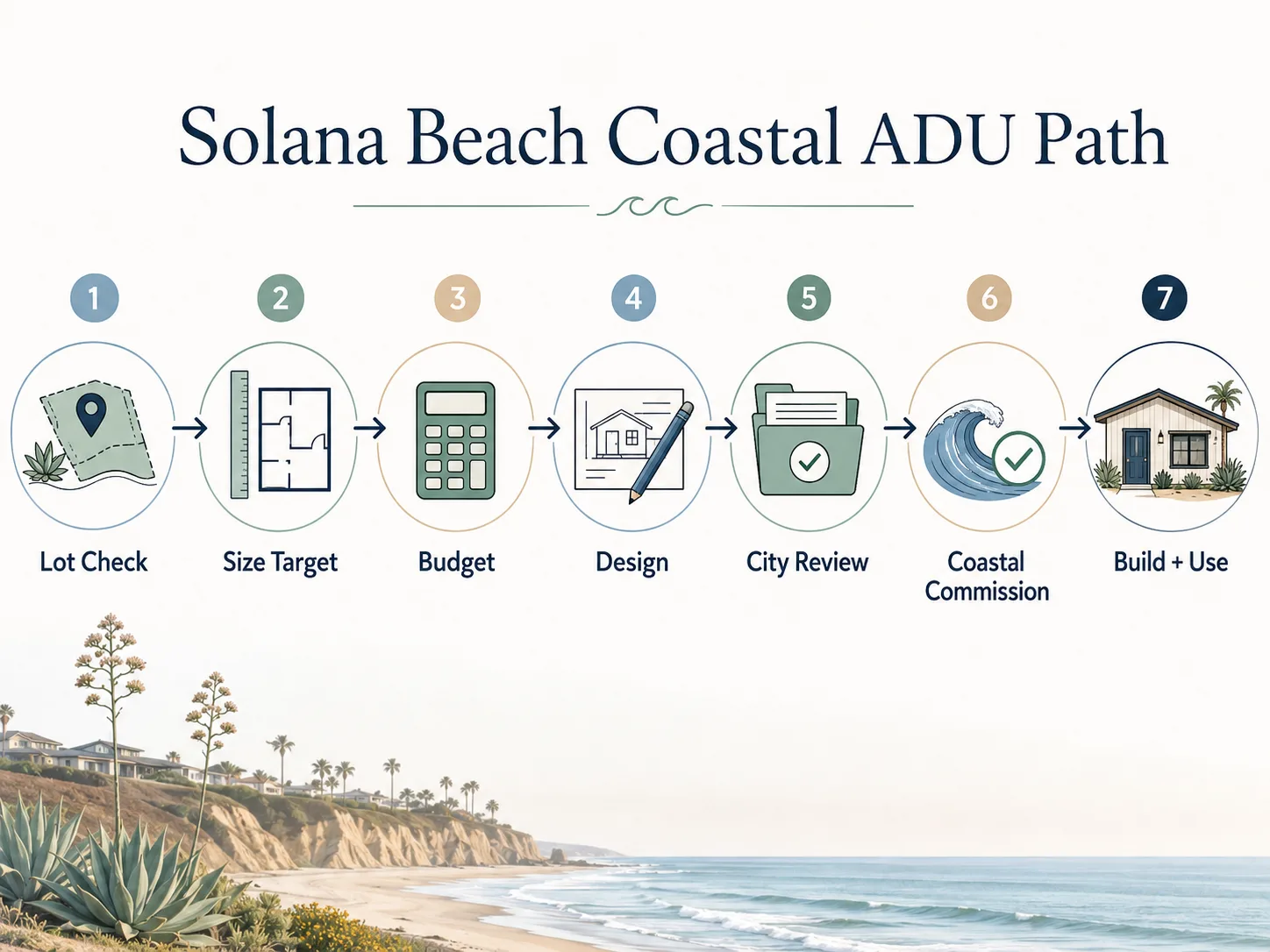
The Practical Permit Sequence
- 1Pre-design diligence. Pull your assessor’s parcel number (APN). Confirm zoning and applicable overlays — Coastal, SROZ, bluff/Coastal Bluff Overlay if applicable, View Assessment trigger. Identify whether your lot is bluff-adjacent or within proximity to wetlands, ESHA (Environmentally Sensitive Habitat Area), or public-view corridors. Pull copies of any prior CDP on the lot — preexisting CDPs can limit or condition future development.
- 2Concept design. Decide the ADU type (detached, attached, conversion, JADU), the target square footage, and where on the lot the structure will sit. Square footage drives the fee profile — the 750/800 sq ft threshold logic is explained below. Site placement drives setbacks, FAR exemptions, and view-assessment exposure.
- 3Plan set preparation. Site plan, floor plan, elevations, sections, roof plan, drainage and engineering documentation, landscape package if irrigated landscape area exceeds 500 square feet, and any required topographic or soils analysis. The site plan must show the proposed FAR calculation, parking, grading quantities (capped at 50 cubic yards outside the structure footprint for ADUs), and the location of all setbacks.
- 4Apply to the Coastal Commission. Under the current city handout, the CCC approval letter is required to accompany the building permit application. For non-bluff lots this can proceed concurrently with the city application. For bluff lots, we recommend engaging the CCC’s San Diego Coast District Office (7575 Metropolitan Drive, Suite 103, San Diego, CA 92108) on bluff-specific issues before submitting the full city application.
- 5Submit to counter@cosb.org electronically. Solana Beach accepts digital submission. Send the completed building permit application, PDF project plans, and the CCC approval letter as one package.
- 6Plan check routing. The application routes to Planning, Building, Engineering, and Fire — and Landscape if applicable.
- 7Building permit issuance. The CCC approval is now in hand at intake, so the city’s review is the remaining gate.
- 8Construction. Inspections are scheduled through the city’s process. Fire sprinkler installation in the ADU is triggered only when the primary residence was required to have sprinklers under the applicable building code. New detached ADUs are subject to California Energy Code solar requirements.
- 9Certificate of occupancy. The final inspection card serves as the certificate of occupancy for the ADU.
What Government Code §§ 66317 and 66329 Say About Timing
- Government Code § 66317 gives the permitting agency 15 business days from submission to determine whether an ADU application is complete, and 60 days after a complete application to approve or deny.
- Government Code § 66329 applies the 60-day decision framework to complete ADU-related coastal development permits, with concurrent-review mandates and exceptions for ADUs tied to new primary or multifamily dwellings.
The Terner Center documented Los Angeles County ADUs in the coastal zone averaging 260 days from application to permit before these reforms, versus 147 days outside the zone. AB 462 was passed in significant part to close that gap.
Want to verify your specific lot’s coastal exposure before committing to a designer? Our free Solana Beach feasibility check flags every overlay, setback, and code section that applies to your address.
See What You Can Build → Get Your Free Solana Beach ADU ReportWhat Size ADU Can I Build in Solana Beach?
Answer capsule: Solana Beach’s local ordinance allows detached or attached ADUs up to 850 square feet for a studio or one-bedroom and up to 1,000 square feet for two or more bedrooms. Junior ADUs are capped at 500 square feet inside the existing primary residence. Independently, California Government Code § 66321 protects at least an 800-square-foot ADU with 4-foot side and rear setbacks from being blocked by local lot coverage, FAR, open space, or minimum lot size standards. The single most consequential design decision is whether to stay at or below 750 square feet, because Government Code § 66311.5 bars impact fees on ADUs at that size or smaller.
The Five-Tier Size Ladder
| ADU path | Size | Why it can fit | Friction to budget for | Source |
|---|---|---|---|---|
| JADU (junior ADU) | ≤ 500 sq ft, inside the existing primary residence | Lowest-disruption family housing path; lowest fee risk; existing-kitchen-sharing rules allow modest construction | Owner-occupancy applies if JADU shares sanitation with primary home (Gov. Code § 66333, as amended by AB 1154 effective Jan 1, 2026); 30-day-plus rental minimum; recorded covenant required | Solana Beach Ordinance 525; Gov. Code §§ 66332–66334 |
| Fee-conscious ADU | ≤ 750 sq ft | No impact fees under Gov. Code § 66311.5; school fees waived for ≤ 500 sq ft; strong rent-to-build ratio | Less family-grade square footage; design discipline needed on storage and bedroom layout | Gov. Code § 66311.5 |
| State-protected ADU | ~800 sq ft, with 4-ft side/rear setbacks | Local standards on lot coverage, FAR, open space, and minimum lot size cannot block this size if protected conditions are met | Above 750 sq ft, impact fees may apply proportionally to primary-home size | Gov. Code § 66321(b)(3) |
| Local-max studio/1-bed ADU | ≤ 850 sq ft | Local ordinance permits this size for studios and one-bedroom units; more livable space than 750 sq ft | Impact fees may apply proportionally to primary-home size | SBMC § 17.20.040(D)(4) |
| Local-max 2-bed+ ADU | ≤ 1,000 sq ft | Local ordinance permits this size for two-or-more-bedroom units; strongest family-grade utility | Higher construction cost; proportional impact-fee exposure; more grading and FAR pressure | SBMC § 17.20.040(D)(4) |
FAR Formulas to Know
Solana Beach’s ADU submittal handout states that “if the total floor area proposed exceeds the 60% threshold, the ADU is limited to 800 SF maximum.” Verify your lot’s specific FAR ceiling:
- Non-SROZ residential: Lot area × 0.600 (first 5,000 sf) + × 0.300 (5,001–20,000 sf) + × 0.150 (above 20,000 sf)
- SROZ-subject: Lot area × 0.500 (first 6,000 sf) + × 0.175 (6,001–15,000 sf) + × 0.100 (15,001–20,000 sf) + × 0.050 (above 20,000 sf)
- HR / MHR zones: Lot area × 0.75 (flat)
The city offers an 800-square-foot ADU FAR exemption and up to 400 square feet of garage FAR exemption (200 sq ft per parking space, max two spaces).
The 750/800 Decision in Plain Terms
At or below 750 square feet, your ADU is exempt from impact fees under Government Code § 66311.5. Above 750 square feet, the city may charge proportional impact fees. Above 750 square feet, the next meaningful jump in design freedom is the 800-square-foot mark, where state law guarantees the unit cannot be blocked by local lot coverage, FAR, open space, or minimum lot size rules.
If you can fit the program in 750 sq ft, do it. If you need 800 sq ft for a one-bedroom that actually functions, you’re paying for the extra 50 sq ft in materials and proportional fees, but you’re inside the strongest state-law protection. For a homeowner targeting rental income, the rent-per-square-foot logic typically favors 750 sq ft over the 800–850 sq ft range, because the impact-fee exemption preserves capital that would otherwise go to the city.
SBMC § 17.20.040(D) Decoded: The Solana Beach ADU Rules That Affect Your Design
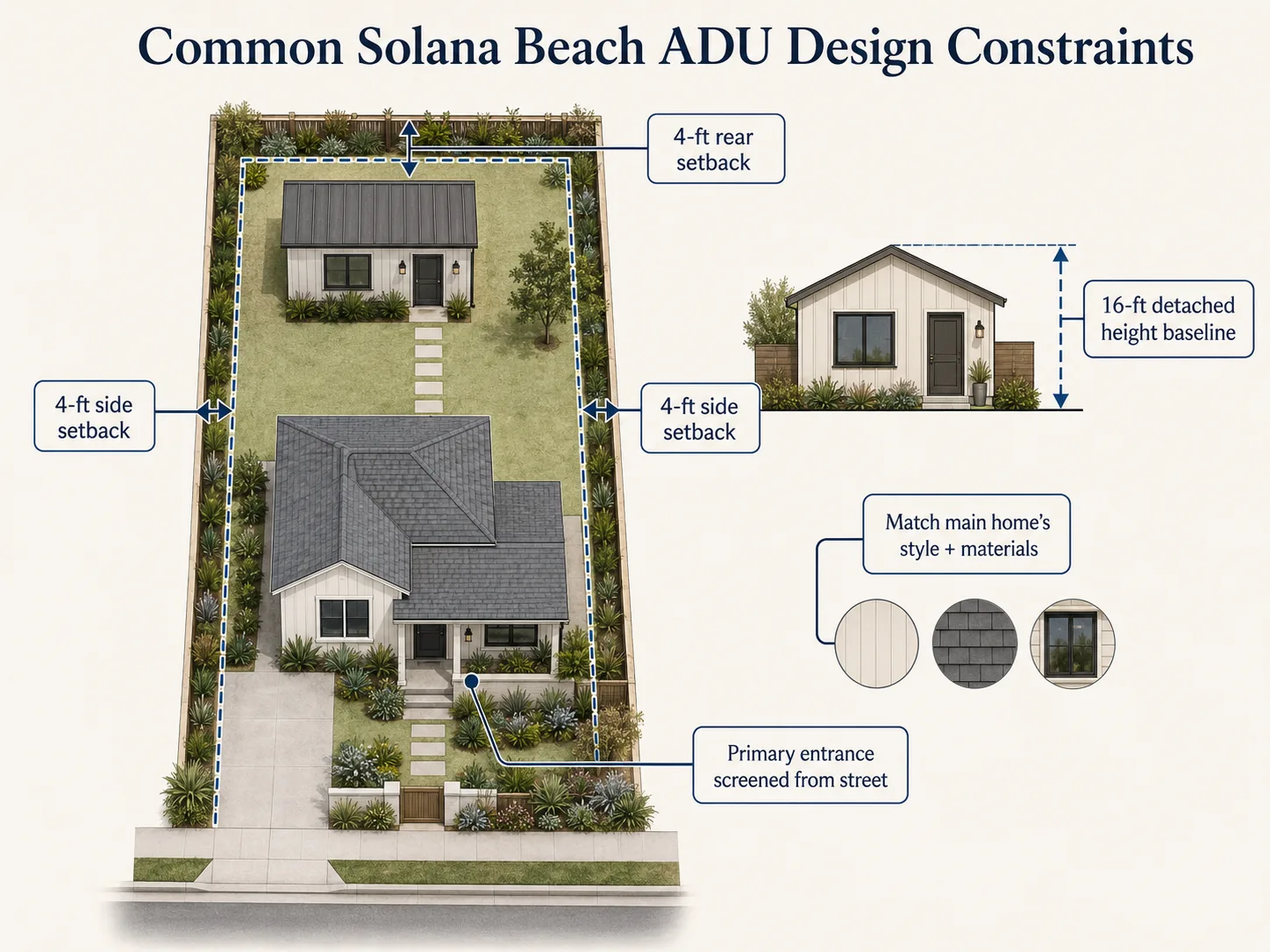
Answer capsule: The Solana Beach ADU rules most likely to change your floor plan are the 4-foot side and rear setbacks for new construction, the 16-foot detached height baseline, the architectural compatibility requirement, the parking exception list, the utility-connection rules, the fire-sprinkler trigger tied to the primary residence, the 30-day-minimum rental term, and the 50-cubic-yard grading cap. Solana Beach also requires that the primary ADU entrance not be visible from the street across the front yard setback.
| SBMC § 17.20.040(D) topic | What the city rule requires | State-law check |
|---|---|---|
| Size cap (single-family) | 850 sq ft studio/1-bed; 1,000 sq ft 2+ bed (attached or detached) | State law requires at least 800 sq ft be allowed under protected conditions (Gov. Code § 66321) |
| Height (detached) | 16 feet baseline | Increases to 18 ft within ½ mile of public transit, on a lot with a multifamily primary dwelling, and +2 ft to match roof pitch under Gov. Code § 66321 categories |
| Height (attached) | Up to 25 ft, or the height of the primary dwelling, whichever is lower | Subject to state-law height categories |
| Side and rear setbacks (new construction) | 4 feet minimum | Aligns with Gov. Code § 66321(b)(3); HCD’s December 2025 letter flagged the local omission of front-setback language |
| Setback (conversion of existing structure) | No setback required for the converted portion | Aligns with Gov. Code § 66314(b) |
| Architectural compatibility | ADU must match the primary residence in roofing, trim, walls, windows, and color palette | Permitted as objective design standard |
| Primary entrance | Must not be visible from the street adjacent to the front yard setback | Solana Beach-specific quirk; verified in SBMC and on the city’s ADU submittal handout |
| Building separation (detached ADU) | 6 ft minimum eave-to-eave from primary; 10 ft if entrance faces another structure’s wall | Local design rule |
| Grading | ≤ 50 cubic yards outside the structure footprint | Local; effectively rules out ADUs on sites that need significant earthwork |
| Lot coverage exemption | ADUs up to 800 sq ft exempt from local lot coverage rules | Aligns with Gov. Code § 66321 |
| FAR additional review | If total proposed floor area exceeds 60% of the maximum FAR, the ADU is limited to 800 sq ft max | Local interaction with SROZ |
| Parking | One off-street space (may be tandem, may be in setbacks) — waived if within ½ mile of public transit, in an established historic district, in a permit-parking area without permits available, within a block of car-share, or converted from / attached to the primary residence | Aligns with Gov. Code § 66322 |
| Replacement parking | Not required when a garage, carport, or covered parking is demolished in conjunction with the ADU or converted to an ADU | Aligns with state law |
| Utility connections | Separate connection generally required for new construction ADUs; sub-meter permitted; conversion/internal ADUs and JADUs may use existing connections | Aligns with Gov. Code § 66316 |
| Fire sprinklers | Required only if the primary residence was required to have sprinklers under the applicable building code | SBMC § 15.32.010 / Ordinance 527 |
| Solar | New detached ADUs subject to California Energy Code solar requirement; can be sited on ADU or primary; conversions exempt | California Energy Code, Title 24 |
| JADU (junior ADU) | ≤ 500 sq ft within existing single-family residence; recorded covenant required; owner-occupancy when sharing sanitation | AB 1154 (effective Jan 1, 2026) limits owner-occupancy to shared-sanitation JADUs (Gov. Code § 66333) |
| Multifamily lots | Conversion ADUs up to 25% of existing units (min 1); detached ADUs up to 8 on existing multifamily lots (capped at existing primary unit count); 2 detached on proposed multifamily | Aligns with Gov. Code § 66323 as amended by SB 1211 |
| Rental term | Minimum 30 consecutive days per city materials; state JADU and § 66323 language uses “longer than 30 days” | Practical conclusion unchanged: do not model as Airbnb |
| Separate sale (AB 1033) | No separate-sale ordinance found as of last verification; reverify with the City before relying on AB 1033 | Local choice |
The most common reason a Solana Beach ADU plan set goes back for corrections is a mismatch between an architect’s training and the city’s specific architectural compatibility standard. A modern flat-roof detached ADU on a lot with a 1970s gable-roof primary home will not survive initial planning review. The city wants the ADU to incorporate the same features as the primary or existing dwelling — roofing, trim, walls, windows, and colors.
The 50-cubic-yard grading cap is the second most common surprise. On flat lots, this is usually a non-issue. On Lomas Santa Fe sloped lots or bluff-adjacent properties, the cap can rule out a basement, a retained pad, or any significant site sculpting. Above 50 cubic yards, you are no longer in the ministerial ADU lane — you’re triggering a Development Review Permit.
Five Solana Beach Quirks That Catch Out-of-Town Designers
1. The primary entrance cannot be visible from the front-yard street.
SBMC § 17.20.040(D) requires that the ADU’s primary entrance not be visible from the street adjacent to the front yard setback. On rear-yard ADUs, this is usually trivial. On side-yard or front-aligned ADUs — common on narrow lots — this rule forces a side-entry or rear-entry orientation that can complicate the floor plan.
2. Architectural compatibility is enforced strictly.
Solana Beach is not Los Angeles or Oakland on this point. The ordinance requires the ADU to utilize the same architectural style, exterior materials, and colors as the primary dwelling. Submissions that don’t match get sent back. If your primary home is stucco with composition shingle, your ADU will be too.
3. Anything over 16 feet triggers the Structure Development Permit and View Assessment.
Under SBMC § 17.63.040, all new construction exceeding 16 feet in height from pre-existing grade requires a Structure Development Permit and must go through the View Assessment process. This is what makes true two-story detached ADUs effectively unavailable on Solana Beach single-family lots. The 18-foot transit-adjacent state-law height still applies, but the View Assessment process is a real additional step.
4. Guest houses and pool houses appear to be off the table.
SnapADU reports, based on city feedback documented in February 2025, that Solana Beach is no longer permitting new guest houses or pool houses — the city permits attached or detached ADUs and unconditioned garages/storage sheds, with utilities prohibited from passing through any storage structure. Confirm directly with the City before treating a proposed pool house or conditioned accessory structure as outside the ADU path.
5. The CCC approval letter is now part of your building permit application.
The City’s June 2025 ADU submittal handout asks for the CCC approval letter to accompany the building permit application package — a change from earlier sequencing where applicants applied to the CCC after initial planning review. For non-bluff lots this can run concurrently with city plan preparation under AB 462’s 60-day clock. For bluff lots, engage the CCC’s San Diego Coast District Office on bluff-specific issues before submitting the full city application.
2026 Solana Beach Permit Fee Worksheet (The Math Most Guides Skip)
Answer capsule: Solana Beach calculates building permit and plan check fees from a valuation table, not a flat ADU rate. For a 2026 R-3 Type V-B (one- or two-family residential, wood-frame) building, the Master Fee Schedule lists a valuation of $170.80 per square foot. The base building permit fee is $1,796 for the first $100,000 of valuation, then $10.13 per additional $1,000 of valuation. Plan check is 85% of the base permit fee; combined plumbing, electrical, and mechanical is 21%; the energy surcharge is 15%. Impact fees only apply if your ADU is larger than 750 square feet.
Worked Example: 800 sq ft Detached ADU, Type V-B
| Line item | Calculation | Result |
|---|---|---|
| Permit valuation | 800 sq ft × $170.80/sq ft | $136,640 |
| Base building permit fee | $1,796 base + 37 increments × $10.13 | $2,170.81 |
| Plan check | 85% × base permit fee | $1,845.19 |
| Plumbing / electrical / mechanical combined | 21% × base permit fee | $455.87 |
| Energy surcharge | 15% × base permit fee | $325.62 |
| Permit issuance | Fixed line item | $52.00 |
| Subtotal before technology surcharge | Sum of above | $4,849.49 |
| Technology surcharge (if applied) | 5% × applicable plan/permit fees | ~$242.47 |
| Illustrative city building/plan-check subtotal | Before CalGreen, SMIP, school, utility, water, impact, CCC, and project-specific fees | ~$5,092 |
This worksheet is a reproducible planning tool, not a city quote. Confirm the final fee invoice with the City before payment. Verified against the Solana Beach Master Fee Schedule effective January 1, 2026.
What This Worksheet Does Not Include
- Coastal Commission application fee. Confirm the current 2026 residential ADU CDP fee with the District Office at filing.
- Impact fees (transportation, fire mitigation, park development, public-use facility). Only apply if ADU exceeds 750 sq ft and are prorated to the ratio of ADU sq ft to primary residence sq ft under § 66311.5.
- School fees. SDUHSD: $2.72/sq ft of residential livable space, with ≤ 500 sq ft exempt. Elementary district fees may also apply.
- Utility connection fees (water and sewer). Most of the city runs through Santa Fe Irrigation District.
- CalGreen and SMIP surcharges. Small but listed.
- Project-specific fees for variance, view assessment, landscape review, soils review, or a Development Review Permit.
The Honest Translation
- 750 sq ft new detached ADU: Total permit and fee costs (city + CCC + utilities + school) typically land in the $8,000–$18,000 range, with most projects clustering near $12,000–$15,000.
- 800–1,000 sq ft ADU: Same range plus prorated impact fees pushes the total toward $15,000–$28,000.
- Garage conversion: Absence of new utility connection fees and smaller plan check scope typically reduces total permit and fee exposure to $5,000–$10,000.
These ranges exclude design and construction.
The 750-vs-800-square-foot decision can swing your fee exposure by $5,000–$15,000. Get a free Solana Beach feasibility check that flags every threshold your specific project is crossing.
Avoid the 750/800 Mistake → Get Your Free Solana Beach ADU ReportWhat a Solana Beach Coastal Zone ADU Actually Costs to Build in 2026
Answer capsule: A turnkey detached ADU in Solana Beach in 2026 runs roughly $375–$600 per square foot all-in, or about $300,000–$450,000 for a typical 600–1,000 sq ft unit. A coastal-zone uplift of roughly 8–12% on construction is typical for salt-air protection and engineering. Garage conversions remain the cheapest path at roughly $100,000–$220,000. Attached ADUs land in the middle, typically $200,000–$350,000. Bluff-adjacent lots add $5,000–$15,000+ in geotechnical and bluff-edge survey soft costs.
Solana Beach ADU Cost Stack — 2026
| Cost line | Range | Source / method |
|---|---|---|
| Vertical construction (structure + finishes, builder-grade to mid-range) | $280–$420/sq ft | Pacific Beach Builder, March 2026 (San Diego coastal-belt data) |
| Soft costs (design, structural and civil engineering, plan check management) | $20–$40/sq ft | Dwelling Index planning estimate; ~10–15% of total project |
| City permit and plan check fees | $5,000–$15,000 | Solana Beach Master Fee Schedule + worked example above |
| Coastal Commission application fee | Varies by category | Confirm with CCC SD Coast District at filing |
| Utility connection (new build, water + sewer) | $4,000–$15,000 | SnapADU March 2026 + Pacific Beach Builder |
| Impact fees (over 750 sq ft) | $5,000–$20,000+ proportional | Dwelling Index planning estimate from city fee schedule + § 66311.5 proration rule |
| School fees | $2.72/sq ft × ADU sq ft (above 500 sq ft) for SDUHSD | SDUHSD current fee page; elementary district fees may also apply |
| Salt-air / coastal materials premium | +8–12% on construction | Pacific Beach Builder, March 2026 |
| Bluff geotech and bluff-edge survey (bluff lots only) | $5,000–$15,000+ | INSTALL-IT-DIRECT 2026 + bluff-engineer market check |
| Solar PV (new detached ADU) | $6,000–$15,000 | Title 24; can be sited on ADU or primary |
| Landscape package (if irrigated landscape > 500 sq ft) | $2,000–$8,000 | Plan, third-party landscape review fee, install |
| Contingency | 15–20% | Dwelling Index planning recommendation given 2026 material volatility |
| All-in turnkey (detached new construction, non-bluff) | $300,000–$450,000+ | Roughly $375–$600/sq ft |
| All-in turnkey (garage conversion) | $100,000–$220,000 | $200–$300/sq ft typical |
| All-in turnkey (attached ADU) | $200,000–$350,000 | $300–$400/sq ft typical |
| All-in turnkey (detached, bluff-adjacent) | $330,000–$520,000+ | Geotech + design constraint premium |
Cost ranges above are independent Dwelling Index research, not paid placements. Actual costs depend on site conditions, finish level, and contractor selection. These figures are illustrative — not a quote and not a guarantee.
Why Solana Beach Sits at the Top of the San Diego County Range
Three things push Solana Beach ADU costs above county averages. First, the salt-air premium on materials and fasteners — marine-grade hardware, corrosion-resistant fixtures, and enhanced weather protection are not optional this close to the coast. Second, smaller-than-county-average lot sizes that complicate access and staging (Solana Beach is 3.5 square miles with a median single-family home value over $2 million). Third, the architectural compatibility requirement, which often forces higher-end finishes on the ADU to match the primary home.
Financing path: How are most Solana Beach owners paying for these projects? Most use a HELOC against existing home equity — Solana Beach’s median home value over $2 million means substantial equity for many longtime owners — a cash-out refinance, or a dedicated construction loan. Compare current paths in our financing-path guide. We present lanes, not ranked lenders.
Explore Solana Beach ADU Financing Paths →Rental Income Reality: What a Solana Beach ADU Actually Rents For
Answer capsule: Solana Beach ADUs must be rented for terms of at least 30 days; short-term vacation rentals are not permitted. For long-term rental income context, current public rent trackers as of May 2026 show Solana Beach studio rents in the low-to-mid $2,000s, one-bedroom rents from the high $2,000s to roughly $3,800, and two-bedroom rents from the high $6,000s into the $7,000s. Realistic ADU rent for a new, well-built one-bedroom detached unit in 2026 typically lands $2,500–$3,500.
Solana Beach Rent Market Context — May 2026
| Source | Studio | 1-bedroom | 2-bedroom | Notes |
|---|---|---|---|---|
| Zillow Rental Manager | $2,328 | $3,250 | $6,809 | Solana Beach market average, May 2026 |
| Apartments.com | — | $3,790 | — | 1BR median, 2026 |
| Rent.com | $2,395 | $2,759 | $7,200 | Updated May 13, 2026 |
| Trulia | — | $3,029 | $7,495 | Listing-based |
These are market context figures, not projected ADU rent. Most comparables are condos or whole-house rentals, not ADUs.
Rough Yield Math, with Honest Caveats
A 750-sq-ft fee-conscious 1-bedroom detached ADU at the lower end of construction cost — say $325,000 turnkey including all soft costs — renting for $3,000/month gross is generating about $36,000/year before vacancy, maintenance, and operating costs. Assume 8% vacancy/turnover and $300/month in maintenance/operating, and the net operating income lands around $26,500/year. Against the $325,000 capital cost, that’s roughly an 8.2% NOI-to-project-cost yield before financing — competitive with most other San Diego County ADU markets.
These are illustrative examples, not guarantees of returns. Actual results depend on local market conditions, construction costs, financing terms, tenant demand, unit quality, and regulatory approvals.
Bluff Lot vs Non-Bluff Lot: Two Different Paths
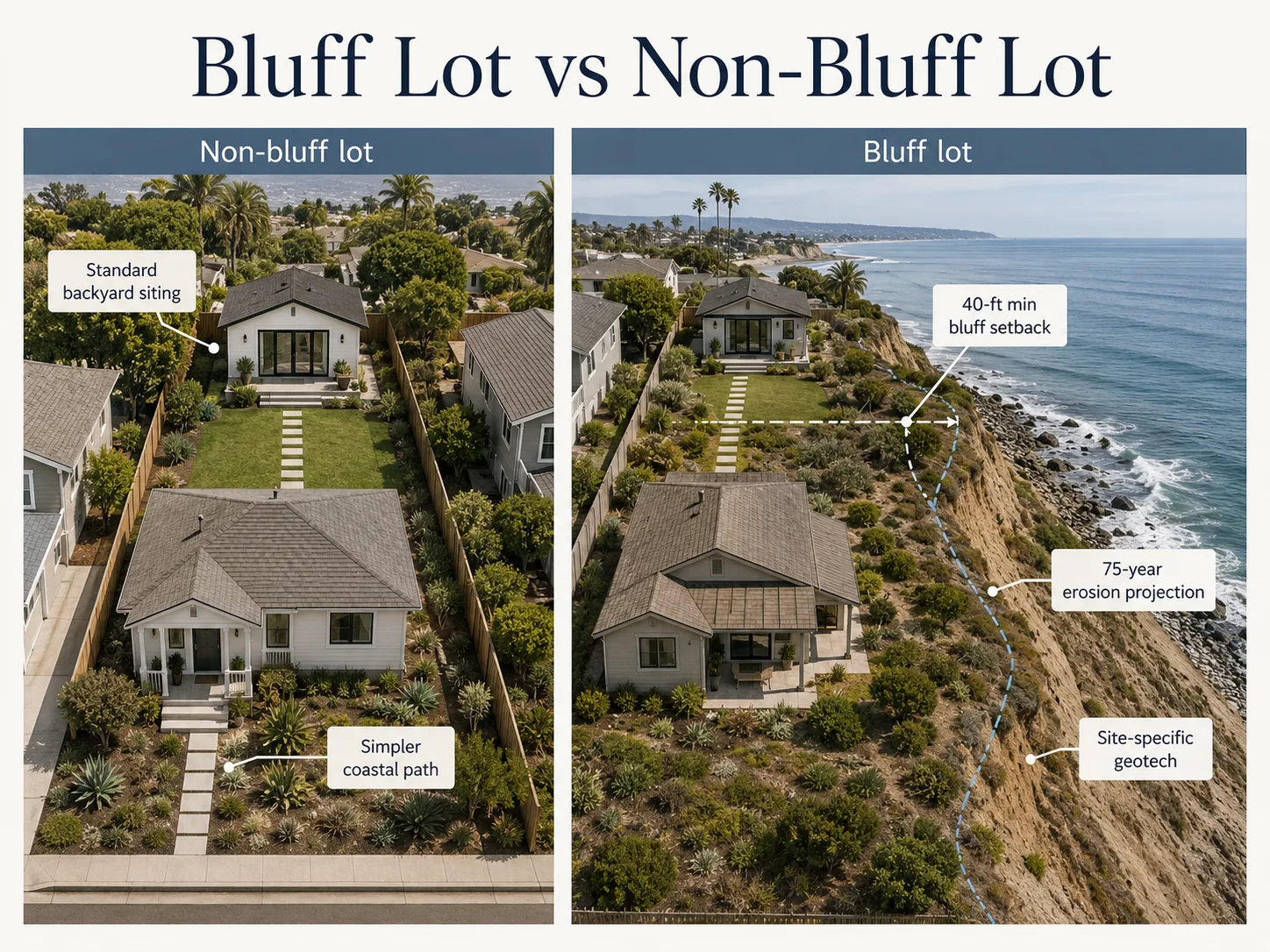
Answer capsule: Solana Beach Land Use Plan Policy 4.18 requires a minimum 40-foot bluff setback measured from the bluff edge, increased by a site-specific geotechnical analysis covering 75 years of erosion plus appropriate factors of safety. The setback cannot be reduced by relying on existing or proposed bluff-retention devices such as seawalls. For lots without bluff exposure, AB 462’s 60-day path applies cleanly. For bluff-adjacent lots, the design constraints and soft costs are materially higher.
Side-by-Side Comparison
| Factor | Non-bluff lot | Bluff-adjacent lot |
|---|---|---|
| Bluff setback | N/A | ≥ 40 ft from bluff edge, plus 75-year erosion + factor of safety |
| Bluff-retention devices | N/A | Cannot reduce setback (LUP Policy 4.18) |
| Bluff-edge survey | N/A | Required |
| Geotechnical report | Not typically required for ADU | Required; typically $5,000–$15,000+ |
| Recommended CCC sequencing | Concurrent under AB 462 | Engage CCC SD Coast District on bluff issues before full city submittal |
| Salt-air material premium | 8–12% | 8–12% |
| Added soft costs | ~$2,000–$5,000 | ~$10,000–$25,000 (geotech, bluff-edge survey, photo simulations, additional CCC documentation) |
| Approximate added construction cost | None | +5–10% for engineered foundations, deeper footings, drainage |
| Risk of project infeasibility | Low | Moderate to high if lot is shallow seaward of the setback line |
| Buildable envelope analysis | Standard | Required as part of initial diligence |
For bluff lots on Pacific Avenue, Circle Drive, South Sierra Avenue, and certain Lomas Santa Fe-area parcels, the bluff-edge analysis is the threshold question. If your lot’s bluff edge is far enough inland from the proposed ADU location that 40 feet plus the 75-year erosion projection plus the factor of safety still leaves a buildable envelope, the project can proceed. If not, the project may be limited to interior or garage conversion ADUs.
Which Solana Beach ADU Path Fits Your Situation?
Answer capsule: Don’t start with a floor plan. Start with the constraint that matters most: family housing, fee control, rental income, privacy, coastal risk, or build speed. The right ADU path follows from the dominant constraint, not from how the unit will look.
Decision Matrix
| Your dominant constraint | Best first path to evaluate | Why |
|---|---|---|
| Housing an aging parent or adult child | JADU (≤ 500 sq ft) or interior conversion ADU | Lowest disruption to primary residence; shared services; lower cost |
| Lowest possible fees | ADU at or below 750 sq ft (interior livable space) | No impact fees under Gov. Code § 66311.5 |
| Strongest state-law design protection | ~800 sq ft ADU with 4-ft side/rear setbacks | Gov. Code § 66321 protects this size against local lot coverage, FAR, open space, and minimum lot size rules |
| Strongest rental utility for the dollar | 750 sq ft 1-bedroom new detached, near transit (parking waived) | Maximum protected size below the fee threshold; transit-adjacent waiver eliminates parking pressure |
| Maximum family-grade living area | 850 sq ft 1-bedroom or 1,000 sq ft 2+ bedroom | Local maximum; higher cost; proportional impact fees |
| Bluff or oceanfront lot | Feasibility screening + bluff-edge survey before any design spend | Bluff path adds geotech, setback, and engineering risk that can dominate the project |
| Multifamily property (existing duplex+) | Conversion ADUs from non-livable space + detached ADU analysis | SB 1211 expanded detached ADU allowances; conversions avoid setback issues |
| Fastest possible build | Conversion of existing legal space (garage, interior) | No new foundation; smaller plan check scope; may qualify for CDP exemption or waiver |
| Sale value uplift | Detached new construction, 750–1,000 sq ft, with parking | Most appraisers credit detached ADUs at higher resale value than conversions |
| Energy-efficient build | New construction with solar sized on ADU | Title 24 compliance built in; lower operating costs |
We built a Solana Beach Quick-Check that takes five inputs — zone, lot size, distance from bluff edge, distance from mean high tide line, and existing structures — and returns a routing recommendation in 30 seconds.
Launch the Solana Beach Coastal ADU Quick-Check →Honest Tradeoffs and What Could Still Go Wrong
Answer capsule: AB 462 closed the timeline gap on complete ADU-related coastal permits, but it didn’t remove Coastal Act review, completeness requirements, new-primary-dwelling exceptions, bluff constraints, or coastal-resource review. The most common Solana Beach ADU failures we see are oversized projects that bust the 60% FAR threshold, plan sets that ignore the primary-entrance rule or the architectural compatibility requirement, projects that assume Airbnb income, bluff lots that get into design without a bluff-edge survey, and projects that lock in size at 800 sq ft when 750 sq ft would have been the better business decision.
Risk 1: Treating the Coastal Commission as a back-end checkbox.
Some applicants treat the CCC step as a final formality, send their plans to the city first, and discover the CCC has fundamental issues with the project. The safer move is to engage the CCC’s San Diego Coast District Office on any specific coastal-resource concerns (bluff stability, ESHA proximity, public view corridor, public access) before finalizing the plan set, and to apply for the CDP early enough to include the CCC approval letter with the city building permit application.
Risk 2: Designing 800 sq ft without fee planning.
The 800 sq ft state-protected design size is strong from a regulatory perspective but crosses the 750 sq ft impact-fee threshold. The safer move is to model the 750 sq ft path and the 800 sq ft path side-by-side, including impact fees, and decide on the actual project economics rather than on a default size.
Risk 3: Planning for short-term rental income.
Solana Beach ADUs cannot be operated as Airbnb-style short-term rentals. The 30-day-plus minimum is firm. The safer move is to model the project as a long-term rental at the realistic local rent ($2,500–$3,500 for a new 1-bedroom detached ADU) or as a 30-day-plus mid-term rental for traveling professionals or relocating families.
Risk 4: Treating bluff lots like flat inland lots.
A designer accustomed to Bay Park or Mira Mesa work may underestimate the bluff path’s complexity. The safer move is to commission a bluff-edge survey and a geotechnical screening before paying for a full plan set on a bluff-adjacent property.
Risk 5: Relying on stale ordinance text.
Local ordinance text lags state law changes by months or years. Solana Beach’s Ordinance 525 has been flagged by HCD for noncompliance on multiple specific provisions. The safer move is to check the current Government Code sections (§§ 66311.5, 66317, 66321, 66322, 66323, 66329, 66333) alongside the SBMC text, and to ask the City directly when there’s a conflict.
Risk 6: Using national cost calculators for a Solana Beach budget.
Generic ADU cost calculators understate Solana Beach’s coastal premium, the salt-air material uplift, and the architectural compatibility-driven finish costs. The safer move is to use San Diego coastal-belt-specific construction cost ranges (the $375–$600/sq ft turnkey range we cite above) and to add a 15–20% contingency in 2026 to account for material volatility.
Pre-Design Checklist: What to Confirm Before You Pay for Plans
Before committing $5,000 to $15,000 to a full architectural plan set, confirm the property’s overlays and constraints, your size target relative to the 750 sq ft fee threshold, the parking exception applicable to your lot, your utility scenario, and who will prepare and submit the Coastal Commission materials. A beautiful plan set that ignores the coastal path or the 750/800 sq ft decision can become an expensive redesign.
- 1Confirm your address is inside the city of Solana Beach. The entire city is in the Coastal Zone, but neighboring properties in unincorporated San Diego County (parts of Lomas Santa Fe Park, for instance) follow county rules.
- 2Pull the APN and check overlays. Use the city’s parcel viewer or call Community Development. You’re looking for Coastal Zone (universal), SROZ status, View Assessment trigger (anything over 16 feet from pre-existing grade), bluff or Coastal Bluff Overlay if applicable, hillside overlay, and any prior CDP on the lot.
- 3Identify coastal-resource exposures. Is the lot bluff-adjacent? Within 300 feet of the mean high tide line? Within 100 feet of a wetland or stream (including San Elijo Lagoon proximity)? Within a public-view corridor? Each exposure changes the diligence required.
- 4Pick an initial size target. ≤ 500 sq ft JADU, ≤ 750 sq ft fee-conscious ADU, ~800 sq ft state-protected ADU, ≤ 850 sq ft studio/1-bed local max, or ≤ 1,000 sq ft 2+ bed local max. Have a defensible reason for the size you pick.
- 5Decide the ADU type. Detached new construction, attached new construction, interior or garage conversion, or JADU within the primary residence. Each has a different cost, timeline, and constraint profile.
- 6Check parking-exception eligibility. Lots within the applicable half-mile walking distance of the Solana Beach Coaster station may qualify for the transit-proximity waiver. Measure the property-specific walking distance before assuming the waiver.
- 7Estimate permit valuation and fee exposure. Use the worksheet above for the city portion. Add CCC application fee, school fee if over 500 sq ft, utility connection fees, and proportional impact fees if over 750 sq ft.
- 8Ask who prepares and submits the Coastal Commission materials. Some design firms handle the CCC application in-house; others outsource it to a planner or expediter; others expect the homeowner to handle it directly. Get this answer in writing before signing.
- 9Confirm the builder’s California Contractors State License Board (CSLB) license. Verify the number directly at cslb.ca.gov. Active license, clean disciplinary history, and a meaningful Solana Beach portfolio is a reasonable threshold.
- 10Run a feasibility report before paying for plans. A free address-specific feasibility check pulls overlays, lot dimensions, and constraint flags into one summary that saves you from designing toward a wall.
SnapADU is a San Diego-based ADU specialist that explicitly serves Solana Beach as part of its Greater San Diego coastal service area. SnapADU says it has designed, permitted, and built over 100 ADUs in San Diego, and they maintain a Solana Beach regulations page they update regularly. They are one of our reviewed partners; they are not the only option, and the vetting criteria above apply to any builder you consider.
Request a Free Solana Beach ADU Estimate from SnapADU →Who Actually Builds in Solana Beach: How to Vet a Contractor
Answer capsule: Look for three things in a Solana Beach ADU contractor: meaningful Solana Beach-specific portfolio depth (not just “San Diego experience”), documented familiarity with SBMC § 17.20.040(D), the city’s plan-submittal sequence, and the Coastal Commission San Diego Coast District’s practice, and an active CSLB license. The architectural compatibility requirement and the 50-cubic-yard grading cap catch out-of-town designers more often than any other rules.
Vetting Criteria — Solana Beach Specific
- ✓Active CSLB license. Verifiable directly at cslb.ca.gov by license number. Check for any disciplinary history.
- ✓Solana Beach-specific portfolio. At least five completed projects in Solana Beach, ideally including at least one bluff-adjacent project if your lot is bluff-adjacent. Ask for addresses.
- ✓Familiarity with SBMC § 17.20.040(D). They should be able to talk about the 16-foot height limit, the 4-foot setback, the architectural compatibility rule, the primary-entrance rule, the 60% FAR threshold, the SROZ formulas, and the 50-cubic-yard grading cap without referring to notes.
- ✓CCC SD Coast District handling. They should describe how they handle the Coastal Commission step — in-house, through a planner/expediter, or as a homeowner responsibility — and provide examples of recent CCC approvals or waivers.
- ✓Bluff-edge survey experience (bluff lots). If your lot is bluff-adjacent, the builder’s geotechnical and bluff-edge survey experience is non-negotiable.
- ✓Transparent fixed-price proposal with itemized soft costs. No “TBD” line items at contract signing for design, permits, utility connections, or impact fees. Get a worked range with verified inputs.
- ✓Insurance and bonding. General liability and workers’ compensation in force.
- ✓References from completed Solana Beach projects — not “San Diego references.”
Our affiliate-partner roster includes SnapADU for Greater San Diego ADU intent. Other Solana Beach-active firms we’ve seen in research include Better Place Design & Build, SoHo Construction, and Better Place Remodeling, none of which are current Dwelling Index partners — references to them in this guide are editorial, not promotional. We recommend evaluating three to five Solana Beach-experienced firms before signing.
Frequently Asked Questions
Are ADUs allowed in Solana Beach?
Yes. ADUs are allowed on qualifying single-family and multifamily lots in residential and mixed-use residential zones. The unit must relate to an existing or proposed primary dwelling. The Solana Beach Coastal Zone designation does not block ADUs; it adds an approval step that under AB 462 is bounded by a 60-day decision clock for complete applications and runs concurrently with the city’s ministerial review.
Is the entire city of Solana Beach in the Coastal Zone?
Yes. The City of Solana Beach Planning Permits page states that the entire jurisdiction is within the Coastal Zone and that all building permit applications require California Coastal Commission approval before the city can issue the building permit.
Do I need Coastal Commission approval for every ADU?
For nearly every project, yes. Narrow exemptions exist for interior conversions of existing legal space that don’t increase habitable area, but city planning staff makes that determination. Applicants should plan for a CDP, waiver, or exemption process and include the CCC approval letter with the building permit application per the City’s June 2025 handout.
What’s the largest ADU I can build in Solana Beach?
850 square feet for a studio or one-bedroom, or 1,000 square feet for two or more bedrooms (detached or attached), per SBMC § 17.20.040(D)(4). California state law independently requires at least 800 square feet be allowed with 4-foot side and rear setbacks under protected conditions (Gov. Code § 66321).
How tall can my detached ADU be?
16 feet baseline. Up to 18 feet within ½ mile of public transit or on a lot with a multifamily primary dwelling, plus an additional 2 feet to match the primary home’s roof pitch in qualifying cases (Gov. Code § 66321). Anything over 16 feet from pre-existing grade triggers Solana Beach’s Structure Development Permit and View Assessment process under SBMC § 17.63.040, which effectively rules out true two-story detached ADUs on single-family lots.
Do I need a parking space for my ADU?
One off-street space, unless an exception applies. Exceptions include being within a half-mile of public transit (the Solana Beach Coaster station covers much of the city’s central area), being in an established historic district, the ADU being a conversion from or attached to the existing primary residence, the lot being in a permit-parking area where ADU occupants would not be eligible for a permit, and the property being within a block of a car-share vehicle.
How long does the permit take?
For a complete application, Government Code § 66317 requires the city to determine completeness within 15 business days and to approve or deny within 60 days. Government Code § 66329 applies a 60-day decision framework to complete ADU-related coastal development permits, with concurrent review mandated under AB 462. Real-world timing depends heavily on application completeness.
Are impact fees waived for Solana Beach ADUs?
ADUs at or below 750 square feet of interior livable space are exempt from impact fees under California Government Code § 66311.5. ADUs over 750 square feet may be charged impact fees proportionally based on the ADU’s size relative to the primary dwelling.
What about school fees?
The San Dieguito Union High School District’s current fee page lists $2.72 per square foot of residential livable space, with residential square footage of 500 sq ft or less exempt. SDUHSD may also collect applicable elementary district fees, so verify the property-specific combined amount with the District before filing.
Can I rent my Solana Beach ADU on Airbnb?
No. Solana Beach’s ADU materials require rentals of 30 consecutive days or more, the city’s short-term vacation rental framework excludes ADUs, and SB 543 codified the prohibition on short-term rental of JADUs statewide effective January 1, 2026.
Does a JADU require owner occupancy?
Under Government Code § 66333 as amended by AB 1154 (effective January 1, 2026), owner occupancy is required for a JADU only when the JADU shares sanitation facilities with the primary residence. JADUs with their own bathroom are no longer subject to the owner-occupancy mandate. Solana Beach’s local ordinance language may not yet reflect this change; verify with the Community Development Department before relying on it.
Can I sell my ADU separately from the primary residence?
No separate-sale ordinance found as of last verification. California AB 1033 (effective 2024) allows cities to opt into separate-sale provisions; reverify with the City before relying on AB 1033.
Is there still a CalHFA $40,000 grant for ADU pre-development costs?
No. The CalHFA ADU Grant Program is paused. All $100 million in the most recent funding round was fully allocated by December 2023, and CalHFA has not announced a confirmed relaunch date (verified May 14, 2026). Do not budget around a $40,000 grant that may or may not return. Our ADU Grants 2026 page maintains the verified current status of every U.S. ADU grant program.
Can multifamily properties in Solana Beach add ADUs?
Yes, and the expanded allowances under SB 1211 (effective January 1, 2025) materially increased the count. On an existing multifamily property (duplex or larger), owners may add conversion ADUs from non-livable space up to 25% of the existing unit count (minimum one conversion), and may build up to 8 detached ADUs capped at the count of existing primary units. On a proposed multifamily property, the detached ADU limit is 2.
What’s the difference between an ADU and a JADU?
An ADU (accessory dwelling unit) is a complete independent living facility with permanent provisions for living, sleeping, eating, cooking, and sanitation, located on a lot with an existing or proposed primary residence. A JADU (junior accessory dwelling unit) is a smaller unit, up to 500 square feet, created within the existing walls of a single-family residence; it includes an efficiency kitchen and may share sanitation facilities with the primary residence.
What’s a Coastal Development Permit?
A Coastal Development Permit (CDP) is the regulatory mechanism by which proposed development in the California Coastal Zone is brought into compliance with the policies of Chapter 3 of the Coastal Act. In jurisdictions with a Coastal Commission-certified Local Coastal Program (LCP), the local agency may issue the CDP; in others, the Coastal Commission issues it directly. For Solana Beach ADUs, the CCC’s San Diego Coast District Office handles intake.
What’s a Local Coastal Program (LCP)?
A Local Coastal Program is the planning document a coastal city or county prepares to govern development in its portion of the Coastal Zone. An LCP consists of a Land Use Plan (LUP) and a Local Implementation Plan (LIP). Solana Beach has a Coastal Commission-certified LUP. The LIP status determines how much CDP authority is delegated locally versus retained by the Coastal Commission.
What’s a bluff retention device, and why does it matter for ADUs?
A bluff retention device is a seawall, revetment, rip-rap, or similar structure designed to protect a bluff or inland development from wave erosion. Solana Beach LUP Policy 4.18 prohibits using existing or proposed bluff retention devices to reduce required setbacks. In practice, this means an ADU on a bluff lot cannot be sited closer to the bluff edge just because the bluff has been armored.
Get the Free Solana Beach ADU Starter Kit
A one-page printable checklist of every Solana Beach-specific document, fee, code section, and inspection you’ll need from day one through certificate of occupancy. No spam, unsubscribe anytime.
Download the Free ADU Starter Kit →How We Researched This Guide
This guide was prepared by the Dwelling Index editorial team. Dwelling Index is an independent research resource covering ADU financing, costs, and regulations. We do not sell construction services.
For this page, we reviewed Solana Beach’s June 2025 ADU Submittal Process and Basic Plan Requirements document, the city’s Planning Permits page, the city’s Building Services page, Ordinance 525 (adopted December 13, 2023, replacing SBMC § 17.20.040(D)), and the Master Fee Schedule effective January 1, 2026. We confirmed the existence and date of the December 16, 2025 HCD ordinance review letter on hcd.ca.gov. We reviewed current California Government Code sections 66311.5, 66317, 66321, 66322, 66323, 66326, 66329, and 66333. We sourced AB 462 details from the bill text and the Best Best & Krieger LLP legal summary published November 7, 2025. We pulled San Diego coastal ADU construction cost data from SnapADU (March 2026), Pacific Beach Builder (March 2026), Subworkit Contracting (March 2026), and Better Place Design & Build (February 2026). We sourced Solana Beach rent context from Zillow Rental Manager, Apartments.com, Rent.com, and Trulia in May 2026. We pulled school fee data from the San Dieguito Union High School District’s current fee page.
Items flagged for re-verification at filing reflect data that can change without a public notice we would see — the current CCC San Diego Coast District filing fee for residential ADU CDPs, the property-specific combined SDUHSD plus elementary school fee, Solana Beach’s response to HCD’s December 2025 noncompliance letter, the City’s position on AB 1033 separate-sale opt-in, and CalHFA’s grant relaunch status. We refresh this page on a quarterly cadence (monthly during periods of active regulatory change) and stamp it with a visible Last Verified date at the top. If we got something wrong, tell us. The Dwelling Index feedback link goes directly to the editorial team.
Solana Beach is one of the most expensive ADU markets in California, and one of the most regulated. After AB 462, it is also one of the most predictable. The single best thing you can do today is verify what your specific lot allows before you commit money to a designer or builder.
Not sure where to start? See what’s possible at your address — get your free ADU report in 60 seconds.
See What You Can Build → Get Your Free Solana Beach ADU Report