
Encinitas Coastal Zone ADU: 2026 CDP Rules, AB 462, and the Permit Path That Actually Applies to You
Last updated: May 12, 2026 · Last verified against City of Encinitas, California HCD, and primary statutory sources: May 12, 2026
The short answer (the BLUF)
If you are researching an Encinitas coastal zone ADU in 2026, here is the honest picture. Most new detached ADUs, garage conversions, and additions that increase habitable area in the Coastal Zone still require a Coastal Development Permit — but Encinitas issues that permit itself through a streamlined no-fee track called the CDPNF (Coastal Development Permit No Fee), and as of October 10, 2025, California Government Code §66329 (as amended by AB 462) requires Encinitas to approve or deny that CDP within 60 days of a complete application, run it concurrently with your building permit, and explicitly removes the right to appeal the local decision to the California Coastal Commission. That is the single biggest procedural change to coastal ADU permitting in a generation. The California Coastal Act still protects bluffs, wetlands, sensitive habitat, public access, and scenic resources, so AB 462 changed the timeline and the appealability — not the substantive standards.
For most Encinitas lots outside the bluff and wetland buffers, the path is now substantially more bounded than it was. For bluff-top lots in Leucadia or above Cardiff, the underlying coastal-bluff geotechnical standards are unchanged and remain the controlling factor. Your real first question is not which floor plan to choose — it is which of four permit lanes your specific parcel sits on.
➤ Encinitas Coastal ADU Permit Path Checker
Drop your address. Our tool overlays the Coastal Zone boundary, the Coastal Bluff Overlay, the Special Study Overlay, and sensitive-resource flags, then returns your likely permit lane, the documents you'll need, and a realistic timeline. Free. No email required.
See What You Can Build → Get Your Free Encinitas Coastal ADU Report →The four permit lanes at a glance
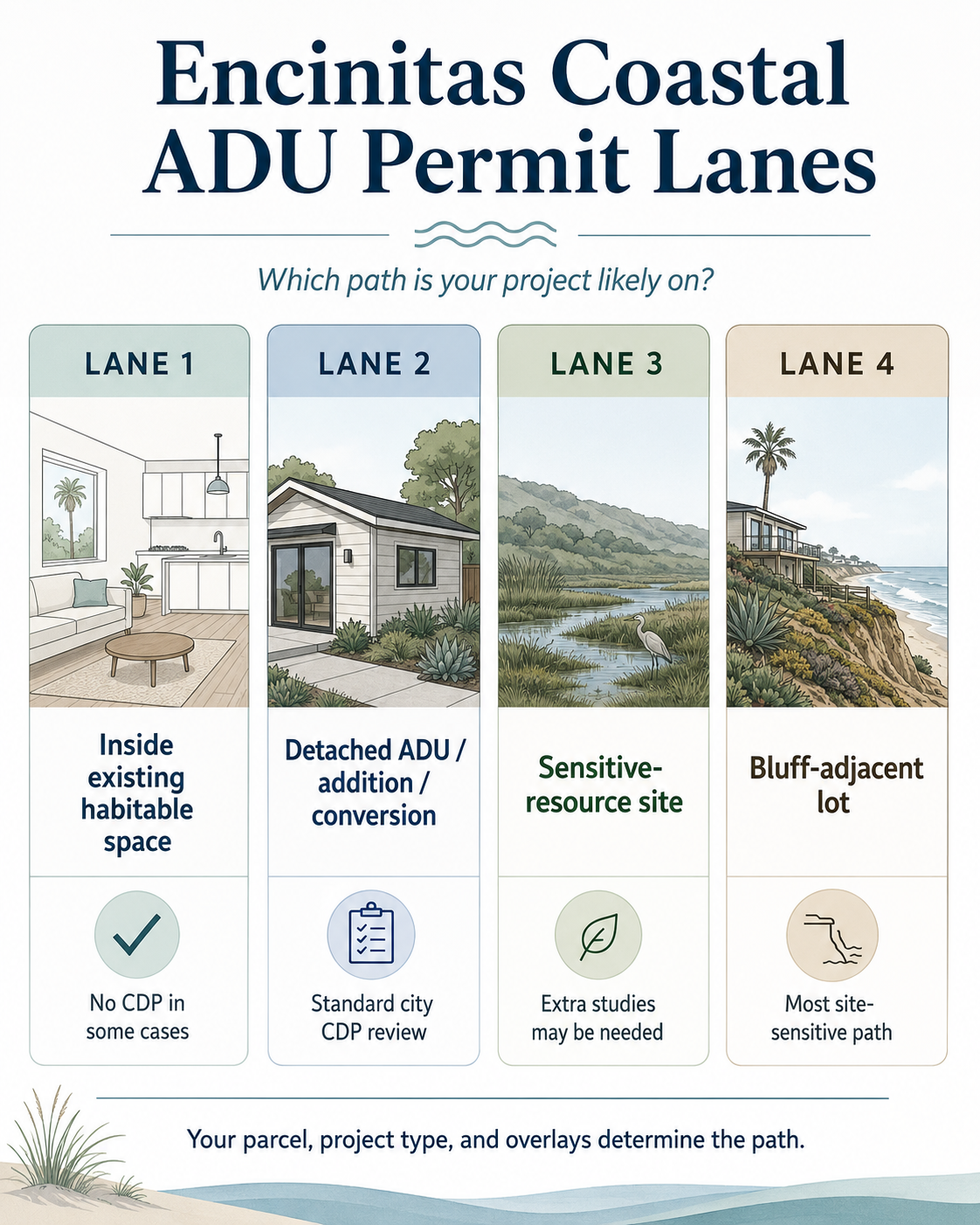
| Lane | What it is | Typical added time vs. inland | Typical added cost vs. inland | Who's usually on it |
|---|---|---|---|---|
| Lane 1: No CDP triggered | JADU created entirely within existing habitable primary-residence space, no added habitable area, no conversion of non-habitable space, no exterior changes | ~0 weeks | ~$0 | The narrow case — confirm in writing with City planning before relying on it |
| Lane 2: CDPNF, standard | New detached ADU, attached addition, ADU above garage, garage conversion — outside bluff and wetland buffers | +0–4 weeks (concurrent under AB 462) | ~$200 noticing + soils/geotech (~$2,500–$6,000) | The most common Encinitas coastal lane |
| Lane 3: CDPNF, sensitive-resource overlay | Project on a lot with Coastal Bluff Overlay, near a wetland (San Elijo, Batiquitos), in HIBO, or in mapped sensitive habitat | +6–16 weeks | $5,000–$25,000 in geotech and additional studies | Many Leucadia and Cardiff bluff-adjacent lots |
| Lane 4: Coastal Bluff Overlay (blufftop parcel) | Bluff-top parcel where EMC §30.34.020 governs siting; new detached ADU inside the 40-foot setback is usually not allowed — realistic paths are landward siting, interior conversion, JADU, or qualifying addition routes | +2–6+ months | $25,000–$60,000+ for full geotech, slope stability, and 75-year erosion analysis | Bluff-top lots, primarily along Neptune Avenue and bluffs above Cardiff State Beach |
Lane time and cost ranges are Dwelling Index editorial estimates assembled from City of Encinitas fee-waiver and process language, EMC §30.80, EMC §30.34.020, EMC §30.48.040T, Government Code §66329, the HCD March 2026 ADU Handbook update, recent Encinitas CDPNF public notices, and published San Diego County builder cost data. Cost lines are ranges, not municipal fee guarantees. See Methodology below.
What we verified (May 12, 2026)
We built this against primary sources. Here is what we checked and where the seams are:
- AB 462 / Government Code §66329 — Approved as an urgency statute and effective October 10, 2025 (Stats. 2025, Ch. 491). 60-day decision deadline tied to §66317. Concurrent processing required. Under §66329(c), local CDP decisions for ADUs under subdivision (a) are not appealable to the Coastal Commission. The express "deemed approved" clause in §66329(b)(5) applies only to Coastal Commission processing in jurisdictions without a certified LCP — not to certified-LCP local agencies like Encinitas.
- Encinitas Local Coastal Program (LCP) — Certified by the California Coastal Commission on May 11, 1995. The City assumed CDP authority on May 15, 1995. The Post-LCP Certification Permit and Appeal Jurisdiction Map was adopted January 9, 2003.
- EMC §30.34.020 (Coastal Bluff Overlay Zone) — 40-foot blufftop setback; 25-foot exception only for additions or expansions of existing principal structures already located seaward of the 40-foot line; 1.5 FOS over 75-year project life required. Latest amendment through Ord. 2025-22, January 21, 2026. Verified against ecode360.com.
- EMC §30.48.040T (ADUs) — Size, setback, height, parking, and rental-duration rules verified against ecode360.com.
- Real 2024–2026 CDPNF cases — Seven cases pulled from The Coast News Group legal-notice publications and the City Development Services Public Notices page (sources noted in the Case Tracker below).
- Lindstrom v. California Coastal Commission, 40 Cal.App.5th 73 (2019) and 2021 Martin decision — Both affirm the additive 1.5 FOS + 75-year erosion methodology for Encinitas bluff setbacks.
- Cost data — Construction-cost ranges ($375–$600/sf, $300,000–$500,000 typical all-in) and Encinitas permit-fee ranges ($2–$4/sf) from SnapADU's 2026 cost content. Framed as published builder data. Last checked May 12, 2026.
Anything we could not independently confirm against a primary source is flagged inline below.
Why we built this page
We are The Dwelling Index — an independent research resource covering ADU financing, costs, and regulations. We are not builders, architects, lenders, or planning staff. We built this page because most existing coverage of the Encinitas coastal zone ADU path was written before October 2025 and still describes a pre-AB 462 world that no longer exists. The City of Encinitas's own ADU page contains both updated CDPNF process information and older language about Notices of Final Action and Coastal Commission appeals — language that, for ADU CDPs under Government Code §66329, is no longer operative. That mismatch is confusing if you have not read the new statute, and we want to make the gap visible rather than paper over it.
The other reason we wrote this: we kept seeing homeowners commit to a 1,200 sf detached ADU plan, pay an architect, then discover that their lot is in a Special Study Overlay or a Coastal Bluff Overlay or has a sewer capacity problem. The right sequence is parcel first, then permit lane, then design. We try to make that sequence obvious below.
Can I build an Encinitas coastal zone ADU?
Answer capsule.
Yes, and for most lots the path is now genuinely bounded. State ADU laws apply throughout the California Coastal Zone, and Government Code §66329 (as amended by AB 462 in October 2025) requires Encinitas to approve or deny an ADU coastal development permit within 60 days of a complete application, process it concurrently with the ADU application, and removes Coastal Commission appeal rights for that local decision. However, California Coastal Act resource-protection policies — bluff setbacks, wetland buffers, sensitive habitat, scenic and public-access protections — remain fully in force, which means parcels near coastal bluffs, wetlands, or sensitive resources can still face substantive design constraints.
The old framing — "Coastal Zone means automatic delay, automatic Coastal Commission involvement, automatic cost" — used to be partly true. It is now largely false for a typical detached ADU on a typical inland-coastal Encinitas lot. What is still true: most of Encinitas's developed area west of Interstate 5 sits inside the Coastal Zone, and the Coastal Bluff Overlay Zone (EMC §30.34.020) imposes serious geotechnical standards on bluff-top lots. None of that is going away.
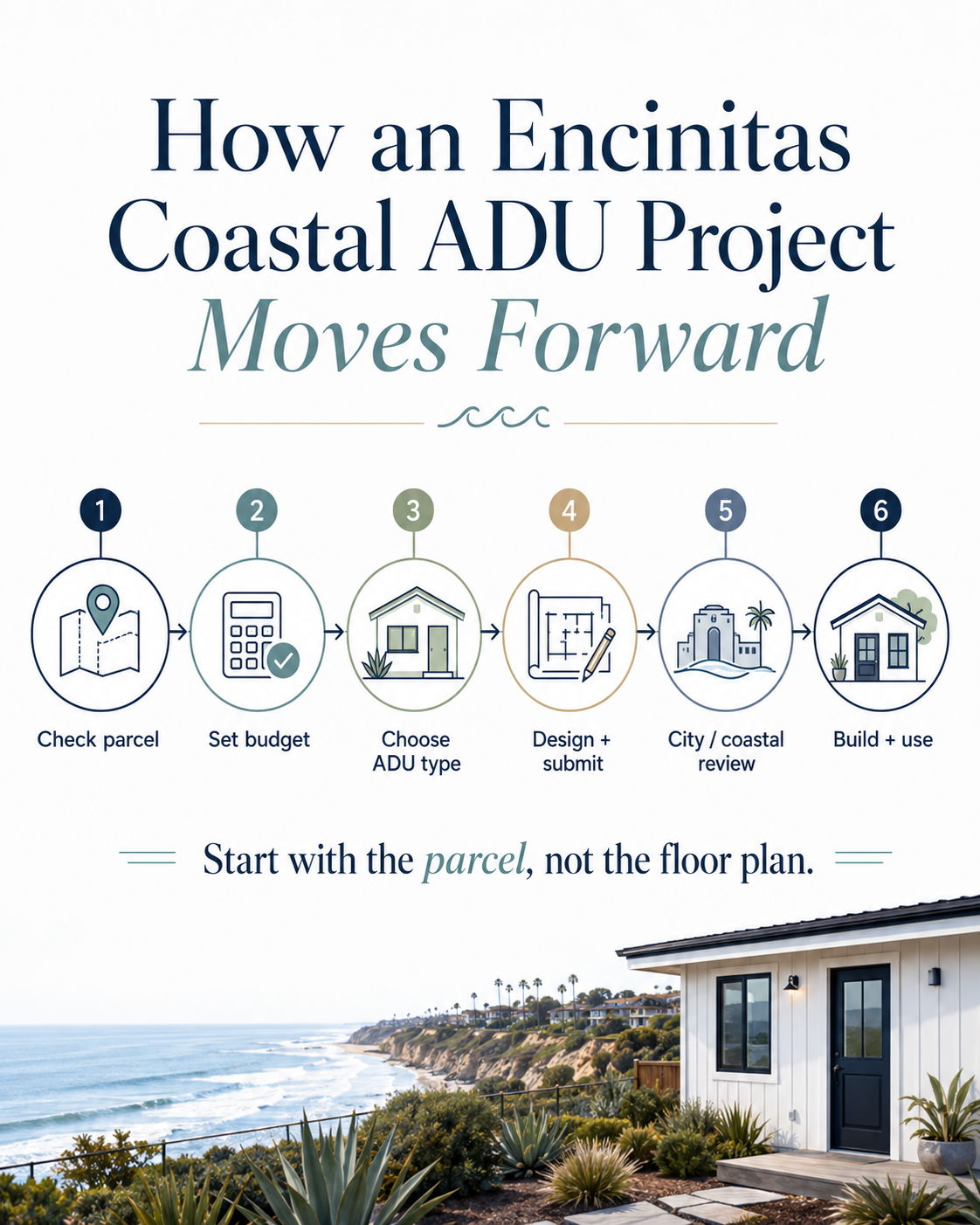
Start with the parcel, not the floor plan
Five things to confirm before you spend money on design:
| Check | Why it matters | Where to verify |
|---|---|---|
| Coastal Zone status | Determines whether a CDP applies at all | California Coastal Commission boundary map (coastal.ca.gov/maps/czb) + Encinitas Post-LCP Certification Permit and Appeal Jurisdiction Map (January 9, 2003) |
| Zoning district | Sets underlying height, front setback, and density rules (R-3, R-5, R-8, R-11, R-15, R-20, RR-1, etc.) | Encinitas eZoning portal (ezoning.encinitasca.gov) |
| Overlay zones | Coastal Bluff Overlay (CBO), Hillside/Inland Bluff Overlay (HIBO), Special Study, Floodplain, Cultural/Natural Resources, Scenic/Visual Corridor — each can change what's allowed | City zoning portal + EMC Chapter 30.34 |
| Water and sewer district | Connection fees and capacity reviews live with the district, not the City | San Dieguito or Olivenhain Municipal Water District; Cardiff Sanitation, Encinitas Sanitary, or Leucadia Wastewater District |
| Existing structure type | Determines JADU, attached, detached, conversion, or above-garage path under EMC §30.48.040T | Site walk + tax-assessor records |
➤ See your parcel's permit lane in 60 seconds
Our checker overlays all of the above.
Get Your Free Encinitas Coastal ADU Report →Is my Encinitas property even in the Coastal Zone?
Answer capsule.
Most of Encinitas's developed area west of Interstate 5 sits inside the California Coastal Zone, and substantial inland areas east of I-5 are also inside the Zone in parts of the city. Olivenhain and the easternmost portions of New Encinitas are largely outside the Coastal Zone. The only definitive check is the parcel-specific overlay on the City of Encinitas Post-LCP Certification Permit and Appeal Jurisdiction Map, adopted by Encinitas on January 9, 2003.
Encinitas has five historic communities. The coastal picture varies meaningfully across them.
Encinitas's five communities and their typical coastal status
| Community | Typical coastal status | Common permit lane | Typical gotchas |
|---|---|---|---|
| Old Encinitas (downtown, west of I-5 south of Encinitas Blvd) | Almost entirely inside the Coastal Zone | Lane 2 for most parcels | Historic Specific Plan overlays; tight downtown lots; transit-related setback reductions may apply |
| Leucadia (north coastal, west of I-5 north of Encinitas Blvd) | Most parcels inside the Coastal Zone | Lane 2 inland of Vulcan; Lane 3 or Lane 4 closer to the bluffs along Neptune Avenue | Coastal Bluff Overlay along Neptune; 40-ft bluff setback; geotech on bluff-adjacent lots |
| Cardiff-by-the-Sea (south coastal) | Most parcels inside the Coastal Zone | Lane 2 for most lots; Lane 3 near San Elijo Lagoon; Lane 4 on the bluffs above the beaches | San Elijo Lagoon proximity can trigger sensitive-resource review; bluff-top lots have serious geotech requirements |
| New Encinitas (inland, around El Camino Real and Encinitas Blvd) | Partial — some parcels inside, some outside | Lane 1 or Lane 2 if inside; no CDP at all if outside | Parcel-by-parcel verification critical; outright easier permit path if outside |
| Olivenhain (eastern, semi-rural) | Mostly outside the Coastal Zone | Typically no CDP required | Septic capacity, well-water concerns, larger lots, different fire-access standards |
This matrix is directional. Final coastal status is per-parcel and must come from the City of Encinitas Post-LCP Certification Permit and Appeal Jurisdiction Map.
How to verify your specific parcel
- Open the Encinitas eZoning portal at ezoning.encinitasca.gov and search your address. Note your zoning district and any overlay zones listed.
- Look for any of: Coastal Overlay, Coastal Bluff Overlay (CBO), Hillside/Inland Bluff Overlay (HIBO), Special Study, Floodplain Overlay (FPO), Cultural/Natural Resources Overlay (C/NRO), Scenic/Visual Corridor Overlay, or Wetland Study Overlay.
- If "Coastal Overlay" appears, you are inside the Coastal Zone and a CDP is in play.
- If "Coastal Bluff Overlay" appears, see the blufftop section below — your project has a substantially different cost and timeline profile.
- If you see Special Study or HIBO, expect to provide a site-specific geotechnical or slope study.
When the City portal is ambiguous, contact Encinitas Land Development & Building staff directly at planning@encinitasca.gov or 760-633-2710 for a parcel-specific determination.
➤ Free Encinitas Coastal ADU Starter Kit
Want a one-page parcel-check checklist plus the overlay-zone decoder we use internally?
Download the Free Encinitas Coastal ADU Starter Kit →When does an Encinitas coastal ADU actually need a CDP?
Answer capsule.
Per the City of Encinitas's ADU page, a Coastal Development Permit is required for ADUs and JADUs in the Coastal Zone that are not completely contained within the existing primary structure, that include any increase in habitable area, that involve conversion of non-habitable space to habitable space, or that are new detached residential units. A JADU created entirely within existing habitable space of the primary residence — with no exterior changes, no added habitable area, and no conversion of non-habitable space — is the narrow case that may not trigger a CDP, but we recommend you confirm that determination in writing with Encinitas planning before relying on it.
The accurate framing: most coastal ADUs do trigger a CDPNF in Encinitas, but after AB 462 that CDPNF is processed concurrently with the building permit on a 60-day clock with no Coastal Commission appeal. Functionally close to "fast and predictable." Not "no CDP."
The Encinitas Coastal ADU CDP Trigger Matrix
Assembled from EMC §30.48.040T, the City of Encinitas ADU page, and the 2024–2026 public-notice record. Every project type below has at least one publicly documented Encinitas CDPNF case to confirm the trigger.
| Project type | CDP required? | Code basis | Real Encinitas example we verified |
|---|---|---|---|
| New detached ADU on a single-family lot | Yes | EMC §30.48.040T + City ADU page | SOS Residence ADU, CDPNF-007695-2024, 1373 Hygeia Avenue, R-8 + Coastal Overlay |
| New attached ADU addition | Yes | Adds habitable area | Selander ADU, CDPNF-008424-2025, 1439 Kings Cross Drive, 525 sf attached, R-8 + Special Study + Scenic/Visual + Coastal Overlay |
| ADU above an existing garage | Yes | Adds habitable area / not contained in primary | Al-Marashi ADU, CDPNF-006513-2023, 774 Melba Road, 942 sf ADU above existing SFR, R-3 + Coastal Zone |
| Garage conversion ADU (non-habitable to habitable) | Yes | Conversion of non-habitable space | De Paolo ADU, CDPNF-007578-2024, 587 Melba Road, garage conversion, R-11 + Special Study + Coastal Overlay |
| Detached ADU on an existing multifamily lot | Yes | Coastal-zone CDPNF applies (EMC + SB 1211) | Hochfilzer ADUs, CDPNF-008073-2025, 1084/1086 Gardena Road, two detached ADUs (706 sf and 1,052 sf) on a multifamily lot, approved May 7, 2026 |
| 1,200 sf detached ADU on a larger lot | Yes | Standard coastal trigger | Held ADU, CDPNF-008024-2025, 1193 Cardiff Drive, 1,200 sf detached, RR-1 + Cultural/Natural Resources + Coastal Overlay |
| Full new SFR with detached ADU | Yes | Combined project triggers CDPNF | Carlson Residence, CDPNF-008648-2026, 188 Phoebe Street, R-11 + Special Study + Coastal Overlay |
| JADU created fully within existing habitable space, no exterior changes, no conversion of non-habitable space | Possibly no CDP — confirm in writing | Narrow exception to listed CDP triggers | Verify directly with planning@encinitasca.gov |
| PRADU detached plan on a coastal lot | Yes — same as any new detached ADU | PRADU speeds building review only, not coastal review | City PRADU program documents |
Case sources: The Coast News Group legal-notice publications (October 2024 through April 2026) and the City of Encinitas Development Services public-notice portal. Each case is identifiable by case number through the City's CSS portal records.
What does "CDPNF" actually mean?
CDPNF stands for Coastal Development Permit No Fee. It is Encinitas's administrative track for coastal-zone ADUs, JADUs, and similar small-scale residential projects. "No fee" refers specifically to the permit application fee — the City does not charge a separate CDP application fee on top of the building permit. It does not mean the project is free. Applicants still pay:
- A public-notice mailing fee (exact amount and mailing radius should be confirmed against the current City form for your project, as these have varied over time).
- State-required fees (SB 2 affordable housing fee, building standards admin, CalBIS, seismic monitoring — all relatively small).
- The ADU covenant recordation fee with the San Diego County Recorder.
- Water and sewer district fees through whichever district serves your lot.
- School fees, where applicable. Per SB 543 (effective January 1, 2026), ADUs and JADUs with less than 500 square feet of interior livable space are excluded from the school-fee assessable-space increase.
- A geotechnical letter report that the City requires for projects at or around the 500 sf threshold (verify against the current City checklist; waiver possible at Building Official discretion).
Plan-review and inspection fees for the ADU itself are largely waived by the City of Encinitas, which has consistently produced some of the lowest ADU permitting costs in San Diego County. SnapADU's published builder data places typical Encinitas ADU permit fees at $2–$4 per square foot — a published builder estimate, not a municipal fee schedule, and the comparison to $13–$28 per square foot in the City of San Diego is similarly third-party builder data. (Source: SnapADU 2026 cost content; last checked May 12, 2026.)
➤ Find out whether the 60-day rule helps your project
Some Encinitas lots benefit dramatically. Others (bluff-top, wetland-adjacent) gain less. We'll tell you which yours is.
Get Your Free Encinitas Coastal ADU Report →Why the City's ADU page may still look contradictory
Answer capsule.
The City of Encinitas's ADU page contains both updated CDPNF process language and older references to a Notice of Final Action (NOFA) being transmitted to the Coastal Commission and a 10-business-day Coastal Commission appeal period. For ADU CDPs decided under Government Code §66329(a), that appeal pathway is no longer operative as of October 10, 2025. The statute controls. Current Encinitas CDPNF public notices for ADUs reflect this — they state explicitly that the action may not be appealed to the California Coastal Commission.
The resolution:
- For ADU CDPs decided by Encinitas under §66329(a) — no Coastal Commission appeal, 60-day decision, concurrent processing. AB 462 governs.
- For other coastal projects decided by Encinitas (non-ADU) — the older NOFA / appealable-area / 10-business-day Coastal Commission appeal framework still applies under Public Resources Code §30603.
We expect the City to retire the older NOFA language from the ADU page during a future update. Until then, trust the statute and the post-October-2025 CDPNF notice template, which already reflects the AB 462 framework.
What AB 462 changed — and what it did not
Answer capsule.
AB 462 (Stats. 2025, Ch. 491), codified at California Government Code §66329, took immediate effect as an urgency statute on October 10, 2025. It requires Encinitas to approve or deny a CDP for an ADU within 60 days of a complete application, requires that CDP review run concurrently with the ADU/building permit review under §66317, prohibits public hearings on ADU CDPs, and removes the right to appeal the local decision to the California Coastal Commission under Public Resources Code §30603. The California Coastal Act and Encinitas's certified LCP resource-protection policies remain fully in force.
What the statute actually does (decoded)
Government Code §66329(a): "Nothing in this article shall be construed to supersede or in any way alter or lessen the effect or application of the California Coastal Act of 1976, except that the local government shall, pursuant to Section 66317, either approve or deny a coastal development permit application for an accessory dwelling within 60 days of receiving a completed application, and shall not be required to hold public hearings for coastal development permit applications for accessory dwelling units. The process to approve or deny a coastal development permit application under this subdivision shall happen concurrently with the process to approve or deny an application for an accessory dwelling unit under Section 66317."
- The 60-day clock starts when Encinitas determines your application is complete. SB 543 (effective January 1, 2026) tightens completeness rules — Encinitas must determine completeness within 15 business days of receiving the application.
- The CDP review runs in parallel with the ministerial ADU review under §66317. The old sequential model is gone.
- No public hearing is required for an ADU CDP. Administrative review only.
- No appeal to the Coastal Commission. This is the headline. The pre-AB 462 framework gave the Commission a 10-business-day appeal window after the City's NOFA on projects in the "appealable area". For ADU CDPs decided under §66329(a), that pathway no longer exists.
- Deemed approval. Under Government Code §66317, failure to act on a complete ADU application within 60 days results in the application being deemed approved.
Current Encinitas public-notice language reflects AB 462. The Lee Residence ADU notice (CDPNF-008759-2026) and the Mack McNab garage conversion notice (CDPNF-008494-2025) both state explicitly that the action may not be appealed to the California Coastal Commission.
What AB 462 did NOT do
The statute says, in its own text, that it does not supersede or alter the application of Coastal Act resource-protection policies. Encinitas can still apply the substantive standards in its certified LCP. That means:
- The Coastal Bluff Overlay Zone 40-foot setback under EMC §30.34.020 still applies.
- The 1.5 Factor of Safety over 75 years for blufftop projects, affirmed by Lindstrom and Martin, still applies.
- Public access, scenic resource, and sensitive habitat policies still apply.
- The City can still deny a CDP within the 60-day window if the project doesn't comply with the LCP. AB 462 forces a decision; it doesn't force approval.
| Lane | AB 462 impact |
|---|---|
| Lane 2 (most Encinitas coastal ADUs) | Genuinely transformative. The CDP is now near-invisible in the timeline. The 10-day public-comment window happens concurrently with building review, not after. |
| Lane 3 (sensitive-overlay) | Helps procedurally — no Coastal Commission appeal window — but the substantive review of overlay constraints is unchanged. Your geotech still has to satisfy the LCP. |
| Lane 4 (Coastal Bluff Overlay) | Largely cosmetic. Bluff geotech, slope stability, 75-year erosion, and the 40-foot setback are entirely outside its scope. If your project could not pass those tests before October 2025, it cannot pass them after. |
The damaging admission, stated plainly
The 60-day rule does not make a bluff problem disappear. It does not make a wetland buffer go away. It does not waive a sewer-capacity issue or a slope-stability finding. If your lot sits within the Coastal Bluff Overlay Zone or within the wetland buffer of San Elijo or Batiquitos Lagoon, AB 462 will speed your administrative process but will not approve a project that conflicts with the underlying coastal protections. We have seen homeowners read about AB 462, assume the bluff issue is gone, and pour design money into a project that geotechnical reality will not bear. We don't want you to be that homeowner.
For those lots, the right path is often inward, not outward — a smaller JADU within the existing primary structure, a conversion of existing habitable space (Lane 1), or an ADU above the existing footprint rather than out toward the bluff.
➤ Check your coastal permit path before you pay for design
A 60-second parcel check before a $15,000 design retainer is the cheapest investment in your ADU project.
Get Your Free Encinitas Coastal ADU Report →The real cost of the coastal layer on top of a standard Encinitas ADU
Answer capsule.
A base detached ADU in San Diego County, including Encinitas, typically runs $375–$600 per square foot in vertical construction cost per published 2026 builder data, with typical detached ADUs landing around $300,000–$500,000 all-in. The coastal layer typically adds approximately $0–$6,000 on a clean Lane 2 project, $5,000–$25,000 on a Lane 3 project, and $25,000–$60,000+ on a Lane 4 bluff-overlay project, depending mainly on whether a full site-specific geotechnical report is required.
The Coastal Layer Cost-Add Table
| Cost element | Lane 1 (no CDP) | Lane 2 (standard CDPNF) | Lane 3 (overlay-sensitive) | Lane 4 (Coastal Bluff Overlay) |
|---|---|---|---|---|
| CDPNF noticing fee | $0 | ~$200 (verify current) | ~$200 (verify current) | ~$200 (verify current) |
| Geotechnical letter/report (City requires at or around 500 sf) | If structural | $2,500–$6,000 | $2,500–$6,000 | Subsumed in full geotech |
| Site-specific geotechnical report | Usually not | Usually not | Often, $5,000–$15,000 | Required, $15,000–$40,000+ |
| Slope stability + 75-year erosion analysis | No | No | Sometimes | Yes, per EMC §30.34.020.D |
| Stormwater / drainage / bio-swale | Varies | $0–$10,000 (project-dependent) | $5,000–$15,000 | $5,000–$15,000 |
| Specialized biology or habitat study | No | No | Sometimes | Sometimes |
| Typical added time vs. inland Encinitas | ~0 weeks | +0–4 weeks (concurrent under AB 462) | +6–16 weeks | +2–6+ months |
| Typical total coastal add | ~$0 | ~$200–$6,000 | ~$5,000–$25,000 | ~$25,000–$60,000+ |
Dwelling Index editorial estimate. Cost lines marked "verify current" should be confirmed against the current City form for your specific project. Stormwater triggers depend on impervious surface and lot conditions. Geotechnical and biology study costs are builder-reported ranges for North County San Diego coastal projects.
A worked example for a typical Lane 2 project
A 750 sf detached ADU in Old Encinitas, R-11 zoning, Coastal Overlay, no bluff or wetland exposure, on a relatively flat lot:
- Base vertical construction at the published builder mid-range: 750 sf × $450/sf ≈ $337,500
- Design and engineering (custom plans): $15,000–$20,000
- Site work, utilities trenching, foundation prep: $25,000–$50,000
- Geotechnical letter report: $3,500
- CDPNF noticing fee: ~$200
- Stormwater mitigation (project-dependent): $0–$10,000
- State fees, recordation, water/sewer/school: $5,000–$15,000
That is a typical $385,000–$435,000 all-in number, of which approximately $3,700–$13,700 is the coastal-specific layer. On a project that scale, the coastal layer is meaningful but not project-defining.
The math changes hard at Lane 4. A blufftop new construction with a full geotechnical investigation, 75-year erosion analysis, slope stability modeling, and possible foundation engineering can add $40,000–$60,000+ in soft costs before you have even hired an architect. That math is why many bluff-top Encinitas homeowners pivot from a detached ADU to an interior JADU.
➤ Talking to an Encinitas-experienced builder
We work with SnapADU as an approved partner for Greater San Diego, including Encinitas, Cardiff-by-the-Sea, La Costa, and Leucadia. SnapADU's published 2026 cost data is widely cited and the company has portfolio examples in Encinitas. If you have verified your permit lane and you want a builder quote:
See whether SnapADU fits your Encinitas project →If SnapADU is not a fit or you want alternatives, the Feasibility Engine will surface other options after parcel review.
What a real Encinitas coastal ADU approval looks like in 2025–2026
Answer capsule.
Encinitas processes a steady stream of CDPNF actions for ADUs through the City's public-notice system. Recent cases include new detached ADUs, attached additions, ADUs above existing garages, garage conversions, and multifamily-lot ADUs. These public notices are published weekly in The Coast News Group's legal-notice section and on the City's Development Services Public Notices page, and they are the most useful proof we have that the system is working as the statute and code describe.
The Encinitas Coastal ADU Case Tracker
| Project | Case number | Address | What it tells you | Public notice source |
|---|---|---|---|---|
| Selander ADU | CDPNF-008424-2025 | 1439 Kings Cross Drive | 525 sf attached ADU in R-8 + Special Study + Scenic/Visual + Coastal Overlay — shows that an attached ADU with multiple overlays still moves through CDPNF | The Coast News Group, March 13, 2026 |
| Hunt ADU | CDPNF-007641-2024 | 836 Del Riego Ave | New detached ADU in R-5 + Special Study + Coastal Overlay — standard Lane 2 case | The Coast News Group, September 12, 2025 |
| De Paolo ADU | CDPNF-007578-2024 | 587 Melba Road | Attached garage converted to ADU in R-11 + Special Study + Coastal Overlay — garage conversion through CDPNF | The Coast News Group, April 18, 2025 |
| SOS Residence ADU | CDPNF-007695-2024 | 1373 Hygeia Ave | New detached ADU in R-8 + Coastal Overlay — clean Lane 2 detached | The Coast News Group, October 31, 2025 |
| Al-Marashi ADU | CDPNF-006513-2023 | 774 Melba Road | 942 sf ADU above existing single-story SFR in R-3 + Coastal Zone — above-existing-structure pathway | The Coast News Group, September 19, 2026 |
| Held ADU | CDPNF-008024-2025 | 1193 Cardiff Drive | New 1,200 sf detached ADU in RR-1 + Cultural/Natural Resources + Coastal Overlay — full 1,200 sf path on a rural-residential lot | The Coast News Group, September 19, 2026 |
| Carlson Residence | CDPNF-008648-2026 (time extension) | 188 Phoebe Street | New 2-story home with detached garage and ADU on R-11 + Special Study + Coastal Overlay — combined SFR+ADU CDPNF path | The Coast News Group, March 13, 2026 |
Sources: City of Encinitas Development Services Public Notices and The Coast News Group legal-notice publications, October 2024 through April 2026. Case records can be looked up by case number through the City's Customer Self Service (CSS) portal.
➤ Have a similar project?
We'll show you the closest verified public-record examples and walk you through the documents you'll need.
Get Your Free Encinitas Coastal ADU Report →How big can my Encinitas coastal ADU be?
| Unit type | What Encinitas allows | What state law protects | Practical effect |
|---|---|---|---|
| Detached ADU | Up to 1,200 sf, or the primary residence's living area, whichever is less (EMC §30.48.040T) | At least 800 sf state-exempt; local max cannot drop below 850 sf (studio/1BR) or 1,000 sf (>1BR) | You can build at least an 800 sf detached ADU on virtually any conforming Encinitas lot |
| Attached ADU | Up to 1,200 sf, or the primary residence's living area, whichever is less (verify against current EMC §30.48.040T) | Same state-protected floors | Often the right answer for small primary residences |
| Junior ADU (JADU) | Up to 500 sf, fully within the primary residence | Same | Owner-occupancy may apply depending on sanitation configuration; efficiency kitchen required |
| Detached ADU on existing multifamily lot | Up to 8 detached ADUs (capped at the existing unit count) under SB 1211, effective January 2025 | State pre-empts local restrictions | Multifamily owners gained dramatic capacity in 2025 |
| PRADU plan | 224 sf, 350 sf, 499 sf, 555 sf, 745 sf, 938 sf, 990 sf, and 1,199 sf — eight pre-approved plans | Same state-floor protections apply | Architect-designed templates available free from the City |
Setback and parking
| Topic | Encinitas rule |
|---|---|
| Side and rear setbacks | 4 feet minimum (reduced-setback path); if the ADU exceeds 16 feet in height, it must use the underlying zone's setbacks |
| Front setback | Per underlying zone; state-protected size envelope may apply when no other location works |
| Street-side setback on corner lots | 4 feet — Encinitas does not apply larger street-side setbacks to ADUs |
| Building separation | 6 feet wall-to-wall between primary and ADU; 4 feet eave-to-eave |
| Parking | 1 space per ADU, with exceptions for transit proximity (½ mile), historic district, conversion of existing structure, or 1-block car-share area. Per SB 1211, replacement parking is not required when a garage is demolished or converted for an ADU |
Note that under SB 543 (effective January 1, 2026), all size limits in the Government Code refer to net square footage of interior livable space — exterior walls and attached uncovered space do not count against the cap.
The Coastal Bluff Overlay Zone and the 40-foot setback rule
Answer capsule.
Encinitas Municipal Code §30.34.020 — the Coastal Bluff Overlay Zone — prohibits principal and accessory structures (including new detached ADUs) within 40 feet of the top edge of a coastal bluff. There is a narrow 25-foot exception that applies only to additions or expansions of existing principal structures already located seaward of the 40-foot line, conditioned on a removability agreement. Encinitas additionally requires a site-specific geotechnical report demonstrating a Factor of Safety of 1.5 maintained over a 75-year project life. The appellate court affirmed this additive methodology in Lindstrom v. California Coastal Commission (40 Cal.App.5th 73, 2019) and the 2021 Martin decision. AB 462 did not change any of this.
What EMC §30.34.020 actually requires
- 40-foot blufftop setback for principal and accessory structures. A new detached ADU sited within 40 feet of the top edge of the coastal bluff is generally not allowed.
- The 25-foot exception applies only to additions or expansions of existing principal structures already located seaward of the 40-foot line — not to new detached construction. The exception requires a removability agreement.
- Site-specific geotechnical investigation is required for any project on a CBO parcel.
- 1.5 Factor of Safety over 75 years. The geotechnical analysis must satisfy 1.5 FOS today plus projected bluff retreat over a 75-year project life.
- No permanent irrigation systems within 40 feet of the bluff edge — only hose bibs or low-volume drip on timers.
- Removability condition. New blufftop construction must be designed so it can be removed in the event of future endangerment.
What "1.5 Factor of Safety over 75 years" means in plain English
Geotechnical engineers calculate a Factor of Safety — a numerical ratio of forces resisting slope failure to forces driving slope failure. A FOS of 1.5 is the standard for new construction on or near a bluff. Encinitas does not stop at today's stability — it asks whether the bluff will still maintain FOS 1.5 in 75 years, given expected erosion.
The Coastal Commission has used the SCAPE methodology to evaluate Encinitas blufftop projects. In case-specific staff reports, the Commission has used erosion-rate assumptions in the range of 0.49–0.52 feet per year for individual Encinitas blufftop parcels. These are parcel-specific rates, not citywide defaults. On bluffs where erosion projections compound the 1.5 FOS line meaningfully, required setbacks have measured 70+ feet from the current bluff edge.
If your lot sits 50 feet from the current bluff edge, you cannot, in 2026, build a new detached ADU 25 feet from the edge. The math does not allow it.
What works on a blufftop Encinitas lot, then
In our review of recent Encinitas blufftop appeals (including CCC staff report A-6-ENC-24-0031, September 2024), the bluff-top projects that succeeded were almost all interior conversions — basement crawl-space conversions, in-house JADUs, attic-to-living-space conversions, or above-existing-garage ADUs landward of the bluff line. The Coastal Commission has noted explicitly that an ADU created from converting existing space within an existing structure does not constitute "new construction" for purposes of the Coastal Bluff Overlay setback requirements.
If you are on a blufftop lot, this is almost always the better path. A 400–700 sf JADU or interior conversion can avoid the 40-foot setback issue entirely, avoid most of the geotechnical cost, avoid the additive 75-year erosion analysis, and process as a Lane 1 or near-Lane 1 project. Many Neptune Avenue and Cardiff blufftop homeowners take exactly this path.
➤ Bluff-top owner reading this?
Before any design work, run the parcel through our checker. We'll flag the bluff-overlay constraints and route you toward a realistic path.
Get Your Free Encinitas Coastal ADU Report →What you submit, and how long it actually takes
Answer capsule.
Encinitas processes all ADU applications electronically through its Customer Self Service (CSS) portal — paper submittals are no longer accepted. A typical complete submittal includes site plan, floor plan, elevations, structural drawings, geotechnical letter or report, grant deed, preliminary title report within six months, Housing Development Tracking Form, water and sewer district forms, Title 24 energy compliance, and school fee form if applicable. New detached ADUs are also generally required to be all-electric and may require a Solar Photovoltaic System.
Encinitas ADU submittal checklist
| Item | Required or conditional | Notes |
|---|---|---|
| Project plans (site, floor, elevations, roof, title sheet) | Required | Upload through CSS portal |
| Grant deed | Required | Establishes ownership |
| Preliminary title report | Required | Within six months of application |
| Housing Development Tracking Form (Single-Family / ADU) | Required | Submitted prior to issuance |
| Title 24 Energy Efficiency Compliance | Required | State energy code documentation |
| Geotechnical letter report | Required at or around 500 sf threshold | Waivers possible at Building Official discretion; verify current threshold on City checklist |
| Full geotechnical report | Conditional | Required for CBO, HIBO, slope, or larger additions |
| Stormwater / grading intake | Conditional | If grading or impervious-surface thresholds trigger |
| All-electric appliance commitment | Generally required for new detached ADUs | Per City Applications & Information page |
| Solar Photovoltaic System | May be required for new detached ADUs | Exceptions discussed with reviewer |
| Water district form (San Dieguito or Olivenhain Municipal) | Required before permit issuance | Coordinate with applicable district early |
| Sewer district form (Cardiff, Encinitas Sanitary, or Leucadia Wastewater) | Required before permit issuance | District-specific |
| School fee form (San Dieguito Union HSD + elementary district) | Required if 500 sf or more interior livable | Per SB 543, ADUs/JADUs under 500 sf excluded from assessable-space increase |
| ADU Covenant and Indemnification Agreement | Required | Recorded with the San Diego County Recorder |
| County Health Approval | Conditional | Septic / well lots (mostly Olivenhain) |
A realistic Lane 2 timeline (post-AB 462)
| Phase | Duration | What happens |
|---|---|---|
| Pre-application + parcel verification | 1–2 weeks | Confirm zoning, overlays, Coastal Zone status; choose design path |
| Design + plan prep | 4–10 weeks | Custom plans or PRADU-plus-site-plan; soils report ordered |
| Submittal to CSS portal | Same day | Electronic submittal of all required documents |
| Completeness review | Up to 15 business days | Per SB 543; written list of any incomplete items |
| First-round review (all departments + CDPNF concurrent) | ~15 working days from complete | Building, Planning/Land Dev, Fire, Engineering, CDPNF |
| Public-notice mailing (concurrent) | 10 calendar days | Mailed to surrounding owners and occupants |
| Revisions (if any) | 2–6 weeks | Address redlines |
| 60-day AB 462 clock | 60 days max from complete | Encinitas must approve or deny CDPNF within this window |
| Covenant recording | 1–2 weeks | Hold Harmless / Covenant filed with County Recorder |
| Building permit issuance | After all conditions met | Cleared for construction |
| Construction | 4–8 months for typical detached | Inspections requested by 3 PM scheduled next business day |
Total realistic timeline from "ready to permit" to ground-breaking, on a clean Lane 2 project: 3 to 5 months.
Lane 3 and Lane 4 projects stretch to 6–9 months and 8–14+ months, respectively.
Fees beyond the CDPNF — the full cost picture
Answer capsule.
Encinitas waives the bulk of its plan-review and inspection fees for ADUs, but the project is not fee-free. State fees, the CDPNF noticing-mailing fee, the County Recorder covenant fee, water and sewer district connection and capacity fees, school fees (excluded for ADUs/JADUs under 500 sf per SB 543), the geotechnical letter or report, Title 24 documentation, and any solar PV installation may all still apply.
| Fee or cost category | What to expect | Verification status |
|---|---|---|
| City ADU plan-review and inspection fees | Largely waived | Verified on City of Encinitas ADU page |
| State-required fees (SB 2, building standards admin, CalBIS, seismic) | Small flat amounts | Set by state, not waivable |
| CDPNF noticing mailing | Postage fees apply | Confirm exact amount and mailing radius against current City form for your project |
| ADU covenant recordation | Per County Recorder schedule | Verify current rate |
| Water district (San Dieguito or Olivenhain Municipal) | Connection + capacity fees vary | Get a written estimate from your district before design |
| Sewer district (Cardiff Sanitation, Encinitas Sanitary, or Leucadia Wastewater) | Connection + capacity fees vary | District-specific |
| School fees (San Dieguito Union HSD + elementary district) | Assessable per-sf if 500 sf or more interior livable | ADUs/JADUs under 500 sf excluded per SB 543 |
| Geotechnical letter / report | $2,500–$6,000 letter; $5,000–$40,000+ for full site-specific report | Builder-reported ranges for North County coastal projects |
| Stormwater / drainage | Project-dependent | Confirm impervious-surface trigger and cost with engineer |
| Solar PV system | May be required for new detached ADUs | Discuss exceptions with City reviewer |
| All-electric appliance package | Generally required for new detached ADUs | Per City Applications & Information page |
| Construction cost | $375–$600/sf published builder range; $300,000–$500,000 typical all-in for detached San Diego County ADUs | Published SnapADU 2026 builder data; last checked May 12, 2026 |
For homeowners thinking about how to pay for all of this, ADU financing typically runs through a HELOC, cash-out refinance, construction loan, or ADU-specific lender. Our ADU financing paths guide covers HELOCs, construction loans, cash-out refinances, and renovation loans without ranking lenders by payout.
PRADU vs. custom vs. prefab in the coastal zone
Answer capsule.
Encinitas's Permit-Ready ADU (PRADU) program, launched in 2019 as one of California's first such programs, offers eight pre-approved master plans ranging from 224 to 1,199 sf, designed by local architects, available free to homeowners. PRADU substantially reduces design fees and speeds plan review for the standard structural plans. However, a PRADU project in the Coastal Zone still requires a site-specific plan, the CDPNF process, the geotechnical letter or report, drainage analysis, and any overlay review. PRADU does not bypass coastal-zone permitting; it speeds the building-plan layer only.
When PRADU is a strong coastal-zone fit
| Scenario | Why PRADU helps |
|---|---|
| Flat or simple lot in Old Encinitas or inland Leucadia | The PRADU plan slots in without major site adaptation |
| Detached ADU project where 4-foot setbacks work | The plans are pre-designed to those parameters |
| Homeowner who values speed and budget over custom design | Eight plans, free, structurally pre-approved; saves $7,000–$17,000 in architectural fees |
| One of the eight plans (224 to 1,199 sf) matches the use case | No need to invent something custom |
When PRADU is the wrong tool
| Scenario | Why a different path is better |
|---|---|
| Coastal Bluff Overlay lot | Site-specific geotech and bluff-aware design needed; PRADU plans aren't tuned for blufftop conditions |
| Garage conversion ADU | PRADU is detached-ADU focused; garage conversions need site-specific plans |
| ADU above an existing garage | Requires custom structural integration |
| Steep slope, HIBO, or sensitive habitat lot | Site adaptation required that PRADU doesn't accommodate |
| Homeowner wants design control | PRADU plans cannot be modified under the program |
Prefab vs. PRADU vs. what neither solves in the Coastal Zone
| Element | What PRADU solves | What prefab solves | What neither solves in the Coastal Zone |
|---|---|---|---|
| Architectural design fees | Yes — free plans | Partially — plans included in package | n/a |
| Building plan-check speed | Some | Some | Both still require Encinitas CSS submittal |
| On-site construction speed | No | Yes — factory build runs parallel to site prep | n/a |
| Coastal Development Permit (CDPNF) | No | No | CDPNF still required for any new detached ADU in the Coastal Zone |
| Coastal Bluff Overlay constraints | No | No | EMC §30.34.020 applies regardless of construction method |
| Solar PV and all-electric requirements | No | Sometimes built into prefab package | City Applications page applies regardless |
For deeper prefab pricing, see our Prefab ADU Cost guide →
Can I rent the ADU? (And can I Airbnb it?)
Answer capsule.
Yes, you can rent an Encinitas coastal-zone ADU as a long-term rental. No, you cannot use it as a short-term rental (under 30 days). Encinitas Municipal Code requires that ADUs be rented for terms longer than 30 days, and the City's short-term rental ordinance prohibits STRs within ADUs. State law (AB 976, effective January 1, 2024) permanently removed owner-occupancy requirements for most ADUs permitted between January 1, 2020 and January 1, 2025; however, JADU owner-occupancy rules in 2026 depend on sanitation configuration — under HCD's March 2026 ADU Handbook, owner-occupancy cannot be required for JADUs that include separate sanitation facilities.
Common long-term use cases we see in Encinitas
- Aging parent housing. A 500–700 sf JADU or attached ADU as multigenerational housing.
- Adult child returning to the area. Particularly common in Olivenhain and New Encinitas where lots accommodate detached units.
- Long-term tenant. Strong rental demand in Leucadia and Cardiff. These are illustrative examples, not guarantees of returns. Actual results depend on local market conditions, construction costs, financing terms, and regulatory approvals. Verify current market rates with a licensed property manager or recent comparable lease data.
- Home office / studio. Artists, professionals, and remote workers using ADUs as dedicated workspace.
- Owner downsizing. Owner moves into the ADU and rents the primary house. Legal in Encinitas; verify any applicable rental ordinances.
Selling the ADU separately
AB 1033 (effective January 1, 2024) allows California cities and counties, at their option, to adopt local ordinances permitting separate sale of ADUs as condominiums. Encinitas has not adopted such an ordinance as of May 2026. Selling your ADU separately is therefore not a current option in Encinitas; it remains tied to the primary residence on the same parcel.
Coastal-specific edge cases that derail Encinitas ADU projects
Answer capsule.
The fastest Encinitas coastal ADU path is a project that avoids the predictable edge cases: Coastal Bluff Overlay proximity, HIBO and Special Study slope flags, sensitive habitat designations, San Elijo or Batiquitos Lagoon proximity, public-access and view-corridor exposure, utility capacity gaps, unpermitted existing structures, and HOA/CC&R restrictions on private streets.
| Edge case | What it can affect | Best next step |
|---|---|---|
| Coastal Bluff Overlay | Setbacks, foundations, geotech, approvability | Coastal-geotech feasibility before design |
| HIBO / Special Study / steep slope | Slope analysis, grading, site plan | Confirm overlay and engineering needs up front |
| Sensitive habitat / scenic resources | Siting, massing, review findings | LCP resource policies still apply post-AB 462 |
| San Elijo or Batiquitos Lagoon proximity | Wetland/sensitive-resource review; biology study possible | Confirm distance from lagoon; biology review if within applicable buffer |
| Public access or view corridor | Coastal Act §30210–30214 protections | Avoid blocking established view easements |
| Utility capacity | Sewer/septic capacity, water pressure, electrical service | Get district capacity letter early; Olivenhain lots in particular need septic review |
| Unpermitted existing structures | Title cleanup before ADU; AB 2533 legalization path for pre-2020 ADUs | Resolve under AB 2533 framework first if applicable |
| HOA / CC&Rs | Private restrictions on use, design, materials | State law limits but does not eliminate HOA leverage; consult HOA counsel for design review |
If you have an existing unpermitted ADU built before January 1, 2020, AB 2533 (effective January 2025) creates a legalization path. Per HCD's framing, AB 2533 prohibits a local agency from denying a permit application to legalize a pre-2020 ADU or JADU based on certain violations, unless correction is necessary to address health, safety, or substandard conditions. We treat AB 2533 in a separate guide.
What's the right next step for my Encinitas property?
Answer capsule.
The right next step depends on the project type and your permit lane. Lane 1 projects (interior JADU) can move quickly with a written confirmation from Encinitas planning. Lane 2 projects (standard detached or garage conversion) benefit from immediate parcel verification, then design. Lane 3 and Lane 4 projects (overlay-sensitive or bluff-top) should never skip the feasibility step — design money spent before geotech is at risk.
| If your project is… | Start here |
|---|---|
| Fully internal JADU within existing habitable space | Confirm in writing with Encinitas planning whether a CDPNF is triggered; if not, proceed with building-permit-only path |
| Garage conversion ADU | Expect Lane 2 CDPNF; gather title documents and a geotech letter early |
| Detached ADU on a typical inland-coastal lot | Verify Coastal Zone status and overlays, then decide PRADU vs. custom |
| Detached ADU on an RR-1 or larger lot | Verify sewer/septic capacity early; you may have access to the full 1,200 sf envelope |
| Bluff-top or wetland-adjacent lot | Coastal-geotech feasibility before design — non-negotiable |
| Existing unpermitted unit (pre-2020) | Pursue AB 2533 legalization path before adding a new unit |
| Multifamily lot | SB 1211 may allow up to 8 detached ADUs; verify primary-unit count |
| Bluff-top homeowner wanting an ADU | Strongly consider interior JADU or interior conversion as the realistic path |
➤ See What You Can Build → Get Your Free Encinitas Coastal ADU Report
We overlay every flag above and tell you which path is real for your specific parcel. No email required.
Run the check →Frequently asked questions
Do state ADU laws apply in the Encinitas Coastal Zone?
Yes. State ADU laws (Government Code §§66310–66342) apply throughout the Coastal Zone, including Encinitas. AB 462 / Gov. Code §66329 expressly preserves the application of California Coastal Act resource protections — bluff setbacks, wetland buffers, sensitive habitat, scenic resources, and public-access policies all remain in force. State law speeds the procedural layer; the substantive Coastal Act standards remain.
Does every Encinitas coastal ADU need a Coastal Development Permit?
Most do. New detached ADUs, attached additions, ADUs above garages, garage conversions, and any ADU that increases habitable area or converts non-habitable to habitable space trigger a Coastal Development Permit No Fee (CDPNF) in Encinitas. The narrow exception is a JADU created entirely within existing habitable space of the primary residence with no exterior changes and no added habitable area — confirm that in writing with Encinitas planning (planning@encinitasca.gov) before relying on it.
What is a CDPNF in Encinitas?
CDPNF stands for Coastal Development Permit No Fee — Encinitas's administrative track for coastal-zone ADU and JADU projects. The permit application fee is waived for these projects. State fees, the public-noticing mailing fee, water and sewer district fees, school fees (for ADUs/JADUs of 500 sf or more interior livable space), the covenant recordation fee, and the geotechnical letter or report all still apply.
Can the California Coastal Commission appeal my Encinitas ADU CDP?
No, not under current law. AB 462 (Gov. Code §66329(c), effective October 10, 2025) expressly states that a local government's decision on an ADU coastal development permit under §66329(a) is not subject to appeal under Public Resources Code §30603. Current Encinitas CDPNF public-notice language confirms this directly.
How long does an Encinitas coastal ADU permit take?
Under AB 462, the City must approve or deny a complete CDPNF application within 60 days, and the CDPNF runs concurrently with the building permit. A realistic complete timeline from ready-to-permit to ground-breaking on a clean Lane 2 detached ADU is typically 3–5 months, faster than the pre-AB 462 baseline of 6–8 months. Lane 3 projects stretch to 6–9 months, and Lane 4 (Coastal Bluff Overlay) can extend to 8–14+ months.
Can I build a 1,200 sf ADU in the Encinitas Coastal Zone?
Possibly. Encinitas allows detached ADUs up to 1,200 sf, or the size of the primary residence, whichever is less. Whether 1,200 sf is achievable on your specific lot depends on setbacks, lot coverage, parking, overlays, and utility capacity. The Held ADU (CDPNF-008024-2025) is a real example of an approved 1,200 sf detached ADU on a rural-residential coastal lot in Encinitas.
Can I convert my garage into an ADU in the Coastal Zone?
Yes, garage conversions are well-traveled in Encinitas. They trigger a CDPNF because they convert non-habitable to habitable space, but the process is administrative and runs under the 60-day AB 462 clock. The De Paolo ADU (CDPNF-007578-2024) is a real Encinitas example.
Do PRADU plans bypass the Coastal Development Permit?
No. PRADU plans speed the building-plan review layer but do not bypass coastal review. Detached PRADU projects in the Coastal Zone still require a CDPNF, a site-specific plan, the geotech letter or report, and any overlay analysis.
Are short-term rentals allowed in Encinitas ADUs?
No, not for new ADUs. Encinitas Municipal Code requires ADUs to be rented for terms longer than 30 days, and the City's short-term rental ordinance prohibits STRs within ADUs. A limited number of pre-existing legally operating ADU STRs were allowed to continue at adoption, but the path forward is closed. Model your project as a long-term rental, family housing, or owner use.
Do I need a geotechnical report for an Encinitas coastal ADU?
It depends on your lot. Encinitas requires a geotechnical letter report at or around the 500 sf threshold for new construction or additions, with waiver possibilities at Building Official discretion — verify the current threshold on the City checklist before submittal. A full site-specific geotechnical report is required for projects in the Coastal Bluff Overlay Zone, in HIBO, on steep slopes, or in Special Study overlays. Blufftop projects must demonstrate 1.5 Factor of Safety over 75 years per EMC §30.34.020.D, Lindstrom, and Martin.
Can I sell the ADU separately from the primary residence?
Not currently in Encinitas. AB 1033 (effective January 1, 2024) authorizes — but does not require — cities to adopt local ordinances permitting separate ADU sale as condominiums. Encinitas has not adopted such an ordinance as of May 2026. Your ADU remains tied to the primary residence.
Can my HOA stop me from building an ADU?
Partially. AB 670 (2019) and subsequent state legislation limit HOAs from imposing unreasonable restrictions on ADU construction, but HOAs retain limited design-review authority over aesthetic standards. CC&R issues are fact-specific and legally complex — if your HOA is likely to object, consult an attorney familiar with California HOA and ADU law.
What is the Coastal Bluff Overlay Zone?
EMC §30.34.020 establishes the Coastal Bluff Overlay Zone, which applies to bluff-adjacent parcels in Leucadia, Cardiff-by-the-Sea, and similar coastal areas. The CBO prohibits principal and accessory structures within 40 feet of the top edge of the coastal bluff. There is a narrow 25-foot exception only for additions or expansions to existing principal structures already located seaward of the 40-foot line, conditioned on a removability agreement. The CBO additionally requires a site-specific geotechnical report demonstrating 1.5 FOS maintained over a 75-year project life.
Does Encinitas waive ADU permit fees in the Coastal Zone?
Largely yes. Encinitas waives the bulk of plan-review and inspection fees for ADUs. State fees, the CDPNF noticing mailing fee, the covenant recordation fee, water and sewer district fees, and school fees (for ADUs 500 sf and over interior livable) still apply. Published San Diego County builder data places typical Encinitas ADU permit fees at $2–$4 per square foot — a third-party builder estimate, not a municipal fee schedule.
Where do I file my Encinitas ADU application?
Through the City's Customer Self Service (CSS) portal. Encinitas no longer accepts paper applications. Initial planning questions can go to planning@encinitasca.gov or 760-633-2710.
Methodology
We are The Dwelling Index — an independent research resource covering ADU financing, costs, and regulations. We are not builders, architects, lenders, or planning staff. We don't run pay-to-play rankings, and our editorial recommendations are independent of any commercial relationship.
This guide was researched against:
- The City of Encinitas Development Services Accessory Dwelling Units page, Applications & Information page, Local Coastal Program page, and Short-Term Rental page.
- Encinitas Municipal Code Title 30, particularly Chapters 30.04 (Definitions), 30.08 (Zones), 30.16 (Residential Zones), 30.34 (Special Purpose Overlay Zones, including §30.34.020 Coastal Bluff Overlay), 30.48 (Accessory Use Regulations, including §30.48.040T ADUs), and 30.80 (Coastal Development Permit), via ecode360.com and qcode.us — including amendments through Ordinance 2025-22, adopted January 21, 2026.
- California Government Code §§66310–66342, particularly §66329 as amended by AB 462 (Stats. 2025, Ch. 491, effective October 10, 2025), §66317 (ministerial approval), §66323 (state-exempt ADUs), §66321 (size limits as amended by SB 543), and §66314 (development standards).
- The California Department of Housing and Community Development (HCD) Accessory Dwelling Unit Handbook, March 2026 update.
- California Public Resources Code §30603 (Coastal Commission appellate jurisdiction) and the California Coastal Act of 1976 (Division 20).
- California Coastal Commission staff reports and guidance documents, including the 2022 J/ADU Memo and recent Encinitas-specific staff reports (e.g., A-6-ENC-24-0031, September 2024).
- Encinitas Development Services public notices for ADU CDPNF cases filed October 2024 through April 2026, drawn from the City's public-notice portal and The Coast News Group legal-notice publications.
- Lindstrom v. California Coastal Commission, 40 Cal.App.5th 73 (2019), and the 2021 Fourth District Court of Appeal Martin decision affirming the additive 1.5 FOS / 75-year erosion methodology.
- Published San Diego County builder cost data, primarily SnapADU's 2026 Encinitas regulatory and cost pages; framed as published builder estimates, last checked May 12, 2026.
- Best Best & Krieger LLP and Burke Williams Sorensen LLP California public-law alerts on the 2025 ADU legislative package (AB 462, AB 1154, SB 9, SB 543).
Last verified: May 12, 2026. Next scheduled review: August 2026.
If you are about to submit an application, please confirm current requirements directly with the City of Encinitas. Forms, fee schedules, and procedures change.
Related guides on The Dwelling Index
- Best ADU Builders Encinitas: 2026 Costs & Permits → — For the provider shortlist after you know your permit lane.
- Encinitas ADU Laws 2026: Rules, Fees & Coastal Guide → — General Encinitas ADU rules, fee waivers, and non-coastal lots.
- Best ADU Builders Carlsbad: 6 Local Fits + Real 2026 Costs → — Sibling coastal city with similar dynamics.
- Best ADU Builders Oceanside (2026): Costs & Picks → — Northern North County coastal context.
- California ADU Laws: 2026 Update → — Statewide framework for the rules used here.
- How Much Does an ADU Cost? Real 2026 Prices by Type → — National context for the cost figures used here.
- ADU Financing: Every Option Explained → — HELOC, construction loan, cash-out refi, rehab loan paths.
- Prefab ADU Cost: Real All-In Prices (2026) → — Prefab vs. site-built decision.
Final note
Most homeowners on the Encinitas coastal zone ADU path are in a better position today than they realize. AB 462 quietly transformed the procedural side of coastal ADU permitting in October 2025, and Encinitas — already one of the more ADU-friendly cities in California before that — has updated its CDPNF notice language to reflect the new framework. The cases that still require careful attention are real and specific: bluff-top lots, wetland-adjacent lots, lots with overlay complications. For everyone else, the procedural path is substantially more bounded than it was in three decades.
The decisions ahead of you — Lane 1 vs Lane 2, custom vs PRADU, detached vs above-garage vs JADU, who to call first — benefit from parcel-specific clarity, not generic advice. Get the parcel-specific picture first. The design choices follow naturally.
Not sure where to start? See what's possible at your address — get your free ADU report in 60 seconds.
Disclaimer: This page is for informational purposes only and does not constitute legal, financial, or professional planning advice. Laws, fees, and procedures change frequently. Always verify current requirements directly with the City of Encinitas, the California Coastal Commission, and any applicable water or sewer district before making permitting or investment decisions. The Dwelling Index is an independent research resource and is not affiliated with the City of Encinitas, the California Coastal Commission, or any listed builder.