
Regulations & Permits · Encinitas, California
Encinitas ADU Laws in 2026: A Plain-English Guide to Rules, Coastal Permits, and Fees
Encinitas waives most ADU permit fees and allows 1,200 sf detached units. Plain-English rules, real costs, coastal permits decoded. Verified May 2026.
Last verified: May 12, 2026 · Sources: City of Encinitas ADU/JADU Guide (Jan 2026), EMC §§ 30.48.040.T–U (Ord. 2020-10, 2022-03, 2022-11), City ADU Permit Application page, Three approved Notices of Decision (CDPNF-007079-2024, CDPNF-007198-2024, CDPNF-006584-2023), Cal. Gov. Code §§ 66310–66342
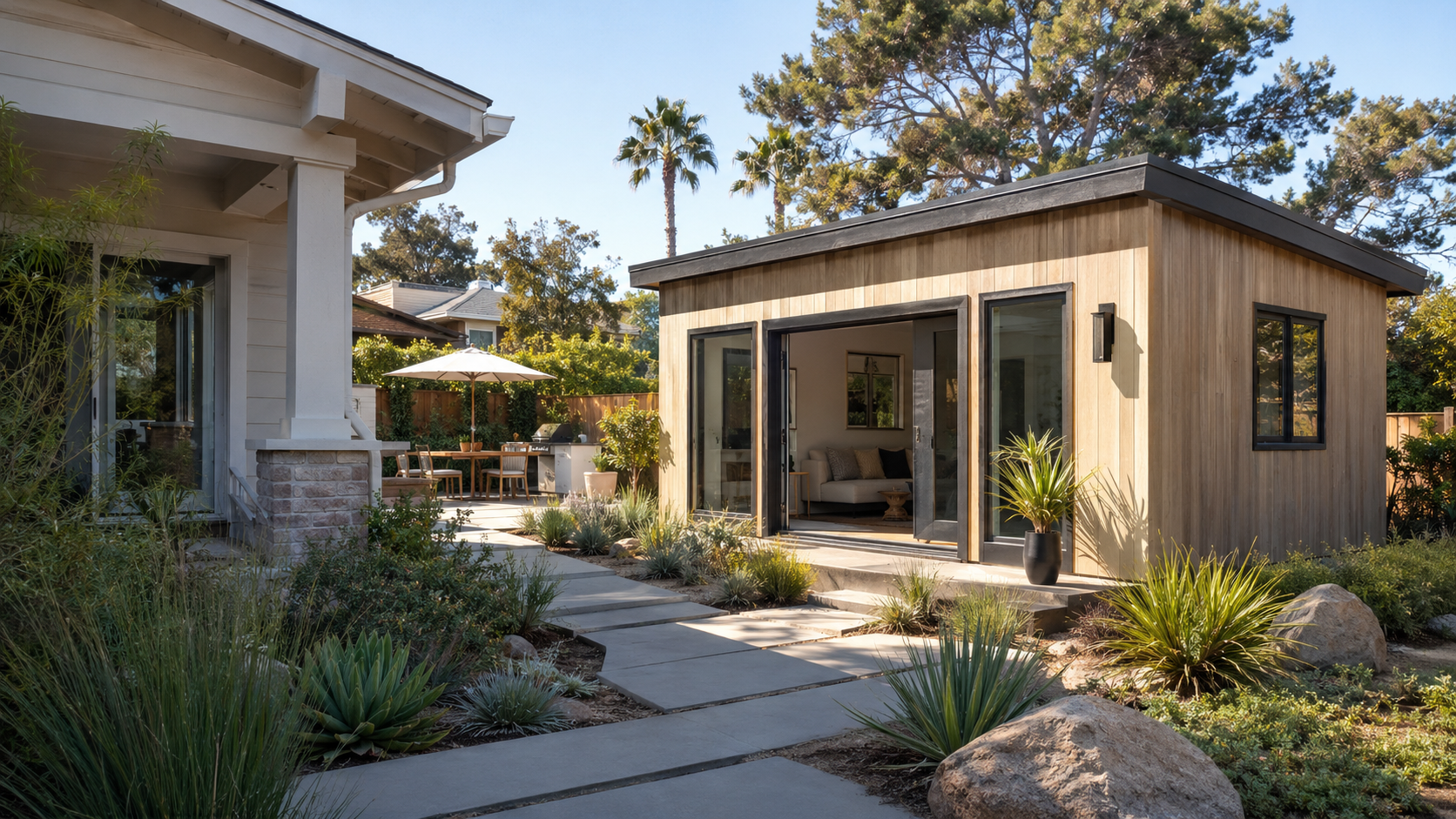
Encinitas ADU rules at a glance — 2026
Encinitas allows detached ADUs up to 1,200 sf (or the size of the primary residence, whichever is smaller), with reduced 4-ft side and rear setbacks, and waives nearly every city plan-check and building permit fee. On a single-family lot you can build one ADU plus one JADU. On a multifamily lot, SB 1211 allows up to eight detached ADUs (capped at the existing unit count) plus conversion ADUs.
The two rules that most surprise Encinitas homeowners: (1) if your property is in the Coastal Overlay Zone — which covers most of western Encinitas including Old Encinitas, Cardiff-by-the-Sea, and Leucadia — your project needs a no-fee Coastal Development Permit (called CDPNF), processed concurrently with the building permit, adding roughly 4–8 weeks and about $200 in noticing costs; and (2) if your parcel is in the Coastal Bluff Overlay, additions are capped at 10% of the existing residence or 250 sf, whichever is greater, no matter how large you wanted to build.
The upside: Encinitas permit fees are among the lowest in San Diego County — roughly $2 to $4 per square foot versus $13–$28 per square foot in the City of San Diego, according to SnapADU’s February 2026 fee analysis.
Encinitas ADU rules at a glance: key numbers
| Rule | Encinitas (2026) | California state minimum |
|---|---|---|
| Max detached ADU size (SFD lot) | 1,200 sf or size of primary, whichever is smaller | No less than 850 sf (1-BR) / 1,000 sf (multi-BR) [§66321] |
| Max JADU size | 500 sf | 500 sf |
| Side + rear setback (detached) | 4 ft minimum | 4 ft minimum [§66321] |
| Max height (detached ≤16 ft, ≤4 ft setbacks) | 16 ft; 24 ft above existing garage; transit-proximity bonus up to 3 ft | 16 ft default |
| Parking (new detached ADU) | 1 space — or exempt per §66322 (transit, conversion, etc.) | 1 space or exempt |
| Parking replacement on garage conversion | Not required (SB 1211) — except west of Coast Hwy 101 in Coastal Zone | Not required [§66322] |
| Owner-occupancy (ADU) | Not required (AB 976, permanent) | Not required |
| Owner-occupancy (JADU) | Only if JADU shares sanitation with primary (AB 1154) | Only if shared sanitation [§66333, AB 1154] |
| Minimum rental term | 31 days (greater than 30 days) | 31 days minimum |
| City plan-check + permit fee | $0 (waived) | Varies |
| School impact fee | Waived ≤500 sf (SB 543); ~$4.79/sf above 500 sf | Waived ≤500 sf [SB 543] |
| Impact fees (city/regional) | Prohibited ≤750 sf; proportional above 750 sf [§66311.5] | Prohibited ≤750 sf [§66311.5] |
| Coastal Development Permit | CDPNF (no-fee CDP) — required if in Coastal Overlay Zone; concurrent with building permit | Required in Coastal Zone per Coastal Act |
| Coastal Bluff Overlay size cap | Additions limited to 10% of existing residence or 250 sf, whichever greater | Site-specific (no state override) |
| All-electric requirement (new detached) | Yes — electricity sole power source; no gas to new detached structure | Title 24 / local option |
| Pre-approved plans (PRADU) | Yes — city program; Helen Putnam Award recipient | Required program [AB 1332] |
| AB 1033 separate ADU sale | Not adopted as of May 12, 2026 | Local opt-in only [AB 1033] |
Get Your Free Property-Specific Encinitas ADU Report
Coastal Overlay check, zone, max size, parking exemption, estimated fees, estimated timeline — in 60 seconds.
Run the Free Feasibility Engine →No email required to see results.
What we verified for this guide
- Encinitas Municipal Code (EMC) Title 30, Chapter 30.48 — specifically § 30.48.040.T (ADU) and § 30.48.040.U (JADU), currently in force as Combined Ordinances No. 2020-10, 2022-03, and 2022-11. Read at ecode360.com/44484213.
- City of Encinitas ADU/JADU Guide (January 2026 edition) and City of Encinitas ADU Permit Application page at encinitasca.gov — including the all-electric requirement and document trigger list.
- City of Encinitas Development Services Public Notices — current May 2026 ADU and CDPNF-related notices confirming the active permit cadence.
- Three approved Notices of Decision for actual Encinitas ADU projects: CDPNF-007079-2024 (815 sf, Old Encinitas, Nov 2024), CDPNF-007198-2024 (497 sf, Cardiff, Nov 2024), CDPNF-006584-2023 (420 sf attached, Cardiff, Jun 2024) — pulled directly from the city’s published records.
- California Government Code §§ 66310–66342 (recodified ADU statutes) and tracking of ten ADU-related bills effective 2024–2026.
- SnapADU February 2026 permit fee analysis, Better Place Design & Build February 2026 Encinitas case study, BNC Builders 2026 cost guide, and Fabrick Construction 2025 guide for cost-per-square-foot ranges.
Can I build an ADU on my Encinitas property?
California law requires Encinitas to approve at least one ADU on any lot that has an existing or proposed primary residence. There is no minimum lot size for ADUs and no minimum lot size to qualify under the state floor. The city’s local rules add zone-specific size constraints, but the state framework protects the right to build.
Single-family residential lots
On a single-family lot you can build one ADU plus one JADU as a baseline. California Government Code § 66323 (the Mandatory-Approval pathway) protects additional stacking combinations, but Encinitas’s January 2026 Guide and HCD’s March 2026 handbook are not perfectly aligned on stacking interpretation. If you want to build more than one ADU plus one JADU, request a written determination from Encinitas Planning before commissioning plans.
The single most powerful combination on a single-family Encinitas lot: a detached ADU (850–1,200 sf, no owner-occupancy required) plus a JADU with its own bathroom (no owner-occupancy required under AB 1154). Two additional dwelling units, no residency obligation, both rentable at 31-day-minimum terms.
Multifamily residential lots
On a multifamily lot, SB 1211 (effective January 2025, reflected in the January 2026 City Guide) allows up to eight detached ADUs, capped at the number of existing primary units. In addition, conversion ADUs are allowed equal to at least one or up to 25% of existing units from non-livable space (storage rooms, garages, common areas), whichever is greater. The codified eCode still shows older language — verify exact counts with Encinitas Planning.
The Coastal Overlay Zone question
If your property is in the Coastal Overlay Zone — most of western Encinitas including Old Encinitas, Cardiff-by-the-Sea, and Leucadia — you can still build an ADU. But your project also needs a Coastal Development Permit No Fee (CDPNF), processed concurrently with the building permit. The CDPNF adds approximately $200 in noticing costs and 4–8 weeks to the typical timeline. It does not require a separate application fee.
Concerned your project triggers the Coastal Overlay?
Run your property through our free Encinitas ADU feasibility check →The Coastal Bluff Overlay (the rule that changes everything on bluff parcels)
If your parcel is in the Coastal Bluff Overlay, the January 2026 City Guide imposes a specific cap: additions to existing structures — including attached or detached ADUs — are limited to 10% of the existing residence or 250 square feet, whichever is greater. Geotechnical bluff-edge setbacks (determined by site-specific study) apply on top of that.
For homeowners with bluff parcels in Cardiff, Leucadia, and parts of Old Encinitas, the 10%/250 sf rule is the most consequential piece of Encinitas ADU law affecting their property. It can mean the difference between a 1,200 sf ADU project and a 250 sf one. If you’re considering an ADU on a bluff parcel, this is the first thing to verify.
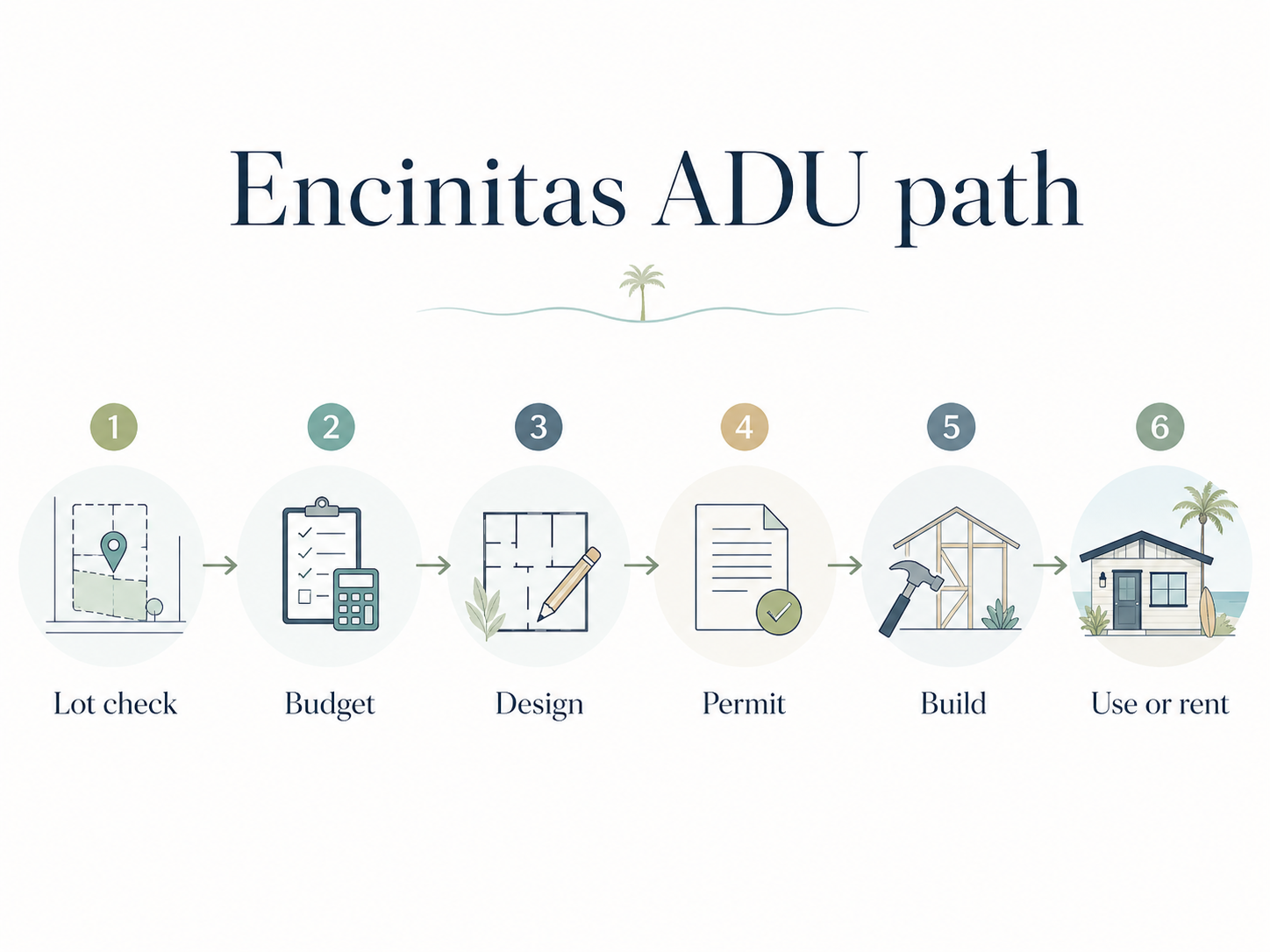
Size, setbacks, height, and parking — the full table
Maximum size
| ADU type | Maximum size (Encinitas) | State floor |
|---|---|---|
| Detached ADU (single-family lot) | 1,200 sf or size of primary, whichever is smaller | 850 sf (1-BR) / 1,000 sf (multi-BR) [§66321] |
| Attached ADU (single-family lot) | 1,200 sf or size of primary, whichever is smaller; also subject to 50% of primary sf under standard pathway | 850 sf (1-BR) / 1,000 sf (multi-BR) [§66321] |
| JADU | 500 sf maximum | 500 sf |
| Conversion ADU (single-family, within existing structure) | Size of existing space — no expansion of footprint | No footprint expansion required |
| Detached ADU on multifamily lot (SB 1211) | Up to 8 units; capped at existing primary unit count | Up to 8; capped at existing unit count [SB 1211] |
Setbacks and height
| Scenario | Side/rear setback | Height limit |
|---|---|---|
| New detached ADU (standard) | 4 ft minimum — state-protected floor | 16 ft (EMC § 30.48.040.T) |
| Detached ADU above existing garage | Same setbacks as existing garage | Up to 24 ft above garage plate height |
| Detached ADU within ½ mile of major transit | 4 ft minimum | Up to 3 ft bonus (Jan 2026 City Guide); confirm with Planning |
| Attached ADU | Underlying zone setbacks apply | Zone height limit; not to exceed 25 ft generally |
| Conversion ADU (within existing structure) | No additional setbacks — uses existing footprint | No additional height — uses existing structure |
| Coastal Bluff Overlay parcel | Bluff-edge setback from geotechnical study applies | Geotechnical setback + 10%/250 sf addition cap |
Parking
One parking space is required for a new detached ADU unless an exemption applies. The state exemptions under California Government Code § 66322 cover most Encinitas properties: within half a mile walking distance of public transit (including a bus stop), historic district, conversion of existing structure, permit-parking area, or within one block of a car-share vehicle. In practice, most Encinitas ADU projects qualify for a parking exemption.
| Situation | Parking required? |
|---|---|
| New detached ADU (general) | 1 space — unless exempt |
| New detached ADU within ½ mile of transit | Exempt [§66322] |
| Conversion of existing structure (garage, accessory building) | Exempt — no replacement required (SB 1211; [§66322]) |
| Garage conversion west of Coast Hwy 101 (Coastal Overlay) | Replacement parking required — west-of-101 rule per Jan 2026 City Guide |
| JADU | No parking required |
| Multifamily conversion ADU (SB 1211) | No replacement parking [SB 1211] |
West-of-101 note: Properties in the Coastal Overlay Zone west of Coast Highway 101 (from the Swami’s area in Encinitas to the La Costa area in Carlsbad) face a different garage-conversion parking rule. The January 2026 City Guide states replacement parking is required when a garage is converted in this zone. Verify your address against this boundary before relying on a no-replacement-parking assumption.
The Coastal Development Permit No Fee (CDPNF) — how it actually works
Encinitas sits almost entirely within the California Coastal Zone. If your property is in the Coastal Overlay Zone, almost any ADU project that increases habitable area or converts non-habitable space triggers the Coastal Development Permit No Fee — a streamlined, no-filing-fee coastal permit unique to Encinitas’s Local Coastal Program. The CDPNF runs concurrently with the building permit; it does not precede it.
| CDPNF step | What happens | Typical timing |
|---|---|---|
| Concurrent submittal | CDPNF record opened at same time as building permit application | Day 1 — same as building permit |
| Public-notice sign posting | City issues a bright-colored 11″ × 17″ notice sign; applicant posts it at the property in public view and files certificate of posting | ~Day 10–20 of review |
| 10-day public comment window | Anyone can submit comments; staff reviews and responds | 10 days from notice posting |
| Notice of Decision (NoD) | Planning Manager signs and publishes NoD approving the CDP; city posts it on the Development Services Public Notices page | ~2–4 weeks after comment period |
| Hold Harmless Agreement | Applicant signs Hold Harmless agreement; recorded with San Diego County Recorder (~$50) | At permit issuance |
| Coastal noticing fee | ~$200 to cover public-notice mailing (verify amount on submittal — city verifies at filing) | At submittal or issuance |
| AB 462 appealability | Under AB 462 (effective 2024), locally approved ADU-only/JADU-only CDPs are NOT subject to appeal to the California Coastal Commission | Permanent rule change |
Three real Encinitas CDPNF approvals
These are pulled directly from the City of Encinitas’s published Notices of Decision — not estimated timelines, but actual approved projects:
| Project | Details | Decision date |
|---|---|---|
| Viskanta ADU | CDPNF-007079-2024 / BLDR-030327-2024 — 815 sf, two-bedroom, detached ADU in R-5 Zone, Old Encinitas | November 18, 2024 |
| McArthur ADU | CDPNF-007198-2024 / BLDR-030853-2024 — 497 sf detached ADU in R-3 Zone, Cardiff-by-the-Sea | November 4, 2024 |
| Best ADU | CDPNF-006584-2023 / BLDR-025618-2023 — 420 sf one-bedroom attached ADU above existing garage in R-8 Zone with Scenic/Visual Corridor, Special Study, and Coastal Overlay Zones, Cardiff-by-the-Sea | June 18, 2024 |
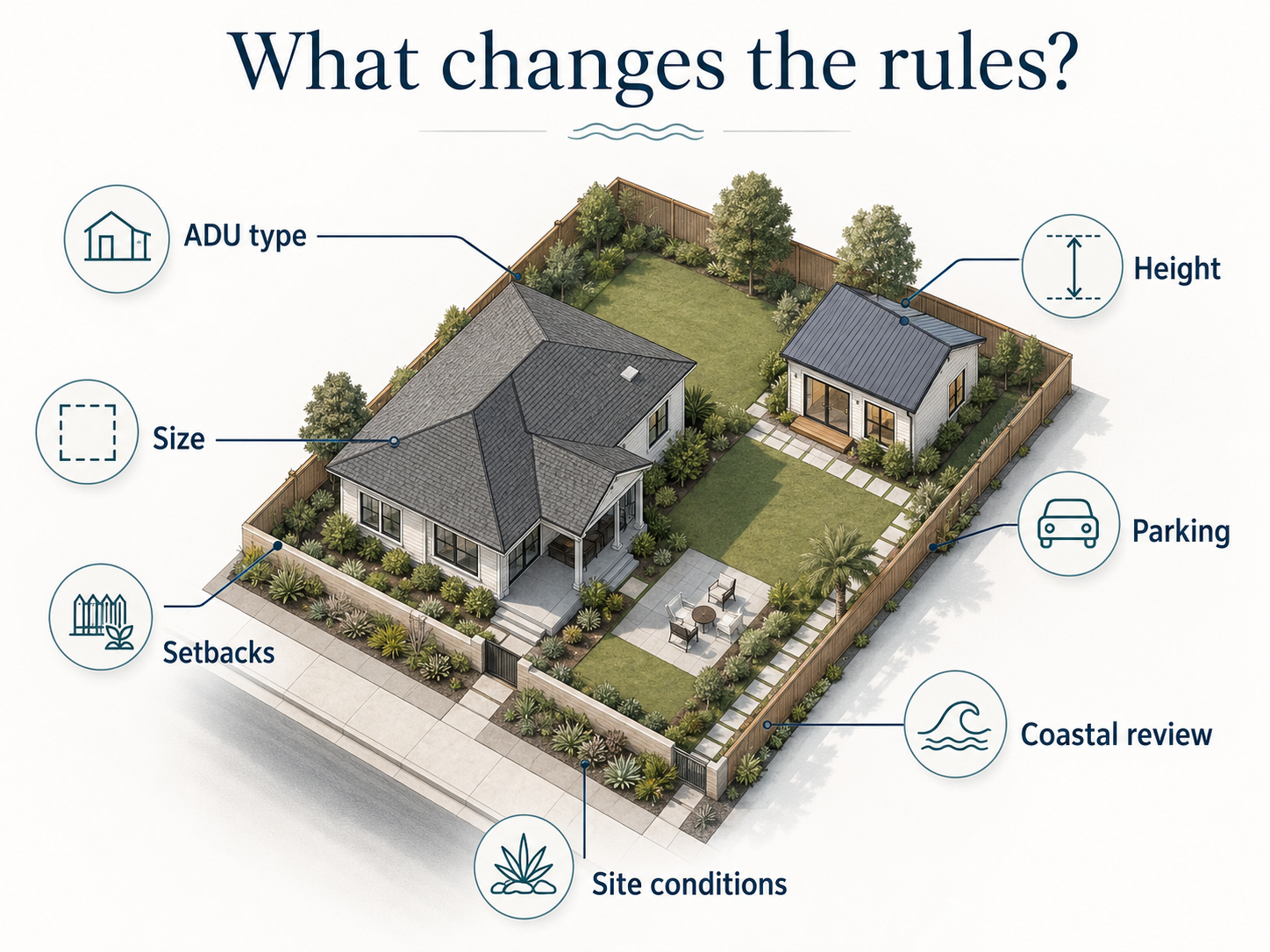
Site conditions and overlays that change the rules
Beyond the Coastal Overlay, several site-specific conditions can change which documents and reviews your Encinitas ADU project triggers. The most common are slope, bluff overlays, geotechnical conditions, stormwater BMPs, boundary proximity, and septic/utility service.
| Trigger | What’s required |
|---|---|
| ADU over 500 sf | Geotechnical Letter Report — unless waived by the Building Official (waivers granted when ADU is on a certified pad, when there’s an existing compaction report for the pad, when the city has a soils report on file, or per Building Official review) |
| Impervious surface over 500 sf | Stormwater Best Management Practices (BMP) plan |
| Building within 5 ft of a property line | Boundary certification by a licensed surveyor |
| Slope on the parcel | Slope analysis and possible Special Study Zone review |
| Septic system on parcel | San Diego County Department of Environmental Health and Quality approval |
| New main service panel upgrade | Electrical load calculation |
| New detached ADU | All-electric appliance requirement — electricity sole power source; no gas to new detached structure (per City ADU permit application page) |
| Project value ≥ $50,000 | Encinitas Climate Action Plan (CAP) Checklist — at least one energy-efficiency measure selected from Table 150.2-E |
| Parcel in Coastal Bluff Overlay (CBO) | Additions capped at 10% of existing residence or 250 sf, whichever greater; bluff-edge geotechnical setbacks from site-specific study |
| Hillside / Inland Bluff Overlay (HIBO) | Special Study Zone review for grading, structural design, and erosion control |
| Scenic/Visual Corridor Overlay | Design-review considerations for roof form, building mass, and façade treatments |
The all-electric requirement deserves emphasis because it changes design and budget. Plan for a heat pump (HVAC and water heating), induction or electric range, and electric dryer. No gas service to the new detached structure. If your existing electrical panel is at capacity, a panel upgrade typically adds $3,000–$8,000.
The 2025–2026 California state-law overlay for Encinitas
California passed ten ADU-related bills affecting Encinitas homeowners between 2024 and 2026. Where any rule in the city’s code is more restrictive than the state version, the state law wins.
| Bill | Effective | What it changes | Why it matters in Encinitas |
|---|---|---|---|
| AB 670 | 2019 (permanent) | Preempts HOAs from prohibiting ADUs on single-family lots | Your HOA cannot block an ADU on a single-family lot |
| AB 976 | Jan 1, 2024 (permanent) | Permanently prohibits owner-occupancy requirements for detached ADUs | You don’t have to live on-site to rent your ADU |
| AB 1033 | Jan 1, 2024 (local opt-in) | Lets cities adopt an ordinance allowing separate sale of ADU as condominium | Not adopted by City of Encinitas as of May 12, 2026. Unincorporated San Diego County adopted it effective April 4, 2026. |
| AB 1332 | Jan 1, 2024; local program required by Jan 1, 2025 | Cities must offer a pre-approved ADU plan program; 30-day approval clock for preapproved plans | Encinitas’s PRADU program predates this and complies |
| AB 2533 | Jan 1, 2025 | Cities cannot deny a permit to legalize an ADU built before Jan 1, 2020 unless there’s a substandard condition | Pathway to legalize older unpermitted units |
| SB 1211 | Jan 1, 2025 | Up to 8 detached ADUs on multifamily lots (capped at existing unit count); no replacement parking on garage conversion | Major capacity expansion for Encinitas multifamily owners; reflected in January 2026 City Guide |
| SB 543 | Jan 1, 2026 | School impact fees waived for ADUs/JADUs ≤ 500 sf; 15-business-day completeness review by the city | More fee relief for small units; the 15-day completeness clock is enforceable |
| AB 130 | Jan 1, 2026 | Tightens HOA “reasonable restriction” rules; removes prior § 66323(g) grandfathering | Strengthens HOA preemption for Encinitas homeowners with CC&Rs |
| AB 462 | 2024 | Shortened city’s approval/denial deadline for ADU-only/JADU-only CDPs; limited Coastal Commission appealability for locally approved ADU-only/JADU-only CDPs | Major coastal streamlining — Encinitas CDPNF decisions are no longer subject to Coastal Commission appeal |
| AB 1154 | Jan 1, 2026 | JADU owner-occupancy required only if the JADU shares sanitation with the primary dwelling | Build the JADU with its own bathroom and the owner-occupancy obligation disappears |
| SB 1077 | Effective July 1, 2026; draft guidance published April 13, 2026 | Directs Coastal Commission and HCD to publish unified coastal ADU guidance and LCP amendment templates | Sets framework for future Encinitas LCP updates — does not by itself repeal CDPNF |
AB 1033 and the separate-sale question
AB 1033 is the most-asked-about of the recent bills because it allows the separate sale of an ADU as a condominium. In practice, AB 1033 is a local-option law — the city or county must adopt its own implementing ordinance. As of May 12, 2026:
- San Jose — adopted in 2024; first AB 1033 transaction closed August 2025.
- Santa Monica — adopted early 2025.
- Unincorporated San Diego County — adopted March 4, 2026, effective April 4, 2026.
- City of Encinitas — has not adopted AB 1033 as of May 12, 2026.
The recorded ADU covenant specifically prohibits separate sale. If you own in unincorporated San Diego County (parts of Olivenhain south of the city line, or any unincorporated parcel), you can pursue separate sale under the County’s ordinance — expect $30,000–$60,000 in conversion costs (condominium map, CC&Rs, separate utility metering, HOA formation), plus a Tentative Parcel Map or Tentative Map process.
What you’ll actually pay: fees, waivers, and the real out-the-door number
Encinitas waives nearly every plan-check and city building permit fee for ADUs. The city’s permit fee is roughly $2 to $4 per square foot of ADU space according to SnapADU’s February 2026 fee analysis — compared to $13–$28 per square foot in the City of San Diego. Encinitas wins this comparison by tens of thousands of dollars on a typical project.
What’s waived
- City plan-check fees
- City building permit fees
- Most city-imposed impact fees on standard residential development (with exceptions below)
What you’ll still pay
| Fee | Range | When it applies | Notes |
|---|---|---|---|
| School impact fee | ~$4.79/sf (San Diego County district average; varies by school district) | ADUs over 500 sf (SB 543 waives ≤ 500 sf) | Verify your exact school district — it varies by boundary inside the city |
| Impact fees (city/regional) | Prohibited ≤ 750 sf; proportional above 750 sf | ADUs over 750 sf [§66311.5] | Encinitas’s waivers further reduce city impact fees vs. state minimums |
| Water connection / CWA capacity charge | $5,000–$15,000+ | When a new water meter is required or upsized | Often the largest single fee; separate from impact fees |
| Sewer connection charge | Varies by agency; proportional where allowed | When new sewer connection or upsized service is required | Separate from impact fees; agency-specific |
| Coastal noticing fee | ~$200 (verify on submittal) | Only if in the Coastal Overlay | Covers public-notice mailing |
| Title 24 / CALGreen compliance documentation | Plan-prep costs vary | Always | Built into your design/permit set |
| County Recorder covenant fee | ~$50–$100 | Always (ADU covenant is recorded) | San Diego County Recorder |
| Hold Harmless recording (Coastal Overlay) | ~$50 | Only if in the Coastal Overlay | Recorded after NoD |
Fee math: a typical 800 sf detached ADU in Encinitas
Illustrative only. Actual fees depend on lot, water meter size, school district boundary, and Coastal Overlay status. Methodology: SnapADU permit fee analysis (February 2026), San Diego County Water Authority capacity fee schedule, and City of Encinitas fee schedule; each cell rounded for readability.
| Line item | Coastal lot (illustrative) | Non-coastal lot (illustrative) |
|---|---|---|
| City plan-check fee | $0 (waived) | $0 (waived) |
| City building permit fee | $0 (waived) | $0 (waived) |
| School impact fee (~$4.79/sf for 800 sf — verify district) | ~$3,832 | ~$3,832 |
| Sewer connection charge (proportional, over 750 sf) | ~$500–$2,000 | ~$500–$2,000 |
| Water meter / CWA capacity charge (if new meter needed) | ~$5,000–$15,000 | ~$5,000–$15,000 |
| Coastal noticing fee | ~$200 (verify) | $0 |
| Title 24 / CALGreen compliance | ~$200 | ~$200 |
| County Recorder covenant fee | ~$75 | ~$75 |
| Hold Harmless recording (coastal) | ~$50 | $0 |
| Estimated fee total (excl. construction) | ~$9,857–$21,157 | ~$9,607–$21,107 |
Exact school-district fee for the specific parcel: confirm with the applicable school district at submittal. Exact CDPNF noticing fee on a given date: verify with Encinitas Planning at filing.
What construction itself costs in Encinitas
| ADU size | All-in budget range (construction + fees) | Source basis |
|---|---|---|
| 500 sf detached | ~$180,000–$260,000 | Better Place Design & Build; BNC Builders |
| 800 sf detached | ~$280,000–$420,000 | SnapADU; Better Place Design & Build |
| 1,000 sf detached | ~$330,000–$480,000 | SnapADU 2026 ranges; Better Place 2026 case study |
| 1,200 sf detached | ~$400,000–$600,000+ | SnapADU 2026 ranges; cross-referenced cost guides |
| Garage conversion | ~$80,000–$200,000 | Better Place Design & Build; BNC Builders |
Construction-only typically runs $375–$600+ per square foot for a turnkey detached ADU in Greater San Diego as of early 2026. Better Place Design & Build documented a 1,000 sf Encinitas ADU at roughly $398,000 construction cost renting for ~$3,882/month in 2026 — one project, not a forecast. These are illustrative examples, not guarantees of returns.
Get an Encinitas-specific quote from a local ADU specialist
SnapADU lists Encinitas (including Cardiff-by-the-Sea) among its core service cities in San Diego County and reports building over 100 ADUs since 2020. They publish their cost methodology transparently.
Request a quote from SnapADU →How long it actually takes (with real Encinitas permit examples)
California Government Code § 66317 sets a 15-business-day completeness review (added by SB 543, effective January 2026) followed by a 60-day approval/denial decision clock, with a deemed-approved consequence if the city misses the deadline. Encinitas typically hits 60–90 days for non-coastal ADU decisions and 4–6 months for Coastal Overlay decisions on complete applications.
Typical observed timeline — non-coastal Encinitas ADU
| Phase | Typical duration |
|---|---|
| Design + construction documents (architect/designer or PRADU modification) | 30–60 days |
| Completeness review (state 15 business days) | ~3 weeks |
| Plan-check + permit decision (state 60-day clock) | 45–60 days |
| Construction | 120–180 days |
| Final inspection + covenant recording | 5–15 days |
| Total: filing to move-in | ~6–10 months |
Typical observed timeline — Coastal Overlay Encinitas ADU
| Phase | Typical duration |
|---|---|
| Design + construction documents | 30–60 days |
| Completeness review | ~3 weeks |
| Plan-check + CDP review (concurrent; includes 10-day public comment) | 75–120 days |
| NoD signing + Hold Harmless recording | 1–2 weeks |
| Construction | 120–180 days |
| Final inspection + covenant recording | 5–15 days |
| Total: filing to move-in | ~8–12 months |
PRADU pre-approved plans — what they actually do (and don’t)
Encinitas’s PRADU (Permit-Ready Accessory Dwelling Unit) program offers city-pre-approved ADU plan sets that streamline design and plan review. The program received the Helen Putnam Award of Excellence from the League of California Cities. Used unchanged on a qualifying lot, a PRADU plan can shorten the review timeline — Encinitas’s PRADU process guide describes review cycles of roughly 15 working days per city staff review on complete applications.
The honest version, from SnapADU (which has built several PRADU projects in Encinitas): the permitting time for PRADU plans is not materially faster than a well-prepared custom ADU. The shortcut is mostly in the design phase, not the permit phase, because every PRADU plan still requires property-specific site adaptation.
Three scenarios where PRADU often loses its edge:
- You modify the plan meaningfully — once you cross a certain modification threshold, the plan returns to standard review and the pre-approved advantage largely disappears.
- Your lot has coastal, bluff, slope, or special-study conditions — all of which require studies and analyses regardless of plan type.
- The available PRADU floor plans don’t fit your needs — forcing a layout that’s wrong for your household to capture a modest permit-speed gain is usually a bad trade.
For more on the available plans, footprints, and realistic timeline gains, see our companion page: Encinitas Pre-Approved ADU Plans: 2026 Options + Costs.
Rentals, owner-occupancy, HOAs, and the AB 1033 question
Encinitas ADUs can be rented on terms of 31 days or longer — short-term/vacation rentals through the ADU pathway are not allowed, and ADUs are explicitly carved out of the city’s short-term rental program.
There is no owner-occupancy requirement for a standalone ADU (AB 976 made the prohibition on owner-occupancy mandates permanent for detached ADUs). JADU owner-occupancy applies only when the JADU shares sanitation with the primary dwelling (AB 1154, effective January 2026) — build the JADU with its own bathroom and the owner-occupancy obligation disappears entirely.
HOAs cannot prohibit ADUs on single-family residential lots under California AB 670 (permanent), and AB 130 (effective January 2026) tightened the “reasonable restriction” standard further. HOAs may impose reasonable architectural design standards but cannot effectively ban an ADU.
Separate sale of an ADU as a condominium is not currently available in the City of Encinitas — the city has not adopted AB 1033 as of May 12, 2026.
Disclaimer on rental income
Any rental-income figures cited in this guide are illustrative examples, not guarantees of returns. Actual results depend on local market conditions, construction costs, financing terms, and regulatory approvals.
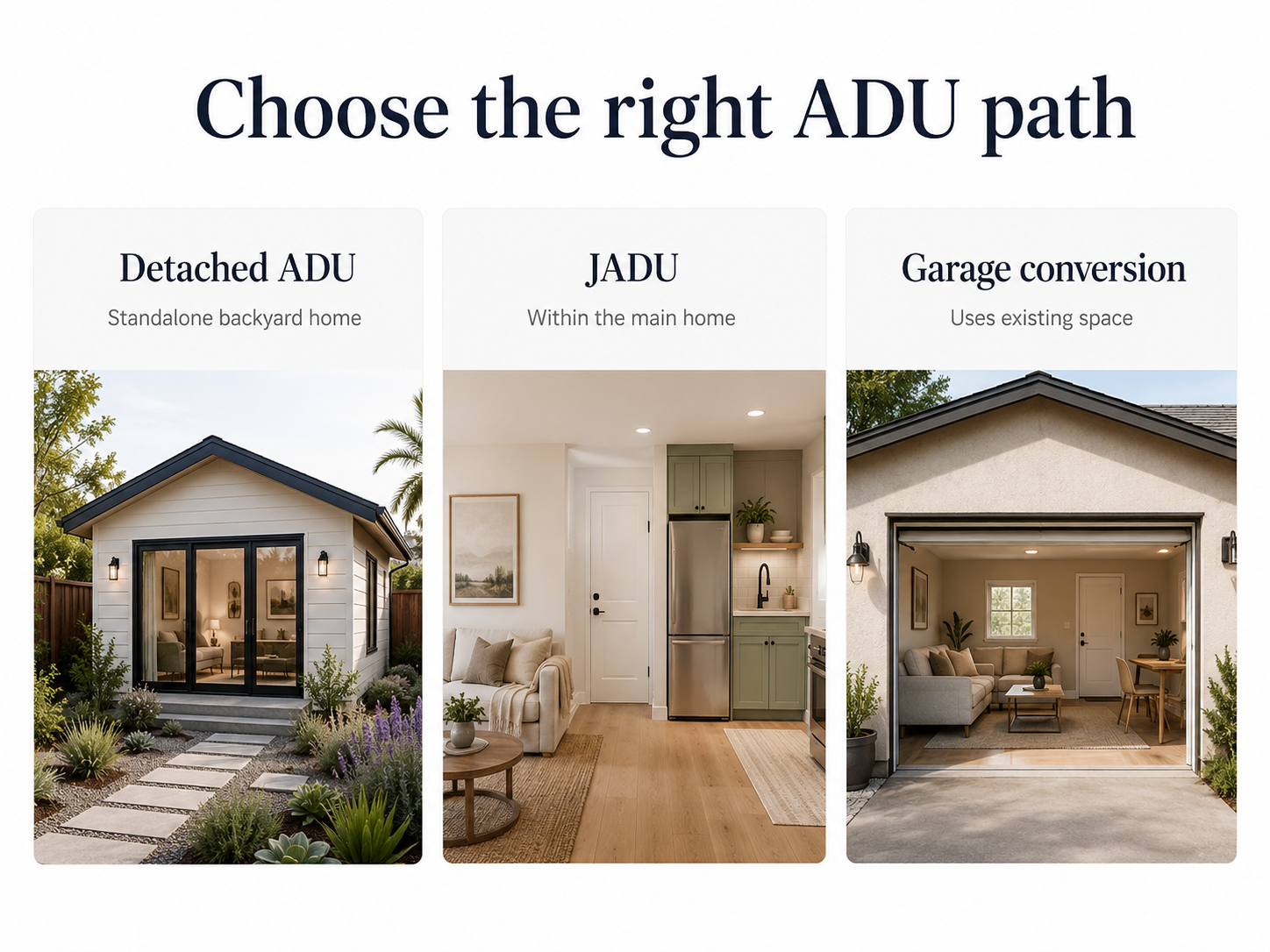
ADU vs. JADU vs. conversion ADU — which one fits your situation?
| Feature | Detached ADU | Attached ADU | Conversion ADU | JADU |
|---|---|---|---|---|
| Max size in Encinitas | 1,200 sf or primary, whichever smaller | 1,200 sf or primary; 50% of primary under standard pathway | Size of existing space | 500 sf |
| Kitchen | Full kitchen | Full kitchen | Full kitchen | Efficiency kitchen |
| Bathroom | Required | Required | Required | Optional — may share with primary house |
| Owner-occupancy | Not required | Not required | Not required | Required only if shared sanitation (AB 1154) |
| Parking | 1 space unless exempt | 1 space unless exempt | None | None |
| Typical all-in cost | $375–$600/sf | $325–$525/sf | $200–$350/sf | $100,000–$250,000+ |
| Best for | Income, multigenerational, privacy | Smaller footprint, lower cost than detached | Cheapest path; uses existing structure | Small in-law unit; pairing with detached ADU |
The most powerful combination on a single-family Encinitas lot: a detached ADU plus a JADU with its own bathroom. The detached unit gives you 850–1,200 sf of independent space (no owner-occupancy requirement, suitable for full-market rental). The JADU adds a second income or family-housing unit inside the existing home — and because of AB 1154, building the JADU with its own bathroom eliminates the owner-occupancy obligation entirely.
Not sure which ADU type fits your lot?
Run our free Feasibility Engine →Encinitas community-by-community: where you live changes the path
Encinitas has five distinct communities, and where you live changes one big thing: how much of your project sits inside the Coastal Overlay Zone.
| Community | Typical Coastal Overlay coverage | Typical lot character | What to verify first |
|---|---|---|---|
| Old Encinitas | Mostly inside Coastal Overlay | Smaller, denser lots; older homes | Coastal Overlay status; lot coverage on small lots |
| New Encinitas | Mostly outside (inland) | Mid-size lots; newer construction; more HOAs | HOA design standards (AB 670/AB 130 limits); zoning sub-district |
| Cardiff-by-the-Sea | Almost entirely inside Coastal Overlay | Mixed sizes; significant bluff parcels | Coastal Bluff Overlay 10%/250 sf rule; bluff-edge geotechnical setbacks; west-of-101 parking rule |
| Olivenhain | Mostly outside Coastal Overlay | Larger rural-residential lots (RR-1 common) | Septic system / County Health approval; long utility laterals |
| Leucadia | Mostly inside Coastal Overlay | Smaller, eclectic lots; high transit corridor along Coast Hwy 101 | Coastal Overlay; transit-proximity height bonus (½ mile of major transit); west-of-101 parking rule |
If your address sits exactly at the boundary between communities or overlay zones, run it through our Feasibility Engine — these boundaries do not follow major streets cleanly in many areas.
Your 7-step Encinitas ADU permit process
Most Encinitas ADU permits move through these seven steps. Steps 1–3 happen before you submit anything; steps 4–7 are the city’s process. If your property sits in the Coastal Overlay Zone, step 5 includes the CDPNF process running concurrently with the building permit.
Step 1: Consult with Encinitas Development Services
Free, and the highest-leverage 30 minutes you’ll spend on the project. The city’s planning staff will discuss your concept before you spend money on plans — in person, by email, or by phone at (760) 633-2710. Bring your APN, a property survey if you have one, and your rough ADU concept (size, type, intended location).
Step 2: Verify your zone, overlay status, and site triggers
Pull the underlying residential zone (R-3, R-5, R-8, R-11, RR-1, or your specific district), check Coastal Overlay and Coastal Bluff Overlay status, identify slope conditions, confirm utility service (sewer vs. septic), and identify which document triggers apply (over 500 sf, over 750 sf, within 5 ft of property line, septic, etc.).
Step 3: Design and prepare construction documents
Three paths:
- PRADU unchanged — use a city pre-approved plan as-is. Fastest design phase, modest plan-review speed advantage.
- PRADU modified — start from a PRADU plan but modify meaningfully. Returns to standard review; speed advantage largely disappears.
- Custom design — fully bespoke. Most flexible, longest design phase, but often the best outcome for constrained lots.
In all three paths, your document set includes architectural drawings, structural drawings, Title 24 energy compliance documentation, Encinitas CAP Checklist, Housing Development Tracking Form, and any triggered studies.
Step 4: Submit through the city’s CSS portal
Encinitas processes building permit applications through its Customer Self Service (CSS) portal. Submit the building permit application, attach all required documents and forms, and pay any submittal-stage fees.
Step 5: City review
- Non-coastal projects: 15-business-day completeness review + 60-day decision clock per Gov. Code § 66317. Correction cycles are common — respond quickly to keep the project moving.
- Coastal Overlay projects: the CDPNF record runs concurrent with the building permit review. Post the city-issued public-notice sign at the property in public view, file the certificate of posting, wait out the 10-day comment window, then the NoD is drafted and signed. AB 462 limited Coastal Commission appealability for ADU-only/JADU-only CDPs.
Step 6: Pay fees and record the ADU covenant
Pay the school impact fee (if applicable), water/sewer connection charges (if applicable), coastal noticing fee (if applicable), and state-mandated fees. Record the ADU covenant with the San Diego County Recorder — the covenant runs with the land and confirms restrictions (no separate sale, minimum 31-day rental term, etc.).
Step 7: Build, inspect, and occupy
Construction proceeds. Schedule inspections through the city’s building inspection email (buildinginspections@encinitasca.gov). The city issues a Certificate of Occupancy or final inspection sign-off when complete. The ADU is now legally rentable on terms of 31 days or longer.
Download the free Encinitas ADU Permit Kit
City document checklist (Title 24, CAP Checklist, Tracking Form, Geotechnical Letter template, Hold Harmless example) compiled into a single printable PDF.
Get the free ADU Starter Kit →Email required. Unsubscribe anytime.
Before you pay for plans: the 12-point Encinitas ADU pre-plan checklist
Run through this checklist before you pay an architect or designer. Skipping any one of these can mean tens of thousands of dollars in rework or a project that simply doesn’t pencil.
- 1Confirm property type — single-family or multifamily.
- 2Confirm the underlying residential zone (R-3, R-5, R-8, R-11, RR-1, or specific district).
- 3Confirm Coastal Overlay Zone status (yes or no).
- 4Check Coastal Bluff Overlay (10%/250 sf addition cap) or Hillside / Inland Bluff Overlay status.
- 5Check slope and Special Study Zone designation.
- 6Decide ADU type: detached, attached, conversion, or JADU (and for JADU, decide whether to share or separate sanitation).
- 7Decide proposed size and bedroom count.
- 8Map the setback and height path (4-ft reduced vs. full setbacks; transit-proximity bonus; above-garage).
- 9Identify parking requirement or exemption (transit, conversion, historic district, west-of-101 rule).
- 10Identify utility path: sewer vs. septic, water meter size, electrical panel capacity.
- 11Identify fee triggers: school (>500 sf), impact fees (>750 sf), water/CWA new meter, geotech (>500 sf unless waived), stormwater BMP (>500 sf impervious), boundary cert (within 5 ft).
- 12Choose plan path: PRADU unchanged, PRADU modified, or custom.
If you want to stack more than one ADU on a single-family lot, add a 13th step: email Encinitas Planning your APN and your proposed unit set, and request a written determination on whether the stacking combination will be approved on your parcel. This 10-minute email is the difference between paying for plans that will be approved and paying for plans that won’t.
How most Encinitas homeowners pay for an ADU
Common ADU financing paths include cash-out refinance, HELOC, construction-to-permanent loan, home equity investment (HEI), and cash. For a full lender comparison, see our ADU financing paths guide. The quick summary:
| Financing path | Best for | Watch out for |
|---|---|---|
| Cash-out refinance | Owners with substantial equity who want a fixed-rate, long-term solution | Resets your primary mortgage rate (may be higher than your existing rate) |
| HELOC | Owners who want flexibility and want to draw funds as construction progresses | Variable rate; lender qualification can be tighter |
| Construction-to-permanent loan | Owners building a new structure who want disbursement during construction | More paperwork; lender draws inspections |
| Home Equity Investment (HEI) | Owners with substantial equity who don’t want monthly payments | Equity-share exit cost; state availability limits |
We don’t quote specific rates, APRs, monthly payments, or qualification guarantees — those depend on your individual credit, equity, lender, and market conditions. Treat the above as financing-path education, not a recommendation.
What we recommend you do next
If you’re still figuring out whether your lot qualifies →
Coastal Overlay check, underlying zone, max ADU size, parking-exemption eligibility, estimated fees, estimated timeline. No email required to see results.
Run the free Feasibility Engine for your Encinitas property →If you’re ready to get a real builder quote →
SnapADU lists Encinitas (including Cardiff-by-the-Sea) among its core service cities in San Diego County and reports building over 100 ADUs since 2020.
Request an Encinitas-specific quote from SnapADU →If you’re trying to figure out how to pay for it →
Financing-path education. No specific rates, payments, or approvals are guaranteed.
See the financing paths most Encinitas homeowners use →If you want a takeaway document →
Download the free Encinitas ADU Permit Kit →Also useful:
- Encinitas Pre-Approved ADU Plans: 2026 Options + Costs — for readers leaning toward PRADU
- California ADU Laws (state-level parent guide) — for state-law context
- City of San Diego ADU rules — for comparison with the largest San Diego jurisdiction
City contacts (verified):
- City of Encinitas Development Services Department — 505 S. Vulcan Avenue, Encinitas, CA 92024
- Planning: (760) 633-2710 | planning@encinitasca.gov
- Building inspections: buildinginspections@encinitasca.gov
Encinitas ADU FAQ
How many ADUs can I build on my Encinitas property?
On a single-family lot the baseline is one ADU plus one JADU. California Government Code §§ 66314 and 66323 protect additional stacking combinations that may allow more, but Encinitas's January 2026 Guide and HCD's March 2026 handbook are not perfectly aligned on stacking interpretation. If you want to stack, request a written determination from Encinitas Planning. On a multifamily lot you can build up to eight detached ADUs (capped at the number of existing primary units, per SB 1211) plus conversion ADUs equal to at least one or up to 25% of existing units, whichever is greater.
Do I need a coastal permit for an ADU in Encinitas?
Probably yes if your property is in the Coastal Overlay Zone (most of western Encinitas) and the project is a new detached ADU, attached addition, garage conversion, or any project that increases habitable area. Encinitas uses a no-fee Coastal Development Permit called CDPNF, processed concurrently with the building permit, adding approximately $200 in noticing costs and 4–8 weeks to the timeline. AB 462 changed local-government CDP timing and limited Coastal Commission appealability for ADU-only/JADU-only approvals.
How much does it cost to build an ADU in Encinitas in 2026?
A turnkey detached ADU in Encinitas typically runs $375–$600+ per square foot in 2026, with all-in budgets of roughly $180,000–$260,000 for 500 sf, $280,000–$420,000 for 800 sf, $330,000–$480,000 for 1,000 sf, and $400,000–$600,000+ for 1,200 sf. Garage conversions run $80,000–$200,000. These are illustrative ranges, not quotes for your specific project.
How long does an ADU permit take in Encinitas?
California Government Code § 66317 sets a 15-business-day completeness review (SB 543) and a 60-day decision clock. Typical observed timelines run 60–90 days for non-coastal decisions and 4–6 months for Coastal Overlay decisions, with total project timelines from filing to move-in running 6–10 months (non-coastal) and 8–12 months (coastal).
Does Encinitas waive ADU fees?
Yes, mostly. The City of Encinitas waives plan-check and city building permit fees for ADUs. You'll still pay school impact fees (waived ≤ 500 sf per SB 543; charged above 500 sf), impact fees on units over 750 sf (proportional), water and sewer connection charges (often the largest single cost), an approximate $200 coastal noticing fee if applicable, and County Recorder fees. Total fees on a typical 800 sf detached ADU run roughly $9,000–$21,000.
Can I rent out my Encinitas ADU on Airbnb?
No. The City of Encinitas requires ADU rentals to be for terms longer than 30 days (31 days minimum). Short-term rentals through the ADU pathway are not allowed. ADUs are explicitly excluded from the city's short-term rental program.
Does Encinitas require owner occupancy for an ADU?
No for a standalone ADU — California AB 976 made the prohibition on owner-occupancy requirements for detached ADUs permanent. For JADUs: owner-occupancy applies only when the JADU shares sanitation with the primary dwelling, per AB 1154 effective January 2026. Build the JADU with its own bathroom and the owner-occupancy obligation disappears.
Can my HOA stop me from building an ADU in Encinitas?
No. California AB 670 prohibits HOAs and CC&Rs from unreasonably restricting or preventing ADU construction on single-family residential lots, and AB 130 (effective January 2026) tightened the 'reasonable restriction' standard. HOAs may impose reasonable design standards but cannot effectively ban an ADU.
Can I sell my Encinitas ADU separately as a condominium?
No, not currently. AB 1033 created the state-law framework for separate ADU sale as a condominium, but each city or county must adopt its own implementing ordinance. The City of Encinitas has not adopted AB 1033 as of May 12, 2026. Unincorporated San Diego County adopted it effective April 4, 2026.
Do new Encinitas detached ADUs have to be all-electric?
Yes — the City of Encinitas ADU permit application page specifies that for new detached ADUs, all appliances must be supplied with electricity as the sole power source. Plan for a heat pump (HVAC and water heating), an induction or electric range, and an electric dryer. No gas service to the new detached unit.
What is the Encinitas PRADU program?
PRADU (Permit-Ready Accessory Dwelling Unit) plans are city-pre-approved detached ADU plan sets that streamline design and plan review. Used unchanged on a qualifying lot, PRADU can modestly shorten the permit timeline. Modified PRADU plans return to standard review. PRADU does not waive site-specific reviews (Coastal Overlay, slope, bluff, geotech). Encinitas's PRADU program received the Helen Putnam Award of Excellence from the League of California Cities.
Do Encinitas ADUs need fire sprinklers?
Only if the primary residence requires them. EMC § 30.48.040.T specifies that fire sprinklers are not required for an ADU if they are not required for the primary residence.
Can I build an ADU on a vacant lot in Encinitas?
No. Encinitas requires either an existing primary residence or a concurrently proposed primary residence on the lot. The ADU is by definition accessory to a primary dwelling.
Can I legalize an unpermitted Encinitas ADU built before 2020?
Possibly, yes. California AB 2533 (effective January 1, 2025) prohibits local agencies from denying a permit to legalize an ADU or JADU constructed before January 1, 2020 unless the agency makes a specific finding that correction is necessary to address a substandard condition. Coastal Act requirements may still apply to coastal legalizations.
What does SB 1077 actually change for my Encinitas ADU project?
The California Coastal Commission and HCD published draft SB 1077 unified ADU coastal guidance on April 13, 2026. The guidance is designed to clarify and simplify coastal ADU permitting and to help local governments prepare LCP amendments. It does not by itself repeal Encinitas's CDPNF process. Watch for Encinitas's LCP amendment in response to the final SB 1077 guidance — that's when the rules could change at the local level.
Methodology
Dwelling Index is an independent research resource covering ADU financing, costs, and regulations. For this Encinitas ADU laws guide, we reviewed primary sources directly:
- City of Encinitas Municipal Code Title 30, Chapter 30.48 — specifically § 30.48.040.T (ADU) and § 30.48.040.U (JADU), currently in force as Combined Ordinances No. 2020-10, 2022-03, and 2022-11. Read at ecode360.com/44484213.
- City of Encinitas ADU/JADU Guide (January 2026 edition) and City of Encinitas ADU Permit Application page at encinitasca.gov.
- City of Encinitas Development Services Public Notices, including current May 2026 ADU and CDPNF-related notices.
- Three approved Notices of Decision for actual Encinitas ADU projects: CDPNF-007079-2024, CDPNF-007198-2024, and CDPNF-006584-2023 — pulled directly from the city’s published records.
- California Government Code §§ 66310–66342 and tracking of ten ADU-related bills effective 2024–2026, via leginfo.legislature.ca.gov.
- HCD March 2026 ADU Handbook and draft SB 1077 Coastal Commission + HCD guidance (April 13, 2026).
- SnapADU February 2026 permit fee analysis, Better Place Design & Build February 2026 Encinitas case study, BNC Builders 2026 cost guide, and Fabrick Construction 2025 guide.
- San Diego County PDS AB 1033 page at sandiegocounty.gov.
Refresh cadence: This page is reviewed at minimum every 90 days, and immediately refreshed when the City of Encinitas amends its ADU ordinance, any tracked California bill changes status, the Coastal Commission/HCD publishes final SB 1077 guidance, the City Council acts on AB 1033 adoption, or the city’s published fee schedule changes.
Next planned refresh: August 10, 2026.
Not sure where to start? See what’s possible at your address.
Get your free ADU report in 60 seconds — Coastal Overlay check, zone, max size, parking exemption, estimated fees, estimated timeline.
Run the Free Encinitas ADU Feasibility Engine →Disclaimer: This page is not legal or financial advice. ADU rules in Encinitas can change. Verify current requirements with the City of Encinitas Development Services Department (760-633-2710 / planning@encinitasca.gov) before relying on any specific figure or rule on this page. Construction cost ranges and rental-income figures are illustrative examples, not guarantees. Actual results depend on local market conditions, construction costs, financing terms, and regulatory approvals. Dwelling Index is an independent research resource; we do not build ADUs and we are not affiliated with the City of Encinitas.
Affiliate disclosure: The Dwelling Index is reader-supported. When you use our links to explore financing options, request prefab pricing, or purchase floor plans, we may earn a commission at no extra cost to you. Our editorial recommendations are based on independent research and are never influenced by compensation.