
Oceanside Coastal Zone ADU 2026: The AB 462 Permit Path, Real Costs, and What to Verify Before You Pay for Plans
By The Dwelling Index Editorial Team · Last updated May 12, 2026 · Last verified against California Government Code §§ 66310–66342, the California Coastal Commission, HCD's May 20, 2025 review of Oceanside's ADU Ordinance, and the City of Oceanside Development Services on May 12, 2026
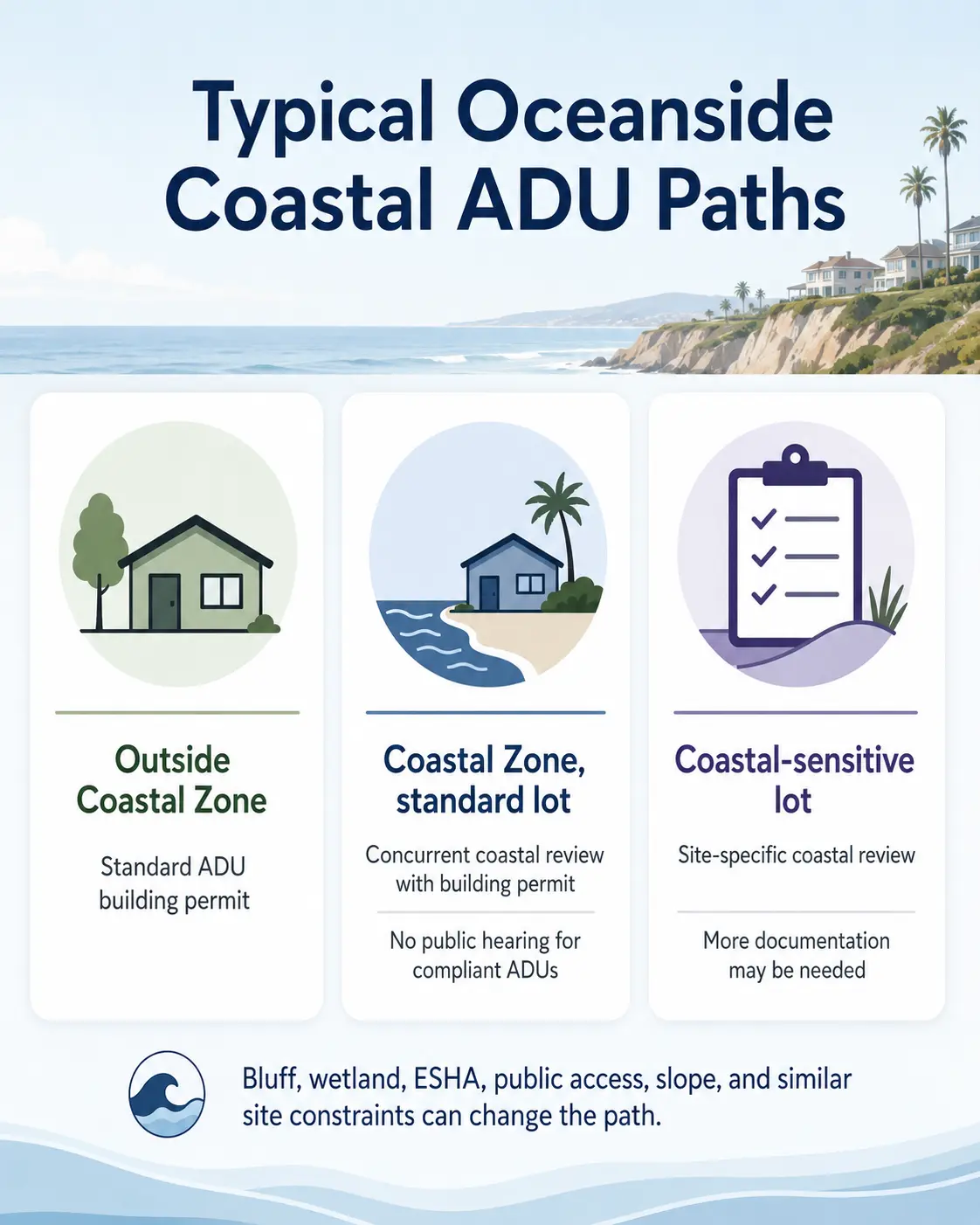
The short answer. Most Oceanside parcels — even most parcels inside the Coastal Zone — can build an Accessory Dwelling Unit (ADU) under a streamlined path that became law on October 10, 2025. AB 462 amended Government Code §66329 so that for a qualifying ADU-only project, Oceanside processes any Coastal Development Permit (CDP) concurrently with the building permit, within 60 days of a complete application, without a public hearing, and the City's decision is not appealable to the California Coastal Commission under Public Resources Code §30603. The Coastal Act still applies — bluff, wetland, public-access, and Environmentally Sensitive Habitat Area (ESHA) constraints can still force studies, conditions, or denial — but the old fear of a neighbor or Commissioner appeal stretching your project by months no longer applies to ADU-only approvals. Next step: verify your parcel's Coastal Zone status and screen for Coastal Act resource constraints before commissioning drawings.
See what's possible at your address
Get your free Oceanside ADU feasibility report →60 seconds, no obligation
The 4-bucket reality of an Oceanside Coastal Zone ADU in 2026
We built this matrix from Government Code §§ 66317, 66323, and 66329 (as amended by AB 462), the California Coastal Act §30603 appeal-geography rules, the City of Oceanside Coastal Permit Handbook, and HCD's May 20, 2025 review letter on Oceanside's ADU Ordinance. It is the single screen most homeowners need before paying for plans.
| Your parcel | What it means | Permit path | Public hearing? | Neighbor/Commission appeal? | Documentation risk |
|---|---|---|---|---|---|
| A. Inland Oceanside (~85% of parcels) | Outside the Coastal Zone | Standard ADU building permit under §66317 | No | No | Standard |
| B. Coastal Zone, ADU-only project under §66329 | Inside the LCP area; project qualifies as an ADU-only coastal review | Concurrent CDP + building permit; 60-day clock under §66329(a) | No (§66329(b)) | No — local decision not subject to §30603 appeal (§66329(c)) | Standard |
| C. Coastal Zone, ADU bundled with other development | ADU is part of a larger project, new primary dwelling, lot split, or other non-ADU work | May fall outside §66329's ADU-only path; possible separate CDP | Maybe | Possible under §30603 for the non-ADU components | Higher |
| D. Coastal Act sensitive resources | Within 300 ft of beach/bluff, 100 ft of wetland/stream, between sea and first public road, tidelands, or ESHA | Discretionary CDP with full Coastal Act review; geotechnical, biological, or visual studies likely | Possible | Possible under §30603 | Significantly higher; redesign or denial risk |
Sources: Government Code §66329 (amended by AB 462, Stats. 2025, Ch. 491, effective October 10, 2025); California Coastal Act §30603; California Coastal Commission Appeal FAQ; HCD May 20, 2025 review of Oceanside ADU Ordinance. Verify your parcel's bucket with Oceanside Planning before relying.
Not sure which bucket you're in?
See what's possible at your address → Get your free Oceanside ADU feasibility report (60 seconds, no obligation)Why we wrote this — and who this is for
We are the Dwelling Index, an independent research resource covering ADU financing, costs, and regulations. We do not sell builds, we do not lend, and we are not a brokerage.
This guide is for one specific person: an Oceanside, California homeowner — or imminent buyer — trying to figure out whether their parcel falls inside the Coastal Zone, whether that changes the permit path under current law, and what it does to the budget before any drawings are commissioned.
If your property is in the City of San Diego — Pacific Beach, La Jolla, Mission Beach, Ocean Beach, or the broader Coastal Overlay Zone south of Camp Pendleton — use our San Diego Coastal Zone ADU guide instead. The rules, fees, and Local Coastal Program are materially different.
If you already know your parcel is buildable and you're shortlisting a contractor, our Best ADU Builders Oceanside guide is the right next stop.
This page is the regulatory-feasibility step most homeowners skip and pay for later.
Can you build an ADU in Oceanside's Coastal Zone in 2026?
Answer capsule: Yes, in nearly all cases. The City of Oceanside permits ADUs and Junior ADUs (JADUs) by right under its ADU Ordinance (Article 30 §3006, adopted February 23, 2022), and California law — codified in Government Code §§ 66314–66333 — preempts most local restrictions on size, height, setbacks, parking, and review time. Inside the Coastal Zone, AB 462 (effective October 10, 2025) amended Government Code §66329 so that qualifying ADU-only projects get concurrent coastal review, a 60-day decision clock, no public hearing, and no §30603 appeal exposure. The Coastal Act still applies to bluff, wetland, public-access, and ESHA-adjacent parcels — those projects can face additional documentation, conditions, or denial — but outright bars are rare.
What "Coastal Zone" actually means in Oceanside
The California Coastal Zone is a state-defined regulatory boundary established by the California Coastal Act of 1976. In Oceanside, it covers the western flank of the city: from the Buena Vista Lagoon (the Carlsbad border) north to the San Luis Rey River mouth, including downtown, the Strand, South Oceanside near Cassidy Street, and inland up to Coast Highway and beyond in places.
Oceanside operates under a certified Local Coastal Program (LCP), which means the City — not the California Coastal Commission directly — issues most coastal development permits for projects inside the Zone.
A common misconception is that being “in the Coastal Zone” automatically triggers a public hearing or a long review. For an ADU-only project, that hasn't been true since AB 462 took effect.
Why the Coastal Act and ADU law coexist (without canceling each other)
Government Code §66329 — the central coastal ADU statute — states that ADU laws apply to jurisdictions in the California Coastal Zone but do not alter Coastal Act resource protection policies. In practice this means:
- The Coastal Act still governs bluffs, wetlands, public access, and sensitive habitat.
- The certified Local Coastal Program still applies as the local rulebook.
- The City must process a CDP for a qualifying ADU concurrently with the building permit, within 60 days of completeness, and without a public hearing.
- The City's decision under §66329(a) is not appealable to the Coastal Commission under §30603.
The California Coastal Commission's own published Appeal FAQ confirms that local approvals for ADU-only projects are not subject to the §30603 appeal process. That is a significant change from how this category was processed before October 2025, and it is the single most important fact for most Oceanside coastal homeowners.
Honest framing — the case where coastal really does cost you
If your lot sits in Bucket D — within 300 feet of the inland extent of a beach or the mean high tide line, within 300 feet of the top of the seaward face of a coastal bluff, within 100 feet of a wetland or stream, between the sea and the first public road, on tidelands, or inside a designated Environmentally Sensitive Habitat Area — the §66329 streamlining does not erase Coastal Act resource protections. Those projects often require a geotechnical study, a biological survey, additional visual analysis, and several months of added review. Conditions or design revisions are common. Outright denial is rare but possible.
That category represents a small minority of Oceanside Coastal Zone parcels. If you suspect you're in it, do not pay for plans before getting a coastal-experienced designer or land-use attorney to screen the site.
How to check if your Oceanside lot is in the Coastal Zone before paying for plans
Answer capsule: Use a five-step parcel screen before commissioning any drawings. Pull your address in the City of Oceanside Land Use and Zoning Map Viewer, cross-reference the Coastal Permit and Appeal Jurisdiction Map, identify your base zoning, check transit-proximity rules that modify your parking and height envelope, and confirm with Planning Division before paying a designer. The California Coastal Commission notes that digital coastal-zone boundaries are not survey-accurate and may not eliminate the need for a formal boundary determination at the parcel level, so map output is a screening tool, not a final legal answer.
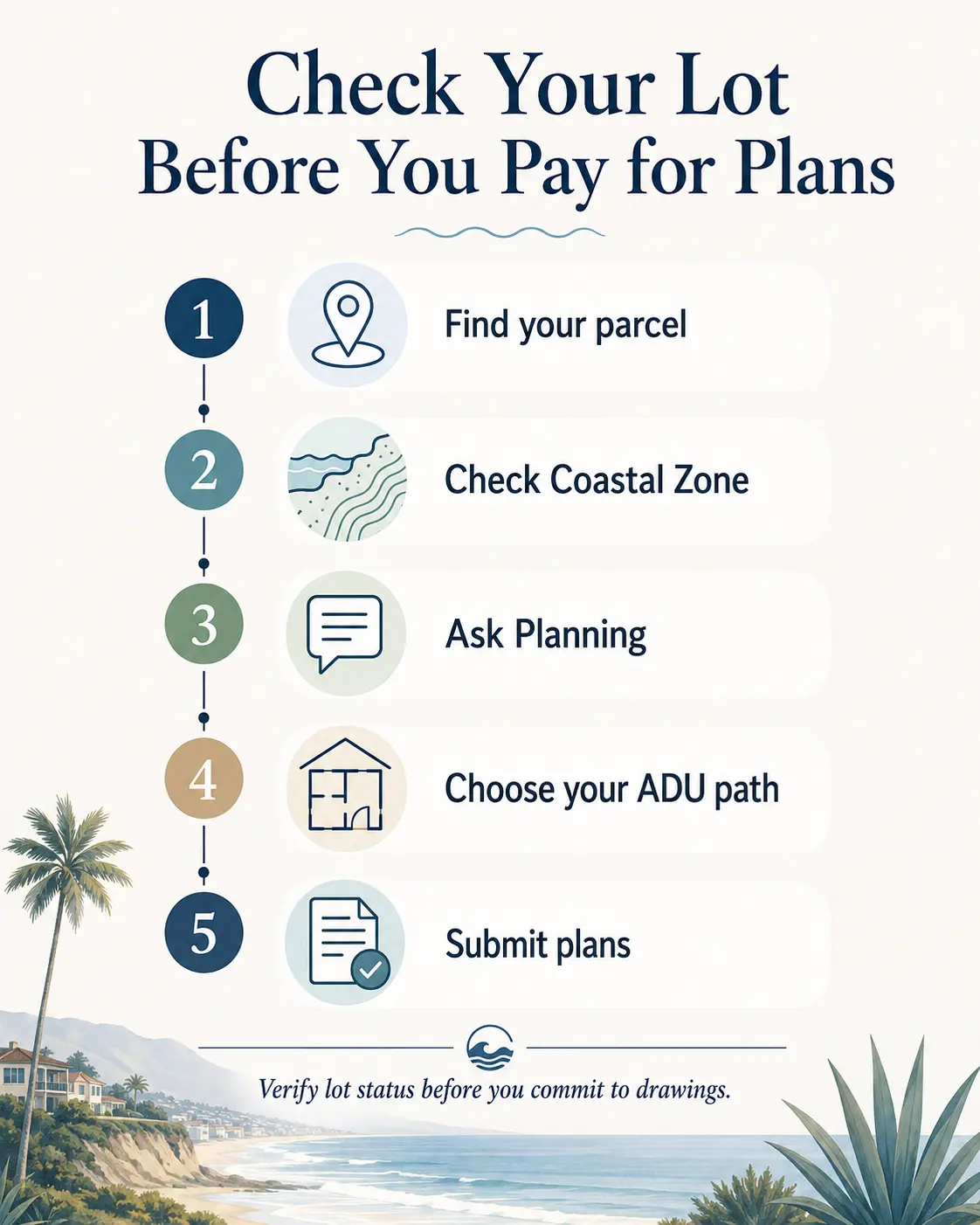
Step 1: Pull your address in the City GIS Map Viewer
Oceanside maintains a public Land Use and Zoning Map Viewer linked from its GIS Maps and Data Hub. Enter your street address or Assessor's Parcel Number (APN) and the tool returns your base zoning district (R-1, R-2, RS, RE, RT, RM, RD, RH, or various Planned Development designations), any overlays, and whether your parcel falls inside the city's mapped Coastal Zone.
What you are looking for: a coastal overlay indicator on your parcel. If the viewer does not show one, you are almost certainly outside the Coastal Zone, and your project follows the standard ADU permit path under §66317.
Step 2: Cross-reference the Coastal Permit and Appeal Jurisdiction Map
Oceanside publishes a separate Coastal Permit and Appeal Jurisdiction Map from its Codes/Regulations/Maps page. This historical map identified the area where the Coastal Commission could, under prior law, hear appeals of local CDPs. Two things matter to read it correctly in 2026:
- The map still tells you whether your parcel sits in the area historically designated as the Coastal Commission's Appeal Jurisdiction — typically within roughly 300 feet of the coastline.
- For ADU-only projects processed under §66329(a), the Commission's appeal jurisdiction is overridden by §66329(c). The map's old appeal-geography boundary no longer creates a §30603 appeal right for those approvals.
The map remains useful as a proxy for proximity to Coastal Act sensitive resources, but it is not the controlling factor for ADU-only appeals anymore.
Step 3: Confirm your base zoning and any coastal-residential overlay
Oceanside consolidated its Downtown, Inland, and Coastal Zoning Ordinances into a single document. Article 30 §3006 governs ADUs locally. Confirm:
- Your base zoning district.
- Whether you are in a coastal residential overlay.
- Whether your parcel is in an established neighborhood with documented design guidelines.
Critical caveat: HCD's May 20, 2025 review letter found that Oceanside's ADU Ordinance does not fully comply with current state ADU law in 11 specific ways (see "What if Oceanside's ADU page conflicts with current California ADU law?" section below). Where Article 30 §3006 conflicts with current Government Code §§ 66310–66342, state law controls.
Step 4: Identify proximity to public transit and rail
Two practical rules turn on transit proximity. First, parking exemptions for ADUs apply within walking distance of public transit. Second, state ADU law requires local standards to allow a detached ADU height of at least 18 feet on a parcel within one-half mile walking distance of a major transit stop or high-quality transit corridor, with an additional 2 feet permitted in specified roof-pitch alignment circumstances. Oceanside Transit Center, served by Coaster, Sprinter, Amtrak, and Metrolink, qualifies as a major transit stop. Multiple bus and transit-corridor routes also qualify.
Step 5: Confirm with Planning before drawings
Maps are screening tools. The Planning Division is the source of truth. Call (760) 435-3520 or email planningstaff@oceansideca.org, give them your address or APN, and ask the four questions that resolve the entire uncertainty:
- Is this parcel inside the Coastal Zone?
- For an ADU-only project of approximately [size] square feet, will Oceanside process this under Government Code §66329 as a concurrent CDP with no hearing?
- Are there any site-specific Coastal Act resource triggers — bluff, wetland buffer, public access, view corridor, ESHA, drainage, or sea-adjacent geography — that would push my project into a discretionary CDP?
- Does my parcel qualify for the 18-foot height allowance based on proximity to a major transit stop or high-quality transit corridor?
A 10-minute call saves $5,000–$15,000 in design fees on a wrong-path project.
Try the free parcel checker.
Our Oceanside Coastal Zone ADU Permit Path Checker flags your parcel's likely bucket, runs the size envelope for your lot, estimates school-fee exposure based on Oceanside Unified School District's current per-square-foot rate, and generates the exact question script for your Planning call.
Check your Oceanside lot →Do you need a Coastal Development Permit for an Oceanside ADU?
Answer capsule: Inside the Coastal Zone but outside Coastal Act sensitive-resource areas, the City of Oceanside processes a Coastal Development Permit for a qualifying ADU concurrently with the building permit, within 60 days of a complete application, with no public hearing required. Under Government Code §66329(c) (added by AB 462 effective October 10, 2025), the City's decision on an ADU-only CDP under §66329(a) is not subject to appeal under Public Resources Code §30603. Outside the Coastal Zone, no CDP applies. Inside Coastal Act sensitive-resource geographies — bluffs, wetlands, between the sea and the first public road, or ESHA — a discretionary CDP with full Coastal Act review may apply, and §30603 appeal exposure can return.
What AB 462 actually changed
AB 462 (Stats. 2025, Ch. 491), signed October 10, 2025, amended Government Code §66329 to do three things for coastal ADUs:
- §66329(a): Requires local agencies to approve or deny a CDP for a qualifying ADU within 60 days of a complete application, with coastal review running concurrently with the building permit.
- §66329(b): No public hearing is required for the CDP.
- §66329(c): The local government's decision under §66329(a) is not subject to appeal under Public Resources Code §30603 — the Coastal Act's standard appeal mechanism.
The practical effect for an Oceanside homeowner: the 20-day Coastal Commission appeal window that previously haunted coastal ADU projects no longer applies to a local ADU-only approval. Neighbors cannot appeal to the Coastal Commission under §30603, and Commissioners cannot file an appeal of an ADU-only approval issued under §66329(a). HCD's March 2026 ADU Handbook identifies the AB 462 amendments as part of the 2025 statutory update.
What AB 462 did not change
Three things did not change:
- The Coastal Act still applies to sensitive coastal resources. Bluff, wetland, public-access, and ESHA protections are intact. A project that requires non-ADU development — for example, a new primary dwelling combined with an ADU, or a lot split — may fall outside §66329(a) and back into the standard CDP framework with §30603 appeal exposure.
- The Local Coastal Program still governs. Oceanside's certified LCP applies to all coastal development. The City still reviews ADU projects for LCP compliance at plan check.
- Coastal Commission original jurisdiction still exists. For tidelands, submerged lands, and public-trust areas, the Commission retains direct permitting authority — but those geographies are rarely relevant for residential ADUs.
The plain-English script for asking Planning
If we could give one tool to every Oceanside homeowner before they pay a designer, it would be this script. Send it by email or read it on the phone to the Planning Division:
“My property is at [address / APN]. I'm considering a [detached / attached / garage-conversion / JADU] ADU of approximately [size] square feet, at [proposed height], with [number] bedrooms. Could you confirm: (1) whether the parcel is inside the Coastal Zone; (2) for an ADU-only project of this scope, whether Oceanside will process the project under Government Code §66329 — concurrent CDP, no hearing, decision not subject to §30603 appeal; (3) whether any Coastal Act sensitive-resource triggers — bluff, wetland buffer, ESHA, public access, view corridor, or sea-adjacent geography — apply to my parcel; (4) whether the project qualifies for the 60-day approval clock under §66317 and the concurrent coastal review provisions of §66329; and (5) whether your current ADU Ordinance application reconciles with HCD's May 20, 2025 review findings on size combinations, height, front setbacks, lot coverage, parking exemptions, and design language.”
You will get a written answer. Save it. It is the most valuable single document in your project file.
Can a neighbor appeal an Oceanside Coastal Zone ADU after AB 462?
Answer capsule: Not for an ADU-only project processed under Government Code §66329(a). AB 462 (effective October 10, 2025) added §66329(c), which states that the City's decision on a qualifying ADU CDP is not subject to appeal under Public Resources Code §30603. Neighbors and Coastal Commissioners cannot file a §30603 appeal of that local ADU approval. If your project bundles non-ADU development — a new primary dwelling, a lot split, or other coastal development — the non-ADU components may still be appealable under §30603.
What this means in practice
Before AB 462, coastal ADU projects in the Appeal Jurisdiction faced a 20-day window during which a neighbor or Coastal Commissioner could file an appeal to the Commission. Even when projects ultimately cleared, the calendar uncertainty added stress, delayed financing, and sometimes pushed buyers to walk away.
That window no longer applies to ADU-only approvals processed under §66329(a). The City's decision is final at the local level for purposes of §30603. A neighbor who disagrees with the project's approval has the same recourse they would have for any inland ADU — they can comment to Planning during plan check, but they cannot trigger a Coastal Commission review of a local ADU-only approval.
What still creates risk
Three scenarios can still produce review beyond the City's permit decision:
- The project includes non-ADU development. A new primary dwelling combined with an ADU, a lot split under SB 9, or any non-ADU coastal development can put the project outside §66329's ADU-only path. Those components may require a standard CDP with §30603 appeal exposure.
- The project triggers Coastal Act sensitive-resource protections. Bluff, wetland, ESHA, public-access, or view-corridor issues can drive the City to require studies, conditions, or design changes before approving the CDP. Those outcomes happen at the local level — not via §30603 appeal — but they are still real risks for sensitive-feature parcels.
- Coastal Commission original jurisdiction. Tidelands and submerged lands remain under Commission permitting authority directly. Essentially no residential ADUs sit on this ground.
Why the historic 20-day window still gets discussed
Older builder pages, blog posts, and even some city map labels still describe a 20-day appeal window because they predate AB 462. Reading those resources without dates can produce confusion. The current law: ADU-only local approvals under §66329(a) are not subject to §30603 appeal. If a source contradicts that, check whether the source was updated after October 10, 2025.
What if Oceanside's ADU Ordinance conflicts with current California ADU law?
Answer capsule: HCD reviewed Oceanside's ADU Ordinance (Ord. No. 22-OR0114-1, adopted February 23, 2022) and issued findings on May 20, 2025 that the Ordinance does not fully comply with current state ADU law in 11 specific ways. Where Article 30 §3006 conflicts with Government Code §§ 66310–66342, state law controls. Practical implication for homeowners: do not rely on Oceanside's published ADU page as the final word on size combinations, height, front setbacks, lot coverage, parking, JADU owner-occupancy, multifamily ADU limits, or design language. Ask Planning to confirm the City's current application of state law for your specific scope.
The 11 HCD findings — what each means for an Oceanside homeowner
Below is the plain-English version of HCD's May 20, 2025 letter to City Planner Sergio Madera, with the homeowner implication for each finding:
| # | What HCD flagged | Homeowner implication |
|---|---|---|
| 1 | Outdated statutory references. The Ordinance still cites Government Code §§ 65852.2, 65852.22, and 65852.26, repealed by SB 477 effective March 25, 2024. The contents were relocated to §§ 66310–66342. | The City must update its references; the substance of state law applies regardless of how the Ordinance numbers it. |
| 2 | JADU owner-occupancy language is too broad. §66333(b) allows exceptions if the owner is a governmental agency, land trust, or housing organization; Oceanside's Ordinance does not include those exceptions. | If you are a nonprofit, land trust, or government agency, owner-occupancy may not be required even though the City's page implies it is. |
| 3 | Unit combination limits are too restrictive. §66323(a) allows homeowners to combine one converted ADU, one detached new-construction ADU, and one JADU on a single-family lot. Oceanside's Ordinance does not permit that full combination. | You may have more flexibility than the City page suggests. Confirm with Planning. |
| 4 | Multifamily ADU limits are wrong. §66323(a)(4) allows up to eight detached ADUs on a lot with an existing multifamily dwelling (capped by the number of existing units). Oceanside's Ordinance still caps multifamily detached ADUs at 2. | Multifamily lot owners have significantly more development capacity under state law than the City's page describes. |
| 5 | Permit timing language is wrong. The Ordinance says the City will "ministerially review and act on" applications within 60 days. §66317(a) requires "approve or deny" within 60 days. | The 60-day clock applies as approve/deny, not as "act on." |
| 6 | Height restrictions don't account for §66321 height tiers. §66321(b)(4) allows additional height in specified circumstances — for example, 18 feet near a major transit stop or high-quality transit corridor, with up to 2 additional feet for roof-pitch alignment. | You may be entitled to more than 16 feet depending on lot characteristics. |
| 7 | Front setbacks are imposed too broadly. §66314(b)(3) precludes front setbacks for ADUs that would otherwise prevent an 800 sq ft ADU with 4-foot side/rear setbacks. | The City cannot force a front-setback application that blocks an 800 sq ft state-protected ADU. |
| 8 | Lot coverage and design standards applied too broadly. §66323(b) precludes design and development standards not specifically authorized by §66323. | For state-protected ADU types, lot coverage limits may not apply. |
| 9 | Parking findings missing. The Ordinance restricts off-street parking in certain setback areas without making the required site-specific findings. | If the City restricts your parking location, ask for the specific findings supporting the restriction. |
| 10 | Missing parking exemption. §66322(a)(6) requires a parking exemption when an ADU application is submitted with a permit for a new single-family or multifamily dwelling. Oceanside's Ordinance does not include this exemption. | If you're building a new primary residence with an ADU, parking may be exempt. |
| 11 | "Architecturally compatible" language is not objective. §66314(b)(1) only allows objective standards; §66313(i) defines objective as standards "uniformly verifiable by reference to an external and uniform benchmark." | The City cannot enforce subjective "architecturally compatible" requirements. If a planner asks for design changes on that basis, ask for the objective benchmark. |
Source: HCD review letter to Sergio Madera, City Planner, City of Oceanside, dated May 20, 2025. Citation: Gov. Code §66326(a).
What this means for your planning timeline
HCD's letter gave Oceanside 30 days to respond. Under §66326(b)–(c), the City must either amend the Ordinance to comply or adopt findings explaining why it believes the existing Ordinance complies. Where state law and the local Ordinance conflict, state law controls.
- Treat Oceanside's published ADU page as a useful starting point, not the legal floor. It still lists older rules that HCD flagged as noncompliant.
- Ask Planning to confirm specific points for your project. Especially: JADU owner-occupancy if you're an organizational owner, multifamily ADU count if you have an existing duplex/triplex/fourplex, height above 16 feet near transit, front setback waivers, lot coverage exemptions for §66323 units, and “architecturally compatible” enforcement.
This conflict is not a reason to delay your project. It is a reason to verify before you pay for plans.
What size, setbacks, height, and parking rules apply to an Oceanside ADU
Answer capsule: California state ADU law sets the controlling baseline. A state-protected ADU of 850 sq ft (studio/1BR) or 1,000 sq ft (2BR+) must be permitted with 4-foot side/rear setbacks and at least 16 feet of height, regardless of underlying zoning. Government Code §66321 also protects an 800 sq ft ADU floor against lot coverage, FAR, open-space, front-setback, and minimum-lot-size restrictions. Detached ADUs may reach 18 feet near a major transit stop or high-quality transit corridor. JADUs of up to 500 sq ft are permitted within an existing or proposed single-family dwelling. Oceanside's local Ordinance allows detached ADUs up to 1,200 sq ft subject to standard zoning, but HCD's May 2025 letter found several Oceanside-specific provisions out of step with current state law.
The state-protected size hierarchy
- 800 sq ft (state development-standard floor under §66321). Government Code §66321 prevents local lot-coverage, FAR, open-space, front-setback, and minimum-lot-size rules from blocking an 800 sq ft ADU with 4-foot side/rear setbacks.
- 850 sq ft (studio or one-bedroom, §66323). The state-protected envelope for studios and 1BRs. The City must permit this size with 4-foot setbacks and a 16-foot height minimum.
- 1,000 sq ft (two or more bedrooms, §66323). Same protections as 850, with an extra 150 sq ft for multi-bedroom units.
- 1,200 sq ft (detached, Oceanside local ordinance). Permitted under Article 30 §3006 subject to the underlying zoning district's standard height, lot coverage, and setback rules. This is the city's larger envelope, but it does not carry the state-protected protections.
If your underlying lot is small or coastal-sensitive, the 800–1,000 sq ft state-protected path is usually faster and lower-risk than the 1,200 sq ft local path.
Attached ADUs and the 50% rule
For an attached ADU, Oceanside caps the new unit at 50% of the primary dwelling's living area, up to 1,200 sq ft. A 2,000-square-foot primary home therefore limits an attached ADU to 1,000 square feet. An attached ADU using the 4-foot setback exemption cannot exceed 25 feet in height under the local Ordinance.
JADUs — 500 sq ft, with updated owner-occupancy rules
Under Government Code §66333, a Junior Accessory Dwelling Unit:
- Must not exceed 500 square feet.
- Must be contained within the walls of an existing or proposed single-family dwelling.
- Must include an efficiency kitchen with a cooking facility, food preparation counter, and storage cabinets.
- Must have exterior access from the primary dwelling.
- Must share or include a sanitation facility (a separate full bathroom is permitted but not required).
- Requires a recorded deed restriction prohibiting separate sale and capping the unit's size.
Owner-occupancy under §66333(b):
- Required when the JADU shares sanitation with the primary dwelling.
- Not required when the JADU has separate sanitation.
- Never required when the property owner is a government agency, land trust, or housing organization.
Oceanside's older Ordinance language broadly required owner-occupancy in all cases; HCD flagged this as noncompliant in its May 2025 review.
Setbacks: the 4-foot floor and where it breaks
For new-construction ADUs using the state-protected envelope, side and rear setbacks are capped at 4 feet under §66323. Front setbacks under §66314(b)(3) cannot be applied in a way that prevents an 800 sq ft ADU with 4-foot side/rear setbacks from being built. Conversions of existing legally permitted structures require no setbacks at all. For ADUs above the state-protected envelope — over 1,000 sq ft, or above the protected height — the underlying zone's setbacks apply.
Height: 16 feet protected, 18 feet near transit
The state-protected baseline height for a detached ADU is 16 feet. Under §66321(b)(4), a detached ADU must be permitted at at least 18 feet if the parcel is within one-half mile walking distance of a major transit stop or high-quality transit corridor, with up to 2 additional feet permitted for specified roof-pitch alignment with the primary dwelling. Oceanside Transit Center qualifies as a major transit stop. So do certain Sprinter rail stations and high-frequency bus corridors throughout the city. HCD specifically flagged Oceanside's narrower height language in its May 2025 review.
Parking — and the coastal carve-out
Under §66322, parking is generally required at one space per ADU unless an exemption applies. Common exemptions:
- Within one-half mile walking distance of public transit.
- Located in a designated historic district.
- Created via conversion of existing space (no replacement parking required even if the conversion displaces primary-residence parking).
- The ADU is included in a permit application for a new single-family or multifamily dwelling (§66322(a)(6) — Oceanside's Ordinance was missing this exemption per HCD's May 2025 review).
For coastal parcels close to the beach, ask Planning whether site-specific LCP parking findings affect your lot.
Lot coverage, FAR, and design compatibility
For ADUs created under §66323 (state-protected detached and conversion paths), Government Code §66323(b) precludes most local design and development standards not specifically authorized by the section. That means Oceanside cannot apply standard lot-coverage or FAR limits to a state-protected ADU.
For larger detached ADUs that exceed the state-protected envelope, Oceanside's underlying zone lot-coverage and FAR limits do apply. On “architecturally compatible” requirements: Oceanside's ADU page still references architectural similarity for larger detached ADUs and inside the Coastal Zone. HCD flagged this language in May 2025 as non-objective and not enforceable for state-protected ADUs.
What an Oceanside Coastal Zone ADU will cost in 2026
Answer capsule: Budget an Oceanside ADU as a high-cost San Diego County project. Published 2026 turnkey detached ADU ranges cluster between $300 and $600 per square foot, with most projects landing between $300,000 and $450,000 all-in for a 750–1,000 sq ft unit. Garage conversions generally run 30–50% less. Oceanside has waived all city-controlled development impact fees for ADUs, but Oceanside Unified School District developer fees (currently $4.79/sq ft on qualifying construction), water-meter buy-in fees, building permit fees, and other utility connection costs remain meaningful line items. The federal Residential Clean Energy Credit (§25D) terminated for property placed in service after December 31, 2025, so 2026 ADU builds do not receive the federal solar credit.
Vertical construction cost — what the build itself costs
| ADU type / size | Published 2026 range | Source |
|---|---|---|
| Garage conversion | $105,000–$260,000 | ADU PALS, 2026 San Diego pricing |
| Detached, 500–650 sq ft (1BR) | $195,000–$400,000 | ADU PALS, 2026 |
| Detached, 700–900 sq ft (2BR/1BA) | $240,000–$475,000 | ADU PALS, 2026 |
| Detached, 900–1,200 sq ft (2BR/2BA) | $270,000–$540,000 | ADU PALS, 2026 |
| Detached, 500 sq ft turnkey example | ~$300,000 all-in | SnapADU, March 2026 |
| Detached, 750 sq ft turnkey example | ~$350,000 all-in | SnapADU, March 2026 |
| Detached, 1,000 sq ft turnkey example | ~$425,000 all-in | SnapADU, March 2026 |
| Detached, 1,200 sq ft turnkey example | ~$450,000 all-in | SnapADU, March 2026 |
| Per-square-foot turnkey range | $375–$600+/sq ft | SnapADU, March 2026 |
All figures are private-market builder estimates for San Diego County, including Oceanside. Treat as planning ranges, not quotes.
What's typically included — and what's not
Turnkey ranges generally include foundation, framing, exterior envelope, mechanical/electrical/plumbing rough-in, interior finishes at a standard level, appliances, and connection to existing utilities on flat lots with reasonable access.
Common exclusions:
- Solar. The California Energy Code requires newly constructed detached ADUs to include a newly installed solar PV system unless an exception applies. Typical small-system cost: $8,000–$12,000; mid-size: $12,000–$18,000; larger with battery: $20,000–$35,000.
- Federal solar tax credit (no longer available for 2026 builds). The Residential Clean Energy Credit (IRS §25D) was terminated by the One Big Beautiful Bill Act (P.L. 119-21) for property placed in service after December 31, 2025. State, local utility, and SREC programs may still apply.
- Sitework on sloped or rocky lots. $5,000–$30,000+ depending on grading, retaining walls, and access.
- Utility upgrades. If your existing water meter cannot support the added unit, Oceanside requires a prorated water buy-in fee for the upsize. Electrical service panel upgrades commonly run $3,000–$8,000.
- Soft costs. Architectural and engineering plans ($5,000–$15,000), Title 24 energy compliance, surveys (Oceanside requires a building verification survey for ADU plan review, typically requiring a boundary survey first — combined budget $1,500–$3,500).
- Permit fees. Discussed below.
Permit fees in Oceanside — what's waived and what isn't
Under Article 30 §3006, the City of Oceanside has waived all city-controlled development impact fees for ADUs. The waiver excludes:
- School fees. Charged by Oceanside Unified School District (and other school districts where applicable). Not waived because they are charged by the school district, not the city.
- Water meter buy-in. A prorated fee if the meter must be upsized to support the new unit.
- Building permit fees themselves. A detached ADU is assessed as a new single-family dwelling; attached or conversion ADUs are assessed as additions/remodels (often $3,000–$7,000 less in plan-check and permit fees).
SnapADU's published Oceanside permit-fee estimate of approximately $9–$11 per square foot is a useful private-market planning figure. Verify your specific project's fees on the current City of Oceanside Development Services fee schedule before submittal.
Oceanside Unified School District fees
OUSD lists residential developer fees at $4.79 per square foot for qualifying construction. Fees apply to new residential units and to additions or remodels increasing assessable space. Residential construction of less than 500 square feet is listed as exempt. A 1,000-square-foot detached ADU would generate approximately $4,790 in school fees. Confirm exact applicability with OUSD before relying on a budget.
Rental income — what to expect in Oceanside in 2026
Two published 2026 rent sources for Oceanside:
- SnapADU (March 2026, Rentometer-based, by Oceanside ZIP): 1BR ADUs roughly $2,050–$2,250/month; 2BR ADUs roughly $2,535–$2,920/month.
- ADU PALS (2026, San Diego County-wide): 1BR detached ADUs $2,400–$3,300/month; 2BR detached ADUs $2,800–$3,700/month.
Coastal Oceanside neighborhoods (South Oceanside, Beachside, Marina del Mar, anywhere within walking distance of the Strand) tend toward the upper end of the SnapADU range and approach the ADU PALS county-wide projections.
The investment math, three scenarios
These are illustrative examples, not guarantees of returns. Actual results depend on local market conditions, construction costs, financing terms, vacancy, insurance, property taxes, maintenance, and regulatory approvals.
Scenario 1 — Conservative 1BR detached ADU, garage conversion path:
- Cost: ~$200,000 (mid-range garage conversion, ADU PALS 2026)
- Rent: $2,200/month (lower end of Oceanside 1BR range)
- Annual gross: $26,400
- Less estimated vacancy (5%), property tax delta, insurance, maintenance (~20% combined): ~$21,000 net
- Best for: homeowners with an existing garage and modest scope ambition.
Scenario 2 — Middle 2BR detached new construction, inland Oceanside:
- Cost: $350,000 (mid-range detached 800–1,000 sq ft, SnapADU 2026)
- Rent: $2,800/month (mid-range Oceanside 2BR)
- Annual gross: $33,600
- Less estimated vacancy and operating costs (~20%): ~$26,900 net
- Best for: rental-income-primary homeowners on standard inland or non-coastal lots.
Scenario 3 — High-cost coastal-adjacent 2BR detached:
- Cost: $450,000 (upper-end detached, SnapADU 2026)
- Rent: $3,200/month (coastal-adjacent premium)
- Annual gross: $38,400
- Less estimated vacancy and operating costs (~22%): ~$29,950 net
- Best for: homeowners weighing rental income alongside family-use flexibility or property-appreciation play.
These yields do not account for financing costs. Run your own numbers in our ADU cost calculator and pressure-test before committing.
The Airbnb dealbreaker
Oceanside Zoning Ordinance §3006(E)(3) prohibits short-term rentals (under 30 days) on any property with an ADU or JADU permitted on or after September 9, 2017. The prohibition applies to the ADU, the JADU, and the primary residence on the same property.
Two implications:
- Do not model an Oceanside coastal ADU as an Airbnb cash flow play. Long-term rental rates and tenant management apply.
- If you currently Airbnb your primary residence and you permit a new ADU, you lose the STR right on the main house.
Compare ADU financing paths
See the lanes homeowners use to fund a $300K–$450K coastal Oceanside ADU build — from cash-out refinance to construction loans to ADU-specific programs.
Compare ADU financing paths →Educational financing-path framing. Not a lender ranking. No rate guarantees.
Pre-approved ADU plans in Oceanside — current status
Answer capsule: Oceanside has an AB 1332 pre-approved ADU program — but as of our most recent verification, the City's pre-approved ADU page indicates that no vendor plans have been submitted to the program. Homeowners cannot currently pick a pre-approved Oceanside plan and file it under the 30-day approval timeline AB 1332 mandates. When vendor plans arrive, site-specific review for grading, drainage, setbacks, utilities, and coastal compliance will still apply. In the meantime, the standard 60-day permit clock under Government Code §66317 applies, with completeness determined within 15 business days.
What AB 1332 actually requires
Assembly Bill 1332 (Chapter 743, Statutes of 2023, effective January 1, 2025) requires every local agency to develop and publish a pre-approved ADU plan program. Applications using a plan that is either pre-approved within the current triennial California Building Standards Code rulemaking cycle, or identical to a previously approved plan within the current cycle, must be approved or denied within 30 days of a complete application.
Where neighboring cities are ahead
While Oceanside's program waits for vendor plans, several neighboring San Diego County cities have published pre-approved libraries homeowners can actually use today:
- City of San Diego: 26+ City-accepted plans plus SDHC templates.
- Encinitas: 8 PRADU options.
- Chula Vista: 12 City Standard plans (498–1,199 sq ft).
- San Marcos: PRADU library.
- Escondido: 4 PAADU options.
- El Cajon: 3 free pre-approved plans.
If your goal is the fastest permit, an Oceanside homeowner could in theory file a custom design under the standard 60-day clock and end up faster than waiting for the pre-approved program to populate.
When Oceanside's program does populate
When vendor plans appear:
- The 30-day approval clock applies to applications using those plans.
- Site-specific design review still applies — coastal status, setbacks, grading, drainage, and utilities are not bypassed.
- The plan itself is pre-vetted for building-code compliance, which dramatically reduces plan-check corrections.
If you are deciding between waiting for Oceanside pre-approved plans or moving forward with a custom design today, our default recommendation is: move forward. The 30-day benefit is conditional and not yet practically accessible in Oceanside.
Download the Free ADU Starter Kit →
Includes the questions to ask before choosing a pre-approved, prefab, or custom plan, plus the 12-point Planning Division verification script.
Get the free ADU Starter Kit →How Oceanside compares to neighboring coastal cities
Answer capsule: Among San Diego County's six coastal-zone cities, Oceanside has one of the lighter coastal-ADU lifts after AB 462. Only about 15% of Oceanside ADU projects fall inside the Coastal Zone (versus nearly 50% in Encinitas and Carlsbad per SnapADU's 2025 published exposure data), the City processes ADU-only CDPs concurrently with no public hearing and no §30603 appeal under §66329, and the City's plan-check turnaround tends to be faster than several neighboring jurisdictions.
| City | % of ADU projects in Coastal Zone | §66329 ADU-only path applies? | Typical plan-check rounds | Local complications |
|---|---|---|---|---|
| Oceanside | ~15% (SnapADU 2025) | Yes | ~2 rounds (SnapADU reported) | Mailing-list noticing where applicable; HCD May 2025 ordinance findings still being reconciled |
| Carlsbad | ~50% (SnapADU 2025) | Yes | 3–5 rounds (typical) | Strict LCP design review; village character standards |
| Encinitas | ~50% (SnapADU 2025) | Yes | 3–5 rounds (typical) | View corridors; PRADU library available |
| Solana Beach | High | Yes | Varies | Bluff sensitivity along most coastal frontage |
| Del Mar | High | Yes | Varies | Most restrictive LCP in San Diego County |
| City of San Diego (PB/LJ/MB/OB) | ~10% (SnapADU 2025) | Yes | Process One Building Permit treatment for compliant projects in non-appealable areas; AB 462 streamlining applies | Beach Impact / Parking Impact Overlay can require one off-street parking space |
Coastal exposure percentages: SnapADU published 2025 data. Process columns cross-referenced from each city's current ADU bulletins, Coastal Permit Handbooks, and the post-AB 462 statutory framework. Verified May 12, 2026.
Why Oceanside is structurally easier
- Concurrent processing under §66329. Oceanside has historically processed coastal ADU review in parallel with the building permit. The post-AB 462 statutory framework codifies that approach with stronger protections.
- Faster plan check turnaround. SnapADU reports obtaining Oceanside ADU permits typically within two rounds of plan-check review, compared to three to five rounds in some neighboring cities.
- Lower coastal exposure share. Only about 15% of Oceanside ADU projects fall in the Coastal Zone, versus 50% in Encinitas and Carlsbad. Most Oceanside homeowners aren't dealing with coastal review at all.
When Carlsbad or Encinitas might actually be easier
In rare cases: Encinitas's PRADU library (8 plans) means a homeowner who likes a published design can move under the 30-day AB 1332 clock today. Larger height bonuses are available in some Encinitas districts. And HOA-specific situations can differ by city. These are exceptions. The baseline assumption: if Oceanside is on your shortlist and the permit experience is the deciding factor, Oceanside is the friendlier neighbor.
The 2026 California state law stack — what changes for an Oceanside coastal parcel
Answer capsule: Nine active state laws materially affect Oceanside coastal ADU permitting in 2026, codified primarily in Government Code §§ 66314–66333. The most consequential for coastal projects are AB 462's amendments to §66329 (effective October 10, 2025) — concurrent CDP review, 60-day decision clock, no public hearing, no §30603 appeal — and SB 1077 (Coastal Commission must publish LCP-streamlining guidance for ADUs by July 1, 2026). None of these laws supersede the Coastal Act for projects with sensitive-feature triggers.
| Law | Effective | What it actually changes for an Oceanside coastal parcel |
|---|---|---|
| AB 462 (Stats. 2025, Ch. 491) | October 10, 2025 | Amended Government Code §66329. For qualifying ADUs in the Coastal Zone: concurrent CDP review, 60-day approval/denial clock, no public hearing, and no §30603 appeal for the local government's decision. The single most consequential 2025 change for coastal ADU homeowners. |
| SB 1077 (Blakespear, Ch. 454, 2024) | Guidance due July 1, 2026 | Directs Coastal Commission + HCD to publish LCP-amendment guidance to streamline ADU permitting in the Coastal Zone. Draft guidance released April 2026. Does not auto-exempt ADUs from CDPs. |
| Government Code §66317 (timeline / completeness) | Active; SB 543 strengthens 2026 | Completeness determination within 15 business days; final approve/deny within 60 days of complete application. |
| AB 1332 (pre-approved plans) | January 1, 2025 | Local agencies must publish pre-approved ADU plans and approve qualifying applications within 30 days. Oceanside's program exists but has no vendor plans submitted yet. |
| AB 976 (no owner-occupancy) | Permanent (no sunset) | Cities cannot require owner-occupancy for standard ADUs. JADUs are separately regulated under §66333 with shared-sanitation and ownership exceptions. |
| SB 1211 (multifamily expansion) | January 1, 2025 | Allows multifamily property owners to build detached ADUs up to the existing unit count, capped at 8. HCD flagged Oceanside's older 2-detached-ADU multifamily limit as noncompliant. |
| AB 2533 (legalization of pre-2020 ADUs) | January 1, 2025 | Cities cannot deny permits for unpermitted ADUs built before 2020 except for severe safety hazards. Useful for older Oceanside coastal-area properties with grandfathered structures. |
| SB 543 (15-day completeness) | January 1, 2026 | Tightens completeness-determination consequences. Missed deadlines create deemed-complete consequences for cities. |
| AB 1154 (JADU clarifications) | January 1, 2026 | Confirms owner-occupancy of primary not required if JADU has separate sanitation; JADU rentals must be longer than 30 days. |
Statutory citations: leginfo.legislature.ca.gov; HCD ADU Handbook (March 2026 update). Verified May 12, 2026.
What the state law stack does not do for coastal Oceanside parcels
- None of these laws override the Coastal Act for sensitive-feature parcels. Bluffs, wetlands, ESHA, and other Coastal Act resource protections still apply.
- None of these laws change the City's STR prohibition. Oceanside Zoning Ordinance §3006(E)(3) is local; state law does not override it.
- None of these laws automatically reconcile Oceanside's Ordinance with current state law. HCD's May 2025 review remains open until the City formally amends the Ordinance or adopts findings.
What can quietly kill or delay an Oceanside Coastal Zone ADU
Answer capsule: The most common failures aren't legal — they're decisions made before parcel verification. Five patterns most commonly cost homeowners money and time: assuming a generic ADU right equals parcel-level approval; assuming “Coastal Zone” means impossible; assuming Oceanside's impact-fee waiver eliminates all fees; assuming Airbnb cash flow on a post-2017 permitted ADU; and hiring a contractor without documented Oceanside coastal experience.
Trap 1: Treating a generic ADU right as parcel approval
California ADU law creates rights. Your specific lot still has zoning, setbacks, lot coverage, utilities, drainage, soils, and overlay conditions. The state floor is a floor, not a guarantee that every state-protected configuration is feasible on every parcel. Inland Oceanside lots with expansive soils, hillside lots with grading complications, and coastal lots near sensitive features all impose practical constraints that the state-law headlines don't address.
The fix: Run the parcel check before paying for plans.
Trap 2: Assuming "Coastal Zone" means impossible
We see this assumption more than any other. It is wrong roughly 95% of the time. Most coastal Oceanside parcels are buildable, often with little added friction over inland — especially post-AB 462. The wrong assumption costs people the ADU they could have built two years ago.
The fix: Use the parcel checker. Talk to Planning. Read this guide.
Trap 3: Assuming "no city impact fee" means no fees
Oceanside has waived all city-controlled development impact fees. That is real and meaningful. It also excludes school fees (OUSD at $4.79/sq ft for units 500 sq ft and over), water-meter buy-in fees if your meter must be upsized, building permit fees themselves, and standard utility connection costs. A 1,000-sq ft detached ADU in Oceanside can still have $15,000–$25,000 in fee-category costs before the first nail is driven.
The fix: Build a complete fee line-item budget. Don't rely on the "waiver" headline.
Trap 4: Modeling Airbnb cash flow
§3006(E)(3) prohibits short-term rentals on properties with an ADU or JADU permitted on or after September 9, 2017 — including the primary residence. Investors and second-home owners regularly model coastal Oceanside ADUs as STR cash flow vehicles. They cannot legally operate that way.
The fix: Model long-term rental cash flow only. If your math depends on Airbnb income, change the math or change the city.
Trap 5: Hiring a contractor without documented Oceanside coastal experience
Generic ADU experience does not equal Oceanside coastal experience. Plans designed to general California ADU rules can fail Oceanside's local design-compatibility review (where applicable), miss the OUSD school-fee line item, or ignore site-specific Coastal Act resource triggers.
The fix: Ask any prospective builder or designer for: two completed Oceanside ADU projects with city permit numbers; at least one Oceanside Coastal Zone permitted project; examples of Oceanside plan-check comment letters they have responded to; and their approach to school-fee verification and water-meter capacity checks. If they can't answer those questions concretely in 10 minutes, keep looking.
The step-by-step Oceanside Coastal Zone ADU permit process
Answer capsule: A typical Oceanside coastal ADU project moves through ten predictable stages over roughly 3–6 months from parcel verification to permit issuance, plus 4–8 months of construction. The 60-day Government Code §66317 review clock starts when the application is deemed complete and stops when the City issues plan-check comments. Under §66329, the coastal review runs concurrently — no separate clock, no public hearing, no §30603 appeal for the local ADU-only decision.
| Stage | What happens | Typical duration |
|---|---|---|
| 1. Parcel verification | GIS check, Coastal Permit & Appeal Jurisdiction Map review, Planning Division call | 1–3 days |
| 2. Designer/builder shortlist | Vet 3–5 firms with documented Oceanside coastal experience | 1–2 weeks |
| 3. Design and engineering | Architectural plans, structural, Title 24, MEP, survey, soils if required | 4–8 weeks |
| 4. Pre-submittal Planning meeting (optional but recommended) | Walk plans through Planning before formal submittal; catch coastal issues early | 1–2 weeks |
| 5. Formal submittal | Building permit application + coastal review materials; first plan-check fee paid | 1 day |
| 6. Completeness determination | City has 15 business days to confirm completeness under §66317 | Up to 15 business days |
| 7. First plan-check review | City returns first round of comments within ~30 days of completeness | ~30 days |
| 8. Resubmittal and second review | Address comments, resubmit; clock restarts | 2–4 weeks per cycle |
| 9. CDP issuance under §66329 (where applicable) | Concurrent with building permit; no separate hearing; no §30603 appeal for the local decision | Concurrent |
| 10. Permit issuance and construction | Building permit issues; construction begins; periodic inspections | 4–8 months construction |
Practical total: 3–6 months from kickoff to permit, plus 4–8 months construction. SnapADU reports obtaining Oceanside ADU permits within two rounds of plan check for most projects.
What stops the 60-day clock
Government Code §66317 imposes a 60-day approve/deny clock once an application is complete. The clock pauses when the City returns plan-check comments and restarts when the applicant resubmits. A project that goes through three rounds of plan check takes longer than 60 calendar days even though the city clock hasn't been exceeded. SB 543 strengthens consequences for missed completeness deadlines effective January 1, 2026.
What to track on your project
- Days since submittal vs. the 60-day complete-application clock.
- Number of plan-check rounds — more than three suggests design issues worth a Planning meeting.
- Days since latest resubmittal — clock restarts each time.
Which ADU path fits your goal?
Answer capsule: The best Oceanside ADU path depends on whether you're solving for family housing, rental income, resale flexibility, lower permit risk, or maximum square footage. In the Coastal Zone, the path with the fewest Coastal Act resource triggers — usually a smaller detached unit or conversion — is the path with the best risk-adjusted return.
| Your primary goal | Best starting ADU path | Why |
|---|---|---|
| Aging parent or accessibility | JADU, garage conversion, or 500–650 sq ft detached unit | Lower disruption, simpler design, often single-story, lowest permitting risk |
| Adult child or family member | 500–850 sq ft detached unit | Independence without overbuilding; state-protected envelope; lowest review friction |
| Long-term rental income | 800–1,000 sq ft 2BR detached | Better rental utility; near top end of state-protected envelope; balanced cost-to-rent ratio |
| Maximum coastal property value | 1,000–1,200 sq ft detached | Higher resale value lift; longer build; verify Coastal Act resource constraints |
| Lowest possible coastal friction | Garage conversion or 500 sq ft detached | Minimal coastal review; well within state-protected envelope |
Quick rules of thumb
- Budget under $200,000: garage conversion is the realistic detached path.
- $200,000–$300,000: a 500–800 sq ft detached unit is the sweet spot.
- $300,000–$450,000: the 800–1,000 sq ft state-protected envelope fits cleanly.
- Above $450,000: a 1,000–1,200 sq ft larger detached unit is feasible, with attention to Coastal Act resource constraints and lot coverage.
Bluff-adjacent or sensitive-feature lots add $10,000–$30,000 in consultant studies regardless of unit size.
See what fits your address
Run a free Oceanside ADU feasibility check →Questions to ask Oceanside Planning and your builder before paying for drawings
Answer capsule: The highest-leverage 30 minutes you can invest in your project is a Planning Division phone call and two builder vetting calls — before commissioning any design work. Planning will resolve your bucket and how the City reconciles its Ordinance with current state law. Your builders will resolve whether they actually know Oceanside coastal practice.
The Planning Division script (12 questions, 10 minutes)
- Is parcel [APN] inside the City of Oceanside Coastal Zone?
- For an ADU-only project of approximately [size] square feet and [height], will Oceanside process this under Government Code §66329 — concurrent CDP, no public hearing, decision not subject to §30603 appeal?
- Are there any Coastal Act sensitive-resource triggers — bluff, wetland buffer, ESHA, public access, view corridor, or sea-adjacent geography — that apply to my parcel?
- Does my parcel qualify for the 18-foot height allowance based on proximity to a major transit stop or high-quality transit corridor?
- Is parking required for an ADU on this parcel, or does an exemption apply?
- What is the current school-fee applicability rule for my unit size?
- Will a water-meter upsize likely be required, and if so, what's the prorated buy-in fee?
- How is the City currently reconciling its Ordinance with HCD's May 20, 2025 review findings for projects of my scope?
- If my project is a JADU and I'm a government agency / land trust / housing organization, does owner-occupancy still apply?
- If my property is multifamily, how many detached ADUs am I permitted to build under current §66323?
- Are there any current LCP amendments in process that would change my analysis?
- Are pre-approved ADU vendor plans currently available in Oceanside under AB 1332?
The builder vetting script (12 questions per builder)
- How many ADUs have you permitted in Oceanside in the last 24 months?
- How many of those were in the Coastal Zone?
- Can you share examples of Oceanside plan-check comment letters and how you resolved them?
- What is your typical Oceanside plan-check turnaround in rounds and weeks?
- What's your process for verifying school-fee and water-meter exposure before quoting?
- What sitework conditions are excluded from your base quote?
- What's your strategy if Planning recommends a smaller footprint for coastal compatibility?
- What's included in your quote for solar PV (and what changes now that the federal §25D credit has expired)?
- What's your warranty on the completed unit?
- Can you provide three Oceanside homeowner references from completed projects?
- Are you a California-licensed general contractor (CSLB), and can you provide your license number?
- What's your current backlog and realistic construction start date?
A builder who answers these concretely in one call is the kind of builder you want. A builder who deflects, generalizes, or pivots to “let's just get on a project call” is a builder to walk away from.
Talk to a builder who's permitted in Oceanside coastal
See our independent Oceanside builder shortlist — including SnapADU, named as a Greater San Diego ADU specialist with documented Oceanside coastal permitting experience.
See our independent Oceanside builder shortlist →SnapADU is named as a Greater San Diego ADU specialist on our partner roster with documented Oceanside coastal permitting experience. Reader-supported disclosure applies. We may earn a commission if you engage them. Our editorial recommendations are based on independent research and are never influenced by compensation.
Oceanside Coastal Zone ADU FAQ
Do you need a Coastal Development Permit for an ADU in Oceanside?
Inside the Coastal Zone, yes — but the path is streamlined. For an ADU-only project under Government Code §66329, the City processes the CDP concurrently with the building permit, within 60 days of a complete application, with no public hearing required. Under §66329(c) (added by AB 462 effective October 10, 2025), the City's decision is not subject to appeal under §30603. Outside the Coastal Zone, no CDP applies. In Coastal Act sensitive-resource geographies — bluffs, wetlands, between the sea and the first public road, or ESHA — a discretionary CDP with full Coastal Act review may apply.
Can a neighbor appeal my Oceanside Coastal Zone ADU to the California Coastal Commission?
Not for an ADU-only project processed under §66329(a). AB 462 added §66329(c), which states the local decision is not subject to §30603 appeal. If your project bundles non-ADU development — a new primary dwelling, a lot split, or other coastal development — the non-ADU components may still be appealable.
How do I know if I'm in Oceanside's Coastal Zone?
Use the City of Oceanside Land Use and Zoning Map Viewer to check whether your address sits inside the mapped Coastal Zone. Cross-reference the Coastal Permit and Appeal Jurisdiction Map. Then confirm with Planning at (760) 435-3520. The California Coastal Commission cautions that digital coastal-zone boundaries are not survey-accurate at parcel level.
How much does an ADU cost in Oceanside in 2026?
Turnkey detached ADUs in Oceanside cluster around $375–$600+ per square foot (SnapADU March 2026), with most projects landing at $300,000–$450,000 all-in for a 750–1,000 sq ft unit. Garage conversions run $105,000–$260,000 (ADU PALS 2026). Add school fees (~$4.79/sq ft via OUSD for units 500 sq ft and over), water-meter buy-in if applicable, and modest coastal premium for any required fire-resistant construction at tight separations.
Can I Airbnb my Oceanside coastal ADU?
No. Oceanside Zoning Ordinance §3006(E)(3) prohibits short-term rentals (under 30 days) on any property with an ADU or JADU permitted on or after September 9, 2017. The prohibition applies to the ADU, the JADU, and the primary residence on the same property. Long-term rental (terms longer than 30 days) is the legal path.
Does Oceanside waive ADU impact fees?
Oceanside has waived all city-controlled development impact fees for ADUs under the 2022 Ordinance revision. School fees (OUSD at $4.79/sq ft for qualifying construction) are not waived — they are charged by the school district, not the city. Water-meter buy-in fees, building permit fees, and standard utility connection costs also apply.
Are school fees required for an Oceanside ADU?
OUSD lists residential developer fees at $4.79 per square foot for qualifying construction. Fees apply to new residential units and to additions or remodels increasing assessable space. Residential construction of less than 500 square feet is listed as exempt. Confirm exact applicability with OUSD before relying on a budget.
How long does an Oceanside ADU permit take?
Most coastal Oceanside ADU permits issue within 3–6 months from kickoff to permit issuance. Government Code §66317 requires completeness determination within 15 business days and final approve/deny within 60 days of complete application. Coastal review runs concurrently under §66329 — no separate clock. Construction typically runs 4–8 months after permit issuance.
Does the federal solar tax credit still apply to my 2026 ADU?
No. The Residential Clean Energy Credit (§25D) was terminated by the One Big Beautiful Bill Act (P.L. 119-21, signed July 4, 2025) for property placed in service after December 31, 2025. Systems installed and placed in service in 2026 or later do not qualify for the federal residential clean energy credit. State, local utility, and SREC programs may still apply.
What are the setbacks for an ADU in Oceanside's Coastal Zone?
Four feet from side and rear property lines for state-protected ADUs under §66323, with a 16-foot height baseline (18 feet within one-half mile walking distance of a major transit stop or high-quality transit corridor). Front setbacks cannot be imposed in a way that prevents an 800 sq ft state-protected ADU with 4-foot side/rear setbacks under §66314(b)(3). Larger ADUs (over 1,000 sq ft or above the protected height) must comply with the underlying zoning district's setbacks.
Can I use a pre-approved ADU plan in Oceanside?
Not yet in practice. Oceanside maintains an AB 1332 pre-approved ADU program page, but as of our most recent verification, no vendor plans have been submitted. When vendor plans appear, applications using them must be approved or denied within 30 days. Site-specific review for grading, drainage, setbacks, utilities, and coastal compliance still applies regardless of whether the plan is pre-approved.
My JADU has a separate full bathroom. Do I still need owner-occupancy?
Under Government Code §66333(b), JADU owner-occupancy is required only when the JADU shares sanitation with the primary dwelling, and is never required if the owner is a governmental agency, land trust, or housing organization. Oceanside's older Ordinance broadly required owner-occupancy; HCD flagged that as noncompliant in its May 20, 2025 review. Confirm with Planning for your specific configuration.
How many detached ADUs can I build on my Oceanside multifamily property?
Under Government Code §66323(a)(4), up to eight detached ADUs on a lot with an existing multifamily dwelling — capped at the number of existing units. Oceanside's older Ordinance limited multifamily detached ADUs to two; HCD flagged this as noncompliant in May 2025. Confirm with Planning how the City is processing multifamily ADU applications under current state law.
Who do I call at the City of Oceanside?
Oceanside Development Services Department, Planning Division: (760) 435-3520, planningstaff@oceansideca.org, 300 N. Coast Highway, Oceanside CA 92054. The Planning Division will resolve your parcel's Coastal Zone status and likely permit path in a 10–15 minute call.
What we verified
Last verified: May 12, 2026. This guide was researched and cross-referenced against the following primary and secondary sources:
| Verified item | Source |
|---|---|
| Government Code §66329 (concurrent coastal review, no hearing, no §30603 appeal) | leginfo.legislature.ca.gov — California Code GOV §66329 |
| AB 462 chaptered text (Stats. 2025, Ch. 491; effective October 10, 2025) | California Legislative Information |
| Government Code §66317 (completeness within 15 business days; 60-day approve/deny) | leginfo.legislature.ca.gov |
| Government Code §66321 (height tiers; development standard floor) | leginfo.legislature.ca.gov |
| Government Code §66322 (parking exemptions) | leginfo.legislature.ca.gov |
| Government Code §66323 (multifamily, unit combinations, design-standard preemption) | leginfo.legislature.ca.gov |
| Government Code §66333 (JADU rules, owner-occupancy exceptions) | leginfo.legislature.ca.gov |
| HCD May 20, 2025 review of Oceanside ADU Ordinance | hcd.ca.gov ordinance review letters |
| HCD ADU Handbook (March 2026 update) | California Department of Housing and Community Development |
| Coastal Act §30603 appeal triggers | California Coastal Commission |
| Coastal Commission Appeal FAQ | California Coastal Commission |
| Oceanside ADU Ordinance Article 30 §3006 (adopted February 23, 2022) | City of Oceanside Development Services |
| Oceanside Coastal Permit & Appeal Jurisdiction Map | City of Oceanside Codes/Regulations/Maps |
| Oceanside Pre-Approved ADU Program status | City of Oceanside Building Division |
| Oceanside Unified School District developer fees ($4.79/sq ft; under-500-sf exemption) | OUSD Developer Fees |
| Oceanside STR program (§3006(E)(3) tie-in) | City of Oceanside STR program page |
| IRS Residential Clean Energy Credit termination (§25D, OBBBA) | IRS.gov — Residential Clean Energy Credit; Instructions for Form 5695 (2025) |
| California Energy Code solar requirement for detached ADUs | California Energy Commission |
| CalHFA ADU Grant Program funding status | CalHFA.ca.gov |
| Construction cost ranges | SnapADU (March 2026); ADU PALS (2026) |
| Rental rate ranges | SnapADU Rentometer March 2026; ADU PALS 2026 |
| Coastal exposure percentages | SnapADU published 2025 data |
What we could not verify, and what to confirm yourself
- Current dollar amounts on the Oceanside Development Services fee schedule. Confirm before submittal.
- Neighboring-city CDP fee dollar figures. We did not publish dollar figures in the comparison table; verify each city's current fee schedule directly.
- Whether Oceanside has formally amended its Ordinance to address HCD's May 2025 findings. Confirm with Planning.
- Parcel-level coastal status, slope/drainage, water-meter capacity, and HOA restrictions. Verify for your specific parcel.
- Current CalHFA ADU Grant Program funding-cycle availability. Verify on CalHFA's current ADU page before relying on grant funds.
We are not lawyers, lenders, or builders. This page is independent research and not legal, financial, tax, or construction advice.
Methodology and limitations
The Dwelling Index is an independent research resource covering ADU financing, costs, and regulations. We do not sell builds, we do not lend, and we are not a brokerage. This guide was built by:
- Prioritizing official legal and city rules over builder summaries.
- Citing California statutes, HCD letters, and the City of Oceanside's published materials for every legal, fee, or regulatory claim.
- Treating private-market builder cost and rent ranges as planning estimates, not guarantees.
- Marking unverified items explicitly and recommending parcel-specific verification.
- Refreshing time-sensitive content on a scheduled cadence: state law stack annually after each session, City of Oceanside ordinance and fee schedule quarterly, SB 1077 guidance and pre-approved plan vendor status monthly until stable, builder cost ranges quarterly.
We do not use fake author credentials, fake testimonials, fake reviews, or fake star ratings. All cost and rent figures are sourced and labeled. All legal claims are anchored to a statute, ordinance, or documented agency communication. Any limitation, drawback, or risk is stated plainly rather than hidden.
If you spot an error, a stale fee, or a verification gap, please reach out via our Corrections page and we will update.
Related Dwelling Index guides
- San Diego Coastal Zone ADU 2026: CDP Rules & Permits — for parcels in the City of San Diego rather than Oceanside.
- Best ADU Builders Oceanside (2026): Costs & Picks — once your bucket is resolved and you're ready to shortlist.
- California ADU Laws 2025: What to Know — the full state-law context, updated annually.
- How Much Does an ADU Cost? Real 2026 Prices by Type — national context with worked examples.
- ADU Financing: Every Option Explained — financing-lane comparison.
- Neighboring coastal builder shortlists: Carlsbad, Encinitas, Solana Beach, Del Mar, Cardiff by the Sea, Imperial Beach.
- SnapADU Review, SnapADU Cost, SnapADU Floor Plans — for the most documented Oceanside coastal-permitting builder on our partner roster.
Not sure where to start?
See what's possible at your address — get your free ADU report in 60 seconds.
Run the Oceanside Coastal Zone Parcel Check →