
Oceanside ADU Laws in 2026: What You Can Build, What to Verify, and Where the Rules Just Changed
By the Dwelling Index Editorial Team · Last updated: May 12, 2026 · Last verified: May 12, 2026
The short version (before you read anything else)
Oceanside allows detached ADUs up to 1,200 sq ft, attached ADUs up to 50% of the primary, and JADUs up to 500 sq ft. Side and rear setbacks are 4 feet for most state-protected paths. Height is 16 feet baseline for detached ADUs using reduced setbacks — 18 feet within ½ mile of a qualifying transit stop. City-controlled development impact fees are waived; school fees, building permit fees, and water meter upsize fees still apply.
Here is what most pages miss: on May 20, 2025, the California Department of Housing and Community Development (HCD) issued a formal findings letter declaring Oceanside’s 2022 ADU ordinance noncompliant with state law in 11 separate respects. The City responded on March 25, 2026 by adopting Ordinance No. 26-OR0104-1, which begins correcting the noncompliant provisions. Until that ordinance is fully operative — and inside the Coastal Zone until the Coastal Commission certifies LCPA25-00002 — there is a documented gap between what the City’s posted rules say and what state law actually allows. Knowing the gap is how you protect your project.
Everything below is built from the City’s own published materials, HCD’s findings letter, the Oceanside City Council 2026 legislative file, California Government Code §§ 66310–66342, and operator data from licensed San Diego County builders. Verified May 12, 2026.
Oceanside ADU rules at a glance (2026)
| Topic | Rule | Notes |
|---|---|---|
| Max detached ADU size | 1,200 sq ft | State-protected at 850 sq ft (studio/1BR) or 1,000 sq ft (2+ BR) |
| Max attached ADU size | 50% of primary dwelling (local path) | State law prevents blocking at least 800 sq ft with 4-ft setbacks |
| Max JADU size | 500 sq ft | Inside existing or proposed single-family residence |
| Side & rear setbacks | 4 feet (protected paths) | ADUs >1,000 sq ft must meet underlying zone setbacks |
| Front setback | Underlying zone applies | Cannot prevent an 800-sq-ft ADU with 4-ft side/rear setbacks |
| Height — baseline | 16 feet (detached, 4-ft setbacks) | One-story detached ADU using reduced setbacks |
| Height — transit bonus | 18 feet | Within ½ mile walking distance of qualifying transit stop |
| Height — multifamily lot | 18 feet | Detached ADU on lot with multi-story multifamily building |
| Parking — general | 1 space per ADU | Unless exemption applies |
| Parking — conversions | None required | No replacement parking for displaced spaces |
| Parking — transit | Exempt | Within ½ mile walking distance of public transit |
| Short-term rentals | Prohibited | Properties with ADU/JADU permitted on/after Sept 9, 2017 |
| Owner-occupancy | Not required for standard ADUs | AB 976 (permanent); JADUs with shared bathroom still required |
| City impact fees | Waived | School fees, utility connection fees may still apply |
| Coastal Zone | CDP required for many lots | AB 462: 60-day concurrent review, no public hearing, not appealable to Coastal Commission |
| Ordinance status | 2026 amendment adopted March 25, 2026 | HCD found 2022 ordinance noncompliant May 20, 2025 |
Sources: City of Oceanside ADU Page (verified May 12, 2026); Oceanside Zoning Ordinance Article 30 § 3006; Ordinance No. 26-OR0104-1 (March 25, 2026); HCD Findings Letter (May 20, 2025); Government Code §§ 66310–66342; HCD ADU Handbook (March 2026).
See What You Can Build at Your Address — Get Your Free ADU Report
About 60 seconds. No commitment. We check zoning, coastal-zone overlap, transit proximity, and your permitted ADU envelope.
Check My Oceanside Property →Why do Oceanside ADU rules look different depending on where you read them?
Oceanside’s published ADU page, the 2022 ordinance that governs most active applications, and the 2026 amendment passed on March 25, 2026, all say different things. HCD’s May 20, 2025 findings letter is an official government determination that parts of the 2022 ordinance conflict with state law — meaning the City’s own posted rules may be narrower than your actual rights. Until Ordinance No. 26-OR0104-1 is fully operative, you are navigating a documented gap.
The three layers every Oceanside applicant must understand:
- The 2022 ordinance (Ordinance No. 22-OR0114-1): Adopted February 23, 2022. This is what the City’s published ADU page and most planner correspondence still references. HCD found it noncompliant in 11 specific ways.
- HCD’s May 20, 2025 findings letter: An official determination that Oceanside’s ordinance conflicts with Government Code §§ 66310–66342 in 11 respects. The City had 30 days to respond or face potential Attorney General referral under SB 9 (Arreguín, 2025).
- Ordinance No. 26-OR0104-1 (adopted March 25, 2026): The City Council response. It takes effect 30 days after adoption outside the Coastal Zone; inside the Coastal Zone, the effective date depends on California Coastal Commission certification of LCPA25-00002.
The practical result: a planner citing the 2022 ordinance may be citing a provision that state law already overrides. Knowing which of the 11 gaps applies to your project is how you avoid a denial based on an unenforceable rule.
Sources: HCD Findings Letter (May 20, 2025); Ordinance No. 22-OR0114-1 (February 23, 2022); Oceanside City Council staff report (March 11, 2026); Ordinance No. 26-OR0104-1 (adopted March 25, 2026); SB 9 (Arreguín, 2025).
The 11 HCD findings: where Oceanside’s ordinance conflicts with state law
This is the single most useful table on this page. We built it by comparing the City’s published ADU page (verified May 12, 2026), the City’s 2022 ordinance, the HCD findings letter, the proposed 2026 ordinance language in the March 11, 2026 staff report, and the current Government Code.
| Topic | What the City’s 2022 ordinance says | What state law actually requires | What this means for you in 2026 |
|---|---|---|---|
| Code authority | Cites repealed §§ 65852.2, 65852.22, 65852.26 | §§ 66310–66342 (SB 477, effective March 25, 2024) | Older citations on planner correspondence or website don't change your rights. |
| JADU owner-occupancy | Owner-occupancy required, period | § 66333(b): not required if owner is governmental agency, land trust, or housing organization; AB 1154 (eff. Jan 1, 2026) further narrows to JADUs sharing a bathroom with the primary | Nonprofit and land-trust ownership models are protected. JADUs with their own bathroom no longer trigger owner-occupancy. |
| ADU + JADU on a single-family lot | "Only one ADU or JADU…" | § 66323(a): one converted-space ADU + one detached new-construction ADU + one JADU may be combined | You may have rights to a third accessory unit the published ordinance denies. |
| Detached ADUs on a multifamily lot | Maximum 2, capped at 850 / 1,000 sq ft | § 66323(a)(4): up to 8 detached ADUs on existing multifamily lots (SB 1211, eff. Jan 1, 2025), no floor-size cap | Apartment and duplex owners have substantially more room than the published ordinance shows. |
| Height with 4-ft setbacks | 16 ft hard cap on protected ADUs ≤850 / 1,000 sq ft | § 66321(b)(4): 18 ft within ½ mile of major transit stop or high-quality transit corridor; 18 ft for detached ADUs on multifamily multi-story lots | The 16-ft cap is too tight in transit-adjacent neighborhoods; the 2026 update proposes the corrected figures. |
| Front-yard setbacks | All ADUs must meet front-yard setback | § 66321(b)(3): no front setback that prevents an 800-sq-ft ADU with 4-ft side and rear setbacks | The City cannot block a baseline 800-sq-ft ADU on front-setback grounds alone. |
| Lot coverage | ADUs > 850 / 1,000 sq ft must meet zone lot coverage | § 66323(b): no design or development standard not authorized by § 66323 applies to protected ADUs | Lot coverage cannot be applied to most § 66323 ADUs. |
| Parking in setbacks | Conditions on which setbacks allow parking | § 66314(d)(10)(B): parking permitted in setbacks unless City makes feasibility findings | Conditions without findings are unenforceable. |
| Parking exemption (concurrent permit) | Not listed | § 66322(a)(6): exemption when ADU permit is submitted concurrently with a new SFD or MFD permit | Concurrent-construction applicants get a parking waiver. |
| "Architectural compatibility" | Required | § 66313(i) + § 66314(b)(1): only objective standards | Subjective design review cannot be the basis for denial. The 2026 amendment proposes deleting this language entirely. |
| 60-day clock | "Ministerially review and act" | § 66317(a) + SB 543: completeness within 15 business days; approve or deny within 60 days of complete application | "Acted on" is not "decided." The 60-day clock is a decision deadline. |
Sources: HCD Findings Letter (May 20, 2025); Oceanside Zoning Ordinance Article 30 § 3006; Oceanside City Council staff report (March 11, 2026); Ordinance No. 26-OR0104-1 (passed March 25, 2026); Government Code §§ 66310–66342; HCD ADU Handbook (March 2026).
The damaging admission, said plainly: most of these gaps will not benefit you automatically. The City is not going to volunteer a wider envelope than its own published ordinance allows. If you want the state-law floor, you need to know it, ask for it, and ideally have a designer or builder who knows the citations and includes them in the application package.
Just learned the City’s posted rules may not be the controlling rules?
Find out what your specific lot actually allows under current state law — before you spend a dollar on plans.
Check My Oceanside Property — Free ADU Feasibility Report →We check zoning, coastal-zone overlap, transit proximity, and your permitted ADU envelope at your exact address. About 60 seconds. No commitment.
How many ADUs can you build on one Oceanside property?
On a single-family lot, the City’s published ordinance allows one ADU plus one JADU. State law (Gov. Code § 66323) goes further — it allows a single-family lot to combine a converted-space ADU, a detached new-construction ADU, and a JADU. On a lot with an existing multifamily dwelling, SB 1211 (Skinner, 2024; effective January 1, 2025) allows up to eight detached ADUs, capped at the existing unit count, plus the conversion of non-livable multifamily space (up to 25% of existing units, or at least one). This is the single largest gap between Oceanside’s posted rules and current state law.
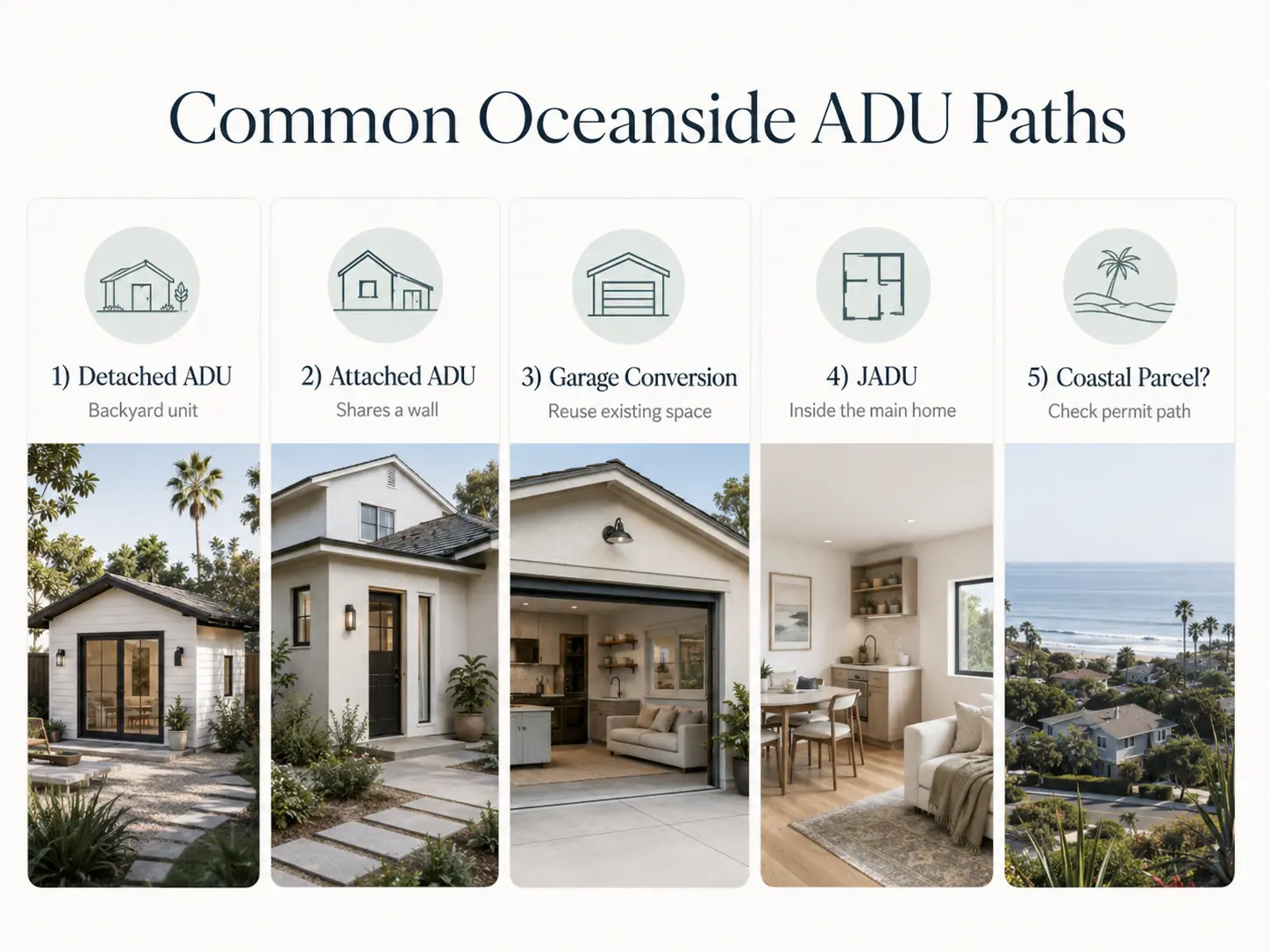
Single-family lots: the three-stack combination
| Configuration | What it includes | City ordinance (2022) | State law (Gov. Code § 66323) |
|---|---|---|---|
| 1 detached new-construction ADU + 1 JADU | One new free-standing unit up to 1,200 sq ft, plus one 500-sq-ft unit inside the home | ✅ Allowed | ✅ Allowed |
| 1 attached ADU + 1 JADU | One unit attached to the primary, plus one 500-sq-ft unit inside the home | ✅ Allowed | ✅ Allowed |
| 1 converted-space ADU + 1 detached new-construction ADU + 1 JADU | A garage or basement conversion, plus a separate new backyard unit, plus a JADU inside the main home | ❌ Currently denied | ✅ Allowed per HCD findings letter and Gov. Code § 66323 |
| 2 detached new-construction ADUs on a single-family lot | Two free-standing units | ❌ Not allowed | ❌ Not allowed (state law does not authorize this on single-family lots) |
The third row is the moneymaker, and it is also the most contentious in Oceanside today. If a planner refuses the three-stack combination, ask for the citation. The current 2022 ordinance language is on shaky ground; the 2026 amendment explicitly proposes correcting it.
Multifamily lots: what SB 1211 changed in 2025
Before SB 1211 (Skinner, 2024), California limited multifamily property owners to two detached ADUs total, regardless of building size. That changed January 1, 2025:
| Existing units on the lot | Maximum detached ADUs allowed | Plus: ADUs in non-livable space |
|---|---|---|
| 2 (duplex) | 2 | At least 1, or up to 25% of existing units |
| 3 (triplex) | 3 | Same |
| 4 (fourplex) | 4 | Same |
| 5–7 | Equal to existing unit count | Same |
| 8 or more | 8 (hard cap) | Same |
Sources: Gov. Code § 66323; SB 1211 (Skinner, 2024); HCD ADU Handbook (March 2026); HCD Findings Letter (May 20, 2025).
How big can an Oceanside ADU be? Size, height, and setback rules
Detached ADUs can be up to 1,200 square feet; attached ADUs are capped at 50% of the primary dwelling under Oceanside’s local path, though state law prevents local standards from blocking at least an 800-square-foot ADU with 4-foot side and rear setbacks; JADUs are capped at 500 square feet. Side and rear setbacks are 4 feet for many protected paths. Height is 16 feet baseline for one-story detached ADUs using reduced setbacks, 18 feet within a half-mile walking distance of a qualifying transit stop, and up to 25 feet for attached ADUs in certain configurations.
Size by ADU type
| ADU type | Maximum size | State-protected envelope | Notes |
|---|---|---|---|
| Detached new construction | 1,200 sq ft | At least 800 sq ft with 4-ft side and rear setbacks | Under 1,000 sq ft: protected size path; over 1,000 sq ft: subject to underlying zoning standards |
| Attached | Up to 50% of primary dwelling (local path) | State law prevents local standards from blocking at least an 800-sq-ft ADU with 4-ft setbacks | Must connect to primary via at least a 4-foot common wall to be considered attached |
| Conversion (garage, basement, attic) | No floor-area cap (limited by existing footprint) | Existing structure dictates | No replacement parking required |
| JADU | 500 sq ft | Inside an existing or proposed single-family residence | Requires efficiency kitchen; may share sanitation with primary |
Setbacks
- Side and rear: 4 feet for many protected ADU paths. ADUs larger than 1,000 sq ft must meet the underlying zoning district’s setbacks instead.
- Front: Must meet the underlying zone’s front-yard setback, except that no front-setback rule can prevent an 800-sq-ft ADU with 4-foot side and rear setbacks.
- Building separation (inland): Typically 6 feet. If the ADU is 5 to 10 feet from the primary, one of the two structures must be fire-resistant construction. Beyond 10 feet, neither must be.
- Building separation in the Coastal Zone: Minimum 10 feet.
Height
- 16 feet: Baseline for a detached one-story ADU using reduced (4-foot) setbacks.
- 18 feet: Within ½ mile walking distance of a major transit stop or high-quality transit corridor (with limited extra height to match a roof pitch).
- 18 feet: For a detached ADU on a lot with an existing or proposed multi-story multifamily dwelling.
- Up to 25 feet: For some attached ADUs (or the height limit of the primary dwelling, whichever is lower).
To check whether your lot qualifies for the transit bonus, measure walking distance from your property to the nearest qualifying stop. The North County Transit District (NCTD) operates the Sprinter (light rail) and Coaster (commuter rail) in Oceanside. Candidate stops to verify:
- Oceanside Transit Center (Coaster + Sprinter)
- Crouch Street Sprinter
- El Camino Real Sprinter
- College Boulevard Sprinter
- Rancho del Oro Sprinter
Sources: Oceanside Zoning Ordinance Article 30 § 3006; Government Code §§ 66314, 66321, 66323; SB 1211 (Skinner, 2024); AB 2221 (2022); Oceanside Planning Division operator notes (Feb 2022 + May 2022); SnapADU operator data (March 2026).
Do Oceanside ADUs require parking?
Oceanside generally requires one parking space per ADU unless an exemption applies. Garage conversions never require replacement parking. ADUs within a half-mile walking distance of public transit are exempt. As of January 1, 2025 under SB 1211 (Skinner, 2024), no replacement parking is required when any parking — covered or uncovered — is demolished or converted to create an ADU.
The parking exemptions you can rely on today:
- Within ½ mile walking distance of public transit. Public transit is defined broadly to include buses, trains, subways, and other fixed-route public transportation. Note: this is a different, broader test than the “major transit stop or high-quality transit corridor” test used for the 18-foot height bonus.
- Conversion ADUs (garage, basement, attic) — no parking required for the ADU and no replacement parking required for the displaced spaces.
- Within a designated historic district.
- In areas where on-street parking permits are required but not offered to the ADU occupant.
- Within one block of a designated car-share vehicle.
- Concurrent applications: when the ADU permit is filed alongside a new single-family or multifamily dwelling permit on the same lot.
- JADUs: No parking required.
Sources: City of Oceanside ADU Page (verified May 12, 2026); Government Code §§ 66314, 66322; SB 1211 (Skinner, 2024); SB 543 (McNerney, 2025); HCD Findings Letter (May 20, 2025).
Do you need a Coastal Development Permit for an Oceanside ADU?
Parts of Oceanside west of I-5 — including portions of Townsite, the Strand, the harbor and pier area, South Oceanside west of Coast Highway, the bluff faces, and lagoon-adjacent parcels — sit inside the California Coastal Zone and may require a Coastal Development Permit (CDP) in addition to the building permit. Under AB 462 (Lowenthal, 2025), effective October 10, 2025, the CDP for an ADU must be processed concurrently with the ADU permit, decided within 60 days without a public hearing, and a local government’s decision on an ADU CDP under Government Code § 66329(a) is not subject to appeal to the California Coastal Commission under Public Resources Code § 30603.
Coastal Zone decision tree
Is your lot inside the Coastal Zone?
Yes → Continue to step 2.
No → You don't need a CDP. Proceed with a standard building permit.
Is your project a conversion of existing space that doesn't alter major structural components?
Yes → Often qualifies for a CDP exemption. Confirm at intake.
No → Continue to step 3.
Is the parcel within 300 feet of the beach or bluff edge, between the sea and the first public road, within 100 feet of a wetland or stream, or in an environmentally sensitive habitat area?
Yes → A regular CDP is typically required; expect longer review and possibly additional environmental documentation.
No → Continue to step 4.
Default for most coastal ADUs
An administrative CDP processed concurrently with the building permit. The City requires a mailing list of surrounding property owners for the public-notice step.
What AB 462 changed in October 2025
- 60-day shot clock on CDP reviews. For a local government with a certified Local Coastal Program (LCP), an ADU CDP application must be approved or denied within 60 days, without a public hearing, and concurrently with the ADU permit application. If the Coastal Commission fails to act in that window, the CDP is deemed approved.
- No appeal to the Coastal Commission for local ADU CDPs. A local government’s decision on an ADU CDP under Gov. Code § 66329(a) is not subject to appeal to the Coastal Commission under PRC § 30603.
- Concurrent processing. The CDP process must run concurrently with the underlying planning and building permits, not sequentially.
LCPA25-00002 caveat
Oceanside’s 2026 ADU ordinance amendments include Coastal Zone provisions that require certification by the California Coastal Commission through a Local Coastal Program Amendment (LCPA25-00002). Ordinance No. 26-OR0104-1 takes effect 30 days after adoption outside the Coastal Zone, but inside the Coastal Zone the effective date depends on Coastal Commission certification of LCPA25-00002. Verify certification status with the Oceanside City Clerk before relying on the 2026 provisions inside the Coastal Zone.
Coastal vs. inland: side-by-side
| Item | Inland Oceanside | Inside the Coastal Zone |
|---|---|---|
| Permit basis | Building permit only | Building permit + CDP (or exemption / administrative CDP) |
| CDP review timeline | N/A | 60 days under AB 462; concurrent with ADU permit; no public hearing |
| Appealable to Coastal Commission? | N/A | No, for local ADU CDPs under Gov. Code § 66329(a) |
| Mailing list of surrounding owners required? | No | Yes, for administrative CDP |
| Minimum separation between detached ADU and primary | 6 feet (City practice) | 10 feet |
| Bluff setback (for CDP exemption) | N/A | 50 feet from bluff top |
| Distance from mean high tide (for CDP exemption) | N/A | 300 feet |
Sources: AB 462 (Lowenthal, 2025); Government Code § 66329; Public Resources Code § 30603; California Coastal Act of 1976; Oceanside Local Coastal Program; SnapADU Coastal Zone ADU Guide (2025).
Coastal lot?
This is one of the most parcel-specific decisions in the whole process. Your bluff distance, wetland proximity, and certified-LCP status all change the path.
Run My Coastal Lot Through the Free Feasibility Check →We flag coastal-zone overlap, bluff and wetland proximity, and the most likely CDP path for your address.
How long does an Oceanside ADU permit take?
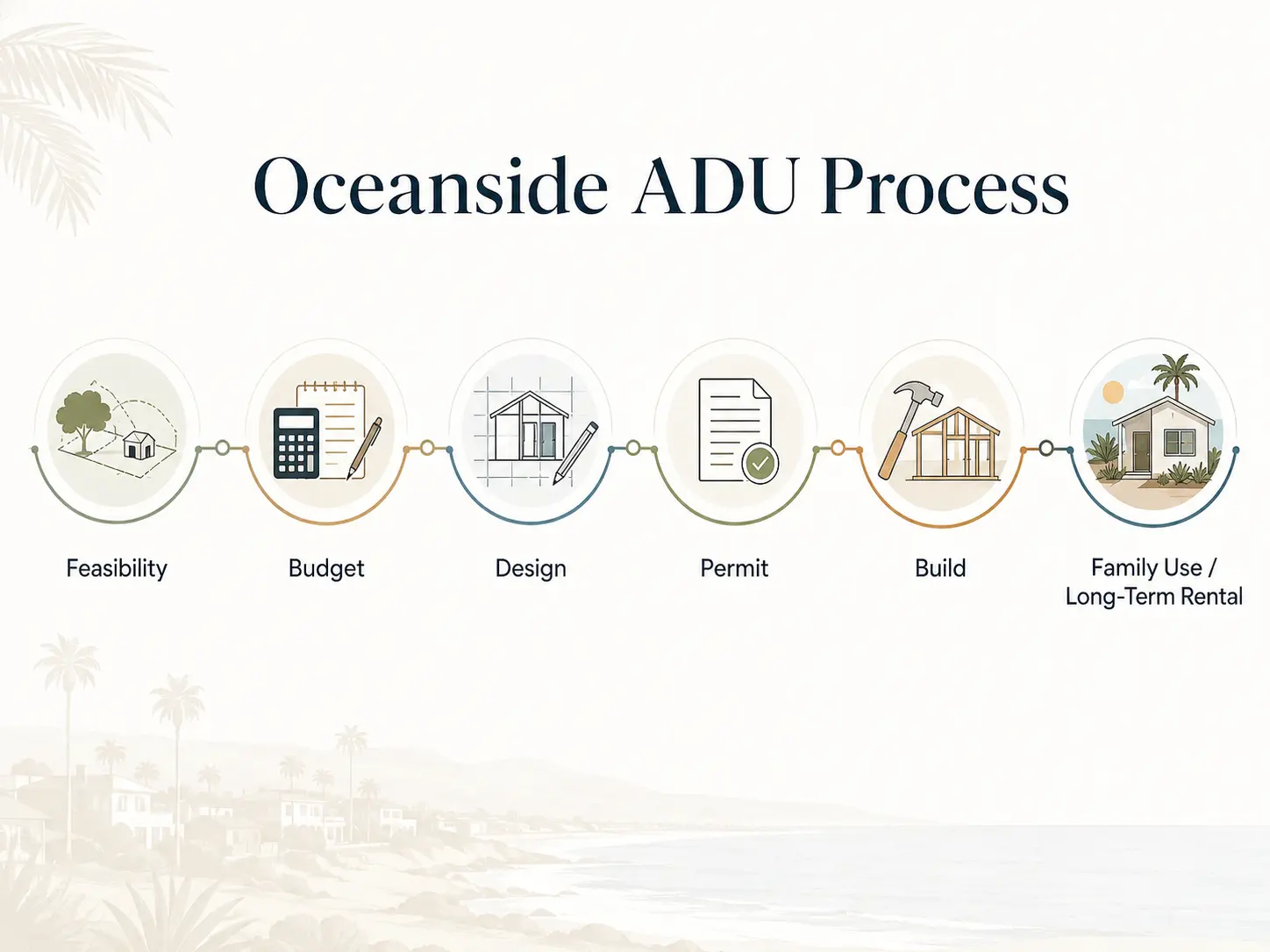
State law gives Oceanside 15 business days to determine whether your ADU application is complete and 60 days to approve or deny a complete application (Gov. Code § 66317; SB 543, McNerney, 2025). Oceanside’s published plan-check target is 14 calendar days for the initial review and 7 calendar days for resubmittals. In practice, the design-plus-permit phase typically runs 6 to 12 months, and full project — design through certificate of occupancy — typically runs 11 to 19 months, based on a sample of three public Oceanside permit records and operator data from licensed San Diego County ADU builders.
How the legal clock actually works
| Stage | What the law / City says | What actually happens |
|---|---|---|
| Submittal | Application filed | City logs the submittal |
| Completeness review | 15 business days to determine completeness (SB 543) | If anything is missing, the City sends a completeness letter; clock pauses |
| First plan check | 14 calendar days target after completeness (Oceanside Plan Check page) | First round of correction comments issued |
| Resubmittal | Applicant uploads revised plans | Clock resumes |
| Second plan check | 7 calendar days target for resubmittals | Often clears in this round per local builder operator data |
| Approve or deny | 60 days total after complete application (Gov. Code § 66317) | Decision must be issued, not merely "acted on" |
| CDP (Coastal Zone only) | 60 days under AB 462; concurrent with the building permit | Runs alongside, not sequentially |
| Permit issuance | After fees are paid | School fees and any water-meter upsize fee must be paid first |
The real-world end-to-end timeline
| Stage | Typical duration | What slows it down | What you can do |
|---|---|---|---|
| Pre-design and feasibility | 2–4 weeks | Site survey availability, HOA approvals, parcel research | Run a free feasibility check first |
| Architectural design and engineering | 6–12 weeks | Custom plans, soils and structural reports | Use a pre-approved plan when available |
| First plan check round | 14–45 days | City workload, project complexity | Submit a clean, complete package |
| Resubmittal and second plan check | 21–45 days | Applicant turnaround time on corrections | Respond promptly with full corrections |
| Coastal Development Permit (if applicable) | Concurrent or +60 days | Coastal Zone procedure | Apply concurrently with building permit |
| Permit issuance | 1–2 weeks | School-fee and water-buy-in payment | Have funds ready |
| Construction | 4–8 months | Trade availability, weather, scope changes | Lock scope before breaking ground |
| Final inspections and certificate of occupancy | 2–6 weeks | Punch-list items | Pre-walk the project with your builder before final inspection |
| End-to-end total | 11–19 months |
Sources: Government Code § 66317; SB 543 (McNerney, 2025); AB 1332 (2023); City of Oceanside Plan Check page (verified May 12, 2026); City of Oceanside Pre-Approved ADU Program page (verified May 12, 2026); Dwelling Index Oceanside permit-record sample (3 records); SnapADU operator data (March 2026).
Want to talk to a builder who designs, permits, and builds Oceanside ADUs every week?
SnapADU is based in Oceanside and has completed over 100 ADUs across San Diego County. They publish their pricing, and consultations are free.
See SnapADU’s Oceanside Project Pricing & Free Consultation →SnapADU is an affiliate partner of the Dwelling Index. We may earn a commission at no extra cost to you when you connect with them through our links. Our recommendation is based on independent research of their published service area (Greater San Diego, including Oceanside), CSLB License #1075582, and 100+ completed ADUs. Read our full disclosure →
What does an Oceanside ADU actually cost in 2026?
Detached ADUs in Oceanside in 2026 typically run $300,000 to $430,000 or more all-in, or roughly $300 to $500-plus per square foot. Garage conversions usually run $150,000 to $250,000. JADUs are the cheapest at $80,000 to $150,000. Permits and fees alone usually total $10,000 to $25,000 depending on size and ADU type, though Oceanside waives most City-controlled development impact fees. The California Construction Cost Index rose from 7,090 in January 2021 to 10,258 in December 2025 — a 44.7% increase — which is why the same ADU that cost $300,000 in 2021 now budgets closer to $430,000.
Cost ranges are Dwelling Index editorial estimates derived from the City of Oceanside fee schedule (effective 9/1/2019, marked informational), operator-published pricing from licensed San Diego County ADU builders (refreshed through March 2026), and the California Construction Cost Index. They are illustrative ranges, not quotes, and assume a level lot with reasonable utility access and standard finishes.
The permit and fee build-up
| ADU path | Base City-listed subtotal (informational) | What this subtotal excludes |
|---|---|---|
| Garage / existing structure conversion, non-structural | $1,605.98 | School fees, valuation-based fees, water meter upsize, current FY updates |
| Garage / existing structure conversion, structural | $2,055.20 | Same exclusions; adds fire plan check and fire inspection items |
| Attached addition | $3,139.56 | Same exclusions; attached / addition fee basis |
| Detached new ADU | $7,320.46 | Same exclusions; detached is assessed more like a new single-family dwelling |
Source: City of Oceanside fee schedule (effective 9/1/2019, marked informational only). Verify current fee schedule and any FY 2026 updates with Oceanside Development Services at 760-435-3520 before relying on the precise dollars.
On top of the base subtotal, the typical Oceanside ADU project also pays:
- School district impact fee. Oceanside Unified, Carlsbad Unified, Vista Unified, or Bonsall Unified depending on attendance zone. SB 543 (McNerney, 2025) treats an ADU or JADU of less than 500 square feet of interior livable space as not increasing assessable space for school-fee purposes. At 500 sq ft or more, school fees typically run $5–$6 per square foot.
- Water meter upsize / buy-in. $0 to $8,000+ depending on whether the existing meter is adequate.
- Sewer and water connection / capacity charges. $0 to $3,500+ depending on the path. Utility connection and capacity charges are handled separately from impact fees.
- Other line-item fees. Plan imaging, green building, SMIP, fire inspection (for fire-zone parcels), flood-zone elevation certificate (if applicable).
Construction costs by ADU type
| ADU type | Typical size | Hard-construction cost range (May 2026) | Per sq ft |
|---|---|---|---|
| Detached new (800 sq ft) | 800 sq ft | $260,000–$400,000 | $325–$500 |
| Detached new (1,200 sq ft) | 1,200 sq ft | $360,000–$520,000 | $300–$435 |
| Attached addition (800 sq ft) | 800 sq ft | $240,000–$380,000 | $300–$475 |
| Garage conversion | 350–550 sq ft | $150,000–$250,000 | $300–$500 |
| JADU | ≤500 sq ft | $80,000–$150,000 | $200–$400 |
| Basement / attic conversion | Variable | $180,000–$320,000 | Variable |
What pushes you to the high end: sloped lots, distance from utilities (long lateral trenches for water, sewer, gas, electric), Coastal Zone exterior detailing, soils and grading issues, custom design, premium finishes, and adding a separate utility meter.
Sources: City of Oceanside fee schedule (effective 9/1/2019); SB 13 (2019); SB 543 (McNerney, 2025); SnapADU cost data (2026); Better Place Design & Build operator data (March 2026); California Construction Cost Index (Jan 2021 to Dec 2025, DGS).
How Oceanside homeowners are actually paying for ADUs in 2026
Most Oceanside ADU projects in 2026 are financed through one or more of these lanes, presented as educational paths sorted by how commonly they appear in editorial conversations with local builders:
- Cash and savings. Common for smaller conversions and garage-to-ADU projects.
- Home equity line of credit (HELOC). A revolving line secured by your existing home equity. You only pay interest on the portion you’ve drawn.
- Home equity loan (HELoan). A fixed-rate lump-sum loan against your equity. Useful when you have a confirmed total cost.
- Cash-out refinance. Replaces your existing mortgage with a larger one and gives you the difference in cash.
- Renovation or construction-to-permanent loan. Combines the build financing and the long-term mortgage into one product.
- Home equity investment (HEI). A lump sum of cash today in exchange for a share of your home’s future appreciation. Not a loan — no monthly payments — but you give up some of the home’s future value.
The figures in this article are illustrative and based on industry data current as of May 2026, not guarantees. Actual costs depend on your lot, your design choices, your finishes, and market conditions. Quoted lender rates and terms change frequently; verify with any lender before relying on a specific number.
Want to see current ADU financing options without committing?
Mortgage Research Center publishes lender education across mortgage, refinance, cash-out refi, and construction-loan paths.
Explore Your ADU Financing Options →Educational content, not lender ranking. No rate guarantees. No approval promises. Mortgage Research Center is an advertising partner of the Dwelling Index. We may earn a commission at no extra cost to you when you request information through their site.
Can you rent an Oceanside ADU as an Airbnb or short-term rental?
You can rent an Oceanside ADU on leases of 30 days or longer. Short-term rentals — under 30 days, like Airbnb or Vrbo — are prohibited on properties with an ADU or JADU permitted on or after September 9, 2017. If a property has a post-2017 ADU, the City rules also prohibit using the primary residence as a short-term rental. Owner-occupancy is no longer required for standard ADUs under AB 976. JADUs still require owner-occupancy when they share sanitation with the primary dwelling; AB 1154 (Carrillo, 2025; effective January 1, 2026) carved out JADUs with their own bathroom.
For the typical Oceanside homeowner, the practical takeaway is clear: an ADU is a long-term rental asset, not an STR play. The prohibition applies to the ADU, the JADU, and the primary residence on that property.
Long-term rents in Oceanside vary considerably by neighborhood. Per Apartments.com rent trend data and Redfin housing data refreshed in February and March 2026:
| Submarket | Rent context |
|---|---|
| Downtown / Townsite | Higher end; coastal proximity |
| South Oceanside | Premium coastal submarket (median home sale near $1.4M in Feb 2026); strong rent potential |
| Fire Mountain | Mid-tier; established neighborhood |
| San Luis Rey | Mid-tier; mid-$2,000s rents |
| Loma Alta | Mid-tier; mid-$2,000s rents |
| Ivey Ranch / Rancho Del Oro | Mid-tier; family-friendly inland |
| Citywide average rent (March 2026) | Approximately $2,234 per month, with nearly half of rents above $2,000 |
These figures are illustrative examples, not guarantees of returns. Actual results depend on local market conditions, construction costs, financing terms, and regulatory approvals.
Sources: City of Oceanside Short-Term Rentals page (verified May 12, 2026); AB 976 (Ting, 2023); AB 1154 (Carrillo, 2025); AB 1033 (Ting, 2023); SB 1211 (Skinner, 2024); HCD ADU Handbook (March 2026); Apartments.com rent trends (March 2026); Redfin Oceanside housing market data (February 2026).
Edge cases most pages miss
A handful of Oceanside-specific situations change the answer in ways the City’s published rules don’t make obvious.
HOAs
Oceanside has HOA-governed neighborhoods — parts of Rancho Del Oro, Arrowood, Ivey Ranch, and others. California Civil Code § 4751 limits HOA authority over ADUs in single-family zones: an HOA cannot prohibit or unreasonably restrict the construction of an ADU on a parcel zoned for single-family residential use. However, HOAs can still impose design and architectural standards — colors, materials, fence heights, roof pitches — as long as those standards don’t effectively prohibit the ADU. Read your CC&Rs before you finalize a design.
Very High Fire Hazard Severity Zones
Portions of east Oceanside touch wildland-urban interface zones and Very High Fire Hazard Severity Zones (VHFHSZ). Building in a VHFHSZ changes some things:
- Fire sprinklers are not required for an ADU if they are not required for the primary dwelling, regardless of fire zone. This is state law.
- Exterior materials — ignition-resistant siding, ember-resistant venting, Class A roofing — may be required.
- Access requirements for fire apparatus may apply.
SB 9 lot splits
Senate Bill 9 (effective January 1, 2022, with 2025 enhancements) allows two-unit housing developments and urban lot splits on most single-family parcels in California. In Oceanside, SB 9 is not available everywhere: historic districts, Very High Fire Hazard Severity Zones, wetlands, flood zones, conservation areas, and protected habitat areas are commonly ineligible. If you’re combining an SB 9 lot split with an ADU plan, verify SB 9 eligibility before designing.
Pre-2020 unpermitted units: the AB 2533 amnesty pathway
AB 2533 (Carrillo, 2024; effective January 1, 2025) created a legalization pathway for ADUs and JADUs built before January 1, 2020. Key protections:
- The City cannot deny a legalization permit on building-code grounds unless the unit is genuinely substandard for health and safety.
- The City must provide a checklist of substandard conditions that would need correction.
- The City may not charge impact, connection, or capacity fees if no new infrastructure is required.
- Homeowners can hire a private licensed contractor to perform a confidential pre-inspection before submitting.
Typical legalization costs are reported at $15,000 to $50,000, depending on the electrical, plumbing, and structural work needed.
The 5–10 foot fire-resistance trigger
Per assistant building official guidance (May 2022): if a detached ADU is 5 to 10 feet from the primary residence, one of the two structures must be fire-resistant construction. Beyond 10 feet, neither must be. Site plans that place a detached ADU at exactly 5–10 feet from the primary often add unnecessary cost — either tuck closer to the 4-foot setback or move beyond 10 feet.
Sources: California Civil Code § 4751; AB 2533 (Carrillo, 2024); SB 9 (2021, with 2025 enhancements); City of Oceanside Planning Division operator notes (May 2022); City of Oceanside GIS fire-hazard map; SnapADU operator data.
What changed in 2025 and 2026, and what it means for Oceanside
Seven state bills materially shifted what Oceanside can and cannot do in the 2025–2026 cycle: SB 1211, AB 2533, SB 1077, AB 462, AB 1154, SB 543, and SB 9 (Arreguín, 2025). Each one rebalanced power away from the city and toward homeowners.
Up to 8 detached ADUs on existing multifamily lots, capped at the existing unit count. Replacement parking no longer required when uncovered parking is demolished for an ADU.
What it means in Oceanside: The 2022 ordinance still caps multifamily detached ADUs at 2; for now, state law controls.
Legalization pathway for unpermitted ADUs built before January 1, 2020.
What it means in Oceanside: Homeowners with pre-2020 unpermitted units can now legalize without facing a demolition order, with a defined safety checklist and no impact fees if no new infrastructure is required.
Started a state-led program to simplify ADU permitting in Coastal Zones.
What it means in Oceanside: State pressure on the City and Coastal Commission to harmonize the Coastal Act with ADU streamlining.
60-day shot clock on ADU Coastal Development Permits with concurrent processing and no public hearing; local ADU CDP decisions not appealable to the Coastal Commission.
What it means in Oceanside: The largest single reduction in coastal ADU procedural delay risk in years.
JADU owner-occupancy applies only when the JADU shares sanitation facilities with the primary.
What it means in Oceanside: A JADU with its own bathroom is now a true rental asset, not an owner-occupancy trap.
15-business-day completeness review; ADUs and JADUs of less than 500 sq ft treated as not increasing assessable space for school-fee purposes.
What it means in Oceanside: Smaller ADUs got cheaper; the City's clock got tighter.
HCD enforcement teeth — local ADU ordinances become null and void if the agency fails to submit them to HCD within 60 days of adoption or fails to respond to HCD's findings within 30 days.
What it means in Oceanside: The 2022 ordinance, which HCD found noncompliant in May 2025, was under real pressure to be amended. The City acted on March 25, 2026.
Sources: Burke, Williams & Sorensen 2025 ADU Legislative Update (Dec. 2025); Best Best & Krieger Governor Newsom Signs Four New Accessory Dwelling Unit Bills (Nov. 7, 2025); Holland & Knight California’s 2025 Housing Laws (Nov. 2024); HCD ADU Handbook (March 2026); LegInfo bill text.
Which Oceanside ADU path fits your goal?
The right ADU path depends on why you’re building. Start with the least-risky rule path that meets your goal, then price the site work.
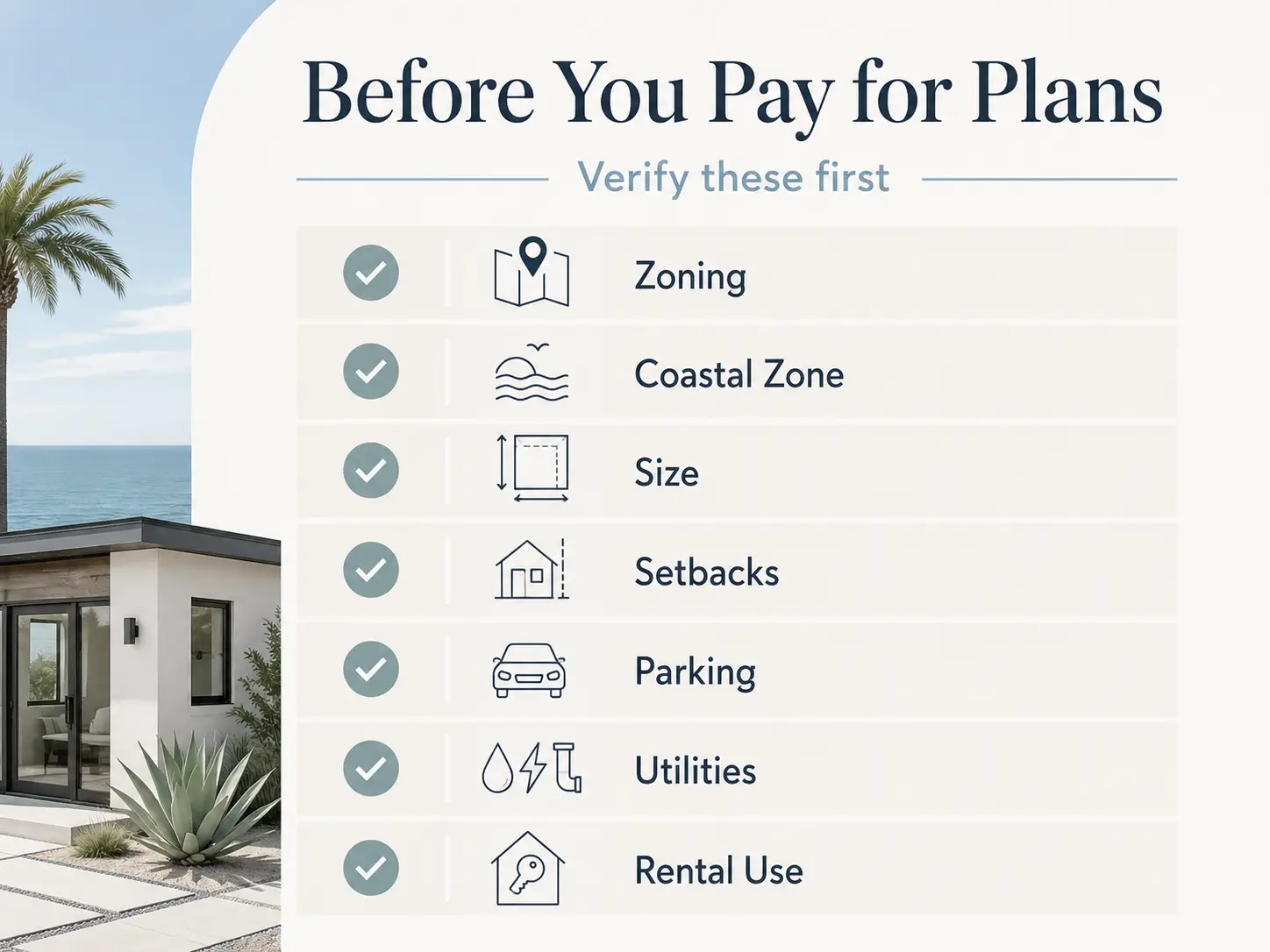
If you're housing aging parents or returning adult children
The path that typically wins: JADU, attached ADU, or small detached ADU. A JADU keeps the unit inside the main house (close, accessible, less expensive to build). Plan the sanitation layout in light of AB 1154 — a JADU with its own bathroom carries no owner-occupancy requirement; one sharing a bathroom with the primary still does. A small detached ADU (650–800 sq ft) gives full independence with a yard.
If you're building for long-term rental income
The path that typically wins: detached ADU at 800–1,000 sq ft, or a garage conversion if the layout works. Detached ADUs rent for more per month than JADUs because they offer full privacy and a separate entrance. The 800–1,000 sq ft size band hits a sweet spot: it's protected under state law from many local restrictions, and a two-bedroom layout commands more rent than a studio. Plan for 30+ day tenancies — Oceanside prohibits short-term rentals on properties with a post-2017 ADU.
If you're trying to minimize permit-fee friction and total cost
The path that typically wins: garage conversion or other existing-structure conversion. Oceanside's fee schedule charges garage / existing-structure conversions at a significantly lower base than detached new construction (roughly $1,600–$2,100 versus roughly $7,300 for detached new). Construction costs are lower too — typically $150,000–$250,000 for a garage conversion versus $300,000+ for detached new — because the slab, walls, and roof already exist.
If you want maximum living space
The path that typically wins: detached new construction up to 1,200 sq ft, if the underlying zone supports it. The 1,200-sq-ft path requires you to meet the underlying zoning district's height, setback, and lot-coverage standards. If your lot is generous and your zoning is RS or RM, you can usually make this work.
If you own multifamily property
The path that typically wins: non-livable space conversions plus as many detached ADUs as your unit count supports (up to 8). Under SB 1211, an eight-unit apartment building with backyard or parking-lot space can add up to eight detached ADUs. The 2022 Oceanside ordinance still caps multifamily detached ADUs at two; if you're building under the SB 1211 envelope today, expect to cite the statute.
If your lot is in the Coastal Zone
The path that typically wins: start with a feasibility check before design. Coastal lots add a CDP layer that's now capped at 60 days under AB 462 and runs concurrently with the building permit, but the design parameters change (10-foot separation, bluff setbacks, sensitive-habitat constraints). It's not a reason to skip an ADU on a coastal lot — coastal-adjacent ADUs are often the highest-yielding rental assets in San Diego County — but it's a reason to verify constraints early, especially while LCPA25-00002 certification is still pending.
Want to see whether your specific lot supports the path that fits your goal?
Get Your Free Oceanside ADU Feasibility Report →We check zoning, coastal-zone overlap, transit proximity, lot dimensions, and your permitted ADU envelope at your address. About 60 seconds. No commitment.
What should you verify before hiring a designer or builder?
Before you sign a design-build contract or pay for plans, verify the following at your specific parcel:
Property checks
- Assessor's Parcel Number (APN) and lot dimensions
- Zoning district (RE, RS, RM, RH, RH-U, or RT) and underlying setback / lot-coverage / height standards
- Whether the lot is inside the Coastal Zone
- Whether the lot is in a Very High Fire Hazard Severity Zone (VHFHSZ)
- Whether the lot is in a FEMA flood zone
- Walking distance to the nearest qualifying transit stop (for the 18-foot height bonus)
- HOA presence and CC&R review
Design checks
- Target ADU type (detached new, attached, conversion, JADU)
- Target square footage relative to the 800 / 850 / 1,000 / 1,200 sq ft thresholds
- Bedroom count (affects the protected size threshold)
- Whether the JADU bathroom configuration triggers owner-occupancy
- Separation from primary dwelling (avoid the 5–10 foot fire-resistance trap unless intentional)
Permit checks
- Completeness of the application package before submittal
- Plan-check target (14 days first round, 7 days resubmittal) and how the design team will respond
- CDP requirement (Coastal Zone only)
- Resubmittal expectations — most Oceanside ADUs clear plan check in two rounds
Cost checks
- Current City fee schedule (not the 2019 informational figures)
- Assigned school district and current school fee rate
- Water meter sizing and whether an upsize fee will apply
- Utility lateral lengths — the trenching from the primary's existing utilities to the ADU is often the largest variable cost
Rental and use checks
- Whether you intend a long-term rental (allowed) or short-term rental (prohibited)
- Whether the JADU bathroom configuration affects owner-occupancy
- Whether AB 1033 has been adopted in Oceanside (for separate sale) — it has not as of May 12, 2026
A good builder will run most of these checks for you during a free consultation. A great builder will run them before drafting any plans. When you’re ready to compare local builders, see our independent Oceanside builder review.
Want it offline?
Get the free California ADU Starter Kit — a printable PDF that bundles the size/setback/permit tables on this page, the financing-path comparison, and a feasibility checklist.
Download the Free California ADU Starter Kit →One email, no spam.
Frequently asked questions about Oceanside ADU laws
Can I build an ADU in Oceanside in 2026?⌄
What is the maximum ADU size in Oceanside?⌄
Can I build a 1,200-square-foot detached ADU in Oceanside?⌄
Can I build an ADU and a JADU on the same Oceanside property?⌄
Can multifamily properties add ADUs in Oceanside?⌄
Do Oceanside ADUs require parking?⌄
Do garage conversions require replacement parking in Oceanside?⌄
Can I use my Oceanside ADU as an Airbnb or short-term rental?⌄
Do I have to live on the property to build an ADU in Oceanside?⌄
Can I sell my ADU separately in Oceanside?⌄
How long does an Oceanside ADU permit take?⌄
Does Oceanside have pre-approved ADU plans?⌄
Do I need a Coastal Development Permit for an Oceanside ADU?⌄
Are Oceanside ADU fees waived?⌄
Can I legalize an unpermitted ADU in Oceanside?⌄
What if Oceanside denies my ADU permit on grounds that conflict with state law?⌄
What we verified, and when
Verified May 12, 2026 against:
- City of Oceanside ADU Page
- Oceanside ADU Ordinance No. 22-OR0114-1 (Article 30 § 3006), adopted February 23, 2022
- Public notice of adoption of Ordinance No. 26-OR0104-1 (adopted March 25, 2026)
- California Department of Housing and Community Development, Review of Oceanside's ADU Ordinance under State ADU Law (Gov. Code §§ 66310–66342), May 20, 2025
- HCD ADU Handbook, March 2026
- Oceanside City Council staff report on proposed ADU ordinance revisions, March 11, 2026
- City of Oceanside Plan Check page
- City of Oceanside Pre-Approved ADU Program page
- City of Oceanside Short-Term Rentals page
- City of Oceanside fee schedule (effective 9/1/2019, marked informational only)
- California Government Code §§ 66310–66342
- California Coastal Act of 1976; Public Resources Code § 30603
- AB 462 (Lowenthal, 2025; urgency, October 10, 2025)
- AB 1154 (Carrillo, 2025; effective January 1, 2026)
- AB 1332 (2023)
- SB 9 (Arreguín, 2025; effective January 1, 2026)
- SB 543 (McNerney, 2025; effective January 1, 2026)
- SB 1211 (Skinner, 2024; effective January 1, 2025)
- AB 2533 (Carrillo, 2024; effective January 1, 2025)
- AB 976 (Ting, 2023); AB 1033 (Ting, 2023); AB 2221 (2022)
- SnapADU Oceanside regulations page (refreshed March 2026), CSLB License #1075582
- Burke, Williams & Sorensen LLP, 2025 ADU Legislative Update (December 2025)
- Best Best & Krieger LLP, Governor Newsom Signs Four New Accessory Dwelling Unit Bills (November 7, 2025)
- Apartments.com rent trends (March 2026); Redfin Oceanside housing market data (February 2026)
- San Diego County Planning & Development Services AB 1033 adoption announcement (March 4, 2026)
- California Construction Cost Index, Department of General Services (Jan 2021: 7,090; Dec 2025: 10,258)
- CalHFA ADU Grant Program page (fully reserved as of 12/28/2023); HCD ADU funding page
Methodology
This guide was built by the Dwelling Index Editorial Team by comparing official City of Oceanside ADU materials, California HCD state-law guidance, HCD’s Oceanside ordinance review letter, the Oceanside City Council 2026 ADU ordinance amendment file, City fee documents, City plan-check targets, the City’s short-term rental rules, and top competing search results.
Source hierarchy used:
- Primary law and government sources. California Government Code, HCD findings letter, HCD Handbook, California Coastal Commission, City of Oceanside published ordinance and policies, City Council legislative file.
- Operator and trade-association sources. Licensed San Diego County ADU builders (SnapADU, Better Place Design & Build) for real-world permitting and cost data.
- Legal-trade publications. Burke, Williams & Sorensen; Best Best & Krieger; Holland & Knight for legislative analysis.
- Market-data sources. Apartments.com, Redfin, California Construction Cost Index for rent and construction-cost context.
What this guide is not. This is not legal advice, lending advice, tax advice, or a guarantee of permit approval. Code requirements, fee schedules, and program statuses change. Verify every figure against your own City, district, and lender before relying on it for a financial decision.
Read our full editorial methodology → · Read our full FTC disclosure →
Related guides
- If you're new to ADUs, start with our explainer on what counts as an ADU
- When you're ready to compare local builders, see our independent Oceanside builder review
- Building outside Oceanside in San Diego County? See the County rules
- Coastal-zone ADU guide for the broader San Diego coast
- The full ADU permit-timeline explainer
- Compare neighboring city rules: Carlsbad ADU laws
Not sure where to start?
See what’s possible at your address — get your free ADU report in 60 seconds.
Check My Oceanside Property →