
Last updated: May 12, 2026 · Last verified: May 12, 2026
Carlsbad Coastal Zone ADU: CDP Rules, Permits, Costs & Real 2026 Checklist
The Dwelling Index is an independent research resource covering ADU financing, costs, and regulations. This guide is written for Carlsbad homeowners whose property sits inside the City’s certified Coastal Zone.
Bottom line.
A Carlsbad Coastal Zone ADU is buildable on most parcels, but the coastal layer changes the permit path. Detached ADUs in the Coastal Zone almost always need a Minor Coastal Development Permit (MCDP) in addition to a building permit. Carlsbad’s own ADU bulletin says attached ADUs and JADUs are exempt from the MCDP requirement subject to the exceptions in Carlsbad Municipal Code §21.201.060(B)(1) — so the right answer depends on your ADU type, your parcel, and whether any coastal-resource exception is triggered. On a clean lot, expect the coastal layer to add roughly 1 to 3 months to a standard Carlsbad ADU permit timeline, plus additional planning fees that we treat as builder-side estimates (verify against the current Master Fee Schedule before filing). AB 462 (Chapter 491, Statutes of 2025; signed and effective October 10, 2025 as an urgency statute) capped the coastal ADU CDP process at 60 days, made it concurrent with ADU permit review, eliminated the public hearing, and made local decisions under Government Code §66329(a) not subject to Coastal Commission appeal under Public Resources Code §30603. SB 1077 (signed September 2024) did not eliminate the MCDP for Carlsbad ADUs — it only directs the California Coastal Commission to publish streamlining guidance by July 1, 2026 that local governments may eventually use to amend their Local Coastal Programs.
Your single best next step before paying for plans: confirm your parcel’s Coastal Zone status, identify your LCP segment, and run a quick trigger check for bluff, lagoon, view-corridor, or sensitive-habitat overlays. We built a free tool that does all three.
Carlsbad-specific. Parcel-level. Returns your LCP segment, MCDP path, and trigger flags.
What we verified for this guide
Verified May 12, 2026. We separate legal and procedural facts (sourced to primary statutes, ordinances, and city documents) from cost, rent, and market estimates (which we label by source and date).
Primary legal and procedural sources:
- Carlsbad Municipal Code §21.10.030 — size, height, setback, parking, solar, architectural-compatibility, and LCP-conformance requirements.
- Carlsbad Municipal Code Chapter 21.201 — defines the MCDP and the City Planner’s authority over administrative coastal review.
- CMC §21.201.060(B)(1) — the exemption section for attached ADUs and JADUs.
- CMC Chapter 21.203 (Coastal Resource Protection Overlay) — additional constraints near the three lagoons.
- CMC Chapter 21.204 (Coastal Shoreline Development Overlay) — applies between the sea and the first public road.
- Carlsbad ADU Information Bulletin IB-111 (updated October 2025) — the City’s consolidated ADU rule summary.
- Carlsbad Ordinance CS-506 (adopted February 3, 2026) — ADU ordinance amendments including the parking-replacement exception. Coastal Zone (LCP) portions require California Coastal Commission certification before they take effect inside the Coastal Zone.
- California Government Code §66329 as amended by AB 462 — concurrent 60-day coastal ADU CDP rule, no public hearing, no appeal under PRC §30603 for local decisions under subdivision (a).
- SB 1077 (Chapter 454, Statutes of 2024) — requires the Coastal Commission, in coordination with HCD, to develop LCP-amendment guidance by July 1, 2026.
Verification items flagged for direct confirmation before acting:
- The exact Minor CDP planning fee against the current FY 2025-26 Master Fee Schedule.
- The current Coastal Commission certification status for the Coastal Zone portions of Ordinance CS-506.
- SDG&E’s current ADU separate-meter cost (the widely cited $15,000 figure dates to 2023).
- The publicly available text of any HCD communication to Carlsbad regarding front-yard setbacks for LCP-covered parcels.
Current implementation status (May 2026)
| Item | Status |
|---|---|
| Carlsbad IB-111 | Last updated October 2025. Contains older Coastal Commission appeal language that conflicts with current Government Code §66329 as amended by AB 462. Current statute controls. |
| Carlsbad Ordinance CS-506 (Feb 3, 2026) | Adopted. Effective outside the Coastal Zone after standard post-adoption period. Coastal Zone (LCP) portions require California Coastal Commission certification before they take effect inside the Coastal Zone. Verify current certification status with City Planning. |
| Carlsbad Permit Ready ADU Program plans | Unavailable while being updated for the 2025 California Building Code. Anticipated to relaunch summer 2026. |
| Government Code §66329 | Current as amended by AB 462 (Chapter 491, Statutes of 2025; effective October 10, 2025 as an urgency statute). |
| SB 1077 Coastal Commission guidance | Final guidance due July 1, 2026; draft posted and public workshops underway. |
At a glance: Coastal Zone vs. non-coastal Carlsbad ADU
| Non-coastal Carlsbad ADU | Carlsbad Coastal Zone ADU | |
|---|---|---|
| Permits required | Building permit only | Building permit + Minor Coastal Development Permit (per CMC Ch. 21.201) for detached ADUs; attached ADUs and JADUs are MCDP-exempt subject to CMC §21.201.060(B)(1) exceptions |
| Public hearing | No | No — Minor CDP is administrative under AB 462 |
| Neighbor notice | No | Yes — written notice to adjacent property owners during the comment window |
| Standard design-to-permit timeline | 3 to 4 months | 4 to 6 months on a clean lot; 6 to 8 months on a triggered lot |
| Statutory ADU shot clock | 60 days under Gov. Code §66317 | Same 60 days under §66317; coastal ADU CDP runs concurrently under §66329 (AB 462) |
| Coastal Commission appeal? | N/A | No — under AB 462, local decisions under §66329(a) are not subject to appeal under PRC §30603. Note: IB-111 still contains older appeal language conflicting with current state law. |
| ADU encroach into front-yard setback? | Yes — state-law 800-sf guarantee applies | No. Carlsbad's LCP front-yard setback applies. CMC §21.10.030 takes precedence over the state-law override for LCP-covered properties. |
| Roof decks | Prohibited on all ADUs | Prohibited on all ADUs |
| Multifamily detached-ADU cap | Up to 8 detached ADUs per state law | IB-111 caps at 2 detached ADUs on existing or proposed multifamily/two-family Coastal Zone lots |
| Parking replacement if garage demolished | Not required once CS-506 fully effective (SB 1211 statewide) | Not required statewide under SB 1211, but CS-506 exception strip applies west of rail corridor between Avenida Encinas and Batiquitos Lagoon. LCPA certification required before taking effect inside Coastal Zone. |
| Short-term rental of newly permitted ADUs | 30-day minimum; restricted for ADUs permitted on or after Jan 1, 2020 | Same |
Sources: CMC §21.10.030 and Chapters 21.201/21.203/21.204; Carlsbad IB-111 (October 2025); Gov. Code §§66317, 66323, 66329; AB 462 (Chapter 491, Statutes of 2025); Carlsbad Ordinance CS-506 (adopted Feb 3, 2026).
Parcel-specific. Returns your likely LCP segment, MCDP path, and trigger flags.
Official Carlsbad ADU resources (verify before filing)
- Carlsbad ADU page — official rule summary and the linked forms list, including IB-111, B-75, B-1, P-1, and the Minor Coastal Development Permit Supplemental Form (P-6). Look for Master Fee Schedule for exact current fee amounts.
- Carlsbad Permit Ready ADU Program page — current PRADU plan status and the processing guide for applicants. See also our guide to Carlsbad permit-ready ADU plans.
- Carlsbad Coastal Zone Map on the City’s open-data portal — confirms whether a specific APN is inside the Coastal Zone.
- Carlsbad Transit Stations Half-Mile Walking Distance Maps — for the 18 to 20 ft height paths.
- Carlsbad Planning Division — 442-339-2610 or planning@carlsbadca.gov.
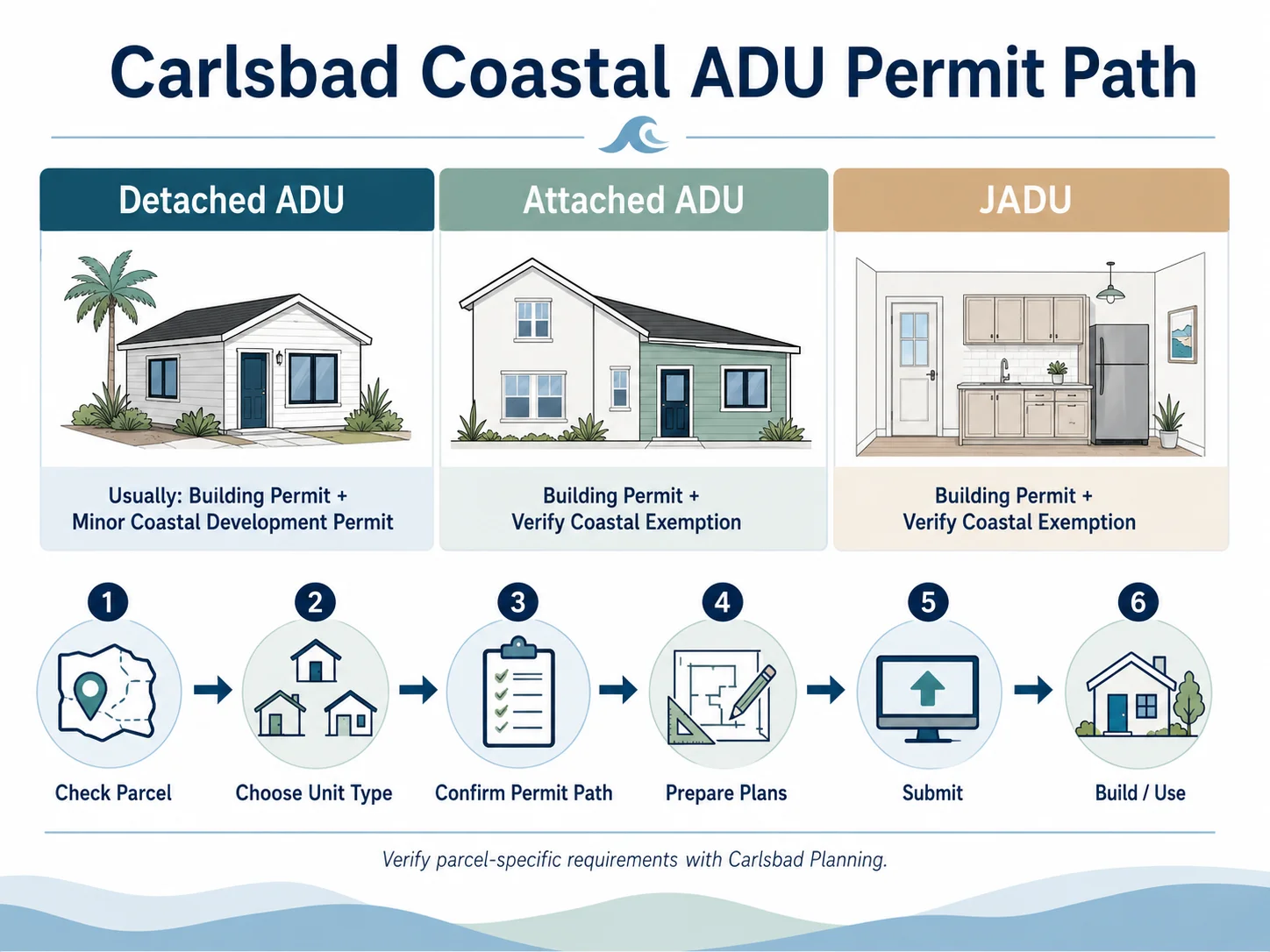
What is the Carlsbad Coastal Zone ADU permit path?
Short answer. Most Carlsbad Coastal Zone ADU projects clear the Minor CDP path cleanly. Carlsbad’s October 2025 ADU Information Bulletin states that a proposed accessory dwelling unit in the California Coastal Zone requires a Minor Coastal Development Permit issued by the City Planner, with attached ADUs and JADUs exempted from the MCDP requirement except where the exceptions in CMC §21.201.060(B)(1) apply. A Minor CDP is administrative, processed by the City Planner under CMC Chapter 21.201, requires written notice to adjacent property owners, and does not require a public hearing.
A Minor CDP is a different animal from a full Coastal Development Permit. A full CDP goes to the Planning Commission and triggers a public hearing. A Minor CDP is decided at the staff level by the City Planner. The application uses the Minor Coastal Development Permit Supplemental Form (P-6) alongside the standard Land Use Application Form (P-1) and the ADU building permit application checklist (B-75) filed against the Residential Building Permit Application Form (B-1). Carlsbad’s Permit Ready ADU Program page is explicit: “A minor coastal development permit for an ADU must be approved before or concurrent with the ADU building permit.”
Concurrent is the operative word. You do not have to wait for the MCDP to issue before submitting the building permit. The City processes them together. AB 462 codified that approach at the state level.
Detached vs. attached vs. JADU: the three permit paths
| ADU type | Likely Coastal Zone permit path | Plain-English meaning |
|---|---|---|
| Detached ADU | MCDP + building permit | A new freestanding structure typically counts as Coastal Zone “development” and triggers the Minor CDP. |
| Attached ADU | Building permit only, unless §21.201.060(B)(1) exception triggers | Attached new construction usually fits within the statutory categorical exclusions for “improvements to a single-family residence” — but sensitive-area exceptions can apply. |
| JADU | Building permit only, unless §21.201.060(B)(1) exception triggers | A Junior ADU lives inside the existing primary residence’s walls (or within an attached garage’s footprint), so it usually qualifies for exemption — but owner-occupancy applies. |
Pre-application email template for Carlsbad Planning
Copy and paste to planning@carlsbadca.gov or call 442-339-2610 to schedule a counter appointment:
“I’m evaluating an ADU at [address / APN]. The project would be [detached / attached / JADU / garage conversion / multifamily conversion], approximately [size] sq ft, located [rear yard / inside the home / above garage / etc.]. Can you confirm: 1. Whether the parcel sits inside Carlsbad’s Coastal Zone, and which LCP segment. 2. Whether a Minor CDP is required, or whether the project qualifies for an exemption under CMC §21.201.060(B)(1). 3. Whether any parking-replacement requirement applies — and the current Coastal Commission certification status for the Coastal Zone portion of Ordinance CS-506. 4. Whether any prior Coastal Development Permit on the property limits this ADU, or whether the project sits within an appealable area, the Coastal Resource Protection Overlay (Ch. 21.203), or the Coastal Shoreline Development Overlay (Ch. 21.204). 5. Whether the existing primary residence’s nonconforming conditions affect this ADU.”
Skip the back-and-forth. Run the parcel check first.
What did AB 462 actually change for Carlsbad coastal ADUs?
Short answer. AB 462 (Chapter 491, Statutes of 2025) was signed and effective October 10, 2025 as an urgency statute and is the most consequential coastal ADU bill yet enacted. It amended Government Code §66329 to require local governments to approve or deny an ADU coastal development permit within 60 days of receiving a complete application, run the coastal review concurrently with the ADU permit review, hold no public hearing, and — critically — provide that a local government decision under subdivision (a) is not subject to appeal to the California Coastal Commission under Public Resources Code §30603. SB 1077, signed in 2024, did not do any of those things.
What AB 462 does, in plain English
- Single 60-day clock. The standard ADU shot clock (60 days after a complete application under Gov. Code §66317) and the coastal ADU CDP clock (also 60 days under §66329) run together. The City cannot use the coastal review as a parallel-but-longer track.
- No public hearing. Minor CDP review is administrative. Carlsbad already processed most ADU MCDPs this way, but AB 462 codifies the no-hearing rule at the state level.
- No Coastal Commission appeal of local §66329(a) decisions. Before AB 462, neighbors and the Coastal Commission itself could in some cases appeal local ADU CDP decisions, adding months of unpredictability. After AB 462, those local decisions are insulated from appeal under PRC §30603.
- A Coastal Commission 60-day clock for deferred-certification areas. Section 66329(b) requires the California Coastal Commission to approve or deny a completed coastal ADU CDP within 60 days when the Commission is the issuing authority — for example, in Carlsbad’s Agua Hedionda segment. If the Commission does not act within 60 days, the application is deemed approved, with limited exceptions.
- The LCP still applies. AB 462 did not override the Coastal Act, the Coastal Resource Protection Overlay, the Habitat Management Plan, bluff or geologic setbacks, public-view protections, or sensitive-habitat rules. It only changed the procedural framework around the local decision.
What AB 462 does not do
- It does not waive the MCDP for detached coastal ADUs.
- It does not override Carlsbad’s LCP, Chapter 21.203, or Chapter 21.204.
- It does not make a Coastal Zone ADU ministerial in the same way a normal inland Carlsbad ADU is ministerial.
- It does not eliminate the Agua Hedionda deferred-certification jurisdiction itself.
The IB-111 vs. AB 462 conflict you should not ignore
Carlsbad’s October 2025 ADU Information Bulletin still contains appeal language that conflicts with the AB 462 amendments to §66329. IB-111 says the City Planner’s decision can be appealed to the California Coastal Commission. Current Government Code §66329, as amended by AB 462 effective October 10, 2025, says the opposite for local decisions made under subdivision (a). We treat current state code as controlling. Before relying on either the appeal pathway or the no-appeal protection for a specific project, confirm Carlsbad’s implementation directly with Planning.
What did SB 1077 change (and not change) for your Carlsbad ADU?
Short answer. SB 1077 (Blakespear), signed September 22, 2024 and effective January 1, 2025, did not exempt ADUs from Coastal Development Permits. The enacted version was narrowed during the legislative process to require only that the California Coastal Commission, in coordination with HCD, develop written guidance by July 1, 2026 that local governments may use to amend their Local Coastal Programs. Until Carlsbad amends its LCP and the Coastal Commission certifies that change, the MCDP framework above stands.
| What the introduced SB 1077 would have done | What the enacted SB 1077 actually does | What it means for Carlsbad today | |
|---|---|---|---|
| Coastal Development Permit | Would have been waived for ADUs on lots with existing residential structures, except in sensitive areas | Coastal Commission must develop guidance by July 1, 2026; the bill itself does not waive any CDP | Minor CDP still required for detached coastal-zone Carlsbad ADUs |
| Who acts | Local governments — automatic exemption | Coastal Commission and HCD develop guidance, then local governments voluntarily amend their LCPs, then Coastal Commission certifies | Carlsbad would need to amend its LCP in 2026 to 2027 to act on the guidance, then route the amendment through Coastal Commission certification |
The simplest reconciliation: AB 462 is the bill that actually changed coastal ADU permitting in 2025. SB 1077 is the bill that may change the substantive rules sometime in 2026 or 2027. We’ll update this section when the Coastal Commission’s final guidance posts — currently anticipated around June 2026.
Is your property in Carlsbad’s coastal zone? A 60-second self-check
Short answer. A significant share of Carlsbad ADU projects sit inside the Coastal Zone — SnapADU reports that nearly half of its Carlsbad and Encinitas ADU projects fall in the Coastal Zone, far higher than the share for San Diego or Oceanside. The “west of I-5” rule of thumb is not legally sufficient — some east-of-I-5 properties are also in the Coastal Zone, particularly around the lagoons.
Five questions that act as practical screens:
- Are you west of El Camino Real? Most of west Carlsbad is in the Coastal Zone. The Coastal Zone in Carlsbad extends well east of I-5 in some places, particularly around Agua Hedionda Lagoon and Batiquitos Lagoon.
- Are you within roughly half a mile of one of Carlsbad’s three lagoons (Buena Vista, Agua Hedionda, or Batiquitos)? You’re almost certainly in the Coastal Zone, and you may also fall inside the Coastal Resource Protection Overlay under CMC Chapter 21.203.
- Are you within 300 feet of the mean high tide line, or “between the sea and the first public road paralleling the sea”? Historically this triggered the Coastal Commission’s appealable jurisdiction — though AB 462 limits this appeal pathway for ADU CDP decisions under §66329(a).
- Is your lot on or near a coastal bluff — the South Carlsbad State Beach corridor, the Cannon Road bluff area, or any other mapped bluff edge? You’ll likely fall inside the Coastal Shoreline Development Overlay under CMC Chapter 21.204.
- Is your address in the Village or Barrio? Most of the Village-Barrio area sits in the Coastal Zone under the Village-Barrio LCP segment. Different setback rules apply under the Village & Barrio Master Plan, and alley-facing lots use the alley as the rear lot line.
If you answer yes to any of these, treat the parcel as Coastal Zone for planning purposes until you verify it with Planning or the City’s Coastal Zone Map.
What do the six Carlsbad LCP segments mean for your ADU?
Short answer. Carlsbad’s certified Local Coastal Program is split into six geographic segments: Mello I, Mello II, Agua Hedionda, West Batiquitos Lagoon/Sammis Properties, East Batiquitos Lagoon/Hunt Properties, and the Village-Barrio. Mello II is by far the largest — roughly 75% of the City, about 5,500 acres. The Agua Hedionda segment is a deferred-certification area, meaning the California Coastal Commission, not the City, is the CDP authority for many development categories there.
| LCP segment | Approximate coverage | Who issues the CDP | Notable nuance for ADUs |
|---|---|---|---|
| Mello I | Northwest and parts of west Carlsbad; certified 1980 | City of Carlsbad | Standard Minor CDP path; lagoon-adjacent properties may trigger the Coastal Resource Protection Overlay (Ch. 21.203) |
| Mello II | ~75% of the City, ~5,500 acres; certified 1981 | City of Carlsbad | Standard Minor CDP path; properties between the sea and the first public road are subject to the Coastal Shoreline Development Overlay (Ch. 21.204) |
| Agua Hedionda | Around Agua Hedionda Lagoon | California Coastal Commission (deferred-certification area) | Commission issues the CDP for many ADU-relevant categories. Under §66329(b), the Commission has a 60-day clock with a deemed-approval safety valve. Pre-application contact with the Commission's San Diego Coast District office is still recommended before designing. |
| West Batiquitos Lagoon / Sammis Properties | West of I-5 around Batiquitos Lagoon; certified 1985 | City of Carlsbad | Stricter habitat and visual-resource protections under the certified Habitat Management Plan |
| East Batiquitos Lagoon / Hunt Properties | East of I-5 around Batiquitos Lagoon; certified 1988 | City of Carlsbad | Stricter habitat and visual-resource protections under the certified HMP |
| Village-Barrio (formerly Village Redevelopment Area) | Carlsbad Village core and the Barrio; expanded and renamed in 2019 | City of Carlsbad | Different setbacks under the Village & Barrio Master Plan; alley-facing lots use the alley as the rear lot line |
If you’re in the Agua Hedionda segment
The Coastal Commission, not the City, is your CDP authority for most categories of new development. AB 462’s §66329(b) gives the Commission a 60-day decision clock for ADU CDPs, but the Commission’s process and standards differ from the City’s Minor CDP path. Before designing, contact the Coastal Commission’s San Diego Coast District office for a pre-application discussion.
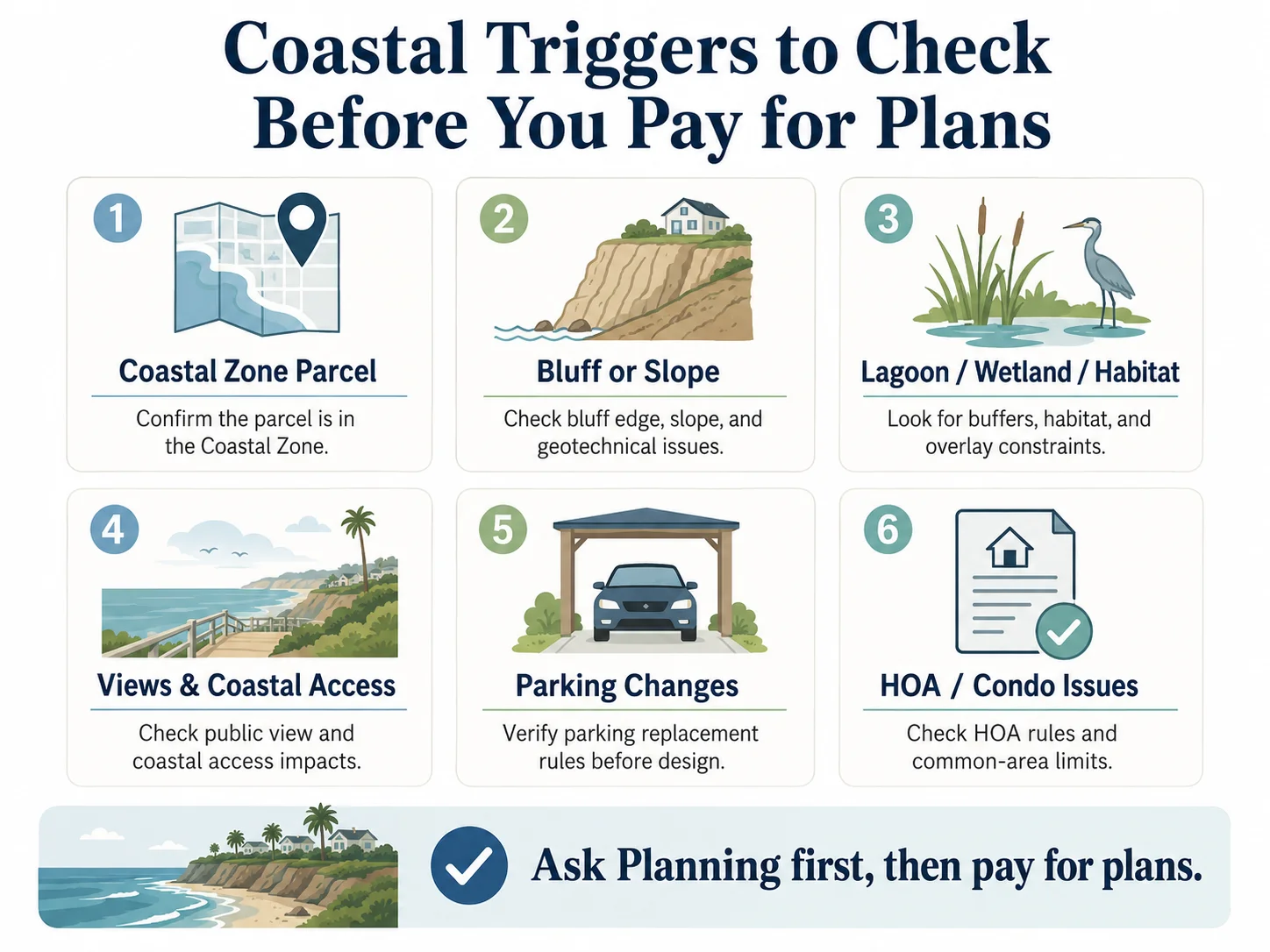
How does the Carlsbad Coastal ADU Trigger Checker work?
We built a parcel-specific screening tool that returns four answers in about a minute:
- Your likely LCP segment (Mello I, Mello II, Agua Hedionda, West Batiquitos, East Batiquitos, or Village-Barrio).
- Whether the City or the Coastal Commission is your CDP authority.
- Any sensitive-area triggers (bluff edge within 50 ft, mean high tide line within 300 ft, lagoon or wetland buffer within 100 ft, view corridor, Coastal Resource Protection Overlay, Coastal Shoreline Development Overlay, Habitat Management Plan area, the post-Feb-2026 parking-replacement strip).
- Your likely permit pathway — Minor CDP, full CDP, or exempt — and a personalized list of questions to ask Planning before paying for plans.
Returns your LCP segment, MCDP path, trigger flags, and the questions to ask Planning.
Download the Free Carlsbad Coastal ADU Starter Kit
A printable version of the trigger checker, the IB-111 plus Minor CDP Supplemental Form checklist, the parking-replacement strip map, and our pre-application email template for Planning.
Get the Starter Kit →Which coastal-zone-only rules override standard Carlsbad ADU rules?
Short answer. Six rules apply to Carlsbad coastal ADUs that don’t apply (or apply differently) to inland Carlsbad ADUs: the Minor CDP requirement for detached units, the front-yard setback override (state law’s 800-sf guarantee does not apply to coastal Carlsbad), Coastal Resource Protection Overlay constraints near lagoons (CMC Ch. 21.203), Coastal Shoreline Development Overlay constraints between the sea and the first public road (CMC Ch. 21.204), Habitat Management Plan consistency for habitat-adjacent lots, and the post-Feb-2026 parking-replacement exception strip west of the rail corridor.
The front-yard setback rule
This is the rule most articles get wrong. State ADU law, codified at Government Code §66323, guarantees a homeowner the right to build at least an 800-sf ADU even if it would encroach into the front-yard setback under local zoning. In non-coastal Carlsbad, that override works exactly as state law promises.
In coastal Carlsbad, you cannot. Carlsbad’s published ADU rules for Coastal Zone parcels do not waive the front-yard setback for the state-law 800-sf override. The City interprets CMC §21.10.030 as taking precedence over the conflicting state ADU provision for properties subject to the LCP. Confirm directly with Planning before relying on this interpretation for a specific project.
Coastal Resource Protection Overlay (CMC Ch. 21.203)
Properties near Buena Vista, Agua Hedionda, and Batiquitos Lagoons fall inside this overlay. The overlay adds buffer, drainage, erosion-control, and (for some properties) habitat-mapping requirements. ADUs are not prohibited in the overlay, but their siting, drainage approach, and stormwater management get extra scrutiny.
Coastal Shoreline Development Overlay (CMC Ch. 21.204)
This overlay applies in the Mello II segment in areas between the sea and the first public road paralleling the sea — specifically the non-beach areas at elevations of ten feet or more above mean sea level. ADUs on these lots get extra scrutiny on grading, drainage, and bluff impacts.
Habitat Management Plan consistency
Carlsbad’s 2003 Habitat Management Plan was certified by the Coastal Commission as part of the LCP. ADU plans must demonstrate consistency with habitat preserve buffers, geologic stability setbacks, and visual resource protection policies. If your lot is mapped inside or adjacent to an HMP preserve area, a biological consultant report is typically required as part of the Minor CDP submittal.
Solar, height, roof decks
Roof decks are prohibited on both attached and detached ADUs anywhere in Carlsbad per the City’s Feb 2026 ordinance clarification. Solar is required on new detached ADUs unless the primary residence’s existing solar system can accommodate the ADU’s additional load. Height for the four-foot-setback path is capped at 16 feet. Per City staff, Carlsbad currently has no high-quality transit corridor as defined by the Public Resources Code, so the +2 ft transit bonus does not currently apply anywhere in Carlsbad. Coastal Zone (LCP) portions of the Feb 2026 ordinance height changes require Coastal Commission certification before taking effect inside the Coastal Zone.
Multifamily Coastal Zone cap
Outside the Coastal Zone, state law allows up to eight detached ADUs on an existing multifamily lot. Inside Carlsbad’s Coastal Zone, IB-111 caps detached ADUs on existing or proposed multifamily/two-family lots at two. If you own a duplex or fourplex in coastal Carlsbad, this LCP-specific limit governs.
Which sensitive-area triggers turn a Minor CDP into a real fight?
Short answer. Most Carlsbad coastal ADU projects clear the Minor CDP path cleanly. The triggers that push a project off the standard administrative path are specific and verifiable: within 300 feet of the mean high tide line, within 50 feet of a coastal bluff edge, within 100 feet of a wetland, in a designated Environmentally Sensitive Habitat Area under the HMP, or in a position to obstruct a designated public view corridor. Any of these can require additional studies, additional design constraints, and additional review time.
- Bluff-top site. A 50-foot setback from the bluff edge is typical, and a geotechnical study is usually required. Bluff stability studies typically run in the $3,500 to $7,500 range.
- Within 300 feet of mean high tide line. Historically this was the Coastal Commission’s appealable jurisdiction for most categories. AB 462 limits this appeal pathway for local ADU CDP decisions under §66329(a), but the underlying coastal-resource policies still apply.
- Within 100 feet of a wetland or ESHA. A biological resources report is typically required. If the ADU footprint cannot be sited outside the buffer without significant redesign, the project may not be approvable in that configuration.
- Designated public view corridor. A visual-resource analysis is typically required. The ADU must demonstrate it does not obstruct or significantly impact protected ocean or lagoon views.
- Mapped HMP preserve area. A biological consultant report is required as part of the Minor CDP submittal.
Honest assessment
A Carlsbad coastal ADU is not just a normal ADU with one extra form. If your lot sits on an active bluff with documented erosion, inside a 100-foot wetland buffer with no developable footprint outside the buffer, or in an ESHA where construction would require habitat impacts no amount of redesign can mitigate, the project may not be buildable on the timeline or budget you want. That said: the typical Carlsbad coastal lot does not have these problems. The trigger check is a small front-end investment that protects against a much larger back-end disappointment.
What is the post-Feb 2026 parking-replacement exception strip?
Short answer. SB 1211, effective January 1, 2025, eliminated the statewide requirement to replace parking spaces when a garage, carport, or uncovered parking space is demolished to build an ADU. Carlsbad adopted Ordinance CS-506 on February 3, 2026 to align with SB 1211 — with one local exception. The ordinance describes a parking-replacement exception strip for Coastal Zone lots west of the rail corridor and west of I-5 between Avenida Encinas and Batiquitos Lagoon, where parking replacement remains required even when demolished for an ADU. Coastal Zone (LCP) portions of CS-506 do not take effect inside the Coastal Zone until the California Coastal Commission certifies the LCPA. Verify the current certification status before relying on either the exception or the broader SB 1211 waiver for a Coastal Zone parcel.
Why the exception exists. The California Coastal Commission has historically pushed back on automatic parking-replacement waivers in coastal areas because of concerns about visitor parking and public coastal access. In Carlsbad, the City Council’s February 3, 2026 ordinance adopted SB 1211’s parking-replacement waiver citywide except in the area that most directly affects coastal public-access parking — the strip along Carlsbad Boulevard and the rail corridor between the southern City limits and Batiquitos Lagoon.
The legally controlling answer today
Inside the Coastal Zone, the answer depends on whether the Coastal Commission has certified the LCPA portion of CS-506. Until certification, the Coastal Zone-specific Carlsbad rules in effect before CS-506 apply. After certification, Carlsbad’s exception strip takes effect: replacement parking required inside the strip, no replacement required elsewhere in the Coastal Zone. This is exactly the kind of question Carlsbad Planning answers in a single email.
How much time and money does the coastal layer add in Carlsbad?
Short answer. On a clean coastal lot — no bluff issue, no lagoon buffer, no view-corridor conflict, no HMP complication — the coastal layer typically adds one to three months to a standard Carlsbad ADU permit timeline. On a triggered lot, add three to six or more months and potentially $5,000 to $25,000 in studies and design revisions. These are the costs the coastal layer adds — not the total ADU project cost.
| Coastal-layer cost line item | Clean coastal lot | Triggered coastal lot |
|---|---|---|
| Minor CDP planning fee | Builder-side estimated range $1,500 to $3,500 — verify against the current FY 2025-26 Master Fee Schedule | Same |
| Public notice / mailing fee | Builder-side estimated range $200 to $400 — verify with Planning | Same |
| Biological survey (if near ESHA or HMP area) | $0 | $2,500 to $8,000 |
| Geotechnical study (if bluff or steep slope) | $0 | $3,500 to $7,500 |
| Visual / view-corridor analysis | $0 | $1,500 to $4,000 |
| Habitat Management Plan consistency analysis | $0 | $1,000 to $3,000 |
| Time added vs. non-coastal Carlsbad ADU | +1 to 3 months | +3 to 6+ months |
Source methodology: builder-side cost ranges from SnapADU’s published Carlsbad data, Better Place Design & Build’s published rates (Feb 2026), and consultant pricing surveyed for this guide. Fee figures flagged for direct Master Fee Schedule verification.
We flag the Coastal Zone, parking-strip, fee-threshold, LCP-segment, and trigger questions to ask Planning before you spend money on plans.
What does the end-to-end Carlsbad coastal ADU permit timeline look like, week by week?
Short answer. Realistic clock for a clean coastal Carlsbad ADU project from “I have a concept” to “I can break ground” is 6 to 8 months for permits, then 4 to 6 months to build — call it 10 to 14 months end to end for typical detached new construction.
- Weeks 1 to 4 — Feasibility and survey. Pre-application meeting with Planning. Site survey. Decide on detached vs. attached vs. JADU vs. garage conversion. Order soils report if project is over 750 sf or two stories. Confirm parcel’s LCP segment.
- Weeks 4 to 10 — Design development. ADU plans drawn. Architectural-compatibility verified per CMC §21.10.030(I)(4) — exterior roofing, trim, walls, windows, and color palette must incorporate the same features as the primary dwelling.
- Weeks 10 to 12 — Concurrent submittal. Building permit (Form B-1) submitted with ADU checklist (B-75), Minor CDP Supplemental Form (P-6), and Land Use Application Form (P-1). As of February 2026, Carlsbad accepts digital submittals through its online portal.
- Weeks 12 to 14 — Completeness review. Under Gov. Code §66317, Carlsbad has 15 business days to determine whether your application is complete.
- Weeks 14 to 18 — First plan check. Planning, Building, Engineering, and (if applicable) Fire issue plan-check comments. You revise.
- Weeks 14 to 18 — Concurrent Minor CDP public notice. A 10-day notice goes to adjacent property owners. The administrative approval by the City Planner happens after the notice period closes, in parallel with the building plan check.
- Weeks 18 to 22 — Second plan check and final corrections. Most projects clear in one to two rounds of corrections.
- Weeks 22 to 24 — Permit issuance. Fees paid, including building permit fees ($2,000 to $4,000 for most ADUs), school district fees, impact fees (for ADUs over 750 sf), and utility connection fees.
- Weeks 24 to 48 — Construction. Conversions typically run 12 to 20 weeks; new detached construction runs 18 to 28 weeks; complex or multi-story builds can run 30 or more weeks.
- Weeks 48 to 52 — Final inspection, Certificate of Occupancy, and post-construction items (final solar interconnection, final landscape, final stormwater compliance).
Sources: Gov. Code §66317; §66329 as amended by AB 462; SnapADU’s published Carlsbad timeline ranges; Carlsbad ADU Permit Ready Program processing guide.
Where applicants lose weeks
The single biggest source of timeline slippage is slow applicant responses to plan-check comments. The City’s clock pauses while the applicant is in the corrections cycle. If you receive comments on a Monday and you respond two weeks later, you’ve added two weeks.
What does a Carlsbad coastal ADU actually cost all-in?
Short answer. A detached new-construction ADU in Carlsbad typically runs $150,000 to $450,000 all-in, with the typical middle of the range — an 800 to 1,000 sf detached unit with mid-range finishes — landing at $280,000 to $400,000 depending on site work and finish level. The coastal layer itself adds 1 to 3 months on a clean lot. Carlsbad’s official ADU page publishes a range from $10,000 up to $300,000 — that floor only applies to interior conversions of existing space; detached new-construction projects start well above the $150,000 mark.
| Cost element | Typical range | Source / verification |
|---|---|---|
| Site-built detached ADU, all-in | $370 to $435 per sf | Better Place Design & Build self-published rates (Feb 2026); verify against current builder bids |
| Prefab / modular ADU, all-in | $327 to $385 per sf | Better Place Design & Build (Feb 2026); SnapADU and other builder-published ranges align |
| Custom / high-end | $600+ per sf | Common in coastal Carlsbad for custom coastal-modern or mid-century aesthetics |
| Carlsbad building permit fees | $2,000 to $4,000 | City of Carlsbad ADU page; verify against FY 2025-26 Master Fee Schedule |
| Site preparation | $30,000 to $65,000 | Better Place Design & Build self-published (Feb 2026); higher for sloped or constrained lots |
| Architectural design (custom, not PRADU) | $8,000 to $16,000 | City of Carlsbad's published PRADU savings estimate |
| Soils report | $2,500 to $5,000 | Required for ADUs over 750 sf or two stories under Carlsbad IB-111 |
| SDG&E separate electric meter (if required) | ~$15,000 (2023 figure) | Flagged for verification — confirm against current SDG&E ADU service pricing |
| Impact fees | $0 for ADUs under 750 sf; proportional for larger | IB-111: no impact fees under 750 sf; proportional charge for ADUs over 750 sf |
| Utility connection fees | $0 for ADU/JADU conversions from existing home space; variable otherwise | IB-111 |
| Coastal-layer additions (clean lot) | See cost-adder table above | Builder-side estimate; verify against current Master Fee Schedule |
| Coastal-layer additions (triggered lot) | +$5,000 to $25,000 | See cost-adder table above |
Honest middle of the range
A typical 800-sf detached ADU in coastal Carlsbad — site-built, mid-range finishes, no triggered coastal constraints — runs $280,000 to $380,000 all-in. Anyone quoting you $150,000 at this size in this market is either pricing a garage conversion, omitting site work and coastal permitting, or about to issue a long list of change orders.
For a full breakdown of ADU costs, see our ADU cost guide and prefab ADU cost guides.
How should you finance a Carlsbad coastal ADU?
Short answer. Carlsbad coastal lots are typically valuable — Redfin reported the Carlsbad median home value above $1.4 million as of February 2026 — which usually means homeowners have meaningful equity to fund an ADU build. The four most common financing paths are HELOC, cash-out refinance, construction-to-permanent loan, and renovation-specific financing.
| If your situation is… | Likely best lane | Why |
|---|---|---|
| You have a sub-5% existing first mortgage you want to keep, and your build is under $300,000 | HELOC | Preserves your existing rate. Variable rate on the HELOC, but you're only paying interest on what you draw during construction. |
| Your current mortgage rate is at or above current market, and your equity easily covers the build | Cash-out refinance | One loan, one rate, one payment. Higher closing costs than a HELOC but simpler to manage. |
| You're building a larger or two-story unit, $350,000+ all-in, or staging draws against a construction schedule | Construction-to-permanent loan | Designed for build schedules. Converts to permanent financing at completion. Tighter draw documentation. |
| You don't have much current equity but the finished ADU will materially raise the property value | Renovation-specific financing | Sized against the post-build appraised value rather than current equity. Specialized product; verify availability. |
| You're on a triggered coastal lot with a contingency need of $15,000 to $25,000 extra | HELOC for soft costs + construction loan for hard costs | Splits the funding so contingency draws don't restart the construction loan documentation. |
Educational note.
The Dwelling Index presents ADU financing as path education, not lender rankings. Rates, qualification rules, and product availability change. We do not guarantee approval, rates, payments, loan terms, or returns. Verify all terms directly with a licensed loan officer before deciding.
Affiliate disclosure. See top of page. When you use our financing links, we may earn a commission at no extra cost to you. Our editorial recommendations are based on independent research and are never influenced by compensation.
Compare ADU financing paths for your Carlsbad coastal build
Path-by-path education on HELOC, cash-out refi, construction loans, and renovation financing — no pre-qualification required to read.
Explore Financing Options →For broader ADU financing context, see our ADU financing options guide.
When should you NOT build a Carlsbad coastal ADU?
Short answer. A Carlsbad coastal ADU is not the right move if your timeline can’t tolerate 10 to 14 months end-to-end, your lot is in the Agua Hedionda LCP segment and you need a fast finish, your numbers only work with short-term rental income (post-Jan-2020 Carlsbad ADUs cannot be short-term rented), or your lot has an active bluff or wetland buffer with no developable footprint outside the buffer.
- Active coastal bluff with documented erosion. A 50-foot bluff setback plus geotechnical analysis may leave no buildable area, or may force a redesign that costs more than the project is worth.
- Lot is wholly within a 100-foot wetland buffer with no developable footprint outside the buffer. Carlsbad’s Coastal Resource Protection Overlay essentially forecloses new freestanding structures in this scenario.
- You need short-term rental income from the ADU. Carlsbad prohibits short-term rental (less than 30 days) of ADUs permitted on or after January 1, 2020.
- Project timeline shorter than 9 to 12 months total. A coastal ADU is not a 90-day project. If your move-in deadline is short, an interior remodel or attic conversion typically fits better.
- Budget below ~$200,000 all-in for new detached construction with significant site work. The math doesn’t pencil at coastal Carlsbad construction costs.
- Agua Hedionda LCP segment with a hard deadline. Even with AB 462’s §66329(b) 60-day clock, the Coastal Commission’s process and standards differ from the City’s Minor CDP path.
Can you rent out a Carlsbad coastal ADU? Short-term, long-term, and what changed
Short answer. Long-term rental of a Carlsbad ADU (30-day or longer leases) is permitted under standard Carlsbad ADU rules. Short-term rental (less than 30 days) is restricted: ADUs permitted before January 1, 2020 may be short-term rented under Carlsbad’s existing rules, but ADUs permitted on or after that date are prohibited from short-term rental. Carlsbad ADUs must be rented for a minimum of 30 days under IB-111. JADUs have an additional layer: the owner must occupy either the primary residence or the JADU itself.
Typical 1BR to 3BR rents across the four Carlsbad zip codes (as of March 2026):
| Zip | Neighborhood | 1 BR | 2 BR | 3 BR |
|---|---|---|---|---|
| 92008 | Carlsbad Village | $2,500 | $3,200 | $4,080 |
| 92009 | La Costa Oaks | $2,280 | $3,200 | $3,645 |
| 92010 | Calavera Hills Village | $2,300 | $2,745 | $3,510 |
| 92011 | Aviara | $2,775 | $3,775 | $4,375 |
Source: Rentometer, March 2026, as published by SnapADU. ADU comparables are limited; smaller ADUs typically compare to apartments and larger ADUs to single-family rentals.
Illustrative income math
An 800-sf one-bedroom detached ADU in 92011 (Aviara) at the $2,775 median 1BR rent generates about $33,300 in gross annual rent. Against a $320,000 all-in build cost (mid-range for that size and zip), gross yield runs around 10.4% before operating expenses, vacancy, taxes, insurance, and financing costs. These are illustrative examples, not guarantees of returns.
Affiliate disclosure. See top of page. The Buildium mention below is an affiliate link.
Once your Carlsbad coastal ADU is built, leases, rent collection, maintenance scheduling, and tenant communication become the work. See how landlords manage these post-build operations with Buildium →
How do you pick a builder who knows Carlsbad’s coastal layer?
Short answer. The right builder for a Carlsbad coastal ADU is one who has already pulled Minor CDPs in Carlsbad — not just an ADU builder, not just a coastal-California builder, but a builder with documented Carlsbad coastal projects. Carlsbad-specific friction points (the front-yard setback rule, the HMP consistency requirement, the Feb 2026 parking-exception strip, the Agua Hedionda deferred-certification jurisdiction) reward local pattern recognition you cannot get from a national prefab brand or a generic San Diego ADU builder.
Six questions to ask any builder bidding your project:
- How many Carlsbad Coastal Zone ADU projects have you permitted and built in the last 24 months? Ask for project addresses or APNs you can verify against public Coastal Commission records or the City’s permit log.
- Which Carlsbad LCP segment is my property in, and what does that mean for my permit path? If they answer “Carlsbad doesn’t have segments” or “it doesn’t matter,” that’s a red flag.
- Will you submit the Minor CDP concurrent with the building permit, or sequentially? The right answer post-AB 462 is concurrent.
- If we hit a sensitive-area trigger, do you have biological, geotechnical, and visual-resource consultants you already work with? Builders who have actually delivered triggered-lot projects can name their consultants by company.
- Have you delivered any project through the Agua Hedionda deferred-certification jurisdiction? Most haven’t. If yours is in Agua Hedionda, this is mandatory experience.
- How are you handling the post-Feb-2026 parking-replacement exception strip if it applies to my lot — and are you aware that the Coastal Zone portion of CS-506 requires LCPA certification? They should know both the geographic boundaries and the certification status.
Affiliate disclosure for the next section. See top of page. The SnapADU recommendation below is an affiliate link. Our editorial recommendation is based on independent research and is never influenced by compensation.
A Carlsbad-specific shortlist note
Among ADU design-build firms with documented Carlsbad coastal experience, SnapADU stands out for our readers. According to SnapADU’s own published Carlsbad and coastal-zone case data, the firm reports that nearly half of its Carlsbad and Encinitas ADU projects fall in the Coastal Zone — a higher share than the typical regional ADU builder, because the team has chosen to specialize in the local permit reality rather than route around it. SnapADU’s published process states the firm files Minor CDPs in-house, handles architectural-compatibility requirements per CMC §21.10.030(I)(4), and runs soils-report coordination through its in-house team. We’re flagging these as builder self-reported facts, not independent verification.
SnapADU’s stated service area covers Carlsbad, Oceanside, Encinitas, Del Mar, Solana Beach, Poway, San Marcos, Escondido, La Mesa, El Cajon, Vista, Chula Vista, Rancho Santa Fe, Santee, Lemon Grove, Imperial Beach, National City, Bonsall, Camp Pendleton, Cardiff By The Sea, La Costa, and unincorporated San Diego County.
For a broader look at Carlsbad builders, see our Best ADU Builders Carlsbad guide. For neighboring North County coastal cities, see our Encinitas and Oceanside coastal-city ADU guides.
Greater San Diego service area. In-house Minor CDP submittal experience per the firm’s published process. Verify your specific project fit before signing anything.
10-step pre-design checklist for a Carlsbad coastal ADU
- Confirm parcel and APN. Look up the address on the City of Carlsbad GIS portal. Note the APN.
- Confirm Coastal Zone status and LCP segment. Pull up the City of Carlsbad Coastal Zone Map. Note which of the six LCP segments your parcel sits in.
- Choose ADU type. Detached, attached, JADU, garage conversion, or multifamily conversion. The type drives the entire permit path.
- Ask Planning whether a Minor CDP is required. Use the pre-application email template above. Reference CMC §21.201.060(B)(1) for exemptions.
- Check for prior CDPs. Title reports or the City’s permit history may show prior Coastal Development Permits with conditions that affect this ADU.
- Measure all relevant setbacks. Front, side, rear, alley (if applicable). Note any nonconforming conditions on the existing primary residence.
- Decide your size threshold. Are you under 500 sf (JADU exempt from many requirements), 750 sf (no impact fees), 800 sf (state-law mandatory-approval path), or above 800 sf (lot-coverage and additional review)?
- Check the parking-replacement strip and CS-506 status. Is your lot in the post-Feb-2026 exception strip west of the rail corridor between Avenida Encinas and Batiquitos Lagoon? Ask Planning whether the Coastal Commission has certified the LCPA portion of CS-506.
- Review HOA / CC&Rs and condominium common-area issues. Under California Civil Code §4751, an HOA cannot prohibit ADUs, but HOA authorization is required for ADUs proposed in condominium common areas.
- Build a contingency budget before financing. Add 10 to 15% contingency for typical projects, 15 to 25% for triggered-lot or complex builds.
Run the checklist against your specific property in 60 seconds
We apply all 10 steps to your parcel and flag the questions to ask Planning before you pay for plans.
See What You Can Build → Get Your Free ADU ReportCarlsbad Coastal Zone ADU FAQ
Q1. Do all ADUs in Carlsbad need a Coastal Development Permit?
Only ADUs on parcels inside Carlsbad's certified Coastal Zone, and even then the requirement depends on ADU type. Carlsbad's IB-111 says detached coastal ADUs generally need a Minor CDP, while attached ADUs and JADUs are exempt from the MCDP requirement subject to the exceptions listed in CMC §21.201.060(B)(1). Verify your specific case with Planning before assuming exemption.
Q2. Did SB 1077 eliminate the Coastal Development Permit for ADUs?
No. The introduced version of the bill would have done so, but the enacted version was narrowed to require only that the California Coastal Commission and HCD develop streamlining guidance by July 1, 2026. Carlsbad would then have to amend its LCP voluntarily, and the Coastal Commission would have to certify the amendment, before any CDP exemption took effect locally.
Q3. What did AB 462 actually change for coastal ADUs?
AB 462 (Chapter 491, Statutes of 2025; effective October 10, 2025 as an urgency statute) amended Government Code §66329 to require coastal ADU CDP review to run concurrently with the standard 60-day ADU shot clock, eliminated public hearings for these decisions, and provided that local decisions under §66329(a) are not subject to appeal to the Coastal Commission under Public Resources Code §30603. Section 66329(b) gives the Coastal Commission its own 60-day clock for ADU CDPs it issues in deferred-certification areas like Agua Hedionda, with a deemed-approval safety valve in most cases. AB 462 did not waive the MCDP itself.
Q4. There's a conflict between Carlsbad's IB-111 and AB 462 on whether local decisions can be appealed. Which controls?
Current state code controls. Carlsbad's October 2025 ADU bulletin contains older appeal language that conflicts with AB 462's amendments to §66329. We treat the current statute as controlling and recommend confirming the City's implementation with Planning before relying on either pathway.
Q5. How long does coastal review take in Carlsbad?
On a clean lot, the coastal layer typically adds one to three months to a standard 3-to-4-month Carlsbad ADU permit timeline. On a triggered lot (bluff, lagoon buffer, ESHA, view corridor, HMP area), expect three to six or more additional months. AB 462's 60-day concurrent rule means that for cooperative applicants, the coastal review should not extend beyond the standard ADU shot clock.
Q6. How long does Carlsbad have to approve an ADU permit?
Under Government Code §66317, the City has 15 business days to determine whether an application is complete and 60 days from a complete application to approve or deny. Under §66329 as amended by AB 462, the coastal ADU CDP runs concurrently with that 60-day clock.
Q7. Can I build my ADU in my front yard if I'm in Carlsbad's coastal zone?
No. State ADU law's 800-square-foot guarantee that overrides local front-yard setbacks does not apply to coastal Carlsbad. Carlsbad's published ADU rules for Coastal Zone parcels do not waive the front-yard setback for that override; the City interprets CMC §21.10.030 as taking precedence over state ADU law for properties subject to the LCP. Confirm directly with Planning before relying on this interpretation for a specific project.
Q8. How big can a detached ADU be in Carlsbad?
Up to 1,200 sf, subject to lot-coverage limits. The state-law mandatory-approval path allows a guaranteed 800 sf with four-foot side and rear setbacks; sizes above 800 sf are subject to the zoning district's lot-coverage rules. Carlsbad's Feb 2026 ordinance (CS-506) removes the one-story maximum for detached ADUs; the Coastal Zone portion of that change requires Coastal Commission certification before taking effect.
Q9. Does Carlsbad require ADU parking?
Generally one space, unless an exception applies — within a half-mile walking distance of public transit (which includes bus stops), within an established historic district, converted from existing space of a primary residence or accessory structure, or attached to an existing or proposed primary residence. Carlsbad's two named major transit stops for the height bonus paths per IB-111 are Carlsbad Village Station and Poinsettia Station.
Q10. Do I have to replace parking if I demolish my garage to build a Carlsbad coastal ADU?
Outside the Coastal Zone, SB 1211 (effective Jan 1, 2025) and Carlsbad's Feb 3, 2026 ordinance (CS-506) eliminate the replacement requirement. Inside the Coastal Zone, the answer currently depends on whether the California Coastal Commission has certified the LCPA portion of CS-506. Until certification, the pre-CS-506 Coastal Zone parking rules apply. After certification, Carlsbad's exception strip takes effect: replacement parking required inside the strip (lots west of the rail corridor and west of I-5 between Avenida Encinas and Batiquitos Lagoon), no replacement required elsewhere in the Coastal Zone. Verify current status with Planning.
Q11. How much does a Carlsbad coastal ADU cost all-in?
A typical 800-sf detached site-built ADU runs $280,000 to $380,000 all-in in coastal Carlsbad with mid-range finishes. The cost range across project types is $150,000 to $450,000 or more. The coastal layer itself adds one to three months on a clean lot and potentially $5,000 to $25,000 more on a triggered lot. Carlsbad's published official range ($10,000 to $300,000) understates the typical detached project because it excludes design, permits, site work, and contingency.
Q12. Can I short-term rent my new Carlsbad coastal ADU?
Generally no. Carlsbad ADUs must be rented for a minimum of 30 days under IB-111. ADUs permitted on or after January 1, 2020 are prohibited from short-term rental (less than 30 days). ADUs permitted before that date may continue to short-term rent under existing rules.
Q13. What if my property is in the Agua Hedionda LCP segment?
The Agua Hedionda LCP segment is a deferred-certification area. The California Coastal Commission, not the City of Carlsbad, is the CDP authority for many development categories there. AB 462's §66329(b) gives the Commission a 60-day decision clock with a deemed-approval safety valve in most cases. Contact the Coastal Commission's San Diego Coast District office for a pre-application discussion before designing.
Q14. Are Carlsbad pre-approved ADU plans available?
No, not as of this guide's verification date. Carlsbad's Permit Ready ADU Program plans are currently unavailable while being updated for the 2025 California Building Code cycle that took effect January 1, 2026. Updated plans are anticipated by summer 2026 per the City's published program page. Custom plans remain available throughout this period. See our guide to Carlsbad permit-ready ADU plans for details.
Q15. Can I sell my Carlsbad ADU separately from the primary residence?
Not currently. AB 1033 (2024) authorized local agencies to permit separate condominium-style sale of ADUs, but Carlsbad has not opted in. Until Carlsbad adopts an ordinance, ADUs and JADUs in Carlsbad must remain on the same parcel and title as the primary residence.
Q16. Can my HOA stop me from building a Carlsbad coastal ADU?
No, under California Civil Code §4751, an HOA cannot prohibit ADUs or JADUs on single-family lots — but if your ADU is proposed in a condominium common area, HOA authorization is required. CC&Rs and architectural review committees may impose design and review processes that don't amount to prohibitions.
Q17. What forms do I need to file?
At minimum: Residential Building Permit Application Form B-1; ADU Building Permit Application Checklist B-75; and, if a Minor CDP is required, the Minor Coastal Development Permit Supplemental Form P-6 plus the Land Use Application Form P-1. Most applicants file all four concurrently. Carlsbad's online permit portal accepts digital submittals as of February 2026.
Q18. Who can I call at the City?
Carlsbad Planning Division: 442-339-2610. Email: planning@carlsbadca.gov. The Permit Center is at 1635 Faraday Ave., Carlsbad, CA 92008. Building permits phone: 442-339-2719. Inspections phone: 442-339-2700.
Methodology
We compiled the legal and procedural facts for this guide from primary sources: Carlsbad Municipal Code Chapters 21.10, 21.201, 21.203, and 21.204; the City of Carlsbad’s Accessory Dwelling Unit Information Bulletin IB-111 (October 2025); the City’s Permit Ready ADU Program page; the Carlsbad Master Fee Schedule (current fiscal year); California Public Resources Code §30171 and §30610; California Government Code §66317, §66322, §66323, and §66329; California Civil Code §4751; the bill texts and statutes-of-enactments for SB 1077 (Chapter 454, Statutes of 2024) and AB 462 (Chapter 491, Statutes of 2025); and the Carlsbad City Council staff presentation accompanying Ordinance CS-506 (January 27, 2026 / February 3, 2026 readings). LCP-segment history was reconstructed from Coastal Commission staff reports filed in the LCP amendment record for Carlsbad.
For procedural, timeline, and cost details, we cross-checked the official sources against builder-side data — primarily SnapADU’s self-published Carlsbad regulations page and coastal-zone guide, plus Better Place Design & Build’s self-published Carlsbad rates and McAllister Homes Real Estate’s Carlsbad ROI article. Builder-side data is labeled by source and used as evidence for cost ranges, timelines, and operational observations — not as legal authority or as independent verification of provider operational claims.
Known publication-stage discrepancies:
- Carlsbad’s October 2025 IB-111 contains appeal language that conflicts with the current Government Code §66329 as amended by AB 462. We treat the current statute as controlling and recommend that any applicant confirm Carlsbad’s implementation with Planning before relying on either the appeal pathway or the no-appeal protection.
- Coastal Zone (LCP) portions of Ordinance CS-506 require California Coastal Commission certification before they take effect inside the Coastal Zone. Outside the Coastal Zone, the ordinance is effective after the standard post-adoption period. Confirm current certification status with Planning if your project depends on the post-Feb-2026 rules inside the Coastal Zone.
If you spot a fact that’s drifted since publication, tell us and we’ll re-verify and update.
The Dwelling Index is an independent research resource covering ADU financing, costs, and regulations. We do not accept compensation in exchange for favorable coverage, ranking influence, or content suppression. Affiliate links are disclosed at every relevant placement.
What’s next
A Carlsbad coastal ADU is more complicated than a non-coastal one, but it is not the multi-year regulatory nightmare some pages make it sound. Most lots are buildable. Most permit paths fit the Minor CDP route. AB 462 has materially tightened the timing rules. The biggest remaining risk for most homeowners is paying for plans before verifying their parcel’s specific trigger flags — and that’s a risk a 60-second check eliminates.
Not sure where to start? See what’s possible at your address — get your free ADU report in 60 seconds.
Returns your LCP segment, MCDP path, trigger flags, and the questions to ask Planning.
Download the Free Carlsbad Coastal ADU Starter Kit
A printable trigger-check, the IB-111 plus Minor CDP form checklist, the parking-replacement strip map, and our pre-application email template for Planning. Sent once, no follow-up sales sequence.
Get the Starter Kit →Related guides:
The Dwelling Index is an independent research resource covering ADU financing, costs, and regulations. This page is updated when laws, fees, or city implementation changes. Next scheduled review: June 12, 2026.