
San Diego Two-Story ADU: Can You Build Up in 2026?
The short answer. In the City of San Diego, you can build a two-story ADU in 2026 — and since Ordinance O-21989 took effect outside the Coastal Zone on August 22, 2025, two stories is now the maximum for a detached accessory dwelling unit on a single-family lot (Information Bulletin 400). The height ceiling is set by your underlying base zone and any overlay zone, typically 24 to 30 feet, with a 4-foot side and rear setback once the structure rises above 16 feet next to a residential parcel.
Costs in 2026 land in the $340,000–$580,000+ range for a builder-built, mid-finish two-story. SnapADU’s published January 2026 benchmarks show roughly $415,000 for 999 square feet and $445,000 for 1,200 square feet. Whether building up is right for your property depends on lot size, slope, fire-zone status, coastal overlay, and where the exterior stair lands.
→ Run the free 60-second lot-fit check to see what your specific parcel allowsNo phone number required. Parcel-specific results.
By The Dwelling Index Editorial Team · Methodology · Editorial standards · Corrections
Last updated: May 12, 2026 · Last verified against primary sources: May 12, 2026 · Next scheduled review: Monthly for Coastal Commission certifications and O-21989 implementation guidance; quarterly for cost benchmarks and permit-timeline data.
Affiliate disclosure: The Dwelling Index is reader-supported. Some links on this page are affiliate links. If you click one and take a qualifying action, we may earn a commission at no extra cost to you. Affiliate relationships do not influence our editorial rankings or conclusions. Read our full disclosure.
What we verified — Last checked May 12, 2026
- City of San Diego IB-400 (current revision) — height, setback, story cap, and configuration rules
- Ordinance O-21989 effective outside the Coastal Zone August 22, 2025; two-story cap, Bonus Program rollback, fire-zone setback changes
- SDMC §141.0302, §141.0307(f), §131.0444 — ADU parameters and height measurement
- California Government Code §66314, §66317, §66321 — state-law height floors, setback standards, timing
- SnapADU two-story pricing benchmarks (January 2026): $415K / 999 sf; $445K / 1,200 sf
- SDUSD developer fees: $5.38/sf residential rate effective May 11, 2026
- SDHC ADU Finance Program terms (verify current funding status with SDHC)
First-screen comparison: what does your situation point to?
If your situation matches a row below, the right-hand column is the path most homeowners in that situation end up on after a feasibility check.
| Your situation | Likely best path | Why |
|---|---|---|
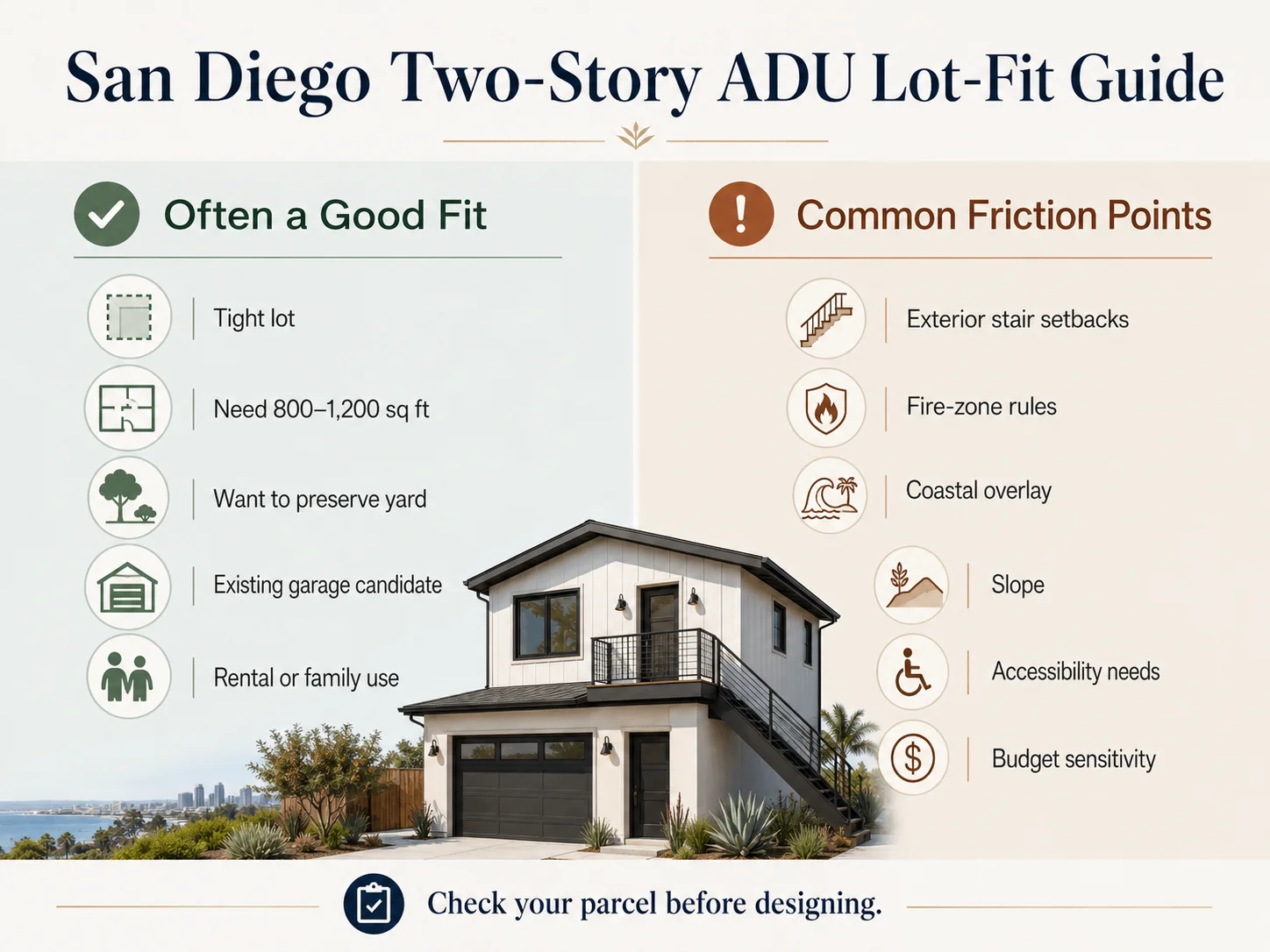
| Tight lot under 6,000 sf, you want 800–1,200 sf of ADU | Two-story detached ADU | Preserves backyard, but pay attention to height, setback, exterior-stair, and fire-zone rules |
| Existing detached garage in good structural condition | ADU over garage (carriage house) | Smallest footprint of the three vertical paths; over-garage height cap is 21 ft flat / 30 ft sloped under SDMC §141.0307(f) |
| Budget is the biggest constraint | Garage conversion, JADU, or attached ADU | Avoid the two-story cost complexity entirely |
| Aging parent or accessibility need | One-story detached or attached ADU | Stairs are a functional dealbreaker for most aging-in-place use cases |
| Multifamily lot or qualifying Bonus Program parcel | Stacked ADUs | Two distinct units on top of each other; only on multifamily lots or qualifying single-family lots under the post–August 2025 Bonus Program rules |
| Lot is in the Coastal Overlay Zone | Pause and verify | The 2025 ordinance package is not yet certified inside the Coastal Zone; prior rules apply |
Free Tool — ~60 Seconds
See What You Can Build at Your Address
Get a parcel-specific report: base zone, height limit, setback rule post–August 2025, fire-zone flag, coastal status, and Bonus Program availability.
Get Your Free Property Eligibility Report \u2192No phone number required. Parcel-specific results.
What this page covers (and what it doesn’t)
We use “San Diego” in this guide to mean the City of San Diego. If your property is in Chula Vista, Encinitas, Oceanside, Poway, La Mesa, El Cajon, Escondido, Vista, Carlsbad, San Marcos, Santee, Lemon Grove, Imperial Beach, National City, Solana Beach, Del Mar, Coronado, Bonsall, Rancho Santa Fe, or the unincorporated County of San Diego, the rules and fees differ. We cover those jurisdictions in our San Diego County builder guides and city-specific pages linked at the end.
A few quick definitions
- ADU (accessory dwelling unit):
- an independent second residence on a property — kitchen, bath, sleeping area, separate entrance. Sometimes called a granny flat, casita, or backyard cottage.
- JADU (junior ADU):
- up to 500 square feet, built inside an existing single-family home, may share a bath with the primary unit.
- DADU (detached ADU):
- an ADU not sharing walls with the primary home. This is what most people mean by "two-story ADU."
- Setback:
- the minimum required distance between a structure and a property line.
- FAR (floor area ratio):
- total floor area divided by lot area; some zones cap it, though ADUs get statutory relief.
- Ministerial approval:
- building department review against objective standards only, not subjective design judgment. ADUs are ministerial in California.
- Plan check:
- the city's review of submitted construction documents before issuing a building permit.
- Utility lateral:
- the underground pipe or conduit connecting your structure to a public utility main.
- Site work:
- everything that happens to the ground before framing — grading, drainage, excavation, foundation prep.
- Base zone / overlay zone:
- your property's primary zoning (e.g., RS-1-7) plus any layered designation (Coastal Overlay, Transit Priority Area, Very High Fire Hazard Severity Zone).
Can you build a two-story ADU in the City of San Diego in 2026?
The legal answer is yes, with conditions. Homeowners frame this question three ways, and each version has a slightly different practical answer:
- “Can I build a two-story ADU at all?” Yes, on the vast majority of single-family and multifamily lots in the City.
- “Can I build the specific two-story design I want?” Maybe. Base-zone height, the 16-foot setback trigger, fire-zone overlays, the Coastal Overlay, exterior-stair placement, and slope all narrow what’s possible.
- “Should I build a two-story ADU?” That depends on lot size, use case, budget, and accessibility needs. We cover the honest tradeoffs further down.
The three-rule hierarchy that controls every San Diego two-story ADU
We find this framework helps homeowners think about the rules in the right order:
Rule 1 — California state law sets the floor.
California Government Code §66314 and §66321 (codified from the SB 897 height provisions) require any city to allow:
- A detached ADU at least 16 feet tall;
- 18 feet on lots within ½ mile of a major transit stop, or on multifamily lots with multistory development;
- An additional 2 feet of height when the ADU’s roof pitch matches the primary home (in qualifying transit cases);
- An attached ADU up to 25 feet tall or the primary home’s zoning height, whichever is lower.
State law also protects an 800-square-foot ADU with 4-foot side and rear setbacks under §66321 — but only when the ADU otherwise complies with allowed objective development standards.
Rule 2 — The City of San Diego adds a ceiling and a cap.
Per IB-400 and O-21989:
- Detached ADUs on single-family lots are capped at two stories;
- The structure must comply with the base zone and overlay zone maximum height (typically 24–30 ft);
- ADUs over a garage have a separate ceiling: 21 feet for flat roofs, 30 feet for sloped roofs under SDMC §141.0307(f);
- Exceeding 16 feet next to a residential parcel triggers a 4-foot side and rear setback;
- Very High Fire Hazard Severity Zone parcels require 4-foot setbacks regardless of height.
Rule 3 — Site-specific code can still reshape the design.
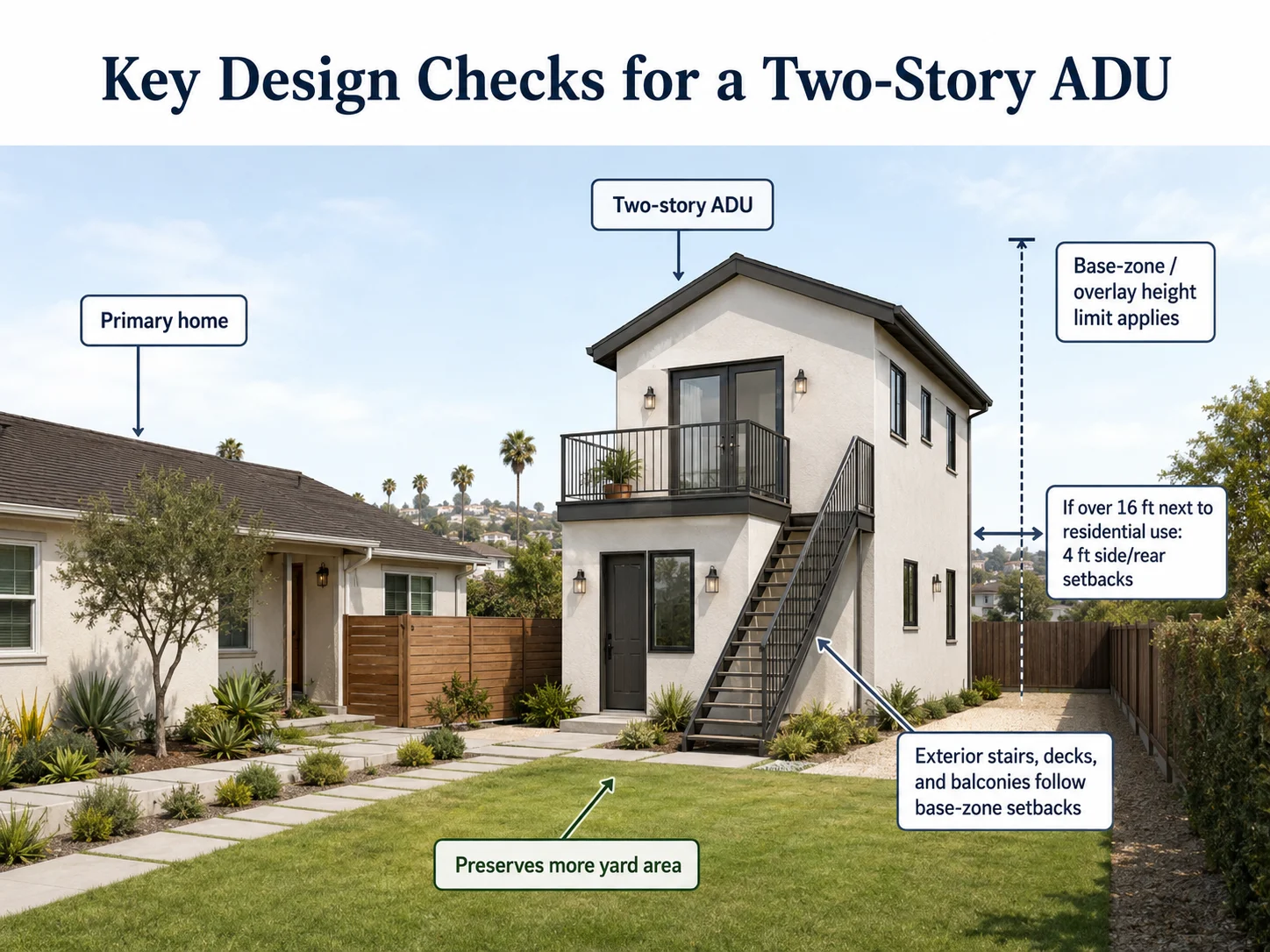
The California Building Standards Code, California Fire Code, the Coastal Overlay Zone (where applicable), Brush Management Zones, slope, and SDG&E interconnection logistics all affect what gets built. IB-400 specifically notes that fire-separation distance, opening-protection rules, allowable height, and allowable area requirements may increase setbacks beyond the ADU 4-foot rule. Exterior staircases, decks, and balconies must conform to base-zone setbacks — not the ADU 4-foot setback — and that one detail reshapes more two-story layouts than any other.
State law sets minimums; local rules add ceilings; building, fire, and coastal codes do the final filtering. When the rules conflict, the more restrictive applicable standard usually controls, except where state law explicitly preempts.
What changed for two-story ADUs in 2025 (and what didn’t)
The 2025 amendments are the single most important regulatory development for anyone researching a San Diego two-story ADU today. Most competing pages still describe the pre–August 2025 rules. Here’s what’s actually in effect now.
Change 1: Two stories is the ceiling, not the option
Before August 22, 2025, ADUs technically followed the underlying zone’s height limit, and a small number of higher-density-zone properties theoretically supported a three-story design. The amendments closed that path on single-family lots. On any lot that permits single-dwelling-unit development but not multiple-dwelling development, detached ADU structures and ADUs attached to existing accessory structures may not exceed two stories (IB-400, post–O-21989).
You can still build up to your zone’s maximum structure height (24–30 ft in most cases) — you simply can’t add a third floor.
Change 2: The Bonus Program was pulled back from eight low-density zones
The Affordable ADU Bonus Program — which previously allowed one bonus market-rate ADU for every affordable ADU built — was eliminated in eight single-family residential zones effective August 22, 2025:
| Excluded zone | Carveout |
|---|---|
| RS-1-1 | Bonus Program remains available if parcel is in a CTCAC High or Highest Opportunity Area and identified as residential in a land use plan |
| RS-1-2 | Bonus Program remains available if parcel is in a CTCAC High or Highest Opportunity Area and identified as residential in a land use plan |
| RS-1-3 | Bonus Program remains available if parcel is in a CTCAC High or Highest Opportunity Area and identified as residential in a land use plan |
| RS-1-4 | Bonus Program remains available if parcel is in a CTCAC High or Highest Opportunity Area and identified as residential in a land use plan |
| RS-1-8 | Bonus Program remains available if parcel is in a CTCAC High or Highest Opportunity Area and identified as residential in a land use plan |
| RS-1-9 | Bonus Program remains available if parcel is in a CTCAC High or Highest Opportunity Area and identified as residential in a land use plan |
| RS-1-10 | Bonus Program remains available if parcel is in a CTCAC High or Highest Opportunity Area and identified as residential in a land use plan |
| RS-1-11 | Bonus Program remains available if parcel is in a CTCAC High or Highest Opportunity Area and identified as residential in a land use plan |
The CTCAC carveout was added at the second council reading after the California Department of Housing and Community Development (HCD) sent a letter on July 11, 2025 warning the original ordinance might conflict with state housing law and could jeopardize the City’s “Prohousing” designation. The eight excluded zones together cover approximately 24% of the land previously eligible for the program.
Change 3: Lot-size caps on total ADUs (Bonus Program)
In zones where the Bonus Program is still available, the maximum number of ADUs and JADUs per single-family lot is now tied to lot size:
| Lot size | Maximum ADUs + JADUs (Bonus Program) |
|---|---|
| Up to 8,000 sf | 4 |
| 8,001 to 10,000 sf | 5 |
| 10,001 sf or larger | 6 |
If you’re not using the Bonus Program, the standard state-law combinations still apply: on a single-family lot you may build one standard ADU, one JADU, and (in some cases) one conversion ADU.
Change 4: New fire, parking, and Community Enhancement Fee triggers
- Fire-zone setbacks: parcels in the Very High Fire Hazard Severity Zone now require 4-foot side and rear setbacks regardless of ADU height. Previously, this only triggered above 16 feet.
- Parking: outside Transit Priority Areas, one off-street parking space is now required per affordable and bonus ADU.
- Community Enhancement Fee: Bonus and affordable ADUs under 750 sf now pay a Community Enhancement Fee, the City’s mechanism to fund neighborhood infrastructure with the missing impact-fee revenue.
- Fire sprinklers: all Bonus ADUs are now required to install fire sprinklers regardless of whether the primary home has them.
What did not change
- The 1,200-square-foot ADU size cap on attached and detached new construction;
- The 4-foot side/rear setback rule for ADUs over 16 feet next to residential uses;
- The ADU above-garage height limits (21 ft flat, 30 ft sloped) under SDMC §141.0307(f);
- The 800-square-foot state-law safe-harbor path (Gov. Code §66321), subject to other applicable development standards;
- The 60-day ministerial approval timeline (Gov. Code §66317);
- No replacement parking required for garage and uncovered parking demolished or converted for an ADU (SB 1211, effective January 2025), outside the Beach Impact Area in the Coastal Overlay Zone.
Grandfathering and the Coastal Overlay Zone
Applications submitted before August 22, 2025 may still qualify under the prior rules per the City’s transition guidance. If your project sits in that window, document the submission date in writing and confirm with the assigned plan-check engineer.
The Coastal Overlay Zone is a separate matter. IB-400 lists Ordinances O-21618, O-21758, O-21836, and O-21989 as not yet certified by the California Coastal Commission. Until they’re certified, the prior rules — including the rules in effect before the 2025 ADU amendments — continue to apply inside the Coastal Zone. If your property sits in the Coastal Overlay, the August 2025 reforms don’t reach you yet, but they likely will once certification lands. See our San Diego Coastal Zone ADU guide for that path.
Free Tool — ~60 Seconds
See What You Can Build at Your Address
Get a parcel-specific report: base zone, height limit, setback rule post–August 2025, fire-zone flag, coastal status, and Bonus Program availability.
Check Your Property \u2192Height and setback rules for a San Diego two-story ADU
This is the section where most two-story designs get pruned. The exterior-stair setback rule alone reshapes more layouts than any other detail.
State-law height floors (the minimum the City must allow)
| Configuration | State-law minimum height |
|---|---|
| Detached ADU, anywhere in San Diego | 16 ft |
| Detached ADU within ½ mile of a major transit stop, or on a multifamily multistory lot | 18 ft |
| Detached ADU, qualifying transit case, roof pitch matching primary home | +2 ft (so up to 20 ft) |
| Attached ADU | 25 ft or the primary home's zoning height, whichever is lower |
Source: Gov. Code §66321 (codified from SB 897 height provisions). A city cannot deny a compliant design that meets these floors, provided the ADU otherwise complies with allowed objective development standards.
City of San Diego height ceilings (what the local rules cap)
| Configuration | City of San Diego cap |
|---|---|
| Detached ADU, two-story | Underlying base-zone max structure height (typically 24–30 ft per SDMC §131.0444) |
| ADU above a garage, flat roof | 21 ft (SDMC §141.0307(f)) |
| ADU above a garage, sloped roof | 30 ft (SDMC §141.0307(f)) |
| Attached ADU | Matches primary home / zone limit |
| Number of stories (detached, single-family lot) | 2 (post–August 2025) |
For most San Diego homeowners on a standard 5,000-square-foot RS-1-7 lot, the practical answer is 24 to 30 feet for the two-story envelope.
The 16-foot setback trigger
If the ADU stays at or under 16 feet, the side and rear setback can be 0 feet in many cases. The moment the structure rises above 16 feet next to a residentially zoned or used parcel, a 4-foot interior side and rear setback kicks in (or the zone’s setback, whichever is less). This is the structural rule that defines most two-story footprints.
Exterior stairs, decks, and balconies (the hidden killer)
This is the rule that catches more two-story plans than any other. Under IB-400, exterior staircases, decks, and balconies must conform to the base-zone setback — not the 4-foot ADU setback. On an RS-1-7 lot with a 5-foot side-yard requirement, an exterior stair attached to a 4-foot ADU envelope violates the base-zone setback.
The workarounds: internal stair, side-yard staircase pulled back to base-zone setbacks, or a Juliet balcony rather than a usable deck. Some designs absorb the stair into a covered porch element that reads as part of the main building — building department interpretation varies, so confirm in a pre-application meeting.
Fire separation from the primary home
Per IB-400, ADUs must comply with California Building Standards Code requirements for fire separation distance, opening protection, allowable height, and allowable area. Those requirements may increase setbacks beyond the 4-foot ADU rule. In practice:
- A detached ADU built close to the primary home often triggers fire-rated wall assemblies;
- An ADU close to a property line may require fire-rated construction on the boundary side;
- Eave overhang clearance from neighboring structures can force redesign;
- A Very High Fire Hazard Severity Zone parcel requires 4-foot side and rear setbacks regardless of ADU height;
- Brush Management Zone clearance requirements may apply on canyon-edge or wildland-interface lots.
How San Diego measures height
San Diego’s height measurement rules are stricter than the casual “average grade to roof peak” framing you see in builder marketing. Per the City’s Land Development Code, maximum permitted structure height is measured from existing grade or proposed grade, whichever is lower, and overall structure height is measured from the lowest point within 5 feet of the structure or property line to the highest point of the structure (City of San Diego measurement guidance).
This matters on sloping lots. A canyon-edge property where the natural grade drops 4 feet across the building footprint can see the height measurement reference point pulled to the lowest of three reference grades, depending on the specific situation. Always confirm the height measurement reference with a survey before locking in floor heights.
Is a two-story ADU cheaper than a one-story ADU in San Diego?
Published two-story benchmarks (verified)
| Example | SnapADU published benchmark, January 2026 | Best use as a planning number |
|---|---|---|
| 999 sf two-story ADU, mid-finish | ~$415,000 all-in | 2BR/2BA tight-lot family unit |
| 1,200 sf two-story ADU, mid-finish | ~$445,000 all-in | Max-size rental or multi-gen unit |
Source: SnapADU two-story guide, retrieved May 2026. One builder’s published benchmark estimates for builder-built, mid-finish two-story ADUs on average San Diego lots. These are illustrative benchmarks, not guarantees of pricing. Get at least three written bids.
Affiliate disclosure: The Dwelling Index is reader-supported. Some links on this page are affiliate links. If you click one and take a qualifying action, we may earn a commission at no extra cost to you. Affiliate relationships do not influence our editorial rankings or conclusions. Read our full disclosure.
Where the two-story design saves money
- Foundation footprint. A 1,200 sf two-story ADU sits on a ~600 sf footprint. The foundation is heavier per square foot but covers half the ground, so the total foundation cost is often lower than a 1,200 sf single-story.
- Roof area. Same logic. Half the area, slightly more expensive per square foot due to taller framing, net lower total roof cost.
- Lot coverage. On lots where lot coverage, floor area ratio, or impervious surface trigger fees or design constraints, the smaller two-story footprint can be the difference between a permittable design and a redesign.
Where the two-story design costs more
| Cost driver | Why it costs more on a two-story |
|---|---|
| Structural framing | The second floor adds vertical load to first-floor walls and footings; requires engineered LVLs, shear walls, and lateral analysis |
| Foundation and soils | A geotechnical (soils) report is more commonly required on two-story builds; budget $2,500–$8,000 if your lot triggers it |
| Stair core | A standard stair eats 80–120 sf on the first floor and the second — about 160–240 sf of "lost" livable area, plus framing, finishes, code-required headroom, and railings |
| Code egress | Bedrooms above grade require code-sized egress windows; the second-story exit path triggers additional inspection items |
| MEP runs and moisture | Plumbing risers run longer, HVAC needs dual-zone or larger single-zone capacity, second-floor bathrooms require waterproofing layers under the floor |
When a one-story ADU is the right financial answer
- Lot is over 8,000 sf with usable rear yard. You don’t need vertical to preserve the yard, so the structural complexity of two-story is uncompensated by footprint savings.
- Aging-in-place use case. Stairs are a hard no for most aging-in-place users; the elevator workaround costs $35,000–$70,000 installed and consumes meaningful floor area.
- Buyer pool at resale. A one-story ADU appeals to a broader buyer pool, including buyers who screen out vertical ADUs for privacy or view reasons.
A Dwelling Index–modeled scenario: 1,200 sf two-story, custom finish, mid-cost lot
The table below is a Dwelling Index–modeled scenario for a 1,200 sf two-story ADU in the City of San Diego at mid-finish with a soils report, average sitework, and typical 2026 fees — useful as a planning upper bound, not as a quote.
| Line item | Modeled cost | Source / assumption |
|---|---|---|
| Design and engineering | $14,000 | Custom plan, structural calcs included |
| Geotechnical (soils) report | $4,500 | Assumed required for two-story; typical SD range |
| Plan check + inspection fees, City of San Diego DSD | $22,000 | Modeled at midpoint of City DSD fee schedule |
| SDG&E interconnect | $9,000 | Typical residential ADU interconnect estimate |
| School fees (San Diego Unified, 1,200 sf × $5.38/sf) | $6,456 | SDUSD residential rate effective May 11, 2026 |
| Site work, grading, foundation | $58,000 | Average sitework, flat lot |
| Framing (incl. two-story structural premium) | $76,000 | Engineered framing, shear walls, lateral system |
| Mechanical, plumbing, electrical | $54,000 | Dual-zone HVAC, second-floor plumbing |
| Insulation, drywall, mid-finish | $135,000 | Mid-range cabinets, flooring, fixtures |
| Kitchen + 1.5 baths | $52,000 | Mid-finish appliances, countertops, tile |
| Stair, railings, code-required egress | $14,000 | Internal stair, egress windows |
| Exterior, roofing, weatherproofing | $38,000 | Standard exterior with sloped roof |
| Contingency (8%) | $33,000 | Industry-standard 8% contingency |
| Total all-in, custom mid-finish scenario | ~$515,956 | Dwelling Index model, May 2026 |
This modeled scenario lands above SnapADU’s pre-priced benchmark of $445,000 for a 1,200 sf two-story because it assumes (a) custom plans rather than pre-priced, (b) a soils report is required, (c) higher City permit fees, and (d) mid-finish rather than builder-spec. Get at least three written bids before committing.
Want to see how homeowners pay for a $400K+ ADU build?
Compare cash-out refinance, HELOC, renovation loans, construction-to-permanent loans, and the San Diego Housing Commission’s up-to-$250K ADU Finance Program in our financing path guide.
See ADU Financing Options →Path education, not a ranked lender list. We don’t publish rate guarantees or approval promises.
Can you build an ADU over a garage or stack two ADUs in San Diego?
“Two-story ADU” is shorthand for three different products. Each has a different cost, permit path, and use case.
Configuration 1: Carriage house (ADU over a garage)
This is the smallest-footprint vertical ADU path. The ADU sits above either an existing detached garage or a new detached garage built specifically to support it.
Key parameters in the City of San Diego:
- Height cap: 21 ft for flat roofs, 30 ft for sloped roofs (SDMC §141.0307(f));
- Above-garage size is part of the 1,200 sf ADU cap;
- External stair must meet base-zone setback (5 ft on a typical RS-1-7 lot);
- The garage itself counts as a separate accessory structure for footprint and FAR purposes.
Two paths within this path:
- Build above existing garage. Cheapest if the existing slab and foundation can take the load. Most existing residential garage slabs and stem walls weren’t designed for residential loading above; reinforcement work commonly runs $20,000–$45,000 based on local builder pricing surveys, and many engineers recommend a teardown-and-rebuild instead.
- Demo and rebuild garage + ADU. Cleaner permit path; you specify the whole structure from foundation up. Total usually lands within $10,000–$25,000 of building a new detached two-story ADU of the same livable area.
When this path is wrong:
- Existing slab is cracked, settling, or under-sized;
- Side-yard access is too narrow to deliver materials to the second floor;
- The neighbor’s window or yard sits directly under the proposed second-floor balcony;
- Fire separation triggers fire-rated construction across the whole envelope.
Configuration 2: Classic two-story detached ADU
The most common path: a single ADU on its own foundation, with living spaces split over two floors connected by an interior stair.
Key parameters in the City of San Diego:
- Height: up to the underlying base-zone limit (24–30 ft);
- Size: up to 1,200 sf total;
- Setback: 4 ft over 16 ft tall;
- Two-story is the maximum since August 22, 2025.
Typical layout: 600 sf footprint, 600 sf upper floor, internal stair core consuming 80–120 sf on each level. Living, kitchen, half-bath downstairs; bedrooms and full bath upstairs.
When this path is wrong:
- Aging-in-place use case (stairs);
- Lot already has 4,000+ sf of usable yard with no neighbor exposure problem;
- Steep slope where the foundation work cancels the footprint savings.
Configuration 3: Stacked ADU (two distinct units)
Two separate ADUs on top of each other, each with its own entrance, kitchen, and address. This is the most efficient unit-count-per-square-foot configuration but is generally restricted.
Where stacked ADUs are allowed:
- Multifamily-zoned lots (RM zones) with an existing duplex or larger residential structure;
- Single-family lots using the Bonus Program — subject to the August 2025 caps (4/5/6 ADUs by lot size) and the carveout in the eight excluded RS zones;
- Lots with multiple existing units where SB 1211 multifamily ADU allowances apply.
Where stacked ADUs are not allowed:
- Standard single-family lots in RS zones, outside the Bonus Program.
How do you check if your San Diego lot is a good fit for a two-story ADU?
The 10-point San Diego two-story ADU lot-fit check
- Confirm your jurisdiction. The City of San Diego boundary is jagged. Use the City’s DSD ADU and JADU Map to confirm; if your address isn’t in the City layer, see the San Diego County builder guides instead.
- Look up your base zone. RS-1-1 through RS-1-14, RM zones, and overlay zones each have different maximum structure heights (typically 24–30 ft) and setbacks. The City zoning map is the source of truth.
- Check overlay zones. Coastal Overlay Zone, Parking Impact Overlay, Transit Priority Area, Sustainable Development Area, Airport Influence Area, Open Space-Residential Zone, and the post–August 2025 affordable-housing overlays all affect what’s possible.
- Check Fire Hazard Severity Zone status. Very High Fire Hazard Severity Zone parcels require 4-foot side and rear setbacks regardless of ADU height (post–August 2025). Lots with single-point ingress/egress in fire zones are also now ineligible for the Bonus Program.
- Check whether your design exceeds 16 feet. A one-story or low-profile two-story under 16 ft can sit at the 0-foot side and rear setback. Above 16 ft, the 4-foot setback rule activates. This affects the buildable rectangle.
- Calculate the buildable rectangle with 4-foot setbacks. Lot width minus 4 ft on each side; lot depth minus front setback minus 4-foot rear. Subtract the primary house footprint. What’s left is the rectangle the two-story ADU has to fit inside — including the exterior stair.
- Plan exterior stair location early. Remember: exterior stairs, decks, and balconies follow the base-zone setback (often 5+ ft), not the ADU 4-foot setback. An exterior stair that violates the base-zone setback kills the design.
- Identify Brush Management or Coastal Brush Zone implications. Required defensible-space clearances, irrigation, and plant lists can constrain footprint placement on hillside lots.
- Check utility access. Where’s the water lateral coming from? The sewer? SDG&E electrical service? Is your panel large enough to support a second residence, or are you looking at a $9,000–$18,000 service upgrade based on typical SDG&E interconnect costs?
- Run the budget tolerance check. Two-story ADU all-in costs run roughly $340,000–$580,000+ depending on size, finish, and site complexity. If your maximum is $250,000–$300,000, the realistic path is a conversion, JADU, or attached ADU, not a two-story new build.
Free Tool — ~60 Seconds
See What You Can Build at Your Address
Get a parcel-specific report: base zone, height limit, setback rule post–August 2025, fire-zone flag, coastal status, and Bonus Program availability.
Run This 10-Point Check Automatically \u2192Tools the City of San Diego publishes (use these directly)
- City of San Diego Information Bulletin 400 — the authoritative ADU and JADU bulletin.
- DSD Permit Processing Timeline — published weekly with current review-time estimates.
- DSD ADU and JADU Map — shows where ADUs have been permitted in the City.
- City zoning map — base zone and overlay zone lookups by APN.
- CAL FIRE Fire Hazard Severity Zone viewer — confirms VHFHSZ status.
- California Coastal Commission boundary viewer — confirms Coastal Overlay status.
What permits and timeline should you expect for a two-story ADU?
The “60-day ADU rule” is one of the most misunderstood numbers in California ADU work. It is not the time from “I have an idea” to “I have a permit.” It is the time the City has to act after a complete application is filed.
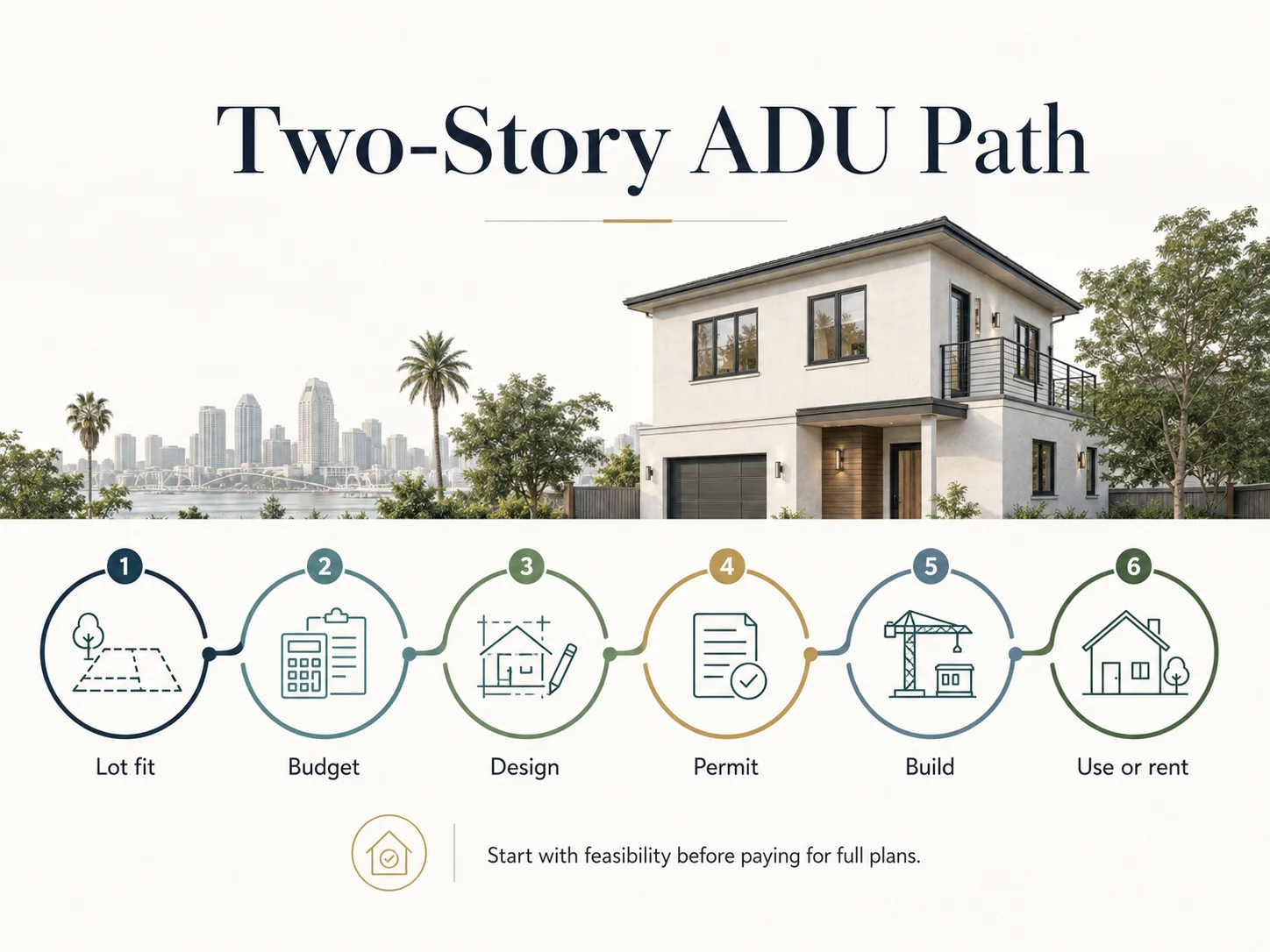
The eight-step permit process for a San Diego two-story ADU
| Step | Typical duration | What happens |
|---|---|---|
| 1. Feasibility check | 1–3 days | Confirm zone, overlays, fire-zone, coastal-zone, slope, base-zone setbacks |
| 2. Schematic design + structural pre-review | 2–6 weeks | Schematic floor plan, structural concept, height/setback verification |
| 3. Geotechnical (soils) report | 2–4 weeks | Field investigation + report; commonly required for two-story |
| 4. Construction documents | 4–8 weeks | Final architectural, structural, MEP plans |
| 5. Plan submittal + intake completeness check | 15 business days | City confirms application is complete (Gov. Code §66317) |
| 6. Plan check (City DSD) | 30–60 days first review | Building, fire, planning, public utilities review |
| 7. Corrections / resubmittal cycle | 2–6 weeks per cycle, usually 1–2 cycles | Address comments, resubmit |
| 8. Permit issuance | 1–2 weeks | Fees paid, permit issued, SDG&E and water/sewer interconnects scheduled |
Total pre-construction: typically 4–7 months from “first call to designer” to “permit in hand” for a two-story build. Construction adds another 5–9 months depending on size and finish.
Why two-story permits get slower than one-story permits
- Soils report not commissioned early. Plan check freezes waiting for the geotechnical report.
- Structural calc package incomplete. Two-story builds require lateral analysis (shear walls, hold-downs, diaphragm continuity) that one-story builds often don’t. Missing calcs trigger a corrections cycle.
- Coastal Overlay Zone trigger discovered late. The 2025 amendments aren’t yet certified in the Coastal Zone, so the prior rules apply — but only if your team knows the project sits in the Coastal Overlay in the first place.
- Fire-zone flag missed in design. VHFHSZ parcels require 4-ft setbacks and may require sprinklers and fire-rated assemblies; finding this out in plan check means redesign.
- SDG&E interconnect underestimated. The interconnect process runs in parallel with permit but has its own queue; budget 6–12 weeks even after permit issuance.
How to speed up a two-story ADU permit
- Use pre-approved plans where they exist for your design. See the San Diego pre-approved ADU plans guide for the current catalog and which plans include a two-story option.
- Express Plan Check. The City says eligible projects typically receive review times 40–50% faster than standard reviews and pay additional fees for the expedited service.
- Submit complete the first time. The completeness determination clock starts at 15 business days. A complete first submittal is the single biggest predictor of finishing inside 60 days.
The honest downsides of a San Diego two-story ADU
Damaging admission: the upgrade isn’t always an upgrade
Most builder pages selling two-story ADUs lead with the upside — preserved yard, more bedrooms upstairs, rental income, multi-gen flexibility. All real. What they tend to leave out is that many homeowners who start with “I want to go two-story” end up choosing a single-story or conversion design after the feasibility check. The cost gap is real (in either direction), the construction is more complex, and the second floor introduces friction that doesn’t exist on one-story builds.
Real downsides that come up repeatedly
- Accessibility.
- Stairs are a functional barrier. If the ADU is for aging parents, an adult child with mobility considerations, or your own aging-in-place plan, the two-story design fails the use case before the permit even gets submitted. Elevators are theoretically possible but typically cost $35,000–$70,000 installed and consume floor area.
- Privacy and neighbor exposure.
- Second-floor windows that look directly into a neighbor’s primary outdoor space create genuine friction even when not legally enforceable. Plan window placement early and consider obscured glass or Juliet balconies for the bedroom-facing sides.
- Exterior-stair compromises.
- If the layout requires an exterior stair and the base-zone setback pushes the stair into a tight side yard, the result is often a stair you wouldn’t want to carry groceries up. The compromise — internal stair, larger building envelope, smaller usable square footage — shifts your design.
- Construction disruption.
- Scaffolding, crane access, materials staging, and second-floor framing create noise, traffic, and visual mass that one-story builds don’t. Neighbors who tolerate a one-story build sometimes appear at corrections review for a two-story.
- HVAC complexity.
- A single-zone HVAC system on a two-story ADU is usually inefficient. Two zones cost more upfront and more to maintain.
- Resale buyer pool.
- Two-story ADUs narrow your buyer profile at sale slightly. Some buyers actively screen out lots with tall accessory structures because of privacy or view concerns.
- Fire-zone arithmetic post–August 2025.
- Properties in the Very High Fire Hazard Severity Zone now require 4-foot setbacks at any height, removing one of the original arguments for two-story (a compact tall footprint with zero side-yard setback under 16 ft). On those parcels, the structural complexity remains but the footprint advantage shrinks.
When a two-story ADU does pay off
The two-story design earns its complexity premium in four scenarios:
- Lot is 6,000 sf or smaller and you need 800+ sf of ADU livable area;
- Multi-gen housing where bedrooms-upstairs separation is the point;
- Investor stacking on a multifamily lot or under the qualifying post–August 2025 Bonus Program;
- Carriage house over an existing, structurally adequate garage — the biggest savings of any vertical path.
What if a two-story ADU doesn’t fit your lot?
Fallback 1: One-story detached ADU
The most common pivot. Same general size class (150–1,200 sf), simpler structure, no soils report often, no stair, no upstairs MEP runs. San Diego County builder cost surveys put 1,000–1,200 sf one-story detached ADUs in the $300,000–$520,000 all-in range at mid-finish in 2026. Best for aging-in-place, single-tenant rental, or backyard-cottage use cases where yard preservation isn’t critical.
Fallback 2: Garage conversion ADU
If you have an attached or detached garage, conversion is the lowest-cost path to an ADU. The City does not require you to replace the parking lost to a garage conversion (SB 1211, effective January 2025), outside the Beach Impact Area in the Coastal Overlay Zone. Typical published cost ranges from local builders run $100,000–$210,000 for a finished conversion, depending on structural condition and code upgrades required.
Fallback 3: Attached ADU (addition to primary home)
An attached ADU shares at least one wall with the primary residence. You can often tap into existing water, sewer, and electrical service, cutting utility hookup costs. Published San Diego cost ranges run $200,000–$350,000 for a 500–800 sf addition at mid-finish.
Fallback 4: JADU (Junior Accessory Dwelling Unit)
A JADU is up to 500 sf, built inside the existing single-family home. It can share a bathroom with the primary unit. Owner-occupancy is required. JADUs may be combined with a separate ADU, giving you two income-producing units on one lot. Published San Diego cost ranges run $40,000–$110,000.
Fallback 5: The 800-square-foot state-protected path
California Government Code §66321 protects an 800 sf ADU with 4-foot side and rear setbacks — provided the ADU otherwise complies with allowed objective development standards. The city cannot block an 800 sf ADU that meets the 4-foot setback standard and other applicable rules, even if a larger or differently configured unit would have failed. For many San Diego lots that fail a 1,200 sf two-story check, an 800 sf one-story safe-harbor path remains viable.
Who should you talk to next?
The 12-question builder vetting checklist
- How many two-story ADUs have you permitted and built in the City of San Diego?
- Do you have in-house structural engineering, or do you outsource? Who?
- Who’s your soils-report supplier and what’s their typical turnaround?
- What’s your typical cost comparison for two-story versus one-story of the same size?
- Show me three two-story projects you’ve permitted in the last 24 months.
- Have you submitted projects after August 22, 2025? What did the new rules change for your typical design?
- How do you handle the Coastal Overlay Zone if applicable?
- Do you carry CSLB Class B license? Show me your current bond and insurance certificate.
- What’s your warranty period and what’s specifically covered?
- What’s your change-order policy and rate?
- Have you been cited by HCD or referenced in any HCD complaint?
- Can I talk to a homeowner whose project you finished in the past 18 months?
SnapADU: when it’s the right fit, and when it isn’t
Fit factors:
- Service area: Greater San Diego per the SnapADU service area page, including San Diego, Carlsbad, Chula Vista, Coronado, County of San Diego, Del Mar, El Cajon, Encinitas, Escondido, Imperial Beach, La Mesa, Lemon Grove, National City, Oceanside, Poway, San Marcos, Santee, Solana Beach, and Vista. Confirm your specific address before the consultation.
- Two-story experience: SnapADU has designed, permitted, and built more than 100 ADUs in San Diego since 2020, including two-story configurations.
- Pricing transparency: SnapADU publishes a price sheet for their floor-plan catalog.
- Process: design-permit-build under one contract.
When SnapADU is not the right fit:
- Projects outside SnapADU’s published service area;
- Sub-$250,000 all-in budgets (their pricing class doesn’t fit);
- Owner-builder paths where the homeowner wants to coordinate trades directly;
- HUD-manufactured ADUs or fully modular factory-built products — see SnapADU alternatives for prefab and modular options;
- Pure financing-comparison searches (use our financing options guide instead).
Ready for a Quote?
If your project is in Greater San Diego and you want one team for design, permits, and construction:
Talk to SnapADU About Your Two-Story Build →Free design consultation. Affiliate link — we may earn a commission at no extra cost to you.
Greater San Diego has dozens of qualified ADU builders. Our Best ADU Builders San Diego County guide compares the field independently.
Financing a $400K+ two-story ADU
We don’t publish lender rate guarantees or approval promises on this page. We present financing as path education, not a ranked lender comparison.
| Path | Best for | Key trade-off |
|---|---|---|
| Cash-out refinance | Significant equity, willing to reset primary mortgage rate | Resets your rate; may extend the loan term |
| HELOC | Strong equity, want to keep your primary mortgage rate | Variable rate; lender ADU appraisal varies |
| Construction-to-permanent loan | Limited current equity; willing to budget around construction draws | Stricter underwriting; appraised as-completed |
| Renovation loan (FHA 203(k), RenoFi where available) | Want a single loan covering the full ADU build | RenoFi is not currently available in Texas; FHA 203(k) has loan limits |
| SDHC ADU Finance Program | City of San Diego moderate-income homeowner; willing to deed-restrict for 7 years | Up to $250,000; 680 minimum credit score; rent capped at 80% AMI for 7 years |
Editorial framing: this is path education, not an approval guarantee. Loan terms, eligibility, and availability depend on your credit profile, equity, lender underwriting, and market conditions at the time you apply.
Our ADU Financing Options guide walks through each path in detail, including documentation requirements, typical timelines, and what lenders look for.
Compare cash-out refinance, HELOC, renovation loans, construction-to-permanent loans, and the San Diego Housing Commission’s up-to-$250K ADU Finance Program in our financing path guide.
See ADU Financing Options →Path education, not a ranked lender list. We don’t publish rate guarantees or approval promises.
San Diego two-story ADU FAQ
- 1. Can an ADU be two stories in San Diego?
- Yes. In the City of San Diego, detached ADUs may be up to two stories on single-family lots. Since August 22, 2025 (Ordinance O-21989), two stories is also the maximum — three-story ADU designs are no longer permitted on ordinary single-dwelling lots.
- 2. How tall can a San Diego two-story ADU be?
- Up to the underlying base-zone maximum structure height, typically 24 to 30 feet under SDMC §131.0444. ADUs above a garage have a separate cap: 21 feet for flat roofs and 30 feet for sloped roofs under SDMC §141.0307(f). State law guarantees minimum heights of 16 feet (detached), 18 feet (within ½ mile of major transit), and 20 feet (matching primary roof in qualifying transit cases).
- 3. Can I build a three-story ADU in San Diego?
- Not on a single-family lot since August 22, 2025. Three-story ADUs are no longer permitted in the RS zones. On multifamily-zoned lots with multistory primary buildings, taller configurations may still be possible — verify with Development Services before designing.
- 4. Can I build a two-story ADU at 4-foot side and rear setbacks?
- Yes, in most cases. The 16-foot trigger applies: at or below 16 feet, the setback can be 0 feet next to residential uses; above 16 feet (including two-story), 4-foot setbacks apply. Very High Fire Hazard Severity Zone parcels require 4-foot setbacks regardless of height since August 22, 2025. Fire-separation and opening-protection requirements under the California Building Code may increase setbacks beyond 4 feet in specific situations.
- 5. Can I build an ADU over my garage in San Diego?
- Yes. ADUs over a garage — sometimes called carriage houses — are allowed throughout most of the City. Height cap: 21 feet for flat roofs, 30 feet for sloped roofs (SDMC §141.0307(f)). Confirm the existing garage's structural capacity before assuming a build-on-top is cheaper than a teardown and rebuild.
- 6. Is a two-story ADU cheaper than a one-story ADU?
- Closer to a wash than most homeowners expect. SnapADU's January 2026 comparison shows roughly $10,000–$15,000 in pure construction savings for a two-story versus a one-story of the same size, because the smaller footprint cuts foundation and roof area. But the structural framing, the stair core, code egress, longer mechanical-plumbing runs, and (often) a required soils report frequently bring the total close to even. The deciding factor is usually lot fit and use case, not pure cost.
- 7. How much does a two-story ADU cost in San Diego?
- Typical 2026 all-in pricing runs $340,000–$580,000+ for a builder-built, mid-finish design. SnapADU's published January 2026 benchmarks land at roughly $415,000 for 999 sf and $445,000 for 1,200 sf. Range varies with size, finish level, site conditions, slope, fire-zone status, school district fees, and contractor margin. Get at least three written bids.
- 8. Do I need parking for a two-story ADU in San Diego?
- Not for standard ADUs outside the Coastal Overlay Zone (state law preempts parking requirements for most ADUs in California). The Beach Impact Area of the Parking Impact Overlay Zone is an exception. Bonus Program ADUs outside Transit Priority Areas now require one off-street parking space each (post–August 2025).
- 9. Can I rent a two-story ADU short-term (under 30 days)?
- No. The City of San Diego prohibits ADUs from being rented for terms shorter than 31 consecutive days. Short-term residential occupancy (STRO) on ADUs is not allowed.
- 10. How long does a two-story ADU permit take?
- State law requires the City to complete an intake completeness determination within 15 business days and approve or deny a complete application within 60 days (Gov. Code §66317). In practice, two-story permits typically take 2–4 months for pre-approved plans and up to 6 months for custom designs, because of structural review and soils-report requirements. The City publishes a weekly permit timeline.
- 11. Are exterior stairs allowed on a two-story ADU?
- Yes, but they must conform to the base-zone setback, not the 4-foot ADU setback. On a typical RS-1-7 lot with a 5-foot side-yard requirement, an exterior stair attached to a 4-foot ADU envelope violates the base-zone setback. The workaround is an internal stair or a stair pulled back to the base-zone setback.
- 12. What if my property is in the Coastal Overlay Zone?
- Different rules apply. The 2025 ADU/JADU amendments (Ordinance O-21989) and several prior ordinances (O-21618, O-21758, O-21836) are not yet certified by the California Coastal Commission. Until those certifications land, the prior rules continue to apply inside the Coastal Overlay Zone. See our San Diego Coastal Zone ADU guide for details.
- 13. What if my lot is in a Very High Fire Hazard Severity Zone?
- Three things change: 4-foot side and rear setbacks are required regardless of ADU height (post–August 2025); the Bonus Program is unavailable if the lot is on a cul-de-sac or road with a single point of ingress/egress; and fire-rated assemblies and sprinklers are more likely to be required. The Fire Code Official may require additional setbacks for California Fire Code compliance.
- 14. Is a two-story ADU a good design for aging parents?
- Usually not. Stairs are a functional barrier for most aging-in-place scenarios. If the use case is housing aging parents, a one-story detached ADU, attached ADU, or JADU almost always serves better. Elevators are technically possible but typically cost $35,000–$70,000 installed and consume meaningful floor area.
- 15. Should I use prefab or site-built for a two-story ADU in San Diego?
- Most two-story ADUs in San Diego are still site-built because two-story prefab requires craning a fully-assembled second unit into place — feasible on flat, accessible lots and prohibitively expensive on tight or hillside lots. Single-story prefab is more common. If you're considering modular or manufactured options, see our SnapADU alternatives guide for verified prefab partners.
Free Download
Get the Free ADU Starter Kit
A 47-page guide covering zoning rules, financing path comparisons, a 14-point builder vetting script, floor-plan templates, and a budget checklist that catches the hidden fees most quotes leave out. Free, no payment information, unsubscribe anytime.
Download Free Starter Kit →What we verified (and what we didn’t)
We built this page from primary sources. Here is the evidence base.
Verified sources (May 12, 2026):
- City of San Diego Information Bulletin 400 — current revision. All height, setback, parking, and configuration rules cross-checked against the bulletin.
- Ordinance O-21989 — adopted July 22, 2025; effective outside the Coastal Zone August 22, 2025. Bonus Program rollback, two-story cap, fire-zone setback changes, parking and Community Enhancement Fee triggers.
- San Diego Municipal Code §141.0302 (Accessory Dwelling Units and Junior Accessory Dwelling Units).
- San Diego Municipal Code §141.0307(f) (Guest Quarters or Habitable Accessory Buildings — height of ADUs above garages).
- San Diego Municipal Code §131.0444 (Angled Building Envelope Plane / Maximum Structure Height in Residential Zones).
- City of San Diego measurement guidance — structure height measurement rules.
- California Government Code §66314, §66317, §66321 — read from the California Legislative Information portal.
- HCD ADU Handbook (2026 edition) — state floor heights, setbacks, ministerial timing.
- HCD letter to City of San Diego, July 11, 2025 — regarding possible state-law conflict with the proposed rollback.
- City of San Diego DSD permit timeline page — data current May 8, 2026 at last check.
- City of San Diego Express Plan Check page — review-time acceleration claim.
- San Diego Unified School District developer fees page — $5.38/sf residential rate effective May 11, 2026.
- SnapADU two-story guide — January 2026 published two-story benchmarks: $415,000 for 999 sf, $445,000 for 1,200 sf; construction cost comparison vs. one-story.
- SDHC ADU Finance Program — up to $250,000, moderate-income, 7-year affordability/rent restriction, 680 credit minimum.
What we did not verify, and you must verify before filing plans:
- Your specific parcel’s zone, overlay flags (Coastal, VHFHSZ, TPA, SDA), CTCAC Opportunity Area classification, school district, water/sewer district, slope, or utility access.
- Current builder pricing for your project — get three written bids.
- Any city ordinance change adopted after May 12, 2026.
- Lender-specific financing terms, rates, or approval likelihood.
These are illustrative planning examples, not guarantees of approval, cost, timeline, financing eligibility, or investment return.
How we built this guide
We approached the San Diego two-story ADU question the way we approach every regulation page: city primary sources first, state-law primary sources second, builder benchmarks third.
For the regulatory content, we read Information Bulletin 400 in its current revision, traced the relevant San Diego Municipal Code sections (§141.0302, §141.0307, §131.0444), and confirmed the post–August 2025 amendments against Ordinance O-21989 and the City’s adopted single-issue code updates page. We cross-referenced the state-law floor against California Government Code §66314, §66317, and §66321 as published on leginfo.legislature.ca.gov, and against the 2026 HCD ADU Handbook.
For cost benchmarks, we used SnapADU’s published January 2026 two-story pricing as the primary local data point ($415,000 for 999 sf, $445,000 for 1,200 sf), and cross-referenced builder pricing pages from Better Place Design & Build, GatherADU, Realm, and Price Builders. The modeled $515,956 scenario reflects a custom-design 1,200 sf two-story with a soils report, mid-finish, and average sitework — useful as a planning upper bound, not a quote.
Rules and pricing change. Verify with the City of San Diego Development Services Department before relying on any specific figure for permit submittal or construction contracting.
Recommended reading on The Dwelling Index
- San Diego Detached ADU Cost 2026: Real Prices + Fee Math →
- San Diego Pre-Approved ADU Plans (2026): 26 Options →
- Best ADU Builders San Diego County: 2026 Costs & Picks →
- San Diego Coastal Zone ADU 2026: CDP Rules & Permits →
- California ADU Laws 2026: Rules, Setbacks, Fees & Permits →
- ADU Financing Options →
- ADU Cost Per Square Foot in 2026 →
- San Diego ADU Permit Process 2026: Fees & Timeline →
- San Diego ADU Permit Timeline 2026: 30/60-Day Rules →
Not Sure Where to Start?
See what’s possible at your address — free ADU report in 60 seconds.
Enter your San Diego address and we return zone, overlays, fire-zone status, Coastal flag, the setback rule that applies after August 2025, and whether the Bonus Program is still available on your specific lot.
→ Get Your Free Property Eligibility Report