Prefab ADU Foundation Requirements: What You Need Before Delivery
By the Dwelling Index Editorial Team · Last updated: · Last verified: · Reviewed against the IRC, IBC, HUD 24 CFR Parts 3280 and 3285, and Fannie Mae factory-built housing guidance · Editorial standards · Affiliate disclosure · ~32 min read
The Dwelling Index is an independent research resource covering ADU financing, costs, and regulations. We are not a lender, broker, appraiser, builder, or zoning authority, and nothing here is financial, legal, tax, or lending advice.
A note on independence: The Dwelling Index is reader-supported and we may earn a commission when you use some of our links (see the disclosure before the financing section). We are not a lender, broker, or builder, and our recommendations are never influenced by compensation.
The prefab ADU foundation matrix: code path, site risk, and cost signal
This is the table to screenshot. It maps each prefab path to the foundation rule you must verify, the biggest risk, a budget signal, and your best next move. Everything below it is the detail.
| Prefab path | Foundation rule to verify | Biggest risk | Budget signal (planning, not a quote) | Best next step |
|---|---|---|---|---|
| Modular ADU (factory-built to building code, set on site) | Permanent foundation meeting local code plus the manufacturer’s set requirements. Fannie Mae treats modular units like site-built housing when permanently attached to a code-compliant foundation. | Assuming “modular” means city approval is automatic. It isn’t. | Slab ~$7K–$15K on a good lot; crawlspace or stem wall higher; site conditions dominate. | Confirm local permit documents; ask whether foundation engineering, soils, utility penetrations, and set tolerances are included. |
| HUD-code manufactured ADU (built on a permanent chassis to the federal HUD Code) | Installation under 24 CFR Part 3285 — foundation, support, anchoring, drainage, and snow/wind/flood detailing based on the unit’s data-plate loads and site conditions. For financing, a permanent foundation plus real-property classification and program-specific documentation. | Treating it like a modular home, or assuming a lender will finance it without the permanent-foundation work and certification. | The permanent-foundation and tie-down work; the path affects financing, taxes, appraisal, and resale. | Verify the HUD Data Plate and Certification Label, the manufacturer’s installation instructions, local acceptance, and title conversion. |
| Panelized / kit ADU (walls and components shipped, assembled on site) | A site-built permanent foundation under local residential code. | Thinking the kit price includes the foundation, engineering, utilities, and inspections. It rarely does. | Foundation is a separate line from the kit; permit, grading, and utility lines are separate again. | Run the quote checklist below before buying plans or a kit. |
| Container / steel-frame ADU | An engineered foundation (often piers or slab); a structural engineer must size it for the unit’s loads and your soil. | “No-permit” container marketing that ignores full plan review. | Comparable to slab or pier costs plus engineering. | Confirm the unit can be permitted as a dwelling at your address. |
| Tiny home / park model / RV-style / on wheels | Often not a legal ADU unless your city accepts the unit’s certification and it sits on a permanent foundation, without wheels, with required utilities. | Mistaking an RV-style or tiny-home-on-wheels (THOW) product for a legal dwelling. | A cheap unit can fail before cost even matters if the code path is wrong. | Ask the building department: “Can this exact certification be used as an ADU at this address?” |
| Any unit on a sloped, flood-zone, frost-prone, high-snow, or wildfire (WUI) site | Site-driven design: geotechnical report, drainage, frost protection, flood elevation/anchoring, snow-load-compatible structure, or wildland-urban interface details. | Buying the unit before discovering the site is the expensive part. | The site work — not the box — is often where the money goes. | Run a property-specific feasibility check before any deposit. |
Sources: Fannie Mae Selling Guide B2-3-02 (factory-built housing, updated Feb 2026); 24 CFR Part 3285 (eCFR, verified May 31, 2026); HUD Permanent Foundations Guide for Manufactured Housing (PFGMH); SnapADU and HomeGuide cost data (2024–2026). Cost figures are planning ranges, not quotes.
Do prefab ADUs need a permanent foundation?
Yes. For nearly every legal, financeable, and occupiable ADU, the foundation must be permanent, engineered or code-compliant, and connected to permanent utilities. The specific design is not chosen by the word “prefab.” It is decided — in this order — by your unit’s code path, your local building department, the manufacturer’s installation instructions, and your site conditions.
Here’s the cleanest plain-English definition we found, from the City of Brighton, Colorado, which actively supports factory-built ADUs: the foundation “must be designed by a licensed engineer and be permanent, meaning it is embedded and anchored to resist downward loads and uplift forces.” That sentence captures the whole idea. A permanent foundation is engineered to carry the home down into stable soil and to hold it down against wind, frost, and seismic uplift. A gravel pad or a few concrete blocks does neither.
“Prefab” is not a building-code category
This is the misunderstanding that drives most foundation surprises. “Prefab” simply means a structure is fabricated off-site. Underneath that umbrella sit several different legal animals, each with its own code, inspection path, and foundation rule:
- Modular homes are built to the same building code as site-built homes — in most states a version of the International Residential Code (IRC) — and are inspected to that standard.
- Manufactured homes (what people once called “mobile homes”) are built to a separate federal HUD Code (24 CFR Part 3280), on a permanent steel chassis, and carry a HUD Data Plate and a red HUD Certification Label.
- Panelized and kit units ship as components and are assembled on a site-built foundation under local code.
- Park models, RV-style units, and tiny homes on wheels are often built to recreational-vehicle or park-model standards and may not qualify as permanent dwellings at all.
The building department doesn’t ask “is it prefab?” It asks “what code is this unit built to, and can that code path be a dwelling here?” Get that answer first and the foundation question gets dramatically simpler.
What “permanent” means for occupancy, financing, appraisal, and resale
A permanent foundation isn’t bureaucratic box-checking. It’s the thing that converts a delivered box into real property — a home attached to land — rather than personal property like a vehicle. That conversion is what lets you legally occupy the unit, what lets it pass final inspection and earn a certificate of occupancy (CO), what lets a lender finance it, what lets an appraiser assign it full value, and what lets it transfer cleanly when you sell.
For a manufactured ADU specifically, lenders generally look for three separate things — three gates rather than one rule:
- A permanent, code-compliant foundation. The unit is permanently attached to a foundation that meets HUD standards and local code.
- Real-property classification. The axles, wheels, and tow hitch are removed and the title is converted so the home merges into the land’s deed.
- Permanent utilities. Electric, water, and sewer are permanently connected — not on temporary hookups.
The programs differ in how strict they are about the certification. FHA is the most prescriptive: it requires a foundation certification, signed by a state-licensed professional engineer or registered architect, attesting that the foundation complies with HUD’s Permanent Foundations Guide for Manufactured Housing (PFGMH, HUD-7584). Fannie Mae (conventional) requires the home to be real property on a permanent foundation, with the towing hardware removed and utilities permanently connected, but it does not mandate a specific foundation type the way FHA does. VA lenders commonly require an engineer’s certification as an overlay, especially in high-wind, cold, or seismic areas. A modular ADU, by contrast, is financed like a site-built home and doesn’t carry the manufactured-home certification burden at all.
The takeaway for budgeting: a permanent foundation is the gate to financing and full value, and for a manufactured unit, the engineer’s certification is part of the cost of doing it right.
Source notes: City of Brighton, CO ADU page (permanent-foundation definition); Fannie Mae Selling Guide B2-3-02 (factory-built housing definitions and hardware-removal requirement); HUD PFGMH (HUD-7584) and HUD manufactured-home foundation-compliance guidance; lender-overlay practice per industry foundation-certification sources. Verified May 2026.
Modular vs. manufactured vs. panelized vs. tiny home: which foundation rules apply to your unit?
A modular ADU is reviewed like site-built housing under your state and local residential code; a HUD-code manufactured ADU follows federal manufactured-home installation standards (24 CFR Part 3285); a panelized or kit ADU needs a locally built, code-compliant foundation; and a tiny home, park model, or RV-style unit may not qualify as an ADU unless your city accepts it as a permanent dwelling on a permanent foundation. Identify your path before you compare floor plans.
| Unit type | What the building department is really asking | Foundation implication |
|---|---|---|
| Modular | Confirm the IRC/state code path, the state insignia where applicable, and the manufacturer’s set requirements. | Permanent, local-code foundation. Treated like site-built construction when compliant. |
| Manufactured (HUD) | Confirm the HUD Data Plate, the HUD Certification Label, and the 24 CFR Part 3285 installation instructions. | Foundation, support, and anchoring sized to the data-plate loads, manufacturer instructions, soil, drainage, snow, wind, and flood conditions. |
| Panelized / kit | Confirm the local permit set, structural plans, and an engineer’s stamp if required. | Foundation is built on site and is almost always a separate cost from the kit. |
| Tiny home / park model / RV | Confirm whether the city accepts the unit’s certification as a dwelling or ADU at all. | Wheels, RV status, or a gravel pad usually disqualify the unit from permanent ADU use. |
Modular ADU foundation requirements
A modular ADU is built in sections in a factory, transported, and craned onto a foundation you build on site. Because it’s constructed to the IRC and your state’s amendments, it is reviewed and treated like a site-built home. Fannie Mae’s guidance is explicit: modular homes are built under the International Residential Code administered by state agencies; modular, prefabricated, panelized, and sectional housing is not manufactured housing; and all factory-built units must be permanently attached to a foundation that meets local building codes and the manufacturer’s recommendations, with the home classified as real property.
The practical consequence: your modular ADU needs a permanent foundation engineered to local code — most commonly a slab, stem wall, crawlspace, or engineered pier system — plus whatever the manufacturer specifies for set tolerances and anchor connections. The most common modular mistake isn’t the foundation type; it’s assuming that “modular” means the city’s plan check is automatic or skippable. It is not. Your lot still gets reviewed for zoning, setbacks (the minimum distance a structure must sit from property lines), utilities, soil, slope, and local overlays.
HUD-code manufactured ADU foundation requirements
A manufactured ADU is a different legal product. It’s built on a permanent chassis to the federal HUD Code (24 CFR Part 3280), and its on-site installation is governed by 24 CFR Part 3285, the Model Manufactured Home Installation Standards. Here is what Part 3285 actually requires, decoded:
- Site preparation (Subpart C): soil conditions, soil classification and bearing capacity (§3285.202), site drainage (§3285.203), and ground moisture control. The ground must be evaluated and graded to drain before the home goes down.
- Foundations (Subpart D): general design (§3285.301), piers and pier spacing, footings (§3285.312), and special snow-load conditions (§3285.315). The support system is engineered to the home’s data-plate loads and your local snow load.
- Anchorage against wind (Subpart E): ground anchors, severe climatic conditions, severe wind zones (§3285.405), and flood-zone anchoring. The home is tied down against wind and storm uplift.
- Flood hazard areas (§3285.102, §3285.302, §3285.406): installation, foundations, and anchorage must resist flotation, collapse, and lateral movement in mapped flood areas.
One important nuance: Part 3285’s pier-and-anchor installation requirements do not apply when a manufactured home is placed on a site-built permanent foundation and the manufacturer certifies the home for that use (24 CFR §3285.1, referencing §3282.12). In plain terms, the engineered permanent-foundation route — the one that aligns with financing and real-property status — is governed by that foundation’s design and your local code rather than by the pier-installation chapter.
Worth stating clearly: HUD’s Permanent Foundations Guide for Manufactured Housing does not permit removing the chassis. The towing gear comes off; the steel chassis stays. The guide is written specifically for manufactured homes that retain their chassis.
Whether a manufactured home can even be an ADU is genuinely jurisdiction- and lender-specific. Truckee, California’s municipal code (Title 18) is a clean example of a city that says yes with conditions: a manufactured home, modular home, tiny home, or park model “may be used as an ADU if it is permanently attached to a foundation and complies with the California Building Standards Code” — and Truckee notes that tiny homes or park models on a chassis are not permitted as ADUs unless they’re modified to meet that permanent-foundation-and-code standard.
Panelized and kit ADU foundation requirements
Panelized and kit ADUs arrive as flat-packed components — walls, floor and roof panels, sometimes pre-cut lumber — and are assembled on site. They’re built to local residential code, which means the foundation is a conventional, site-built, permitted foundation, and it is almost always priced and engineered separately from the kit. The recurring trap: a kit advertised at $20,000–$60,000 is the box, not a finished home — foundation, engineering, permits, utilities, grading, and inspections are additional. Run the ADU kit cost guide and the quote checklist later in this guide before you buy any kit or plan set.
Container-style and steel-frame ADUs
Container and steel-frame units must be engineered to local code, and a structural engineer sizes the foundation — frequently a slab or pier system — for the unit’s loads and your soil. The marketing pitfall is “no permit required.” A habitable container ADU goes through full plan review and inspection like any other dwelling. See also our steel-frame modular ADU guide.
Tiny homes, park models, and units on wheels
A tiny home on wheels (THOW), a park model, or an RV-style unit is typically built to recreational-vehicle or park-model standards, not residential building code. Many jurisdictions will not accept these as ADUs at all; where they are accepted, the unit usually must be placed on a permanent foundation, with the wheels and towing hardware removed, and connected to permanent utilities. The single most important question to ask your building department: “Can a unit with this exact certification be used as an ADU at this address?” If the answer is no, no slab will fix it.
Source notes: Fannie Mae Selling Guide B2-3-02 (and B4-1.4-02, manufactured-housing appraisal); 24 CFR Part 3280 and Part 3285, including §3285.1 and §3282.12 (eCFR, verified May 2026); HUD PFGMH; Town of Truckee Municipal Code Title 18 and ADU guidance. Verified May 2026.
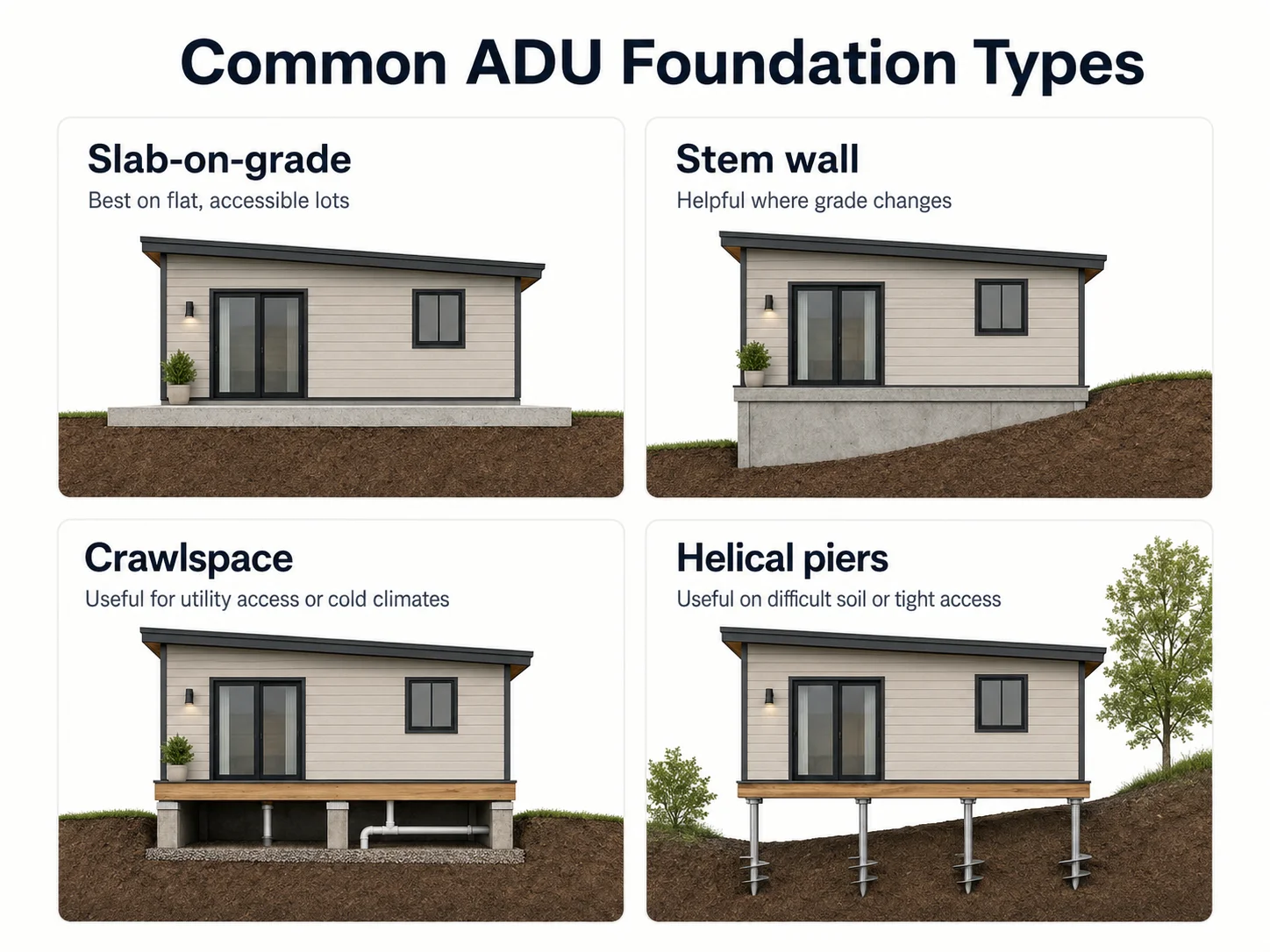
What foundation types are used for prefab ADUs?
The common options are slab-on-grade, stem wall, crawlspace (raised), pier-and-beam, helical piers, and basement foundations. A flat, accessible, temperate lot usually points to a slab; slope, frost, flood, poor soil, high snow load, or a manufacturer’s installation rules can push the design to a raised or deep system. The “right” type is decided by your soil, slope, climate, unit weight, and local code — and confirmed by a structural engineer.
We added a column most foundation explainers skip: the quote red flag for each type — the line that, if it’s missing from a bid, tells you the number is going to move later.
| Foundation type | What it is / best for | Watch-outs | Quote red flag (what’s missing) |
|---|---|---|---|
| Slab-on-grade | A 4–6 inch reinforced concrete pad on compacted soil over a gravel base and vapor barrier; doubles as the floor. The post-tensioned variant adds tensioned steel cables to resist cracking on expansive soil. Best for flat lots, most detached modular ADUs, mild climates. | Needs frost protection in cold climates (a deepened edge or an insulated shallow foundation). | No frost-protection line in a cold climate; no reinforcement, vapor-barrier, or base-prep spec. |
| Stem wall | A slab with a short concrete wall built up where the grade is highest — like a low retaining wall fused to the foundation. Best for lots with grade changes and erosion control. | Cost rises with excavation and reinforcement; multiple concrete pours. | A flat per-square-foot price with no excavation or grading allowance for the actual slope. |
| Crawlspace (raised) | Elevates the structure ~18–48 inches on stem walls or piers, leaving an accessible void for utilities. Best for slope, utility access, cold climates, and some modular set requirements. | Requires ventilation and moisture control (IRC baseline under-floor ventilation is 1 sq ft of net free area per 150 sq ft, reducible with a Class I vapor retarder and ground cover — IRC §R408.1; verify locally). | No ventilation, vapor-barrier, or insulation line. |
| Pier-and-beam | Concrete piers anchored deep, with beams and joists creating a raised floor. Best for challenging or sloped terrain and lighter units. | Can underperform in expansive clay (uneven settling, sagging floors); pair with drainage. | Used on expansive clay with no drainage detail or engineered capacity. |
| Helical piers (screw piles) | Steel shafts with welded helical plates, hydraulically screwed into deep, stable soil and capped with brackets. Best for poor or unstable soil, tight access, minimal excavation, fast installs, and frost/uplift resistance. | More engineering; priced per pier; new-build ADU loads require a designed layout. | A per-pier price with no engineered pier count, torque spec, or geotechnical basis. |
| Basement | A full or partial below-grade level, typically excavated 7–10 feet down. Best for maximizing space on a small lot, or cold/sloped sites. | Heavy excavation and waterproofing; the most expensive option. | No waterproofing or drainage line. |
The pier-and-beam versus helical-pier distinction confuses a lot of homeowners. Both create a raised, deep-anchored foundation, but a helical pier is a manufactured steel pile screwed into the ground to a tested torque, while pier-and-beam usually means cast concrete piers. Helical piers shine where access is tight, soil is weak, or speed matters; concrete is often cheaper on a simple, good-soil lot where budget is the priority. An engineer makes the call for your loads and soil.
Source notes: Presite, SnapADU, APE Structural Engineering (foundation-type behavior); HomeGuide and FND Piers (helical piers, 2026); IRC §R408.1 (crawlspace ventilation baseline). Verified May 2026.
Is a concrete slab required for a prefab ADU?
No — a concrete slab is the most common prefab ADU foundation on a flat, accessible lot in a mild climate, but it is not legally required everywhere or for every unit. Slope, expansive soil, a deep frost line, flood risk, or a manufacturer’s installation rules can call for a stem wall, crawlspace, pier-and-beam, or helical-pier system instead. What you cannot skip is a permanent, engineered foundation of some kind.
A slab earns its popularity honestly. It’s typically the simplest and most cost-efficient option, it doubles as the finished floor, and it suits the flat backyards where most detached modular ADUs land. But “default” is not “required”:
- When a slab is likely right: a flat, accessible lot; stable, well-draining soil; a mild climate without a deep frost line; and a single-story unit.
- When a slab is risky or wrong: a sloped lot (you’ll likely need a stem wall or piers); expansive clay (a post-tensioned slab, deeper footings, or helical piers may be required); a cold climate (the slab edge has to be frost-protected, or you use an insulated shallow foundation); a flood zone (the unit may need to be elevated and anchored); or a manufacturer’s instructions that specify a different support system.
So if a builder tells you “every prefab ADU just needs a slab,” treat that as a prompt to ask about your soil, slope, and frost depth — not as the final word. The honest answer is that a slab is the common path, and a permanent engineered foundation is the actual requirement.
Source notes: Foundation-type suitability per SnapADU, Presite, and APE Structural Engineering; frost and soil considerations per IRC §R403 and §R401.4. Verified May 2026.
How deep does a prefab ADU foundation have to be? Frost line and code, decoded
Exterior footings must sit at least 12 inches below undisturbed grade and below your local frost line — the depth to which the ground freezes (IRC §R403.1.4 and §R403.1.4.1; IBC §1809.4). Frost depth ranges from essentially 0 inches in South Florida and Hawaii to roughly 42–60 inches in cold states and up to about 120 inches in interior Alaska. Your local building department sets the exact number. A frost-protected shallow foundation (IRC §R403.3) is the code-approved way to use shallower, insulated footings on a heated building instead of digging deep.
The IRC requires that footings extend below the frost line so that freezing, expanding soil can’t lift and crack your foundation — a failure called frost heave. The code itself doesn’t print a single national number; it delegates the value to your Authority Having Jurisdiction (AHJ), which fills it into IRC Table R301.2(1). And regardless of frost, no exterior footing may be shallower than 12 inches below the undisturbed ground surface.
| Region / example | Typical footing depth below grade | Note |
|---|---|---|
| South Florida, Hawaii | ~0 in frost; the 12-inch minimum still applies | No frost line, so the 12-inch minimum governs. |
| Much of the South / Southwest | 12–24 in (often a local minimum) | Varies by county; many set their own minimum. |
| Mid-latitude / temperate | ~24–42 in | 36 inches is common across much of the cold-temperate U.S. |
| Cold (Upper Midwest / Northeast) | ~42–60 in | Example: parts of Michigan use 42 inches. |
| Mountain / cold-amended | Varies widely | Wyoming examples: Cheyenne 36 in, Gillette 42 in; Idaho commonly 24–36 in. |
| Interior Alaska | up to ~120 in | Anchorage: 120 in for cast-in-place concrete piers (reducible to 60 in in non-frost-susceptible soil); Fairbanks 42 in; Juneau 32 in. |
These are representative values, not authoritative for any specific address. Confirm your frost depth with the local building department.
The cold-climate shortcut: frost-protected shallow foundations (FPSF)
Digging four feet of footing in a cold climate is expensive. The IRC offers an alternative in §R403.3: for a building kept heated (a monthly mean temperature of at least 64°F), footings do not have to extend below the frost line if they’re protected by rigid insulation meeting the code’s R-value and configuration, sized to your local Air-Freezing Index, using insulation that complies with ASTM C578. An FPSF can bear as shallow as roughly 12–16 inches. The catch: it’s only for heated spaces — you cannot use an FPSF for an unheated garage or carport — and the insulation detailing has to be designed correctly. The engineered route, ASCE 32, is the third code-approved option alongside extending below the frost line and FPSF.
The inspection sequence
Foundations are inspected in stages, and the order matters because some inspections must happen before concrete is poured. The classic checkpoint is the footing/rebar inspection, which verifies depth, forms, and reinforcement before the pour — once concrete is in, it’s too late to fix. For prefab and factory-built units that rely on earth anchors to resist wind and seismic loads, some jurisdictions require proof-load testing of those anchors. Portland, Oregon’s building code guidance for prefabricated structures (BCG 15-10) is a documented example: when an approved geotechnical report is on file, at least 50% of the earth anchors must be proof-load tested; without one, 100% must be tested.
Source notes: IRC §R403.1.4, §R403.1.4.1, §R403.3 (ICC Digital Codes, InterNACHI, Jaspector); IBC §1809.4; frost-depth examples from Apex and MeltPlan (Wyoming, Idaho); Portland BCG 15-10 (earth-anchor proof-load testing). Verified May 2026.
How much does a prefab ADU foundation cost in 2026?
Budget roughly $7,000–$15,000 for a slab on a typical 400–600 square foot prefab ADU on a good flat lot; $12,000–$25,000 for a stem wall, crawlspace, or helical-pier system; and $30,000–$75,000 for a basement. Add a soils report (commonly $500–$5,000, often $1,500–$4,000+ in Southern California) where one is required, plus grading, over-excavation, retaining walls, long utility trenching, or crane access on difficult lots. These are planning ranges, not quotes — your soil, slope, access, and local labor decide the real number.
A critical, counterintuitive point first: foundation cost does not scale neatly with square footage. A foundation has fixed costs — mobilizing equipment, forming the perimeter footing, the soils review — that don’t shrink much on a small unit. That’s why a 400-square-foot ADU slab is rarely “400 times a few dollars.”
| Foundation type | Typical installed range (≈400–600 sq ft ADU) | Source signal | Caveat |
|---|---|---|---|
| Concrete slab-on-grade | ~$7,000–$15,000 | ~$6–$14/sq ft (Presite 2024; HomeGuide 2026); ~$7K–$12K for 500 sq ft (Curated ADU Homes) | Usually excludes unusual site prep, engineering, utilities, and permit scope. |
| Stem wall / raised perimeter | ~$10,000–$25,000 | Higher than slab (Curated ADU Homes; SnapADU) | Depends heavily on excavation and reinforcement. |
| Crawlspace (raised) | ~$12,000–$25,000 | ~$12K–$25K for 500 sq ft (Curated ADU Homes) | Ventilation, insulation, access, frost, and moisture control change scope. |
| Pier-and-beam | Project-specific, often ~$10,000–$25,000 | Varies with soil and slope (HomeGuide; APE) | ADU-specific engineered designs can exceed simple planning ranges. |
| Helical piers (screw piles) | Quote-specific; commonly ~$7,000–$25,000, more for deep or many-pier installs | ~$900–$2,500 per pier (vendor estimates) to ~$2,000–$4,000 per pier (HomeGuide); ~8–12 piers typical | Priced per pier, not per square foot; new ADU loads need an engineered layout. |
| Basement | ~$30,000–$75,000 | ~$30K–$75K for 500 sq ft (Curated ADU Homes) | Often impractical for ADUs unless slope or site plan justifies it. |
| Site-condition add-ons | Site-specific | Soils report ~$500–$5,000; $1,500–$4,000+ typical in Southern California (gatherADU 2026); plus grading, over-excavation, retaining walls, long trenching, crane | The line that most often blows the budget. |
A reality check from the field: in some markets, builders report combined foundation-and-site-work packages of $25,000–$50,000, and homeowners in higher-cost regions have reported foundation bills well into the five figures on units around 500 square feet. We share those as planning context — not as a typical number — because they illustrate how fast a “simple slab” becomes a major line when slope, soil, or access enter the picture.
Why “foundation included” rarely means “site ready”
When a prefab quote says “foundation included,” ask what that actually covers. Site work — the grading, excavation, drainage, and utility-lateral installation that prepares the ground (a utility lateral is the pipe or line connecting your ADU to the water, sewer, gas, or electric main) — is frequently a separate scope. So is the engineering, the soils report, the over-excavation if the soil is weak, the crane to set a modular unit, and the inspections. We break the delivery-and-set side of this down in our prefab ADU delivery cost guide; here, the rule is: if the quote doesn’t name the foundation and site-work scope line by line, assume it’s excluded until proven otherwise. See also our prefab ADU utility hookups guide for what connects to the foundation.
The five things that turn a cheap slab expensive
- Slope. A grade change forces a stem wall, deepened footings, or retaining walls.
- Expansive or weak soil. Clay and poor bearing capacity push you to post-tensioned slabs, deeper footings, or helical piers.
- Frost depth. Cold climates mean deep footings or an engineered shallow foundation.
- Tight access. A backyard a crane or concrete truck can’t reach raises labor and may force helical piers.
- Over-excavation. When a soils report finds unsuitable soil, you may have to dig it out and replace it with engineered fill before you can build.
Source notes: HomeGuide (foundation and helical-pier costs, 2026); Presite (2024); Curated ADU Homes (per-type ranges); SnapADU and Better Place Design & Build (San Diego/SoCal soils and foundation, 2026); gatherADU (SoCal soil-report ranges, 2026); builder and homeowner reports used only as planning context. Cost figures are planning ranges, not quotes. Verified May 2026.
Do you need a soils (geotechnical) report for an ADU foundation?
Sometimes — and it depends on your city, your slope, and your unit’s size. A soils report (also called a geotechnical report) is an engineer’s analysis of whether your ground can safely carry a foundation, evaluating bearing capacity, expansive soil, moisture, and seismic hazard. Some cities require one for every ADU; many require one only on sloped lots or in hazard zones; and several let you swap a deeper “prescriptive” foundation for the report. Expect roughly $500–$5,000, often $1,500–$4,000+ in high-cost markets, when one is required.
The rules vary so widely by jurisdiction that a national “you need a soils report” answer is useless. So we assembled the actual triggers from city, county, and specialist sources. Each row notes whether it’s an official municipal source or a specialist/builder interpretation.
| Jurisdiction | When a soils report is triggered | Prescriptive alternative / waiver | Source |
|---|---|---|---|
| California statewide baseline | Under the California Building Code (CBC Ch. 18A), geotechnical reports are not required for one-story, wood- or light-steel-frame buildings of Type II/V construction up to 4,000 sq ft if the site is not in an Earthquake Fault Zone or Seismic Hazard Zone. Local rules can be stricter. | Use code-prescribed values where eligible. | CBC 2025 Ch. 18A (official) |
| City of Los Angeles | Slopes steeper than 3:1; excavations that remove lateral support; when code-prescribed soil values can’t be used; certain mapped seismic-hazard zones. LA accepts a “modified” (observation-based) soil report for many ADUs. | Code-prescribed soil values, or a modified report (~$1,500). | LADBS triggers via geotechnical-firm summary (specialist-reported) |
| Glendale, CA | Reported to require a full or modified geotechnical report for all ADU projects, flat or sloped. | A modified report is accepted. | Glendale-based geotechnical firm Applied Earth Sciences (specialist-reported) |
| Carlsbad, CA | Detached single-story ADUs under 500 sq ft are exempt; 500–749 sq ft can waive the report with a prescriptive foundation; over 750 sq ft or two stories require a report. Slopes, bluffs, coastal, and mapped hazard areas can trigger a report regardless of size. | A prescriptive foundation — reported as 24-inch footings with a 5-inch slab — to waive the report on a 500–749 sq ft unit. | SnapADU’s Carlsbad interpretation (builder-reported); confirm against Carlsbad bulletin B-75 |
| Portland, OR | Site slope of 20% or more, or within a landslide/hazard area. | For prefab foundations (BCG 15-10): 12-inch minimum footing embedment or 12 inches of non-frost-susceptible crushed rock; earth anchors proof-load tested (50% with an approved geotechnical report, otherwise 100%). | City of Portland BCG 15-10 (official) |
| Santa Clara County, CA | New residential/non-residential structures or additions over 1,200 sq ft; any new structure or retaining wall using piers, piles, or engineered systems — including helical piles; agricultural accessory structures over 3,000 sq ft. | Per County Development Services policy B-001. | Santa Clara County DSOP B-001 (official) |
| City of Boulder, CO | Required for all new structures on properties with steep-slope concerns or soils with mass-movement potential; a slope of 15% or greater is a specific trigger. | A grading and drainage plan by a licensed engineer where required. | City of Boulder Building Permits & Inspections (official) |
| Boulder County, CO | New home construction in the plains (east of U.S. Hwy. 36), where expansive soils and high groundwater are common. | — | Boulder County Building (official) |
| Denver, CO | New dwellings, townhouses, or accessory structures with living space; any IRC project using a deep foundation except a helical-pier foundation; projects triggering excavation/benching/shoring rules; and any construction where expansive or questionable soils are likely (Denver Residential Code §R401.4). | Helical-pier foundations are exempt from the deep-foundation trigger. | Denver Building Permit Policy IRC R401.4 (official) |
| Garden Grove / Orange County, CA | Required for all projects except listed exceptions — including one-story detached accessory structures or ADUs up to 1,200 sq ft in non-liquefaction areas; in liquefaction areas, units over 500 sq ft typically require 4 feet of over-excavation. | A prescriptive foundation: a 5-inch slab reinforced with #4 bars at 18 inches on center over a 4-inch clean-aggregate base with a 10-mil vapor retarder. | Orange County / Garden Grove foundation handout (official) |
The pattern worth internalizing: in many California jurisdictions, the prescriptive-foundation waiver is a real lever. You accept a deeper, slightly more expensive foundation and skip the report-plus-over-excavation path. For a small ADU near the size thresholds, that trade often saves both money and weeks of schedule.
San Diego County note
If your project is in Greater San Diego — San Diego, Carlsbad, Encinitas, Chula Vista, Oceanside, Poway, La Mesa, El Cajon, and surrounding cities — the prescriptive-foundation waiver and local soils thresholds are well documented, and a San-Diego-focused design-build firm like SnapADU publishes city-by-city guidance. See our San Diego ADU permit process guide for the local detail.
Source notes: California Building Code 2025 Ch. 18A (statewide baseline); LADBS triggers and modified-report acceptance via Marshall Geo and Applied Earth Sciences (specialist-reported); Glendale via Applied Earth Sciences (specialist-reported); Carlsbad thresholds and prescriptive detail via SnapADU (builder-reported — confirm against Carlsbad bulletin B-75); City of Portland BCG 15-10; Santa Clara County DSOP B-001; City and County of Boulder; Denver Residential Code §R401.4 building-permit policy; Orange County / Garden Grove foundation handout. Verified May 2026.
What site conditions change the foundation: soil, slope, frost, flood, snow, seismic, and WUI?
The “best” prefab ADU foundation changes when the lot is sloped, the soil is weak or expansive, the property sits in a flood zone, the climate has a deep frost line, the area carries heavy snow loads, or the parcel is in a seismic or wildfire zone. These aren’t cosmetic factors — they change the engineering, the cost, the schedule, and sometimes whether a given prefab product can be used on your lot at all.
Federal manufactured-home rules make this concrete. Under 24 CFR Part 3285, a manufactured ADU’s installation must respond to soil bearing capacity (§3285.202), site drainage (§3285.203), flood hazard areas (§3285.302 and §3285.406, requiring resistance to flotation, collapse, and lateral movement), special snow loads (§3285.315), and wind anchorage in severe wind zones (§3285.405). Site-built and modular ADUs face the same physics through the IRC and ASCE 7 (the standard that sets design loads for wind, snow, and seismic forces).
- Soil and bearing capacity. The IRC allows a default presumptive soil bearing value (commonly 1,500 pounds per square foot) for simple projects, but engineers warn against assuming it on variable or expansive soils. A geotechnical report removes the guesswork and may require a post-tensioned slab, deeper footings, or helical piers.
- Slope and drainage. Grade changes drive stem walls, deepened footings, and retaining work, and they frequently trigger the soils report described above.
- Frost line. Covered in detail earlier — footings below the frost line, or an engineered shallow foundation.
- Flood hazard areas. In mapped flood zones, the foundation may need to elevate the unit, anchor it against flotation, and use flood-resistant detailing.
- Snow load. This is the factor most homeowners underestimate, and it can disqualify a unit. Truckee, California publishes ground snow loads of 170 to 480+ pounds per square foot and interviewed eight prefab manufacturers specifically to find models that can meet its snow loads and wildland-urban interface codes. Wyoming’s Teton County can exceed 350 psf; Colorado’s Summit and Clear Creek counties can require 100–150+ psf.
- The “flatlander prefab” failure. Here’s a documented pattern worth its own warning: out-of-state modular units engineered to Midwestern snow loads (often 20–25 psf) routinely fail structural plan review in Colorado’s mountain counties, which can require three to eight times that capacity — meaning the unit cannot receive a building permit. The lesson generalizes everywhere: the unit’s engineering package must match your site’s loads, or no foundation will get it approved.
- Seismic and wind anchoring. In high-seismic regions (much of California sits in Seismic Design Category D), the foundation and the connections that tie the unit down are engineered specifically. California’s 2025 Building Standards Code took effect January 1, 2026 for permit applications submitted on or after that date, so confirm which code edition your jurisdiction is applying.
- Wildland-Urban Interface (WUI). In wildfire-prone areas, WUI codes add ignition-resistant construction and detailing that interact with how the unit is set and enclosed.
- Utility trenching and distance. The farther the ADU sits from the main house and the utility mains, the more trenching for water, sewer, gas, and electric laterals — a real, lot-specific cost that rides alongside the foundation.
Source notes: 24 CFR Part 3285 (Subparts C, D, and E; eCFR, verified May 2026); Town of Truckee Modular and Kit ADUs resource and Municipal Code Title 18; documented Colorado mountain-county plan-review failures (Olerra Living Innovations); MeltPlan structural-design references for Wyoming and Idaho snow loads and frost depths; California Housing & Community Development Department (2025 code effective date). Verified May 2026.
What permit documents will the building department ask for?
Expect a building permit application, a site/plot plan, a foundation plan, utility information, and — depending on your lot — a soils/geotechnical report, grading and drainage plans, flood, fire/WUI, snow, seismic, or septic documentation, plus factory-built certification papers. The exact list is local, but the categories are remarkably consistent across jurisdictions.
Brighton, Colorado’s factory-built ADU process is a clean, verified model of what to expect. Brighton supports two kinds of factory-built ADUs — HUD-certified manufactured homes and Colorado Division of Housing–certified prefabricated homes — and for the permit application it requires a plot plan, a soils testing report, a foundation plan, and a water/sewer service utility letter. It also notes a useful efficiency: HUD- and state-certified ADU applications don’t require the IECC or conventional heat-loss calculations a site-built unit would. And whether or not the manufacturer offers a turnkey package, Brighton is explicit that the foundation must be engineered by a licensed engineer and permanent.
| Document | What it is / why it’s required |
|---|---|
| Building permit application | The core authorization to construct. |
| Site / plot plan | Shows the unit’s location, setbacks, easements, and distance from the main house and property lines. |
| Foundation plan | The engineered design of footings, slab or piers, reinforcement, and anchoring. |
| Structural calculations / engineer stamp | Required where the design isn’t fully prescriptive or where loads (snow, seismic, wind) demand it. |
| Soils / geotechnical report | Required by slope, soil type, size, or jurisdiction (see the matrix above). |
| Grading and drainage plan | Required on slopes or where you’re changing the grade. |
| Utility plan / water-sewer service letter | Confirms how the ADU connects to water, sewer (or septic), gas, and electric. |
| Factory-built certification documents | HUD Data Plate and Certification Label for manufactured units; state insignia or state-agency certification for modular/prefab units. |
| Flood / WUI / snow / seismic addenda | Site-specific, where mapped hazards apply. |
One more layer that surprises people: in some states, a state housing agency reviews the factory-built foundation itself. Colorado’s Division of Housing, for instance, reviews and inspects foundation systems for manufactured homes in jurisdictions that don’t have their own building department. Know who your reviewing authority actually is before you assume the city handles everything.
Source notes: City of Brighton, CO ADU page (factory-built ADU document list and foundation language); Colorado Division of Housing (Factory Built Structures program); Denver and Boulder permit guides. Verified May 2026.
Can you reuse an existing slab, patio, shed pad, or garage foundation?
Sometimes — but never assume it. A patio, shed pad, or old slab was almost certainly not designed for a habitable dwelling, utility penetrations, frost protection, uplift, seismic or wind loads, or your prefab manufacturer’s set requirements. Garage conversions are different, because the structure may already have a permitted, code-compliant foundation — but it still requires engineering review before you build on it.
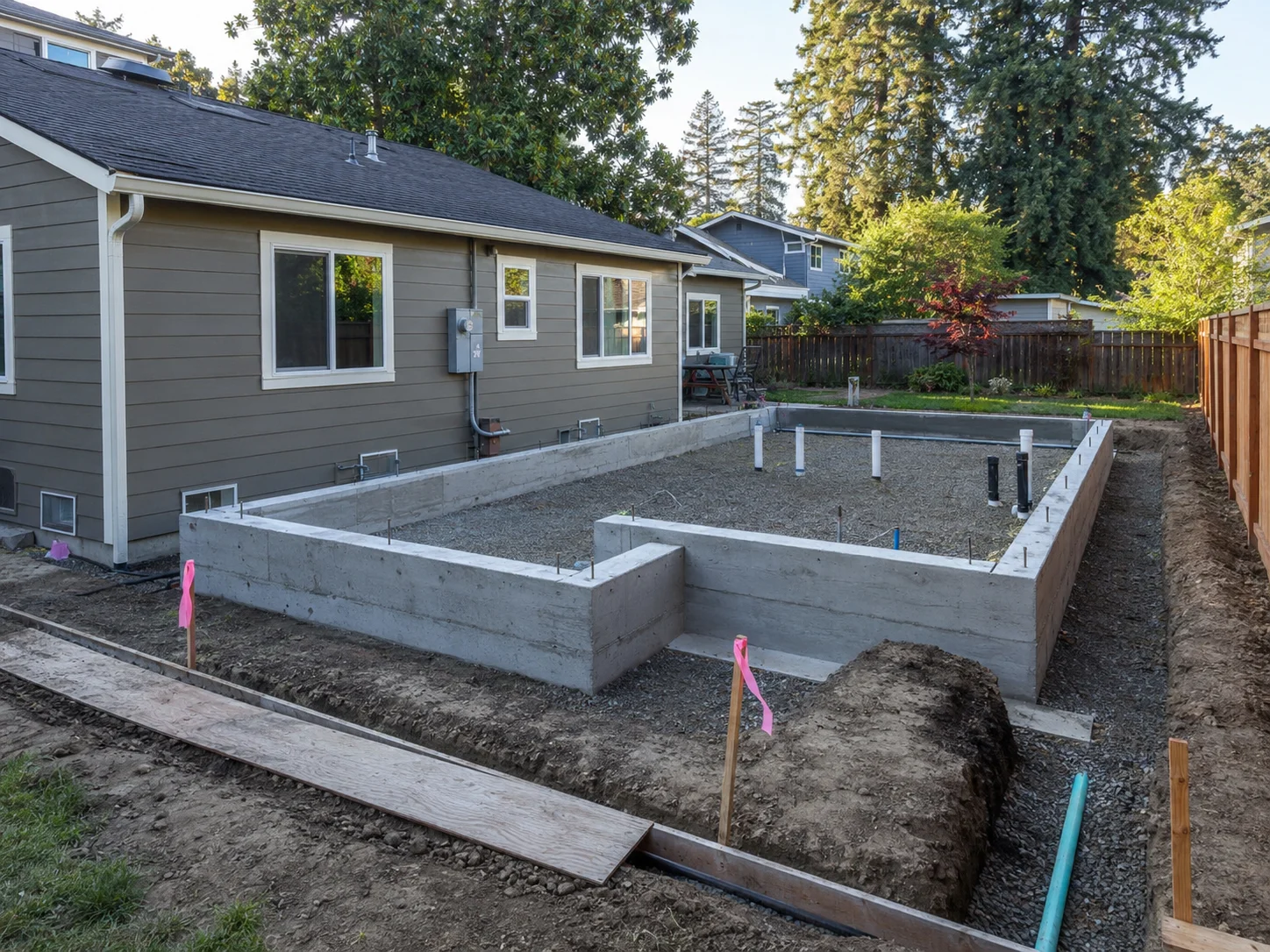
The honest reality, as San Diego design-build firm SnapADU puts it, is that existing pads almost never meet the structural, geotechnical, and code requirements for a new ADU. A shed slab is typically too thin and unreinforced. A patio has no footings. An old slab may have unknown reinforcement, the wrong thickness, cracks, or settlement. Even when a slab looks solid, it may sit on soil that was never evaluated for a dwelling’s loads.
- Existing patio or shed slab: rarely usable as-is; usually needs demolition and a proper pour.
- Existing garage foundation: the most promising case, since a permitted garage may have adequate footings — but an engineer must verify thickness, reinforcement, footing depth, and capacity for the new loads and utility penetrations.
- Converting a detached structure: treated like a garage conversion; the existing foundation is evaluated, not assumed.
- What an engineer must verify: slab thickness and reinforcement, footing depth versus frost line, soil bearing, drainage, and connections for uplift and seismic.
- When demolition is cheaper: if saving an old slab requires extensive cutting, underpinning, and patching, a clean repour is often faster and less expensive than fighting the existing one.
The takeaway: get an engineer’s eyes on any existing foundation before you build your budget around reusing it. See also our garage conversion ADU financing guide for how foundation evaluation fits into the conversion budget.
Source notes: SnapADU (existing-pad reuse); Maxable (garage conversions versus prefab new-builds). Verified May 2026.
What should be included in a prefab ADU quote — and what to ask before you pay a deposit?
A trustworthy prefab ADU quote separates the unit price from foundation, grading, drainage, utility trenching, crane/set, permits, inspections, engineering and geotech, concrete, anchoring, stairs/decks, skirting or crawlspace work, and final utility connections. If the quote doesn’t name the foundation scope, assume it’s excluded until proven otherwise.
First, decode the quote types you’ll encounter:
- Unit-only: the box, delivered. Everything site-side is yours to arrange.
- Installed: the unit plus set (often the crane), but frequently not the foundation, utilities, or permits.
- Turnkey: intended to be all-in, but read the exclusions — “turnkey” means different things at different companies, and our turnkey prefab ADU guide details where six-figure scope gaps hide.
- Foundation-included: confirm whether that means a designed, engineered, permitted foundation for your soil and slope, or a generic allowance that changes after the soils review.
The pre-deposit foundation scope checklist
Send these questions to any provider, in writing, before you put money down:
- Is foundation design (engineering) included, or just the pour?
- Is the engineer’s stamp included?
- Is a soils/geotechnical report included — or assumed unnecessary?
- Are grading and drainage included?
- Are utility sleeves and penetrations coordinated before the pour (so you’re not cutting a finished slab)?
- Are anchor bolts and tie-downs for wind/seismic uplift included?
- Is the crane or set within the quote, and is set tolerance (re-leveling if the unit lands out of spec) covered?
- Is frost, flood, snow, or seismic design included where your site requires it?
- Is inspection scheduling and coordination included?
- If the foundation lands out of tolerance, who pays for the rework?
- Are utility laterals (the runs to the mains) included, and for how many linear feet?
- Is over-excavation (digging out and replacing unsuitable soil) included or excluded?
- Are retaining walls, if your slope needs them, included?
- Are permit fees (separate from permit drawings) included?
- What is the deposit refund policy if the city won’t permit this unit on this lot?
If a provider can’t answer these clearly, that’s information. A good prefab company will have the answers ready. See also our full prefab ADU guide and the prefab ADU financing guide for the deposit-timing issue.
Source notes: Synthesized from provider quote structures (SnapADU, Maxable, BuildX) and the cost-driver analysis above; checklist framework assembled by The Dwelling Index. Verified May 2026.
What happens if the foundation is wrong?
A wrong or incomplete foundation can delay delivery, fail inspection, void the manufacturer’s installation assumptions, create settlement or moisture problems, block your certificate of occupancy, or prevent the unit from being treated as real property. That’s the entire reason to verify the foundation and code path before you pay a deposit — fixing it afterward is the expensive path. Each consequence below ties back to a real, sourced requirement.
- Delivery delay. A modular unit can’t be set on a foundation that isn’t poured, cured, and inspected. A foundation hold pushes your crane date and your whole schedule.
- Failed inspection. Footings poured too shallow (below the IRC §R403.1.4 frost/depth rule), missing reinforcement, or earth anchors that aren’t proof-load tested where required (as in Portland’s BCG 15-10) all fail inspection — and concrete is unforgiving once it’s set.
- Manufacturer warranty conflict. Manufactured-home installation follows the manufacturer’s instructions under 24 CFR §3285.2. Deviating from them — or skipping the engineered alternative the instructions require — can void warranty coverage.
- Financing and appraisal problems. Without a permanent foundation, real-property classification, and (for manufactured units) the foundation certification, a lender may decline the loan and an appraiser may not assign full value — exactly the gates Fannie Mae and FHA describe.
- Moisture and settlement. A foundation that ignores soil bearing and drainage (the very factors 24 CFR §§3285.202–203 and a geotechnical report address) invites cracking, sagging floors, and water intrusion down the road.
- Rework cost. Correcting a foundation after the fact — underpinning, re-pouring, adding piers — is among the most expensive repairs in construction.
None of this is meant to scare you off prefab. It’s meant to put the verification before the deposit, where it belongs.
Source notes: IRC §R403.1.4; Portland BCG 15-10; 24 CFR §3285.2 and §§3285.202–203; HUD PFGMH; Fannie Mae B2-3-02 (permanent foundation and real-property treatment). Verified May 2026.
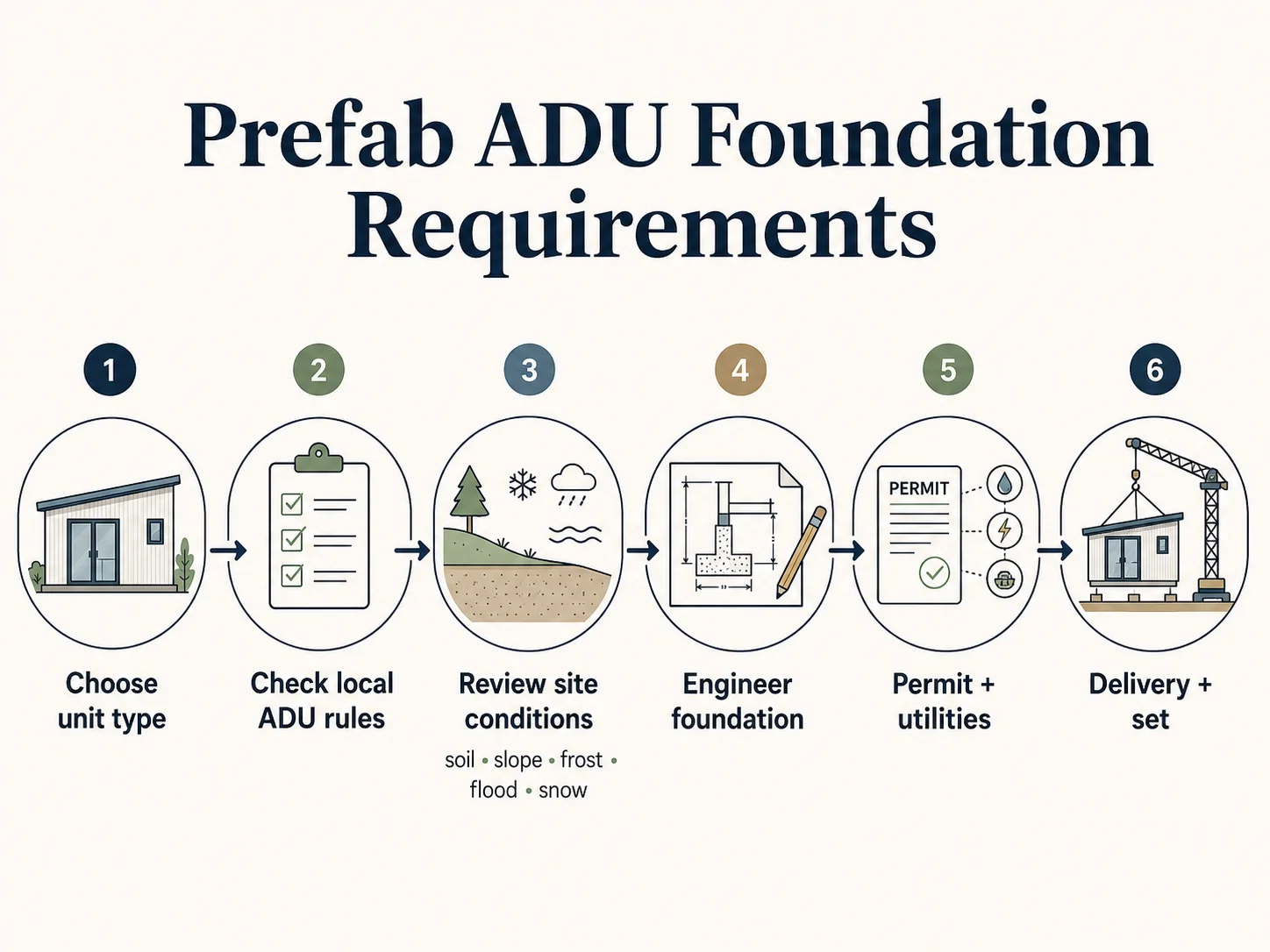
The safe, step-by-step process: understand the ground before you buy the box
Don’t start with the prettiest floor plan. Start with the code path, the property fit, and the foundation scope — then compare providers. This sequence prevents the two most common and most expensive mistakes: buying a unit your city won’t permit, and budgeting the box without budgeting the ground. We’ve added the one document you should have in hand at each step.
- Identify the unit’s code path — modular (IRC), manufactured (HUD), panelized/kit, container, or tiny-home/park-model/RV. Have: the spec sheet and, for manufactured units, a photo of the HUD Data Plate and Certification Label.
- Ask the city whether that code path can be an ADU at your address. Have: a short written confirmation or email from the building department. This single question disqualifies most “no-permit” bargains before you spend anything.
- Check zoning, setbacks, access, utilities, and local overlays. Have: your parcel’s zoning and any coastal/hillside/historic/fire overlay status.
- Confirm site conditions — slope, soil, flood zone, frost depth, snow load, and WUI status. Have: a soils/geotechnical result if your jurisdiction or lot requires one.
- Ask the provider for the foundation requirements in writing, including set tolerances and anchoring. Have: the manufacturer’s foundation/installation instructions.
- Get a foundation and site-work quote itemized using the checklist above. Have: an itemized foundation plan and site-work scope.
- Confirm the permit documents your jurisdiction requires. Have: the plot plan, foundation plan, utility/service letter, and certifications.
- Only then place a deposit or order plans. Have: a crane/access plan and a written deposit-refund policy.
Prefab ADU foundation requirements: frequently asked questions
- Do prefab ADUs need a foundation?
- Yes. A legal, occupiable, financeable prefab ADU needs a permanent, code-compliant foundation and permanent utilities. The exact type depends on the unit's code path, your local building department, the manufacturer's instructions, and your site conditions.
- Can a prefab ADU sit on a gravel pad?
- Generally no, not as a permanent dwelling. Gravel pads and skid foundations suit temporary or relocatable structures, but most jurisdictions require a permanent, engineered foundation for an ADU. A gravel-pad 'no-permit' product usually can't be legally occupied, rented, or financed as an ADU.
- Can a tiny home on wheels be an ADU?
- Often no. A tiny home on wheels (THOW), park model, or RV-style unit is typically built to recreational-vehicle standards, not residential building code. Where a jurisdiction does allow it, the unit usually must be placed on a permanent foundation, with the wheels removed and permanent utilities connected. Ask your building department about your exact unit before buying.
- Is a modular ADU the same as a manufactured home?
- No. A modular ADU is built to your local building code (the IRC) and treated like a site-built home; a manufactured home is built to the federal HUD Code on a permanent chassis. They follow different foundation, installation, financing, and inspection paths. Fannie Mae explicitly classifies modular housing as not manufactured housing.
- Does a HUD-code manufactured ADU need a permanent foundation?
- For FHA financing, yes — a permanent foundation documented by an engineer's or architect's certification of compliance with HUD's Permanent Foundations Guide for Manufactured Housing (PFGMH). Fannie Mae (conventional) requires real-property classification on a permanent foundation with towing hardware removed, and VA lenders often require an engineer's certification as an overlay. The installation itself follows 24 CFR Part 3285.
- Can I use an existing concrete slab for my prefab ADU?
- Rarely without modification. Patio and shed slabs almost never meet the structural and code requirements for a new dwelling. A permitted garage foundation is more promising but still requires an engineer's review of thickness, reinforcement, depth, and capacity.
- How much does a prefab ADU foundation cost?
- A slab on a good flat lot typically runs about $7,000–$15,000 for a small ADU; stem walls, crawlspaces, and helical-pier systems run roughly $12,000–$25,000; basements run $30,000–$75,000. Add a soils report (commonly $500–$5,000, often $1,500–$4,000+ in Southern California) if required, plus site-specific grading and excavation. These are planning ranges, not quotes.
- Is slab-on-grade cheaper than a crawlspace?
- Usually yes. A slab-on-grade is generally the most affordable foundation on a flat, accessible lot, while crawlspaces and raised foundations cost more because of additional excavation, stem walls, ventilation, and moisture control.
- Do I need a soils report?
- It depends on your jurisdiction, slope, and unit size. Some cities require one for every ADU; others (like Los Angeles or Portland) require one mainly on slopes or in hazard zones; and some (like Carlsbad) let you swap a deeper prescriptive foundation for the report on smaller units. Confirm with your local building department.
- Does the prefab company build the foundation?
- Sometimes. Some providers offer a turnkey package including the foundation and utility connections; many do not. Either way, the foundation must be engineered and permanent, and you should confirm in writing exactly what's included before paying a deposit.
- Can I pour the foundation before permits are approved?
- No. Pouring before permit approval risks rejection, costly rework, and re-pours, because the foundation plan, setbacks, and reinforcement are reviewed and inspected (often before the pour) as part of the permit process.
- What happens if my lot is sloped?
- Slope typically drives a stem wall, deepened footings, or retaining walls, and it frequently triggers a soils or grading report. It adds cost and engineering, but it's routine for experienced ADU builders.
- What if I'm in a flood zone?
- In a mapped flood hazard area, the foundation may need to elevate and anchor the unit to resist flotation, collapse, and lateral movement, using flood-resistant detailing. For manufactured units this is governed by 24 CFR Part 3285.
- Does foundation type affect financing?
- Yes. A permanent foundation is what lets a prefab ADU be treated as real property, which affects loan eligibility, appraisal value, taxes, and resale — and for manufactured units, the permanent-foundation certification is often the gate to FHA, VA, and conventional financing.
- What should I ask before paying a prefab deposit?
- Confirm whether the unit's code path can be an ADU at your address, what the foundation and site-work scope includes, whether a soils report is needed, who pays for rework, and the deposit refund policy if the city won't permit the unit. Use the 15-point checklist in this guide.
Methodology
We built this guide by separating prefab ADU foundation questions into four layers: code path, local permit review, site conditions, and cost scope. For the code path, we reviewed Fannie Mae’s factory-built housing guidance and HUD’s manufactured-home construction and installation standards (24 CFR Parts 3280 and 3285). For footing depth and frost, we used the International Residential Code (§R403.1.4, §R403.1.4.1, and §R403.3) and the International Building Code (§1809.4). For local rules, we reviewed official city and county ADU and building pages that directly discuss permanent foundations, soils reports, foundation plans, snow loads, and factory-built ADUs — including Brighton (CO), Portland (OR), the City and County of Boulder, Denver, Santa Clara County, and Truckee (CA) — and supplemented Los Angeles, Glendale, and Carlsbad soils-report detail with specialist geotechnical and ADU-builder sources, which we label as such. For cost, we used published 2026 foundation and soil-report cost guides and clearly labeled planning ranges; builder and homeowner reports are used only as context, not as typical figures. Code and regulatory claims are sourced to primary or highly authoritative sources; cost figures are planning ranges only. Foundation requirements are always set by your local building official and a licensed engineer on a site-specific basis.
The Dwelling Index is an independent research resource covering ADU financing, costs, and regulations. We are not a lender, broker, or builder.
Sources and verification
All sources accessed and verified May 31, 2026. Regulations, costs, and local rules change — re-verify before relying on any figure.
Federal code and financing
- International Residential Code (IRC) §R403.1.4, §R403.1.4.1 (footing depth and frost protection), §R403.3 (frost-protected shallow foundations), and §R408.1 (crawlspace ventilation) — ICC Digital Codes, InterNACHI, Jaspector.
- International Building Code (IBC) §1809.4 (minimum footing depth).
- 24 CFR Part 3285 — Model Manufactured Home Installation Standards (Subparts B–E: flood, soil, drainage, foundations, footings §3285.312, snow §3285.315, wind anchorage), including §3285.1 (scope and the site-built-foundation exception) and §3285.2 (manufacturer installation instructions); 24 CFR §3282.12 (excluded structures / site-built permanent foundation). eCFR, verified May 31, 2026.
- 24 CFR Part 3280 — Manufactured Home Construction and Safety Standards (HUD Code).
- HUD Permanent Foundations Guide for Manufactured Housing (PFGMH, HUD-7584), including the chassis-retention requirement; HUD manufactured-home foundation-compliance guidance (FHA engineer/architect certification).
- Fannie Mae Selling Guide B2-3-02 and B4-1.4-02 (factory-built housing; modular/prefabricated/panelized are not manufactured housing; real-property and towing-hardware-removal requirements).
- FHA/VA/conventional foundation-certification practice via industry foundation-certification and lender sources.
Local examples
- City of Brighton, CO — Accessory Dwelling Units (factory-built ADU document list and permanent-foundation definition).
- Colorado Division of Housing — Factory Built Structures program.
- Town of Truckee, CA — Modular and Kit ADUs resource and Municipal Code Title 18 (170–480+ psf snow loads; manufactured/modular/tiny/park-model ADUs on permanent foundations).
- City of Portland Building Code Guide 15-10 — Prefabricated Structure Foundations (earth-anchor proof-load testing).
- Santa Clara County, CA — Development Services policy B-001 (geotechnical report triggers including helical piles).
- City and County of Boulder, CO (soils-report triggers).
- City and County of Denver — Building Permit Policy IRC R401.4 (geotechnical report triggers; helical-pier exception).
- California Building Code 2025, Chapter 18A (statewide geotechnical-report baseline); California Housing & Community Development Department (2025 code effective date).
- Orange County / Garden Grove, CA — foundation requirements handout (geotechnical-report exceptions and prescriptive foundation detail).
- Los Angeles, Glendale, and Carlsbad soils-report detail via specialist geotechnical firms (Marshall Geo, Applied Earth Sciences) and ADU builder SnapADU — labeled as specialist/builder-reported.
Cost data (planning ranges, not quotes)
- HomeGuide — foundation cost and helical-pier cost guides (2026).
- Presite — ADU foundations ($6–$12/sq ft slab, 2024).
- Curated ADU Homes — slab/crawlspace/basement ranges for a 500 sq ft ADU.
- Better Place Design & Build and gatherADU — Southern California soil-report cost ranges (2026).
- Angi — general foundation cost data; builder and homeowner reports used only as planning context.
Related guides
- The complete prefab ADU guide
- Prefab ADU cost (all-in)
- Prefab ADU delivery cost
- Prefab ADU utility hookups
- Turnkey prefab ADU: what’s really included
- How to finance a prefab ADU
- Manufactured home ADU guide
- Steel-frame modular ADU guide
- Container home ADU guide
- Expandable prefab ADU
Not sure where to start? See what’s possible at your address — get your free ADU report in 60 seconds.