
Expandable Prefab ADU — Complete Guide
Expandable Prefab ADU: What It Really Costs — and When You Can Legally Live In One
By the Dwelling Index Editorial Team · Last updated: May 27, 2026 · Last verified: May 27, 2026 · ~22 min read
The Honest Answer, Up Front
An expandable prefab ADU is a factory-built structure — usually a steel box that folds or slides open on-site — marketed for backyard and accessory-dwelling use. But “ADU” is a legal occupancy status, not a product you can buy off a listing. The $5,000–$20,000 prices you’ve seen are almost always “Ex Works” (EXW) factory-door prices for uncertified imported units — not your all-in cost, and not permission to move anyone in. Add ocean freight, U.S. import duties, a foundation, utility hookups, permits, and code-upgrade work, and a realistic all-in cost lands at $45,000–$120,000+.
| The cheap import listing | A legal, occupiable ADU | |
|---|---|---|
| Price you see | $5,000–$20,000 “EXW” (factory door) | — |
| True all-in cost | $45,000–$120,000+ after freight, duty, site work, permits | $45,000–$120,000+ |
| Certification | Usually none recognized in the U.S. | HUD label, state modular approval, or stamped/site-built review |
| Can you legally live in it? | Usually no, as shipped | Yes — with permit and certificate of occupancy |
| Your next step | Verify before you pay | See what your lot can support → |
Last updated: May 27, 2026 · Last verified: May 27, 2026
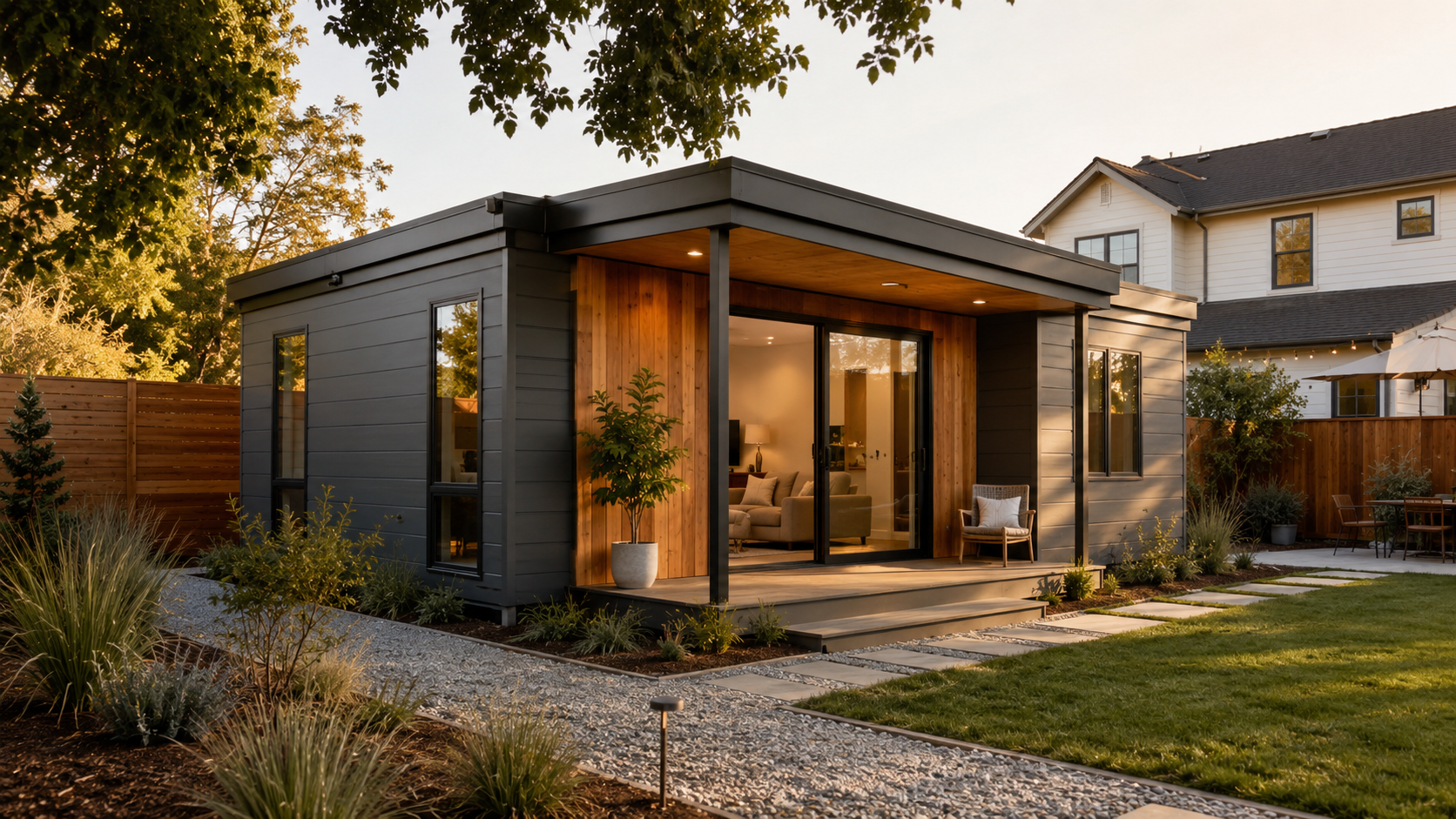
Dwelling Index is an independent research resource covering ADU financing, costs, and regulations. We don’t manufacture units, build ADUs, or lend money — which is exactly why we can tell you the parts the sellers won’t.
We’ve watched the same story play out across Reddit, Facebook ADU groups, and builder forums: a homeowner finds a sleek folding home online for the price of a used pickup and thinks they’ve cracked the code on backyard housing while everyone else overpays. Then the questions start. Why does shipping cost more than the house? What’s an “EXW price”? Will the city let me rent it out? Why did the inspector say it has no label?
This page answers all of it in one place, with real 2026 numbers, before you spend a dollar. Let’s start with what you’re actually looking at.
What exactly is an expandable prefab ADU?
Quick definitions: An ADU (accessory dwelling unit) is a self-contained second home on the same lot as a primary residence — its own kitchen, bathroom, and entrance — regulated as a permanent dwelling under local building codes. A JADU (junior ADU) is a smaller unit (up to 500 square feet) carved out of the existing house. “Prefab” means the structure is built in a factory and delivered. “Expandable” means it ships compact and opens up on-site.
The confusion is that “expandable” gets used at completely different ends of the market. Here’s how to tell them apart.
The imported folding-container unit (the $5K–$20K listings)
This is what most people find first: a steel-framed box, usually 20 ft long for transport, with floor and wall sections that fold down and out to roughly triple the footprint on-site. One real, currently-listed example — CASA BOX — markets a 20ft expandable container house starting at $5,699 EXW and a larger version at $9,399 EXW (CASA BOX listing, verified 2026). These are built overseas, predominantly in China, and listings frequently claim the units are “hurricane-resistant” or “meets Australian standards” — language that signals non-U.S. certification and cannot substitute for a HUD label or state modular approval.
The unit will physically stand up. The trouble is buried in two letters — EXW — and in what happens when an inspector asks for documentation. We’ll get to both.
Engineered U.S. foldables (e.g., the Boxabl Casita)
At the legitimate end sits a small set of U.S.-built foldable homes designed from the start to expand on-site and meet construction codes. The best-known is the Boxabl Casita, a 361-square-foot foldable studio (19′ × 19′) built in Las Vegas that folds for highway transport and unfolds on-site. Boxabl’s current public pricing is structured as turnkey packages — its investor page lists turnkey Casita Studio pricing around $150,000, with a one-bedroom and two-bedroom above that (Boxabl investor-relations and Casita pages, 2026). The key difference: Boxabl is designed with U.S. code paths in mind, and the company tells buyers directly to confirm local zoning before ordering. See our full Boxabl alternatives and prefab options guide.
Slide-out and sectional modular units
A third group expands via RV-style slide-outs or arrives as two-plus modules joined on-site. These overlap with conventional modular ADUs and are priced like them — typically $180–$500 per square foot all-in depending on finishes and site conditions (Critchfield Construction prefab guide, 2026).
What does an expandable prefab ADU actually cost?
This is the most important section on the page, so we built something no seller will hand you: a line-by-line reconciliation that turns an advertised sticker into the number you’ll actually spend to live in it legally.
The Sticker-to-Reality cost reconciliation
| Cost line | Typical 2026 range | Why it’s unavoidable | Source |
|---|---|---|---|
| Advertised “expandable” unit (EXW) | $5,700–$20,000 | Factory-door price. EXW = “Ex Works”: you own it the moment it leaves the factory and pay everything after. | CASA BOX listing ($5,699 / $9,399), 2026 |
| Ocean freight (40ft container, China → U.S.) | $1,850–$4,100 | Sea shipping. West Coast ports cheaper; East Coast higher. Rates swing with fuel, season, and policy. | 2026 freight indices |
| U.S. import duties (China-origin) | Get an HS-code broker quote | Stacks vary by classification and change fast in 2026. Do not budget a single percentage — see note below. | CBP Ruling N314354; CBP IEEPA/Section 301 guidance, 2026 |
| Customs entry / broker | $125–$300+ | A $5,699+ unit is far above any low-value parcel threshold; expect a formal entry and broker fee. | CBP de minimis notice, 2025–26 |
| Crane / forklift offload | $500–$2,000 | You unload a multi-ton unit on arrival. CASA BOX states it cannot deliver to the door or assist with installation. | CASA BOX listing, 2026 |
| Foundation (slab, raised, or pier) | $5,000–$15,000 | A code-compliant ADU needs an engineered foundation, not gravel. Soil and slope move this a lot. | ADU cost sources, 2025–26 |
| Utility hookups (water, sewer, electric, gas) | $5,000–$20,000 | Trenching and connecting to your home or the street. Distance and sewer condition drive the range. | ADU cost sources, 2025 |
| Permits & municipal fees | Varies by city | Plan check, building permit, and (for larger units) impact fees. See city examples below. | City fee schedules (SD, LA), 2025–26 |
| Code-upgrade work (insulation, fire, energy, electrical) | $5,000–$25,000+ | Imported units rarely meet U.S. energy, fire, and electrical code as shipped. | Container-compliance + ADU sources, 2026 |
| TRUE ALL-IN, OCCUPIABLE | ~$45,000–$120,000+ | The number that gets someone legally living in it. | Dwelling Index assembled estimate |
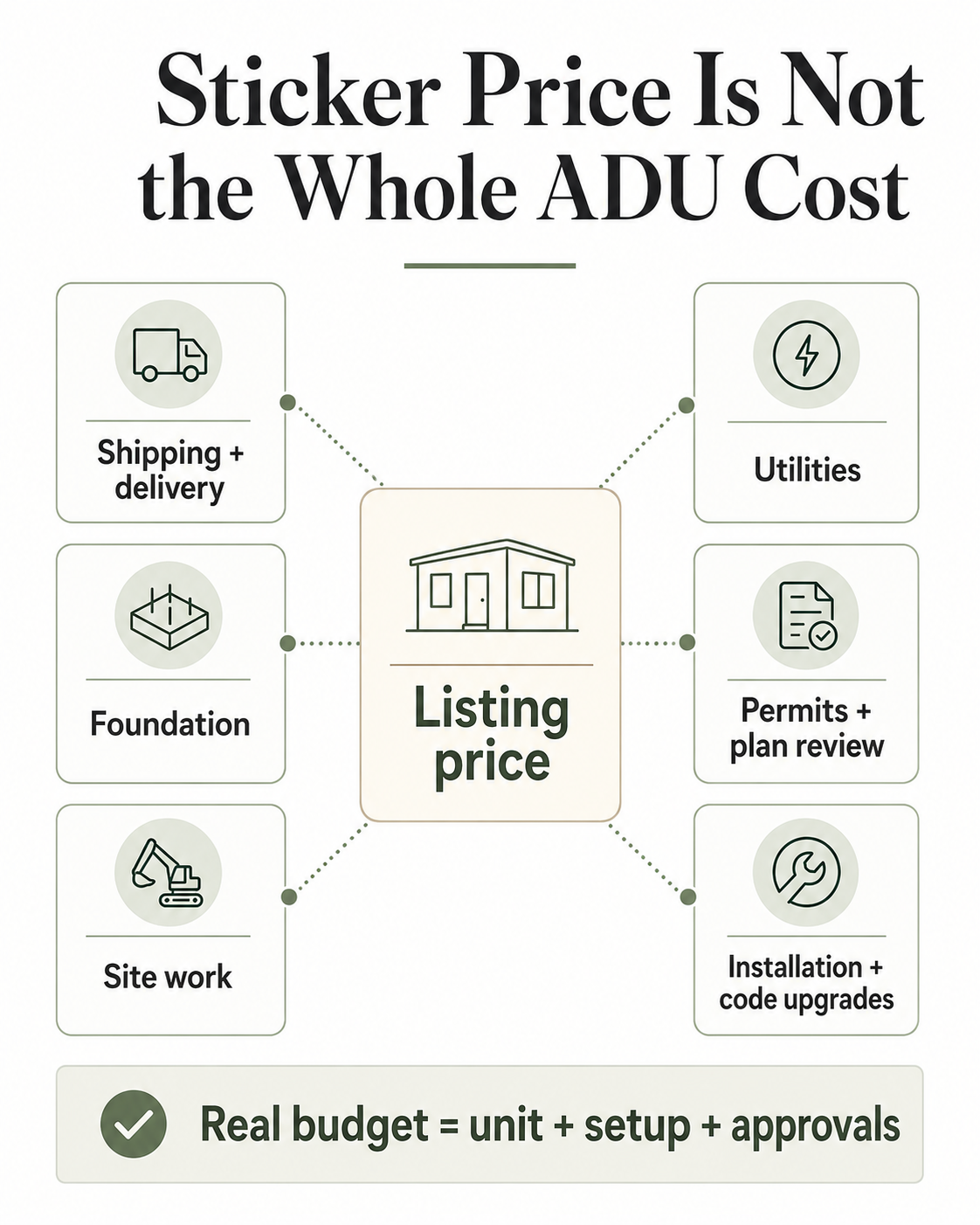
The CASA BOX listing proves the thesis in its own words. CASA BOX itself tells buyers they must understand local housing procedures and separately prepare a flat foundation, water, power, and a septic tank, arrange a crane or forklift, handle customs clearance, and arrange transportation from the port to the site — and it states plainly that it cannot deliver to your door and cannot assist with on-site installation (CASA BOX listing, 2026). If the seller of a “cheap” expandable unit says the same things, you are not being warned — you are being handed the invoice for the rest of the job.
Why we won’t print a single tariff percentage — and why that protects you. Import duty on a Chinese-origin prefab unit depends on its exact HS classification, and the 2026 picture is genuinely in motion. CBP’s own ruling on prefabricated residential “microhome” buildings from China (Ruling N314354) classifies them under heading 9406 with a low base duty plus the additional Section 301 duty for China-origin goods, and CBP guidance shows other temporary surcharges moving in and out. Before you rely on any figure — including ours — get a written quote from a licensed customs broker for your specific unit’s classification. That quote takes 24–48 hours and costs nothing upfront; skipping it is how homeowners end up with a customs bill that eclipses the unit price.
Foundation, hookups, and permits are not optional extras. A code-compliant ADU needs an engineered foundation ($5,000–$15,000) and utility connections that commonly run $5,000–$20,000 depending on trenching distance and whether the sewer line needs work. Put plainly: the site costs alone routinely exceed the entire advertised price of a cheap expandable unit.
What permits actually cost: two verified city examples
We use official city figures here rather than a vague “typical range,” because permit cost is exactly the kind of claim a homeowner needs to be able to verify. Los Angeles’ Housing Element fee appendix gives those two worked LADBS examples above; your actual fee scales with project scope and valuation (City of Los Angeles fee appendix, 2025–26). In San Diego, the city confirms a 30-day review for applications using its pre-approved ADU plans and directs applicants to the plan provider’s licensing cost (City of San Diego ADU program, 2025–26). Those are permit fees; utility connection fees and impact fees (where applicable) are separate line items and not included in the permit fee itself.
See What You Can Build → Get Your Free ADU Report
Before you commit to any unit, find out what your specific lot can legally support — size limits, setbacks, and the ADU type that fits.
Check My Property →Takes about 60 seconds
Can you legally live in an expandable prefab ADU?
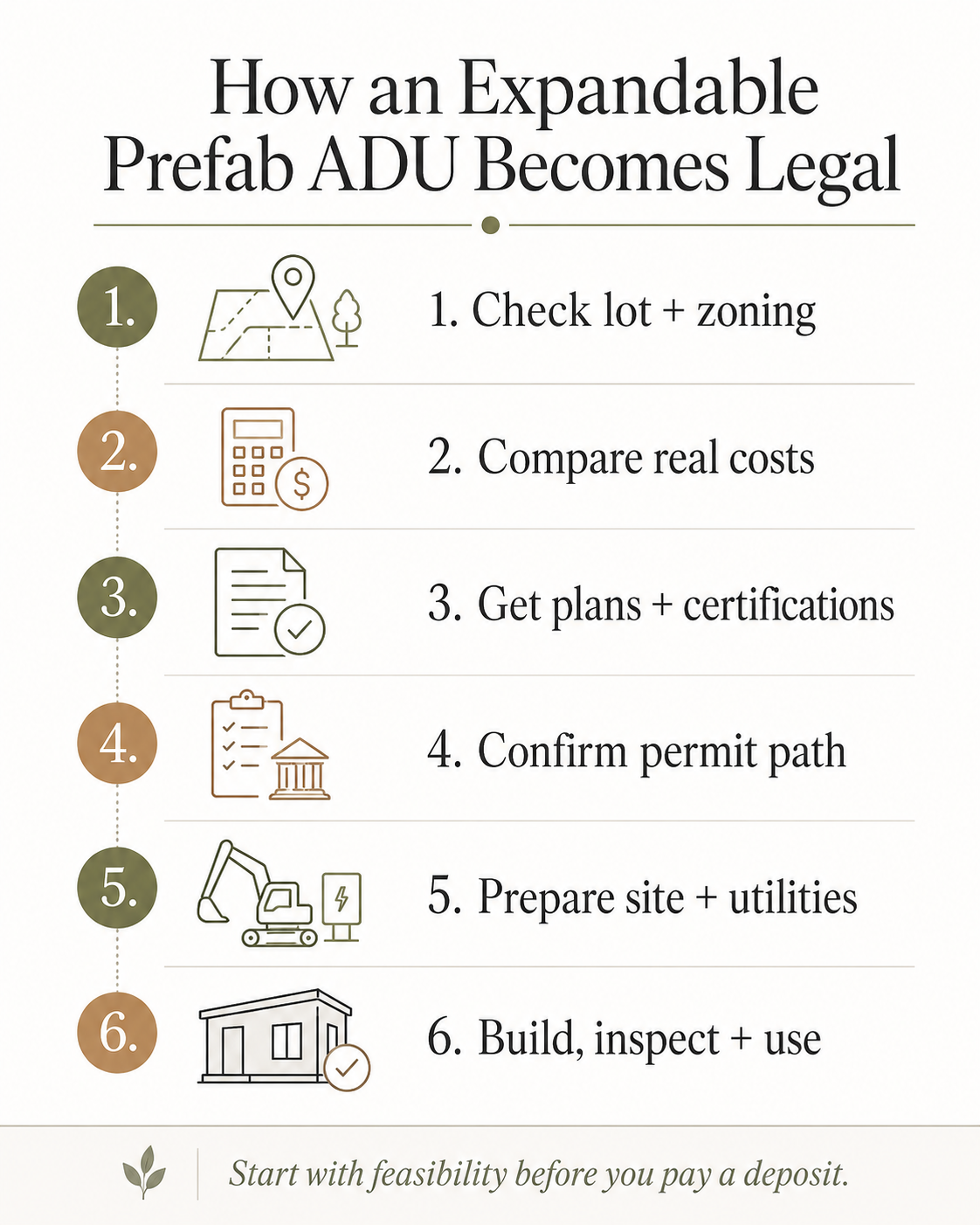
This question decides whether your purchase becomes a home or an expensive shed. Here’s the certification & code-path decision matrix, decoded from federal HUD/eCFR rules and state/local ADU requirements.
The certification & code-path decision matrix
| Unit type | What it carries | Legal as a permitted ADU? | Plain-English reality |
|---|---|---|---|
| HUD-code manufactured home | Federal HUD certification label (the red tag) + data plate | Often yes | The HUD label shows it’s a HUD-code home. Local zoning, foundation, and ADU rules still decide whether it can be an ADU on your lot. |
| State-approved modular / factory-built | State factory-built program approval/insignia (built to the applicable residential code, e.g., IRC or a state counterpart) | Yes — the standard legitimate prefab-ADU path | The factory-built equivalent of a site-built ADU. In California, factory-built housing is regulated through HCD; local installation still needs permits. |
| Site-built / locally reviewed kit | Local building permit + inspections (residential-code review) | Yes | Built or finished to code on your lot with full inspections — including non-HUD, non-modular kits reviewed locally. |
| Uncertified imported “expandable” unit | No disclosed U.S.-recognized path | Usually no — not as shipped | No HUD label, no state modular approval, no stamped U.S. plan set means no clear route to a certificate of occupancy. May require extensive retrofit and re-engineering — or get rejected. |
| Unit on a permanent chassis/wheels | Often titled as an RV / park model | Generally no for permanent ADU occupancy | Many ultra-small or trailer-mounted units are legally RVs. Most jurisdictions prohibit full-time ADU occupancy of an RV. |
Sources: HUD/eCFR 24 CFR Part 3280 (manufactured-home standards and certification label); California HCD factory-built housing program; local ADU requirements. Local rules vary — verify with your building department.
The certification problem with imported units
HUD/eCFR is specific: a manufactured home built to the federal HUD Code carries a red certification label on each transportable section (24 CFR Part 3280). For modular units, the equivalent assurance comes from a state factory-built program — in California, regulated through HCD. An overseas unit advertised as meeting, say, Australian or New Zealand fire standards is not carrying U.S. certification, and your inspector knows the difference. In the low-cost EXW listings we reviewed, we did not find a disclosed HUD label, state modular approval, HCD insignia, or U.S. stamped plan package — and without one of those reviewable paths, legal ADU occupancy is high-risk.
What your building department checks before occupancy
Before anyone can legally live in your ADU, a building official typically verifies: an engineered, code-compliant foundation; structural calculations for your area’s wind, seismic, and snow loads; egress (a legal way out in a fire); insulation and energy compliance; a compliant electrical system; potable water and approved wastewater; smoke/CO detection; and setbacks and zoning compliance. A folding steel box that “unfolds in an hour” satisfies none of these on its own — and a missing certification can make several effectively unclearable.
What we verified — May 27, 2026
- \u2713HUD certification label requirement — 24 CFR Part 3280 (eCFR), HUD.gov
- \u2713State factory-built/modular regulation — California HCD factory-built housing program
- \u2713Imported-unit classification & duty — CBP Ruling N314354; CBP Section 301/IEEPA guidance, 2026
- \u2713Reviewed-listing exclusions — CASA BOX listing, 2026
Verification date: May 27, 2026. Local rules vary by city and county — always confirm with your building department.
Get Your Free ADU Report →
Not sure which path your unit even qualifies for? Start with a lot-specific read on what’s buildable and permittable at your address.
Check My Property →What documents prove an expandable unit can actually be permitted?
The pre-deposit seller-document checklist
| Document to request | Why it matters | Red flag if missing |
|---|---|---|
| U.S. code-path proof (HUD label/data plate, state modular approval/insignia, or stamped U.S. plan set) | This is the gatekeeper for legal occupancy | No path = likely no certificate of occupancy |
| Stamped structural calculations (wind/seismic/snow for your area) | Your city requires engineering for your loads | Foreign-only calcs rarely transfer |
| Foundation plan | A code ADU needs an engineered foundation | “Set it on gravel” is not a foundation |
| Electrical / plumbing / mechanical specs | Must meet U.S. code | Overseas standards often fail inspection |
| Energy / insulation (R-value) + fire + weather-load docs | Energy and fire codes are non-negotiable | Thin insulation = condensation, mold, failed energy check |
| Installation manual + who installs | CASA BOX, for example, provides no on-site install help | You may need to source a contractor yourself |
| Warranty + warranty jurisdiction | An overseas warranty can be unenforceable in practice | “Warranty” with no U.S. recourse is thin |
| Deposit / cancellation terms in writing | Protects you if it fails inspection | Nonrefundable overseas deposits are high-risk |
| Examples of permitted installations in U.S. jurisdictions | Proof it has cleared a real building department | “First in your area” means you’re the test case |
The exact email to send your building department
Copy, fill the brackets, and send this before you pay anything:
Subject: ADU permit path for a factory-built / imported expandable unit
Hello, I’m a homeowner at [ADDRESS, APN if known]. I’m considering a factory-built “expandable” unit [link or model name] as an accessory dwelling unit. Before I purchase, can you tell me: (1) Which review path applies — manufactured (HUD), state-approved modular/factory-built, or site-built/local plan review? (2) What documentation do you require for that path (e.g., HUD label, state insignia, stamped plans)? (3) Are there setback, owner-occupancy, or foundation requirements specific to this unit type on my lot? (4) Roughly what are the permit and impact fees for an ADU of [SIZE] sq ft? Thank you.
If the answer is “we’d need a HUD label or state modular approval and we don’t see one for this unit,” you have your answer before you’ve risked a dollar — and you’ve just saved yourself the most expensive mistake in this category.
Download the Free ADU Starter Kit
Includes the seller-document checklist, the building-department email script, and a permit-fee worksheet — everything you need before you buy any prefab unit.
Download the Free ADU Starter Kit →Can an Amazon, Walmart, Home Depot, Alibaba, or TikTok prefab home be used as an ADU?
The storefront is not the certification. A listing on a trusted U.S. marketplace can feel safer than buying direct from an overseas factory, but the legal question is identical: does this specific unit have a code path your building department will accept? Some marketplace units are genuinely state-modular-approved; many are the same EXW folding boxes with a marketplace logo on top. Run the seller-document checklist above before you treat any of them as an ADU — and assume “fast shipping” and “as seen on TikTok” tell you nothing about whether you can legally live in it.
Expandable import vs. Boxabl vs. site-built ADU: which path fits you?
We sorted this table by neutral criteria — cost, legality, timeline, financing eligibility, and resale — not by anyone’s payout.
| Path | All-in cost (typical) | Legal as permitted ADU? | Timeline | Financeable / insurable? | Best for |
|---|---|---|---|---|---|
| Uncertified imported expandable | $45,000–$120,000+ after freight, duty, site, compliance | Usually no, as shipped | Months (factory + ocean + retrofit + permit) | Rarely — no recognized certification | Non-dwelling uses; rare permissive lots |
| Engineered foldable (Boxabl Casita) | ~$60,000 base (non-turnkey) to ~$150,000 turnkey Studio + site work | Yes, where it meets state/local code | Faster install; permitting still applies | More likely, as a recognized unit | Compact studio/1-BR ADU, speed priority |
| State-approved modular ADU | $180–$500/sq ft installed (varies) | Yes | Weeks of install; local approval timeline applies | Yes — standard financing paths apply | Most homeowners wanting a rentable ADU |
| Site-built ADU | Often $150,000–$400,000+ in high-cost metros | Yes | Months | Yes | Maximum customization, complex lots |
Cost sources: CASA BOX (2026); Boxabl IR & Casita pages (2026); Critchfield Construction (2026, commercial); LA fee appendix (2025–26); Dwelling Index assembled estimate. Legality varies by jurisdiction — verify locally.
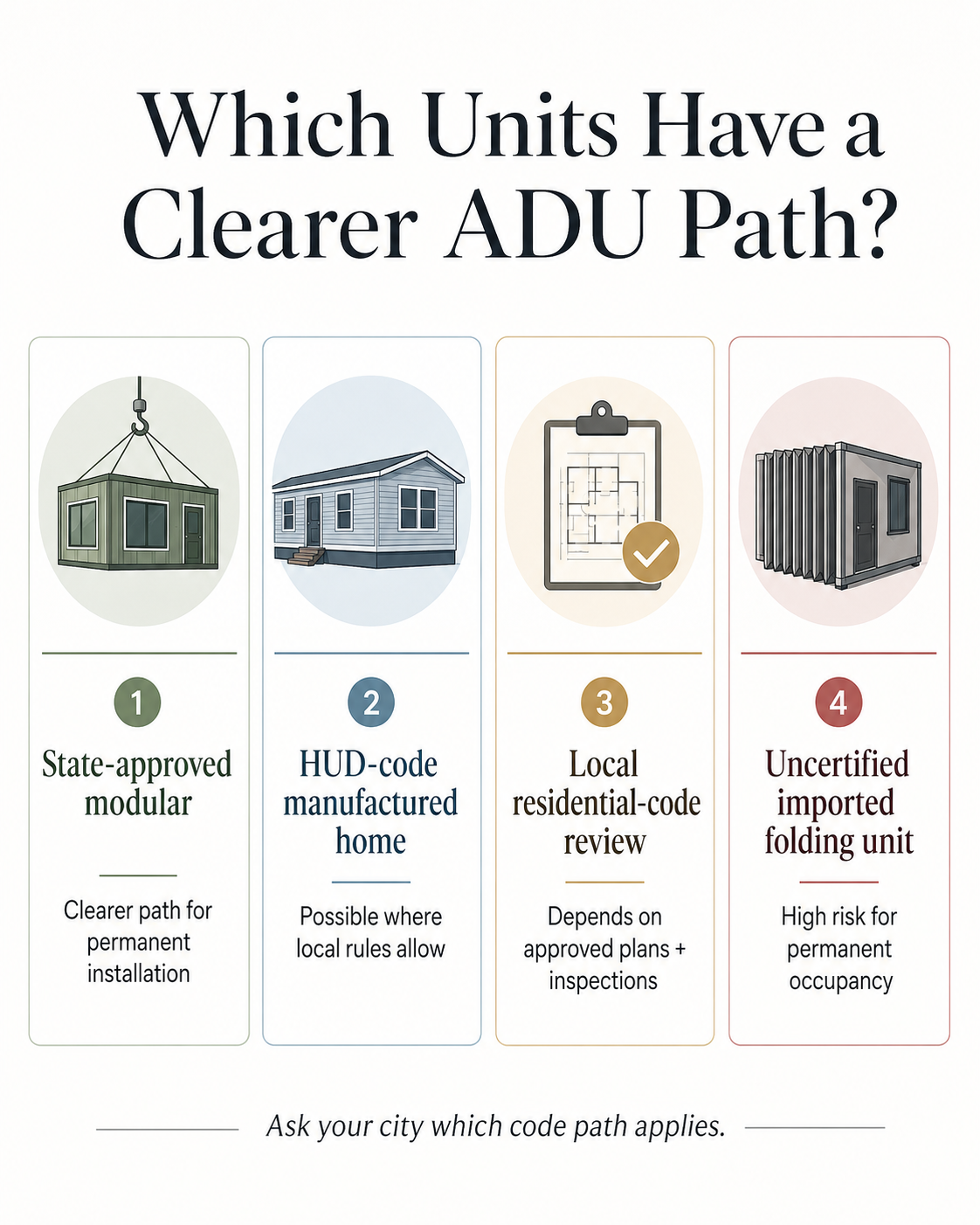
Where the Boxabl Casita genuinely fits. Boxabl is the best-known U.S. foldable-home brand in this category, sold as an ADU-capable unit with composite steel-and-foam panels, insulation, and pre-installed electrical, plumbing, and HVAC. Pricing runs from a non-turnkey base near $60,000 (you arrange site work and installation) up to turnkey packages around $150,000 for the Studio (Boxabl, 2026). Boxabl has a clearer permitting path where its approvals, installer scope, and local documents match your jurisdiction — and it tells buyers directly to confirm local zoning before placing one. That accountability is the difference between an engineered foldable and a folding import.
Compare foldable & portable prefab options
Explore current models with documented specs and a path that can actually be permitted. Check availability in your state.
See Current Pricing & Models →Disclosure: This link is reader-supported and may earn us a commission at no extra cost to you. We sort comparisons by neutral criteria — price, size, timeline, service area — never by compensation.
Why certification controls financing, insurance, and resale
This is the quiet reason certification matters so much. A permitted ADU on a permanent foundation generally becomes part of your real property: a lender can underwrite against it, an insurer can write a standard policy, and an appraiser can credit it in a sale. An uncertified box without a certificate of occupancy often sits in limbo — too permanent to insure as an RV, too uncertified to count as a dwelling.
If it never passes inspection, cash spent on it is largely unrecoverable. Financing a certified build, by contrast, ties your money to something the bank, the appraiser, and the insurer all recognize. See our guide on ADU appraisal requirements for how lenders and appraisers evaluate ADU additions.
What’s the cheapest legal ADU path if an expandable import won’t work?
The dream behind “expandable prefab ADU” — affordable, fast backyard housing — is real and achievable. It’s just reached through a different door. Here are the levers that actually reduce legal ADU cost.
Cost levers that actually reduce a legal ADU’s cost
| Lever | Legal basis | Where it applies | What it does NOT do |
|---|---|---|---|
| Stay at/under 750 sq ft | California law bars impact fees on ADUs ≤750 sq ft of interior livable space; larger ADU impact fees must be proportionate | California (verify your city) | Does not waive utility connection or capacity charges — those are separate from “impact fees” |
| Use the pre-approved plan process | California requires local agencies to offer an ADU plan pre-approval process (AB 1332) | California; many cities nationwide offer similar | Does not require every city to own plans or give drawings free; you may still pay the provider’s licensing cost |
| Pre-approved-plan review speed | City of San Diego: 30-day review for pre-approved-plan applications | San Diego (example) | Does not remove permit/impact fees or site-work cost |
| Choose a certified modular unit | State factory-built (modular) approval is a recognized code path | Nationwide (program varies by state) | Does not eliminate local permits, foundation, or utility work |
Sources: California Government Code on ADU impact fees (\u2264750 sq ft); AB 1332 (ADU plan pre-approval process); City of San Diego ADU program (30-day pre-approved-plan review), 2025–26. California examples are state-specific — confirm your own jurisdiction’s rules.
A note on geography: the figures above are California examples, included because California has the most developed ADU framework in the country. See our full guide on California ADU laws (AB 1332, impact-fee rules). Your city’s size limits, fees, and review timelines are what govern your project.
Finance it as the home improvement it is
We present financing as lanes, not lender rankings. Common lanes for ADU projects:
- Cash-out refinance or construction loan — useful when you have significant equity and want one loan covering the build.
- Renovation loan — folds the ADU into a single home-improvement loan, sometimes based on the home’safter-renovation value.
- Home-equity products (HELOC / home-equity loan) — draw against existing equity; availability and terms vary by state and lender.
We don’t quote rates, payments, or “easy approval” promises. What we can say is that financing a certified build keeps your money attached to something a bank, appraiser, and insurer all recognize. See our full ADU financing lanes guide.
Financing content here is educational, not a recommendation of a specific loan. We never sort options by compensation. Rates, payments, and qualification depend on your individual circumstances and current market conditions.
Explore ADU Financing Paths
Educational only. We present financing lanes, not lender rankings. No rates, APRs, payments, or approvals are promised.
Explore ADU Financing Paths →Disclosure: This link is reader-supported and may earn us a commission at no extra cost to you.
Honest tradeoffs: who an expandable import is genuinely right for
We’re not here to tell you these units are worthless — that would be as dishonest as the ads that oversell them. The legitimate uses:
- Non-dwelling structures. If no one needs to legally live in it, most certification hurdles fall away. A folding unit as a detached office or studio can be genuine value — still check local rules for accessory structures, electrical permits, and setbacks.
- Permissive rural lots. Some rural counties have lighter requirements. If you’ve confirmed in writing with your building department that an uncertified unit can be occupied on your specific parcel, the economics can work.
- Off-grid or recreational use. As a seasonal cabin on raw land, the calculus changes again.
The dealbreakers we won’t soften: no recognized U.S. code path means likely no certificate of occupancy, likely no standard financing, and likely no standard insurance. Poorly built steel-and-glass boxes also have well-documented condensation, rust, and thermal problems without proper insulation and drainage. And the freight-plus-duty math in 2026 erases much of the apparent savings before the unit reaches your lot.
Frequently asked questions
Are expandable container homes legal?
It depends on certification and local zoning. To be legally occupied as a permanent dwelling or ADU, a factory-built unit generally needs a U.S.-recognized code path — state-approved modular/factory-built status, a federal HUD label (manufactured homes), or local residential-code review with a stamped plan set — plus compliance with local zoning. Most low-cost imported expandable units disclose none of these and therefore cannot receive a certificate of occupancy as an ADU without major added work. Confirm with your local building department before buying.
Can you live in an expandable prefab home full-time?
Only if it’s permitted and certified as a dwelling for your jurisdiction. A state-approved modular unit or HUD-labeled manufactured home on a permanent foundation can support full-time occupancy where zoning allows; an uncertified import or a trailer-mounted, RV-classified unit generally cannot.
How much does an expandable prefab ADU really cost?
Imported units are often advertised at $5,000–$20,000 EXW (factory-door price), but the realistic all-in cost for a permitted, occupiable expandable prefab ADU is roughly $45,000–$120,000+ once you add ocean freight, U.S. import duties, a foundation, utility hookups, permits, and code-upgrade work. The advertised sticker is rarely more than half the true cost.
Do expandable prefab homes need a permit?
Yes. In virtually every U.S. jurisdiction, installing a habitable ADU requires a building permit, inspections, and a certificate of occupancy regardless of whether the unit was prefabricated. Permitting also takes time — for example, the City of San Diego reviews pre-approved-plan ADU applications within 30 days, and other review paths can take longer.
Are the cheap Chinese expandable homes a scam?
Not inherently — the units physically exist and EXW pricing is a legitimate trade term. The problem is that EXW (factory-door) prices are routinely presented as if they were finished, delivered, installed prices, and the units typically lack a U.S.-recognized code path for legal ADU occupancy. The risk is less ‘fraud’ and more ‘buying something you can’t legally use.’
Can I use an Amazon, Walmart, Home Depot, or Alibaba prefab as an ADU?
Only if that specific unit has a U.S.-recognized code path and clears your local permit and inspection process — the retail channel confers no legal status. Many marketplace listings are the same uncertified imports under a familiar storefront, so run the seller-document checklist on any of them before treating it as an ADU.
Will an expandable prefab ADU add resale value?
A properly permitted, certified ADU generally adds usable space and rental potential, which can support property value — but actual impact depends on local market conditions and appraisal. An unpermitted or uncertified unit can do the opposite, since appraisers and lenders typically won’t credit a structure without a certificate of occupancy, and an unpermitted dwelling can complicate a future sale. These are illustrative examples, not guarantees of returns. Actual results depend on local market conditions, construction costs, financing terms, and regulatory approvals.
What is the lifespan of an expandable container home?
Steel-framed units can last decades if properly insulated, sealed, and maintained, but poorly built imports are prone to condensation, rust, and mold without proper drainage and insulation. Longevity depends heavily on build quality and climate — another reason certification and engineering matter.
Methodology & sources
Dwelling Index is an independent research resource covering ADU financing, costs, and regulations. We do not manufacture units, build ADUs, or lend money directly; we may earn referral compensation from partner links, disclosed above.
How we built the cost reconciliation. We took a real, currently-listed EXW price for an imported expandable unit (CASA BOX), then added each downstream cost using current 2026 sources: ocean-freight indices for China-to-U.S. container shipping; CBP guidance and Ruling N314354 for import classification and duty; and city ADU fee schedules (Los Angeles fee appendix and San Diego ADU program), plus foundation and utility-hookup ranges from ADU cost sources. The “true all-in” range is our assembled estimate; individual projects vary with lot conditions, jurisdiction, and unit.
What is verified vs. requires your confirmation. Listed prices, freight ranges, the LA permit-fee examples, the San Diego 30-day review, the HUD certification-label requirement, and the California impact-fee/pre-approval statutes are sourced and dated. Import duty is deliberately presented as “get an HS-code-specific broker quote” rather than a fixed percentage, because 2026 tariff policy is in motion and the only reliable number is a broker’s written quote for your unit’s classification. Confirm code path and fees with your local building department before you rely on any figure here.
Primary and authoritative sources: HUD / eCFR 24 CFR Part 3280; California HCD factory-built housing program; CBP Ruling N314354 and CBP Section 301/IEEPA guidance (2026); CBP de minimis notice (2025); City of San Diego ADU program; City of Los Angeles Housing Element fee appendix; California Government Code on ADU impact fees and AB 1332. Commercial/market sources (dated, used as market inputs only): CASA BOX listing (2026); Boxabl investor-relations and Casita pages (2026); Critchfield Construction prefab guide (2026). Voice-of-customer context only (not used for legal or cost claims): ADU forums and homeowner discussions.
This page does not carry a personal author byline or expert-reviewer credential, because we will not invent one. It is editorial research by the Dwelling Index team, last verified on the date shown above. Import/EXW prices and freight ranges are re-checked quarterly; duty and tariff guidance and California ADU statutes are re-checked at least twice yearly against primary sources; partner availability is re-checked quarterly.
Related guides
Download the Free ADU Starter Kit
Seller-document checklist, building-department email script, and permit-fee worksheet — everything you need before you buy any prefab unit.
Download the Free ADU Starter Kit →See what’s possible at your address
Get your free ADU report in 60 seconds. Before you commit to any unit, find out what your specific lot can legally support — size limits, setbacks, and the ADU type that fits.
Get Your Free ADU Report →Your address, your rules, no obligation.