
Prefab ADU Utility Hookups: Water, Sewer, Electric, Gas & 2026 Cost Risks
By The Dwelling Index Editorial Team · Last updated: May 31, 2026 · Last verified: May 31, 2026 · Dwelling Index is an independent research resource covering ADU financing, costs, and regulations.
Overview
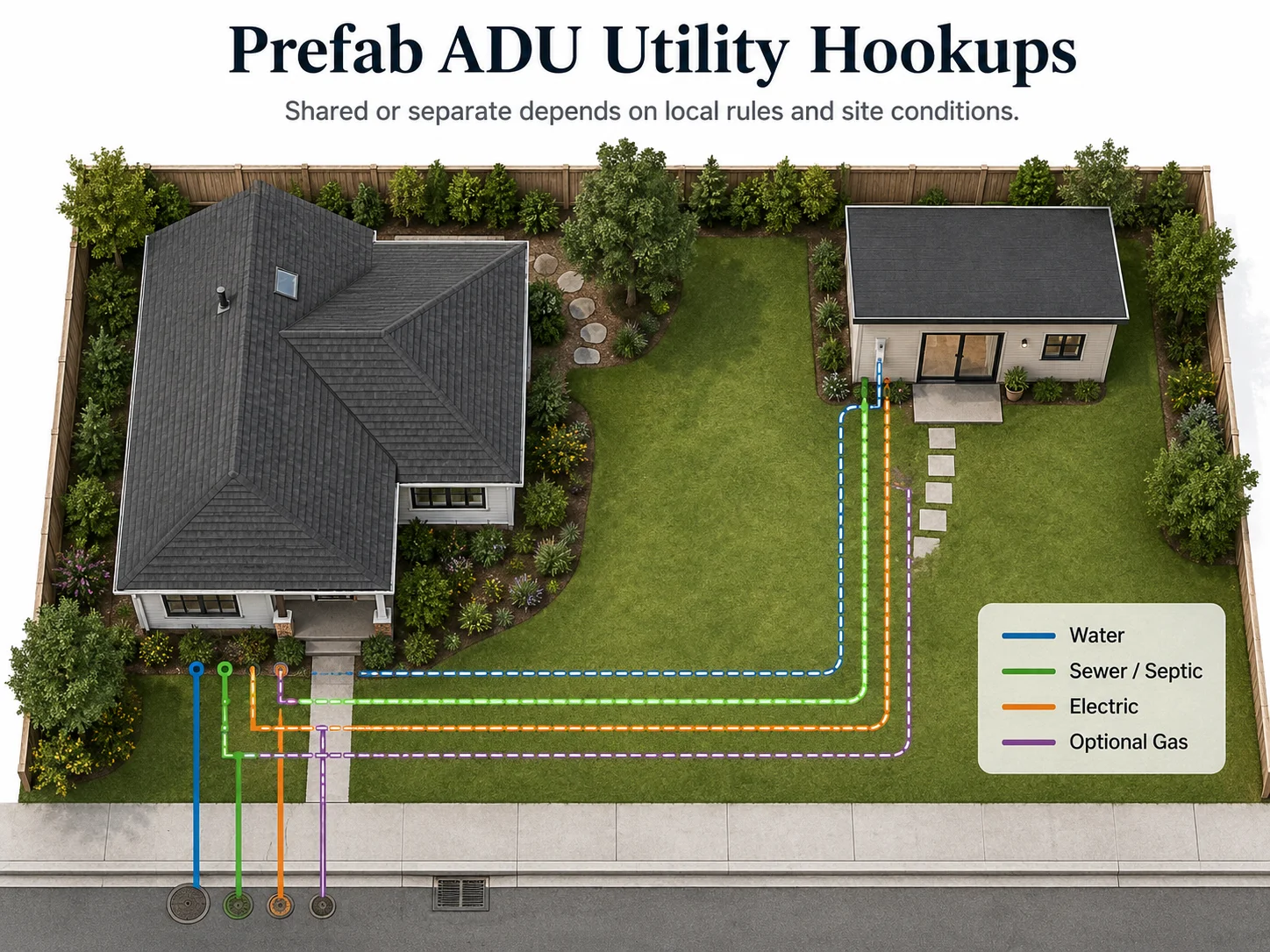
Prefab ADU utility hookups are the water, sewer (or septic), electrical, and optional gas connections that link a factory-built accessory dwelling unit to your property’s services — and they are almost never included in an advertised prefab “unit” price. For most homeowners, ordinary hookup work falls in a planning range of roughly $5,000 to $30,000+, but a single complication — a new sewer lateral, a sewage ejector pump, a separate electric meter, an undersized main panel, or a septic system at capacity — can pass that on its own. The number on your invoice comes down to six things: whether you’re on sewer or septic, how far the unit sits from existing lines, whether your electrical panel has spare capacity, whether you choose gas or all-electric, whether your site has enough slope for gravity sewer, and whether your city or utility requires separate meters.
Who this is for: anyone comparing prefab, modular, or manufactured ADUs who has a quote — or is about to get one — and wants to know what’s really included before paying a deposit. For the full prefab ADU cost breakdown, including unit prices, foundation, permits, and total project ranges, see our dedicated guide.
Fast answer: which prefab ADU utilities can usually be shared?
The first question almost every homeowner asks is whether the new unit can run off the main house or needs its own everything. Here’s the at-a-glance version; each row is unpacked further down.
| Utility | Can it share with the main house? | When separate service may be required or useful | Biggest budget risk |
|---|---|---|---|
| Electric | Often, through the existing service and a new subpanel — if the panel has spare capacity | Rental billing; utility rules; panel at capacity; city/utility requires a separate meter | Panel or service upgrade; utility scheduling delay |
| Water | Often, if the meter, service line, and fixture load allow | City requires a separate meter; fixture count exceeds capacity; clean rental billing | Water meter or service-line upgrade |
| Sewer | Often, if the lateral, slope, and fixture load work | Damaged or undersized lateral; no gravity slope; local rule requires separate connection | New sewer lateral or an ejector pump |
| Septic | Only if the system has spare capacity and the county health department approves | Existing system is undersized, or the ADU adds bedrooms/fixtures | Septic redesign or outright denial |
| Gas | Optional — skip it entirely with an all-electric design | Gas appliances; you want a separate gas meter | New gas meter or service; provider scheduling |
| Heating / ventilation | Provided inside the unit (often a heat pump) | — | Equipment is usually in the unit price; confirm it's included |
| Stormwater | Site-specific | New impervious area, grading, local stormwater rules | Drainage plan, drywell, or regrading |
| Internet / trash | Usually the easy part | Rental separation or city service rules | Billing and admin friction, not core construction cost |
“ADUs can share utilities” and “ADUs need separate utilities” are both wrong as blanket statements. The real answer is conditional: ADU type + your jurisdiction + the condition of your existing infrastructure + your utility provider’s process + how you’ll use the unit.
What utilities does a prefab ADU actually need?
Quick answer: A legal prefab ADU needs potable water, approved wastewater disposal through a public sewer or a septic system, electrical service, code-compliant heating and ventilation, permits, and passing inspections. Gas is optional — an ADU can be built all-electric and skip the gas connection. The prefab label changes how the structure is manufactured; it does not remove the need for site-built utility connections.
When a factory ships your unit, the walls, roof, fixtures, and interior wiring may already be done. What’s not done is everything that happens in the dirt between your existing services and the new unit: trenching, tying into or extending water and sewer, coordinating with the electric utility, pulling permits, and passing inspections before anyone can legally move in.
Internal rough-ins are not the same as exterior hookups
This is the distinction that catches the most people off guard.
A rough-in is the interior plumbing, wiring, and HVAC work the factory installs inside the unit — pipes to the walls, a load center or subpanel (a smaller electrical panel that branches off your main service), duct stubs, and fixture connections. A utility lateral is the underground pipe carrying water to the building or wastewater away from it; the sewer lateral runs from the building to the public main or the septic tank. The hookup is the work that connects those interior rough-ins to your property’s actual services.
A prefab quote can be “complete” from the factory’s point of view and badly incomplete from your budget’s point of view, because the factory price typically covers the box, not the lot.
The four utility decisions every prefab ADU buyer makes
Before you choose a model, you’re really making four decisions:
- Water — share the existing line, upgrade it, or run a separate metered service?
- Wastewater — tie into the existing sewer lateral, upgrade the lateral, add a pump, or get septic approval?
- Electric — branch off the existing panel with a subpanel, upgrade the main panel/service, or install a separate meter?
- Gas — design all-electric and avoid it, or coordinate a gas service and meter?
| Line item | Usually inside the prefab "unit" scope | Usually site / property scope |
|---|---|---|
| Interior plumbing | Yes | No |
| Exterior water trench and tie-in | Only if a turnkey contract says so | Yes |
| Interior electrical wiring | Yes | No |
| Main panel / service upgrade | No | Yes |
| Sewer or septic connection | Only if a turnkey contract says so | Yes |
| Gas line and meter | Usually no | Yes |
| Final city and utility inspections | Sometimes coordinated | Always property-specific |
Assembled from prefab scope documentation and builder guidance, 2025–2026. Always confirm against your own written contract.
Does your prefab ADU price include utility hookups?
Quick answer: Almost never. An advertised prefab or modular price — the “$99K,” “$120K,” or “$150K” figure — typically covers the manufactured structure only. Site preparation, foundation, permits, utility hookups, and sewer or septic work are billed separately, which is why an installed prefab ADU commonly costs far more than the sticker.
Here is the uncomfortable part, stated plainly: prefab does not eliminate the hardest, least predictable utility work. Factory construction can shorten the build and cut weather delays, but the trench, the meter, the panel, the lateral, the septic review, and the utility company’s schedule still live in your yard.
| Item the advertised price usually excludes | Typical added cost | Source |
|---|---|---|
| Site preparation / grading | $10,000–$30,000 | BuildX, Mar 2026 |
| Foundation | $25,000–$50,000 | BuildX, Mar 2026 |
| Permits & engineering | $5,000–$15,000 | BuildX, Mar 2026 |
| Utility hookups (water/sewer/electric/gas) | $10,000–$25,000 | BuildX, Mar 2026; ADUs by Avatar (Orange County), Jan 2026 ($5K–$15K+) |
| Sewer or septic connection | $20,000–$50,000 (septic system) | BuildX, Mar 2026 |
| Interior finish work | Varies by spec | BuildX, Mar 2026 |
An independent renovation guide put the same gap in concrete terms: a 600 sq ft prefab ADU advertised at $120,000–$180,000 reached $200,000–$300,000 all-in once site work, foundation, utilities, permits, and installation were added, with utility connections alone at $10,000–$30,000 (Block Renovation, Feb 2026). These are sourced planning examples, not quotes.
Three prices that sound alike and aren’t
| Price you see | What it typically covers | Utility scope risk | Ask |
|---|---|---|---|
| Unit price | The factory structure, delivered | Excludes nearly all site work and hookups | "What does this exclude?" |
| Installed price | Unit + delivery + crane set, sometimes the foundation | May still exclude utility upgrades, meters, fees, finishes | "Are utilities, meters, and fees in this?" |
| Turnkey price | Design through final inspection | Real turnkey can include hookups — but watch footage caps and excluded upgrades | "Is trenching, connection, meters, permits, fees, and any required upgrade included?" |
For the full price comparison, see our prefab ADU guide, prefab vs. site-built ADU cost breakdown, and what “turnkey” really includes.
How much do prefab ADU utility hookups cost in 2026?
Quick answer: For planning, ordinary prefab ADU utility hookups land in a band of about $5,000 to $30,000 for water, sewer, electric, and optional gas combined. Small conversions and attached units with short runs can come in around $5,000–$8,000; an average detached unit with moderate distances runs roughly $12,000–$18,000; and long trench runs, separate meters, a new lateral, or added gas can push a detached project to $25,000–$35,000 or more. A septic system that needs replacing is a separate event that can add $20,000–$50,000.
Cost by utility (national planning ranges, 2025–2026)
| Connection | Typical cost (detached ADU) | What pushes it up | Source |
|---|---|---|---|
| Electrical subpanel from main service | $2,000–$8,000 | Distance, trenching, spare panel capacity | ADU Builders Finder, Apr 2026; CCS/LA Construction Compliance, Nov 2025 |
| Panel / service upgrade (100A → 200A) | $2,000–$5,000+ | Age/capacity of existing panel; all-electric load | ADU Builders Finder, Apr 2026; Maxable, Feb 2025; Honeywill (Riverside County), Sep 2025 |
| Separate electric meter | $500–$5,000 (far higher in some utility territories) | Utility rules; separate service vs. submeter | ADU Builders Finder, Apr 2026; Maxable, Feb 2025 |
| Water — tie into the existing line | ~$1,500+ (short run) | Distance, trenching | CCS, Nov 2025 |
| Water — new service + meter | $4,000–$6,000+ | Encroachment permit, water tap, new meter, development fees | CCS, Nov 2025; City of Sacramento ADU |
| Sewer — tie into the existing lateral | $2,000–$5,500 (short run) | Distance, slope | CCS, Nov 2025; ADU Builders Finder, Apr 2026 |
| Sewer — new or upgraded lateral | $5,000–$15,000 | Street-work permits, depth, lateral capacity | ADU Builders Finder, Apr 2026 |
| Sewer ejector / grinder pump (no gravity slope) | +~$5,000 | Less than ~1 ft of fall per 50 ft of run | SnapADU (San Diego context), Feb 2026; ADU Utah |
| Septic — new or expanded system | $20,000–$50,000 | Soil/percolation, added bedrooms, capacity | BuildX, Mar 2026 |
| Gas line (if not all-electric) | ~$2,000–$4,500+ | Distance; CPUC subsidy change for mixed-fuel builds | CCS, Nov 2025; SnapADU (San Diego context), Feb 2026 |
| Separate gas meter | $5,000–$10,000 | Site complexity; utility coordination | SnapADU (San Diego context), Feb 2026 |
| Trenching (shared) | $25–$200 per linear foot | Soil, obstructions, distance, single vs. multiple trenches | SnapADU (sitework), Mar 2026; CCS, Nov 2025 |
| Internet / data | $200–$1,500 | Wi-Fi extension vs. a hardwired or separate drop | CCS, Nov 2025 |
The figures above are builder and cost-guide planning examples (2025–2026), not official fees or firm quotes. Government connection, capacity, and impact fees are a separate category — see the city fee matrix further down.
The low / medium / high cost-risk matrix
Assembled from several 2025–2026 sources rather than one builder, so it reflects national patterns instead of a single market.
| Band | Lot profile | Estimated total hookups |
|---|---|---|
| Low | JADU, attached, or small detached; short runs; existing panel has capacity; gravity sewer; all-electric; shared meters | ~$5,000–$8,000 |
| Medium | ~800 sq ft detached; moderate distance; 100A subpanel or modest panel upgrade; gravity sewer; all-electric; one new meter | ~$12,000–$18,000 |
| High | ~1,000 sq ft detached; long runs; separate service and meters; ejector pump or new lateral; gas added | ~$25,000–$35,000+ |
| Septic wild card | Any band above, plus an inadequate septic system | +$20,000–$50,000 |
Bands anchored on CCS/LA Construction Compliance sample scenarios (Nov 2025: ~$7,700 / ~$17,500 / ~$32,500) and cross-checked against the per-utility ranges above. Planning examples, not quotes — your cost depends on your city, utility, lot layout, trench distance, panel, slope, water and sewer condition, septic status, and permit requirements.
See What You Can Build — Get Your Free ADU Report
It flags the utility runs and upgrades most prefab quotes leave out — including whether your lot can share services or will need separate meters — before you commit to a model.
See What You Can Build → Get Your Free ADU ReportFree. Takes about 60 seconds. No obligation.
Cost by utility, explained: water, sewer, electric, and gas
This is the “why” behind the numbers. Read the one keeping you up at night.
Electrical: subpanel, panel upgrade, and separate meters
Quick answer: Most detached ADUs are powered by a dedicated subpanel fed from the main house’s electrical service, the least expensive path when the main panel has spare capacity. A standard ADU often needs about 100 amps of dedicated service; an all-electric unit with a heat pump and electric water heating is commonly planned at 200 amps. Older homes with 100-amp panels frequently need a 200-amp service upgrade ($2,000–$5,000+), and a separate utility meter — useful for rental billing — adds cost and utility coordination (ADU Builders Finder, Apr 2026; Honeywill, Riverside County, Sep 2025).
Two questions decide your electrical cost: Does my existing panel have room for the ADU’s load? and Do I want or need a separate meter?
If your panel is maxed out, you’ll pay for a panel or service upgrade. If you want the ADU billed separately, a separate electric meter creates an independent account but adds meter, panel-layout, and utility-scheduling work. A common alternative is a submeter — a private device that tracks the ADU’s usage so you can bill a tenant, without creating a separate utility account. A submeter solves billing; it does not add capacity or satisfy a utility’s requirement for separate service.
Costs here are regional. In San Diego Gas & Electric (SDG&E) territory, a builder reports that a separate ADU electric meter typically runs in the mid-five figures once utility coordination, trenching, and panel changes are included (SnapADU, San Diego context, 2026). Treat that as a local utility-review question, not a national rule.
Water: tie-in versus a new metered service
Quick answer: Detached ADUs can often tie into the water line that already serves the main house, which is the cheaper path when the existing meter and service line have capacity for the added fixtures. A separate water service is more expensive because it adds an encroachment permit, a new water tap into the main, a new meter, and development fees.
Whether you can share comes down to fixture units — a plumbing-code measure of demand — and the size and condition of your existing meter and service line. Add enough fixtures and an older, undersized service may need upgrading, which is where water costs climb. If your city or water district requires a separate meter (some do above a size threshold — see the fee matrix below), the meter and processing fees are unavoidable.
Sewer: the lateral, the slope, and the ejector-pump trap
Quick answer: Tying into the existing sewer lateral is the cheapest wastewater path; a new or upgraded lateral runs $5,000–$15,000, and if your site lacks enough downhill slope for gravity flow, you’ll need a sewage ejector pump that typically adds about $5,000. A practical rule of thumb builders use: a sewer line needs roughly one foot of drop for every 50 feet of horizontal run to flow by gravity (ADU Builders Finder, Apr 2026; SnapADU, Feb 2026).
Sewer is the line item most likely to blow up quietly, because problems hide underground. If the existing lateral is old, undersized, damaged, or too flat, you may need to replace it — and street-work permits can apply if the work reaches the public right-of-way. In San Diego County, one builder reports that when an existing lateral must be upgraded the work has run $20,000–$30,000 in Carlsbad-area examples (SnapADU, San Diego context, 2026). A pre-construction video inspection of your lateral is cheap insurance.
Septic: the budget wild card
Quick answer: If your property is on a septic system rather than a public sewer, your existing system may not have the capacity for the ADU’s added bedrooms and fixtures, and a new or expanded system can cost $20,000–$50,000. In states like Massachusetts, the septic regulation known as Title V governs what’s allowed, and county or local health departments must approve the design — they can also deny it (BuildX, Mar 2026).
Gas: usually optional, increasingly skipped
Quick answer: Gas is not required for an ADU — an all-electric design with a heat pump for heating, cooling, and water heating avoids the gas connection entirely. When you do add gas, a separate gas meter commonly costs $5,000–$10,000, and in California a 2023 California Public Utilities Commission decision (D.23-12-037) ended the subsidies that used to offset line-extension costs for mixed-fuel new construction, with customers paying actual costs as of January 1, 2025 (SnapADU, San Diego context, Feb 2026).
Our take: for most backyard ADUs, all-electric is the simpler and often cheaper path to connect — it removes a utility, a meter, a permit, and a scheduling dependency, and it sidesteps the California subsidy change above. The exception is a homeowner with specific gas needs. Your climate, appliances, local energy code, and utility rates can change the math.
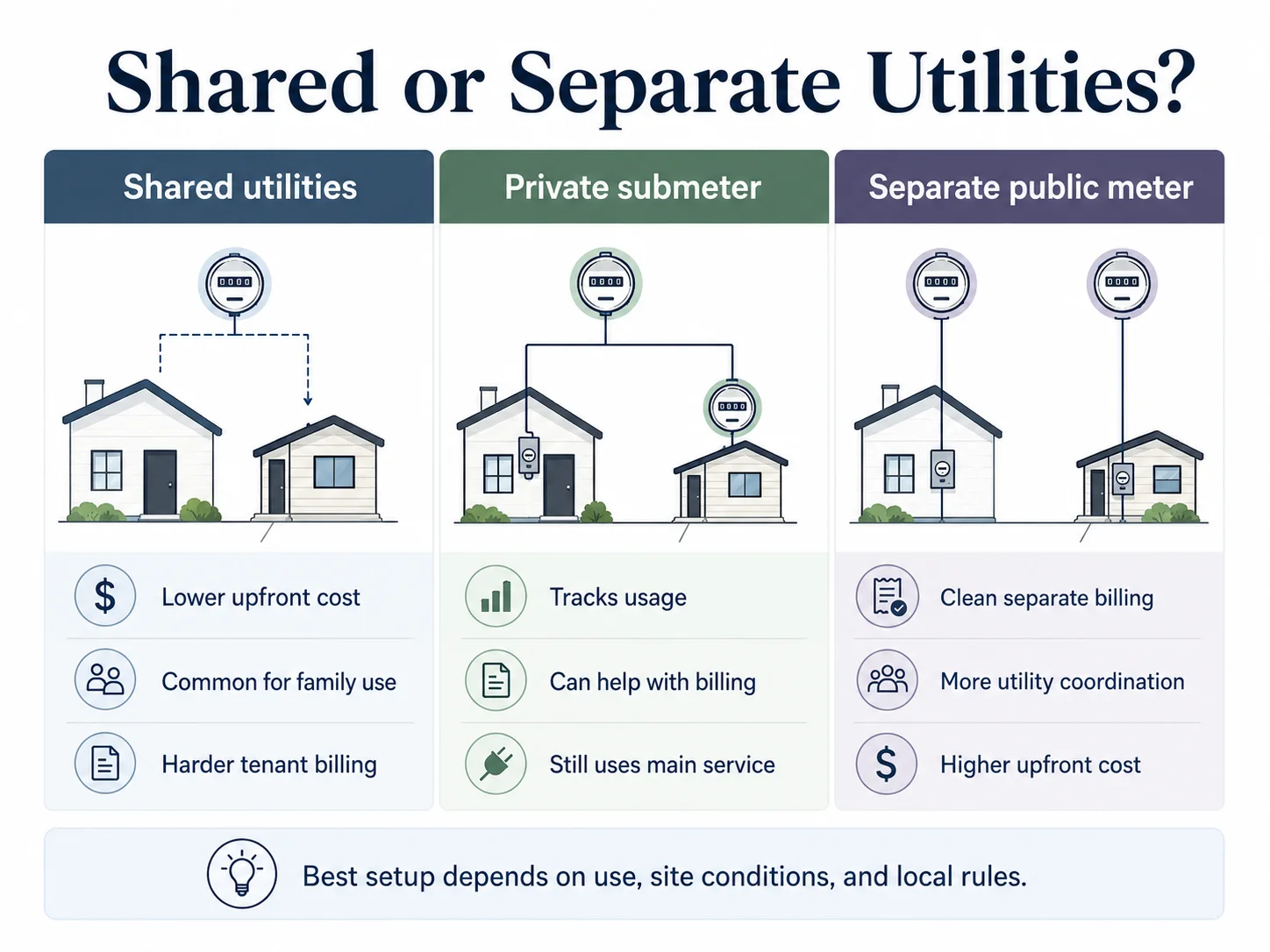
Can my prefab ADU share utilities with the main house?
Quick answer: Often, yes — and shared utilities are usually the cheaper, simpler path, especially for family use. But whether you can share depends on local code, utility rules, the capacity of your existing lines, fixture and electrical load, the condition and legality of your current connections, and your billing goals. Denver, for example, directs ADUs to share water, electric, and sewer “where feasible”; Portland offers shared and separate water-meter options but requires the ADU’s electrical circuits to be fully independent; and California law limits when a separate connection can even be required.
Sharing is mostly a question of capacity, not preference. The relevant checks: your electrical load calculation, your water meter and service-line capacity, your fixture count, your sewer lateral condition and slope, your septic capacity if applicable, and whether your existing service is legal and up to code.
Shared vs. submeter vs. separate public meter
| Option | Best for | Pros | Cons | Ask first |
|---|---|---|---|---|
| Shared utilities | Family, guest, or aging-parent use; non-rental | Lowest cost, simplest design | Harder to bill a tenant fairly | Does my city/utility allow sharing for this ADU type? |
| Private submeter | Long-term rental where a public meter isn't required | Tracks usage so you can allocate cost | May not create a separate utility account; varies locally | Is submeter billing legal and practical in my city? |
| Separate public meter | Rentals, a future-sale strategy, or where the utility requires it | Clean billing, independent account | Higher cost, utility scheduling risk | What's the cost and timeline for a separate meter here? |
Real-world examples: Santa Rosa, CA requires a separate water meter only for new ADUs over 750 sq ft; Denver directs sharing “where feasible”; Portland allows shared/separate water but mandates independent ADU electrical circuits; in San Diego, separate electric meters can run into the mid-five figures.
Do I need separate meters for an ADU?
Quick answer: Not always. Separate meters make rental billing cleaner, but they add cost, design work, utility review, and schedule risk. For many family-use ADUs, shared service is simpler where it’s allowed and the existing systems have capacity. For rentals, a separate electric meter is usually the first one worth evaluating; water and gas separation are more variable and depend heavily on your city and utility.
Separate electric meter. Helps most when you’re renting and want the tenant on their own account. Some utilities or cities require it; others leave it optional. Cost swings widely by territory — from a few hundred dollars on the low end to the mid-five figures in high-cost utility areas like San Diego (SnapADU, 2026).
Separate water meter. Required in some jurisdictions, optional in others, and frequently tied to ADU size. Santa Rosa, California requires no separate water meter for new ADUs up to 750 square feet but requires one above that (City of Santa Rosa Water, effective Jan 1, 2025). Where it’s required, expect meter and processing fees on top of the install.
Separate gas meter. Only relevant if you’ve chosen gas. It can add provider scheduling time and $5,000–$10,000. Going all-electric removes the question.
Submetering for rentals. A submeter is useful for allocating cost but is not a substitute for code capacity, and it doesn’t fix an undersized panel, water line, sewer lateral, or septic system. Billing tenants for utilities can also implicate state landlord-tenant law and local rules — verify before you build a billing plan around it. This is educational information, not legal advice.
The six factors that decide whether you pay $5K or $35K
Quick answer: Six property conditions drive almost all of the variance in prefab ADU hookup costs: whether you’re on sewer or septic, the distance from the unit to existing lines, your main panel’s spare capacity, gas versus all-electric, the slope available for gravity sewer, and whether separate meters are required or desired.
- Sewer or septic? Public sewer is predictable; septic is the wild card that can add $20K–$50K.
- Distance to existing lines. This drives trenching at $25–$200 per linear foot — a 100-foot run is a different project than a 20-foot run.
- Main panel capacity. A maxed-out 100-amp panel usually means a $2,000–$5,000+ upgrade.
- Gas or all-electric? Gas adds a line, a possible $5K–$10K meter, and (in California) the end of mixed-fuel subsidies.
- Slope to the sewer connection. Too little fall means a +$5,000 ejector pump.
- Separate meters? Each one adds cost and utility coordination.
The 10 red flags that signal an expensive hookup
| Red flag | Why it matters |
|---|---|
| The ADU sits far from the main house | Longer trench, more restoration, more labor |
| A driveway or patio must be cut to reach utilities | Hardscape removal and restoration add cost |
| The main panel is undersized | Panel or service upgrade may be required |
| You want a separate electric meter | Utility coordination and new meter work |
| The water meter or service line is undersized | Upgrade can be expensive |
| The sewer lateral is old, damaged, or undersized | Replacement can exceed a normal hookup |
| The ADU sits lower than the sewer line | An ejector pump is likely needed |
| The septic system is near capacity | The health department may require an upgrade — or deny the unit |
| You've selected gas appliances | Gas meter and service coordination |
| The quote says 'utilities by owner' | You're carrying unknown risk |
Each of these has a real-world price tag: too little sewer slope means a roughly $5,000 ejector pump; an undersized lateral has run $20,000–$30,000 in San Diego-area examples; and a new water or wastewater connection can require an engineered tap plan, fees, and a right-of-way permit before you even get a building permit (Austin Water). The upgrade you discover after a capacity or slope review, not the basic tie-in, is what breaks budgets.
The design principle most people miss: ADU placement should consider the utility route, not just setbacks and views. Moving a unit ten feet closer to your existing lines — within the rules — can be worth thousands in trenching and restoration. (A setback is the minimum required distance between a structure and a property line.)
What your city can legally charge: ADU connection and capacity fees decoded
Quick answer: Utility connection fees (also called demand fees) and capacity charges are one-time fees a water or sewer agency charges to add a new connection or new demand to its system — and they’re set locally, so the same prefab unit can owe very different fees in different cities. In California, statewide law sharply limits these fees for ADUs, but it treats three fee types differently, so read each one separately. Outside California, you must check your own city and utility.
A few terms, defined
- Connection fee / demand fee — a one-time charge to physically connect to (and add demand to) a water or sewer system.
- Capacity charge — a one-time charge for the system capacity your new connection uses, often calculated per Equivalent Dwelling Unit (EDU) or by drainage fixture unit (DFU) values from the plumbing code.
- Impact fee — a one-time charge to fund off-site infrastructure (roads, parks, schools) tied to new development. In California’s ADU statute, “impact fee” is defined to exclude connection fees and capacity charges.
- System Development Charge (SDC) / Additional System Development Charge (ASDC) — terms some agencies (e.g., Portland, Denver Water) use for capacity-type fees.
- Ministerial approval — approval based on objective standards, without discretionary review or a hearing; ADUs that qualify get streamlined treatment under state law.
California, decoded (correctly cited for 2026)
California’s ADU statutes were renumbered by SB 477, effective March 25, 2024 — they moved from Government Code § 65852.2 and related sections into a consolidated chapter at Government Code §§ 66310–66342. The move was organizational, not substantive. We flag this loudly because many city ordinances and even current articles still cite the repealed § 65852.2; if you see that number, the rules haven’t disappeared, they’ve just been renumbered.
| Your situation | What California law says (Gov. Code §§ 66310–66342) | Plain English |
|---|---|---|
| Fee-type basics | Three different one-time charges can apply — impact fees, connection fees, and capacity charges — and the statute's definition of "impact fee" expressly excludes connection fees and capacity charges | Waiving one does not waive the others. Read each line of your fee estimate separately. |
| Impact fees | No impact fee for an ADU of 750 sq ft or less of interior livable space (a JADU, capped at 500 sq ft, is always within this); larger ADUs pay impact fees proportionate to the primary dwelling's square footage | A small ADU owes no impact fees — but that does not mean no connection fee or capacity charge. |
| ADU within existing space / §66323(a)(1) units | A local agency, special district, or water corporation generally may not require a new or separate utility connection or impose a related connection fee or capacity charge — except when the ADU is built with a new single-family home or separately conveyed under § 66342 | Convert existing space (or build a qualifying ministerial unit) → usually no new connection and no connection/capacity fee. |
| New detached ADU needing a separate connection | A new or separate connection may be required; any connection fee or capacity charge must be proportionate to the ADU's burden — by square footage or DFU values — and may not exceed the reasonable cost of service | A new detached unit can be charged, but the fee must scale to the ADU's size/load, not be billed like a separate house. |
| "New residential use" | An ADU shall not be treated as a new residential use when calculating water/sewer connection or capacity charges (unless built concurrently with a new single-family home) | They can't count your ADU as a brand-new home for capacity-fee math. |
| Utility response time | AB 2221 requires the utility to respond within roughly 60 days | The utility can't sit on your request indefinitely. |
| Faster-hookup bill | SB 1196 proposes firm hookup timelines and penalties for delays — homeowners have reported 9–12 month waits | A bill aims to force utilities to connect ADUs faster. |
Sources: California Legislative Information (leginfo.legislature.ca.gov), Gov. Code § 66311.5 (connection/capacity charges and “new residential use”), § 66323 (qualifying/conversion units), § 66342 (separate conveyance), § 66013 (reasonable-cost basis); California HCD ADU Handbook (2025–2026); SB 477 (renumbering); SB 543 (2025 updates, effective Jan 1, 2026); SB 229 legislative analysis. Verified May 31, 2026.
The city fee & rule matrix (national, source-backed)
| Jurisdiction (source) | The rule | What it means before you sign |
|---|---|---|
| California — statewide · Gov. Code §§ 66310–66342 | ADU isn't a "new residential use" for connection/capacity fees; conversion / §66323(a)(1) units generally owe no new connection or connection/capacity fee; new detached units pay only a proportionate fee; no impact fee ≤750 sq ft (and "impact fee" excludes connection/capacity charges) | A conversion or small ADU may owe little or nothing in fees; a large new detached unit can still owe a proportionate connection/capacity charge. |
| Ramona Municipal Water District, CA (San Diego Co.) · San Diego Union-Tribune, Feb 2023 | Listed capacity fees ≈ $11,000 (water) + $16,000 (sewer) for a single-family home; no capacity fees for an ADU added to an existing home; later voted to waive even for concurrent builds | Capacity fees can rival the unit's foundation cost — but the "existing home" exemption can erase them. Verify your district's current schedule. |
| Santa Rosa, CA · srcity.org Water FAQ & fee schedule (eff. Jan 1, 2025) | New ADUs ≤750 sq ft: no water/sewer demand fees, no separate-meter requirement (meter optional, with a processing fee). New ADUs >750 sq ft: demand fees and a separate water meter required. Conversions ≤1,200 sq ft: exempt | A 751-sq-ft unit can cost meaningfully more than a 749-sq-ft one. Size your unit with the threshold in mind. |
| Portland, OR · portland.gov; PP&D electrical guide | Waives the System Development Charge (SDC) for qualifying ADUs; the Water Bureau performs the public-right-of-way water work; a sewer-lateral permit is required for a new public connection. Electrical: an ADU's circuits must be fully independent of the main dwelling and cannot share loads | Fee relief exists, but plan a fully separate ADU electrical circuit set — you can't simply branch off shared loads here. |
| Denver, CO · denvergov.org; Denver Water | Directs ADUs to share water, electric, and sewer "where feasible." Denver Water says running water service to an ADU requires a water supply license plus an additional system development charge; some non-copper service lines may need replacement | Sharing is the default, but budget for Denver Water's license + charge, and check your service-line material. |
| Seattle, WA · seattle.gov (SDCI) | An ADU isn't legal unless permitted; permits are reported to King County for a sewer treatment capacity charge; the project may need Seattle City Light service changes. Pre-approved DADU plans can permit in ~2–6 weeks (standard-plan track only) | Expect a King County capacity charge and possible electric-service work; the fast permit timeline applies only to the city's pre-approved plans. |
| Worcester, MA · worcesterma.gov | Detached ADUs pay a sewer connection fee of ≈ $1,650 per bedroom; a plumbing permit is required to connect water from the main dwelling | A 2-bedroom detached unit carries ~$3,300 in sewer connection fees alone here — count bedrooms when budgeting. |
| Austin, TX · austintexas.gov; Austin Water | A structure with habitable space, a full bath, and a qualifying sink/dishwasher must meet dwelling-unit rules (zoning, utility meter, access, address). Austin Water lists impact fees for lots platted after Oct 1, 2023 at $4,800 (water) + $2,900 (wastewater) per service unit; new connections may require engineered tap plans, fees, and right-of-way permits | Whether a separate connection (and those impact fees) applies to your lot depends on Austin Water's review — confirm before you quote it as a cost. |
Building where fee waivers or special programs apply? See our guide to ADU fee-waiver programs.
See What You Can Build — Get Your Free ADU Report
A conversion or a sub-750-sq-ft unit may owe little or nothing in connection fees. See what your lot qualifies for before you choose a model.
Get Your Free ADU Report →What is the utility hookup process from quote to final inspection?
Quick answer: The usual sequence is: map your existing utilities, run load/fixture/sewer/septic capacity checks, decide shared vs. separate service, confirm city and utility rules, include the utility details in your plan set, pull permits and submit utility applications, trench and rough-in, pass inspections, connect the meters and services, and complete the final inspection before occupancy. The utility company’s own timeline is often the longest pole in the tent — California homeowners have reported 9–12 month waits for service connections, which AB 2221 and the proposed SB 1196 aim to shorten.
Map your existing utilities
Locate and document your electric panel and service, water meter and line, sewer cleanout and lateral (or septic tank and leach field), gas meter and line, stormwater path, and any driveways, trees, easements, or right-of-way a trench would cross. In many cities you can request your property's sewer-connection record from public works.
Decide shared vs. separate service
Tie this to how you'll use the unit (family vs. rental vs. future sale), using the shared/submeter/separate table above.
Run the capacity checks
An electrical load calculation confirms whether your panel can carry the ADU; fixture-unit counts and slope checks confirm the water and sewer can handle it; a septic professional confirms system capacity.
Submit city permits and utility applications
Connections typically involve multiple departments — planning, building, and public works — plus a separate application to the utility. Plan the utility application early — before the unit ships if possible. A new water/wastewater connection in Austin may require an engineered tap plan and fees before the building permit, plus a right-of-way permit (Austin Water). PG&E requires a formal "residential add meter" service request and trench coordination; trenching that fails PG&E standards causes delays. Seattle requires an SDCI permit and reports the permit to King County for the sewer treatment capacity charge.
Trench, connect, inspect, and restore
Call 811 before any digging (the free national service that marks underground lines). Use a licensed contractor, follow the utility's design standards, and budget for the full inspection sequence — typically an underground plumbing inspection, an underground electrical inspection, a gas pressure test if gas is involved, and rough and final inspections — plus restoration of any driveway or landscaping the trench disturbed.
Who actually pays for the utility upgrades?
Quick answer: Unless your written turnkey contract explicitly says otherwise, assume every item below is on you, not the factory. This is the single most expensive assumption homeowners get wrong, because the “unit” price made it feel handled.
| Cost item | Who usually pays |
|---|---|
| Main panel / service upgrade | Owner / site scope |
| Utility trenching | Owner / site scope |
| Sewer lateral replacement or upgrade | Owner / site scope |
| Water meter or service-line upgrade | Owner / site scope |
| Utility-provider connection, capacity, or impact fees | Owner / site scope |
| Right-of-way restoration | Owner / site scope |
| Driveway / hardscape repair after trenching | Owner / site scope |
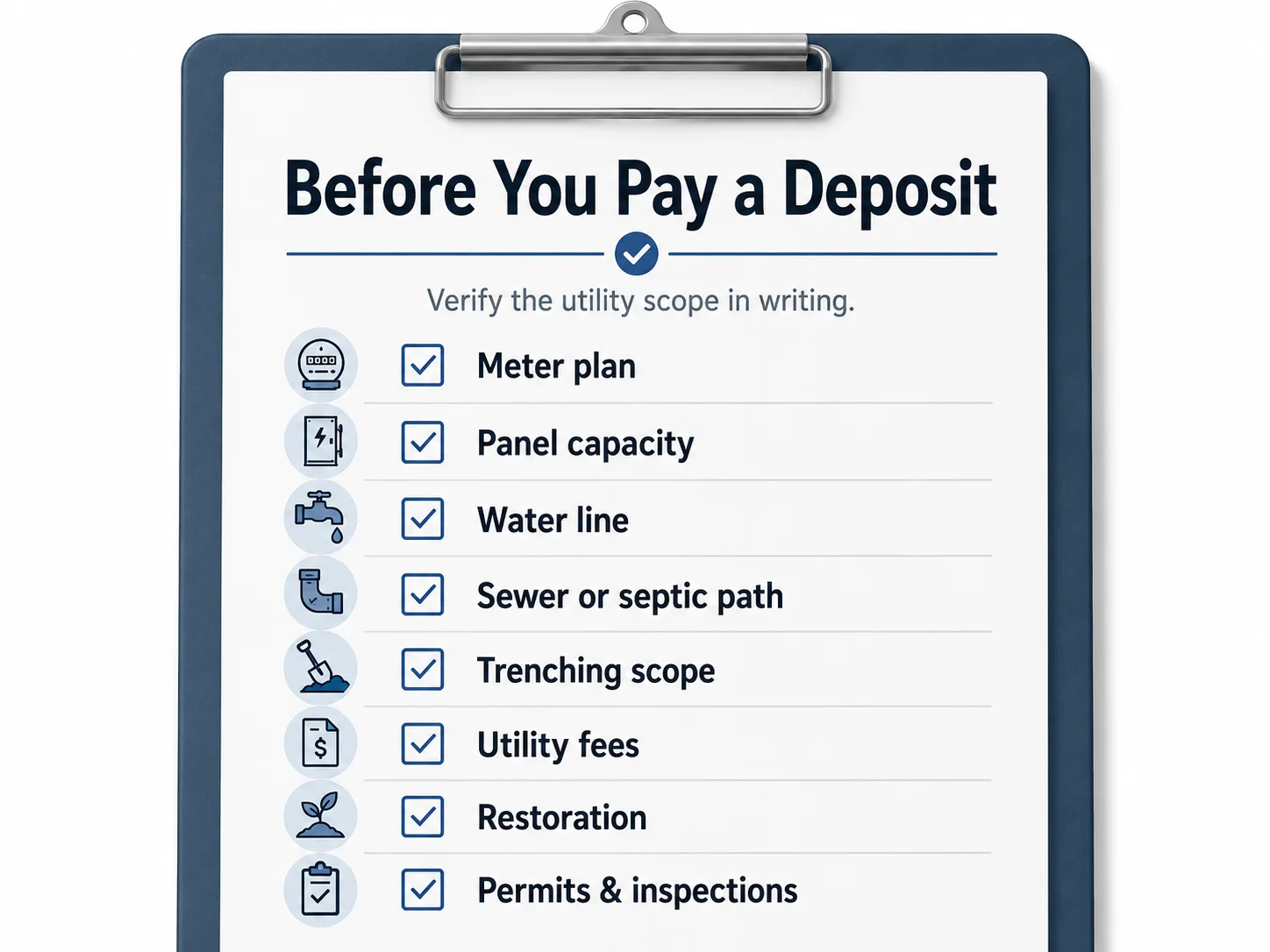
The fix is simple: get each of these named — included, an allowance, or excluded — in writing before you pay a deposit.
What should I verify before paying a prefab ADU deposit?
Quick answer: Get the utility scope in writing before any deposit. The decisive question is not “does the unit come with plumbing and electrical?” — it almost always does. The decisive question is “who pays for the trench, connection, meter, lateral, panel, permit, fee, utility-company work, inspection, and any upgrade if my existing system isn’t enough?” A quote that can’t answer that is a quote hiding risk.
Decode the quote language
| Quote phrase | What it usually means | Your utility risk | Ask before you sign |
|---|---|---|---|
| "Standard utility connections" | A baseline allowance, often assuming short runs and adequate existing capacity | Anything beyond "standard" (long trench, lateral upgrade, panel upgrade) is extra | "What distance and conditions does 'standard' assume, and what triggers an overage?" |
| "Site-specific" / "subject to site review" | Not yet priced; depends on your lot | The number can move a lot after a site visit | "Can you do the site review and give me a firm utility number before I pay a deposit?" |
| "By owner" / "utility work excluded" | You're responsible for trenching and connections | You carry the full, unbounded utility cost | "Can you scope and price it, or refer a contractor who will, before I commit?" |
| "Allowance: $X" | A placeholder budget, not a fixed price | If actual cost exceeds it, you pay the difference | "What happens if the real cost is higher — and how is the overage approved?" |
| "Trenching included up to 50 feet" | Only the first 50 feet is covered | Every foot past the cap is billed (often $25–$200/ft) | "How far is my unit from each existing line, and what's the per-foot rate beyond 50 feet?" |
| "Final connections by others" | Someone else hooks up the last mile | A coordination and cost gap at the most critical step | "Who exactly does the final connections, on what timeline, and at what cost?" |
The 12 utility questions to ask the prefab company
| Question | A good answer looks like | Red flag |
|---|---|---|
| Are utility hookups included? | A written scope with line items | "Usually," or "depends," with no allowance |
| Is trenching included? | Footage, depth, and restoration clearly stated | No trench distance or cap |
| Who handles the utility-provider applications? | A named party and a timeline | You discover this after the permit |
| Is a separate electric meter included? | Yes/no, with utility coordination scope | "Electric included" with no meter/panel detail |
| What if my panel is undersized? | A stated upgrade allowance or exclusion | No load calculation mentioned |
| Is water meter/service work included? | Included or excluded, with a capacity review | "Water hookup included," and nothing more |
| Is sewer lateral work included? | Scope distinguishes a tie-in from a lateral upgrade | No sewer condition or slope review |
| What if I need a sewer pump? | A pump allowance or exclusion is stated | Not discussed |
| Is septic review included? | The county health/septic process is identified | "We'll connect to septic" with no approval path |
| Is gas included, or is it all-electric? | The appliance plan and gas decision are stated | Gas assumed with no meter/service review |
| Are utility fees or capacity charges included? | Listed as included, an allowance, or your cost | "Permit fees not included," too vague to budget |
| Who restores the driveway, landscaping, and hardscape? | Restoration is in the scope | Trenching scope excludes restoration |
Before you pay a prefab deposit, check your property — Get Your Free ADU Report
Especially worth it if your quote says utilities are “by owner,” “TBD,” or “site-specific.” It takes about 60 seconds.
See What You Can Build → Get Your Free ADU ReportFree. Takes about 60 seconds. No obligation.
Get the Free ADU Utility Scope Checklist
The 12 utility questions to ask your prefab company before you sign — formatted as a printable checklist included in the free ADU Starter Kit.
Download Free Starter Kit →Are prefab, modular, manufactured, and tiny-home ADUs different for utility hookups?
Quick answer: The hookup requirement depends less on the marketing label and more on whether the unit is legally permitted as a dwelling on an approved foundation. Modular, manufactured, panelized, and site-built ADUs all need approved water, wastewater, electrical, inspections, and local permits. A tiny home on wheels or an RV-style unit may not qualify as an ADU at all in many jurisdictions — and if it doesn’t qualify, you can’t hook it up like a permitted dwelling.
- Modular prefab ADU. Built as factory modules, set on a permanent foundation, permitted under your state and local code. Normal utility connections apply.
- Manufactured home ADU. Built to the federal HUD code, subject to local zoning and placement rules. Utility connections are still required and inspected.
- Tiny home / park model. Often not a legal ADU depending on the jurisdiction, especially on wheels. Seattle treats a tiny house on wheels like a camper trailer that can’t be lived in as an ADU, while a tiny house on a permanent foundation may qualify as a detached ADU if it meets ADU requirements (Seattle SDCI). Confirm before you buy.
- Container ADU. Can still require structural engineering, a foundation, full utilities, permits, and inspections.
Compare build types in our modular ADU guide and our roundup of prefab ADU companies.
Should a rental ADU have separate utilities?
Quick answer: For a rental, a separate electric service — or at least a clear electric billing plan — is often worth evaluating first, but separate utilities are not automatically worth the cost. The right answer depends on local rules, tenant-billing law, your utility’s options, the meter cost, and whether you’ll rent long-term, house family, or eventually sell.
Best billing default by use case
| Use case | Utility billing default |
|---|---|
| Aging parent / family housing | Shared utilities are often simplest, where allowed |
| Long-term rental | Evaluate separate electric first; submeter the rest |
| Short-term rental | Shared may work if allowed; track costs internally |
| Future resale / condo-style strategy | A separate service may matter more — verify the legal path |
| House-hack (owner in one unit) | Separate or submetered electric helps avoid disputes |
Running the numbers on rent? See our prefab ADU rental income breakdown.
What if utility hookups make the prefab ADU too expensive?
Quick answer: If hookups push the project past your budget, “cancel” is rarely the only option. You can often move the unit closer to existing lines, switch to an all-electric design, share utilities where allowed, reduce the fixture count, choose a smaller unit, convert existing space instead of building detached, phase non-essential work, or revisit financing before you sign.
| The problem | A possible path |
|---|---|
| Long trench run | Move the ADU closer to the main utility path |
| Gas-service delay or cost | Choose an all-electric design |
| High water/sewer lateral cost | Smaller unit, fewer fixtures, or different placement |
| Septic capacity issue | A garage conversion, JADU, or smaller attached ADU where legal |
| Separate-meter cost | Shared utilities or a private submeter, where legal |
| Hookups blow up the budget | Rework the scope before the deposit, and compare financing paths |
On financing: utility work is part of your project cost, so it can usually be folded into the same funding you’d use for the build. Homeowners commonly cover ADU project costs through one of a few lanes — a renovation loan, a cash-out refinance, a construction loan, or a home equity line of credit (HELOC, a revolving credit line secured by your home’s equity). The right lane depends on your equity, your timeline, and your rate situation.
How we built this utility-hookup guide
Quick answer: We built this guide by separating three kinds of evidence and never mixing them. Official city, state, and utility sources were used for laws, fees, and process. Builder and cost-guide sources were used for planning ranges, clearly labeled as third-party examples rather than quotes. Homeowner language from forums and social groups was used only to understand the questions and anxieties people bring to this topic — never to prove a legal, code, or cost claim.
- Rules and fees: primary and authoritative sources — the California Government Code (via the official California Legislative Information site) and HCD guidance, and official municipal and utility pages (Portland, Worcester, Sacramento, Santa Rosa, Denver and Denver Water, Seattle/SDCI, Austin and Austin Water, PG&E).
- Cost ranges: dated builder and cost-guide sources, presented as planning examples and triangulated across publishers so no single market drives the numbers.
- Voice of customer: ADU forums and social groups, used for phrasing and decision friction only.
What this guide is not: it is not legal, engineering, or permitting advice; it is not a utility quote; and it is not a guarantee of permit approval, utility approval, financing approval, or final cost.
Last verified: May 31, 2026. Cost ranges are re-verified quarterly; California statutes and city fee schedules are re-verified each legislative session or on fee updates; utility-provider timelines are monitored in featured territories.
Frequently asked questions
Do prefab ADUs come with plumbing and electrical?
Many prefab ADUs arrive with interior plumbing and electrical systems already installed, but that does not mean the site utility hookups are included. The exterior water, sewer or septic, electrical service, trenching, meters, permits, and inspections are still property-specific and usually billed separately from the unit.
Are utility hookups included in a turnkey prefab ADU?
Sometimes. A true turnkey contract may include utility trenching and hookups, but typically only within a defined scope and footage limit. Upgrades such as a sewer lateral replacement, a primary-home panel upgrade, separate meters, city fees, or right-of-way work are often excluded or priced separately, so confirm the written inclusion/exclusion schedule before paying a deposit.
Can an ADU share electricity with the main house?
Often, but only if the city and utility allow it and the existing service can support the added load. A separate meter may be required or preferred for rental billing, but it adds cost and utility coordination, while a private submeter can handle tenant billing without a separate utility account.
Do ADUs need separate water meters?
Not always. Some cities allow shared water service if the existing meter and line can support the ADU; others require a separate meter in specific cases, often tied to size. Santa Rosa, California requires no separate water meter for new ADUs up to 750 square feet but requires one for new ADUs over 750 square feet (City of Santa Rosa Water, effective January 1, 2025).
Does a detached ADU need its own sewer line?
Not automatically. A detached ADU may be able to tie into the existing sewer lateral if the lateral, fixture count, slope, and local rules allow it. If the lateral is undersized, damaged, too flat for gravity flow, or not code-compliant, a lateral upgrade ($5,000–$15,000) or a sewage ejector pump (about $5,000) may be required.
How much does it cost to run utilities to a backyard ADU?
A reasonable planning range for ordinary utility-hookup work is about $5,000 to $30,000 or more, with difficult sites exceeding that. The largest swing factors are separate electric meters, water or sewer lateral upgrades, a sewage pump, septic work, right-of-way trenching, and panel upgrades, per builder cost guides and city utility pages, 2025–2026.
Do I need gas for a prefab ADU?
No. An ADU can be designed all-electric, which avoids gas-meter and gas-service coordination entirely. Whether all-electric is best depends on your climate, appliances, local energy code, and utility rates, but it removes a utility, a meter, and a permit from the project, and in California it sidesteps the end of mixed-fuel line-extension subsidies that took effect in 2025.
Does California charge connection fees for an ADU?
It depends on the unit. California law says an ADU isn't treated as a new residential use for connection or capacity fees, and conversions and qualifying ministerial units generally owe no new connection or related connection/capacity fee. A new detached ADU that requires a separate connection can be charged, but only a fee proportionate to the ADU's size, not the cost of a whole new house. Note that the impact-fee waiver for units 750 square feet or smaller does not, by itself, waive connection or capacity charges (California Government Code §§ 66311.5 and 66323).
Who installs ADU utility hookups?
Licensed contractors typically handle the trenching and on-site utility work, while the city inspects and the utility provider performs or approves certain meter and service steps. A turnkey prefab company may coordinate all of it, but that responsibility must be written into the scope rather than assumed.
Can utility hookups delay my prefab ADU?
Yes. Utility-provider applications, inspections, trenching standards, meter scheduling, panel upgrades, sewer lateral work, septic review, and right-of-way permits can all delay a project if they aren't started early. PG&E treats ADU meter and service work as a defined application path and warns that trenching that fails utility standards can cause delays; California homeowners have reported waits of 9–12 months for utility connections.
What is the first utility question to ask before buying a prefab ADU?
Ask whether the price you're seeing is a unit price, an installed price, or a true turnkey price that includes utility trenching, hookups, meters, permits, inspections, fees, and any required upgrades — then ask for the utility scope in writing. The answer separates an honest quote from one hiding five figures of site work.
See what’s possible at your address
Utility runs, panel capacity, septic flags, and prefab feasibility — in about 60 seconds. No sales call. No commitment.
Free. Takes about 60 seconds. No obligation.
Not sure where to start? See what’s possible at your address — get your free ADU report in 60 seconds.