
Best Prefab ADU for Rental Income: What to Build Before You Request Pricing
The short answer. For most homeowners, the best prefab ADU for rental income is an efficient one-bedroom unit of roughly 500–600 square feet, priced as a complete all-in number, on a property where it can be legally permitted and rented long-term. A studio costs less but often rents for nearly the same in a strong market; a two-bedroom only wins where the local rent premium clearly beats the extra cost. This is for owners pursuing a long-term (30+ day) tenant — short-term rental rules are covered in the legal section, and they vary dramatically by city.
| Your goal | Best prefab ADU direction | Why it wins |
|---|---|---|
| Best default for long-term rent | Efficient 1-bedroom (~500–600 sq ft) | Balances tenant demand, build cost, and rent ceiling better than any other size in most markets |
| Highest rent ceiling | Compact 2-bedroom (~700–800 sq ft) | Larger rent in high-demand metros — only if the rent premium beats the added cost |
| Shortest payback | Garage conversion or simple attached ADU | Often the cheapest legal path; reuses existing structure and utilities |
| Lowest disruption / fastest build | Factory-built modular or panelized DADU | Less on-site time, predictable timeline — but not automatically cheaper |
| Short-term rental (Airbnb) | Any size — but only after a city STR check | Many cities cap or ban ADU short-term rentals; model long-term first |
| Lowest advertised price | ⚠️ The danger zone | Base price often excludes foundation, utilities, permits, delivery, crane, taxes, and site prep |
🟢 See what's actually possible on your lot before you fall in love with a floor plan.
See What You Can Build → Get Your Free ADU Report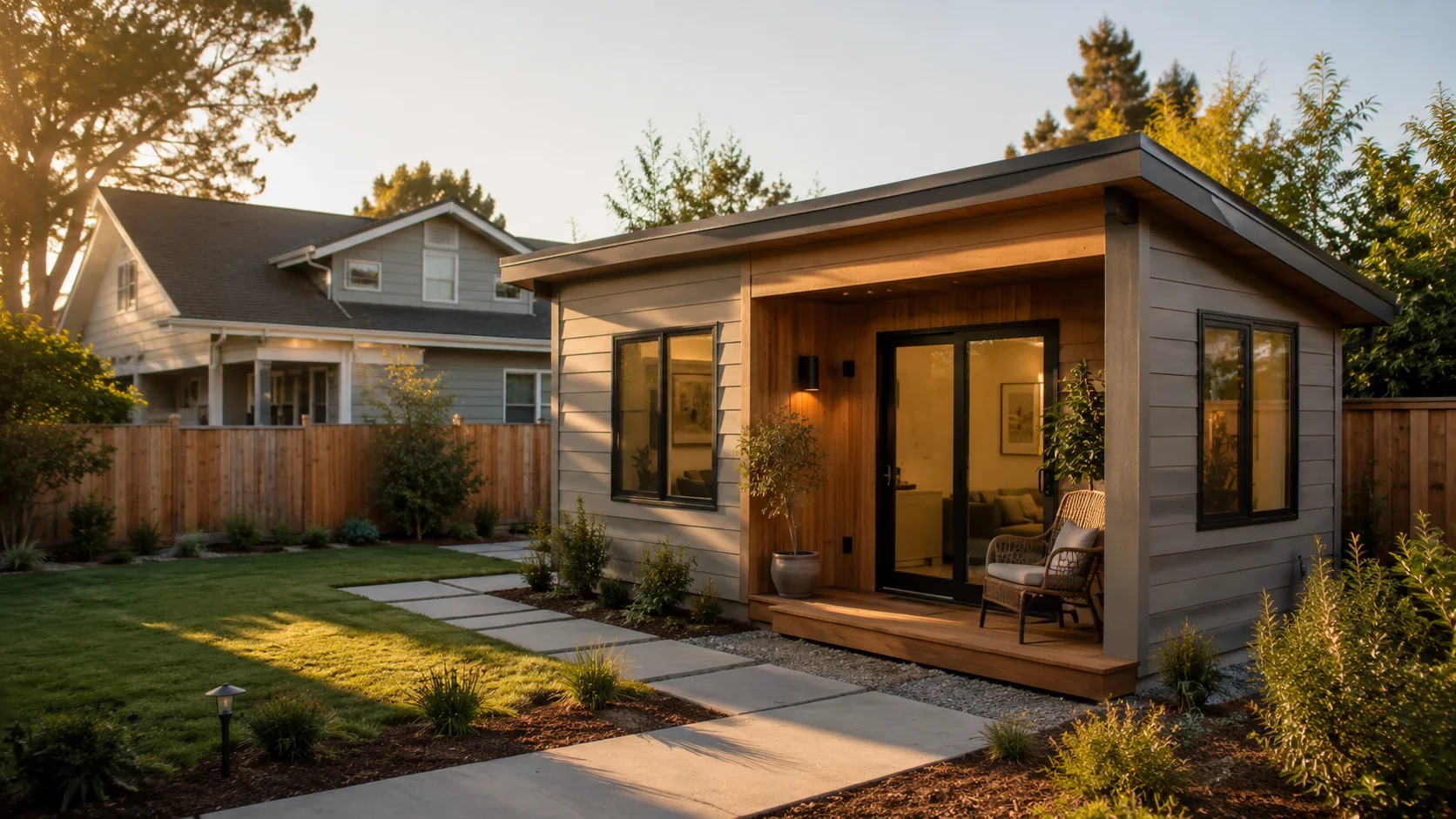
By The Dwelling Index editorial team — an independent research resource covering ADU financing, costs, and regulations. Last updated: September 16, 2026 · Last verified: September 16, 2026.
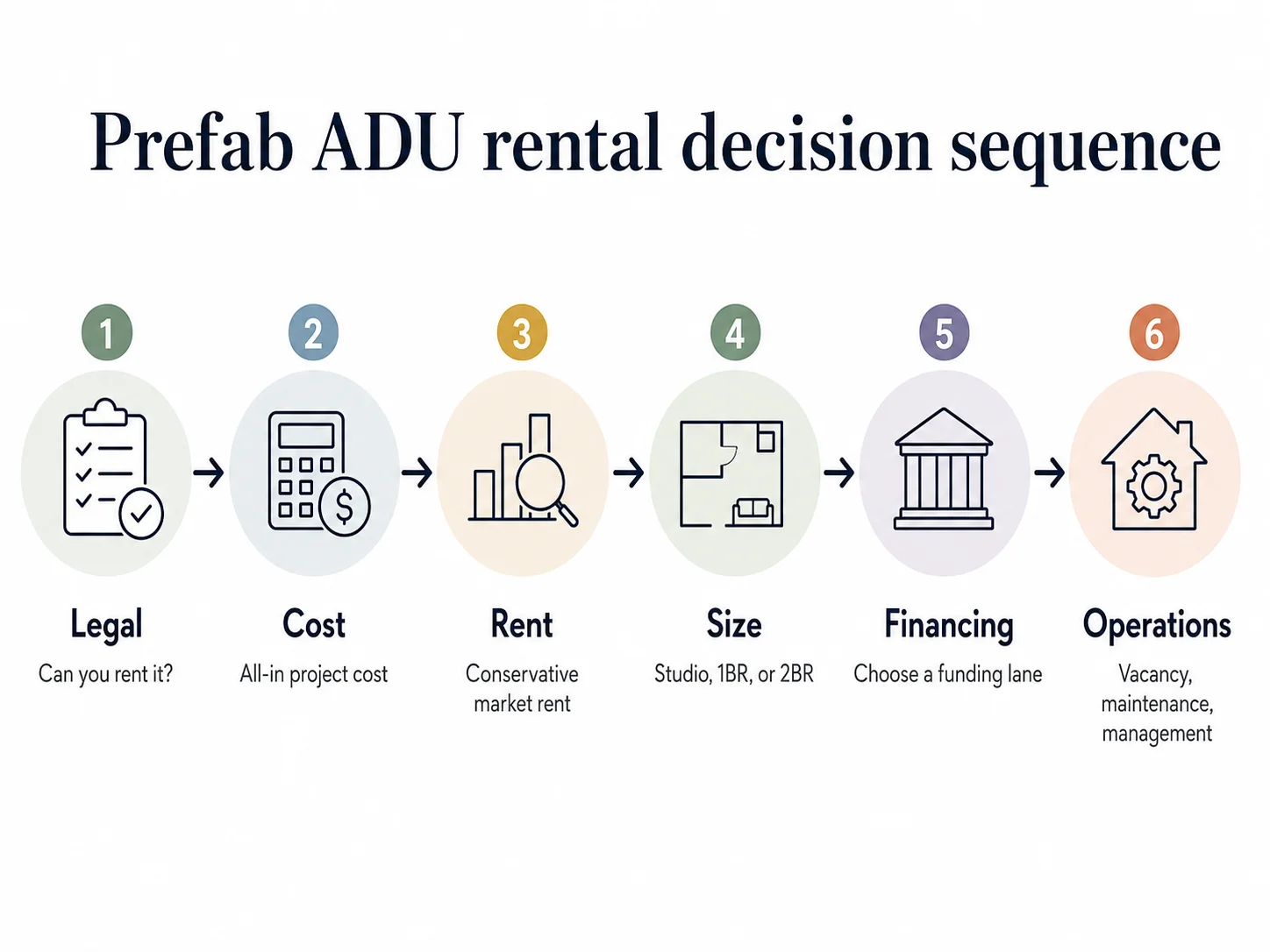
We built this page because "which prefab ADU is best for rental income?" is almost never answered honestly. Most guides rank brands by how pretty the renders look. Almost none start where a real investor starts: Can I legally rent it here? What does it cost installed? What will it actually rent for? And does that math survive vacancy, taxes, and a loan payment? So that's our order — legal first, cost second, rent third, size fourth, financing and operations last.
A few definitions first, because the words drive both rent and resale. An ADU (accessory dwelling unit) is a self-contained second home on a lot zoned for a primary residence — its own kitchen, bath, and entrance. A DADU is a detached ADU (a standalone backyard unit). A JADU (junior ADU) is a smaller unit carved from the existing house, usually capped at 500 square feet. Prefab is not a legal category — it's a construction method (built in a factory, delivered to site), which includes modular, panelized, and manufactured homes, each treated differently by local codes, lenders, and appraisers.
What is the best prefab ADU for rental income?
Answer capsule: A one-bedroom prefab ADU of about 500–600 square feet is the best default for rental income in most U.S. markets because it captures stronger tenant demand than a studio without the full cost jump of a two-bedroom. A two-bedroom earns more only where the local rent premium is large enough to offset a higher installed cost — often $40,000 or more in verified prefab pricing — and a studio makes sense mainly on tight lots or tight budgets. Prefab is a construction method, not a code category, so the right provider depends on your location, lot, and code path, not on any single national ranking.
Here's why the one-bedroom keeps winning — and where it doesn't.
Best overall: the efficient one-bedroom
A one-bedroom hits the sweet spot. It opens you to the largest tenant pool — singles, couples, remote workers, downsizing parents — while staying small enough that your cost per square foot doesn't spiral. In the verified HUD data below, the rent gap between a one-bedroom and a two-bedroom commonly runs from about 10% to 25%, while the cost gap between a one-bed and two-bed prefab is frequently larger in dollar terms. That asymmetry is the whole argument.
Concrete example with verified 2026 pricing: Abodu's one-bedroom (500 sq ft) averages $324,800 home-plus-typical-installation and its two-bedroom (625 sq ft) starts at $358,800 home-plus-typical-installation; confirm separately quoted items and tax (Abodu pricing) — about $40,000 more for the second bedroom. In Los Angeles, the revised HUD FY2026 Fair Market Rent rises from $2,328 (1BR) to $2,903 (2BR) — about $575/month, or $6,900/year (HUD revised FY2026 FMRs effective May 21, 2026). At $6,900/year, the second bedroom takes roughly 5.8 years to repay its own cost before financing — defensible in LA, but not in Tampa (12 years) or Charlotte (nearly 14 years).
Best for high-rent markets: the compact two-bedroom
In expensive coastal metros, the two-bedroom can be the smarter long-term asset — it draws couples and small families (longer tenancies, less turnover) and tends to appraise higher at resale. The verified rent gap supports it where it's wide: San Jose runs $2,982 (1BR) vs $3,483 (2BR) and San Francisco $2,977 vs $3,604 (HUD FY2026 FMR Schedule). Where the monthly premium clears roughly $500/month and the lot can accommodate the larger footprint, the two-bedroom is defensible.
Best for a tight budget: garage conversion or attached ADU
Here's our honest admission: a prefab detached unit is often not the cheapest route to rental income. If you have a garage that can legally convert, you're reusing a foundation, walls, and a roof, and you're frequently closer to existing utilities. That can beat a detached prefab on payback by years. Prefab earns its premium when you need a detached unit, want a faster and more predictable build, want less on-site disruption, or want a repeatable rent-ready design.
Best for low disruption: factory-built modular
If your priority is "build it without turning my backyard into a construction site for a year," modular wins. Most of the unit is built in a factory while your site work happens in parallel, then it's craned in. Abodu, for example, says most projects go from signed contract to move-in or lease-up in six to eight months (Abodu). Faster, though, never means cheaper — and never means exempt from local permits.
The worst assumption: choosing by base price
A $150,000 "ADU" advertised online is usually a shell — no foundation, no utility connections, no permits, sometimes not even a legal dwelling. The number that matters is total installed cost, and we devote a whole section to it below. (If a sub-$200K all-in unit is genuinely your target, we keep an honest running list on our prefab ADUs under $200K page.)
| Prefab ADU size | Typical use | Rental-income upside | Main risk |
|---|---|---|---|
| Studio (~340–400 sq ft) | Tight lots, lowest budget, solo renters | Lowest total cost | Rent ceiling limited; small tenant pool |
| 1-bedroom (~500–600 sq ft) | Most long-term rentals | Best balance of demand and cost | Still needs all-in cost discipline |
| 2-bedroom (~700–800 sq ft) | High-rent metros, couples, families | Higher rent ceiling, lower turnover | Extra cost can sink payback in cheap markets |
| 2BR/2BA (800+ sq ft) | Premium markets, resale play | Best tenant experience and resale | Usually too expensive for pure cash-flow logic |
Pricing anchors verified from Abodu's published model pricing (2026): Studio 385 sq ft $298,800 home plus typical installation; 1BR 500 sq ft $324,800; 2BR 625 sq ft $358,800; 2BR/2BA 800 sq ft $424,800. Confirm separately quoted items and tax in the property-specific quote.
Can I legally rent a prefab ADU where I live?
Answer capsule: A prefab ADU can usually be rented only if it is permitted as a legal dwelling unit and complies with local rules on rental duration, owner-occupancy, and short-term rentals, which vary by city and state. Long-term rental (30+ days) is broadly permitted where ADUs are legal, but short-term rental (under 30 days) is restricted or prohibited in many jurisdictions. Confirm zoning eligibility, the building-code path for your unit type, and any owner-occupancy or HOA restrictions before you model any income.
This belongs first in your head, even though every brochure buries it. A unit you can't legally rent has a yield of zero.
A few terms. Zoning governs whether an ADU is allowed on your parcel at all. Ministerial approval means the city must approve a compliant application without discretionary review or hearings — a big deal for timeline. A certificate of occupancy (CO) is the city's sign-off that the unit is legal to inhabit; most rental licenses require it. Owner-occupancy rules require you to live on the property to rent the other unit.
The legal-rental checklist
| Check | Why it matters | Where to confirm |
|---|---|---|
| ADU allowed on your parcel | No rental model matters if it can't be permitted | City zoning / permit portal |
| Unit type / code path | Modular, manufactured (HUD-code), tiny-home-on-wheels, and site-built are treated differently | Local building department |
| Rental duration rules | Many cities allow long-term but restrict short-term | City STR ordinance |
| Owner-occupancy | Some require you to live on-site; rules differ for STR | State + city code |
| Certificate of occupancy | Rental licenses typically require final inspection/CO | Building department |
| HOA / deed restrictions | Private rules can block rentals even where zoning allows | HOA / CC&Rs |
| Tax & registration | Rental income, business license, or transient occupancy tax may apply | County treasurer / tax office |
Legal-rental rules by city, decoded
Pulled from primary government sources so you're not relying on a builder's summary. (Verified May 28, 2026.)
| City / State | Long-term rental | Short-term rental (Airbnb) | Practical takeaway |
|---|---|---|---|
| Washington State | Two ADUs allowed on single-family lots in UGAs; units of ≥1,000 sq ft permitted; impact-fee limits | No owner-occupancy except where the ADU is used as a short-term rental | Build and rent long-term without living on-site; STR can trigger owner-occupancy |
| Seattle, WA | Legal only if permitted and built to current code | Tiny house on wheels is treated like a camper trailer — not a legal dwelling | The cheap 'tiny home on a trailer' is not a rentable ADU here |
| San Diego, CA | Permitted long-term | ADUs cannot be used for short-term rental (narrow exception for certain older permitted companion units) | Plan for a long-term tenant, not a vacation listing |
| Austin, TX | Permitted long-term | ADUs built after Oct. 1, 2015 may not be STR'd more than 30 days/year; CO required for STR license | A new Austin ADU is a long-term play |
| Portland, OR | Permitted long-term | Allowed under Type A/Type B rules — but the SDC-waiver covenant blocks STR for 10 years on the whole property | If you took the fee waiver, you traded away a decade of Airbnb for both homes |
Sources: WA Dept. of Commerce; Seattle SDCI; City of San Diego STRO; City of Austin; Portland.gov ADU SDC waiver.
One detail worth stating plainly on Portland: the SDC waiver saves you fees up front, but the covenant says neither the ADU nor the main house can be a short-term rental for 10 years — the restriction runs with the entire property, not just the new unit.
The pattern across all five jurisdictions: long-term rental is the dependable model; short-term rental is the conditional bonus. Build your numbers on the dependable model.
🟢 See what you can build before you request pricing.
Zoning, owner-occupancy, and unit-type rules are the first dominoes. Check yours before anything else.
Check Your ADU Feasibility → Get Your Free ADU ReportHow much can a prefab ADU rent for in 2026?
Answer capsule: Realistic ADU rent depends on local market conditions, but HUD publishes Fair Market Rents (FMRs) — estimates of base rent plus essential utilities — that give a standardized, conservative benchmark by metro before you pay for a rent-comp tool. HUD FY2026 one-bedroom FMRs in the 15 markets below range from about $1,538 to $2,982, and the revised Los Angeles figure (effective May 21, 2026) is $2,328. FMRs are not a guarantee of market rent and should be confirmed with local comparables.
This is the heart of the page: we combined HUD's official FY2026 rent schedule — including HUD's May 21, 2026 revision for Los Angeles — with verified prefab pricing so you can screen rent against real cost in one place. HUD describes FMRs as estimates used in the Housing Choice Voucher program, reflecting base rent plus essential utilities — useful precisely because they're conservative and standardized (Data.gov FMR dataset).
The 2026 Prefab ADU Rental-Readiness Matrix
Rent figures from the HUD FY2026 Fair Market Rent Schedule, except Los Angeles, which uses HUD's revised FY2026 FMRs effective May 21, 2026. "Gross annual 1BR baseline" = 1BR FMR × 12 (a screening number, not a forecast).
| Market (HUD FMR area) | FY2026 1BR FMR | FY2026 2BR FMR | Gross annual 1BR baseline | Rental-first read |
|---|---|---|---|---|
| San Jose-Sunnyvale-Santa Clara, CA | $2,982 | $3,483 | $35,784 | Highest verified rent signal; site/grading costs can be brutal |
| San Francisco, CA | $2,977 | $3,604 | $35,724 | High rent; high entitlement and site complexity |
| Santa Ana-Anaheim-Irvine (Orange County), CA | $2,746 | $3,236 | $32,952 | Strong; long-term more dependable than STR assumptions |
| San Diego-Chula Vista-Carlsbad, CA | $2,459 | $3,001 | $29,508 | Strong 1BR/2BR signal; STR is heavily restricted |
| Boston-Cambridge-Quincy, MA | $2,476 | $2,941 | $29,712 | Strong; verify local zoning and utility/site costs |
| Los Angeles-Long Beach-Glendale, CA *(revised 5/21/26)* | $2,328 | $2,903 | $27,936 | High demand; figure rose 11.6% mid-year |
| Seattle-Bellevue, WA | $2,146 | $2,501 | $25,752 | Strong demand; pre-approved DADU paths reduce friction |
| Miami-Miami Beach-Kendall, FL | $1,995 | $2,436 | $23,940 | Strong; STR licensing rules matter |
| Denver-Aurora-Centennial, CO | $1,754 | $2,089 | $21,048 | Moderate-to-strong; compare 1BR vs full installed cost |
| Tampa-St. Petersburg-Clearwater, FL | $1,696 | $1,977 | $20,352 | Moderate; a 1BR likely beats overspending on a 2BR |
| Raleigh-Cary, NC | $1,596 | $1,750 | $19,152 | Moderate; thin 2BR premium — favor the 1BR |
| Phoenix-Mesa-Chandler, AZ | $1,583 | $1,839 | $18,996 | Moderate; utility/site costs can dominate payback |
| Nashville-Davidson-Murfreesboro-Franklin, TN | $1,578 | $1,730 | $18,936 | Moderate; thin 2BR premium; verify STR rules |
| Austin-Round Rock-San Marcos, TX | $1,562 | $1,852 | $18,744 | Moderate; STR limited for ADUs built after Oct. 1, 2015 |
| Charlotte-Concord-Gastonia, NC | $1,538 | $1,686 | $18,456 | Moderate; needs a tight all-in budget to pencil |
All rent figures verified against the HUD FY2026 FMR Schedule on May 28, 2026; Los Angeles reflects HUD's revised FY2026 FMRs effective May 21, 2026.
Notice the spread in the two-bedroom premium: it's near or above 20% in Los Angeles, San Diego, San Francisco, and Miami, but under 12% in Nashville, Raleigh, and Charlotte. That single number tells you whether the second bedroom is worth building in your market.
A word on what FMR is not: it is not your guaranteed rent. In hot submarkets, a well-finished new ADU often rents above FMR; in soft submarkets it can sit below. Treat FMR as a conservative floor, then confirm with two or three live comps.
How to verify your local rent in five minutes
- Start with your metro's FMR above as the floor.
- Pull two or three live long-term listings for similar square footage within a few miles.
- Sanity-check with one local property manager — they quote real lease-up rents.
- Adjust down for vacancy and any utilities you'll pay.
- Use that final number in your ROI screen.
Why short-term rent shouldn't be in your first model
It's tempting to plug in Airbnb nightly rates and watch the spreadsheet glow. Don't — not until you've confirmed legality above. Short-term rent is higher gross but carries higher vacancy, far higher management load, and the regulatory risk that one ordinance erases the model overnight. Model the dependable long-term number first; if STR is legal on your parcel and you want the upside, treat it as a bonus scenario, not the base case.
🔵 Run your own rent-to-cost screen.
Enter your city, bedroom count, estimated all-in quote, and expected rent. The checker returns a gross-yield screen, a simple payback range, and the next legal check to make before you request pricing.
Run Your Rent-to-Cost Screen →These are illustrative examples, not guarantees of returns. Actual results depend on local market conditions, construction costs, financing terms, vacancy, maintenance, insurance, taxes, tenant demand, and regulatory approvals.
What size prefab ADU usually earns the best return?
Answer capsule: A one-bedroom prefab ADU of roughly 500–600 square feet usually earns the best risk-adjusted return because it captures broad tenant demand at a moderate build cost. The added cost of a two-bedroom — often $40,000 or more in verified prefab pricing — is justified only where the local two-bedroom rent premium is large, typically in high-cost coastal metros. Studios minimize cost but cap rent and shrink the tenant pool.
Here's the rule of thumb you can apply to any market using the matrix above:
- Find your metro's 1BR and 2BR FMR.
- Calculate the annual rent premium for the second bedroom:
(2BR − 1BR) × 12. - Compare it to the cost premium for a 2BR over a 1BR (start with ~$40,000 from verified Abodu pricing, then adjust for your real quotes).
- If the rent premium repays the cost premium in under ~6–7 years, the two-bedroom is defensible. If not, build the one-bedroom.
Two worked examples
| Market | Annual 2BR rent premium | Cost premium (~$40K) | Gross years to repay | Verdict |
|---|---|---|---|---|
| Los Angeles (revised) | $6,900/yr | ~$40,000 | ~5.8 yrs | 2BR defensible |
| Tampa | $3,372/yr | ~$40,000 | ~11.9 yrs | Build the 1BR |
Rent figures: HUD FY2026 and the LA revision; cost premium: Abodu pricing.
Beyond size, a few features quietly drive rent and retention: a separate, private entrance; in-unit or dedicated laundry; basic soundproofing between the ADU and your home; and parking where required. They cost little at the design stage and are expensive to retrofit — and they cut turnover, which is where small landlords actually lose money.
How much does the best rental-ready prefab ADU really cost?
Answer capsule: The figure that matters for rental decisions is total installed cost — the complete all-in price including the unit, foundation, delivery, craning, utility connections, permits, taxes, and site work — not the advertised base price. Abodu publishes home prices separately from typical installation: One $260,800 / $324,800 and Two $293,800 / $358,800. Site conditions and separately quoted scope can change the property-specific total.
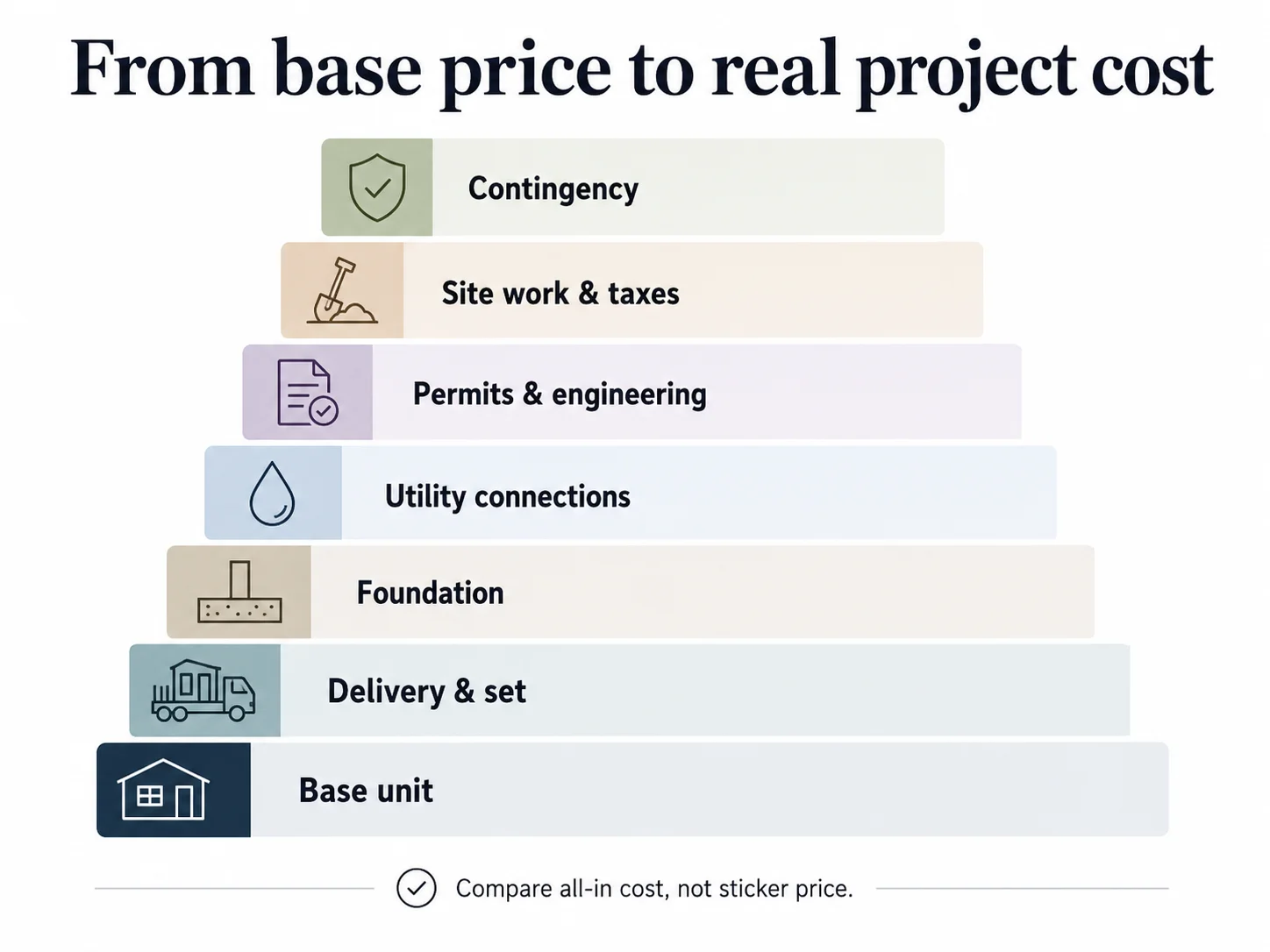
Prefab pricing comes in three flavors, and conflating them is how people get burned:
- Base price — the unit only. May exclude almost everything that makes it livable.
- Installed price — unit plus delivery, foundation, and setting.
- All-in project cost — installed price plus permits, utility connections, site prep, taxes, and contingency. This is the number to compare.
What transparent builders actually charge (verified, 2026)
Abodu is one of the few national-profile builders that publishes complete pricing — not necessarily the cheapest, but honest about the all-in. From Abodu's pricing page:
| Abodu model | Size | Base price | Avg. all-in price* |
|---|---|---|---|
| Studio | 385 sq ft | $234,800 home | $298,800 home + typical installation |
| One (1BR) | 500 sq ft | $260,800 home | $324,800 home + typical installation |
| Two (2BR/1BA) | 625 sq ft | $293,800 home | $358,800 home + typical installation |
| Two+ (2BR/2BA) | 800 sq ft | $328,800 home | $424,800 home + typical installation |
| Dwell | Current specifications require confirmation | Current quote required | Current quote required |
*Home-plus-installation figures reflect Abodu’s published typical installation amounts; confirm separately quoted items and tax in writing. Abodu's base price includes foundation, permit services, pre-approved plans, delivery, installation, and standard utility connections, but excludes utility trenching beyond 50 feet, craning beyond 100 feet, demolition, tree removal, unique site engineering, and sales tax/permit fees.
For the lower end of the market, Samara (Backyard) lists models "starting at" prices plus installation: Studio $152,000, One Bedroom $170,000, Two Bedroom $190,000, XL (800 sq ft) $249,000, and XL (950 sq ft, 2BR/2BA) $277,000, all plus installation, available in California. The gap between Samara's "starting at plus installation" and Abodu's "all-in average" is the gap between base price and total installed cost.
The quote-normalization worksheet
Make every builder fill this out. The one who can't is the one who'll surprise you later.
| Line item | Included? | Amount | Risk note |
|---|---|---|---|
| Unit / base model | |||
| Foundation | Slope and soil drive this | ||
| Delivery | Distance from factory | ||
| Crane / set | Included in typical installation up to the published 100-ft allowance | ||
| Utility trenching | Included in typical installation up to 50 ft | ||
| Electrical service upgrade | Panel may need upsizing | ||
| Sewer / water connection | Sewer vs. septic changes everything | ||
| Permits / plan check | Abodu's current fixed-pricing page includes permits and plan check in the home price; confirm the itemized scope | ||
| Engineering | Sloped/complex lots only | ||
| Taxes | Sales tax on the unit | ||
| Site repair / landscaping | Restoring the yard after a crane | ||
| Contingency (10–15%) | The line everyone skips | ||
| Total installed cost | This is your real number |
🟡 Once you know your real all-in number, the next question is how to fund it.
We map the lanes — cash-out refinance, construction loans, home equity — without ranking lenders by anything but neutral criteria.
Explore ADU financing paths → Compare options before you commitWe do not quote rates or guarantee approval.
When does prefab beat site-built or a garage conversion for rental income?
Answer capsule: Prefab construction beats site-built and garage conversions for rental income when speed, timeline predictability, reduced on-site disruption, and a standardized rent-ready product outweigh absolute lowest cost. Garage conversions and simple site-built ADUs often win on payback when an existing structure and utilities can be reused and local code permits it.
The honest framing: prefab buys you time and predictability, not necessarily savings. Maxable's analysis makes the same point — prefab base prices frequently exclude site prep, permits, utilities, foundation, and delivery, so the all-in can land near or above a custom build, while pre-approved plans can shorten permitting (and every month of delay is a month of lost rent).
| Option | Best when | Rental-income risk |
|---|---|---|
| Detached prefab ADU | You want speed/predictability and have good site access | Base price can understate all-in cost |
| Site-built detached ADU | Irregular lot or custom design needed | Longer build, change-order risk |
| Garage conversion | Existing garage can legally convert | Parking replacement, fire separation, structural, utility issues |
| Basement / internal ADU | Existing space can be legalized | Ceiling height, egress, moisture, sound/privacy |
| Tiny home on wheels | Temporary/flexible use where legal | Often not a legal permanent rental (see Seattle) |
| Manufactured (HUD-code) home | Jurisdiction allows it as an ADU | Zoning acceptance and foundation/code path vary |
One technical but important point on the code path: a modular unit is built to the same local/state building code as a site-built home, just assembled in a factory — generally treated like any other house for appraisal, financing, and zoning. A manufactured (HUD-code) home is built to a federal HUD standard and can be treated differently by lenders, appraisers, and some zoning codes. Fannie Mae's ADU rental-income policy covers ADUs that are attached, detached, or manufactured, but does not allow the arrangement where the main home is a manufactured home (Fannie Mae Selling Guide). Plain English: the same-looking box can be a "real house" or a "manufactured home" to your lender and city, and that label can change your loan options and your resale value — confirm the code path before you buy.
How do you calculate prefab ADU ROI and payback?
Answer capsule: Use two screens. Gross yield (annual rent ÷ total all-in cost) gives a fast comparison; net payback (all-in cost ÷ net annual income, after vacancy, maintenance, taxes, insurance, utilities, management, reserves, and financing) gives the real decision. A prefab ADU's gross yield commonly lands in the mid-single digits to low teens depending on market, but net figures are meaningfully lower once operating costs are subtracted, so any payback estimate that ignores them is optimistic by design.
The math, laid bare
Gross annual rent      = monthly rent × 12
Gross yield            = gross annual rent ÷ total all-in ADU cost

Net annual income      = gross annual rent
                         − vacancy (e.g., 5–8%)
                         − repairs / maintenance
                         − insurance increase
                         − property tax increase
                         − owner-paid utilities
                         − management / software
                         − reserves
                         − financing cost

Simple net payback      = total all-in ADU cost ÷ net annual income
Cash-on-cash return     = net annual income ÷ cash you actually invested
A worked screen: one-bedroom in Los Angeles
- Published home-plus-typical-installation reference: $324,800 for Abodu One; confirm the property-specific total before underwriting.
- Gross rent: $2,328/month (revised LA 1BR FMR) × 12 = $27,936/year
- Gross yield: $27,936 ÷ $369,500 ≈ 7.6%
- Gross payback (cost ÷ gross rent): ≈ 13.2 years
Now the net version, with every assumption shown so you can swap in your own:
| Line | Assumption | Annual |
|---|---|---|
| Gross rent | $2,328/mo × 12 | $27,936 |
| Vacancy | 6% of gross | −$1,676 |
| Property tax increase | ~1.1% of $369,500 | −$4,065 |
| Insurance increase | flat estimate | −$900 |
| Maintenance + reserves | ~6% of gross | −$1,676 |
| Management/software | ~6% of gross (self-manage = lower) | −$1,676 |
| Owner-paid utilities | assume tenant pays | −$0 |
| Net operating income (before financing) | ≈ $17,943 | |
That puts net payback before financing at roughly 20.6 years ($369,500 ÷ $17,943). Add a loan and the early years are likely break-even or slightly negative on cash flow, with the real return showing up as equity and the eventual refinance, not monthly profit. That's not a reason to walk away — in high-rent California, an ADU still often beats most home improvements on total return, and HUD FMR is a conservative floor that many new units exceed. It is the reason to run your numbers on your quote and your rent.
These are illustrative examples, not guarantees of returns. Actual results depend on local market conditions, construction costs, financing terms, vacancy, operating expenses, tax treatment, and regulatory approvals.
One framing tip: keep rental cash flow and property-value gain in separate columns. Both are real returns, but blending them hides whether the unit actually pays you each month or just builds equity you can't spend until you sell or refinance.
Can rental income help pay for — or help you qualify for — a prefab ADU loan?
Answer capsule: Projected ADU rental income may improve a project's affordability, and as of 2026 it can, in specific cases, help a borrower qualify. Fannie Mae now allows rental income from one ADU on a one-unit principal residence to count toward qualifying income on purchase and limited cash-out refinance transactions, capped at 30% of total qualifying income. Outside that rule, financing still depends on equity, credit, income, property type, loan program, and appraisal — and projected rent on a not-yet-built ADU does not automatically help you qualify.
We present financing as lanes, not as a ranked "best lender" list — because the right lane depends on your equity and timeline, not on anyone's payout.
- Cash-out refinance — Replace your mortgage with a larger one and take the difference as cash. Best when current rates make refinancing the whole balance sensible.
- HELOC / home equity loan — A HELOC lets you borrow against equity as needed; a home equity loan is a lump sum. Often the simplest path if you have substantial equity and want to leave your first mortgage untouched.
- Construction or renovation loan — Lends against the future improved value, useful when current equity is thin. More paperwork, draw schedules, inspections.
- Construction-to-permanent loan — Converts to a regular mortgage when the build finishes; one closing instead of two.
- Personal loan — A caution, not a recommendation: typically higher cost and shorter terms; usually only sensible for small projects.
- Home equity investments (HEIs) — Companies that advance cash today in exchange for a share of future appreciation. Availability is state-restricted and terms vary, so check availability in your state before counting on this lane.
The 2026 rule that changed the math: ADU rent can help you qualify
This is new and worth understanding precisely. Under Fannie Mae Selling Guide Announcement SEL-2025-08, rental income from an ADU may now count toward a borrower's qualifying income when all of these hold (Fannie Mae Selling Guide B3-3.8-01; SEL-2025-08):
- The property is a one-unit principal residence.
- The transaction is a purchase or limited cash-out refinance only.
- Income may come from only one ADU, even if the property has more than one.
- ADU rental income used to qualify is capped at 30% of the borrower's total qualifying income.
Desktop Underwriter (DU) version 12.1 implemented the change the weekend of March 21, 2026 (Pennymac alignment notice). One real constraint: for borrowers with no prior landlord experience, qualifying ADU rent generally cannot exceed the property's monthly housing payment (PITIA) (Fannie Mae ADU income overview).
What this does not mean: it does not let you treat optimistic projected rent on a unit you haven't built as guaranteed qualifying income. Build your plan assuming the rent does not help you qualify, and treat it as upside if your lender confirms it does. (We go deeper on lanes in our guides to financing a prefab ADU and ADU financing for investment property.)
🟡 Once you know your real all-in number, the next question is how to fund it.
We map the lanes — cash-out refinance, construction loans, home equity — without ranking lenders by anything but neutral criteria.
Explore ADU financing paths → Compare options before you commitWe do not quote rates or guarantee approval.
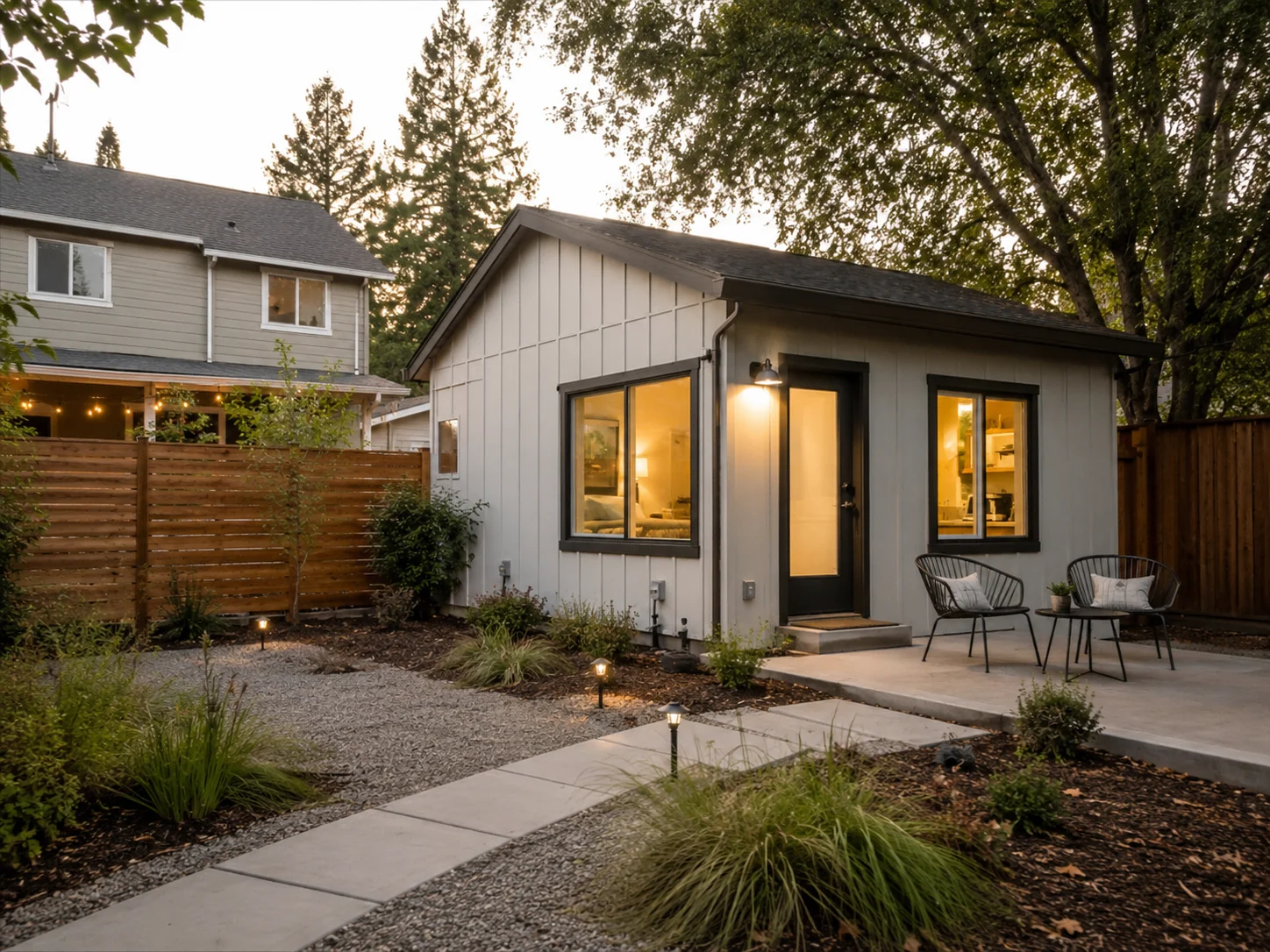
Which prefab ADU companies or code paths should rental-income owners compare?
Answer capsule: For rental income, prefab providers should be compared by building-code path, service area, local permitted track record, all-in scope, warranty, timeline, and whether the floor plan is genuinely rent-ready — not by renders alone. Because availability is regional, the right provider depends heavily on where the property is located, and any provider should be confirmed to serve the specific address and to deliver a legally permittable unit before pricing is requested.
Don't shop by photos. Shop by these questions: Which code path do you build to? Have you permitted this exact model in my city? What's your all-in scope and what's excluded? What warranty backs it? What's your realistic timeline to certificate of occupancy?
Service areas verified May 28, 2026 — confirm directly, since they change.
| Provider / category | Best geographic fit | Confirm before you rely on it |
|---|---|---|
| National modular/prefab marketplace (Modular Home Direct) | Broad national comparison and idea generation | Code path, your state's availability, ADU legality on your parcel |
| California Central Coast / Bay-adjacent modular (Framework First) | Out of Monterey County, generally within ~150 miles | Use only inside its verified California service area |
| Greater San Diego ADU builder (SnapADU) | San Diego County — incl. San Diego, Carlsbad, Encinitas, Chula Vista, Escondido, La Mesa, Oceanside, Poway, and nearby | Use only where the San Diego service area matches |
| Utah & Southern California tiny-home/ADU (Nest Tiny Homes) | Utah and Southern California | Verify the jurisdiction accepts the unit as a legal ADU |
| Compact foldable unit (BOXABL) | Brand-specific / compact-Casita interest | Don't assume universal ADU legality; confirm local code path |
| Local design-build firm | Complex lots, permit-heavy cities | Use as neutral comparison |
Listing a provider here is not an endorsement of suitability for your specific property. Confirm service area and that the unit can be legally permitted on your parcel before requesting pricing.
🟠 See which prefab options may actually serve your address.
Confirm availability before you spend time on a quote.
Compare prefab options that may serve your area →What can wreck rental income after you build?
Answer capsule: The most common ADU rental-income failures come from preventable assumptions: illegal short-term rental use, underestimated site costs, weak local tenant demand, poor privacy or soundproofing, owner-paid utilities, property-tax reassessment, insurance increases, and unplanned landlord operations. Confirming legal use, normalizing all-in cost, and planning operations before building eliminates most of these risks.
The failure modes we see most — each with the specific number or document to check before you put money down.
| Risk | Why it matters | What to check before deposit |
|---|---|---|
| STR restriction | Can erase an Airbnb model overnight | Your city's STR ordinance (link it; read the ADU clause) |
| Hidden site costs | Sloped lots and long utility runs add tens of thousands | Included trenching distance + crane allowance in the quote |
| Weak privacy | Lowers rent and increases turnover | Separate entry, fencing, soundproofing spec at design stage |
| Owner-paid utilities | Creates disputes and erodes margin | Whether the quote includes a submeter; lease utility terms |
| Property-tax reassessment | The new unit's value gets taxed | Your county's ADU reassessment estimate (we modeled ~1.1%) |
| Insurance increase | A second dwelling raises premiums | A written quote from your insurer before you build |
| No management plan | Income becomes a second job | Whether you'll self-manage or budget ~6–10% for software/PM |
| Overbuilt unit | A 2BR that won't earn its cost back | Your market's 2BR-minus-1BR rent premium (matrix above) |
🟠 An ADU is a real rental the day a tenant moves in.
Plan rent collection, maintenance tracking, and accounting before you build — not after the first leaky faucet.
Compare rent collection, maintenance, and accounting tools →What should you ask a prefab ADU builder before putting down a deposit?
Answer capsule: Before paying a deposit, homeowners should confirm that the unit can be permitted as a permanent ADU in their city, learn which building-code path applies, and establish whether the price is base, installed, or all-in — including exactly what is excluded. Questions about utility distance allowances, permit handling, local permitted track record, foundation assumptions, crane access, timeline to certificate of occupancy, and legal rental use protect against the most expensive surprises.
Print this. Bring it to every sales call. The builder who answers all 20 cleanly is the one to trust.
- Is this unit permitted as a permanent ADU in my city?
- Which building-code path applies — modular, manufactured, or site-built?
- Is the price base, installed, or all-in?
- What exactly is excluded?
- What utility trenching distance is included? (Abodu, for reference, includes 50 ft.)
- What happens if trenching exceeds the allowance?
- Are permit fees, plan-check fees, taxes, and impact fees included?
- Do you handle city submittals, or do I?
- Have you permitted this model in my city or county before?
- What foundation is assumed in this quote?
- Is crane access required, and is craning included? (Abodu includes up to 100 ft.)
- What are the delivery-route requirements for my street?
- What inspections happen in the factory vs. on site?
- What warranties apply, and for how long?
- Can you provide a sample all-in budget from a completed local project?
- Can this unit legally be a long-term rental on my parcel?
- Can it legally be a short-term rental?
- Realistic timeline from deposit to certificate of occupancy?
- What owner decisions most often delay projects?
- What happens if the city requires design changes?
⚪ Free ADU Starter Kit
Download the feasibility checklist, the quote-normalization worksheet, and all 20 builder questions above — in one free PDF.
Download the Free ADU Starter Kit →🟢 See what's actually possible on your lot before you fall in love with a floor plan.
See What You Can Build → Get Your Free ADU ReportWhat should you do next?
Answer capsule: The most reliable sequence for a prefab ADU rental decision is: confirm legal rental use, estimate conservative rent, normalize all-in cost, compare ADU size against the local rent premium, review financing lanes, then shortlist providers that serve the property. Starting with a prefab catalog instead of the legal and financial checks is the most common and costly mistake.
- Check legality. Can you build and rent an ADU on this property?
- Run the math. Does conservative rent support your real all-in cost?
- Compare paths. Prefab, site-built, garage conversion — or no build at all.
Ready to see what your lot allows?
Check your address for zoning eligibility, setbacks, and size limits — in one free report.
Get Your Free ADU Report →🟡 Once you know your real all-in number, the next question is how to fund it.
We map the lanes — cash-out refinance, construction loans, home equity — without ranking lenders by anything but neutral criteria.
Explore ADU financing paths → Compare options before you commitWe do not quote rates or guarantee approval.
⚪ Free ADU Starter Kit
Download the feasibility checklist, the quote-normalization worksheet, and all 20 builder questions above — in one free PDF.
Download the Free ADU Starter Kit →What we verified
Last verified: May 28, 2026
Verified for this page:
- Prefab pricing & scope: Abodu model pricing, inclusions, and exclusions, read directly from abodu.com/pricing (2026); Samara "starting at" model pricing and California availability from samara.com.
- Rent benchmarks: HUD FY2026 Fair Market Rents for all 15 markets in the matrix, from the HUD FY2026 FMR Schedule, plus HUD's revised FY2026 FMRs effective May 21, 2026 (Los Angeles), per the Federal Register notice and HUD User.
- Legal/regulatory examples: ADU and short-term-rental rules for Washington State, Seattle, San Diego, Austin, and Portland, from official government sources (linked inline).
- Financing rule: Fannie Mae's 2026 ADU rental-income qualifying policy, from the Fannie Mae Selling Guide and Announcement SEL-2025-08.
- Disclosure standard: FTC material-connection requirements (16 CFR § 255.5).
Confirm for your own property (no page can verify these for you):
Whether a specific parcel can build an ADU; whether your city will approve a specific model; exact local market rent; financing approval, terms, APR, or payment; provider availability at your address; short-term-rental legality for your parcel.
A note on sourcing: Some popular ADU guides cite a "$2,100 national average ADU rent" attributed to a 2025 AARP survey and a "NAR ADU Impact Study 2025." We could not locate either figure in AARP's or NAR's published materials, so we left them out rather than repeat unverified statistics. Every number on this page traces to a source above.
Frequently asked questions
- Is a prefab ADU a good rental investment?
- It can be, but only when legal rental use, all-in cost, a conservative rent baseline, financing, and operating expenses all work together. A prefab with a low base price but high site costs can be a worse investment than a more expensive quote with fewer unknowns. Verified 2026 all-in prices run well above advertised base prices — Abodu's one-bedroom averages $352,500 before permits and taxes — so measure rent against the real installed number.
- What size prefab ADU is best for rental income?
- For most homeowners, an efficient one-bedroom (about 500–600 sq ft) is the best default because it balances tenant demand and build cost. Studios work on tight lots or budgets; two-bedrooms work in high-rent markets where the rent premium offsets the added cost — often $40,000 or more.
- Is a prefab ADU cheaper than site-built?
- Not always. Prefab improves timeline predictability and reduces on-site disruption, but base prices often exclude site work, utilities, permits, foundation, delivery, crane, and taxes, so the all-in can equal or exceed a custom build. Compare total installed cost, not sticker price.
- Can I Airbnb a prefab ADU?
- Only if your city allows it and the unit is legally permitted for that use. San Diego prohibits using ADUs for short-term rental except certain older permitted companion units, while Portland allows ADUs as accessory short-term rentals but a system-development-charge waiver blocks STR for 10 years across the whole property. Confirm your city's ordinance before modeling short-term income.
- Do prefab ADUs need permits?
- Yes. A prefab ADU used as a dwelling generally needs local permits and inspections. Seattle states an ADU is not legal unless established through a permit process and built to current code.
- Can ADU rental income help me qualify for a mortgage in 2026?
- In specific cases, yes. Fannie Mae now allows rental income from one ADU on a one-unit principal residence to count toward qualifying income on purchase and limited cash-out refinance loans, capped at 30% of total qualifying income, with Desktop Underwriter updated the weekend of March 21, 2026. For first-time landlords, qualifying ADU rent generally can't exceed the property's housing payment. It does not turn optimistic projected rent into guaranteed qualifying income.
- How long does it take for an ADU to pay for itself?
- A gross screen divides total all-in cost by annual rent; a one-bedroom in Los Angeles at ~$369,500 all-in against the revised LA 1BR FMR of $2,328/month screens at roughly 13.2 years gross. Real net payback — after vacancy, taxes, insurance, maintenance, management, reserves, and financing — runs meaningfully longer, around 20 years before financing in our worked example. These are illustrative examples, not guarantees of returns.
- Should I choose prefab or a garage conversion for rental income?
- If a garage conversion can be legally permitted and upgraded affordably, it often produces a faster payback than a detached prefab because it reuses existing structure and utilities. Prefab is more attractive when you need a detached unit, want less disruption, value a faster controlled build, or want a repeatable rent-ready design.
- Are tiny homes on wheels good rental ADUs?
- Usually not, as a default. Some cities treat tiny homes on wheels like RVs or camper trailers rather than permanent dwellings — Seattle explicitly says a tiny house on wheels is treated like a camper trailer and can't be lived in on a city lot. Confirm your jurisdiction's stance before assuming you can rent one.
Not sure where to start? See what's possible at your address — get your free ADU report.