ADU Fee Waiver Programs: The 2026 State & City Tracker (What's Actually Waived)
There is no national ADU fee waiver program, and "waived" almost never means your ADU is free to permit. Fee relief comes from two layers: a handful of state laws that cap or eliminate one category of fee, and local city or county programs in cities like Dublin, Portland, Orlando, and Grand Junction — most of which attach a long-term-rental requirement or a short-term-rental ban. The single most expensive mistake: assuming a fee waiver covers your whole permit bill, then getting blindsided by utility connection charges, school fees, or plan-check costs the waiver never touched.
This is the national reference for ADU fee waiver programs specifically — what's active, what's limited, what's expired, and what to verify before you budget around any of it. If you're looking for cash grants and forgivable loans more broadly, we keep a separate ADU Grants tracker; this page is about the fees themselves.
Last updated May 27, 2026 · Last verified May 27, 2026 · Sources cited inline.
The 30-second version: which ADU fees can and can't be waived
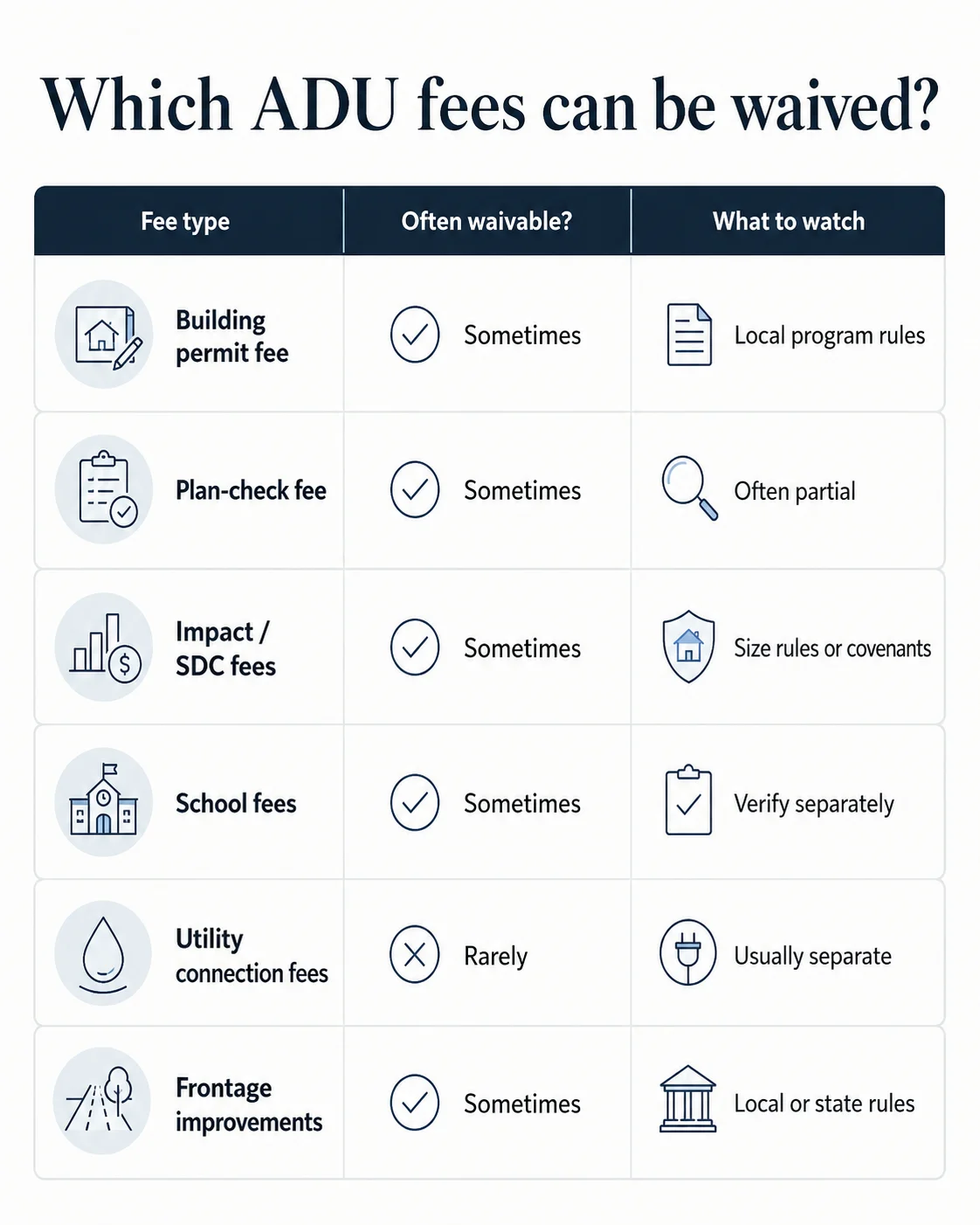
This is the table to screenshot. Every "ADU fee waiver" you'll encounter touches one or more of these buckets — and the differences are exactly where homeowners get surprised.
| Fee type | What it pays for | Can it be waived? | Common catch |
|---|---|---|---|
| Building permit fee | City review and issuance of your permit | Sometimes — via local program | Often tied to using city “standard plans” or an affordability agreement |
| Plan-check fee | Staff review of your construction drawings | Sometimes — often a partial reduction | Frequently reduced 50%, not waived 100% |
| Development impact fee (DIF) | Roads, parks, general infrastructure growth burdens | Yes — barred by state law in CA (≤750 sq ft) and capped in WA; rebated by some cities | Utility connection fees are NOT impact fees |
| System development charge (SDC) | Oregon's equivalent of impact fees | Sometimes — Portland and Medford have programs | 10-year no-short-term-rental covenant common |
| School impact fee | Local school district capacity | In CA, no fee on ADU/JADU under 500 sq ft; otherwise district-specific | Set by the district, not the city — confirm separately |
| Utility connection / capacity charge | Physically tying the unit to water and sewer | Rarely — legally distinct from impact fees | Some converted ADUs are protected; many new units still pay |
| Frontage / public street improvements | Curb, gutter, sidewalk along your lot | Sometimes barred by state law (WA, some CA cities) | Can be a four-or-five-figure budget item if required |
| Technology fee, construction tax, deposits | Miscellaneous city charges | Sometimes folded into a local waiver | Easy to miss on an itemized estimate |
Not sure which of these fees apply to your property? Our free Feasibility Engine checks your address and returns a personalized ADU report in about 60 seconds — what your lot allows, size limits, and the fee questions worth bringing to your city. No phone call, no commitment.
See What You Can Build → Get Your Free ADU Report
The honest admission first: most fee waivers don't make an ADU cheap
Before we get into a single program, here's the thing the city press releases won't lead with. Most ADU fee waivers reduce a slice of your soft costs — not the build. A permit-fee waiver might save $2,500–$6,000. An impact-fee rebate might save $1,300–$9,097 depending on the city. Those are real dollars and worth chasing. But on a project where construction alone typically runs from roughly $80,000 for a garage conversion to well over $300,000 for a large detached unit (see our ADU cost guide for current ranges by type), a fee waiver is a meaningful discount on the paperwork — not a path to a free backyard home.
And the bigger waivers — the ones worth five figures — almost always come with strings: a recorded covenant promising not to short-term rent the unit for a decade, a requirement to rent at below-market rates to an income-qualified tenant, or a clawback that makes you repay everything (plus a penalty) if you sell or change the use too soon.
The goal isn't to find "free money." It's to figure out which fee relief genuinely fits your project and your plans for the unit — and to avoid budgeting around a program that's expired, oversubscribed, or carries restrictions you can't live with.
Is there a national or statewide ADU fee waiver program?
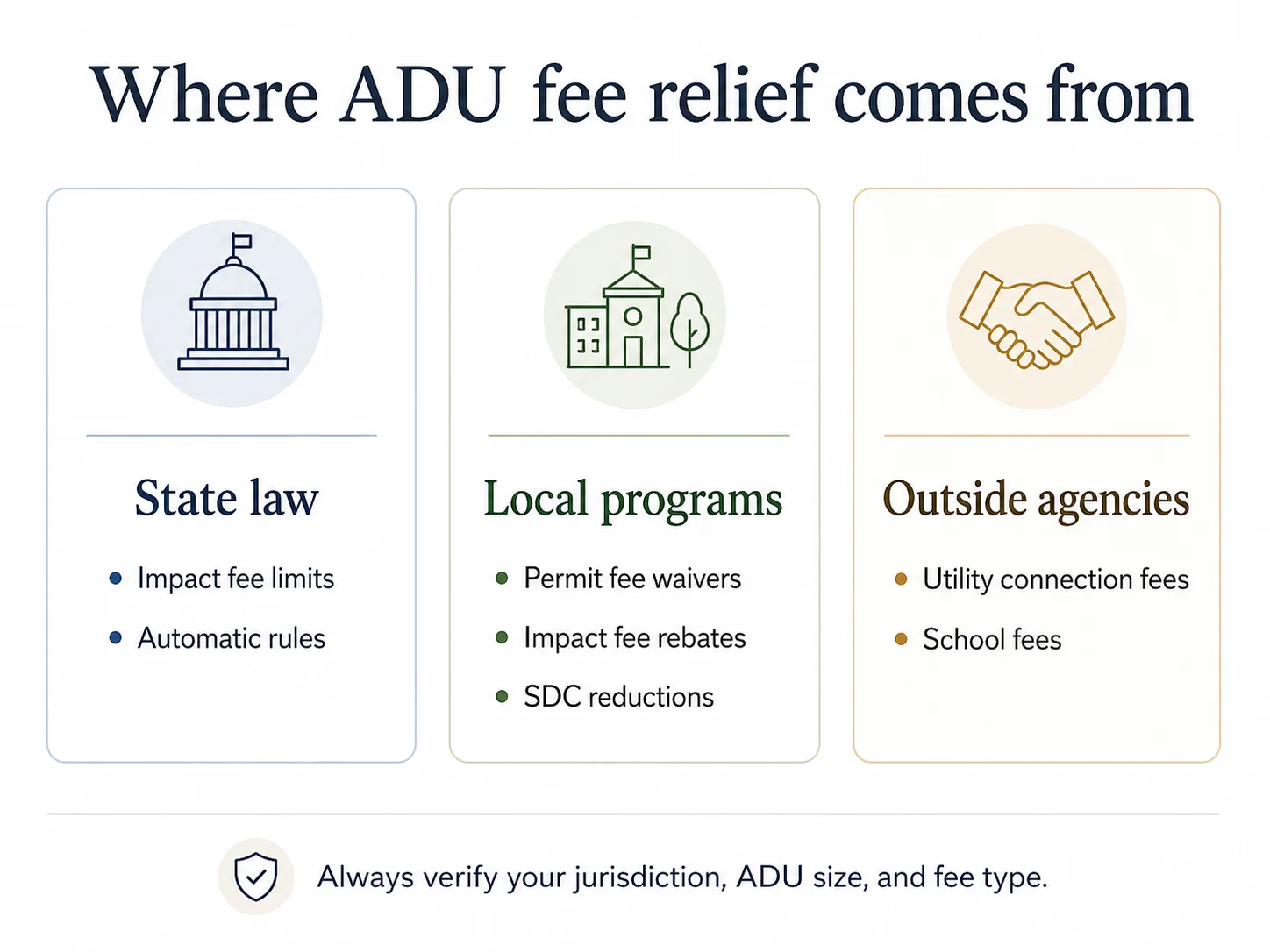
No single national ADU fee waiver exists. Fee relief comes from two separate layers: state laws that limit one fee category, and local city or county programs that waive or rebate specific fees. A state may cap impact fees, a city may waive permit fees, a county may rebate development charges, and a utility district may still bill connection fees the whole time — all on the same project.
Knowing which layer you're dealing with is the foundation for everything else, because they behave completely differently. State-law limits are automatic and non-negotiable — you don't apply, and the city can't opt out. Local programs are discretionary and time-limited — you apply, there's often a deadline, and they can expire or run out of money.
The three layers that control your ADU fees
Layer 1 — State law
A growing number of states preempt local rules to make ADUs easier and cheaper. Two states carry the most consequential fee provisions:
- California prohibits local agencies, special districts, and water corporations from charging impact fees on an ADU with 750 sq ft of interior livable space or less, and on a JADU with 500 sq ft or less; larger ADUs pay proportionally. (Cal. Gov. Code §66311.5(c), effective Jan. 1, 2026, per SB 543; verified May 2026.)
- Washington caps ADU impact fees at no more than 50% of the impact fees that would be imposed on the principal unit, bars owner-occupancy requirements, and prohibits requiring public street improvements as a condition of permitting an ADU. (RCW 36.70A.681(1)(a),(b),(l); verified May 2026.)
Layer 2 — Local city/county programs
This is where the actual "waivers" live: Dublin, Portland, Orlando, Grand Junction, Medford, Everett, Vista, Pasadena. The tracker below catalogs them. These programs are discretionary, time-limited, and require an application — unlike the automatic state-law limits above.
Layer 3 — Non-city fee authorities
The fees most likely to surprise you come from agencies that aren't the city: water and sewer districts (connection/capacity charges), school districts (school impact fees), and sometimes fire or sanitation districts. A city permit-fee waiver does nothing to these. You confirm them separately — every time.
The practical lesson: when someone says "my city waives ADU fees," always ask which layer, and which fee. The answer tells you whether it's automatic, whether you apply, and whether utility and school charges still apply.
Which ADU fees can actually be waived? A fee-type decoder
An "ADU fee waiver" can mean waived permit fees, reduced impact fees, rebated SDCs, exempted school fees, or just one city-controlled charge. It rarely means the entire approval is free, and it almost never eliminates every utility connection charge. Knowing exactly which fee a program touches is what separates a realistic budget from a nasty surprise at permit issuance.
Permit and plan-check fees
The building department charges these to review your drawings (plan check) and issue your permit. A permit-fee waiver is the most common "ADU fee waiver" and the most straightforward — but it's also typically the smallest in dollar terms, and it's often tied to a condition like using the city's pre-approved standard plans. Plain-English note: a permit-fee waiver helps with soft costs; it doesn't pay for design, engineering, construction, utilities, or inspections unless the program says so explicitly.
Development impact fees (DIFs)
One-time charges to fund the public facilities new development burdens — roads, parks, general government capacity. They're often the largest single soft-cost line, which is why they're the headline target for both state laws and local rebate programs. In California, an ADU with 750 sq ft of interior livable space or less is exempt from impact fees by statute; larger units pay proportionally. In Washington, the impact fee can't exceed half the principal unit's fee.
System development charges (SDCs)
Oregon's functional equivalent of impact fees, funding water, sewer, transportation, and parks infrastructure. They can be substantial, which is why Oregon's ADU fee programs (Portland, Medford) are SDC waivers and reductions — and why they're worth real money when you qualify.
School impact fees
School districts levy these to fund capacity for new residents, governed separately from city fees and with their own square-footage threshold. As of January 1, 2026, California treats an ADU or JADU with less than 500 sq ft of interior livable space as exempt from school impact fees. (SB 543; verified May 2026.) The takeaway: a city impact-fee waiver doesn't touch school fees — confirm with the district directly, and note the school threshold (500 sq ft) is different from the impact-fee threshold (750 sq ft).
Utility connection and capacity charges
This is the single most misunderstood charge in the entire ADU fee landscape. A connection fee or capacity charge is the cost of physically tying your ADU into the water and sewer system. And here's the trap: it is legally not an impact fee. California's ADU statute explicitly excludes connection fees and capacity charges from the impact-fee definition (Gov. Code §66311.5(c)). So the impact-fee exemption — and most local impact-fee rebates — do nothing to your connection fees.
But there's an important nuance: California treats certain ADUs as not a new residential use for connection-charge purposes. For specific converted ADUs and JADUs built within or converted from existing space, a provider generally may not require a new or separate utility connection or impose a related charge — unless the unit is built alongside a new single-family home. Other ADUs, typically new detached construction, may be required to install a new connection, but the charge must be proportionate and may not exceed reasonable cost.
That carve-out is why your quote can "contradict" the law. The law barred a specific category — development impact fees. It never promised to erase the cost of a new pipe connection.
Frontage improvements and public works conditions
Sometimes the city conditions your permit on building curb, gutter, or sidewalk along your frontage. That's not technically a "fee," but it's a budget item — and a big one. Washington bars cities from requiring public street improvements as a condition of permitting an ADU (RCW 36.70A.681(1)(l)). Everett, WA states frontage improvements are not required for adding one or two ADUs where a principal dwelling remains (everettwa.gov, verified May 2026). Elsewhere, ask early whether any frontage or public-improvement condition applies.
The 750 sq ft fee cliff: how California's proportional rule actually works
In California, an ADU with 750 sq ft of interior livable space or less pays zero local impact fees; an ADU with more than 750 sq ft pays impact fees proportional to the primary home's size. A small jump across that threshold — from 750 to 800 sq ft — can swing the fee from $0 to several thousand dollars. This is the highest-leverage design decision most California ADU builders never realize they're making.
The current statutory rule (effective January 1, 2026) bars impact fees on an ADU at or below 750 sq ft and requires proportional fees above it. The City of Placerville's official ADU impact-fee methodology states the formula as:
(ADU sq ft ÷ primary dwelling sq ft) × full impact fee = your ADU impact fee
Worked example: 750 sq ft vs. 800 sq ft
Two identical homeowners, each with a 2,000 sq ft primary house, each in a jurisdiction with a hypothetical $12,000 full impact fee (a hypothetical to show the math; real fees vary widely — Los Angeles has historically added $8,000–$15,000, per GatherADU's 2026 California law guide, verified May 2026).
| Homeowner A: 750 sq ft ADU | Homeowner B: 800 sq ft ADU | |
|---|---|---|
| Over the 750 threshold? | No (750 or less is exempt) | Yes |
| Impact fee owed | $0 (statutory exemption) | Proportional |
| The math | — | (800 ÷ 2,000) × $12,000 = $4,800 |
| Cost of 50 extra sq ft, in fees alone | — | $4,800 |
A design decision the size of a small bathroom is the difference between $0 and $4,800 in this example. It's not a gentle ramp — it's a cliff. At exactly 750 sq ft you owe nothing; at 751 you owe a proportional share of the full fee.
Note the proportionality is against your primary dwelling's size, so the same ADU costs less behind a bigger house. A 900 sq ft ADU behind a 3,000 sq ft home pays 30% of the fee; behind a 1,200 sq ft home it pays 75%.
Want to see what size your lot actually supports before you design around a threshold? Get your buildable scenario first.
See What You Can Build → Get Your Free ADU Report
Which ADU fee waiver programs are active, limited, or expired in 2026?
The most useful ADU fee waivers are local and change often. The tracker below separates currently active programs from expired ones, state-law fee limits, and programs that need direct staff confirmation before you budget around them. Every row is sourced to an official city, county, or state page with a verification date.
Status legend: ✅ Active · ⚠️ Limited / verify timing · ⛔ Expired
Active and recently verified local programs
| Jurisdiction | Program | What it does | Key strings | Status | Verified |
|---|---|---|---|---|---|
| Dublin, CA | ADU Fee Waivers | Waives building permit fees; published savings ~$2,500–$6,000 by valuation | Permit-fee waiver for ADUs <750 sq ft applied for Jan 1 2022–Dec 31 2026; larger units need 55-yr lower-income deed restriction | ✅ Through Dec 31, 2026 | dublin.ca.gov May 2026 |
| Portland, OR | ADU SDC Waiver | Waives System Development Charges (thousands) | 10-yr recorded covenant; no short-term rental of ADU or house; violation repays 150% of current SDCs | ✅ Active | portland.gov May 2026 |
| Orlando, FL | ADU Incentive Program | Up to $10,000 buildout rebate + 100% rebate of park, transportation & sewer impact fees + 100% building-permit-fee rebate (impact fees ~$1,300–$3,100; permit fees ~$450–$1,050) | Within Orlando city limits; ADU + new driveways/patios/walkways ≤500 total sq ft; individual electric & water meters; lease to tenant ≤120% AMI for 12 of first 24 months (waived if resident 62+); STR under 30 days restricted | ✅ Active | orlando.gov May 2026 |
| Grand Junction, CO | ADU Production Program (Ord. 5136) | Tier 1: city pays impact fees (currently $9,097). Tier 2: impact fees + ~$6,000 direct incentive ($15,000 total) | Tier 1: 5-yr long-term rental. Tier 2: owner-occupant, ≤140% AMI, 7-yr LTR. Early exit: 20% of total fees + 20% of paid incentives per year remaining | ✅ Active, first-come | gjcity.org May 2026 |
| Medford, OR | ADU SDC Reduction | 50% reduction of city-assessed SDCs (Transportation, Sanitary Sewer Collection, Stormwater, Parks) on new ADU permits, Dec 1 2020–Jun 30 2027 | Excludes Sanitary Sewer Treatment SDC and building permit fees; new ADUs only; 10-yr no-STR covenant + annual rent reporting; the funding that paid the other 50% has been expended | ✅ Active (reduced scope) | medfordoregon.gov May 2026 |
| Everett, WA | ADU fee reductions | Park impact fees –50%; transportation impact fee waived for first ADU, –50% for second; school impact fees waived; no frontage improvements required for 1–2 ADUs | Applies to first two ADUs; principal dwelling must remain | ✅ Active | everettwa.gov May 2026 |
| Vista, CA | ADU Fee Waiver Program | Notes <750 sq ft fees waived under state law; development-impact-fee waivers for qualifying affordable occupancy | Eligible household ≤80% San Diego County median income (by household size) OR a family member/caregiver providing regular care to the primary-unit owner/occupant; recorded regulatory agreement for first 10 years after C of O | ✅ Active | vista.gov May 2026 |
| Pasadena, CA | ADU fee reductions | ADUs ≤900 sq ft (no Housing Agreement): exempt from Residential Impact Fees; 25% off Construction Tax, General Plan Maintenance Fee, Technology Fee; C&D deposit cut to $1,000. ADUs of any size with a Housing Agreement, or using a City Standard Plan: 50% plan-check discount, exempt from RIFs and several permit fees, $1,000 C&D deposit | Not retroactive; most reductions effective May 6, 2025 (reduced RIFs/Construction Tax effective Jul 17, 2025); multifamily sites don't qualify | ✅ Active | cityofpasadena.net May 2026 |
Programs to confirm before you budget
| Jurisdiction | Program | Note | Source |
|---|---|---|---|
| Marin County, CA (unincorporated) | ADU permit fee waiver | Reported up to $2,500 ADU / $1,500 JADU (no income limit) and up to $10,000 deed-restricted low-income, no STR, through Dec 31, 2026 — confirm current amounts on the official page before relying on them. | marincounty.gov |
| Summit County, CO | ADU Fee Waiver | Best for owners planning to keep the ADU 10 years; waives building, planning, and engineering fees. Covenant: removing it within 10 years triggers repayment of original fees plus 2% compounding interest. Confirm current amounts/eligibility with staff. | summitcountyco.gov |
| Fruita, CO | ADU Fee Waiver Project | City page states that when the program launches, eligible homeowners may receive up to $10,000 in waived permitting, impact, and utility connection fees; no STR for ≥5 yrs. Not yet open — don't budget around it until applications are live. | fruita.org |
Related research: city permit-fee examples
Expired programs you may still find in old articles (don't budget around these)
This section exists because stale builder blogs and old city pages circulate for years, and homeowners plan around money that's gone.
| Jurisdiction | Program | Status | Source |
|---|---|---|---|
| San Diego County, CA (unincorporated) | ADU Fee Waiver Program | ⛔ Trial impact-fee waiver ran Jan 9, 2019 – Jan 9, 2024. No longer available. | sandiegocounty.gov |
| Santee, CA | ADU Fee Waiver Program | ⛔ Ended Sept 27, 2024. ADUs now subject to fees at permit issuance. | cityofsanteeca.gov |
State-law fee limits (automatic — not "programs")
These aren't applications. They're rights. We list them separately so you don't confuse a legal cap with a local grant.
| State | Rule | Citation |
|---|---|---|
| California | No local impact fees on an ADU ≤750 sq ft interior livable space or a JADU ≤500 sq ft; proportional above 750; no school fees under 500 sq ft; utility connection/capacity charges excluded from "impact fee" and barred for certain converted units | Gov. Code §66311.5 (SB 543, eff. Jan 1, 2026) |
| Washington | ADU impact fee ≤50% of principal unit's fee; no owner-occupancy requirement; no public street improvements as a permit condition | RCW 36.70A.681(1)(a),(b),(l) (WA Legislature) |
Instructive counterexample: Bend, Oregon — an ADU-friendly city — states it currently does not offer an ADU tax exemption (bendoregon.gov). Proof that even pro-ADU cities don't all have fee relief — verify your own jurisdiction rather than assume.
Looking for cash grants, rebates, and forgivable loans by state — with open/closed/waitlist status? That's a different question than fee waivers, and we keep a dedicated, source-linked tracker for it.
ADU Grants & Incentives: Verified Programs by State →
How much can ADU fee waivers actually save?
Verified ADU fee waivers range from roughly $2,500 to over $15,000 depending on the city, fee type, ADU size, and restrictions accepted. A fee waiver is a budget reducer, not a construction grant — the savings rarely cover more than the soft costs. What you'll actually see depends on your valuation, square footage, utility district, and whether you accept an affordability or rental restriction.
Dublin, CA
~$2,500–$6,000
in waived permit fees, depending on the ADU's valuation
Official source (verified May 2026)Orlando, FL
Up to ~$14,000+
Up to $10,000 buildout rebate, plus 100% rebate of park, transportation, and sewer impact fees (~$1,300–$3,100) and 100% of building permit fees (~$450–$1,050)
Official source (verified May 2026)Grand Junction, CO
$9,097–$15,000
Tier 1 covers impact fees currently totaling $9,097; Tier 2 adds ~$6,000 for $15,000 total
Official source (verified May 2026)Medford, OR
50% of qualifying SDCs
Meaningful on a typical ADU, though it excludes the Sanitary Sewer Treatment SDC and permit fees
Official source (verified May 2026)Why the same waiver is worth different amounts to different people
Two homeowners in the same city can get wildly different value from an identical program. The variables that move the number: ADU valuation, square footage (especially against a 500 or 750 sq ft threshold), new construction versus conversion, which utility and school districts you fall under, whether the ADU is deed-restricted, the fee-schedule year (many cities update July 1), and whether the program is first-come, first-served and still funded.
Want to know whether the savings actually change your project math? See your buildable scenario first.
See What You Can Build → Get Your Free ADU Report
How do I check whether my property qualifies before paying for plans?
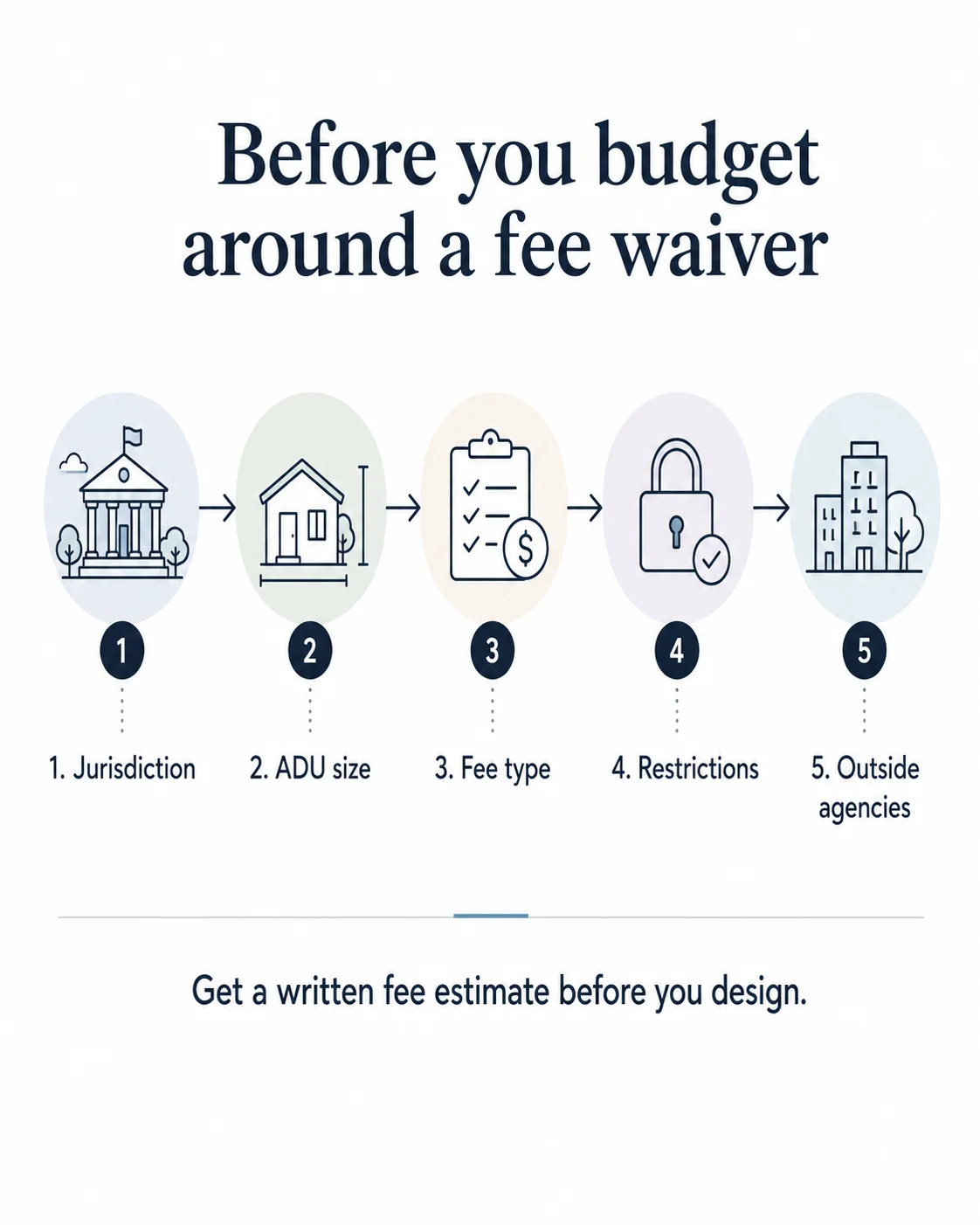
Before paying for ADU plans, confirm six things: whether your lot is inside city limits or unincorporated county, your ADU type and interior square footage, a preliminary fee estimate by category, which fees are city-controlled versus outside-agency, the size thresholds that change fee treatment, and whether any waiver requires a covenant or deed restriction. The most expensive mistake is assuming a state impact-fee exemption equals a full local fee waiver — it doesn't.
The 10-minute ADU fee-waiver checklist
- 1
Confirm whether your property is inside city limits or unincorporated county — it determines who reviews your permit.
- 2
Ask whether your ADU is reviewed by the city, the county, or both.
- 3
Identify the ADU type: detached (DADU), attached, conversion, garage conversion, or JADU (junior ADU — a unit up to 500 sq ft within the existing home).
- 4
Confirm your proposed interior square footage, and whether it's near 500 or 750 (the thresholds that flip fee treatment).
- 5
Request a preliminary fee estimate by category, not a lump sum.
- 6
Ask which fees are city-controlled and which come from outside agencies (water, sewer, school, fire).
- 7
Ask whether size thresholds change the fee treatment for your unit.
- 8
Ask whether any waiver requires long-term rental, affordability, or owner-occupancy.
- 9
Ask whether short-term rental use is prohibited under any program you'd use.
- 10
Ask whether a covenant, deed restriction, annual reporting, or clawback applies — and for how long.
Copy-and-paste email to your permit office
I'm planning an accessory dwelling unit at [address]. Before I pay for plans, can you confirm whether any ADU fee waivers, reductions, rebates, impact-fee exemptions, SDC reductions, school-fee exemptions, utility-fee reductions, or permit-fee waivers apply? The proposed ADU is approximately [size] square feet of interior livable space and would be [detached / attached / conversion]. Please separate city fees from utility, school, fire, sewer, and other outside-agency charges, and let me know whether any waiver requires long-term rental, affordability, owner-occupancy, no short-term rental use, a recorded covenant, or repayment if the use changes.
Putting it in writing creates a record — useful if you later need to challenge a fee. If you're in California and an impact fee appears on an ADU of 750 sq ft or less, add: "Under Gov. Code §66311.5, a local agency may not impose impact fees on an ADU with 750 square feet of interior livable space or less. Please confirm and adjust the impact-fee line."
Watch for the "we'll get your waiver for a fee" scam
No legitimate exemption or program requires you to pay a third party an upfront fee to "unlock" it. The statutory exemptions are automatic and free; the local programs have official .gov application pages. California's housing finance agency states on its ADU page that funding has been fully allocated and warns that anyone claiming they can help you get an ADU Grant is a financial scam (CalHFA.ca.gov/adu, verified May 2026). The same caution applies to anyone promising to "secure your fee waiver" for a charge. If someone asks for money upfront to get you a government fee exemption, stop.
Run your own situation before you spend a dollar on design. Our free tool maps the fee questions worth asking your city to your address and ADU type.
Run the ADU Fee Check → Get Your Free ADU Report
What strings are attached to ADU fee waivers?
The biggest strings on ADU fee waivers are long-term-rental requirements, short-term-rental bans, affordability/AMI restrictions, owner-occupancy rules, recorded covenants, annual reporting, and repayment penalties (clawbacks). These restrictions often matter more than the dollar value of the waiver itself. A $15,000 incentive that locks you into seven years of below-market rent isn't a $15,000 gift — it's a trade, and you need to price the trade.
Long-term-rental requirements
Many of the most valuable programs require you to keep the unit as a long-term rental for years. Grand Junction requires 5 years (Tier 1) or 7 years (Tier 2). Medford and Portland tie their reductions to long-term residential use. If you wanted the flexibility to house a family member, then rent it, then sell — a multi-year rental covenant constrains that.
Affordability and AMI restrictions
Some programs require renting to an income-qualified tenant at a controlled rate. Orlando requires leasing to a tenant at or below 120% of Area Median Income for 12 of the first 24 months (waived if the resident is 62+). Dublin's larger-ADU waiver path requires a 55-year lower-income deed restriction. Grand Junction's Tier 2 requires the owner's household to be below 140% AMI. Affordable rent is a genuine public good — but it's a different project from a market-rate rental, and your financing math changes with it.
Short-term-rental bans
If short-term rental income is core to your plan, read the covenant carefully. Portland's SDC waiver requires a 10-year recorded covenant barring short-term rental of both the ADU and the main house. Medford prohibits STR use. Orlando restricts rentals under 30 days. Accepting one of these waivers can cost you the STR option for a decade.
Clawbacks and repayment risk
Break the rules — or sometimes just sell early — and you may owe it all back, with a penalty. Portland: revoking the covenant or violating the program can require repayment of 150% of current SDC rates. Summit County, CO: removing or voiding the covenant within 10 years can trigger repayment plus 2% compounding interest. Grand Junction: leaving early costs 20% of total fees plus 20% of paid incentives for each remaining year. These are real liabilities that run with the property.
If a restriction doesn't fit your plans, that's a perfectly good reason to skip the waiver and fund the fees another way. You're not stuck — you've just learned the waiver isn't your path, and the next two sections show you what is.
Decided a covenant isn't worth it for your plans? That's a legitimate call. See how homeowners fund ADUs without restrictive programs.
Explore Your ADU Financing Options →Rental-income note: any rental figures discussed on this site are illustrative examples, not guarantees of returns. Actual results depend on local market conditions, construction costs, financing terms, and regulatory approvals.
Should you design at 750 sq ft or apply for a local waiver?
In California, designing at 750 sq ft of interior livable space or less automatically avoids local impact fees with no application and no covenant — often the cleanest path. A local waiver can save more in absolute dollars but usually requires restrictions. The right choice depends on your state, your local fee schedule, your utility charges, and whether you want the unit's use to stay flexible. When both are available, the deciding question is usually: how much do you value keeping the ADU unrestricted?
| Your situation | Likely better path | Why |
|---|---|---|
| California ADU near 750 sq ft, wants flexibility | Design at 750 sq ft or less | Automatic impact-fee exemption, zero strings, no covenant |
| Wants short-term-rental income | Avoid waivers with STR covenants; use state thresholds + financing | A 10-year STR ban can cost more than the waiver saves |
| Building for a parent or adult child (no rent) | Check permit/impact waivers; skip affordability-tied programs | AMI/rental rules often don't fit family use |
| Comfortable as a long-term affordable landlord | Pursue the bigger local incentive (Orlando, Grand Junction) | The five-figure incentive rewards exactly what you'd do anyway |
| Local waiver expired (San Diego County, Santee) | Use state thresholds + a financing/feasibility plan | Don't budget around a program that's gone |
| Big detached unit, rental income is the goal | Larger ADU may beat the fee savings | Extra rentable space can outweigh a proportional fee |
The honest meta-point: a fee waiver should rarely be the reason you build an ADU, and almost never the reason you accept a decade-long restriction. It's a discount to optimize around, not a deal to chase. Decide what you want the unit to be first; then pick the fee path that doesn't compromise it.
What should you do if there's no ADU fee waiver where you live?
If your city has no ADU fee waiver, focus on fee-aware design, pre-approved standard plans, conversion options, and a financing path that matches your equity and timeline. A missing waiver doesn't make an ADU unaffordable — it means the budget gets built around real fees instead of hoped-for incentives.
| Fee-reduction substitute | Verified example | What it saves |
|---|---|---|
| State impact-fee threshold | CA: ADU ≤750 sq ft pays no impact fees (Gov. Code §66311.5) | The full impact fee — often the largest soft cost |
| State school-fee threshold | CA: ADU/JADU <500 sq ft exempt from school fees (SB 543) | District fees that can run several thousand dollars |
| City pre-approved standard plans | Pasadena: 50% plan-check discount with a City Standard Plan; Medford offers 5 permit-ready plans (364–896 sq ft) | Plan-check fees + much of the architectural design cost |
| Frontage-improvement exemption | Everett, WA: no street improvements required for 1–2 ADUs | Curb/gutter/sidewalk costs that can run four-to-five figures |
| Conversion vs. ground-up | Garage/basement conversions reduce site work and sometimes utility scope | Foundation, site prep, and (sometimes) a new utility connection |
The order of operations is simple: check your state-law limit first, ask your city about standard plans, consider a conversion, and then match a financing path to your situation. Most ADU fee waivers reduce soft costs; they rarely pay for the build itself — so for the construction, financing is where the project actually gets funded.
Strong existing equity →
A HELOC or cash-out refinance can fund the build with flexible, draw-based access.
Limited equity now, but the ADU adds value →
A renovation loan that lends against after-completion value may unlock funds a standard product can't.
Larger ground-up build →
A construction-to-permanent loan releases funds in draws as work is inspected, then converts to a mortgage.
Can't take on monthly payments →
Certain home-equity products provide cash without monthly payments (availability is limited by state — check yours).
Fee waiver not enough to move the project forward? Compare the financing lanes by your equity and timeline before you pay for plans.
Explore Your ADU Financing Options →Financing availability, terms, and eligibility vary. The Dwelling Index does not guarantee approval, rates, payments, or project outcomes.
What if my city isn't in the tracker?
If your city isn't listed above, it doesn't mean no fee relief exists — it means we haven't independently verified a program there yet. Run the same verification workflow: check your state-law limit, search your city's official site, and request an itemized fee estimate before assuming anything. New programs launch (and expire) constantly, so your own city's planning department is always the final word.
Three steps that take about fifteen minutes: First, confirm whether your state has an automatic limit (California and Washington do; many don't). Second, search your city or county name plus "ADU fee waiver" or "ADU incentive," and open the official .gov result — not a builder blog. Third, send the copy-and-paste email above to your permit office asking for a category-by-category fee estimate and any applicable waivers.
Faster than fifteen tabs: start with what your address actually allows, then take the fee checklist to your city.
Get Your Free ADU Report →
How to avoid outdated or misleading ADU fee-waiver information
Treat every ADU fee-waiver claim as temporary until you confirm it against the current city or county fee schedule or program page. Some programs that still circulate in old articles are already expired — San Diego County's ended in January 2024 and Santee's in September 2024.
Red flags that a fee-waiver claim is stale or misleading
- ✗It says "waived" but never specifies which fee.
- ✗No verification date anywhere on the page.
- ✗No official source — just a builder or marketing site.
- ✗No deadline mentioned (most programs have one).
- ✗No mention of covenants or restrictions (almost all valuable waivers have them).
- ✗It blurs city, county, utility, and school fees together.
- ✗It says "free ADU permit" without itemizing fee categories.
- ✗It cites "Gov. Code §65852.2" for California — that's the pre-2026 number; current law is §66311.5.
Verify in 15 minutes
Search your city name + "ADU fee waiver." Open the city or county page first, not the builder pages. Find the city's fee-schedule PDF. Request a written preliminary estimate by category. Ask specifically about outside-agency fees. Save screenshots with dates. If a builder page and an official page disagree, the official page wins — and if the official page itself looks old, call or email the planning department to confirm current status.
What we verified for this guide
Verified against primary law and state-agency guidance: California Gov. Code §66311.5 (the 2026 SB 543 renumbering, the 750 sq ft impact-fee threshold, the 500 sq ft JADU and school-fee thresholds, and the connection-fee carve-out), confirmed via the California HCD 2026 ADU Handbook update summary and multiple law-firm analyses (Best Best & Krieger; Dannis Woliver Kelley; Atkinson, Andelson, Loya, Ruud & Romo); Washington RCW 36.70A.681 (50% impact-fee cap, no owner-occupancy, no street-improvement condition) via the Washington Legislature; and the City of Placerville's published proportional-fee methodology.
Verified against official program pages: Dublin (through Dec 31, 2026), Portland SDC waiver, Orlando ADU Incentive Program, Grand Junction ADU Production Program (Ord. 5136, via Colorado DLG and gjcity.org), Medford SDC Reduction, Everett fee reductions, Vista, Pasadena, and Bend (counterexample).
Verified as expired: San Diego County (ended Jan 9, 2024) and Santee (ended Sept 27, 2024) via official county/city pages.
Flagged to confirm before budgeting: Summit County, CO; Fruita, CO (not yet launched); and Marin County, CA current amounts.
Update cadence: program open/closed status and deadlines monthly; fee amounts and law/ordinance citations quarterly and after legislative sessions or July 1 fee updates. Last verified: May 27, 2026. Found a program we missed or a status that changed? Tell our research team.
These are illustrative program summaries, not legal, tax, or financial advice. Program terms, eligibility, fee schedules, and statutes change without notice. Confirm everything with the administering agency and your local building department before making decisions.
ADU fee waiver FAQ
Does an ADU fee waiver mean my permit is free?
Usually no. A waiver typically applies to one fee bucket — impact fees, permit fees, SDCs, or school fees. Other charges, including utility connection/capacity fees, deposits, plan costs, and the construction itself, generally still apply.
Are ADUs at 750 square feet free from all fees in California?
No. As of January 1, 2026, California law (Gov. Code §66311.5) bars local impact fees on an ADU with 750 sq ft of interior livable space or less, and on a JADU with 500 sq ft or less. It doesn't automatically waive permit, plan-check, utility connection, or outside-agency fees. School fees are separately exempt for units under 500 sq ft.
Can a city still charge utility fees for an ADU even if impact fees are waived?
Sometimes. California treats connection and capacity charges as separate from impact fees, and protects certain converted ADUs from new connection charges — but new detached units may still owe them. Ask your water and sewer district for a written estimate.
What's the difference between an impact fee and a connection fee?
An impact fee is a one-time charge to fund public facilities that growth burdens (roads, parks, schools). A connection fee or capacity charge is the cost of physically tying your unit into the water and sewer system. California's ADU exemption covers the first and explicitly excludes the second.
Can I use my ADU as a short-term rental if I accept a fee waiver?
Often no. Portland's SDC waiver requires a 10-year covenant barring short-term rental of both the ADU and the main house; Medford's SDC reduction also prohibits STR; Orlando restricts rentals under 30 days. If STR income is central to your plan, many waivers won't fit.
Do ADU fee waivers apply to garage conversions and JADUs?
Sometimes. Conversion ADUs may avoid some new-construction costs, and JADUs (junior ADUs, within the existing home and up to 500 sq ft) often get favorable fee treatment — including, in California, exemption from impact fees at 500 sq ft or less and from school fees under 500 sq ft. Local rules vary; ask the city to itemize fees for your project type.
What happens to California impact fees if my ADU is more than 750 sq ft?
They apply, but only proportional to your primary home's size, using (ADU sq ft ÷ primary dwelling sq ft) × the full fee. A small jump from 750 to 800 sq ft can swing the fee from $0 to thousands — see the fee cliff section above.
Can I combine an ADU fee waiver with a grant?
Sometimes, depending on local rules. Some jurisdictions allow stacking a fee waiver with a separate grant, rebate, or financing product; others prohibit it. Confirm with each program administrator, and see our ADU Grants tracker for funding programs.
What if my city says there's no waiver but state law says impact fees are limited?
Ask the city to identify the legal basis for each fee in writing. A state impact-fee limit (California's 750-sq-ft exemption, Washington's 50% cap) may apply to the impact-fee line while other city, utility, and school fees remain valid.
Is there a federal ADU fee waiver?
No. There is no federal ADU fee waiver. Impact fees and their exemptions are set by state and local governments, so the answer always depends on your state statute and your city's ordinances.
Are ADU fee waivers worth it?
They can be — especially when savings reach several thousand dollars and the restrictions fit your plans. But a waiver tied to long-term affordability, a short-term-rental ban, or a recorded covenant may not be worth it if those terms conflict with how you want to use the unit. Decide what you want the ADU to be first, then choose the fee path.
Free resource: your ADU fee checklist in one place
Want the fee-type decoder, the 10-minute checklist, and the permit-office email bundled with a financing decision tree? Our free ADU Starter Kit has them all. Or start now with your address and get a personalized ADU report in 60 seconds.