
Prefab ADU Delivery Cost: What Shipping, Crane, and Setup Really Cost in 2026
By The Dwelling Index Editorial Team · Last updated: May 29, 2026 · Last verified: May 29, 2026 · Dwelling Index is an independent research resource covering ADU financing, costs, and regulations.
Overview
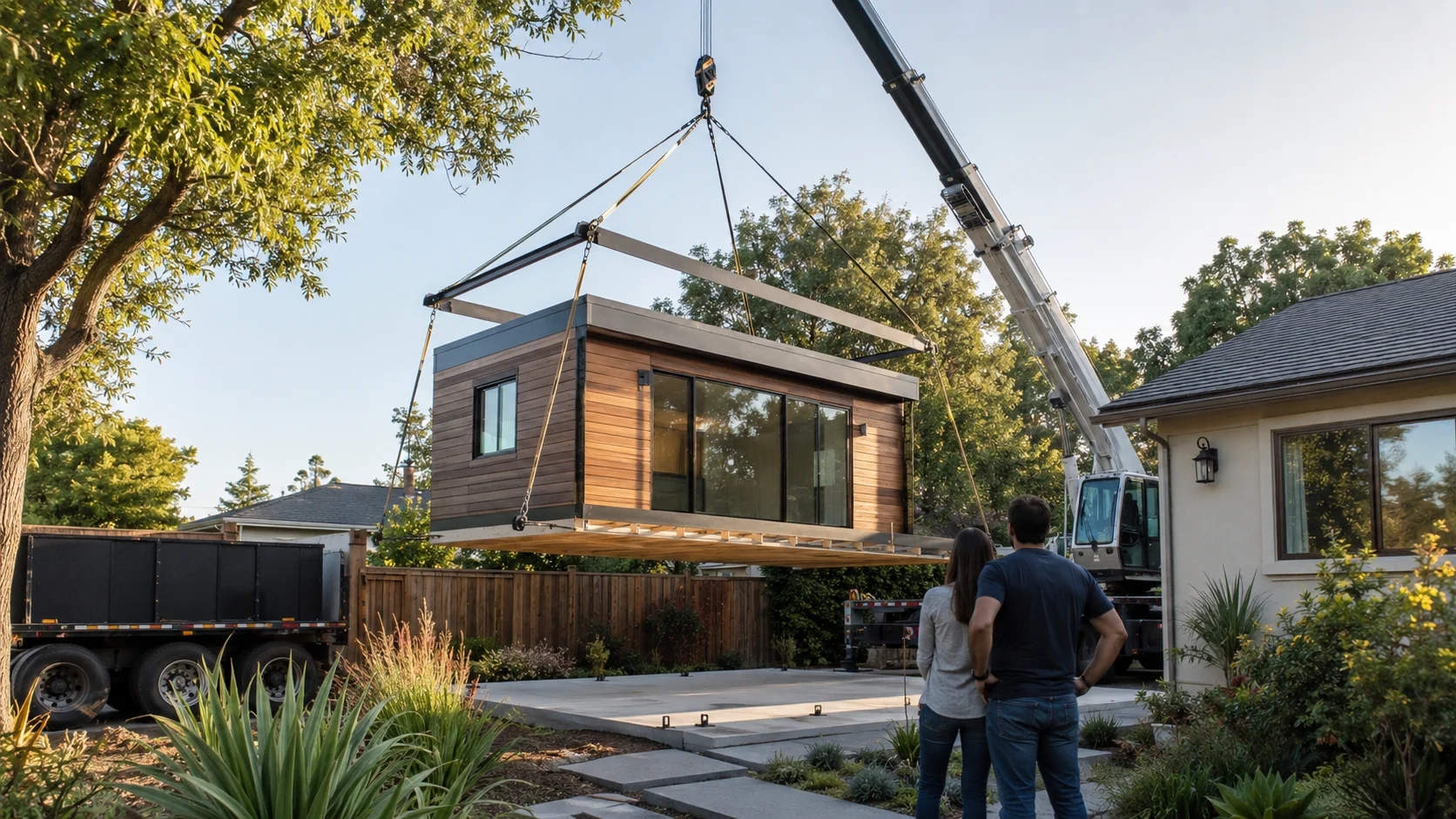
Prefab ADU delivery cost is not one fee — it’s a stack of separate charges, and whether you ever see them depends entirely on how your quote is written. As an editorial planning range assembled from current modular-home transport, crane, and set benchmarks, the delivery-and-set portion of a single-module prefab ADU — the freight, escort cars, transport permits, and the crane that lifts the unit onto your foundation — often lands around $8,000 to $25,000, before site-readiness costs (foundation, utility trenching, hookups, inspections) that most quotes list separately. The component breakdown and the site-readiness costs are further below; what matters first is understanding that your quote may only be describing one or two of those four layers.
The cheapest-looking prefab unit is often the most expensive way to find out what “delivery” leaves out. This page exists so you find out before you sign, not after the invoice lands. For the full prefab ADU cost breakdown, including unit prices, foundation, permits, and total project ranges, see our dedicated guide.
Prefab ADU delivery cost by quote type — read this first
| Quote type | What “delivery” usually means | The main risk hiding behind it |
|---|---|---|
| True turnkey | Delivery and set are usually bundled into one all-in price, but distance and lift caps still apply. | Utility trenching beyond the included length, crane reach beyond the included radius, permit fees, demo, unusual site engineering. |
| Semi-turnkey / installed | Unit, freight, and crane-set are typically included; some local site work is not. | Utility hookups, permit fees, grading, local trades. |
| Unit-only / catalog price | Freight may be separate, or included only to the curb — not set on a foundation. | Foundation, crane, utility hookups, permits, inspections, installation. |
| Kit / tiny-home-style product | Shipping gets the box to you; it does not make it a legal ADU. | Code path, local zoning, foundation, utilities, occupancy approval. |
Get the Free Prefab ADU Delivery Quote Checklist
The nine questions we use to flag the delivery, crane, foundation, and utility lines most likely missing from your quote — before you pay a deposit. Included in the free ADU Starter Kit.
Download Free Starter Kit →How much does prefab ADU delivery cost in 2026?
Answer capsule: Prefab ADU delivery is a bundle of separate line items: factory-to-site freight (roughly $5–$15 per mile per module for modular units), escort or pilot cars ($1.50–$2.50 per mile per vehicle), state oversize-transport permits (which vary by state), and the crane plus set crew ($1,500–$4,000 for a single-module ADU on an accessible lot, rising to $3,000–$10,000 or more for multi-module or tight-access sets). As a national benchmark, modular-home delivery data puts the average at roughly $5–$10 per square foot, or $3,000–$20,000, depending on distance and complexity.
Here is the part almost no competing page gives you in one place: the delivery cost broken into its actual components, each with a current range and a source. We assembled this from heavy-haul logistics pricing, crane-rental data, modular-home cost guides, and manufacturer disclosures.
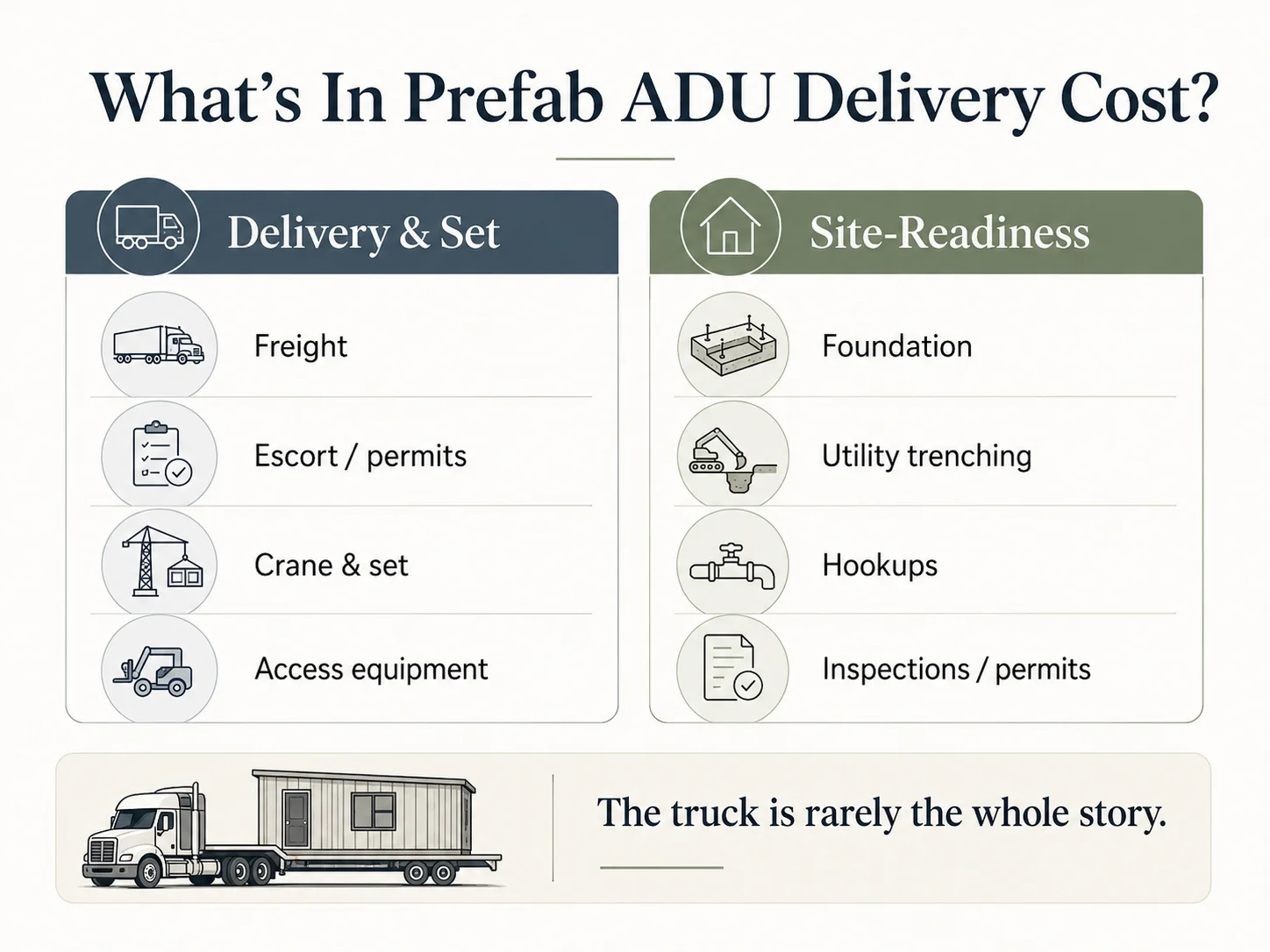
Delivery & set (freight, escorts, crane) and site-readiness (foundation, trenching, hookups, permits) are separate cost buckets — the truck is rarely the whole story.
The Prefab ADU Delivery Cost Stack — verified May 2026
| Delivery line item | Typical 2026 range | How it’s billed | Source |
|---|---|---|---|
| Factory-to-site freight — modular ADU | $5–$15 / mile per module (often $3,000–$15,000 total) | Per mile, per module; wider or heavier loads sit at the high end | Tri-Town Construction (Jul 2025); A-1 Auto Transport (Apr 2026) |
| Freight — modular home-grade wide loads | $10–$15 / mile | Per mile | HomeNation (Apr 2026) |
| National modular delivery benchmark | $5–$10 / sq ft, or $3,000–$20,000 avg | Per square foot / lump | Angi (Mar 2026) |
| Escort / pilot cars | $1.50–$2.50 / mile per vehicle | Per mile, per escort; wide or multi-state loads need one or more | Tri-Town Construction (Jul 2025) |
| State oversize / transport permits | State-specific — e.g. Pennsylvania (eff. Jul 1, 2025): $53 (under 14 ft wide) / $103 (over 14 ft wide) single-trip | Per trip, per state crossed | PA DOT fee schedule, eff. Jul 1, 2025 |
| Crane + operator + rigging — single-module ADU, good access | $1,500–$4,000 | Day or half-day; 4–8 hr minimum; portal-to-portal billing | RiggingForce |
| Crane — multi-module, larger, or tight access | $3,000–$10,000+ (day rate scales: 40–75-ton $1,500–$2,800; 100–200-ton $2,500–$6,000) | Day rate by crane class | RiggingForce; HomeNation benchmark $3,000–$12,000 |
| Set crew labor (un-wrap, place, stitch, bolt-down) | Often $1,000–$3,000+ | Subcontracted; sometimes bundled into 'install' | ModularHomePlace; industry set-cost data |
| Access equipment (toter, dozer, ground-protection mats) | A few hundred to low thousands | As needed for tight, soft, or steep sites | Tri-Town Construction (Jul 2025) |
| Standby / delay charges | $100–$200 / hour | If the site isn't ready, weather hits, or the route fails | Tri-Town Construction (Jul 2025) |
Reading the stack: A toter is a specialized tractor used to maneuver units into tight sites; a telehandler is a forklift with an extending boom that some compact units use instead of a crane. Portal-to-portal billing means the crane’s clock starts when it leaves the yard and stops when it returns — not just the hours it spends on your lot — which is why a one-hour lift can still cost a half-day minimum.
Bottom-line delivery-and-set range: For a single-module prefab ADU within a few hundred miles of the factory on an accessible lot, freight, escorts, and permits ($4,000–$15,000) plus crane and set ($3,000–$10,000) commonly land around $8,000–$25,000. This is the delivery slice only — it sits inside the broader project budget, not on top of an already-complete one.
What’s actually included when a prefab ADU quote says “delivery”?
Answer capsule: “Delivery included” means different things at different companies. Abodu’s California pricing — from $278,800 for a 340-square-foot studio — bundles the unit, delivery, permit services, pre-approved plans, foundation, and standard site work, while excluding the roughly $17,000 average in sales tax and permit fees, and billing overages for utility trenching beyond 50 feet and crane reach beyond 100 feet. Modular Home Direct states freight is included in its online prices while foundation and hookups are local-contractor costs. BOXABL’s dealer FAQ lists site survey, engineering, permitting, utilities, foundation, shipping, crane, and installation as separate project components alongside the $60,000 unit MSRP.
The single most expensive misunderstanding in prefab is treating “delivery included” as “ready to live in.” Some companies mean the truck reaches your curb. Others mean a crane sets the unit on a foundation they built, hooked to utilities they ran, under permits they pulled. Those are wildly different scopes at similar-sounding prices. To compare prefab ADU providers side-by-side on scope — not sticker — see our full provider comparison.
Provider delivery-and-scope matrix — verified May 2026
This is a scope-verification tool, not a ranking. Sorted alphabetically by provider name — never by price or any commercial relationship.
| Provider | Service area | What the published scope signals | Caution before you sign |
|---|---|---|---|
| Abodu | California | All-in pricing from $278,800 (340-sq-ft studio) includes the unit, delivery, permit services, pre-approved plans, foundation, and standard site work; one-day install is typical. | Utility trenching beyond 50 ft and crane reach beyond 100 ft are documented overages; ~$17,000 average in sales tax and permit fees is excluded from base price. California only. |
| BOXABL (Casita) | Ships to 15 states; statewide modular approval in AZ, NM, and CA only | A foldable 361-sq-ft unit with a $60,000 unit MSRP, shipped from North Las Vegas; the dealer FAQ lists site survey, soils/geotech, engineering, permitting, utilities, foundation, roofing, shipping, crane, and installation as separate project components. | The unit price is not the project price. In states without a modular program, local jurisdiction approval is required — confirm your city's stance before you buy. |
| Cover | Southern California | A panelized system that can be assembled on site without a crane; needs about four feet of access. Sitework is priced on access, utilities, logistics, soils, and topography. | Southern California only; sitework costs vary by lot conditions. |
| Modular Home Direct | National catalog (verify local code path) | Freight is included in displayed online prices; foundation, site prep, and utility hookups are local-contractor costs handled separately. | "Freight included" is not "turnkey." Budget separately for foundation, hookups, and permits. |
| Samara | California | Its process covers permitting, site prep, foundation and utilities, crane placement (a few hours), and final touches; permitting often runs about five months. | California availability; verify the proposal's caps and exclusions. |
| Villa | California and Colorado | Includes an itemized budget summary for all scopes of work, with anticipated costs such as foundation, utilities, and permits. | Estimated pricing can change; confirm delivery, installation, utility-hookup, and fixed-price terms in the purchase agreement. |
What’s usually in the base price vs. billed separately:
- Usually in the base unit price: the structure, exterior cladding, factory finishes and appliances, and factory QC.
- Usually billed separately (the surprise lines): freight, escorts, transport permits, the crane and set crew, traffic control — plus all true site work (foundation, grading, utility trenching, hookups, permit fees). On true-turnkey contracts these are pre-bundled; on unit-only purchases they’re yours to assemble and pay.
The four prices people confuse: unit, freight, crane-set, and ready-to-occupy
Answer capsule: A prefab ADU has four distinct price layers that marketing routinely blurs into one: the unit price (the box itself), freight (trucking it to your lot), crane-and-set (lifting it onto the foundation), and ready-to-occupy (foundation, utilities, permits, and inspections that make it a legal dwelling). A low advertised number almost always refers to the first layer only. The gap between layer one and layer four is where most budget shocks live.
Think of it as a ladder, not a single rung.
- Unit price: The structure with factory finishes, sometimes priced ex-works (you arrange transport).
- Freight: The per-mile haul, escorts, and transport permits from the factory to your address.
- Crane and set: The lift onto a prepared foundation and the crew that places, stitches, and bolts it down.
- Ready-to-occupy: The foundation, grading, utility laterals (the pipes and conduit connecting your ADU to the street or main lines), permit fees, and inspections that turn a box on a slab into a legal accessory dwelling unit.
You can see all four layers in the real disclosures. A BOXABL Casita lists a $60,000 unit MSRP, while its dealer FAQ separately lists site survey, engineering, permitting, utilities, foundation, shipping, crane, and installation as project components. An Abodu starts at $278,800 with delivery, foundation, and standard utilities already inside the number. Modular Home Direct includes freight but not the default grading, foundation, or final hookups. Same word — “price” — three completely different layers.
A “$60,000 unit-only quote” and a “$280,000+ installed ADU quote” are usually different scopes, not comparable bids. The trick to reading any quote is to figure out which layer the headline number stops at, then ask which party owns each layer above it. Neither figure is dishonest. Confusing them costs you tens of thousands.
How distance from the factory drives your freight bill
Answer capsule: Prefab freight is billed per mile, so the factory’s location is one of the largest single variables in delivery cost. At $5–$15 per mile for a modular ADU, a 100-mile haul might run $500–$1,500 plus escorts and permits, while a 1,000-mile haul can exceed $10,000 before escorts.
Distance is the variable buyers most often underestimate, because the unit price looks the same to everyone in the catalog. It isn’t. A buyer 80 miles from the plant and a buyer 1,800 miles away pay the same sticker and radically different freight. A low-cost unit hundreds of miles from your lot can see its transportation eat the savings that made it attractive in the first place.
Two practical moves that protect you:
- Get the freight quote tied to your exact address, not a region. Per-mile pricing means a ZIP code changes the number. Compact-unit sellers like BOXABL generate a shipping quote only after a site survey rather than publishing a flat figure, precisely because the route matters. Third-party commentary has cited compact-unit shipping in the range of roughly $2–$10 per mile, but for current planning, use the dealer’s address-specific quote rather than any published rule of thumb.
- Compare a closer factory’s higher sticker against a distant factory’s freight. Sometimes the “more expensive” unit 90 miles away is cheaper delivered than the bargain unit 900 miles away.
Wide loads add a second multiplier. Loads over a certain width trigger escort vehicles at $1.50–$2.50 per mile each, and in some states, particularly wide loads require a police escort billed separately. California loads wider than 14 feet may require a police escort. Verify route-specific escort requirements with your state permit authority. On a long haul, two escorts can add several thousand dollars on top of the line-haul freight.
Why the crane quote swings from $1,500 to $15,000
Answer capsule: Crane cost for a prefab ADU set ranges from about $1,500–$4,000 for a single module on an accessible lot to $10,000 or more for multi-module or tight-access sites. The swing is driven by four variables — lift weight and reach, number of modules, site access, and street closure requirements — not by vendor markup.
The crane line is where homeowners most often suspect they’re being gouged. Usually they aren’t — they’re seeing the price of physics.
The four variables that move your crane number:
- Lift weight and reach: Crane day rates scale with capacity: a small hydraulic crane (14–30 ton) runs roughly $800–$1,500 a day, a mid-range unit (40–75 ton) $1,500–$2,800, and a large crane (100–200 ton) $2,500–$6,000. A heavier unit, or one that must reach over a house into a backyard, forces a bigger crane parked farther away — and a bigger crane is a bigger bill.
- Number of modules: A single-module ADU is one pick. A two- or three-module unit means multiple lifts, more rigging cycles, and more crew hours, which is why multi-module sets climb toward the $3,000–$10,000+ range.
- Site access: Overhead power lines, narrow side yards, mature trees, and soft or sloped ground all push the crane farther from the drop point, demanding more reach and therefore more crane.
- Street closure and traffic control: Urban sets often need a street-closure permit plus flaggers, billed on top of the crane itself.
A single light module dropped from an open driveway is the floor of the range. A multi-module set lifted over a house onto a tight urban lot with a street closure is the ceiling. For more on how prefab compares to stick-built overall, see prefab vs. site-built ADU cost.
Delivery-access red flags (each one can raise your crane and set cost)
- Side-yard or gate clearance below the unit's width
- Overhead power lines or low utility wires on the approach
- Mature trees or dense canopy over the set path
- Sloped, soft, or unstable ground at the staging point
- No flat area for the crane to set up and extend its outriggers
- Narrow street or a tight turning radius for the delivery truck
- A required street closure or traffic-control plan
- A long carry distance or long crane reach into the backyard
If three or more of these describe your lot, a panelized system (assembled on site without a crane) may be cheaper than a crane-set modular unit. Cover’s panelized approach, for instance, was reported to need only about four feet of access and no crane at all. That’s not a small detail — on a tight lot, it can be the difference between a feasible project and an impossible one. See our modular ADU code path guide for the full delivery-type comparison.
Not sure whether a crane can even reach your foundation site?
Run a quick feasibility check at your address — it turns your lot's access into a clear go / no-go before you commit a dollar.
Get Your Free ADU Report →What costs aren’t “delivery” — but must be paid before delivery day
Answer capsule: Before a prefab ADU can be delivered, the site usually needs permits, a foundation, grading, utility trenching, and water, sewer, and electrical connections — none of which is “delivery,” but all of which must be solved first. Building permits commonly run about $500–$4,000, and a slab foundation runs roughly $5–$16 per square foot before site-specific excavation, engineering, soil, and slope costs. These pre-delivery costs frequently exceed the freight bill itself.
This is the section that reframes the whole search. People come looking for “delivery cost” because that’s the line that surprised them — but the truck is rarely the real risk. The real risk is everything that has to be ready before the truck arrives, because if the site isn’t ready, the unit can’t be set, and you may pay standby charges of $100–$200 per hour while a crew waits.
A utility lateral is the connecting line — sewer, water, gas, or electrical — that runs from your ADU to the street main or to your existing home’s service. The longer that run and the more hardscape it crosses, the more it costs. Site work is the umbrella term for grading, foundation, trenching, and hookups. None of it is optional for a legal, occupiable ADU.
Pre-delivery costs that can make the truck irrelevant
| Cost line | Why it matters | Ask this before you pay a deposit |
|---|---|---|
| Foundation | The unit cannot be permanently set without engineered, inspected support. At roughly $5–$16 per square foot for a slab, a 340–800 sq ft footprint implies a meaningful four-to-five-figure line before soil and slope factors. | "Is foundation design and construction included, and what type?" |
| Utility trenching | Long runs and hardscape crossings can blow past included caps — Abodu, for example, includes trenching to 50 ft and bills beyond it. | "How many linear feet of trenching are included, and what's the price per extra foot?" |
| Electrical panel / service | An ADU's added load can trigger a panel or service upgrade. | "Who verifies my panel capacity, and is an upgrade included?" |
| Sewer / septic | Capacity, slope, and tie-in distance can drive major cost; septic adds more. | "Is sewer or septic review and tie-in included?" |
| Permits, fees, taxes | Often excluded from base prices; building permits alone average about $500–$4,000, and Abodu notes customers pay about $17,000 on average in combined sales tax and permit fees. | "Are permit fees, plan-check fees, impact fees, and sales tax included?" |
| Overhead utility coordination | Wires over the lift path can force a temporary drop, a clearance, or a route change on set day. | "Who coordinates and pays for temporary wire drops, utility clearances, or route changes if overhead lines block the lift?" |
| Site access prep | Fence or tree removal, ground protection, and access widening to get the truck and crane in. | "What access width and crane radius does my set require, and who pays to create it?" |
Prefab’s biggest weakness is exactly this disclosure gap. Because the sticker rarely includes site readiness, some buyers feel ambushed. But that’s a disclosure problem, not a cost problem — every one of these lines also exists for a site-built ADU. Once they’re in writing, a prefab project is usually faster and far less disruptive than months of on-site construction.
See What You Can Build → Get Your Free ADU Report
Before you pay a deposit, check your lot's setbacks, likely ADU fit, utility-path flags, and delivery-access concerns at your actual address. It takes about 60 seconds and costs nothing.
See What You Can Build → Get Your Free ADU ReportFree. Takes about 60 seconds. No obligation.
How delivery costs differ by prefab ADU type
Answer capsule: Delivery cost and risk vary sharply by prefab type. Modular ADUs ship as finished three-dimensional boxes and depend heavily on crane and truck access. Panelized ADUs ship as flat panels assembled on site, lowering crane risk on tight lots. Foldable and container units have simple shipping profiles but still require foundation, utilities, and local code approval. Manufactured homes follow the federal HUD Code (24 CFR Part 3280) and a different approval path than modular construction.
Modular ADU
Built as complete three-dimensional modules in a factory to the same state and local building codes as a site-built home, then craned onto a foundation.
Advantage: Fastest set, often a single day. Risk: Crane, access, route, and staging are the cost drivers. Best fit: Flat, accessible lots.
Panelized ADU
Ships as flat wall, floor, and roof panels assembled on site.
Advantage: Fits tighter access, often without a crane. Risk: More on-site labor and a longer set. Best fit: Narrow yards, lots with trees or overhead wires.
Foldable / container-style ADU
Compact shipping profile (a foldable unit like the BOXABL Casita travels folded and unfolds on site).
Advantage: Simpler to truck. Risk: A simple shipping profile can mask the foundation, utility, and local-code work still required; a crane, forklift, or telehandler is needed to position and unfold it. Best fit: Buyers with strong local GC support.
Manufactured ADU (HUD Code)
Built to the federal Manufactured Home Construction and Safety Standards (24 CFR Part 3280); a transportable structure built on a permanent chassis, distinct from modular.
Advantage: Established federal code category. Risk: Lender, title, and local-zoning acceptance vary; not every jurisdiction lets a HUD-Code home serve as an ADU. Best fit: Jurisdictions that accept the HUD path.
Kit / tiny-home-style product
Low visible product price, often sold online.
Advantage: Low initial cost. Risk: May not be a legal dwelling at all without the right code path, foundation, utilities, and occupancy approval. Best fit: Non-ADU uses unless verified.
Prefab type vs. delivery risk
| Type | Delivery advantage | Delivery risk | Best fit |
|---|---|---|---|
| Modular | Fast set, factory-finished | Crane, access, route, staging | Flat, accessible lots |
| Panelized | Fits tighter access, often no crane | More on-site assembly labor | Narrow yards, trees, wires |
| Foldable / container | Compact shipping profile | Local code, foundation, hookups | Buyers with strong local GC support |
| Manufactured (HUD Code) | Established federal code category | Lender, title, and local-zoning acceptance | Jurisdictions that accept the HUD path |
| Kit / tiny home | Low visible product price | May not be a legal dwelling | Non-ADU uses unless verified |
Can you use a $60K prefab unit as a legal ADU?
Answer capsule: Sometimes — but the unit price is not the legal-ADU price. A foldable unit like the BOXABL Casita lists a $60,000 unit MSRP, yet the dealer FAQ itself lists site survey, soils and geotech, engineering, permitting, utilities, foundation, shipping, crane, and installation as separate project components. In California, a manufactured home can be used as an ADU under the state’s ADU definition, which incorporates the manufactured-home definition in Health and Safety Code §18007, provided it still meets applicable building, health, and safety requirements. A cheap unit only becomes a legal ADU after the code path, permits, foundation, utilities, and inspections are satisfied.
Three things to confirm before you treat a low-cost unit as an ADU:
- Unit price vs. project price: The MSRP is layer one of four (see above). The BOXABL dealer FAQ is unusually candid here, listing the full set of separate project components alongside the $60,000 unit figure. Map the other three layers before you celebrate the sticker.
- Which code path applies: Modular (local and state code), manufactured (federal HUD Code, 24 CFR Part 3280), and RV or tiny-home products are reviewed differently. Note that some foldable units, including the BOXABL Casita, are explicitly not HUD/manufactured homes but state-approved modular units — a distinction your building department will care about. A DADU (detached accessory dwelling unit) and a JADU (junior ADU — a small unit, typically up to 500 sq ft, carved out of an existing home) also carry different rules.
- "State approved" is not "your lot approved": A unit approved for sale in your state still has to clear your city's zoning, setbacks (the minimum distance a structure must sit from property lines), and site conditions. California's ADU framework treats manufactured homes as eligible in concept while still requiring local compliance — eligibility in principle is not a permit in hand. See ADU rules in your state for a full breakdown.
The move that protects you: call your local building department with the specific product and your address before you buy. Five minutes on the phone can save a five-figure mistake. For a full breakdown of ADU rules in your state, see our guide.
Check My Lot Before I Buy the Unit → Get My Free ADU Report
See whether your address, setbacks, and access actually support the unit you're eyeing — before you put money down on a box that may not fit your lot or your code path.
Get Your Free ADU Report →Turnkey or unit-only? Which delivery path fits you
Answer capsule: Choose a true turnkey prefab ADU (one company handling permitting, delivery, foundation, utilities, and installation) if you want a single accountable party and predictable completion. Choose unit-only if you already have a qualified local general contractor, understand your code path, and can manage foundation, utilities, inspections, and delivery logistics yourself. For most first-time ADU buyers, the lowest sticker (unit-only) carries the highest coordination risk.
The delivery question is really an accountability question: when the truck arrives and something isn’t ready, whose problem is it?
The scope contrast across real providers makes the trade-off concrete. Abodu (turnkey) includes delivery, installation, foundation, and standard utilities in its number, with documented caps. Modular Home Direct (catalog) includes freight but not the default grading, foundation, or final hookups. BOXABL’s dealer FAQ lists site survey, utilities, foundation, shipping, crane, and install as separate components you or a dealer coordinate. The lower the sticker, the more layers you’re agreeing to own.
Turnkey vs. unit-only decision matrix
| Your situation | Better path | Why |
|---|---|---|
| First ADU, no contractor relationship | Turnkey or strong semi-turnkey | Fewer coordination gaps; one party owns the schedule |
| Tight lot, no clear crane path | Panelized or site-built | Avoids large-module crane-set risk |
| Experienced owner-builder with a GC | Unit-only can work | You can manage local scope and capture the savings |
| Need a predictable completion date | True turnkey | One party owns more of the risk |
| Budget depends on rental income | Feasibility and quote audit first | Avoids building an ROI on a freight-and-site-work number you haven't verified |
If you’re counting on rent to carry the project, run the full delivered-and-installed number — not the unit price — before you model returns. These are illustrative planning notes, not guarantees of returns. Actual results depend on local market conditions, construction costs, financing terms, and regulatory approvals.
What to ask before you pay a prefab ADU delivery deposit
Answer capsule: Before paying any deposit, require the provider to answer — in writing — whether delivery to your exact address, crane and set, foundation, utility trenching length, permits, transit insurance, and a site-not-ready policy are included, capped, excluded, or owner-managed. A safe quote names the address, the trenching footage, the crane assumptions, and the party responsible for each line. A risky quote says “delivery included” or “standard utilities” without specifics.
This is the search-ending tool. Print it, paste your quote next to it, and you’ll see in five minutes what’s missing.
The deposit-safe quote audit
| Question | A safe answer looks like | A risk answer looks like |
|---|---|---|
| Is delivery to my exact address included? | "Yes — here are the route and access assumptions." | "Delivery included" with no address named. |
| Is the crane and set included? | "Yes, assuming an X-ton crane, Y-ft reach, Z access." | "That should be fine." |
| How many feet of utility trenching are included? | A specific number, plus the price per additional foot. | "Standard utilities included." |
| Who pulls the permits? | A named party with the included scope. | "You handle the city stuff." |
| Who coordinates overhead wires blocking the lift? | A named party and a stated cost responsibility. | Not addressed. |
| Who pays if the site isn't ready on delivery day? | A written reschedule, standby, or storage policy. | Not addressed. |
| Who insures the unit in transit and during the set? | A named policy and responsible party. | Not addressed. |
| What voids the fixed price? | A specific, short list of exclusions. | A broad "subject to change." |
This is exactly why Abodu’s 50-foot trenching cap and 100-foot crane cap matter: a cap turns vague “included” language into real quote math, because you can price the overage instead of discovering it on an invoice. The included / capped / excluded / owner-managed markup method works on any quote — go line by line and tag each cost with one of those four words. Anything you can’t tag is a question you haven’t asked yet, and an invoice you haven’t seen yet.
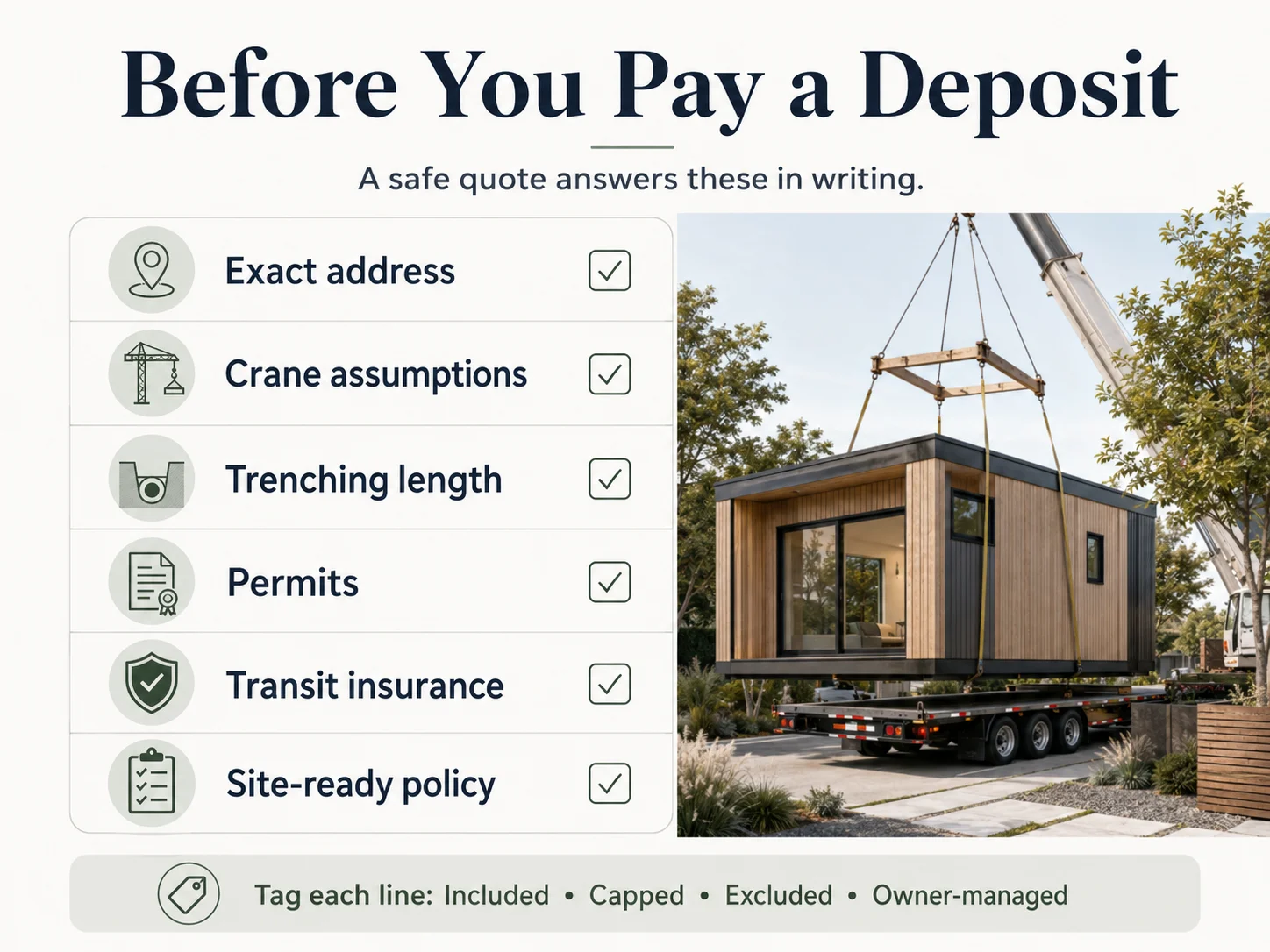
Tag each line in your quote as Included, Capped, Excluded, or Owner-managed. Anything untagged is a gap.
Check My Property Before I Pay a Deposit → Get My Free ADU Report
See whether your lot, setbacks, access, and utility path actually support the quote in front of you — at your real address, before any money changes hands.
Get Your Free ADU Report →How homeowners pay for the delivery and site-work gap
Answer capsule: Because delivery, foundation, utilities, and permits create a cash gap between the unit price and the finished ADU, homeowners typically fund prefab projects through one of a few financing lanes: cash reserves, a home equity line of credit (HELOC — a revolving loan against your home’s equity), a cash-out refinance, or a construction or renovation loan that disburses in stages. The right lane depends on your equity, timeline, and how much of the budget is unit versus site work.
The point is simply that the delivered number — not the sticker — is what you finance, and the site-work gap is real money that needs a source. For a comprehensive guide to ADU financing paths, see our dedicated guide.
- Cash or staged savings: Simplest, with no financing cost; works when the gap is modest and the timeline is flexible.
- HELOC: Draws against existing home equity; flexible for paying contractors in stages, including delivery and site work.
- Cash-out refinance: Replaces your existing mortgage with a new, larger one and takes the difference as cash; works best when rates are favorable and the project is large.
- Construction or renovation loan: Designed for projects with staged completion; disburses in draws, so it matches the delivery-then-site-work sequencing of most prefab builds.
- Manufacturer financing: Some prefab sellers offer financing, but confirm it covers the full project, not just the unit.
These are educational financing paths, not guarantees of approval, rates, payments, or outcomes. Actual financing availability depends on credit, income, equity, property type, lender guidelines, and local project requirements.
What we verified, and how we built this
What we verified (last checked May 29, 2026):
- Provider pricing and scope: Abodu (studio from $278,800; 50-ft trenching and 100-ft crane caps; ~$17K excluded tax and permit fees), BOXABL (dealer FAQ — $60,000 unit MSRP, 15 ship-to states, statewide modular approval in AZ/NM/CA, separate project components, not HUD/manufactured), Modular Home Direct (FAQ — freight included, foundation and hookups separate), Samara, Villa (CA and CO; itemized proposal scope), and Cover (Southern California; sitework variables).
- Delivery and crane benchmarks: Angi modular-home data (delivery $5–$10/sf, $3,000–$20,000; permits ~$500–$4,000; slab $5–$16/sf), HomeNation, Tri-Town Construction (per-mile freight, escort, and standby ranges), A-1 Auto Transport, RiggingForce (crane day rates and ADU set range), Maden.co, and the Pennsylvania DOT permit fee schedule effective July 1, 2025 (primary source: $53/$103 single-trip modular-housing permit).
- Code path: HUD Manufactured Home Construction and Safety Standards (24 CFR Part 3280); California HCD ADU Handbook on manufactured homes as ADUs under Health and Safety Code §18007.
Methodology:
We separated every claim into three buckets: Verified commercial facts (provider pricing, scope, service area) came from provider pages and current cost guides, with dates. Regulatory and code facts (HUD Code, California HCD) came from primary or highly authoritative sources. Editorial conclusions (which path fits which buyer, how to read a quote, the assembled $8,000–$25,000 delivery-and-set planning range) are framed as our judgment built on those verified component figures, not as a guaranteed quote.
Frequently asked questions
Is prefab ADU delivery included in the price?
It depends entirely on the quote type. True-turnkey contracts usually bundle delivery and set into the all-in price; unit-only purchases bill freight and the crane separately, and may not include the foundation or utilities at all. Always confirm in writing whether delivery to your exact address is included, capped, or excluded.
How much does it cost to ship a prefab ADU?
For a modular ADU, freight commonly runs $5–$15 per mile per module, or $3,000–$20,000 on average. Escorts at $1.50–$2.50 per mile per vehicle and state transport permits are additional.
Do I need a crane for a prefab ADU?
Most modular ADUs are lifted onto the foundation by crane, and the set often takes a single day. Foldable units may use a forklift or telehandler instead, and panelized systems can sometimes avoid a crane entirely.
What's the difference between delivery and installation?
"Delivery" is getting the unit to your lot (freight, escorts, permits). "Installation" is setting it on a prepared foundation, connecting utilities, and finishing it for occupancy (crane, set crew, hookups, inspections). A quote can include one without the other.
Can a prefab ADU fit through my side yard?
That's an access question that directly affects your crane cost. Side-yard width below the unit's dimensions, overhead wires, and mature trees can force a larger crane or a different delivery method. Check your access before assuming your backyard is reachable.
What happens if the truck or crane can't access my backyard?
You may need a larger crane with longer reach (higher cost), a panelized unit assembled on site, or in some cases a different product entirely. This is why an access assessment before deposit matters — discovering it on delivery day can mean standby charges of $100–$200 per hour.
Does turnkey include utility hookups?
Usually, but with caps. Abodu, for example, includes standard site work and utility tie-in but documents overages for trenching beyond 50 feet. Confirm the included trenching footage and the per-foot price beyond it.
Are permit fees included in prefab ADU delivery?
Often not. Building permits average roughly $500–$4,000, and some providers exclude them from base pricing — Abodu notes customers pay about $17,000 on average in combined sales tax and permit fees, separate from the base price.
Can I buy the unit now and handle permits later?
You can, but it's the highest-risk path. Buying unit-only means you own the foundation, utilities, permits, inspections, and delivery logistics. Most first-time ADU buyers are better served by turnkey or strong semi-turnkey contracts that keep one party accountable.
Is a BOXABL Casita a legal ADU in every state?
No. BOXABL ships to 15 states and holds statewide modular approval in Arizona, New Mexico, and California; elsewhere on its ship list, deployment is subject to local jurisdiction approval. A unit approved for sale is not automatically permitted as an ADU on your specific lot.
Is panelized cheaper than modular for delivery?
Often, on tight lots — because panelized units ship flat and can be assembled with little or no crane, avoiding the access and crane-reach costs that drive modular set prices up. The trade-off is more on-site labor.
Who pays if the unit is damaged in transit?
That depends on the contract. A safe quote names the transit insurance policy and the responsible party; if your quote is silent on it, ask before you sign.
Can a manufactured home be used as an ADU?
In some jurisdictions, yes. California's ADU definition incorporates the manufactured-home definition in Health and Safety Code §18007, so a manufactured home can serve as an ADU provided it meets applicable building, health, and safety requirements. Manufactured homes follow the federal HUD Code (24 CFR Part 3280) and a different approval path than modular units, so local acceptance varies.
What's the cheapest prefab ADU delivery path?
Generally, a closer factory plus an accessible, flat lot plus a single-module or panelized unit — minimizing freight miles, escort needs, and crane reach all at once. The 'cheapest unit' far from your lot is frequently not the cheapest delivered.
Sources & verification log
Verification date: May 29, 2026. Figures are dated; reverify before relying on them for your project.
- Tri-Town Construction — modular-home transport: per-mile freight $5–$15, escort $1.50–$2.50/mile/vehicle, standby $100–$200/hr — tri-townconstruction.com/how-modular-homes-are-transported/ (Jul 2025).
- A-1 Auto Transport — heavy-haul rates per mile — a1autotransport.com/heavy-haul-rates-per-mile/ (Apr 2026).
- HomeNation — modular-home price guide: freight $10–$15/mile for wide loads; crane/set benchmark $3,000–$12,000 — homenation.com/blog/the-complete-guide-to-modular-home-prices (Apr 2026).
- Angi — modular-home cost: delivery $5–$10/sf or $3,000–$20,000; building permits ~$500–$4,000; slab foundation $5–$16/sf — angi.com/articles/modular-home-cost.htm (Mar 2026).
- Pennsylvania DOT oversize-transport permit fee schedule effective July 1, 2025 — Mobile Home / Modular Housing Unit single-trip permit: $53 (under 14 ft wide), $103 (over 14 ft wide) — pa.gov DOT hauling permit 2025 fees PDF.
- RiggingForce — crane hiring cost: single-module ADU/modular-home set $1,500–$4,000; 14–30-ton crane $800–$1,500/day; 40–75-ton $1,500–$2,800; 100–200-ton $2,500–$6,000 — riggingforce.com/crane-rigging-faqs/how-much-does-it-cost-to-hire-a-crane-for-a-day/.
- Maden.co — calculating real cost to build a modular house; multi-module set pricing — maden.co/blogs/building-basics/calculating-the-real-cost-to-build-a-modular-house (Feb 2026).
- Abodu — all-in pricing from $278,800 (340-sq-ft studio); one-day install; utility trenching cap 50 ft; crane-reach cap 100 ft; ~$17K avg tax + permit fees excluded — abodu.com/pricing (2026).
- BOXABL dealer FAQ — Casita unit MSRP $60,000; ships to 15 states; statewide modular approval AZ, NM, CA; separate project components: site survey, soils/geotech, engineering, permitting, utilities, foundation, roofing, shipping, crane, installation; not HUD/manufactured — boxabldealership.com/FAQ (2026).
- Modular Home Direct — freight included in online prices; foundation, site prep, utility hookups are local-contractor costs — modularhomedirect.com/faq/ (2026).
- Samara — process covers permitting, site prep, foundation and utilities, crane placement (a few hours), final touches; permitting ~5 months — samara.com/backyard/how-it-works (2026).
- Villa Homes — itemized budget summary; CA and CO service areas — villahomes.com/feasibility-study (2026).
- Dwell — Cover panelized system: no crane needed, ~4 ft access — dwell.com/article/cover-prefab-adu-turnkey-backyard-homes-a4da5164 (2023).
- California HCD ADU Handbook — manufactured homes eligible as ADUs under Health and Safety Code §18007; HUD Code (24 CFR Part 3280) — hcd.ca.gov/sites/default/files/docs/policy-and-research/adu-handbook-update.pdf.
See what’s possible at your address
Lot access, setbacks, delivery flags, and prefab feasibility — in about 60 seconds. No sales call. No commitment.
Free. Takes about 60 seconds. No obligation.
Get the Free Prefab ADU Delivery Quote Checklist
The nine questions we use to flag the delivery, crane, foundation, and utility lines most likely missing from your quote — before you pay a deposit. Included in the free ADU Starter Kit.
Download Free Starter Kit →