
Best Modular ADU Companies in 2026: Which Ones Actually Fit Your Lot, Budget, and Code Path?
By The Dwelling Index Editorial Team · Last updated: · Last verified:
Published
Comparing every factory-built option nationally? Start with our broader Best Prefab ADU Companies guide. Want a plain-English primer on the build method itself? See Modular ADU: Costs, Rules & When Modular Wins. This page is the layer underneath both: it tells you which modular ADU company is a real code, scope, and service-area fit for your specific lot — before you request a single quote.
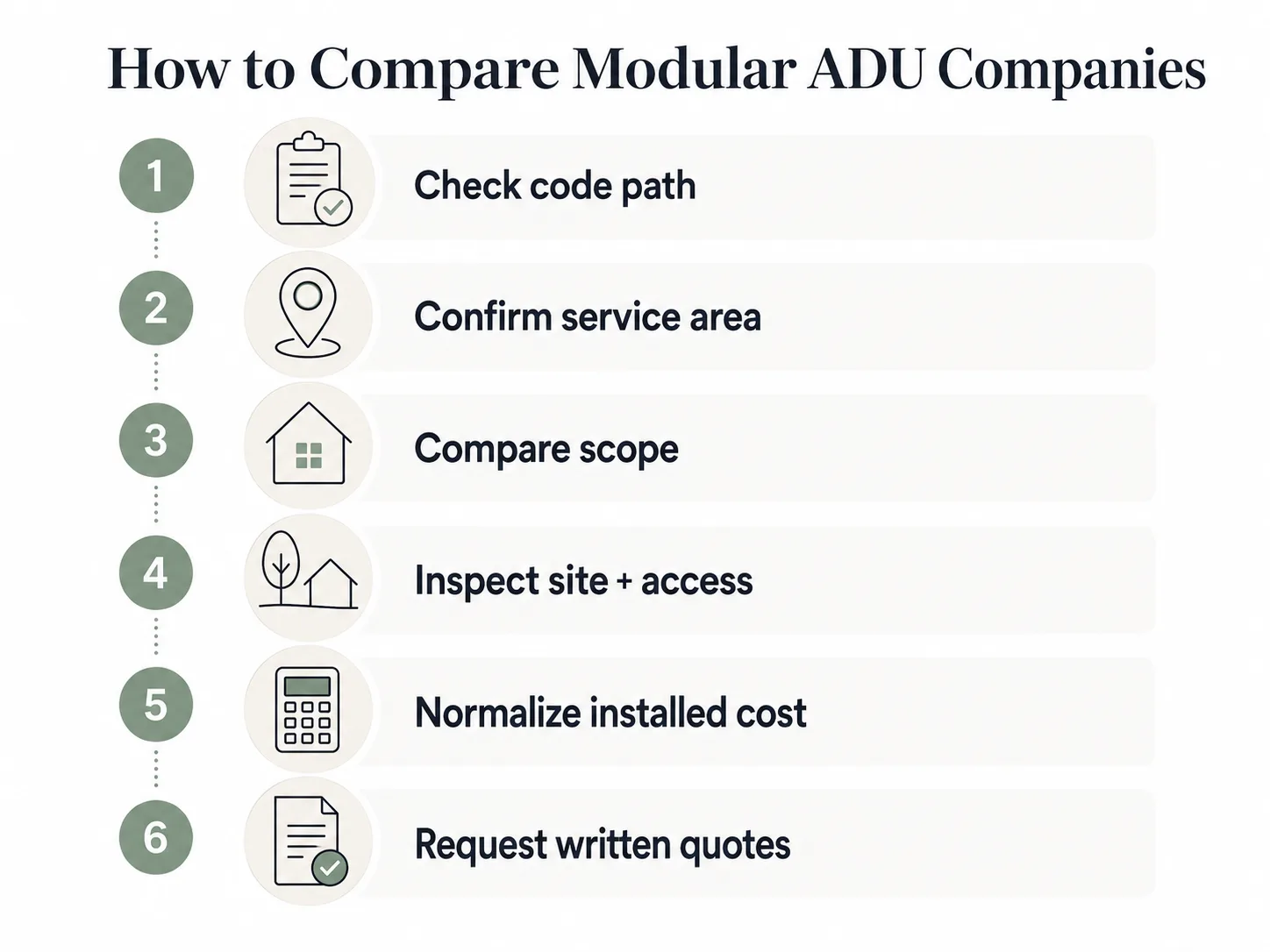
The best modular ADU companies aren’t the ones with the lowest “starting at” price — they’re the ones that build to a code path your local building department will accept, serve your county, and put every line of site work in writing. For most homeowners in 2026, that means: in California, Abodu (fixed-price turnkey, starting at $278,800 before taxes, permit fees, and nonstandard site work) and Samara (design-forward, from $152,000 plus installation) lead the true-modular field; nationally, Studio Shed, Modular Home Direct, Method Homes, and Wolf Industries are real options only after you solve local permits and foundation; and BOXABL fits a narrow compact-unit niche. One number to anchor everything: a fully installed detached modular ADU commonly lands between $250,000 and $450,000+ once foundation, utilities, permits, delivery, and finish work are added — and on many lots the site work alone runs 70–120% of the factory module cost (Placer County, CA government ADU data). The single most expensive mistake is comparing factory unit prices as if they were project prices. Your first move isn’t picking a brand — it’s checking what your lot can legally and physically support.
The fastest way to start: before you compare a single company, see your address-specific size limits, setback requirements, and likely ADU type.
See What You Can Build — Get Your Free ADU Report →About 60 seconds, no sales call
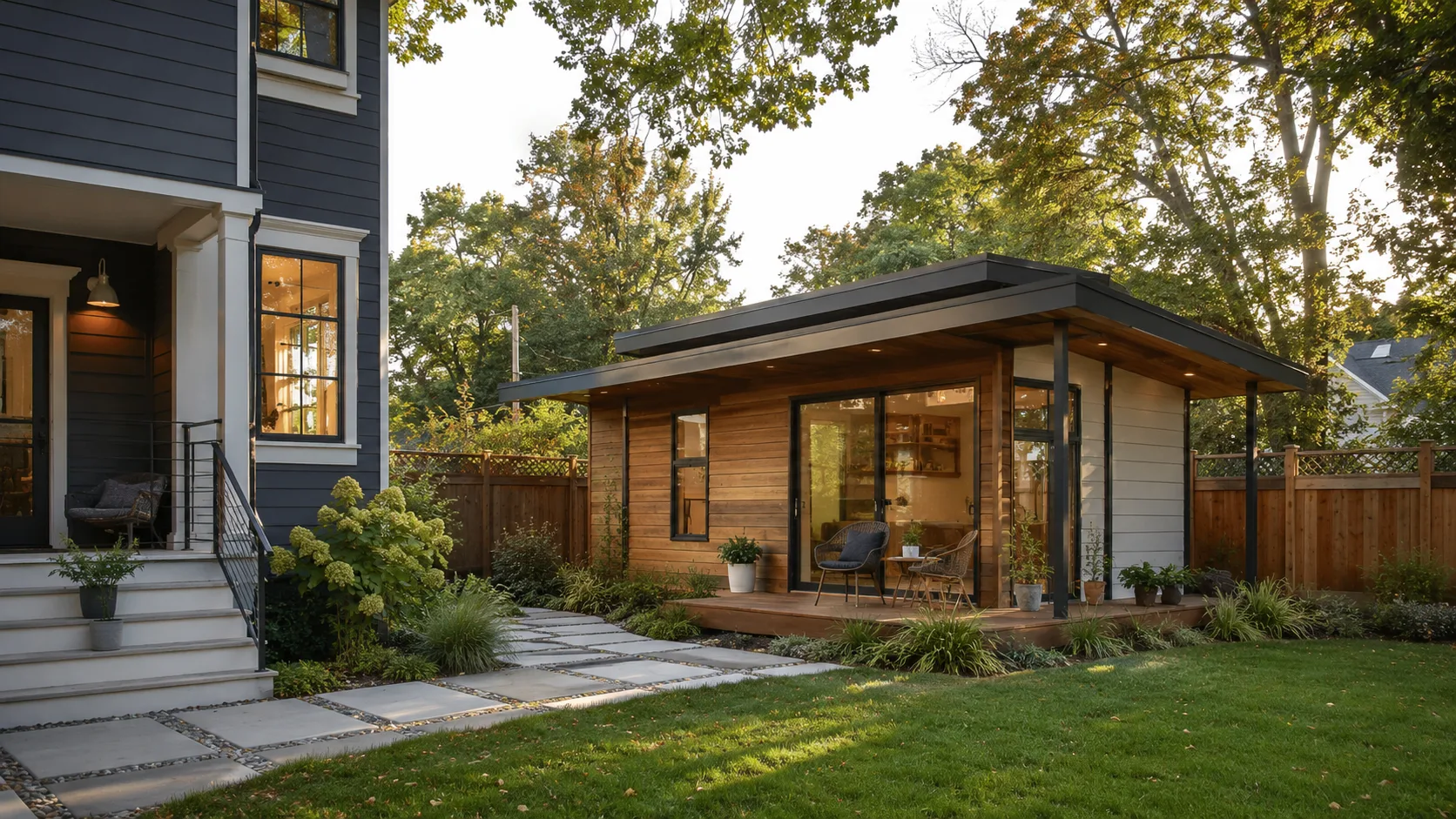
Best first call, by your situation
| Your situation | Start here | Why |
|---|---|---|
| Turnkey California modular ADU | Abodu, Samara, Villa Homes (verify current scope) | Regional providers with managed ADU workflows |
| National modular / panelized route | Studio Shed, Modular Home Direct | Broader reach, but local permitting and site work are still on you |
| Compact foldable unit | BOXABL | Only after verifying local ADU legality and full installed scope |
| Central Coast / within ~150 mi of Monterey | Framework First | Managed-modular regional fit |
| Utah or Southern California | Nest Tiny Homes | Regional ADU/tiny-home path; verify code category |
| San Diego, where modular may not fit | SnapADU | Site-built design-build alternative |
| Complex lot — slope, HOA, coastal, septic, no crane access | Run feasibility first | Product choice is premature until constraints are known |
Which Are the Best Modular ADU Companies to Shortlist First?
The best modular ADU companies to shortlist are the ones that build to a code path your jurisdiction accepts, serve your county, and clearly state who handles permits, foundation, utilities, delivery, installation, and inspections. Factory price comes last, because the unit is typically only 40–60% of the installed project cost. No single company is “best” nationwide — the right pick is the one whose service area, code path, and scope match your specific property.
Here’s the part most comparison pages skip. They rank companies by how their renderings look, or by a “starting at” number that excludes site work. We built something different: a decision matrix that sorts real modular ADU providers by the factors that actually decide whether a project is feasible, legal, and on-budget for you. Assembling this otherwise means opening eight-plus company websites, three code-agency pages, and building a spreadsheet. We did that work and put it in one table — with the source and date we checked each row.
Terms defined once, used throughout: A modular ADU is built in volumetric sections in a factory to your state or local building code (the IRC — International Residential Code), then trucked to your lot and set on a permanent foundation, usually with a crane. Site work means everything that happens on your property — foundation, grading, trenching, hookups. A utility lateral is the underground line connecting your ADU to water, sewer, or electrical service. Turnkey means one company manages the whole path from design to your certificate of occupancy (CO) — the document your building department issues confirming the unit is legal to live in.
The 2026 Modular ADU Company Fit Matrix
Prices and service areas are sourced from each company’s own website and named third-party reporting, with the date we checked each. Scope varies dramatically — always confirm in writing what your quote covers before signing. See our methodology →
Some companies on this page have, or may in future have, affiliate relationships with The Dwelling Index. Our rankings and editorial judgments are based on independent research and are never influenced by compensation. Notably, the strongest options above — Abodu and Samara — are not affiliate partners, and we’d still tell a friend to start there.
| Company | Best fit | Service area | Code path | Published starting price | What price includes | Turnkey reality | Crane? | Source checked |
|---|---|---|---|---|---|---|---|---|
| Abodu | CA turnkey buyers wanting fixed pricing | California | IRC modular, state-approved plans | Studio from $278,800 before tax/permit fees; Abodu One from $326,800 (avg total ~$352,500) | Unit, foundation, standard utilities (~50 ft), permit services, delivery, install | True turnkey (CA) | Yes | abodu.com/pricing, Apr 2026 |
| Samara | CA design-forward buyers | California | IRC modular | From $152,000 + installation | Unit only; installation quoted separately | Managed; install priced separately | Yes | samara.com, May 2026 |
| Villa Homes | CA larger 1–3BR layouts | California (+ Colorado) | Offsite/prefab | Quote-based (verify current pricing) | Turnkey design–permits–site–install (per company) | Managed/turnkey | Varies | villahomes.com, May 2026 |
| Studio Shed | National buyers OK managing local scope | All 50 states | Panelized (no crane) | Product + plans ~$40K+; ~$250/sq ft w/ ProAssembly + site work | Panels, plans, appliance/kitchen/bath packages | Hybrid — kit to ProAssembly | No | studio-shed.com, Apr 2026 |
| Modular Home Direct | National modular/container comparison | National (product/plan route) | IRC modular / container | Quote-based | Stamped blueprints; owner/contractor submits permits | Product/plan — local GC needed | Varies | modularhomedirect.com FAQ, May 2026 |
| Method Homes | Higher-budget custom modular | Multi-state (West) | IRC modular | Base modular ~$300–$450+/sq ft; soft costs $40K+; site costs 60–150% of modular cost | Modules; soft + site costs separate | Managed/custom | Yes | methodhomes.net/pricing, May 2026 |
| Wolf Industries | Smaller modular/ADU in PNW | OR/WA turnkey; ships wider | IRC modular | Models $67,500–$178,500, home-only | Home only — no delivery, install, permits, utilities, sitework | Turnkey in OR/WA only | Yes | wolfind.com, May 2026 |
| BOXABL | Compact foldable-unit shoppers | Expanding nationally — verify | Factory-built foldable; verify local code acceptance | Financing example from ~$895/mo (studio) — price varies, see disclaimer | "We handle everything" — verify scope for your area | Verify per area | Yes | boxabl.com/casita, May 2026 |
| USModular | SoCal/Inland Empire/San Diego budget | Southern California | Manufactured (HUD) and modular (IRC) — ask which applies | Quote-based | Design, permitting, fabrication, site work, install (varies) | Managed | Varies | usmodularinc.com, Feb 2026 |
Find a builder for your specific city: if you’re in Greater San Diego, our city-level builder guides match you to vetted local options (SnapADU and San Diego County builders →). On the Central Coast or Bay-adjacent (within ~150 miles of Monterey County), Framework First is a managed-modular option we cover below. In Utah or Southern California, Nest Tiny Homes is a regional path — with the code-path caveat in our breakdown.
You’ve seen the field. Now narrow it to your lot. The matrix tells you who could fit; your property decides who actually fits.
See What You Can Build — Get Your Free ADU Report →Is It Really Modular — Or Prefab, Manufactured, Panelized, Kit, or Tiny Home?
“Prefab” is a marketing umbrella; “modular,” “manufactured,” “panelized,” “kit,” “tiny home,” and “park model RV” are different code paths with different inspection systems and different zoning outcomes. A true modular ADU is built to state/local building code (IRC) and is generally financed and appraised like a site-built home. A manufactured home is built to the federal HUD Code (24 CFR Part 3280) and may only be allowed as an ADU where local zoning specifically permits it. Identifying what the product legally is must come before comparing companies — because it determines whether you can even permit it, how you can pay for it, and how it appraises.
This is the single most important section on the page, and the one almost every competing listicle skips. We’ve watched homeowners fall for a beautiful $90,000 “modular ADU” online, put down a deposit, and only later learn the product is a HUD-code manufactured home their city won’t allow as an ADU on their lot — or a “tiny home” built to RV standards that their jurisdiction won’t issue a certificate of occupancy for as permanent housing. The label isn’t pedantry. It’s the difference between a legal, financeable, value-adding ADU and an expensive lawn ornament.
Product label vs. code path vs. ADU risk
| Label | What it usually means | The code/approval catch | Ask before you pay a deposit |
|---|---|---|---|
| Modular ADU | Factory-built volumetric sections, set on a permanent foundation | Built to state/local building code (IRC); your state's factory-built/modular program approves the unit | "Is this approved under my state's modular program, and will the city treat it as a standard ADU?" |
| Manufactured home | Built to federal HUD Code (24 CFR Part 3280), on a permanent chassis | Allowed as an ADU only where zoning permits manufactured homes; financing and appraisal differ | "Will my city allow a HUD-code home as an ADU on my specific lot?" |
| Panelized ADU | Factory-built wall/roof panels, assembled on-site | Built to IRC, but local engineering, assembly, and inspection still apply | "Who engineers it, who assembles it, and who pulls the permits?" |
| Kit ADU | Materials + plans package shipped to you | Often the buyer's or a local GC's responsibility to permit and build | "What's included beyond the materials, and who's responsible for the rest?" |
| Tiny home | Could be RV-certified, movable, or site-built | Frequently not automatically legal as a permanent ADU | "What code is it actually built to — IRC, or RV/ANSI?" |
| Park model RV | Recreational/seasonal product | Usually not a permanent-dwelling path | "Is this legal for year-round occupancy as a dwelling?" |
The plain-English decode: The U.S. Department of Housing and Urban Development (HUD) defines a manufactured home as a factory-built home constructed to the federal HUD Code, in effect since June 15, 1976 (HUD, “Manufactured Home Resources”). Modular and panelized homes, by contrast, are built to the same IRC-based codes as site-built houses and are inspected through your state’s building-code system, not the federal manufactured-housing program. That distinction flows straight into your wallet: Fannie Mae treats modular, prefabricated, panelized, and sectional housing the same as site-built housing for financing and appraisal, while HUD-code manufactured housing follows separate requirements (Fannie Mae Selling Guide, B2-3-02).
One company makes this especially worth checking: USModular builds both HUD-code manufactured and IRC-modular ADUs in Southern California, and holds both a California general contractor’s license and a manufactured-home dealer’s license (usmodularinc.com, Feb 2026). That’s a legitimate, useful combination — but it means you must ask, on their quote specifically, which code path your unit is built to, because it changes your financing options and how an appraiser values the finished ADU.
No commercial CTA here — this section exists to protect you, not to sell you. For the full build-method primer, see Modular ADU: Costs, Rules & When Modular Wins →
What Does a Modular ADU Actually Cost Once the Site Is Included?
A modular ADU’s factory price is not its project price. The complete installed cost of a detached modular ADU commonly runs $250,000–$450,000+, and the factory module itself is usually only 40–60% of that total — the rest is foundation, utilities, delivery, crane, permits, finish work, and local labor. On many infill lots, the site work alone runs as much as the factory unit.
Here’s the math that catches buyers off guard, stated by a source no one can accuse of bias toward expensive builders — Placer County, California’s own government ADU page. The county publishes vendor pricing showing modular costs of $300–$400 per square foot, soft costs (design, engineering, permits) of $40,000+, and site costs running 70–120% of the modular cost itself (placer.ca.gov, “Modular & Kit ADUs,” reflecting Jan 1, 2026 code updates). Read that again: the work on your lot can cost as much as, or more than, the factory unit.
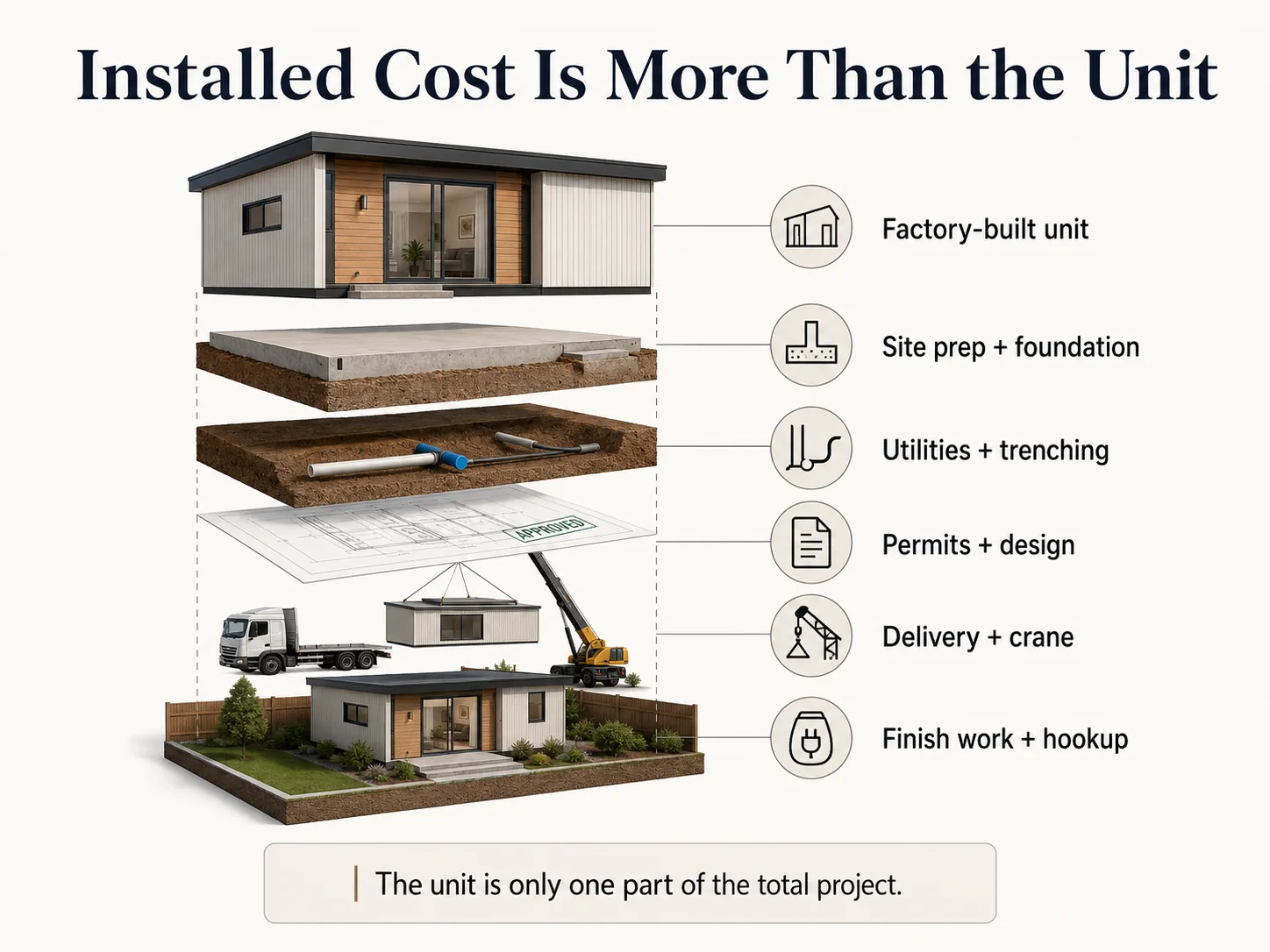
Where the money actually goes — the cost-inclusion checklist
| Cost item | Included by some companies? | What to confirm in writing |
|---|---|---|
| ADU unit / module | Yes | Model, finishes, appliances |
| Foundation | Sometimes | Type, engineering, soil/slope assumptions |
| Permit drawings (stamped) | Sometimes | Stamped plans + revisions during plan check |
| Permit & impact fees | Often excluded | City/county fees, school/impact fees |
| Utility trenching | Sometimes | Distance limits, sewer/septic, water, gas |
| Electrical panel upgrade | Often excluded | Main panel capacity |
| Delivery | Sometimes | Distance, road access, staging |
| Crane / set crew | Sometimes | Access, overhead lines, possible street closure |
| Local contractor / GC | Often needed | Who hires and manages them |
| Finish work | Varies | Turnkey includes it; kits often don't |
| Final inspections + CO | Sometimes | Who is responsible for the certificate of occupancy |
Real published examples (sourced, dated, and clearly labeled)
Related research: how modular ADUs are charged for permits
- ▸Abodu (turnkey, California): A 500 sq ft Abodu One starts at $326,800, with an average total around $352,500. Standard foundation and utility connections (to ~50 ft) are included — a genuine differentiator — but taxes and permit fees (~$17,000 average, varies by city) are on top. Stated exclusions include utility trenching beyond 50 ft, craning beyond 100 ft, demolition, tree removal, unique site engineering, and sales tax (abodu.com/pricing, April 2026).
- ▸Wolf Industries (home-only, PNW): Models run $67,500–$178,500, but Wolf states plainly that this is “for the home only and do not include delivery, installation, permitting, utility fees, or sitework,” with turnkey service available only in Oregon and Washington (wolfind.com). Wolf’s own permitting-specialist service is ~$2,000–$5,000 plus the actual permit fees.
- ▸Method Homes (custom, multi-state): Base modular costs from roughly $300–$450+/sq ft, soft costs $40,000+, and site costs that can run 60–150% of the modular cost (methodhomes.net/pricing) — the clearest proof in the category that modular does not automatically mean cheap.
The gap between the factory price and the all-in price is the part people don’t plan for. If you’re wondering how to bridge it, our independent guide compares the real ways homeowners pay — HELOC, cash-out refinance, renovation loans, and construction-to-permanent — with no rate promises and no lender rankings.
Explore Your ADU Financing Paths →Educational comparison only; no rates, approvals, or payments are guaranteed.
Illustrative-example disclaimer: The figures above are published prices and editorial estimates, not quotes or guarantees of returns. Actual results depend on local market conditions, construction costs, financing terms, and regulatory approvals.
Why Modular Is Uniquely Fast in California Right Now
California’s 2025–2026 ADU law changes make modular especially advantageous in that state, because a hard statutory approval clock — plus pre-approved-plan pathways — can compress permitting from months to weeks. Under the rules now in effect, a local agency must determine whether your ADU application is complete within 15 business days and must approve or deny a complete application within 60 days; miss the deadline, and the ADU is deemed approved (California Government Code §66317; HCD ADU Handbook, January 2026 addendum). A separate pre-approved-plan track can shorten qualifying detached-ADU review to 30 days (Government Code §65852.27).
Here’s the important nuance other listicles get wrong: state-level approval of a factory-built unit and local pre-approved-plan approval are two different things. State or HCD approval can reduce friction for the unit itself, but the site-specific ADU permit still goes through your local agency. The 30-day fast track applies only when your application uses a plan the local agency has pre-approved — or a plan identical to one it already approved within the current triennial California Building Standards Code cycle. Modular companies that maintain state-approved designs slot into these lanes more easily, but they don’t skip the local permit.
What each law change actually means for your calendar
- ✓Government Code §65852.27 (pre-approved plans): California requires local agencies to create pre-approval programs. A plan already checked against the current code cycle can be approved on a 30-day clock for qualifying detached ADUs.
- ✓The 15-day / 60-day clock (Gov. Code §66317): Cities must rule your application complete within 15 business days and approve or deny within 60 days, or it's deemed approved. No more indefinite limbo.
- ✓AB 462 (coastal): Requires the Coastal Commission and local governments to approve or deny a complete ADU coastal development permit (CDP) within 60 days; if the Coastal Commission misses that deadline, the CDP is deemed approved; and locally approved ADU CDPs are not subject to Coastal Commission appeal (California Coastal Commission 2026 legislative report).
- ✓AB 976 (owner-occupancy): California permanently removed owner-occupancy requirements for standard ADUs — build and rent without living on-site.
- ✓AB 1033 (separate sale): Lets local agencies opt in to allowing ADUs to be sold separately as condominiums. San José approved an ADU-condominium ordinance effective July 18, 2024; the City of San Diego allows ADU separate sale via condo conversion effective August 22, 2025; and San Diego County adopted AB 1033 implementation for unincorporated communities on March 4, 2026.
For the full state breakdown, see our California ADU Laws guide →. Outside California, ADU-enabling laws are spreading fast — Oregon, Washington, Colorado, Texas (notably Austin), Florida, and Massachusetts among them — but implementation varies dramatically by municipality, so always confirm your local code, not just state law. ADU Laws by State →
Which Modular ADU Companies Are Actually Turnkey?
“Turnkey” should mean one company manages design, permits, site work, foundation, delivery, installation, utility connections, inspections, and the final certificate of occupancy. Many factory-build companies are not truly turnkey everywhere, even when the product itself is fully factory-built. A transparent factory price is not the same as a managed local project — and confusing the two is how budgets balloon.
We sorted the field into honest tiers. The product can be excellent at every tier; the difference is how much of the local project you still own.
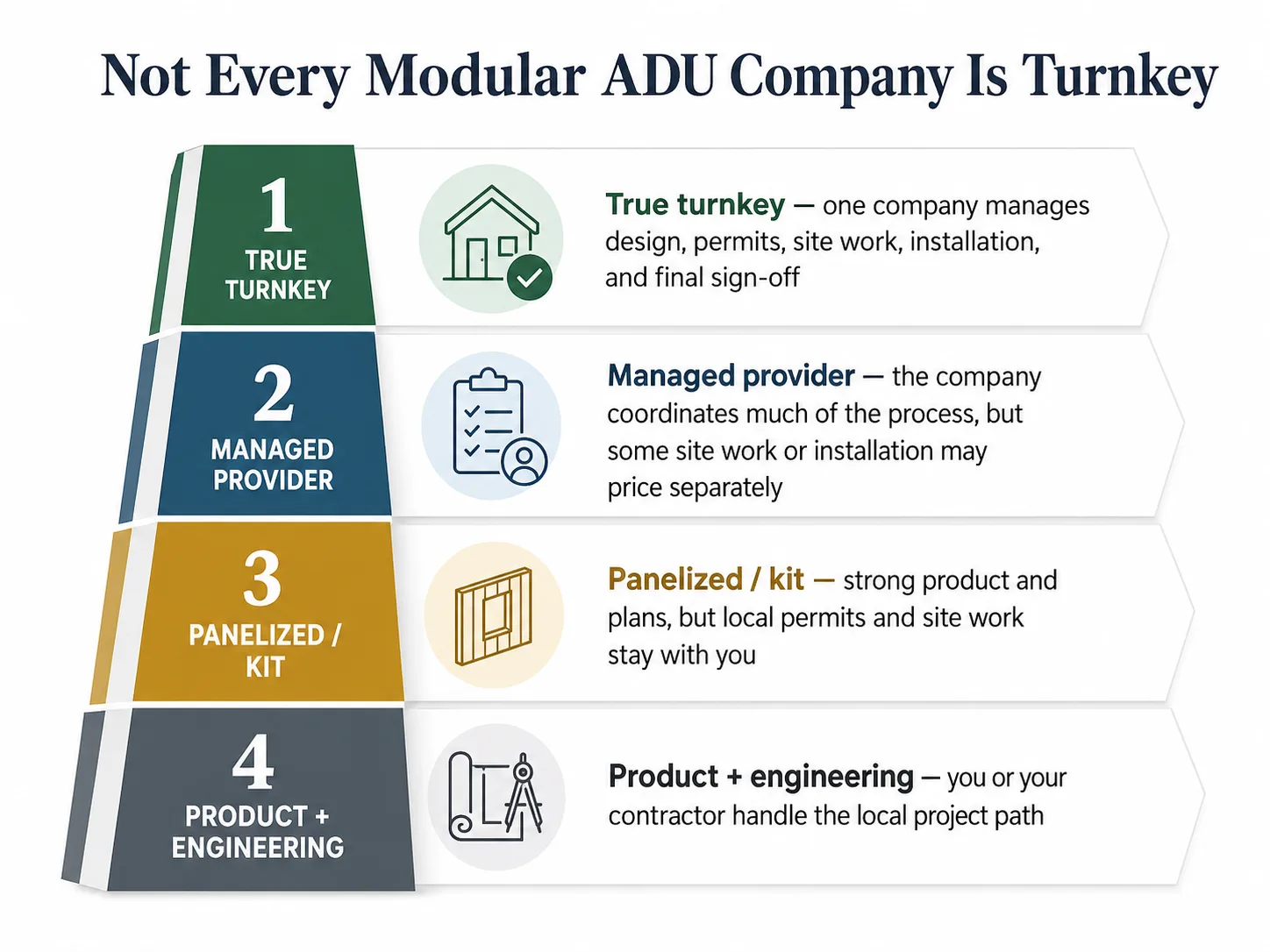
The turnkey reality scale
| Scope tier | What it means for you | Examples |
|---|---|---|
| True regional turnkey | Company manages most of the ADU path locally, including permits and site work | Abodu (California); Framework First (within ~150 mi of Monterey County); Wolf Industries (Oregon & Washington only) |
| Managed provider | Provider helps coordinate, but installation/site work is priced separately | Samara; Villa Homes (verify current scope); Method Homes (custom) |
| Panelized/kit with support | Strong product and plans, but local scope remains yours | Studio Shed (ProAssembly available, but you arrange site work/permits in many markets) |
| Product/engineering route | You or your local contractor handle permitting and site path | Modular Home Direct (owner/contractor submits stamped blueprints) |
| Compact foldable route | Product may be compelling, but the installed ADU path is highly local | BOXABL (verify foundation, utilities, installer, and local legality) |
Two examples make the distinction concrete. Modular Home Direct states on its own FAQ that final stamped blueprints are submitted by the owner or contractor, that engineering must align with local seismic and wind requirements, and that permit timing depends on your city or county (modularhomedirect.com FAQ). That’s a perfectly legitimate model — but it is not a hand-off-everything turnkey solution, and pricing it as if it were will hurt you. Wolf Industries is explicit that its published model prices are home-only and that its turnkey delivery/install/permitting service is available only in Oregon and Washington (wolfind.com) — outside those states, you’re coordinating the rest.
Before you assume a company is turnkey in your area, confirm it for your address. Many providers are turnkey in their home region and product-only everywhere else.
Compare Modular Options Against Your Actual Lot →For national modular and container comparison with engineering support — where you understand you’ll still need a local permit and contractor path — Modular Home Direct is a reasonable starting point.
Company-by-Company Modular ADU Breakdowns
Each company below follows the same structure: the punchline, who it’s best for, who should skip it, what to verify before you put down a deposit, and the published facts with the date we checked them. We use affiliate links only where a partner genuinely fits, and only after explaining the fit honestly. The strongest companies here are not partners — and we say so.
Abodu — Best California Turnkey Modular
Abodu is the most transparent turnkey modular ADU option in California, with fixed pricing and state-approved plans that slot into California’s accelerated permitting pathways. Abodu offers floor plans from 340 to 1,200 sq ft, starting at $278,800 before taxes and permit fees, with installation as fast as one day and typical contract-to-move-in around six months (abodu.com, April 2026).
Best for: California homeowners who want predictable, fixed costs and minimal project management, on lots with reasonable crane access. Abodu now also explicitly markets to wildfire-rebuild homeowners.
Who should skip it: Anyone outside California; buyers who need heavy custom design; properties where a crane physically can’t reach.
Verify before deposit: Whether standard foundation and utility assumptions (utilities included to ~50 ft) apply to your specific lot, and your city’s permit-fee estimate (~$17,000 average, but it varies).
Damaging admission, stated plainly: Abodu is not the cheapest factory price you’ll see, and it isn’t a national option. You’re paying for convenience and scope clarity, not for a bargain unit. For many California buyers, that trade is worth it — which is why it’s our California shortlist anchor.
Not an affiliate partner. We route you to the free feasibility check, not a paid link.
Samara — Best Design-Forward (California)
Samara builds design-forward modular backyard homes in California, with a published starting price of $152,000 plus installation — meaning the headline number is the unit, not the full project. Published models run from a 420 sq ft studio up to a 950 sq ft two-bedroom (samara.com, May 2026).
Best for: California buyers who prioritize design and build quality and can budget installation separately.
Who should skip it: Budget-first buyers; anyone outside California.
Verify before deposit: Your site-specific installation quote — “plus installation” is the line that decides your real budget.
Damaging admission: Until you normalize “plus installation” into the number, you can’t honestly compare Samara to an all-in provider like Abodu. Do that math first.
Not an affiliate partner. Route to feasibility check.
Villa Homes — Best for Larger Layouts (California / Colorado)
Villa Homes offers one of the widest selections of larger 1-, 2-, and 3-bedroom modular ADU layouts (roughly 450–1,200 sq ft) among California turnkey providers, with expansion into Colorado. Villa positions itself as a full-turnkey provider covering design, permitting, site work, installation, and utility hookups (villahomes.com).
Best for: Homeowners wanting larger, multi-bedroom layouts and turnkey management.
Who should skip it: Lowest-budget buyers; homeowners outside California and Colorado.
Verify before deposit: Current official pricing, current service-area scope, and exactly what installation includes — confirm these from Villa’s site before you rely on them.
Editorial inclusion; not an affiliate partner.
Studio Shed — Best National Panelized Option
Studio Shed ships panelized ADU kits to all 50 states with no crane required, making it the strongest option for homeowners outside California who are comfortable coordinating local permits and site work. Product and permit-ready plans start around $40,000; a full ADU with ProAssembly plus site work runs roughly $250/sq ft for a 400 sq ft unit (studio-shed.com, April 2026). Studio Shed has operated since 2008 — one of the longest track records in the category.
Best for: Nationwide reach; tight-access lots where a crane won’t fit; homeowners who want some control over the process.
Who should skip it: Anyone wanting a fully hands-off, zero-coordination experience.
Verify before deposit: What’s included at your chosen service tier, and who handles your local foundation, utilities, and permits.
Damaging admission: A transparent model price is not a turnkey ADU price. Studio Shed’s panelized route avoids the crane and the long on-site build, but you (or a local GC) still own foundation, utilities, and permitting in most markets.
Editorial comparison; not currently an affiliate partner. For the broader national prefab field, see our Best Prefab ADU Companies guide →
Modular Home Direct — National Modular/Container Comparison
Modular Home Direct is a useful national route for comparing modular and container-style options with engineering support, but it functions as a product/plan/engineering provider rather than a guaranteed local turnkey builder. Final stamped blueprints are submitted by the owner or contractor, engineering aligns with local seismic and wind requirements, and permit timing depends on your jurisdiction (modularhomedirect.com FAQ).
Best for: National shoppers comparing modular/container options who have, or will hire, a local permit-and-contractor path.
Who should skip it: Anyone expecting a single company to manage everything locally.
Verify before deposit: Who in your market will pull permits, build the foundation, and connect utilities.
Method Homes — High-End Custom Benchmark
Method Homes is the category’s clearest proof that modular does not automatically mean cheap: it publishes base modular costs from roughly $300–$450+/sq ft, soft costs of $40,000+, and site costs that can run 60–150% of the modular cost itself. It builds custom modular homes roughly 60% faster than traditional site-built timelines by running factory and site work concurrently (methodhomes.net/pricing).
Best for: Higher-budget buyers who want custom modular design and quality.
Who should skip it: Budget-focused ADU shoppers.
Damaging admission (in your favor): We include Method specifically to break the “modular = cheap” myth. Use its published structure as a reality check on any quote that looks too good.
Editorial benchmark; not an affiliate partner.
Wolf Industries — Smaller Modular (Pacific Northwest)
Wolf Industries publishes transparent model prices from $67,500 to $178,500 for modular homes and ADUs from 300 to over 1,200 sq ft — but these are home-only prices that exclude delivery, installation, permitting, utility fees, and site work. Wolf offers full turnkey service in Oregon and Washington; elsewhere, you coordinate the rest (wolfind.com, models + FAQ). Its in-house permit specialist service runs about $2,000–$5,000 plus actual permit fees.
Best for: Pacific Northwest buyers and shoppers who want clear published model pricing.
Who should skip it: Buyers outside OR/WA expecting turnkey; anyone treating the model price as all-in.
Verify before deposit: Service area for full turnkey, and your site-specific delivery, set, and utility costs.
Editorial inclusion; not an affiliate partner.
BOXABL — Compact Foldable Niche
BOXABL’s foldable Casita units (studio, one-, and two-bedroom) are a fit for compact-unit shoppers, but the company’s own disclaimer states that actual price and payment vary by model, location, site work, taxes, delivery, installation, credit approval, and financing terms. Casita financing is advertised from roughly $895/month for a studio — but per BOXABL’s disclaimer, actual price and payment vary by model, location, site work, taxes, delivery, installation, credit approval, and financing terms, and crane or telehandler equipment is required for installation (boxabl.com).
Best for: Buyers specifically drawn to compact, factory-finished, foldable units.
Who should skip it: Anyone treating the advertised monthly figure as a guaranteed all-in ADU cost.
Verify before deposit: Local ADU legality, foundation, utilities, delivery, and the full installed scope for your area.
Damaging admission: The marketing simplicity does not remove local permitting, foundation, utility, or installation requirements. Treat BOXABL as a code-and-site-work question first.
Affiliate link. Best for compact-unit shoppers who have first verified local ADU code fit, foundation, and installed scope. Advertised monthly figures are financing examples, not all-in project costs.
USModular — SoCal Budget Modular/Manufactured
USModular is a Southern California full-service prefab ADU builder that builds both HUD-code manufactured and IRC-modular units, and holds both a California GC license and a manufactured-home dealer license. Its official site emphasizes manufactured ADUs, single-family homes, and small duplexes across Southern California, with a noted permitting track record in the Inland Empire and San Diego (usmodularinc.com, Feb 2026).
Best for: SoCal, Inland Empire, and San Diego budget-focused buyers.
Who should skip it: LA/OC homeowners who’d prefer a builder with deeper roots in those specific jurisdictions.
Verify before deposit — this one is critical: Which code path your unit is built to (IRC modular vs. HUD-manufactured), because it changes your financing and appraisal. Ask directly, and request current pricing in writing.
Editorial inclusion; not an affiliate partner.
Regional fits (geo-restricted)
These are providers we cover for the specific regions they actually serve.
Framework First — Central Coast / Bay-adjacent California
Framework First is based in Monterey County and serves properties approximately within a 150-mile radius. Its included scope covers permits and paperwork, plans, project management, foundation, the unit, crane and truck, and installation (frameworkfirst.com). It’s a genuinely managed-modular path for eligible California homeowners.
Compare ADU BuildersNest Tiny Homes — Utah & Southern California
Nest serves Utah and Southern California with ADU and tiny-home options (nest-tinyhomes.com). Because “tiny home” can mean different code paths, verify that your unit is built to a residential code your jurisdiction accepts as a permanent ADU before relying on it.
Explore Utah & SoCal ADU Options — Nest Tiny Homes →Affiliate link. Confirm code path, foundation, utility, and local permit fit for your property.
SnapADU — Greater San Diego (site-built alternative)
SnapADU is not a modular company; it’s a San Diego County design-build ADU specialist serving 18+ Greater San Diego cities and jurisdictions (snapadu.com/service-area). We include it as the right call when modular isn’t the best path — tight lots, no crane access, heavy customization, or coastal/HOA complexity. See our detailed SnapADU Review → and San Diego County builders guide →
Is “Best” Just Pay-to-Play? How We Actually Ranked These
No. The strongest companies on this page — Abodu and Samara — earn us no commission. We rank by neutral, documented criteria, never by payment. Our sort order is: service-area fit first, code path second, scope clarity third, published evidence fourth. Any affiliate relationship is disclosed at the link, but it is never the ranking basis.
The Dwelling Index is an independent research resource covering ADU financing, costs, and regulations. We are not a builder, lender, broker, architect, or zoning authority. We have no incentive to push you toward any single company — our incentive is to be the page you trust enough to come back to. What disqualified a company from our shortlist: render-only portfolios with no verified completed installations, pricing that appeared misleading, and service-area claims we couldn’t confirm. Full detail is in our editorial methodology and partner vetting policy.
What Happens If a Modular ADU Company Goes Out of Business?
It does happen — and you can lose your deposit and end up with an incomplete project. The prefab/modular industry is young and consolidating, so milestone-based payments and written scope are your protection. In January 2025, Connect Homes filed for liquidation after accumulating debt and supply-chain problems; as reported by Dwell, one Northern California family paid more than $400,000 for an ADU that was never delivered (Dwell, “Buying a Prefab ADU Was Supposed to Be Easier Than This,” 2025).
Connect Homes had advertised in major design publications and looked entirely credible. That’s exactly why due diligence isn’t optional. Protect yourself: verify recent completed installations (not renders), understand your deposit terms and what happens if the project is cancelled, insist on a milestone-based payment structure tied to manufacturing and site progress, and check the company’s state contractor license. The good news is that the survivors are getting more transparent — Abodu’s fixed pricing, Samara’s managed model, and Studio Shed’s online design center all point the right direction — but the burden of verification still falls on you.
Want our vetting tools in one place? The free 2026 ADU Starter Kit includes a vendor call script, a quote-comparison worksheet, and a permit-scope checklist — everything you need before you talk to a single company.
Download the Free ADU Starter Kit →Will a Modular ADU Appraise and Finance Like a Normal Home?
An IRC-built modular or panelized ADU is generally financed and appraised like a site-built home; a HUD-code manufactured ADU follows a different pathway that can limit your loan options. Fannie Mae treats modular, prefabricated, panelized, and sectional housing the same as site-built housing for financing and appraisal, while manufactured housing built to the federal HUD Code (24 CFR Part 3280) follows separate requirements (Fannie Mae Selling Guide, B2-3-02; HUD). The practical takeaway: the build type you choose directly affects whether you can use a HELOC, a construction loan, or a cash-out refinance — and how an appraiser values the finished ADU.
Build type vs. financing and appraisal path
| Build type | Code path | Key lender question | What to request |
|---|---|---|---|
| Modular | State/local IRC | "You treat this like site-built, correct?" | State modular insignia / approval |
| Panelized | State/local IRC | "Site-built treatment for the panelized unit?" | Engineered, stamped plans |
| Kit | State/local IRC (built on-site) | "Standard construction loan eligible?" | Plan set + local GC contract |
| Manufactured | Federal HUD Code (24 CFR 3280) | "Will you finance a HUD-code ADU on my lot, and how is it appraised?" | HUD certification label + foundation cert |
Homeowners pay for modular ADUs through several lanes, and the right one depends on your equity, credit, and how the unit is classified. The main paths: a HELOC (home equity line of credit — you draw against existing equity and pay interest only on what you use); a cash-out refinance (replace your mortgage with a larger one and take the difference); a construction loan (funds released in stages, converting to permanent financing at completion); and a growing set of ADU-specific lender products. Before you commit to any company, ask your lender directly: “Will you finance a [specific build type] ADU on my property?” The answer can change everything.
We present financing as paths, not lender rankings — and we never sort by payment. Our independent guide walks all of them with current context and worked scenarios.
Compare ADU Financing Paths →This is educational information, not lending advice. The Dwelling Index is not a lender, broker, or financial advisor. Terms and qualification vary by lender and circumstance. No rates, approvals, or payments are guaranteed.
For prefab-specific timing (the factory-deposit trap), see How to Finance a Prefab ADU →. For whether your ADU will “count” at appraisal, see ADU Appraisal Requirements →
When Modular Is NOT the Best ADU Choice
Modular is the wrong tool when your lot can’t physically take a delivery truck or crane, when a HUD-manufactured or tiny-home product won’t be accepted by local zoning, or when you need heavy customization that factory plans can’t accommodate. In those cases, a panelized kit, a site-built design-build contractor, or a garage conversion is often the smarter path — and forcing modular onto the wrong lot is how a “cheap” unit turns into a six-figure site-work surprise.
Modular struggles or fails when:
- ✗There's no crane or truck access. Narrow side-gates, overhead power lines across the crane path, or tight urban streets can make a full modular set impossible. Panelized (Studio Shed) or kit routes fit through standard gates.
- ✗The lot is steep, has septic, or has distant utilities. Significant slope means custom foundation engineering and retaining walls; long utility-lateral runs add cost per foot.
- ✗You're in a historic district, coastal overlay, HOA, or design-review zone. These can impose design constraints that standard modular models can't meet.
- ✗You need two-story, above-garage, or highly custom design. Custom site-built or hybrid approaches adapt where modular models can't.
- ✗The product is a manufactured home, RV, or tiny home your zoning won't accept as an ADU. This is the legality trap from the code-path section — verify first.
- ✗Your financing or appraisal path is uncertain for the build type. Resolve this before comparing any company.
The product choice is premature until you know your constraints. Run your lot first — it tells you whether modular, panelized, site-built, or a garage conversion is the realistic path before you talk to anyone.
Find the Right ADU Path for Your Property →Internal next steps if modular isn’t your fit: How to Finance a Garage Conversion ADU → · Prefab ADU Cost → · Best ADU Builders by city →
How to Vet a Modular ADU Company Before You Sign
Before any deposit, make the company answer — in writing — what code the unit is built to, whether they serve your jurisdiction, who pulls permits, what site work is excluded, and who is responsible for your certificate of occupancy. Vagueness about what’s included is a bigger red flag than a high price. Use the 20-question script below; any company that can’t answer it clearly is telling you something important.
- 1.What code is the unit built to (IRC modular, HUD-manufactured, panelized, kit, RV/tiny-home)?
- 2.Is this legally an ADU in my jurisdiction, or does my zoning restrict the product type?
- 3.Do you serve my city/county?
- 4.Who pulls the permits?
- 5.Who provides stamped plans, and who responds to plan-check corrections?
- 6.Who designs and builds the foundation?
- 7.Who handles water, sewer/septic, electric, gas, and trenching?
- 8.Who pays permit fees and utility fees?
- 9.Is delivery included? To what distance?
- 10.Is the crane/set included, and have you confirmed access at my address?
- 11.Who manages local subcontractors?
- 12.What exactly is excluded from this quote?
- 13.What recent, occupied, local projects can I verify (not renders)?
- 14.What is the deposit schedule, and is it milestone-based?
- 15.What happens to my deposit if permits are denied or the project is cancelled?
- 16.What warranty covers the unit, and what covers the site work?
- 17.Is the installing contractor licensed and insured in my state?
- 18.Which timeline assumptions depend on my city?
- 19.What change orders are most common on projects like mine?
- 20.What must be true about my lot for this quote to remain valid?
The Starter Kit puts this script, plus a quote-comparison worksheet and permit-scope checklist, in one download.
Download the Free ADU Starter Kit →What to Do Before You Contact Any Modular ADU Company
Verify your property first, then shop companies — a provider can only be “best” once you know your jurisdiction’s rules, your likely ADU type and size limit, your lot’s access and utility constraints, and your budget lane. Calling brands before you know what your lot can support wastes weeks and invites quotes built on assumptions that don’t hold for your property.
The five-step sequence we’d give a friend:
- 1Confirm jurisdiction and ADU legality — State law sets the floor, but your local code controls.
- 2Identify your likely ADU type and size range — Detached, attached, garage conversion, or JADU (junior ADU, a unit under 500 sq ft within the existing home).
- 3Check lot constraints — Setbacks (minimum distance from property lines, often 4 ft), slope, truck/crane access, utility distance, septic, HOA.
- 4Choose your provider lane — Regional turnkey modular, panelized/kit with a local GC, national modular route, compact unit, or site-built.
- 5Request two or three written, scope-normalized quotes — Make every company itemize the same way so you can compare like with like.
Step one takes about 60 seconds. Your free ADU report shows your address-specific size limits, setback requirements, and likely ADU type — before you request a single quote.
See What You Can Build — Get Your Free ADU Report →How We Compared These Modular ADU Companies
We compared providers using verifiable facts only: service area, code/product type, published model sizes, public pricing or quote structure, what scope is included, what scope is excluded, permit responsibility, and local contractor responsibility. We sorted by service-area fit, then code path, then scope clarity, then published evidence — never by compensation.
We used public provider pages, government and code-agency resources (HUD, California HCD, Placer County, California Coastal Commission, Fannie Mae), and public homeowner discussions. Homeowner forum comments were used only to understand buyer questions and fears — never as proof of costs, laws, timelines, or construction claims.
What We Verified
Last verified:
We verified each company’s stated service area, model-size ranges, and published pricing or quote structure from its own current website (Abodu, Samara, Villa Homes, Studio Shed, Modular Home Direct, Method Homes, Wolf Industries, BOXABL, USModular, Framework First, Nest Tiny Homes, SnapADU); the code-path distinctions against HUD and Fannie Mae (Selling Guide B2-3-02); California’s 2025–2026 ADU law changes against California Government Code §66317 and §65852.27, the HCD ADU Handbook (January 2026 addendum), and the California Coastal Commission’s 2026 legislative report (AB 462); the CalHFA ADU Grant status against CalHFA’s official ADU Grant page; cost-structure data via Placer County, CA’s government ADU page, Method Homes, Wolf Industries, and HomeAdvisor (2026, via AmeriSave); and the Connect Homes liquidation via Dwell. We review pricing, service areas, and company status at least quarterly. Spot a change? Corrections →
Sources
- HUD — Manufactured Home Resources (manufactured-home / HUD Code definition)
- Fannie Mae Selling Guide, B2-3-02 — Factory-Built Housing (modular vs. manufactured treatment)
- California Government Code §66317 (15-business-day completeness; 60-day ADU approval clock)
- California Government Code §65852.27 (local pre-approved-plan programs; 30-day path)
- California HCD — ADU Handbook (January 2026 addendum)
- California Coastal Commission — 2026 legislative report (AB 462 coastal ADU CDP timing)
- CalHFA — ADU Grant Program official page (funding status)
- Placer County, CA — Modular & Kit ADUs vendor pricing page (modular $/sq ft; site-cost ratio)
- Abodu — pricing page (model pricing, inclusions, exclusions)
- Samara, Villa Homes, Studio Shed, Modular Home Direct, Method Homes, Wolf Industries, BOXABL, USModular — official company pages
- Framework First, Nest Tiny Homes, SnapADU — official service-area pages
- HomeAdvisor 2026 modular analysis (via AmeriSave) — general modular-home cost context
- Dwell — “Buying a Prefab ADU Was Supposed to Be Easier Than This” (Connect Homes liquidation)
Frequently Asked Questions About Modular ADU Companies
What is the best modular ADU company?
There is no single best modular ADU company nationwide. The best choice depends on your state, lot constraints, desired size, budget, code path, and whether you need a turnkey provider or can manage a local contractor. In California, Abodu (turnkey) and Samara (design-forward) lead; nationally, Studio Shed (panelized) and Modular Home Direct (modular/container) are common starting points.
Are modular ADUs cheaper than site-built ADUs?
Not reliably. Modular can shorten factory-build time and standardize finishes, but foundation, utilities, permits, delivery, crane, and local labor can erase the apparent savings. Industry and government data show the factory module is typically only 40–60% of the installed cost, with site costs alone running 70–120% of the modular cost (Placer County, CA; HomeAdvisor 2026).
What is the difference between modular and manufactured ADUs?
A modular ADU is built to state/local building codes (the IRC), the same standards as a site-built home. A manufactured home is built to the federal HUD Code (24 CFR Part 3280). Local zoning determines whether either can be used as an ADU on a specific lot, and the two follow different financing and appraisal pathways (HUD; Fannie Mae Selling Guide).
Can a BOXABL be used as an ADU?
Potentially, but only if your local jurisdiction accepts the product, your site can support the required foundation and utilities, and the installed scope is clear. BOXABL's own disclaimer states that actual price and payment vary by model, location, site work, taxes, delivery, installation, credit approval, and financing terms.
Do modular ADU companies handle permits?
Some do; many do not handle the full local permit path everywhere, even when the unit is factory-built. Always ask who submits plans, who responds to plan-check corrections, who pays the fees, and who is responsible for the final certificate of occupancy.
Which modular ADU companies serve California?
California modular ADU options include Abodu and Samara (statewide-focused), Villa Homes (also Colorado, verify current scope), USModular (Southern California), and Framework First within roughly 150 miles of Monterey County. The best choice depends on your county, lot constraints, and whether the quote includes site work.
Which modular ADU companies serve nationwide?
Some panelized, kit, and modular/product providers market nationally — including Studio Shed (panelized, all 50 states) and Modular Home Direct (modular/container) — but national availability does not mean turnkey local permitting or site work.
How long does a modular ADU take from contract to move-in?
Four to eight months is realistic. The factory build (roughly 4–12 weeks) often runs in parallel with permitting and site prep, but permitting drives the overall timeline more than construction. California's pre-approved-plan pathway can shorten qualifying applications to a 30-day approve/deny clock (Government Code §65852.27).
What is the biggest hidden modular ADU cost?
Site work — foundation, utility trenching, sewer/septic, electrical panel upgrades, delivery and crane access, local labor, permit fees, and plan revisions. On many projects, site costs alone run 70–120% of the cost of the factory unit (Placer County, CA government data).
What happens if my modular ADU company goes out of business?
You may lose your deposit and be left with an incomplete project. Connect Homes liquidated in January 2025, leaving customers with significant losses (Dwell). Protect yourself with milestone-based payments, written scope, verified recent completions, and a confirmed contractor license.
Should I contact companies before checking my lot?
No. Check your lot first. A modular ADU company can only be the right fit if your property can legally and physically support that product. Confirm jurisdiction, likely ADU type, size limits, access, and utilities before requesting quotes.
Is the California ADU grant still available?
No. According to CalHFA's official ADU Grant Program page, the latest round of ADU grant funding has been fully allocated and the program is not accepting new applications, with no confirmed relaunch date. CalHFA also warns that anyone claiming they can help you get an ADU grant right now is running a scam. Homeowners are still building ADUs every day through financing — see our ADU Grants guide for programs that are actually active.
Glossary
- ADU (Accessory Dwelling Unit)
- A secondary dwelling on a single-family or multifamily lot. Also called a granny flat, in-law unit, backyard cottage, or DADU (detached ADU).
- JADU (Junior ADU)
- A unit up to 500 sq ft created within the existing footprint of a single-family home.
- Modular ADU
- Factory-built volumetric sections, built to state/local building code (IRC/IBC), delivered and craned onto a permanent foundation.
- Panelized ADU
- Factory-built wall and roof panels shipped flat and assembled on-site. No crane required.
- Kit ADU
- Materials, plans, and pre-cut components shipped for on-site assembly.
- Manufactured home
- Built to the federal HUD Code (24 CFR Part 3280) on a permanent chassis. Different permitting, financing, and appraisal treatment.
- Park model RV
- A recreational/seasonal product, generally not a legal permanent-dwelling path.
- IRC / IBC
- International Residential Code / International Building Code — the model building codes used for most site-built and modular construction.
- HUD Code
- The federal construction standard for manufactured homes, in effect since June 15, 1976.
- HCD
- California Department of Housing and Community Development — administers California's factory-built housing program and publishes the state ADU Handbook.
- Ministerial approval
- Permit approval based on objective standards without discretionary public hearings — the basis of California's fast ADU timelines.
- Plan check
- The building department's review of your construction drawings for code compliance.
- Setback
- The minimum required distance between a structure and a property line (often 4 ft for ADUs).
- Site work
- All on-property work — foundation, grading, trenching, hookups — separate from the factory unit.
- Utility lateral
- The underground line connecting your ADU to water, sewer, or electrical service.
- Turnkey
- One company manages the entire process from design through certificate of occupancy.
- Certificate of Occupancy (CO)
- The building department's official approval that the ADU is legal to inhabit.
Related Guides
- Best Prefab ADU Companies (2026): Prices, Fits & Red Flags →
- Modular ADU: Costs, Rules & When Modular Wins →
- Prefab ADU Cost: Real All-In Prices (2026) →
- ADU Cost Per Square Foot in 2026 →
- California ADU Laws: What to Know →
- ADU Financing Options 2026: HELOC vs Refi vs Loan →
- ADU Laws by State: All 50 States & Official Sources →
- ADU Grants 2026: Verified Programs by State →
Not sure where to start?
See what’s possible at your address — get your free ADU report in 60 seconds.
Get Your Free ADU Feasibility Report →The Dwelling Index is an independent research resource covering ADU financing, costs, and regulations. We are not a builder, lender, or broker. Content on this page is for informational purposes and does not constitute professional construction, legal, tax, or financial advice. Cost estimates are based on publicly available data and editorial analysis — actual project costs depend on your specific property, location, and project scope. Consult qualified local professionals for your situation.