
El Cajon ADU Cost in 2026: Real Prices, Fees, and the Hidden Costs Builders Don’t Itemize
By The Dwelling Index Editorial Team
Last updated: May 18, 2026 · Last verified: May 18, 2026 · Next review: August 18, 2026
Bottom line up front. Building an ADU in El Cajon, California in 2026 typically costs $110,000 for a small garage conversion to $680,000 for a full 1,200-square-foot detached unit, all in. Most homeowners building a 700–900 square-foot detached ADU end up spending $340,000–$525,000. The number you should plan around is your specific quote — decoded against the El Cajon FY26 fee schedule, the Cajon Valley + Grossmont school-fee math, and the city’s quirks (sewer-lateral video, SDG&E meter on detached units, wall articulation over 800 sq ft) — not a national $/sq ft average.
Applies only inside the City of El Cajon. Unincorporated San Diego County uses different rules and fees.
| Path | Typical size | Realistic 2026 all-in | Best for |
|---|---|---|---|
| Garage conversion | 400–500 sq ft | $110,000–$240,000 | Lowest budget, existing structure suitable |
| Junior ADU (JADU) | ≤500 sq ft | $60,000–$170,000 | Family housing, inside the primary home |
| Detached new build | 700–900 sq ft | $340,000–$525,000 | Rental income, multigenerational living |
| Detached new build (max) | 1,200 sq ft | $465,000–$680,000 | Maximum size, premium finishes |
| Prefab / modular detached | 400–1,200 sq ft | $230,000–$520,000 | Speed (3–6 months vs. 9–12 months) |
See what you can actually build at your address →
Address-based; returns your ADU type, size envelope, parking flag, and likely budget band before you spend a dollar on plans.
Get Your Free 60-Second El Cajon ADU Report →A note before we start the math
We built this guide for one reader: the El Cajon homeowner staring at a builder quote that feels high, or about to ask for one, and wanting to know what’s reasonable before signing anything. We’re not selling you the build. The Dwelling Index is an independent research resource covering ADU financing, costs, and regulations.
Here’s the damaging admission, up front: California ADU law is the most homeowner-friendly in the country, and El Cajon has become one of the easier San Diego County cities to permit in — digital submissions through PACO, a 60-day approval clock, three free pre-approved plans. But “easier to permit” is not the same as “cheap to build.” Detached ADUs in El Cajon will not pencil at the $150,000-per-unit price that national calculators advertise. Anyone telling you they can build a detached ADU here for under $200,000 is selling you a unit price, not a project price.
How much does an ADU cost in El Cajon in 2026?
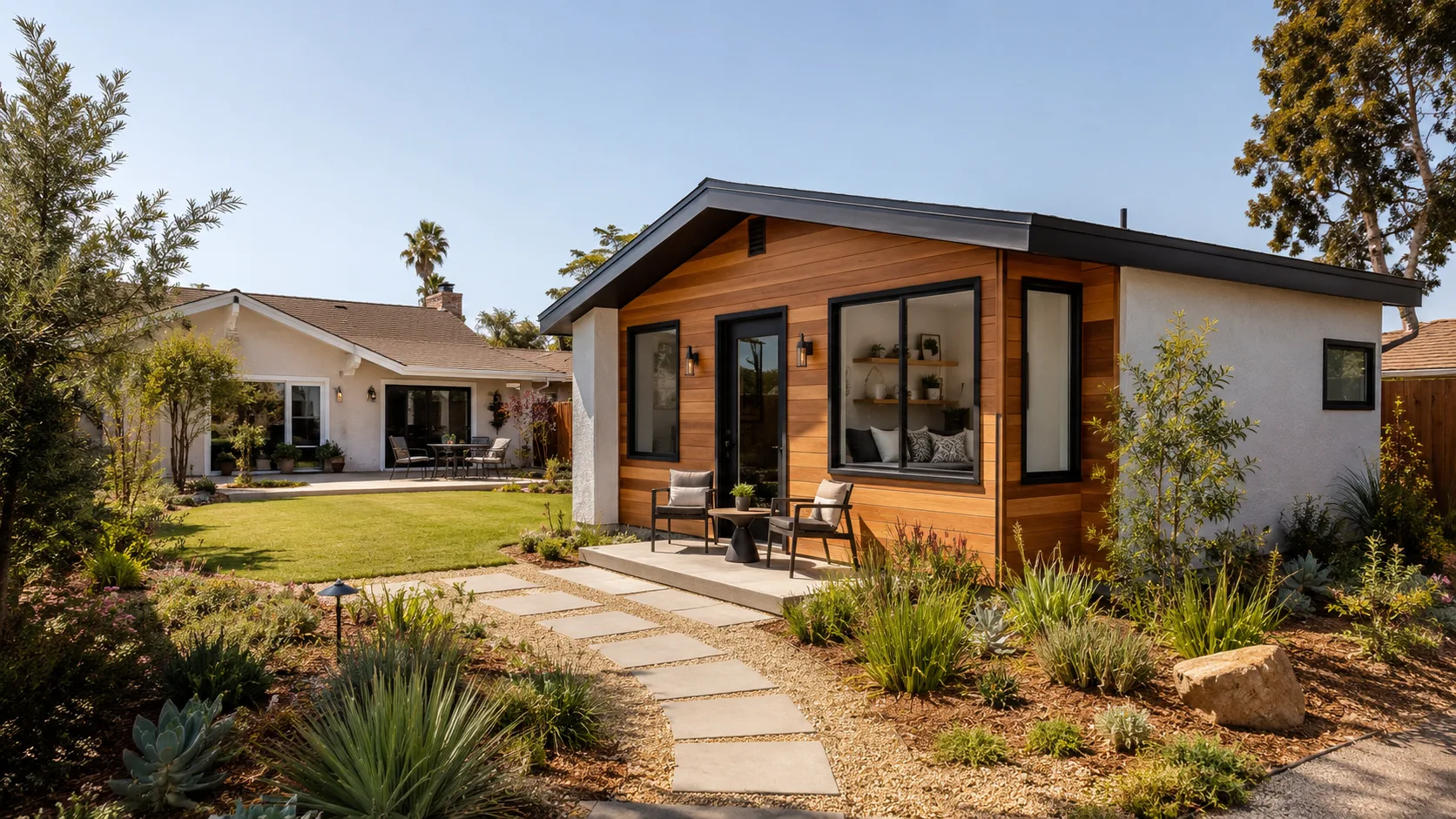
Answer capsule. A realistic 2026 ADU budget in El Cajon, California ranges from about $110,000 for a small garage conversion to $680,000 for a max-size 1,200-square-foot detached new build, all-in including design, permits, school fees, utility upgrades, construction, and a 10–15% contingency. Most full-service detached projects between 700 and 900 square feet land in the $340,000–$525,000 range.
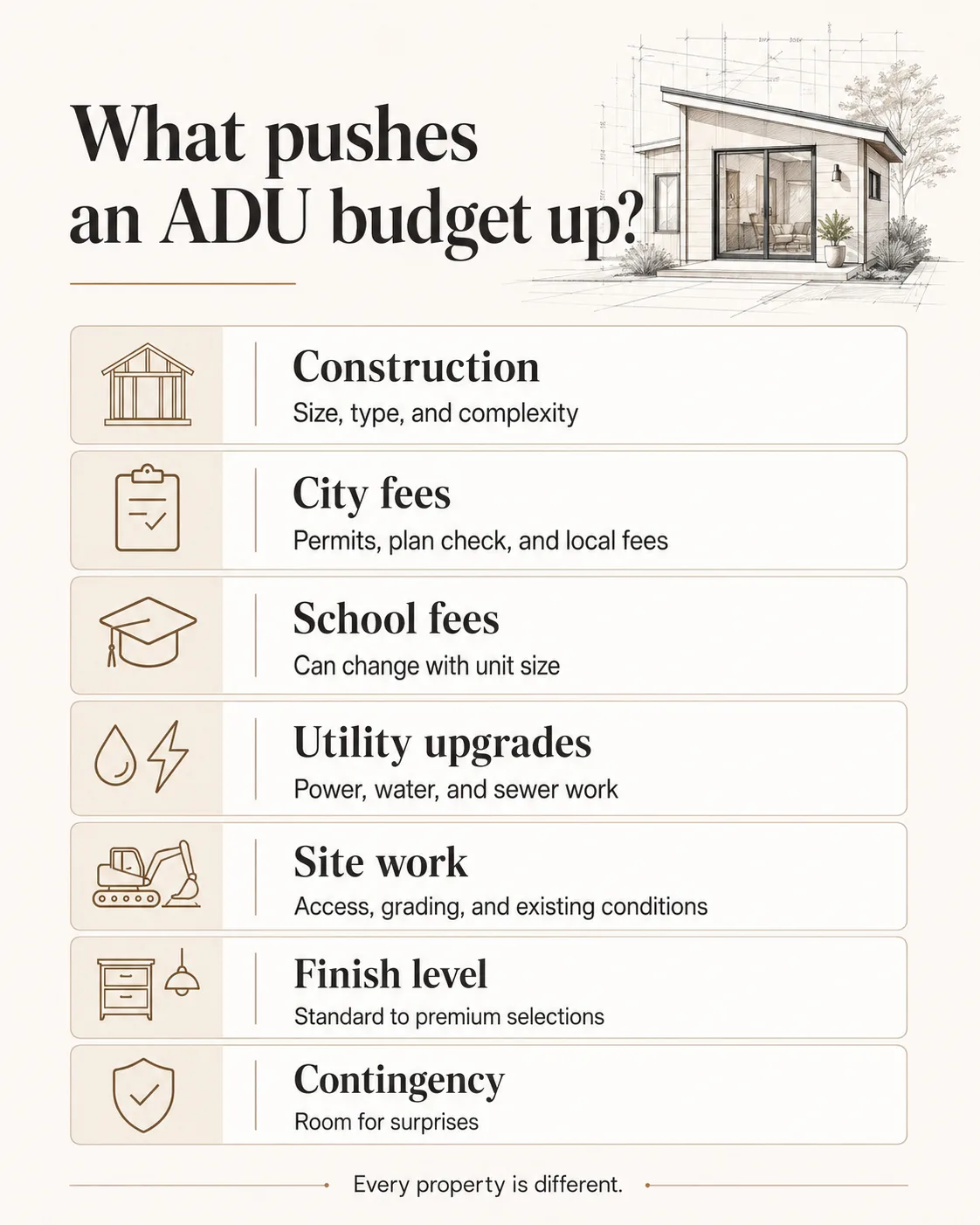
The reason the spread is this wide comes down to four variables most calculators ignore:
- Type. A detached new build from the ground up costs roughly two to three times more than a garage conversion of the same square footage because the conversion already has a foundation, walls, and roof.
- Size and the fixed-cost penalty. Smaller detached ADUs carry a higher cost per square foot, not a lower one, because fixed costs (design, kitchen, bathroom, utility meter set, permits, mobilization) don’t scale down. SnapADU reports detached ADUs in San Diego County run roughly $375–$600+ per square foot, with smaller units toward the top of the range.
- Site conditions. Sewer-lateral condition, electrical panel capacity, distance to utility runs, slope, and access can swing a budget by $25,000–$80,000 before construction even starts.
- Finish level. Mid-grade finishes versus premium kitchen, bath, and millwork can add $40,000–$120,000 to a 900 sq ft unit.
El Cajon ADU all-in cost — 2026
| ADU path | Typical size | Realistic all-in 2026 | What drives the range |
|---|---|---|---|
| JADU (interior conversion, ≤500 sq ft, inside primary home) | 300–500 sq ft | $60,000–$170,000 | Existing layout, fire separation, kitchen/bath retrofit. No new foundation. |
| Garage conversion ADU | 400–500 sq ft | $110,000–$240,000 | Garage condition (slab, drainage, framing), code legalization, panel/sewer/utility runs. |
| Attached ADU (shares one wall with primary) | 600–800 sq ft | $235,000–$465,000 | Shared wall saves foundation cost, but separate kitchen/bath/utilities still required. |
| Detached ADU — small | 500–700 sq ft | $245,000–$485,000 | Highest $/sq ft band because fixed costs spread over the fewest square feet. |
| Detached ADU — Standard Plan studio | 560 sq ft | $230,000–$330,000 | Free plans reduce design fees; site work and utility hookups still apply. |
| Detached ADU — Standard Plan 1BR | 649 sq ft | $260,000–$360,000 | Below 750 sq ft impact-fee threshold. Common rental sweet spot. |
| Detached ADU — Standard Plan 2BR | 802 sq ft | $340,000–$430,000 | Triggers wall articulation over 800 sq ft and school fees over 500 sq ft. |
| Detached ADU — mid | 800–1,000 sq ft | $340,000–$590,000 | Full impact-fee exposure; school fees on full square footage. |
| Detached ADU — max | 1,200 sq ft (local cap) | $465,000–$680,000 | Cannot exceed primary dwelling size; full impact-fee exposure; premium finishes likely. |
| Prefab / modular detached ADU (turnkey, site-installed) | 398–1,200 sq ft | $230,000–$520,000 | Factory unit + site work + utility hookups + local fees. Faster (3–6 months vs. 9–12 months). |
Sources: SnapADU “Cost to Build an ADU in San Diego (2026)”; ADU PALS “ADU Pricing in San Diego — 2026”; Better Place Design & Build El Cajon page (March 2026 update); City of El Cajon FY26 Fee Schedule; CVUSD and GUHSD published 2026 fee rates. Cost basis verified May 18, 2026.
See what you can actually build at your address →
Budget band, fee flags, and feasibility in 60 seconds.
Get Your Free El Cajon ADU Report →El Cajon ADU cost per square foot, decoded
Answer capsule. El Cajon ADUs in 2026 typically run $200 per square foot for the cheapest garage conversions to $600 per square foot for small high-finish detached units, with most full-service detached builds landing $400–$525 per square foot all-in. Smaller detached units carry the highest $/sq ft because design, kitchen, bath, utility hookups, and permit costs don’t shrink with the floor plan.
SnapADU explains the math directly: a detached ADU has roughly $50,000–$80,000 of fixed costs that exist regardless of size — one kitchen, one bathroom, one electrical service, one set of permits, one mobilization. Spread that over 1,200 sq ft and your $/sf goes down. Spread it over 500 sq ft and your $/sf goes up.
| Metric | Garage conversion | Detached small (500–700 sq ft) | Detached mid (800–1,000 sq ft) | Detached max (1,200 sq ft) |
|---|---|---|---|---|
| Construction-only $/sq ft (2026) | $200–$400 | $400–$600 | $375–$525 | $350–$500 |
| All-in $/sq ft (design, permits, fees, utilities) | $275–$450 | $450–$650 | $425–$575 | $390–$540 |
| Why | Existing shell saves 30–50% on framing/foundation | Fixed costs spread over fewest sq ft — highest $/sf band | Most efficient size band | Largest band, lowest unit cost — but highest total |
Cost by ADU type — the all-in matrix, expanded
Answer capsule. Detached new builds are the most expensive path in El Cajon. Garage conversions are the cheapest. Prefab and modular units land in the middle and trade speed for cost predictability. Junior ADUs (JADUs) inside the primary residence are the lowest-cost legal ADU path but carry use restrictions.
JADU — Junior Accessory Dwelling Unit
$60,000–$170,000A JADU is a small ADU (500 sq ft or less per California Government Code § 66333) carved out of the primary residence. It can share a bathroom with the main house and uses an efficiency kitchen. Owner-occupancy rules depend on the design: if the JADU shares sanitation facilities with the primary residence, owner-occupancy is required; if the JADU has separate sanitation facilities, the state statute does not allow a local agency to require owner-occupancy. JADUs are exempt from California impact fees, are below the 500 sq ft school-fee threshold, and often combine with a separate ADU on the same lot.
Garage conversion ADU
$110,000–$240,000The cheapest detached path. You’re reusing the foundation, exterior walls, and roof of an existing garage. The variables that push this number around: slab condition, drainage (older garages often weren’t built with code-compliant drainage), the electrical panel, and fire separation (one-hour fire-rated walls and ceilings required when the conversion attaches to the primary). Per California Government Code § 66314(a)(11), El Cajon cannot require replacement parking when a garage, carport, or covered parking structure is demolished or converted. The trap: the “cheap” path only stays cheap if the existing structure is actually code-suitable.
Attached ADU
$235,000–$465,000An ADU that shares at least one wall with the primary residence — sometimes called a “bump-out” or addition ADU. Because it shares a wall, foundation, and often a roofline with the primary, attached ADUs typically run $235,000–$465,000 for 600–800 sq ft. California Government Code § 66314 caps an attached ADU at 50% of the primary dwelling’s floor area or 1,200 sq ft, whichever is less, with a state-protected floor of 800 sq ft regardless of the primary’s size under § 66321.
Detached ADU (new build)
$245,000–$680,000A standalone backyard cottage with its own foundation, walls, roof, and utilities. This is the most expensive path and also the highest-rental-income path. El Cajon Municipal Code Chapter 17.140 caps the ADU at the size of the primary dwelling — so on smaller primary homes, you may be capped below 1,200 sq ft. Requires minimum 6-foot separation from the primary dwelling.
Standard Plan detached ADUs
$230,000–$430,000The City of El Cajon publishes three free pre-approved Standard ADU Plans: a 560 sq ft studio ($230K–$330K), a 649 sq ft 1-bedroom ($260K–$360K), and an 802 sq ft 2-bedroom ($340K–$430K). The published plans are approximately 85% complete — they cover architectural, structural, and core building details but still require site-specific work. Using these plans cuts design fees by $10,000–$20,000 and qualifies you for the AB 1332 30-day permitting pathway. See our El Cajon Pre-Approved ADU Plans guide for the full breakdown.
Prefab / modular ADU
$230,000–$520,000Factory-built units delivered and installed on a prepared foundation. The factory price isn’t the project price. Site preparation (foundation, grading, utility connections, permits, sewer lateral, electrical meter set) typically adds $30,000–$70,000+. USModular’s 2022-published starting price for a 398 sq ft 1-bedroom prefab in El Cajon was $178,000 — current quotes should be verified directly with the manufacturer. Prefab’s real advantage is timeline (3–6 months from order to occupancy versus 9–12 months for site-built), not always cost.
Movable Tiny Home (MTH)
$80,000–$180,000El Cajon Municipal Code § 17.140.230 allows DMV-registered, NFPA-certified movable tiny homes between 150 and 430 sq ft at the rear of the primary residence, subject to an Administrative Zoning Permit. These typically cost $80,000–$180,000 for the unit plus site prep. See our El Cajon ADU Laws guide for the rules in detail.
El Cajon permit & city fees, line by line (FY26)
Answer capsule. Total permit-and-city fees for a new detached ADU in El Cajon typically land $11,000–$22,000 once the General Plan Maintenance Fee, valuation-based building permit and plan check, fixed ADU line items, school fees, and capacity charges are added up. ADUs under 750 square feet qualify for the SB 13 impact-fee waiver per California Government Code § 66311.5, which can save $5,000–$15,000.
Fixed ADU-specific fees (FY26)
| Line item | Amount | When it applies |
|---|---|---|
| ADU permit | $906 | All ADU permit applications |
| AB 1332 Pre-Approved ADU Plans permit | $1,982 | When using one of the three El Cajon Standard Plans (560 / 649 / 802 sq ft) under the AB 1332 30-day pathway |
| Title 24 plan check for a new structure | $567 | Energy compliance check on new detached construction |
| New sewer connection | $297 | Detached ADU requiring its own sewer connection |
| Change of Address Fee | $273 | Detached ADU receiving a new address distinct from the primary residence |
Source: City of El Cajon Planning and Building Fee Schedule, FY26 (verified May 2026). Confirm current rates at elcajon.gov before final budget.
The most commonly missed fee: General Plan Maintenance Fee (1.5% of project valuation)
The two largest city-side fees are the building permit fee and plan check fee, both calculated as a percentage of declared construction valuation. On top of those, El Cajon charges a General Plan Maintenance Fee of 1.5% of project valuation. This is the line item we see omitted from builder estimates most often — it can put a budget $4,000–$8,000 short on a single oversight.
Worked example: a 649 sq ft Standard Plan 1BR detached ADU, $385,000 declared valuation
| Line item | Cost | Notes |
|---|---|---|
| General Plan Maintenance Fee (1.5% of $385K) | $5,775 | Valuation-based; the line builders skip most |
| Building permit fee (valuation-based formula) | $1,800–$3,000 | Per City’s FY26 formula on construction valuation |
| Plan check fee (valuation-based formula) | $1,200–$2,000 | Per City’s FY26 formula |
| AB 1332 Pre-Approved Plans permit | $1,982 | Triggers 30-day permit pathway |
| Title 24 plan check | $567 | New structure energy compliance |
| New sewer connection | $297 | Detached unit |
| Change of Address Fee | $273 | New address for the detached unit |
| Records/maintenance + SMIP/SB 1473 fees | $60–$200 | Pass-through state/admin fees |
| School fees (CVUSD + GUHSD @ $4.41/sq ft × 649 sq ft) | $2,862 | Through July 10, 2026; rises to $4.54/sq ft July 11 |
| Water capacity / sewer capacity (district-specific) | $2,300–$5,000+ | Helix Water District or Padre Dam MWD depending on service area |
| Inspection fees | $1,000–$2,000 | Foundation, framing, MEP, final |
| Subtotal city + fee stack | $18,116–$23,956 | Before SDG&E meter set, sewer lateral remediation, or contingency |
Even on a Standard Plan project under 750 sq ft (impact-fee exempt), the city-side fee stack is $18,000–$24,000, not the $9,000–$12,000 commonly quoted. The General Plan Maintenance Fee alone — $5,775 on a $385K valuation — exceeds many builders’ entire “city fees” placeholder.
| Line item | Typical range | Notes |
|---|---|---|
| Revision / resubmittal fees | $200\u2013$1,000+ per round | Each round of plan-check corrections |
| Encroachment permit | Variable | Only if touching the right-of-way (driveway widening, sidewalk repair, new sewer tap from main) |
For the full step-by-step permit process — PACO submission, the 15-business-day completeness clock, and the document checklist — see our El Cajon ADU Permit Process guide.
School fees: the 500-square-foot cliff most pages skip
Answer capsule. ADUs in El Cajon that fall within the Cajon Valley Union School District (CVUSD) elementary boundary and the Grossmont Union High School District (GUHSD) secondary boundary pay combined school facility fees of approximately $4.41 per square foot through July 10, 2026, rising to $4.54 per square foot starting July 11, 2026. Both districts state that residential projects totaling 500 square feet or less are exempt. School fees are due before building permit issuance.
School fee math by ADU size
| ADU size | Through July 10, 2026 ($4.41/sq ft) | Starting July 11, 2026 ($4.54/sq ft) |
|---|---|---|
| 500 sq ft or less | $0 (both districts exempt) | $0 (both districts exempt) |
| 560 sq ft (Standard Plan studio) | $2,469.60 | $2,542.40 |
| 649 sq ft (Standard Plan 1BR) | $2,862.09 | $2,946.46 |
| 749 sq ft | $3,303.09 | $3,400.46 |
| 802 sq ft (Standard Plan 2BR) | $3,536.82 | $3,641.08 |
| 1,000 sq ft | $4,410.00 | $4,540.00 |
| 1,200 sq ft | $5,292.00 | $5,448.00 |
Sources: Cajon Valley Union School District “School Facility Fees” page ($3.21/sq ft residential through July 10, 2026; $3.34/sq ft starting July 11, 2026; projects 500 sq ft or less exempt); Grossmont Union High School District “Pay Fees” page ($1.20/sq ft residential; projects 500 sq ft or less exempt). Verified May 2026.
What this means in practice
Captures the school-fee exemption and the impact-fee exemption and the lowest construction cost.
Captures the same fee profile with more flexibility.
Pays $2,862 in school fees but doesn’t trigger California’s 750 sq ft impact-fee threshold — usually the better all-in deal.
Triggers wall articulation requirements and sits above the 750 sq ft impact-fee threshold — a budget step-up, not a marginal one.
If your property sits in a different elementary district (La Mesa-Spring Valley School District serves some El Cajon mailing addresses in unincorporated San Diego County), confirm your district combination before budgeting. The PACO portal is the fastest way to confirm jurisdiction.
El Cajon-specific gotchas that inflate your quote
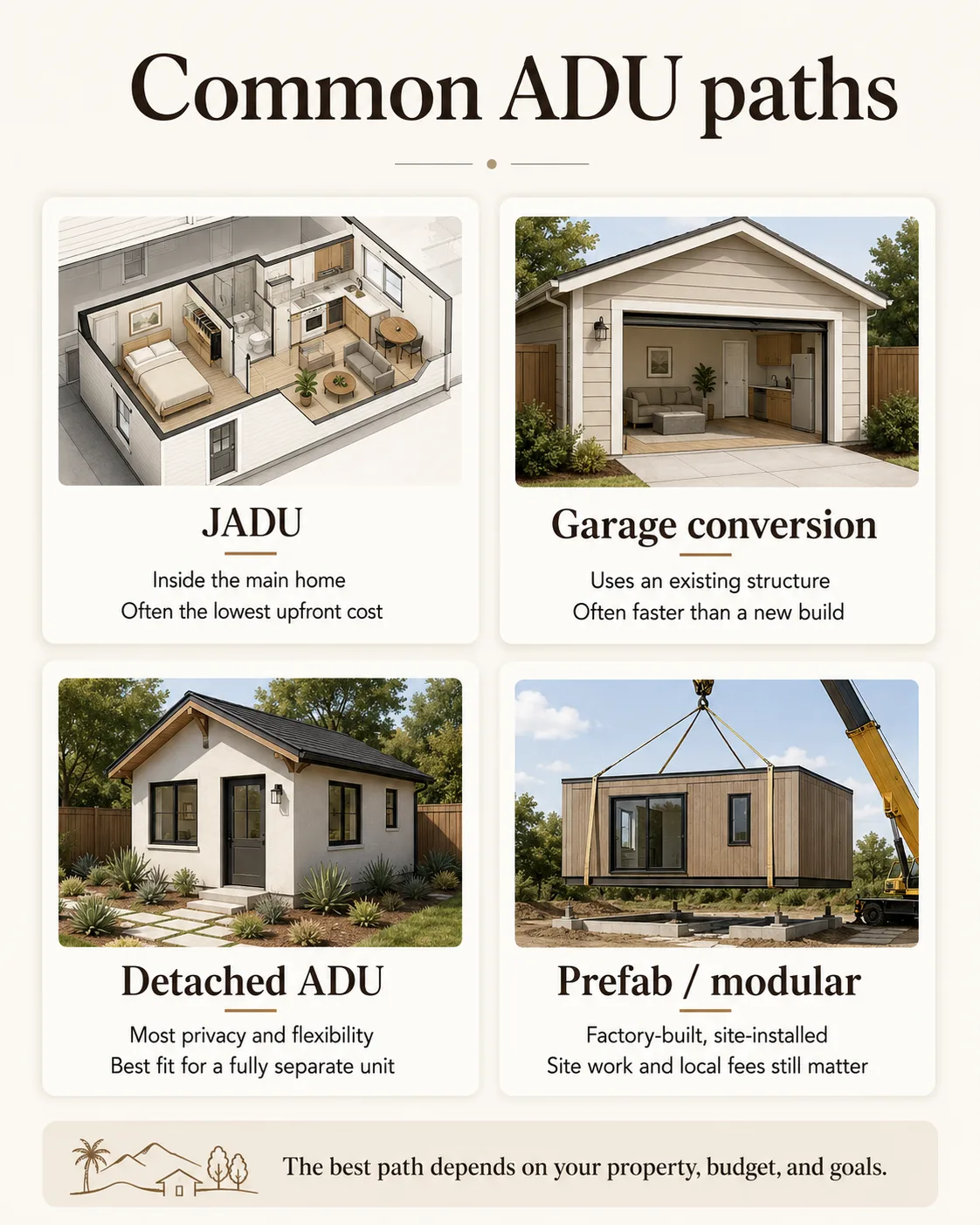
Answer capsule. Five line items appear in El Cajon ADU budgets that don’t show up on most national cost calculators: the sewer-lateral video requirement, the SDG&E separate-meter set on detached ADUs (~$15,000), the 6-foot building-separation rule, the wall-articulation design requirement for ADUs over 800 sq ft, and the residual parking requirement when state waivers don’t apply. Skipping these can put you $25,000–$50,000 short of your actual all-in number.
#1The sewer-lateral video
Per SnapADU’s published El Cajon guide and the City of El Cajon Public Works Wastewater Administration Department’s June 2022 position, El Cajon requires a recorded video inspection of the property’s private sewer lateral as part of ADU permit intake. To our knowledge, El Cajon is the only San Diego County municipality that systematically requires this video as part of ADU intake. The sewer-lateral video itself: $200–$400. Remediation if problems found: $8,000–$18,000 for partial replacement or relining; $15,000–$30,000+ for full replacement on long or deep laterals. Run the sewer lateral video before you pay for design, not after.
#2The SDG&E detached-ADU electric meter (~$15,000)
Detached ADUs in San Diego Gas & Electric territory typically need a separate electric meter, which means a new electrical panel, sub-panel, trenching from the existing service to the new unit, and SDG&E service coordination. Better Place Design & Build estimates this typically averages around $15,000 for a standard El Cajon installation. The trap on builder quotes: this line item often shows up as “by owner” or “SDG&E coordination TBD.” If your builder’s quote doesn’t include a $12,000–$18,000 SDG&E line, you don’t have a finished quote.
#3The 6-foot separation rule
El Cajon Municipal Code Chapter 17.140 requires a minimum 6-foot separation between a detached ADU and the primary dwelling. On narrow lots, this rule effectively dictates ADU placement and can force trade-offs between the ADU footprint, backyard space, and primary-home access. It also affects how you trench utilities and route drainage. Verify your lot width and the location of the primary’s foundation before signing for plans.
#4Wall articulation over 800 sq ft
For ADUs over 800 square feet, El Cajon’s residential design standards require wall plan articulation — for any wall longer than 30 feet, there must be a jog of at least 18 inches deep continuing for at least 4 feet. A straight 35-foot wall on a 900 sq ft ADU isn’t permittable as drawn. You’ll need to add a recess, bump-out, or projection, which adds framing labor and roofing complexity. Cost impact: typically $3,000–$8,000 on a mid-size detached ADU.
#5The electrical panel upgrade
Many El Cajon homes built before 1990 have 100-amp or 125-amp main electrical service panels — sufficient for the existing home, insufficient when you add a detached ADU. ADU PALS lists main panel upgrades in San Diego County at $6,000–$14,000 in 2026. The line item rarely appears on initial builder quotes. If your home was built before 2000, budget $10,000 for a panel upgrade as a working assumption.
#6Site work and soils (hillside lots)
El Cajon has a mix of flat valley lots (cheaper) and hillside lots in Fletcher Hills, Granite Hills, and Mt. Helix-adjacent neighborhoods (significantly more expensive). Hillside lots can require retaining walls ($150–$300 per linear foot), additional drainage, and in some cases a geotechnical soils report ($2,500–$4,000). El Cajon does not mandate soils reports for ADUs as a default — but your builder, structural engineer, or lender may require one.
#7Parking (when state waivers don’t apply)
California Government Code § 66322 lists the circumstances in which ADU parking requirements are waived (including properties within ½ mile of public transit, garage conversions, and units within the primary residence). When none of those waivers apply, El Cajon’s default is one paved off-street space. Adding a paved space: $1,500 (simple gravel-to-concrete on flat lot) to $8,000+ (new concrete pad with proper drainage and grading).
The El Cajon ADU Quote Decoder
Answer capsule. A complete El Cajon ADU quote should explicitly itemize design and engineering, building permits and city fees (including the 1.5% General Plan Maintenance Fee), school fees, sewer-lateral inspection and remediation contingency, SDG&E meter set, water and sewer capacity fees, site work, construction broken down by trade, finishes allowance, and a 10–15% contingency. Quotes that bundle these into “soft costs” or “by owner” hide $20,000–$60,000 of cost that will eventually land on you, just later when you have less negotiating power.
Use this table to score the quote in front of you. Hold it next to your builder’s PDF and check each row.
| Line item | What a fair quote shows | Red flag / what to push back on |
|---|---|---|
| Architecture, structural, Title 24 | $8,500–$20,000 itemized; or $0–$5,000 if using a Standard Plan | “Design fees” lumped under one number without scope |
| Building permit + plan check (valuation-based) | Estimated dollar range with the City’s FY26 formula | “City fees by owner” with no range |
| General Plan Maintenance Fee (1.5% of valuation) | Listed as a separate line, ~$5,775 on a $385K valuation | Most commonly omitted line — if missing, the quote is incomplete |
| ADU permit ($906) and AB 1332 plan permit ($1,982) | Listed as line items at the City’s published FY26 rates | Missing entirely or included in “permits” lump sum |
| Change of Address Fee ($273) | Listed for detached ADUs | Missing |
| School fees (CVUSD + GUHSD) | Calculated against your specific square footage | “School fees TBD” — these are calculable today |
| Sewer-lateral video and remediation reserve | $300 video + $0–$15,000 remediation contingency | Not mentioned; “we’ll deal with it if it comes up” |
| SDG&E separate meter and trenching | $12,000–$18,000 placeholder for detached ADUs | “By owner” or “SDG&E coordination TBD” |
| Water and sewer capacity fees | $2,300–$5,300 placeholder | Missing or “by owner” |
| Electrical panel upgrade reserve | $6,000–$14,000 contingency for pre-2000 homes | Not mentioned; “we’ll pull your panel and see” |
| Site work — grading, drainage, retaining | $5,000–$15,000 flat lot; $15,000–$40,000+ slope | “Site work as needed” without a placeholder dollar amount |
| Hard construction (foundation, framing, roof, MEP, finish) | Itemized by trade or bundled with breakdown available | One huge number with no breakdown |
| Finishes allowance | $/sq ft allowance for cabinets, counters, flooring, fixtures | Vague “mid-range finishes” without dollar allowance |
| General conditions / overhead / supervision | 7–12% of hard cost | More than 12% without itemized backup |
| Builder fee / profit | 10–18% of hard cost | More than 18% without scope justification |
| Contingency | 10–15% of hard cost | Less than 10%; you’ll burn through it on change orders |
| Sales tax | Itemized (materials only — labor isn’t taxed in CA) | “Tax included” with no breakdown |
| Engineering / inspections / third-party reports | $1,000–$4,000 itemized | Not mentioned |
Get an itemized El Cajon estimate from a local design-build partner →
We work with SnapADU as the local design-build partner for Greater San Diego because their service area explicitly includes El Cajon and their published process produces an itemized estimate you can check against the line items above.
Request an Itemized El Cajon Quote from SnapADU →Affiliate link; we may earn a commission at no extra cost to you. We disclose all affiliate relationships. See our full disclosure.
Garage conversion vs. detached vs. prefab — which is cheapest in El Cajon?
Answer capsule. A garage conversion is the cheapest legal ADU path in El Cajon when the existing structure is code-suitable, typically saving $130,000–$240,000 versus a comparable detached new build. A detached new build is the most expensive but generates the highest rental income and biggest property-value lift. Prefab and modular ADUs split the difference on cost and beat both on timeline — 3–6 months from order to occupancy versus 9–12 months for site-built construction.
| Factor | Garage conversion | Detached site-built | Prefab / modular detached |
|---|---|---|---|
| Realistic all-in cost (El Cajon, 2026) | $110,000–$240,000 | $245,000–$680,000 | $230,000–$520,000 |
| Timeline (design through cert. of occupancy) | 4–8 months | 9–14 months | 5–8 months (factory build runs parallel to site prep) |
| Best when… | Existing garage is dry, structurally sound, has adequate access | Lot supports a real second unit and the budget supports it | Speed matters and lot is accessible for crane delivery |
| Watch out for… | Slab condition, drainage, fire separation, panel capacity | Sewer lateral failure, SDG&E meter cost, soil/slope on hillside lots | Crane access, transport costs ($10,000–$30,000), local fees still apply |
| El Cajon parking impact | No replacement parking required (§ 66314(a)(11)) | Possible 1-space requirement unless § 66322 waiver applies | Same as detached site-built |
| Permit pathway | Standard ADU permit (60-day clock) | Standard ADU permit or AB 1332 30-day if Standard Plan | Same as detached site-built |
Convert your garage when…
- Garage is structurally sound (no settled slab, no rotting framing)
- You can sacrifice the parking
- Optimizing for family housing or modest rental income
- Utility runs from garage to existing service are short
Build detached when…
- Garage is unsuitable or already needed
- You want maximum rental income or resale lift
- Lot has space for a real backyard cottage
- Multigenerational housing with privacy is the primary goal
Consider prefab when…
- Speed is your primary constraint
- Lot is accessible to delivery truck and crane
- You want a fixed factory price with less site-build variance
- You’re comfortable with the provider’s standard plans
Should you use El Cajon’s free Standard ADU Plans?
Answer capsule. El Cajon publishes three free pre-approved Standard ADU Plans — a 560 sq ft studio, a 649 sq ft 1-bedroom, and an 802 sq ft 2-bedroom. Using a Standard Plan saves $10,000–$20,000 in design fees and qualifies your project for the AB 1332 30-day permit pathway under California Government Code § 65852.27. The plans are approximately 85% complete — site-specific work for foundation, utilities, grading, and Title 24 still applies.
| Element | Standard Plan provides | Still required for your project |
|---|---|---|
| Architectural drawings | Yes | None (drawings are reusable) |
| Structural engineering | Yes (for the plan as drawn) | Possible site-specific adjustment if soil or seismic conditions vary |
| Title 24 energy calculations | Yes (general) | Site-specific energy calc may be required for your orientation |
| Site plan, plot plan, civil | No | Yes — site work, utility routing, drainage |
| Foundation specs | Yes (assumes flat lot) | Custom foundation if slope, soil, or expansive soil conditions |
| Permit pathway | AB 1332 30-day | Building, mechanical, electrical, plumbing permits still required |
| City fees | AB 1332 Pre-Approved Plans permit ($1,982) | Plus Title 24 plan check ($567), sewer connection ($297), school fees, capacity fees, General Plan Maintenance Fee |
Standard Plans are the right choice when:
- Your lot is flat, with reasonable access, and one of the three plan footprints (560 / 649 / 802 sq ft) fits your needs
- You want the fastest possible permit timeline (30 days vs. 60 days)
- You don’t need significant customization (Standard Plans cannot be modified — they’re fixed designs)
- You want to lower design fees by $10,000–$20,000
Standard Plans are NOT the right choice when:
- You need a different square footage or layout
- Your lot has slope, expansive soils, or unusual access
- You want a specific architectural style
- You’re building an attached ADU or garage conversion (Standard Plans are detached new-build only)
Grants, the City of El Cajon ADU Loan Program & financing paths
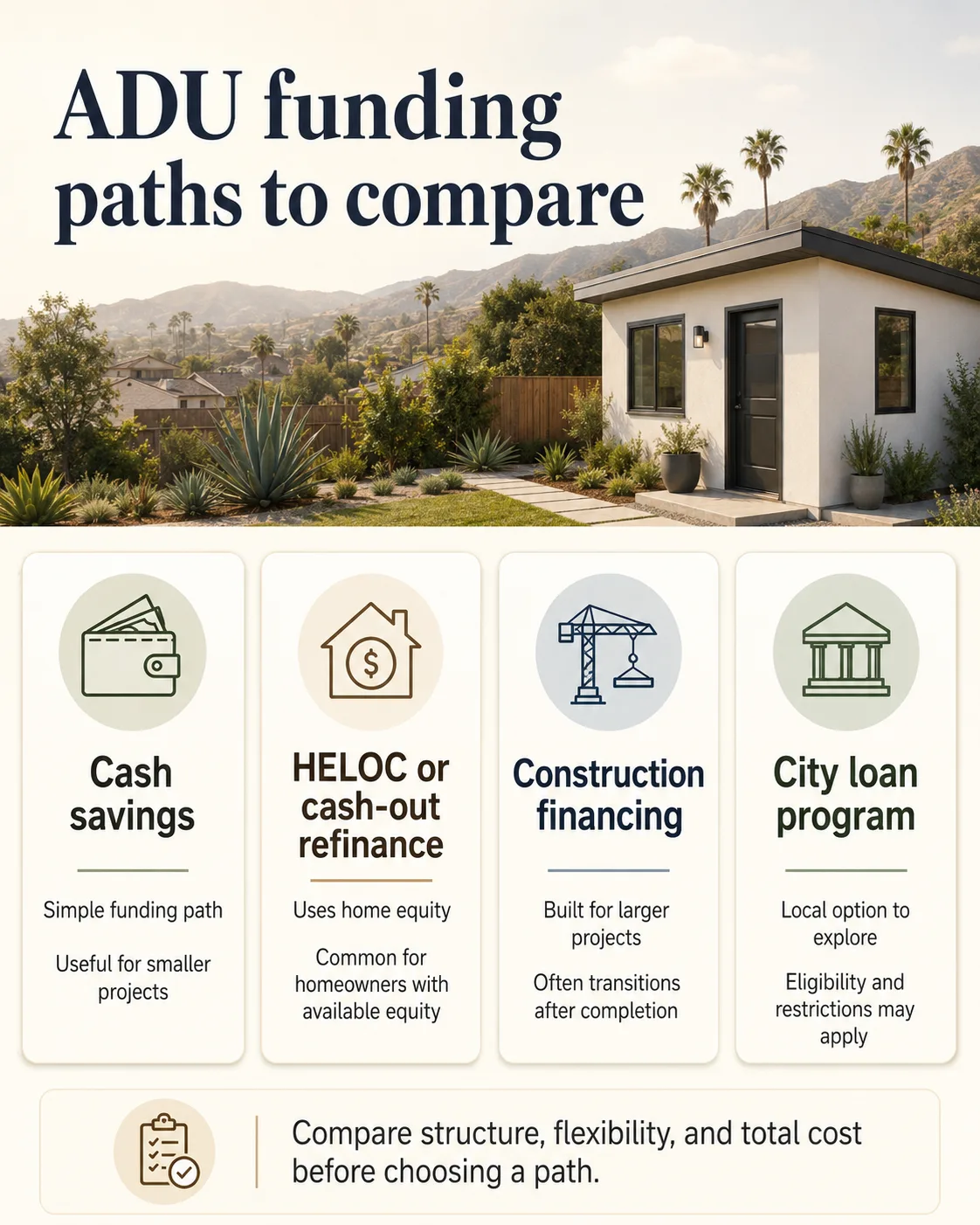
Answer capsule. The CalHFA $40,000 ADU grant has been paused since December 28, 2023, with no announced relaunch — anyone telling you they can secure it today is on CalHFA’s published scam-warning list. The City of El Cajon offers its own ADU Loan Program: a non-forgivable deferred loan up to $100,000 for income-qualified owner-occupants who agree to maintain rental affordability for 5 to 30 years.
The CalHFA grant: what’s true today
The CalHFA ADU Grant Program was fully allocated as of December 28, 2023. CalHFA’s own website explicitly states the latest round of funding has been fully allocated and posts a warning: “If anyone approaches you saying they can help you get an ADU Grant, it is a financial scam.” As of May 2026 there is no confirmed relaunch date. Do not budget around a CalHFA grant.
See our ADU Grants guide for programs that are actually active in 2026 →The City of El Cajon ADU Loan Program
El Cajon’s Housing Division administers a deferred-payment ADU Loan Program for owner-occupied properties inside the City:
- Loan type:Non-forgivable deferred loan (repayment required in the future, not a grant)
- Maximum amount:Up to $100,000
- Eligible uses:Construction materials, labor, overhead, builder-grade finishes, soft costs, and construction-contract-related costs
- Ineligible uses:Pre-construction costs, city building permits, third-party fees, furnishings, moving expenses, landscaping, luxury items
- Borrower requirements:Minimum 640 credit score, maximum 75% combined loan-to-value, owner-occupancy, at least one year of ownership and occupancy, no outstanding code enforcement issues
- Affordability covenant:ADU must be rented to an income-qualified household at affordable rents. Restriction terms range from 5 to 30 years
The honest tradeoff: At a 30-year covenant, the difference between affordable rent and market rent on a $2,000/month unit can mean $144,000–$360,000 in lost rent over the term. The program makes sense for owners whose primary motivation is family housing or community benefit, less so for pure investor math.
How to apply: Contact the El Cajon Housing Division at 619-441-1710 or housing@elcajon.gov. Confirm current funding availability before budgeting around the program.
Financing paths for the rest of homeowners
Path 1: Home Equity Line of Credit (HELOC)
Path 2: Cash-out refinance
Path 3: Construction-to-permanent loan (FHA 203(k) or conventional)
Compare HELOC, cash-out refi, and construction loan options →
Compare common funding routes and their eligibility limits before contacting a lender.Compare ADU Financing OptionsAffiliate links may apply; we may earn a commission at no extra cost to you. Educational only, not financial advice; no rate, payment, or approval guarantees. Also see our HELOC for ADU deep-dive.
Does it pencil? Rents and 5-year math
Answer capsule. El Cajon ADU rents in May 2026 range roughly $1,450–$1,600 for studios, $1,695–$1,913 for 1-bedrooms, $2,095–$2,321 for 2-bedrooms, and $2,920–$3,300 for 3-bedrooms based on current published rental market data. Against a $385,000 1-bedroom detached ADU financed via HELOC at current rates, the project typically generates positive cash flow only with significant equity already deployed.
Required disclaimer: These are illustrative examples, not guarantees of returns. Actual results depend on local market conditions, construction costs, financing terms, and regulatory approvals.
El Cajon ADU rent comps, May 2026
| Source | Studio | 1BR | 2BR | 3BR |
|---|---|---|---|---|
| RentCafe (current) | n/a published | ~$1,913 | ~$2,320 | ~$3,037 |
| RentHop (May 2026) | $1,600 | $1,750 | $2,095 | $3,295 |
| Zillow (May 2026) | $1,550 | $1,795 | $2,230 | $3,300 |
Sources: RentCafe.com El Cajon market trends; RentHop.com May 2026 El Cajon report; Zillow.com El Cajon rental market data. Verified May 2026. Rental data is volatile and changes month to month.
5-year illustrative math: a 700 sq ft 1-bedroom detached ADU
Project assumptions:
- All-in cost: $385,000 (mid-range for a 700 sq ft detached ADU including all fees)
- Financing: HELOC at illustrative rate (rates vary; we don’t quote specific rates as guarantees)
- Rent: $1,850/month (between current 1BR comps from RentHop, Zillow, and RentCafe)
- Vacancy: 5% (standard underwriting assumption)
- Operating expenses: 25% of gross rent (owner-paid utilities, maintenance reserve, insurance, property taxes on the ADU’s added value)
| Year 1 gross rent | $22,200 |
| Year 1 effective rent (after 5% vacancy) | $21,090 |
| Year 1 operating expenses (25% of effective rent) | $5,272 |
| Year 1 net operating income (NOI) | $15,818 |
The honest takeaway: El Cajon ADUs are most reliably profitable when the homeowner deploys significant existing equity and treats the project as a 10-year wealth-building decision, not a 2-year cash-on-cash investment. Pure-cash-flow ADU economics work best on lower-cost paths (JADUs and garage conversions) where the build cost is smaller relative to the rent.
Use cases where ROI isn’t the right metric
Aging parents
A detached ADU lets aging parents maintain independence at a fraction of San Diego County assisted-living costs ($4,000–$7,000/month). The “return” is in extending the family’s care window.
Adult children
Returning college graduates or saving-for-down-payment adult kids get private living space. The “return” is in housing stability during a transition.
Home office or studio
A detached ADU as a dedicated workspace can replace commercial office or studio rent for self-employed homeowners.
Future resale optionality
Permitted ADUs add to a property’s appeal to multigenerational family buyers and investors. Appraised value depends on comparable sales.
Choose your El Cajon ADU path by budget
Answer capsule. El Cajon ADU paths sort cleanly by budget band: under $150,000 typically means JADU or garage conversion only; $200,000–$330,000 opens up small detached new builds and Standard Plan studios; $325,000–$475,000 covers the 700–1,000 sq ft detached range that captures most rental sweet-spot units; $425,000+ moves you into larger detached, premium finishes, or hillside-lot complexity.
| If your realistic all-in budget is… | Your likely path | Key considerations |
|---|---|---|
| Under $150,000 | JADU (interior conversion) or garage conversion (if structure is suitable) | Verify garage condition before committing; consider whether you can sacrifice the parking |
| $150,000–$240,000 | Garage conversion at the higher end, or JADU with significant work | Get a sewer-lateral video and panel inspection first |
| $200,000–$330,000 | Small detached new build (500–650 sq ft) or El Cajon Standard Plan studio (560 sq ft) | Site conditions can push this higher; budget for $25K of unexpected line items |
| $325,000–$475,000 | 700–1,000 sq ft detached new build, or 1-bedroom Standard Plan (649 sq ft) | Stay under 750 sq ft to capture SB 13 impact-fee waiver |
| $425,000–$525,000 | 800–1,000 sq ft detached new build, or Standard Plan 2BR (802 sq ft) | Wall articulation triggers at 800 sq ft; school fees fully apply |
| $525,000+ | 1,000–1,200 sq ft detached new build, premium finishes, or hillside lot | Diminishing per-sq-ft savings; consider whether you need the size |
See what you can build at your address →
Tells you which path your lot supports before you commit budget to design.
Get Your Free 60-Second El Cajon ADU Report →7 levers to control your El Cajon ADU budget
Answer capsule. Most El Cajon homeowners can pull $30,000–$80,000 out of their ADU quote by exercising two or three of these seven levers before signing the construction contract. None require sacrificing quality, code compliance, or long-term ADU value.
Use one of El Cajon’s free Standard Plans
Saves $10,000–$20,000The three free Standard Plans (560 / 649 / 802 sq ft) replace $10,000–$20,000 of custom architectural and structural fees with $0 design cost. They also qualify for the AB 1332 30-day permit pathway, saving 30+ days of permit review.
Stay under 750 sq ft
Saves $5,000–$15,000California Government Code § 66311.5 bars cities from charging impact fees on ADUs of 750 sq ft or less. In El Cajon, this typically saves $5,000–$15,000 in fees. For most family-housing or 1-bedroom-rental use cases, 649–749 sq ft is a great size.
Convert the garage instead of building new
Saves $130,000+If your garage is structurally sound and you can sacrifice the parking, a garage conversion typically costs $130,000–$240,000 less than a comparable detached new build.
Don’t over-finish the kitchen and bath
Saves $20,000–$50,000Kitchen and bathroom finishes are where premium materials inflate ADU budgets the most. The rental market in El Cajon doesn’t pay a meaningful premium for premium finishes — your renter cares about layout, light, and parking, not whether the backsplash is subway tile or zellige.
Verify the sewer lateral before design
Saves $0–$15,000 in surprisesRunning a sewer-lateral video before design costs $200–$400. Discovering a failed lateral after you’ve broken ground costs $8,000–$30,000 plus schedule delay. This is the highest-leverage $300 you’ll spend on the project.
Pick the financing path that doesn’t blow up your existing first-mortgage rate
Saves ongoing interestIf you locked in an existing first-mortgage rate during 2020–2021, a cash-out refinance at today’s rates can cost meaningfully more in additional interest over the life of the new loan. A HELOC preserves your existing first-mortgage rate.
Bid the project to at least three local builders
Saves 10–25% on hard costSingle-bid construction projects routinely cost 10–25% more than multi-bid projects. Get three itemized quotes using the Quote Decoder table above. Pay attention to which builders include the El Cajon-specific line items versus which ones leave them as “by owner.”
Pre-design verification checklist: 11 things to confirm before paying for plans
Answer capsule. Before paying for ADU design in El Cajon, verify jurisdiction, school district combination, planned size against the 500/750/800 sq ft thresholds, ADU type and feasibility, existing structure code-suitability (for conversions), sewer-lateral condition, electrical panel capacity, utility distance, site access, City ADU Loan Program fit, and the line items your builder has actually included.
Is the property inside the City of El Cajon?
Check PACO. If your address doesn’t appear, you’re likely in unincorporated San Diego County and the County’s rules and fees apply.
Which school district combination applies?
Most City of El Cajon properties are CVUSD + GUHSD. Confirm before budgeting school fees.
Is the planned ADU 500 sq ft or less?
Captures the school-fee exemption from both CVUSD and GUHSD.
Is the planned ADU 750 sq ft or less?
Captures the SB 13 impact-fee waiver per California Government Code § 66311.5.
Is the planned ADU over 800 sq ft?
Triggers wall articulation requirements under El Cajon’s residential design standards.
What ADU type is it?
Detached, attached, JADU, garage conversion, or movable tiny home — different rules, different costs.
For a garage conversion: is the existing structure actually code-suitable?
Slab, framing, drainage, fire separation, panel.
Has a sewer-lateral video been performed?
El Cajon requires this. Run it before design, not after. Cost: $200–$400 for the video.
Has the electrical panel been pulled and verified?
Pre-2000 homes often need a $6,000–$14,000 panel upgrade.
Does your builder’s bid include the El Cajon-specific line items?
Sewer-lateral remediation reserve, SDG&E meter set, school fees, capacity fees, General Plan Maintenance Fee, contingency.
Are you considering the City of El Cajon ADU Loan Program?
Confirm current funding availability and whether the affordability covenant fits your rental plans (call 619-441-1710).
Get the full checklist as a downloadable PDF →
One-page format you can hold next to a builder’s bid.
Download the Free El Cajon ADU Cost Checklist →When NOT to build an ADU in El Cajon
Answer capsule. An El Cajon ADU is not the right project right now if you’re planning to sell within 3 years, if your only financing option carries a rate above 9%, if your lot has compounded problems (failed sewer lateral plus steep slope plus undersized electrical panel), or if you’re counting on a CalHFA grant that doesn’t currently exist.
If you’re selling within 3 years
The property-value uplift from an ADU takes time to materialize. A $400,000 ADU build typically doesn’t return $400,000 in resale value within the first 2–3 years.
If your only financing is a 9%+ personal loan or credit card
ADUs are a long-duration asset. Financing them with short-duration, high-rate debt is the most common way a “good” ADU project becomes a financial disaster.
If your lot has compounded problems
A failed sewer lateral plus a steep slope plus a 100-amp electrical service can add $40,000–$80,000 to your project before construction starts.
If you’re banking on the CalHFA grant
It’s paused. There’s no announced relaunch. CalHFA itself has issued a scam warning. Budget without it.
Not sure if your lot is ready? →
Get your free 60-second El Cajon Feasibility Check. Tells you which constraints apply at your address and which paths are realistic.
Get Your Free El Cajon Feasibility Check →What we verified
Verified May 18, 2026.
- El Cajon Municipal Code Chapter 17.140 (Ord. 5151, adopted May 13, 2025) — setback, height, parking, and ADU standards.
- California Government Code §§ 66310–66342 — including § 66311.5 (750 sq ft impact-fee waiver), § 66314 (ADU standards including § 66314(a)(11) no replacement parking on garage conversion), § 66315 (local agencies may require rentals longer than 30 days), § 66317 (15-business-day completeness clock and 60-day approve-or-deny clock), § 66321 (800 sq ft state floor), § 66322 (parking-waiver circumstances), § 66323 (single-family ADU combinations), § 66333 (JADU standards).
- CalHFA ADU Grant Program — fully allocated December 28, 2023, no announced relaunch as of May 18, 2026. Source: calhfa.ca.gov/adu.
- City of El Cajon ADU Loan Program — program guidelines remain published. Loan terms verified: up to $100,000, non-forgivable deferred loan, owner-occupancy required, affordability covenant 5–30 years. Current funding availability not independently verified — confirm via Housing Division before budgeting.
- City of El Cajon FY26 Planning and Building Fee Schedule — $906 ADU permit, $1,982 AB 1332 pre-approved-plan permit, $567 Title 24 plan check, $297 new sewer connection, $273 Change of Address Fee, and the General Plan Maintenance Fee at 1.5% of project valuation.
- Cajon Valley Union School District — $3.21/sq ft residential through July 10, 2026; $3.34/sq ft starting July 11, 2026; projects 500 sq ft or less exempt.
- Grossmont Union High School District — $1.20/sq ft residential; projects 500 sq ft or less exempt.
- El Cajon Standard ADU Plans — three pre-approved plans (560 sq ft studio, 649 sq ft 1BR, 802 sq ft 2BR) verified against the City’s published plan packet.
- Sewer-lateral video requirement — sourced to SnapADU’s published El Cajon city guide and the City of El Cajon Public Works Wastewater Administration Department’s June 2022 position. Confirm with City Public Works for current intake practice before paying for design.
- SDG&E detached-ADU separate-meter planning assumption — sourced to Better Place Design & Build’s El Cajon page (~$15,000 typical installation). Actual SDG&E service treatment depends on review and existing service capacity.
- Per-square-foot cost ranges — reconciled from SnapADU’s 2026 San Diego cost guide, ADU PALS’ 2026 San Diego pricing, Better Place Design & Build’s El Cajon page (March 2026 update).
- Rent comps — RentCafe.com El Cajon market trends; RentHop.com May 2026 El Cajon report; Zillow.com El Cajon rental market data. Verified May 2026.
- USModular El Cajon prefab starter price — USModular’s published 2022 pricing for a 398 sq ft 1-bedroom prefab unit was $178,000. Current pricing should be confirmed directly with the manufacturer.
Methodology
The Dwelling Index is an independent research resource covering ADU financing, costs, and regulations. We are not a lender, broker, or builder. This page does not provide legal, financial, or construction advice; it provides researched information that homeowners can use to ask better questions and make better-informed decisions.
Our process for city-specific cost pages:
- Construction cost ranges are reconciled from at least three independent published 2026 sources covering San Diego County (SnapADU, ADU PALS, Better Place Design & Build), then segmented for El Cajon’s specific cost profile.
- Permit and city fee data are taken from the City of El Cajon’s published Planning and Building Fee Schedule (FY26) and the PACO portal.
- School fee data are taken directly from CVUSD and GUHSD district-published per-square-foot rates with effective dates.
- State law citations are verified against California Legislative Information (leginfo.legislature.ca.gov) and the California HCD ADU Handbook.
- Local ordinance citations are verified against the El Cajon Municipal Code as adopted (Ord. 5151, May 13, 2025).
- Loan program data are verified against the City of El Cajon Housing Division’s published program guidelines.
- Rent comps are assembled from multiple published rental market data sources and cross-checked.
See our full Methodology and Editorial Standards pages.
El Cajon ADU cost FAQ
How much does it cost to build an ADU in El Cajon?
An ADU in El Cajon, California costs between $110,000 (small garage conversion) and $680,000 (max 1,200 sq ft detached new build), all-in for design, permits, school fees, utility upgrades, construction, and contingency. Most 700–900 sq ft detached projects land $340,000–$525,000.
How much does an El Cajon ADU cost per square foot?
El Cajon ADUs run roughly $200/sq ft for the cheapest garage conversions to $600/sq ft for small high-finish detached units. Most full-service detached builds land $400–$525/sq ft all-in. Smaller detached units carry higher cost per square foot because fixed costs don’t scale down.
Is the $40,000 CalHFA ADU grant still available in El Cajon?
No. The CalHFA ADU Grant Program has been fully allocated since December 28, 2023, with no announced relaunch as of May 2026. CalHFA has issued a public scam warning about anyone claiming they can secure the grant today. Source: calhfa.ca.gov/adu.
Does El Cajon have its own ADU grant or loan program?
Yes. The City of El Cajon ADU Loan Program offers deferred non-forgivable loans up to $100,000 for owner-occupied income-qualified properties willing to maintain rental affordability for 5–30 years. Contact the El Cajon Housing Division at 619-441-1710 to confirm current funding availability.
What permit fees should I budget for an El Cajon ADU?
Total city-side permit and fee spend in El Cajon typically lands $11,000–$22,000 for a new detached ADU once the General Plan Maintenance Fee (1.5% of valuation), valuation-based building permit and plan check, fixed line items, school fees, and capacity charges are included. Key fixed line items: $906 ADU permit, $1,982 AB 1332 pre-approved-plan permit (if using a Standard Plan), $567 Title 24 plan check, and $297 new sewer connection.
How much are school fees on an El Cajon ADU?
For properties in the CVUSD + GUHSD district combination (most City of El Cajon parcels), combined school fees are approximately $4.41/sq ft through July 10, 2026, rising to $4.54/sq ft starting July 11, 2026. ADUs of 500 sq ft or less are exempt from both districts. School fees are due before building permit issuance.
How long does it take to build an ADU in El Cajon?
From design through certificate of occupancy, expect 6–14 months: roughly 2–4 months of design, 1–3 months of permit review (California Government Code § 66317 requires a 15-business-day completeness check and a 60-day approve-or-deny decision), and 4–8 months of construction. Prefab and Standard Plan AB 1332 pathways can compress this to 4–6 months total.
What’s the El Cajon sewer-lateral video requirement?
El Cajon requires a recorded video inspection of the property’s private sewer lateral as part of ADU permit intake. The video itself costs $200–$400. If it reveals problems, remediation costs $8,000–$30,000+. Run the video before paying for design, not after.
Do I need a separate SDG&E meter for a detached ADU?
Detached ADUs in SDG&E territory typically need a separate electric meter, which means a new subpanel, trenching, and SDG&E coordination — averaging around $15,000 installed per Better Place Design & Build’s published El Cajon planning assumption. Attached ADUs and JADUs have more flexibility.
Can I rent the ADU as a short-term Airbnb in El Cajon?
No. California Government Code § 66315 allows local agencies to require ADU and JADU rental terms longer than 30 days, and El Cajon has adopted this requirement. Short-term rentals (less than 30 days) are prohibited.
Can I sell the ADU separately from the main house in El Cajon?
Not yet. California’s AB 1033 (2023) allows cities to opt into separate ADU condo-sale ordinances. As of May 2026, the City of El Cajon has not adopted this option. Verify current City Council adoption status with the City Clerk before relying on this path.
What size makes the most financial sense?
For pure rental return-on-investment, a sub-750 sq ft unit captures the SB 13 impact-fee waiver and lowers school-fee exposure. For maximum property-value uplift, a 700–900 sq ft 1-bedroom or small 2-bedroom typically performs best. For lowest absolute cost, JADU or garage conversion at 400–500 sq ft.
What’s the cheapest legal ADU I can build in El Cajon?
A garage conversion ADU, typically $110,000–$240,000 all-in, assuming the existing garage is code-suitable. If the garage needs significant structural work, a JADU within the primary residence ($60,000–$170,000) may be cheaper.
Should I use El Cajon’s free Standard ADU Plans?
If one of the three Standard Plan footprints (560 sq ft studio, 649 sq ft 1-bedroom, or 802 sq ft 2-bedroom) fits your needs and your lot is reasonably flat with good access, yes — they save $10,000–$20,000 in design fees and qualify for the AB 1332 30-day permit pathway. If you need custom sizing or your site has slope or unusual soil, custom plans may be the better choice.
What ADU types are allowed in El Cajon?
El Cajon allows JADUs (up to 500 sq ft, inside the primary), garage conversions, attached ADUs, detached ADUs (up to 1,200 sq ft or the size of the primary, whichever is less), and movable tiny homes per El Cajon Municipal Code § 17.140.230 (150–430 sq ft, DMV-registered, NFPA-certified). Multifamily properties can convert non-livable space and build detached ADUs up to 8 per lot under SB 1211 (effective January 2025).
Related Dwelling Index resources
- El Cajon ADU Laws 2026: Size, Setbacks, Parking & State Rules
- El Cajon ADU Permit Process 2026: Timeline, PACO & Checklist
- El Cajon Free Standard ADU Plans 2026: 560 / 649 / 802 sq ft Guide
- Best ADU Builders El Cajon 2026
- San Diego ADU Cost in 2026: Real Prices by Type, City & Size
- ADU Cost in Escondido CA 2026
- ADU Cost in San Marcos CA 2026
- ADU Cost Per Square Foot 2026: National Guide
- How Much Does an ADU Cost? 2026 Hub
- ADU Financing Options 2026: HELOC, Cash-Out Refi & More
- HELOC for ADU: How to Use Home Equity to Fund Your Build
- ADU Grants 2026: Verified Programs by State
- Prefab ADU Cost 2026: Factory Prices vs. All-In Reality
- San Diego County ADU Laws 2026 (Unincorporated)
Not sure where to start? See what’s possible at your address — get your free ADU report in 60 seconds.
Jurisdiction, lot fit, ADU type, size envelope, and a first-pass budget band — free, no commitment, before you spend a dollar on plans.
Get Your Free El Cajon ADU Report →