
By The Dwelling Index Editorial Team · Published · Updated · Last verified
The El Cajon ADU Permit Process in 2026: A Decoded, Stage-by-Stage Walkthrough
The El Cajon ADU permit process runs through PACO — the city’s Project Assistance Center Online portal — and follows a six-stage path from feasibility to Certificate of Occupancy. Under California Government Code § 66317, El Cajon has 15 business days to determine your application is complete and then 60 days to approve or deny a complete ADU application on a lot with an existing single-family or multifamily dwelling. The 60-day clock runs from the completed application only — not from first submittal. In practice, most El Cajon ADU permits issue 8 to 16 weeks after a complete first submittal.
Verified against City of El Cajon PACO documentation, El Cajon Municipal Code § 17.140.180, the FY26 Schedule of Miscellaneous Fees (Resolution No. 056-25, effective July 1, 2025), the city’s Standard ADU Plans, California Government Code §§ 66311.5–66335 as amended by SB 543 (effective January 1, 2026), and Cajon Valley Union, Grossmont Union HSD, and La Mesa-Spring Valley school district fee resolutions.
Start with the parcel.
See What You Can Build at Your Address → Get Your Free ADU Report
At-a-glance: the questions this page answers
| Question | El Cajon bottom line | Where we go deep |
|---|---|---|
| Where do I apply? | PACO — the city’s online portal | “The 6-stage PACO workflow” |
| Is a permit required? | Yes for any new ADU or JADU per ECMC §17.140.180 | “Do you need a permit at all?” |
| Statutory review clock? | 15 business days completeness + 60 days approve/deny (Gov. Code §66317) | “How long does it take?” |
| Max ADU size? | 1,200 sf; cannot exceed primary dwelling | “What rules must you meet?” |
| Max JADU size? | 500 sf inside the primary dwelling | “What rules must you meet?” |
| Setbacks? | 3 ft min (12 ft height), 4 ft (16 ft), 5 ft (20 ft) | “What rules must you meet?” |
| Parking? | One space default; broad transit/conversion exemptions | “What rules must you meet?” |
| Impact fees? | None for ADUs of 750 sf or less of interior livable space (Gov. Code §66311.5) | “What does it actually cost?” |
| School fees? | None for ADUs/JADUs of 500 sf or less; charged proportionally above (SB 543) | “What does it actually cost?” |
| Pre-approved plans? | Yes — Studio 560 sf, 1-BR 649 sf, 2-BR 802 sf | “Pre-approved plans” |
| Owner-occupancy required? | No for ADUs (Gov. Code §66315) | “FAQ” |
| Short-term rental? | No — 30-day minimum tenancy | “FAQ” |
| Permit validity? | 12 months from issue; extended 12 months per inspection; max 3 years | “Inspections” |
Sources you can verify yourself
| Claim category | Primary source | Where it lives |
|---|---|---|
| Portal workflow and jurisdiction warning | City PACO Frequently Asked Questions | elcajon.gov |
| ADU local standards | El Cajon Municipal Code §17.140.180 | ecode360.com (Title 17, Chapter 17.140) |
| Statutory review clock | California Government Code §66317 | leginfo.legislature.ca.gov |
| ADU impact fee rule | California Government Code §66311.5 (amended by SB 543) | leginfo.legislature.ca.gov |
| City fee schedule | Resolution No. 056-25 (FY26 Schedule of Miscellaneous Fees) | elcajon.gov |
| CVUSD school facility fee | Cajon Valley Union resolution, eff. Feb 15, 2025 | cajonvalley.net |
| GUHSD school facility fee | Grossmont Union HSD published rate | guhsd.net |
| LMSVSD school facility fee | La Mesa-Spring Valley fiscal services page | lmsvschools.org |
| Pre-approved plan inventory | City of El Cajon Standard ADU Plans (Studio/1BR/2BR) | elcajon.gov |
| ADU Loan Program | City of El Cajon ADU Loan Program guidelines | elcajon.gov |
Do you actually need a permit to build an ADU in El Cajon?
Define your terms first
- ADU (Accessory Dwelling Unit)
- A complete, independent residential unit on the same lot as a primary dwelling, with its own kitchen, bath, and sleeping area. Detached, attached, or a conversion of existing space.
- JADU (Junior Accessory Dwelling Unit)
- A smaller secondary unit up to 500 square feet contained entirely within the walls of an existing or proposed single-family dwelling. JADUs have specific kitchen and sanitation rules, and owner-occupancy requirements that depend on whether the JADU shares sanitation with the primary home.
- Ministerial approval
- The city must approve based on objective standards, not subjective judgment. No discretionary “yes/no” by a commission. State law makes ADU applications ministerial when they meet objective code.
- PACO
- The City of El Cajon’s online permit portal (Project Assistance Center Online). All ADU applications route through this system.
- Plan check
- The city’s review of submitted plans for code compliance, before permit issuance. Multiple departments review in parallel.
- Setback
- Minimum distance from a structure to a property line.
- Site work
- Prep work on your specific parcel (grading, utility trenching, drainage, retaining walls) as opposed to the building itself. Site work is the single biggest cost variable in real ADU budgets.
- Sewer lateral
- The private sewer pipe running from your home to the city’s main in the street. El Cajon reviews lateral condition as part of ADU permitting.
Six ADU paths in El Cajon — pick yours
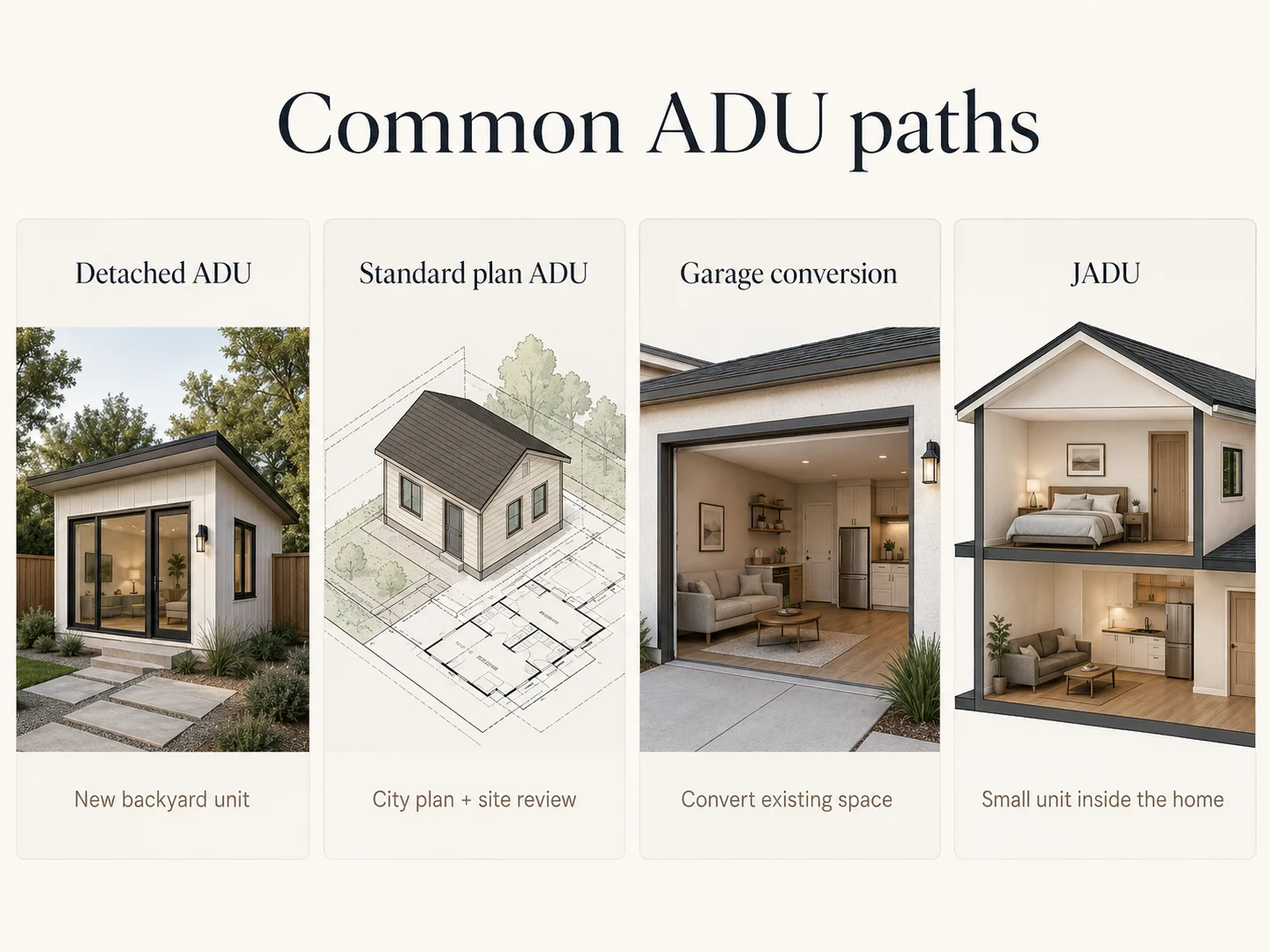
| ADU type | What it is | Permit complexity |
|---|---|---|
| Detached new construction | A freestanding new structure in the backyard, up to 1,200 sf | Highest — full code review across building, planning, fire, engineering |
| Detached using city standard plan | A freestanding new structure using one of El Cajon’s three pre-approved plans (Studio 560 sf, 1-BR 649 sf, 2-BR 802 sf) | Lower — building design is pre-vetted; site-specific items still apply |
| Attached ADU | A new addition joined to the primary home, with separate entrance and full living facilities | Medium — fire separation and structural connections add complexity |
| Garage conversion ADU | Existing garage converted to a dwelling | Medium — depends heavily on existing structure condition; no replacement parking required |
| JADU (Junior ADU) | Up to 500 sf inside the existing home, often a converted bedroom with a kitchenette | Lower — within existing walls; recorded deed restriction; owner-occupancy rules apply |
| Legalization (unpermitted ADU) | Existing unpermitted structure being legalized under AB 2533 (built before Jan 1, 2020) | Variable — depends entirely on existing condition vs. current code |
Is my address actually inside the City of El Cajon?
This is the first practical blocker. The city addresses it directly in the PACO FAQ: “If you cannot find an address in PACO, then it is likely not within the City of El Cajon. Many unincorporated San Diego County addresses have El Cajon listed as the city.” Source: City of El Cajon PACO Frequently Asked Questions.
Why this matters in dollars: unincorporated parcels are permitted by County of San Diego Planning & Development Services, with different fees, plan sets, processes, and school districts. We’ve seen homeowners pay designers to draft El Cajon-compliant plans only to learn the parcel falls under the county.
Verify in two minutes:
- Try entering your address in PACO at elcajon.gov/PACO. If the system finds the parcel, you’re in the city.
- If PACO can’t find it, you’re almost certainly unincorporated. Call El Cajon Building Safety at 619-441-1726 to confirm, then redirect to the County of San Diego.
- Cross-reference using the city’s interactive boundary map (linked from elcajon.gov).
Which department owns which part of the review
Four city groups review every El Cajon ADU permit in parallel. Their comments come back consolidated through PACO — but knowing who owns what saves calls when corrections arrive.
| Department | Phone | Owns | Fee impact |
|---|---|---|---|
| Building & Fire Safety Division | 619-441-1726 | Code compliance (CRC, CBC, CMC, CPC, CEC, CEnC, CFC, CGBSC — 2025 California Building Standards Code effective Jan 1, 2026) | Building permit, plan check (65% of building permit), sub-permits, state surcharges |
| Planning Division | 619-441-1742 | Zoning, setbacks, height, lot coverage, design including wall-plan articulation | Planning Plan Check — New ADU: $110 |
| Engineering Services | 619-441-1653 | Sewer lateral video review, storm water, encroachment, grading | SFR Building Permit Review: $870; Storm Water: $240; Sewer Lateral Video Review: $200 |
| Heartland Fire & Rescue | via city dispatch | Fire access, hydrant flow, sprinkler review | Fire Plan Review + Final Fire Clearance: $228 |
| Public Works — Wastewater Administration | 619-441-1653 | Private sewer lateral standards | Triggers Engineering’s video review |
| Housing Division | 619-441-1710 | City ADU Loan Program | Separate from the permit itself |
Source: City of El Cajon FY26 Schedule of Miscellaneous Fees (Resolution No. 056-25, adopted June 10, 2025, effective July 1, 2025, Exhibit A).
How does the El Cajon ADU permit process work in PACO?
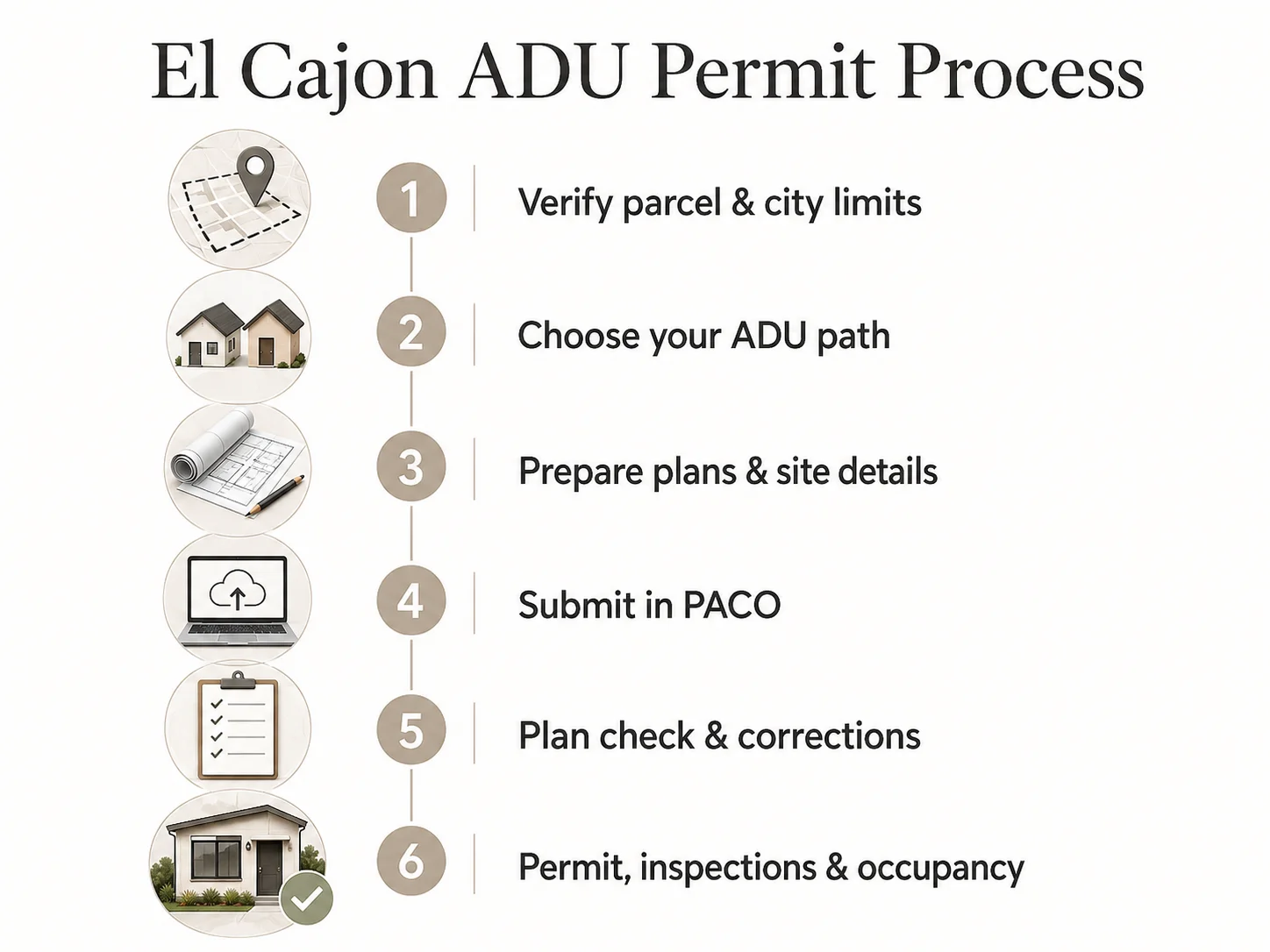
The 6-stage workflow at a glance
| Stage | Owner | What happens | City expectation | Realistic duration |
|---|---|---|---|---|
| 0. Pre-app feasibility | You / your designer | Verify jurisdiction, zone, setbacks, lot coverage, easements, sewer lateral condition, fire severity zone | “Contact us at the earliest stage” | 1–2 weeks |
| 1. PACO submittal | You / your designer | Register on PACO; upload application, plans, Title 24, structural calcs, site plan, supplemental forms | Same-day submittal once package is complete | Same day |
| 2. Initial invoice | City | Email directing payment of initial plan-check fees | “Within 1–2 business days” | 1–2 business days |
| 3. First plan check | All four departments concurrently | Comments come back as consolidated correction list | “Typically about three to four weeks” | 3–6 weeks |
| 4. Correction cycles | You / your designer | Respond to corrections; resubmit | “Typically about one to two weeks” per recheck | 1–3 weeks × 1–3 cycles |
| 5. Final approval & issuance | City | Final invoice including school fee forms; pay; permit issues | After approval | 1–2 weeks |
| 6. Inspections to CofO | You + city inspectors | ~9 staged inspections through the build | Per CRC and city plan notes | 4–9 months construction |
Source: City of El Cajon PACO FAQ and Building Safety FAQ, elcajon.gov.
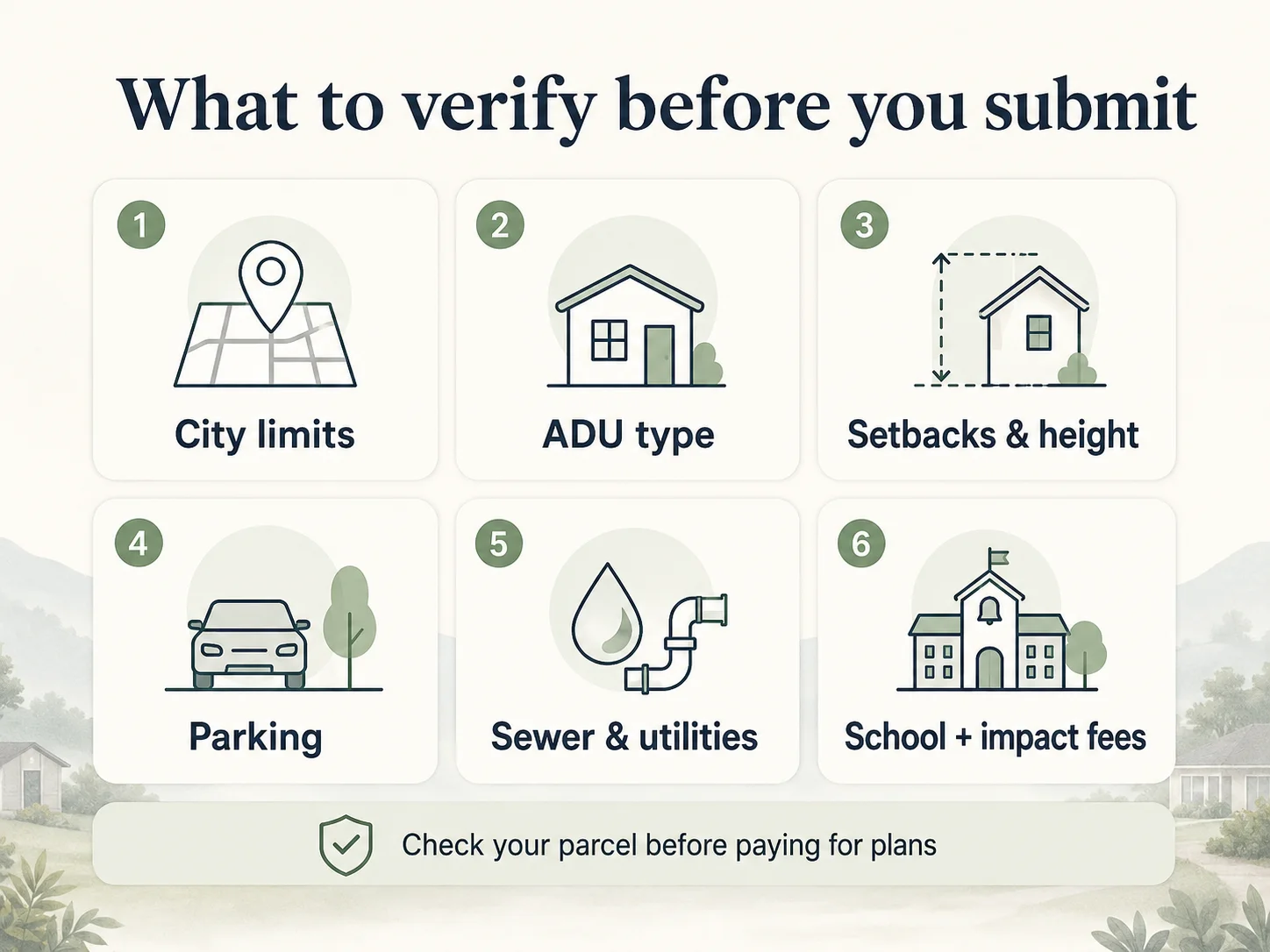
Stage 0 — Pre-application feasibility (skip this and you’ll pay for it)
Before you spend a dollar on plans, verify six things. Every one of these has stopped a project mid-design:
- Is your parcel in the City of El Cajon vs. unincorporated San Diego County? See the jurisdiction check above.
- What’s the underlying zone, and what setbacks apply? El Cajon’s tiered setback/height combinations mean a 3-foot setback caps you at 12 feet, a 4-foot setback unlocks 16 feet, and a 5-foot setback unlocks 20 feet. Locations within ½ mile of major transit get up to 18 feet regardless. (ECMC § 17.140.180.)
- Is your parcel in a High Fire Severity Zone overlay? Parcels in a Very High Fire Hazard Severity Zone trigger CRC R337 requirements (non-combustible gutters, valley flashing, spark arrestors, glazing reinforcement). This adds construction cost meaningfully. Call Building Safety for the current map.
- Is your existing primary dwelling sprinklered? A fire sprinkler system is required for an ADU only if the primary dwelling is served by a fire sprinkler system. ADU construction does not trigger sprinklers in the existing primary home.
- Where’s your sewer lateral, and what condition is it in? El Cajon Engineering reviews the lateral as part of permitting, typically via video ($200 city review fee). If the video shows defects, repairs in the right-of-way trigger a separate Encroachment Permit ($195–$815 by level).
- Which school district covers your parcel? Most El Cajon parcels are Cajon Valley Union (K-8) + Grossmont Union HSD (9-12). Western parcels are La Mesa-Spring Valley K-8 + GUHSD. Confirm with the districts before estimating fees.
Stage 1 — PACO account and submittal
Register at elcajon.gov/PACO (click “guest” in the upper right). Once your account is live, click “apply,” select the permit/plan type, select your project location, and the portal walks you through required info and forms.
What documents do I need to submit through PACO?
From your designer or architect:
- Architectural plan set (custom or one of El Cajon’s three pre-approved Standard ADU Plans)
- Site plan with all 13 required elements (north arrow, scale, parcel dimensions, APN, bordering streets, easements, driveway, all building footprints, setbacks, distances between buildings, slope locations, drainage)
- Vicinity map
- Title 24 energy calculations (El Cajon is in California Climate Zone 10)
- Structural calculations (or use Seismic Design Category D2 default per CRC R301.2.2.1 if no site-specific analysis)
- Truss calculations (deferred submittal acceptable)
- Stormwater plan
- Erosion control / Best Management Practices (BMP) plan
From you (the property owner):
- Permit application form (PACO digital)
- Owner/Builder Declaration (if you’re owner-permitting)
- Authorization to Sign Permit (if someone else is signing on your behalf)
If applicable:
- Soils/geotechnical report (only if existing conditions or grading triggers it)
- Sewer lateral video documentation
- Encroachment Permit application if any work in the public right-of-way is anticipated
- Grading permit (required if volume moved exceeds 200 cubic yards or any cuts/fills exceed 8 feet)
- Hazardous Materials Questionnaire
- Certification of Easements
- JADU Deed Restriction (for JADUs only, recorded after permit approval)
Deferred submittals:
- Photovoltaic solar panel system (Title 24 — required on new construction)
- NFPA 13D fire sprinkler plans (if applicable) — minimum 30 calendar days before installation or framing inspection
Stage 2 — The initial invoice (within 1–2 business days)
After PACO accepts your submittal, the city sends an automated email within 1–2 business days directing payment of the initial plan-check fees. Plan check does not start until this invoice is paid. Source: PACO FAQ. The initial invoice covers plan-check fees only, not the full permit issuance package. Remaining permit and school fees come at Stage 5.
Stage 3 — First plan check (3–6 weeks)
All four departments review concurrently. The city’s published expectation is “typically about three to four weeks.” In busy quarters, expect 5–6 weeks. Track status through your PACO dashboard.
Common correction-list categories on a first review:
- Missing or unclear site-plan elements (the single most common category)
- Title 24 compliance items
- Structural callouts that don’t match the engineer’s calcs
- Fire access or hose-pull questions
- Sewer lateral or utility tie-in concerns
- Wall articulation issues on ADUs over 800 sf
- School fee calculation discrepancies
Stage 4 — Correction cycles
Each cycle takes 1–3 weeks of your designer’s time and 1–2 weeks of city re-check time. Plan for 1–3 cycles. Resubmitted applications are subject to another 15-business-day completeness review under Gov. Code § 66317, so submitting a clean, complete first application is the highest-leverage move you can make.
Stage 5 — Final approval and permit issuance
After all corrections clear, the city issues a final invoice including any remaining fees. School fee forms appear in PACO under “Attachments” once plan review is complete. You pay each school district directly at the address listed on each form.
Permit validity: 12 months from the date of issue. Each successful inspection extends the permit 12 months from the date of that inspection. Maximum total validity is 3 years from issue. After 3 years, expect a Building Permit Extension fee ($179) and potential re-inspection on completed work.
Stage 6 — Construction inspections through Certificate of Occupancy
The key rule, in the city’s own words on every El Cajon permit: “Do not cover any aspect of construction (underground, wall framing, etc.) until you have obtained a passing inspection.” Full inspection sequence is covered in the dedicated inspections section below.
Don’t want to coordinate four city departments yourself?
SnapADU is a Greater San Diego design-build firm that publishes El Cajon-specific guidance on wall-plan articulation, the sewer lateral video requirement, and the tiered height/setback math (April 2026 update). They state on their site that they’ve designed, permitted, and built 100+ ADUs in San Diego since 2020.
See if SnapADU Is a Fit for Your El Cajon Project →Disclosure: We have a referral relationship with SnapADU. They serve the City of El Cajon and 20+ surrounding San Diego County cities.
How long does El Cajon have to approve or deny an ADU permit?
The 60-day rule decoded
What it covers:
- The city’s ministerial review and decision on a complete ADU application on a lot with an existing single-family or multifamily dwelling
- The decision to approve or deny — not your correction-response time
What it does NOT cover:
- Pre-application feasibility (your work, your time)
- Plan preparation by your designer
- The clock when the applicant requests delay (statute expressly tolls in that case)
- Construction inspections after permit issuance
- Projects submitted concurrently with a new primary dwelling
What happens if the city finds your application incomplete:
Under Gov. Code § 66317(a)(2)(A)–(B), if the city determines the application incomplete within 15 business days, they must provide a written list of incomplete items and a description of how to complete the application. Once you resubmit, another 15-business-day completeness review applies. This is why “completeness” is the single biggest timing lever you control.
Realistic El Cajon ADU permit timeline
| Phase | City-published expectation | Realistic range |
|---|---|---|
| Pre-application feasibility | None (recommended) | 1–2 weeks |
| Design and submittal prep | None | 4–10 weeks |
| PACO submittal to initial invoice | 1–2 business days | 1–2 business days |
| Completeness determination (statutory) | 15 business days | 15 business days |
| First plan check | 3–4 weeks | 3–6 weeks |
| Each correction cycle | 1–2 weeks | 1–3 weeks × 1–3 cycles |
| Final approval and permit issuance | After approval | 1–2 weeks |
| Construction and inspections | None | 4–9 months |
| Complete application → city decision | 60 days statutory | 8–16 weeks practical |
| Idea → keys in hand | — | 10–14 months typical |
A real El Cajon ADU permit from the city’s own records
Permit #BP-2023-0495 — Peach Avenue, El Cajon, CA 92021
- Application submitted: October 3, 2023
- Permit issued: September 10, 2024
- Project: New 2-story, 1,200 sf detached ADU with garage
- Zone: RM-6000 (residential multifamily 6,000 sf lot minimum)
- Total city fees paid: $5,003.30
- Reported valuation: $187,412.28
Source: City of El Cajon “Permits Issued by Type” report, period 09/01/2024 to 09/30/2024, published at elcajon.gov.
What this real record tells us: A 1,200 sf detached two-story ADU in El Cajon’s RM-6000 zone in 2024 paid about $5,000 in city fees on a city-assessed valuation of about $156 per square foot. Elapsed time from application to permit issuance was roughly 11 months. The record doesn’t prove the cause of that elapsed time; it does prove the line items, valuation, fees, and zoning.
The 30-day pre-approved plan pathway
California Government Code § 65852.27 (AB 1332) creates a 30-day approve-or-deny pathway for qualifying ADU applications submitted using a plan that has been preapproved within the current triennial California Building Standards Code cycle. The 2025 California Building Standards Code took effect January 1, 2026, which means previously pre-approved plans may need updating before they qualify under the new code cycle.
What rules must you meet before submitting?
Size
- ADU maximum: 1,200 sf, and not larger than the primary dwelling. (ECMC § 17.140.180.)
- State-law floor: California guarantees the right to build an ADU of at least 800 sf regardless of local restrictions. (Gov. Code § 66314.)
- JADU maximum: 500 sf, located entirely within an existing or proposed single-family residence.
- State minimum: 150 sf.
Setbacks and height (the tiered combination)
New detached ADUs outside primary dwelling setbacks must meet El Cajon’s tiered combinations under ECMC § 17.140.180:
| Setback to rear/side property line | Maximum height |
|---|---|
| 3 feet | 12 feet |
| 4 feet | 16 feet |
| 5 feet | 20 feet |
Plus state-law height protections:
- Up to 18 feet for any ADU within ½ mile walking distance of a major transit stop or high-quality transit corridor, with up to 2 additional feet to match roof pitch (Gov. Code § 66321).
- Up to 18 feet for an ADU on a lot with an existing or proposed multistory dwelling.
- ADUs within the primary dwelling setbacks can match the underlying zone’s height.
Wall plan articulation — the El Cajon-specific design rule
If your ADU will be over 800 sf, factor this into your design from sheet one. Getting articulation added back in after a first plan check is expensive.
Lot coverage
ADUs up to 800 square feet are exempt from lot coverage requirements under ECMC § 17.140.180. You can build a sub-800-sf ADU even if your parcel is otherwise maxed out on lot coverage.
Parking
- Default: one off-street parking space.
- Exemptions under ECMC § 17.140.180(D): within ½ mile of public transit; in a historic district; ADU is part of existing primary structure or accessory structure conversion; on-street parking permits are required but not offered to the ADU occupant; car share within one block.
- No replacement parking required when a garage, carport, or covered parking structure is demolished or converted to create an ADU.
Fire sprinklers
ADUs do NOT require sprinklers unless the primary residence is served by a fire sprinkler system. ADU construction does not trigger sprinklers in the existing primary dwelling. If sprinklers are required, they’re submitted as a deferred submittal — minimum 30 calendar days before installation or framing inspection.
Rentals
ADU and JADU tenancy must be 30 days or longer under ECMC § 17.140.180 and state law. Long-term rentals permitted; short-term Airbnb-style rentals not permitted.
Owner-occupancy
- ADUs: Owner-occupancy cannot be required (Gov. Code § 66315).
- JADUs: Owner-occupancy rules depend on whether the JADU shares sanitation facilities with the primary home (Gov. Code § 66333). Verify in writing for your specific JADU configuration.
Multifamily lot ADU counts
Under SB 1211 (effective January 2025), a multifamily property can build:
- Detached new construction ADUs equal to the number of existing units, with a maximum of 8 detached ADUs
- Plus a minimum of one ADU or up to 25% of existing units through conversion of non-habitable space
Now that you know the rules that apply to El Cajon ADUs…
The cleanest next move is to verify your parcel can support what you actually want to build — without spending a dollar on design.
See What Your Lot Can Support → Get Your Free ADU ReportWhat does the El Cajon ADU permit actually cost in 2026?
The fee formula, decoded
El Cajon’s building permit fee scales by construction valuation, not square footage directly. The city uses its amended 2024 Valuation Schedule (as adopted by the San Diego Chapter of the International Code Council) or your contract value if higher. Plan check is 65% of the building permit fee per Resolution 056-25.
The line items, by valuation bracket
From the City of El Cajon FY26 Schedule of Miscellaneous Fees (Resolution 056-25, Exhibit A, pp. 2–5):
| Fee | Rate |
|---|---|
| Building permit fee — $50,001–$100,000 | $748.59 base + $8.13 per additional $1,000 |
| Building permit fee — $100,001–$500,000 | $1,154.94 base + $6.32 per additional $1,000 |
| Building permit fee — $500,001–$1,000,000 | $3,683.34 base + $5.42 per additional $1,000 |
| Plan check fee | 65% of building permit fee |
| Issuance fee | $45 per permit |
| Technology Maintenance Fee | $25 per permit |
| Building Permit GP Maintenance Fee Surcharge | $135 |
| Code Enforcement Surcharge — $50,001–$100,000 | $321.89 base + $3.50 per $1,000 |
| Code Enforcement Surcharge — $100,001–$468,000 | $496.62 base + $2.72 per $1,000 |
| Code Enforcement Surcharge — over $468,000 | $1,500 flat |
| Planning Plan Check — new ADU | $110 |
| Engineering — SFR Building Permit Review | $870 |
| Engineering — Storm Water (SFR) | $240 |
| Engineering — Sewer Lateral Video Review | $200 |
| Fire Plan Review + Final Fire Clearance (residential) | $228 |
| State Energy/Accessibility/CalGreen Plan Check | 10% of plan check each (×3 = 30% of plan check total) |
| Plumbing issuance + fixtures, water heater, sewer, gas | $45 issuance; $17/fixture; $17 WH; $36 sewer; $12+$2/outlet gas |
| Electrical issuance + devices + meter | $45 issuance; $0.10/sf; $43 meter ≤200A |
| Mechanical issuance + HVAC units + ducts | $45 issuance; $39 A/C; $21 FAU; $16 ducts; $16 bath fan |
The 500 / 750 / 800 / 1,200 sq ft threshold map
| Threshold | What it controls | Source |
|---|---|---|
| 500 sf or less | Exempt from school impact fees | Gov. Code §66311.5 (amended by SB 543, eff. Jan 1, 2026); GUHSD policy |
| 750 sf or less | Exempt from all development impact fees | Gov. Code §66311.5 |
| 800 sf or less | Exempt from El Cajon lot coverage requirements | ECMC §17.140.180 |
| 1,200 sf | El Cajon’s maximum ADU size | ECMC §17.140.180 |
Three worked examples for typical El Cajon ADU builds
| Fee component | 400 sf studio (~$80K val.) | 800 sf 2BR detached (~$200K val.) | 1,200 sf 2BR + garage (~$300K val.) |
|---|---|---|---|
| Building permit fee | ~$992 | ~$1,786 | ~$2,420 |
| Plan check (65%) | ~$645 | ~$1,161 | ~$1,573 |
| Code Enforcement Surcharge | ~$427 | ~$768 | ~$1,040 |
| GP Maintenance Fee | $135 | $135 | $135 |
| Tech Maintenance Fee | $25 | $25 | $25 |
| Issuance Fee | $45 | $45 | $45 |
| State Energy/Access/CalGreen (3 × 10% plan check) | ~$194 | ~$348 | ~$472 |
| Planning Plan Check (new ADU) | $110 | $110 | $110 |
| Engineering SFR Building Permit Review | $870 | $870 | $870 |
| Engineering Storm Water (SFR) | $240 | $240 | $240 |
| Engineering Sewer Lateral Video Review | $200 | $200 | $200 |
| Fire Plan Review + Final Fire Clearance | $228 | $228 | $228 |
| Plumbing sub-permit (estimate) | ~$245 | ~$245 | ~$280 |
| Electrical sub-permit (estimate) | ~$128 | ~$168 | ~$208 |
| Mechanical sub-permit (estimate) | ~$120 | ~$120 | ~$140 |
| City + state subtotal | ~$4,604 | ~$6,449 | ~$7,986 |
| + CVUSD school fee ($3.21/sf, ≤500 sf exempt) | $0 | $2,568 | $3,852 |
| + GUHSD school fee ($1.20/sf, ≤500 sf exempt) | $0 | $960 | $1,440 |
| TOTAL (if in CVUSD + GUHSD) | ~$4,604 | ~$9,977 | ~$13,278 |
Important: the 501–750 sf middle band. Under Gov. Code § 66311.5 (amended by SB 543, effective January 1, 2026), ADUs of 750 sf or less are exempt from all impact fees. Local school districts treat their fees as falling under this exemption when the ADU is at or below 750 sf. For ADUs in the 501–750 sf range, verify school fee applicability directly with Cajon Valley Union at 619-588-3676 and Grossmont Union HSD at 619-644-8177 before relying on a school-fee estimate.
School fees by district — the rates
| If your parcel is in… | K-8 fee (per sf) | 9-12 fee (per sf) | Combined rate | Source |
|---|---|---|---|---|
| Most of El Cajon (CVUSD) | $3.21 (eff. Feb 15, 2025) | $1.20 (GUHSD) | $4.41/sf | CVUSD Board Res. Dec 17, 2024; guhsd.net |
| Western El Cajon (LMSVSD) | $3.21 (eff. May 13, 2024) | $1.20 (GUHSD) | $4.41/sf | lmsvschools.org; guhsd.net |
School-fee exemption summary per SB 543 (signed October 2025) and Gov. Code § 66311.5 (amended, effective January 1, 2026): ≤500 sf ADUs/JADUs exempt from school fees; ≤750 sf ADUs exempt from all development impact fees; >750 sf: fees apply proportionally.
What’s NOT in the city fee total
- SDG&E meter installation (separate utility coordination)
- Helix Water District or Padre Dam Municipal Water District connection and capacity fee (depending on parcel)
- New sewer connection fee if the project triggers a new lateral
- Encroachment Permit fees if any work is in the public right-of-way: Level 1 $195, Level 2 $450, Level 3 $815
- Soils/geotechnical report (rare)
- Builder or designer fees (a typical design-build firm’s permit-handling charge runs $10,000–$25,000; this is an editorial estimate based on quoted ranges, not a verified city figure)
Permit fees are a small fraction of total project cost (roughly 2–5%).
Most El Cajon homeowners finance construction through cash-out refinance, construction-to-permanent loans, HELOC, or — if income-qualifying — the City of El Cajon’s own ADU Loan Program.
Compare El Cajon ADU Financing Paths →Disclosure: Our financing-paths page may include links to Mortgage Research Center for cash-out refinance and construction-loan education. We may earn a commission from referrals. We do not rank lenders and never quote rates, APRs, or payments as guarantees.
For full project cost beyond just permits, see our San Diego County ADU Cost Guide.
El Cajon’s three pre-approved ADU plans — and when they save you time
What’s in the 14-sheet pre-approved plan set
| Sheet | Content |
|---|---|
| A0.1 | Title sheet (permittee completes site plan, vicinity, owner info, project info) |
| A0.2 | General notes |
| A0.3 | CRC minimum construction specifications |
| A0.4 | Erosion control / BMP |
| A1.1 | Floor plan / roof plan |
| A1.2 | Foundation plan / roof framing plan |
| A1.3 | Utility plan |
| A2.1 | Elevations |
| A3.1 | Sections |
| A4.1 | CRC schedules |
| A4.2 | CRC details |
| A4.3 | Details |
| T24.1 | Energy calculations |
| T24.2 | Energy calculations (continued) |
What you still have to complete
The plans are pre-approved as architectural documents but require permittee-completed fields and project-specific submittals. Think of the city’s plans as the building design solved, with site-specific items still on you:
- Project-specific site plan with all 13 required elements
- Vicinity map
- Owner information (name, address, phone, email, signature, date)
- Project information (site address, APN, legal description, zone, sprinkler status, square footages)
- Title 24 energy calculation verification for your project
- Truss calculations (deferred)
- Grading plan (if needed)
- Septic design (rare — most El Cajon parcels are sewered)
- Encroachment Permit documents (if work in the right-of-way is needed)
- Sewer lateral video (Engineering review)
- Photovoltaic solar panel system plan (deferred per Title 24)
When pre-approved plans save you time
Pre-approved makes sense when:
- You want a standard floor plan with minimal personalization
- You’re cost-sensitive and the city’s plans are free or low-cost
- Speed-to-permit matters more than custom features
- Your lot has standard orientation, modest slope, and conventional setbacks
- You’re paying a designer just for the site-specific completion work
Pre-approved probably doesn’t help when:
- Your lot has unusual orientation, significant slope, or unusual setback constraints
- You want customization (any modification defeats the time savings)
- You’re already engaged with a design-build firm that has its own permitted plan inventory
- The 2025 California Building Standards Code update hasn’t been reflected in the city’s posted plans yet
For the full deep-dive on El Cajon’s pre-approved plan inventory, sizes, and fees, see our El Cajon Pre-Approved ADU Plans guide.
The El Cajon ADU inspection sequence
The typical 9-step El Cajon ADU inspection sequence
Standard order under the 2025 California Building Standards Code (effective January 1, 2026), the city’s published “do not cover” rule, and the inspection categories visible on El Cajon’s public daily inspection portal. Project-specific inspections may add or remove items.
- Temporary power / power pole — if needed before permanent utilities are run.
- Underground / foundation forms / rebar / anchor bolts — before pouring concrete. Includes verification of foundation reinforcement (continuous footings/stem walls require minimum two #4 longitudinal bars, one at top and one at bottom per CRC R403.1.3.3).
- Slab / underfloor — before slab is poured. Includes verification of the 10-mil polyethylene vapor retarder beneath the slab (CRC R506.2.3) and the 4-inch base of ½-inch or larger clean aggregate per CalGreen.
- Rough framing — after walls are framed, before insulation. Shear walls, hold-downs, and structural connectors are verified. May be combined with rough MEP at the inspector’s discretion.
- Rough plumbing, mechanical, electrical — at the rough-in stage, before insulation. Verifies fixture rough-ins, gas piping, ductwork, and electrical circuits per the CPC, CMC, and CEC with El Cajon amendments.
- Insulation — after rough MEP signs off, before drywall. Title 24 verification, including R-value, vapor barrier placement, and air sealing.
- Drywall nailing (wallboard) — before mudding/ taping. Verifies fastener pattern, spacing, and edge nailing for shear panels.
- Fire sprinkler (if required) — only if the primary unit is sprinklered. Submitted as deferred submittal; rough sprinkler inspection happens after framing but before insulation.
- Final inspection — once construction is complete, all sub-permits have finaled, the ADU has its separately assigned address through the city’s addressing department, and the Certificate of Occupancy is issued.
View daily inspection times, results, and corrections at El Cajon’s public Tyler Technologies portal: elcajonca-energovpub.tylerhost.net/Apps/SelfService#/inspection/todaysinspections.
Three inspection rules that catch homeowners off guard
- The “do not cover” rule. Written into every El Cajon permit. If you bury a footing or cover a wall before inspection passes, the inspector can require you to uncover the work. The most expensive mistake.
- Permit validity. 12 months from issue date. Each successful inspection extends the permit 12 months from the inspection date. Maximum total validity is 3 years from issue. If your permit lapses, expect a Building Permit Extension fee ($179 per Resolution 056-25) and potential re-inspection on completed work.
- Re-inspection fees. If a final inspection fails, the second attempt is included. The third attempt and beyond costs the city’s fully burdened hourly rate (Building Safety) or $110 per re-inspection (Planning).
Download the Free El Cajon ADU Permit Playbook
A printable single-page summary of this guide’s workflow, fee math, friction points, and inspection sequence. We’ll send it to your inbox. We never sell your email; we use it only to send the playbook and (if you opt in) a quarterly update if El Cajon’s fees, plans, or state law change.
Download the Free El Cajon ADU Permit Playbook (PDF) →What can stall or stop your El Cajon ADU permit
Friction point 1 — Sewer lateral video and encroachment chain
The issue: El Cajon Engineering Services requires verification that your existing private sewer lateral can handle the ADU’s added flow. The typical method is a video inspection. The City of El Cajon Public Works Wastewater Administration’s published guidance states that “property owners are responsible for their entire private lateral... from the building up to and including the connection with the City sewer main.”
The chain reaction: If the video shows defects, repair work in the public right-of-way requires a separate Encroachment Permit (Level 1 $195, Level 2 $450, Level 3 $815) plus traffic control. A cured-in-place liner repair may avoid the encroachment trigger.
▶ Pre-empt it: Get the sewer lateral video done during pre-application feasibility, not after plan check kicks back.
Friction point 2 — Wall plan articulation on ADUs over 800 sf
The issue: El Cajon requires wall plan articulation for any wall plane longer than 30 feet on ADUs over 800 square feet. Per SnapADU’s April 2026 interpretation: a “jog” of at least 18 inches deep extending at least 4 feet on the wall plane.
▶ Pre-empt it: Design with the articulation rule from sheet one. Long, flat walls that look fine in 3D renderings will trigger a correction.
Friction point 3 — Pre-approved plans on the wrong code cycle
The issue: The 2025 California Building Standards Code took effect January 1, 2026. Previously pre-approved plans must be updated to comply with the current code before they can qualify for the 30-day AB 1332 pathway.
▶ Pre-empt it: Call El Cajon Planning Division at 619-441-1742 and ask directly whether the city’s pre-approved ADU plans have been updated for the 2025 California Building Standards Code. Get the answer before committing to the pre-approved plan path.
Friction point 4 — School district misidentification
The issue: Most El Cajon parcels are in CVUSD + GUHSD. Western parcels are LMSVSD + GUHSD. A school fee estimate based on the wrong K-8 district can be off by hundreds of dollars and creates payment delay at Stage 5.
▶ Pre-empt it: Confirm school district by parcel address with CVUSD at 619-588-3676 before estimating school fees.
Friction point 5 — Easement and fire-access conflicts
The issue: Site plans that miss easements, right-of-way limits, fire access requirements, hose-pull distances, or required turnarounds will trigger a correction cycle. Per the city’s standard plan note: “Fire safety standards for site access, building spacing, and hose-pull must be observed. A turnaround may be required.”
▶ Pre-empt it: Have the city map applicable easements before design starts. Public Works can confirm city-owned easements that restrict where permanent structures can sit.
Friction point 6 — What happens if my application is incomplete?
The issue: If El Cajon determines your application incomplete within the 15-business-day review window, the city must provide a written list of incomplete items (Gov. Code §66317(a)(2)(A)–(B)). When you resubmit, another 15-business-day completeness review applies before the 60-day decision clock starts. Every incomplete cycle pushes your permit issuance roughly 3–5 weeks deeper into the calendar.
Now that you know what can stall a permit…
The cleanest move is to address the biggest risks before they hit.
See What You Can Build at Your Address → Get Your Free ADU ReportDIY permit vs. design-build firm: how to decide
The decision matrix
| If you… | DIY-permit makes sense | Design-build makes sense |
|---|---|---|
| Have time, patience, and willingness to coordinate four departments | ✓ | |
| Already work with a designer or architect with closed El Cajon permits | ✓ | |
| Care about lowest possible all-in cost | ✓ | |
| Want the simplest possible homeowner experience | ✓ | |
| Have never permitted construction work before | ✓ | |
| Want a single accountable party from feasibility through CofO | ✓ | |
| Have a complex parcel (sloped, fire-zone, sewer issues, wall articulation triggers) | ✓ | |
| Are using one of El Cajon’s pre-approved plans as-is | ✓ | Either works |
| Have an aggressive timeline | ✓ | |
| Want a turnkey path including financing coordination | ✓ |
Our editorial take:
For a homeowner with no prior construction-permitting experience building a standard 800–1,200 sf detached ADU on a flat El Cajon parcel inside the CVUSD service area, the design-build firm route typically delivers a faster, lower-stress outcome.
For a homeowner with a designer they already trust, a flat parcel, and the time to engage with the city directly, DIY-permitting can save meaningful money. A designer-plus-engineer DIY-permit approach typically lands $10,000–$25,000 below a comparable turnkey design-build firm’s design and permit fees (editorial estimate based on quoted San Diego market ranges; verify against your own quotes).
The dealbreaker for DIY is usually one of three things: a sloped or fire-severity-zone parcel requiring significant engineering, a sewer lateral failure requiring Encroachment Permit coordination, or an ADU design that triggers wall-plan articulation requirements you didn’t anticipate.
If you go the DIY-permit route: hire two professionals — a licensed designer or architect with documented El Cajon ADU experience and a structural engineer. Budget $8,000–$18,000 combined for these two roles on a standard detached ADU (editorial estimate based on quoted San Diego market ranges).
If you go the design-build route:
SnapADU is a Greater San Diego design-build firm that publishes El Cajon-specific guidance on wall-plan articulation, the sewer lateral video, and the tiered height/setback rules (April 2026 update). They state on their site that they’ve designed, permitted, and built 100+ ADUs in San Diego since 2020. They serve the City of El Cajon, San Diego, Oceanside, Carlsbad, Encinitas, Del Mar, Solana Beach, Poway, San Marcos, Escondido, La Mesa, Vista, Chula Vista, Rancho Santa Fe, Santee, Lemon Grove, and most of unincorporated San Diego County.
Get a Free Feasibility Consultation from SnapADU →Disclosure: We have a referral relationship with SnapADU. They serve the City of El Cajon and 20+ surrounding San Diego County cities. We may earn a commission from referrals at no cost to you.
Can I convert a garage into an ADU in El Cajon?
What’s different about a garage conversion
- Foundation — was the existing slab poured to residential standards, or to a lesser garage standard? Many older garage slabs lack the 10-mil polyethylene vapor retarder and rebar reinforcement required for habitable space under CRC R403 and R506.
- Fire separation — if the garage shares a wall with the primary dwelling, current code requires fire-rated separation between the new dwelling unit and the primary house.
- Egress — habitable rooms need code-compliant emergency escape and rescue openings (CRC R310).
- Insulation and Title 24 — existing garage walls and roof typically aren’t insulated to residential standards.
- Plumbing, electrical, mechanical — you’re adding kitchen, bath, water heater, and HVAC where none existed.
- Utility tie-ins — connection to existing water, sewer, gas, and electrical service or new lines.
What you don’t have to do
- Replace the parking. No replacement parking required under state law and ECMC § 17.140.180.
- Match setbacks of new detached ADUs. Conversions of legally established structures are exempt from standard ADU setback requirements (Gov. Code §§ 66323 / 66314).
- Add fire sprinklers. Unless the primary dwelling has sprinklers, the garage-conversion ADU doesn’t trigger them.
For a full conversion checklist, see our Garage Conversion ADU permit checklist.
Can you legalize an unpermitted ADU in El Cajon?
What AB 2533 changed
AB 2533 created a streamlined legalization pathway for ADUs and JADUs built before January 1, 2020. The bill prohibits local agencies from denying a permit to a substandard ADU built before that date solely because the structure doesn’t comply with current zoning, lot coverage, setback, or FAR requirements — provided the unit meets health and safety standards.
What to gather before you call the city
- Year built (approximate is fine)
- Floor plan sketch (no design polish needed)
- Photo set of interior, exterior, kitchen, bath, and utility connections
- Property records / title search showing the structure’s existence
- Any city or county code-violation notices you’ve received
- Permit history from the city (PACO can pull old records)
What not to assume
- “Storage” or “bonus room” doesn’t mean it qualifies as a JADU or ADU
- Older “granny flat” structures may pre-date current code by decades — bringing them to current standards can be more expensive than new construction
- Legalization doesn’t grandfather you out of fire-safety, sanitation, or egress requirements
The El Cajon ADU Loan Program — who qualifies
Program structure
| Feature | Published guideline |
|---|---|
| Program type | Non-forgivable deferred loan |
| Maximum loan amount | Up to $100,000 |
| Property requirement | Owner-occupied home within City of El Cajon |
| Eligible costs | Construction costs only (city building permits excluded) |
| Interest rate | Simple interest up to 5% |
| Affordability covenant | Minimum 5 years |
| Rental requirement | Affordable rents to income-qualified households |
| Short-term rental | Not allowed |
| Priority window | Environmental Justice Areas and Racially & Ethnically Concentrated Areas of Poverty (initial period) |
| After April 1, 2024 | First-come, first-served |
| Contact | Housing Division, 619-441-1710 or housing@elcajon.gov |
Source: City of El Cajon ADU Loan Program page, elcajon.gov.
Funding is finite. The city’s initial program allocation was approximately $600,000 spread across an estimated six households. Subsequent funding depends on city budget decisions and federal/state program allocations. Confirm current funding availability before assuming the program is open.
This is not a grant. The loan is deferred but not forgivable. It must be repaid.
Permits aren’t eligible. The loan covers construction costs only; building permit fees and plan check fees are not eligible.
Affordability covenant binds future rentals. If you accept the loan, the ADU must be rented at affordable rates to income-qualified households for at least 5 years.
If the city loan isn’t a fit
The most common alternative financing paths:
- Cash-out refinance of the primary mortgage — works when current rates aren’t punishing and you’ve held the primary long enough for meaningful equity.
- Construction-to-permanent loan — single-close construction loan that converts to a 30-year permanent mortgage at completion.
- Home equity loan or HELOC — preserves the primary mortgage’s existing rate.
Disclosure: Our financing-paths page may include links to Mortgage Research Center for cash-out refinance and construction-loan content. We may earn a commission from referrals. We do not rank lenders and never quote specific rates, APRs, or payments as guarantees.
Compare El Cajon ADU Financing Paths →Who should you contact before submitting?
Question-to-contact routing
| Your question | Best first contact |
|---|---|
| “Can I submit this through PACO?” | Building Safety — 619-441-1726 |
| “Is my lot eligible for an ADU?” | Planning Division — 619-441-1742 |
| “What setbacks, height, or parking rules apply?” | Planning Division — 619-441-1742 |
| “Why can’t PACO find my address?” | Building Safety or Planning |
| “Is my parcel in a High Fire Severity Zone?” | Building Safety |
| “Do I need an Encroachment Permit for sewer work?” | Engineering Services — 619-441-1653 |
| “How do I respond to plan-check comments?” | Department listed on the correction notice |
| “Can I legalize an existing unit under AB 2533?” | Building Safety first, then Planning |
| “Do I qualify for the ADU Loan Program?” | Housing Division — 619-441-1710 |
| “Where do I pay school fees?” | After PACO Attachments has the form — pay directly to CVUSD (619-588-3676), GUHSD (619-644-8177), or LMSVSD |
City Hall walk-in
200 Civic Center Way, 1st Floor
Monday–Thursday 7:30 a.m.–5:00 p.m.; alternate Fridays 8:00 a.m.–5:00 p.m.
Frequently asked questions about the El Cajon ADU permit process
Where do I apply for an ADU permit in El Cajon?
PACO — the City of El Cajon’s Project Assistance Center Online portal at elcajon.gov/PACO. All ADU and JADU permit applications are submitted electronically through this system. Paper submittals are not accepted.
Is a permit required to build an ADU in El Cajon?
Yes. El Cajon Municipal Code §17.140.180 requires a building permit for every new ADU and JADU. There are no exemptions for small units, conversions of existing structures, or units built for family members.
How long does El Cajon have to approve or deny an ADU permit?
California Government Code §66317 requires El Cajon to determine an application complete within 15 business days and to approve or deny a complete application within 60 days. Pre-approved plans may qualify for a 30-day pathway under Gov. Code §65852.27 (AB 1332). In practice, most El Cajon ADU permits issue 8–16 weeks after a complete first submittal.
What is the maximum ADU size El Cajon will permit?
1,200 square feet, and the ADU cannot exceed the primary dwelling size. JADUs are capped at 500 square feet. The state-law minimum of 800 square feet applies on qualifying lots regardless of local restrictions.
What setbacks does El Cajon require for an ADU?
El Cajon uses a tiered setback-to-height system: 3-foot setback allows 12-foot height, 4-foot setback allows 16-foot height, 5-foot setback allows 20-foot height. ADUs within ½ mile of major transit can reach 18 feet at 4-foot setbacks under state law.
Do I need parking for my El Cajon ADU?
There is a default requirement of one off-street parking space, but broad exemptions apply: within ½ mile of public transit, garage conversion or existing-structure ADU, JADU, historic district, car-share within one block, or on-street permits unavailable to the occupant. No replacement parking is required when a garage is converted.
How much do El Cajon ADU permits cost?
Total city-side permit fees typically land between $4,604 (400 sf studio) and $7,986 (1,200 sf detached) based on the FY26 fee schedule (Resolution 056-25). School district fees add $0 for ADUs of 500 sf or less, or approximately $3,500–$5,300 for ADUs over 500 sf. A real El Cajon permit for a 1,200 sf detached ADU issued September 2024 paid $5,003 in city fees.
Are ADUs under 750 square feet exempt from impact fees?
Yes. ADUs of 750 square feet or less of interior livable space are exempt from all development impact fees under California Government Code §66311.5 (amended by SB 543, effective January 1, 2026). ADUs of 500 square feet or less are also exempt from school impact fees.
What school fees apply to El Cajon ADUs?
Most El Cajon parcels are served by Cajon Valley Union School District ($3.21/sf, eff. Feb 15, 2025) plus Grossmont Union High School District ($1.20/sf) for a combined $4.41/sf. Western El Cajon parcels are LMSVSD ($3.21/sf) plus GUHSD ($1.20/sf), also $4.41/sf combined. ADUs of 500 sf or less are exempt from school fees.
Does El Cajon have pre-approved ADU plans?
Yes. The City of El Cajon Planning Division publishes three pre-approved Standard ADU Plans: Studio (560 sf), 1-Bedroom (649 sf), and 2-Bedroom (802 sf). Used as-is on a qualifying lot, they may qualify for the 30-day approval pathway under AB 1332. Verify with Planning (619-441-1742) that the plans have been updated for the 2025 California Building Standards Code cycle.
Do I have to live on the property to permit an El Cajon ADU?
No for standard ADUs — owner-occupancy cannot be required under Government Code §66315. For JADUs, owner-occupancy rules depend on whether the JADU shares sanitation facilities with the primary home. Verify your specific JADU configuration with Planning at 619-441-1742.
Can I legalize an unpermitted ADU in El Cajon?
Possibly, under California AB 2533 (effective 2025). ADUs and JADUs built before January 1, 2020 may qualify for a streamlined legalization path. Contact Building Safety at 619-441-1726 before investing in design work.
How many inspections does an El Cajon ADU require?
Typically nine staged inspections: temporary power (if needed), underground/foundation/rebar, slab/underfloor, rough framing, rough plumbing/mechanical/electrical, insulation, drywall nailing, fire sprinkler (if applicable), and final. Per the city’s published permit condition: do not cover any aspect of construction until a passing inspection is obtained.
What is the El Cajon ADU Loan Program?
A non-forgivable deferred loan of up to $100,000 for owner-occupant homeowners within the City of El Cajon. Simple interest up to 5%, deferred payments, minimum 5-year affordability covenant. City building permits are excluded from eligible costs. Contact Housing Division at 619-441-1710 or housing@elcajon.gov to confirm current funding availability.
What is the sewer lateral requirement for El Cajon ADUs?
El Cajon Engineering Services reviews the sewer lateral as part of ADU permitting, typically via a video inspection ($200 city review fee). The city’s guidance states property owners are responsible for the entire private lateral including the portion under the public right-of-way. Defects found in the video may require a separate Encroachment Permit (Level 1 $195, Level 2 $450, Level 3 $815) for repair.
Can I convert my garage to an ADU in El Cajon without replacing the parking?
Yes. State law and El Cajon Municipal Code §17.140.180 require no replacement parking when a garage, carport, or covered parking structure is demolished or converted to create an ADU. The converted garage must meet current habitable-space code requirements for foundation, fire separation, egress, insulation, and utility connections.
What we verified (and how)
Methodology and sources. The Dwelling Index is an independent research resource covering ADU financing, costs, and regulations. We are not a builder, lender, broker, or permit expediter. All claims verified on .
Primary city sources:
- City of El Cajon Project Assistance Center Online (PACO) Frequently Asked Questions, elcajon.gov
- City of El Cajon Building & Fire Safety Division Frequently Asked Questions, elcajon.gov
- City of El Cajon Schedule of Miscellaneous Fees, Resolution No. 056-25, adopted June 10, 2025, effective July 1, 2025 (Exhibit A), elcajon.gov
- City of El Cajon Planning Permit Information page, elcajon.gov
- City of El Cajon Standard ADU Plans (Studio 560 sf, 1-Bedroom 649 sf, 2-Bedroom 802 sf), elcajon.gov
- City of El Cajon “Permits Issued by Type” report, period 09/01/2024 to 09/30/2024 (used to verify Permit #BP-2023-0495), elcajon.gov
- City of El Cajon ADU Loan Program guidelines, elcajon.gov
- El Cajon Municipal Code Title 17, Chapter 17.140, § 17.140.180 (ADU/JADU standards), ecode360.com
Primary district sources:
- Cajon Valley Union School District Board Resolution adopted December 17, 2024 (school facility impact fee $3.21/sf residential effective February 15, 2025), cajonvalley.net
- Grossmont Union High School District facilities & construction page ($1.20/sf residential, ≤500 sf exempt), guhsd.net
- La Mesa-Spring Valley School District fiscal services page ($3.21/sf residential, effective May 13, 2024), lmsvschools.org
Primary state-law sources:
- California Government Code §§ 66311.5, 66313, 66314, 66315, 66317, 66321, 66323, 66329, 66333, 66335 (ADU statute as amended through October 2025; renumbering effective January 1, 2026 per SB 543), leginfo.legislature.ca.gov
- California Government Code § 65852.27 (AB 1332 — pre-approved ADU plans, 30-day pathway)
- AB 2533 (unpermitted ADU legalization pathway, effective January 1, 2025)
- SB 543 (signed October 2025 — renumbering and school fee exemption amendments)
- SB 1211 (effective January 1, 2025 — multifamily ADU expansion)
Spot-check before relying on these for a transaction:
Current codified § 17.140.180 text via City Clerk or eCode360; current school impact fee rates by district; current PACO wait times and staffing; Standard Plan current-code status; live ADU Loan Program funding availability; current encroachment permit fee levels; current state law renumbering under SB 543. For any specific project, confirm with El Cajon Building Safety (619-441-1726) or Planning (619-441-1742) before paying for plans.
Not sure where to start?
See what’s possible at your address — get your free ADU report in 60 seconds.
Get Your Free El Cajon ADU Report →Related guides