
Regulations & Permits · Escondido, California
Escondido ADU Permit Process 2026: Steps, Fees, Timeline & Checklist
By The Dwelling Index Editorial Team · Methodology · Editorial standards
Last updated: May 13, 2026 · Last verified: May 13, 2026 · Next scheduled review: August 13, 2026
Bottom line — Escondido ADU permit process, 2026
The Escondido ADU permit process starts with a building permit from the City of Escondido’s Building Division, governed by Article 70 of the Escondido Zoning Code and California Government Code §§ 66310–66342. State law gives the City 15 business days to determine whether your application is complete and 60 days to approve or deny it once complete; qualifying detached ADUs using one of Escondido’s four PAADU pre-approved plans get a 30-day clock under Gov. Code § 65852.27.
Source-calculated 2026 City permit fees run approximately $5,300–$8,800 for a typical detached ADU before school fees and SDCWA water-meter capacity charges. Escondido’s Article 70 exempts qualifying ADUs from approximately $32,500 in standard development impact fees — wastewater, water, traffic, public facility, drainage, and park fees.
The single biggest source of delay is not the City clock — it’s reaching application-complete status. The documents homeowners skip, plus Escondido’s Planning-Division-first sequential review, are what stretch the 60-day legal clock into a multi-month project.
Your fastest next step
Enter your address and get your jurisdiction (City vs. County), zone, applicable setbacks, fire/flood overlay status, OEN status, septic-vs-sewer status, and which fee schedule applies. Free. No phone call. No commitment.
See What You Can Build → Get Your Free Escondido ADU Report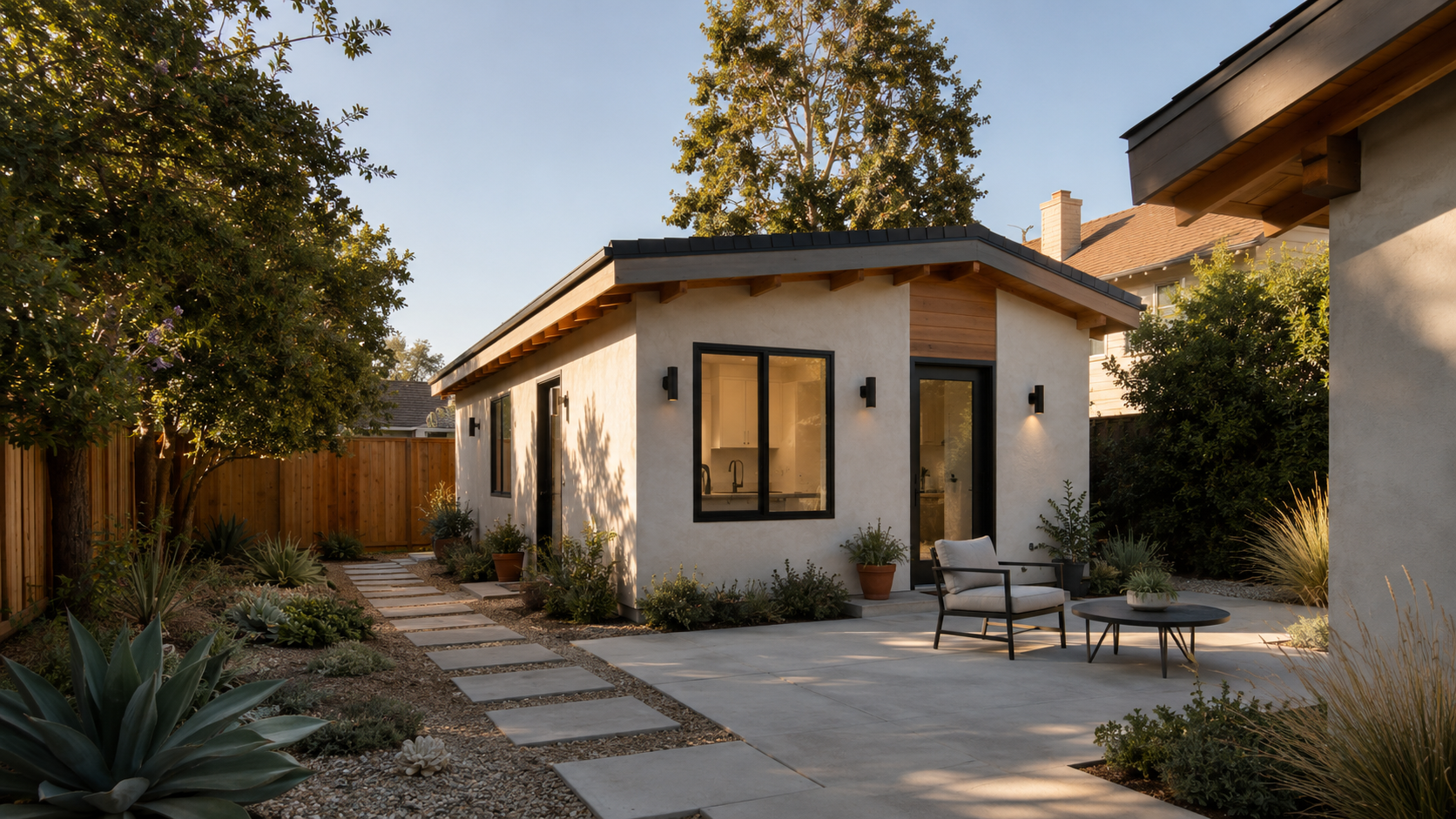
What we verified for this guide
- ✓City of Escondido Accessory Dwelling Units page (escondido.gov/238) — verified May 13, 2026
- ✓City of Escondido Pre-Approved ADU Program (PAADU) page (escondido.gov/1207) — verified May 13, 2026
- ✓Article 70 of the Escondido Zoning Code (ecode360.com/43269708) — verified May 13, 2026
- ✓City of Escondido Building Division page (escondido.gov/215) — verified May 13, 2026
- ✓City of Escondido 2025 Fee Guide (updated September 16, 2025) (escondido.gov/DocumentCenter/View/8626) — verified May 13, 2026
- ✓City of Escondido Utilities Rates and Fees Schedule (SDCWA capacity charges effective January 1, 2026) (escondido.gov/399) — verified May 13, 2026
- ✓City of Escondido ADU Submittal Checklist (PDF) (escondido.gov/DocumentCenter/View/545) — verified May 13, 2026
- ✓City of Escondido STR Eligibility page (escondido.gov/1272) — verified May 13, 2026
- ✓California Government Code §§66310–66342 — §66317, §66321, §66323, §66332, §66333 (leginfo.legislature.ca.gov) — verified May 13, 2026
- ✓California Government Code §65852.27 — 30-day pre-approved plan clock (AB 1332) (leginfo.legislature.ca.gov) — verified May 13, 2026
- ✓HCD ADU Handbook (2026 update) (hcd.ca.gov) — verified May 13, 2026
- ✓SnapADU Escondido Regulations & Zoning page — 6–8 month timeline (snapadu.com) — verified May 13, 2026
Which Escondido ADU permit lane applies to your project?
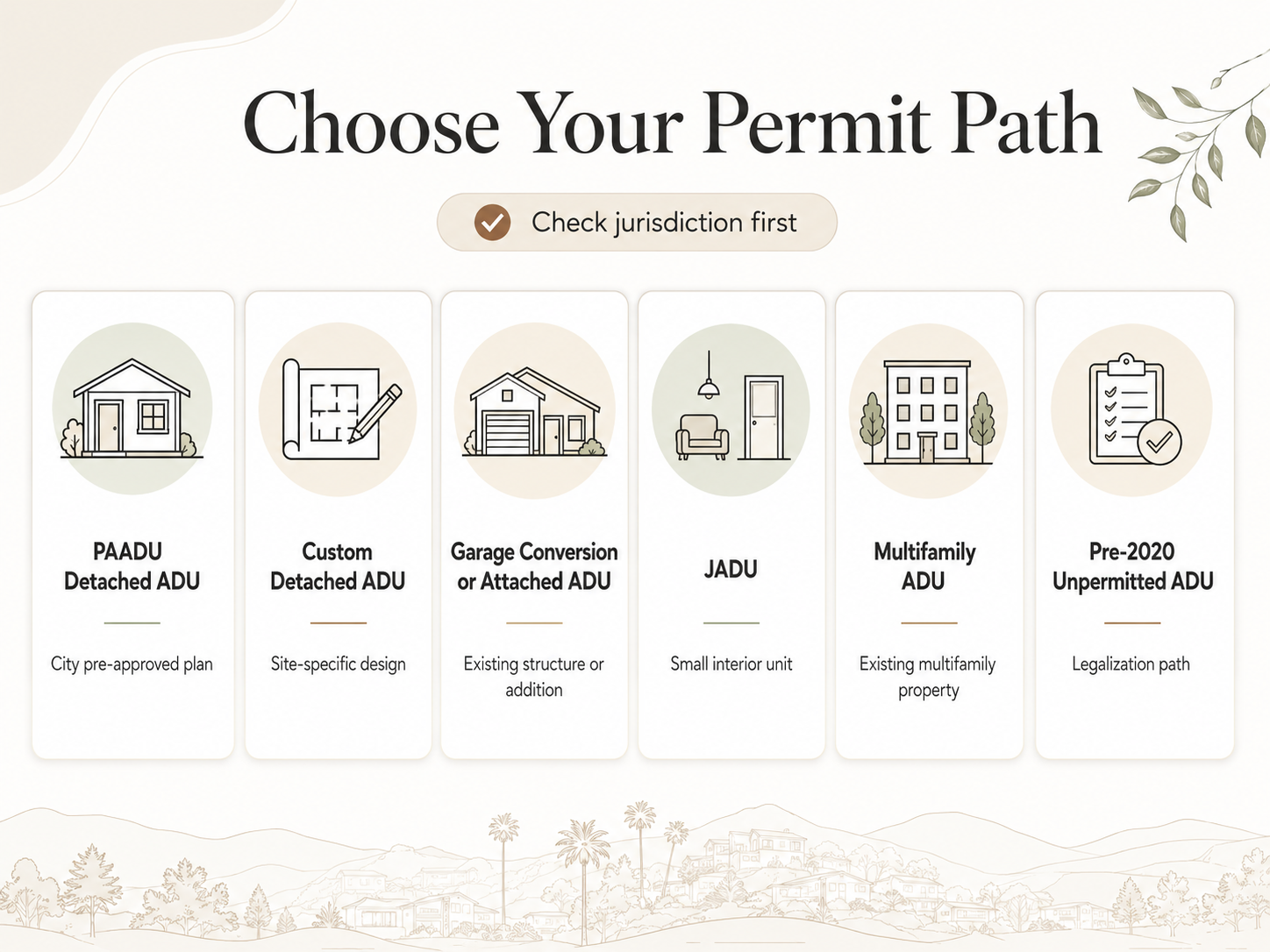
Escondido has five practical permit lanes plus a jurisdiction gate. Pick the right lane before paying for plans.
| Your project | Permit lane | Main risk | First move |
|---|---|---|---|
| Detached ADU using one of the 4 PAADU plans | PAADU lane — 30-day clock (Gov. Code §65852.27) | Lot fit; current code-cycle status of the plan | Confirm your lot can accept the footprint inside setbacks |
| New detached ADU using custom plans | Standard ADU building permit — 60-day clock (Gov. Code §66317) | Setbacks, utilities, school fees, Title 24, structural docs | Confirm zoning and overlays before commissioning design |
| Garage conversion or attached ADU | Standard ADU building permit | Fire separation, egress, existing-structure permit history | Verify the existing structure was legally permitted |
| Junior ADU (JADU, 150–500 sq ft, interior) | Standard permit + JADU rules (Gov. Code §66333) | Sanitation, kitchen, interior-access requirements | Confirm the unit is fully within the existing single-family residence |
| Multi-family ADU (apartment/duplex lot) | Multi-family ADU permit — separate path | SB 1211 unit-count rules, fire-sprinkler interaction | Confirm the property has an existing multi-family structure |
| Pre-2020 unpermitted ADU on the property | AB 2533 legalization path (Gov. Code §66332, effective 2025) | Documenting pre-2020 existence; corrective work | Pull historic photos, utility bills, prior records |
| "Escondido" address that’s actually unincorporated County | County of San Diego PDS — not City of Escondido | Filing with the wrong jurisdiction | Verify jurisdiction at the parcel level first |
Free address-level check before you pay for plans.
Do you file with the City of Escondido or with San Diego County?
ZIP code routing — verify each parcel individually
| ZIP code | Jurisdiction notes |
|---|---|
| 92025 | Contains parcels in both City of Escondido and surrounding areas — verify at parcel level |
| 92026 | Contains parcels in both City of Escondido and unincorporated San Diego County |
| 92027 | Contains parcels in both City of Escondido and unincorporated San Diego County |
| 92029 | Contains parcels in both City of Escondido and unincorporated San Diego County |
| 92046 | Used for PO boxes — jurisdiction determined by physical address |
The 60-second jurisdiction check
- Open Escondido’s Parcel Look Up Tool and enter your address or APN.
- If the parcel returns City of Escondido zoning, you’re in City jurisdiction.
- If the parcel returns “outside city limits,” “unincorporated,” or no City data, you’re in unincorporated County — file with San Diego County PDS.
- When in doubt, call City Planning at (760) 839-4671 or email planning@escondido.gov. They confirm jurisdiction in minutes.
City vs. County in one table
| Factor | City of Escondido | Unincorporated San Diego County |
|---|---|---|
| Permit authority | City Building Division | County Planning & Development Services (PDS) |
| Primary code | Article 70 + state ADU law | County Zoning Ordinance + state ADU law |
| Online portal | ProjectDox | Accela |
| In-person option | Limited (digital preferred) | Available at the County Permit Center |
| Pre-approved ADU plans | 4 PAADU plans available | County library of pre-approved plans |
| Septic review | Some outer parcels | Common (many County parcels on septic) |
The rest of this guide is City of Escondido specific.
Do you need a permit for an ADU in Escondido?
What “ministerial review” actually means
California’s ADU laws require ADU permit applications to be reviewed ministerially. In plain English: if your project meets objective development standards — setbacks, height, size, the items written into Article 70 — the City cannot deny it on aesthetic or planning-judgment grounds. When a Planning reviewer pushes back with a subjective objection, you can respectfully cite the ministerial-review standard.
ADU vs. JADU vs. conversion — the definition that matters
| Term | Maximum size | Location requirement | Sanitation |
|---|---|---|---|
| ADU (detached, attached, conversion) | 850 sq ft (1BR) or 1,000 sq ft (2+BR); cannot be set below state floors | On the same lot as the primary residence | Independent kitchen + bathroom required |
| JADU | 150–500 sq ft | Entirely within the existing or proposed single-family residence | Efficiency kitchen required; may share bathroom with main house |
| Conversion ADU | Same as detached ADU above | Within an existing legal structure being converted | Independent kitchen + bathroom required |
Source: City of Escondido ADU page; Article 70; Gov. Code §§ 66313–66342.
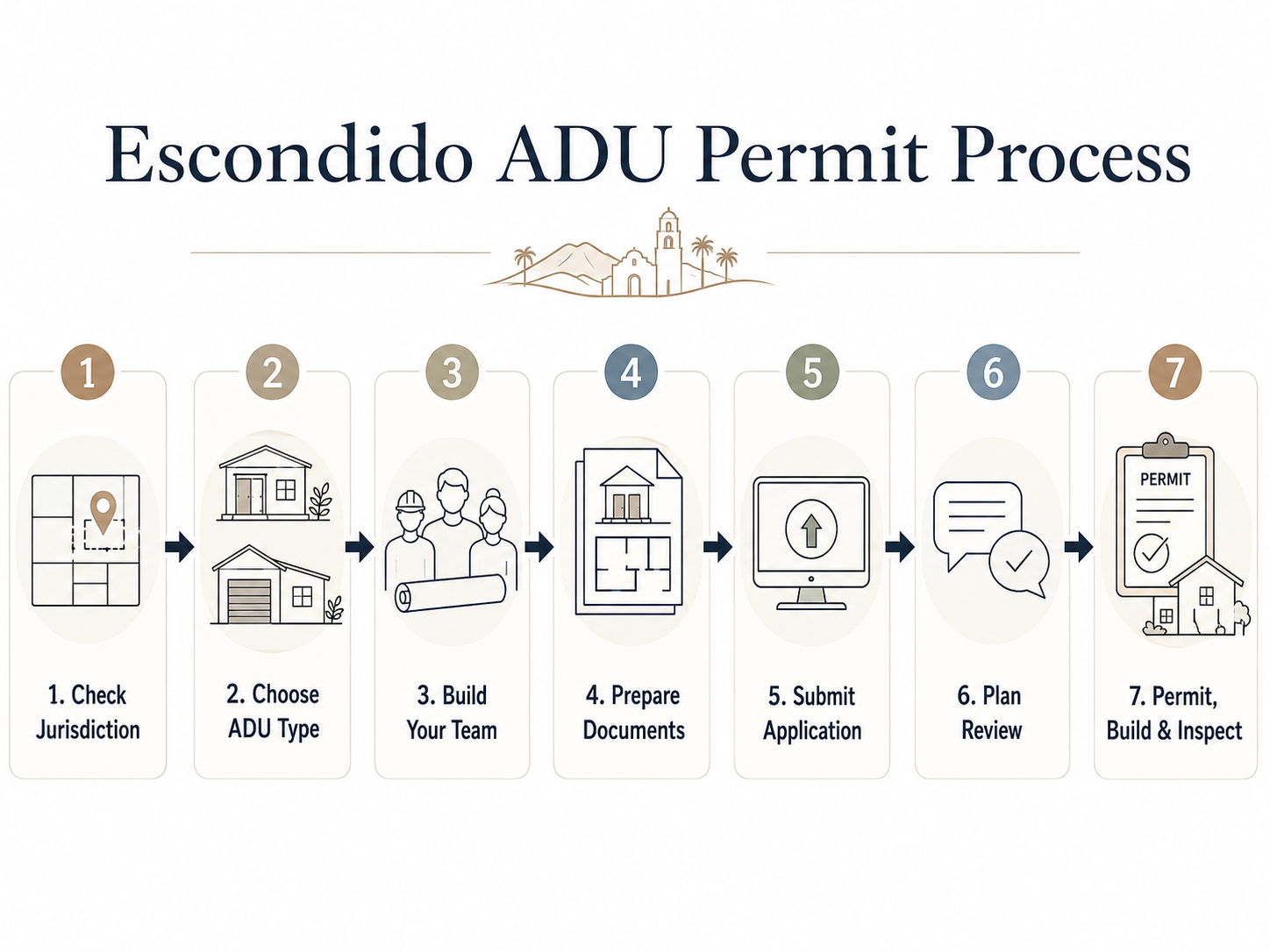
What is the Escondido ADU permit process, step by step?
Pre-application research
This is the cheapest and highest-leverage hour you’ll spend on the entire project. Gather: Assessor’s Parcel Number (APN), lot dimensions and zoning district, existing structures on the lot, fire severity zone status, FEMA flood zone status, HOA presence, Old Escondido Neighborhood (OEN) status, sewer vs. septic connection, water meter size, and SDG&E electrical service.
Read Article 70 of the Escondido Zoning Code. Contact City Planning at (760) 839-4671 or planning@escondido.gov. Planning will answer general zoning and ADU-eligibility questions before you commission design work.
Pick your permit lane
Use the lane-decoder table above. Each lane has different document requirements, different review pathways, and different fee triggers. The most common decision is PAADU vs. custom detached — covered in detail in the section below.
Build your team
A typical Escondido ADU permit team includes:
- Licensed contractor (CSLB Class B General Building) for construction
- Civil engineer or designer for the site plan and drainage plan
- Structural engineer if engineered foundations or framing are required
- City Planning Division — (760) 839-4671
- City Building Division — (760) 839-4647
- Escondido Fire Department — for high-fire severity zone properties
- SDG&E — for utility coordination (SDG&E notification form required regardless of upgrade scope)
- San Diego County Water Authority (SDCWA) — if a new or upsized water meter is required
- San Diego County DEHQ — for properties on septic
- Title insurance company — to produce the preliminary title report
- HOA — if your property is in an HOA
Prepare the submittal package
The City’s ADU Submittal Checklist is the authoritative list. See the 18-point checklist in the “Required documents” section below.
Contact the Building Division and submit through ProjectDox
Per the City’s ADU page: “The City accepts applications digitally, but in order to submit you must first contact the Building Division at buildingpermits@escondido.gov.”
- Email buildingpermits@escondido.gov with your project description, APN, and contact info.
- The Building Division responds with submittal instructions and a permit number.
- You receive ProjectDox access at escondido-ca-us.avolvecloud.com.
- Upload plans individually — not as a single combined PDF — following the City’s file-naming convention at escondido.gov/1203. [Verify current naming convention before uploading.]
- Pay plan-check fees online. The completeness clock starts.
PAADU file-naming note: For PAADU plans, the City requires plan files to be renamed with your assigned permit number. A PAADU sheet originally named B00-0000A102-Site Plan becomes B24-2022A102-SitePlan once you have your permit number. Get this wrong and the file gets rejected.
Plan-check review
Escondido’s review runs Planning Division first — Planning fully reviews zoning, setbacks, lot coverage, FAR, parking, OEN compliance, and design conformance. Only after Planning signs off do plans route to Building, Fire, Engineering, and outside agencies.
Plan review takes about 30 calendar days per review cycle after complete construction documents are received. State law (Gov. Code § 66317) gives the City 15 business days for completeness and 60 days total to approve or deny a complete standard ADU. For qualifying PAADU plans under Gov. Code § 65852.27, the clock is 30 days.
Most projects move through 2–3 correction cycles before approval. Respond to corrections in one consolidated resubmittal, not piecemeal. Address every comment from every reviewer in a single upload with a written response cover sheet explaining what changed. Piecemeal responses double the calendar.
Issuance, construction, and final approval
- Clear issuance items: final fees, school-fee certificate (if ADU >500 sq ft), utility clearances, contractor license verification.
- The Building Permit is issued — valid for one year from issuance, extended 180 days after each passed inspection.
- Construction begins under the approved plans.
- Schedule inspections online through the City Portal.
- Final inspection clears the unit for legal occupancy.
Do not occupy or rent the unit before final inspection passes. Occupying without final approval is a code violation that can complicate insurance claims, resale, and future permit applications, and can trigger code enforcement.
The 7 steps at a glance
| Step | Who’s responsible | Published source | Common delay |
|---|---|---|---|
| 1 — Pre-application research | Homeowner | Article 70; City ADU page | Discovering jurisdiction or overlay issues late |
| 2 — Pick permit lane | Homeowner / designer | This guide; City PAADU page | Defaulting to PAADU when custom would fit better |
| 3 — Build team | Homeowner | City + state law + HOA | Hiring before confirming feasibility |
| 4 — Prepare package | Designer / homeowner | ADU Submittal Checklist | Missing preliminary title report (6-month window) |
| 5 — Submit through ProjectDox | Designer / homeowner | Building Division page | File-naming convention violations |
| 6 — Plan-check review | City | Building Division (~30 days/cycle); state law | Sequential Planning-first review; multiple correction cycles |
| 7 — Issuance + construction + inspections | Homeowner / contractor | Building Division page | Missing school-fee certificate; SDG&E coordination |
Run the address check before you commission design work. Free, 60 seconds, no phone call.
How long does the Escondido ADU permit really take in 2026?
Realistic phase-by-phase timeline
| Phase | Low end | High end | What extends it |
|---|---|---|---|
| Pre-design (zoning verification, design, engineering, Title 24) | 1 month | 4 months | Custom vs. PAADU; designer scheduling; lot complications |
| Completeness review (state clock: 15 business days) | 2 weeks | 4 weeks | Incomplete title sheet; missing site-plan details; ProjectDox naming violations |
| First plan-check round — standard ADU | ~30 days | ~45 days | Sequential Planning-first review; multi-discipline routing |
| First plan-check round — PAADU | ~20 days | ~30 days | Less Planning depth (building is pre-approved); site-specific review still applies |
| Correction cycle(s) | 4–6 weeks | 12+ weeks | Multi-discipline gaps; incomplete resubmittals; design changes mid-cycle |
| Issuance | 2 weeks | 4 weeks | School-fee certificate; SDG&E coordination; contractor license items |
| Construction + inspections (new detached) | 5 months | 10 months | Supply chain; contractor scheduling; lot conditions |
Phase ranges are editorial estimates assembled from City review-cycle guidance, local design-build firm published timelines, and industry pattern observation.
Why Escondido is slower than some neighboring cities
Sequential Planning-first review
Cities that run concurrent multi-discipline review tend to be faster on second and third review cycles. SnapADU’s published Escondido process notes confirm: “Turnaround times at the city are lengthy, due to a sequential processing system in which the planning department does a full review prior to submitting the plans to the rest of the departments.”
Preliminary title report 6-month window
Escondido requires a preliminary title report dated within the last six months at submittal. If your title report expires mid-review, you’ll need to refresh it and resubmit.
OEN architectural review
Properties in the Old Escondido Neighborhood require additional architectural detailing per the OEN ADU Style Adaptation Guide. This adds a review layer not present in most other San Diego County cities.
What do you need to submit for an Escondido ADU permit?
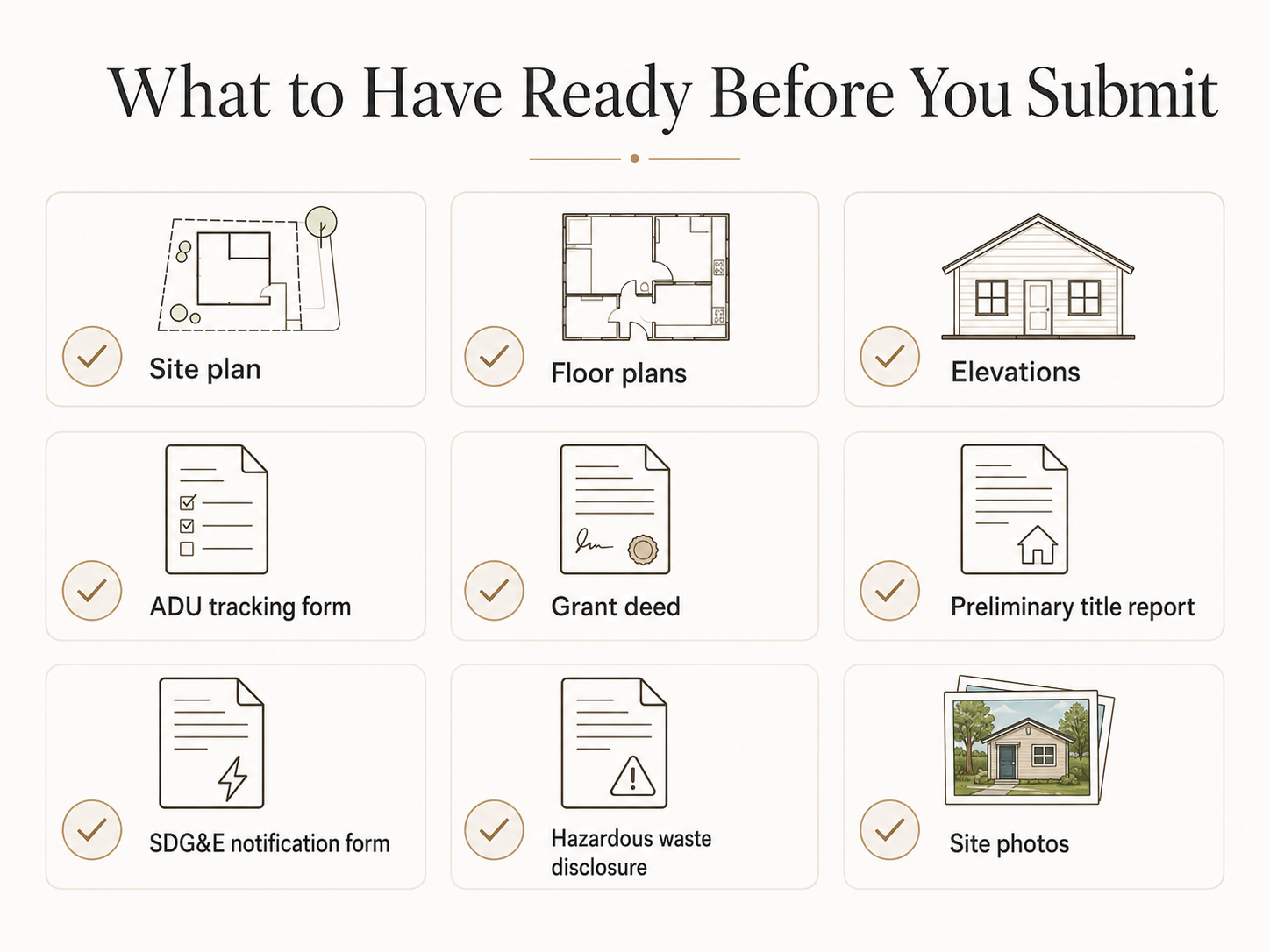
The 18-point Escondido ADU permit package checklist
| # | Document | Why it matters | Source |
|---|---|---|---|
| 1 | Building permit application form, fully completed | Required for any construction permit | City ADU page |
| 2 | Project scope written description (specific, not vague) | Ambiguous scope invites reviewer questions | Submittal Checklist |
| 3 | Owner information and signature blocks | Missing signatures stop completeness review | Submittal Checklist |
| 4 | Contractor information (or owner-builder declaration) | Required at permit issuance | Building Division |
| 5 | Title sheet with APN, legal description, lot size | Required to confirm jurisdiction and zoning | Submittal Checklist |
| 6 | Site plan with property boundaries, total site area, topography, easements | Most common correction item in Escondido | Submittal Checklist |
| 7 | Site plan showing all existing and proposed structures, including adjacent structures within 50 feet | Verifies setbacks, lot coverage, separation distances | Submittal Checklist |
| 8 | Site plan showing utility connections (water, sewer, gas, electric) and drainage flow | Affects routing, grading, and stormwater review | Submittal Checklist |
| 9 | Site plan showing parking, driveways, landscaping, open space | Verifies code compliance | Submittal Checklist |
| 10 | Floor plans and roof plans for the ADU | Core construction review | Article 70 |
| 11 | Elevations and sections showing exterior treatments | Required for exterior, structural, and OEN review | Submittal Checklist |
| 12 | Structural plans and calculations where engineering is required | Required for engineered framing | Building Division |
| 13 | Title 24 energy compliance documentation (with solar plan for new detached construction) | Required for all habitable construction | California Title 24 |
| 14 | Grant deed | Confirms ownership and legal property information | Submittal Checklist |
| 15 | Preliminary title report dated within the last six months ⚠️ | Shows legal description, easements, encumbrances | Submittal Checklist |
| 16 | ADU Housing Development Tracking Form | State of California uses this to track new housing | Submittal Checklist |
| 17 | SDG&E Notification Form | Certifies notification to SDG&E Gas and Planning | Submittal Checklist |
| 18 | Hazardous Wastes Disclosure Statement | Required for application completeness | Submittal Checklist |
Conditional documents (situational, but high-impact when missed):
- Septic capacity letter from San Diego County DEHQ — required if your property is on septic
- HOA approval letter — required if your property is in an HOA
- OEN Style Adaptation submittal — required for properties in Old Escondido Neighborhood
- Fire Department pre-clearance — required for properties in a Very High Fire Hazard Severity Zone
- Lot-boundary survey — required when property lines are unclear or easements are in question
The 5 missing details that quietly stall Escondido submittals
Scope ambiguity
“Interior remodel” gets corrections; “Convert existing detached garage to 484 sq ft conversion ADU with new bathroom and kitchen, no footprint change” doesn’t.
Setbacks not dimensioned to property lines
This is the single most common correction in Escondido Planning review. Show every setback distance from the proposed ADU wall to the property line, in feet, on the site plan.
Preliminary title report missing or expired
Escondido requires the preliminary title report dated within the last six months of submittal. Order it strategically — once the rest of the package is close to ready, not at the beginning of design.
SDG&E Notification Form missing
This form is required even when you don’t anticipate any service upgrade. It certifies that SDG&E has been notified about the new dwelling unit.
ProjectDox file-naming convention violated
Files uploaded as a single combined PDF, or named without the assigned permit number as the prefix, get rejected by the portal before any reviewer sees them.
18-point printable list with source citations to City forms.
How much does an Escondido ADU permit cost in 2026?
Fee worksheet methodology
| Element | Value | Source |
|---|---|---|
| Valuation multiplier | $226.08 / sq ft (V-Wood Frame, Additions) | 2025 Fee Guide valuation table |
| ADU fee treatment | Calculated like residential room additions | 2025 Fee Guide Article 70 instruction |
| Plan check fee | 75% of building permit fee | 2025 Fee Guide |
| State Energy plan-check surcharge | 20% of plan check fee | 2025 Fee Guide |
| State Energy inspection surcharge | 20% of building permit fee | 2025 Fee Guide |
| Planning Plan Review Fee | $160 | 2025 Fee Guide |
| Fire Plan Review + Inspection | $271 (smaller) or $310 (larger) | Fire Department fee schedule |
| Permit Processing Fee | $73 | 2025 Fee Guide |
| General Plan Maintenance fee | 5% of building permit + plan check | 2025 Fee Guide |
| Technology Fee | 5% of building permit + plan check | 2025 Fee Guide |
| MEP issuance | ~10% × 3 trades on building permit | 2025 Fee Guide |
| Article 70 development impact fee exemption | Applies to qualifying ADUs | 2025 Fee Guide |
The Article 70 fee exemption — Escondido’s homeowner-friendly feature
| Standard fee category | Standard rate | Article 70 ADU? |
|---|---|---|
| Wastewater Connection Fee | $7,500.00 | Exempt |
| Water Connection Fee (3/4” meter) | $4,690.00 | Exempt |
| Traffic Fee (Local) — Single-family | $3,047.57 | Exempt |
| Traffic Fee (Regional RTCIP) — Single-family | $4,191.77 | Exempt |
| Public Facility Fee | $4,969.99 | Exempt |
| Park Fee — Single-family | $6,986.29 | Exempt |
| Drainage Facilities Fee | $1,136.12 | Exempt |
| Approximate total exempted | ~$32,521.74 |
Source: Escondido 2025 Fee Guide. Confirm with the City that the exemption applies to your specific project before relying on this comparison.
Worked permit-fee examples — six scenarios
Editorial calculations using published Fee Guide table values. Final fees are determined by the Building Division at permit issuance. Verify with the Building Division at (760) 839-4647 before relying on these for project budgeting.
| Building valuation (484 × $226.08) | $109,422.72 |
| Building Permit Fee | $1,874.40 |
| Plan Check Fee (75%) | $1,405.80 |
| State Energy surcharges | $656.04 |
| Planning Plan Review Fee | $160.00 |
| Fire Plan Review + Inspection | $271.00 |
| MEP issuance | ~$562 |
| GP Maintenance + Technology + Processing | ~$401 |
| City fees subtotal | ~$5,330 |
| School fee (under 500 sq ft) | $0 — exempt |
| Estimated total | ~$5,330 |
| Building valuation (644 × $226.08) | $145,595.52 |
| Building Permit Fee | $2,286.24 |
| Plan Check Fee (75%) | $1,714.68 |
| State Energy surcharges | ~$800 |
| Planning Plan Review Fee | $160.00 |
| Fire Plan Review + Inspection | $310.00 |
| MEP issuance | ~$686 |
| GP + Technology + Processing | ~$473 |
| City fees subtotal | ~$6,430 |
| School fee (~644 sq ft, [verify]) | $1,400–$3,600 |
| Estimated total City + school | ~$7,800–$10,000 |
| Building valuation (851 × $226.08) | $192,394.08 |
| Building Permit Fee | $2,823.92 |
| Plan Check Fee (75%) | $2,117.94 |
| State Energy surcharges | ~$988 |
| Planning Plan Review Fee | $160.00 |
| Fire Plan Review + Inspection | $310.00 |
| MEP issuance | ~$847 |
| GP + Technology + Processing | ~$567 |
| City fees subtotal | ~$7,810 |
| School fee (~851 sq ft, [verify]) | $1,900–$4,700 |
| Estimated total City + school | ~$9,700–$12,500 |
| Building valuation (1,000 × $226.08) | $226,080.00 |
| Building Permit Fee | $3,212.88 |
| Plan Check Fee (75%) | $2,409.66 |
| State Energy surcharges | ~$1,124 |
| Planning Plan Review Fee | $160.00 |
| Fire Plan Review + Inspection | $310.00 |
| MEP issuance | ~$964 |
| GP + Technology + Processing | ~$635 |
| City fees subtotal | ~$8,815 |
| School fee (~1,000 sq ft, [verify]) | $2,200–$5,500 |
| Estimated total City + school | ~$11,000–$14,300 |
| Building valuation (800 × $226.08) | $180,864.00 |
| Building Permit Fee (interpolated) | ~$2,690 |
| Plan Check Fee (75%) | ~$2,020 |
| State Energy surcharges | ~$942 |
| Planning Plan Review Fee | $160.00 |
| Fire Plan Review + Inspection | $310.00 |
| MEP issuance | ~$807 |
| GP + Technology + Processing | ~$546 |
| City fees subtotal | ~$7,475 |
| School fee (~800 sq ft, [verify]) | $1,800–$4,400 |
| Estimated total City + school | ~$9,300–$11,900 |
| Building valuation (400 × $226.08) | $90,432.00 |
| Building Permit Fee (interpolated) | ~$1,656 |
| Plan Check Fee (75%) | ~$1,242 |
| State Energy surcharges | ~$580 |
| Planning Plan Review Fee | $160.00 |
| Fire Plan Review + Inspection | $271.00 |
| MEP issuance | ~$497 |
| GP + Technology + Processing | ~$334 |
| City fees subtotal | ~$4,740 |
| School fee (under 500 sq ft) | $0 — exempt |
| Estimated total | ~$4,740 |
School fees — Escondido school districts
| District | Coverage | Verify current per-sf rate |
|---|---|---|
| Escondido Union School District (K–8) | Most of central Escondido | (760) 432-2382 [verify] |
| Escondido Union High School District (9–12) | Most of central Escondido | (760) 291-3200 [verify] |
| Poway Unified School District | Some northern Escondido parcels | (858) 521-2800 [verify if applicable] |
| San Pasqual Union School District | Some east Escondido parcels | (760) 745-4931 [verify if applicable] |
School fees apply only to ADUs over 500 sq ft of interior livable space. The City does not collect school fees. Confirm which district covers your parcel before finalizing your budget.
- 5/8” or 3/4” meter: $6,501.00 (effective January 1, 2026)
- 1” meter: $10,402.00 (effective January 1, 2026) — required when fire sprinklers are required
Verify meter sizing requirements with the Engineering Department at (760) 839-4651 before assuming no upgrade is needed.
Get the fee schedule that applies to your specific lot before committing to design.
Should you use Escondido’s PAADU plans or custom plans?
What PAADU does for you
- Plan 1 — 484 sq ft studio (optional 1-bedroom), 22 × 22 ft footprint
- Plan 2 — 644 sq ft, 2-bedroom / 1-bath, narrow rectangular
- Plan 3 — 851 sq ft, 2-bedroom / 2-bath, square footprint
- Plan 4 — 1,000 sq ft, 2-bedroom (optional 3-bedroom) / 2-bath
- Under AB 1332 (Gov. Code § 65852.27): 30-day clock once complete
- Saves $15,000–$25,000 in architect fees
What PAADU does NOT do
- Does not provide your site plan (still required)
- Does not engineer your foundation for your specific soil
- Does not verify lot fit inside setbacks
- Does not eliminate any fees
- Does not waive Fire, Engineering, SDG&E, or SDCWA review
- Does not apply to: conversions, attached, two-story, prefab, JADUs
PAADU vs. custom — side by side
| Factor | PAADU lane | Standard custom lane |
|---|---|---|
| Plan cost | $0 (free download) | $15,000–$25,000 architect fee |
| Approve/deny clock (after complete) | 30 days (Gov. Code §65852.27) | 60 days (Gov. Code §66317) |
| Eligible project types | New detached, single-story, no footprint change | All ADU types |
| Site plan required? | Yes — site-specific drawings still required | Yes |
| Fire / septic / HOA / OEN review still applies? | Yes | Yes |
| Site-specific cost beyond plans | $3,500–$6,000 | $0 (included in architect’s scope) |
| Customization | Within City-defined Option Selections only | Full customization |
| Building footprint changes | Not allowed | Allowed |
For deeper analysis of which PAADU plan fits which lot, see our companion guide: Escondido Pre-Approved ADU Plans: 4 PAADU Options + Costs.
Affiliate disclosure: we may earn a referral fee on builder introductions made through the link below. Our editorial selection is independent. Read our full disclosure.
Our approved Greater San Diego design-build partner
SnapADU is a design-build firm that has focused on designing, permitting, and building over 100 ADUs in San Diego County including Escondido. They publish their floor-plan catalog and pricing transparently, maintain an Escondido-specific regulations page (reporting 6–8 month standard permit timelines), and handle the full permit process end-to-end. They are not the right fit for projects outside Greater San Diego, all-in budgets under $250,000, or prefab/HUD-certified units.
Are garage conversion ADUs the cheapest Escondido permit path?
What makes garage conversion cheap
- Reuses existing legally-permitted structure
- Lower valuation → lower permit + plan-check fees
- No impact-fee triggers, typically no school fees (<500 sq ft)
- No new structural foundation work
- State-law setback protection: no setback required for existing structure converted to ADU
What can derail garage conversion
- Unpermitted prior additions or modifications
- Inadequate ceiling height (California minimum: 7 ft for habitable rooms)
- Fire separation required if garage shares wall with primary residence
- Egress requirements for bedrooms
- SDG&E electrical service upgrade if existing service is undersized
- Title 24 retrofit compliance (insulation, HVAC, water heating)
How do Junior ADUs (JADUs) work in Escondido?
When a JADU fits
- You have unused interior space (converted master suite, bonus room, attached garage)
- You want a rental or family unit without adding building footprint
- You want the cheapest and fastest path to a second unit
- You have separate sanitation (avoids owner-occupancy)
When a JADU doesn’t fit
- You want a separate detached structure
- You want more than 500 sq ft of separate space
- You want a full kitchen rather than an efficiency kitchen
- You don’t want the potential owner-occupancy requirement
For most homeowners who want full rental flexibility, a conversion ADU (no owner-occupancy under AB 976) is often preferable to a JADU. Verify how Escondido applies the owner-occupancy rule with the Planning Division at (760) 839-4671.
How do multi-family ADUs work in Escondido under SB 1211?
| Multi-family ADU item | Details |
|---|---|
| Permit form | Multi-family ADU Building Permit (separate from the Standard ADU Building Permit) |
| Pre-application meeting | Strongly recommended for any multi-family ADU project — call (760) 839-4671 |
| Fire interaction | Existing building fire systems may need to be evaluated for new units |
| Parking | State law preempts most local parking requirements for multi-family ADUs |
| School fees | Still apply per unit over 500 sq ft |
| Multi-family lot qualification | Determined by actual existing structure, not zoning alone |
How do you legalize a pre-2020 unpermitted Escondido ADU under AB 2533?
Acceptable proof of pre-2020 existence
- Dated photographs (with timestamp metadata or contextual dating)
- Utility bills with service connection dates
- Prior code-enforcement records
- Rental agreements signed before January 1, 2020
- Property tax records showing the structure
- Aerial imagery from Google Earth historical views or County GIS
- Real-estate listings or appraisal documents from before January 1, 2020
- Sworn declarations from prior owners or tenants
The AB 2533 process in Escondido (standard path)
- Compile pre-2020 proof package
- Contact the Building Division at (760) 839-4647 to discuss your specific situation
- Submit a permit application with the proof package and as-built plans showing the existing unit
- Schedule a compliance inspection — an inspector evaluates the existing condition against current code
- Receive a corrective-action list — itemizing what must be brought into compliance
- Complete corrective work (typical: electrical upgrades, smoke/CO detectors, egress windows, water-heater straps, fire-rated separations)
- Final inspection — confirming corrections are complete
What Escondido ADU rules can change your permit?
Maximum ADU size in Escondido
| ADU type | Maximum size (Article 70) | State-law protection (Gov. Code §66321) |
|---|---|---|
| Detached ADU (1 bedroom or less, lot <20,000 sq ft) | 850 sq ft | Local max cannot be set below 850 sq ft |
| Detached ADU (2+ bedrooms, lot <20,000 sq ft) | 1,000 sq ft | Local max for 2+ BR cannot be set below 1,000 sq ft |
| Detached ADU (any size, lot ≥20,000 sq ft) | 1,000 sq ft | — |
| Attached ADU | 50% of primary or 1,200 sq ft (whichever less) | — |
| JADU | 500 sq ft | — |
| Multi-family detached ADU | Per state law / SB 1211 | — |
| Conversion ADU (existing structure) | Existing footprint | — |
Setback rules
- Side and rear: 4 ft minimum
- Front: per the underlying zoning district
- Building separation: 10 ft between primary residence and detached ADU; can reduce to 5 ft if both single-story
- Above-garage ADU: 5 ft side and rear setback
- Conversion ADUs: exempt from minimum setback where existing structure complies
Height limits
- 16 ft baseline regardless of zoning (state-law guarantee)
- 18 ft within ½ mile walking distance of major transit
- 25 ft for attached ADUs matching the primary residence height
- Two-story ADUs allowed with custom design; PAADU plans are single-story only
Rental rules
- 30+ days only for ADUs and JADUs
- ADUs and JADUs are ineligible for short-term rental permits per the City STR Eligibility page
- No owner-occupancy required for ADUs (AB 976, effective January 1, 2024)
- JADUs: owner-occupancy may apply if sharing sanitation (§ 66333)
Fire sprinklers & solar
- Fire sprinklers required in ADU only if primary residence has them
- If required: 1-inch water meter + $10,402 SDCWA capacity charge + 4-inch sewer lateral
- Solar PV required for newly constructed non-manufactured detached ADUs (Title 24)
- Solar can often be located on primary residence rather than ADU
Special-condition lots: high-fire zones, septic, OEN, FEMA flood zones
Very High Fire Hazard Severity Zone (VHFHSZ)
- 100-ft minimum defensible space zone around structures
- Class A roof, ember-resistant venting, fire-rated siding within 5 ft of the structure
- Brush management plan required if property has chaparral or fire-prone vegetation
- Fire Department pre-clearance — call Escondido Fire Department before commissioning design
Septic properties
- Capacity letter from San Diego County DEHQ required before Escondido plan check
- City won’t review the building permit without it
- Septic capacity review timing set by County DEHQ (typically several weeks)
- If system is inadequate, upgrade or replacement required — meaningful budget item
Old Escondido Neighborhood (OEN)
- OEN ADU Style Adaptation Guide provides architectural detailing options for 6 historic styles
- ADU permit must include: architectural detailing matching one OEN style, exterior photos of adjacent OEN-style structures, materials and color samples, site context documentation
- Adds review time to plan check but does not block construction
FEMA flood zones
- Floodplain Development Permit required in addition to Building Permit
- Elevation of lowest finished floor above the Base Flood Elevation (BFE)
- Foundation design suitable for flood loads
- Compliance with Escondido Municipal Code floodplain standards
What happens after your ADU permit is approved?
Issuance items checklist
- Remaining City fees (Building Permit, MEP fees, water/sewer plan-check line items)
- School-fee certificate or receipt from applicable school district (required for ADUs over 500 sq ft)
- Construction and Demolition (C&D) debris deposit if project meets the threshold
- Utility clearances — SDG&E interconnection; water meter sizing if a new or upsized meter is required
- Contractor information — CSLB license number, workers’ compensation insurance, City business tax certificate
Inspection sequence
| Stage | What’s inspected | When to schedule |
|---|---|---|
| Foundation / slab | Footings, reinforcing, slab prep before pour | After excavation, before concrete pour |
| Underground plumbing | Drain lines under slab | Before slab pour |
| Framing | Walls, roof framing, sheathing, structural connections | After framing complete, before insulation |
| Rough mechanical / electrical / plumbing | HVAC ducting, wiring, plumbing rough-in | After framing |
| Insulation | Wall and ceiling insulation before drywall | After rough inspections pass |
| Drywall nailing | Drywall fasteners before tape and texture | After drywall hung |
| Exterior / weatherproofing | Building wrap, roof underlayment, flashings | Before siding and roofing |
| Solar PV (new detached) | PV installation and interconnection | After roofing |
| Final | All systems functional, code-compliant | When construction is complete |
Inspection requests are submitted online through the City Portal. Inspectors can be reached at (760) 839-4647 between 8:00–8:30 a.m. and 4:00–5:00 p.m.
What changed for Escondido ADUs in 2024–2026
| Law | Effective | What it changed | Escondido implementation |
|---|---|---|---|
| AB 976 | Jan 1, 2024 | Permanently eliminated owner-occupancy requirements for ADUs (not JADUs) | Adopted via Article 70 amendment; Fee Guide language conflicts — verify with Planning |
| AB 1332 | Jan 1, 2025 | Required pre-approved ADU plans + 30-day clock for qualifying plans | PAADU program launched January 2025; 4 plans active |
| SB 1211 | Jan 1, 2025 | Up to 8 detached ADUs on existing multi-family lots; parking replacement waived | Article 70 amended late 2024 / early 2025 |
| AB 2533 | 2025 (Gov. Code §66332) | Retroactive permitting path for pre-2020 unpermitted ADUs | Confirm specific submittal path with Building Division |
| SB 543 | Jan 1, 2026 | 15-business-day completeness; specific deficiency-list requirements; no new requirements on resubmittal | Reflected in Gov. Code §66317 |
| AB 1033 | 2023 (opt-in) | Allowed cities to permit separate-sale ADU condominiums | Verify directly with Escondido Planning at (760) 839-4671 |
Common Escondido ADU permit mistakes
Confirming jurisdiction late
Paying $8,000+ for plans before learning the lot is in unincorporated County (different rules, different forms). Fix: run the parcel lookup before commissioning design.
Submitting before the package is complete
Triggers completeness rejection within the 15-business-day window. Each rejection adds calendar time. Fix: use the 18-point checklist before clicking submit.
Underestimating the sequential Planning-first review
Assuming concurrent multi-discipline review and being surprised when Planning corrections delay everything else. Fix: front-load Planning compliance with a designer who has Escondido-specific experience.
Missing the preliminary title report six-month window
Submitting with a title report dated 7+ months ago triggers a correction. Fix: order the title report once the rest of the package is close to ready, not at the beginning of design.
Violating the ProjectDox file-naming convention
Uploading a single combined PDF or files without the permit number prefix gets rejected before any reviewer sees them. Fix: verify the exact naming convention at escondido.gov/1203 before uploading.
Overlooking the school-fee certificate for ADUs over 500 sq ft
The City won’t issue the Building Permit without proof of school-fee payment. The school district is a separate agency with its own timeline. Fix: submit school-fee paperwork as soon as plans are approved.
Misreading the owner-occupancy footnote in the City Fee Guide
Some homeowners read the Fee Guide’s pre-AB-976 language and assume they must occupy the property. AB 976 eliminated that requirement statewide. Fix: confirm in writing with Planning at (760) 839-4671 before adjusting your strategy.
DIY vs. designer vs. design-build: which path fits your Escondido project?
| Your situation | Best-fit path |
|---|---|
| Simple JADU or interior conversion, no overlays, owner has construction-document experience | DIY may work; consult Building Division (760) 839-4647 |
| Garage conversion ADU, flat lot, no overlays | Designer/draftsperson alone may suffice; hire a GC for construction |
| New detached ADU using a PAADU plan, clean lot | PAADU + local GC, or PAADU through a design-build firm |
| New detached custom ADU | Architect or designer + GC, or full design-build |
| High-fire zone, septic, OEN, or 45+ year structure on lot | Experienced local ADU professional |
| Multi-family ADU project | Specialist firm with multi-family ADU experience |
| Pre-2020 unpermitted ADU legalization | Designer + permit expediter familiar with AB 2533 |
| Want one accountable team end-to-end | Design-build provider |
How to pay for the build and the permit fees
Lane 1 — HELOC or home equity loan
Best for: Homeowners who want to keep an existing low-rate primary mortgage intact.
Trade-off: Variable rates on HELOCs mean your payment can change. Both products are secured by your home.
Lane 2 — Cash-out refinance
Best for: Homeowners with substantial equity willing to accept a new rate on the entire mortgage.
Trade-off: If your current mortgage rate is well below current market rates, a cash-out refi resets you to today’s higher rate on the whole loan.
Lane 3 — Construction-to-permanent loan
Best for: The largest builds (1,000+ sq ft custom), or when equity is thin and you need to finance against future appraised value.
Trade-off: More paperwork, stricter draw schedules, and an appraisal of the post-build value before funding.
Lane 4 — Cash and reimbursement
Best for: Homeowners with the liquidity to pay out of pocket, especially those chasing grants or rebates that reimburse after the fact.
Trade-off: CalHFA $40,000 grant was the most widely-used program; latest round was fully allocated December 28, 2023. See our ADU Grants 2026 page for current status.
Plan-fit by financing path
| Project size | All-in cost band | Typical financing fit |
|---|---|---|
| Garage conversion or JADU | $50K–$120K | HELOC, home equity loan, or cash |
| PAADU Plan 1 / small detached | $190K–$310K | HELOC, cash-out refi, or cash |
| PAADU Plan 2 / mid-size detached | $255K–$406K | HELOC, cash-out refi, or construction loan |
| PAADU Plan 3 or 800 sq ft custom | $335K–$534K | Cash-out refi or construction loan |
| PAADU Plan 4 or 1,000 sq ft custom | $392K–$625K+ | Cash-out refi or construction-to-permanent |
| Multi-family ADU project (2+ units) | $700K+ | Construction-to-permanent or commercial construction loan |
These are illustrative examples of financing structures, not guarantees of returns, rates, or approval.
For deeper financing education, see our ADU Financing: Every Option Explained guide.
The 10-point pre-plan checklist — verify before you pay for design
- 1
City vs. County jurisdiction
Confirm via the Escondido Parcel Look Up Tool before any other step.
- 2
APN and zoning
Pull from your tax bill or the parcel lookup tool; confirm the applicable zone allows ADUs.
- 3
Lot size and existing structures
Measure and document all existing improvements on the lot.
- 4
Easements
Request a preliminary title report (you’ll need it for permit anyway); identify any utility, drainage, or access easements that affect ADU placement.
- 5
Fire-separation conditions
10 ft minimum building separation; can reduce to 5 ft if both single-story (verify in Article 70).
- 6
Water and sewer connection
Confirm City sewer vs. septic; if septic, plan for County DEHQ review.
- 7
Sprinkler status of the primary residence
If your primary residence has sprinklers, the ADU must have them; if not, it doesn’t.
- 8
HOA, historic, design constraints
Check your CC&Rs and confirm OEN status if applicable.
- 9
ADU type decision
PAADU, custom detached, conversion, attached, JADU, multi-family — picked based on lot fit, budget, and use case.
- 10
Budget assumptions
Fees, school-fee scenarios, construction costs, contingency, financing path.
Download the Free ADU Starter Kit
Includes the 10-point pre-plan checklist, the 18-point document checklist, the seven-step permit flow, and a question list to bring to your Planning Division pre-application call.
Get the Escondido-Specific Permit Checklist (PDF) →Frequently asked questions
Do you need a permit for an ADU in Escondido?
Yes. Every ADU type — detached, attached, conversion, JADU, multi-family, and AB 2533 legalization — requires a building permit from the City of Escondido Building Division (or San Diego County PDS if your parcel is unincorporated). There is no permit-free ADU pathway in Escondido.
How long does it take to get an ADU permit in Escondido?
The state-law clocks are 15 business days for completeness and 60 days for approval/denial of a complete standard ADU (Gov. Code §66317), or 30 days for a qualifying PAADU plan (Gov. Code §65852.27). The Escondido Building Division states plan review takes about 30 calendar days per review cycle. Industry observations cite realistic total timelines in the 3–8 month range; SnapADU’s published Escondido page reports 6–8 months for standard projects. Construction adds 5–10 months for new detached units.
How much does an Escondido ADU permit cost in 2026?
Source-calculated City permit fees run approximately $5,300–$8,800 for a typical detached ADU, with garage conversions at the lower end (~$4,740) and 1,000 sq ft custom ADUs at the upper end (~$8,815). Escondido’s Article 70 exempts qualifying ADUs from approximately $32,500 in standard development impact fees. School fees apply only on ADUs over 500 sq ft.
Does Escondido have pre-approved ADU plans?
Yes. The City offers four free Pre-Approved ADU Program (PAADU) plans: 484 sq ft studio, 644 sq ft 2-bedroom, 851 sq ft 2-bedroom/2-bath, and 1,000 sq ft 2-or-3-bedroom. Plans are detached, single-story, and new-construction only.
How many ADUs can I have on my Escondido property?
The City’s PAADU FAQ describes the single-family allowance as one ADU plus one JADU. State law under Gov. Code §66323 may allow broader combinations — verify with Escondido Planning at (760) 839-4671. On a multi-family lot: up to 8 detached ADUs capped at the number of existing primary units (SB 1211), plus conversion ADUs at 25% of existing unit count (minimum one).
What’s the maximum ADU size in Escondido?
Per Article 70: detached ADUs cap at 850 sq ft (1-bedroom-or-less) or 1,000 sq ft (2+ bedrooms) on lots under 20,000 sq ft. Attached ADUs cap at 50% of the primary residence or 1,200 sq ft, whichever is less. JADUs cap at 500 sq ft. Gov. Code §66321 prevents local size caps from being set lower than 850/1,000 sq ft, and separately protects an 800 sq ft path against lot-coverage, FAR, open-space, and front-setback restrictions.
Does Escondido require parking for ADUs?
No. Article 70 §33-1474(c)(1) explicitly states the City will not impose parking standards for ADUs or JADUs. Replacement parking is also not required when a garage is demolished or converted for an ADU.
Can I rent my Escondido ADU as a short-term rental?
No. Per state law and the City’s STR Eligibility page, ADUs and JADUs are ineligible for short-term rental permits in Escondido and may only be rented for terms longer than 30 days.
Do new detached ADUs in Escondido require solar panels?
Yes, generally. Newly constructed non-manufactured detached ADUs are subject to California Title 24, Part 6 solar requirements. In many cases, the required solar generation can be located on the primary residence rather than the ADU itself. Conversions and additions are typically exempt.
Do Escondido ADUs require fire sprinklers?
Sprinklers are required in the ADU only if the primary residence has them. If required, a minimum 1-inch water meter, water service, and backflow preventer are also required, along with a 4-inch minimum sewer lateral for single-family lots.
Can I sell my Escondido ADU separately from the main home?
We did not find a public City of Escondido AB 1033 implementation source during our review. Verify directly with Escondido Planning at (760) 839-4671 before assuming separate ADU sale is or is not available in the City of Escondido.
What if my ADU was built before 2020 without a permit?
AB 2533 (Gov. Code §66332, effective 2025) created a structured retroactive permitting path. It requires documentary proof of pre-January-1-2020 existence, a permit application, and a compliance inspection. The City cannot deny the permit solely because the unit was previously unpermitted, subject to Health and Safety Code §17920.3 substandard-building exceptions. Contact the Building Division at (760) 839-4647 before filing.
Can my HOA stop my Escondido ADU?
No. California state law (Civil Code §4751 and Gov. Code §§66310–66342) prohibits HOAs from preventing ADU construction or rental on single-family lots. HOAs may impose reasonable design-conformance restrictions but cannot block the project.
What’s the difference between City of Escondido and unincorporated County permits?
City of Escondido uses ProjectDox and follows Article 70 + state ADU law. Unincorporated County of San Diego uses Accela (with in-person option) and follows the County Zoning Ordinance + state ADU law. Fees, forms, and process steps differ. Confirm jurisdiction at the parcel level before starting.
Is there an owner-occupancy requirement for Escondido ADUs?
No for ADUs (AB 976 eliminated it permanently as of January 1, 2024). For JADUs, owner-occupancy may be required when the JADU shares sanitation with the existing structure per Gov. Code §66333; it is not required when the JADU has separate sanitation, or when the property is owned by a government agency or qualifying nonprofit.
Can I build a two-story ADU in Escondido?
Yes, subject to the height limits for your zone. PAADU plans are single-story only; two-story requires custom design. Article 70 generally allows ADUs up to 16 ft regardless of zone, 18 ft near transit, or 25 ft if attached.
Does the Old Escondido Neighborhood have extra rules?
Yes. OEN properties follow the City’s OEN ADU Style Adaptation Guide, which provides architectural detailing options for six recognized historic styles. OEN review adds time to plan check but does not block construction.
What if my property is on septic?
You’ll need a capacity letter from San Diego County DEHQ confirming that the existing septic system can support the additional unit. The DEHQ letter is required before Escondido plan check; the City won’t review the building permit without it.
Methodology
The Dwelling Index is an independent research resource covering ADU financing, costs, and regulations. We are not a builder, lender, broker, or permit expediter.
This guide was researched by reading the City of Escondido’s official ADU materials (ADU page, PAADU page, Building Division page, STR Eligibility page, Utilities Rates Schedule, Parcel Look Up Tool); Article 70 of the Escondido Zoning Code; the City’s 2025 Fee Guide (updated September 16, 2025); the ADU Submittal Checklist and supporting forms; California Government Code §§ 66310–66342; the HCD ADU Handbook (2026 update); and the underlying state laws AB 976, AB 1332, AB 2533, AB 1033, SB 1211, and SB 543.
We cross-verified fee figures against the Fee Guide’s published valuation table (V-Wood Frame Additions at $226.08 per sq ft), the 75% plan-check rule, fire review tiers, and Article 70’s instruction that ADUs are calculated like residential room additions. Where the City’s Fee Guide and the PAADU FAQ contained conflicting language on owner-occupancy, we surfaced the conflicts explicitly and recommended direct verification.
This guide is not legal advice, not tax advice, not financing advice, and not a substitute for City review of your specific project. Read our complete editorial standards, methodology, and corrections policy.
Related guides
- Escondido ADU Laws 2026: Rules, Fees, Permits & What You Can Build
- Escondido Pre-Approved ADU Plans: 4 PAADU Options + Costs
- Best ADU Builders Escondido: Fits, Costs & Rules
- Poway ADU Permit Process 2026
- Vista ADU Permit Process 2026
- California ADU Laws 2025: What to Know
- ADU Financing Options: Every Option Explained
Your next step in Escondido
1. You want clarity on YOUR specific property before paying anyone
Run the free address eligibility check. It returns your jurisdiction, zone, applicable setbacks, fire/flood overlay status, OEN status, septic-vs-sewer status, maximum ADU count, and the fee schedule that applies — all from your address.
See What You Can Build → Get Your Free Escondido ADU ReportAffiliate disclosure: we may earn a referral fee. Our editorial selection is independent.
2. You’re ready to talk to a builder who handles the full permit process in-house
SnapADU is our approved-affiliate design-build partner for Greater San Diego, including Escondido. Not the right fit if you’re outside Greater San Diego, your all-in budget is under $250,000, or you want a prefab/HUD-certified unit.
3. You want to keep researching before talking to anyone
Pick up the free permit-package checklist and our companion guides.
Download the Free Escondido ADU Permit Checklist (PDF) →