
Regulations & Permits · Escondido, California
Escondido ADU Laws 2026: Rules, Fees, Permits & What You Can Build
By The Dwelling Index Editorial Team · Last updated: May 13, 2026 · Last verified against primary sources: May 13, 2026
Bottom line — Escondido ADU laws, 2026
Inside the City of Escondido, you can generally build one detached or attached accessory dwelling unit (ADU) up to 1,000 square feet plus one Junior ADU (JADU) up to 500 square feet on a qualifying single-family property. Side and rear setbacks are 4 feet for new construction. No off-street parking is required. The Planning Division land-use fee is $4,170 (effective Sept. 15, 2024). State law (Gov. Code § 66317) requires a decision within 60 days of a complete application; local builders report a realistic total permit timeline of 6–8 months due to the City’s sequential review.
Critical threshold: many “Escondido” properties are actually in unincorporated San Diego County — with different fees, different rules, and a different AB 1033 separate-sale status. Confirm jurisdiction by APN before you spend a dollar on plans.
See What You Can Build on Your Escondido Lot
Answer 7 quick questions about your property. Get a parcel-aware feasibility summary in about 60 seconds. Built to inform, not to sell you.
Get Your Free ADU Report →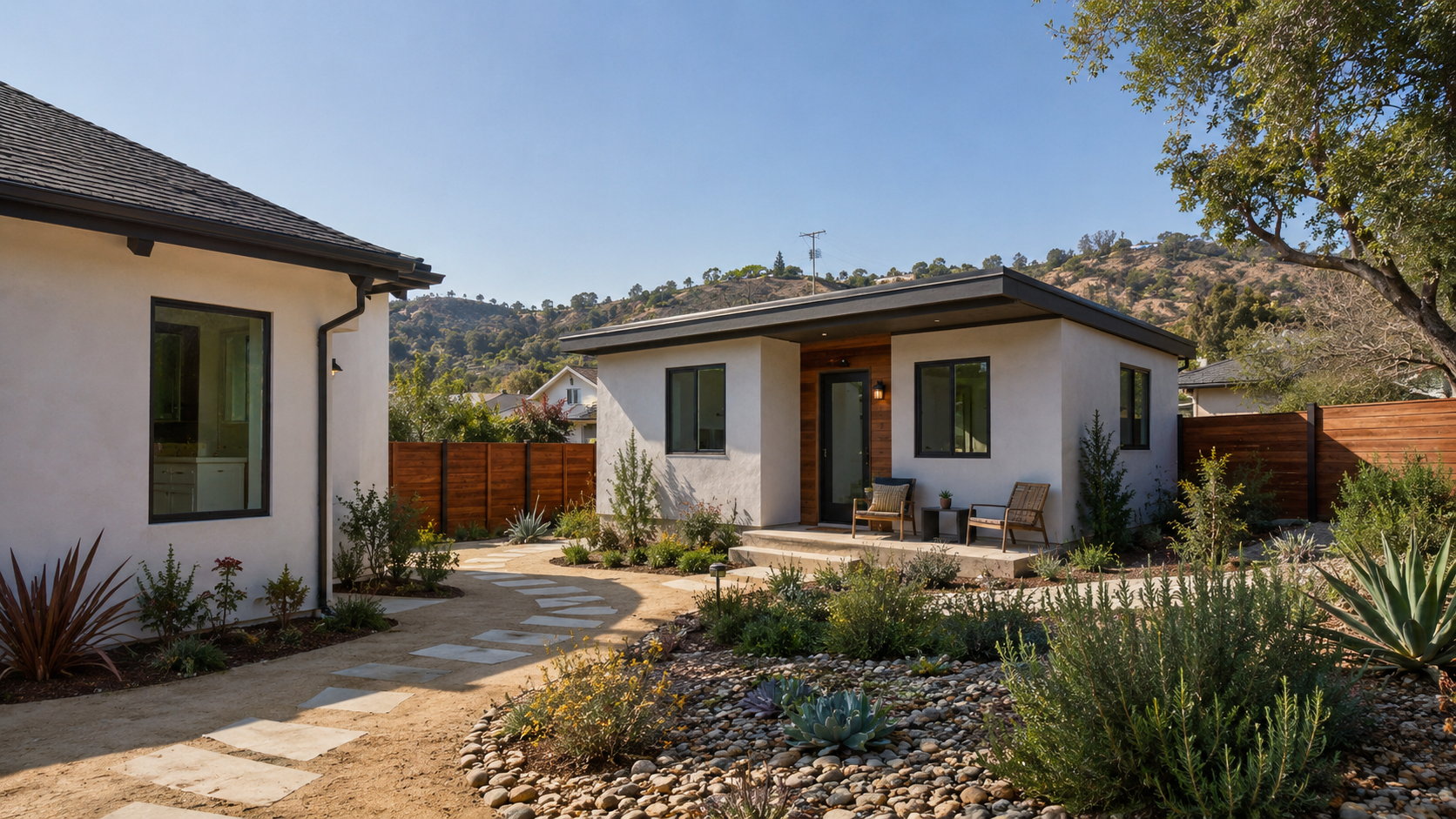
Quick rules — Escondido ADU at a glance
| Question | Bottom-line answer | Source |
|---|---|---|
| Are ADUs allowed in Escondido? | Yes, on qualifying single-family and most multifamily properties inside City jurisdiction. | City ADU page; Escondido Zoning Code Article 70 |
| Maximum standard ADU size? | 1,000 sq ft per the City’s public ADU page. State law protects minimum allowed sizes of 850 sq ft (studio/1-BR) and 1,000 sq ft (2+ BR). | City ADU page; Cal. Gov. Code §66321 |
| Maximum JADU size? | 500 sq ft, inside the primary residence, with an efficiency kitchen. | City ADU page; Cal. Gov. Code §66333 |
| Minimum side and rear setback? | 4 feet for new construction detached and attached ADUs. | Escondido Zoning Code Article 70; PAADU FAQ |
| Maximum height? | 16 ft detached; 18 ft if within ½ mile of a major transit stop; up to 25 ft for attached ADU (or local zoning limit, whichever is lower). | Cal. Gov. Code §66321 |
| ADU parking required? | No. Escondido’s ADU ordinance eliminates ADU parking (§33-1474(c)(1)). Replacement parking is also not required when a garage is converted. | Escondido ADU FAQ |
| Short-term rentals / Airbnb? | Not allowed. ADUs and JADUs are ineligible for short-term rentals. Long-term rentals (30+ days) are permitted. | City Short-Term Rental FAQ; PAADU FAQ |
| Owner-occupancy required? | Not for standard ADUs (AB 976, Gov. Code §66315). JADUs may require it if they share sanitation with the main home (§66333; AB 1154 effective Jan. 1, 2026). | Cal. Gov. Code §66315, §66333 |
| Separate sale of ADU (AB 1033)? | Not adopted by City of Escondido (May 2026). Adopted by unincorporated San Diego County under Ordinance No. 10986 (effective April 4, 2026). | County of San Diego PDS; Cal. Gov. Code §66342 |
| Planning Division ADU/JADU fee? | $4,170 (effective Sept. 15, 2024). Building permit, plan check, fire, school, and utility fees apply separately. | Escondido Planning Division Fee Schedule (Sept. 15, 2024) |
| Digital permit submission? | Yes. The City accepts digital ADU applications via ProjectDox after the applicant contacts the Building Division. | City of Escondido ADU page |
| Realistic total permit timeline? | State law requires a decision within 60 days of a complete application. Local builders report a standard Escondido permit timeline of 6–8 months due to the City’s sequential review. | Cal. Gov. Code §66317; SnapADU April 2026 |
| Available pre-approved (PAADU) plans? | Four free detached plans: 484, 644, 851, and 1,000 sq ft. | City PAADU page |
What we verified (and how)
We verified every claim in this guide on May 13, 2026 against primary sources:
- City of Escondido ADU page (escondido.gov/238) and PAADU Program page (escondido.gov/1207).
- City of Escondido PAADU FAQ, ADU Handout / Submittal Checklist, and Short-Term Rental FAQ (PDFs).
- Escondido Zoning Code Article 70 (sections §§ 33-1471 through 33-1478) via eCode360.
- Ordinance No. 2025-01 (the 2024 Omnibus Zoning Code Update, adopted by Escondido City Council, signed May 7, 2025), which expressly removed the proposed Article 70 amendments from the omnibus package after a Feb. 18, 2025 letter from the California Housing Defense Fund.
- Escondido Planning Division Fee Schedule, effective Sept. 15, 2024.
- 2025 City of Escondido Development Fee Guide (updated September 2025).
- California Government Code §§ 66310–66342— specifically §§ 66311.5, 66311.7, 66315, 66317, 66321, 66322, 66323, 66333, and 66342.
- California HCD Accessory Dwelling Unit Handbook, March 2026.
- San Diego County Board of Supervisors AB 1033 ordinance action (Ordinance No. 10986, March 4, 2026, effective April 4, 2026).
Spot-check before relying on these for a transaction:
Current codified Article 70 text via City Clerk or eCode360; current school impact fee rates by district; current City permit backlog; PAADU plan-cycle status; live AB 1033 status for the City of Escondido. For any specific project, confirm with Escondido Planning before paying for plans.
Why we wrote this guide
Most “Escondido ADU laws” pages we read reprint the same handful of bullet points, contradict each other on details that matter (in-person vs. digital submission, 1,200 vs. 1,000 sq ft, the unit count on a single-family lot), or skip the parts that actually trip homeowners up. We assembled this from primary sources. Where sources disagree, we tell you which we treated as authoritative. Where a number changes too often to publish honestly, we flag it [NEEDS VERIFICATION] instead of guessing.
This guide is educational. It is not legal, tax, lending, construction, or design advice. Before you sign a contract or pay for plans, verify with the Escondido Planning Division (planning@escondido.gov · 760-839-4671) or your own licensed professional.
Are you actually in the City of Escondido? (Read this first.)
Why this matters more than any size or setback question
We lead with this because it is the single most expensive mistake we see Escondido-area homeowners make. A property with an Escondido ZIP code is not automatically inside the City. Mailing addresses follow USPS routes; jurisdiction follows city boundaries. The difference changes your fees, your review office, your permit pathway, and — as of April 4, 2026 — whether you can ever sell the ADU separately under AB 1033.
Inside the City of Escondido
- Article 70 of the Escondido Zoning Code applies
- City Planning and Building Divisions review your project
- City fee schedule controls ($4,170 Planning fee)
- PAADU pre-approved plans are available
- AB 1033 separate sale: not adopted (May 2026)
Unincorporated San Diego County
- County ADU ordinance controls
- County Planning & Development Services reviews
- County fees apply
- PAADU is not available
- AB 1033 separate sale: adopted under Ordinance No. 10986 (effective April 4, 2026)
How to confirm jurisdiction in 60 seconds
- Find your APN. It’s on your property tax bill, your deed, or the City’s Parcel Look-Up tool.
- Run your APN through the City of Escondido GIS map. If the parcel is shaded as inside city limits, you’re under City rules.
- If it isn’t, run it through the County’s SanGIS. Unincorporated parcels are under County rules.
- When in doubt, call. Escondido Planning Division: 760-839-4671 · planning@escondido.gov. County PDS: (858) 565-5920.
Check Your Parcel and See What’s Possible
The Feasibility Engine asks for your APN or address, your goals, and your lot conditions, then maps your most likely City-of-Escondido or County path with the documents you’ll need next.
Get Your Free ADU Report →The Escondido ADU Source Conflict Matrix
Escondido’s ADU rules are spread across multiple City documents that do not all say the same thing. We assembled the conflicts in one place so you can verify the right answer before paying for plans.
| Topic | Source A says… | Source B says… | What we recommend |
|---|---|---|---|
| Unit count on a single-family lot | City main ADU FAQ: a single-family property "may allow for up to two accessory dwelling units (one ADU, and one JADU)." | City PAADU FAQ references up to three accessory units on a single-family residence property, consistent with Cal. Gov. Code §66323 combinations. | Plan to the conservative read (one ADU + one JADU) unless you have written Planning confirmation for a §66323 combination on your specific parcel. |
| Article 70 amendment status | January 2025 Planning Commission packet proposed Article 70 amendments to align with SB 1211, AB 976, and related state changes. | Ordinance No. 2025-01 (the 2024 Omnibus update) expressly removed the proposed Article 70 amendments after a Feb. 18, 2025 CalHDF letter. Staff said they would return with ADU changes in a future item. | Treat the currently codified Article 70 in eCode360 — together with state-law floors under Gov. Code §§66310–66342 — as controlling. The January 2025 proposal is not adopted law. |
| Owner-occupancy for standard ADUs | City 2025 Development Fee Guide contains older language suggesting an owner-occupancy condition. | Cal. Gov. Code §66315 (codifying AB 976) permanently removes the owner-occupancy requirement for standard ADUs. City PAADU FAQ also supports no owner-occupancy. | State law controls. Use the fee guide for fees, not for owner-occupancy. |
| In-person vs. digital permit submission | Some secondary sources still claim Escondido requires in-person plan submission. | City of Escondido ADU page says the City accepts digital applications via ProjectDox after the applicant contacts the Building Division. | Submit digitally after the required Building Division clearance step. |
| AB 1033 separate sale | City of Escondido: not adopted as of May 2026; PAADU FAQ says ADUs cannot be sold separately. | Unincorporated San Diego County: adopted under Ordinance No. 10986 (March 4, 2026, effective April 4, 2026). | Path depends entirely on jurisdiction. |
| Multifamily lot allowance | Older local handout language. | SB 1211 (effective Jan. 1, 2025) and Cal. Gov. Code §66323 allow up to 8 detached ADUs on existing multifamily lots, capped by existing unit count, plus interior conversions of non-livable space. | State law preempts conflicting older local text. |
What are the Escondido ADU laws in 2026?
The three layers that apply to every Escondido ADU project
Layer 1 — California state law
Government Code §§ 66310–66342 sets the floor. Key sections: § 66311.5 (impact fees), § 66311.7 (legalization of pre-2020 ADUs), § 66315 (owner-occupancy), § 66317 (review timelines and ministerial approval), § 66321 (size and height), § 66322 (objective standards), § 66323 (unit-count combinations), § 66333 (JADUs), and § 66342 (separate sale under AB 1033). State law controls when it conflicts with local code.
Layer 2 — City of Escondido Article 70
Escondido’s Zoning Code Article 70 (sections §§ 33-1471 through 33-1478) implements state law locally and adds Escondido-specific rules where state law allows. The currently codified text in eCode360 is what controls — the January 2025 proposed amendments were not adopted. Article 70 itself includes a severability clause stating that any provision found not in compliance with state law “should be severed and stricken from Article 70 as if it had never been adopted.”
Layer 3 — Your specific property
Setbacks, fire separation, utility capacity, drainage, slope, historic-district design controls (especially the Old Escondido Neighborhood), septic vs. sewer, and any HOA covenants. State law limits how restrictive HOA rules can be, but it does not eliminate them.
How many ADUs can you build on an Escondido property?
Single-family properties
Conservative read (City main ADU FAQ): one ADU plus one JADU.
State-law / PAADU FAQ read (Cal. Gov. Code § 66323): one new construction ADU, plus one ADU created via conversion of existing space, plus one JADU — subject to physical, zoning, and safety constraints.
What we recommend: Plan to the conservative read unless you have written confirmation from Escondido Planning that the § 66323 combination applies to your specific parcel.
Multifamily properties — the SB 1211 expansion
For lots with an existing multifamily structure (duplex, triplex, apartment building, etc.), Senate Bill 1211 (effective Jan. 1, 2025) substantially expanded what is allowed:
- Interior conversions of existing non-livable space (storage rooms, boiler rooms, passageways, attics, basements, garages) → minimum of 1 ADU, up to 25% of existing units, whichever is greater.
- Detached ADUs → up to 8 per lot, capped by the number of existing primary units on the property.
- No replacement parking required when uncovered parking areas are converted to ADUs.
Unit-count decision matrix
| Your property | Conservative max (City main FAQ) | §66323 / PAADU FAQ max | What to verify with Planning |
|---|---|---|---|
| Single-family, one detached ADU only | 1 ADU | 1 ADU | Setbacks, fire separation, utilities |
| Single-family, ADU + JADU | 1 ADU + 1 JADU | 1 ADU + 1 JADU | Owner-occupancy if JADU shares sanitation |
| Single-family, detached + conversion + JADU | Not addressed | Up to 3 accessory units (§66323 + PAADU FAQ) | Get written confirmation before plans |
| Existing duplex (2 units) | Per state law | 2 detached ADUs + interior conversions (≥1, up to 25%) | Lot fit, fire access |
| Existing 4-plex | Per state law | 4 detached ADUs + interior conversions (≥1, up to 25%) | Site circulation, layout |
| Existing 10+ unit multifamily | Per state law | Up to 8 detached ADUs + interior conversions | Cap = existing unit count |
| Proposed multifamily | Per state law | 2 detached ADUs (not within structure) | Concurrent permitting |
| "Escondido" address in unincorporated County | County rules apply | County rules apply | Confirm jurisdiction first |
What size ADU or JADU can you build in Escondido?
Standard detached and attached ADU size limits
The City’s public ADU page is unambiguous: “ADUs can be up to 1,000 square feet.” Some practical implications:
- A 999 sq ft, two-bedroom detached ADU is within both City and state guardrails.
- An 1,100 sq ft detached ADU is above the City’s published cap. Until you see written confirmation tied to your specific application, plan to 1,000 sq ft.
- Attached ADU size: State law provides that an attached ADU’s total floor area is capped at 50% of the existing primary dwelling — while § 66321 still protects 850 sq ft (studio/1BR) or 1,000 sq ft (2+BR) as the floor a city cannot go below.
- Conversion ADUs benefit from strong state-law protections, including no required setback for an existing living area or accessory structure converted to an ADU, and allowance for up to 150 sq ft of footprint expansion solely for ingress/egress.
JADU size limit
A Junior ADU (JADU) is a small unit created inside the existing footprint of a single-family residence. Under § 66333 and the City’s ADU handout, JADUs are limited to 500 sq ft maximum, must be created within the existing footprint, must have an efficiency kitchen, and may share sanitation facilities with the main home or have separate sanitation.
PAADU pre-approved plan sizes
| PAADU plan | Size | Typical bedrooms | Best for |
|---|---|---|---|
| Plan 1 | 484 sq ft | Studio or 1 bedroom | Small lots, lowest construction cost |
| Plan 2 | 644 sq ft | 2 bedroom / 1 bath | Compact family or rental unit |
| Plan 3 | 851 sq ft | 2 bedroom / 2 bath | Mid-size rental or multi-generational unit |
| Plan 4 | 1,000 sq ft | 2 or 3 bedroom / 2 bath | Maximum legal size under City cap |
PAADU plans are detached, single-story designs. They are not approved for prefab/modular construction, attached additions, conversions, two-story builds, or over-garage ADUs. For the deepest dive into the four plans, see our companion article: Escondido Pre-Approved ADU Plans: 4 PAADU + Costs (2026).
What are Escondido’s setback, height, parking, and design rules?
Setbacks — what is required, what is exempt
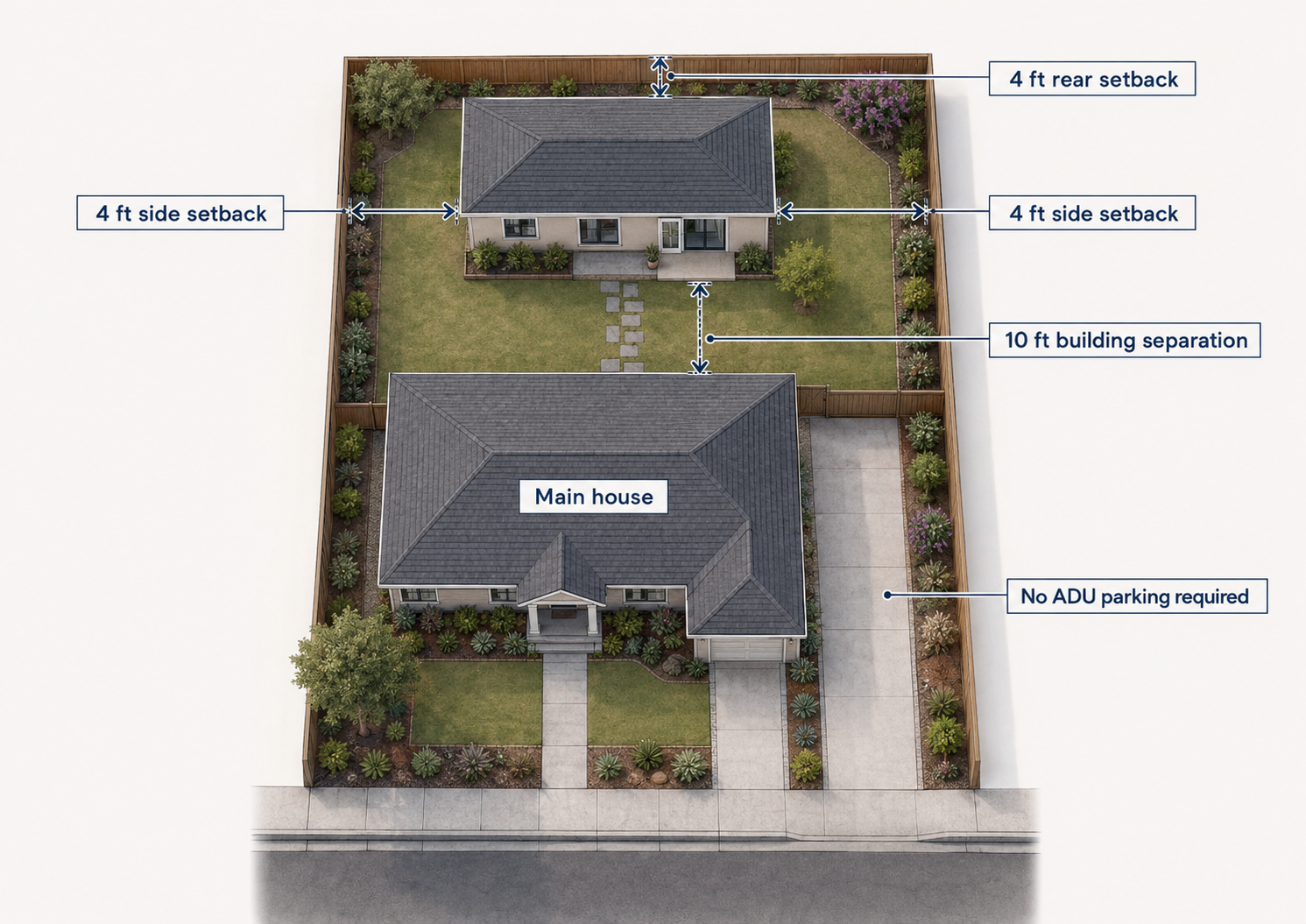
- New construction detached and attached ADUs: Side and rear setbacks minimum 4 feet. Front setback per the underlying zoning district.
- Detached ADUs above a garage: Side and rear setbacks 5 feet.
- Conversions of legally established structures: State law protects these — no setback is required for an existing living area or accessory structure converted to an ADU, even if the existing structure does not currently meet zoning setbacks.
- Building separation: Escondido’s PAADU FAQ calls for a 10-foot separation between the main home and a detached ADU unless additional fire-safety features are reviewed and approved.
Height — and why ½ mile of qualifying transit matters
- Detached ADU: 16 ft maximum height on a single-family lot.
- Detached ADU within ½ mile walking distance of a major transit stop or high-quality transit corridor: up to 18 ft. Uses walking distance, not radial distance — confirm transit qualification with Planning.
- Attached ADU: 25 ft or the local zoning height limit applicable to the primary dwelling, whichever is lower.
- Conversions of existing space: not subject to ADU-specific height limits (the existing structure’s height controls).
Parking — Escondido eliminated it
Per the City’s published FAQ: the City will not impose parking standards for ADUs or JADUs. The relevant ordinance text is at § 33-1474(c)(1). Two corollaries homeowners often miss:
- No replacement parking is required when an existing garage, carport, or covered parking structure is demolished or converted as part of an ADU project (consistent with SB 1211, effective Jan. 1, 2025).
- HOA parking restrictions cannot effectively prohibit a state-law-compliant ADU.
Fire sprinklers and utility upgrades
Fire sprinklers are required in the ADU only if sprinklers are required for the primary residence. When sprinklers are required, the City notes additional minimum utility requirements: a 1-inch water meter and service with backflow prevention, and a 4-inch sewer lateral minimum for single-family dwellings. These are real budget items — get a utility evaluation early.
Design compatibility and the Old Escondido Neighborhood (OEN)
The City’s ADU handout requires compatible materials, siding, roofing, and windows. Exposed concrete or masonry block walls are not allowed for ADU exteriors. If your property is inside the Old Escondido Neighborhood historic district, the PAADU FAQ adds an additional layer: ADU design must include architectural features that match the primary structure’s style. The City publishes an Old Escondido Neighborhood PAADU Adaptation Guide showing approved feature options for the four PAADU plans. If you live in OEN, your design budget will be a little higher than the standard PAADU path.
Which Escondido ADU path fits your property?
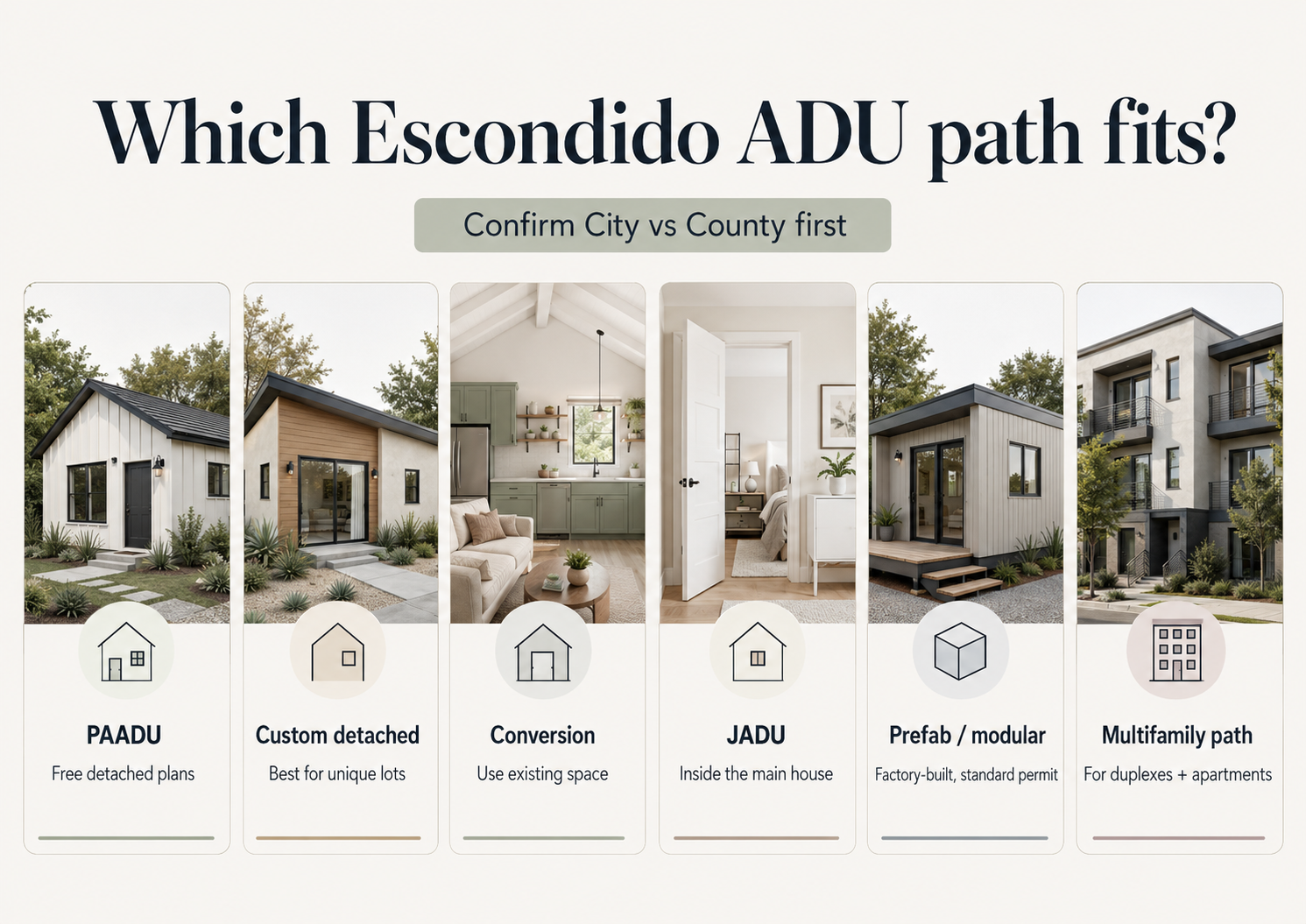
PAADU pre-approved plans
Free plan set, four sizes (484, 644, 851, 1,000 sq ft), single-story, detached, slab-on-grade. You save thousands in architecture and engineering fees and shorten the design phase. Trade-offs: no design freedom, no two-story options, no prefab, no over-garage or attached configurations.
Custom detached ADU
A licensed architect or designer creates plans for your specific lot. You pay full design fees but gain layout, height, and material freedom up to City code limits. Worth it when PAADU plans do not fit your lot, you need two stories, or you have specific aesthetic requirements.
Conversion of existing space
A garage, basement, attic, or accessory structure converted into a permitted ADU. Typically the lowest construction-cost path because the shell already exists, and conversions benefit from state-law setback protections. Trade-offs: structural reinforcement, full MEP buildout, fire separation upgrades.
JADU within the primary residence
A small (≤500 sq ft) unit carved out of the existing home with an efficiency kitchen. The cheapest path because footprint and most systems are already present. Trade-off: owner-occupancy may apply if JADU shares sanitation with the main home.
Prefab or modular ADU under standard permit
Factory-built, delivered, set on a permanent foundation. PAADU does not apply to prefab — the pre-approved plans are stick-built only. You still need a standard permit, foundation engineering, site work, utility connections, and City review.
Multifamily path
Applies only to lots with an existing multifamily structure. SB 1211 expanded what is possible — up to 8 detached ADUs plus interior conversions of non-livable space — but the layout, fire access, utility separation, and unit-numbering logistics are more complex.
Which path fits? — quick-reference table
| Your situation | Best starting path | Why |
|---|---|---|
| Lowest design risk and cost on a single-family lot | PAADU | Free plans, pre-reviewed, four standard sizes |
| Lot does not fit any PAADU plan, or you want a 2-story unit | Custom detached | Layout/height flexibility |
| You have a detached garage or large basement | Conversion | Lower construction cost, state-law setback protection |
| You need a small family suite inside the home | JADU | Lowest total cost; verify owner-occupancy implications |
| You want a factory-built unit | Prefab / modular under standard permit | Faster on-site construction; PAADU does not apply |
| You own a duplex or apartment building | Multifamily ADU path | SB 1211 expanded allowances substantially |
| Address is "Escondido" but parcel is in the County | County-jurisdiction path | PAADU is not available; AB 1033 may apply |
Affiliate disclosure: we may earn a referral fee on builder introductions made through the link below. Our editorial selection is independent.
Talk to a Builder Who Has Permitted ADUs Across Greater San Diego
See our independent Best ADU Builders Escondido page for the full builder comparison — service-area fit, customization options, and what each builder includes versus excludes from their published pricing. If your parcel is outside their service area, this CTA is not for you — skip it.
Compare Escondido ADU Builder Paths →How do you get an ADU permit in Escondido?
Confirm jurisdiction, APN, lot size, zoning, and Article 70 fit
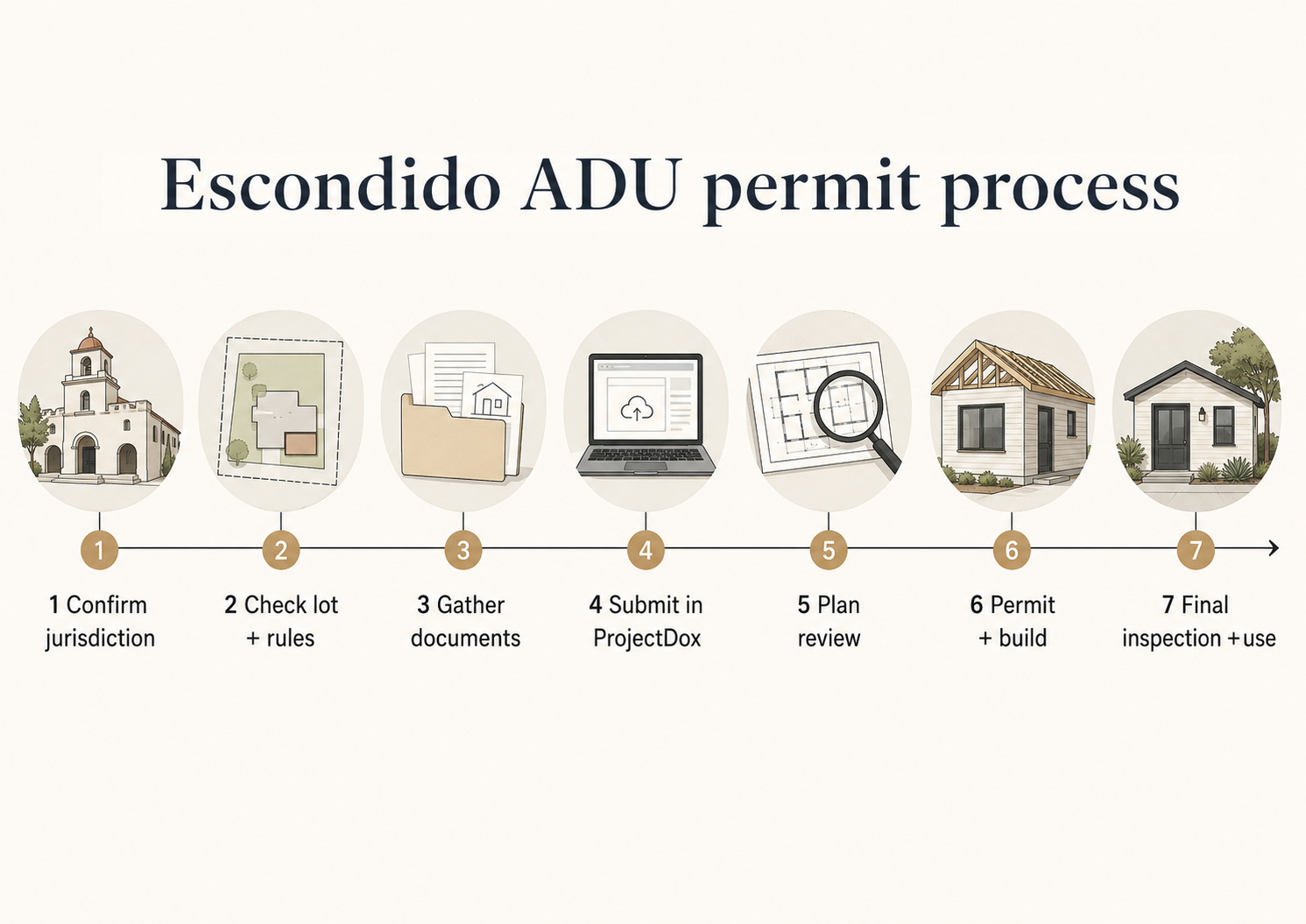
Before you spend a dollar on plans, confirm your parcel is inside the City of Escondido (not the County), pull your Assessor’s Parcel Number, check your zoning district (R-1, R-E, R-A, R-M, etc.), and review the relevant Article 70 standards. Escondido’s Parcel Look-Up tool and the Planning Division’s pre-application contact (planning@escondido.gov · 760-839-4671) are the official starting points.
Gather the documents the City actually asks for
The City’s ADU Submittal Checklist (PDF) is the controlling document. Plan to assemble: ADU Handout and Submittal Checklist completed; ADU Housing Development Tracking Form; grant deed; preliminary title report (within last 6 months); site plan; architectural plans (floor plan, elevations, roof plan, sections); structural details; Title 24 energy compliance documents; site photos and proposed materials/colors; SDG&E Notification Form; Hazardous Wastes Disclosure Statement; water and sewer details; fire sprinkler information if applicable; landscape plan if your project triggers landscape thresholds.
Contact the Building Division before submitting
Applicants must first contact the Building Division at buildingpermits@escondido.gov before submitting digitally. The Building Division then provides instructions for online application submission and payment via ProjectDox. If you have read elsewhere that Escondido requires in-person submission, that is out of date — as of 2026, the City accepts digital ADU applications via ProjectDox after the Building Division clearance step.
Plan check and the sequential review reality
State law (§66317) requires a completeness determination within 15 business days and an approve-or-deny decision within 60 days of a complete application. Escondido’s review is sequential: the Planning Division typically completes its review before routing plans to the rest of the departments (Building, Fire, Engineering). Plan for two correction cycles even on a solid submittal. During review, watch ProjectDox and your email — the City posts comments there.
Permit issuance and construction
When all departments approve, the City issues the building permit. You pay the remaining fees, and construction can begin. Permits are valid for 180 days from issuance, with extensions available; continuous inspection progress keeps the permit active.
Inspections
Standard ADU inspection sequence: foundation, framing, rough mechanical/electrical/plumbing, insulation, drywall, final. Each inspection must pass before the next phase.
Certificate of Occupancy
Once final inspection is approved, the ADU is permitted for use. Long-term rental can begin (30+ day terms only).
How much are Escondido ADU permit fees in 2026?
Planning Division ADU/JADU fee
From the Escondido Planning Division Fee Schedule (effective Sept. 15, 2024): $50 imaging fee + $4,120 City review fee = $4,170 total for the Planning land-use review of an ADU or JADU application. This is paid at submittal. It does not include the building permit, plan check, fire review, school fees, or any utility connection charges.
State-law fee protections you should plan around
- ADUs with 750 sq ft or less of interior livable space are exempt from impact fees (Gov. Code § 66311.5).
- ADUs larger than 750 sq ft must be charged impact fees proportional to the ADU’s size relative to the primary dwelling — flat impact-fee structures are no longer allowed.
- School fees: ADUs with less than 500 sq ft of interior livable space are treated as not increasing assessable space by 500 sq ft (effectively exempt for that calculation).
- Escondido-specific local exemption: The City’s 2025 Development Fee Guide separately exempts Article 70 ADUs from several local development impact fees (wastewater, water, traffic, public facility, drainage, park) regardless of size. The two protections — state floor and local exemption — stack in your favor where they overlap. Do not assume a hard 750-sq-ft “fee cliff” in Escondido specifically.
Fee guide inconsistency to know about
Escondido’s 2025 Development Fee Guide contains an owner-occupancy sentence that does not reflect current state law (Gov. Code § 66315, codifying AB 976, made the elimination of owner-occupancy for standard ADUs permanent). Treat the fee guide as fee guidance, not as owner-occupancy guidance.
[NEEDS VERIFICATION] items on the fee stack:
- School impact fees by district (Escondido Union Elementary, Escondido Union High, and adjacent districts have different per-square-foot rates).
- Utility upgrade costs (water meter sizing, sewer lateral, SDG&E service upgrades) — these range from $0 to several thousand dollars depending on what your property already has.
- Fire-sprinkler-driven utility upgrade costs when the primary residence is sprinklered.
The honest answer: plan for several thousand dollars in combined permit and soft costs beyond the $4,170 Planning fee, with the understanding that utility upgrades can push that higher. Project-specific quotes are the only number worth budgeting against.
Can you rent, Airbnb, sell, or owner-occupy an Escondido ADU?
Long-term rental — permitted
ADUs and JADUs in Escondido can be rented to long-term tenants (minimum 30-day terms). This includes month-to-month leases, fixed-term leases, and traveling-professional rentals as long as the term is 30 days or longer.
Illustrative rental income data from SnapADU’s April 2026 Escondido page (Rentometer data): approximately $1,550–$2,260/month for 1-bedroom, $2,610–$2,670/month for 2-bedroom, $3,175–$3,290/month for 3-bedroom rentals in Escondido ZIP codes. These are illustrative examples, not guarantees of returns. Actual results depend on local market conditions, construction costs, financing terms, and regulatory approvals. Run your own comps with a local realtor or recent rental data for your specific neighborhood.
Short-term rental (Airbnb, VRBO) — not permitted
Per the City of Escondido’s Short-Term Rental FAQ, ADUs and JADUs are ineligible units for short-term rental use. If your investment thesis depended on Airbnb income, Escondido is not your jurisdiction. Reposition to a long-term tenant model or look at jurisdictions that permit ADU-based STRs.
Owner-occupancy — what currently applies
- Standard ADU (detached, attached, or new construction): No owner-occupancy requirement. Gov. Code § 66315 codifies the permanent removal under AB 976. You may rent both the primary residence and the ADU.
- JADU: Under § 66333, owner-occupancy may be required if the JADU shares sanitation facilities with the primary residence. AB 1154, effective Jan. 1, 2026, narrows this so it does not apply when the JADU has its own sanitation.
Separate sale — AB 1033
City of Escondido
AB 1033 not adopted as of May 2026. The City has not introduced an ordinance to enable separate sale of ADUs as condominiums. The PAADU FAQ explicitly states ADUs cannot be sold separately from the main residence.
Unincorporated San Diego County
AB 1033 adopted under Ordinance No. 10986 (signed March 4, 2026, effective April 4, 2026). Authorizes separate sale of ADUs as condominiums in the unincorporated area. JADUs are not eligible. Soft costs and timelines for separate-sale conversion are project-specific and meaningful. See our AB 1033 ADU Condo Conversion Status by Jurisdiction for the full guide.
Property taxes — the blended assessment
Per the City’s PAADU FAQ and standard San Diego County Assessor practice: only the new construction is assessed, not the existing primary residence. The County conducts a blended assessment — your primary home retains its existing Prop 13 tax basis, and the value of the new ADU is added. Confirm specific tax impact with the San Diego County Assessor or a local tax professional before relying on a number in your pro forma.
Can you legalize an unpermitted ADU in Escondido?
If your property has an unpermitted ADU built before January 1, 2020, start with a structural and life-safety assessment, then approach Escondido Planning about the legalization pathway under § 66311.7. The City’s Article 70 also discusses existing nonconforming units that were legally established before the current ordinance — those may continue to operate as legal nonconforming units.
What can stop or change an Escondido ADU project?
Jurisdiction mismatch
The single most expensive mistake. Confirm City vs. County before paying for plans.
Old Escondido Neighborhood and historic-adjacent properties
Properties inside OEN or adjacent to a designated historic structure are subject to additional design review. PAADU plans can still be used in OEN with the City’s Old Escondido Neighborhood Adaptation Guide, which adds compatible architectural features. Custom designs face design review.
HOA covenants
California Civil Code §4751 voids HOA restrictions that effectively prohibit or unreasonably restrict the construction or use of an ADU or JADU. HOAs may impose reasonable design and aesthetic restrictions on ADU exteriors. They may not effectively prohibit ADU construction. If your HOA tells you flat-out you cannot build, get a copy of the relevant CC&R section and consult a California real estate attorney — the state-law preemption under §4751 is strong.
Septic capacity
If your parcel is on septic, state law allows the local agency to require a percolation test for ADUs connected to onsite wastewater treatment. A failed perc test can require a septic upgrade or a sewer connection if available. Budget for percolation testing as a project-specific line item if your parcel is on septic.
Sloped lots and drainage
Hillside parcels often require additional civil engineering, grading review, retaining-wall design, and drainage plans. Sloped sites typically run a premium over flat-lot projects — get bids that itemize site work separately.
Utility capacity
Three common upgrades that drive cost: SDG&E electrical service (ADUs typically need their own panel; if the existing service is undersized, expect a service upgrade); water meter (upsizing to a 1-inch meter if fire sprinklers required); sewer lateral (4-inch minimum for single-family dwellings; older laterals may need replacement). Get the utility evaluation early.
Unpermitted prior modifications
State law (Gov. Code §66318) limits how aggressively a city can deny an ADU permit based on unrelated nonconforming conditions that do not present an immediate health or safety threat. Conditions that are affected by the ADU work — for example, an unpermitted bathroom addition you are tying into for the ADU’s plumbing — will need to be resolved as part of the permit.
Step-by-step: what to do before you pay for Escondido ADU plans
- 1
Confirm jurisdiction
City of Escondido or unincorporated San Diego County. This single answer changes everything downstream.
- 2
Pull APN and parcel data
Lot size, zoning district, existing improvements, title status. Use the City Parcel Look-Up tool and your most recent property tax bill.
- 3
Decide the use case
Family housing, long-term rental, multi-generational housing, resale appreciation, or a combination. The use case drives the size, design, and finish level — and dictates whether owner-occupancy or AB 1033 questions even matter.
- 4
Choose your path
PAADU, custom detached, conversion, JADU, prefab under standard permit, or multifamily. The path determines whether the four PAADU plans are even relevant.
- 5
Sanity-check fit
Setbacks, 10-ft building separation, utility connections, OEN/historic constraints, HOA covenants, septic vs. sewer, slope, drainage. A pre-application conversation with Planning is free — use it.
- 6
Estimate the fee and cost stack
Use the verified Planning fee ($4,170), the 75%-of-building-permit plan-check formula, and get project-specific quotes on utility upgrades. Add a 10–20% contingency.
- 7
Run feasibility before paying for plans
Either through our Feasibility Engine or with a builder who will scope the project before charging for design. If steps 1–6 do not change your mind, step 7 will tell you whether the project pencils.
Download the Free ADU Starter Kit
Includes a jurisdiction-check worksheet, the City’s submittal checklist, the seven-step pre-plan flow, and a question list to bring to your Planning Division pre-application call.
Get the Escondido-Specific Checklist (PDF) →Frequently asked questions about Escondido ADU laws
Are ADUs allowed in Escondido?
Yes, on qualifying single-family and most multifamily properties inside City of Escondido jurisdiction. JADUs are also allowed on qualifying single-family lots. Properties with an Escondido mailing address that are actually in unincorporated San Diego County follow County rules instead.
How big can an ADU be in Escondido?
The City of Escondido’s published ADU page caps standard ADUs at 1,000 square feet. California state law (Gov. Code §66321) also protects minimum allowed sizes of 850 sq ft (studio/1-bedroom) and 1,000 sq ft (2+ bedroom) — the City cannot impose a lower cap. Conversions of existing legal structures are not subject to the size cap.
How big can a JADU be in Escondido?
500 square feet maximum, located inside the primary residence’s footprint, with an efficiency kitchen.
How many ADUs can I build on one Escondido single-family property?
The City’s main ADU FAQ references one ADU plus one JADU (two accessory units total). The City’s PAADU FAQ references up to three accessory units (one new detached ADU, one conversion ADU, one JADU) consistent with California Government Code §66323. If you are planning a multi-unit strategy, confirm in writing with Escondido Planning before paying for plans.
Does Escondido require ADU parking?
No. Escondido’s ADU ordinance eliminates parking requirements for ADUs and JADUs (§33-1474(c)(1)). No replacement parking is required when a garage is converted to an ADU.
What are Escondido ADU setback requirements?
4 feet minimum from side and rear property lines for new construction detached and attached ADUs. Front setback follows the underlying zone. Detached ADUs above a garage need 5-ft side and rear setbacks. Conversions of existing legal structures benefit from state-law setback protections.
Can I use Escondido PAADU plans for a garage conversion?
No. PAADU plans are pre-approved for new detached, single-story, slab-on-grade construction only. They are not applicable to conversions, attached additions, two-story builds, over-garage ADUs, or prefab construction.
Can I use Escondido PAADU plans for a prefab or modular ADU?
No. PAADU plans are stick-built only. Prefab and modular ADUs go through the standard permit process; the factory-built unit’s design replaces the PAADU plan set.
Can I build a two-story ADU using PAADU plans?
No. All four current PAADU plans are single-story. A two-story ADU requires a custom plan set.
Does Escondido allow short-term rentals or Airbnb in ADUs?
No. The City’s Short-Term Rental FAQ lists ADUs and JADUs as ineligible units. Rentals must be 30 days or longer.
Do I have to live on the property if I build an Escondido ADU?
For a standard ADU: no. Gov. Code §66315 (codifying AB 976) permanently removed owner-occupancy for standard ADUs. For a JADU: owner-occupancy of either the main home or the JADU is required if the JADU shares sanitation facilities with the primary residence. JADUs with independent sanitation are not subject to owner-occupancy under AB 1154 (effective Jan. 1, 2026).
Can I sell my Escondido ADU separately from the main home?
Not in the City of Escondido as of May 2026 — the City has not adopted AB 1033, and the PAADU FAQ confirms ADUs cannot be sold separately. In unincorporated San Diego County, AB 1033 was adopted under Ordinance No. 10986 (effective April 4, 2026), authorizing separate sale of ADUs as condominiums in the unincorporated area.
Does my HOA have to allow an ADU in Escondido?
California Civil Code §4751 voids HOA restrictions that effectively prohibit or unreasonably restrict the construction or use of an ADU or JADU consistent with state law. HOAs may impose reasonable design restrictions, but cannot effectively prevent ADU construction.
How much is the Escondido ADU planning fee?
The Escondido Planning Division ADU/JADU land-use review fee is $4,170 as of the September 15, 2024 fee schedule ($50 imaging + $4,120 City fee). Building permit, plan check, fire review, school, and utility connection fees apply separately.
How long does the Escondido ADU permit process take?
California state law requires a complete application to be approved or denied within 60 days (Cal. Gov. Code §66317), with a 15-business-day completeness determination. SnapADU’s April 2026 Escondido process notes report a standard total permitting timeline of 6–8 months because of the City’s sequential review structure. Construction adds additional time depending on the project.
Does Escondido accept digital ADU permit applications?
Yes. The City accepts digital applications via ProjectDox once the Building Division has cleared the project for digital submission. Applicants must first contact buildingpermits@escondido.gov for instructions.
What if my Escondido address is actually in unincorporated San Diego County?
Different rules apply. The County’s ADU ordinance controls, the County’s Planning & Development Services reviews your project, County fees apply, PAADU is not available, and AB 1033 (separate sale) is available under Ordinance No. 10986 as of April 4, 2026. Confirm jurisdiction by APN before paying for plans.
Are CalHFA grants still available for Escondido ADUs?
Per CalHFA’s official ADU Grant Program page, the latest round of ADU grant funding was fully allocated on December 28, 2023. CalHFA also warns against anyone claiming they can help secure an ADU Grant. Verify directly at calhfa.ca.gov before relying on a future grant round in your budget.
Do I need fire sprinklers in my Escondido ADU?
Only if your primary residence is sprinklered. If sprinklers are required, expect minimum 1-inch water meter, water service, backflow prevention, and 4-inch sewer lateral upgrades.
Can I legalize an unpermitted ADU built before 2020?
California Government Code §66311.7 creates a legalization pathway for certain ADUs built before January 1, 2020. A local agency cannot deny a permit for legalization unless specific findings are made (such as a substantial life-safety issue that cannot be corrected). The unit still must be brought up to current health and safety standards. Start with a professional assessment and consider consulting a California real estate attorney before approaching the City.
Source and verification notes
This guide was prepared by The Dwelling Index Editorial Team. The Dwelling Index is an independent research resource covering ADU financing, costs, and regulations. We are not lawyers, contractors, lenders, or city officials. This page is educational and is not legal, tax, lending, construction, or design advice.
Verification standard. For every claim about Escondido ADU law, fees, timelines, or process, we verified against:
- City of Escondido ADU page and PAADU Program page.
- City PAADU FAQ, ADU Submittal Checklist / Handout, and Short-Term Rental FAQ (PDFs).
- Escondido Zoning Code Article 70 (§§ 33-1471 through 33-1478) via eCode360.
- Ordinance No. 2025-01 — which expressly removed the proposed Article 70 amendments from the omnibus package after a February 18, 2025 letter from the California Housing Defense Fund.
- Escondido Planning Division Fee Schedule, effective September 15, 2024.
- 2025 Development Fee Guide (City of Escondido, updated September 2025).
- California Government Code §§ 66310–66342, specifically §§ 66311.5, 66311.7, 66315, 66317, 66321, 66322, 66323, 66333, and 66342.
- California HCD Accessory Dwelling Unit Handbook, March 2026.
- San Diego County Board of Supervisors Ordinance No. 10986 (AB 1033 adoption, March 4, 2026, effective April 4, 2026).
Refresh cadence:
Quarterly: Article 70 (eCode360 print view), Planning Division fee schedule, Development Fee Guide, PAADU plan availability. Annually: California legislative cycle and HCD ADU Handbook. Active monitoring: City Council agendas for any AB 1033 adoption movement.
Contact for corrections: editorial@dwellingindex.com. If anything in this guide is out of date, please tell us.
Related Dwelling Index resources
- Escondido Pre-Approved ADU Plans: 4 PAADU + Costs (2026)
- Best ADU Builders Escondido: Fits, Costs & Rules (2026)
- San Diego County ADU Laws
- San Diego County Pre-Approved ADU Plans
- Poway ADU Laws 2026
- Vista ADU Laws 2026
- California ADU Laws Overview
- ADU Financing Paths Guide
- AB 1033 ADU Condo Conversion Status by Jurisdiction
- SB 1211 Multifamily ADU Guide
Not sure where to start?
See what’s possible at your address — get your free ADU report in 60 seconds.
See What You Can Build → Get Your Free ADU Report