
Regulations & Permits · Poway, California
Poway ADU Laws (2026): Size, Setbacks, Fees, Permits & State Rules Decoded
Poway ADU laws decoded for 2026: size, setbacks, fees, fire-zone rules, permit steps, and where state law overrides Poway’s 2019 ordinance.
Last updated: May 13, 2026 • Last verified against primary sources: May 13, 2026 • The Dwelling Index — an independent research resource covering ADU financing, costs, and regulations.
The bottom line (read this first)
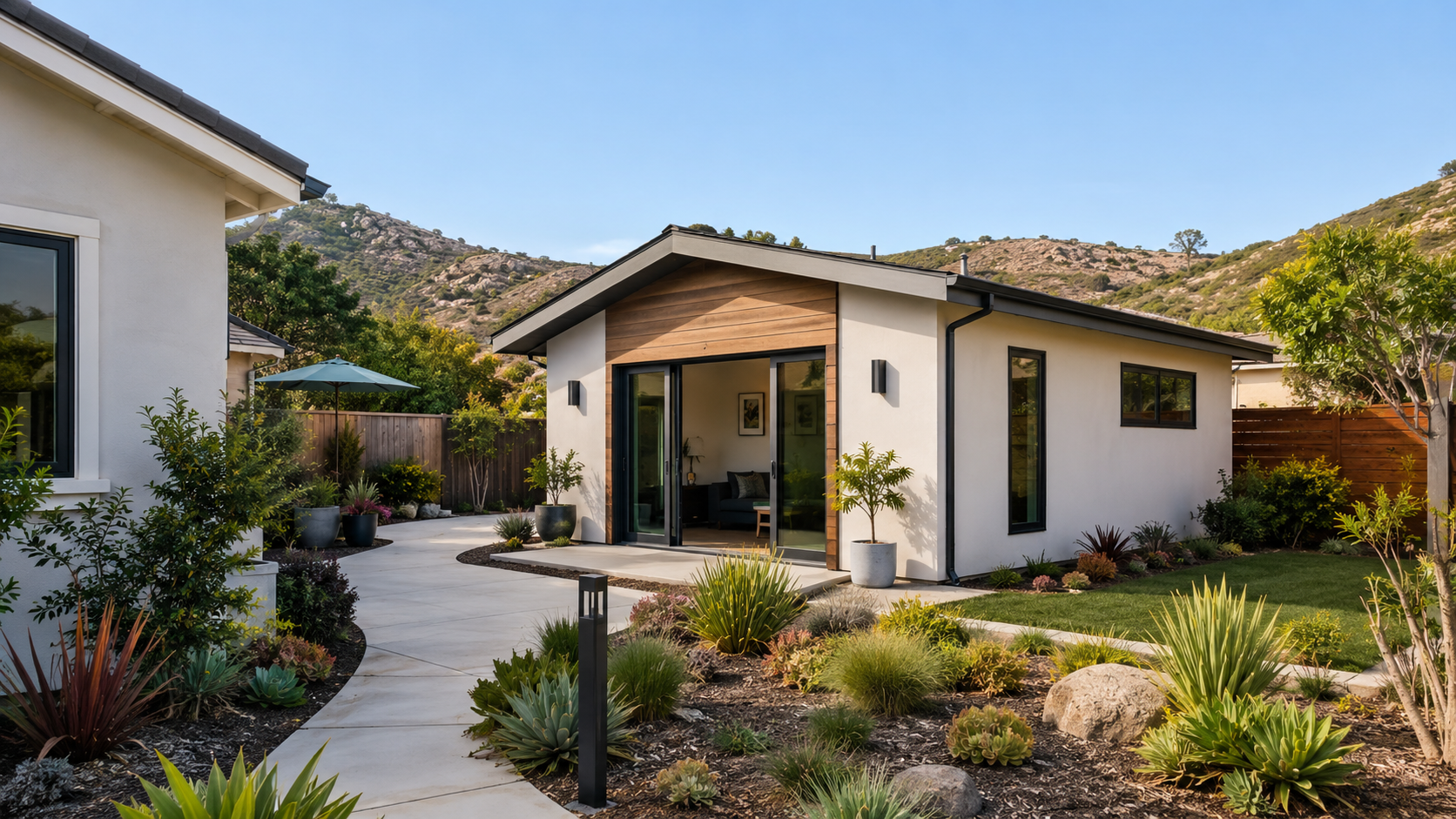
Poway ADU laws allow most single-family homeowners to add one detached accessory dwelling unit (ADU), one Junior ADU (JADU), and one internal conversion ADU — three additional living units in most configurations — with 4-foot side and rear setbacks, no owner-occupancy required for the standard ADU, no HOA approval required (CC&Rs that prohibit or unreasonably restrict ADUs are void under Civil Code §4751), and permits submitted electronically through Poway Online Services.
One important asterisk runs through this entire page. On October 8, 2025, the California Department of Housing and Community Development sent the City of Poway a Letter of Technical Assistance flagging Poway’s 2019 ADU ordinance as likely out of compliance with current State ADU Law. Under Gov. Code §66316, when a local ordinance fails to meet state law, the ordinance is “null and void” and the city must apply state-law standards until it adopts a compliant version. This is the section that no other Poway ADU page surfaces cleanly, and it’s the section most likely to save you a permit fight at the counter.
For most homeowners the rules that matter most are: detached ADU up to 1,500 sq ft (lesser of 50% of primary or 1,500 sq ft, with a 1,200 sq ft minimum floor); 4-foot side and rear setbacks; 10-foot separation from the primary residence; no impact fees for ADUs at or under 750 sq ft; mandatory soils report for new construction; architectural-consistency rule; and potential fire-zone overlay for a substantial portion of the city.
What you’ll get from this guide
This is a regulations and permitting guide for Poway, California — not a builder ranking and not a generic California ADU explainer. We built it from primary sources: the City of Poway’s Municipal Code (PMC), the City’s ADU/JADU handouts and Online Services ADU application handout, the HCD Letter of Technical Assistance to Poway (October 8, 2025), California Government Code §§66311.5–66342 (post-SB 477 renumbering), California Civil Code §4751, Poway Municipal Code Chapter 15.24, the HCD ADU Handbook (March 2026 release), and published builder cost analyses from February–April 2026.
If you’ve already chosen a builder, this isn’t the page for that — see our Poway ADU builders guide. If you want a statewide ADU primer, see our California ADU laws guide. This page exists for the homeowner who needs to know what is legal, what is buildable on their specific Poway lot, and what to verify before paying for plans.
What we verified
Primary sources reviewed for this guide (last checked against the source on May 13, 2026):
- Poway Municipal Code §17.08.180 (Accessory buildings and structures), §17.08.160 (Setbacks), §17.08.020 (Prop FF / Ordinance 283), and Chapter 15.24 (Fire Code) — current through Ordinance 878, passed December 2, 2025 via codepublishing.com/CA/Poway
- City of Poway Development Services Department ADU & JADU General Information handout
- City of Poway Online Services ADU application handout (electronic submission as of June 1, 2022)
- City of Poway Pre-Approved ADU Policy (effective March 4, 2025)
- City of Poway Building Services page (review-cycle targets, fees, inspections)
- HCD Letter of Technical Assistance to City of Poway dated October 8, 2025, signed by Jamie Candelaria, Section Chief, ADU Policy, Housing Accountability Unit; addressed to Kevin Parker, Poway Planning and Building Director; response requested by November 7, 2025
- California Government Code §§66311.5, 66313, 66314, 66315, 66316, 66317, 66320, 66321, 66323, 66324, 66331, 66332, 66333, 66334 (post-SB 477 renumbering effective March 25, 2024)
- California Civil Code §4751 (HOA and CC&R limitations)
- HCD ADU Handbook (March 2026) with the December 2025 addendum summarizing changes effective January 1, 2026
- Poway Unified School District developer fee schedule (current rate: $5.17/SF, effective July 9, 2024; subject to change)
- PowGIS (powaygis.poway.org) for parcel-level zoning and the Very High Fire Hazard Area map layer
- Published builder cost and timeline analyses from SnapADU, Better Place Design & Build, Cali Dream Construction, and Freeman’s Construction (February–April 2026 — used as cross-checks for cost ranges, not as the basis for legal claims)
What we couldn’t independently confirm as of May 13, 2026 (verify with the City before relying on these):
- Whether Poway has adopted a corrective ordinance updating §17.08.180 since the HCD October 2025 letter — the PMC is current through Ord. 878 (Dec 2, 2025), but we cannot confirm whether Ord. 878 or any subsequent ordinance specifically amended the ADU section
- Whether Poway has received and posted any pre-approved ADU plans since the March 4, 2025 policy took effect
- Whether the Poway City Council has scheduled any AB 1033 (separate ADU conveyance) adoption discussion
Poway ADU laws at a glance
Before the long explanations, here is the entire ruleset at the level of detail most homeowners need on a first read.
| Rule | Poway answer (2026) | Why it matters | Source |
|---|---|---|---|
| ADUs allowed? | Yes, on qualifying residential parcels with an existing or proposed primary dwelling | Feasibility starts with parcel condition, not whether ADUs are legal | PMC §17.08.180; Gov. Code §66323 |
| How many on a single-family lot? | One detached ADU + one JADU + one internal conversion ADU (subject to size path) | Three units of additional housing possible on most SFR lots | Gov. Code §§66314, 66323; HCD March 2026 Handbook |
| How many on a multifamily lot? | Up to 8 detached ADUs (capped at existing unit count) + internal conversions up to 25% of existing units | SB 1211 expanded multifamily ADU rights effective Jan. 1, 2025 | Gov. Code §66323(a)(4)(A)(ii) |
| Detached ADU max size (Poway local path) | Lesser of 50% of primary dwelling or 1,500 sq ft, with a minimum 1,200 sq ft allowance | Determines whether a full two-bedroom rental unit is realistic | PMC §17.08.180; Gov. Code §66321 |
| Detached ADU in §66323 protected combination | Up to 800 sq ft when stacked with a JADU and conversion ADU under Gov. Code §66323 | The protected three-unit stack caps the detached at 800 sq ft | Gov. Code §66323(a)(1); HCD Handbook |
| Attached ADU max size | Lesser of 50% of primary or 1,500 sq ft; state-protected minimum of 850 sq ft (studio) or 1,000 sq ft (1+ BR) | Prevents small primary homes from killing ADU buildability | PMC §17.08.180; Gov. Code §66321 |
| JADU max size | 500 sq ft, within the walls of the primary single-family home | Lowest-cost path; owner-occupancy may apply (see JADU section) | Gov. Code §66333; PMC §17.08.180 |
| Side & rear setbacks | 4 ft minimum for ADUs ≤16 ft tall; otherwise main residence setbacks apply | Most site plans live or die on these four feet | PMC §17.08.180; Gov. Code §66321 |
| Detached structure separation | 10 ft minimum between primary and ADU | Can block an ADU even when side/rear setbacks work | PMC §17.08.180 |
| Front setback | Per zone (typically ~40 ft in RS zones); state law allows an 800 sq ft ADU within front setback only if no other alternative exists | Verify variance availability directly with Poway Planning | PMC §17.08.160; Gov. Code §66321 |
| Height | 16 ft with 4-ft reduced setbacks; up to 18 ft + 2 ft roof-pitch bonus near major transit; up to main-residence height with standard setbacks | Drives one- vs two-story design decisions | PMC §17.08.180; Gov. Code §66321 |
| Parking | Generally one off-street space; numerous state-law exemptions; JADUs require no parking even when converting an attached garage | Parking can affect garage conversions and small lots | PMC §17.08.180; Gov. Code §66314(d)(11), §66334(a) |
| Owner-occupancy (standard ADU) | Not required (AB 976 permanently prohibited the requirement) | You may rent both the primary and the ADU | Gov. Code §66315 |
| Owner-occupancy (JADU) | May be required only if the JADU shares sanitation facilities with the primary dwelling | Independent sanitation eliminates the owner-occupancy condition | Gov. Code §66333 |
| HOA review/approval | CC&Rs that prohibit or unreasonably restrict ADUs are void and unenforceable; HOA review cannot be part of the City's ADU permit approval | The HOA can request reasonable conformance, not block the project | Civ. Code §4751; HCD March 2026 Handbook |
| Rental terms | Must exceed 30 days; short-term (Airbnb-style) is not the compliant ADU path | Long-term and mid-term rental are the standard income paths | PMC §17.08.180 |
| Fire sprinklers | Required if ADU exceeds 1,200 sq ft, OR if required for the primary residence | State law prohibits requiring sprinklers for an ADU when not required for the primary | PMC §17.08.180; Gov. Code §66314(d)(12) |
| Impact fees | Waived statewide for ADUs of 750 sq ft or less; proportional above 750 sq ft | The 750 sq ft line is the single biggest cost cliff in California ADU law | Gov. Code §66311.5 |
| School developer fees (PUSD) | Not assessed for additions of 500 sq ft or less; $5.17 per square foot for assessable area greater than 500 sq ft (eff. July 9, 2024; subject to change) | Verify current rate with PUSD before payment | Poway Unified School District developer fee page |
| Permit submission | Electronic submittals only, via City of Poway Online Services (in effect since June 1, 2022) | No physical plan sets required for ADU intake or resubmittals | Poway Building Services; Poway Online Services ADU handout |
| Review timeline | State law: 15 business days for completeness check, then 60 days for approval/denial; Poway targets: up to 14 calendar days for building review and up to 28 calendar days for planning and engineering review per cycle | The 60-day clock runs against the city after completeness | Gov. Code §66317; Poway Building Services |
| Construction cost | Approximately $220–$600+/sq ft typical Greater San Diego range (builder-published estimates, Feb 2026) | Total project including soft costs and fees: roughly $200K–$500K+ depending on size and finishes | Builder analyses (SnapADU, Better Place Design & Build, Cali Dream Construction, Feb–April 2026) |
| Separate ADU sale (AB 1033) | Not yet adopted by Poway as of our verification date; verify with City Clerk | San Diego City adopted Aug. 22, 2025; San Diego County (unincorporated) adopted Apr. 4, 2026 — Poway is independent | Gov. Code §§66340–66342 |
Run the Poway property check → See which of these rules constrain your specific parcel
Free, 60 seconds. We surface your zone, fire-hazard status, buildable ADU size, and the fee cliffs that apply to your address.
Get My Free Poway ADU Report →Before the long explanations: check your property in 60 seconds
Most Poway homeowners discover too late that “ADUs are allowed” doesn’t mean “this specific lot is easy.” Our free Poway property check asks for your address, zone (RS-7, RR-A, RR-B, RR-C, RS-1, RS-2, RC, RA), approximate lot size, primary residence size, fire-zone status, and HOA status. It returns the maximum ADU size, height, setback configuration, parking requirements, an estimated fee range, fire-code implications, and the specific overlays we recommend verifying with the City before you buy plans.

How many ADUs can I have on my Poway property?
Answer capsule. On a single-family Poway lot, you can build a stack of three additional units — one detached ADU, one JADU, and one internal conversion ADU — but the exact size of the detached ADU depends on which statutory pathway you use. Under California Government Code §66323’s protected combination, the detached new-construction ADU is capped at 800 square feet when stacked with a JADU and conversion. Under Poway’s local ADU allowance (lesser of 50% of primary or 1,500 sq ft, with a 1,200 sq ft minimum floor), the detached ADU can be larger. On multifamily lots, SB 1211 expanded detached ADU capacity to as many as eight units, capped by the number of existing residential units.
Single-family lots: the two size paths
The single biggest confusion in California ADU law for 2026 is that there are two different statutory paths to a multi-unit stack on a single-family lot, and they produce different maximum sizes:
Path A — The §66323 protected combination
Under Gov. Code §66323(a)(1), local agencies must allow: one interior or attached conversion ADU within the existing or proposed primary residence or an existing accessory structure, plus one Junior ADU (up to 500 sq ft) within the walls of the primary residence, plus one detached new-construction ADU capped at 800 square feet (with 4-foot side and rear setbacks). This is the protected combination — Poway cannot deny it, and it preempts more restrictive local rules. The downside: the detached ADU is capped at 800 sq ft in this stack.
Path B — Poway’s local detached ADU allowance
Under Poway’s local ordinance and Gov. Code §66314, a homeowner can build a detached ADU up to the lesser of 50% of the primary dwelling or 1,500 sq ft, with a 1,200 sq ft minimum allowance regardless of the primary home’s size.
The HCD March 2026 Handbook clarifies that local agencies must allow the combinations described in §66323 AND must allow at least one unit under §66314. In practice, most single-family homeowners get the flexibility to choose:
- A larger detached ADU (up to 1,500 sq ft under Path B), OR
- A protected three-unit stack (Path A) with the detached capped at 800 sq ft
Stacking both — a 1,500 sq ft detached ADU plus a JADU plus a conversion — is the area where Poway’s interpretation matters, and where homeowners should confirm with Planning rather than assume.
- Path A (protected stack): 800 sq ft detached ADU + 500 sq ft JADU + conversion ADU within the existing garage = three units, ~1,800 sq ft of additional housing.
- Path B (local detached path): 1,200 sq ft detached ADU (capped at 50% of primary) + JADU/conversion to be confirmed with Planning.
Multifamily lots: SB 1211 changed the math in January 2025
Senate Bill 1211, which took effect January 1, 2025, expanded multifamily ADU rights significantly. Current state law (Gov. Code §66323(a)(4)(A)(ii)) permits up to eight detached ADUs, capped by the number of existing residential units on the property. A four-unit apartment building can now support up to four additional detached ADUs. An eight-unit complex can support up to eight. Internal conversion of non-livable space (storage rooms, boiler rooms, attics, basements, passageways, garages) is permitted up to 25% of existing units with a minimum of one.
Because Poway’s 2019 ordinance still reflects the older two-detached-ADU cap on multifamily lots, and the HCD October 2025 letter specifically identifies SB 1211 as a change that may render Poway’s ordinance noncompliant under Gov. Code §66316, the state-law expansion applies to your project until Poway updates its code.
SB 9 and urban lot splits — a brief note
Poway ministerially processes urban lot splits under Senate Bill 9, which creates a separate pathway: split a single-family lot into two and place up to two units on each resulting lot. This is a different legal route from the standard ADU pathway — if your lot is large enough and you want to maximize density, it’s worth a separate conversation with a land-use planner.
Check which size path makes sense for your specific lot
Our free report runs both paths against your zone and parcel dimensions so you know exactly what you can build before you pay for plans.
Check My Lot →Poway ADU size, height, and setback rules
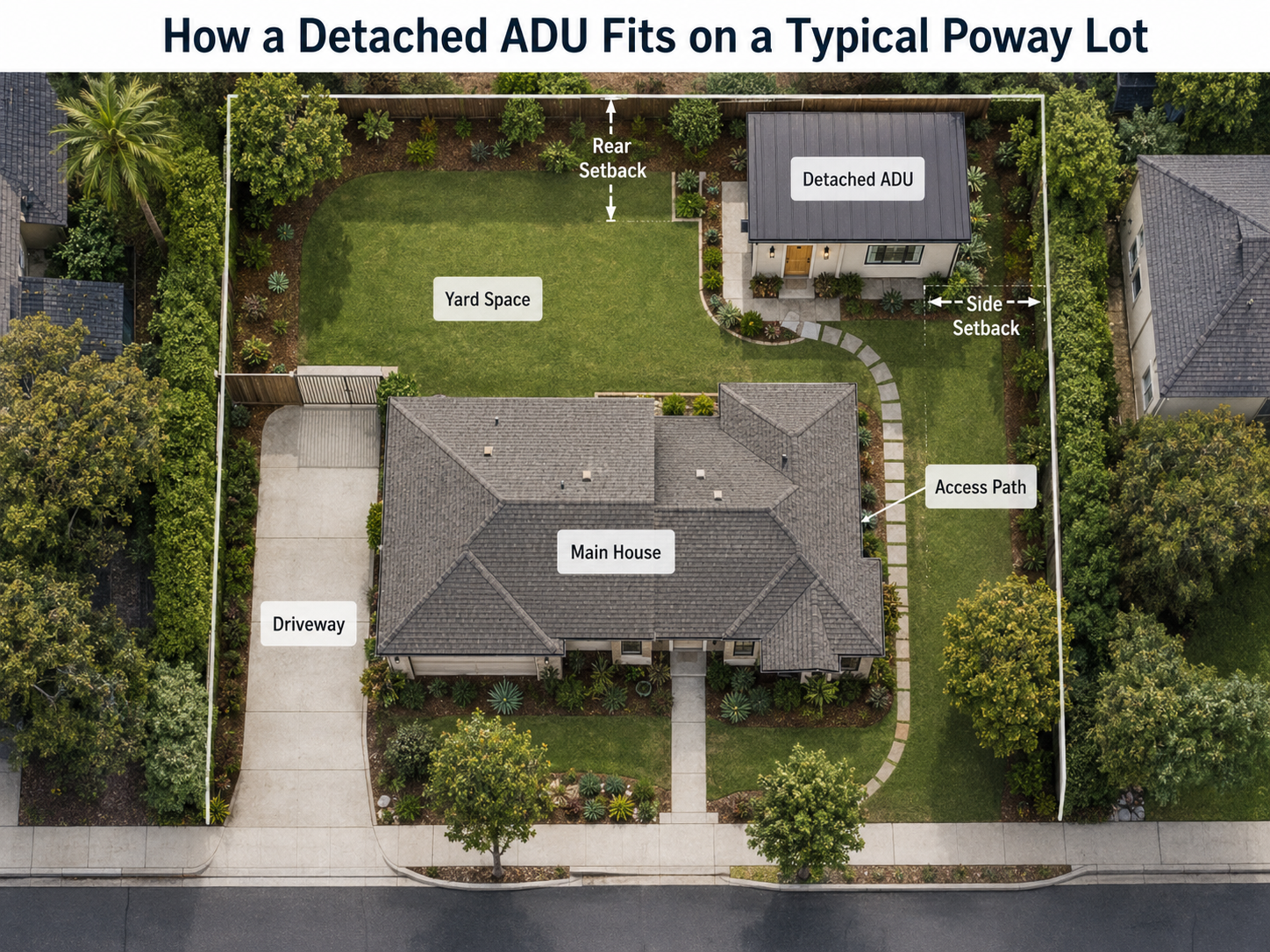
Answer capsule. Detached ADUs in Poway can be up to 1,500 square feet under Poway’s local allowance, but no more than 50% of the primary home’s floor area, with a guaranteed minimum of 1,200 square feet (PMC §17.08.180). Height tops out at 16 feet when using the 4-foot reduced setbacks; up to 18 feet (plus a 2-foot roof-pitch bonus) within a half-mile of a major transit stop. Side and rear setbacks are 4 feet. 10-foot separation between the primary residence and any detached ADU.
The size matrix: thresholds that change the project
| Size threshold | What it triggers | Best-fit reader |
|---|---|---|
| <500 sq ft | Per Gov. Code §66311.5, an ADU/JADU with less than 500 sq ft of interior livable space is not treated as increasing assessable space by 500 sq ft for school fee purposes; per PUSD, no residential developer fees are assessed for additions with 500 sq ft or less of assessable area | Family suite, internal conversion, lowest-disruption path |
| ≤750 sq ft | Statewide development impact fee exemption under Gov. Code §66311.5. The single biggest cost cliff in California ADU law. | Cost-sensitive detached or attached ADU; rental-income builds optimized for fees |
| ≤800 sq ft | State-protected ADU size under Gov. Code §66321 with 4-ft side/rear setbacks; can be placed within the front setback if no alternative exists on the lot; cap for the detached ADU in the §66323 protected three-unit combination | Homeowner who wants strongest state-law protection or the protected three-unit stack |
| ≤1,200 sq ft | Poway's minimum guaranteed detached ADU allowance regardless of primary home size; no fire sprinklers required (unless required for primary) | Larger family housing or long-term rental |
| >1,200 sq ft | Per Poway's handout, fire sprinklers required; proportional impact fees apply | Larger custom builds where the value of the extra space outweighs the sprinkler cost |
| ≤1,500 sq ft | Poway's local upper ceiling for ADUs (subject to the 50%-of-primary cap) | Maximum size detached ADU; requires a 3,000+ sq ft primary residence to reach the full ceiling |
Height and the transit-corridor bonus
- Single-story, 16 feet or less, using 4-foot reduced setbacks: standard one-story ADU configuration.
- Single-story, taller than 16 feet, with full primary-residence setbacks: permitted, height limited to match the primary residence.
- Two-story: per Poway’s handout, two-story ADUs are tied to meeting the setbacks required of the main residence rather than the 4-foot reduced setback path. Confirm interpretation with Poway Planning for any two-story design.
- Within ½ mile of a major transit stop or high-quality transit corridor: up to 18 feet under Gov. Code §66321, with an additional 2 feet permitted if the ADU’s roof pitch matches the primary dwelling. Most Poway parcels are not within a half-mile of a major transit stop.
Setbacks: the four feet that decide most projects
Side and rear setbacks for a Poway ADU at 16 feet or less are 4 feet minimum under PMC §17.08.180 and the state-law protection in Gov. Code §66321. Key wrinkles:
- Building separation. Poway requires a 10-foot minimum separation between the primary dwelling and the detached ADU. A 4-foot setback to the property line plus a 10-foot separation to the main house can be impossible on a narrow lot.
- Front setbacks. Standard for the zone — typically around 40 feet in RS zones. The single state-law exception: an 800 sq ft ADU may be located within the front setback if no other location is feasible on the lot (Gov. Code §66321).
- Encroachment exception. An addition of 150 sq ft or less to accommodate an ADU or JADU may encroach into the interior side or rear setback if specific conditions are met: ingress/egress preserved, minimum 4-foot setback to property line maintained within a Very High Fire Hazard Area, and exterior access provided.
- Fire-zone setbacks. In Rural Residential zones, PMC Chapter 15.24 requires a 30-foot setback from property lines abutting open space or biological conservation easements, unless the Fire Code Official determines the wildfire hazard isn’t significant or the parcel geometry makes it infeasible.
When state ADU law beats Poway’s local rules: the Decoder Table
Answer capsule. On October 8, 2025, the California Department of Housing and Community Development sent the City of Poway a Letter of Technical Assistance flagging Poway’s 2019 ADU ordinance as likely out of compliance with current State ADU Law. Under California Government Code §66316, when a local ordinance fails to meet state law, the local ordinance is “null and void” and state-law standards apply until the city adopts a compliant version. This section decodes every conflict point.
The HCD letter, in plain English
The HCD letter (dated October 8, 2025, signed by Jamie Candelaria, Section Chief of HCD’s ADU Policy team within the Housing Accountability Unit, addressed to Kevin Parker, Poway’s Planning and Building Director) opens with this observation:
“The most recent ADU ordinance on file for City of Poway with the California Department of Housing and Community Development is from 2019. Given the numerous changes to State ADU Law since the adoption of the ordinance, the ordinance may be outdated and out of compliance with State ADU Law.”
The legal consequence of an out-of-compliance ordinance is laid out at Gov. Code §66316: “If an existing ADU ordinance fails to meet the requirements of State ADU Law, the ordinance is null and void and the local jurisdiction must apply the standards set forth in State ADU Law until it adopts an ordinance that complies with state law.”
The Decoder Table
| Provision (Poway 2019 ordinance, PMC §17.08.180) | Current California state law | What applies to your project today |
|---|---|---|
| Owner-occupancy may be required for some standard ADU configurations | Owner-occupancy permanently prohibited as a condition for standard ADUs (Gov. Code §66315, post-AB 976 of 2023) | No owner-occupancy requirement for any standard ADU |
| Maximum 2 detached ADUs on multifamily lots | Up to 8 detached ADUs on multifamily lots, capped at existing unit count (Gov. Code §66323(a)(4)(A)(ii), SB 1211 effective Jan. 1, 2025) | Up to 8 detached ADUs on a multifamily lot |
| Parking replacement may be required when garage is demolished or converted | Parking replacement explicitly prohibited when garage/carport/covered or uncovered parking space is demolished or converted for an ADU (Gov. Code §66314(d)(11), SB 1211) | No replacement parking required for any garage or parking space removed for ADU construction |
| HOA / CC&R review may apply in some cases | HOAs cannot use ADU permit review as part of City approval; CC&Rs that prohibit or unreasonably restrict ADUs are void; HOAs may impose reasonable restrictions that don't effectively prohibit the ADU (Civ. Code §4751; HCD March 2026 Handbook) | HOA cannot block your ADU. Reasonable architectural restrictions may still apply. |
| Deed restrictions may be imposed as a permit condition on standard ADUs | Deed restrictions on standard ADUs prohibited as 'additional standards' (HCD March 2026 Handbook); JADUs separately require a recorded deed restriction under Gov. Code §66333 | No deed restrictions on standard ADUs. JADU deed restriction is a statutory requirement, not a discretionary local condition. |
| 60-day review with extensions historically interpreted liberally | Application deemed approved if not approved or denied within 60 days of completeness determination; 15 business days for completeness check (Gov. Code §66317) | 60-day deemed-approved clock runs against the City after a 15-business-day completeness check |
| Pre-2020 unpermitted ADUs require correction to current code | Permit denial prohibited for pre-2020 unpermitted ADUs unless violation requires correction to avoid substandard-structure findings (Gov. Code §66332, AB 2533 effective Jan. 1, 2025) | AB 2533 streamlined permitting available for pre-2020 unpermitted ADUs |
| Parking required for some JADU configurations | Local agencies may not require parking as a condition to permitting a JADU, even when JADU converts an attached garage (Gov. Code §66334(a); HCD March 2026 Handbook) | No parking required for any JADU |
| Minimum lot size requirements may apply | Local agencies prohibited from imposing minimum lot size requirements on ADUs (Gov. Code §66314(b)(1)) | No minimum lot size can be required for your ADU |
| Government Code citations reference §65852.2 (pre-2024 numbering) | SB 477 (Chapter 7, Statutes of 2024) renumbered all ADU statutes effective March 25, 2024 — substantive content unchanged but section numbers moved | If a Poway counter staffer cites §65852.2, the current location is Gov. Code §§66313–66342. Same provisions, new numbers. |
How to use this at the permit counter
If a Poway Development Services staffer cites a 2019 ordinance provision that conflicts with current Gov. Code, you can — politely and with citations in hand — reference Gov. Code §66316 and the October 8, 2025 HCD Letter of Technical Assistance. Most municipal planning departments are working through the post-2019 state law cascade and counter staff sometimes cite older provisions out of habit, not adversarial intent.
This is educational information, not legal advice. Complex situations — multifamily expansions under SB 1211, AB 2533 streamlining for pre-2020 unpermitted ADUs, or front-setback ADUs under the 800 sq ft state-law exception — warrant a land-use attorney’s review.
Run the Poway property check to see which of these state-law protections apply to your specific parcel
Run the Property Check →Can my Poway property actually fit an ADU?
Answer capsule. A Poway ADU can be fully legal under both city and state rules and still be impractical or expensive on your specific lot. Before paying for plans, confirm zoning and buildable area, check Very High Fire Hazard Severity Zone status via PowGIS, verify slope and grading requirements, confirm septic clearance through San Diego County Health if not on city sewer, screen for Habitat Conservation Plan and cultural-resource overlays, audit utility capacity, and review your HOA’s CC&Rs. Most cost surprises in Poway ADU projects trace back to one of these seven categories.
The Poway lot-fit risk checklist
| Risk category | What to check | Why it matters | Who verifies |
|---|---|---|---|
| Zoning & buildable area | Your zone (RS-7, RS-4, RS-2, RS-1, RR-A, RR-B, RR-C, RC, RA), lot dimensions, existing lot coverage, easements | Determines whether your target ADU size and setback path is geometrically possible | Poway Planning Division via PowGIS lookup |
| Very High Fire Hazard Severity Zone (VHFHSZ) | Whether your parcel sits within a VHFHSZ as mapped by CAL FIRE or the City | Triggers defensible space, material hardening (Chapter 7A), Fire Department landscape and material approval, potential setback adjustments | Poway Fire Department and Planning Division |
| Slope & grading | Average parcel slope, grading permit requirements, drainage analysis | Detached ADUs on sloped lots often trigger civil engineering, grading permits, and significant site work cost | Poway Engineering Division; private civil engineer for slope analysis in RR zones |
| Septic | Whether the primary residence is on septic and whether the septic can accommodate a second unit | Septic capacity is binary — if it can't handle the additional load, you need County Health Department approval or a new system | San Diego County Health Department |
| Habitat & biological resources | Whether your parcel falls within an HCP mitigation area or has sensitive vegetation | Vegetation clearing in HCP mitigation areas may require biological studies, administrative clearing permits, and added review time | Poway Planning Division; California Department of Fish and Wildlife in some cases |
| Cultural resources | Whether your parcel is in an archeologically sensitive area | May require an archeological study before grading/building permit | Poway Planning Division |
| Utility access | Water meter sizing, sewer lateral capacity, electrical panel capacity, gas line capacity | Water meter upsize alone can run several thousand dollars in capacity charges; new sewer lateral or panel upgrade adds similar | Utility providers (Poway water, SDG&E, regional sewer) |
| HOA / CC&Rs | Whether your subdivision has a homeowners association and what the CC&Rs say | HOAs cannot block ADUs (Civ. Code §4751), but they can impose reasonable architectural restrictions | Your HOA board; counsel if dispute escalates |
Very High Fire Hazard Severity Zone: the most-asked Poway question
A substantial portion of Poway sits within a Very High Fire Hazard Severity Zone (VHFHSZ), per the City’s published VHFHA map layer on PowGIS. If your parcel is in a VHFHSZ, several things change for your ADU per Poway’s Fire Code (PMC Chapter 15.24) and California Building Code Chapter 7A:
- Defensible space is required under Public Resources Code §4291 and PMC Chapter 15.24. Zone 1 (first 30 feet): intensive clearance. Zone 2 (next 70 feet): reduced fuel load. Zone 0 (first 5 feet): ember-resistant perimeter under AB 3074 — non-combustible materials, no wood mulch, no combustible fencing.
- Material hardening under California Building Code Chapter 7A requires ember-resistant vents, Class A roofing, fire-resistant siding and eaves, and approved windows and doors.
- Fire Department review of landscape plans, fire fuel management, and structural hardening.
- Fire access roads / driveways must comply with Poway’s Supplemental Engineering Standards for width, surface, grade, and turn-around requirements.
- Wildland setback in Rural Residential zones: PMC Chapter 15.24 requires a 30-foot setback from any property line that abuts open space or biological conservation easements, unless the Fire Code Official waives it.
VHFHSZ status does not disqualify a Poway parcel from having an ADU. It changes the cost profile and the design constraints. Run the PowGIS check on your address before paying for design work.
Septic: the silent project-killer
The Poway Online Services ADU handout is explicit: if your project uses a septic system, you need San Diego County Health Department approval before the City will issue your building permit. The County will evaluate whether your existing septic can accommodate the additional load from the new ADU. If it can’t, your options are (1) upgrade the septic system, (2) connect to city sewer if a connection is feasible, or (3) abandon the project. Plan for a septic capacity evaluation early in the design process.
Habitat and cultural overlays
Two overlays catch Poway homeowners who don’t expect them: Habitat Conservation Plan (HCP) mitigation areas — Poway is covered by a Subarea Habitat Conservation Plan protecting sensitive vegetation communities and species. Lots within HCP mitigation areas may require biological studies, administrative clearing permits, and added review time. And archeologically sensitive areas — some Poway parcels are flagged for potential archeological sensitivity, requiring an archeological study before grading or building permit issuance.
Get a parcel-level overlay check for your address
Our free Poway ADU report flags fire-zone status, HCP overlay, septic status, and other parcel-specific risks before you commit to a designer.
Get My Parcel Overlay Check →The Poway ADU permit process, step by step
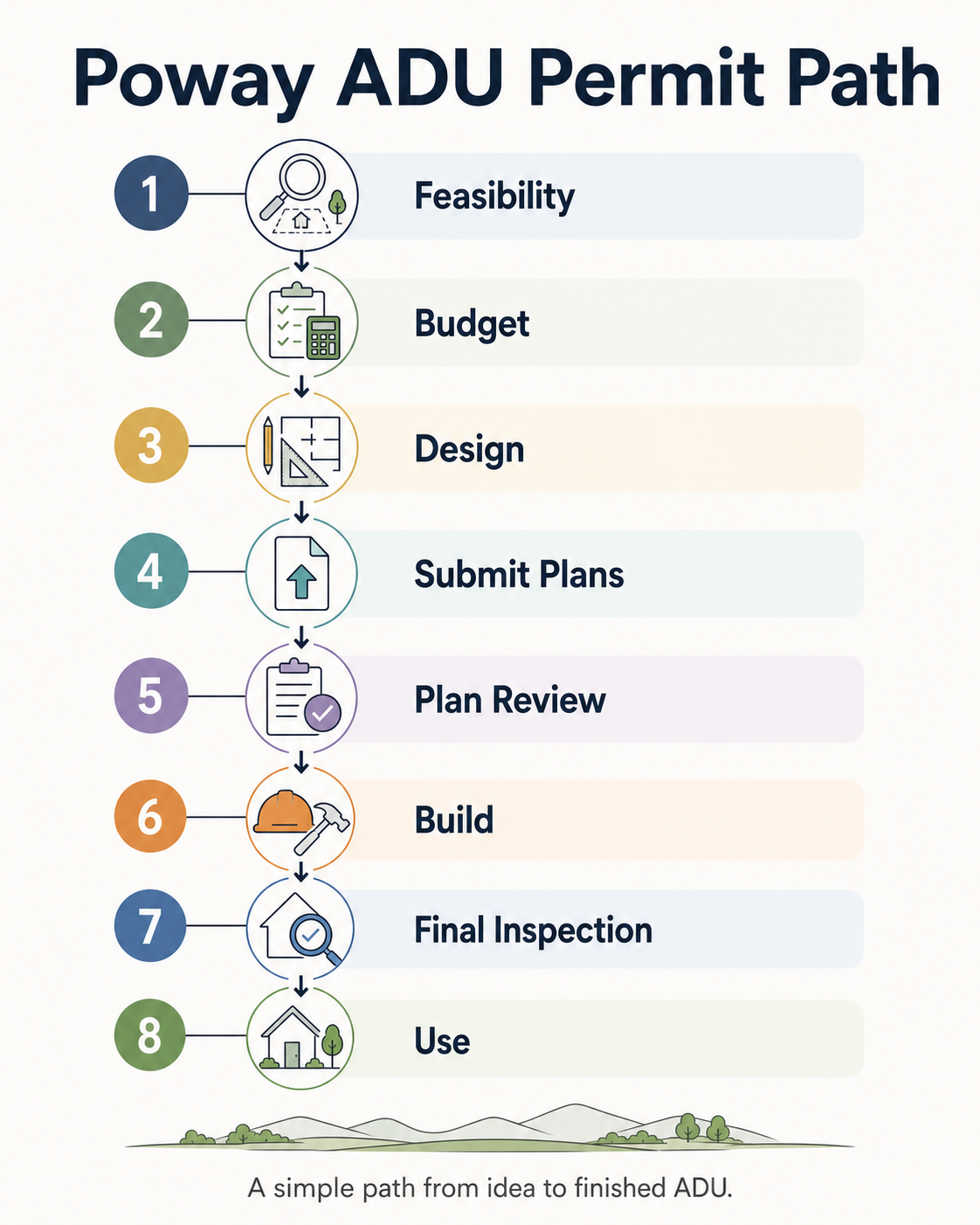
Answer capsule. Poway ADU applications are submitted electronically through City of Poway Online Services and routed for ministerial review — meaning no public hearing and no discretionary judgment. California Government Code §66317 gives the City 15 business days to determine whether your application is complete, then 60 days from completeness to approve or deny. Poway requires a soils (geotechnical) report for projects proposing new structures.
The eight-step walkthrough
1Sketch the concept and confirm zoning
Before you hire a designer, run PowGIS (powaygis.poway.org) on your address. Enter the address, click Search → Community Info → Planning Information. Note your zone, fire-hazard status, and any relevant overlays. Cross-reference setbacks against PMC §17.08.160. This is fifteen minutes of work that prevents most expensive mistakes.
2Make a preliminary call to Poway Planning
The Poway Planning Division (858-668-4610) will answer general questions about whether your concept is feasible. They won't pre-approve a design, but they will flag deal-killers early. If you're in an HCP mitigation area or have an unusual setback situation, ask now.
3Hire a licensed designer or architect
They prepare plans meeting PMC §17.08.180 and the City's submittal checklist. The designer will coordinate the soils report, Title 24 energy compliance, and structural calculations. Typical Poway ADU design fees run roughly $5,000–$15,000 depending on complexity, per published builder analyses from February 2026.
4Soils (geotechnical) report
Poway's Online Services ADU handout lists soils reports among required application uploads for projects proposing new structures. Cost: roughly $1,500–$3,500 depending on lot conditions and report scope. Allow 2–4 weeks for the report turnaround. Verify scope with Poway if your project is a conversion-only ADU within an existing structure.
5Submit electronically through Poway Online Services
Effective June 1, 2022, Poway accepts only electronic submittals. You upload your plans, soils report, calculations, Title 24 documentation, septic clearance where applicable, and other required attachments through the City's online portal.
6Completeness check (15 business days)
Per Gov. Code §66317, the City must determine whether your application is complete within 15 business days. If incomplete, they identify what's missing; you resubmit; the 15-day clock starts over. If complete, the 60-day approval/denial clock starts.
7Plan review cycle
Poway's Building Services page lists target cycle times of up to 14 calendar days for building review and up to 28 calendar days for planning and engineering review. Most ADU projects involve at least one round of corrections. The single biggest determinant of total timeline is how quickly you respond to corrections.
8Permit issuance, inspections, and final approval
Once plans are approved and fees paid, the building permit is issued. Poway typically conducts 5–6 inspections during ADU construction (foundation, framing, rough utilities, insulation, drywall, final). Construction times in Poway average 6–9 months for a typical 750–1,200 sq ft detached ADU per published builder analyses.
The 60-day clock matters more than most people realize
Government Code §66317(a) states that if the City has not approved or denied a complete ADU application within 60 days, the application is deemed approved. This is not a guideline — it’s a hard statutory deadline, and it runs in your favor. The clock pauses when the City returns corrections to you, but it does not extend indefinitely.
A common pattern is for an incomplete application to bounce back, get resubmitted, bounce back again, and absorb weeks of calendar time before the 60-day clock even starts. The fix: hire a designer who has shepherded multiple Poway ADUs through completeness review and knows what the City wants on first submission.
Poway ADU fees and the size-cliff math
Answer capsule. For a typical detached Poway ADU, expect roughly $3,000–$10,000 in combined plan-check and building permit fees (excluding impact fees, school fees, and utility connections), plus impact fees for ADUs over 750 square feet, plus the Poway Unified School District developer fee for ADUs with more than 500 square feet of assessable area. California Government Code §66311.5 waives all development impact fees for ADUs of 750 square feet or less. PUSD’s current school developer fee is $5.17 per square foot of assessable area, effective July 9, 2024 (subject to change — verify before payment).
The fee categories
| Fee category | When it applies | Typical range (verify before budgeting) | Source / notes |
|---|---|---|---|
| Plan check fee | After intake review | $1,500–$3,500 | Scales with project complexity and valuation; verify current rate at submittal |
| Building permit fee | At permit issuance | $1,500–$5,000 | Per Poway's published fee schedule and valuation formulas |
| Development impact fees | Only if ADU is over 750 sq ft | Variable; proportional to primary residence | Gov. Code §66311.5 exempts ADUs of 750 sq ft or less |
| PUSD school developer fee | If ADU has more than 500 sq ft of assessable area | $5.17/SF × assessable sq ft (eff. July 9, 2024; subject to change) | Poway Unified School District developer fee schedule |
| Sewer connection fee | Only if a new or separate connection is requested | Variable; protected internal/conversion ADUs under Gov. Code §66323(a)(1) generally cannot be required to add a new connection | Not required if shared with primary in most cases |
| Water connection / meter upgrade | Only if a new meter or upsized meter is required (often for fire sprinkler load) | Several thousand dollars in capacity charges plus meter installation | County Water Authority capacity fees vary by meter size |
| Soils / geotechnical report | Required for new ADUs (verify scope for conversions) | $1,500–$3,500 (third-party engineer; published builder estimate, Feb 2026) | Required by Poway per the Online Services ADU handout |
Modeled fee table by ADU size
These figures are modeled estimates based on Poway’s published valuation formulas and must be confirmed with Poway Building Division before budgeting. They exclude construction cost, design fees, soils, Title 24, utility upgrades, school fees, development impact fees, and all other soft costs.
| Sample ADU size | Modeled Poway valuation | Modeled permit-only fee range | Why this size matters |
|---|---|---|---|
| 499 sq ft | ~$64,000 | ~$1,800 | Below the 500 sq ft school-fee threshold per PUSD; per Gov. Code §66311.5, an ADU/JADU with less than 500 sq ft of interior livable space is not treated as increasing assessable space by 500 sq ft |
| 750 sq ft | ~$96,000 | ~$2,300 | Statewide impact-fee exemption ceiling under Gov. Code §66311.5; design ceiling for many income-optimized builds |
| 800 sq ft | ~$103,000 | ~$2,400 | State-protected ADU size with 4-ft setbacks under Gov. Code §66321; cap for the detached ADU in the §66323 protected three-unit combination |
| 1,200 sq ft | ~$154,000 | ~$3,100 | Poway's minimum guaranteed detached ADU allowance; per Poway handout, no fire sprinklers required if not required for primary |
| 1,500 sq ft | ~$193,000 | ~$3,600 | Poway's local ceiling (subject to 50%-of-primary cap); fire sprinklers required per Poway handout |
The 750 sq ft cliff, decoded precisely
Gov. Code §66311.5 prohibits cities from charging any development impact fee on an ADU of 750 square feet or less. At exactly 750 sq ft, the exemption applies. Above 750 sq ft, fees apply on a proportional basis to the primary dwelling.
Poway’s June 2024 handout uses language that says impact and stormwater fees apply for ADUs “at or above 750 sq ft.” Cross-checked against Gov. Code §66311.5, the state-law rule controls and 750 sq ft itself is exempt. If you design to 750 sq ft exactly and a counter staffer quotes impact fees, state law preempts.
The PUSD school developer fee operates on a separate threshold at 500 square feet of assessable area. Per PUSD, no residential developer fees are assessed for additions of 500 square feet or less. Above 500 sq ft, fees are assessed at $5.17/SF (effective July 9, 2024; subject to change). Confirm the assessable-area calculation method directly with PUSD before payment.
Honest cost framing
Building an ADU in Poway in 2026 runs roughly $220–$600+ per square foot depending on type, finishes, site conditions, and utility work, based on cost analyses published February–April 2026 by SnapADU, Better Place Design & Build, Cali Dream Construction, and Freeman’s Construction. A 750 sq ft detached ADU in Poway typically lands all-in somewhere between $200,000 and $450,000, with most projects clustering in the $250,000–$350,000 range.
These are illustrative ranges based on published builder analyses, not guarantees. Actual quotes vary by site conditions, finishes, utility connections, fire-zone upgrades, and the timing of California Construction Cost Index movement.
For a deeper cost breakdown, see our ADU cost guide and ADU cost per square foot analysis. For financing path comparisons, see our ADU financing guide.
Does Poway have pre-approved ADU plans?
Answer capsule. Poway adopted a Pre-Approved ADU Plan Policy effective March 4, 2025, that allows expedited 30-day review when a homeowner submits a permit application using a pre-approved plan. The policy text indicates that as of its drafting, the City had not yet received any pre-approval plan submissions. Even when pre-approved plans become available, site-specific work — soils report, grading, Title 24 compliance, fire-zone review, utility connections, and setback verification — still applies to every project.
| Item | Pre-approved plan helps? | Still site-specific? |
|---|---|---|
| Base architecture and structural | Yes | Sometimes (for slope and soils variations) |
| Site plan placement | No | Yes |
| Setback verification | No | Yes |
| Soils / geotechnical report | No | Yes |
| Title 24 energy compliance | Usually no | Yes |
| Fire-zone review (if VHFHSZ) | No | Yes |
| Grading and drainage | No | Yes |
| Septic clearance (if applicable) | No | Yes |
| Utility connections (water meter sizing, sewer lateral, electrical service) | No | Yes |
| HCP / habitat review (if applicable) | No | Yes |
For homeowners considering pre-approved plans, the County of San Diego maintains its own pre-approved ADU plan program for unincorporated areas. See our San Diego County pre-approved ADU plans guide for that program.
Poway-only quirks you won’t see in generic ADU guides
Answer capsule. Four things about building an ADU in Poway specifically catch most homeowners off-guard: mandatory soils reports for new ADU construction; strict enforcement of the architectural-consistency rule; large portions of the city in a Very High Fire Hazard Severity Zone; and Proposition FF (1988), a voter-approved density-preservation rule that some homeowners mistakenly believe restricts ADU construction.
Quirk 1: Mandatory soils report for new construction
Poway requires a soils (geotechnical) report for new ADU construction per the City’s Online Services ADU handout. The requirement applies to projects proposing new structures; conversion-only ADUs within existing permitted structures should be verified with Poway.
The soils report has two practical impacts. First, it adds roughly $1,500–$3,500 in soft costs that aren’t on most ADU cost calculators (published builder estimate, February 2026). Second, it adds 2–4 weeks to the pre-submittal timeline. Build this into your project schedule from day one.
Quirk 2: Architectural consistency — what it actually means for your budget
Poway interprets the architectural-consistency requirement strictly. PMC §17.08.180 requires that the exterior roofing, trim, walls, windows, and color palette of the ADU “shall incorporate the same features as the primary dwelling unit.” In practice:
- Siding material must match the primary residence (stucco, wood, fiber-cement, vinyl, etc.)
- Roofing material must match (asphalt shingles, tile, metal)
- Trim profile and color must match
- Window style must match (typically the same brand and operation type)
- Color palette must match — the City has reviewed paint colors on submitted plans
For homeowners with standard finishes (stucco walls, asphalt shingle roof, white vinyl windows), the architectural consistency rule adds little to nothing. For homeowners with architectural-grade finishes — custom stucco textures, wood or composite siding, tile or metal roofing, custom-clad windows — published builder analyses note that matching can add meaningful cost to the ADU exterior.
A useful state-law backstop from the HCD March 2026 Handbook: design review for an ADU cannot impose more restrictive standards than those required of the primary residence.
Quirk 3: Very High Fire Hazard Severity Zone overlay
We covered this in detail in the lot-fit risk checklist. The short version: a substantial portion of Poway sits within a VHFHSZ per the City’s published map layer, triggering defensible space, material hardening (Chapter 7A), ember-resistant Zone 0, fire access road standards, Fire Department landscape and material review, and (in Rural Residential zones) a 30-foot wildland setback. None of this disqualifies your parcel from having an ADU. All of it changes the cost profile and design constraints. Run the PowGIS check on your address early.
Quirk 4: Proposition FF (1988) — the misunderstood density preservation rule
In November 1988, Poway voters passed Proposition FF, enacted as Ordinance 283, amending PMC §17.08.020. The proposition requires voter approval before lands in the Rural Residential (RR-A, RR-B, RR-C), Open Space, and Planned Community categories can be rezoned to denser categories.
The rumor circulating among some Poway homeowners is that Prop FF restricts ADU construction in RR zones. It does not. Prop FF prevents rezoning — changing the underlying zone of a parcel to allow denser use. ADUs are permitted by right under state law on any qualifying residential parcel regardless of zone. If your lot is RR-A, RR-B, or RR-C, you can still build an ADU subject to the standard size, height, setback, and overlay rules.
That said, RR zones in Poway often carry other practical constraints: larger required setbacks, slope analysis requirements, the 30-foot wildland setback in fire-hazard areas, septic systems, and habitat or cultural overlays. The constraints aren’t from Prop FF — they’re from PMC Chapter 15.24, the City’s Subarea HCP, and parcel-specific conditions. Verify the actual constraints, not the rumor.
2026 California state law changes that apply to Poway
Answer capsule. Even with Poway’s 2019 ordinance still on the books, a stack of California state laws automatically applies to your Poway project and overrides any conflicting local rules. The most important ones for 2026 are SB 1211 (multifamily expansion to eight ADUs), AB 976 (permanent owner-occupancy prohibition), AB 2533 (pre-2020 unpermitted ADU streamlining), SB 477 (statute renumbering), and the HCD March 2026 Handbook clarifications on HOA review, deed restrictions, and JADU parking.
SB 1211 — multifamily expansion (effective January 1, 2025)
Senate Bill 1211 made two significant changes that matter in Poway: (1) Up to 8 detached ADUs on multifamily lots, capped by the number of existing residential units (Gov. Code §66323(a)(4)(A)(ii)). This replaces the older two-detached-ADU cap that Poway’s 2019 ordinance still reflects. (2) No replacement parking required when a garage, carport, or other parking is demolished or converted for ADU construction (Gov. Code §66314(d)(11)). Even uncovered off-street parking spaces don’t need to be replaced.
AB 976 — permanent owner-occupancy prohibition for standard ADUs
AB 976 made permanent the prohibition on cities requiring owner-occupancy as a condition of permitting a standard ADU. Local agencies are now permanently prohibited from requiring owner-occupancy for standard ADUs (Gov. Code §66315). JADUs are a separate category — under current Gov. Code §66333, owner-occupancy may be required only if the JADU shares sanitation facilities with the primary dwelling. Where the JADU has separate sanitation facilities, owner-occupancy is not required.
AB 2533 — streamlining for pre-2020 unpermitted ADUs (effective January 1, 2025)
AB 2533 expanded the pre-2020 unpermitted ADU/JADU legalization protections (codified at Gov. Code §66332(a)–(c)). The city cannot deny a permit for a pre-2020 unpermitted ADU on the basis of building code violations unless the city makes a finding that correcting the violation is necessary to avoid the structure being deemed substandard under California Health and Safety Code §17920.3. If you bought a Poway property that has an unpermitted ADU built before 2020, you may be able to permit it without bringing it fully to current code, potentially saving tens of thousands of dollars in retrofit work.
SB 477 — statute renumbering (effective March 25, 2024)
Senate Bill 477 renumbered the entire ADU section of the Government Code. The pre-2024 ADU statute lived at Gov. Code §65852.2; the post-SB 477 numbering distributes the same provisions across Gov. Code §§66311.5 through 66342. The substantive content was unchanged. If a counter staffer cites §65852.2, the current location is somewhere in §§66313–66342. Verify the substance, not the section number.
HCD March 2026 Handbook clarifications
- No deed restrictions on standard ADUs. A deed restriction on a standard ADU is treated as an “additional standard” and is prohibited. JADUs are a separate case — Gov. Code §66333 requires a recorded deed restriction for JADUs containing specified statutory items.
- HOAs cannot review ADU applications as part of City approval. Third-party review by an HOA or its representatives violates State ADU Law. No other local ordinances, policies, or regulations may be applied in the approval or denial of an ADU or JADU permit application (Gov. Code §66317(c)).
- No parking for JADUs. Local agencies cannot require parking as a condition of permitting a JADU, even when the JADU is converted from an attached garage (Gov. Code §66334(a)).
Civil Code §4751 — HOA restrictions: what is and isn’t allowed
Civil Code §4751 makes any CC&R provision that effectively prohibits or unreasonably restricts the construction or use of an ADU or JADU on a single-family lot void and unenforceable. Your HOA cannot legally block your ADU. The exception: HOAs may impose reasonable restrictions — those that do not effectively prohibit the ADU and do not unreasonably increase the cost or unreasonably decrease the efficiency of the ADU. If your HOA pushes back beyond what looks reasonable, document everything in writing and consider consulting a real estate attorney.
Rental rules, owner-occupancy, and AB 1033 (separate sale)
Answer capsule. Poway permits ADU rentals only for terms exceeding 30 days. Standard ADUs do not carry an owner-occupancy requirement under AB 976. JADUs may require owner-occupancy only if they share sanitation facilities with the primary dwelling. AB 1033 — the California law that permits cities to opt into allowing ADUs to be sold separately as condominiums — has not been adopted by the City of Poway as of our verification date.
Rental terms: 30 days minimum
The Poway ADU handout requires that rental terms exceed 30 days. Short-term rental (typically stays under 30 days) is not the compliant operating model for a permitted Poway ADU. Long-term rental (12-month leases or month-to-month) and mid-term rental (corporate housing, traveling professionals, family housing) are the standard income paths. If short-term rental income is the primary financial driver of your project, Poway is not the easiest jurisdiction for that strategy.
Owner-occupancy: ADU no, JADU only when sharing sanitation
For standard ADUs (attached, detached, or conversion), owner-occupancy is permanently prohibited as a condition of permitting (Gov. Code §66315, AB 976). You can build an ADU on a Poway property, never live on the property yourself, and rent both the primary residence and the ADU. For Junior ADUs, owner-occupancy under current Gov. Code §66333 may be required only if the JADU shares sanitation facilities with the primary dwelling. Where the JADU has separate sanitation facilities, the owner-occupancy condition does not apply.
AB 1033: Poway has not opted in (verify with the City Clerk)
Assembly Bill 1033 (signed October 11, 2023, effective January 1, 2024) lets California cities and counties adopt local ordinances permitting ADUs to be sold separately from the primary residence as condominiums. Each city or county must affirmatively opt in. As of our verification date, the City of Poway has not adopted AB 1033. For comparison:
- City of San Diego adopted AB 1033 effective August 22, 2025.
- San Diego County (unincorporated areas only) adopted AB 1033 effective April 4, 2026.
- Carlsbad, Vista, Chula Vista, Escondido, Oceanside, and Poway are independent jurisdictions and must each adopt their own ordinance.
Honest tradeoffs and limitations
Answer capsule. Building an ADU in Poway is genuinely doable, the laws are on the homeowner’s side, and state-law preemption protects most of the rights that matter. But Poway is stricter than some neighboring jurisdictions on a handful of practical points: mandatory soils reports for new construction, the architectural-consistency rule, the VHFHSZ overlay for many parcels, and the absence (so far) of a published pre-approved ADU plan program.
What’s harder in Poway than in lower-friction California cities
- Mandatory soils report adds approximately $1,500–$3,500 and 2–4 weeks of pre-submittal time. Many California cities don’t require soils for ADUs in stable soil conditions.
- Architectural-consistency rule can add meaningful cost to the ADU exterior if your primary residence has non-standard finishes.
- VHFHSZ overlay for many parcels adds material-hardening costs (Chapter 7A), defensible space requirements, and potentially the 30-foot wildland setback in Rural Residential zones.
- No active pre-approved ADU plan program submissions yet, which means most projects require a custom design and design fees rather than the lower cost of a stock plan.
- The HCD-flagged 2019 ordinance means homeowners may occasionally encounter counter staff working from older rules; you’ll need to be ready to cite Gov. Code §66316 if necessary.
What’s easier than people think
- State law protects you from HOA prohibition, deed restrictions on standard ADUs, owner-occupancy demands, parking replacement, and minimum lot size requirements.
- The 60-day deemed-approved clock is a real statutory deadline that runs in your favor.
- ADUs of 750 sq ft or less pay zero impact fees statewide.
- No discretionary review or public hearing — ministerial approval is the default for ADUs.
- Electronic submission through Poway Online Services has been the standard since June 1, 2022 — no in-person submittal cycles.
- Poway’s larger lots (compared to coastal San Diego cities) often give you geometric flexibility that compensates for the stricter rules.
From idea to keys: a realistic Poway ADU timeline
Answer capsule. Most Poway ADU projects move from initial concept to certificate of occupancy in 8 to 14 months: roughly 1–2 months of design and pre-submittal work, 4–7 months for plan check and permits including resubmittal cycles, and 4–7 months for construction. The fastest projects compress to 7 months; the slowest stretch to 16+ months when soils, septic, or fire-zone issues require deep workarounds.
The typical project arc
| Phase | Duration | What happens |
|---|---|---|
| Concept & feasibility | Weeks 0–2 | Run the Poway property check, review zone, VHFHSZ overlay, septic, slope; talk to Planning Division |
| Design | Weeks 2–8 | Hire designer; develop schematic, design development, construction documents; soils report ordered |
| Pre-submittal | Weeks 6–10 | Title 24, structural calcs, soils report integration; final plan set assembly |
| Online submittal & completeness | Weeks 10–13 | Submit electronically through Poway Online Services; intake review; plan-check fees issued; 15-business-day completeness check |
| Plan check cycles | Weeks 13–28 | First-round building review (up to 14 days), planning/engineering review (up to 28 days); corrections; resubmittal; second-round review |
| Permit issuance & utility coordination | Weeks 28–30 | Pay permit and impact fees; coordinate water meter upsize if needed; mobilization |
| Construction | Weeks 30–52 | Foundation, framing, rough utilities, insulation, drywall, finish; 5–6 inspections through the project |
| Final inspection & C of O | Weeks 52–56 | Final inspection; certificate of occupancy; ready to rent or occupy |
Where projects actually slow down
- Resubmittal cycles. A designer who turns corrections in three days versus three weeks can shave a month or more off the total timeline. Hire experience.
- Soils report delays. If the geotechnical engineer is booked out 4–6 weeks, your project waits.
- Septic capacity. If your primary is on septic and the system can’t handle the ADU, you’re looking at a multi-month septic upgrade or sewer connection.
- Fire-zone material specification. Chapter 7A materials sometimes have longer lead times than standard finishes.
- Water meter upsize. If fire sprinklers are required and your meter needs upsizing, this can add weeks for utility coordination.
Affiliate disclosure (repeated): The Dwelling Index is reader-supported. When you use our links to explore financing options, request prefab pricing, or purchase floor plans, we may earn a commission at no extra cost to you. Our editorial recommendations are based on independent research and are never influenced by compensation.
If you want to compare Poway-experienced design-build options, SnapADU is an approved partner that serves Greater San Diego including Poway. By their own published count, they’ve designed, permitted, and built over 100 ADUs across San Diego County since 2020. They’re one verified Poway-served option among several reputable local providers, not a ranked “best.”
Frequently asked questions
Can I build an ADU in Poway?
Yes, on qualifying residential properties with an existing or proposed primary dwelling. Whether your specific lot is buildable depends on zone, setbacks, fire-zone status, slope, septic, and utility access.
How big can a detached ADU be in Poway?
Up to 1,500 square feet under Poway's local allowance (capped at 50% of the primary residence's floor area, with a guaranteed minimum of 1,200 square feet regardless of the primary home's size). Under the Gov. Code §66323 protected three-unit combination, the detached ADU is capped at 800 sq ft.
How big can a JADU be in Poway?
500 square feet maximum, within the walls of the primary single-family residence. Owner-occupancy may apply if the JADU shares sanitation facilities with the primary dwelling (Gov. Code §66333).
What setbacks are required for a Poway ADU?
Side and rear: 4 feet minimum for ADUs at 16 feet or less in height. Front: standard for the zone (typically ~40 feet in RS zones). Detached structures must be 10 feet from the primary residence.
Does Poway require ADU parking?
Generally one off-street space, with multiple state-law exemptions including locations within ½ mile of major transit, conversion of existing permitted space, units in historic districts, and units within one block of car-share. JADUs require no parking under any circumstances.
Can I rent my Poway ADU on Airbnb?
Not as a permitted ADU. Rental terms must exceed 30 days under Poway's ADU rules. Long-term and mid-term rental are the compliant paths.
Does Poway require owner-occupancy for ADUs?
No, for standard ADUs. AB 976 permanently prohibited cities from requiring owner-occupancy for standard ADUs (Gov. Code §66315). For JADUs, owner-occupancy may be required only if the JADU shares sanitation facilities with the primary dwelling.
Can my HOA block my Poway ADU?
No. Civil Code §4751 makes CC&Rs that prohibit or unreasonably restrict ADUs void and unenforceable. HOAs may impose reasonable restrictions that don't effectively prohibit the ADU; they cannot use ADU approval as part of the City's permit process.
How long does a Poway ADU permit take?
Legally, 60 days from completeness determination under Gov. Code §66317, after an initial 15-business-day completeness check. Realistically, 4–7 months including resubmittal cycles. Total project from concept to certificate of occupancy typically runs 8–14 months.
Does Poway require online or in-person submission?
Electronic submission only, through City of Poway Online Services. Poway has accepted only electronic submittals since June 1, 2022.
Does Poway require a soils report for ADUs?
Yes for projects proposing new structures. The Online Services ADU handout lists soils reports among required uploads for new construction. Verify scope with Poway for conversion-only projects.
Do I need fire sprinklers in my Poway ADU?
Per Poway's handout, sprinklers are required if the ADU exceeds 1,200 square feet OR if sprinklers are required for the primary residence. State law (Gov. Code §66314(d)(12)) protects ADUs from sprinkler requirements where not required for the primary.
Can I convert my garage into an ADU in Poway?
Yes, and no replacement parking is required even after the garage is converted (Gov. Code §66314(d)(11), SB 1211). Conversion ADUs use the existing structure's footprint plus up to 150 sq ft of expansion for ingress/egress.
Can I build an ADU and a JADU on the same Poway lot?
Yes. Per Gov. Code §66323 and the HCD March 2026 Handbook, single-family lots can support one ADU plus one JADU plus one conversion ADU. The detached ADU size depends on which statutory pathway you use.
My Poway parcel is in a Very High Fire Hazard Severity Zone — can I still build?
Yes. VHFHSZ status doesn't disqualify your parcel. It adds defensible space requirements, material-hardening (Chapter 7A) requirements, potentially the 30-foot wildland setback in Rural Residential zones, and Fire Department review.
My Poway property is on septic — does that change things?
Yes. The County Health Department must approve the septic system's capacity to handle the additional load before Poway issues your building permit. If the septic can't accommodate the ADU, you face a septic upgrade or a city sewer connection.
Is my Poway lot too small for an ADU?
State law prohibits minimum lot size requirements for ADUs (Gov. Code §66314(b)(1)). Practical buildability depends on setbacks, fire-zone status, and existing site coverage, not on a minimum-lot-size rule.
Does Poway have pre-approved ADU plans?
Poway adopted a Pre-Approved ADU Plan Policy effective March 4, 2025, that allows for 30-day expedited review when a pre-approved plan is used. The policy states that as of its drafting, the City had not received pre-approval plan submissions. Verify current availability with Planning before designing around this path.
Can I sell my Poway ADU separately from my primary house?
Not currently. AB 1033 permits separate sale only in cities that have opted in. Poway has not adopted AB 1033 as of our verification date — verify with the City Clerk. San Diego City and unincorporated San Diego County have adopted; Poway is an independent jurisdiction and must adopt separately.
What if my ADU was built before 2020 without permits?
AB 2533 (effective January 1, 2025) created a streamlined permitting path. Per Gov. Code §66332, the City cannot deny a permit on the basis of code violations unless correction is necessary to avoid substandard-structure findings.
How am I going to pay for this?
We cover HELOC, construction loan, cash-out refinance, ADU-specific loans, and home equity investment paths in our ADU financing guide.
Who do I contact at the City of Poway?
The Planning Division (858-668-4610) handles zoning, setbacks, and overlay questions. The Building Division (858-668-4644 / 858-668-4645) handles permits, plan check, and inspections. Submit applications and plans through Poway Online Services.
Want the Poway ADU starter kit?
If you’re earlier in the process and want a portable reference you can save, share, or send to your spouse, we publish a free ADU Starter Kit — a printable guide covering size thresholds, fee cliffs, financing paths, design considerations, and the questions to ask before you buy plans. No spam. Unsubscribe anytime.
Get the Free ADU Starter Kit →Methodology
We built this guide from primary sources first. The City of Poway’s Municipal Code (PMC §17.08.180, §17.08.160, §17.08.020, and Chapter 15.24), the City of Poway ADU/JADU General Information handout, the Online Services ADU application handout, the Pre-Approved ADU Policy document (effective March 4, 2025), the Building Services page, and the City’s published fee schedule provided all local regulatory content.
State-law content came from California Government Code §§66311.5 through 66342 (post-SB 477 renumbering effective March 25, 2024), California Civil Code §4751, and the HCD ADU Handbook (March 2026 release with the December 2025 addendum). The HCD Letter of Technical Assistance to the City of Poway dated October 8, 2025 was reviewed in full and is the basis for the State-vs-Poway Decoder Table.
School fee content came from the Poway Unified School District developer fee schedule, which lists the current rate of $5.17 per square foot effective July 9, 2024, with the standard caveat that fees are subject to change.
Cost and timeline ranges were cross-referenced against published builder analyses from SnapADU, Better Place Design & Build, Cali Dream Construction, and Freeman’s Construction (all published February through April 2026). These builder sources were used as cross-checks for cost ranges and operational details — not as the basis for legal, zoning, permitting, or fee claims.
The Dwelling Index does not accept payment for ranking placement, does not include lender or builder recommendations based on affiliate payout, and discloses every commercial relationship. This guide is educational and does not constitute legal advice. Verify project-specific details with the City of Poway Development Services Department before submitting any application.
Related guides
Not sure where to start? See what’s possible at your Poway address — get your free ADU report in 60 seconds.